Israeli army turns Palestinian homes in Hebron into military barracks
MEMO | October 4, 2012
 The Israeli occupation forces have turned the roofs of Palestinian homes in the ancient city of Hebron, south of the West Bank, into military barracks and control points under the pretext of providing security for Jewish settlers during the Hebrew celebrations of the Sukkot Feast.
Human rights sources in the Hebron Rehabilitation Committee reported that a large number of Israeli forces took over the roofs of several Palestinian homes along the lanes of the old town. These houses, including the family home of the Islam Al-Fakhouri in Al-Sahla area, have been turned into military barracks and control towers while the families have been forced to leave.
Israeli soldiers also commandeered the roofs of the Abdulmutallab Abu Sunaina, Imran Abu Rumaila, Daoud Jaber, Nader Salaymeh and AliAl-Rajabi households turning them into control points.
Sources also point out that the regions extending between the settlement of Kiryat Arba, the Cave of the Patriarchs, Tel Rumeida, Al-Shuhada, Al-Ras, and Wadi El-H’aseen streets; and the areas of Al-Masharqa Al-Fawqa and Tahta, are subjected to a blanket Israeli police and army presence.
Related articles
- Army Kidnaps Two Palestinians In Hebron (imemc.org)
- Soldiers Kidnap A Child In Hebron (imemc.org)
- Israeli high court rejects south Hebron village petition (alethonews.wordpress.com)
- Jewish Settler’s Vehicle Rams Child in Hebron Hit and Run (alethonews.wordpress.com)
- Soldiers Physically Attack Palestinian Youth In Hebron (alethonews.wordpress.com)
- Jewish Settlers Invade Palestinian Home In Hebron, Attack Family Members (alethonews.wordpress.com)
- Four Residents, Including Two Children, Kidnapped By The Army In Hebron (imemc.org)
- Hebron: Soldiers invade Kultuba School, attempt arrest 2 sixth grade students (occupiedpalestine.wordpress.com)
- Soldiers Kidnap A Child playing near the Ibrahimi mosque In Al-Khalil (occupiedpalestine.wordpress.com)
Jewish Settlers Invade Palestinian Home In Hebron, Attack Family Members
By Saed Bannoura | IMEMC & Agencies | September 20, 2012
A group of armed extremist Israeli settlers of the Avraham Avino illegal Israeli settlement, invaded a Palestinian home in the southern West Bank city of Hebron, and attacked two family members including an eight years old child on Wednesday.
The settlers initially hurled stones and empty bottles at the home of Nidal Al-Oweiwy, and climbed on its rooftop before invading the home through it roof door, the Arabs48 news website reported.
The extremist settlers then proceeded to attack Sally, Nidal’s 8-year-old daughter, and his son Sa’id, leading to various cuts and bruises.
They also destroyed the homes’ furniture and shattered the glass of several doors and windows in addition to damaging the water tanks on its rooftop.
Local sources reported that, Israeli soldiers deployed in the area, did not attempt to stop the settlers.
This is not the first attack against the home, and a number of nearby homes, as the settlers are trying to occupy them.
It is worth mentioning that, several days ago, another son of Nidal, identified as Tha’er, 20, who was kidnapped by the army, was released and forced under house arrest after the army forced his father to pay a 4000 NIS fine.
The family of Al-Oweiwy said that despite all attacks and violations practiced against them by the army and the extremist settlers, they will never leave their home and will never sell it to the settlers.
Settler groups repeatedly tried to force the family into selling their home to them, and when the family refused, the settlers started attacking their home in an attempt to scare them away, local sources said.
Related articles
- Jewish Settlers Deface Mosque Near Hebron (alethonews.wordpress.com)
- Soldiers Physically Attack Palestinian Youth In Hebron (alethonews.wordpress.com)
- Jewish Settlers Empty Palestinian Well, Flood Farmlands (alethonews.wordpress.com)
- Hebron: Over 30 detained (alethonews.wordpress.com)
- French activist injured as Israeli troops attack Hebron (alethonews.wordpress.com)
- Jewish Settler’s Vehicle Rams Child in Hebron Hit and Run (alethonews.wordpress.com)
- Hebron man walks down street for first time in years (alethonews.wordpress.com)
- Four Residents, Including Two Children, Kidnapped By The Army In Hebron (imemc.org)
- Settler attack in Aqraba leaves 3 injured, 1 hospitalized (alethonews.wordpress.com)
Jewish Settlers Deface Mosque Near Hebron
By Saed Bannoura | IMEMC & Agencies | September 12, 2012
A group of extremist Israeli settlers defaced, on Tuesday at dawn, a mosque in Emresh village, south of Doura town, near the southern West Bank city of Hebron.
The settlers came from Etnael illegal settlement, built on privately-owned lands that belong to the residents in the area.
The settlers wrote racist graffiti that read “Death to Arabs”, “Price Tag”, and several other racist graffiti.
Extremist settlers are behind hundreds of attacks that not only target the residents and their lands, but also have targeted graveyards, mosques and churches in different parts of Palestine.
Last week, a group of extremist Israeli settlers attacked the Latrun Christian Monastery in occupied Jerusalem, and wrote racist graffiti describing Jesus as a “Monkey”, and other graffiti against the Christian religion in general.
Last month, several extremist Israeli settlers invaded the Awarta village, east of the northern West Bank city of Nablus, and wrote racist graffiti on the walls of several homes, and the deface the local mosque.
Earlier in February this year, extremist Israelis wrote “Death to Christians” on the walls of a Jerusalem church, and slashed the tires of vehicles parked in the area.
The attacks fall under the “Price Tag” attacks carried out by extremist Israeli settlers against the Palestinian people, their lands and property, such attacks have been carried out against several mosques, including some that were completely burnt, and several churches.
Related articles
- Soldiers Physically Attack Palestinian Youth In Hebron (alethonews.wordpress.com)
- Hebron man walks down street for first time in years (alethonews.wordpress.com)
- Jewish Settlers Empty Palestinian Well, Flood Farmlands (alethonews.wordpress.com)
Hebron man walks down street for first time in years
September 10, 2012 | International Solidarity Movement, West Bank
 Hashem Azzeh in front of the graffiti on his door
Photos: EA Phelie Maguire
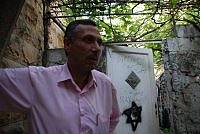
On Sunday 9th September, Hashem Azzeh walked down the street outside his house for the first time in years.
Hashem lives with his artist wife Nasreen and their four children (14, 9, 4 and 2 years old) on a hillside in the Tel Rumeida district of Hebron. The street outside Hashem’s house is barred to Palestinians and overseas visitors, with an army checkpoint at the end of the street to enforce the ban. To reach their house, the family have to go via a treacherous back route, clambering over walls and around other properties on the way.
Despite all the harassment and violence, Hashem remains determined to stay in his house, and today said he wanted ‘an adventure’. Hashem and five ISM volunteers from the UK, Italy and the USA clambered up from the house to the street, then walked the 200 or so metres to the checkpoint at the end of the street. The Israeli soldier at the checkpoint appeared astonished to see Hashem and international volunteers come along the street from the ‘wrong’ direction and immediately started radioing for back-up. When the soldier asked Hashem why he was walking on the street, Hashem replied, ‘I am walking to my house’.
Hashem’s family have faced years of harassment from residents of the illegal Israeli settlement on the hillside just above their house. The settlement happens to be home to some of the most fanatical settlers in Hebron, including American-born extremist Baruch Marzel.
Over the years, Hashem’s family have faced attacks on their property by settlers, with Israeli soldiers standing alongside doing nothing to intervene. Settlers have also poisoned his water supply, and killed his olive trees, fruit trees and vines. When Hashem installed his own water tank, the settlers shot it full of holes in yet another attack.
As well as attacks on their property, the family have faced regular physical violence. Hashem’s nephew had his teeth knocked out by rocks, and his brother was also smashed in the face with rock and suffered damage to his teeth and nose. Nasreen has had two miscarriages. An ISM activist, 77 year old Australian academic Mary Baxter, also faced violence in the past, when accompanying Hashem’s children to school in 2005. She and the children were attacked, and Mary had four bones in her back broken and is now disabled as a result.
Related articles
- Soldiers Physically Attack Palestinian Youth In Hebron (alethonews.wordpress.com)
- Hebron: Over 30 detained (alethonews.wordpress.com)
- Hebron: settler illegally enters Palestinian home (occupiedpalestine.wordpress.com)
- Hebron: Palestinian streets closed for Israeli settlers (alethonews.wordpress.com)
- French activist injured as Israeli troops attack Hebron (alethonews.wordpress.com)
- Jewish Settler’s Vehicle Rams Child in Hebron Hit and Run (alethonews.wordpress.com)
- Hebron: Settlers gas attack Palestinians, victim arrested and refused aid (occupiedpalestine.wordpress.com)
- Soldiers Kidnap Girl, Her 12-Year-Old Brother In Hebron (imemc.org)
Soldiers Physically Attack Palestinian Youth In Hebron
By Saed Bannoura | IMEMC & Agencies | September 04, 2012
Israeli soldiers physically attacked, on Monday at night, a Palestinian nonviolent activist after stopping his vehicle, in Hebron city, in the southern part of the West Bank. The soldiers forced him out of his car and brutally attacked and kicked him.
Tamer al-Atrash, media spokesperson of the Youth Coalition Against Settlements, stated that several soldiers stopped his car and forced him out of it before they started shouting at him, in addition to kicking and punching him.
Al-Atrash said that he recognized the soldiers who attacked him as he previously filmed them while they were assaulting a number of residents in the Tal Romedia neighborhood in Hebron.
“This is an act of revenge; it seems they think they are settling a score”, Al-Atrash stated. “We always expose their violations and abuse practiced against the civilians on a daily basis in Tel Romeida”.
Israeli settlers illegally reside in the neighborhood in privately-owned Palestinian property, in Tal Romeida and in several parts of the city.
Settlers who reside in the heart of the occupied city of Hebron are responsible for dozens of attacks against the residents and their property.
Related articles
- French activist injured as Israeli troops attack Hebron (alethonews.wordpress.com)
- Hebron: Over 30 detained (alethonews.wordpress.com)
- Jewish Settler’s Vehicle Rams Child in Hebron Hit and Run (alethonews.wordpress.com)
- Hebron: Palestinian streets closed for Israeli settlers (alethonews.wordpress.com)
Occupation confiscates Al Hasba market for the Jewish Settlements Council
Palestine Information Center – 04/09/2012

AL-KHALIL — Hebron Rehabilitation Committee (HRC) condemned the Israeli Ministerial Committee’s decision granting stores in the ancient vegetable market in Hasba neighborhood, located in the center of al-Khalil, to the Jewish Settlements Council.
HRC warned of the seriousness of consequences of such ministerial decision on the demographic, geographic, political and economic reality.
It considered in a statement that the decision “comes in the framework of a settlement scheme to Judaize the Old City of al-Khalil, to strengthen the presence of settlers there, and to deport its indigenous population after seizing their properties without legal justification.”
It also warned that this decision aims to eliminate once and for all legal and political possibilities to re-open the shops and the confiscated vegetable market, considered the main commercial center in the city of al-Khalil.
The committee noted in its statement that the HRC and Peace Now Movement had obtained last March a resolution from the Israeli Supreme Court imposing on the settlers to immediately evacuate al-Oweiwi shops located in the ancient vegetable market Hasba near “Abraham Avenue” outpost.
The Israeli Ministerial Committee has issued a new decision under which the settlers have to evacuate the shops which they seized from their Palestinian owners in al-Hasba vegetable market to be granted to the Jewish Settlement Council.
Related articles
- Hebron: Over 30 detained (alethonews.wordpress.com)
- Jewish Settler’s Vehicle Rams Child in Hebron Hit and Run (alethonews.wordpress.com)
- Israeli ministers order Al Khalil (Hebron) shop handed to settlers (occupiedpalestine.wordpress.com)
Jewish Settler’s Vehicle Rams Child in Hebron Hit and Run
By Saed Bannoura | IMEMC & Agencies | August 23, 2012
An Israeli settler driving in Jaber Neighborhood, in the southern West Bank of Hebron, hit a Palestinian child then drove off in what appears to be a ramming attack, medical sources reported.
Nasser Qabaja, a Red Crescent official in Hebron, said that the child was moved to an Israeli hospital upon request of her family.
Medical sources said that the child suffered moderate injuries, and that she suffered various cuts and bruises.
Late in January this year, an Israeli driver hit a Palestinian teenager at a checkpoint near Jerusalem, and then drove off in an apparent ramming attack.
Some of the witnesses present at the scene were able to document the license number of the vehicle, but Israeli police did not take the information when it was presented to them.
Although several previous ramming incidents have been reported to the Israeli police and military, no investigations of these incidents have been carried out by the Israeli authorities.
Related articles
- Israeli kills 2 Palestinians near Hebron (alethonews.wordpress.com)
- Israeli Court Approves Well Destruction In Bethlehem (alethonews.wordpress.com)
- French activist injured as Israeli troops attack Hebron (alethonews.wordpress.com)
- Six Palestinians Wounded, Some Seriously In Settler Firebomb Attack On Their Car Near Hebron (occupiedpalestine.wordpress.com)
- #VIDEO | Child Abuse | Palestinian child kicked by Israeli Border Police in Hebron (occupiedpalestine.wordpress.com)
- Israeli Settlers Attack Home, Attempt to Torch It (occupiedpalestine.wordpress.com)
- This Week in Palestine, August 17th, 2012 (indybay.org)
Israeli high court rejects south Hebron village petition
Ma’an – 10/08/2012

Villagers in the South Hebron Hills face eviction as Israel pushes plans
to use their land for army training (MaanImages/Eleonora Vio, File)
BETHLEHEM – Israel’s High Court on Thursday rejected a petition against the removal of Palestinian villagers from the southern West Bank by the Israeli army, but stressed further legal challenges were still open.
The ruling allows villagers in the south Hebron hills to remain in their villages until November 1, when an order blocking their displacement will expire.
The court said it was not taking a position on the wider dispute, in which the Israeli government has ordered demolition of eight of the 12 villages in an area the army designates as a military training zone.
Tamar Feldman, a legal director for the Association for Civil Rights in Israel who filed the petition, insisted: “It is the full legal right of all of the residents of these villagers to remain on the land that they have owned for generations and use it for their livelihood.”
“There is no justification, legal or moral, for evacuating and displacing residents from their homes and their lands – whether we are talking about 12 villages or 8,” she said.
Residents of the south Hebron hills have fought a long battle to remain in their homes.
In 1999, over 700 residents were evicted due to “illegal residence in a firing zone” and Israeli forces confiscated property and demolished buildings and wells.
Israel’s High Court issued an interim injunction, and Israeli forces allowed named petitioners to return but not their relatives.
In July, Israeli Defense Minister Ehud Barak told the court the army plans to demolish Khirbet al-Majaz, Khirbet al-Tabban, Sfai, Khirbet al-Fakheit, Halaweh, Mirkez, Jinba, and Kharoubeh.
The Israeli state says the residents are squatters from the nearby town of Yatta, while lawyers for the villagers say their rural communities pre-date the establishment of the state of Israel.
Related articles
- Israel ‘closes road’ linking Hebron villages slated for demolition (occupiedpalestine.wordpress.com)
- Israeli kills 2 Palestinians near Hebron (alethonews.wordpress.com)
- Palestinian voice from Susiya, a Palestinian village that existed before the establishment of the State of Israel (alethonews.wordpress.com)
- Israel orders demolition of eight Palestinian villages for military training sites (alethonews.wordpress.com)
- Susiya: Another Casualty of Israeli Occupation? (alethonews.wordpress.com)
Hebron: Palestinian streets closed for Israeli settlers
6 August 2012 | International Solidarity Movement, West Bank
In Hebron on the evening of July 29, almost 100 Israeli settlers from the illegal settlements occupying the centre of the city crossed into the Palestinian-controlled area H1. The settlers illegally entered H1 supported by a heavy Israeli military presence.

Earlier that evening, 4 Israeli military vehicles were witnessed driving through H1 area. At the same time, some 60 Israeli settlers gathered at Checkpoint 56 which marks the border between H1and H2 (the Israeli-controlled areas of Hebron). Several of the settlers, besides being armed with assault rifles, were also carrying compact tables and large bags of food.
Shortly before 7 p.m., Checkpoint 56 was closed to all Palestinians. Soon after, the Israeli military escorted the settlers through the checkpoint into the Bab al-Zawiyeh neighbourhood of area H1.
After the group of settlers passed through, Checkpoint 56 was reopened to Palestinians but the streets of Bab al-Zawiyeh were closed to Palestinian pedestrians and cars who were told to use a parallel street. The 4 military vehicles seen earlier were now parked and soldiers forced Palestinian shops to close down. Thus the otherwise lively Bab al-Zawiyeh was almost deserted.
The Israeli brigade commander declared that the street was a Closed Military Zone (CMZ), and when asked for the CMZ paper permit he replied,“this is a Closed Military Zone because I say so.” The same commander pushed several International Solidarity Movement volunteers in the chest for their inquiries.
Several Palestinians attempted to enter to their homes in H2, as they regularly would, but were aggressively refused at the checkpoint and directed to a lengthy detour. The detour is made kilometres longer by the fact that Palestinians are denied access to Shuhada street.
At 7:30 p.m., just before eftar when most Palestinians would be breaking the day’s fast, a group of about 30 settlers gathered at Checkpoint 56. A short while later, this group was escorted down the closed-off street to join the other settlers now numbering almost 100.
Twenty minutes later, a group of 20 settlers returned back towards H2. As they passed the empty square of Bab al-Zawiyeh they clapped their hands and started chanting in Hebrew, celebrating the empty Palestinian streets. Several pointed, laughed, and made rude gestures at the few Palestinians remaining on the edges of the street.
At around 8:30 p.m., the settlers returned to H2 in smaller groups and escorted by soldiers. Again they pointed, laughed, and took photos of Palestinians they passed. At 9 p.m., the last soldiers packed up and left the area. Immediately, shops reopened and Palestinians returned to the streets. Slowly, Bab al-Zawiyeh began to look like itself again.
More than 50 soldiers and almost 100 illegal Israeli settlers were participating in what is a yearly event. Annually, dinner is had at a site in Bab al-Zawiyeh which they consider a sacred place in Judaism. In practice, this dinner serves as an aggressive reminder of who is in charge. That Israel with more than 4000 soldiers stationed in Hebron, can do as they please despite what the lawful agreements may dictate.
It is noteworthy that this occurred in a week that has been rampant with military night raids, harassment and abuse against Palestinian residents of Hebron who are celebrating the month of Ramadan.
Related articles
- 8 injured as settlers stone bus carrying worshipers (alethonews.wordpress.com)
- Hebron: Over 30 detained (alethonews.wordpress.com)
- Hebron: Israeli settlers occupy Palestinian home (alethonews.wordpress.com)
- French activist injured as Israeli troops attack Hebron (alethonews.wordpress.com)
- Ultimate goal of Israeli policies in Hebron: ethnic cleansing (alethonews.wordpress.com)
- Israeli kills 2 Palestinians near Hebron (alethonews.wordpress.com)
- Tuesday Raids Follow Monday Killing (alethonews.wordpress.com)
- Settlers set fire to ancient tree in Hebron (alethonews.wordpress.com)
Tuesday Raids Follow Monday Killing

By Craig Harrington | IMEMC & Agencies | July 31, 2012
On Tuesday the Israeli military raided several refugee camps south of Hebron and detained two residents. Five more Palestinians were arrested simultaneously around the West Bank.
The arrests of seven Palestinians on Tuesday morning as part of strategic Israeli raids into refugee areas continued what has already been a violent week in the West Bank. A series of raids into Palestinian homes and villages led to the arrest of two Palestinians near Hebron and five others around the West Bank, according to Ma’an News. The Israeli military has released no charges for the detainees or any cause for the raids.
The violence on Tuesday followed shocking news from Monday in which three Palestinians were shot at an Israeli checkpoint between the West Bank capital of Ramallah and occupied East Jerusalem. The Israeli military released no reason for the shooting but sources did confirm that 40-year old Akram Dair was killed, reports Al Jazeera.
Palestinian Prime Minister Salam Fayyad has blamed the Israeli military for the checkpoint killing, reports Ma’an News. The Israeli military has released no comment on what it simply referred to as ‘the incident’.
News of killings is often followed by other news of arrests in the immediate area or elsewhere in the Occupied Territories. Some have argued that the summary harassment and arrest of Palestinians is a tactic where raids are used as a means to stamp out local resentment for Israeli killings. The raids on Tuesday are not necessarily linked directly to Monday’s killing, but it is further evidence of Israeli occupation strategy.
Related articles
- French activist injured as Israeli troops attack Hebron (alethonews.wordpress.com)
- Weekly Report On Israeli Human Rights Violations in the Occupied Palestinian Territory (altahrir.wordpress.com)
- Hebron: Over 30 detained (alethonews.wordpress.com)
- #VIDEO | Israeli soldier headbutts Palestinian teen (occupiedpalestine.wordpress.com)
- Nablus: night raids and arrests (alethonews.wordpress.com)
- Australia to investigate Israeli treatment of Palestinian children (occupiedpalestine.wordpress.com)
Palestinian voice from Susiya, a Palestinian village that existed before the establishment of the State of Israel
By Eva Bartlett | In Gaza | July 30, 2012
Five years ago, I met Nasser Nawaja and his family, and the community of Palestinian Susiya (not to be confused with the illegal Zionist colony of Susiya, in the same south of Hebron, West Bank area, whose colonists regularly viciously attack and aggress Susiya Palestinians, including elderly, children and women).
When in 2007 I met Nasser, his parents, his wife, brothers and extended family, they had been enduring for years, almost two decades, aggressions by the Israeli army and by Zionist colonists. They had been forcibly moved from their very functional, cool in summer, and innovative cave homes to arid dessert land on which, periodically, the Israeli occupation army would invade and destroy the ramshackle homes these displaced families had constructed.
The layers of injustice inflicted on these peaceable, innovative people are countless, and in the many months I spent with them in 2007, I and other justice activists I joined, attempted to document both the injustices heaped upon these Palestinians and the beauty of their sustainably-living lives–when not attacked by the IOF and Zionist colonists (see Susiya Palestinians suffer).

*Khalil Nawaja, 2007, his leg broken by Zionist colonists in 2006


*photo of 2008 Zionist attack on Imran Nawaja, Khalil, and his wife Manam, and other family members, courtesy B’Tselem “shooting back” documentation project–photo and video footage taken by Khalil Nawaja’s neice
Nasser has in the past few years–and against all odds, while providing for his wife and children and documenting the injustices inflicted on his community (at the expense of his own personal safety, many times attacked and beaten by Zionist colonists and for no reason except Occupation arrested by the IOF)–studiously expanded his knowledge of human rights law and the English language, to the point that he is able to now write poignant articles in well-read alternative press.
Please see his op-ed “Palestinian from Area C on a life in constant need of rebuilding” –wherein he describes Susiya life and how his village, surrounded by illegal Zionist colonies and outposts, was called “an illegal outpost” with the ultimatum of demolition, below:
I am Nasser Nawaj’ah. I am 30 years old. My mother gave birth to me in a cave in Susya El-Kadis. You know of Susya as a Jewish settlement in the South Hebron Hills, but Susya is first of all a Palestinian village that existed before the establishment of the State of Israel.
I was named after my grandfather, who was still alive at the time. In 1948, he was displaced from his village near Arad, now in southern Israel. When they were expelled, my father was just a little boy and my grandfather carried him in his arms until they reached their family in Susya El Kadis. They hoped one day to return to their village, but my grandfather died without ever seeing it again.

Nasser Nawaj’ah (L) and Salam Fayyad (Courtesy of B’Tselem)
A year after I was born, in 1983, the settlement of Susya was established. In 1986, after Israeli archaeologists found remnants of a synagogue in our village, we were expelled again. I was 4 years old. My father took me in his arms while bulldozers destroyed our homes and blocked the caves that we lived in. We scattered in our agricultural lands around the village. The grown-ups hoped that we would one day return to our caves, but a fence was built around the village and it was turned into an archaeological site. Today we still live on our agricultural land and I can see the place where I was born, but cannot go there. Israelis and foreigners from all over the world enter the site, but I cannot.
After 1990, the expulsion attempts started up again. Despite the fact that we have documents proving that the land belongs to us, the caves we lived in and our water wells were destroyed. But each time, we returned and built anew. At the same time, the Israeli settlement of Susya continued to flourish and grow. In 2001, after the murder of Yair Har Sinai, settlers arrived with the army and again destroyed the caves and the wells and uprooted our trees. It was only after 10 days and an interim decision by the Israeli High Court that we were able to return to our homes.
Today we live in tents – and even these were threatened with demolition orders forcing us to obtain permits for them. This is the life of a Palestinian in Area C of the West Bank. We are denied building permits, and are disinherited and banished from our land. Each time we request permits from the Israeli army, we are denied. The water pipes of Israel’s Mekorot water company pass several meters away from our village – they bring water to illegal outposts around us but we can’t get water from them. We don’t have access to the water that flows in those pipes, even though this is our water, water that Israel pumps from the West Bank.
We are forced to live off of rain water that we collect in our wells. The water situation in the South Hebron Hills is dire, and we are always forced to supplement by buying water brought in tankers to sustain ourselves through the summer. We pay NIS 35 for a cubic meter of water – about four times as much as you pay for water inside Israel.
Four months ago, the Regavim organization filed a petition to the High Court demanding that our village, Susya, be destroyed. They refer to it as an “illegal outpost” and claim that our village presents a security threat. Last week there was a hearing in the Israeli High Court. They call my village an illegal Palestinian outpost. But these have been our lands since before the establishment of the State of Israel. My father is older than your state and I am not legal on my own land? I ask you: where is the justice in that? In your court there is a difference between a Palestinian and a settler. You call it illegal construction but what we’re talking about is an underground cave that is hundreds of years old.
Illegal Israeli settlement outposts are all around us in the Susya area, and there are many buildings inside settlements with pending demolition orders – but they have everything. The government provides them with infrastructure for water and electricity despite the fact that according to Israeli law they are illegal, and nothing happens to them. And now you want to displace the old man from his home? To expel us from land that belongs to us, that we have lived on generation after generation, that is all that we know.
Resources:
2007 video on Susiya Palestinians
2005 video on Susiya Palestinians
Civil Administration threatens to demolish most of Susiya village
Settlers beat Jamal a-Nawaj’a and throw stones at his mother and wife, in Susiya, March 2006
Settlers assault Palestinian shepherds sleeping in tents in the southern Hebron hills, 26 March 2006
Related articles
- Susiya: Another Casualty of Israeli Occupation? (alethonews.wordpress.com)
- Israel Plans Demolition of Entire Palestinian Village (alethonews.wordpress.com)
- #PHOTOS | Demo In #Susiya against Israeli plans to eradicate the entire village (occupiedpalestine.wordpress.com)
- Save Susiya : Palestinian village at risk to be leveled again (windowintopalestine.blogspot.com)
- Israeli forces order Hebron village demolished after settler case (alethonews.wordpress.com)
- My Home is Everything: the People of Susiya Speak to the World, and other updates (villagesgroup.wordpress.com)
- The EU-Israel Association Council Violates The constitutions of EU (occupiedpalestine.wordpress.com)
Ultimate goal of Israeli policies in Hebron: ethnic cleansing
28 July 2012 | International Solidarity Movement
Just below the illegal settlement of Kiryat Arba, situated on the the eastern outskirts of Al Khalil (Hebron) is the Palestinian area of ar-Ras.
A quick online search of the Israeli settlement of Kiryat Arba provides general knowledge on the founding history and how it has been subject to Palestinian resistance since 1981 but fails to inform the reader of the consequences for the indigenous Palestinians living nearby the relatively large (ca. 7000 inhabitants) settlement. Nor will one find written that such colonies are considered illegal by international law as confirmed by the International Court of Justice. Nor of the Ibrahimi Mosque massacre in 1994 which was committed against Palestinians by an Israeli settler from the same area.
Hebron residents regularly speak with the International Solidarity Movement about constant violent attacks by the settlers, land expropriation by Israeli policies, lack of freedom of movement and the requirement of special permits for car use, lack of running water, and demolitions.
Demolitions
In 2006, Palestinian landlord Fayiz Arajar began the construction of a large building intended to house a dozen shops and several families. The building is formidably situated, overlooking the olive grove of the ar-Ras area and the distant white houses of Al Khalil, flickering in the heat.
In 2007, as the project was nearly completed, Israeli settlers occupied the building. Subsequent to a high court decision to evict them, settlers from across the West Bank gathered in the house ready to defend their illegal takeover of the building. The eviction deadline was set to December 4, 2007 by the high court.
The week leading to the deadline was tense. Israeli settlers vandalized the Palestinian cemetery, burned Palestinian cars, and attacked Palestinian houses. The escalation in such attacks came due to the arrival of thousands of illegal settlers in support of the squatters. They succeeded in fighting the eviction force. Israeli authorities simply refrained from further attempts to remove them and, as seen before, allowed the story to twist from that of property theft to a question of security (of the settlers). In recent years, Israel has even decided to erect a military checkpoint for Palestinian pedestrians in the interest of ‘protecting’ the settlers.
Muhammed Al-Jabari ‘Abu Naim’ and his family live in a house about 100 metres from the occupied building. On May 28 of this year, they began to build an extra floor ontop of their house. The family of 15 members needed more space.
Settlers from a nearby recently occupied house repeatedly attacked the building project underway by Abu Naim. Subsequently, Abu Naim was banned by Israeli authorities from continuing construction.
With reference to the Oslo accords (Annex 1, article XII) Palestinians are not allowed to build within 50 metres of security roads. In Abu Naim’s case, a security road was announced with the construction of a new military checkpoint in the area. The legal value of Abu Naim’s construction permit was overruled although his house is far from the 50 meter no-construction zone. The land on which the house was built 14 years ago has belonged to the Al-Jabari family since before the Israeli occupation in 1967.
For now, the mid-construction upper floor is left as an empty shell without windows or doors. Israeli bulldozers are on stand by to demolish the entire house should Abu Naim continue construction.
Prevention and annexation of resources
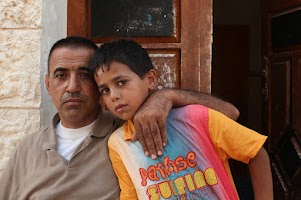 Across the olive grove and by Kiryat Arba’s barbed wire fence lives Kayid Dana and his brothers. Another stunning view embraces you from just outside their house, disrupted only by a looming Israeli watchtower. Most of the occupied West Bank is spotted with these grey towers. Watching from their windows, the ever present occupation, reminding Palestinians that privacy is a luxury that few, if any, enjoy.
The Dana family has been living on the same land for over 50 years. In 1958, the Israeli authorities repetitively offered them money to leave the house and make room for the growing illegal settlement. The family refused and nonetheless Israeli forces bulldozed half of their garden.
As of June 24, the Dana family has been without water. Israeli authorities prevented water trucks from entering the area to refill their water tanks. As a result, Kavid and his family are relegated to pump water from an unsanitary well outside their home. This is where they encounter the next problem: water is only available for a couple of hours each day. This is not enough to supply their 4 camels (100 liters/day) and the most basic household needs.
North of the Dana family home, through the olive groves, lives the Abdul Hay family (Abu Hossni). Their windows are fenced to prevent Israeli settlers from shattering the glass with the stones they throw. On December 4, the family was subject to a vicious attack that left 3 with dumdum (expanding bullet) wounds. Dumdum bullets are a type of live ammunition that enter the body, expand, and cause permanent injuries or death. Although dumdum bullets have been known to be used by Israeli settlers, they are illegal according to international law.
Jamal Abu Saifan, who lives in the area, captured the incident on his camera and explains how a lightly injured Israeli settler was choppered away 15 minutes after his injury, whereas the 3 Palestinians wounded by gunfire, one critically, waited 3 hours for an ambulance.
The ambulance attempting to reach them was stopped and denied entry to the area by Israeli forces.
Unfortunately, settler attacks are far from rare and have been occurring since Kiryat Arba was established in 1968. The purpose of these violent attacks, and the army violence and policies that accompany them, are not only to injure people and destroy their lands. That is only a strategic measure to reach an ultimate goal: the ethnic cleansing of Palestine.
The next step by Kiryat Arba is the construction of a new road which will divide the vital Palestinian olive groves down the middle. The road will be inaccessible to Palestinians, not only preventing Palestinians from tending to their trees on the other side, but annexing further land, expropriating an economic necessity, and making life more difficult for the indigenous Palestinians.
Despite the collection of circumstances to make life difficult, all the families in the area have made the choice to remain on their land despite the uncertainty and pressures of their everyday life under Israeli occupation.
Related articles
- Hebron: Over 30 detained (alethonews.wordpress.com)
- French activist injured as Israeli troops attack Hebron (alethonews.wordpress.com)
- Renegade Jewish Settlers (alethonews.wordpress.com)
- Weekly Report On Israeli Human Rights Violations in the Occupied Palestinian Territory (altahrir.wordpress.com)
- Palestinian stabbed, shot in settler attack near Nablus (alethonews.wordpress.com)
- Hebron: Israeli settlers occupy Palestinian home (alethonews.wordpress.com)
Featured Video

Your Enslavement Begins in Gaza: The ‘Board of Peace’
or go to
Aletho News Archives – Video-Images
From the Archives
The US: The Century of Lost Wars
By James Petras | Global Research | September 12, 2018
Introduction
Despite having the biggest military budget in the world, five times larger than the next six countries, the largest number of military bases – over 180 – in the world and the most expensive military industrial complex, the US has failed to win a single war in the 21st century.
In this paper we will enumerate the wars and proceed to analyze why, despite the powerful material basis for wars, it has led to failures. … continue
Blog Roll
 Aletho News
- Israel designates five Palestinian media outlets as ‘terrorist organizations’
- Israel, not America, first: Carlson’s Huckabee interview lays bare US foreign policy priorities
- Israeli troops executed Palestinian aid workers at ‘point blank range’: Report
- Iran war What if today’s Iran is resigned to a long, hellish war with the US?
- Why Israel Is Escalating Its War Crimes Against Lebanon
- Iran in the face of the armed diplomacy of imperialism
- The US build-up around Iran constitutes strategic war option, not ‘deterrence’
- Iran to US: Sanctions and war failed; try diplomacy and respect
- China supplies Iran with radar, surveillance tech to track US stealth aircraft: Report
- Zelensky rejects territorial concessions to Russia
- If Americans Knew
- Footage Shows Israeli Troops Waiting in Ambush, Then Opening Fire on a Palestinian Teen
- The US is on the brink of a major new war that Trump has not even bothered explaining
- Latest Epstein document dump is one more cover-up
- No Protection, No Justice: US Citizens Killed with Impunity by Israel
- Maria Farmer: Epstein Victim Reveals Explosive Information Covered Up by Media
- Average of five Palestinians killed by Israel every day in Gaza since ceasefire – Not a ceasefire Day 136
- Palestinian church leaders admonish Christian Zionist Mike Huckabee – Not a ceasefire Day 135
- Ominous messaging from Trump’s “Board of Peace” – Not a ceasefire Day 134
- ‘Christians Out’: Jerusalem Church Tagged With Hate Graffiti, Police Investigating
- Israeli Settlers Kill American Teen
- No Tricks Zone
- New Research Reaffirms Clouds, Aerosols, And Surface Solar Radiation Are ‘Driving The Climate System’
- Germany: Electric Car Catches Fire At Charging Station, Sets Off Local “Inferno”, Widespread Damage
- New Study: Canada’s New Brunswick Was 1°C Warmer Than Today During The Medieval Warm Period
- Coal Power Back In Trend As Globe Tries To Keep Pace With Growing Demand For Power
- New Study: A 4°C Warmer Beaufort Sea Had ‘No Sea Ice’ 11,700 – 8200 Years Ago
- Unfudging The Data: Dutch Meteorological Institute Reinstates Early 20th Centruy Heat Waves It Had Erased Earlier
- German Gas Crisis…Chancellor Merz Allegedly Bans Gas Debate Ahead of Elections!
- Pollen Reconstructions Show The Last Glacial’s Warming Events Were Global, 10x Greater Than Modern
- Germany’s Natural Gas Storage Level Dwindles To Just 28%… Increasingly Critical
- New Study Rebuts The Assumption That Anthropogenic CO2 Molecules Have ‘Special’ Properties
 Aletho News