International activists assaulted by extreme settlers in Al Khalil
March 9, 2012 | International Solidarity Movement, West Bank
2 international activists were assaulted late this morning by extreme Zionist setters in Al Khalil (Hebron). A female activist was assaulted by a male settler, after being punched in the face and having her camera stolen by this male settler.
Today’s attack comes following weeks of warning and aggression towards photojournalists and activists with cameras by Israeli military and police, which have stated to internationals that Israeli law forbids the photography of their operations, or rather, their breach of international law and human rights.
Activists have received these warnings for weeks now, and today’s attack comes parallel to the deliberate targeting by Israeli military of journalists and activists with cameras, by shooting tear gas canisters and bullets directly at them at most West Bank demonstrations.
About a month ago, Reporters without Borders published this statement regarding these warnings and threats.
While today’s attack is an escalation against internationals in the region, and while it is evident that the Israeli military and illegal settlers are collaborating in attacking Palestinians and internationals, International Solidarity Movement will not desist from bringing proof of Israeli aggression through pictures, videos, and our continued reporting.
We thank the international solidarity community for its continued support in the face of Israeli Zionism, colonialism, discrimination, and militarization of Palestine.
Related articles
- International Solidarity Movement volunteers encounter settler attack and sexual harassment in Hebron (alethonews.wordpress.com)
- Settler Violence: Broken Glass on Shuhada Street (alethonews.wordpress.com)
- The massacre of 1929 and the War of Narratives (alethonews.wordpress.com)
- Demanding justice for Yousef, a quiet boy killed by Israeli settlers (alethonews.wordpress.com)
- Extremist settlers hurl concrete blocks at Hebron’s Old Market (alethonews.wordpress.com)
Report: Army, Settlers, Carried Out 145 Attacks In February

By Saed Bannoura | IMEMC & Agencies | March 01, 2012
The Wall and Settlements Information Center at the Palestinian Authority’s Ministry of Wall and Settlements, issued a report revealing that Israeli soldiers and settlers carried out 145 attacks against the Palestinian residents, their lands and homes, killing one and wounding several others.
Tal’at Ramia, 25, was killed on Friday February 24, during clashes with Israeli troops near the Qalanida terminal, north of occupied East Jerusalem; the residents were protesting attempts by extremist settlers to break into the Al-Aqsa mosque.
The Center reported that soldiers demolished 42 structures in the West Bank; 22 homes and structures were leveled in Khirbit Ar-Rahwa, 3 in Ath-Tha’la area, and one home in Surif.
12 homes and structures were demolished in Nablus district, 12 homes and structures were demolished in Jerusalem and Tubas, four wells were demolished in Hebron, and one in Jenin.
Israel further served 88 notices against Palestinian homes and structures; this includes 2 mosques and one school in Hebron and Jenin, 24 orders against homes and structures in several areas in Hebron, 22 notices against structures in several areas in Jerusalem, 17 against structures in Bethlehem, 5 in Jenin, 8 in Salfit, and two in Qalqilia,
Furthermore, Israeli settlers carried out dozens of attacks, uprooting and bulldozing 4931 Dunams (1218.47 Acres) of Palestinian farmlands; 1825 Dunams in Jaloud – Nablus, Nahhalin and Al-Jab’a in Bethlehem, Yousouf and Sarta in Salfit, in addition to Beit Ola and Al-Himma in Hebron and Tubas. 1383 Dunams were bulldozed and uprooted, and owners of 1723 Dunams were prevented from entering their lands after extremist settlers planted them and are attempting to take them over. 1169 trees were uprooted in Surif, Beit Ummar, Tormos Ayya, Aqraba and Michmas.
The report further pointed out the escalating attacks carried out by Israeli soldiers and settlers against Jerusalem and its holy sites, by the sharp increase of home demolitions, escalating settlement activities, sharply increasing attacks against holy sites, and the recent plan to plan to build a temple on 400 square/meters west of the Al-Boraq Wall, and other plans including the so-called “Visitors Center” in Wadi Hilweh in Silwan, the taking-over of a parking lot in the Armenian neighborhood in order to build a settlement outpost despite the fact that the land is owned by the Armenian Monastery.
This is all happening while excavations continue under the Al-Aqsa mosque and several areas in occupied East Jerusalem. The information center further stated that Israel recently approved a law exempting taxes on donations that support settlement projects.
As for the non-violent resistance against the Wall and Settlements in Palestine, Israeli soldiers continued their violent attacks against these protests, shot and wounded more than 22 protestors, including international and Israeli peace activists, in addition to 5 reporters.
Furthermore, Israeli settlers carried out dozens of attacks against the residents and their property leading to the injury of 9 Palestinians, including 6 women, and set ablaze six Palestinian cars. They also tried to torch a mosque near Ramallah, and broke into a mosque near Hebron.
The Israeli government also approved the construction of 500 units for Jewish settlers in Shilo settlement, between Ramallah and Nablus, granted construction permits for 200 units planned to be built in Shvut Rachel near Nablus, in addition to a plan aims at constructing a new settlement east of Ramallah to replace the Migron illegal outpost the was evacuated by the army.
Israel also announced a plan to build a religious Jewish school and a temple near Itamar settlement, near Nablus with an estimated cost of 9 Million NIS.
Two new outposts were installed on Palestinian lands in Tal Romeida and Al-Karmel in Hebron, while the Israeli government approved a plan to build a settlement that is handicap-friendly in the place of a former military camp that was evacuated by the army in the Bethlehem district; it will be part of the Gush Etzion settlement block. Settlers also installed 18 mobile homes in a number of illegal outposts in the districts of Nablus and Ramallah.
Related articles
- Settlers Install New Outpost Near Hebron (alethonews.wordpress.com)
- Settler Violence: Broken Glass on Shuhada Street (alethonews.wordpress.com)
- Soldier, 2 Female Settlers, Arrested For Writing Racist Graffiti (alethonews.wordpress.com)
- Jewish Settlers Torch Mosque In Ramallah (alethonews.wordpress.com)
Settler Violence: Broken Glass on Shuhada Street
21 February 2012 | International Solidarity Movement, West Bank
Five years ago Abed Seder’s wife, Kefah, was shot five times in the chest by Israeli soldiers as she went onto her roof to check her water tank. She was 23 years old and left three sons motherless. He tells me his sons are afraid to go on the roof, which overlooks the illegal Zionist settlement of Beit Hadassah. To an international community, Abed’s struggle is one of trauma and loss, but he tells it with shockingly familiar regularity.
Abed´s home is sandwiched inbetween Beit Hadassah and Beit HaShisha settlements, from which he receives regular torrents of abuse and violence. Rubbish and broken glass bearing Hebrew writing litters the path to his front door, bypassing the nets which attempt to catch the used nappies and toilet roles. His windows have been boarded up from the outside by Israeli soldiers in an attempt to prevent settlers from throwing molotov cocktails into Abed´s home. Abed shows me the view from his caged bedroom window, which looks directly onto a neatly planted playground, complete with basket ball court where the children of immigrant Zionists can enjoy the sunshine. As one of them raises their middle finger, Abed tells me that they regularly throw water and beer bottles so they try to keep the window closed.
Perhaps the saddest victim of this has been Abed´s 6 year old son Wadia, who was left blind after Abed´s neighbours threw chloric acid from their rooftops two years ago. He was just four years old. Wadia has since been seeking treatment in a hospital in Jordan while Abed and his wife can only afford to visit him once every three months.
In 1967 Israel occupied Hebron along with the rest of the West Bank. The settlement of Kiyat Arba was established on the outskirts of Hebron in 1968, later allowing for communities of settlers to illegally occupy properties such as the Hadassah Hospital and other Palestinian neighbourhoods such as Tel Rumeida. Hebron is currently home to over one hundred thousand Palestinians, who are suffering at the hands of some 500-800 settlers protected by a constant Israeli military presence.
Since the Second Intifada, settler violence has escalated in the city of Hebron with illegal settlers routinely attacking and violating the rights of their Palestinian neighbours. B’tselem has recorded incidents of physical assaults, including beatings, stone throwing and hurling of refuse, sand, water, chlorine and empty bottles. Settlers have destroyed shops and doors, committed thefts and chopped down fruit trees. Settlers have also been involved in gunfire, attempts to run people over, poisoning of a water well, breaking into homes, spilling of hot liquid on the face of a Palestinian, and the killing of a young Palestinian girl.
“Price Tagging” has become a coined phrase for the violent, illegal, Zionist settlers “struggle” as they continue to illegally steal land throughout the West Bank. On 24 July 2008, after Israeli security forces removed a bus that had been placed in the Adey Ad outpost, the head of the settlers’ struggle headquarters in Yitzhar was quoted in Ha’aretz as saying,
“The police have to understand that there will be a very high price tag on any event of this kind.”
He described the harm to Palestinians as “a display of good citizenship that is intended to help the police enforce the planning and building laws in the area on Palestinians, too.” Collective punishment is illegal under international law and is a violation of the Geneva Convention.
B’Tselem has investigated many incidents of settler violence and stated to have found that “Israeli forces intervened late, usually when Palestinians begin throwing stones at their attackers. The late response cannot be justified, as these incidents are part of a pattern and can be predicted. They conclude that “the security forces must prepare in advance in a way that will enable them to prevent harm to Palestinians.” B´Tselem stated that the authorities have systematically failed to enforce law and order against violent settlers attacking Palestinians.

Abed Seder stands before his home in Al Khalil
Human rights worker Hisham Shabarati explains the relationship between the soldiers and the settlers as a kind of role play, whereby “settlers are able to make the actions the military can’t.” He describes settlers as a political instrument able to carry out random and brutal attacks under the protection of Israeli soldiers.
“They have the same agenda; to make life unbearable for the Palestinians.”
Abed Seder’s home in the Old City of Hebron is four hundred years old. His brother and four children live above him and his great-grandfather lived here before them. For Abed, the act of resisting occupation stretches for as far as he can continue to live in the home which he legally owns. Its traditional arched doorways and original winding stairways make his home a desirable target for many settlers looking to move into an area which former Prime Minister David Ben Gurion described as “more Jewish even than Jerusalem.”
As long as Israel protects the rights of illegal settlers in Hebron over the rights of the Palestinian people, Abed and his family will suffer.
Related articles
- The massacre of 1929 and the War of Narratives (alethonews.wordpress.com)
- Settlers Install New Outpost Near Hebron (alethonews.wordpress.com)
- International Solidarity Movement volunteers encounter settler attack and sexual harassment in Hebron (alethonews.wordpress.com)
- Settlers torch cars in Beit Ummar (alethonews.wordpress.com)
- Extremist settlers hurl concrete blocks at Hebron’s Old Market (alethonews.wordpress.com)
- Israeli occupation forces detain Palestinians, settlers attack others (alethonews.wordpress.com)
The massacre of 1929 and the War of Narratives
21 February 2012 | International Solidarity Movement, West Bank
If you ask an Israeli settler in or around Al-Khalil (Hebron) what calls them to live on contested land, most will speak to a religious connection to the city and the Cave of the Machpelach (“patriarchs”), where Jews, Muslims, and Christians come to revere the biblical figures believed to be buried there. A series of signs posted nearby along Shuhada Street, the once-main road and market district now closed to Palestinians, tell a story of Hebronite Jewish habitation dating from biblical times, brought to a sharp and bloody end with a 1929 pogrom, which resulted in the deaths of 67 Jewish residents and the displacement of the survivors. Citing this narrative, many of today’s settlers justify their occupation of the old city as a rebirth and continuation of this community, a story echoed in publications distributed by the Gutnick Center (a Jewish cultural center) and soldier-escorted weekly tours through the Palestinian market. The problem with this narrative is that no one, not even the survivors’ descendants, agrees on it.

On Monday, February 20th, the Jerusalem Post published an article presenting the conflict between the survivors’ descendants as a microcosm for Jewish public opinion, some of whom support the settlements and a growing number who oppose Hebron’s especially active settler community, one which Yair Keidan calls “a loaded bomb that can blow up peace altogether.” Both sides have signed petitions to the Israeli government, asking variously to maintain, evacuate, and/or halt settlement activity, and both groups claim a right to the legacy of their parent community.
“You can’t bring back the dead,” said Ya’acov Castel, a survivor from 1929, “but there are people living here now who are carrying out the dream of the Jews who lived here for hundreds of years.” Yona Rochlin, whose family went back many generations in pre-1929 Hebron, argues the opposite—pointing out that the majority of settlers are US immigrants, who have settled in a foreign city unfamiliar with the customs, language, or neighborly habits of the people they claim as spiritual forebears. Unlike the predominantly Sephardi and Mizrahi (Spanish/North African and Middle Eastern respectively) Jewish minority that coexisted with a Muslim majority for five centuries, she says that today’s settlers “came to the city to take revenge for the 1929 massacre and their main idea was to drive out the Arabs and turn Hebron into a Jewish city.”
Hebronite settlers have many claims to fame, including the first West Bank settlement Kiryat Arba (founded 1968, pop. 7200) and the only settlements within the bounds of a Palestinian city—Avraham Avinu, Beit Hadassah, and Beit Romano, which lie at the heart of the Old City and fall under Israeli military control. They are also known to be among the most violent and hardline, with many claiming allegiance to the Kahanist, Gush Emunim, and other extremist Jewish political and religious sects. Particularly infamous Kahanists include Baruch Marzel, founder of the Jewish National Front, and Baruch Goldstein, who in 1994 massacred 29 and injured over 150 Muslims at prayer in the Mosque al-Ibrahimi. Today Goldstein, who was killed during the attack, is venerated as a hero and martyr—and his tomb in Kiryat Arba continues to draw extremist pilgrims, even though his shrine was removed in 1999.
Rochlin, a politically active parent and child of conservative Jewish parents, in 1996 coauthored an open letter to the Israeli government, “Message from the original Jewish community of Hebron: Evacuate settlers,” which stated, “[Hebronite settlers] are alien to the culture and way of life of the Hebron Jews, who in the course of generations created a heritage of peace between peoples and understanding between faiths.” She sees evidence of this tradition in the fact that Muslim neighbors intervened to save her family and over 400 more when the Jewish community was attacked in 1929. Who exactly did the killing, and from where, is uncertain—but there is surprisingly little disagreement over the 19+ Palestinian families that sheltered and defended Jews. Although some Palestinian community members invited their neighbors to stay or return, by 1936 the British Mandate had relocated the remaining Jews to Jerusalem, Tel Aviv and elsewhere.
Curiously, although the Israeli Jews’ narratives tell radically different stories, many area Palestinians also know a great deal about the pogrom and mourn the loss of friends and neighbors. For Muhammad, head of the Abu Aisha family who live in the famed ‘caged house’ on Tel Rumeida, where their home is surrounded by settlement homes, it is a matter of family pride that his father is named among the Palestinians to save Jewish residents. Nonetheless, the Abu Aisha family struggles with daily harassment at the hands of settlers, who occupy land all around the home. Hajj Yussef, one of the few surviving Palestinians who responded in 1929, talks about “our Palestinian Jews,” who dressed and spoke like non-Jewish neighbors. To Yussef, like the children of his refugee neighbors, the obstacle to peace in Hebron lies not in difference but attitude and actions: “I have no problem living with the Jews, like we lived many years ago. But today’s settlers are not Palestinian Jews, they came here from abroad. And I have a problem if the Jews live in my country as occupiers and settlers.”
Open Shuhada Street, the international campaign to end Israeli Apartheid in Al-Khalil/Hebron will continue February 20th through 25th, with actions and cultural events in Khalil and around the world. Each day, we will cover a different aspect of the Occupation’s effects on Shuhada Street and the city generally.
Continue to follow www.palsolidarity.org throughout the week for more stories and analysis.
Related articles
- Settlers Install New Outpost Near Hebron (alethonews.wordpress.com)
- International Solidarity Movement volunteers encounter settler attack and sexual harassment in Hebron (alethonews.wordpress.com)
- Soldiers raid community center, arrest local activist (alethonews.wordpress.com)
- Under Attack – the Golani Brigade’s war on the Palestinian population of Al-Khalil/Hebron (alethonews.wordpress.com)
- Israeli demolition ‘displaces 120′ in Hebron village (alethonews.wordpress.com)
- This Week in History: The second Hebron massacre (altahrir.wordpress.com)
- Hebron: Occupation and Sterilization (alethonews.wordpress.com)
- Settlers torch cars in Beit Ummar (alethonews.wordpress.com)
- An exclusive corner of Hebron (arunwithaview.wordpress.com)
Under Attack–the Golani Brigade’s war on the Palestinian population of Al-Khalil/Hebron
CPTnet | 15 February 2012
A newly released report submitted to the United Nations by international organizations working in Al Khalil documents a sharp increase in serious human rights violations against Palestinian civilians, particularly youth and children, living in the Old City and Tel Rumeida since the arrival of the Golani Brigade of the Israeli army on 27 December 2011.
The report documents an increase in arrests and detentions of adults and children, serious physical injuries sustained while in military custody, home invasions, and an increase in the number and duration of arbitrary detentions of civilians at checkpoints. It also documents harassment of and attempts to silence international observers attempting to document these abuses.
Contrary to military justifications, these human rights violations have occurred without observed provocation on the part of Palestinians. These accounts, either reported to or witnessed by internationals working in the city, are believed to represent only a small portion of the total number of abuses.
For example
On Thursday, 12 January, Golani soldiers beat a developmentally disabled young man who had earlier in the day been teased by Border police who kept closing a mechanized door at a checkpoint when he tried to pass through. That evening, the Golani also attacked his mother and beat the teenager’s younger brother, cracking his skull, and then arrested the two young men.
On Tuesday, 17 January, Golani entered a man’s home at night, pushed the family out of their house, including their 1-½ year old son, and beat the father, for which he required medical treatment.
On Friday, 20 January, Golani held a ten and twelve year-old boy behind the gate of the Beit Romano settlement. A witness said the boys had been wearing ski masks because of the cold weather, but had not been throwing rocks, as the soldiers claimed. The soldiers gave the boys’ parents a list containing the names of five other boys from the Old City, saying that if the parents brought those boys to the gate, the soldiers would release the other two.
The full report is available for viewing, along with video and photos, at http://www.cpt.org/underattack
See also an article by Israeli journalist Amira Hass on the subject.
Related articles
- Israeli demolition ‘displaces 120′ in Hebron village (alethonews.wordpress.com)
- International Solidarity Movement volunteers encounter settler attack and sexual harassment in Hebron (alethonews.wordpress.com)
- Israeli Soldiers Accidentally Kill Settler Near Hebron (alethonews.wordpress.com)
- Israeli soldiers beat and arrest two teenagers in Hebron (alethonews.wordpress.com)
- Israeli forces arrest Hebron journalist (alethonews.wordpress.com)
- Hebron: Occupation and Sterilization (alethonews.wordpress.com)
- Extremist settlers hurl concrete blocks at Hebron’s Old Market (alethonews.wordpress.com)
Israeli demolition ‘displaces 120’ in Hebron village
Ma’an – 14/02/2012
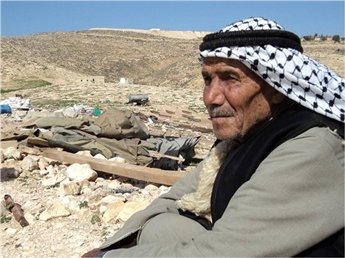
HEBRON – Israeli forces demolished 22 buildings in a Palestinian village south of Hebron on Monday, displacing 120 villagers, residents told Ma’an.
Twenty Israeli military vehicles accompanied bulldozers to raze the 16 domestic tents and six animal shelters in Khirbet al-Rahwa, they said.
Villager Salim Salem al-Tal told Ma’an forces also demolished a well that was the village’s only water source. Soldiers did not give the villagers any time to remove their possessions from their homes, he said.
Rateb al-Jabareen, whose home was demolished, said that the soldiers told them they would have to leave the village. Israel hopes to expand the neighboring Jewish-only settlement Tene Omerem by pushing them from their village, he added.
He vowed the villagers would remain despite repeated demolitions.
Hebron governor Kamel Hemaid said Israeli authorities were systematically destroying Palestinian homes in order to expand Israeli settlements throughout the West Bank.
He appealed for international intervention to halt the demolitions.
The number of Palestinians displaced by demolitions doubled in 2011 compared to 2010, according to UN figures.
Related articles
- Settlers Install New Outpost Near Hebron (alethonews.wordpress.com)
- UNRWA: Israel’s displacement of Palestinians ‘doubles’ (alethonews.wordpress.com)
- Israeli forces and settlers try to drive away Um Alfagara residents (alethonews.wordpress.com)
- Settlers torch cars in Beit Ummar (alethonews.wordpress.com)
- Israeli forces demolish homes in Jericho (alethonews.wordpress.com)
- Israel plans to demolish solar panels in village near Hebron (altahrir.wordpress.com)
Settlers Install New Outpost Near Hebron
By Saed Bannoura | IMEMC & Agencies | February 03, 2012
A group of fundamentalist Israeli settlers installed a new illegal settlement outpost, south of the southern West Bank city of Hebron, on Friday while another group of armed settlers invaded areas in Beit Ummar town, north of Hebron.
Rateb Jabbour, coordinator of the National Committee Against the Wall and Settlements, reported that approximately 250 settlers, accompanied by Israeli Border Police officers, invaded that Al-Carmel village, and installed six new caravans in Um Ash-Shuqhan area, near the Maoun illegal outpost that was installed on privately-owned Palestinian lands.
In related news, Yousef Abu Maria, media spokesperson of the National Committee Against the Wall and Settlements in Beit Ummar, stated that approximately 150 settlers attacked Palestinian farmlands in Za’ta area, east of Beit Ummar, and blocked the Jerusalem-Hebron road in front of Palestinian traffic.
According to Abdul-Hadi Hantash, a Palestinian expert on Maps and Settlements, that recent escalation is part of a larger plan that aims at installing more outposts, and expanding existing ones, by stealing more Palestinian lands.
Hantash added that settlers are stealing Palestinian lands in Um Ash-Shuqhan area, and installing new outposts, so that they can create a geographical contiguity by linking the new outposts with the settlements of Ma’oun, Karmiel, Havat Yair, Avigayil, and Susyia. All are illegal outposts built on privately-owned Palestinian lands.
The official further stated that Israel is implementing an agenda that aims at isolating the Palestinians in Hebron by the illegal Annexation Wall and the chain of settlements and outposts built on the hills of the Hebron district.
“Israel wants to force the Palestinians out of their homes and lands, wants them to leave”, Hantash added, “But the residents are determined to remain steadfast in their homes, lands”.
Related articles
- Official: Israeli settlers tour Beit Ummar (altahrir.wordpress.com)
- Settlers torch cars in Beit Ummar (alethonews.wordpress.com)
- An exclusive corner of Hebron (arunwithaview.wordpress.com)
- Demanding justice for Yousef, a quiet boy killed by Israeli settlers (alethonews.wordpress.com)
- Palestine: Even Sheep Are Not Safe from Jewish Settlers (alethonews.wordpress.com)
Demanding justice for Yousef, a quiet boy killed by Israeli settlers
Bekah Wolf | The Electronic Intifada | 27 January 2012

Yousef Ikhlayl, top left, attending a demonstration in Beit Ommar less than six months before he was killed by Israeli settlers. (Palestine Solidarity Project)
On 28 January 2011 at 6:30am, Yousef Ikhlayl, 17, went with his father Fakhri to their farmland on the outskirts of the West Bank village Beit Ommar, where they prepared the land around their grapevines. At approximately 7am, two groups of Israelis from the illegal settlements Bat Ayn and Kiryat Arba were taking a “hike” in the privately-owned Palestinian agricultural land belonging to the residents of Beit Ommar (“Palestinian killed in clashes with settlers near Hebron,” The Jerusalem Post, 29 January 2011).
There was no indication that the settlers were planning on shooting. Yousef’s father reported that the first shot fired by the settlers hit his son in the head. The settlers then began shooting in the air and the surrounding areas to prevent others from approaching, as his father screamed desperately for help.
Yousef was carried to a car that drove him out of the agricultural valley and to the main road, where an ambulance “rushed” him to the hospital in Hebron, passing two Israeli military checkpoints on the way. At the hospital, Yousef was put on a respirator, though he had no brain activity. He passed away soon after.
At his funeral the following day, as is common practice with the Israeli military involving martyr funerals, soldiers numbering in the hundreds invaded Beit Ommar and attacked the funeral with tear gas, rubber-coated steel bullets and even live ammunition, as the Palestine Solidarity Project reported (“Funeral of Yousef Ikhlayl attacked by Israeli military, dozens injured,” 29 January 2011).
The murder of Yousef Ikhlayl, the impunity with which the settlers acted and the military’s behavior at the funeral are common occurrences in the occupied West Bank. The death of a Palestinian, even a child, is rarely noted and quickly forgotten in much of the world. The killing of Yousef was, however, a profound event for myself, the Palestine Solidarity Project (PSP, the organization I co-founded) and popular resistance in the Hebron district as a whole.
Never safe
PSP began farmer-accompaniment programs in the areas surrounding Beit Ommar — particularly the areas near Bat Ayn settlement — in 2006. We did so because of the extreme violence and the regularity with which settlers from this colony would attack farmers, particularly in the Saffa valley near where Yousef was killed.
Yousef was a regular participant in all of our activities, including demonstrations, farming actions, summer camps, English classes and even a photography workshop we held in 2010. He was a fixture at PSP events, volunteering to set up for conferences and often babysitting my young daughter as we held meetings and tours for international activists. I have vivid memories of Yousef carrying my baby, Rafeef, around the yard of my house, pointing out tree leaves and flowers while my husband, PSP co-founder Mousa Abu Maria, and I met with international delegations and the local popular committee.
Yousef was quite familiar with the Israeli settlers from the area and their potential for violence. Perhaps it was because of this familiarity with them that he did not run when they arrived in the area. He had been with PSP dozens of times as we accompanied other farmers to their land, as settlers watched from the hillside or hurled rocks at us from hundreds of meters away. Perhaps he assumed this time would be no different; but maybe it would have been different if we had been there with his family. I wonder about what he thought when the settlers approached. I have often thought in the last year if things would have been different if international activists had been there; if I had been there.
Our farmer-accompaniment program in the area throughout the years, though it had led to literally dozens of arrests of Israeli and international solidarity activists, was completely successful in deterring settler violence during the accompaniment.
In the end, the settlers roamed the area freely, shooting at residents and youth who began throwing stones for two hours. Two hours before Israeli soldiers, who are responsible for the security of Area C — 60 percent of the West Bank under Israeli military control — could persuade the residents to return to their homes.
The aforementioned Jerusalem Post article adds that twenty settlers were detained at the scene by the military — a highly unusual occurrence, possibly due to the presence of international and Israeli activists who had arrived in the area after the shooting — but were all released the same day.
Israeli impunity
During the two hours that the settlers stayed in the area, PSP activists arrived and began taking pictures of them to provide to the Israeli police responsible for investigating attacks by settlers on Palestinians in the West Bank. Shortly after the murder, Yousef’s father and the activists who took the pictures went to the Israeli police station (located in the settlement Kfar Etzion, next door to Bat Ayn) and filed a formal complaint.
Yousef’s father provided the photographs to the police and even identified a few individuals he saw closest to him and his son when he was shot. In a democracy, one would think this level of evidence, combined with the heinousness of the crime, would lead to a thorough investigation and speedy indictment. But, as we all well know, that is not what happens when settlers attack Palestinians.
In December 2011, Yesh Din, an Israeli human rights organization that monitors the criminal accountability of Israeli civilians and Israeli military forces in the West Bank, released an updated report on the rate of which Israeli civilians are prosecuted for crimes committed against Palestinians in the West Bank.
Yesh Din discovered, after researching the progress of 700 individual complaints filed with the Israeli police in the West Bank by Palestinians, that 91 percent of all complaints end with the investigation being closed without an indictment, including 85 percent of cases involving violence. The most common reason for closing a case (which can be done either by the police or by the police prosecutor) is “perpetrator unknown,” though a full 2 percent of all cases were closed because of a “lack of public interest,” which begs the question, “which public?” (“Updated data monitoring hundreds of investigations: 91% of cases closed without indictments,” 15 December 2011).
The report reveals that only 7.4 percent of cases involving settler crimes committed against Palestinians from 2005 to 2011 actually ended in an indictment. The statistic regarding crimes committed by Israeli military personnel against Palestinians, which are investigated by a separate entity, is a negligible 3.5 percent ending in indictments.
Yesh Din’s full report shows a series of failures, from the process of filing an initial complaint, to the police investigation, to the process inside the prosecutors’ office for initiating an indictment. In Yousef Ikhlayl’s case, Yesh Din discovered that while an investigation was conducted by the police (which may have only constituted the interview with Yousef’s father) and the file was turned over to the prosecution, the case has inexplicably been stalled for months because the prosecution’s office has refused to assign the case to an individual attorney, a step necessary before a final decision can be made on whether an indictment will be handed down.
It is obvious that individual justice for Palestinian victims of settler crimes — even when the victim is an unarmed child — remains elusive. Perhaps, as was suggested in an op-ed that appeared in Israeli daily Haaretz about the murder of Mustafa Tamimi, knowing the individual perpetrator, and pursuing a case against the individual, only serves to alleviate the responsibility of the system as a whole (“A courageous Palestinian has died, shrouded in stones,” 13 December 2011).
However, violent, ideological settlers, and their counterparts in the Israeli military, will only continue to act with total disregard for the basic human rights of Palestinians if they are assured that they will not face consequences. The death of a civilian, particularly a child, should result both in a black mark on the society that condones it, as well as the prosecution of the individuals responsible.
A call to action
Yousef Ikhlayl’s murder was overshadowed by world events taking place in January 2011. Activists and sympathetic journalists alike were focused on the massive uprising in Egypt that had just erupted, as well as other developments during the Arab uprisings. Beit Ommar, Yousef’s hometown, had fallen into the background as settler violence had decreased in previous months and the demonstrations in Nabi Saleh were gaining attention.
The community of Beit Ommar and the Palestine Solidarity Project have called for an international day of action on Saturday, 28 January, to commemorate the one-year anniversary of Yousef’s death and ensure that he will not be forgotten.
People all over the world will hold demonstrations in front of Israeli consulates, and will plaster their cities with posters of with his face (which can be found on the website).
We are calling for an end to Israeli impunity, and the world to remember that behind statistics and policy reports, the victims of Israel’s murderous policies are real, live people. It is imperative that the international community not only hold Israel accountable for its criminal acts, through movements including boycott, divestment and sanctions (BDS), and solidarity work in Palestine, but also to humanize the victims of these crimes. Yousef Ikhlayl was a goofy, quiet and dedicated boy. He had a sheepish smile and made my daughter laugh. We will not forget him.
~
Bekah Wolf is a co-founder of the Palestine Solidarity Project, and has worked in the West Bank since 2003. Further details on the day of action to demand justice for Yousef Ikhlayl can be found on the PSP website, www.palestinesolidarityproject.org. PSP can be followed on Twitter at @PalestinePSP.
Related articles
- International Solidarity Movement volunteers encounter settler attack and sexual harassment in Hebron (alethonews.wordpress.com)
- No jail for Jewish extremists in “price tag” attacks (alethonews.wordpress.com)
- Child in critical condition after being hit by Israeli settler bus (alethonews.wordpress.com)
Israelis attacking children on their way to school
April 2010
Palestinian Children in the rural village of at-Tuwani speak of their encounters with violent Israeli Settlers in the South Hebron Hills of Occupied Palestine.
Related articles
- PALESTINE: Tent for school children demolished hours after it was built (alethonews.wordpress.com)
- Stranded in Shuhada: Hebron’s Qurtuba school (alethonews.wordpress.com)
- Mass arrest of schoolchildren (alethonews.wordpress.com)
Israel wants 1,500 shekels for 15-year-old boy
Ma’an – 20/03/2010
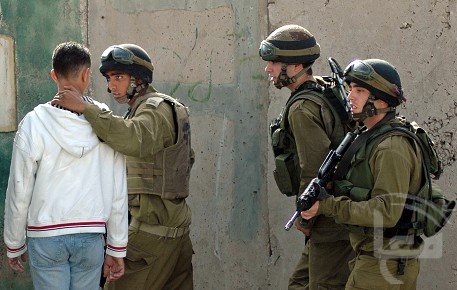 Israeli forces arrest a Palestinian boy after he attempted to cross the Al-Ram checkpoint on the northern edge of Jerusalem en route to prayers at the Al-Aqsa Mosque on 18 October 2006. [MaanImages/Moamar Awad]
Hebron – Israeli authorities have asked the family of a detained 15-year-old boy to pay 1,500 Israeli shekels (about 400 US dollars) to release the minor, a prisoners solidarity group reported on Saturday.
The boy, Ratib Abu Meizar, was detained on Friday evening in the Zahid neighborhood of central of Hebron in the southern West Bank. He was taken to a detention center housed in the illegal Israeli settlement of Kiryat Arba.
Amjad Najjar, director of the Palestinian Prisoners Society in Hebron, told Ma’an that Abu Meizar’s detention “is a continuation of Israel’s policy of blackmailing the families of detained Palestinian children, a policy which has become official.”
Najjar urged international children’s rights groups to exert pressure on the government of Switzerland and other signatories to the Fourth Geneva Convention to encourage Israel to abide by its responsibilities. Israel is also a signatory to the convention, which extends protection to children in conflict zones.
A spokesman for Israeli police in the West Bank did not immediately return calls seeking comment.
Related articles
- Israeli forces raid Cremisan Monastery in Bethlehem (alethonews.wordpress.com)
- Two Palestinian children detained in Hebron (imemc.org)
- Father and 7-year-old son illegally detained in occupied Hebron (alethonews.wordpress.com)
Featured Video

The Source of America’s Wars – Kristol Clear
or go to
Aletho News Archives – Video-Images
From the Archives
Is Israel to blame for the Iraq War?
American Goy | March 10, 2008
I am so tired of this old canard that “Israel had nothing to do with USA’s war with Iraq – in fact, it officially advised America against it”.
Bullshit. … continue
Blog Roll
 Aletho News
- Alberta Bill Would Fine Political Deepfakes $10,000 Without Satire Exemptions
- Iran declares ‘historic victory’ over US, says enemy forced to accept its proposal
- Trump Claims Ceasefire, Reopening of Strait of Hormuz Agreement with Iran
- Israeli tank fire killed UN peacekeeper in Lebanon, UNIFIL investigation finds
- Russia, China block Bahrain-sponsored UN resolution on Strait of Hormuz
- The US-Israeli War on Science is an Assault on our Future
- Trump’s Promise to Bomb Iran ‘Like Never Before’ Faces Brutal Logistics — Expert
- Germany seeks to restrict stays abroad for men of fighting age – Berliner Zeitung
- Evidence points to Ukraine being behind TurkStream attempted sabotage, but that should come as no surprise
- Sri Lanka secures supplies of Russia oil – minister
- If Americans Knew
- Thousands dead and neighborhoods razed to the ground: Aid agencies fear southern Lebanon is becoming the new Gaza
- The war the US is fighting for Israel could cost trillions
- ‘Cigarette Burns, Nail Wounds’: Toddler Tortured in Gaza to Coerce Father
- Trump Says US Sent ‘a Lot of Guns’ to Protesters in Iran
- Israeli forces destroy 17 UN peacekeeper cameras in south Lebanon
- US-Israeli strikes ‘completely destroy’ synagogue in Tehran
- Archbishop for US Military Says Iran War Is Unjust Under Catholic Teaching
- Iranian leaders’ Open Letters to the American People
- Trump says Iranians appreciate bombs, WHO warns of nuclear risks – Daily Update
- U.N. experts demand Israel release prominent Gaza doctor after reports of ‘severe torture’
- No Tricks Zone
- An Inconvenient Tree: Uncovered In Alps… Europe Much Warmer Than Today 6000 Years Ago
- New Study Reports A 60% Slowdown In Greenland’s Ice Loss Rate In The Last Decade
- Low Intensity Tornado Wrecks Major Solar Farm, Creating A Potential Toxic Dump
- New Study Finds Warming Saves Lives…Cold Temperatures 12 Times More Deadly Than Excess Heat
- German Science Blog Accuses PIK Climate Institute Of Hallucinating Climate Tipping Points
- Devastating Assessment Of Comirnaty Vaccine By Former Senior Pfizer Europe Toxicologist
- New Study: CO2 Is ‘Effectively Negligible’ As An Explanatory Climate Change Factor Since 2000
- Former Pfizer Toxicologist Dr. Helmut Sterz Tells Bundestag Hearing Pfizer Vaccine Should Have Never Been Approved
- Energy Expert: Germany’s Nuclear Phaseout Was A “500 Billion Euro Mistake”
- New Research: South Australia’s Mid-Holocene Sea Surface Temperatures Were 4°C Warmer Than Today
 Aletho News