Riyadh and Hezbollah: A rapprochement forged in fire
As Lebanon becomes an unlikely stage for a slow Saudi pivot toward pragmatism, regional rifts with allies and foes alike compel Riyadh to recalculate its hard lines.
By Tamjid Kobaissy | The Cradle | January 29, 2026
Lebanon, once more, reflects the fault lines tearing through the Arab world. But this time, the ground is moving. The era of blockades and isolation is ceding to a colder, more calculated politics – and at its core lies an unlikely dialogue: between Hezbollah and the Kingdom of Saudi Arabia.
As The Cradle observed last month on ‘Hezbollah and Saudi Arabia’s uneasy détente,’ behind-the-scenes communication between the two has laid groundwork for a quiet thaw. Recent developments have accelerated this shift, compelling the kingdom to reassess both threats and alliances. The signals are no longer limited to backchannels.
They are becoming visible across Lebanon’s political, economic, and media fronts. This suggests that rapprochement is no longer a theoretical discussion but an unfolding process reshaping both the Lebanese and regional scene.
Economic tremors, political signals
Saudi repositioning on Lebanon and Hezbollah has taken shape across multiple fronts. Economic pressures are easing, political language is softening, and discourse on the resistance movement’s disarmament is adapting to new realities. These changes track with the Saudi–Hezbollah talks and reflect broader drivers such as domestic demands in Lebanon, urgent regional recalculations, and Hezbollah’s calibrated outreach.
Sources tell The Cradle the talks have already produced results, with Riyadh stepping away from its previous economic blockade. That shift is becoming tangible across Lebanon.
The economic front offers the clearest evidence. During a visit to Beirut by Iranian Foreign Minister Abbas Araghchi, flanked by a senior economic team, Lebanese President Joseph Aoun signaled readiness to deepen Beirut–Tehran ties. In Lebanon, such moves usually require nods from Riyadh or Washington.
Lebanese Prime Minister Nawaf Salam, known for his Saudi ties, announced the launch of reconstruction in southern Lebanon within two weeks, with plans to accelerate rebuilding efforts. This follows parliamentary approval of a World Bank loan – an indication of intent to harness regional momentum. Salam also flagged upcoming agreements with Riyadh.
Simultaneously, the long-dormant file of Lebanese depositors was revived in cabinet through a proposed financial reorganization and deposit recovery law. This legislation lays the groundwork for closing the financial gap and gradually repaying deposits.
The reopening of this file after years of stagnation reflects not only domestic pressure but also a new political and financial environment shaped by waning external pressure and the rollback of the economic suffocation policy previously imposed on Lebanon.
Changing tones in Beirut
Political and media rhetoric in Lebanon is also adjusting, particularly among factions with Saudi leanings. The Lebanese Forces (LF) offer a striking example. Lebanon’s Foreign Minister Youssef Raji’s tone during Araghchi’s visit was notably tempered compared to previous Iranian delegations. While his broader stance may still reflect internal party lines, it is important to note that the LF is not entirely Saudi-aligned and intersects with Washington’s foreign policy.
Equally notable is the near absence of the usual Saudi-linked media campaigns. Outlets and figures typically vocal during such visits stayed quiet. That silence reflects a broader repositioning.
Media sources also say Saudi Ambassador to Lebanon Waleed Bukhari has privately conveyed Riyadh’s interest in engaging Lebanon’s Shia leaders, moving beyond the image of a sectarian boycott.
The weapons file: A vocabulary shift
A recalibration is also visible in official discourse around Hezbollah’s arms. Where previous rhetoric focused on “disarmament” or exclusive control south of the Litani River, a new phrase has emerged: weapons “containment” north of the Litani. This lexical shift reflects a more tempered and strategic approach.
On one level, it indicates closer coordination – both internally and with external stakeholders – and a move away from maximalist demands. On another, it aligns with a broader political posture from Riyadh to reduce friction and avoid escalation.
During a recent visit to Beirut, Saudi envoy Yazid bin Farhan told Lebanese officials that while Riyadh supports arms being under state authority, the process must proceed with reason and avoid internal disruption. This was widely read as a message tailored to Hezbollah.
His remark that Saudi Arabia has “no problem … with any of the Lebanese components,” mirrored Hezbollah’s framing of a national defense dialogue. More pointedly, his call for calm in the process echoed the group’s insistence that change must come through consensus, not coercion.
Wariness of war, new parliamentary cues
Another clear signal of Saudi recalibration is its growing resistance to military escalation in Lebanon. Once expressed obliquely, this position is now surfacing in both private meetings and public statements from Saudi-aligned figures.
Reports from Israel’s Channel 12, citing unnamed Saudi royals, pointed to Riyadh’s refusal to countenance any military operation against Lebanon. Such red lines bolster Hezbollah’s messaging and complicate Tel Aviv’s threat matrix.
This shift was also evident in the 18 January parliamentary session, where quorum battles pitted Hezbollah and the Amal Movement – referred to in Lebanon as the Shia Duo – against the LF. Samir Geagea, the long-standing LF leader and vocal advocate for Hezbollah’s disarmament, reportedly urged the Saudi envoy to discourage Sunni MPs from attending. The attempt fell flat. Sunni MPs aligned with Riyadh showed up anyway.
In this context, Hezbollah Political Council member Ghaleb Abu Zainab tells The Cradle:
“In principle, we want our relations with Arab states to be positive – built on mutual respect and shared interests in Lebanon and the Arab world. This, of course, includes the Kingdom of Saudi Arabia, which holds significant Arab and Islamic weight in the region.”
Riyadh’s Persian Gulf equation is shifting
The Hezbollah track is one part of a larger Saudi recalibration, driven by new regional pressures. Yemen, Sudan, the Red Sea, and Lebanon are all areas where Riyadh now sees mounting friction with longtime Gulf ally, the UAE.
In Yemen, Saudi Arabia remains uneasy. While it sought to contain Emirati actions in the south, Abu Dhabi’s moves – including a controlled pullback from certain zones – have sparked concern. The fugitive leader of the now-dissolved Southern Transitional Council (STC), Aidarus al-Zubaidi’s remarks from Abu Dhabi about pursuing southern independence, coupled with the assassination attempt on Giants Brigade commander Hamdi Shukri al-Subaihi and subsequent protests, have raised alarms in Riyadh.
In Sudan, Saudi Arabia is backing the official government in Khartoum, preparing for a potential confrontation with the UAE-supported Rapid Support Forces (RSF). Riyadh facilitated a $1.5-billion deal with Pakistan to supply weapons, air defense systems, and drones to the Sudanese army, signaling its intent to push back on Emirati encroachment – part of a broader regional re-ordering described as a response to Abu Dhabi’s growing alignment with Tel Aviv.
Meanwhile, Israel’s recognition of Somaliland and reports of a possible military presence there have added another layer of anxiety – a new Israeli footprint near the Red Sea.
Confronting Emirati ambitions
Lebanon is not exempt. Saudi officials now suspect that Abu Dhabi is maneuvering for influence in Beirut. The LF, with its alignment to the UAE–Israel axis, is part of this concern. The scandal involving “Abu Omar” – a man posing as a Saudi prince who reportedly ran Lebanese political operations – reinforced concerns that the UAE filled the Saudi void during Riyadh’s absence.
Sources note that Qatar has also intensified its presence in Lebanon, funding figures like those in the Free Patriotic Movement. Whether this is in coordination with Riyadh or not, it contributes to a crowded Gulf rivalry playing out in Beirut.
In response, Riyadh is reassessing its Lebanese allies. The “Abu Omar” affair reportedly prompted the kingdom to question the seriousness of some of its former clients – many of whom failed to deliver either politically or in terms of security. This realization has made Riyadh more cautious and less inclined to repeat past mistakes.
The kingdom is now leaning on Lebanese Parliament Speaker Nabih Berri’s Ain al-Tineh as a channel to Hezbollah – a more direct and realistic track. Hezbollah remains the decisive force in Lebanon, and Riyadh now appears willing to operate within that reality.
Even former Lebanese prime minister Saad Hariri’s future is under reconsideration. A political source stresses that a return through the Emirati channel would lead to deep divisions, especially within the Hariri household itself, as the Emirati project does not align with his personality or political legacy. One of the main reasons for his withdrawal from public life was his refusal at the time to follow the Saudi call for a civil war – a demand that reflected the Emirati approach. Therefore, the Saudi option remains the most realistic path for Hariri, capable of reintegrating him into the political scene and ensuring the unity of the Sunni community under Riyadh’s umbrella rather than fragmenting it through external projects.
These developments mark a broader unveiling of the long-simmering Saudi–Emirati rivalry. Riyadh is now moving quickly to neutralize manageable disputes and focus on what it increasingly sees as its main challenge: Abu Dhabi.
In the end, it is clear that the Saudi–Hezbollah rapprochement is not a sudden development but the product of mounting regional pressures and internal constraints that have made pragmatism not a choice – but a necessity.
Lebanese Resistance will inevitably triumph: Former President Lahoud
Al Mayadeen | January 22, 2026
Former Lebanese President Emile Lahoud affirmed that Lebanon remains committed to the current ceasefire, while “not a day goes by without the Israeli occupation violating it.”
Speaking amid ongoing tensions, Lahoud condemned on Thursday the continued aggression by “Israel”, accusing it of operating under a long-standing strategy of deception backed by US support. “For 80 years, this enemy has relied solely on deception, using unwavering American support as its cover,” he said.
Lahoud emphasized that Lebanon has two options: either accept the reality imposed by “Israel” or stand in solidarity with those under attack, particularly in the South and the Bekaa.
He reminded the Lebanese people of the country’s historic milestones, namely the liberation of South Lebanon in 2000 and the Resistance’s victory in 2006. “Our capabilities were also limited at that time, but internal unity around a single national position made those victories possible,” he said.
Addressing those he described as “playing the role of instigators from within, against their own people,” Lahoud warned that their actions would ultimately backfire. “This internal agitation will return to harm them first,” he said, accusing them of aligning, willingly or not, with the interests of the enemy.
Lahoud urged all Lebanese factions to take note of what even their adversaries have come to recognize. “Look at your undeclared Israeli ally,” he said, “who admitted that the Resistance’s greatest weapon is its unwavering spirit of defiance and steadfastness.”
He urged them to abandon any illusions about weakening the Resistance, asserting that such hopes are futile. “Stop betting on breaking the resistance… stop dreaming of its surrender,” he said, adding with confidence: “The resistance will inevitably triumph.”
IOF aggression on South Lebanon continues
His statements come after Israeli occupation forces launched a series of violent airstrikes across southern Lebanon on Wednesday, targeting several towns, according to Al Mayadeen’s correspondents.
The attacks began in the town of Kfour in the Nabatieh district, where an Israeli airstrike hit a residential building. Subsequent raids struck multiple buildings in Qennarit, also in southern Lebanon. In Jarjou’, another airstrike destroyed a targeted building, while drones maintained heavy patrols over the area.
Al Mayadeen correspondent revealed that several reporters were injured following the airstrikes on Qennarit, as “there were 10 journalist colleagues near the site of the strike.”
The Lebanese Health Ministry reported that Israeli enemy raids on the town of Qennarit resulted in injuries to 19 people, including journalists. Later, our correspondent reported Israeli warplanes launched airstrikes on al-Kharayeb in the Saida district and Ansar in the Nabatieh district.
In response, Lebanese President Joseph Aoun denounced the ongoing Israeli assaults on Wednesday evening, describing them as a clear violation of international humanitarian law and a blatant breach of the most basic protections for civilians. He stressed that “Israel’s” repeated aggressive actions confirm its refusal to honor commitments under the ceasefire agreement, holding Tel Aviv fully accountable for the consequences of these violations.
Is Israel About to Return to Genocide? Three Scenarios for What Comes Next
By Robert Inlakesh | The Palestine Chronicle | December 30, 2025
With Tel Aviv openly rejecting withdrawal and insisting on disarmament, the “ceasefire” risks sliding into either renewed mass killing or a slow-motion attempt to impose control and displacement.
Debate rages on over what Phase Two of the Gaza Ceasefire will look like, as US President Donald Trump demands the disarmament of the Palestinian resistance. Meanwhile, Gaza refuses to hand over its weapons. Most analyses are, however, missing the mark when it comes to reading Tel Aviv’s calculations.
The so-called Gaza Ceasefire has proven itself to be little more than an extended pause in the mass slaughter of civilians. While it is still described as a ceasefire, there were three major changes to the predicament on the ground that took hold during “Phase One,” as the war continued to rage on.
The first major change, perhaps the most notable, was that the Israelis committed to no longer killing an average of around 100 civilians on a daily basis. The second was that more aid entered Gaza, although nowhere near the amount required or agreed to. The third was a mutual prisoner exchange.
Assessing the strength and direction of the ceasefire in its first phase is important to reading what the second phase may have in store, if it is even reached.
To the Israelis, the benefits of the partial implementation of Phase One were numerous. To begin with, the least consequential element, they relieved themselves of the burden of releasing their captives. This was important for Israeli Prime Minister Benjamin Netanyahu, in that he managed to clear the topic of returning the captives, especially as he heads into a new election cycle.
Then we have the other benefits for the Israelis. Gaza exited the international headlines, as daily killings appeared too low to even register as a major issue in the biased Western press. Meanwhile, Israeli soldiers were able to continue doing the exact same work inside Gaza that has constituted the majority of its military operations throughout the genocide: building demolition work.
These demolition missions, for which a privatized Israeli workforce has been employed to operate alongside the occupation army’s engineering units, have constituted the vast majority of the military’s efforts on the ground. Face-to-face combat on the ground has never been a notable feature of the Israeli genocide; they simply refused to actually fight the Palestinian resistance groups.
One thing that troubled the Israelis was that this demolition work, which sometimes included destroying entrances to tunnels, came with a high risk of running into armed ambushes. The Palestinian fighters would prepare traps and set up ambush operations for their forces, especially when Israel would invade or reinvade any new area they had not retained a permanent presence in.
Phase One of the Gaza Ceasefire agreement, therefore, guaranteed that soldiers were not going to be subjected to the same dangers as before, as the Palestinian resistance groups would halt all operations against the invading army.
It is important that this reality is established when analyzing Israel’s decision-making, because what is being done to Gaza is a genocide, not a conventional war. Israel’s intent is to wipe out Gaza, ensuring that it becomes totally uninhabitable, with the intention of mass expulsion in mind. This is also why they rarely targeted the armed wings of the Palestinian factions, focusing on maximum damage to the civilian population instead.
Any other way of framing this issue is misleading and whitewashes what the Israeli regime has committed since October 7, 2023. It also robs any analyst of his or her ability to assess Israel’s calculations critically.
With this in mind, consider that the Israelis have now had over two months where their armed forces have still been working, but have had a break from any fighting or the fear of being ambushed. Israeli tanks, armored personnel carriers, and other equipment were also being repaired, as the decision-makers in Tel Aviv and Washington designed new plans for their fronts against Iran, Yemen, and Lebanon.
They also needed fewer soldiers for security reasons, as a so-called Civil-Military Coordination Center (CMCC) took over in monitoring the situation and helping shape the realities imposed on the ground. Every country involved in the CMCC was therefore made complicit in the genocide.
This phase came with the additional benefit for the Israelis that they now had the space to experiment with new approaches, conjure up more conspiracies, and seek to find a way to ensure the ethnic cleansing of the Gaza Strip occurs. As Israeli Defense Minister Israel Katz has explicitly stated, his army has no intention of withdrawing from the besieged coastal territory.
Phase Two and What It Will Show Us
If we establish the fact that the Israelis are adamant on achieving ethnic cleansing, that their military operations have always sought to achieve this goal, and that they are continuing to conspire to achieve this, then we have arrived at the starting point from which to assess the implementation of a so-called Phase Two.
During the first phase, the groundwork was laid for a new set of conspiracies against the people of Gaza. The population was subjected to countless pressures, which the criminal CMCC oversaw, including the deprivation of sustainable living conditions, with only a handful of its nongovernmental organizations even raising issues about it.
Despite the best efforts of the Hamas-affiliated government security forces to restore order, they were dealing with an impossible situation. Over a million people live in tents that are unstable or susceptible to dire weather conditions, a lack of adequate medical supplies, sanitary supplies, and many food items are even restricted. Amid this, most people don’t have jobs, few have adequate salaries coming in, and even for those in a better economic standing, they remain traumatized and unable to return to their homes. Inevitably, this leads to social issues that no regular security force can fully repel.
Meanwhile, the Israelis expand the so-called Yellow Line, behind which they were supposed to remain, instead using this line to execute anyone who comes within a few hundred meters of it, thus deterring them from returning to their own homes or land, where they could possibly plant small crops. Behind this ever-expanding occupying line, the Israeli military and private contractors destroy more and more infrastructure. All of this is monitored by the US-Israeli-led CMCC.
The plan is rather overt in its goals, but still vague in its precise stages of implementation. Both US and Israeli officials have made it crystal clear that they seek reconstruction only inside the Israeli-controlled portion of the Gaza Strip, where five ISIS-linked death squads are being strengthened by Israel and the United Arab Emirates (UAE).
The UN’s most shameful Resolution 2803, passed by the United Nations Security Council (UNSC) in November, makes it apparent that the goal is to implement a “Board of Peace” (BoP) and International Stabilization Force (ISF). The BoP makes Donald Trump the de facto ruler of Gaza, and the ISF is set to be a multinational invasion force tasked with fighting the Palestinian resistance factions.
This Monday, the new spokesperson for the Qassam Brigades of Hamas, who has also taken on the alias Abu Obeida, announced a staunch opposition to disarmament, instead calling on the Israelis to disarm, as they are the ones responsible for committing a genocide. All the Palestinian factions, with the exception of the mainstream branch of Fatah, which controls the Palestinian Authority (PA), are united on this issue.
The PA is in favor of Donald Trump’s plan for him to rule the Gaza Strip and disarm the resistance by force, but it is irrelevant in terms of representing Palestinians. This authority only continues to exist because it is propped up by the Israelis, Americans, Saudis, and Europeans, and its popularity, beyond its base of employees, is in the single digits among the Palestinian people. It does not even represent the sentiments of the majority of Fatah supporters anymore.
All of this is to say that if any Phase Two is going to be implemented, neither side is going to be in agreement about it. Netanyahu’s government demands disarmament, while the Palestinian factions demand Gaza’s self-governance and will only disarm by handing over their weapons to a newly established Palestinian state. Hamas is clear that it would allow a technocratic administration to take over Gaza and is not demanding that it remain as the government of Gaza.
Considering that neither side can agree upon the basis on which a Phase Two can begin, keeping in mind that Israel and the US are the sides with military dominance, there are three ways that this will unfold:
The US and Israel will proceed with aggressively implementing their plan, as laid out in the shameful UNSC Resolution 2803. They will begin deploying a regime change force and attempt to implement a number of schemes to start a slow ethnic cleansing of the territory amid this.
Israel will restart its full-scale genocide.
The shaky ceasefire will continue, but remain in limbo. This will mean periodic spats of violence, as the Israelis and the US attempt to slowly and partially implement the ISF-BoP agenda. This will be a process during which the people of Gaza will be subjected to more pressure, but not enough to collapse the agreement altogether.
An Aggressive Phase Two?
The first means of implementing the next phase of the Gaza Ceasefire initiative would likely buckle under the immense pressures destined to befall it. If we look at the ISF alone, it is a recipe for total disaster.
Forcing the “International Stabilization Force” aggressively on the people of Gaza means that it will start going after Palestinian resistance factions. Two major issues will immediately pop up. The resistance will certainly kill some of these foreign soldiers, who will return to their home nations in body bags and cause domestic chaos. A heavy-handed approach here would also likely result in civilians being killed, another major debacle in its own right.
The Israelis are adamant that Türkiye, Qatar, and other Muslim-majority nations they take issue with cannot deploy their armed forces in Gaza. Whether they get their way or not, consider that this armed force would mean gathering a few hundred soldiers from one country, a few thousand from another, and so on.
If this kind of ISF was sent into Gaza aggressively, considering that so far there has been no agreement concerning how to implement this invasion initiative or which countries will participate, it will be thrust into a complex urban warfare environment. They all speak different languages, work off different military doctrines, are ill-prepared, likely ill-equipped for their tasks, and, according to reports, will only number in the tens of thousands.
Donald Trump recently boasted that the nations which, he says, are participating in his so-called “peace plan” will work to destroy Hamas if it refuses to disarm, even bragging that Israel would not be required to act and that foreign invading forces would do all the work for them.
In order to conduct a regime change operation of this nature, the ISF would have to be at least 250,000 men strong. Bear in mind that mobilizing a multinational invasion force of this kind would take many months, an enormous amount of funding, and the key feature would be that it actually fights, unlike the Israeli army, which refused to go after the Palestinian resistance factions on the ground.
If an ISF that numbers only in the tens of thousands is going to try and defeat the Palestinian resistance, it will suffer heavier casualties than the Israeli military did. Any Arab or Muslim-majority nation deploying forces could experience mass protests or rebellions against their role in the genocide. Without going into the fine details, it makes no sense and if it is tried, it will quickly fail. Even the Egyptians, who along with Israel will be the guarantors of the strategy, have been advocating for a force equivalent to Lebanon’s UNIFIL to enter Gaza, which is not what UNSC Resolution 2803 approved.
Israel Collapses the Ceasefire
The next way this can go is that Benjamin Netanyahu decides to collapse the ceasefire altogether. Some argue this wouldn’t happen because the US is committed to its “peace plan.” This is not a serious argument. Donald Trump has demonstrated that he will go along with whatever the Israelis choose. He isn’t a strong leader on this question and clearly possesses a level of knowledge about the region that you would expect of a public high school student who took history and didn’t really bother to listen.
There are only two circumstances under which the Israelis will collapse the ceasefire in its entirety. They no longer believe that any of the schemes they sought to implement under the so-called ceasefire will work, and there is some kind of political benefit to returning to all-out combat. The second reason is that they are scared that the Palestinian resistance may launch some kind of offensive while the Israeli army is also battling Hezbollah and Iran.
Collapsing the ceasefire demonstrates that the Israelis are without any direction and lack a coherent plan to actually end the fighting on the Gaza front. It means that they are simply reverting to all-out genocide, with the hope that eventually an opportunity arises which will allow a mass ethnic cleansing event, or a slow process of ethnic cleansing as they exterminate tens of thousands more civilians.
Stuck Between Phase One and Phase Two
Another option is for the Israelis and Americans to stall the collapse of the ceasefire. It would mean placing the situation in limbo, not allowing its total collapse, but undergoing a process of trial and error, whereby it slowly attempts to force elements of “Phase Two” into reality.
This is a very likely outcome, designed to keep the Gaza front closed while focusing more on Iran, Lebanon, and perhaps even Yemen. We could therefore expect to see the ISF deployed in a less meaningful capacity than is currently envisaged in Washington, disastrous plots implemented involving private military contractors and aid distribution, and attempts to ethnically cleanse the population slowly here and there. All of these schemes will fall flat on their faces, but not without inflicting suffering on the civilian population of Gaza.
In the meantime, the US-Israeli alliance will have Tehran in its sights. The thinking behind this would be to squeeze the civilian population of Gaza, while prioritizing Iran and Hezbollah as their major strategic threats.
Israel’s Failure Hedges against Iran and Hezbollah
The conspiracies of Washington and Tel Aviv against Gaza can be defeated, but this hinges upon Hezbollah and Iran for the most part. If Iran and Hezbollah manage to deal enormous blows to the Israelis, refusing to play their game of fighting short defensive conflicts, then Israel will be dragged into deep waters.
All that is required of Hezbollah and Iran is that they don’t stop firing, no matter the degree of carnage exacted against their people. If Hezbollah drags the Israeli military into Lebanese lands and refuses the calls for a ceasefire, instead forcing the Israelis into a war that it intends to fight for many months, and Iran does the same, the Israelis will be in a major crisis.
The details of such conflicts are a topic for different pieces and many outcomes could occur, yet it suffices to say that major moves from Lebanon and Iran could put the Israelis in a very weak position, one that even enables major action from Gaza also.
If Iran and Hezbollah are either defeated or taken out of the picture for an even longer period after agreeing to meaningless ceasefires, after short rounds of fighting, also suffering the assassinations of major figures, this is the most favorable outcome for Benjamin Netanyahu. Victories in these arenas will open the door to ethnically cleansing the Gaza Strip, even if slowly rather than in a stampede into the Sinai Peninsula. This is, of course, assuming there are no other major fronts which suddenly open to preoccupy them.
As things stand, the Israelis are in a very weak position, having failed to defeat any of their enemies. The only exception is the fall of the previous Syrian regime, which was not directly fighting Israel, but was a major land bridge for the Iranian-led Axis of Resistance. For now, Syria can be considered a victim of Israel, but poses no immediate threat.
Ultimately, Israel has fought for over two years and failed to defeat the Palestinian resistance, Hezbollah, Ansarallah, Iran, or any of its other adversaries, even after dealing varying degrees of blows against each of them. Netanyahu’s long-sought-after “total victory” does not appear likely, yet he still continues to double down on attempting to achieve this goal. The primary reason for this is the refusal of the people of Gaza, and also Lebanon, to give up.
Robert Inlakesh is a journalist, writer, and documentary filmmaker. He focuses on the Middle East, specializing in Palestine.
Hezbollah: Syria not a model for Lebanon, weapons will not be taken to fulfill Israel’s demands
The Cradle | December 13, 2025
Hezbollah Secretary General Naim Qassem declared on 13 December that the resistance is willing to cooperate fully with the Lebanese Armed Forces (LAF) but emphasized that it is not ready “for any framework that leads to surrender to the Israeli entity and the American tyrant.”
“Since the ceasefire agreement was reached, we have entered a new phase … Once the agreement was concluded, the state became responsible for ending the occupation and consolidating the army’s presence, and the resistance has done everything required of it,” Qassem declared during a ceremony organized by Hezbollah’s Women’s Organizations Units.
“The problem facing the state is not exclusively the issue of weapons to rebuild the country; rather, what is being discussed is an Israeli-American demand … With surrender, Lebanon will not survive, and Syria is a model before us,” the resistance leader emphasized.
“We will defend ourselves even if the sky were to close in on the earth. The weapons will not be taken away in implementation of Israel’s demands, even if the whole world unites against Lebanon,” Qassem added.
He also pointed out recent remarks by Diotto Abagnara, the commander of the UN Interim Forces in Lebanon (UNIFIL), who told Israeli media that Hezbollah is not rearming, contradicting Tel Aviv’s assertions to justify nonstop ceasefire violations in Lebanon.
During Saturday’s speech, Qassem also urged Lebanese authorities to “stop making concessions and backtracking.”
“Implement the agreement, and then discuss the defense strategy. Do not ask us not to defend ourselves, while the state is unable to protect its citizens. Let the state provide protection and sovereignty, and then we will put everything on the table for dialogue on the defense strategy, and reach a conclusion.”
Qassem’s speech coincided with Israeli threats to bomb a residential building in Yanouh, south Lebanon, hours after a UNIFIL and LAF patrol had inspected it.
According to local sources, the building was inspected at the direct request of the “mechanism committee” overseeing the one-sided ceasefire.
The house was alleged to have weapons, but the patrol found none. As the troops were preparing to leave, an Israeli drone hovered over the site, and UNIFIL received a request to conduct a second search of the house.
Israel has threatened to launch a major offensive against the country unless Hezbollah surrenders its weapons by the end of 2025. Washington has publicly backed Tel Aviv’s threats.
‘No evidence’: UNIFIL chief refutes Israeli claims about Hezbollah rearming in south Lebanon
Press TV – December 9, 2025
The commander of the United Nations Interim Force in Lebanon (UNIFIL) says the multinational peacekeeping mission has not found any evidence of Hezbollah rebuilding its military capabilities, contradicting Israeli claims used as the pretext to strike southern Lebanon.
Speaking in an interview with Israel’s Channel 12 television channel on Monday, Diodato Abagnara said he had seen “no evidence” that the Lebanese resistance movement was rearming south of the Litani River.
Abagnara, who took over as head of UNIFIL in June, also condemned continued Israeli airstrikes on Lebanon, which have killed hundreds of people, as “blatantly violating the ceasefire agreement.”
He warned that the slightest mistake could lead to a major escalation, describing the security situation as “really fragile.”
Abagnara also noted that the presence of Israeli troops in five points along the Blue Line demarcating the border between Lebanon and the Israeli-occupied territories constitutes a “flagrant” violation of UN Resolution 1701.
The resolution, which brokered a ceasefire in the 33-day-long war Israel launched against Lebanon in 2006, calls on the occupying Tel Aviv regime to respect Lebanese sovereignty and territorial integrity.
Israel and the Hezbollah resistance movement reached a ceasefire agreement that took effect on November 27, 2024. Under the deal, Tel Aviv was required to withdraw fully from the Lebanese territory, but has kept forces stationed at five sites, in clear violation of UN Security Council Resolution 1701 and the terms of last November’s agreement.
Since the implementation of the ceasefire, Israel has violated the agreement multiple times through repeated assaults on the Lebanese territory.
Lebanese authorities have warned that the Israeli regime’s violations of the ceasefire threaten national stability.
The Myth of Total Victory and the Reality on the Ground: Is Israel Winning Its Seven-Front War?
By Robert Inlakesh | The Palestine Chronicle | December 2, 2025
From the Gaza genocide to the assassination of Hezbollah’s senior leadership, Israel has carried out unprecedented destruction across the region. Yet, despite everything that has happened since October 7, 2023, has Israeli Prime Minister Benjamin Netanyahu truly delivered the “total victory” he promised over his regime’s adversaries?
The current state of play across West Asia has left many in despair. Undoubtedly, the genocide in the Gaza Strip has inflicted a generational psychological wound, not only on the people of the region, but concerned citizens throughout the world.
When the genocide began in October of 2023, many assumptions were made regarding who or what was going to come to the aid of the Palestinian people.
Some trusted in international institutions, others believed that the Arab masses would mobilize or assumed that the rulers of Muslim Majority countries would utilize their trade leverage, resources, and even militaries to rescue the people of Gaza. Then there were those who depended upon the Iranian-led Axis of Resistance.
On the question of the international institutions, the Israelis were brought before the UN’s top judicial organ, the International Court of Justice (ICJ), which found Tel Aviv plausibly guilty of committing genocide. However, when it issued its provisional measures, the court was simply ignored.
The United Nations Security Council (UNSC) even passed resolution 2728 on March 25, 2024, which called for a ceasefire until the end of the Muslim Holy Month of Ramadan, which was supposed to be binding and was again ignored by Israel.
Then came along the International Criminal Court (ICC)’s arrest warrants for Israeli Prime Minister Benjamin Netanyahu and former Defense Minister Yoav Gallant. Tel Aviv and Washington decided to go after the court and its prosecutor, undermining its authority.
The Arab Nations, with the exception of Yemen’s Ansarallah government in Sana’a, refused to lift a finger, as did the rulers of most Muslim Majority nations. The populations of Jordan and Egypt that were expected to act, didn’t even live up to the popular actions taken by European populations. The people in the major cities of the West Bank and in occupied Jerusalem didn’t even stage notable protests.
The only ones who acted were the Axis of Resistance. Lebanese Hezbollah and Yemen’s Ansarallah waged support fronts in solidarity with Gaza, while some Iraqi factions occasionally sent suicide drones and rocket fire from Syria would occur periodically.
Yet the way that the Axis of Resistance dealt with the genocide appeared to be the execution of a strategy to ultimately de-escalate hostilities and bring the assault on Gaza’s people to an end. The Israelis, however, were not interested in a cessation of hostilities and were instead hell bent on destroying the entire Iranian-led Axis once and for all.
Israel broke every tenet of international law and violated all diplomatic norms. They would go on to carry out countless assassinations eventually stretching across Lebanon, Syria, Iraq, Iran, Yemen, with a failed attempt on the lives of Hamas leaders in Doha, Qatar. The consular segment of Iran’s embassy in Syria was even bombed.
Israel carried out the pager terrorist attacks across Lebanon, which wounded thousands and killed dozens, including countless women and children. This not only shook Lebanese society to the core, but also proved a major security and communications blow to Hezbollah itself. The infiltration of Hezbollah allowed Israel to murder the majority of the organization’s senior leadership. Perhaps the biggest psychological blow was the assassination of Hezbollah’s Secretary General, Seyyed Hassan Nasrallah.
Shortly after thousands had been murdered by Israel’s onslaught on Lebanon between September and late November, the next major blow to the Axis of Resistance came in the form of regime change in Syria. Suddenly, a US-backed government had been ushered into power and instantly opened up lines of communication with Israel.
What occurred in Syria was significant for a number of reasons, the most important of which was the collapse of the Syrian military and occupation of vast portions of territory in southern Syria, including the strategic high-ground of Jabal Al-Sheikh (Mount Hermon). It also meant that weapons transfers to Lebanon, to supply Hezbollah and the Palestinian armed factions, were instantly made much more difficult.
The resistance in the West Bank that had been growing in the north of the occupied territory since 2021 was significantly cut down through aggressive Israeli and Palestinian Authority military campaigns. In the Gaza Strip, the resistance forces were also degraded and had no supply lines. Meanwhile, the only consistent front that never buckled and only accelerated their attacks was the Yemeni Armed Forces, but due to their geographical constraints were limited in what impact they could have.
For all of the above-noted reasons, the Israelis have appeared to have gained the upper hand, and this has left many fearing what they have in store next. It is assumed that further attacks on Lebanon and Iran will be aimed at achieving regime change in Tehran, which, if successful, would indeed declare Israel the undisputed ruler of the region.
A Reality Check
Despite the gains that the Israelis have made, they have also suffered enormous blows themselves, which are often left out of many analyses offered on the current situation the region finds itself in. Before delving into this, to avoid accusations of “cope”, it is important to make note of a few different points.
Many refutations offered to the pessimistic view commonly adopted of the region engage in exaggeration, speculation, and refuse to even acknowledge the obvious losses their side has suffered. This is often the practice of those who remain die-hard supporters of resistance against the Israelis and their regional project.
When such positive and romanticized depictions are used to describe the current situation and are heard by those who are convinced that their side has already lost, they often experience a visceral opposition to that sense of optimism. Supporters of the resistance to Israel’s tyranny attempt to rescue morale through slogans and dogmatic rhetoric, which falls on deaf ears, as such explanations lack logical consistency.
This all being said, things are not exactly as doom-and-gloom as the popularized pessimism that prevails across the region suggests.
At this current moment, Israel has not won on any front; the caveat is obviously that the Axis of Resistance has not won either. Every front is a de facto stalemate. This being said, the Israelis have undoubtedly inflicted much greater damage on their adversaries in the short run.
Yes, the Palestinian factions in Gaza have been weakened, and the human cost of the war has been enormous, beyond anyone’s imagination, but they have not been defeated. Instead, they have waged a guerrilla war against the occupying army that has targeted the civilian population as a means of attempting to defeat them by proxy. Are they capable of defeating the Israeli military? No, not by themselves, but this has always been the case.
In Lebanon, the Israelis certainly dealt a massive blow to Hezbollah; there can be no doubt about it. Although they were incapable of collapsing the group and it is clear that they still retained an abundance of arms, something demonstrated throughout the course of the war in late 2024. Today, Hezbollah is rapidly rebuilding its capabilities and preparing for the inevitability of the next round.
One key takeaway from the Israel-Lebanon war was that, beyond assassinations and intelligence operations, the Israelis proved incapable on the ground and were even deterred from conquering villages like Khiam along with the Lebanese border area. Their greatest tactical achievements came at the beginning of the war, while the remainder of the battle proved that Israel’s only edge came through its air force.
The reason why the Lebanon war was a loss for Hezbollah was down to the collapse of Hezbollah’s image. Previously, the propaganda of the organization and the trust commanded by its leader, Seyyed Hassan Nasrallah, had convinced the world that the group was powerful enough to destroy Israel by itself. In his last speech, before he was murdered alongside 300 civilians, Nasrallah had publicly admitted that there is, in fact, no parity between Hezbollah and Israel militarily.
In 2006, just as occurred in 2024, the result of the war was a stalemate. No side decisively beat the other. Instead, it was the combined fact that Hezbollah’s performance was militarily stunning, from a planning and execution point of view, in addition to the fact that nobody expected the group to even survive, let alone force the Israelis to abandon their war plans. If you look at the difference in Lebanese to Israeli casualties in 2006, there is no comparison; in fact, it was even a major achievement for Hezbollah to have hit Haifa with rockets back then.
The 2006 war proved that Hezbollah was a force to be reckoned with, that it would inflict serious blows on Israel if it sought to re-invade and re-occupy southern Lebanon, so Tel Aviv made the calculation that it was best to leave it alone. This is why there were 17 years of deterrence, where Israel would not dare bomb Lebanon.
Fast forward to 2023, Hezbollah was a group capable of striking any target across occupied Palestine, and in 2024 hit Tel Aviv for the very first time. Compared to a force of an estimated 14,000 men in 2006, Hezbollah’s current armed forces consist of over 100,000 men, making them a larger armed group than many of the militaries of various countries.
The difference is that Hezbollah is fighting Israel, which is equipped with an endless supply of the world’s most technologically advanced weapons and equipment that enables it to pinpoint target leaders.
It suffices to say, the two sides are not equal, but by no means is Hezbollah finished or weak; it is simply that the group must suffer immense sacrifices in order to prove victorious in any confrontation with Israel. This is because the equation has changed since October 7, 2023; it is no longer the case that the Israelis can be deterred. It is a long war that will lead to the total defeat of one side or the other. What happens from here is largely down to leadership and the willingness to commit to total war.
Syria is itself a totally different issue. First, we must keep in mind that the government of Bashar al-Assad was not actively engaged in the war against Israel; instead, it allowed for the Axis of Resistance to operate inside its territory and establish a defensive front in southern Syria.
Again, being realistic, the new government in Syria has weakened the entire State and divided it even more than was already the case. Ahmed al-Shara’a is joined at the hip with his US allies and pursues policies that explicitly favor his backers in Western governments. All of the denialism in the world does not change this fact, nor does it change Damascus’s establishing direct communications and even coordination with the Israelis.
To avoid going through what is already well known and beating a dead horse, there are a number of key considerations to make when looking at the situation in Syria, which could lead in various different directions.
I will preface everything below by saying that it is plausible that for the foreseeable future, the Israelis are going to succeed at every turn in Syria, as they have done since the pro-US government took power.
Unfortunately, the Syrian conflict is the top cause of sectarian division in the region. These divisions work on two pillars: tribalism and propaganda. Round-the-clock propaganda is churned out to cause fitnah and you will still hear baseless claims, including totally fabricated statistics, spread to achieve this division. Some would blame these conflicts on religion, yet it is more about blood feuds, corruption, and tribalistic tendencies.
Putting this aside, the Syrian front is now open and various possibilities exist. There is a competition between Turkiye and Israel inside the country, meaning that a proxy conflict is not off the table. It is also very possible that Ahmed al-Shara’a, who has managed to create problems with even his once staunch allies, will be assassinated or ousted from power, creating a bloody power struggle that could pour into the streets of Damascus.
For now, the weapons flow into Lebanon to supply Hezbollah is ongoing and there are also indications that during the final days of the former regime, many advanced weapons fell into various hands. The US is now working alongside the government in Damascus to ensure that these weapons transfers are stopped or at least rendered much more difficult. In addition to this, in the event of a war between Hezbollah and Israel, it is safe to assume that weapons transfers will be put to a halt.
As Israel advances further into southern Syrian territory, more villages will likely choose to resist them, as occurred in Beit Jinn recently; this will happen independent of the government in Damascus. As Ahmed al-Shara’a does not enjoy full control over his country, this also provides opportunities for armed groups to pop up and begin resisting the occupying force, something that the Syrian President will not be able to control, especially if Israel makes mistakes and gets itself embroiled in a crisis.
This story is not over and Syria is a hostile environment for Israeli forces due to the rejection of the people there. Ultimately, just as occurred in southern Lebanon, when the government abandons its duties, the people end up taking matters into their own hands to resist occupation. Does this mean we can expect a robust fighting force there soon? Probably not for now, but various possibilities exist in the foreseeable future.
Then we look to Iran and Yemen, whose capabilities remain and only grow; neither has been defeated. Iraq’s Hashd al-Shaabi have not been mobilized until now, and it is unclear what role they could play in a broader regional war, but it is of note that they exist.
What has happened is that Israel has proven time and time again that it is willing to be daring with the one tactic that they can actually excel in, assassinations and intelligence operations. However, these operations do not win wars; they are undoubtedly blows, but they do not inflict a knockout punch.
When two sides engage in such a war, it is expected that losses will occur on both sides. The Israelis have suffered a battered economy, a divided society, their settlements in the north are still in ruins, they haven’t repaired the damage inflicted on their infrastructure, and they have lost public support across the world, including in the United States. They are a global pariah sustained only by their Western backers, incapable of defeating what was viewed as the weakest link of the Axis of Resistance in Gaza.
In their favor, they have eliminated most of Iran’s influence in Syria, committed one of the worst crimes in modern history against Gaza and weakened the armed resistance there as a result of it. They also took out Hezbollah’s senior leadership, while degrading it and its political standing. In addition to this, many leaders and generals in the Islamic Revolution Guard Corps (IRGC)’s chain of command were killed.
In Iran’s case, the so-called 12 Day War, back in June, had resulted in failure for the Israelis. Instead of achieving regime change and/or the destruction of Iran’s nuclear program, it is clear now that it has only succeeded in driving out international monitors and even united the population in a way previously unimaginable. Tehran has leaned into the growing trend of Iranian nationalism among its people and is preparing for another round. That battle also ended with Iran landing the last real blows.
The Israeli military must be viewed for what it is; it has the military edge in the air, possesses the most advanced weapons in the world [outside of Russia], enjoys full US support and is backed by one of the best intelligence agencies in the world. It also has something else on its side, which is that it does not care for morality or international law at all; it will break any rule to achieve an objective.
At the same time, its ground force is largely incapable, and it is also massively fatigued. The Israeli army was only really prepared to fight very brief battles and is an occupation force, which is why it now struggles to mobilize the soldiers necessary to carry out various offensive actions. It also needs to pay some of its soldiers’ danger money salaries. It has also recruited the private sector and civilians, paid as much as 800 dollars per day, to carry out their demolition missions in Gaza.
There is a reason why, on October 7, 2023, a few thousand Palestinian fighters armed with light weapons managed to collapse the Israeli southern command in a matter of hours and temporarily took control of the Israeli settlements surrounding Gaza. In other words, they are far from invincible.
Is this all to say that “Israel has lost”? No, clearly no side has won yet. There are various conspiracies in the works. In the Gaza Strip, the US is working alongside its allies to find a way to defeat the armed resistance groups. The Israelis clearly have their sights set on new wars against Lebanon and Iran; they will also likely strike Yemen hard again. However, they now find themselves in a much more vulnerable situation and could easily overextend themselves on one front, leading to significant losses.
So, can we say that Benjamin Netanyahu is closer to his “total victory”? The answer to this question is no. Is it possible that the “Greater Israel Project” will be implemented and that Iran will be toppled? This always has to be considered as a threat, because this is clearly Israel’s goal, but it is also just as likely that Tel Aviv will suffer a strategic defeat. It is especially the case because they are fighting an opposition that is more likely to commit to an all-out war, given what they have suffered up until this point.
The Terrifying Case of Natalie Strecker
By Craig Murray | December 2, 2025
I am confident that over 2 million people in the UK have shared thoughts on the Genocide in Gaza that are stronger than anything Natalie Strecker has expressed.

I am quite certain that I am one of those 2 million.
Yet Natalie Strecker, an avowed pacifist and mother of young children, today faces up to ten years in prison under the Terrorism Act when the verdict in her case comes in.
Strecker is charged with eliciting support for Hamas and Hezbollah, based on 8 tweets, cherry-picked by police and prosecutors from an astounding 51,000 tweets she sent, mainly from the Jersey Palestine Solidarity Committee account.
The tweets were rather rattled off in court and referred to occasionally again in whole and in part. There may be minor inaccuracies not affecting sense, but this is the best reconstruction of those tweets that I can make (they were not displayed to the public):
“People will be individually resisting: otherwise we would be asking them to submit to genocide on their knees”
“Solidarity with the people of Lebanon and Hezbollah has the right to resist in international law, I remind you the occupier does not, and are legally obligated to try to prevent Genocide.”
“Solidarity with the resistance. In the same way that the reistance fought the Nazis in Europe, we must support the fight against the Nazis of our generation”.
“Resistance is their legal right under moral and international law. If you don’t want resistance, then don’t create the circumstances which require it. Solidarity with the Resistance.”
“This nonsense our nation has descended into, where one side is committing genocide, and the other is proscribed for fighting it. I believe Hezbollah may be Palestine’s last hope”.
“Hamas the resistance did not break out of their concentration camp to attack Jews as Jews. We can debate whether armed resistance is legitimate. Of course there should be no attacks on civilians.”
“I am sick of the MSM propaganda about “Hamas-run health ministry figures”. Hamas is the government in Gaza. Every health ministry in the world is run by its government.”
“Are you awake? So it is down to ordinary people like you an me to end it. We must take our power back. Join me in solidarity with the people of Lebanon and Palestine. Solidarity with the Resistance.”
That is it. The prosecution case is that these tweets, both collectively and individually, amount to an invitation of support for Hamas and Hezbollah resulting in up to ten years in jail in Jersey, or 14 years in jail on the UK mainland.
The prosecution explicitly stated, and the judge notably intervened to make sure that everybody understood, that it is the offence of supporting terrorism to state that the Palestinians have the right to armed resistance in international law.
Judge John Saunders interrupted the prosecution to ask whether they were saying that he would be guilty of support for terrorism if, in a lecture, he told an international law class that Palestinians have the right to armed resistance in international law.
After some kerfuffle when faced with such an awkward question, the prosecution replied that yes, it could be the offence to tell law students that.
I should point out, at risk of dying in jail, that the Palestinians are beyond doubt an occupied people in international law, and equally beyond doubt an occupied people have the right of armed resistance.
To state that the Palestinians have the right of armed resistance in international law is not in the least controversial as a statement of law. A few Zionist nutters would try to differ, but 95% of international lawyers on this planet would agree.
I assume by perfectly logical extension that this means the prosecution must believe it is a terrorist crime in UK law, for example, to quote UN General Assembly Resolution 37/43, which:
2. Reaffirms the legitimacy of the struggle of peoples for independence, territorial integrity, national unity and liberation from colonial and foreign domination and foreign occupation by all available means, including armed struggle;
3. Reaffirms the inalienable right of the Namibian people, the Palestinian people and all peoples under foreign and colonial domination to self-determination, national independence, territorial integrity, national unity and sovereignty without outside interference;
It is also worth stating that on Friday the prosecution stated, in these precise words, that “Resistance is synonymous with Hamas and Hezbollah” and that any support for, or justification of, Palestinian resistance is support for a proscribed organisation.
To repeat, there are millions of people in the UK who have stated stronger things than the tweets above. Including me. And, as the defence pointed out repeatedly, just eight tweets had been found after hundreds of hours of police time, and found amidst tens of thousands of other tweets on the Middle East, hundreds of which specifically urge non-violence.
So why are the police doing this to Natalie? Why did six armed police storm her apartment and rouse her young family at 7am a year ago, seizing all her electronics and papers, arresting her in front of her children and not allowing her to have a pee without leaving the bathroom door open so she could be observed?
This is where the story gets very dark indeed.
This is not a local Jersey initiative.
The prosecution is directed from London and Alison Morgan KC, senior Treasury counsel (UK government lawyer) is seated beside the local prosecuting counsel, openly puppeteering him every step of the way.
So why has the UK government chosen Jersey to prosecute a local pacifist mother whose statements provide possibly the weakest case of support for terrorism that has ever been heard in any court in the western world?
The answer is that here in Jersey there is no jury.
Facing this charge on the UK mainland Natalie would have a jury, and there is not a jury in the UK that would not throw this self-evidently vindictive nonsense out in 5 minutes.
Why is it worth the time and expense for Whitehall to send Alison Morgan KC here to direct a weak case against somebody who is obviously not a terrorist?
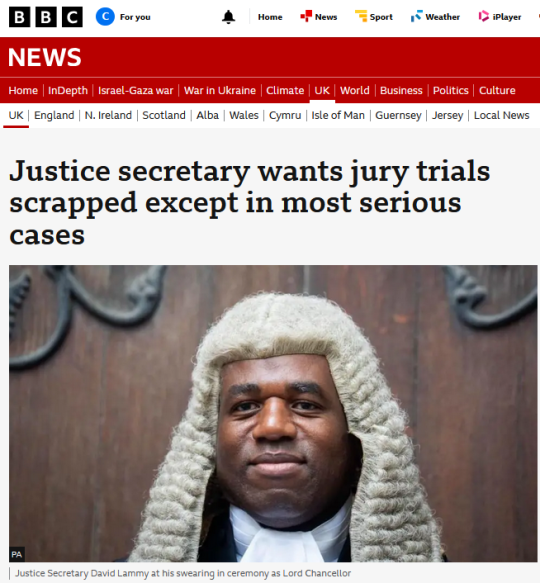
The plain answer is that this is a pilot for what they can get away with on the mainland when they abolish juries in such trials, as “Justice Secretary” David Lammy has announced that they will indeed do.
In Jersey the system is inherited from the Normans. The judge sits with two “jurats” or lay magistrates. They determine innocence or guilt. These come from a pool of 12 permanent jurats. In practice these are retired professionals and frequently have strong connections to the financial services industry.
What the jurats emphatically are not is Natalie Strecker’s working class peers of a kind who would be represented on a jury. I strongly recommend this brief article on the corruption of Jersey society by a man who was for 11 years the Government of Jersey’s economic adviser.
The judge, Sir John Saunders, seems a decent old stick in a headmasterly sort of way. He has told the court that “Mrs Strecker’s good character is not in doubt”. On Friday he stated that this was “A very difficult and in many ways a very sad case for the court to deal with. But I have to construe it according to strict legal principles”.
In the Palestine Action proscription case, as I reported, counsel for the UK government openly stated “We do not deny that the law is draconian. It is supposed to be”. In the mass arrests of decent people over Palestine Action, people have understood what a dreadfully authoritarian law the proscription regime is.
An intelligent observer cannot sit in Judge Saunders’ courtroom without realising that he thinks this is a dreadful law, but accepts that it is his job to enforce it. He reminds me of the caricature of the lugubrious headmaster stating “This is going to hurt me more than it is going to hurt you”.
In effect, Alison Morgan and the UK government are attempting through this prosecution to make even the most basic expression of support for Palestine a serious criminal offence. Remember that a terrorism conviction destroys your life – it almost certainly brings loss of employment, debanking and severe travel restrictions.
The International Court of Justice has decided that Israel has a real case to answer on Genocide, and most experts believe that Israel is committing Genocide. In Natalie’s correct image, the UK government is trying to make it a terrorist offence to say anything other than that the Palestinians should quietly submit to Genocide on their knees.
The danger is that the hubris of lay magistrates will lead the jurats to try cleverly to construe Natalie’s comments as support for terrorism in line with the government’s wishes. Natalie has, however, one defence in Jersey not available in mainland UK – here in Jersey the prosecution has to show intent: that she intended to cause support for terrorist organisations.
The prosecution has also relied on the extremely wide definition of support adopted in UK terrorist cases, that “support of” merely means “expression of agreement with”.
In defending the tweet about Hamas-run health ministry figures, Natalie Strecker’s counsel Luke Sette countered this rather well when he said: “there is no offence of causing people to think less badly of Hamas”
I confess however I am slightly puzzled that I have not heard the defence argue that the prosecution positions are grossly disproportionate violations of freedom of expression in terms of Article X of the European Convention of Human Rights.
I would have thought, for example, that was the natural thing to say in response to the prosecution’s contention that it would be a crime for a law lecturer to tell his class that the Palestinian people had the right of armed resistance in international law.
The verdict was decided yesterday afternoon between the judge and jurats. It will be presented in full written judgment in an hour’s time.
This is a truly horrifying case for Natalie, who cannot afford to lose her job with a Jersey government agency and most certainly does not wish to be jailed away from her children. I pinch myself to be sure that this is all really happening.
It is a truly horrifying case in terms of what the Starmer government intends to do on the mainland in further criminalising support for Palestine.
I do not support Hamas nor Hezbollah, being opposed to theocracy. But for it to be illegal to discuss the Genocide in Gaza and the role of these two organisations, unless you do it absolutely without either context or nuance, is Orwellian.
Western dissent is also a victim of the Zionist Genocide.
Hezbollah and Saudi Arabia’s uneasy détente
By Tamjid Kobaissy | The Cradle | December 2, 2025
In West Asia, where sectarian politics and external meddling collide with local power struggles, few rivalries have been as entrenched or as symbolically loaded as that between Hezbollah and Saudi Arabia.
For decades, it embodied the broader confrontation between Iran and the Persian Gulf kingdoms – a proxy war defined by ideology, oil, and shifting battlefronts. But today, under the weight of new regional calculations, rising Israeli belligerence, and the cracks in American hegemony, that once-intractable hostility is giving way to a more ambiguous and tactical coexistence.
What is developing is neither an alliance nor even reconciliation. But for the first time, Hezbollah and Riyadh are probing the edges of a relationship long defined by zero-sum enmity. A pragmatic detente is emerging, shaped less by goodwill than by the shared urgency to contain spiraling instability across the region.
Tehran, Riyadh, and the long shadow of history
The long arc of the Hezbollah–Saudi confrontation is impossible to separate from Iran’s post-revolutionary clash with Riyadh. When Ayatollah Ruhollah Khomeini toppled the Shah in 1979 and declared the House of Saud a reactionary tool of western imperialism, the rupture was both ideological and strategic.
The Saudis responded by bankrolling Saddam Hussein’s devastating war against Tehran, and in 1987, relations cratered after Saudi security forces massacred Iranian pilgrims in Mecca. Khomeini’s message was scathing:
“Let the Saudi government be certain that America has branded it with an eternal stain of shame that will not be erased or cleansed until the Day of Judgment, not even with the waters of Zamzam or the River of Paradise.”
Decades later, the so-called Arab Spring of 2011 reopened the wound. While Tehran stood by its state allies in Damascus and Baghdad, Riyadh threw its weight behind opposition movements and fanned the flames of sectarian conflict.
In Yemen, the kingdom launched a military campaign against the Ansarallah movement and allied forces, which Tehran backed politically and diplomatically. After Saudi Arabia executed outspoken Shia cleric Sheikh Nimr al-Nimr in 2016, Iranian protesters stormed the Saudi embassy in Tehran, prompting Riyadh to sever diplomatic ties. The two regional powers would only resume relations as part of Chinese-backed mediation in 2023.
From Hariri’s abduction to assassination plots
Within this regional maelstrom, Hezbollah became a prime Saudi target. When the Lebanese resistance captured two Israeli soldiers on 12 July 2006, to secure the release of prisoners, Riyadh dismissed it as “uncalculated adventures” and held Hezbollah responsible for the fallout.
In Syria, Hezbollah’s deployment alongside former Syrian president Bashar al-Assad’s army placed it in direct opposition to Saudi-backed militants. In Yemen, the movement’s vocal support for the Ansarallah–led government in Sanaa triggered Gulf Cooperation Council (GCC) sanctions and terrorist designations.
Matters escalated in 2017 when Saudi Arabia detained then-Lebanese prime minister Saad Hariri and coerced him into announcing his resignation on television from Riyadh. Late Hezbollah secretary-general Hassan Nasrallah slammed the move as an act of war against Lebanon. The situation de-escalated only after French mediation.
In a 2022 TV interview, Nasrallah revealed that Saudi Crown Prince Mohammed bin Salman (MbS) was ready to authorize an Israeli plot to assassinate him, pending US approval.
Quiet channels, Iranian cover
The Beijing-brokered rapprochement between Tehran and Riyadh changed the regional tone but did not yield immediate dividends for Hezbollah. On the contrary, Saudi Arabia intensified its efforts to roll back Hezbollah’s influence in Beirut, especially following Israel’s October assault on Gaza and southern Lebanon.
Riyadh pressured Lebanese Prime Minister Nawaf Salam to implement the so-called “Barrack Paper,” aimed at politically sidelining Hezbollah and stripping its arms. Speaking to The Cradle, a well-informed political source reveals that the kingdom informed the former Lebanese army commander – now the country’s president – Joseph Aoun, that it would proceed with its plans even if they triggered civil war or fractured the military. The source describes this as emblematic of Riyadh’s short-term crisis management, mirroring Washington’s reactive regional strategy.
Despite this, signs of a tactical shift began to emerge. In September, Nasrallah’s successor, Sheikh Naim Qassem, publicly called for opening a “new chapter” in ties with Riyadh – an unprecedented gesture from the movement’s leadership. According to the same source, this was not a spontaneous statement.
During a visit to Beirut, Iranian national security official Ali Larijani reportedly recieved a message from Hezbollah to Riyadh expressing its openness to reconciliation. In a subsequent trip to the kingdom, Larijani presented the message to MbS.
While initially dismissed, it was later revisited, leading to discreet backchannel coordination directly overseen by Larijani himself.
Tehran talks and guarded understandings
The Cradle’s source adds that since then, three indirect rounds of Hezbollah–Saudi talks have reportedly taken place in Tehran, each under Iranian facilitation. The first focused on political de-escalation, while the latter two addressed sensitive security files, signaling a mutual willingness to test limited cooperation.
One provisional understanding emerged: Saudi Arabia would ease pressure on Hezbollah in Lebanon and drop immediate demands to disarm the movement. In exchange, Riyadh asked Hezbollah to keep its weapons out of Syria – echoing a broader Gulf consensus – and assist Lebanese authorities in curbing drug smuggling networks.
In private, Riyadh reportedly acknowledges Hezbollah’s military resilience as a strategic buffer against Israel’s regional belligerence. The Persian Gulf states no longer trust Washington to shield them from Tel Aviv’s increasingly unilateral provocations – as was seen in the Israeli strikes on Doha in September. But Hezbollah’s dominance in Lebanon remains a challenge to Riyadh’s political influence.
Hezbollah, Saudi Arabia, and the Iranian umbrella
The Hezbollah–Saudi contacts are just one strand in a broader strategic dance between Riyadh and Tehran. According to The Cradle’s source, Saudi Arabia has assured Iran it will not join any Israeli or US-led war, nor allow its airspace to be used in such a scenario. In return, Tehran pledged not to target Saudi territory. These commitments are fragile, but significant.
The source also reveals that US President Donald Trump had authorized MbS to explore a direct channel with Iran, tasking him with brokering understandings on Yemen and beyond. Larijani conveyed Iran’s openness to dialogue, though not to nuclear concessions. MbS reportedly stressed to Trump that a working accord with Tehran was essential to regional stability.
In parallel, Lebanese MP Ali Hassan Khalil, a close advisor to Parliament Speaker Nabih Berri, is expected to visit Saudi Arabia soon following meetings in Tehran. This suggests continued shuttle diplomacy across resistance, Iranian, and Saudi nodes.
Strategic divergence, tactical convergence
Still, no one should confuse these developments with a realignment. Rather than a reset, this is merely a tactical repositioning. For Riyadh, the old boycott model – applied to Lebanon between 2019 and 2021 – failed to dislodge Hezbollah or bolster pro-Saudi factions. Now, the kingdom is shifting to flexible engagement, partly to enable economic investments in Lebanon that require minimal cooperation with the dominant political force.
The pivot also serves Saudi Arabia’s desire to project itself as a capable mediator rather than a crude enforcer. The 7 October 2023 Operation Al-Aqsa Flood has tilted regional equations, while Israeli expansionism has become a destabilizing liability. A Hezbollah–Israel war would not stay confined to the Blue Line. Gulf cities, energy infrastructure, and fragile normalization deals would all be at risk.
From Hezbollah’s side, the outreach reflects both constraint and calculation. The resistance faces growing pressure: an intensified Israeli campaign, a stagnating Lebanese economy, and the need to preserve internal cohesion. A tactical truce with Riyadh offers breathing space, and possibly, a check against Gulf-backed meddling in Syria.
When Sheikh Naim Qassem declared that Hezbollah’s arms are pointed solely at Israel, it was also a signal to the Gulf: we are not your enemy.
The real enemy, for both sides, is the unpredictable nature of Israeli escalation. Riyadh fears being dragged into an Israeli-led regional war that it cannot control. Hezbollah fears encirclement through economic, political, and military pressure. Their interests may never align, but for now, they are no longer mutually exclusive.
Will Saudi Arabia fund Israel’s grip over Lebanon?
By Mohamad Hasan Sweidan | The Cradle | Novmber 27, 2025
In the wake of Israel’s November 2024 apparent ceasefire with Lebanon, Tel Aviv has moved to reshape the post-war order in its favor. Treating Lebanon as a weakened and fragmented state, Israel seeks to impose a long-term, unilateral security and economic regime in the south, bolstered by US backing.
Simultaneously, Saudi Arabia has thrust itself into the reconstruction process as the main Arab financier. But the kingdom risks becoming a junior partner in an Israeli-American project that sidelines it from real decision-making. The question facing Riyadh is clear: Will it bankroll its own marginalization?
Tel Aviv’s vision: Disarmament, deterrence, domination
Israel’s strategy for Lebanon extends far beyond the oft-repeated demand to disarm Hezbollah. It envisions a sweeping transformation of Lebanon into a demilitarized satellite state governed under a US-Israeli security framework. Nowhere is this clearer than in Tel Aviv’s insistence on remaining inside Lebanese territory until Hezbollah is stripped of its deterrent capabilities, not just south of the Litani River, but across the country.
Israeli Defense Minister Israel Katz and former Northern Command chief Uri Gordin have both publicly outlined this goal. Gordin even suggested establishing a permanent buffer zone inside Lebanon to serve as a “bargaining chip” for future negotiations, while Katz confirmed that Israeli forces would remain indefinitely in the south. Tel Aviv no longer seeks temporary deterrence, favoring permanent subordination.
Katz, for his part, has stated “Hezbollah is playing with fire,” and called on Beirut to “fulfill its obligations to disarm the party and remove it from southern Lebanon.”
Most recently, while addressing the Knesset, he warned that “We will not allow any threats against the inhabitants of the north, and maximum enforcement will continue and even intensify.”
“If Hezbollah does not give up its weapons by the year’s end, we will work forcefully again in Lebanon,” Katz reiterated. “We will disarm them.”
According to this blueprint, Lebanon is not considered a sovereign neighbor, but a security appendage to Israel’s northern frontier. State institutions are expected to serve as administrative fronts for a de facto Israeli-American command center. International aid, including funding from Arab states of the Persian Gulf, is being weaponized to enforce this new security-economic order.
From the perspective of Israel, the goals in Lebanon are not limited to the disarmament of Hezbollah. They go beyond that toward a deeper project of transforming Lebanon – especially the south – into a kind of security-economic colony.
This includes consolidating a long-term military presence, imposing new border arrangements, and paving the way for settlement projects or institutionalized buffer zones, as evidenced by current maps showing the presence of Israeli forces at several points inside Lebanese territory.
Saudi Arabia’s options: Pressure or partnership
Enter Riyadh. The Saudi Foreign Ministry has repeatedly called for Lebanese arms to be confined to the state and endorsed the implementation of the 1989 Taif Agreement.
In September, Saudi Foreign Minister Faisal bin Farhan, in a speech to the UN General Assembly, stressed that:
“Saudi Arabia stands with Lebanon, supports everything that strengthens its security and stability, and welcomes the efforts of the Lebanese state to implement the Taif Agreement (1989), affirm its sovereignty, and place weapons in the hands of the state and its legitimate institutions.”
The Saudi envoy to Lebanon, Yazid bin Farhan, reiterated Riyadh’s position: the exclusive right to possess arms must lie with the Lebanese state. In private information, during a meeting between Bin Farhan and Sunni leaders in Lebanon, the diplomat stressed that pressure must be put on disarming the party, even if that requires reaching a civil war.
On the surface, Saudi and Israeli objectives appear aligned. Tel Aviv applies military pressure. Riyadh applies economic and political pressure. Both demand the end of Hezbollah’s armed presence. But while Israel’s aim is absolute control over Lebanon’s security order, Saudi Arabia still seeks a political system that reflects its influence. In this, Tel Aviv’s ambitions collide with Riyadh’s.
However, Israel has no intention of sharing influence with any Arab state – nor even Turkiye. Its model is exclusionary. It views Riyadh not as a partner, but as a bankrolling mechanism to finance the dismantling of Lebanon’s axis of resistance under Israeli terms. As former deputy director of the National Security Council, Eran Lerman put it, Saudi Arabia is merely a pressure tool to bring Lebanon to heel.
Thus, the crux of the matter is this: Riyadh may envision itself as a key stakeholder in post-war Lebanon, but Israel sees it as a disposable auxiliary.
The 17 May redux: Recolonizing south Lebanon
To grasp the depth of Israel’s project, one need only look to its precedents. In 1983, Israel, alongside the US and under Syrian oversight, tried to enshrine a similar model via the 17 May Agreement. That deal called for an end to hostilities, gradual Israeli withdrawal, a “security zone” in the south, and joint military arrangements. In practice, it turned Lebanon into a protectorate tasked with safeguarding Israeli security interests.
Today, after the 2024 war, Tel Aviv is resurrecting that same formula. Israeli forces have remained stationed at multiple points inside Lebanon despite the ceasefire terms mandating full withdrawal. Airspace violations and near-daily raids persist under the pretext of preventing Hezbollah from “repositioning.” Think tanks in Tel Aviv, alongside joint French-US proposals, are now pushing phased disarmament: first the south, then the Bekaa, then the Syrian border, ultimately ending all resistance capabilities.
International support is being dangled as a carrot. Aid from the US, France, Saudi Arabia, Qatar, and others is contingent on Lebanon executing a disarmament plan under International Monetary Fund (IMF) oversight and within a strict timeline. This is the economic arm of the Israeli security project.
More dangerously, Israeli studies suggest that reconstruction of southern villages should be explicitly tied to the removal of resistance forces, while preserving “full freedom of action” for the Israeli army in Lebanese air and land space.
Can Riyadh afford Tel Aviv’s trap?
In parallel with this vision, western analyses close to decision-making circles in Washington and Riyadh show that Saudi Arabia itself sees Lebanon as a pivotal arena in its conflict with Iran. Any serious return to the Lebanese file is linked to the weakening of Hezbollah’s influence.
But the key divergence between the Saudi and Israeli approaches lies in a critical question: Who ultimately holds the keys to decision-making in Lebanon?
Riyadh aims to use its financial and political capital to recalibrate the Lebanese political order in its favor, minimizing Iranian sway while reinforcing its own influence. But Israel’s plan is more radical: to redefine Lebanese sovereignty altogether, placing it under perpetual Israeli security oversight.
In this model, Saudi Arabia – and any other Arab state – is reduced to the role of financier, tasked with implementing terms written in Tel Aviv and Washington rather than contributing an independent Arab vision for the region.
From this angle, Tel Aviv’s persistent invocation of the “military option” in Lebanon works against Gulf interests. It positions Riyadh and its allies as the paymasters for reconstruction, forced to foot the bill for a post-war settlement they had no role in shaping.
If Saudi Arabia concedes to this logic – and fails to leverage its influence in Washington, in Arab diplomatic circles, and in donor mechanisms – it risks forfeiting Lebanon to a joint Israeli-American order.
That order would mirror the defunct 17 May Agreement, only more deeply entrenched. Lebanon would not only be demilitarized. It would become a living model of “security-economic conjugation,” designed to recalibrate regional influence away from the Arab world and toward an Israeli-dominated Levant.
Israel fortifying outposts in southern Lebanon in violation of ceasefire
Press TV – November 26, 2025
Satellite imagery shows Israel continues to occupy and fortify military positions in southern Lebanon in violation of Lebanese sovereignty, one year after signing a ceasefire with Hezbollah.
According to Planet Labs PBC, the Israeli military occupies five strategic positions along the Blue Line, the de facto border between Lebanon and the occupied territories. These positions are surrounded by earthen fortifications and connected by widened access roads.
The outposts, covering one to two hectares each, include sections for temporary buildings and military vehicles, according to an analysis by AFP, which says the access roads to these positions have also been significantly expanded to facilitate vehicle movement.
The westernmost base in the Labbouneh area lies only 150 meters from a UN peacekeeping station, while the easternmost on Hamames hill is about 1.5 kilometers inside Lebanese territory.
The analysis also shows near-total destruction of buildings in villages near the outposts due to Israel’s systematic demolition of infrastructure.
By maintaining control over southern Lebanese villages, Israel continues to violate the ceasefire it signed on November 27, 2024, which required a full withdrawal of its forces within 60 days.
Israel says it keeps these positions to ensure Hezbollah does not carry out military activities in the area.
However, analysts state that these fortified positions and demolitions mirror the war tactics employed by Israel in the Gaza Strip.
According to the United Nations Interim Force in Lebanon (UNIFIL), the regime’s forces have committed over 7,500 air violations and nearly 2,500 ground violations in the past year, totaling almost 10,000 breaches of the ceasefire.
In a latest violation, Israel assassinated top Hezbollah commander Haitham Tabatabai in a strike on a residential area near Beirut on Sunday.
Hezbollah warned that Israel has committed a grave mistake, saying the resistance group is considering its response to the killing.
Lebanese President Michel Aoun also condemned the attack, calling it a clear demonstration of Tel Aviv’s disregard for repeated international appeals. Aoun urged the global community to act to prevent further aggression against the Lebanese people.
Enemy plot against Lebanon similar to conspiracy imposed on Syria, says lawmaker
Press TV – November 16, 2025
A senior Lebanese lawmaker says his country does not need a new agreement given the fragile ceasefire that Israel repeatedly violates, warning that the occupying entity is devising a plot against Lebanon similar to the conspiracy imposed on neighboring Syria.
“Some in Lebanon insist on disarmament of Hezbollah and assert that the enemy will no longer have an excuse against Lebanon in case the resistance movement lays down arms,” Hussein Hajj Hassan, a member of Loyalty to the Resistance Bloc – the political wing of Hezbollah in the Lebanese parliament – said on Saturday evening.
“They believe the sole reason behind Israel’s aggression against Lebanon lies in Hezbollah’s weapons,” he said, adding that the plot the Tel Aviv regime is drawing up for Lebanon is akin to the conspiracy imposed on Syria.
“It involves creation of a buffer zone, continuation and expansion of the Zionist occupation, and destruction of the elements of power, not only the Hezbollah resistance movement, but also the government.”
Hajj Hassan noted that the talk of a new agreement with Israel is meaningless whilst the regime does not stand committed to the ceasefire deal concluded in November last year.
“The ceasefire agreement has been brokered by the United States and France, carries UN guarantees, and stipulates the withdrawal of Israeli forces from Lebanese territory, cessation of aggression, release of Lebanese prisoners, and reconstruction of the country. The need for a new deal is pointless, especially as the previous agreement has not been implemented at all by Zionist occupiers,” the Lebanese legislator said.
“Is there a resistance group and weapons in Syria? So why does the Zionist regime keep invading the country, occupying more land there, and affirming that it will not pull out?” Hajj Hassan questioned.
The Lebanese lawmaker highlighted that Syria’s ruling Hay’at Tahrir al-Sham (HTS) regime is allied to Washington, yet the Zionist regime is pressing ahead with its acts of aggression and occupation of Syrian territories.
“The more concessions you grant the Zionist enemy, the weaker you become. Hezbollah and national unity are the only guarantors of deterrence and defense,” he emphasized.
Israel and Hezbollah reached a ceasefire agreement that took effect on November 27, 2024. Under the deal, Tel Aviv was required to withdraw fully from the Lebanese territory—but has kept forces stationed at five sites, in clear violation of UN Security Council Resolution 1701 and the terms of last November’s agreement.
Since the implementation of the ceasefire, Israel has violated the agreement multiple times through repeated assaults on the Lebanese territory.
Lebanese authorities have warned that the Israeli regime’s violations of the ceasefire threaten national stability.
Syria’s HTS deploys foreign fighters to Lebanon border: Report
Press TV – November 13, 2025
Hayat Tahrir al-Sham (HTS) has reportedly deployed foreign Takfiri fighters from northern Syria to the border with Lebanon, sparking renewed concern over the group’s destabilizing activities and growing presence in the region.
According to sources cited by The Cradle, foreign militants affiliated with HTS were transferred in recent days from the Harem area in Idlib province to the city of al-Qusayr, near the Syrian–Lebanese border.
The movement reportedly coincided with the transfer of heavy military equipment, including armored vehicles and other hardware.
“At the same time, forces affiliated with the Ministry of Defense of the ‘Syrian Transitional Government’ attempted to advance and take positions inside Lebanese territory, specifically in the Wadi al-Thalajat area of Ras al-Maara, along the Syrian–Lebanese border in the Damascus countryside,” the sources said, referring to barren areas where the Lebanese army is not present.
These reports emerge shortly after Washington announced Syria’s participation in the US occupying coalition in the Arab country, as Abu Mohammed al-Jolani — once affiliated with al-Qaeda and Daesh — arrived in Washington on Sunday.
The HTS military remains deeply infiltrated by extremist elements. Many of its current commanders and officers are known former members of al-Qaeda and Daesh factions.
The reported buildup of HTS-linked forces near Lebanon coincides with renewed US threats that such militias could be deployed against Hezbollah.
On Friday, US envoy Tom Barrack said that “Damascus will now actively assist us in confronting and dismantling the remnants of ISIS, the IRGC (Islamic Revolution Guards Corps), Hamas, Hezbollah, and other terrorist networks, and will stand as a committed partner in the global effort to secure peace.”
Analysts warn that the alignment of US policy with extremist-leaning Syrian factions such as HTS risks reigniting cross-border violence and undermining the security achieved by Hezbollah and the Lebanese Armed Forces after expelling Daesh and al-Qaeda elements from Lebanon’s eastern border in 2017.
Jolani told the Washington Post in an interview that “good” progress has been made in direct talks to reach an agreement with Israel, while boasting about weakening the Axis of Resistance on behalf of Tel Aviv.
“Israel has always claimed that it has concerns about Syria because it is afraid of the threats that the Iranian militias and Hezbollah represent. We are the ones who expelled those forces out of Syria,” he said.
“The US is with us in these negotiations, and so many international parties support our perspective in this regard. Today, we found that Mr. Trump supports our perspective as well, and he will push as quickly as possible in order to reach a solution for this,” he added.
Jolani also met with US-based Syrian rabbi Yosef Hamra.
Hebrew reports have revealed that a main part of the agreement will likely involve HTS–Israeli intelligence sharing and cooperation against the Axis of Resistance, specifically Iran and Hezbollah – which helped the former government recapture large swathes of Syria from al-Qaeda and Deash.
Israel carried out heavy strikes in Damascus and elsewhere in southern Syria earlier this year, under the pretext of protecting the Druze minority from Jolani’s extremist forces.
Now, it continues to carry out incursions, seize territory, and expand the occupation it established after the fall of former Syrian president Bashar al-Assad’s government last year.
Yet Jolani and other HTS officials have repeatedly signaled that they pose no threat to Tel Aviv.
The deployment of Takfiri fighters along the Lebanese border serves as a pretext for confronting resistance groups and advancing Israeli interests, coming as Israel continues its repeated acts of aggression across Syrian territory following the collapse of former President Bashar al-Assad’s government late last year.
Analysts are asking why al-Jolani does not deploy any forces against Israel, which continues to attack and occupy parts of Syria almost daily.
The HTS-led regime will reportedly hand over the occupied Golan Heights to Israel as part of a looming normalization deal with the illegal entity.
Since taking power, HTS has committed widespread war crimes and brutal repression, particularly against minority communities such as the Alawites, who have faced targeted violence, as Syria has experienced waves of sectarian and regional unrest under the group’s control.
Featured Video

or go to
Aletho News Archives – Video-Images
From the Archives
Israel Would Have No Qualms About USS Liberty-Style FALSE FLAG If Iran Campaign Falters – Analysts
By Ilya Tsukanov – Sputnik – 18.06.2025
Donald Trump is mulling whether or not to join Israel’s aggression against Iran as Tel Aviv faces problems sustaining its defenses against growing counterstrikes, and apparently lacks a realistic game plan for an end to hostilities after failing to achieve its goals. Analysts told Sputnik how the US could be ‘nudged’ into the conflict.
“The US is already assisting Israel with supplies, intel, refueling support, etc. One of the many US posts in the region could be attacked for a casus belli,” former Pentagon analyst Karen Kwiatkowski explained.
“If Trump doesn’t comply with Israel’s demand” and join its aggression voluntarily, “a false flag may be needed” to drag the US in, Kwiatkowski, retired US Air Force Lt. Col.-turned Iraq War whistleblower, fears.
Netanyahu has a diverse array of options at his disposal, according to the observer, including:
- a false flag against US assets abroad blamed on Iran or one of its Axis of Resistance allies, like the Houthis
- a US domestic attack or assassination blamed on Iran
- Iranian air defenses ‘accidentally’ hitting a civilian jetliner carrying Americans
- use of a dirty bomb or nuclear contamination somewhere in the region blamed on Iran
- even blackmailing by threatening to use nukes against Iran if the US doesn’t join the fight
Kwiatkowski estimates that Israel probably has “enough blackmail power” against President Trump and Congress to avoid the necessity of a false flag operation, but a “USS Liberty-style” attack, targeting the soon-to-be-retired USS Nimitz supercarrier that’s heading to the Middle East, for example, nevertheless cannot be ruled out entirely, she says. … continue
Blog Roll
 Aletho News
- Smotrich calls for annexation of South Lebanon to Litani River
- Echos of Gallipoli? Hormuz and the Geography of Hubris
- Pakistan PM backs Iran’s right to self-defense amid tensions
- Hungary blasts ‘fake’ EU accusation
- SAFE Debt Trap: Poland’s €43.7 Billion Bet on Unipolar Illusion
- War on Iran threatens global Gulf capital flows: FT analysis
- Mossad De Facto Admits To Inciting Riots In Iran
- Tehran: World grown thoroughly exhausted with US-Israeli ‘false flag storylines’
- Trump ‘stuck between a rock and a hard place’, lacks Iran war strategy: Ex-CIA chief
- Trump’s bombardment of fake news so far is working quite well. But where is it heading?
- If Americans Knew
- From Sde Teiman, the truth about Israel’s military justice system has been set free
- Child denied life-saving bone marrow transplant by Israel ‘because he is from Gaza’
- Raffi Berg: BBC Middle East Editor Exposed as CIA, Mossad Collaborator
- Jerusalem Archbishop Rebukes Netanyahu’s Statements on Christianity
- US to embed Palantir AI across entire military: Report
- Israeli-US war on Iran to drag on “a few more weeks” – Not a ceasefire Day 164
- Lebanon deaths top 1,200; Palantir AI to be embedded across US military – Not a ceasefire Day 163
- Israel’s assassination game: Take all pragmatists off the board
- Food shortages return to Gaza as Israel tightens aid restrictions under the cover of its war on Iran
- Trump demands trillions in payments from Gulf countries, billions from Harvard – Not a ceasefire Day 162
- No Tricks Zone
- Devastating Assessment Of Comirnaty Vaccine By Former Senior Pfizer Europe Toxicologist
- New Study: CO2 Is ‘Effectively Negligible’ As An Explanatory Climate Change Factor Since 2000
- Former Pfizer Toxicologist Dr. Helmut Sterz Tells Bundestag Hearing Pfizer Vaccine Should Have Never Been Approved
- Energy Expert: Germany’s Nuclear Phaseout Was A “500 Billion Euro Mistake”
- New Research: South Australia’s Mid-Holocene Sea Surface Temperatures Were 4°C Warmer Than Today
- Storing Green Energy To Last Germany 10 Days Would Require A 60-Million Tonne Battery
- New Studies: UK Sea Levels Were 4 Meters Higher Than Today During The Mid-Holocene
- Destructive Green New Deal: German Energy And Metal Group Warns Of Drastic Crisis
- New Study Documents A 20-Year Pause In Arctic Sea Ice Decline – Driven By Internal Variability
- Wake-up Call: Survey Shows Majority Of Germans Now Favor Postponing Climate Targets!
 Aletho News