Lebanon: March 14 Christians on Shaky Ground With Hariri
By Maysam Rizk | Al-Akhbar | January 20, 2014
Lebanon’s March 14 Christians are banding together in an attempt to pressure former Prime Minister Saad Hariri about the government. However, their game will be over very soon. According to March 14 sources, “March 14 Christians are used by Hariri to fuel his battles then sacrificed when a settlement is reached.”
The smile on Lebanese Forces leader Samir Geagea’s face was not enough to convince French presidential envoy Emmanuel Bon that the situation is well. Geagea stressed that Hariri would never join Hezbollah in one government. Yet no matter how hard Geagea attempts to show confidence in his relationship with Hariri, he will never manage to cover up their discords.
Geagea remarked, “We are still in the stage of deliberations and negotiations regarding the government,” perhaps not noticing that Hariri announced from The Hague his willingness to join Hezbollah in the government.
MP Sami Gemayel spoke to Geagea via telephone for 15 minutes, assuring him that Kataeb will boycott the government, even if Hariri participates. He expressed his support for Geagea’s position favoring a neutral cabinet. Sami later announced, “We are not concerned with the nature of the government. What matters is its agenda.” Perhaps Sami had heard about Hariri’s positive attitude before the rest of Lebanese, hence his taking a middle ground.
Former minister Boutros Harb seemed ready to overcome the tensions that emerged between the Lebanese Forces and March 14 independent figures following the debate over the infamous Orthodox Electoral Law. Due to Hariri’s “concessions,” Harb now sees his alliance with the Lebanese Forces as the only available option to confront Hariri’s waiving of March 14 demands, mainly Hezbollah’s withdrawal from Syria.
At the peak of the confrontation, Hariri left his allies blundering. According to leaked information, Hariri’s statements on the sidelines of the Special Tribunal for Lebanon show “he is holding negotiations with the opposite side while his allies are in a whole different place.” Some March 14 sources even stressed that Hariri is going to participate in the upcoming cabinet “even if his allies refuse to join him.”
Hariri is willing to drop his Christian-Muslim partnership, and “March 14 will no longer be united.” Sources confirmed that Hariri cannot be part of any compromise regarding the government unless he receives a Saudi order.
March 14 Christian sources said, “There has been no Saudi password. Riyadh left the decision to its people in Lebanon so they do what they deem suitable. Hence, Hariri is seeking his own interests, not those of his alliance! Despite all that, some in Geagea’s and Gemayel’s circles still believe that Hariri negotiators are trying to reach a compromise that would include the Baabda Declaration in the government statement and would omit the word ‘resistance’ in order to gain leverage against Hezbollah.”
The Christian wing of March 14 is counting on “Sunni politicians to continue what Maronite politicians started in their policies against Syrian and Iranian hegemonies,” said a source. They hope Hariri “will change his mind about joining a government with Hezbollah if the party doesn’t return to the state and comply with all conditions.”
Geagea didn’t make any “loud statement” concerning Hariri’s latest remarks, neither did Gemayel, Harb, or anyone who sees himself as future president. These politicians are seeking to “buy time and announce positions that they can concede to Hariri when the time comes.”
Some March 14 Christians are convinced that “Hariri is not very pleased with his alliance with Geagea and Gemayel. Even though they all shared a common political position in 2005, Hariri still believes that he naturally belongs alongside Nabih Berri and MP Walid Jumblatt, whom his father used to reach compromises with.”

STL defense dismisses prosecution’s “circumstantial” evidence
Al-Akhbar | January 17, 2014
The defense counsel of four Hezbollah members accused of planning the 2005 assassination of former Lebanese Prime Minister Rafik Hariri dismissed evidence presented by the prosecution over Thursday and Friday as unverifiable “observations.”
Prosecutors offered nothing new during their opening arguments, the defense team said at a press conference Friday evening after the Special Tribunal for Lebanon (STL) went to recess.
“There is nothing new in the presentation the prosecutor presented at the beginning of the trial,” Antoine Korkmaz, one of the defense lawyers for the suspects being tried in absentia, told reporters.
“We have not heard anything about the content of the conversations that the prosecutor claims were made between the defendants,” he added.
“The burden of proof lies with the prosecution,” and so far it has only provided circumstantial evidence that does not prove the suspects were behind the bombing that killed Hariri and 21 others on February 14, 2005.
Nor did the prosecutor explain the motive behind the killing of Rafik Hariri, he added, saying that the billionaire maintained good relations with Hezbollah before his assassination.
“The evidence presented by the prosecutor is only theoretical,” defense lawyer Yasser Hassan added. “We have not seen anything new, and there is no court that could issue convictions on the basis of speculation.”
The defense will present their counter arguments when The Hague-based court resumes on Monday.
Who Benefits from the Shatah Assassination?
By RANNIE AMIRI | CounterPunch | January 3, 2014
The burial of former Lebanese Finance Minister Mohammed Shatah next to assassinated ex-premier Rafic al-Hariri in Beirut’s Muhammad al-Amin mosque was as striking and deliberate in symbolism as the towering structure itself.
Last Friday’s assassination of the Hariri family’s senior advisor and one-time U.S. ambassador was by similar method: a massive car bomb detonated under his convoy as it drove through the heart of Beirut’s upscale downtown district. As if to purposefully underscore the parallels and frame the post-assassination narrative, it also occurred just a few hundred yards from the site where the billionaire Hariri was murdered in February 2005.
Just as after Hariri’s killing, the calculated recriminations of the March 14 coalition, led by the Future Movement, came fast and furious. Blame was laid squarely at the feet of Hezbollah. March 14 supporters were quick to point out that the crime took place less than three weeks before the Special Tribunal for Lebanon (STL; the U.N.-established court tasked with investigating the Hariri assassination) was set to open proceedings against four accused Hezbollah members.
The shoddy STL investigation, relying heavily on telecommunications data wholly compromised by Israeli intelligence and their captured agents, has been previously discussed.
Did the masterminds of the Shatah assassination hope the Lebanese population would turn against Hezbollah, already facing strong rebuke for its intervention in Syria by March 14 politicians (despite that the latter have implicitly lent support to radical takfiri elements involved in the Syrian conflict since its earliest days)?
As with all political upheavals in Lebanon, the question that must be asked is, “who benefits?” Does Hezbollah? Although Shatah was a stalwart March 14 operative who decried Hezbollah’s role in Syria, he was nevertheless regarded as a relative moderate. But the increasingly virulent sectarian discourse of those on the fringes of this political alliance (and many at its center) and the cover they have extended to extremists like fugitive Sheikh Ahmad al-Assir, cannot be ignored. Beirut after all, is still reeling from recent twin suicide car bombings at the Iranian embassy followed shortly thereafter by the assassination of Hezbollah senior commander Hassan al-Lakkis. On Thursday, innocent Lebanese civilians were again victims of a car bomb detonated in the Haret Hreik neighborhood of Beirut’s Shia-majority southern suburbs, known as the dahiyeh.
“Moderate” Sunni politicians like Shatah are viewed as expendable, for their killing only serves to polarize the wider Sunni community by inciting sectarian hatred and thereby marginalize more reasoned voices. Even Lebanon’s Grand Mufti was not spared as he was accosted after mourners’ passions were stoked by Sheikh Ahmad al-Omari, the cleric who delivered the sermon at the funeral of a young man also killed in the assassination. As Al-Akhbar reports, “Omari attacked Hezbollah, describing it as the ‘party of the devil.’ He called on the Shia to ‘disown’ Hezbollah ‘if they are true believers,’ and stressed the ‘patience of the persecuted Sunni sect is running out.’”
Again, does Hezbollah achieve any gain, political or otherwise, with Shatah’s demise?
The irony is that the inflammatory rhetoric and policies of March 14 parliamentary bloc members have led to the exponential growth of radical forces in the country. One only has to recall how former Prime Minister Fouad Siniora, Bahia Hariri and others insinuated the Lebanese Army was responsible for provoking Salafist cleric al-Assir’s armed forces to launch an attack against them this past summer in Sidon, killing 18.
Son of the late prime minister and Future Movement head Saad Hariri also did not waste any time in essentially blaming the victims themselves for Thursday’s attack: “They are at the same time victims of [Hezbollah’s] involvement in foreign wars, particularly in the Syrian war.”
The northern city of Tripoli and the Ain al-Hilwah Palestinian refugee camp near Sidon have provided extremist groups with safe refuge. Details have now emerged pointing to a possible link between those in the camp and recent events.
Just as in Iraq, moderate Sunni politicians have been singled out for assassination by takfiris who seek to exploit their spilled blood, provoke co-religionists into committing crimes against civilians and stir a simmering sectarian pot.
Who are the likely perpetrators behind Mohammed Shatah’s assassination and the dahiyeh bombing?
The very same ones the U.S. and Saudi-backed March 14 coalition have emboldened.
Rannie Amiri is an independent commentator on Middle East affairs.
Related articles
Syria as a Bridge
By Robert Thompson | Axis of Logic | March 8, 2009
The good news is that two envoys have been sent by the USA to Damascus, and that they have discussed with the Syrian Foreign Minister what can be done to improve Syria’s relations with the USA, now that a new régime is in place in Washington.
The bad news is that these envoys (and their bosses) seem to have expected Syria, as part of this aim, to give up all its present diplomatic and other links with some of its principal local friends and allies in the region, especially Hezbollah, Hamas, and (above all) Iran. If this is indeed so, it shows a staggering lack of understanding, not only of Syria, but also of the whole Near and Middle East on the part of the US State Department under the direction of Mrs Hillary Clinton [who seems to think that Syria should be yoked to an alliance with U.S. backed Sunni regimes].
The Syrian Ba’ath Party remains (as its founders, Michel Aflaq and Salah-al-Din Bitar always intended) strictly secular, and its links with theocratic bodies and governments are based on practical strategic concerns and on shared interests which are not linked to any religious affinities. Beyond this, the Syrian government has the good sense to wish to remain in close touch with the vast majority of the inhabitants of all the Arab states. This is in stark contrast, very clearly, with the behaviour and policies of the many Arab rulers who, effectively to protect themselves from their own subjects, have decided to shelter under the protection of the USA and the Zionists.
The rulers of the USA must also bear in mind that a significant and strategic area of Syrian territory is still under harsh enemy occupation. We, on the sidelines, can only wonder what the Obama régime, with its ‘diplomacy’ being mismanaged by Mrs Clinton, thinks it can do, if it believes that it can bully Syria into joining the club of Arab states which have been neutered to make them do as the Zionists/Neocons wish.
The very sensible proposal put forward once again by Syria (using much more polite words than I do) is that it should serve as a bridge linking the USA, the Zionist entity and their servile allies on the one hand, and the people of the Near and Middle East on the other. If the Neocons/Zionists really wanted peace in the area, they would not hesitate a second to welcome such a proposition. Any hesitation can only be a sign that they wish merely to make much of pretending to work for peace, while doing all that they can to ensure that justice continues to be denied to the Palestinians, the Syrians, and the Lebanese, all of whom seek liberation from the atrocities inflicted on them by the Zionist war machine.
It would appear that even the Obama régime has finally understood the sheer lunacy of the expression (invented for Mr George W. Bush by Mr David Frum) ‘Axis of Evil’ in grouping Iran and Syria with North Korea. These three states are so dissimilar that it is hard to follow what this expression was intended to mean. The USA has every interest in having the best of relations with both Iran and Syria; and if they wish to get anywhere in solving the multiple problems arising from the chaos of Afghanistan, they could not do better than to cooperate closely with Iran. Both parties have similar concerns relating to that unhappy country.
To revert to the question of relations between the USA and Syria, some humility on the part of the former would not come amiss, since Syria is no threat to any of the USA’s genuine interests. It is fully understandable, though, that Syria would be extremely happy to see its turbulent south-western neighbour converted into a single democratic and secular state, based on justice, in which its citizens of any religion or none would have equal rights and duties. Apart from the benefits that the whole world would enjoy if peace could return to the Near and Middle East, the USA has no vital interests in that part of the world. The sooner they withdraw their occupation forces from the area, the better it would be for the ordinary citizen (and taxpayer) in the US, as well as for the rest of the world.
The basic problem remains, as ever, the greedy desire by the rulers of the USA to dominate the whole world, and I cannot get out of my mind the fact that the command structure based in Diego Garcia is known as CENTCOM (i.e. Central Command). I would still like a satisfactory answer to explain what it is ‘central’ to, for the USA.
My conclusion is that the USA has every interest in taking advantage of any assistance which Syria can give them, and should be grateful for it. However, I cannot see this being welcomed by the Zionist entity based on (and only held together by) its viciously rigid apartheid system!
© Copyright 2009 by AxisofLogic.com
Lines of the Game: Price to Pay for the Shatah Assassination
By Sami Kleib | Al-Akhbar | December 28, 2013
The assassination of former Lebanese Finance Minister Mohammed Shatah will open a dangerous chapter in Lebanon, a bit similar to the one that followed the assassination of late Prime Minister Rafik Hariri. Shatah was no ordinary man in the region, and the attack occurred at a crucial moment in Lebanon and its neighborhood’s history. Here, escalated tensions and sedition will never let such a crime pass by without major repercussions. The killer knew it!
Hariri’s assassination in 2005 was a turning point for Hezbollah’s image in the Arab and Islamic world, and contributed to the Syrian army’s withdrawal from Lebanon. These events weren’t just a result of local demands. Former US President George W. Bush and his French counterpart Jacques Chirac were also involved.
The Sunni-Shia strife that ripped Iraq apart after the American-British invasion was further consolidated when Hezbollah, with its large Shia base, was accused of murdering the new symbol of modern Sunnism in the region: Rafik Hariri. Back then, political accusation preceded all real investigations on the ground.
Now, what to expect after Shatah’s assassination?
Former Lebanese Prime Minister Saad Hariri was brief, while Future bloc leader Fouad Siniora elaborated, hinting that the Syrian regime planned the crime, and its Lebanese allies, mainly Hezbollah, carried it out. In the March 14 statement, Siniora echoed the calls that followed Hariri’s murder, urging to take Shatah’s assassination to the international level, something we expect to hear quite often in the coming weeks amid international pressure on Hezbollah and Lebanon.
Head of the National Struggle Bloc MP Walid Jumblatt was alone in his call for reason and moderation. He knows quite well that some are seeking to exploit the assassination to achieve bigger political gains. He also understands that this assassination is apt to take the country from sectarian sedition to the battlefield.
The Shatah assassination occurred while Lebanon was at a crossroads. The future government and the current presidency are now up for grabs amid political bickering between Hezbollah and March 14. But behind both parties is a larger and deeper conflict taking place in Syria.
The assassination ought to increase pressure on the formation of a Lebanese government and a formula for a presidential agreement. Previously hesitant, the international community is now expected to support these solutions as the death of Shatah and the other martyrs raised the alarm about a bloody year awaiting Lebanon.
Shatah’s murder also paves the way for further assassinations, clashes, and blasts. Obviously there is a plan to transform Lebanon into an arena for a regional and international conflict that has not been settled in Syria.
What if a Hezbollah leader or ally is killed in the coming days? Will we hear that it is a retaliation for the Shatah murder? Who will break this vicious cycle?
Israel may also find an opportunity to conduct a military operation. It is reported that Hezbollah’s incursion in Syria and the widening rift with its former Sunni base offers Israel the right opportunity to strike. In Lebanon, Israel may redeem what it couldn’t achieve in Iran. At least that’s what the Israelis believe.
The assassination put the Syrian regime and Hezbollah in a raging storm of accusations at a critical time. The world is heading toward the Geneva II conference and an historic understanding with Iran. The international tribunal investigating Hariri’s murder will soon begin its sessions.
Martyr Mohammed Shatah was no ordinary man. Neither was martyr Wissam al-Hassan. Shatah, a man with hefty economic and political baggage, was, just like security man Hassan, standing on a pivotal local, regional, and international intersection. With such assassinations, it is easy to point figures, but it is hard to support accusations with evidence as political exploitation comes in smoothly.
A dark period of major transformation is awaiting Lebanon, but unfortunately the fierce battle ahead won’t yield any winners. What if a fait accompli government was imposed on Hezbollah and its allies? How will Hezbollah Secretary General Hassan Nasrallah put his words “don’t mess with us” into action? Those messing with him this time will have an international cover far larger than the one they had before the assassination.
Related article
Beirut murder: Dirty tricks get dirtier
By Finian Cunningham | Press TV | December 28, 2013
The latest deadly attack in Lebanon’s capital Beirut is yet another desperate attempt to destabilize not only that country, but the entire Middle East to precipitate all-out sectarian war.
The murder of senior Lebanese Sunni political figure, Mohamad Shatah, on Friday in a massive bomb blast that hit his motorcade as it drove through downtown Beirut was aimed at implicating the Shia Hezbollah and closely allied Syrian and Iranian governments.
Syria’s government of President Bashar al-Assad, along with Hezbollah and Iran, swiftly condemned the assassination of Shatah, who was formerly Lebanon’s finance minister between 2008 and 2011.
But the condemnations didn’t stop anti-Syria politicians within Lebanon and various Western media outlets from pointing the finger.
“Anti-Assad ex-minister killed in Beirut bomb,” was the headline carried by Reuters and Britain’s Daily Telegraph, among others.
This contrived innuendo betrays who the real perpetrators are.
Mohamad Shatah, a senior political adviser to Lebanese opposition leader Saad Hariri, was indeed a strident critic of Hezbollah and Syria’s Assad, accusing them of fuelling bloodshed in Syria and also sectarian tensions inside Lebanon. His political views were consistent with the narrative of the pro-Zionist Western media, as well as Saudi Arabia.
Shatah could therefore be considered an ally of the West, Saudi Arabia and the Zionist Israeli regime. But that very profile may have been what made him a prime target, not for Hezbollah or Syria, but for his so-called allies.
The day before his killing, Shatah had reiterated criticism of Hezbollah, claiming that the group was using Syria to consolidate its military strength in Lebanon.
Within minutes of Shatah’s murder, the Saudi-backed Lebanese opposition leader Saad Hariri implicated Hezbollah for the attack. “Shatah’s murderers are the same ones who assassinated former premier Rafik Hariri.” This was a reference to the bomb-blast killing of his father, Rafik, also a former prime minister, in 2005.
A United Nations-backed Lebanese tribunal has indicted five members of Hezbollah for that 2005 murder. The trial is set to open in the coming weeks in a Hague court. For the past eight years Hariri’s group have accused Hezbollah as well as Syrian intelligence over that assassination, without the accusations gaining much credibility.
Both Hezbollah and Syria have strenuously denied any involvement, saying that there is no evidence, and that the tribunal is politically driven. Hence, they have refused to cooperate with the forthcoming trial.
That is why Saad Hariri said of the latest killing: “The accused… are the same ones who are running away from international justice.”
Shatah’s assassination this week comes at a sensitive time, which strongly suggests who the real perpetrators might be.
First, the atrocity serves to re-ignite the accusations against Hezbollah, and its regional allies, in the murder of Rafik Hariri just when the case is being re-opened in an international court.
Secondly, there is the forthcoming Geneva II political talks organized to find a peaceful solution to the nearly three-year Syrian crisis. If Hezbollah, and by extension Syria and Iran, can be linked by sensational media claims of involvement in the murder of high-profile Lebanese politicians, then that would have a damaging impact on the Assad government during the Geneva negotiations.
Thirdly, and this is more to the point of who are the likely perpetrators, the murder of Mohamad Shatah comes at a time of mounting sectarian tensions and violence across the region. Lebanon has witnessed a wave of deadly bomb attacks and assassinations in recent months, which have mainly targeted Shia areas of Beirut.
Earlier this month, a senior Hezbollah commander was shot dead. And at the end of last month, a twin suicide bomb attack on the Iranian embassy in Beirut killed 29, including Iran’s cultural attaché, Ebrahim Ansari. Back in August, a bomb outside a Sunni mosque in Sidon reportedly butchered 40 people.
This violence replicates the pattern of sectarian bloodshed unleashed in neighboring Syria and Iraq. There is ample evidence to show that that violence is being systematically fuelled by Saudi Arabia, working in collusion with Israeli and Western intelligence.
Israel in particular has a long track record of sabotaging Lebanon from within, having invaded that country in 1978, 2000 and 2006. There is also evidence that its agents were the real authors of the assassination of Rafik Hariri in 2005.
Lebanon is particularly vulnerable to sectarian strife. The country’s communal wounds are still raw from the 15-year-old civil war between its Sunni, Shia, Christian and Druze communities, which ended in 1990. There have been renewed sectarian clashes between Sunni and Shia/Alawite groups in Sidon, Tripoli and several other towns over the past year. Saudi-backed Sunni clerics have been prominent in agitating sharper tensions in Lebanon.
This pattern of sectarian destabilization within Lebanon and across the Middle East by external forces is consistent with the latest murder of Mohamad Shatah in Beirut. The massive blast is believed to have come from a 50-60 kg bomb wired in a booby-trapped car. Wreckage was scattered 100 meters away and some 40 other cars were damaged, some of them upended. This was a professional hit with a devastating message.
In the grand nefarious scheme of geopolitics it matters little that Shatah was a prominent Sunni figure who was an ardent critic of Hezbollah and Syria. Indeed, from the viewpoint of the agents of subversion and destabilization, Shatah’s political and religious affiliation would have made him a prime target for their purpose of trying to explode sectarian war.
The heinous role played by Saudi, Israeli and Western intelligence in inflicting untold suffering on civilians across the Middle East, whether Shia, Sunni or Christian, means that their capability of using the dirtiest tricks knows no limits. The murder of Mohamad Shatah would be viewed by these dark forces as merely an expendable sacrifice if that means achieving the bigger aim of inciting all-out sectarian war in Lebanon; and engulfing the entire region in internecine flames.
The powers that gain from this atrocity are those that sow division and thrive on conflict in order to shore up their illegitimate hegemony over the region and over the mass of its ordinary, decent people.
Why Doesn’t Israel Eliminate Hezbollah Now?
By Yahya Dbouk | Al-Akhbar | December 16, 2013
Israeli political and military leaders of all levels have been issuing almost daily threats against Hezbollah while claiming that the Israeli army stands fully ready to confront – and even crush – Hezbollah. So, why don’t they destroy Hezbollah now?
Recently, Israel began to step up its verbal threats, “flexing the muscles” of its military. Hardly a day passes without a statement, report, or interview coming from the Jewish state raising alarm about Hezbollah’s military capabilities but affirming at the same time the “might” of the Israeli armed forces and their preparedness for any future conflict involving Hezbollah.
Israeli military commanders have all put their two cents in. The Israeli top brass seem to suffer from a curious case of overconfidence, prompting observers to wonder why Tel Aviv has not already proceeded to wage war and end Hezbollah once and for all, with victory so close at hand given Israel’s allegedly full readiness and unmitigated superiority.
The most recent statement on Hezbollah came from Yuval Steinitz, Israel’s intelligence minister. Steinitz was keen to affirm that Hezbollah does not have chemical weapons, and that it had not obtained any, prior to the deal to dismantle Syria’s arsenal being reached.
Steinitz may have been clarifying remarks made earlier by a senior Israeli officer, who said that it could be neither confirmed nor denied whether Hezbollah had acquired part of Syria’s chemical weapons – an issue that aggravates the concerns Israelis have regarding the losses to be expected in the event of a confrontation with Hezbollah.
In recent days, Tel Aviv resumed its campaign against Hezbollah, raising many questions about its aims with regard to timing. Usually, these Israeli campaigns, often instigated by the Israeli army spokesperson, seek to ramp up the perception of Israel’s deterrence vis-à-vis Hezbollah to dissuade it from carrying out any operations, or to warn it against responding if Tel Aviv decides to launch an attack.
The question is: Does this weeks-long campaign seek to achieve one of these goals, or both?
Colonel Asher Ben-Lulu, commander of the Israeli army’s Kfir infantry brigade, stressed the army was ready to face the worst and most complex scenarios involving Hezbollah, though he acknowledged, “The smartest and most formidable enemy we face is Hezbollah, whether at the level of intelligence, combat techniques, or military doctrine.” In an interview with Maariv, Ben-Lulu said, “Hezbollah is a smart enemy. It possesses a network of underground tunnels and has professional fighters and state-of-the-art combat techniques.”
Regarding scenarios for a future conflict with Hezbollah, Ben-Lulu warned, “The conflict will not involve convoys of armored vehicles or legions of soldiers, but [will involve] guerilla warfare and hostilities originating from civilian areas.” The Israeli colonel then stressed the need for additional troops on the ground, and said that the Kfir brigade would be suitable for the job.
Ben-Lulu continued, “The next war will see forces brought in to control the areas where rockets are launched. We at the Kfir brigade train on combat behind enemy lines to inflict heavy losses on the enemy.”
The commander then remarked that Israel’s enemies, especially Hezbollah, are fully aware of Israel’s air superiority, intelligence capabilities, and precise firepower, and said, “Hezbollah will operate underground, will not rely on communications, and will try to invalidate our superiority as a conventional army.”
In the same vein, Raafat Halabi, commander of the Israeli army’s Herev (Sword) battalion, said that his unit was prepared to move from “zero to one hundred” in a matter of seconds. In an interview with the website Israel Defense, the officer in charge of the Druze battalion specialized in combat in Lebanon revealed that preparations had been stepped up recently, with the build-up focusing on training and increased readiness for contingencies along the northern front. He said, “We must be ready in a matter of seconds.”
“Hezbollah members patrol the border in four-wheel drives or disguised as shepherds, who are sometimes seen carrying scopes,” he added.
Concerning whether Hezbollah’s intervention in Syria serves the interests of the Israeli army, Halabi said, “On the one hand, this hurts Hezbollah. But nevertheless, it allows its fighters to accumulate operational experience on how to carry out attacks.” Halabi reckoned that “offensive combat is new to Hezbollah, which has so far played on the defensive.”
Herev’s commander then pointed out that the members of his unit are frequently posted along different border positions with Lebanon to maintain their readiness, saying that in the next war, they will spend a long time inside Lebanese territory and reach the areas where Hezbollah’s rocket-launching platforms are deployed.
According to Israel Defense, a specialized military affairs website, the Herev battalion has developed new techniques to fight Hezbollah. Israel Defense indicated that the Northern Command in the Israeli army is currently considering transferring Herev’s techniques to other units that must also be ready for war.
The website also stated that the soldiers in the battalion were training to fight inside Lebanon in a third Lebanon war and to defend settlements in the Galilee, as Hezbollah Secretary General Hassan Nasrallah had promised “surprises” in any future conflict, for example, in the form of a Hezbollah incursion into northern Israel.
Three Lebanese Cleared of Nigeria Terror Charges
Al-Manar | November 29, 2013
Three Lebanese were cleared of terrorism charges in Nigeria on Friday.
“The Nigerian authorities released Mustapha Fawaz and Abdallah Thahini, while Talal Ahmad Roda’s trial is still ongoing for possessing weapons,” Lebanese charge d’affaires in Nigeria told FM Adnan Mansour.
Federal High Court Judge Adeniyi Adetokunbo Ademola said Hezbollah “is not an international terrorist organisation in Nigeria” and therefore membership is not criminal.
He said there was “no evidence” that the group was planning an attack or had received “terrorism training” as the prosecution alleged.
US Treasury Official Threatens Lebanese Banks
Al-Akhbar | November 19, 2013
Speaking at the 2013 Annual Arab Banking Conference, Daniel Glaser, the US assistant secretary for terrorist financing in the Office of Terrorism and Financial Intelligence, warned local banks against any kind of dealing with Hezbollah and its allies.
In a talk titled “Protecting the Lebanese Financial Sector from Illicit Finance,” Glaser first noted the importance of Lebanon’s financial sector to the region’s economic well-being, remarking, “Lebanon’s ability to retain its position as an important regional and international financial center requires constant vigilance, leaving no stone unturned in our collective efforts to uproot money laundering, terrorist financing, and other forms of illicit finance from the Lebanese financial system.”
“Failing to do so,” he continued in a threatening tone, “would not only represent a missed opportunity to contribute to global efforts to uphold the rule of law and disrupt criminal and illicit groups, but might also allow regulators and financial institutions around the world to draw the conclusion that business with Lebanon comes at too high a risk.”
In particular, Glaser designated finances related to “organized criminal groups, narcotraffickers, terrorist organizations, WMD proliferators, and regimes such as Iran and Syria” as illegal activity that must be closely watched by regulators of the banking system.
The American official explained that the Lebanese banking sector’s “studied neutrality and the guarantee of bank secrecy for all” in the past “is no longer tenable. Moving forward, that professionalism and stability, which have been the hallmark of the Lebanese financial system, can be maintained only through the efforts of both the public and private sectors to ensure a hostile environment for terrorists, criminals, narcotraffickers, and sanctioned regimes such as Iran and Syria. Working together, we can stop the illicit financial activities of groups that seek to destabilize the region such as al-Qaeda and Hezbollah.”
The target here became abundantly clear as Iran, Syria, and the Lebanese Resistance were placed alongside drug traffickers in order to prevent them from accessing Lebanon’s banks…or else!
In an attempt to link Washington’s political opponents to criminal activities, Glaser noted, “It is important at the outset to identify the illicit finance threats that Lebanese financial institutions face. Some of the threats, such as narcotics-related money laundering, are universal challenges confronting financial centers around the world. Others, such as terrorist financing and sanctions evasion, while certainly not unique to Lebanon, are amplified by Lebanon’s geographic, historic, and political circumstances.”
In a more direct wink in the direction of Hezbollah, he referred to the case of the Lebanese Canadian Bank (LCB), maintaining that the “scheme involved the laundering of hundreds of millions of dollars in narcotics proceeds through the Lebanese financial system using bulk cash shipments and trade-based money laundering involving used car sales and consumer goods.”
Glaser, however, forgot to mention that his administration neglected to pursue the LCB in the courts and instead struck a back-room deal, in which the bank paid $102 million in exchange for the case against them being dropped, after it was accused of laundering money on behalf of Hezbollah.
So after closing the LCB file in Washington, the US Treasury official nevertheless insisted that “this should not be surprising given Hezbollah’s involvement in a wide range of illicit activities. These illicit activities, combined with its ties to sanctioned regimes such as Iran and Syria, should call into question all financial relationships with Hezbollah or its agents.”
Glazer took his threats against any financial dealings with the Resistance one step further, saying, “The risks of engaging in such relationships will only increase as more countries apply sanctions on Hezbollah, which continues to engage in destabilizing military activity in Syria and attacks in Europe.”
He also did not fail to warn Lebanon’s banks against the danger of conducting business with Syria and Iran: “Lebanese financial institutions must also be alert to the threat of sanctions evasion. As a nearby regional banking hub, regimes such as Syria and Iran will continue to look to Lebanon as a potential financial access point into the global system. Lebanese financial institutions are therefore an important component of international efforts to isolate these regimes, and Lebanon’s resistance to any attempts to use Lebanese banks as a gateway to the international financial system is essential.”
In his concluding statement, Glaser got to the heart of his message by warning the bank officials present that “the United States is prepared and will continue to take action to protect our financial system from threats when we deem it necessary.”
Featured Video
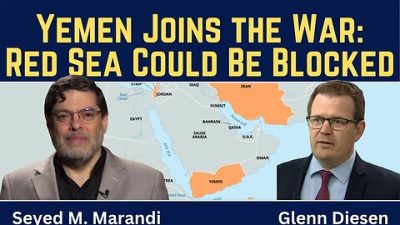
Yemen joins the war – Red Sea could be blocked next – Saudi regime at risk
or go to
Aletho News Archives – Video-Images
From the Archives
Should Europeans ‘Thank’ the Americans for Destroying Nord Stream?
By Robert Bridge | Strategic Culture Foundation | September 29, 2022
With an investigation continuing into the destruction of the Nord Stream gas pipeline that provided energy supplies to Europe from Russia, there appears to be just one prime suspect, and that should surprise nobody.
Following the sabotage of the Nord Stream 1 and 2 gas pipelines, former Polish Foreign Minister Radoslaw Sikorski already seemed to know the identity of the perpetrator when he tweeted out: “Thank you, USA.”
At first glance, it seemed that Sikorski was speaking sarcastically, berating Washington for carrying out an attack that will have severe repercussions for the people of Europe. After all, how could anyone see any good coming from the termination of Europe’s primary source of gas reserves with winter just around the corner? It was Sikorski’s homeland of Poland, after all, that urged its citizens to collect firewood in the face of dwindling gas reserves.
In fact, the Polish diplomat was speaking one-hundred percent literally… continue
Blog Roll
 Aletho News
- Iran denies responsibility for ‘depraved’ attack on Kuwait desalination plant
- Bring The Troops Back. End This War Now!
- Can we please stop calling Israel the ‘only democracy in the Middle East’ now?
- US should start removing its troops for Germany, proposes AfD co-leader Chrupalla
- Iran Red Crescent: 600 educational centers attacked in US-Israeli ‘war crimes’
- Russian Oil Tanker Arrives in Cuba Amid U.S. Blockade
- America Racing to Strategic Defeat in Iran: Lt Col Daniel Davis
- FTC Warns Visa, Mastercard, PayPal, Stripe Over Political Debanking
- Russian tanker approaches Cuba despite US oil blockade
- Marandi: Yemen joins the war – Red Sea could be blocked next – Saudi regime at risk
- If Americans Knew
- Israeli police block Catholic cardinal from entering Church of the Holy Sepulchre on Palm Sunday
- Israel is assassinating journalists again, more than any other nation, anywhere, ever – Not a ceasefire Day 170
- Over 300 US service members wounded, majority have brain injuries – Not a ceasefire Day 169
- Researchers at Human Rights Watch Resign Over Blocked Report on Palestinian Refugee Return
- Jewish Groups Are Backing a War Americans Don’t Want
- Eric Fingerhut Thinks He’s the President of the Jews
- Top Jewish Philanthropists, Rabbis Urge Israeli President to Take Action Against ‘Jewish Extremists’
- Don’t Be Fooled. Zionist Leaders Have Always Wanted to Control Southern Lebanon
- Israel’s widespread use of torture is a core element of its genocide against the Palestinian people
- In Israel’s War on Iran, Many Middle East US Bases Rendered “All But Uninhabitable”
- No Tricks Zone
- New Study Finds Warming Saves Lives…Cold Temperatures 12 Times More Deadly Than Excess Heat
- German Science Blog Accuses PIK Climate Institute Of Hallucinating Climate Tipping Points
- Devastating Assessment Of Comirnaty Vaccine By Former Senior Pfizer Europe Toxicologist
- New Study: CO2 Is ‘Effectively Negligible’ As An Explanatory Climate Change Factor Since 2000
- Former Pfizer Toxicologist Dr. Helmut Sterz Tells Bundestag Hearing Pfizer Vaccine Should Have Never Been Approved
- Energy Expert: Germany’s Nuclear Phaseout Was A “500 Billion Euro Mistake”
- New Research: South Australia’s Mid-Holocene Sea Surface Temperatures Were 4°C Warmer Than Today
- Storing Green Energy To Last Germany 10 Days Would Require A 60-Million Tonne Battery
- New Studies: UK Sea Levels Were 4 Meters Higher Than Today During The Mid-Holocene
- Destructive Green New Deal: German Energy And Metal Group Warns Of Drastic Crisis
 Aletho News