US Treasury Official Threatens Lebanese Banks
Al-Akhbar | November 19, 2013
Speaking at the 2013 Annual Arab Banking Conference, Daniel Glaser, the US assistant secretary for terrorist financing in the Office of Terrorism and Financial Intelligence, warned local banks against any kind of dealing with Hezbollah and its allies.
In a talk titled “Protecting the Lebanese Financial Sector from Illicit Finance,” Glaser first noted the importance of Lebanon’s financial sector to the region’s economic well-being, remarking, “Lebanon’s ability to retain its position as an important regional and international financial center requires constant vigilance, leaving no stone unturned in our collective efforts to uproot money laundering, terrorist financing, and other forms of illicit finance from the Lebanese financial system.”
“Failing to do so,” he continued in a threatening tone, “would not only represent a missed opportunity to contribute to global efforts to uphold the rule of law and disrupt criminal and illicit groups, but might also allow regulators and financial institutions around the world to draw the conclusion that business with Lebanon comes at too high a risk.”
In particular, Glaser designated finances related to “organized criminal groups, narcotraffickers, terrorist organizations, WMD proliferators, and regimes such as Iran and Syria” as illegal activity that must be closely watched by regulators of the banking system.
The American official explained that the Lebanese banking sector’s “studied neutrality and the guarantee of bank secrecy for all” in the past “is no longer tenable. Moving forward, that professionalism and stability, which have been the hallmark of the Lebanese financial system, can be maintained only through the efforts of both the public and private sectors to ensure a hostile environment for terrorists, criminals, narcotraffickers, and sanctioned regimes such as Iran and Syria. Working together, we can stop the illicit financial activities of groups that seek to destabilize the region such as al-Qaeda and Hezbollah.”
The target here became abundantly clear as Iran, Syria, and the Lebanese Resistance were placed alongside drug traffickers in order to prevent them from accessing Lebanon’s banks…or else!
In an attempt to link Washington’s political opponents to criminal activities, Glaser noted, “It is important at the outset to identify the illicit finance threats that Lebanese financial institutions face. Some of the threats, such as narcotics-related money laundering, are universal challenges confronting financial centers around the world. Others, such as terrorist financing and sanctions evasion, while certainly not unique to Lebanon, are amplified by Lebanon’s geographic, historic, and political circumstances.”
In a more direct wink in the direction of Hezbollah, he referred to the case of the Lebanese Canadian Bank (LCB), maintaining that the “scheme involved the laundering of hundreds of millions of dollars in narcotics proceeds through the Lebanese financial system using bulk cash shipments and trade-based money laundering involving used car sales and consumer goods.”
Glaser, however, forgot to mention that his administration neglected to pursue the LCB in the courts and instead struck a back-room deal, in which the bank paid $102 million in exchange for the case against them being dropped, after it was accused of laundering money on behalf of Hezbollah.
So after closing the LCB file in Washington, the US Treasury official nevertheless insisted that “this should not be surprising given Hezbollah’s involvement in a wide range of illicit activities. These illicit activities, combined with its ties to sanctioned regimes such as Iran and Syria, should call into question all financial relationships with Hezbollah or its agents.”
Glazer took his threats against any financial dealings with the Resistance one step further, saying, “The risks of engaging in such relationships will only increase as more countries apply sanctions on Hezbollah, which continues to engage in destabilizing military activity in Syria and attacks in Europe.”
He also did not fail to warn Lebanon’s banks against the danger of conducting business with Syria and Iran: “Lebanese financial institutions must also be alert to the threat of sanctions evasion. As a nearby regional banking hub, regimes such as Syria and Iran will continue to look to Lebanon as a potential financial access point into the global system. Lebanese financial institutions are therefore an important component of international efforts to isolate these regimes, and Lebanon’s resistance to any attempts to use Lebanese banks as a gateway to the international financial system is essential.”
In his concluding statement, Glaser got to the heart of his message by warning the bank officials present that “the United States is prepared and will continue to take action to protect our financial system from threats when we deem it necessary.”
Lebanese army defuses 50-kilogram car bomb in Beirut suburb
Al-Akhbar | October 15, 2013
The Lebanese army successfully defused a 50-kilogram bomb discovered Monday in a southern Beirut suburb, a military official said on Tuesday.
A Jeep Grand Cherokee packed with explosives was discovered in the Maamoura neighborhood of Dahiyeh, which has been swarming with security forces since two car bombs exploded in July and August.
The July 9 attack on the Dahiyeh neighborhood of Bir al-Abed injured 53 people. On August 15, a massive explosion killed 27 people in the nearby Roueiss neighborhood.
In remarks carried by Lebanon’s National News Agency, an army spokesperson said the booby-trapped vehicle discovered Monday contained a 50-kilogram bomb, three anti-tank mines and six cluster bombs wired to 20 kilograms of an explosive chemical compound and “multiple detonators.”
Investigators are looking for those responsible for planting the car bomb, the spokesperson added.
Attacks have increased on Beirut’s southern suburbs, where Hezbollah draws strong support, since the powerful Shia movement publicly announced earlier this year that its troops had joined the war against Syria’s anti-government rebels.
Hezbollah erected dozens of checkpoints in Dahiyeh following the August 15 car bomb in attempt to stem further attacks.
Lebanese army and Internal Security Forces took over those checkpoints last month.
What does the Syrian chemical disarmament deal mean?
By Zaher Mahruqi | Press TV | September 24, 2013
Bashar’s acceptance to let go of his “Nukes of the poor” arsenal could mean that the Syrian government has assessed the potential outcome of an American sustained offensive to be a game changer and desperately agreed to any way out.
Handing over chemical weapons in a gradual more controlled manner would have been understandable but giving up the location of the chemical sites with such immediacy hints to a much weakened Syrian position. It is no secret that the details given to the UN will eventually end up in Israeli hands, then why would the Syrian government accept such a deal other than Assad’s real fear of loosening his grip on power?
Netanyahu’s remarks following the chemical handover deal that “negotiating with Syria and Iran with a real and present threat to use force is the only way to make them cooperate” suggests that Syria’s president is indeed at the mode of fighting for survival. But that too is too simplistic provided that, surrendering chemical weapons or not, the US is sure to pursue him to the very bitter end. Then why give up such a strong deterrent?
The fact of the matter is that Bashar al-Assad is an intelligent man who at the very least understands that betraying Russia and Iran, who have been supporting his efforts in the past two years, would be a serious mistake. Therefore, any big decision Syria makes has to have been consulted with its main backers and has been given some sort of guarantees that giving up chemical weapons is not as risky as it might appear and that a credible backup plan is in place.
Smartly, Syria is giving both the US and Russia a face saving mechanism to avoid any further escalation between the two super powers and at the same time it is buying crucial time. Bashar himself declared that at least one full year is required to clear Syria of chemical weapons.
For Syria, chemical weapons are much harder to dispose of than replenish because Syria’s allies have stockpiles upon stockpiles of them. And so if the US chooses to change course somewhere during the period of chemical disarmament and attacks Syria, the very scenario that has been averted would be quickly reintroduced.
One ship full of chemical weapons is all that is required to rearm Syria, after all the main target of such weapons is a country the size of a province; Israel. Moreover, the Iranian and Hezbollah threat of intervening by attacking Israel will not be changed by simply handing over the chemical weapons.
Of course, the decision to hand over the weapons which buys the Syrian government crucial time is unwelcome by the “saboteur” of the region, Saudi Arabia and Turkey. The real danger for them is that this could actually lead to further weakening of the Syrian opposition and force them unto Geneva peace talks; talks which have just been strengthened by Syria’s agreement to declare its chemical arsenal.
Turkey and Saudi Arabia know well that their stances on Syria in the past two years makes it impossible for relations with Bashar’s Syria to normalize or even a negotiated Syria where opposition participates in governance.
Regardless of Turkish and Saudi stances, the US administration and Israel had strong interests in making sure that a war is averted in some way. Had the US congress vote gone ahead and disapproved of any attack on Syria in order to fulfill the wishes of the American people, it would have been a huge blow to them.
For Obama, it would have meant being stripped of legitimacy as it relates to Syria and wider international engagements and for Israel it would have meant the weakening of the Zionist lobby within US politics and a disastrous counter attack from Iran, Syria and Hezbollah.
Bashar’s objectives to consolidate alliances and weaken the counter alliance and buying time have all been thus far satisfied. The one year disarmament period that Bashar suggested will be needed is no speculation at all; it is well calculated period during which time to weaken the opposition and its supporters and to deny the US and her allies any legitimate pretext to attack Syria.
Moreover, if Iran and Hezbollah felt justified to intervene early on, now any attack from the US or her allies before the chemical disarmament is complete makes the Iran and Hezbollah retaliation against Israel with the support of Russia even more justified.
On the other hand, the US, Turkey and Saudi Arabia, (the latter seeming more keen than the US to overthrow Bashar’s government), provided that the SNC is in a weakened position and the desperation of the trio is acute, places them in a real danger of open colluding with the likes of Al Qaeda and Al-Nusra Front. So much for fighting “terrorism”!
Every time one sees a billboard advertising Syrian International Trade Exhibition across the world one wonders how can a government in a war state for over two years manage to facilitate an environment where its factories can produce? The answer could simply be that Syria is not nearly as chaotic or as weak as Western media portrays it to be. That position has just been strengthened by Syria’s agreement to disarm.
The objective of the US and Israel has always been to disarm any Arab army that might use its weapons against Israel; the issue is not whether a country owns a huge arsenals of weapons or not, but whether it has enough potential will to use them against Israel.
The Saudis are armed to the teeth and so are the Turkish but it is their clear stance on ensuring Israel’s peace that makes them allies rather than enemies. It is for that reason that Syria is a prime target as was Saddam’s Iraq.
Five armies that pose serious threat to Israel were the priorities of the US and Israel namely Iranian, Syrian, Egyptian, Iraqi and Hezbollah and so far only one has been dealt with; that of Iraq. In the case of Egypt, the US and Israel are pleased because the Egyptian army is suspect and they truly believe they will eventually buy out its generals. That means Hezbollah, Iran and Syria are left to fight this war that will not stop until one side secures a clear victory.
Where Russia had disappointed in the past as was the case with Iraq, now it appears poised to put up a stronger posture and as such days ahead will clarify the longevity of the new Russian posture. But the latest events have revealed that Russia is no longer a mere Security Council voter but a physical actor in world events.
Therefore, it is naive to assume that Russia has been blackmailed or tricked by the US into pressuring Syria to surrender her most prized deterrent against Israel. Syria will comply albeit at a calculated pace and will give America and Israel no legitimate pretext to attack it and as such Russia will have no choice but to stand its ground. If an attack takes place, Russia’s response is likely to be far stronger than the recent showdown in the Mediterranean or else Russia becomes a goofball.
The stance of Western media and Aljazeera is a good indication that the US and her allies are not in a war mood. When a war is imminent, there are certain networks that have a duty to fulfill and that is drumming for war. They are not doing that just yet!
While it will be naive to assume that Bashar will hold on to power indefinitely, it is clear that the Syrian civil conflict will be a long term struggle and will not end nor conclude the way the US and Israel are hoping for.
Related articles
- Nasrallah: Saudi Arabia, Turkey have failed in Syria (alethonews.wordpress.com)
- Questions on Syria’s Chemical Weapons disarmament (alethonews.wordpress.com)
Nasrallah: Saudi Arabia, Turkey have failed in Syria
Al-Akhbar | September 23, 2013
Saudi Arabia, Turkey and other regional countries backing Syria’s rebels must acknowledge their failures to bring down the Syrian government, and join efforts for a political solution to end the two and a half year civil war, Hezbollah Secretary General Hassan Nasrallah said on Monday.
In his first televised speech in over a month, Nasrallah said dialogue is the only option to bring an end to a conflict that has already left over 100,000 people dead and threatened to exacerbate tensions across the region.
“I call on Saudi Arabia, Turkey, and other Gulf states to revise your stance,” he said. “You won’t reach anywhere by relying on a military victory. Put this hatred (for Hezbollah) aside and think with your minds. Think about your interests, the interests of the region, the survival of the region.”
He condemned calls by some Lebanese politicians from the March 14 alliance for the United States to launch an attack on Syria, warning that any strike would cause global repercussions, and that Lebanon would be the first casualty.
Those same politicians calling for the West to intervene in Syria have accused Hezbollah of endangering Lebanon by sending troops to Syria, Nasrallah added, urging them to evaluate the consequences of a US attack across the border.
Nasrallah said that Saudi Arabia and other Gulf countries believed their support to rebel forces would lead an overthrow of the Syrian government within months, and are using Hezbollah as a scapegoat “to run away from their failures,” by accusing it of occupying Syria.
“For two and a half years, they used everything in their disposal … to control Syria and they failed. Of course [Hezbollah] are foreigners, we are not Syrian, but [what about] the tens of thousands of foreign fighters who you brought from all over the world? Are they occupying Syria?”
He noted that the Syrian government has expressed willingness to engage in dialogue with the opposition, and emphasized talks as the only suitable option to achieve peace.
Nasrallah also flatly denied accusations that his powerful Shia movement had obtained chemical arms from Syria, saying that he was principally and religiously forbidden from using such weapons.
Related article
- Text of Nasrallah’s September 23 speech Hezbollah chief… (yallasouriya.wordpress.com)
ProPublica Exposed: A Pseudo Alternative with $26 Million Dollars in Secret Mega-Donors Funding
By Sibel Edmonds | Boiling Frogs | September 8, 2013
On September 7, 2013, the daring website, Cryptome, published and publicized the tax reports filed by one of the dime-a-dozen pseudo alternative online publications-ProPublica. The stunning IRS 990 forms filed by this new flashy tax-exempt online news organization expose a secretive operation funded by millions of dollars received from secret entities:
ProPublica Tax Report for 2011 lists $10,000,000 (Ten Million Dollars) private funding from Anonymous (Secret) Donors: Click Here
ProPublica Tax Report for 2010 lists $10,000,000 (Ten Million Dollars) private funding from Anonymous (Secret) Donors: Click Here
ProPublica Tax Report for 2009 lists $ 6,000,000 (Six Millions Dollars) private funding from Anonymous (Secret) Donors: Click Here
That is correct. ProPublica, in the first three years of its existence and operation, has received $26,000,000 (26 Million Dollars) funding from secret donors.
The tax-exempt, 501 (C) (3) NGO was established and began operation in June 2008. When you look at the established date of their operation, and their first 990 tax form filed in 2009, you see that, right from the start, before even establishing any track record, their founders-operators were able to collect $6,000,000.
Well, if you look at ProPublica’s founders and operators the above facts will start making sense:
- ProPublica was founded by Paul Steiger, the former managing editor of The Wall Street Journal
- Propublica is managed and led by Stephen Engelberg, the former investigative editor of The New York Times
- Propublica is run and directed by Richard Tofel, the former assistant publisher of The Wall Street Journal
Let’s sum it up: Three individuals, major participants and players from the US mainstream media, from entities long known as intimate propaganda arms of the US government, The Wall Street Journal and The New York Times, got together and said: The alternative media is taking off with the public, so let’s set up shop and pose as one. After all, the establishment is smart enough to not put all its eggs in one basket-in this case, the mainstream outlet.
With their established record as mainstream players who understood the importance of government-imposed propaganda and the role of controlled opposition fronts, the trio set up shop with window-dressing that distorted them and made them look like a Watch-Dog Independent Alternative media outlet – in a posh office with an Uber Expensive Manhattan address.
Right from the start, with the government and the establishment’s backing they positioned them in the forefront as a major player by: 1-quickly securing $6,000,000 upfront seed money from secret donors; 2-smoothly establishing their shop-business as a tax-exempt 501 (C) (3) NGO with the US government
Isn’t it amazing how a supposedly alternative watchdog that is supposedly working to expose dark secret deals for greater transparency and public awareness happens to be a mega-funded business with secret mega-donors?!
I tried my best to comb through their site, hoping to get a glimpse of these generous funders who have given ProPublica $26,000,000. But, no such luck. If I were a betting woman, I’d put my money on the same-o-same-o mega corporate foundations- the 1%: Soros, Rockefellers, Carnegie, Ford … You know who we’re looking at and talking about here, no?
I would say that even more appalling than having $26,000,000 from secret donors is the fact that ProPublica wants much more: They want uninformed and gullible individuals, our average hard-working Janes & Johns, to dish out donations and recurring subscriptions, and enrich the already very rich operators of this so-called alternative business. How bold and daring of ProPublica !
Think about it, during these tough economic times, while even the mainstream is struggling to make ends meet (despite backing from billionaires, government and corporate advertisers), ProPublica has received $26, 000,000 and more from its secret admirers within the mega-billionaire circle. Why? Since when do the Uber Corporate players and their foundations have a desire for transparency-seeking and Pro-Public media sources? Obviously, they don’t want any transparency when it comes to their money and where their mega-dollars go. Otherwise, why remain so very anonymous and secret? Right?
~
Aletho News adds that ProPublica seems to have a thing about Iran and Hezbollah:
- The Terror Threat and Iran’s Inroads in Latin America
- U.S. Sues To Recover $446 Million From Hezbollah-Connected Firms
- Government Says Hezbollah Profits From U.S. Cocaine Market Via Link to Mexican Cartel
- Before Deadly Bulgaria Bombing, Tracks of a Resurgent Iran-Hezbollah Threat
- Shadow War: Hezbollah’s Hand Seen In Bombing of Israeli Bus
- How Hezbollah Trained an Operative to Spy on Israeli Tourists
Salting “public interest” news and commentary with warmongering pieces furthering Israel’s aggressive aims deserves exposure and LobeLog has done just that. In July, Jim Lobe deconstructed the ProPublica piece, The Terror Threat and Iran’s Inroads in Latin America. His take on ProPublica’s smear Iran pieces:
What virtually all of them have in common is the heavy reliance on anonymous intelligence sources; a mixture of limited original reporting combined with lots of recycled news; a proclivity for citing highly ideological, often staunchly hawkish neoconservative “experts” on Middle East issues from such think tanks as the Washington Institute for Near East Policy (WINEP), the Foundation for the Defense of Democracies (FDD), the American Enterprise Institute (AEI) and the American Foreign Policy Council (AFPC) without identifying them as such; a surprising deference (considering his status as an investigative reporter) toward “official” accounts or reports by friendly security agencies, some of which work very closely with their Israeli counterpart…
Lobe’s article, ProPublica and the Fear Campaign Against Iran is worth reading in its entirety.
~
BFP Update #1
In less than an hour after our report on ProPublica tax forms, their $26 Million-dollar budget and untraceable (at least not easily traceable) corporates and foundations funders, we received a threatening e-mail from their President Richard Tofel asking us to retract since somewhere, out there, they have a list of some of their major donors. They sure made that info hard to find!
Now we have more documents, including the list of some of their major donors and a more exact dollar number for their operating budget. We are more than happy to release these documents and the links. You know what: This information proves every single point we made in our report and more! Here we go:
1- We had listed ProPublica’s funding at $26,000,000. Well, it happens to be much higher than that: ProPublica, during their first four years, received $37,000,000 in funding. They received $11,000,000 in 2012, and that brings the total for their four years in operation to $37,000,000 Million: Click Here
2- They have listed some of their big foundations- make that corporate-foundations, under a vague ‘Supporters’ page. Well, again, I was right: Ford, Soros, Rockefeller and Carnegie are there, but there are more …Hewlett Foundation, Lisa & Douglas Goldman Fund , Geraldine Rockefeller Dodge … and check this, even NBC4New York!! To read the list filled with mega billionaires and millionaires check out ProPublica’s list of Sugar Daddies here
Let me give you a couple of examples: Sandler Foundation gave ProPublica $4,000,000 in 2012, and Knight Foundation gave them $2,000,000 only in 2012 (for one year). Check them out here
3-ProPublica also lists its partners. Ladies and gentleman if we had to summarize the list it would read: The Entire US Mainstream Media. ProPublica partners list include: CNN, ABC News, CBS News, Chicago Tribune, NPR, CNBC, Fortune, Los Angeles Times, The Nation, The New York Times, NewsWeek … Basically, the entire charlatan and propaganda machine called the US Mainstream Media. Not only that, they are also partner with Amazon! Please help yourself to this truly stinky list of ProPublica partners: Click Here
All right. I now have provided you with additional information related to ProPublica funding and partners, as I promised Mr. Tofel. And with all this, what have we got? Let’s recap:
An almost brand new business posing as a nonprofit alternative online publication received $37,000,000 since its operation began 4 years ago. This hefty $37,000,000 comes from all the nasty corporate moguls such as Rockefellers, George Soros, Ford, Carnegie Family, Hewlett Packard, Goldman, and the like. ProPublica is also proud to announce the entire dirty despicable US mainstream media, outlets such as CNN, NBC, Los Angeles Times, Newsweek, as its dear partners in its operations.
Now, I invite you to find one qualification here, whether in funding, or the background of its operators, or its partners, that makes this phony an Independent Alternative Media with only the public interest in mind. When ProPublica says, alternative, ask them exactly alternative to what?!
BFP Update #2
Today, after spending hours analyzing ProPublica’s tax forms, which list their enterprise’s expenses for 2012 (Click Here ), we have more shocking items to report. For this report we are concentrating mainly on the incredibly extravagant salaries listed for this newly created NGO enterprise, since the level of money they receive would even raise the eyebrows of the highest paid reporters-managers in mainstream media publications.
The average salary earned by Presidents-CFOs/CEOs within the NGO industry is $97,000 a year
The President and Editor in Chief for ProPublica, Paul E. Steiger (Position in 2012), made $570,000 + $14,914 = $584,914
The 2012 average salary for managing editors for major publications is $65,000
The Managing Editor for ProPublica, Stephen Engelberg, made $360,000 + $31, 758 = $391,758
The average salary for NGO general managers is around $60,000 a year
The General Manger for ProPublica (Position in 2012), Richard Tofel, made $335,000 + $28,600 = $363,600
The average salary for Vice President (VP) positions within the NGO community is $70,000
The average salary for editors for major publications in New York is $61,000
The Editor for ProPublica, Mark Schoofs, made $184,000 + $7918 = $191,918
The 2012 average salary for reporters in major publications in New York is around $67,000
A Senior Reporter for ProPublica (Position in 2012), Jesse Eisinger, made $218,500 + $29,682 = $248,182
Another Senior Reporter, for ProPublica, Dafna Linzer, made $212,000 + $18,534 = $230,534
Another ProPublica Senior Reporter, Charles Ornstein, made $192,500 + $$25,984 = $218,484
And yet another Propublica Senior Reporter, Tracy Weber, made $192,500 + $20,270 = $212,770
The last we heard (and read) journalists were crying out loud on the issue of shrinking and even disappearing already-meager salaries. Well, the industry’s report on average salaries justifies them, since even within the major publications in New York many senior reporters are collecting less than $60,000. What do you know! They should be lining up for jobs with the NGO online publications!! ProPublica reporters are making quarter million dollars annual salaries and benefits ($248,000).
Same with managers and mid-level editors. The private publication business industry seems nothing compared to some start-up NGOs. Look, the general managers and mid-level VPs at ProPublica are raking hundreds of thousands of dollars ($363,600 & $260,135).
And check out the Wall Street man who had the nose to smell where the real money was going to come from: Mr. Paul E. Steiger with $584,914. And whoever said you can’t make millions of dollars within a couple of years using NGO models and dirty sugar daddies has been proven wrong!
Yes, Syria and Hezbollah Will Hit Israel if US Strikes
By Sharmine Narwani | Al-Akhbar | 2013-09-06
Informed insiders have confirmed that Syria and Hezbollah plan to retaliate against Israel in the event of an American-led military attack on Syria. Says one: “if even one US missile hits Syria, we will take this battle to Israel.”
An official who spoke to me on the condition that neither his name or affiliation is published, says the decision to retaliate against Israel “has been taken at the highest levels within the Syrian state and Hezbollah.”
Why attack Israel after a US strike?
“Israel has been itching for a fight since their 2006 defeat by Hezbollah,” explains an observer close to the Lebanese resistance group. “They have led this campaign to draw the US into a confrontation with Syria because they are worried about being left alone in the region to face Iran. This has become an existential issue for them and they are now ‘leading’ from behind America’s skirts.”
The “Resistance Axis” which consists of Iran, Syria, Hezbollah and a smattering of other groups, has long viewed attacks on one of their members as an effort to target them all.
And Israeli aggression against this axis reached a new high in 2013, with missile strikes and airstrikes unseen for many years in the Levant.
Israel has reportedly conducted at least three separate, high profile missile strikes against Syria this year, effectively ending a 40-year ceasefire between the neighboring states. The last overt violation of this uneasy truce was in 2007 when the Jewish state destroyed an alleged nuclear site inside Syria.
Then two weeks ago, Israel launched its first airstrike in Lebanon since the 2006 war, bombing a Popular Front for the Liberation of Palestine–General Command (PFLP-GC) target in an entirely unprovoked attack. Earlier, four rockets had been launched into Israel from Lebanese territory, but an unrelated Al Qaeda-linked group took credit for that incident.
When asked whether Syrian allies Russia and Iran would participate in retaliatory strikes against Israel or other targets, the official indicated that both countries would back these efforts, but provided no information on whether this support would include direct military engagement.
The Russians have stated on several occasions that they will not participate in a military confrontation over Syrian strikes. Iran has not offered up any specifics, but various statements from key officials appear to confirm that strikes against Syria will result in a larger regional battle.
On Tuesday during an official visit to Lebanon, Iranian parliamentarian and Chairman of the (Majlis) Committee for National Security and Foreign Policy Alaeddin Boroujerdi told reporters: “The first party that will be most affected by an aggression on Syria is the Zionist entity.”
His comments follow a steady stream of warnings by senior Iranian officials, which have escalated in tenor as western threats to attack Syria have intensified.
“The US imagination about limited military intervention in Syria is merely an illusion, as reactions will be coming from beyond Syria’s borders,” said the Commander of the Islamic Revolution Guards Corps Major General Mohammad Ali Jafari last Saturday.
Even Iran’s Supreme Leader Ayatollah Ali Khamenei has stepped into the fray, warning the US and its allies: “starting this fire will be like a spark in a large store of gunpowder, with unclear and unspecified outcomes and consequences”.
Concurrent with these warnings, both Iran and Russia have been urging the West to avoid further confrontation and return to the negotiating table to resolve Syria’s 29-month conflict. But instead, western officials and diplomats in the Mideast have spent the past few weeks hitting up their regional sources for information on how Syria’s allies will react to a strike.
An unusual visit to Tehran by UN Under-Secretary-General for Political Affairs Jeffrey Feltman (a former senior US State Department official) was one such “feeler.”
According to several media outlets, the Iranians had a singular response to Feltman’s efforts to gauge their reaction to a US strike: if you are serious about resolving the Syrian crisis, you must first go to Damascus, and follow that by launching negotiations in Geneva.
Gunning for a fight
While Israel plays heavily in the background, by turns provoking and encouraging western military intervention in Syria, it publically denies any role in this business.
Just this week, Israeli President Shimon Peres attempted to distance the Jewish state from events in Syria by insisting: “It is not for Israel to decide on Syria, we are in a unique position, for varying reasons there is a consensus against Israeli involvement. We did not create the Syrian situation.”
He’s right about one thing. Any visible Israeli military intervention in Syria will likely raise the collective ire of Arabs throughout the region. But Peres is being disingenuous in suggesting that Israel hasn’t played a pivotal role in dragging the region to the brink of a dangerous confrontation.
In fact, since its establishment as a state, Israel has possibly never been more motivated to force a military confrontation in the Mideast:
The Arab uprisings, a shift in the global balance of power, increased isolation and the waning influence of Israel’s superpower US ally have all served to remind Israel that it stands increasingly alone in the Mideast in confronting its longtime adversaries – Iran, Hezbollah, Syria and various Palestinian resistance groups.
Before a US exit from the region becomes patently clear to one and all, Israel needs to disarm its foes – and it needs the Americans to do that. For years, the Israeli establishment has regularly threatened military strikes against Iran, in most part attempting to inextricably embroil Washington in this military venture.
Forcing ‘red line’ narratives into western political discourse – whether it be the use of chemical weapons in Syria or a civilian nuclear program in Iran – has become a clever way to commit allies to an Israeli military agenda.
When US President Barack Obama last week appeared to suddenly revise his plans to launch a strike on Syria by deferring the decision to Congress, Israel went into overdrive:
Two Israeli missiles were launched off the Syrian coast in the Mediterranean Sea to raise temperatures again. Whether this was meant to be veiled threat, a provocation, or an attempt to pin the deed on Syrians is unclear. What is certain is this: Russian early radar systems caught the activity and publicized it quickly to ward off misunderstandings that might trigger counterstrikes.
This quick reaction forced Israel – under US cover – to acknowledge it had participated in unannounced ballistic missile tests. The Iranians reacted very skeptically. Chief of Staff of the Iranian Armed Forces General Hassan Firouzabadi said the missiles were “a provocative incident” conveniently executed as western nations withdrew from plans to attack Syria, and called Israel “the region’s warmonger.” He further charged: “If the Russians had not traced the missiles and their origin, a Zionist liar would have alleged that they belonged to Syria in a bid to pave the way for breaking out a war in the region.
On an entirely different front, Israel has been amassing its considerable army of US supporters and lobbyists to ensure a compliant Congressional vote on strikes against Syria.
All its heavy hitters have now stepped up to push US lawmakers into backing military intervention, even though polls continue to show the majority of Americans rejecting strikes.
The Israeli lobbying effort has been particularly critical to ensure there is bipartisan consensus and that Obama’s Republican opponents join the bandwagon. To ensure this, the scope of the “surgical strikes” had to be expanded for GOP members opposed to a cursory punitive strike against Syrian government interests.
Key Republicans have since piled on, and already there are soundings of ‘mission creep.’ Obama told lawmakers on Tuesday that his plan “also fits into a broader strategy that can bring about over time the kind of strengthening of the opposition and the diplomatic, economic and political pressure required – so that ultimately we have a transition that can bring peace and stability, not only to Syria but to the region.”
This suddenly sounds remarkably like President George W. Bush’s plans to remake the Middle East. And it is everything Syria and its allies have both feared and suspected from the start.
Existential for you, existential for me
If ever there was a real ‘red line’ in the region, this is it. Any “limited” or “broad” military intervention in Syria is simply unacceptable to Syria, Iran, Russia, Hezbollah, China and a whole host of other nations that want to turn the page on US hegemonic aspirations in the region and beyond.
Washington has miscalculated in thinking that an attack in any shape or form would be palatable to its quite incredulous adversaries. They are all intimately familiar with the slippery slope of American interventionism and its myriad unintended consequences.
Israel, in particular, appears to be victim to a false sense of security. Analysts and commentators there seem to think that the lack of a Syrian military response to recent Israeli missile strikes is a trend likely to continue. Or that Hezbollah and Iran would have no ‘grounds’ to climb aboard a counterattack if Syria were attacked.
But the fact is that, to date, no member of the Resistance Axis has faced a collective western-Israeli-GCC effort to strike a blow at their core. This promised US-plus-allies strike against Syria makes their calculation an easy one: there is nowhere to go but headfirst into the fracas.
As Israeli warplanes pounded Lebanon during the 2006 war, then-US Secretary of State Condaleeza Rice got one thing right. Refusing to call for a ceasefire, Rice explained that battle was sometimes necessary to break free of the status quo and emerge with a new regional order. The carnage, in short, was simply “the birth pangs of a New Middle East” – something to endure in order to reach a desired outcome.
But in 2006, conditions were not yet ripe for an all-out confrontation on multiple fronts. Today’s confrontation, however, has all the ingredients to fundamentally shift the region in a clear new direction, depending on which side emerges victorious.
What Rice did not anticipate seven years ago was that a few thousand Hezbollah fighters could shake the region beyond Lebanon’s small borders in a mere 33 days – simply by emerging from battle with Israel, leadership and capabilities intact.
The US has never predicted outcomes successfully in the Middle East and is unlikely to do so this time given that its strategic and military objectives seem even more muddled than usual. What we do know is that Hezbollah Secretary-General Hassan Nasrallah has promised that the “next battle” will take place inside Israel’s borders and that he will fight proportionately this time – striking Israeli cities when Israel hits Lebanese ones.
On the Syrian front, Israel imagines a war-weary adversary. But the Syrian armed forces have the kinds of conventional weapons and ballistic missiles that can level a town in short shrift – that is not an outcome Israel has the capacity to endure.
In yet another corner is Iran, boasting a rare combination of military manpower, hardware, technology and tactical skills that Israel has never faced in any adversary on the battlefield. Russia looms large too – it may provide military intelligence to its allies or it may just use its clout in the UN Security Council to intervene at opportune moments in the fight. Either way, Moscow is a huge asset for the Resistance Axis – and will be joined by China to coach and calibrate responses to the fighting from the ‘international community.’
Meanwhile, as if unable to stop a ‘war trajectory’ once it starts, the US Senate’s Foreign Relations Committee has just voted to widen and deepen the scope of a US attack on Syria. The new goal? To “reverse the momentum on the battlefield” against the Syrian army and “hasten Assad’s departure.”
This is no different than Libya, Afghanistan or Iraq. Israelis and Americans need to understand that language and behavior threatening ‘regime-change’ gives their adversaries only one choice: to retaliate with all their capabilities and assets on all fronts. Washington just made this existential. No more games, no more rhetoric. Any strike on Syria will be ‘war on.’ In US military parlance: a ‘full-spectrum operation’ will be heading your way. And you can call it Operation “Tip of the Iceberg” out of sheer accuracy, for a change.
Sharmine Narwani is a commentary writer and political analyst covering the Middle East. You can follow Sharmine on twitter @snarwani.
Related articles
- The Israel Lobby and the Organized Jewish Community Want Regime Change in Syria (alethonews.wordpress.com)
- Israel concerned with US hesitation on Syria (alethonews.wordpress.com)
The Media Deception About the Bombings in Lebanon
By Mahdi Darius NAZEMROAYA | Strategic Culture Foundation | 21.08.2013
There has been an ongoing information war being fought for hearts and minds inside and outside of the Middle East. The war has mostly been tied to Syria. As the US and its allies begin to focus their attention on Hezbollah in Lebanon, the media war now includes the events in Lebanon. This, however, has not stopped the media attempts to depict the fighting in Syria in sectarian terms as a regional war between Shias and Sunnis or to demonize Syria’s allies…
In regards to Syria, the Israeli media, the Saudi media, and Lebanon’s Hariri-owned media — which belongs to Hezbollah’s US/Saudi-supported rivals — have all carried the same August 2013 AFP story or some derivative of it that deceitfully reports that Iran and Hezbollah are now running Syria. The Jerusalem Post, Arutz Sheva, the Daily Star, Ya Libnan, Al-Arabiya, the Saudi Gazette, Hürriyet, Naharnet, France 24, Fox News, and the Dubai-based Gulf News are examples of the type of media that carried this so-called news. Here is an extract of the text which sums up the entire image that the article is trying to engrain into the minds of its readers: “Assad ‘no longer runs Syria. The real rulers of Syria are the Iranian (elite) Revolutionary Guard… with the participation of Hezbollah fighters,’ Jarba said.” The entire report is built around a quote by Ahmad Al-Jarba, the leader of the foreign-controlled and funded Syrian National Coalition.
How the Mainstream Media Legitimizes Terrorism Against Lebanese Civilians
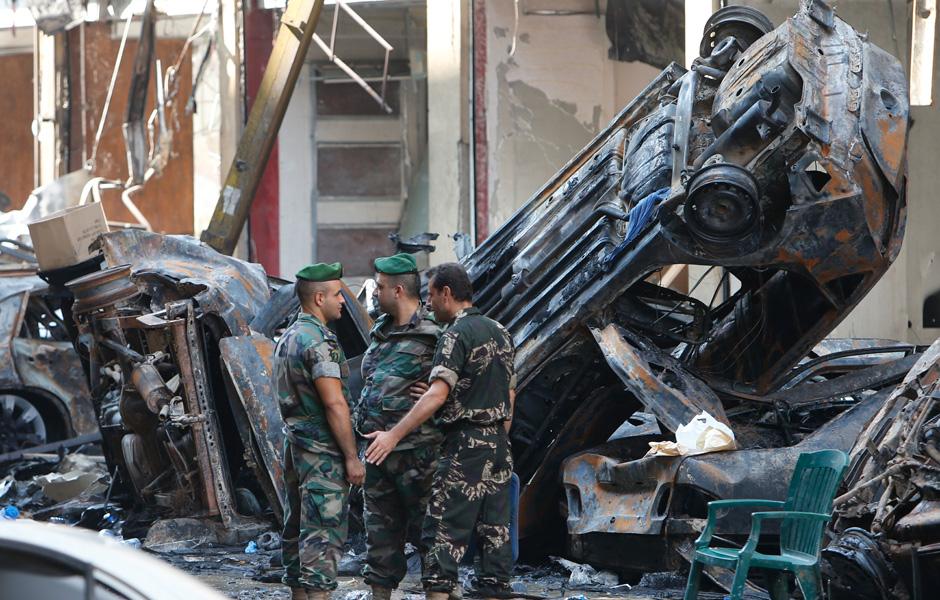 Next the same media outlets finessed the news about the terrorist bombs planted in Beirut’s southern suburb of Dahiyeh. The August 15, 2013 terrorist bombings in the neighbourhood of Al-Rouweiss (Al-Rweiss) were downplayed and, in a manner of speaking, legitimized by the media through their selective use of language. The attack on Al-Rouweiss come about a month after the July 9, 2013 terrorist attack on the neighbourhood of Bir Al-Abed. Both are densely populated neighbourhoods in Dahiyeh. The Institute for Public Accuracy (IPA) in the United States took quick notice of the biased media framing. IPA asked the following, on August 16, 2013, through the title of report: “Why Isn’t Beirut Bombing Called ‘Terrorist’? What’s Behind It?”
The Lebanese newspaper Al-Akbar is worth looking at to get a grasp of the biased media reporting that has been used to reframe the events as legitimate. It commented thus on August 17, 2013: “The Western media have double standards when it comes to ‘terrorism.’ Within hours after two bombs were detonated at the Boston Marathon last April, many in the media had christened it a ‘terrorist attack.’ Meanwhile, the August 15 bombing in Rouweiss that killed at least two dozen is a ‘blast’ that occurred in a ‘Hezbollah stronghold.’” As Al-Akhbar observes, the phrase “Hezbollah stronghold” plays a prominent role in giving the impression that the civilian neighbourhoods bombed in Beirut were armed barracks. Al-Akhbar even nicely sums up some of the biased titles used to describe the terrorist attacks:
Wall Street Journal: «Car Bomb Blasts Hezbollah Stronghold in Lebanon»
BBC: «Deadly Lebanon Blast in Beirut Stronghold of Hezbollah»
LA Times: «Massive Explosion in Beirut Rocks Hezbollah Stronghold»
Washington Post: «Bomb Explodes in Hezbollah Stronghold in Beirut, Injuring Dozens»
Reuters: «Over 50 Hurt as Car Bomb Hits Hezbollah Beirut Stronghold»
Associated Press: «Car Bomb Rocks Hezbollah Stronghold in Lebanon»
France24: «Car Bomb Rocks Hezbollah Stronghold in Beirut»
Mixed with the other narratives that the same media outlets are painting, the terrorist attacks are being tacitly portrayed as some type of legitimate retaliation. Readers are basically led to think that that the terrorist attacks in Dahiyeh were a military act against some type of Hezbollah base.
How the Mainstream Media Lies and Deliberately Places the Blame on Sunni Muslims
Sheikh Hassan Nasrallah, the secretary-general of Hezbollah, responded to the terrorist attack on Al-Rouweiss by categorically saying that the attacks were not the work of Sunni Muslims. He gave a speech saying that there were going to be those groups and individuals that would try to blame the terrorist attacks in Beirut on the Sunnis and said that these groups and individuals should be outright dismissed. In fact, he said that anyone that used this divisive logic was an “Israeli” and a partner in the goal of creating massacres. He made it clear that the individuals who planted the bomb did not represent the Sunni Muslims or the Arabs or the Syrians or the Palestinians. In a message to the US and its allies, he also said clearly stated that Hezbollah was aware that the intelligence services of the US and its allies had infiltrated various terrorist groups and manipulate them as tools.
Despite Nasrallah’s clarity, his words were totally changed by the same media outlets that were legitimizing the terrorist attacks in Beirut. The Israeli media, the state-run British Broadcasting Corporation (BBC), Al Jazeera, and Al Arabiya would blatantly fabricate the news and claim that Nasrallah “blamed the Sunnis” or try to manipulate readers into getting the impression that he did. The New York Times titled an August 16, 2003 article on the terrorist attacks as the following: “Hezbollah Makes Vow to Step Up Sunni Fight”. It never even mentioned that Nasrallah went out of his way to say that the people involved in the terrorist attacks were the tools of the US and Israeli government and not really Sunni Muslims. Instead Ben Hubbard focused on sectarianism in Lebanon and wrote: “In short, Hezbollah has more enemies than it used to have.”
The BBC wrote a similar article on August 16. It also used a grossly misleading title. The title being “Hezbollah blames Sunnis for bomb”. After a large number of people caught it, the BBC changed the title to “Beirut bomb: Hezbollah’s Nasrallah blames Sunni radicals”.
Exposing the Yellow Journalism at Work as a Tool of War
Aside from their direct or indirect links to these media outlets, even the political actors involved show that the way the news is reported is not isolated. Saad Hariri, the leader of the Future Party and a Saudi client, even responded to Hassan Nasrallah’s speech by saying that he had no right to designate what groups are terrorists. Hariri’s overlords in Saudi Arabia, on the other hand, refused to even condemn the terrorist attacks. This again is tied to the attempts to reframe the terrorist attacks in Beirut as a legitimate military act.
This type of yellow journalism that relies on misleading headlines that essentially say everything while the hollow articles carry and have little or no newsworthy material is not politically neutral. It is a weapon of war. All these articles are agitating for bloodletting in the Middle East, specifically between Shias and Sunnis. This type of journalism either directly or indirectly stokes the fires of sectarianism in Lebanon and the Middle East with the intentions of spreading sectarian animosity. This is why it deliberately ignores and refuses to even acknowledge the main points of Nasrallah’s speech that clearly pointed the finger at Israel and the US and said that the terrorist attacks had nothing to do with Sunni Muslims.
Related article
Why Western media frames civilian areas as “Hezbollah strongholds”
By Sharmine Narwani | Al-Akhbar | August 19, 2013
Beirut was thrown into turmoil on Thursday evening as a terrorist attack against residents of Dahiyeh – a southern suburb of the Lebanese capital and a predominantly Shia neighborhood – threatened to draw the country into a region wide crisis.
As conflicting news reports began to leak out in the immediate aftermath of the city’s deadliest car bombing in eight years, there was a disconcerting congruity in headlines beaming out from western capitals – and it had nothing to do with facts.
 In lock-step, western media was calling the scene of the crime a “Hezbollah stronghold”:
Wall Street Journal: “Car Bomb Blasts Hezbollah Stronghold in Lebanon”
BBC: “Deadly Lebanon Blast in Beirut Stronghold of Hezbollah”
LA Times: “Massive Explosion in Beirut Rocks Hezbollah Stronghold”
Washington Post: “Bomb Explodes in Hezbollah Stronghold in Beirut, Injuring Dozens”
Reuters: “Over 50 Hurt as Car Bomb Hits Hezbollah Beirut Stronghold”
Associated Press: “Car Bomb Rocks Hezbollah Stronghold in Lebanon”
France24: “Car Bomb Rocks Hezbollah Stronghold in Beirut”
A quick Twitter or Google search for “Hezbollah stronghold” is all you need to see how hard western media works to “frame” language and drive use of a phrase that makes Shia civilian life negligible.
On Twitter Thursday night, “tweeps” questioned the validity of this phrase in describing a civilian neighborhood. Said one observer: “When you write “Hezbollah stronghold” instead of South Beirut it gives the impression military barracks were bombed and no innocents died.
That view seemed to be confirmed by the reaction of an American tweep who wrote: “GREAT NEWS!!!!!” in response to the BBC headline “Deadly Lebanon blast in Beirut stronghold of Hezbollah.”
Worse yet was this reprehensible tweet by Al Monitor’s Washington correspondent and senior fellow at the Atalantic Council Barbara Slavin, who declared on Twitter: “As I recall, Hezbollah invented the car bomb; what goes around, comes around.” Except, of course, the targets of Thursday’s terror attack – where 27 died and nearly 300 injured – were civilians, not Hezbollah.
An army of tweeps quickly reminded Slavin that Hezbollah neither invented the car bomb nor targets civilians, and drew attention to the ironic fact that Israeli militant groups used them liberally in attacking British officials in Palestine last century – well before Hezbollah’s 1985 formation to combat Israel’s occupation of Lebanon.
And herein lies the problem. By calling a residential neighborhood a “Hezbollah stronghold,” western media softens public opinion to accept these terror attacks as justifiable, and their targets, legitimate. Because the only reason for characterizing civilian Shia neighborhoods as “strongholds” of Hezbollah is to justify carnage against those populations most likely to support the Lebanese resistance group.
Similar language – War on Terror, terrorism, militants, extremists, Al Qaeda – is also frequently employed to excuse western carnage in countries from Iraq to Afghanistan to Mali to Yemen to Pakistan. Droning and bombing targets are rarely characterized as “civilian,” even though data suggests that most victims of US attacks are not militants. The goal? To eradicate second thoughts about violence against innocent civilians – often bolstered by a complicit media that characterizes these deaths as “collateral damage.”
While the term “stronghold” can simply refer to an area in which an organization, party or point of view holds sway, in the context of US foes in the Mideast, it is instead usually used to suggest a militant base absolutely controlled by that foe. As one tweep noted, western media uses similar language against other American targets to scene-set for “excusable” carnage: “Hezbollah stronghold” for car bombs in Lebanon, “Assad stronghold” for car bombs in Damascus; “Assad heartland” for massacres in Latakia.”
Dahiyeh – the scene of Thursday’s explosion – is also, for instance, home to significant Maronite Christian and Sunni communities. And even within the suburb’s Shia community, there are disparate political views and affiliations. It is by no means true that all Shia residents are supporters of Hezbollah, a Lebanese political party that – in lieu of national political consensus – provides local social services and security for residents of all sects and backgrounds in these areas.
A December Christian Science Monitor article entitled “In Hezbollah Stronghold, Lebanese Christians Find Respect, Stability,” (a piece which repeats the “stronghold” theme and other Hezbollah stereotypes ad nauseum) does however manage to highlight the positive experiences of Maronites living in Dahiyeh neighborhood, Haret Hreik:
The face of the revered Shiite militant leader appears on posters, a calendar, and in several photographs nestled amid those of Christian homeowner Randa Gholam’s family members. Mr. Nasrallah is, Ms. Gholam asserts amid a string of superlatives, “a gift from God.”
Lebanon’s sectarian divides are legendary, and the residents of the historically Christian neighborhood of Harat Hreik, now a Hezbollah stronghold, remember well the civil war that set Beirut on fire. They were literally caught in the middle of some of the most vicious fighting, with factions firing shots off at one another from either side of their apartment buildings.
But in the intervening years, as Hezbollah cemented its control over the suburb of Dahiyeh, which includes Harat Hreik, the militant group has been an unexpected source of stability and even protection for the few remaining Christian families. Just a few blocks away from Nasrallah’s compound is St. Joseph’s Church, a vibrant church that Maronite Christians from across Beirut flock to every Sunday.
“I feel honored to be here. They are honest. They are not extremists. It’s not like everyone describes,” Gholam says. “I can speak on behalf of all my Christian friends. They would say the same thing.”
Why western media uses the term “Hezbollah stronghold”
Dahiyeh is not the only Lebanese area referred to as a “Hezbollah stronghold” by western media. Most Shia towns, cities and neighborhoods in this country are labelled with that moniker – facts be damned. Bekaa, Nabatiyeh, Bint Jbeil, Khiyyam and other predominantly Shia areas are frequently cited as such. Not coincidentally, all these civilian areas have been subjected to Israeli strikes over the years.
While hunting for Scuds in Lebanon two years ago – a search prompted by Israel’s fabricated claim that Hezbollah was hoarding the difficult-to-conceal ballistic missiles – I came across some IDF “3D animated clips” that allegedly “illustrate how Hezbollah has turned over 100 villages in South Lebanon into military bases.”
Introducing an array of IDF computer-generated slides that purport to identify existing Hezbollah weapons stores by marking large Xs in Shia-heavy civilian centers, the Israeli military then alleges:
“Hezbollah stores their weapons near schools, hospitals, and residential buildings in the village of al-Khiam (Khiyyam). They follow similar tactics in villages across southern Lebanon, essentially using the residents as human shields, in gross violation of UN Resolution 1701. al-Khiam was used as a rocket launching site during the Second Lebanon war.”
When I asked him about it, The Independent’s veteran Beirut-based journalist Robert Fisk scoffed at the IDF slide show: “The Israelis are making excuses for the next war crimes. The Scuds don’t exist, they’re not here. I’ve seen the (IDF) pictures – garbage. There’s nothing in those houses.”
Human Rights Watch’s extensive report on Israel’s 2006 attack on Lebanon, entitled Fatal Strikes: Israel’s Indiscriminate Attacks Against Civilians in Lebanon, covers at length the Jewish state’s unproven allegations that Hezbollah stashes weapons among civilian populations – charges that Israel continues to repeat despite evidence to the contrary.
The group’s Executive Director Kenneth Roth concludes: “The pattern of attacks shows the Israeli military’s disturbing disregard for the lives of Lebanese civilians. Our research shows that Israel’s claim that Hezbollah fighters are hiding among civilians does not explain, let alone justify, Israel’s indiscriminate warfare… In the many cases of civilian deaths examined by Human Rights Watch, the location of Hezbollah troops and arms had nothing to do with the deaths because there was no Hezbollah around.”
Instead the Report clearly states:
“Human Rights Watch did not find evidence that the deployment of Hezbollah forces in Lebanon routinely or widely violated the laws of war, as repeatedly alleged by Israel. We did not find, for example, that Hezbollah routinely located its rockets inside or near civilian homes. Rather, we found strong evidence that Hezbollah had stored most of its rockets in bunkers and weapon storage facilities located in uninhabited fields and valleys. Similarly, while we found that Hezbollah fighters launched rockets from villages on some occasions, and may have committed shielding, a war crime, when it purposefully and repeatedly fired rockets from the vicinity of UN observer posts with the possible intent of deterring Israeli counterfire, we did not find evidence that Hezbollah otherwise fired its rockets from populated areas. The available evidence indicates that in the vast majority of cases Hezbollah fighters left populated civilian areas as soon as the fighting started and fired the majority of their rockets from pre-prepared positions in largely unpopulated valleys and fields outside villages.”
Fisk is correct. The Israelis are making excuses for the next war crimes. in 2006, the IDF used the “Hezbollah stronghold” and “human shielding” arguments for carpet bombing Dahiyeh, the very same residential neighborhood targeted by terrorists on Thursday.
And Western journalists act either as dupes or complicitly when they repeat these same Israeli-generated mantras – laying the groundwork for further military and terror strikes against Lebanese civilians.
It is not just Western media that regurgitates this irresponsible language. “Hezbollah stronghold” has been so mainstreamed that virtually all English-language media utilizes the expression, from Iranian-backed Press TV to Moscow’s Russia Today. But online searches identify Western media – by far – as the main driver of this narrative.
Not all Western journalists are complicit though. On Twitter last Thursday, a rare moment of rationality came from a Voice of America source, of all places. VOA reporter Cecily Hilleary bothered to ask the all-important question: “Does term ‘Hezbollah stronghold’ aptly describe this Beirut neighborhood that was just hit by car bomb?” The first two responses were “no” and “it’s a civilian area.”
And as freelance British journalist Patrick Galey, a past Beirut resident, noted sarcastically after the Bir al Abed car bombing in July unleashed another Twitter-frenzy of “Hezbollah stronghold” tweets: “For ‘Hezbollah stronghold’ you can also say “highly-populated civilian area.” Just a thought.”
Watching an elderly woman sitting alone on the steps outside Bahman hospital on Thursday, her head in her hands, sobbing, as she awaited news of a relative injured in the car bomb earlier that day – it seemed ludicrous that the media still uses “Hezbollah stronghold” as a term to describe Israel’s past and future civilian-targeted neighborhoods.
And yet, on Sunday, as four rockets were fired into the northern Bekaa – one landing in a school playground – the “Hezbollah” association was invoked again. There are many dangerous words and phrases used to frame people and events in the Middle East, but here, now, we can collectively make a start to change that.
Sharmine Narwani is a commentary writer and political analyst covering the Middle East. You can follow Sharmine on twitter @snarwani.
Lebanon: Who Is Behind the Attacks on Hezbollah?
By Ibrahim al-Amin | Al-Akhbar | August 5, 2013
For 25 years now, Hezbollah has been engaged in a war with many powerful intelligence outfits from around the world. These intelligence agencies have devoted tremendous resources to collect information on the party, in addition to pursuing both its civilian and military activities, not to mention carrying out assassinations against its cadre and leadership.
Israel has played a key role in these efforts, but it is hardly alone. After the assassination of Rafik Hariri in 2005, Hezbollah was subjected to the most ferocious campaign against it, with former US ambassador to Lebanon Jeffrey Feltman admitting before Congress that Washington spent $500 million to undermine the party’s image.
After the outbreak of the Syrian uprising and Hezbollah’s open declaration of its involvement in the country’s fighting, the campaign intensified, with mounting threats to the party and its supporters that they may be subjected to revenge attacks.
First, the Resistance’s Dahiyeh stronghold was shelled with rockets. Similar attacks followed on many towns and villages in Baalbeck and Hermel. These were followed by roadside bombs targeting Hezbollah members on the main Lebanese highway to Syria, culminating in the massive Bir al-Abed blast in the heart of Dahiyeh.
Hezbollah is in a state of high alert due to the fact that it has been forced to fight simultaneously on two fronts. This has prompted Secretary General Hassan Nasrallah to tell the party’s cadre that they must be prepared for attacks that may involve both Syrian and Lebanese groups, without dropping their guard against their main enemy – Israel.
On the eve of Hezbollah’s engagement in the battle of Qusayr, it initiated a plan that involved:
– a series of practical steps to prevent the killing of Lebanese civilians held by the Syrian opposition in the north of the country;
– securing areas that may become targets of reprisals, including the border areas, Beirut, and South Lebanon.
The question today is: Who thought up an adventure of this kind against the Resistance? I wonder whether they thought about the party’s reaction.
Who are these people? Are they groups within the Free Syrian Army or the Salafi al-Nusra Front? Are they jihadi elements in Lebanon active in the North and Bekaa? Could they be Palestinians who have abandoned their cause to work as agents serving another agenda?
Who is helping them inside Lebanon? What are the Internal Security Forces (who take orders from the Future Party) doing about it? They seem to care little about people’s safety and are mainly concerned with collecting information on the Resistance.
In any case, Hezbollah has surprised friend and foe on more than one occasion in their intelligence capabilities. So, will the Resistance surprise us again by revealing who is behind these attacks?
Related article
Featured Video
Yemen joins the war – Red Sea could be blocked next – Saudi regime at risk
or go to
Aletho News Archives – Video-Images
From the Archives
Should Europeans ‘Thank’ the Americans for Destroying Nord Stream?
By Robert Bridge | Strategic Culture Foundation | September 29, 2022
With an investigation continuing into the destruction of the Nord Stream gas pipeline that provided energy supplies to Europe from Russia, there appears to be just one prime suspect, and that should surprise nobody.
Following the sabotage of the Nord Stream 1 and 2 gas pipelines, former Polish Foreign Minister Radoslaw Sikorski already seemed to know the identity of the perpetrator when he tweeted out: “Thank you, USA.”
At first glance, it seemed that Sikorski was speaking sarcastically, berating Washington for carrying out an attack that will have severe repercussions for the people of Europe. After all, how could anyone see any good coming from the termination of Europe’s primary source of gas reserves with winter just around the corner? It was Sikorski’s homeland of Poland, after all, that urged its citizens to collect firewood in the face of dwindling gas reserves.
In fact, the Polish diplomat was speaking one-hundred percent literally… continue
Blog Roll
 Aletho News
- Growing insecurity, soaring prices fuel protests in north as regime bans evacuation: Sources
- Iran denies responsibility for ‘depraved’ attack on Kuwait desalination plant
- Bring The Troops Back. End This War Now!
- Can we please stop calling Israel the ‘only democracy in the Middle East’ now?
- US should start removing its troops for Germany, proposes AfD co-leader Chrupalla
- Iran Red Crescent: 600 educational centers attacked in US-Israeli ‘war crimes’
- Russian Oil Tanker Arrives in Cuba Amid U.S. Blockade
- America Racing to Strategic Defeat in Iran: Lt Col Daniel Davis
- FTC Warns Visa, Mastercard, PayPal, Stripe Over Political Debanking
- Russian tanker approaches Cuba despite US oil blockade
- If Americans Knew
- Israeli police block Catholic cardinal from entering Church of the Holy Sepulchre on Palm Sunday
- Israel is assassinating journalists again, more than any other nation, anywhere, ever – Not a ceasefire Day 170
- Over 300 US service members wounded, majority have brain injuries – Not a ceasefire Day 169
- Researchers at Human Rights Watch Resign Over Blocked Report on Palestinian Refugee Return
- Jewish Groups Are Backing a War Americans Don’t Want
- Eric Fingerhut Thinks He’s the President of the Jews
- Top Jewish Philanthropists, Rabbis Urge Israeli President to Take Action Against ‘Jewish Extremists’
- Don’t Be Fooled. Zionist Leaders Have Always Wanted to Control Southern Lebanon
- Israel’s widespread use of torture is a core element of its genocide against the Palestinian people
- In Israel’s War on Iran, Many Middle East US Bases Rendered “All But Uninhabitable”
- No Tricks Zone
- New Study Finds Warming Saves Lives…Cold Temperatures 12 Times More Deadly Than Excess Heat
- German Science Blog Accuses PIK Climate Institute Of Hallucinating Climate Tipping Points
- Devastating Assessment Of Comirnaty Vaccine By Former Senior Pfizer Europe Toxicologist
- New Study: CO2 Is ‘Effectively Negligible’ As An Explanatory Climate Change Factor Since 2000
- Former Pfizer Toxicologist Dr. Helmut Sterz Tells Bundestag Hearing Pfizer Vaccine Should Have Never Been Approved
- Energy Expert: Germany’s Nuclear Phaseout Was A “500 Billion Euro Mistake”
- New Research: South Australia’s Mid-Holocene Sea Surface Temperatures Were 4°C Warmer Than Today
- Storing Green Energy To Last Germany 10 Days Would Require A 60-Million Tonne Battery
- New Studies: UK Sea Levels Were 4 Meters Higher Than Today During The Mid-Holocene
- Destructive Green New Deal: German Energy And Metal Group Warns Of Drastic Crisis
 Aletho News