Manafort Ledger Evidence Central to Trump-Russia Collusion Claims Discredited as Total ‘Fabrication’
Sputnik – February 8, 2020
During the 2016 race, Trump campaign chairman Paul Manafort was caught up in a scandal when his name appeared in a ‘leaked black ledger’ of alleged off-the-books payments from pro-Russian politicians in Ukraine. The document became one of the core pieces of evidence used by the president’s opponents to accuse him of colluding with the Kremlin.
The ‘black ledger’ of alleged secret cash payments to lobbyist and political consultant Paul Manafort was completely made up and the FBI knows it, investigative journalist John Solomon has reported, citing sources.
Speaking to Solomon, Rick Gates, Manafort’s former business partner and cooperating witness in the FBI investigation on possible Russia-Trump collusion, said that the ledger “was a fabrication,” and adding that “this fact has since been proven true.”
The ledger, first publicized in the New York Times in the summer of 2016, was one of the two major pieces of evidence used by Donald Trump’s opponents in the media and state to try to link the real estate mogul to Moscow, with the other being the so-called Steele Dossier. The latter document, compiled at the behest of the Democratic Party by a British ex-spook, became the pretext for the FBI to start spying on the Trump campaign, but has since similarly been discredited as a complete fabrication.
In an April 2018 interview with special counsel Robert Mueller, Gates, who reached a plea deal to testify against Manafort in a criminal case relating to tax evasion and bank fraud, told investigators that the ledger was “completely made up.”
Commenting on the New York Times piece which made the ‘black ledger’ claims public in his testimony to the FBI, Gates insisted that the article was “completely false,” adding that “as you know there were no cash payments. The payments were wired. The ledger was completely made up… It was not how the PoR [Party of Regions – the party of former Ukrainian President Viktor Yanukovych, whose campaign Manafort advised] did their record keeping.”Gates further told the FBI that the ledger could not be real, because the party’s accounting records were destroyed in early 2014 in the midst of the US and EU-backed coup d’etat in Ukraine. “All the real records were burned when the party headquarters was set on fire when Yanukovych fled the country,” Gates recalled.
Ledger Never Used by FBI and Prosecutors
The FBI and prosecutors in Manafort’s criminal case appeared to have corroborated Gates’ conclusions by their actions, or more precisely inaction, failing to mention it in Manafort’s 2018 trial on charges of tax and bank fraud.Similarly, the ledger was not discussed at any length by Mueller in the special counsel’s exhaustive 488 page report searching for evidence of collusion between President Trump and Russia. Mueller released the long-awaited report in April 2019, exonerating the president and his staff, and concluding that the only alleged substantive Russian effort to meddle in the election was linked to an online trolling campaign which proved to have no impact whatsoever on the election results.
The FBI has yet to publicly comment on its conclusions regarding the black ledger.
According to Solomon, “if true, Gates’ account means the two key pieces of documentary evidence used by the media and FBI to drive the now-debunked Russia collusion narrative – the Steele dossier and the black ledger – were at best uncorroborated and at worst disinformation. His account also raises the possibility that someone fabricated the document in Ukraine in an effort to restart investigative efforts on Manafort’s consulting work or to meddle in the US presidential election.”Ukrainian Trace
Ukraine made no secret about its preference for Democratic presidential candidate Hillary Clinton during the 2016 campaign, expressing concerns about Trump’s campaign promises of trying to improve relations with Moscow, revoke anti-Russian sanctions or even recognize the status of Russia’s Crimea. In August 2016, Ukrainian officials openly revealed to the Financial Times the extent of their involvement in the US campaign, with Ukraine’s National Anti-Corruption Bureau linked to the ‘leak’ of the ledger to US media.
In late 2018, a Ukrainian court ruled that Artem Sytnyk, former head of the National Anti-Corruption Bureau, and Serhiy Leshchenko, an ally of Ukraine’s post-coup President Petro Poroshenko, illegally interfered in the 2016 US election with the release of the black ledger. The ruling was overturned on a technicality, but Ukrainian Prosecutor General Yuriy Lutsenko told The Hill in May 2019 that he had opened a fresh probe into the case following the election of Volodymyr Zelensky as Ukraine’s new president.
Ukraine ended up proving central to the drawn out Trump impeachment saga, with the Democrats accusing the president of illegally pressuring Zelensky to restart a frozen investigation into the possible pay-to-play corruption of former Vice President Joe Biden and his son Hunter in Ukraine between 2014 and 2019. Last week, Trump was acquitted of the charges against him following a senate trial.
Why Dems, MSM Ignore FBI Whistleblower’s Revelations on the Clintons’ Links to the Uranium One Deal
By Ekaterina Blinova – Sputnik – 28.01.2020
While US lawmakers and media pundits are busy discussing Donald Trump’s impeachment process, the Clinton Foundation’s alleged misdeeds, including its supposed role in the Uranium One deal, remain neglected, says Wall Street analyst Charles Ortel, referring to a mid-January public interview with an FBI whistleblower.
On 15 January, FBI whistleblower Nate Cain told OAN’s investigative journalist Richard Pollock that he possesses classified documents implicating former Secretary of State Hillary Clinton and the Clinton Foundation with regard to the Uranium One deal. However, he added that he would never release them unless he receives approval from the appropriate federal authorities.
According to Cain, who joined the FBI in 2016, he overheard major concerns voiced by top brass FBI officials who purportedly came across damning evidence about the Clinton Foundation’s role in the Uranium One deal. The whistleblower said that having reviewed the materials, he had been sure that the Clintons would be indicted.
However, the case was apparently swept under the rug after then-FBI chief James Comey recommended no criminal charges for Hillary Clinton’s mishandling of classified emails in 2016.
Being a protected whistleblower under US law, Cain delivered 450 pages of documents concerning the deal to Inspector General Michael E. Horowitz in June 2018. However, in November, 16 FBI agents raided Cain’s Maryland home, accused him of possessing “stolen federal property” and ignored his argument about whistleblower protection, as The Daily Caller revealed on 29 November 2018.
Uranium One Case Remains Undeservingly Neglected
According to Charles Ortel, a Wall Street analyst and investigative journalist who has been looking into the Clinton Foundation’s alleged fraud for the past few years, the Uranium One issue still remains undeservedly neglected both by the American authorities and media pundits.
“It strikes me that President Trump needs to make sure that his senior team finally addresses long-unanswered questions concerning Uranium One anyway,” he underscores.
In his interview with OAN, Cain asserted that former FBI chief James Comey had been aware about the agency’s concerns with regard to the deal. One might ask how this happened that the former agency’s boss “overlooked” the supposed “damning evidence”.
“This question needs to be considered alongside questions about others who tried to inform James Comey concerning suspected mishandling by Hillary Clinton of classified information,” the Wall Street analyst notes.
He recalls that Cain wasn’t the only one whistleblower who stepped forward to shed light on the Clinton Foundation’s alleged role in the uranium deal: another one was William Campbell and his claims “to date, do not seem to have been considered carefully enough”, according to the analyst.
On 7 February 2018, Republican and Democratic staff from the Senate Committee on the Judiciary, House Committee on Oversight and Government Reform, and House Permanent Select Committee on Intelligence interviewed Campbell. However, the summary of the interview released on 8 March 2018 said that Campbell “provided no evidence” of alleged quid pro quo involving Hillary Clinton or the Clinton Foundation in arranging and approving the Uranium One deal.
“It certainly seems as if Comey was determined not to examine core issues involving mishandling – one imagines that one reason for this could be that numerous senior Obama administration officials might be implicated in potential wrongdoing, and that these officials were determined and remain determined not to let the truth out in advance of the pivotal election of 2016 and the looming one this year,” Ortel suggests.
The Wall Street analyst presumes that it was no coincidence that the Uranium One case was buried when Comey announced that he would not recommend charging Hillary Clinton over mishandling classified government emails.
“I do not believe in coincidences when it comes to this matter,” Ortel says. “More likely, President Obama’s Justice Department had made decisions to bottle up Comey’s ‘investigation’ and remained ‘all-in’ to support Hillary Clinton through the 2016 election contest.”
Whistleblowers & Double Standard Approach
The Wall Street analyst also emphasises the apparent double standard approach exercised by the FBI and DoJ towards Cain, Campbell and the unnamed whistleblower whose complaint to IG Michael K. Atkinson became the trigger for the impeachment process against Donald Trump.
According to Ortel, one can hardly “reconcile the protection given to the whistleblower who even now cannot be named (in theory) with the aggressive tactics allegedly taken by elements within the US government against Campbell and Cain”.
“It certainly seems to me that the aggressive handling of the ‘impeachment case’ by Democrats in the House and Senate and mainstream media stands in stark contrast to the lack of interest by too many in understanding what really has been going in and around the Clinton Foundation, including with Uranium One and other projects where Clinton donors, and possibly the Clinton family, may have derived personal benefits in projects where US government approvals and/or financial support were involved,” the investigative journalist concludes.
The controversy over the Uranium One deal, which envisaged a partial sale of Canadian company Uranium One to Tenex, a subsidiary of Russia’s nuclear company Rosatom which was approved by the Obama administration in 2011, erupted ahead of the 2016 elections. In his 5 May 2015 book, “Clinton Cash” American author Peter Schweitzer wrote that at the time the uranium deal was arranged, former US President Bill Clinton received thousands in speaking fees in Russia; the Clinton Foundation got substantive donations from firms interested in the deal; while then Secretary of State Hillary Clinton oversaw the Committee on Foreign Investment in the United States. However, Hillary Clinton and Obama administration officials denied the accusations, insisting that neither Russians nor the foundation’s sponsors had been involved in any wrongdoing and that at the time there was no security reason to axe the deal.
Clinton Accuses Zuckerberg of Having ‘Authoritarian’ Views on Misinformation
Sputnik – 27.01.2020
2016 presidential candidate Hillary Clinton said in an interview over the weekend that Mark Zuckerberg’s views on misinformation on his Facebook platform are “authoritarian.”
Clinton told The Atlantic magazine during the Sundance Film Festival that she believes Zuckerberg’s Facebook is “not just going to reelect Trump, but intend[s] to reelect Trump.” The magazine reported her being horrified and alarmed by what she believed was Zuckerberg’s unwillingness to battle the spread of disinformation and propaganda on Facebook.
Clinton recalled the time she saw a slowed-down video of House Speaker Nancy Pelosi that went viral on Facebook. The video made it appear Pelosi was slurring her words and was designed to make it appear she was cognitively impaired.
“Google took it off YouTube … so I contacted Facebook,” Clinton told the Atlantic. “I said, ‘Why are you guys keeping this up? This is blatantly false. Your competitors have taken it down.’ And their response was, ‘We think our users can make up their own minds.’”
The Atlantic then asked Clinton whether she saw Zuckerberg’s reasoning that Facebook users can decide for themselves what to believe as “Trumpian,” with Clinton responding, “It’s Trumpian. It’s authoritarian.”
A Facebook spokesman told Fox News on Sunday it had no comment on Clinton’s remarks, noting that Zuckerberg had spoken about the importance of protecting free expression in his speech at Georgetown University.
“People should be able to hear from those who wish to lead them, warts and all, and that what they say should be scrutinized and debated in public,” Facebook said earlier in its statement on the issue.
In her interview with the Atlantic, Clinton said that Zuckerberg can be compared to the world leaders due to the power he holds.
“I feel like you’re negotiating with a foreign power sometimes,” she said of her conversations with Facebook top executives. “He’s immensely powerful. This is a global company that has huge influence in ways that we’re only beginning to understand.”
She insisted that Zuckerberg could be persuaded to support Trump, adding that at least this is what she wants to believe and it “gives [her] a pit in [her] stomach.”
Hillary Puts Bernie Into Her Basket of Deplorables

By Pat Buchanan • Unz Review • January 24, 2020
“Nobody likes him, nobody wants to work with him, he got nothing done. He was a career politician.” So says Hillary Clinton of her former Senate colleague and 2016 rival for the Democratic nomination, Bernie Sanders.
Her assessment of Sanders’ populist-socialist agenda?
“It’s all just baloney and I feel so bad that people get sucked into it.”
Does that assessment still hold with Sanders now running strong in Iowa, New Hampshire and Nevada, and having emerged, according to The New York Times, as “the dominant liberal voice in the 2020 race”?
“Yes, it does,” said Clinton, who left open the possibility she might not support Sanders if he became the nominee.
In her interview with The Hollywood Reporter to promote a documentary that premieres Saturday at the Sundance Film Festival, Clinton also tore into Bernie’s backers.
“It is not only him. It’s the culture around him. It’s his leadership team. It’s his prominent supporters. It’s his online Bernie Bros and their relentless attacks on lots of his competitors, particularly the women,” said Clinton. “It should be worrisome that he has permitted this culture — not only permitted (he) seems to be very much supporting it.”
From her own words, Clinton regards Sanders as a nasty man running a misogynistic campaign and a political phony whose achievements are nonexistent and who lacks the temperament to be president.
As Clinton describes Sanders, he seems to fit nicely into her Trumpian “basket of deplorables.” Reflecting the significance of Clinton’s attack, The New York Times put it on Page 1.
This comes one week after Elizabeth Warren, at the end of the last debate, confronted Sanders, who had denied ever telling her a woman could not win the presidency.
“I think you just called me a liar on national TV,” said Warren, twice. Sanders assuredly had. He then accused Warren of lying.
This is “a part of a pattern,” says Clinton, noting that Sanders said in 2016 that she was not qualified to be president.
What is Hillary up to? She is “hellbent on stopping Sanders,” says Obama strategist David Axelrod.
The bad blood between Bernie and two leading women in the Democratic Party calls to mind the battle between Nelson Rockefeller and Barry Goldwater, which did not end well for the Republican Party in 1964.
While the eventual GOP nominee, Goldwater, lost in a 44-state landslide to Lyndon Johnson, the liberal Republican establishment that Rockefeller led would never again be able to nominate one of its own.
It is difficult to see how this acrimony inside the Democratic Party — over the character, record, ideology and alleged sexism of Sen. Bernie Sanders — ends well for the Democrats.
Already, Bernie’s backers believe the DNC “rigged” the nomination in 2016 by feigning neutrality while secretly aiding Clinton. If Sanders now fails in the first primaries and loses his last chance for the Democratic nomination because of the Clinton-Warren’s attacks, it is difficult to see how Bernie’s backers enthusiastically support Warren.
As for Bernie backing Biden, the raison d’etre of the liberal-radical wing of the party to whom Sanders is a hero is that the Democratic establishment consistently sells out progressive values.
Sanders’ crowd consists of true believers, a trademark of whom is militancy. Such folks often prefer defeat behind a principled leader to victory for a corporatist Democrat they regard as the enemy within.
Assume Bernie defeats Warren in Iowa, bests Biden in New Hampshire, and then goes on to win the nomination. Would women, a majority of whom vote Democratic, and who are indispensable to party victory, surge to the polls to install a president whom Hillary Clinton and Elizabeth Warren describe as a sexist who ruined their own presidential hopes?
Would Democratic women come out to vote for a candidate who was responsible, in two successive presidential elections, for keeping the glass ceiling firmly intact over the heads of the Democratic Party’s leading female candidates? Bernie has made some bad enemies.
Ten days before the Iowa caucuses, the great unifier of the Democratic Party remains Donald Trump. But now, with Iowa, New Hampshire, Nevada and South Carolina dead ahead, the Democrats’ focus is becoming: Who should replace Trump?
The rival claims of the constituent elements inside the party are rising to the fore. And what they reveal is a Democratic Party that is a coalition of groups that seem to be dividing along the lines of ideology, politics, race, class and culture.
Consider the most loyal of Democratic constituents in presidential elections: African Americans. They are 13% of the electorate but a fourth of the national Democratic vote.
Yet, of the six candidates for the nomination on stage in the last debate, not one was African American. Not one was Hispanic or Asian. Four were white men, and two were white women.
The lone outsider rising in the polls is another white man, a multi-billionaire who is willing to spend a billion dollars to buy the presidential nomination of the party of the common man.
Copyright 2020 Creators.com.
Defamation suit aims to stop Hillary and her ‘powerful elite friends’ from silencing patriotic Americans, Gabbard says
RT | January 23, 2020
Suing Hillary Clinton for defamation is necessary in order to keep the former first lady and her powerful allies from smearing Americans who seek “peace and freedom” for all, Tulsi Gabbard has argued.
The Democratic presidential hopeful released a scathing statement in defense of her suit against Clinton, noting that the former secretary of state’s attempt to smear her as “the favorite of the Russians” would have far-reaching consequences if left unchallenged.
“If Hillary Clinton and her allies can successfully destroy my reputation – even though I’m a war veteran and a sitting member of Congress – then they can do it to anybody,” Gabbard wrote.
Gabbard’s lawsuit, which seeks up to $50 million in damages from Clinton for insinuating that she is a “Russian asset,” is really about sending “Hillary and her powerful elite friends” a message, the Hawaiian congresswoman and Iraq war veteran noted.
“Hillary Clinton and her allies want you to know that if you dare to cross them, they will destroy your reputation as well.”
She added that she could not stand for Clinton’s “blatant effort to intimidate me or other patriotic Americans.”
Gabbard’s filing cites Clinton’s “long-time grudges” as the likely rationale for the character assassination, noting that the congresswoman resigned her post as vice chair of the Democratic National Committee in protest and voiced support for Clinton’s rival Bernie Sanders after it emerged that there was ample evidence to suggest that the DNC had unfairly thrown its weight behind the former first lady and New York senator.
‘Obvious malicious intent’: Tulsi Gabbard hits Clinton with defamation suit over ‘Russian asset’ smear
RT | January 22, 2020
Democratic presidential hopeful Tulsi Gabbard is suing two-time White House runner-up Hillary Clinton over her claim that Gabbard was a “Russian asset,” alleging that the lie hurt not just her campaign but the entire election.
Clinton “lied about her perceived rival Tulsi Gabbard… publicly, unambiguously, and with obvious malicious intent” when she claimed Gabbard was “the favorite of the Russians,” the campaign alleges in the suit, filed on Wednesday in the federal Southern District of New York. While Clinton isn’t technically running against Gabbard in the 2020 contest, the filing drily notes that the role of president is “a position Clinton has long coveted, but has not been able to attain.”
The filing alleges Clinton harmed not just Gabbard but also “American voters” and “American democracy” by pushing the baseless smear, citing “scientifically conducted opinion surveys” indicating that millions of potential voters believed Clinton’s claims due to her status as a political insider and authority figure with likely access to non-public information. Over 200 articles have been published amplifying the smear since Clinton first uttered it in an October episode of Democratic strategist David Plouffe’s ‘Campaign HQ’ podcast, and the campaign estimates the former secretary of state’s attacks cost Gabbard $50 million in lost donations, lost votes, and reputational damage.
While Clinton never retracted the inflammatory claim that Gabbard was working for the Kremlin – despite a formal request from the Hawaii congresswoman’s campaign – her representatives did attempt to retrospectively muddy the waters. After Clinton spokesman Nick Merrill verified that she was indeed referring to Gabbard with a snarky “if the nesting doll fits” after Clinton’s initial comments in October, he subsequently backpedaled, trying to claim that Clinton meant Republicans – not Russians – were pulling the candidate’s strings. The resulting “corrections” streamed unevenly through the media, confusing no one bar a few copy-editors.
The Gabbard campaign has requested a jury trial in addition to legal restrictions on republishing the smear, and also seeks at least $50 million in compensatory, punitive and special damages. The filing painstakingly lays out Gabbard’s history of service to her country, indicating that Clinton could not possibly have believed the Iraq war vet and House Foreign Relations Committee member was “the favorite of the Russians,” and must therefore have been deliberately lying. It cites Clinton’s “long-time grudges” as the likely rationale for the attack, recalling that Gabbard resigned her post as vice chair of the Democratic National Committee in protest and voiced support for Clinton’s rival Bernie Sanders after it emerged that the DNC had put its thumb on the scale in the 2016 primary contest to help the former New York senator.
Clinton has not publicly responded to the lawsuit as of Wednesday afternoon. The former First Lady has shown no signs of letting go of 2016-era rivalries, however, recently claiming in an interview that “no one likes” or wants to work with Sanders, who recently polled as the most popular member of the US Senate.
Shell-shocked pundits come crawling back to Hillary over Trump’s Iran belligerence… forgetting she’d have started war sooner
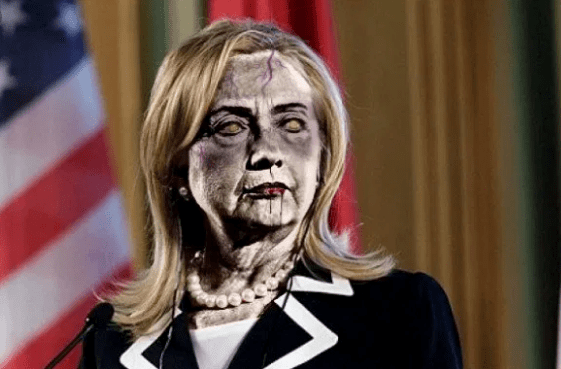
If you squint really hard, it’s ALMOST like she’s in the Oval Office…
RT | January 8, 2020
Social media sang praises of would-be US President Hillary Clinton as actual President Donald Trump seemed headed for all-out war with Iran – even though Clinton had been a much more enthusiastic participant in US wars.
After Iranian missiles struck several US bases Tuesday night, #Resistance twitter wasted no time disavowing the administration they blamed for the hostilities, running into the arms of his arch-rival with the #IVotedforHillaryClinton hashtag.
But claiming Clinton was the less warlike of the two candidates, or would have steered the country away from war with Iran, requires a serious divergence from history. The former Secretary of State once told an interviewer that “I want the Iranians to know that if I’m the president, we will attack Iran.”
That was during her 2008 campaign, and in the middle of a discussion about Iran possibly attacking Israel. Perhaps her stance on the Islamic republic had softened a bit by 2016, enough to justify viewing her as the lesser of two Iran hawks?
Nope. The months leading up to that election saw her parroting Israeli PM Benjamin Netanyahu’s decades-old talking points about Iran “racing toward a nuclear capability,” expanding “secret facilities,” and “defying their international obligations” before she swept in with the nuclear deal and solved all the problems.
Except the deal was negotiated after she was replaced as the top US diplomat by John Kerry. Clinton was on the same side as Trump, demanding ever more sanctions even as the nuclear deal took effect, this time as punishment for Iran’s ballistic missile program.
Beyond interventionist Democrats, she was courted by a bevy of neocons who couldn’t stomach Trump’s anti-interventionist rhetoric. Inveterate warmongers like Robert Kagan and Richard Armitage swooned over the ex-First Lady.
In short order, the infamous clip of Clinton mocking the brutal murder of Libyan leader Muammar Gaddafi – “we came, we saw, he died” – resurfaced on twitter. The so-called “humanitarian” intervention in Libya was largely a creation of Clinton’s State Department, complete with risible wartime propaganda about Gaddafi handing out Viagra so his soldiers could better commit mass rapes, and the continued chaos in that once-advanced state remains a testament to what the region (or world) might look like under her watch.
She wanted a repeat performance in Syria, calling for – and thankfully not getting – a no-fly zone, even while admitting it would “kill a lot of Syrians.”
While Trump lost the popular vote to Clinton, he handily beat her in the Electoral College, which ultimately decides who occupies the White House. Despite her massive advantage in political experience, his promises to bring US troops home attracted significant support. Nearly four years later, however, the US is poised on the brink of a catastrophic expansion of its Forever War.
Justice at Last? ‘Panic’ in Israel as the ICC Takes ‘Momentous Step’ in the Right Direction

By Ramzy Baroud | Palestine Chronicle | January 8, 2020
At long last, Fatou Bensouda, the Chief Prosecutor of the International Criminal Court (ICC) has uttered the long-anticipated conclusion that “all the statutory criteria under the Rome statute for the opening of an investigation (into alleged war crimes in the Occupied Palestinian Territories) have been met”.
Bensouda’s verdict has been in the making for a long time and should, frankly, have arrived much earlier. The ICC preliminary investigations into Israeli war crimes began back in 2015. Since then, many more such war crimes have been committed, while the international community persisted in its moral inertia.
The ICC statement, issued on December 20, asserted that the court saw “no substantial reasons to believe that an investigation would not serve the interests of justice”.
But can the “interest of justice” be served while the United States government continues to wield a massive stick, using its diplomatic, political and financial clout to ensure Israel emerges unscathed from its latest legal scuffle?
There is little doubt that Michael Lynk, the United Nations Special Rapporteur for the situation of human rights in the Palestinian territory, is absolutely right: A formal ICC criminal investigation into war crimes in Palestine is a “momentous step forward in the quest for accountability”.
He is also correct in his assessment, published in the United Nations Human Rights Officer of the High Commissioner website, that “accountability has, until now, been largely missing in action throughout the 52-year-old occupation.”
I would go even further and expand the timeline of the missing accountability to include the two decades prior to the Israeli occupation of East Jerusalem, the West Bank and the Gaza Strip. Otherwise, how is one to account for the ethnic cleansing of Palestine in 1947-48, the numerous massacres and other wanton killings that accompanied and followed those defining years, or the fact that Israel was never held accountable for its violations of international and humanitarian laws between 1948 and 1967?
That issue notwithstanding, the Palestinian Authority and all political parties in Palestine should exploit this unprecedented opportunity of holding Israel accountable.
As soon as the ICC issued its statement, news reports surfaced conveying a sense of “panic” in Israel. The Times of Israel reported that an Israeli government meeting to discuss the ICC decision was held shortly after, with the aim of considering a proper response, including the possibility of preventing ICC investigators from reaching Israel.
This is eerily familiar. Israel has denied entry to – or refused to cooperate with – international investigators and observers on many occasions in the past.
Following a UN planned investigation into alleged Israeli war crimes in the Palestinian refugee camp of Jenin in 2002, the Israeli government quickly moved, and, sadly, succeeded in blocking the investigation altogether.
It has done so time and again, often demonizing the very individuals entrusted with the mission of examining the illegality of Israel’s behavior in the context of international law. Well-respected judges and international law experts, such as Richard Goldstone, Richard Falk, and John Dugard, were vehemently attacked by Israeli officials and media and, by extension, by the US government and media as well.
Israel has managed to survive dozens of United Nations Resolutions and countless legal reports and indictments by the UN and all UN-affiliated organizations, largely because of blind and unequivocal American support, which has shielded Israeli war criminals from ever answering to their horrific actions in Palestine.
“Remember, it was (then-Secretary of State) Hillary Clinton who took pride in the fact that she personally killed the Goldstone Report,” said US author, Norman Finkelstein, in a recent interview with the news website Mondoweiss.
The Goldstone report was issued in the wake of the Israeli war on Gaza in 2009, dubbed ‘Operation Cast Lead’. The campaign of intimidation and pressure on Goldstone, personally, has forced the once-respected judge to retract his accusations of Israeli war crimes and the deliberate targeting of civilians.
While Clinton did her part in torpedoing the Goldstone Report, former US President, Barack Obama, according to Finkelstein, went to great lengths to “neutralize international law against settlements and other Israeli crimes in the occupied territories”.
Worse still, on September 14, 2016, Obama handed Israeli Prime Minister, Benjamin Netanyahu, himself accused of carrying out numerous war crimes against Palestinians, the largest US aid package to a foreign country in modern history, a whopping $38 billion over the course of ten years.
This is not a new phenomenon, where the US enables Israeli crimes and simultaneously shields Tel Aviv from any accountability for these crimes before the international community. All US administrations, whether Republican or Democrat, have honored the same sinister maxim, thus ensuring Israel, literally, gets away with murder.
A particular case in point was in 2001, when 28 Palestinian and Lebanese survivors of the 1982 Sabra and Shatila massacre attempted to try, in a Belgian court, late Israeli leader and accused war criminal, Ariel Sharon. Intense American pressures and a brazen intimidation campaign, targeting the Belgian government and the judicial system, resulted in the dismissal of the case in 2003. To deny Israel’s victims the opportunity to seek justice everywhere in the country, Belgium revised its very law, to the satisfaction of Israel and the United States.
The high level of the ICC investigations places the legal push against Israel at a whole new level. This is uncharted territory for Israel, the United States, Palestine, the ICC and the international community as a whole. There is little doubt that some joint Israeli-American effort is already underway to develop strategies aimed at countering if not altogether dismissing, the ICC investigation.
It is clear that justice for Palestinians in the face of Israeli aggression, itself fueled by unconditional American support, is not at all possible if it is not accompanied by regional and international unity, and a clear and decisive decision by all parties concerned that Israel, once and for all, must pay for its military occupation, racist apartheid laws, protracted siege on Gaza, and the many massacres in between.
Without this kind of international will, the ICC investigation could become another sad case of justice denied, a non-acceptable option for any justice-seeking individual, organization, and government anywhere in the world.
– Ramzy Baroud is a journalist and the Editor of The Palestine Chronicle. He is the author of five books. His latest is “These Chains Will Be Broken: Palestinian Stories of Struggle and Defiance in Israeli Prisons” (Clarity Press, Atlanta). Dr. Baroud is a Non-resident Senior Research Fellow at the Center for Islam and Global Affairs (CIGA), Istanbul Zaim University (IZU).
Chelsea Clinton Gains $9 Mln from Corporate Board Position in Her Mother’s Friend Company – Report
Sputnik – 07.01.2020
Chelsea Clinton has reaped $9 million in compensation since 2011 for serving on the board of an internet investment company, according to Barron’s, a financial publication.
Barron’s reported Sunday that Clinton has profited as a board member for IAC/InterActiveCorp, a media and internet investment company that has an ownership stake in 150 well-known brands, such as Vimeo, Tinder, Angie’s List and Home Advisor. The only child of former President Bill Clinton and 2016 presidential candidate Hillary Clinton has served on IAC’s board since 2011 and receives an annual $50,000 retainer and $250,000 worth of restricted IAC stock units, according to Barron’s.
She reported owning $8.95 million worth of IAC stock to the Securities and Exchange Commission at the end of December. According to Barron’s, IAC’s stock has risen 89 percent, 50 percent and 36 percent in 2017, 2018 and 2019, respectively, in an extremely steep rise.
Clinton was also named to the board of Expedia Group in March of 2017, a position that typically earned $250,000 in 2015, according to a report at the time by The Guardian. Both IAC and Expedia are controlled by Barry Diller, a business and television mogul and, notably, a friend of Hillary Clinton.
The IG Report: Malfeasance, Lies, Threats and Denials
By Renée Parsons | OffGuardian | December 28, 2019
It is no surprise that when the Inspector General’s Report was released in early December, the corporate media, which itself has been knee-deep and complicit in spreading the false Russiagate narrative, chose to focus on one narrow conclusion: that, given DOJ’s ‘lax guidelines,’ the IG found no bias related to opening the Crossfire Hurricane investigation.
Ergo, once the Media labels the IG Report, all dutiful subscribers and readers fall in line with its dictates, nodding in concurrence, as those who refuse to do their own homework get on board and accept the hogwash they are being fed. Once the Media hypes the repetitive drone that there was ‘no bias,’ the phrase becomes embedded into the collective unconscious and the disinformation becomes gospel.
The question has yet to be asked what role the FISA Court played in its own debasement by blindly accepting the majority of surveillance requests and by lax procedures that allow its own credibility to be violated.
What remains uncertain is exactly how Crossfire Hurricane was born. While it is known that the Clinton campaign (via the DNC) hired GP Fusion (which hired DOJ deputy AG Bruce Ohr’s wife) to dig dirt on a Republican candidate for President and we know that former MI6 asset Christopher Steele became involved with creating a salacious Dossier – but the specific links tying those diverse parts to the FBI remains enigmatic.
An almost immediate response to the ‘no bias’ allegation came from AG William Barr stating that…
The Inspector General’s report now makes clear that the FBI launched an intrusive investigation of a U.S. presidential campaign on the thinnest of suspicions that, in my view, were insufficient to justify the steps taken.”
… with Special Investigator US Attorney John Durham adding that he:
advised the IG that he did not agree with some of the report’s conclusions as to predication and how the FBI case was opened.”
Both responses were highly unusual and may be interpreted as affirmation of a deeper level of complicity than the IG discovered although his investigation was limited to DOJ employees and to the FISA Court process.
It was not until IG Horowitz’s testimony before the Senate Judiciary Committee that the true scathing impact of the full Report was understood; thus revealing the true depth of the FBI’s embedded systemic problems.
Horowitz told the Senate panel:
We found and are deeply concerned that so many basic and fundamental errors were made by three separate handpicked investigative teams on one of the most sensitive FBI investigations after the matter had been briefed to the highest levels within the FBI even though the information sought through the use of FISA authority related so closely to an on-going Presidential campaign and even though those involved with the investigations knew that their actions would likely be subjected to close scrutiny. The circumstances reflect the failure not just by those who prepared the applications but also by the managers and supervisors in the Crossfire Hurricane chain of command including FBI senior officials who were briefed as the investigation progressed”
In dialogue with Sen. Crapo about FBI misconduct as ‘mind-numbing’, Horowitz responded “there is such a range of conduct here that is inexplicable and the answers we got were not satisfactory that we’re left trying to understand how could all these errors occur over a nine month period or so…”
In other words, the FBI, with a tainted history of deeply embedded corruption, has been out of control for decades with an aggressive pursuit of political opponents, corruption of its Forensic Lab and a COINTEL program against American citizens.
It is ironic that some of the FBI’s Congressional supporters are now recipients of that corruption.
In response to Barr’s statement regarding the IG Report, former Attorney General Erik Holder who once referred to himself as “still Obama’s wing man so i’m there with my boy,” wrote a divisive op ed for the Washington Post provocatively entitled “Eric Holder: William Barr is Unfit to be Attorney General“.
In a classic example of covering one’s butt, it can be assumed that Holder is still protecting Obama’s wing as he took cheap shots at Barr for a “series of public statements and taken actions that are so plainly ideological, so nakedly partisan and so deeply inappropriate” making him ‘unfit to lead the Justice Department.”
Suffering a partisan anxiety attack, Holder has clearly been directed to slander a successor who exhibits more candor and principle than he himself demonstrated as AG.
Given the IG report’s otherwise thorough analysis, the Hope and Change crowd may be feeling the heat that those morning tete a tete intel briefings in the Oval Office may have included updates on Crossfire Hurricane.
Holder’s condescension, as if he had special privilege to pontificate on “career public servants,” falls flat with his thinly veiled threat to Durham:
I was troubled by his unusual statement disputing the inspector general’s findings. Good reputations are hard-won in the legal profession, but they are fragile; anyone in Durham’s shoes would do well to remember that, in dealing with this administration, many reputations have been irrevocably lost.”
With focus now on whether Durham will succumb to Holder’s warning may instead boomerang, inspiring Durham to dig deeper than he had previously planned.
The IG Report cited former FBI Director Jim Comey for “clearly and dramatically” departing from department norms in the investigation of HRC’s email server and that he made a “serious error of judgment” in sending a letter to Congress announcing the re-opening of the Clinton probe. Comey was fired from the FBI for ‘insubordinate’ acts and ‘dangerous’ behavior in deceiving the FISA Court.
When asked by CNN’s Anderson Cooper,
“When you read what the report said, do you think this is a vindication
Comey responded:
It is. The FBI has had to wait two years while the President and his supporters lied about the institution, finally the truth gets told.”
Apparently Comey had not read the Report in its entirety, not listened to Horowitz’s testimony to the Senate or he continues to live under a rock.
In a recent interview with NBC News Pete Williams, Barr explained that
“One of the problems in the IG investigation is that Comey refused to sign back up for his security clearance and therefore could not be questioned (by the IG) on classified matters.…so someone like Durham can compel testimony.”
In other words, Comey is shrewd enough to know how to deliberately avoid pertinent questions from Horowitz without implicating himself but the day will come when Durham has the legal authority to demand Comey’s full participation.
In a Fox News Sunday interview with Chris Wallace, Comey refused to accept and was significantly at odds with many of the IG most significant findings including denial of any personal role in Crossfire. “I didn’t know, As Director I am not kept informed on the details of an investigation.
I didn’t know the particulars with an agency of 38,000 people ‘seven layers below.” Wallace repeatedly pushed back with Comey remaining smooth as silk, carefully coached, as he slipped around every iota that he had any responsibility for the investigation of a President and its constitutional screw ups.
When asked if he would resign if all these misdeeds were revealed under his watch, Comey replied “No, I don’t think so. There are other mistakes I consider more consequential than this during my tenure.”
Pray, we await those revelations.
‘Because You’d Be in Jail!’ The Real Reason Democrats Are Pushing Trump Impeachment?
By Robert Bridge | Strategic Culture Foundation | December 28, 2019
In the time-honored tradition of Machiavellian statecraft, all of the charges being leveled against Donald Trump to remove him from office – namely, ‘abuse of power’ and ‘obstruction of congress’ –are essentially the same things the Democratic Party has been guilty of for nearly half a decade: abusing their powers in a non-stop attack on the executive branch. Is the reason because they desperately need a ‘get out of jail free’ card?
Due to the non-stop action in Washington of late, few believe that the present state of affairs between the Democrats and Donald Trump are exclusively due to a telephone call between the US leader and the Ukrainian President Volodymyr Zelensky. That is only scratching the surface of a story that is practically boundless.
Back in April 2016, before Trump had become the Republican presidential nominee, talk of impeachment was already in the air.
“Donald Trump isn’t even the Republican nominee yet,” wrote Darren Samuelsohn in Politico. Yet impeachment, he noted, is “already on the lips of pundits, newspaper editorials, constitutional scholars, and even a few members of Congress.”
The timing of Samuelsohn’s article is not a little astonishing given what the Department of Justice (DOJ) had discovered just one month earlier.
In March 2016, the DOJ found that “the FBI had been employing outside contractors who had access to raw Section 702 Foreign Intelligence Surveillance Act (FISA) data, and retained that access after their work for the FBI was completed,” as Jeff Carlson reported in The Epoch Times.
That sort of foreign access to sensitive data is highly improper and was the result of “deliberate decision-making,” according to the findings of an April 2017 FISA court ruling (footnote 69).
On April 18, 2016, then-National Security Agency (NSA) Director Adm. Mike Rogers directed the NSA’s Office of Compliance to terminate all FBI outside-contractor access. Later, on Oct. 21, 2016, the FBI and the DOJ’s National Security Division (NSD), and despite they were aware of Rogers’s actions, moved ahead anyways with a request for a FISA warrant to conduct surveillance on Trump campaign adviser Carter Page. The request was approved by the FISA court, which, apparently, was still in the dark about the violations.
On Oct. 26, following approval of the warrant against Page, Rogers went to the FISA court to inform them of the FBI’s non-compliance with the rules. Was it just a coincidence that at exactly this time, the Director of National Intelligence James Clapper and Defense Secretary Ashton B. Carter were suddenly calling for Roger’s removal? The request was eventually rejected. The next month, in mid-November 2016 Rogers, without first notifying his superiors, flew to New York where he had a private meeting with Trump at Trump Towers.
According to the New York Times, the meeting – the details of which were never publicly divulged, but may be guessed at – “caused consternation at senior levels of the administration.”
Democratic obstruction of justice?
Then CIA Director John Brennan, dismayed about a few meetings Trump officials had with the Russians, helped to kick-start the FBI investigation over ‘Russian collusion.’ Notably, these Trump-Russia meetings occurred in December 2016, as the incoming administration was in the difficult transition period to enter the White House. The Democrats made sure they made that transition as ugly as possible.
Although it is perfectly normal for an incoming government to meet with foreign heads of state at this critical juncture, a meeting at Trump Tower between Michael Flynn, Trump’s incoming national security adviser and former Russian Ambassador to the US, Sergey Kislyak, was portrayed as some kind of cloak and dagger scene borrowed from a John le Carré thriller.
Brennan questioning the motives behind high-level meetings between the Trump team and some Russians is strange given that the lame duck Obama administration was in the process of redialing US-Russia relations back to the Cold War days, all based on the debunked claim that Moscow handed Trump the White House on a silver platter.
In late December 2016, after Trump had already won the election, Obama slapped Russia with punitive sanctions, expelled 35 Russian diplomats and closed down two Russian facilities. Since part of Trump’s campaign platform was to mend relations with Moscow, would it not seem logical that the incoming administration would be in damage-control, doing whatever necessary to prevent relations between the world’s premier nuclear powers from degrading even more?
So if it wasn’t ‘Russian collusion’ that motivated the Democrats into action, what was it?
From Benghazi to Seth Rich
Here we must pause and remind ourselves about the unenviable situation regarding Hillary Clinton, the Secretary of State, who was being grilled daily over her use of a private computer to communicate sensitive documents via email. In all likelihood, the incident would have dropped from the radar had it not been for the deadly 2012 Benghazi attacks on a US compound.
In the course of a House Select Committee investigation into the circumstances surrounding the attacks, which resulted in the death of US Ambassador Chris Stevens and three other US personnel, Clinton handed over some 30,000 emails, while reportedly deleting 32,000 deemed to be of a “personal nature”. Those emails remain unaccounted for to this day.
By March 2015, even the traditionally tepid media was baring its baby fangs, relentlessly pursuing Clinton over the email question. Since Clinton never made a secret of her presidential ambitions, even political allies were piling on. Senator Dianne Feinstein (D-Calif.), for example, said it’s time for Clinton “to step up” and explain herself, adding that “silence is going to hurt her.”
On July 24, 2015, The New York Times published a front-page story with the headline “Criminal Inquiry Sought in Clinton’s Use of Email.” Later, Jennifer Rubin of the Washington Post candidly summed up Clinton’s rapidly deteriorating status with elections fast approaching: “Democrats still show no sign they are willing to abandon Clinton. Instead, they seem to be heading into the 2016 election with a deeply flawed candidate schlepping around plenty of baggage — the details of which are not yet known.”
Moving into 2016, things began to look increasingly complicated for the Democratic front-runner. On March 16, 2016, WikiLeaks launched a searchable archive for over 30 thousand emails and attachments sent to and from Hillary Clinton’s private email server while she was Secretary of State. The 50,547-page treasure trove spans the dates from June 30, 2010 to August 12, 2014.
In May, about one month after Clinton had officially announced her candidacy for the US presidency, the State Department’s inspector general released an 83-page report that was highly critical of Clinton’s email practices, concluding that Clinton failed to seek legal approval for her use of a private server.
“At a minimum,” the report determined, “Secretary Clinton should have surrendered all emails dealing with Department business before leaving government service and, because she did not do so, she did not comply with the Department’s policies that were implemented in accordance with the Federal Records Act.”
The following month brought more bad news for Clinton and her presidential hopes after it was reported that her husband, former President Bill Clinton, had a 30-minute tête-à-tête with Attorney General Loretta E. Lynch, whose department was leading the Clinton investigations, on the tarmac at Phoenix International Airport. Lynch said Clinton decided to pay her an impromptu visit where the two discussed “his grandchildren and his travels and things like that.” Republicans, however, certainly weren’t buying the story as the encounter came as the FBI was preparing to file its recommendation to the Justice Department.
The summer of 2016, however, was just heating up.
Hack versus Leak?
On the early morning of July 10, Seth Rich, the director of voter expansion for the Democratic National Committee (DNC), was gunned down on the street in the Bloomingdale neighborhood of Washington, DC. Rich’s murder, said to be the result of a botched robbery, bucked the homicide trend in the area for that particular period; murders rates for the first six months of 2016 were down about 50 percent from the same period in the previous year.
In any case, the story gets much stranger. Just five days earlier, on July 5th, the computers at the DNC were compromised, purportedly by an online persona with the moniker “Guccifer 2.0” at the behest of Russian intelligence. This is where the story of “Russian hacking” first gained popularity. Not everyone, however, was buying the explanation.
In July 2017, a group of former U.S. intelligence officers, including NSA specialists, who call themselves Veteran Intelligence Professionals for Sanity (VIPS) sent a memo to President Trump that challenged a January intelligence assessment that expressed “high confidence” that the Russians had organized an “influence campaign” to harm Hillary Clinton’s “electability,” as if she wasn’t capable of that without Kremlin support.
“Forensic studies of ‘Russian hacking’ into Democratic National Committee computers last year reveal that on July 5, 2016, data was leaked (not hacked) by a person with physical access to DNC computer,” the memo states (The memo’s conclusions were based on analyses of metadata provided by the online persona Guccifer 2.0, who took credit for the alleged hack). “Key among the findings of the independent forensic investigations is the conclusion that the DNC data was copied onto a storage device at a speed that far exceeds an Internet capability for a remote hack.”
In other words, according to VIPS, the compromise of the DNC computers was the result of an internal leak, not an external hack.
At this point, however, it needs mentioned that the VIPS memo has sparked dissenting views among its members. Several analysts within the group have spoken out against its findings, and that internal debate can be read here. Thus, it would seem there is no ‘smoking gun,’ as of yet, to prove that the DNC was not hacked by an external entity. At the same time, the murder of Seth Rich continues to remain an unsolved “botched robbery,” according to investigators. Meanwhile, the one person who may hold the key to the mystery, Julian Assange, is said to be withering away Belmarsh Prison, a high-security London jail, where he is awaiting a February court hearing that will decide whether he will be extradited to the United States where he faces 18 charges.
Here is a question to ponder: If you were Julian Assange, and you knew you were going to be extradited to the United States, who would you rather be the sitting president in charge of your fate, Hillary Clinton or Donald Trump? Think twice before answering.
“Because you’d be in jail”
On October 9, 2016, in the second televised presidential debates between Donald Trump and Hillary Clinton, Trump accused his Democratic opponent of deleting 33,000 emails, while adding that he would get a “special prosecutor and we’re going to look into it…” To this, Clinton said “it’s just awfully good that someone with the temperament of Donald Trump is not in charge of the law in our country,” to which Trump deadpanned, without missing a beat, “because you’d be in jail.”
Now if that remark didn’t get the attention of high-ranking Democratic officials, perhaps Trump’s comments at a Virginia rally days later, when he promised to “drain the swamp,” made folks sit up and take notice.
At this point the leaks, hacks and everything in between were already coming fast and furious. On October 7, John Podesta, Clinton’s presidential campaign manager, had his personal Gmail account hacked, thereby releasing a torrent of inside secrets, including how Donna Brazile, then a CNN commentator, had fed Clinton debate questions. But of course the crimes did not matter to the mendacious media, only the identity of the alleged messenger, which of course was ‘Russia.’
By now, the only thing more incredible than the dirt being produced on Clinton was the fact that she was still in the presidential race, and even slated to win by a wide margin. But perhaps her biggest setback came when authorities, investigating Anthony Weiner’s abused laptop into illicit text messages he sent to a 15-year-old girl, stumbled upon thousands of email messages from Hillary Clinton.
Now Comey had to backpedal on his conclusion in July that although Clinton was “extremely careless” in her use of her electronic devices, no criminal charges would be forthcoming. He announced an 11th hour investigation, just days before the election. Although Clinton was also cleared in this case, observers never forgave Comey for his actions, arguing they cost Clinton the White House.
Now James Comey is back in the spotlight as one of the main characters in the Barr-Durham investigation, which is examining largely out of the spotlight the origins of the Trump-Russia conspiracy theory that dogged the White House for four long years.
In early December, Justice Department’s independent inspector general, Michael E. Horowitz, released the 400-page IG report that revealed a long list of omissions, mistakes and inconsistencies in the FBI’s applications for FISA warrants to conduct surveillance on Carter Page. Although the report was damning, both Barr and Durham noted it did not go far enough because Horowitz did not have the access that Durham has to intelligence agency sources, as well as overseas contacts that Barr provided to him.
With the AG report due for release in early spring, needless to say some Democrats are very nervous as to its finding. So nervous, in fact, that they might just be willing to go to the extreme of removing a sitting president to avoid its conclusions.
Whatever the verdict, 2020 promises to be one very interesting year.
The Carter Page/Ukraine Lie That Kept On Lying for Mueller and the FBI
By Paul Sperry – RealClearInvestigations – December 12, 2019
The FBI and Special Counsel Robert Mueller repeatedly kept alive a damning narrative that investigators knew to be false: namely, that a junior Trump campaign aide as a favor to the Kremlin had “gutted” an anti-Russia and pro-Ukraine plank in the Republican Party platform at the GOP’s 2016 convention.
Federal authorities used this claim to help secure spy warrants on the aide in question, Carter Page, suggesting to the court that he was “an agent of Russia” – even though investigators knew that Page was working for U.S., not Russian, intelligence, and that they had learned from witnesses, emails and other evidence that Page had no role in drafting the Ukraine platform plank.
The revelation is buried in the Justice Department watchdog’s just-released report on FISA surveillance abuses. RealClearInvestigations fleshed out this unreported story with footnotes from the Mueller report and exclusive interviews with Trump campaign officials who worked on the convention platform.
Of all the Trump-Russia rumors, insinuations and falsehoods – from secret payments for shadowy hackers, to videotaped prostitutes with active bladders, to a clandestine rendezvous with Kremlin figures in Prague – the supposedly pro-Russia Ukraine platform alteration stands out. It seemed to offer early, public, concrete evidence of an actual bending of prospective U.S. policy to suit Moscow. The false narrative is also significant because it was initially pushed not by Democrats, but by associates of Republican Sen. John McCain and other so-called Never Trumpers. As a bipartisan red flag, it helped build momentum around a narrative of Trump treachery with, then as now, Ukraine playing a central role. It also shows how the Russia and Ukraine controversies were linked from the beginning by Trump’s foes.
This episode loomed so large that the first person Mueller’s team interviewed after taking over the Russia investigation in May 2017 was Rachel Hoff, who was serving as McCain’s policy adviser on the Senate Armed Services Committee. Like her boss, Hoff was no fan of President Trump. Agents sought to confirm with her reports that the Trump campaign had “gutted” the GOP’s platform plank on Ukraine to favor Russia during the party’s convention in Cleveland in early July 2016.
As a disgruntled convention delegate, Hoff got the story started by putting Washington Post columnist Josh Rogin in touch with another Never Trump delegate, Diana Denman, who had lost her bid to amend the GOP plank to call for providing “lethal” weapons to Ukraine to help fend off Russian incursions, according to people with direct knowledge of the matter. Instead, the platform called for “appropriate assistance to the armed forces of Ukraine.”
Denman was overruled because heavily arming Ukraine was out of step with the GOP consensus at the time – to say nothing of the Obama administration’s policy, which refused to arm the Ukrainians. And it was at odds with Trump’s stated position, which sought to avoid military escalation in the region, while encouraging the European Union to take a larger peacekeeping role.
On July 18, 2016, the Post ran Rogin’s sensational story under the misleading headline, “Trump Campaign Guts GOP’s Anti-Russia Stance on Ukraine.” Pushing the narrative that Trump was doing the Kremlin’s bidding, it quoted Hoff warning that Trump “would be dangerous for America and the world.” The story left out the key part of the final Trump-approved plank pledging aid “to the armed forces of Ukraine.” Reached by phone, Rogin declined comment.
This story was quickly amplified in the Steele dossier, the series of now-debunked opposition research memos alleging Trump-Russia collusion. Compiled by ex-British intelligence officer Christopher Steele for the Clinton campaign, those memos became a foundation for the FBI and Mueller probes even though – as this week’s IG report established – bureau agents knew that the material in them included demonstrably false assertions and exaggerated gossip dismissed as nonsense by Steele’s own purported source.
Steele also embellished the GOP convention story by claiming that Carter Page had played a key role in drafting the Ukraine plank as part of a commitment he had allegedly made to his Kremlin handlers “to sideline Russian intervention in Ukraine as a campaign issue.”
None of this was true. And the FBI — and Mueller — knew it, the Justice inspector general reveals in his report.
Still, the FBI presented the Steele dossier’s smear, cataloged as “Steele Report 95,” as key evidence in all four of its warrant applications to obtain wiretaps to eavesdrop on Page, according to the IG report.
To keep renewing the spy warrants, the FBI had to produce fresh evidence for FISA judges to support suspicions Page was “an agent of Russia.” Just a few weeks before the FISA warrant was set to expire in June 2017, Mueller had his investigators interview Hoff, as his first witness, followed by Denman, hoping they could provide fresh details to keep building an espionage case against Page and the Trump campaign.
But Mueller struck out.
According to agents’ notes documenting their June 2017 interview, as revealed in the IG report, Denham told the FBI that Page was not involved in the drafting of the Ukraine plank. But Mueller’s team did not update its fourth and final FISA warrant application on Page with this exculpatory information. Instead, it recited the same baseless claim that he had shaped the Ukraine policy with guidance from Russia. And the court renewed the warrant that June to electronically monitor Page, allowing the government to continue vacuuming up all of his emails, phone calls, text messages and other communications for another 90 days.
“Although the FBI did not develop any information that Carter Page was involved in the Republican Platform Committee’s change, the FBI did not alter its assessment of Page’s involvement in the FISA applications,” Justice Department Inspector General Michael Horowitz noted in his 476-page report released Monday.
Added Horowitz: “We found that, other than this information from Report 95 [of the Steele dossier], the FBI’s investigation did not reveal any information to demonstrate that Page had any involvement with the Republican Platform Committee.” Yet, “all four FISA applications relied upon information in the Steele reporting” alleging Page’s role in drafting the Republican plank on Ukraine and Russia.
A former U.S. Navy lieutenant, Page was never charged with espionage or any crime. He told RealClearInvestigations that he has received “numerous death threats that directly resulted from the false allegations” that he was a traitor.
The FBI and Mueller failed to correct the record about Page in their FISA warrant applications even after they identified the Trump campaign officials who actually had a hand in influencing the GOP plank, J.D. Gordon and Matt Miller. A July 14, 2016, email from Gordon confirmed what Page had personally told the FBI in an interview — that he had not taken part in the decision. The FBI knew about the email since at least March 2017, when agents sat down with Page. (Gordon and Page were chatting by email about the convention, and it’s clear from Page’s responses he had no idea what Gordon had done in the Ukraine-Russia platform drafting sessions. IG Horowitz published the relevant excerpt in his report and noted the FBI had the email in its possession.)
Still, Horowitz found, “The FBI never altered the assessment.”
Horowitz further concluded that the FBI should not have included the dossier’s rumor even in its original October 2016 application for a FISA warrant targeting Page, let alone its three renewals, because a confidential source the FBI assigned to spy on Page at the time found no basis for it. In the IG report, Horowitz noted that during that same month of October 2016, the FBI informant met with Page and tape-recorded him denying he was involved in the drafting of the Ukraine plank. Page told the informant, Stefan Halper, that he “stayed clear of that.”
Horowitz’s investigators established that the informant’s recorded statements were sent to the FBI agent assigned at the time to Page’s case, and were copied to a supporting team of other agents, supervisors and analysts. Yet the FBI also withheld that critical exculpatory evidence from the FISA court in the initial application for a warrant on Page (and then continued to deny the court the information in subsequent requests to monitor Page).
The lead case agent, unnamed in the report, told investigators the FBI was operating on a “belief” that Page was involved in the Ukraine and Russia platform, and that he and the FISA team were “hoping to find evidence of that” from the wiretaps. Despite all the snooping on Page, the FBI never collected the hoped-for proof.
The lead supervisor, also unidentified, told investigators “he did not recall why Page’s denial was not included.”
Horowitz reports that the exculpatory documents were also sent to a Justice Department attorney before the warrant was renewed for the first time in January 2017, “[y]et, the information remained unchanged in the renewal applications.”
Added Horowitz: “The attorney told us that he did not recall the circumstances surrounding this, but he acknowledged that he should have updated the descriptions in the renewal applications to include Page’s denials.”
The FBI also failed to inform surveillance court judges that Page was an “operational contact” for the CIA for several years, according to the Horowitz report. In 2013, Page also volunteered as a cooperating witness in an FBI espionage case, and helped put away a real Russian agent in 2016. This was additional exculpatory evidence the FBI kept from the FISA court, as RealClearInvestigations first reported last year.
Peter Strzok, then the FBI’s top counterintelligence official, rode herd on the Page wiretap requests and reported back to FBI attorney Lisa Page (no relation to Carter), who in turn, updated then-Deputy FBI Director Andrew McCabe.
Text messages previously uncovered by Horowitz and shared with Mueller revealed that Strzok and Page, who were having an affair, rooted for Hillary Clinton during the 2016 campaign and held Trump in complete contempt. In one exchange, they discussed the need to “stop” Trump from winning the election. And the two of them had also huddled with McCabe in his office to devise an “insurance policy” in the “unlikely event” Trump ended up winning.
The inspector general’s report points out that it was McCabe who urged investigators to look at the Clinton-funded dossier. The previous year, his Democratic politician wife, Jill, received hundreds of thousands of dollars in donations arranged by Clinton ally and Virginia’s governor at the time, Terry McAuliffe.
Strzok remained central to the investigation well into 2017 – until Mueller was forced to kick him off his team when the anti-Trump bias was revealed. The bureau fired him in 2018, the same year Lisa Page resigned from the FBI. In spite of their anti-Trump political bias, Horowitz said he found “no evidence” their bias influenced their investigative decisions.
Lawyers for Strzok and McCabe did not respond to requests for comment. The FBI and a spokesman for Mueller declined comment.
Putting Carter Page under surveillance starting in October 2016 effectively let the FBI spy on the Trump campaign since its beginnings, because it allowed the bureau to scoop up all of Page’s prior communications. Former Trump officials who have reviewed Horowitz’s new findings confirmed their view that the bureau was trying to make it look like Page and the Trump campaign were doing something sinister to help Russia.
“Page actually had no role in the platform, whatsoever,” Gordon, the Trump campaign’s director of national security, told RCI. “Failing to include the exculpatory information in the FISA application is horrifying.”
While it’s true that Trump sought better relations with Russia, Gordon said, there was nothing nefarious about the drafting of the Ukraine platform. He said the FBI simply assumed it was watered down as a favor to Russia based on a false narrative driven by liberal media outlets like the Post and Never Trumpers such as Rachel Hoff. He said the FBI, under the direction of McCabe, Mueller and former FBI Director James Comey, also wanted to believe the worst about Trump, whom they simply did not like.
Gordon noted that, except for the two Never Trump delegates, nobody in the platform drafting sessions raised a fuss about the Ukraine plank — not even the press.
“The media was present in the room, yet not one person wrote about the Ukraine issue,” he said — until, that is, the Never Trumpers went to the Washington Post that July and helped launch the Trump-Russia “collusion” myth.
Moreover, the narrative was untrue even on its own terms – without the spurious inclusion of Carter Page. Internal platform committee documents show the Ukraine plank could not have been weakened as claimed, because the “lethal” weapons language was never part of the GOP platform in the first place. The final language actually strengthened the platform by pledging direct assistance not just to the country of Ukraine, but to its military in its struggle against Russian-backed forces.
Far from “gutting” assistance, the Trump administration approved the transfer of tank-busting Javelin missiles to Kiev — something the Obama administration refused to do. More than 200 of those weapons have been sold to Ukraine since Trump took office. And the sale and delivery of Javelins never stopped even during this year’s temporary suspension of military aid to Ukraine that is now the subject of the Democrats’ impeachment proceedings.
The final draft of the Ukraine plank also branded Russia a menace, and pledged to stand against “any territorial change imposed by force in Ukraine.” Yet Mueller and his prosecuting staff of mostly Democratic donors still suspected collusion, and they dispatched FBI agents to grill Gordon about the drafting of the platform three times between 2017 and 2019. They also got a grand jury to subpoena his phone records.
In the end, the Mueller report found no Russian influence in the platform.
But the false narrative – that the Ukraine plank stood as early proof of the “extensive conspiracy” between the Trump campaign and Moscow that Steele alleged in his now-debunked dossier – has persisted.
Earlier this year, House Judiciary Committee Chairman Jerry Nadler demanded Gordon provide additional documents, and he has complied. Nadler is now marking up articles of impeachment against Trump over a request he lodged with Ukraine’s new president this summer to help investigate the former Clinton-friendly regime’s attempts to “sabotage” Trump’s election bid in 2016. Trump also asked Kiev to look into possible corruption involving former Vice President Joe Biden’s son Hunter and a Ukrainian energy oligarch.
Meanwhile, Nadler’s impeachment partner, House Intelligence Committee Chairman Adam Schiff, continues to insist that the Trump team “softened” the GOP platform to accommodate “Putin’s invasion of Ukraine.”
A retired Navy commander and former Pentagon spokesman, Gordon said he has run up a five-figure legal bill defending against what he calls a “hoax” perpetrated by Never Trumpers, the media, Comey, Mueller, and now congressional Democrats.
“In the vicious frenzy to destroy President Trump and his associates at all costs, they attempted to turn a routine foreign policy debate in conjunction with the four-year renewal of the GOP platform into a crime scene,” Gordon said in an interview with RCI.
“Incredibly,” he added, “the GOP platform change hoax [later] became the very first order of business in Mueller’s nearly two-year investigation.”
Featured Video
Your Enslavement Begins in Gaza: The ‘Board of Peace’
or go to
Aletho News Archives – Video-Images
From the Archives
The US: The Century of Lost Wars
By James Petras | Global Research | September 12, 2018
Introduction
Despite having the biggest military budget in the world, five times larger than the next six countries, the largest number of military bases – over 180 – in the world and the most expensive military industrial complex, the US has failed to win a single war in the 21st century.
In this paper we will enumerate the wars and proceed to analyze why, despite the powerful material basis for wars, it has led to failures. … continue
Blog Roll
 Aletho News
- Why Israel Is Escalating Its War Crimes Against Lebanon
- Iran in the face of the armed diplomacy of imperialism
- The US build-up around Iran constitutes strategic war option, not ‘deterrence’
- Iran to US: Sanctions and war failed; try diplomacy and respect
- China supplies Iran with radar, surveillance tech to track US stealth aircraft: Report
- Zelensky rejects territorial concessions to Russia
- German leader of EU’s largest faction sounds the alarm of possibility of right-wing forces coming to power in France, Poland
- Putin: Developing Russia’s nuclear forces ‘absolute priority’
- Hungary Blocks 20th Package of Anti-Russia Sanctions, $106B Loan to Ukraine – Szijjarto
- NATO Must Return to 1997 Borders for Peace in Ukraine – Finnish Politician
- If Americans Knew
- Maria Farmer: Epstein Victim Reveals Explosive Information Covered Up by Media
- Average of five Palestinians killed by Israel every day in Gaza since ceasefire – Not a ceasefire Day 136
- Palestinian church leaders admonish Christian Zionist Mike Huckabee – Not a ceasefire Day 135
- Ominous messaging from Trump’s “Board of Peace” – Not a ceasefire Day 134
- ‘Christians Out’: Jerusalem Church Tagged With Hate Graffiti, Police Investigating
- Israeli Settlers Kill American Teen
- ‘We returned from hell’: Palestinian journalists recount torture in Israeli prisons
- No mercy for Gaza in Ramadan – Not a ceasefire Day 133
- The Israeli Government Installed and Maintained Security System at Epstein Apartment
- Tucker Carlson interrogated in Israel, has passport seized after interviewing US ambassador
- No Tricks Zone
- New Research Reaffirms Clouds, Aerosols, And Surface Solar Radiation Are ‘Driving The Climate System’
- Germany: Electric Car Catches Fire At Charging Station, Sets Off Local “Inferno”, Widespread Damage
- New Study: Canada’s New Brunswick Was 1°C Warmer Than Today During The Medieval Warm Period
- Coal Power Back In Trend As Globe Tries To Keep Pace With Growing Demand For Power
- New Study: A 4°C Warmer Beaufort Sea Had ‘No Sea Ice’ 11,700 – 8200 Years Ago
- Unfudging The Data: Dutch Meteorological Institute Reinstates Early 20th Centruy Heat Waves It Had Erased Earlier
- German Gas Crisis…Chancellor Merz Allegedly Bans Gas Debate Ahead of Elections!
- Pollen Reconstructions Show The Last Glacial’s Warming Events Were Global, 10x Greater Than Modern
- Germany’s Natural Gas Storage Level Dwindles To Just 28%… Increasingly Critical
- New Study Rebuts The Assumption That Anthropogenic CO2 Molecules Have ‘Special’ Properties
 Aletho News