Integrity Initiative – The HSBC Connection
Real Media | February 3, 2019
“2 Degrees of separation” – a theory whistleblower Nicholas Wilson has, that wherever in the world a financial scandal occurs HSBC is to be found nearby.
Nicholas has been campaigning for 13 years after blowing the whistle on a High Street fraud of excessive bank charges applied to store cards administered by HSBC. He has recently been vindicated by a Financial Conduct Authority ruling and HSBC have had to begin paying back some of the money defrauded from customers. He was dubbed “Mr. Ethical” by his boss at the time for refusing to defraud debtors.
In this first of several interviews for Real Media, he connects Government funding and the security services to the recently revealed psyops outfit, Institute for Statecraft and its ‘integrity initiative’.
He asks whether there might be a connection with the suspicious death of auditor Sergei Magnitsky, who was working for the Hermitage Fund there. HSBC bankrolled and jointly managed the Hermitage Fund with Bill Browder, who appears in Institute of Statecraft’s documents.
Browder, convicted of tax fraud in Russia connected with the Magnitsky affair, has spent years pointing the finger at the Russians over both the killing and the disappearance of nearly quarter of a billion pounds, but a film by Andrei Nekrasov casts suspicion on Browder and HSBC. If the film is to be believed, it would make sense that Browder is involved with a shadowy group set up to counter Russian “disinformation”.
Nicholas Wilson reveals the close associations between HSBC and the UK security forces, and asks whether the Foreign and Commonwealth Office should be giving public funding to the Institute of Statecraft.
More HSBC revelations at nicholaswilson.com
In first, UK university divests from firms supplying Israel army
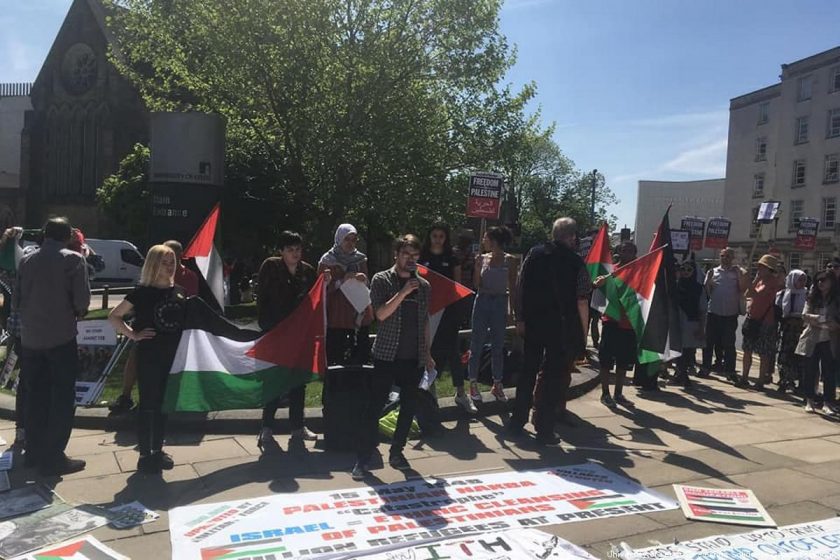
Students hold a protest calling for an end of Israel’s occupation on Gaza at Leeds University, UK on 5 May 2018
MEMO | November 5, 2018
In the first move of its kind, a UK university has divested from companies that supply military equipment to the Israeli army following a student campaign.
The University of Leeds this weekend made the decision to divest from three companies which were found to be complicit in the violation of Palestinian human rights: Airbus, United Technologies and Keyence Corporation. A fourth company – HSBC – is also under review by the university’s investment managers for its provision of loans to Elbit Systems, Caterpillar and BAE Systems, all of which sell weapons and military equipment to the Israeli government.
The move came after it emerged that the University of Leeds had invested £2.4 million ($3.1 million) in these companies this year alone. The sum was revealed by a Freedom of Information request dating back to August, under which the British public can demand access to information held by public authorities.
Students, staff, societies and alumni of the university then published an open letter to the Vice Chancellor calling for the cessation of investment in the four firms. The letter stated that: “In summer 2014, 2,251 Palestinians were killed, including 526 children, by the Israeli Defence Force in the attacks on Gaza […] the artillery used to carry out this destruction were made by Elbit Systems, funded by HSBC. The fighter jets employed by the IDF were maintained by United Technologies. The helicopters which patrol Gaza’s sea border are supplied by Airbus. Further military activity was aided by the equipment provided by Keyence Corporation. The University of Leeds knowingly enables this activity by investing in these companies.”
Our university should not enable military occupation. Our tuition fees should not fund killing. Our education should not be at the expense of a person’s life.
The move has been hailed as a victory for the Boycott, Divestment and Sanctions (BDS) movement. Co-President of the Leeds Palestine Solidarity Group, Evie Russell-Cohen, explained: “It’s clear that the Palestinian call for Boycott, Divestment and Sanctions is being heard in the UK. Students are no longer willing to see their tuition fees funding weapons companies which profit from the killing of Palestinians. This is a massive success, but we hope that it will only be the beginning of a wave change across UK Universities.”
Calls for UK universities to review their investments in companies known to assist the Israeli army have been growing in recent months. In April, activists at the University of Manchester exposed a web of connections between the university and several weapons companies, including Israel Aerospace Industries which produced drones used during Israel’s 2014 assault on the besieged Gaza Strip. The University of Manchester had previously tried to conceal its links to such companies until the Information Commissioner’s Office (ICO) – the body regulating data protection in the UK – found the university to be in contravention of the Freedom of Information Act, the same act which enabled University of Leeds students to force their institution to divest.
$470 mil HSBC settlement, but no one is in jail
The federal government announced a $470 mil settlement with banking giant HSBC on Friday, despite causing financial crisis worth $22 tril
American Herald Tribune | February 11 ,2016
Banking giant HSBC has reached a settlement with the Federal government and most U.S. states for their part in the 2008 financial crisis—the largest such economic downturn since the Great Depression.
But as with Bank of America, Goldman Sachs and J.P. Morgan Chase, no individuals will face trial for engaging in predatory lending tactics, selling bad mortgages to homeowners and forcing illegal foreclosures on millions.
The Justice Department announced the $470 million settlement on Friday, saying that HSBC’s tactics hastened the country’s economic meltdown.
The settlement includes the Justice Department, the Department of Housing and Urban Development (HUD) and the Consumer Financial Protection Bureau as well as 49 state attorneys general and the District of Columbia’s attorney general.
In a Justice Department press release, Iowa Attorney General Tom Miller states that such a settlement serves as precedent for how banks are allowed to behave.
“This agreement not only provides relief to borrowers affected by HSBC’s past practices, it puts in place protections for current and future homeowners through tough mortgage servicing standards,” Miller said. “For years we’ve worked together to hold mortgage servicers responsible for their past conduct. We’re doing that here through this settlement and we’ll continue to address bad conduct in the future.”
According to the terms of the agreement, HSBC’s payments will include $100 million to be distributed between the federal government and a state-administered escrow fund, allowing the states to reimburse borrowers who lost their homes to foreclosure between 2008 and 2012.
Another $370 million in relief is slated directly for borrowers and homeowners in order to reduce mortgage principals for those at risk of default. The federal government says this relief is already underway, noting that the actual cost could be higher because HSBC cannot claim credit for every required consumer relief dollar.
A 2013 study by the Government Accountability Office, funded by a cost-analysis stipulation of the Dodd-Frank financial reform law of 2010, found that the economic crisis cost the American economy $22 trillion.
HSBC will be responsible for implementing standards for mortgage loan servicing, foreclosure procedure and ensuring accuracy of information provided to federal bankruptcy court, according to the federal government.
The deal unfortunately gives HSBC leeway in how it imposes the new standards.
In the past, the bank employed a plethora of intentionally ambiguous practices like robo-signing, false documentation and lost paperwork, in order to continue foreclosures.
The new standards also make it imperative that foreclosure is a last resort by requiring HSBC to provide loss-mitigation options first.
It is unclear how stringent the government will be in accepting applications for the state’s reimbursement plans, but the settlement will almost certainly not be a fix-all for homeowners still reeling from the economic crisis.
Tanuka Loha, then-director of Amnesty International’s Demand Dignity program wrote in 2011 about the severe consequences of the crisis.
“Since 2007, banks have foreclosed around eight million homes. It is estimated that another eight to ten million homes will be foreclosed before the financial crisis is over. This approach to resolving one part of the financial crisis means many, many families are living without adequate and secure housing.,” Loha said. “In addition, approximately 3.5 million people in the U.S. are homeless, many of them veterans. It is worth noting that, at the same time, there are 18.5 million vacant homes in the country.”
Banking on Criminality: Drug Money and the Above-the-Law Global Banking Cartel
By Andrew Gavin Marshall | December 13, 2012
In what the New York Times declared as a “dark day for the rule of law” on December 11, 2012, HSBC, the world’s second largest bank, failed to be indicted for extensive criminal activities in laundering money to and from regimes under sanctions, Mexican drug cartels, and terrorist organizations (including al-Qaeda). While admitting culpability, and with guilt assured, state and federal authorities in the United States decided not to indict the bank “over concerns that criminal charges could jeopardize one of the world’s largest banks and ultimately destabilize the global financial system.” Instead, HSBC agreed to pay a $1.92 billion settlement.
The fear was that an indictment would be a “death sentence” for HSBC. The U.S. Justice Department, which was prosecuting the case, was told by the U.S. Treasury Department and the Federal Reserve that taking such an “aggressive stance” against HSBC could have negative effects upon the economy. Instead, the bank was to forfeit $1.2 billion and pay $700 million in fines on top of that for violating the Bank Secrecy Act and the Trading with the Enemy Act. In a statement, HSBC’s CEO stated, “We accept responsibility for our past mistakes… We are committed to protecting the integrity of the global financial system. To this end, we will continue to work closely with governments and regulators around the world.” With more than $7 billion in Mexican drug cartel money laundered through HSBC alone, the fine amounts to a slap on the wrist, no more than a cost-benefit analysis of doing business: if the ‘cost’ of laundering billions in drug money is less than the ‘benefit,’ the policy will continue.
As part of the settlement, not one banker at HSBC was to be charged in the case. The New York Times acknowledged that, “the government has bought into the notion that too big to fail is too big to jail.” HSBC joins a list of some of the world’s other largest banks in paying fines for criminal activities, including Credit Suisse, Lloyds, ABN Amro and ING, among others. The U.S. Assistant Attorney General Lanny A. Breuer referred to the settlement as an example of HSBC “being held accountable for stunning failures of oversight.” Lanny Breuer, who heads the Justice Department’s criminal division, which was responsible for prosecuting the case against HSBC, was previously a partner at a law firm (along with the U.S. Attorney General Eric Holder) where they represented a number of major banks and other conglomerates in cases dealing with foreclosure fraud. While Breuer and Holder were partners at Covington & Burling, the firm represented notable clients such as Bank of America, Citigroup, JP Morgan Chase and Wells Fargo, among others. It seems that at the Justice Department, they continue to have the same job: protecting the major banks from being persecuted for criminal behaviour.
With a great deal of focus on the $1.9 billion in fines being paid out by HSBC, little mention was made of the fact that HSBC had roughly $2.5 trillion in assets, and earned $22 billion in profits in 2011. But not to worry, HSBC’s executive said that they “accept responsibility for our past mistakes,” and added: “We have said we are profoundly sorry for them, and we do so again.” So not only did the executives of the world’s second largest bank apologize for laundering billions in drug money (along with other crimes), but they apologized… again. Thus, they pay a comparably small fine and face no criminal charges. I wonder if a crack dealer from a ghetto in the United States could avoid criminal prosecution if he were to apologize not once, but twice. Actually, we don’t have to wonder. In May of 2012, as HSBC executives were testifying before the U.S. Senate in Washington D.C., admitting their role in drug money laundering, a poor black man was convicted of peddling 5.5 grams of crack cocaine just across the river from the U.S. Capitol building, and he was given 10 years in prison.
Back in August the bank stated that they had put aside $700 million to pay fines for illegal activities, which conveniently was the exact amount they were fined by the U.S. Justice Department (not including the forfeiture of profits). Lanny Breuer declared the settlement to be “a very just, very real and very powerful result.” Indeed, one could agree that the results are “powerful” and “very real,” in that they provide a legal state-sanctioned decision that big banks will not be prosecuted for their vast criminal activities, precisely because they are big banks. The “very real” result of this is that we can guarantee that such criminal behaviour will continue, since the banks will continue to be protected by the state. With news of the settlement, HSBC’s market share price rose by 2.8%, a clear sign that “financial markets” also reward criminal behaviour and the “pervasively polluted” culture at HSBC (in the words of the U.S. Senate report).
Jack Blum, a Washington attorney and former special counsel for the Senate Foreign Relations Committee who specializes in money laundering and financial crimes stated that, “If these people aren’t prosecuted, who will be?” He further asked: “What do you have to do to be prosecuted? They have crossed every bright line in bank compliance. When is there an offense that’s bad enough for a big bank to be prosecuted?” But the Justice Department’s Lanny Breuer explained that his department had to consider “the collateral consequences” of prosecutions: “If you prosecute one of the largest banks in the world, do you risk that people will lose their jobs, other financial institutions and other parties will leave the bank, and there will be some kind of event in the world economy?”
In other words, the U.S. Justice Department decided that big banks are above the law, because if they weren’t, there would be severe consequences for the financial system. And this is not just good news for HSBC, the “favourite” bank of Mexican drug cartels (according to Bloomberg), but it’s good news for all banks. After all, HSBC is not the only bank engaged in laundering drug money and other illegal activities. Back in 2010, Wachovia (now part of Wells Fargo) paid roughly $160 million in fines for laundering some $378.4 billion in drug money. Drug money has also been found to be laundered through other major financial institutions, including Bank of America, Banco Santander, Citigroup, and the banking branch of American Express. Nearly all of the world’s largest banks have been or are currently being investigated for other crimes, including rigging interest rates (in what’s known as the Libor scandal), and other forms of fraud. Among the banks being investigated for criminal activity by U.S. prosecutors are Barclays, Deutsche Bank, Citigroup, JP Morgan Chase, Royal Bank of Scotland, UBS, Bank of America, Bank of Tokyo Mitsubishi, Credit Suisse, Lloyds, Rabobank, Royal Bank of Canada, and Société Générale, among others. Regulators and investigators of the Libor scandal – “the biggest financial scandal ever” – report that the world’s largest banks engage in “organized fraud” and function like a “cartel” or “mafia.”
The pervasive criminality of this “international cartel” is so consistent that one commentator with the Guardian has referred to global banks as “the financial services wing of the drug cartels.” But indeed, where could be a better place for drug cartels to deposit their profits than with a financial cartel? And why would banks give up their pivotal role in the global drug trade? While the pharmaceutical drug industry records annual revenues in the hundreds of billions of dollars (which is nothing to ignore), the global trade in illicit drugs, according to the United Nations Office on Drugs and Crime, amounted to roughly 2.3-5.5% of global GDP, around $2.1 trillion (U.S.) in 2009. That same year, the same United Nations office reported that billions of dollars in drug money saved the major global banks during the financial crisis, as “the only liquid investment capital” pouring into banks. Roughly $325 billion in drug money was absorbed by the financial system in 2009. It is in the interest of banks to continue profiting off of the global drug trade, and now they have been given a full green light by the Obama administration to continue.
Welcome to the world of financial criminality, the “international cartel” of drug money banks and their political protectors. These banks not only launder billions in drug money, finance terrorists and commit massive fraud, but they create massive financial and economic crises, and then our governments give them trillions of dollars in bailouts, again rewarding them for creating crises and committing criminal acts. On top of that, we, the people, are handed the bill for the bailouts and have to pay for them through reduced standards of living by being punished into poverty through ‘austerity measures’ and have our labour, resources, and societies exploited through ‘structural reform’ policies. These criminal banks dominate the global economy, and dictate policies to national political oligarchies. Their greed, power, and parasitic nature knows no bounds.
The fact that the Justice Department refused to prosecute HSBC because of the effects it could have on the financial system should be a clear sign that the financial system does not function for the benefit of people and society as a whole, and thus, that it needs to be dramatically changed, cartels need to be destroyed, banks broken up, criminal behaviour punished (not rewarded), and that people should dictate the policies of society, not a small network of international criminal cartel banks.
But then, that would be rational, so naturally it’s not even up for discussion.
Featured Video

The Most Important Bet You’ve Never Heard Of
or go to
Aletho News Archives – Video-Images
From the Archives
The Occupied Mentality Syndrome
Saudi Arabia on the American chessboard – Part 2
By B. J. Sabri | American Herald Tribune | April 19, 2016
Since the Korean War, but particularly since the Iranian Revolution of 1979 until today, the United States has been steadily escalating its military presence in the Persian Gulf. Taking advantage of many colossal events of the past 36 years, [1] the hyper-empire has institutionalized its massive presence on land and sea, and expanded its objectives to include the unambiguous physical control of the area, as well as the clear understanding that local Arab governments should abide by them. The pretext is always the same: in “defense” of the national interests and security of the United States. From observing how the United States has been interacting with the governments of the region, and by judging from the size of its expeditionary force, we could reach a basic conclusion. The United States is occupying, de facto, the entire Arabian Peninsula. (Yemen, devastated by Saudi and American jets is yet to be conquered. Oman? Britain returned not as colonial ruler but as a soft occupying power.)
Under this articulation, Saudi Arabia, Qatar, Kuwait, and the United Arab Emirates are virtually occupied countries. If we compare this type of occupation to the mandate and protectorate regimes of the past, the results might be identical—the nations affected by it lose sovereignty. When Arab governments comply with the objectives of a foreign power that station military forces on their national milieu, then that power controls them in multiple ways including how they react to policy deliberations and what decisions they intend to take on specific issues. A good method to verify the concept of effective occupation is this: take notice of what the United States says and wants, and then compare it to what the gulf rulers do in response. (I shall discuss this detail at some point in the upcoming parts.)
If the presence of US forces or other means of political pressure are a factor in Saudi Arabia’s interventionist Arab wars, then we need to debate this issue. However, from the history of resistance to colonialism, we learnt: if a powerful state imposes its order on a nation by military means or other forms of coercion, and if this nation does not resist that imposition, then a mental subordination to the powerful state will ensue. This is especially true in the case of Saudi Arabia. One single event, 9/11, has transformed it from a US “ally” into an instant political hostage of the American Empire. … continue
Blog Roll
 Aletho News
- Trump and the debris of Iran war
- IRGC hits US tech giant Oracle’s data center, computing site in UAE over new assassinations
- Bombing Iran Back Into the Stone Age /Lt Col Daniel Davis & Jim Jatras
- UAE rejects report claiming it is ready to join war on Iran to reopen Hormuz
- A New Resistance Front: How Does Syria Factor into the Regional War?
- Gulf states weigh pipeline expansion plans, hoping to bypass Hormuz
- Iran sets up ‘tollbooth’ system in Strait of Hormuz
- Wave 90: IRGC strikes US-linked industrial sites in Gulf
- Iran Says US-Israeli Claims of Its Military Strength Are Wrong
- Trump’s April Fools’ Address to the nation
- If Americans Knew
- ‘War crime’: Global condemnation as Israeli ministers celebrate death penalty law targeting Palestinian prisoners
- 7 Ways Israel Is Turning Lebanon Into Gaza
- World’s Leading Football Bodies Under Fire Over Israel Policies
- Experts warn of possible use of nukes against Iran
- Israeli invasion of Lebanon could be worse than 1982, warn European officials
- Passover: Liberation and collective punishment
- Trump says the quiet part out loud: (Israel’s) war on Iran > Americans’ health – Daily Update
- Gaza families reunite years after babies evacuated amid Israel’s war
- International Rescue Committee warns Gaza’s children face grave protection risks
- Iran’s Alleged 47-Year War on America: Debunking the 1,050 American Deaths Canard
- No Tricks Zone
- Low Intensity Tornado Wrecks Major Solar Farm, Creating A Potential Toxic Dump
- New Study Finds Warming Saves Lives…Cold Temperatures 12 Times More Deadly Than Excess Heat
- German Science Blog Accuses PIK Climate Institute Of Hallucinating Climate Tipping Points
- Devastating Assessment Of Comirnaty Vaccine By Former Senior Pfizer Europe Toxicologist
- New Study: CO2 Is ‘Effectively Negligible’ As An Explanatory Climate Change Factor Since 2000
- Former Pfizer Toxicologist Dr. Helmut Sterz Tells Bundestag Hearing Pfizer Vaccine Should Have Never Been Approved
- Energy Expert: Germany’s Nuclear Phaseout Was A “500 Billion Euro Mistake”
- New Research: South Australia’s Mid-Holocene Sea Surface Temperatures Were 4°C Warmer Than Today
- Storing Green Energy To Last Germany 10 Days Would Require A 60-Million Tonne Battery
- New Studies: UK Sea Levels Were 4 Meters Higher Than Today During The Mid-Holocene
 Aletho News