Tanks and Think Tanks: How Taiwanese Cash is Funding the Push to War with China
By Alan Macleod | MintPress News | May 22, 2021
TAIPEI — At MintPress, we have been at the forefront of exposing how Middle Eastern dictatorships and weapons contractors have been funneling money into think tanks and political action committees, keeping up a steady drumbeat for more war and conflict around the world. Yet one little-discussed nation that punches well above its weight in spending cash in Washington is Taiwan.
By studying Taiwan’s financial reports, MintPress has ascertained that the semi-autonomous island of 23 million people has, in recent years, given out millions of dollars to many of the largest and most influential think tanks in the United States. This has coincided with a strong upsurge in anti-China rhetoric in Washington, with report after report warning of China’s economic rise and demanding that the U.S. intervene more in China-Taiwan disputes.
These think tanks are filled with prominent figures from both parties and have the ears of the most powerful politicians in Washington. It is in their offices that specialists draw up papers and incubate ideas that become tomorrow’s policies. They also churn out experts who appear in agenda-setting media, helping to shape and control the public debate on political and economic issues.
Twenty years ago, a group of neoconservative think tanks like the Project for a New American Century, funded by foreign governments and weapons manufacturers, used their power to push for disastrous wars in the Middle East. Now, a new set of think tanks, staffed with many of those same experts who provided the intellectual basis for those invasions, is working hard to convince Americans that there is a new existential threat: China.
A fistful of dollars
In 2019, the Taipei Economic and Cultural Representative Office in the United States (TECRO) — for all intents and purposes, the Taiwanese embassy — donated between $250,000 and $499,999 to the Brookings Institute, commonly identified as the world’s most influential think tank. Taiwanese tech companies have also given large sums to the organization. In turn, Brookings Institute staff like Richard C. Bush (a former member of the National Intelligence Council and a U.S. national intelligence officer for East Asia) vociferously champion the cause of Taiwanese nationalists and routinely condemn Beijing’s attempts to bring the island more closely under control.
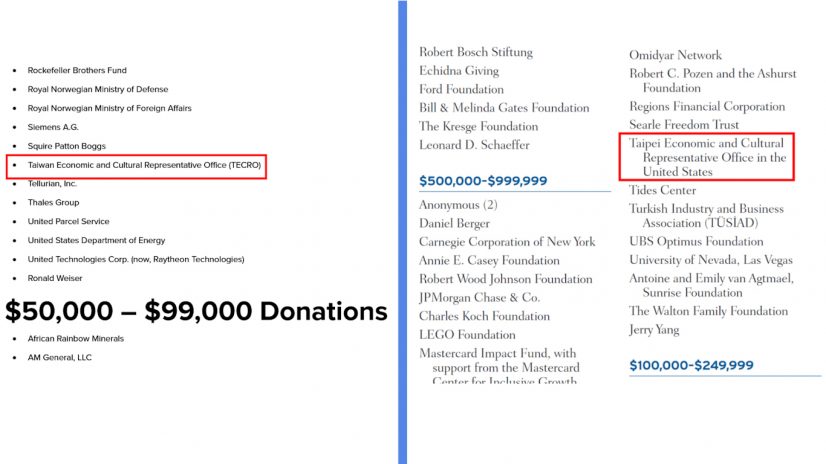
TECRO featured prominently among myriad defense interests on the donor rolls for both the Atlantic Council, left, and Brookings Institute
Last week, Brookings held an event called “Taiwan’s quest for security and the good life,” which began with the statement that “Taiwan is rightly praised for its democracy. Elections are free, fair, and competitive; civil and political rights are protected.” It went on to warn that the “most consequential” challenge to the island’s liberty and prosperity is “China’s ambition to end Taiwan’s separate existence.”
According to another organization’s latest financial disclosure, TECRO also gave a six-figure sum to the Atlantic Council, a think tank closely associated with NATO. It is unclear what the Atlantic Council did with that money, but what is certain is that they gave a senior fellowship to Chang-Ching Tu, an academic employed by the Taiwanese military to teach at the country’s National Defense University. In turn, Tu authored Atlantic Council reports describing his country as a “champion [of] global democracy,” and stating that “democracy, freedom and human rights are Taiwan’s core values.” A menacing China, however, is increasing its military threats, so Taiwan must “accelerate its deterrence forces and strengthen its self-defense capabilities.” Thus he advises that the U.S. must work far more closely with Taiwan’s military, conducting joint exercises and moving towards a more formal military alliance. In 2020, the U.S. sold $5.9 billion worth of arms to the island, making it the fifth-largest recipient of American weaponry last year.
Other Taiwan-employed academics have chided the West on the pages of the Council’s website for its insufficient zeal in “deter[ring] Chinese aggression” against the island. “A decision by the United States to back down” — wrote Philip Anstrén, a Swedish recipient of a fellowship from the Taiwanese Ministry of Foreign Affairs — “could damage the credibility of U.S. defense guarantees and signal that Washington’s will to defend its allies is weak.” Anstrén also insisted that “Europe’s future is on the line in the Taiwan Strait.” “Western democratic nations have moral obligations vis-à-vis Taiwan,” he added on his blog, “and Western democracies have a duty to ensure that [Taiwan] not only survives but also thrives.”
The reason this is important is that the Atlantic Council is an enormously influential think tank. Its board of directors is a who’s-who in foreign policy statecraft, featuring no fewer than seven former CIA directors. Also on the board are many of the architects of the wars in Iraq and Afghanistan, including Colin Powell, Condoleezza Rice and James Baker. When organizations like this begin beating the war drums, everybody should take note.
Perhaps the most strongly anti-Beijing think tank in Washington is the conservative Hudson Institute, an organization frequented by many of the Republican Party’s most influential figures, including former Secretary of State Mike Pompeo, former Vice-President Mike Pence and Arkansas Senator Tom Cotton. The words “China” or “Chinese” appear 137 times in Hudson’s latest annual report, so focused on the Asian nation are they. Indeed, reading their output, it often appears they care about little else but ramping up tensions with Beijing, condemning it for its treatment of Hong Kong, Taiwan and Uyghur Muslims, and warning of the economic and military threat of a rising China.
Over the years, Hudson’s efforts have been sustained by huge donations from TECRO. The Hudson Institute does not disclose the exact donations any sources give, but their annual reports show that TECRO has been on the highest tier of donors ($100,000+) every year since they began divulging their sponsors in 2015. In February, Hudson Senior Fellow Thomas J. Duesterberg wrote an op-ed for Forbes entitled “The Economic Case for Prioritizing a U.S.-Taiwan Free Trade Agreement,” in which he extolled Taiwan’s economy as modern and dynamic and portrayed securing closer economic ties with it as a no-brainer. Hudson employees have also traveled to Taiwan to meet and hold events with leading foreign ministry officials there.
The Hudson Institute also recently partnered with the more liberal Center for American Progress (CAP) to host an event with Taiwanese President Tsai Ing-wen, who took the opportunity to make a great number of inflammatory statements about the “ever more challenging threats to free and democratic societies” China poses; applaud the U.S.’ actions on Hong Kong; and talk about how Taiwan honors and celebrates those who died at the Tiananmen Square massacre. TECRO gave the CAP between $50,000 and $100,000 last year.
It is the Center for Strategic and International Studies (CSIS), however, that appears to receive the most Taiwanese money. According to its donor list, Taiwan gives as much money to it as the United States does — at least $500,000 last year alone. Yet all of the Taiwanese government money is put into CSIS’s regional studies (i.e., Asia) program. Like Hudson employees, the CSIS calls for a free trade agreement with Taiwan and has lavished praise on the nation for its approach to tackling disinformation, describing it as a “thriving democracy and a cultural powerhouse.” Although acknowledging that the reports were paid for by TECRO, CSIS insists that “all opinions expressed herein should be understood to be solely those of the authors and are not influenced in any way by any donation.” In December, the CSIS also held a debate suggesting that “[w]ithin the next five years, China will use significant military force against a country on its periphery,” exploring what the U.S. response to such an action should be.
Like the Atlantic Council, the CSIS organization is stacked with senior officials from the national security state. Its president and CEO is former Deputy Secretary of Defense John Hamre, while Henry Kissinger — former secretary of state and the architect of the Vietnam War — also serves on its council.
The CSIS accepts money from the Global Taiwan Institute and the Taiwan Foundation for Democracy (TFD) as well. The former is a rather shadowy pro-Taiwanese group that appears not to disclose its funding sources. The latter is a government-funded organization headed by former Taiwanese President You Si-kun. Every year, the TFD publishes a human rights report on China, the latest of which claims that “the Chinese Communist Party knows no bounds when it comes to committing serious human rights violations” — accusing it of “taking the initiative” in “promoting a new Cold War over the issue of human rights” and trying to “replace the universal standing of human rights values around the world.” Ultimately, the report concludes, China “constitutes a major challenge to democracy and freedom in the world.”
The TFD has also been a major funder of the Victims of Communism Memorial Foundation, a far-right pressure group that insists that Communism has killed over 100 million people worldwide. Last year, the Victims of Communism Memorial Foundation added all global COVID-19 fatalities to the list of Communist-caused deaths on the basis that the virus started in China. The Foundation also employs Adrian Zenz, a German evangelical theologian who is the unlikely source of many of the most controversial and contested claims about Chinese repression in Xinjiang province.
In the past 12 months, TECRO has also donated six-figure sums to many other prominent think tanks, including the German Marshall Fund of the United States, the Center for a New American Security, and the Carnegie Endowment for International Peace. MintPress reached out to a number of these think tanks for comment but has not received any response.
“It would be naive to believe that Taiwan’s funding of think tanks is not pushing them to take pro-Taiwan or anti-China positions,” Ben Freeman, the director of the Foreign Influence Transparency Initiative at the Center for International Policy, told MintPress, adding:
After all, why would Taiwan keep funding think tanks that are critical of Taiwan? There’s a Darwinian element to foreign funding of think tanks that pushes foreign government funding to think tanks that write what that foreign government wants them to write. Taiwan is no exception to this rule.”
TECRO is not just sponsoring American think tanks, however. It has also given funds to the Australian Strategic Policy Institute (ASPI), a hawkish and controversial group described as “the think tank behind Australia’s changing view of China.” The country’s former ambassador in Beijing described ASPI as “the architect of the China threat theory in Australia” while Senator Kim Carr of Victoria denounced them as working hand-in-hand with Washington to push “a new Cold War with China.” ASPI was behind Twitter’s decision last year to purge more than 170,000 accounts sympathetic to Beijing from its platform.
“We must be ready to fight our corner as Taiwan tensions rise,” ASPI wrote in January, having previously castigated the West for being “no longer willing to defend Taiwan.”
ASPI — like Brookings, the Atlantic Council and others — are directly funded by weapons manufacturers, all of whom also have a direct interest in promoting more wars around the world. Thus, if the public is not careful, certain special interests might be helping move the United States towards yet another international conflict.
While the situation outlined above is concerning enough, the Foreign Influence Transparency Initiative’s research has shown that around one-third of think tanks still do not provide any information whatsoever about their funding, and very few are completely open about their finances. Freeman maintains that, while there is nothing inherently wrong with foreign governments funding Western think tanks, the lack of transparency is seriously problematic, explaining:
This raises a lot of questions about the work they’re doing. Are their secret funders saying what the think tank can do in a pay-for-play scheme? Are the funders buying the think tanks silence on sensitive issues? Without knowing the think tank’s funders, policymakers and the public have no idea if the think tank’s work is objective research or simply the talking points of a foreign government.”
Freeman’s study of the Taiwanese lobby found that seven organizations registered as Taiwan’s foreign agents in the U.S. Those organizations, in turn, contacted 476 Members of Congress (including almost 90% of the House), as well as five congressional committees. House Speaker Nancy Pelosi was their most frequent contact, the Californian being contacted 34 times by Taiwanese agents. Pelosi has been a great supporter of Taiwanese nationalists, successfully promoting pro-Taiwan legislation and proudly announcing that the U.S. “stands with Taiwan.”
Foreign agents working on behalf of Taiwan also made 143 political contributions to U.S. politicians, with former Alabama Senator Doug Jones the lead recipient (Pelosi was third).
Losing China, regaining Taiwan?
The reports listed above understand the dispute as purely a matter of Chinese belligerence against Taiwan and certainly do not consider U.S. military actions in the South China Sea as aggressive in themselves. That is because the world of think tanks and war planners sees the United States as owning the planet and having a remit to act anywhere on the globe at any time.
To this day, U.S. planners bemoan the “loss of China” in 1949 (a phrase that presupposes the United States owned the country). After a long and bloody Second World War, Communist resistance forces under Mao Tse-tung managed to both expel the Japanese occupation and overcome the U.S.-backed Kuomintang (nationalist) force led by Chang Kai-shek. The United States actually invaded China in 1945, with 50,000 troops working with the Kuomintang and even Japanese forces in an attempt to suppress the Communists. However, by 1949, Mao’s army was victorious; the United States evacuated and Chang Kai-shek retreated to Taiwan.
The Kuomintang ruled the island for 40 years as a one-party state and remains one of the two major political groups to this day. The war between the Communists and the Kuomintang never formally ended, and Taiwan has now lived through 70 years of estrangement from the mainland. Polls show a majority of Taiwanese now favor full independence, although a large majority still personally identify as Chinese.
While many Taiwanese welcome an increased U.S. presence in the region, Beijing certainly does not. In 2012, President Barack Obama announced the U.S.’ new “Pivot to Asia” strategy, moving forces from the Middle East towards China. Today, over 400 American military bases encircle it.
In recent months, the United States has also taken a number of provocative military actions on China’s doorstep. In July, it conducted naval exercises in the South China Sea, with warships and naval aircraft spotted just 41 nautical miles from the coastal megacity of Shanghai, intent on probing China’s coastal defenses. And in December, it flew nuclear bombers over Chinese vessels close to Hainan Island. Earlier this year, the head of Strategic Command made his intentions clear, stating that there was a “very real possibility” of war against China over a regional conflict like Taiwan. China, for its part, has also increased its forces in the region, carrying out military exercises and staking claims to a number of disputed islands.
A new Director of National Intelligence (DNI) report notes that China is the U.S.’ “unparalleled priority,” claiming that Beijing is making a “push for global power.” “We expect that friction will grow as Beijing steps up attempts to portray Taipei as internationally isolated and dependent on the mainland for economic prosperity, and as China continues to increase military activity around the island,” it concludes.
In an effort to stop this, Washington has recruited allies into the conflict. Australian media are reporting that their military is currently readying for war in an effort to force China to back down, while last week President Joe Biden met with Japanese Prime Minister Yoshihide Suga to shore up a united front against Beijing vis-a-vis Taiwan.
In February, the Atlantic Council penned an anonymous 26,000-word report advising Biden to draw a number of red lines around China, beyond which a response — presumably military — is necessary. These included any military action or even a cyber attack against Taiwan. Any backing down from this stance, the council states, would result in national “humiliation” for the United States.
Perhaps most notably, however, the report also envisages what a successful American China policy would look like by 2050:
[T]he United States and its major allies continue to dominate the regional and global balance of power across all the major indices of power;… [and head of state Xi Jinping] has been replaced by a more moderate party leadership; and … the Chinese people themselves have come to question and challenge the Communist Party’s century-long proposition that China’s ancient civilization is forever destined to an authoritarian future.”
In other words, that China has been broken and that some sort of regime change has occurred.
Throughout all this, the United States has been careful to stress that it still does not recognize Taiwan and that their relationship is entirely “unofficial,” despite claiming that its commitment to the island remains “rock solid.” Indeed, only 14 countries formally recognize Taiwan, the largest and most powerful of which is Paraguay.
Along with a military conflict brewing, Washington has also been prosecuting an information and trade war against China on the world stage. Attempts to block the rise of major Chinese companies like Huawei, TikTok and Xiaomi are examples of this. Others in Washington have advised the Pentagon to carry out an under-the-table culture war against Beijing. This would include commissioning “Taiwanese Tom Clancy” novels that would “weaponize” China’s one-child policy against it, bombarding citizens with stories about how their only children will die in a war over Taiwan.
Republicans and Democrats constantly accuse each other of being in President Xi’s pocket, attempting to outdo each other in their jingoistic fervor. Last year, Florida Senator Rick Scott went so far as to announce that every Chinese national in the U.S. was a Communist spy and should be treated with extreme suspicion. As a result, the American public’s view of China has crashed to an all-time low. Only three years ago, the majority of Americans held a positive opinion of China. But today, that number is only 20%. Asian-Americans of all backgrounds have reported a rise in hate crimes against them.
Cash rules everything around me
How much of the United States’ aggressive stance towards China can be attributed to Taiwanese money influencing politics? It is difficult to say. Certainly, the United States has its own policy goals in East Asia outside of Taiwan. But Freeman believes that the answer is not zero. The Taiwan lobby “absolutely has an impact on U.S. foreign policy,” he said, adding:
At one level, it creates an echo-chamber in D.C. that makes it taboo to question U.S. military ties with Taiwan. While I, personally, think there are good strategic reasons for the U.S. to support this democratic ally — and it’s clearly in Taiwan’s interest to keep the U.S. fully entangled in their security — it’s troubling that the D.C. policy community can’t have an honest conversation about what U.S. interests are. But, Taiwan’s lobby in D.C. and their funding of think tanks both work to stifle this conversation and, frankly, they’ve been highly effective.”
Other national lobbies affect U.S. policy. The Cuban lobby helps ensure that the American stance towards its southern neighbor remains as antagonistic as possible. Meanwhile, the Israel lobby helps ensure continuing U.S. support for Israeli actions in the Middle East. Yet more ominously with Taiwan, its representatives are helping push the U.S. closer towards a confrontation with a nuclear power.
While Taiwanese money appears to have convinced many in Washington, it is doubtful that ordinary Americans will be willing to risk a war over an island barely larger than Hawaii, only 80 miles off the coast of mainland China.
Alan MacLeod is Senior Staff Writer for MintPress News. After completing his PhD in 2017 he published two books: Bad News From Venezuela: Twenty Years of Fake News and Misreporting and Propaganda in the Information Age: Still Manufacturing Consent, as well as a number of academic articles. He has also contributed to FAIR.org, The Guardian, Salon, The Grayzone, Jacobin Magazine, and Common Dreams.
Hudson Institute Award to Netanyahu Named for Neocon Who Inspired Dr. Strangelove
By Richard Silverstein | Tikun Olam | August 28, 2016

Herman Kahn as featured in a Life Magazine profile
When Bibi Netanyahu comes to New York next month for the UN General Assembly, the Hudson Institute will bestow its Herman Kahn award on him. Kahn was an early neocon intellectual who advocated U.S. first-use of nuclear weapons. He propounded this theory in his provocatively titled 1960s book, Thinking the Unthinkable.
The Institute is a leading neocon think-tank based in Washington DC. It is a wonky version of the American Enterprise Institute or the Heritage Foundation. It’s senior vice-president is Scooter Libby, a man who barely escaped spending time in a federal prison.
The Hudson Institute is the primary funder (see Didi Remez’s post for a fuller discussion of the funding and relationships) of the far-right Israeli NGO, Institute for Zionist Strategies, which advocate purging “post-Zionist” material from Israeli academic curriculum. They’ve been so successful at pressuring academia to “Zionize” the curriculum that Tel Aviv University President Joseph Klafter promised he would personally examine individual course syllabi for tainted content.
Hudson is also the primary backer of Uzi Arad’s Atlantic Forum, a shadowy Israeli think tank founded by the former Mossad officer. The NGO’s mission is to strengthen Israel’s security relationship with NATO. He’s reputed to have “run” Larry Franklin, the former Defense Department analyst caught with Steven Rosen passing U.S. secrets to the Israelis. Rosen too came within a whisker or two of landing in federal prison. Luckily for him, the Israel Lobby came to his defense and the Justice Department dropped the case against him. Arad worked with Kahn at Hudson in the 1970s.
Bush-era neocon analyst, Meyrav Wurmser, runs Hudson’s Center for Middle East Policy. That explains Hudson’s love affair with Netanyahu and the award he is to receive. In many ways it seems fitting for the Israeli leader to receive an award named for Kahn. Israel is, after all, one of the most dangerous of the nuclear states. One of those most likely to engage in first-use of nuclear weapons would the circumstances arise. One may argue whether that distinction should rather belong to North Korea or Pakistan. But the Koreans don’t yet have the capacity to destroy western Asia as Israel does the Middle East. And Pakistan’s nuclear arsenal is child’s play compared to Israel’s estimated 200 nuclear warheads.

Herman Kahn (David Levine)
It may be worth hearing some words said about Kahn’s work. A reader summarized another of his books: “On Thermonuclear War, was ‘a moral tract on mass murder: how to plan it, how to commit it, how to get away with it, how to justify it.’” Some other words of wisdom from Kahn on nuclear deterrence:
“If it is not acceptable to risk the lives of the three billion inhabitants of the earth in order to protect ourselves from surprise attack, then how many people would we be willing to risk?”
Another critic said that the publication of that book “should properly have caused the sequestration of its author into psychiatric care.” A science reporter, reviewing Kahn’s book called him a contemporary version of the devil:
“Not the traditional devil, reeking of brimstone and tempting men to old-fashioned sins, but a slick, talcum-scented, contemporary Satan, rationalising hideous emotions by reference to strategic studies, electronic computers, contingency planning, and all the other gimmicks of paranoiac gamesmanship.”
The following comment by Kahn to a reporter surely served as the inspiration for Terry Southern’s screenplay for Dr. Strangelove: “I can be funny on the subject of thermonuclear war.” In fact, writing in the NY Times, Fred Kaplan says:
… The real model [for the Strangelove character] was almost certainly Herman Kahn, an eccentric, voluble nuclear strategist at the RAND Corporation, a prominent Air Force think tank. In 1960, Mr. Kahn published a 652-page tome called “On Thermonuclear War,” which sold 30,000 copies in hardcover.
… When Dr. Strangelove talks of sheltering people in mine shafts, President Muffley asks him, “Wouldn’t this nucleus of survivors be so grief-stricken and anguished that they’d, well, envy the dead?” Strangelove exclaims that, to the contrary, many would feel “a spirit of bold curiosity for the adventure ahead.”
Mr. Kahn’s book contains a long chapter on mine shafts. Its title: “Will the Survivors Envy the Dead?” One sentence reads: “We can imagine a renewed vigor among the population with a zealous, almost religious dedication to reconstruction.”
So it is altogether fitting that Bibi Netanyahu be enshrined along with Herman Kahn in a sort of Nuclear War Hall of Fame, as two men prepared to see their region (in Bibi’s case) or world (in Kahn’s) go up in flames in order to “save” their country.
It’s perfectly fitting that a past recipient of the award was Dick Cheney (especially considering his former protege, Scooter Libby works for Hudson).
The Evolving Story of the Death of Father Murad
By Richard Edmondson | War and Peace | July 3, 2013
Conflicting news reports have been coming out on the death of Father Francois Murad. Initially it was reported by a number of sources, including a press release from the Vatican, that the priest had been beheaded. Today, however, reports are saying that no, this was incorrect, that he was only shot dead, and that the video purporting to show his beheading was an old video. Here is how The Telegraph is reporting the matter:
The footage, said to show Father Francois Murad, 49, as the victim in a brutal summary execution by foreign jihadists is likely to be an older video that bares no relation to the death of the Catholic priest.
Father Murad “died when he was shot inside his church” in the northern Syrian Christian village of Ghassaniyeh on June 23, three separate local sources, who did not wish to be named, told the Telegraph.
Claims that Father Murad was one of two men to be decapitated by a foreign jihadist group went viral, with outrage expressed in blogs and articles worldwide.
The story goes on to describe the contents of the video, noting that it is “too grainy to be able to confirm the identity of either of the victims as Father Francois,” while offering quotes of clarification from Human Rights Watch as well as Holy Land Custos Pierbattista Pizzabala. The latter is quoted as saying, “Islamists attacked the monastery, ransacking it and destroying everything. When Father Francois tried to resist, defending the nuns, rebels shot him.”
According to the HRW spokesperson, the video “looks like it may have been filmed” several months ago, well before Murad’s death, and that the confusion may have arisen due to its appearance “around the same time that the news came out that Father Francois had been killed.”
All of this quite naturally raises some questions. Descriptions of the video, found at both LiveLeak and YouTube, specifically said the two men shown being beheaded were Christians and that Murad was one of them. Who made this video available to the public and what was their motive?
The conflict in Syria is becoming more and more like a house of mirrors—something noted in a report by journalist Patrick Cockburn published Sunday in The Independent and headlined, “Foreign Media Portrayals of the Conflict in Syria are Dangerously Inaccurate.” Cockburn writes:
Every time I come to Syria I am struck by how different the situation is on the ground from the way it is pictured in the outside world. The foreign media reporting of the Syrian conflict is surely as inaccurate and misleading as anything we have seen since the start of the First World War. I can’t think of any other war or crisis I have covered in which propagandistic, biased or second-hand sources have been so readily accepted by journalists as providers of objective facts.
Slogans replace policies: the rebels are pictured as white hats and the government supporters as black hats; given more weapons, the opposition can supposedly win a decisive victory; put under enough military pressure, President Bashar al-Assad will agree to negotiations for which a pre-condition is capitulation by his side in the conflict. One of the many drawbacks of the demonising rhetoric indulged in by the incoming US National Security Adviser Susan Rice, and William Hague, is that it rules out serious negotiations and compromise with the powers-that-be in Damascus. And since Assad controls most of Syria, Rice and Hague have devised a recipe for endless war while pretending humanitarian concern for the Syrian people.
In the midst of all this confusion and pretense over humanitarian concerns comes a report from the Hudson Institute highlighting the horrendous toll the conflict has taken on Syria’s Christian population. The report documents, among other things, deaths of priests, though here again there is some suspicious timing. On June 25, two days after the murder of Father Murad, a pair of congressional subcommittees held a joint hearing on the issue of “Religious Minorities in Syria: Caught in the Middle.” This is the subject of the Hudson Institute’s report, or more specifically the report focuses on the testimony given at the hearing by one of the institute’s chief researchers on the plight of Syria’s Christians.
Such a report becomes all the more remarkable when you consider that the Hudson Institute basically could be thought of as a neocon think tank. Its senior vice president is Lewis “Scooter” Libby, while Douglas Feith is listed as a senior fellow. Is there not something strange about a report documenting rebel atrocities against Syrian Christians being released by such an organization? Doesn’t Israel want to see Assad overthrown, and haven’t the Zionist media been feeding us the spin of the rebels, as Cockburn puts it, wearing the “white hats”? What gives?
I’ll have more on this report in an upcoming post, hopefully in a day or two.
Related articles
- Catholic Online Muddles Story of Priest’s Beheading (alethonews.wordpress.com)
- Vatican confirms horror beheading of Catholic priest by Syrian rebels (independent.ie)
Featured Video
No Threat Can Force Iran’s Surrender /Trita Parsi & Lt Cl Daniel Davis
or go to
Aletho News Archives – Video-Images
From the Archives
An Expert Military Analysis of War with China
Actually, None is Necessary
By Fred Reed • Unz Review • December 13, 2020
The Correlation of Armed Forces: U.S. goods and services trade with China totaled an estimated $634.8 billion in 2019. Exports were $163.0 billion; imports were $471.8 billion. The U.S. goods and services trade deficit with China was $308.8 billion in 2019. Trade in services with China (exports and imports) totaled an estimated $76.7 billion in 2019. Services exports were $56.5 billion; services imports were $20.1 billion. The U.S. services trade surplus with China was $36.4 billion in 2019.
There is talk within the Washingtoniat of a possible war with China. Steve Bannon, who apparently was dropped on his head as a child, actually favors such a war. We hear the usual shoo-the-boobs alarm about how the Chinese are doing something terrible and we must gird our loins and American values and show them what for, bow wow, woof. The danger is that the current game of who-blinks-first in Asian waters might actually provoke a shooting war. You know the kind of thing: One warship refuses to get out of the way of another, a collision ensues, some retard lieutenant who signed up on waivers opens fire, and we’re off and running. It is not a good idea to let children play with matches.
The said war is discussed either in emotional terms by idiots or in purely naval terms by those familiar with such things, so we hear of the First Island Chain and the Second Island Chain and whose missiles against the other’s missiles and so on. This would be appropriate if we were fighting World War Two again. Which we aren’t. Let’s take a quick-and-dirty look at how such a war might go.
To begin the war, America would overestimate itself and underestimate China. This is doctrine in the Pentagon. … continue
Blog Roll
 Aletho News
- Theodore Postol: Iran’s Missiles & Drones Were Underestimated
- Iran To Target Military Industrial-Tech Complex That Facilitated Gaza Genocide
- Collapsing Empire: The Resistance Disarms ‘Israel’
- Suicide Should Not Be a Government Service
- Rethinking America’s greatest threat: Iran vs. Israel-Firsters
- Iran accuses adversaries of false flags to strain Turkey ties
- Poland rules out sending Patriot missiles to US/Israel amid war on Iran
- Tehran approves new Hormuz plan with major restrictions
- No Threat Can Force Iran’s Surrender /Trita Parsi & Lt Cl Daniel Davis
- UK’s New Pandemic Plan Would Turn Big Tech Into a Mass Location Tracking Network
- If Americans Knew
- Ann Coulter Rips Into Fox News for Iran War Coverage, Compares to False Rigged 2020 Election Reporting
- Joe Kent Urges Americans To Call White House and Congress To Object To Sending Troops Into Iran
- DNC Resolution to Reject AIPAC Funding Puts Democratic Leaders in the Hot Seat
- Swedish foundation to build 400 schools as over 650,000 Gaza children remain without education for 2 years
- Israeli army admits photshopping image of slain Lebanese journalist
- This is how Israel is systematically killing health workers under the cover of war in Lebanon
- Carrying life under fire: Israeli invasion of Lebanon leaves pregnant women facing deadly risks
- Champagne all around for the new death penalty (for Palestinians) law – Not a ceasefire Day 172
- Why are Palestinian books struggling to be seen on Amazon?
- The Line Between Affinity and Conspiracy
- No Tricks Zone
- New Study Finds Warming Saves Lives…Cold Temperatures 12 Times More Deadly Than Excess Heat
- German Science Blog Accuses PIK Climate Institute Of Hallucinating Climate Tipping Points
- Devastating Assessment Of Comirnaty Vaccine By Former Senior Pfizer Europe Toxicologist
- New Study: CO2 Is ‘Effectively Negligible’ As An Explanatory Climate Change Factor Since 2000
- Former Pfizer Toxicologist Dr. Helmut Sterz Tells Bundestag Hearing Pfizer Vaccine Should Have Never Been Approved
- Energy Expert: Germany’s Nuclear Phaseout Was A “500 Billion Euro Mistake”
- New Research: South Australia’s Mid-Holocene Sea Surface Temperatures Were 4°C Warmer Than Today
- Storing Green Energy To Last Germany 10 Days Would Require A 60-Million Tonne Battery
- New Studies: UK Sea Levels Were 4 Meters Higher Than Today During The Mid-Holocene
- Destructive Green New Deal: German Energy And Metal Group Warns Of Drastic Crisis
 Aletho News