EU nation ‘disrupting normal religious life’ – UN experts
RT | December 17, 2025
Estonian authorities are undermining religious freedoms by fostering an “adversarial environment” for the country’s largest church community because of its spiritual ties to Russia, a panel of experts advising the UN Human Rights Council has warned.
In a statement issued on Monday, the experts criticized Tallinn’s approach toward the Estonian Orthodox Christian Church (EOCC), which maintains canonical links with the Russian Orthodox Church. They pointed to a series of administrative actions, a court decision that stripped the EOCC of state funding on security grounds, and a proposed legislative amendment that the panel said would “disproportionately affect a single religious community.”
“Canonical identity, ecclesiastical hierarchy and spiritual allegiance are integral components of the freedom of religion and are fully protected under international law,” the three-member panel emphasized.
The experts highlighted as particularly troubling a bill being advanced in the Estonian parliament despite objections from President Alar Karis. He has argued that the proposed ban on religious organizations accused of links to a foreign entity labeled a security threat by the government would violate the constitution.
The panel also condemned refusals to grant rent agreements and residency permits to clergy, stating: “Such actions disrupt normal religious life and may undermine the autonomy that should be granted under freedom of religion or belief.”
Moscow has long accused Estonia of pursuing discriminatory policies allegedly driven by entrenched Russophobia. The Estonian Orthodox Christian Church includes both ethnic Estonians and members of the country’s sizable Russian-speaking minority among its faithful.
NATO’s Red Pen on Ukraine: Jacques Baud and the Silencing of Dissent
By Freddie Ponton | 21st Century Wire | December 17, 2025
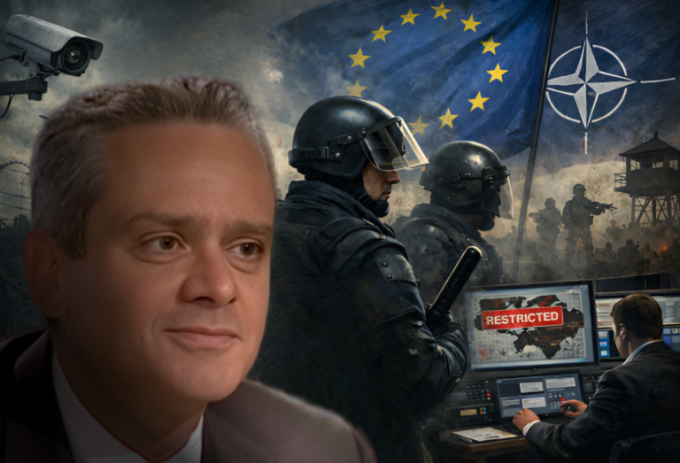
On 15 December, the European Union took a step that few could have imagined: it sanctioned twelve individuals, including Swiss analyst and former intelligence officer Jacques Baud and French national Xavier Moreau, not for breaking the law, but for expressing views deemed politically inconvenient. Asset freezes, travel bans, and economic restrictions were imposed without any judicial process. While presented as an EU initiative, the fingerprints of NATO’s strategic communications and information-control apparatus are unmistakable, shaping both the targets and the justification. Europe is no longer simply countering disinformation; it is policing interpretation itself, turning independent analysis into a potential liability. The question now is not whether dissent will be punished, but how far these measures will go, and who will decide the boundaries of acceptable thought.
Baud, a Swiss national, is not a political activist, influencer, or anonymous online provocateur. He is a former Swiss intelligence officer and army colonel, trained in counter-terrorism, counter-guerrilla warfare, and chemical and nuclear weapons. Over the course of his career, he helped design the Geneva International Centre for Humanitarian Demining (GICHD) and its Mine Action Information Management System (IMSMA), served with the United Nations as Chief of Doctrine for Peacekeeping Operations in New York, worked extensively in Africa, and later held senior responsibilities at NATO, where he led efforts against the proliferation of small arms. He is also the author of multiple books on intelligence, asymmetric warfare, and terrorism, texts widely read well before the Ukraine war.
Yet this résumé, once considered exemplary, has now been recast as suspicious. On 15 December, the EU placed Baud under sanctions, freezing assets and restricting travel, accusing him of acting as a “spokesperson of Russian propaganda” and of participating in “information manipulation and influence.” No criminal charges have been filed. No judicial process has taken place. No evidence has been publicly tested in court. The punishment is administrative, political, and immediate.
DOCUMENT: COUNCIL DECISION (CFSP) 2025/2572 of 15 December 2025 amending Decision (CFSP) 2024/2643 concerning restrictive measures in view of Russia’s destabilising activities (Source: EUR-Lex)
This is not an isolated case. Baud joins a growing list of European journalists, analysts, and commentators sanctioned or publicly stigmatised for expressing views that diverge from official EU and NATO positions. Germans living in Russia, independent journalists, and alternative media figures have already faced similar measures. What unites these cases is not proof of coordination with Moscow, but a shared refusal to reproduce the sanctioned narrative framework through which the war must be interpreted.
From Foreign Policy to Narrative Enforcement
Officially, these sanctions are justified as defensive measures against “foreign information manipulation and interference”, a phrase now deeply embedded in EU and NATO communications. The stated objective is to protect European democracies from destabilisation. In practice, however, the definition of “manipulation” has expanded so broadly that any analysis which echoes, overlaps with, or even partially aligns with Russian positions can be deemed suspect, regardless of sourcing, intent, or transparency.
The problem is not that governments counter disinformation. Every state does. The problem is how disinformation is defined, who defines it, and what instruments are used to combat it.
In Baud’s case, the EU does not allege clandestine activity, secret funding, or covert coordination with Russian authorities. Instead, he is held responsible for contributing to a narrative environment that, in Brussels’ view, undermines Ukraine and EU security. This is a crucial shift: The target is no longer falsehood, but interpretation.
Once interpretation itself becomes sanctionable, the boundary between security policy and censorship collapses.
France’s Role, and NATO’s Shadow
Several reports indicate that the initiative to sanction Baud and eleven others originated with France. French Foreign Minister Jean-Noël Barrot publicly announced that Europe would impose sanctions on what he described as “pro-Russian agents,” including individuals accused of repeatedly influencing French and European public debate. Among those named was Xavier Moreau, a French analyst long critical of NATO policy.
Barrot’s declaration on X was unambiguous:
“At France’s initiative, Europe is today imposing sanctions against Kremlin propaganda outlets and those responsible for foreign digital interference. Zero impunity for the architects of chaos.”
The language is revealing. “Architects of chaos” is not a legal category; it is a political one. It frames speech as an act of aggression and analysts as hostile operators.
Behind this framing lies a figure little known to the public but central to the architecture of Europe’s contemporary information policy: Marie-Doha Besancenot, Senior Advisor for Strategic Communications in the French Foreign Ministry. Prior to assuming this role, Besancenot served from 2020 to 2023 as NATO Assistant Secretary General for Public Diplomacy.
In an interview published in English by the French Ministry of the Armed Forces and Veteran Affairs, in March 2025, Besancenot openly described founding a task force in late 2023 dedicated to detecting and analysing what she termed “hostile narratives,” with the capacity to alert authorities “in real time” and propose political responses. The task force’s mission, she explained, was to detect, track, and report information threats against NATO in the information domain. In this interview, Besancenot articulates how “France understood what was happening in the information domain was a matter of national security”, and speaks of Viginum, a French agency created in response to these perceived threats, and that is responsible for monitoring and protecting the state against foreign digital interference that, according to them, affects the digital public debate in France.
The continuity is striking. The doctrine developed inside NATO’s strategic communications apparatus appears to have migrated almost seamlessly into national and EU-level policy, without democratic debate, parliamentary oversight, or public consent.
Strategic Communications as Political Power
NATO insists that it does not police speech and that it respects freedom of expression. Formally, this is true. NATO does not arrest journalists or pass laws. Instead, it develops conceptual frameworks, “hybrid threats,” “information laundering,” and “foreign information manipulation”, which are then adopted by member states and EU institutions.
Once a narrative framework is institutionalised, it becomes self-enforcing. Media outlets internalise red lines. Publishers hesitate. Platforms over-moderate. Governments justify extraordinary measures as technical necessities or national security. The perfect storm in which sanctions replace debate.
One of the most insidious concepts to emerge from this ecosystem is that of “information laundering”, the idea that domestic journalists or analysts can unwittingly “clean” foreign propaganda simply by engaging with it critically. Under this logic, intent becomes irrelevant. What matters is effect, as defined by strategic communicators.
This doctrine eliminates the possibility of good-faith analysis. To examine Russian claims, even to refute them selectively or partially, is to risk being accused of amplifying them. The only safe position is total dismissal, which appears to be NATO and the EU’s endgame.
The Democratic Cost
The danger of this approach extends far beyond Jacques Baud.
Sanctions are no longer being used to punish illegal acts, but to discipline discourse. They operate without due process and create chilling effects far wider than their immediate targets. An analyst does not need to be sanctioned to be silenced; seeing a peer sanctioned is often enough.
Moreover, these measures are imposed by non-elected bodies, EU councils, commissions, and advisory structures, drawing heavily on NATO doctrine, an alliance that itself is not subject to democratic accountability. National parliaments are largely absent from the process. Courts intervene only after the damage is done.
The precedent is dangerous. If today the target is analysts accused of being “pro-Russian,” tomorrow it could be critics of EU defence spending, sceptics of military escalation, or scholars questioning intelligence claims. Once the machinery exists, its scope inevitably expands.
History offers ample warning. Democracies do not usually collapse through sudden repression, but through the gradual normalisation of exceptional measures, each justified by urgency, each framed as temporary, each defended as necessary.
Security Without Freedom Is Not Security
The EU and NATO argue that they are facing unprecedented hybrid threats and that extraordinary responses are required. That claim deserves serious consideration. But security achieved by narrowing the space of permissible thought is a brittle security, one that ultimately undermines the democratic resilience it claims to protect.
A society confident in its values does not need to freeze bank accounts to win arguments. It does not need to conflate analysis with subversion. It does not need to outsource intellectual authority to strategic communications units.
Jacques Baud may be wrong in some of his assessments. He may be right in others. That is beside the point. What matters is that his arguments exist in the open, supported by sources, available for rebuttal. The appropriate response to analysis is counter-analysis, and certainly not sanctions. By choosing punishment over debate, Europe is not defending democracy. It is redefining it, quietly, administratively, and without asking its citizens whether this is the kind of polity they wish to inhabit.
The sanctions against Baud are therefore not merely about Ukraine, Russia, or NATO. They are about who gets to speak, who decides what is permissible to think, and whether Europe still trusts its citizens to judge arguments for themselves.
That question, once raised, cannot be easily swept away.
EU Sanctions Swiss Analyst For Criticism Of The Ukraine Proxy War

The Dissident | December 15, 2025
The European Union has just released a new sanctions package intended to impose “restrictive measures in view of Russia’s destabilising activities”.
Among the people slapped with EU sanctions is Jacques Baud, a retired colonel in the Swiss army; former strategic analyst, intelligence and terrorism specialist, solely for his position and analysis of the war in Ukraine.
The EU accuses Baud of being “a regular guest on pro-Russian television and radio programmes” and being a “mouthpiece for pro-Russian propaganda” and claiming he “makes conspiracy theories, for example, accusing Ukraine of orchestrating its own invasion in order to join NATO.”
The EU accuses him of being “responsible for, implementing or supporting actions or policies attributable to the Government of the Russian Federation which undermine or threaten stability or security in a third country (Ukraine) by engaging in the use of information manipulation and interference” and imposed sanctions on him, solely because his position differs from NATO’s and the EU’s on the Ukraine war.
The outlet Switzerland24 noted that the sanctions on Baud, “provide for the freezing of the assets of sanctioned persons, a ban on entry into the EU and a ban on making funds available to them”.
Commenting on this, Alfred de Zayas, a former UN expert, noted, “We are witnessing a civilizational collapse with the EU sanctioning Jacques Baud, a retired Swiss colonel and intelligence officer, for publishing books and articles expressing views on the Ukraine war contrary to those of the NATO leadership.”
In reality, Jacques Baud’s position, as laid out in his article, “The Military Situation In The Ukraine” from April of 2022, is that, “the dramatic developments we are witnessing today (in Ukraine) have causes that we knew about but refused to see”, including
- The expansion of NATO
The fact that NATO expansion led to the Ukraine war has been acknowledged by multiple Western officials.
U.S. diplomat George Kennan, said as far as 1997 that NATO expansion towards Russia’s borders would be “the most fateful error of American policy in the entire post-Cold War era” adding that it would, “be expected to inflame the nationalistic, anti-Western and militaristic tendencies in Russian opinion; to have an adverse effect on the development of Russian democracy; to restore the atmosphere of the cold war to East-West relations, and to impel Russian foreign policy in directions decidedly not to our liking”.
In 1998, George Kennan said that NATO expansion was “the beginning of a new cold war” and said, “the Russians will gradually react quite adversely and it will affect their policies”.
In 2008, when NATO first invited Ukraine and Georgia to join, then U.S. ambassador to Russia, William Burns, said, “Ukraine and Georgia’s NATO aspirations not only touch a raw nerve in Russia, they engender serious concerns about the consequences for stability in the region. Not only does Russia perceive encirclement and efforts to undermine Russia’s influence in the region, but it also fears unpredictable and uncontrolled consequences which would seriously affect Russian security interests” adding, “Experts tell us that Russia is particularly worried that the strong divisions in Ukraine over NATO membership, with much of the ethnic-Russian community against membership, could lead to a major split, involving violence or at worst, civil war. In that eventuality, Russia would have to decide whether to intervene; a decision Russia does not want to have to face”.
Most recently, Amanda Sloat, a top Biden administration official for European affairs admitted that, “We had some conversation even before the war started, about what if Ukraine comes out and just says to Russia, ‘fine, you know, we won’t go into NATO if that stops the war, if that stops the invasion,’ which at that point it may well have done” adding that promising no NATO membership for Ukraine “certainly would have prevented the destruction and the loss of life”.
David Arakhamia, one of the lead Ukrainian negotiators during the Istanbul talks of 2022 also said, “Russia’s goal was to put pressure on us so that we would take (NATO) neutrality. This was the main thing for them: they were ready to end the war if we accepted neutrality, as Finland once did”.
- The Western refusal to implement the Minsk Agreements
Similarly, the fact that the West blocked the Minsk accords in 2019, the peace agreement that would have ended the civil/proxy war in Eastern Ukraine that sparked after the U.S.-backed 2014 Maidan coup, is well documented.
As former UK Prime Minister Boris Johnson admitted, “Zelensky is not an unreasonable guy, he got elected as a peacenik, in 2019 he tried to do a deal with Putin, as far as I can remember, his basic problem was that the Ukrainian nationalists couldn’t accept the compromise”.
What Johnson was referring to as the NGO Finnish Peace Defender documented was that,“While President Zelensky is trying to follow commitments given to his electorate and international obligations in implementation of the Minsk Agreements, he has to overcome obstacles placed by irregular armed groups who identify themselves as patriots of Ukraine” including “open threats and blackmail by far-right military circles in Ukraine, including the National Corps led by Andrii Biletski”.
Instead of backing Zelensky in implementing the Minsk Accords, Western-funded NGOs sided with the far-right nationalists in blocking them.
Ukranian-Canadian academic Ivan Katchanovski has documented, “The Western governments and foundations, such as Soros foundation, funded all but one of about two dozen Ukrainian NGOs, which initially issued in 2019 a collective statement that any talks with Donbas separatists were impermissible after the head of the Zelenskyy’s presidential administration supported creation of a consulting group with representatives of the separatist-controlled Donbas during the Minsk negotiations.”
- The continuous and repeated attacks on the civilian population of the Donbass over the past years, and the dramatic increase in late February 2022.
Indeed, while blocking the Minsk Accords, the Trump administration- trying to prove it was not controlled by the Russians as the media claimed based on the Russiagate hoax- approved sending lethal arms to the Ukrainian government in 2017 and 2019, which increased the civilian casualties on the pro-Russia side of the Donbas conflict.
Jacques Baud, in his article, cites a UN report which found that there were 381 civilians killed in the conflict between 2018 and 2021 and that 81.4% occurred “in territory control led by the self-proclaimed ‘republics’”, the pro-Russian separatist side.
Jacques Baud concluded that, “we can naturally deplore and condemn the Russian attack. But WE (that is: the United States, France and the European Union in the lead) have created the conditions for a conflict to break out”.
One is free to agree or disagree with Jacques Baud’s perspective, but the reality is, it is not a “conspiracy theory” or “information manipulation” but a fact-based analysis on the Western policies that led to the war in Ukraine, which is shared by well-respected foreign policy analysts, including John Mearsheimer, Jeffrey Sachs and Noam Chomsky.
The EU’s claim that Jacques Baud accuses “Ukraine of orchestrating its own invasion in order to join NATO”, appears to be a reference to the fact that Jacques Baud has cited a 2019 interview with the Ukrainian presidential advisor Oleksiy Arestovych where he said the best case scenario for Ukraine was “a large scale war with Russia and joining NATO as a result of defeat of Russia”, saying that currently, “NATO would be reluctant in accepting us”, but defeating Russia would lead to Ukraine joining NATO.
Again, directly quoting a Ukrainian government official is hardly a “conspiracy theory”.
Furthermore, it is blatantly undemocratic and authoritarian for the EU to slap sanctions on someone solely because he has a critical perspective on Western and EU foreign policy.
While the EU pushes for the continuation of the Ukraine war based on the principles of “democracy” and “freedom”, they blatantly disregard democracy and freedom in order to crack down on critics of this policy.
UK Lawmakers Propose Mandatory On-Device Surveillance and VPN Age Verification
By Cindy Harper | Reclaim The Net | December 15, 2025
Lawmakers in the United Kingdom are proposing amendments to the Children’s Wellbeing and Schools Bill that would require nearly all smartphones and tablets to include built-in, unremovable surveillance software.
The proposal appears under a section titled “Action to promote the well-being of children by combating child sexual abuse material (CSAM).”
We obtained a copy of the proposed amendments for you here.
The amendment text specifies that any “relevant device supplied for use in the UK must have installed tamper-proof system software which is highly effective at preventing the recording, transmitting (by any means, including livestreaming) and viewing of CSAM using that device.”
It further defines “relevant devices” as “smartphones or tablet computers which are either internet-connectable products or network-connectable products for the purposes of section 5 of the Product Security and Telecommunications Infrastructure Act 2022.”
Under this clause, manufacturers, importers, and distributors would be legally required to ensure that every internet-connected phone or tablet they sell in the UK meets this “CSAM requirement.”
Enforcement would occur “as if the CSAM requirement was a security requirement for the purposes of Part 1 of the Product Security and Telecommunications Infrastructure Act 2022.”
In practical terms, the only way for such software to “prevent the recording, transmitting (by any means, including livestreaming) and viewing of CSAM” would be for devices to continuously scan and analyze all photos, videos, and livestreams handled by the device.
That process would have to take place directly on users’ phones and tablets, examining both personal and encrypted material to determine whether any of it might be considered illegal content. Although the measure is presented as a child-safety protection, its operation would create a system of constant client-side scanning.
This means the software would inspect private communications, media, and files on personal devices without the user’s consent.
Such a mechanism would undermine end-to-end encryption and normalize pre-emptive surveillance built directly into consumer hardware.
The latest figures from German law enforcement offer a clear warning about the risks of expanding this type of surveillance: in 2024, nearly half of all CSAM scanning tips received by Germany were errors.
According to the Federal Criminal Police Office (BKA), 99,375 of the 205,728 reports forwarded by the US-based National Center for Missing and Exploited Children (NCMEC) were not criminally relevant, an error rate of 48.3 percent, up from 90,950 false positives the year before.
Many of these reports originate from private companies such as Meta, Microsoft, and Google, which voluntarily scan user communications and forward suspected material to NCMEC under the current “Chat Control 1.0” framework, a system that is neither mandatory nor applied to end-to-end encrypted services.
Such a high error rate means that users are having their legal and private photos and videos falsely flagged and sent to authorities, a massive invasion of privacy.
Other parts of the same bill introduce additional “age assurance” obligations. On pages 19 and 20, the section titled “Action to prohibit the provision of VPN services to children in the United Kingdom” would compel VPN providers to apply “age assurance, which is highly effective at correctly determining whether or not that person is a child.”
On page 21, another amendment titled “Action to promote the well-being of children in relation to social media” would require “all regulated user-to-user services to use highly-effective age assurance measures to prevent children under the age of 16 from becoming or being users.”
Together, these amendments establish a framework in which device-level scanning and strict age verification become legal obligations.
While described as efforts to “promote the wellbeing of children,” they would, in effect, turn personal smartphones and tablets into permanent monitoring systems and reduce the privacy of digital life to a conditional privilege.
The proposal represents one of the most widespread assaults on digital privacy ever introduced in a democratic country.
Unlike the European Union’s controversial “Chat Control” initiative, which has faced strong resistance for proposing the scanning of private communications by online services, the UK plan goes a step further.
The EU proposal focused on scanning content as it passed through communication platforms. The UK’s version would build surveillance directly into the operating system of personal devices themselves.
Every photo taken, every video saved, every image viewed could be silently analyzed by software running beneath the user’s control.
The bill would turn every connected device into a government-mandated inspection terminal.
Even though it is presented as a measure to protect children, the scope of what it enables is staggering. Once a legal foundation for on-device scanning exists, the definition of what must be scanned can easily expand.
A system designed to detect child abuse imagery today could be repurposed to search for other material tomorrow. The architecture for continuous surveillance would already be in place.
The United Kingdom is seeing a steady erosion of civil liberties as surveillance and speech policing expand at the same time.
People are being arrested over online posts and private messages under loosely applied communications laws, while police are rolling out live facial recognition systems that scan the public without consent and rely on error-prone biometric data.
When this is combined with proposals for device-level content scanning and mandatory age verification, the result is a climate in which privacy, anonymity, and free expression are increasingly treated as risks to be managed rather than rights to be protected.
Israeli army shoots Jewish man in occupied West Bank
MEMO | December 15, 2025
The Israeli army shot a young Jewish man on Monday morning near the Kedumim settlement, east of Qalqilya, in the northern occupied West Bank, after initial reports of a stabbing incident.
Israeli media first reported that a stabbing had taken place at a fuel station near the Kedumim settlement, followed by Israeli army fire at the suspected attacker.
Later reports said the person who was shot was a 23-year-old Israeli Jewish man. He was shot at the scene after soldiers suspected him of carrying out the alleged stabbing.
Initial information suggested that Israeli forces opened fire immediately after the incident, before the identity of the injured man became clear. Further details about the circumstances were not immediately known.
Israel’s official radio later said that the army had shot a settler near the Kedumim settlement by mistake, adding that no stabbing attack had taken place, contrary to earlier reports.
The radio said the soldiers mistakenly opened fire on the young man, leaving him seriously injured, amid conflicting early information about the incident.
Yoon accused of staging DPRK provocation to justify martial law
Al Mayadeen | December 15, 2025
A special investigation led by Prosecutor Cho Eun-seok has revealed that former South Korean President Yoon Suk-yeol allegedly orchestrated covert military operations aimed at provoking a reaction from the Democratic People’s Republic of Korea (DPRK).
According to the final report released on Monday, Yoon attempted to manufacture a pretext for imposing martial law by sending drones into DPRK airspace. The investigation found that irregular military activities, including drone flights carrying propaganda leaflets, were conducted near Pyongyang.
Evidence obtained from the mobile device of Yeo In-hyung, the former chief of Counterintelligence Command, included detailed notes advocating for the creation of a wartime or chaotic environment that would appear to require emergency rule.
Despite these efforts, DPRK reportedly did not engage militarily in response, leading to the failure of the plan to justify emergency measures. In October 2024, DPRK authorities reported multiple drone incursions over the capital and claimed one had crashed nearby, but Seoul dismissed these accusations at the time.
Failed attempt to justify martial law
With no military retaliation from the DPRK, the focus of the alleged plan shifted inward, and Yoon was accused of trying to paint the April 2024 parliamentary elections as fraudulent, blaming supposed “anti-state forces” as part of a broader narrative to suspend parliamentary functions under martial law.
The investigation found that preparations for martial law began as early as October 2023. Plans included the immediate seizure of the Central Electoral Commission upon the declaration of emergency rule. Intelligence agents were reportedly assigned to detain and isolate commission staff accused of electoral misconduct.
Per the report, roughly 30 intelligence officers participated in an operation targeting the electoral commission. The group allegedly entered the commission’s premises without any legal authority, occupying key infrastructure such as server rooms.
They also had tools on hand, including blindfolds, cable ties, bats, and hammers, intended for use during detentions. Lists of targets were read aloud, and staff were to be transported to a regional military bunker. However, the martial law order was rescinded before arrests could occur.
The special prosecutor’s office concluded that these actions were designed to dismantle opposition forces, disable parliament, and centralize power under Yoon’s control.
Impeachment, political fallout
On December 3, 2024, President Yoon declared martial law, accusing the opposition of conspiring with the DPRK in a supposed plot against the state. Within hours, the South Korean parliament voted to cancel the declaration.
Yoon complied and issued a public apology.
According to the report, Yoon also ordered military and police forces to enter the National Assembly in an attempt to dissolve it. Lawmakers managed to enter the building, some even climbing over fences, and held an emergency vote to revoke the decree. The lack of military support and no external threat led to the collapse of the operation.
Just eleven days later, on December 14, the parliament voted to impeach Yoon over his attempt to unlawfully consolidate power. The new evidence added charges of treason and incitement of foreign aggression to Yoon’s ongoing legal battles, making conviction in his criminal trials increasingly likely
UK Drops Terrorism Case Against Journalist Richard Medhurst, But Hands Files to Austria
Richard Medhurst | December 14, 2025
UK Drops Terrorism Case Against Journalist Richard Medhurst No charges will be filed, and bail has been cancelled. However, this is only a partial victory for freedom of the press, as the UK authorities handed Austria all their intel/files for them to continue the persecution.
Support the show on Patreon: patreon.com/richardmedhurst
Donate on PayPal: https://paypal.me/papichulomin
Donate on GoFundMe: http://tiny.cc/GoFundMe-Richard
Bitcoin address: bc1qnelpedy2q6qu67485w4wnmcya5am873zwxxvvp
Subscribe to Richard Medhurst on other platforms here:
Rumble: https://rumble.com/richardmedhurst
Rokfin: https://rokfin.com/richardmedhurst
Odysee: https://odysee.com/@richardmedhurst
Substack: https://richardmedhurst.substack.com/
Richard Thomas Medhurst (1992) is an independent journalist, political commentator, and analyst from the United Kingdom with a focus on international affairs, US politics, and the Middle East.
Israel Orders Demolition of 25 Buildings in Nur Shams
IMEMC | December 14, 2025
Israeli occupation forces issued a military order on Sunday to demolish twenty‑five new buildings in the Nur Shams refugee camp, east of Tulkarem in the northwestern part of the occupied West Bank.
The decision has drawn sharp condemnation from Palestinian officials, who warn of escalating destruction and forced displacement in the area.
Governor of Tulkarem Abdullah Kamil urged the international community, human rights organizations, diplomatic missions, and embassies to intervene immediately to stop the order.
He described the military order as a continuation of Israel’s systematic campaign of demolition and collective punishment against the residents of Tulkarem and Nur Shams, stressing that it represents a flagrant violation of international law, humanitarian conventions, and human rights treaties.
Kamil emphasized that the measures are part of a deliberate policy of devastation targeting civilians and their property, resulting in widespread displacement.
The two refugee camps have already endured extensive destruction. Earlier this year, more than one hundred buildings and housing units were demolished in both Tulkarem and Nur Shams, in what residents say was an attempt to alter their geographic and social character.
The new order comes as Israeli forces maintain a prolonged siege: Nur Shams has been under siege for three hundred and nine consecutive days, while Tulkarem city and Tulkarem refugee camp have been under siege for three hundred and twenty‑two days.
Entrances remain blocked with earth mounds, concrete cubes, and iron gates, while heavy gunfire is reported daily inside the camps. Residents are barred from returning to their homes, and several houses have been seized and converted into military outposts.
The humanitarian toll has been devastating. More than five thousand families, amounting to over twenty‑five thousand residents, have been displaced from the two refugee camps.
More than six hundred homes have been completely destroyed, while more than two thousand five hundred others have been partially damaged, leaving vast areas uninhabitable.
The ongoing assault has killed fourteen Palestinians, including a child and two women, one of them eight months pregnant.
Dozens more have been injured or abducted, while widespread destruction has devastated infrastructure, homes, shops, and vehicles.
The demolition order in Nur Shams underscores the intensifying Israeli campaign of collective punishment in the occupied West Bank.
With prolonged sieges, forced displacement, and systematic destruction, Tulkarem and its refugee camps have been transformed into zones emptied of civilian life, in clear violation of international law.
Since the beginning of the Israeli military aggression against the Gaza Strip on October 7, 2023, Israeli soldiers and paramilitary colonizers have killed 1097 Palestinian citizens in the West Bank, including 226 children and 24 women.
In the Jenin governorate, 308 Palestinians have been killed, while 213 were killed in Tulkarem, 138 in Nablus, 105 in Hebron, 98 in Tubas, 81 in Ramallah, 60 in Jerusalem, 42 in Qalqilia, 32 in Bethlehem, 13 in Jericho and the Jordan Valley, and 7 in Salfit.
Over Half of Germans Feel Unable to Speak Freely – Poll
Sputnik – 14.12.2025
More than half of Germans believe they cannot freely express their opinion, a poll conducted by Swiss company Tenor and published by a German newspaper on Sunday revealed.
Fifty-seven percent of Germans feel it is currently better to “be careful” when voicing their views, the survey showed. The strongest apprehensions were recorded among the right-wing Alternative for Germany (AfD) party supporters, with only 11% of AfD voters saying they feel free in expressing their views, while the remaining 89% said otherwise.
Concerns over freedom of expression are more pronounced among residents of eastern German states, where 64% said they feel reserved in expressing their opinions. In western Germany, 55% of respondents advocated for caution.
Only 18% of Germans said they approved of the country’s social and political course, with the remaining 82% expressing the opposite opinion, the study showed.
Age-wise, the strongest dissatisfaction with Germany’s political course was expressed by respondents aged 45 to 49 years. At the same time, among all age groups from 16 to 60 years and older, at least 80% of respondents have described themselves as dissatisfied with Germany’s political path.
An overwhelming 94% of AfD voters disapprove of Germany’s social and political trajectory, while 91% of the Left Party voters described its socio-political course as “not good.”
The online survey was conducted from November 26 to December 3 among 1,500 people.
An October poll conducted by the Forsa Institute for the n-tv and RTL broadcasters showed that only 26% of Germans were satisfied with Chancellor Friedrich Merz’s job performance, his lowest approval rating to date. The number of those discontent with the conservative leader rose to a record of 71%, up from 52% in May when he was appointed chancellor.
EU state jails anti-NATO politicians for ‘treason’
RT | December 13, 2025
An Estonian court has handed lengthy prison sentences to the leaders of an anti-NATO party convicted of working on behalf of Russia to undermine the Baltic state’s security.
On Thursday, the Harju District Court sentenced Aivo Peterson, co-founder of the small conservative Koos (Together) party, to 14 years in prison for treason. His associates Dmitri Rootsi and Andrei Andronov received sentences of 11 years and 11 years and six months, respectively. All three denied any wrongdoing and said they would appeal the verdict.
Prosecutors alleged that the defendants spread “narratives supporting Russia’s foreign and security policy” intended to undermine public trust in NATO and Estonia’s military aid to Ukraine.
“The defendants deliberately assisted Russia in activities directed against the Estonian state and society,” State Prosecutor Triinu Olev-Aas said.
Founded in 2022, Koos calls for Estonia to leave NATO, become a neutral state, remove foreign troops from its territory, and “refrain from participating directly or indirectly in military conflicts between other countries.”
In 2023, Peterson traveled to Russia’s Donetsk People’s Republic, which Estonia considers occupied Ukrainian territory. He said at the time that he was gathering information about the Russian-Ukrainian conflict. “There are two sides to every conflict, but the information we receive from Estonian media is one-sided. All of our journalists support Kiev, which often comes across as propaganda,” Peterson said.
The Koos party rejected the allegations against its members, arguing that prosecutors had failed to present “concrete proof that their actions had caused real damage to Estonia’s constitutional order or security.”
Estonia is one of Ukraine’s top supporters and has been pushing for further militarization of Europe. Russian Foreign Ministry spokeswoman Maria Zakharova labeled Estonia “one of the most hostile countries” in June and accused Tallinn of “spreading myths and falsehoods about the supposed threat from the East.”
Indiscriminate killings: New footage refutes Israel’s pretext for Palestinian teen’s killing

17-year-old Palestinian, Ahmed Khalil Rajabi, who was killed by Israeli forces in the occupied West Bank
Press TV – December 12, 2025
New footage has emerged that challenges Israel’s justification for the killing of a Palestinian teenager last week in the occupied West Bank, which Israeli troops described as a car-ramming attack.
The footage shows 17-year-old Ahmed Khalil Rajabi approaching Israeli soldiers who signaled for him to stop. His car paused briefly, but as the occupation soldiers advanced, one aimed a gun at his vehicle.
In a bid to save his life, Rajabi reversed and made contact with one of the soldiers. And they reportedly chased him and shot him dead.
Al Jazeera’s Nour Odeh, reporting from Ramallah, said, “The teenager was injured and fled towards Hebron. He was later found and killed inside a car. The body is now being withheld by Israeli forces in what is now standard operating procedure.”
The Israeli forces also shot dead a 55-year-old municipal sanitation worker, Ziad Na’im Jabara Abu Dawud, who was in the area during the incident.
Child rights group Defense for Children International – Palestine (DCIP) also questioned Israel’s narrative and quoted Ahmed’s father as saying his son was “visiting a patient at the hospital and was on his way home” when he was shot.
Israeli forces have withheld the body of Rajabi, refusing to allow his family to bury him.
The Israeli regime has escalated its West Bank violence since October 7, 2023, when it launched a genocidal war on Gaza. Since then, Israeli forces and settlers have killed hundreds of Palestinians in the occupied territory.
Israeli ‘Predator’ Smartphone Spyware Exposed
By Kit Klarenberg | Global Delinquents | December 11, 2025
New research published by Amnesty International exposes the disturbing internal workings of Intellexa, and its constellation of digital espionage products. This includes ‘Predator’, a highly invasive resource linked to grave human rights abuses in multiple countries. Intellexa’s menacing technology allows government customers to access target smartphones’ cameras, microphones, encrypted chat apps, emails, GPS locations, photos, files, browsing activity, and more. It’s just the latest example of an Israeli-linked spyware specialist acting with no consideration for the law – although one wouldn’t know that from Amnesty’s probe.
Intellexa is among the world’s most notorious “mercenary spyware” purveyors. In 2023, the company was fined by Greece’s Data Protection Authority for failing to comply with its investigations into the company. An ongoing court case in Athens implicates Intellexa apparatchiks and local intelligence services in hacking the phones of government ministers, senior military officers, judges and journalists. Oddly unmentioned by Amnesty International, Intellexa was founded by Tal Dilian, a senior former Israeli military intelligence operative, and is staffed by Zionist entity spying veterans.

Leaked Intellexa marketing slide
In March 2024, following years of damaging disclosures about Intellexa’s criminal activities, the US Treasury imposed sweeping sanctions on Dilian, his closest company confederates, and five separate commercial entities associated with Intellexa. Yet, these harsh measures were no deterrent to Intellexa’s operations. The company’s service offering has only evolved over time, becoming ever-more difficult to detect, and increasingly effective at infecting target devices. Typically, civil society and human rights activists, and journalists, are in the firing line.
On December 3rd, Google announced Intellexa’s targets numbered at least “several hundred”, with individuals based in Angola, Egypt, Kazakhstan, Pakistan, Saudi Arabia, Tajikistan, Uzbekistan and elsewhere potentially affected. Predator frequently relies on “one-click” attacks to infect a device. Users open a malicious link, which installs spyware that breaks open their chats on Signal, Telegram, WhatsApp and other chat platforms, audio recordings, emails, device locations, screenshots and camera photos, stored passwords, contacts and call logs, and the device’s microphone.
The vast data trove then passes through a chain of anonymising servers to hide its end destination, before being received by a customer. Predator also boasts a number of unique features designed to obscure its installation on a device from targets. For example, the spy tool assesses a device’s battery level, and whether it’s connected to the internet via sim card data or WiFi. This allows for a bespoke extraction process, ensuring devices aren’t obviously drained of network or power, to avoid stoking user suspicion.

Aladdin’s Cave
If Predator senses it has been detected, the spyware will even “self-destruct” to leave no trace of its presence on an impacted device. The methods by which Intellexa installs its malign tech on target devices is just as ingenious, and insidious. On top of “one-click” attacks, Intellexa is a pioneer in the field of “zero-click” infiltration. Its resource ‘Aladdin’ exploits internet advertising ecosystems, so users need only view an ad – without interacting with it – for spyware to infect a device.
Such ads can appear on trusted websites or apps, resembling any other advert a user would normally see. This approach requires Intellexa to pin down a “unique identifier” – such as a user’s email address, geographical location, or IP – to accurately serve them a malicious advert. Intellexa’s government customers can often readily access this information, simplifying accurate targeting. Research published by Recorded Future indicates Intellexa has covertly established dedicated mobile ad companies to create “bait advertisements”, including job listings, to lure in targets.

Leaked Aladdin explainer
Aladdin has been under development since 2022 at least, and only grown more sophisticated over time. Troublingly, Intellexa is not the only company active in this innovative spying field. Amnesty International suggests “advertisement-based infection methodologies are being actively developed and used by multiple mercenary spyware companies, and by specific governments who have built similar ADINT [advertising intelligence] infection systems.” That the digital advertising ecosystem has been subverted to hack the phones of unsuspecting citizens demands urgent industry action, which is as yet unforthcoming.
Just as disquietingly, a leaked Intellexa training video depicts how the Intellexa can “remotely access and monitor active customer Predator systems.” In effect, the firm is able to keep an eye on who its clients are spying on, and the precise private data they are extracting, in real-time. Recorded in mid-2023, the video begins with an instructor connecting directly to a deployed Predator system via TeamViewer, a commercial remote access software. Its contents suggest Intellexa can peruse at least 10 different customer systems simultaneously.
This capability is amply highlighted in the leaked video, when a staff member asks their trainer if they’re connecting to a testing environment. In response, they state a live “customer environment” is being accessed instead. The instructor then initiates a remote connection, showing Intellexa staffers can access highly sensitive information collected by customers, including photos, messages, IP addresses, smartphone operating systems and software versions, and other surveillance data gathered from Predator victims.
The video also appears to show “live” Predator infection attempts against real-life targets of Intellexa’s clients. Detailed information is shown from at least one infection attempt against an individual based in Kazakhstan, including the malicious link they unwittingly clicked that enabled their device’s infiltration. Elsewhere, domain names imitating legitimate Kazakhstani news websites, designed to trick users, are displayed. The country’s government is a confirmed Intellexa client, and local youth activists have previously been targeted by the notorious, similarly Israeli-incubated Pegasus spyware.
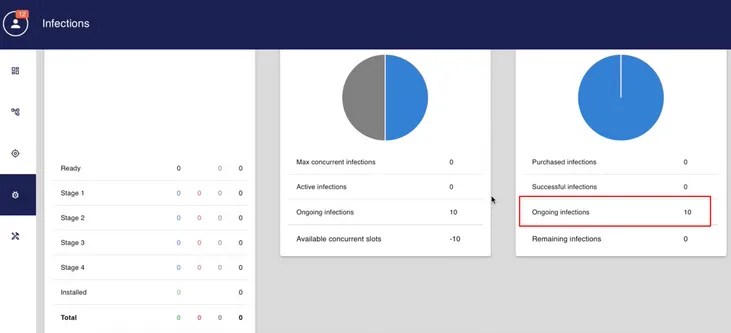
Screenshot of Predator dashboard listing ongoing infections
‘Business Opportunity’
The leaked video raises a number of grave concerns about Intellexa’s operations. For one, the shadowy, high-tech digital spying entity employed TeamViewer, a commercial software about which major security concerns have long-abounded, to access highly sensitive, invasive information on customer targets. This raises obvious questions about who else might be able to pry on this trove. Moreover, there is no indication Intellexa’s clients approved this access for training process, or the tutorial was conducted with even basic safeguards in place.
As such, the targets of Intellexa’s suite of spying resources not only face having their most sensitive secrets exposed to a hostile government without their knowledge or consent, but a foreign surveillance company in the process. The extent to which Intellexa is cognisant of how its technology is used by its clients is a core point of contention in the ongoing Greek legal case. Historically, mercenary spyware companies have firmly insisted they aren’t privy to data nefariously seized by their customers. Amnesty International states:
“The finding that Intellexa had potential visibility into active surveillance operations of their customers, including seeing technical information about the targets, raises new legal questions about Intellexa’s role in relation to the spyware and the company’s potential legal or criminal responsibility for unlawful surveillance operations carried out using their products.”
The latest disclosures about Intellexa have all the makings of a historic, international scandal, in the precise manner the use of Pegasus by state and corporate entities the world over has elicited international outcry, criminal investigations, and litigation lasting many years. However, the proliferation of ominous private spying tools, and their industrial scale abuse by paying customers, is no aberrant bug, but an intended upshot of the Zionist entity’s relentless crusade for cyberwarfare supremacy. In 2018, Israeli premier Benjamin Netanyahu boasted:
“Cybersecurity grows through cooperation, and cybersecurity as a business is tremendous… We spent an enormous amount on our military intelligence and Mossad and Shin Bet. An enormous amount. An enormous part of that is being diverted to cybersecurity… We think there is a tremendous business opportunity in the neverending quest of security.”
This investment manifests in almost every area of Israeli society. Numerous universities in Tel Aviv, with state support, hone new technologies and train future generations of cyber spies and digital warriors, who then join the Zionist Occupation Force’s ranks. Once their military service is complete, alumni frequently found companies at home and abroad offering the same monstrous services road-tested against Palestinians to private sector bodies and governments, without any oversight or guarantee these resources won’t be used for malevolent purposes.
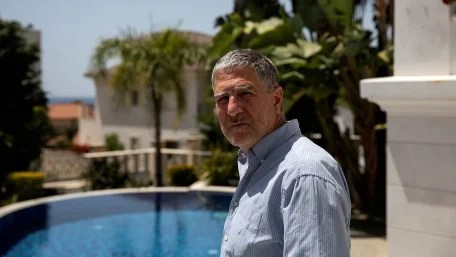
Intellexa founder and Israeli military intelligence veteran Tal Dilian
The intelligence failures that enabled the success of Operation Al-Aqsa Flood in October 2023 did enormous damage to Israel’s credibility as a cybersecurity leader, while devastating its “Startup Nation” brand, with foreign investment in the entity’s tech industry collapsing precipitously. However, the fresh Intellexa revelations show certain elements of the sector remain in high demand, and pose an unseen threat to untold numbers of people globally. Should the firm fall into disrepute as a result, another surely waits in the wings to take its place.
Featured Video

Rewriting the risk? Inside the government’s vaccine safety messaging
or go to
Aletho News Archives – Video-Images
Book Review
“Davos Can Really Replace the UN”
Inside the book that maps the architecture behind global governance — from the Epstein files to the Pact for the Future
Lies are Unbekoming | April 1, 2026
On June 13, 2019, the United Nations and the World Economic Forum signed a partnership deal to “accelerate the implementation of the 2030 Agenda for Sustainable Development.” That same evening, WEF president Börge Brende — Norway’s former Foreign Minister — had dinner with Jeffrey Epstein at Epstein’s Manhattan townhouse. The Epstein files, released January 2026, contain an exchange between the two from the previous year. Epstein to Brende: “Davos can really replace the UN. C21, cyber, crypto . genetics… intl coordination.” Brende back to Epstein: “Exactly — we need a new global architecture. World Economic Forum (Davos) is uniquely positioned — public private.”
The next day, the UN General Assembly adopted the framework for restructuring global governance.
That sequence — the partnership signing, the Epstein dinner, the candid admission about replacing the UN with a public-private architecture, and then the formal adoption — opens Jacob Nordangård’s The Digital World Brain. Pages two and three. Footnoted to the UN resolution number, the Epstein files, and the General Assembly record.
I keep coming back to it because it captures what this book does that almost nothing else in the independent research space manages. I’ve followed Jacob’s work for years now and interviewed him about his research. Each book peels back another layer of the same institutional architecture, and each time I think he’s reached the limit of what can be documented, the next one goes further. Nordangård doesn’t speculate. He doesn’t editorialize much. He lays institutional actions next to each other in chronological order and lets the pattern announce itself. … continue
Blog Roll
 Aletho News
- What’s Behind U.S./Israeli Strikes On Iranian Pistachio Factories?
- Seyed M. Marandi: U.S. Military DIVIDED? Iran’s Secret Defense EXPOSED
- How I fell foul of the BBC thought police
- The End of NATO
- 37 days of war on Iran cost US staggering $42bln, tracker shows
- Baghdad tells Asian refiners, traders to begin loading Iraqi crude amid Iranian exemption
- Under fire, Moscow and Tehran close ranks
- Iran, US receive Pakistan-mediated plan for ceasefire then final deal
- Iran submits demands for end to war as mediators scramble ahead of Trump deadline
- Iran Threatens Retaliatory Strike on Stargate AI Project in UAE
- If Americans Knew
- U.N. experts demand Israel release prominent Gaza doctor after reports of ‘severe torture’
- Israel’s Latest Genocide Is Against the Shias of Lebanon. Why Is the World Silent?
- How Eliot Cohen’s influence over U.S. war-making paved the way for Trump’s war crimes in Iran
- Israelis don’t pay for the weapons we ‘sell’ to them — US taxpayers do
- While Distancing from AIPAC, Most 2028 Democratic Hopefuls Are Still Embracing Israel
- A brief history of the Israeli nuclear program, the open secret at the heart of the Iran war
- Israeli Settlers Killed a Palestinian Farmer on His Own Land, in Front of His Father. Yes, Again
- The US-Israeli War on Science is an Assault on our Future
- 100+ International Law Experts Say US Strikes on Iran Violate UN Charter, Could Be War Crimes
- ‘Vile, Horrifying, Evil’: Trump Threatens to Bomb Nation of 90 Million People ‘Back to the Stone Ages’
- No Tricks Zone
- An Inconvenient Tree: Uncovered In Alps… Europe Much Warmer Than Today 6000 Years Ago
- New Study Reports A 60% Slowdown In Greenland’s Ice Loss Rate In The Last Decade
- Low Intensity Tornado Wrecks Major Solar Farm, Creating A Potential Toxic Dump
- New Study Finds Warming Saves Lives…Cold Temperatures 12 Times More Deadly Than Excess Heat
- German Science Blog Accuses PIK Climate Institute Of Hallucinating Climate Tipping Points
- Devastating Assessment Of Comirnaty Vaccine By Former Senior Pfizer Europe Toxicologist
- New Study: CO2 Is ‘Effectively Negligible’ As An Explanatory Climate Change Factor Since 2000
- Former Pfizer Toxicologist Dr. Helmut Sterz Tells Bundestag Hearing Pfizer Vaccine Should Have Never Been Approved
- Energy Expert: Germany’s Nuclear Phaseout Was A “500 Billion Euro Mistake”
- New Research: South Australia’s Mid-Holocene Sea Surface Temperatures Were 4°C Warmer Than Today
 Aletho News