Gaza ‘flour massacre’ textbook case of Israel’s war crimes and cover-ups
By Alireza Hashemi | Press TV | March 4, 2024
In the early hours of Thursday, in line with its genocidal war against Palestinians in the besieged Gaza Strip, Israeli troops opened indiscriminate fire on people waiting for food aid in the southwest of Gaza City.
At least 116 people were killed and more than 760 others injured in what rights groups described as a textbook case of cold-blooded massacre on the Al Rashid street that stretches along the coast of Gaza.
The regime denied involvement in the massacre that came nearly five months into the Israeli genocide in the besieged territory, which has so far claimed the lives of more than 30,400 Palestinians.
The flawed Israeli narrative kept changing and evolving throughout the day, designed to shift the blame on victims, the desperate aid-seekers who were there to get some flour.
The Israeli army claimed they had nothing to do with the incident and blamed a stampede for it. Later, they said trucks carrying aid had run over civilians. Finally, they admitted to having fired at the crowd, but “only targeting the militants trying to sabotage the aid delivery.”
A report by Yediout Aharonot said, “Dozens of Gazans died during a stampede as large crowds descended on humanitarian aid trucks entering northern Gaza, attempting to loot supplies and sparking violent clashes, the IDF reported on Thursday.”
“An initial IDF probe into the incident found that Palestinian gunmen fired at the aid trucks, with most fatalities resulting from trampling and crowding,” the report noted.
Another report by the Times of Israel said it “acknowledged that troops opened fire on several Gazans who moved toward soldiers and a tank at an IDF checkpoint, endangering soldiers, after they had rushed the last truck in the convoy further south.”
Reuters quoted an Israeli official as saying “there had been two incidents”, in one of which “dozens” were “trampled or run over” and in the second “some people” approached troops including a tank who “felt under threat and opened fire” in a “limited response”.
“The soldiers fired warning shots in the air and then fired towards those who posed a threat and did not move away,” Reuters quoted the official as saying.
“This is what we understand. We’re continuing to review the circumstances.”
In the broadest account, the Jerusalem Post, quoting Israeli army sources, said three incidents occurred.
The first one was the stampede that left most of the casualties, the second when the armed Palestinians fired on the trucks and stole supplies, and the third when a large group of Palestinians approached the Israeli forces nearby, who responded with live fire.
The Israeli newspaper, quoting its sources, claimed that “it was unclear if they had aggressive intentions or were civilians caught up in a chaotic moment.”
Later on Thursday, Israeli army spokesman Rear Admiral Daniel Hagari said the military had fired “a few warning shots” to try to disperse a “mob” who had “ambushed” the aid trucks.
“As these vital humanitarian supplies made their way toward Gazans in need, thousands of Gazans [rushed] the trucks, some began violently pushing and trampling other Gazans to death, looting the humanitarian supplies,” he said.
Some accounts identified those targeted as ordinary people and others identified them as a “mob”.
For example, Israel’s far-right minister Itamar Ben Gvir said Israeli soldiers “acted excellently against a Gazan mob that tried to harm them”.
In some versions, the victims were said to have trampled each other and in others, the trucks were believed to have mowed down people.
Israeli regime spokesman Eylon Levy blamed “Gaza truck drivers” for the massacre.
In this age of technology, it is interesting that Israeli accounts are never consistent and the regime officials are always “reviewing” things and struggling to find simple answers.
The regime offered no evidence to back its claims. It released a 100-second, heavily edited drone video as proof, which showed aid seekers surrounding trucks, but no trampling or trucks running over people.
If the Israeli drones recorded the situation, why did the regime not publish the scenes showing the moment when people were “trampled” or “run over”?
Holes in Israeli story
However, the strategy of ‘cover-up’ didn’t work this time. There are several glaring holes in the Israeli version of the incident that demand unraveling.
How did Gazan truck drivers start to kill their own people? Why hasn’t this ever happened before?
Or, why did Israeli troops kill 10 unarmed, starved Palestinians who had approached them? What kind of threat did these people pose to armed-to-the-teeth soldiers and tanks?
And, how scores of people were trampled? In any case, who is to blame for the desperate humanitarian situation that this regime claims was the cause of the incident?
These holes are filled by the Palestinian witness accounts that present a different chain of events.
Palestinians say most of the people present at the scene fell victim to Israeli gunfire, and the stampede occurred only after the Israeli troops started indiscriminately firing at them.
Local journalist Khadeer Al Za’anoun, a reporter for the Palestinian news agency Wafa, who witnessed the incident, said the chaos and confusion were sparked after Israeli forces opened fire, which led to people being hit by aid trucks.
Al-Jazeera journalist Ismail al-Ghoul reported that Israeli tanks “advanced and ran over many of the dead and injured people.”
The acting director of the Al-Awda Hospital said they received 161 wounded patients, most of whom appeared to have been shot.
Also, an initial probe by the Euro-Med Human Rights Monitor showed that the Israeli army gunfire was responsible for most deaths in a massacre of Palestinian civilians.
In a follow-up report, the rights group confirmed the regime’s “full involvement” in the massacre at the Nabulsi roundabout, calling for an “effective international investigation to hold Israeli officials accountable.”
Its field team – present at the time of the incident – “documented Israeli tanks firing heavily towards Palestinian civilians while trying to receive humanitarian aid,” the report noted.
Trying to get away with another massacre
The incident has been widely condemned by governments and organizations. The United Nations Secretary-General Antonio Guterres called for an independent probe into the killing of civilians.
Iran slammed “the barbaric attack by the Zionist regime”. Iranian foreign ministry in a statement said “The wound of Gaza will not be erased from the memory of the free people of the world.”
China said it was “shocked” while Colombia said, “This is called genocide and recalls The Holocaust.”
Even European allies of Israel, including France and Italy, denounced the massacre. Josep Borrell, the EU’s top diplomat, described the incident as a “totally unacceptable carnage”.
It wasn’t the first massacre of Palestinians though. There have been massacres every day in the Gaza Strip since October 7.
On January 26, Gaza’s Health Ministry said Israeli fire struck a crowd of people waiting for humanitarian aid at a roundabout in Gaza City on Thursday, killing at least 20 and wounding 150.
The UN Office for the Coordination of Humanitarian Affairs said on February 4, “a group of people a group of people waiting for humanitarian aid trucks near Al Kuwaiti roundabout in southern Gaza City were reportedly fired at.”
Another report referred to the February 5 attack on an aid convoy at the same place, Al-Rashid Street. That attack forced the UN Agency for Palestinian Refugees to warn it could not carry out its mission and provide humanitarian relief if safety conditions were not met.
A day before the latest attack, on Wednesday, Wafa news agency reported that three Palestinians, who were waiting for aid near Gaza City, were killed after being hit by Israeli artillery fire on al-Rashid Street.
Israel has a long record of massacring Palestinians in cold blood and then trying to cover up their crimes and avoid accountability, say observers. A notable example is the Deir Yassin massacre in 1948 when at least 107 Palestinians were slaughtered by Zionists.
The bloodthirst of the child-murdering regime has only increased over the years.
Scores of Palestinians killed, injured as Israel bombs aid truck in central Gaza
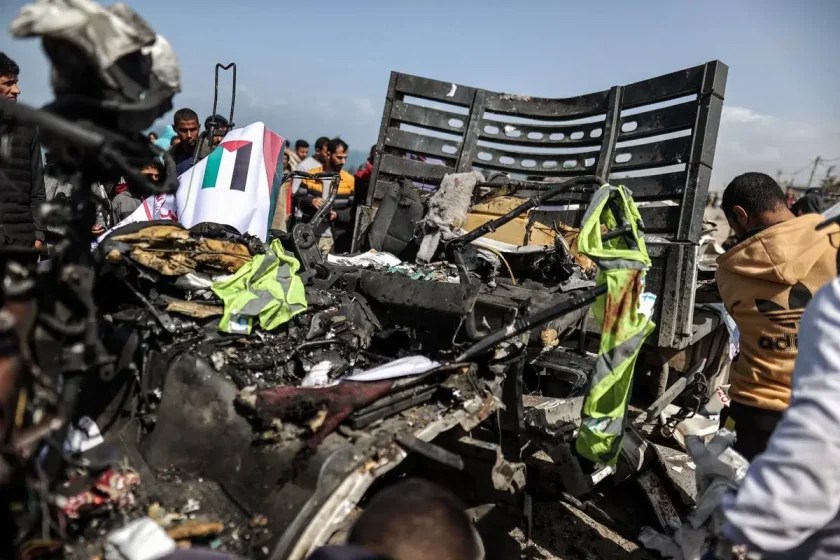
A humanitarian aid vehicle which had been the target of Israeli airstrikes resulting in the death of nine and dozens of injured in Deir Al-Balah of Gaza on March 3, 2024. [Ali Jadallah – Anadolu Agency ]
MEMO | March 3, 2024
Scores of Palestinians were killed and injured when the Israeli army dropped bombs on people collecting humanitarian aid from a truck in Deir al-Balah in the central Gaza Strip on Sunday, Anadolu reports.
This is the second major Israeli attack in the last five days on displaced Palestinians in Gaza who are waiting for humanitarian aid.
Earlier on Thursday, at least 112 Palestinians were killed and 760 others injured when Israeli forces shelled a crowd waiting for humanitarian aid south of Gaza City.
“Many people were killed and others wounded in an Israeli bombing that targeted an aid truck in the city of Deir al-Balah in the central Gaza Strip,” sources in the medical field told Anadolu while requesting anonymity.
So far, the number of casualties from the latest attack is not clear as neither the Health Ministry in the besieged Gaza Strip nor Israeli authorities have issued statements.
Israel has launched a deadly military offensive on the Gaza Strip since an Oct. 7, 2023, cross-border attack led by Hamas, in which nearly 1,200 people were killed.
At least 30,410 Palestinians, mostly women and children, have since been killed in Gaza, and 71,700 others injured amid mass destruction and shortages of necessities.
Israel has also imposed a crippling blockade on Gaza, leaving its population, particularly residents in the north where the Thursday shootings took place, on the verge of starvation.
The Israeli war has pushed 85% of Gaza’s population into internal displacement amid acute shortages of food, clean water, and medicine, while 60% of the enclave’s infrastructure has been damaged or destroyed, according to the UN.
Israel stands accused of genocide at the International Court of Justice. An interim ruling in January ordered Tel Aviv to stop genocidal acts and take measures to guarantee that humanitarian assistance is provided to civilians in Gaza.
Injured survivors of Gaza aid chaos say Israeli forces shot at them
MEMO | March 2, 2024
Divergent accounts
Lies about China’s Uyghur Oppression
Tales of the American Empire | February 29, 2024
Americans see news reports about the plight of Uyghurs. They are told these Muslims living in the western China province of Xinjiang are abused by the ruling Han Chinese and over a million are imprisoned in camps where they are forced to perform slave labor. As a result, China must be constantly denounced for this abuse and sanctions imposed on any Chinese business exploiting this slave labor. This is false and based on lies promoted by the American CIA.
Note: We are told to pronounce Uyghur as “WEE-gur” even though it has no W. In the province of Xinjiang and in their language it is pronounced “OO-gur” and should be in English since it starts with a U! So I adopted Dr. de Zayas’ correct pronunciation to reject whoever decided we should call them something weird in English.
___________________________________________________
“I Saw ZERO Evidence of Uyghur Repression In China”; Jimmy Dore Show; YouTube; September 30, 2023;  • “I Saw ZERO Evidence Of Uyghur Repres…
“What’s it REALLY like to travel in Xinjiang, China?”; Cyrus Janssen; YouTube; May 1, 2021; • What’s it REALLY like to travel in Xi…
“No, the UN did not report China has ‘massive internment camps’ for Uighur Muslims”; Ben Norton; The Grayzone; August 23, 2018; https://thegrayzone.com/2018/08/23/un…
“Was There Really a Massacre in Tiananmen Square–or Was It an Illusion Fabricated by U.S. Politicians and Corporate Media to Make Americans Hate China?”; Jeremy Kuzmarov; Covert Action Magazine; August 7, 2023; https://covertactionmagazine.com/2023…
“US efforts to strangle China & reassert hegemony”; The Duran; YouTube; September 16, 2023; https://theduran.com/us-efforts-to-st…
Related Tales: “The American War on China”: • The American War on China
MPs smear Gaza protestors, while others invent scare stories
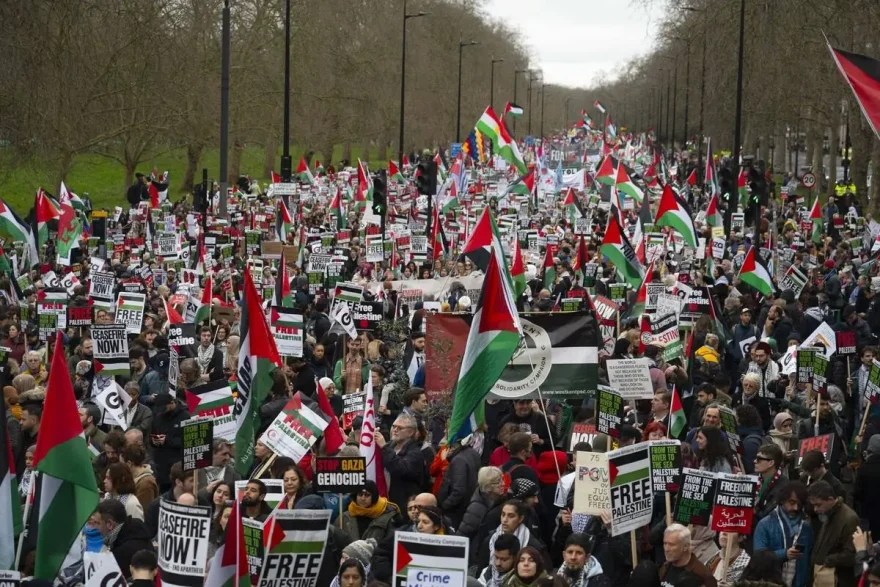
By Yvonne Ridley | MEMO | March 1, 2024
Are the massive pro-Palestine marches in Britain being deliberately targeted and smeared as part of a concerted Zionist effort to use the law to stop people from joining the ranks of the growing anti-war movement? That would certainly explain the furore over MPs’ safety which came to a head last week when Sir Lindsay Hoyle, the Speaker of the House of Commons and a member of the Labour Friends of Israel lobby group, cited threats to politicians in his disastrous handling of a debate on calls for a ceasefire in Gaza.
I pose the question after some extraordinary events have been picked up and anchored in a media campaign which has collectively shown nothing but hostility towards Palestinians in favour of the Zionist Israeli state as the genocidal onslaught in Gaza continues. Throw in some decidedly Islamophobic comments by prominent Conservative MPs, and there is a really toxic atmosphere brewing in advance of this year’s General Election, with Muslims — “Islamists” — cast as the bad guys.
Today, my suspicions were fuelled by none other than British Prime Minister Rishi Sunak who resorted to shameless smears and scare tactics as he warned police chiefs of a “growing consensus that mob rule is replacing democratic rule”. Calling for more robust police action, Sunak used inflammatory language to insist that politicians need to be protected from intimidatory protests outside their homes.
However, the Home Office has nevertheless announced a £31 million package aimed at protecting MPs. It is said to be in response to the impact of the ongoing “Israel-Hamas conflict”.
Meanwhile, in Scotland police were called to investigate bizarre claims that the Glasgow constituency office of Labour Members of the Scottish Parliament was “stormed” by 30 pro-Palestine protesters, with MSP Paul Sweeney criticising officers for taking 27 minutes to respond even though the office staff were left “distressed”.
Police Scotland insist that the storming of the politicians’ shared office never happened as described, and rejected the claims made by Sweeney. According to him, campaigners forced their way into the office that he shares with party leader Anas Sarwar, and fellow MSPs Pam Duncan-Glancy and Pauline McNeil.
“It may well be that this entire furore over alleged threats by protestors is confected,” said Mick Napier, a co-founder of the Scottish Palestine Solidarity Campaign, whose members took part in the protest. Certainly, the example of Sweeney caught flagrantly inventing threats to the staff suggests that this might be the case. Sweeney supports a party leader who endorses Israel withholding water, food and fuel from the entire population of Gaza — not only cruel, but also collective punishment, a war crime — while he complains that people opposing such barbarism raise their voices.
“Although in this case voices weren’t even raised,” explained Napier. “There seems to be something new in the shamelessness with which our politicians lie to the public. Could it be because the mainstream media have given up any pretence of investigating such fabrications?”
Despite repeated attempts to contact Sarwar, McNeil, Duncan-Clancy and Sweeney, none were prepared to offer a comment to me about the incident.
European political analyst Kevin Ovenden wrote about the incident on 22 February: “Two elected politicians have been exposed today for simply lying that they faced violent intimidation when they merely had to deal with democratic lobbying and political pressure. One is the Labour Member of the Scottish Parliament Paul Sweeney. Police in Glasgow refuted his highly charged claim that anti-war protesters stormed his office and intimidated his staff. They did no such thing, as the police concluded, having been present throughout for an orderly protest, without even any civil disobedience, by a small group of middle-aged or older women and men.
“That has not stopped the Speaker of the House of Commons, Lindsay Hoyle (for years a nodding-donkey Labour MP) today smearing the entire anti-war movement as in some way incubating terrorism as justification for his anti-democratic manoeuvres on behalf of [Labour Party leader] Keir Starmer.”
Ovenden blames craven support for Israel by the two main establishment parties, Conservative and Labour, for “not only leading to authoritarianism against public protest and free speech. It is now even crushing the limited democratic avenues available through parliament.”
The streets of London have witnessed some of the largest, peaceful, pro-Palestine demonstrations in the capital’s history, but that did not stop Sunak from calling an urgent meeting in Downing Street for police chiefs on Thursday. He urged them to use all of their existing powers to crack down on the alleged intimidation, disruption and subversion.
“We simply cannot allow this pattern of increasingly violent and intimidatory behaviour which is, as far as anyone can see, intended to shout down free debate and stop elected representatives doing their job,” insisted the prime minister.
Without a hint of irony, the man who has so far given his unconditional support to Israel, currently under investigation for genocide by the International Court of Justice, added: “That is simply undemocratic… I am going to do whatever it requires to protect our democracy, and our values, which we all hold dear.”
Del Babu, a former chief superintendent in London’s Metropolitan Police, said language like “mob rule” was not “helpful”. He told BBC Radio 4’s Today programme that appealing to people to demonstrate less could have “unintended consequences” and potentially lead to more people protesting.
“We will continue to march until there is an immediate ceasefire,” said Shamiul Joarder of Friends of Al-Aqsa. The organisation is part of a coalition of groups organising the marches which have brought world attention to London’s streets.
Members from all six groups, along with Labour MP and former shadow chancellor John McDonnell, and the campaign group Liberty, held a press conference earlier this week in parliament criticising unhelpful language used by politicians. They claim that anti-Muslim “hysteria” and pressure from the government had provoked the Metropolitan Police into heavy-handed and “discriminatory” policing of “peaceful mass protests”.
Home Secretary James Cleverly, meanwhile, told the BBC: “I genuinely don’t know what these regular protests are seeking to achieve. They have made their position clear, we recognise that there are many people in the UK that hold that position.”
Hours later, 104 starving Palestinians in Gaza were massacred — witnesses say that Israeli troops opened fire on them — as they gathered around an aid convoy distributing food. If Cleverly doesn’t understand the point of the street demonstrations then he has the emotional intelligence of a brick and a surname which doesn’t quite match his IQ.
Calls for a ceasefire will continue until Israel’s genocide of the people of occupied Palestine is stopped in its murderous tracks. Which bit of “Stop Killing Civilians” do our politicians not understand?
‘State-minus’: Biden’s Palestine solution
Three decades after the Oslo Lie, neither the US nor the EU are in any position to dangle the promise of a Palestinian state.
By Stasa Salacanin | The Cradle | February 29, 2024
Is it sadly ironic that the issue of Palestinian statehood – unresolved for over 75 years – has resurfaced only after Israel’s wholesale carpet-bombing of the Gaza Strip, killing over 30,000 civilians, injuring tens of thousands more, and destroying significant swathes of the territory’s infrastructure.
University of California (UCLA) historian James Gelvin states the case plainly:
“There would have been no serious discussion of a two-state solution without [the events of] 7 October. As a matter of fact, putting the Palestine issue back on the front burner of international and West Asian politics was one of the reasons Hamas launched its operation.”
As Gelvin explains it to The Cradle, Hamas has already scored several victories since its Al-Aqsa Flood operation: “The Palestine issue is back on the international agenda, it is negotiating the release of its captives as an equal partner to Israel,” and has demonstrated that it is “more effective in realizing Palestinian goals than its rival, Fatah.”
New ‘Biden Doctrine’
While the unprecedented, brutal Israeli military response has indeed illustrated the urgency for establishing a Palestinian safe haven, it is impossible to ignore that western state backers of the 1993 Oslo Accords – which laid out the essential framework for the establishment of a Palestinian state – have then so assiduously ignored and neglected that responsibility.
Even greater hypocrisy emerges from the fact that these western powers, led by Washington, have now decided to force the discussion of Palestinian statehood in the midst of Gaza’s carnage, with an Israeli prime minister, Benjamin Netanyahu, who is infamously opposed to it.
So, why is this debate possible now? Why was it ignored before 7 October – or even prior to Netanyahu’s return to the prime ministership?
After enormous public and international pressure, US President Joe Biden has, at least rhetorically, reopened the issue of Palestinian statehood. According to the New York Times, the Biden White House’s new doctrine would “involve some form of US recognition of a demilitarized Palestinian state in the West Bank and Gaza Strip in return for strong Palestinian guarantees that their institutions could never threaten Israel.”
In addition, the US president’s plan also envisages Saudi–Israeli normalization and a tough military stance against Iran and its regional allies. However, many analysts have already raised questions about the viability of a plan that does not reflect current ground realities.
While Netanyahu rejects the very notion of a Palestinian state, the ‘Biden doctrine’ and its offering of some limited-sovereignty version of a demilitarized Palestinian state is nothing less than humiliating for Palestinians.
Dr Muhannad Ayyash, Professor of Sociology at Mount Royal University, observes that there is no fundamental change of approach by the US on this issue. In short, the Biden administration refuses to clarify what it means by a ‘Palestinian state.’ Its initiative appears mainly to advance a form of a two-state solution that would be palatable to Israel.
Ayyash points out that the key issues related to Palestinian statehood are left unanswered, including the issue of sovereignty, Jewish settlements, the status of East Jerusalem, a necessary West Bank/East Jerusalem connection with the Gaza Strip, the Palestinian right to return, and so forth.
As Israel has firmly insisted on retaining full security control over the entire territory west of Jordan – meaning, over all the territory likely to come under Palestinian (self-)rule – many experts fear that Israel would have the right to militarily enter those territories at will, without Palestinian consent, with the latter banned from assembling its own military force.
This version of ‘statehood’ is not remotely on par with that of other UN member-states, who are entitled, under the UN Charter, to exercise full sovereignty and defend their territorial integrity. Biden’s ‘solution’ of a Palestinian state with limited sovereignty is nothing more than the legalization of Israel’s perpetual occupation of Palestine.
A Palestinian ‘empty shell’
The revived debate on Palestinian statehood is also intricately connected to a big western public relations dilemma. The Atlanticists’ unconditional support for Israel’s illegal, disproportionate military assault against mostly female and child populations has deeply impacted their image and capacity to maneuver in West Asia and beyond.
This is especially true for Washington’s foreign policy objectives in the region, which are facing major, direct resistance on the ground in Iraq, Syria, and Yemen.
The revival of a two-state solution is, therefore, a “desperate act to salvage some of the credibility or legitimacy of these regimes (both Arab and Western governments),” argues Dr Mohammed Abu-Nimer, Professor and Abdulaziz Said Chair for Peace and Conflict Resolution at the American University in Washington, DC.
For decades, the US has capitulated to Israeli demands on pretty much everything Tel Aviv has ever asked for. In recent years, as Gelvin describes it, the US has mainly focused “on bribing various Arab governments – the UAE, Bahrain, Morocco, Sudan – to normalize relations with Israel” through the “Abraham Accords,” which, in effect, took the Palestine issue off the table.”
Meanwhile, Arab states managed regional expectations by continuing to pay lip service to Palestinian issues while scuttling any opportunities behind the scenes. With few Arab state allies left, Palestinians themselves had no cards left to leverage – until 7 October.
Now, Israel is doing all it can to negate that day’s gains. Says Ayyash:
“Netanyahu wants to dispense with all pretension about the establishment of the Palestinian state and use this moment to establish full Israeli Jewish sovereignty from the river to the sea, whereas the Biden administration prefers a quieter approach that pretends to care about the aspirations of the Palestinian people in order to maintain its close ties with Arab regimes across the region.”
The two-state solution, according to Professor Abu-Nimer, is, therefore, nothing other than a “fig leaf” to resuscitate the west’s crashing image and should not be viewed as a serious US initiative. The proposed plan is “a skeleton or an empty shell which lacks of any serious form of sovereignty.”
Nathan Brown, an American scholar of Middle Eastern law and politics at George Washington University, largely concurs:
“This is not a step toward statehood but only reviving some provisions of the Oslo Accords. Even at a maximum, it would produce what would have been called a ‘protectorate’ in the nineteenth century, not a state.”
A Palestinian state is not on the cards
Although the US and the EU could exercise immense leverage over Israel to revive the Oslo agreement and fast-track its provisions, they are doing nothing of the sort.
Today, there is a unique opportunity for Tel Aviv’s western allies to play this hand, given the utter collapse of Israel’s image worldwide and the mass public demand for the protection of Palestinians.
Instead, the Biden administration thinks that it can resurrect the two-state idea by mediating a grand regional deal – one that will deliver everything Israel wants, by dangling the promise of a rump Palestinian state.
The White House believes that the reward of normalizing relations with Saudi Arabia will offset for the Netanyahu government a reversal on the question of Palestinian statehood and withdrawal from the occupied Palestinian territories.
Gelvin dismisses the plan, saying it simply won’t work on so many levels. For starters, “if Netanyahu commits to a Palestinian state and withdrawal from the occupied territories, his government will collapse and he will go to jail.”
Don’t expect anything spectacular from the European Union either. Although EU High Representative for Foreign Relations Josep Borrell has said that a Palestinian state may need to be imposed from the outside without Israel’s agreement, realistically, the range and reach of European foreign policy is minimal or non-existent. According to Gelvin, “the EU has no more leverage against Israel than Costa Rica.”
Abu-Nimer likely speaks for the majority of regional observers – who have seen this game play out before: these top-down western statehood formulas do not work without genuine engagement with Palestinian political representation – in this case, Hamas and other Palestinian resistance organizations.
Thirty-one years after the Oslo Accords promised a Palestinian state, Israel is ethnically cleansing Gaza and swallowing up the West Bank and East Jerusalem. Almost five months after the start of Operation Al-Aqsa Flood, some of the leverage is back in Palestinian resistance hands, and they are unlikely to trade their gains for an unsovereign rump state which diplomats are privately calling a ‘state-minus.’
Washington blocks UNSC statement condemning Israel for ‘Flour Massacre’
The Cradle | March 1, 2024
The US, on 29 February, vetoed a UN Security Council (UNSC) statement that would have condemned Israel for the mass murder of over 100 Palestinian civilians who were awaiting the delivery of humanitarian aid in Gaza City.
“We don’t have all the facts on the ground – that’s the problem,” US deputy ambassador to the UN Robert Wood told reporters on Thursday.
He then claimed there are “contradictory reports” about the Israeli army’s latest massacre and highlighted that Washington was focused on finding “some language that everyone can agree on.”
Thursday’s veto is the fifth time Washington has blocked a UNSC statement or ceasefire resolution that would hold Israel accountable for the atrocities it has committed in Gaza.
According to Riyad Mansour, the Palestinian UN ambassador, 14 of the 15 council members supported the statement advanced by Algeria.
At least 112 Palestinians were killed and more than 750 wounded after Israeli troops opened heavy machine gun and artillery fire on thousands waiting for food on Gaza’s Al-Rashid Street, in what marked the first delivery of food to northern Gaza in several weeks.
“After opening fire, Israeli tanks advanced and ran over many of the dead and injured bodies,” Al Jazeera’s Ismail al-Ghoul reported from the scene.
“We had come here to get our hands on some aid. I have been waiting since noon yesterday. At about 4:30 in the early morning, trucks started to trickle in. The Israelis just opened random fire on us as if it was a trap. Once we approached the aid trucks, the Israeli tanks and warplanes started firing on us,” a witness at the scene told Al Jazeera.
The Israeli aggression triggered a stampede, adding to the chaos.
“We were going to bring flour … then Israeli snipers shot at us,” another person in the area told the Qatari news outlet. “They shot me in the leg. I’m unable to stand up,” he added.
Tel Aviv changed its story multiple times on Thursday, first claiming the majority of victims were killed by the stampede and later saying that soldiers opened fire only after feeling “threatened.” Officials have yet to explain how the crowds of underfed and displaced civilians posed any threat to them.
Ex-UK Army Chief Nick Carter, Once In Charge of “Misinformation” Surveillance Army Unit, Joins Tony Blair Institute
By Didi Rankovic | Reclaim The Net | February 28, 2024
A new noteworthy instance of what can be described as the UK-style revolving door policy, where those working for the government and private entities switch employers in both directions, has happened in that country.
A former chief of the British Army, under whose watch the 77th Brigade was spying on citizens during the pandemic, has now joined Tony Blair’s organization.
General Nick Carter is therefore a new recruit at the Institute for Global Change (globalist not in name only, either) – which the former British prime minister set up to supposedly create “open, inclusive and prosperous countries for all.”
Carter previously “distinguished” himself at the peak of the pandemic for allowing a unit under his command to hunt down “bad” speech on the internet – that of citizens skeptical of Covid measures and related contentious issues, whatever was treated as “Covid misinformation.”
Carter’s fellow new recruit at the Institute is former Government Chief Scientific Adviser Sir Patrick Vallance. Another new hire is Finnish Prime Minister Sanna Marin. They will act as members of a team of “expert strategic counselors” in what critics might call Blair’s elitist globalist group – his own version of WEF, even.
Before becoming Blair’s private adviser, Carter, a decorated officer, served as the principal military advisor to the prime minister (reports don’t say which ones), as head of the Armed Forces, and finally the chief of the Defense Staff for the United Kingdom.
Back in the spring of 2020, reports cited Carter, then at the helm of the Defense Staff, saying that the 77th Brigade was “countering coronavirus misinformation online.”
Not a traditional deployment of a country’s military potential, even if it is one set up to carry out physiological warfare, like 77th Brigade had been.
And it didn’t make things better that the target of this warfare was free speech on the UK’s citizens – on Twitter, Facebook and the like.
No less than 2,000 military personnel were involved in this, with a dubious to say the least goal of what looks like a straight-forward attempt to sway opinion among the population.
This was at the time phrased as delivering “means of shaping behavior through the use of dynamic narratives.”
Related:
Tony Blair Institute Calls For a Digital ID For All British Citizens, Calls It The “Great Enabler”
How to Stop the WHO – #SolutionsWatch
Corbett | February 27, 2024
We all know the problem by now: the World Health Organization is trying to override your health freedoms and abrogate your bodily autonomy in the name of their scamdemic agenda. But what is the solution? Join James for this in-depth exploration of the ideas, organizations and actions that are already in motion to derail the WHO tyranny and regain our medical sovereignty.
WATCH ON:  /
/  /
/  /
/  /
/  /
/ or DOWNLOAD THE MP4
SHOW NOTES:
Episode 417 – The Global Pandemic Treaty: What You Need to Know
Episode 442 – The Global Pandemic Treaty Is A Threat To Us All
Episode 445 – James Corbett Testifies at the National Citizens Inquiry
Canadian petitions to parliament
The Global WHO Uprising Has Begun! on CHD TV
Amending The International Health Regulations (2005) – Health.Govt.NZ
Netherlands Letter To Parliament
South Africa Bill To Withdraw From WHO
Press conference on the growing concerns over the WHO ‘pandemic treaty’
Presentation to Irish parliament
Good News: The UK’s membership of the WHO seems to be unlawful and legal action is pending
Nullification – #SolutionsWatch
Maharrey on The Corbett Report
Michael Maharrey on “Shot Callers” discussing nullifying the WHO agreements
This week, please PAY FORWARD your gratitude for this work by sending info on the WHO takeover to someone in your life and by supporting the group or the individual that put that info together.
Canada’s Liberal Government Advances “Online Harms” Censorship Bill
Trudeau wants new laws to censor online speech

By Cindy Harper | Reclaim The Net | February 27, 2024
Canada’s Justice Minister Arif Virani has advanced a highly controversial bill, named Bill C-63, proposing comprehensive new legislation aimed at addressing online “hate” speech.
We obtained a copy of the bill for you here.
The bill covers seven types of harmful material, from content sexually exploiting or re-victimizing children and survivors, to content promoting violence and extremism.
But it also outlaws online “hatred,” so-called “hate speech,” and forms of deepfakes.
In an attempt to decrease the prevalence of harmful content, this legislation puts the onus on online platforms to be accountable and transparent about how they handle such content.
Platforms like social media and live-streaming services are included under the legislation’s “online services” umbrella.
The bill would also create a new “standalone hate crime offense that would apply to every offence in the Criminal Code and in any other Act of Parliament, allowing penalties up to life imprisonment to denounce and deter this hateful conduct as a crime in itself,” – the briefing explained.
The proposed law would also raise the maximum punishments for the four hate offenses from five years to life imprisonment for advocating genocide and from two years to five years for the others when persecuted by way of indictment.
The Liberal government states that the bill’s proposed regulations centre on the platforms most frequented by Canadians. However, the specifics will depend on whether these platforms meet the eventual user thresholds. Over time, the government may hold other platforms accountable, if these platforms end up posing “a significant risk of harm.”
Additionally, Bill C-63 proposes establishing a censorship organization, which will oversee digital “safety” issues. This organization is anticipated to include a five-member digital safety commission, an independent digital safety ombudsman, and a digital safety office. These will assist in addressing Canadians’ grievances about platforms’ content moderation decisions.
In a recent critique of Prime Minister Justin Trudeau’s approach to regulating online speech, Conservative leader Pierre Poilievre didn’t mince words. He accused Trudeau of labeling any speech he personally dislikes as “hate speech.” This accusation comes amidst discussions surrounding Canada’s proposed online harms bill, a legislation echoing similar efforts in other western democracies aimed at curbing hate speech, terrorist incitements, and violent content online.
Poilievre’s comments reflect a growing concern about the potential for such laws to be misused for broader censorship. This concern is not unfounded, given precedents in other countries where similar laws have veered into the realm of suppressing free speech. The Conservative leader’s stance suggests a keen awareness of these risks.
The term “woke authoritarian agenda” was used by Poilievre to describe the draft of the online harms bill, which he and his party are committed to opposing. He draws attention to the Trudeau administration’s handling of the 2022 “Freedom Convoy,” a protest against COVID-19 restrictions. Poilievre points out the government’s extreme measures, including freezing citizens’ bank accounts, as indicative of a mindset that easily conflates criticism with hate speech.
Highlighting the Trudeau government’s actions during the pandemic, Poilievre remarked, “Justin Trudeau said anyone who criticized him during the pandemic was engaging in hate speech.” This statement underscores a fear that the government might use the proposed legislation to silence dissent in various scenarios.
Featured Video

EUROPE FEARS RUSSIA’S NEXT MOVE / Ian Proud
or go to
Aletho News Archives – Video-Images
New Book
New Book: No Autoimmunity The Body Doesn’t Attack Itself
Lies are Unbekoming | September 24, 2026
 The label for Humira, once the best-selling drug in the world, lists its risks in plain print. One of them, in the label’s own words, is new “autoimmune” disease.
A drug prescribed for a condition labelled autoimmune carries a warning that it can cause a condition labelled autoimmune. That contradiction sits in every box, on a folded paper almost nobody reads.
My new book starts there.
No Autoimmunity: The Body Doesn’t Attack Itself
For seventy years, “your body is attacking itself, and we don’t know why” has ended the conversation for people diagnosed with multiple sclerosis, lupus, rheumatoid arthritis, Hashimoto’s, Type 1 diabetes, Crohn’s and psoriasis. More than eighty conditions now carry the autoimmune label. The diagnosis comes with a prescription for life. It almost never comes with a question about cause.
This book asks the question and answers it from the framework’s own records: its drug labels, its journals, its regulatory filings, and its own experiments. … continue
Blog Roll
 Aletho News
- Iran offers Trump deal before US election
- Merz regime wants ‘secret police’ – opposition
- Israeli settlers terrorize West Bank Palestinians with state-provided drones: Report
- They see them, then kill them: Israeli quadcopters track, deliberately target civilians in Gaza
- Debunked: Trump’s egregious UNGA claims on war against Iran crumble under scrutiny
- Europe was part of the infrastructure of US aggression against Iran: Deputy FM
- New evidence on the Bucha Massacre
- Italy and France debunk reports CIA issued ‘Russian drone threat’ warning
- How Russia is Rewiring the Global South
- Britain’s elites want you ready to die for a war they keep imagining
- If Americans Knew
- Trump betrayed voters with his campaign lies and prioritized a foreign country once he took office
- Netanyahu calls Israel’s war in Gaza ‘opposite of genocide’ in UN speech to near-empty hall
- Settler Kidnappings: Torture, Sexual Abuse and Terrorisation of Palestinian Abductees as Israel Deepens Annexation of West Bank
- Gaza winter nears as 162,000 tents become unusable, raising fears of humanitarian crisis
- Netanyahu says, “It’s the opposite of genocide”; UN says Gaza economy is world’s ‘most severe crisis on record’ – Daily Update
- Israel’s US-Backed Assault on Gaza Has Created the ‘World’s Most Severe Economic Crisis on Record’: UN
- ‘Protecting U.S. Citizens’… From Israel
- ‘This is where I live now, the back of a truck’: a day in the life of a grandmother in Gaza
- In UN Speech, Iran’s President Displays Pictures of Children Killed by US, Brings Attention to Israel’s Nuclear Arsenal
- Israel displaces hundreds of Palestinians amid wave of demolitions in West Bank
- No Tricks Zone
- New Study: Earth And Venus Surface Warmth Largely Explained By Convection And Lapse Rate, Not CO2 Or Radiation
- 2025 Nature Paper Claiming Worsening Global Drought Gets RETRACTED …Heavily Flawed
- New Study: ‘Global Drought Shows No Detectable Recent Acceleration Under Climate Warming’
- Economic Masterminds: German Socialists Suggest Taxing Productivity Gains Stemming From Using AI
- The South China Sea Has Not Been Cooperating With The Climate Change Narrative
- Energy Crisis: Germany Enters Heating Season With Historically Low Gas Reserve Fill Levels
- New Study: The Antarctic Ice Sheet Gained Mass From 2020-2024 Due To Staggering Snow And Ice Accumulation
- Study: Ocean Heating Rates From Thousands Of Years Ago ‘Dwarf’ Modern Ocean Heating Rates
- Climate Extremists Target, Attack Large-Scale Power Grid Infrastructure In Germany!
- New Study: Antarctic Ice Melt Has Contributed Less Than 1 Centimeter To Sea Level Rise In The Last 30 Years

