UK Digital ID Scheme Faces Backlash Over Surveillance Fears — Is a Similar Plan Coming to the U.S.?
By Michael Nevradakis, Ph.D. | The Defender |October 2, 2025
The U.K. plans to introduce a nationwide digital ID scheme that will require citizens and non-citizens to obtain a “BritCard” to work in the U.K., which includes England, Scotland, Wales and Northern Ireland.
Government officials say the plan, to take effect no later than August 2029, will help combat illegal immigration.
But critics like U.K. activist and campaigner Montgomery Toms said the scheme, “far from being a tool for progress,” is instead a “gateway to mass surveillance, control and ultimately the rollout of a centralised social credit system.”
The plan faces broad opposition in the U.K., according to Nigel Utton, a U.K.-based board member of the World Freedom Alliance, who said, “the feeling against the government here is enormous.”
A poll last week found that 47% of respondents opposed digital ID, while 27% supported the ID system and 26% were neutral. The poll was conducted by Electoral Calculus and Find Out Now, on behalf of GB News.
A petition on the U.K. Parliament’s website opposing plans to introduce digital ID may force a parliamentary debate. As of today, the petition has over 2.73 million signatures.
According to The Guardian, petitions with 100,000 signatures or more are considered for debate in the U.K. parliament.
As opposition mounts, there are signs the BritCard may not be a done deal. According to the BBC, a three-month consultation will take place, and legislation will likely be introduced to Parliament in early 2026.
However, U.K. Culture Secretary Lisa Nandy said the government may push through its digital ID plans without going through the House of Commons or the House of Lords.
Protesters plan to gather Oct. 18 in central London.
Digital ID will ‘offer ordinary citizens countless benefits,’ U.K. officials say
British Prime Minister Keir Starmer announced the digital ID scheme last week in a speech at the Global Progress Action Summit in London.
“A secure border and controlled migration are reasonable demands, and this government is listening and delivering,” Starmer said. “Digital ID is an enormous opportunity for the U.K. It will make it tougher to work illegally in this country, making our borders more secure.
The plan “will also offer ordinary citizens countless benefits, like being able to prove your identity to access key services swiftly,” Starmer said.
According to The Guardian, digital ID eventually may be used for driver’s licenses, welfare benefits, access to tax records, and the provision of childcare and other public services.
Darren Jones, chief secretary to Starmer, suggested it may become “the bedrock of the modern state,” the BBC reported.
Supporters of the plan include the Labour Together think tank, which is closely aligned with the Labour Party and which published a report in June calling for the introduction of the BritCard.
Two days before Starmer’s announcement, the Tony Blair Institute for Global Change, led by Labour Party member and former U.K. Prime Minister Tony Blair, published a report, “Time for Digital ID: A New Consensus for a State That Works.”
Blair tried to introduce digital ID two decades ago as a means of fighting terrorism and fraud, but the plan failed amid public opposition. According to the BBC, Starmer recently claimed the world has “moved on in the last 20 years,” as “we all carry a lot more digital ID now than we did.”
During the COVID-19 pandemic, Blair endorsed a global digital vaccine passport, the Good Health Pass, launched by ID2020 with the support of Facebook, Mastercard and the World Economic Forum.
According to Sky News, French President Emmanuel Macron welcomed the BritCard for its ability to help fight illegal immigration into the U.K., much of which originates from France.
Critics: Digital ID marks ‘gateway to mass surveillance’
The BritCard, which would live on people’s phones, will use technology similar to digital wallets. People will not be required to carry their digital ID or be asked to produce it, except for employment purposes, the government said.
According to the BBC, BritCard will likely include a person’s name, photo, date of birth and nationality or residency status.
Digital wallets, which include documents such as driver’s licenses and health certificates, have been introduced in several countries, including the U.S.
Nandy said the U.K. government has “no intention of pursuing a dystopian mess” with its introduction of digital ID.
However, the plan has opened up a “civil liberties row” in the U.K., according to The Guardian, with critics warning it will lead to unprecedented surveillance and control over citizens.
“Digital ID systems are not designed to secure borders,” said Seamus Bruner, author of “Controligarchs: Exposing the Billionaire Class, their Secret Deals, and the Globalist Plot to Dominate Your Life” and director of research at the Government Accountability Institute. “They’re designed to expand bureaucratic control of the masses.”
Bruner told The Defender :
“All attempts to roll out digital ID follow a familiar pattern: corporate and political elites wield crises — such as mass migration, crime, or tech disruptions — as a pretext to expand their control … over private citizens’ identities, finances and movements into a suffocating regime.
“Once rolled out, these systems expand quietly, shifting from access tools to enforcement mechanisms. Yesterday it was vaccine passports and lockdowns; tomorrow it is 15-minute cities and the ‘universal basic income’ dependency trap. ‘Voluntary’ today becomes mandatory tomorrow.”
Tim Hinchliffe, editor of The Sociable, said digital ID is “not about tackling illegal immigration, it has nothing to do with job security and it definitely won’t protect young people online. Digital ID is all about surveillance and control through coercion and force.”
Hinchliffe said:
“Illegal immigration is just one excuse to bring it all online. Be vigilant for other excuses like climate change, cybersecurity, convenience, conflict, refugees, healthcare, war, famine, poverty, welfare benefits. Anything can be used to usher in digital ID.”
Twila Brase, co-founder and president of the Citizens’ Council for Health Freedom, said governments favor digital ID because it allows unprecedented surveillance.
The ID system “notifies the government every time an identity card is used, giving it a bird’s-eye view of where, when and to whom people are showing their identity,” she said.
According to Toms, “A digital ID system gives governments the ability to monitor, restrict, and ultimately punish citizens who do not comply with state directives. It centralises power in a way that is extremely dangerous to liberty.”
Experts disputed claims that digital ID is necessary to improve public services.
“The ‘improved efficiency’ argument is a technocratic fantasy used to seduce a public obsessed with convenience,” said attorney Greg Glaser. “Governments have managed to provide services for centuries without a digital panopticon. This is not about efficiency. It is about creating an immutable, unforgeable link between every individual and the state.”
Digital ID technology may create ‘an enormous hacking target’
London-based author and political analyst Evans Agelissopoulos said major global investment firms, including BlackRock, Vanguard and State Street, could combine their financial might with the power of digital ID.
“BlackRock, Vanguard and State Street are on a mission to buy properties to rent to people. Digital ID could be used against people they deem unfit to rent to,” he said.
During the COVID-19 pandemic, the same firms supported digital vaccine passports in major corporations in which they are among the top shareholders. Some experts suggested digital ID may institutionalize a vaccine passport regime and central bank digital currencies.
“Digital identity is the linchpin to every dystopian nightmare under the sun,” Hinchliffe said. “Without it, there can be no programmable digital currencies, there can be no carbon footprint trackers, no social credit system.”
Other experts suggested that a centralized database containing the data of all citizens could be monetized. “By centralizing everything, they will have access to health, criminal, financial records. This data can be sold,” Agelissopoulos said.
According to Brase, those who will benefit from the centralization of this data include:
“Anybody who’s going to be the third-party administrator, academia and companies who are building biometric systems and what they call ‘augmented authentication systems’ that provide the cameras, the back system operations for biometric identification and for digital systems.”
Several major information technology (IT), defense and accounting firms, including Deloitte and BAE Systems, have received U.K. government contracts totaling 100 million British pounds ($134.7 million) for the development and rollout of BritCard.
U.S. tech companies, including Palantir, Nvidia and OpenAI, “have also been circling the UK government,” The Guardian reported.
Digital ID also raises security concerns, with IT experts describing the U.K.’s plan as “an enormous hacking target,” citing recent large-scale breaches involving digital ID databases in some countries, including Estonia.
“Government databases are frequently hacked — from healthcare systems to tax records,” Toms said. “Centralizing sensitive personal data into a single mandatory digital ID is a disaster waiting to happen.”
The public may also directly bear the cost of these systems. Italy’s largest digital ID provider, Poste Italiane, recently floated plans to levy a 5 euro ($5.87) annual fee for users.
Switzerland to roll out digital ID next year, amid controversy
In a referendum held on Sunday, voters in Switzerland narrowly approved the introduction of a voluntary national digital ID in their country.
According to the BBC, 50.4% of voters approved the proposal. Biometric Update noted that the proposal received a majority in only eight of the country’s 26 cantons, though the country’s government campaigned in favor of the proposal.
Digital ID in Switzerland is expected to be rolled out next year.
Swiss health professional George Deliyanidis said he “does not see any benefits for the public” from the plan. Instead, he sees “a loss of personal freedom.”
“There are suspicions of election fraud,” he added.
In a letter sent Tuesday to the Swiss government, a copy of which was reviewed by The Defender, the Mouvement Fédératif Romand cited “significant statistical disparities” in the referendum’s results and called for a recount.
In 2021, Swiss voters rejected a proposal on digital ID under which data would have been held by private providers, the BBC reported. Under the current proposal, data will remain with the state.
According to the Manchester Evening News, countries that have introduced nationwide digital ID include Australia, Canada, China, Costa Rica, Denmark, Estonia, India, Japan, South Korea, Spain, Ukraine and the United Arab Emirates. Other countries with similar systems include France, Finland and Norway.
In July, Vietnam introduced digital ID for foreigners living in the country. In August, the Vietnamese government helped neighboring Laos launch digital ID.
The New York Times reported that, in 2024, China added an “internet ID” to its digital ID system, “to track citizens’ online usage.”
Bill Gates has supported the rollout of digital ID in several countries, including India.
The European Union plans to launch its Digital Identity Wallet by the end of 2026.
“When you see a nearly simultaneous worldwide push, like this digital ID agenda, people in all nations need to expect to be impacted to some extent,” said James F. Holderman III, director of special investigations for Stand for Health Freedom.
Is national digital ID coming to the U.S.?
Although the U.S. does not have a national identification card, the U.K. did not have one either — until digital ID was introduced. The U.K. scrapped national ID in 1952.
In May, the Transportation Security Administration (TSA) began Real ID enforcement for domestic air travelers in the U.S. In the months before, TSA engaged in a push to encourage U.S. citizens to acquire Real ID-compliant documents, such as driver’s licenses. Full enforcement will begin in 2027.
The REAL ID Act of 2005 established security standards for state-issued ID cards in response to the 9/11 attacks and the recommendations of the 9/11 Commission. In the intervening years, its implementation was repeatedly delayed.
Last year, then-President Joe Biden issued an executive order for federal and state governments to speed up the adoption of digital ID.
Brase said Real ID “is really a national ID system for America, currently disguised as a state driver’s license with a star. The American people really have no idea that what’s in their pocket is a national ID and they have no idea that the [Department of Motor Vehicles offices] are planning to digitize them.”
Hinchliffe said 193 countries, including the U.S., accepted digital ID last year when they approved the United Nations’ Pact for the Future.
Earlier this month, Sen. Rand Paul (R-Ky.) introduced the Safeguarding Personal Information Act of 2025 (S 2769), a bill to repeal the REAL ID Act of 2005.
“If digital ID is allowed to spread globally, future generations will never know freedom,” Hinchliffe said.
This article was originally published by The Defender — Children’s Health Defense’s News & Views Website under Creative Commons license CC BY-NC-ND 4.0. Please consider subscribing to The Defender or donating to Children’s Health Defense.
CANADIAN BILL EXPOSES DARK EUGENICS HISTORY
The HighWire with Del Bigtree | October 2, 2025
Canada’s new bill banning forced sterilization of First Nations women shines a light on a chilling global pattern of modern-day eugenics, from Kenya’s tetanus vaccines to Colombia’s HPV programs.
New York Imposes Law Forcing Social Media to Justify Speech Policies to State Authorities
By Cindy Harper | Reclaim The Net | October 3, 2025
Social media companies operating in New York are now under fresh legal obligations as the state enforces the so-called “Stop Hiding Hate Act,” a new compelled speech law that forces platforms with annual revenues exceeding $100 million to hand over detailed reports on how they handle various forms of speech, including speech that is legally protected under the First Amendment.
The legislation went into effect on October 1 and has already triggered a constitutional showdown in court.
The law, officially Senate Bill S895B, demands biannual disclosures to the state Attorney General’s office.
These reports must outline how platforms define terms such as “hate speech,” “misinformation,” “harassment,” “disinformation,” and “extremism.”
Companies are also required to explain what moderation practices they apply to those categories and to provide specifics about actions taken against users and content.
Platforms that fail to comply face penalties of up to $15,000 per violation, per day. Injunctive action can also be taken against non-compliant entities.
Attorney General Letitia James declared that the law is about transparency and oversight.
“With violence and polarization on the rise, social media companies must ensure that their platforms don’t fuel hateful rhetoric and disinformation,” she said in a public statement, reinforcing her view that private companies should be accountable to the state for how they manage user expression.
“The Stop Hiding Hate Act requires social media companies to share their content moderation policies publicly and with my office to ensure that these companies are more transparent about how they are addressing harmful content on their platforms.”
Governor Kathy Hochul voiced similar sentiments, saying the legislation “builds on our efforts to improve safety online and marks an important step to increase transparency and accountability.”
The reporting rules, however, do not simply demand that companies disclose general moderation policies. They compel platforms to state clearly how they define some of the most politically charged and subjective categories of online content. These include terms that do not have universally accepted definitions and that often serve as the basis for viewpoint discrimination.
This government demand for compelled speech is at the heart of a legal battle now playing out in federal court.
In June 2025, X Corp., the company behind the X platform, filed a lawsuit challenging the constitutionality of the law.
The company’s complaint argues that Senate Bill S895B is a direct assault on editorial discretion and a violation of free speech rights enshrined in both the US and New York Constitutions.
According to the complaint, the law imposes “an impermissible attempt by the State to inject itself into the content-moderation editorial process.” X warns that the statute operates as a tool to pressure platforms into adopting government-favored positions on disputed topics.
Key to X’s legal objection is what it refers to as the “Content Category Report Provisions.” These provisions, the company argues, effectively force platforms to accept the state’s framing of controversial topics, including “foreign political interference” and “hate speech,” regardless of how a private entity might choose to treat or define such categories independently.
The lawsuit also highlights the heavy financial threat tied to non-compliance, noting that fines can reach $15,000 per day for every violation. In addition, platforms could face legal action from the Attorney General’s office.
In defending its position, X Corp. references a victory it recently secured in a separate First Amendment case involving a similar law in California. There, the Ninth Circuit ruled that forced reporting of this nature likely constitutes compelled non-commercial speech and does not hold up under strict scrutiny.
The court concluded that forcing platforms to adopt state-defined language “amounts to compelled speech,” a stance X Corp. is urging the Southern District of New York to follow.
The company’s lawsuit goes a step further, pointing to legislative bias as motivation for the law’s passage.
According to the complaint, New York lawmakers refused to engage with X’s representatives in the wake of the California ruling, explicitly citing their disapproval of Elon Musk’s public statements and use of the platform.
In correspondence included in the court filing, lawmakers dismissed the company’s concerns because, in their words, Musk had used X to promote content that “threatens the foundations of our democracy.”
That remark, X argues, reveals a plainly unconstitutional motive rooted in viewpoint discrimination. “The government cannot do indirectly what [it] is barred from doing directly,” the complaint states, referencing controlling Supreme Court precedent.
Despite the ongoing litigation, New York officials are moving forward with the law’s enforcement.
Senator Brad Hoylman-Sigal, one of the bill’s sponsors, defended the policy as a necessary countermeasure to what he described as real and potential violence driven by online speech. “The Stop Hiding Hate Act will ensure that New Yorkers are able to know what social media companies are doing (or not doing) to stop the spread of hatred and misinformation on their platforms,” he said.
The outcome of the lawsuit could have wide-reaching implications not only for companies operating in New York but also for how much power states can exert over online speech. For now, platforms face a stark choice: speak as the state demands or risk steep penalties for silence.
IOF kidnaps Gaza nurse as medical staff struggle to work under fire

Palestinian Information Center – October 2, 2025
GAZA – Israeli occupation forces (IOF) on Thursday abducted nurse Tasneem al-Hems from a medical point in Khan Yunis, in the southern Gaza Strip, in yet another attack on Palestinian health workers. She is the daughter of Dr. Marwan al-Hems, the director of Gaza’s field hospitals, who was kidnapped by an IOF undercover unit in July this year.
Family sources confirmed that Tasneem was seized by a special IOF unit near her workplace. Her father, Dr. al-Hems, was shot in the leg and abducted on July 21 near the International Committee of the Red Cross hospital in western Khan Yunis. He has since been held in Ashkelon prison, denied access to his lawyer, and remains in detention under extended orders.
The Gaza-based al-Dameer Association for Human Rights condemned the kidnapping and confirmed that Israel is using enforced disappearance against medical professionals. According to the Ministry of Health in Gaza, at least 361 Palestinian medical staff are currently imprisoned by Israel.
Meanwhile, Gaza’s Ministry of Health warned that the few hospitals still partially operating in Gaza City are facing extreme risks. In a statement Thursday, the ministry said that reaching Al-Shifa Medical Complex, Al-Quds Hospital, and Al-Helou Hospital has become “highly dangerous” due to ongoing Israeli bombings.
The ministry urged international bodies to intervene immediately to protect medical institutions and staff and to ensure safe access to health facilities.
Health authorities recently reported that 20 hospitals in Gaza have been forced out of service, with only eight functioning at limited capacity under constant threat of IOF strikes.
Since August 11, 2025, Israel has intensified its genocide against Gaza, attempting to destroy the city and forcibly displace its population southward.
Italian dockworkers block ships bound for Israel amid Gaza flotilla tensions

Dockworkers and citizens at the garrison outside the Tuscan dock pose for a photo and rejoice at the news that Israeli ship Zim is preparing to leave the port of Livorno without unloading or loading after Italian dockworkers on strike, block the Darsena Toscana terminal during a protest in support of Gaza, Palestine and Global Sumud Flotilla on September 29, 2025 in Livorno, Italy. [Photo by Laura Lezza/Getty Images]
MEMO | October 2, 2025
Dockworkers in several Italian ports are stepping up actions to block shipments to Israel as tensions mount over the approach of the “Sumud Flotilla” to Gaza.
Labour unions across Europe have pledged coordinated efforts to disrupt maritime trade with Israel if the flotilla comes under attack. In a meeting held in Genoa, union representatives said they had set up an alert system to monitor shipments and respond rapidly by halting the loading or unloading of vessels.
Italy has become the epicenter of the movement. Genoa was the first port to act, followed by Livorno, where union-led strikes have already disrupted operations. The container ship Zim Virginia was kept waiting for five days off the Tuscan coast after dockworkers refused to allow it to dock.
Another vessel, the Zim Iberia, is expected to arrive in Livorno on 3 October and is likely to encounter similar resistance, according to union organizers.
In Genoa, tensions escalated last week when about 2,000 protesters gathered at the port. The demonstration forced the Zim New Zealand to leave without loading any cargo after reports that several containers were suspected of being linked to Israeli shipments.
Union leaders said their campaign is aimed at putting pressure on Israel and demonstrating solidarity with Gaza. They warned that actions would intensify if the flotilla is obstructed.
Protests erupt worldwide against Israeli attack on Global Sumud Flotilla
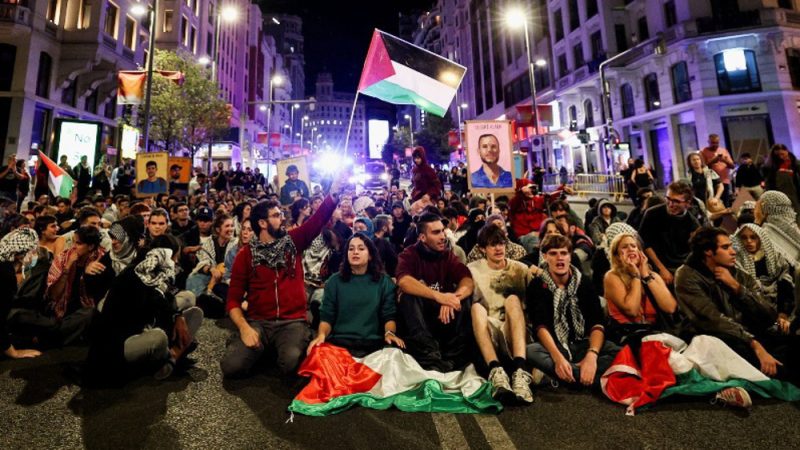
The Cradle | October 2, 2025
Protests erupted across cities worldwide on the night of 1 October after Israel intercepted the Gaza-bound Global Sumud Flotilla, with thousands taking to the streets to denounce the raid, demand the release of detained activists, and call for an end to the siege on the enclave.
Demonstrations broke out in Greece, Spain, Sweden, and Belgium, as large rallies took place in Italy, where the country’s largest trade unions announced a general strike for 3 October.
Among the largest gatherings overnight, tens of thousands marched through Rome in support of the Sumud Freedom Flotilla.
Hundreds more blocked traffic at Piazza dei Cinquecento, while in Milan, large crowds shut down train stations, blocking rail traffic as part of nationwide demonstrations.
Organizers estimated around 1,000 people would march toward Piazza Barberini. Italy’s unions USB and CGIL confirmed a nationwide strike call, while dock workers carried out their pledge to blockade in response to the flotilla’s interception.
Hundreds also gathered outside the US consulate in Istanbul, chanting slogans, praying for Palestinians, and denouncing what they called genocide.
In Berlin, protesters gathered at Central Station, and in Brussels, marchers moved from Place de la Bourse to the Belgian Foreign Ministry.
In London, thousands marched to the prime minister’s residence, chanting against him. In Germany, demonstrators briefly shut down the main train station.
The Tunisian capital also saw a mass demonstration, while Mauritania’s Nouakchott hosted protests denouncing the flotilla raid.
A snap protest was held outside Sydney Town Hall in support of the Global Sumud Flotilla, with demonstrators voicing solidarity and chanting “From the river to the sea,” which echoed through the rally.
Latin American cities witnessed parallel mobilizations. Local media in Buenos Aires said hundreds demonstrated against what they called an “assault by the Israeli occupation forces” and demanded an end to the genocide in Gaza.
In Mexico City, Reuters captured images of marchers outside the Foreign Ministry, with demonstrators demanding the release of seven Mexican nationals detained in the flotilla raid.
Activists Arlin Medrano and Sol Gonzalez confirmed in a video that their ship had been intercepted in international waters, calling it an illegal act.
David Pena, the Mexican delegation’s legal representative, told protesters Israel planned to charge them with trespassing and deport them.
In Colombia, protesters gathered outside the headquarters of the National Business Association (ANDI) after the Global Movement to Gaza accused it of ties to Israel’s economic mission – an allegation the group denied in a statement.
Demonstrations also swept Bogota, Montevideo, and several Argentine cities, with protesters in Uruguay’s capital calling for the imprisonment of Israeli Prime Minister Benjamin Netanyahu.
Out of 44 vessels that departed with the Global Sumud Flotilla, only four are still marked as ‘sailing’ as of 12:15 pm Thursday, according to live tracking data on the flotilla’s website.
One vessel appeared to have reached Gaza’s waters before communications were lost.
Organizers said one of the boats intercepted was rammed by an Israeli naval vessel.
Israel’s Foreign Ministry labeled the mission on its official X account as the “Hamas Flotilla.”
Explainer: How is Trump’s 20-point Gaza ‘plan’ dangerously tilted in Israel’s favor
By Hamid Javadi | Press TV | October 1, 2025
US President Donald Trump on Monday unveiled a 20-point proposal for post-war Gaza that is dangerously skewed in favor of the Israeli regime and ignores Palestinian realities.
At its core, the plan demands Hamas disarm within 72 hours of a ceasefire, release all captives, and accept a phased Israeli troop withdrawal.
But here’s the catch: there’s no binding commitment to end the military occupation, no clear roadmap for Palestinian sovereignty or right to self-determination of Palestinians and no guarantee that Israel won’t resume its genocidal aggression once its captives are returned.
The much-hyped “plan” that has been welcomed by a group of Muslim countries demands Palestinian surrender without offering sovereignty, envisions the so-called economic development built on displacement, and leaves the door open for continued Israeli occupation.
Trump, who has long eyed Gaza as waterfront property on the Mediterranean, touted the proposal as “a peace plan,” but beneath its diplomatic gloss lies a blueprint that has been designed keeping in view long-term Israeli and American interests.
Under the deal, Israel would release over 1,900 Palestinian prisoners, including 250 serving life sentences, in exchange for all 48 Israeli captives held by Hamas — both living and deceased — within 72 hours of a ceasefire taking effect.
How does Hamas or Palestinians appear in Trump’s plan?
The proposal, which has grabbed headlines in world media in the past two days, calls for the Hamas resistance movement to relinquish all governing roles in Gaza and lay down its weapons, a condition the group has previously ruled out unless a sovereign Palestinian state is established and the aspirations of Palestinians are taken into account.
Israeli Prime Minister Benjamin Netanyahu said he agreed to the plan at a press conference with Trump at the White House on Monday, even as Israeli regime forces continued to rain down bombs on Palestinians across Gaza.
However, speaking to Israeli media later, Netanyahu ruled out the military withdrawal, saying that it “is not going to happen.” It came even before Hamas’ official reaction to the plan.
Hamas’s negotiating team said it was studying the plan. However, a Hamas official told Reuters that Trump’s proposal was “completely biased to Israel” and imposed “impossible conditions” that aimed to eliminate the resistance group, a longtime objective of Netanyahu.
“What Trump has proposed is the full adoption of all Israeli conditions, which do not grant the Palestinian people or the residents of the Gaza Strip any legitimate rights,” the Palestinian official said on condition of anonymity.
While Hamas has frequently said it would welcome any initiative that ends the genocidal war on Gaza — which has killed more than 66,000 since October 2023, mostly women and children — it has every reason to be skeptical.
Last time Hamas leaders were reviewing Trump’s proposal for a ceasefire, Israeli warplanes bombed their headquarters in Qatar, a key mediator in negotiations between the Palestinian resistance movement and the Tel Aviv regime.
So, while Netanyahu has endorsed Trump’s new proposal, he has rejected the only two terms in the plan that could give Hamas a reason to accept the deal: the withdrawal of Israeli occupation forces (though conditional and gradual) and the eventual establishment of a Palestinian state.
What does the plan say about Israeli occupation?
A day after he gave his backing to Trump’s plan, Netanyahu said Israeli forces would remain in most of Gaza.
“We will recover all our hostages, alive and well, while the (Israeli military) will remain in most of the Gaza Strip,” he said in a video statement on Tuesday.
This isn’t the only point of friction. Netanyahu also said he would never allow the creation of a Palestinian state, yet the White House document includes language about a “credible pathway to Palestinian self-determination and statehood” if the deal is fully implemented.
“It’s not written in the agreement,” Netanyahu claimed, saying that Israel would “strongly oppose” such a move. He insisted that Trump shared this view.
This is a nonstarter for Palestinians. As Ziyad al-Nakhalah, leader of the Palestinian Islamic Jihad, put it, “Israel is trying to impose through the United States what it was unable to achieve through war.”
What does Netanyahu want in Gaza?
Netanyahu appears to be trying to have it both ways: Publicly embracing the deal to pressure Hamas, while privately rejecting its most fundamental terms.
It’s a familiar tactic. The Israeli prime minister, who is wanted by the International Criminal Court (ICC) for war crimes and crimes against humanity in Gaza, has a track record of endorsing negotiations and ceasefire proposals, and at the same time making contradictory statements to kill the momentum.
Captive families, humanitarian groups, and even some Israeli regime officials have accused Netanyahu of prolonging the war for political gains. Hamas says the Israeli prime minister has used negotiations as a smokescreen for continued genocide in Gaza.
In February, Israel kept stalling the second phase of a ceasefire agreement that had already begun by violating terms related to troop withdrawal and humanitarian aid delivery.
Trump’s latest proposal does not address the root causes of the protracted issue — namely, the occupation and the apartheid oppression of the Palestinian people.
How does Trump’s plan address displacement?
The plan is largely driven by Trump’s desire to build a Dubai-style wonderland on the wasteland of Gaza. Though the plan claims “no one will be forced to leave Gaza,” Trump’s vision for Gaza — as publicly announced in the past — is premised on the forced displacement of the native populace.
The more Palestinians are forcibly removed from their land, the cheaper the project becomes to implement.
A reconstruction and economic blueprint for Gaza, published by The Washington Post, estimates that $23,000 will be saved for every Palestinian who leaves.
Trump had previously floated the idea that he would send the US military into Gaza to clear the territory of its residents by force if necessary. Those remarks sparked a fierce global backlash.
The White House text says, “a Trump economic development plan to rebuild and energize Gaza will be created by convening a panel of experts who have helped birth some of the thriving modern miracle cities in the Middle East.”
“A special economic zone will be established, with preferred tariff and access rates to be negotiated with participating countries,” it specifies.
What is the role of Tony Blair in Trump’s plan?
That’s where former British Prime Minister Tony Blair also enters the frame. As part of Trump’s plan, Gaza will be governed by “a temporary technocratic committee,” made up of Palestinians and international experts, supervised by a new transitional body called the “Board of Peace.”
That board will be headed and chaired by Trump himself, with other members and heads of state, including Blair.
Blair is back in business once again, nearly two decades after he presented a 34-page document that outlined a “corridor for peace and prosperity,” which envisioned an agro-industrial park in the occupied West Bank.
Blair promised at the time that more such packages would be unveiled over time. He was forced to resign from office later largely as a result of the Iraq War. He has reportedly been advising the White House about Trump’s latest plan for Gaza.
Blair has reportedly been in contact with Trump’s son-in-law, Jared Kushner, to work out the details. His role in Trump’s plans for Gaza has been criticized by Palestinians and advocates for Palestinian rights across the world.
Earlier this year, the Tony Blair Institute supported a “Trump Riviera” and an “Elon Musk Smart Manufacturing Zone” as part of a post-war plan for Gaza.
The plan included paying half a million Palestinians to leave their homelands to create room for private investors to develop Gaza into a money-making tourist hub.
What did Trump tell Hamas?
Trump issued an ultimatum of “three to four days” to Hamas on Tuesday to respond to his proposal. The US president threatened that he would let Israel “go and do what they have to do” in Gaza if Hamas rejects the deal.
“They could do it pretty easily,” he claimed.
Hamas is still reviewing the proposal. But with Netanyahu signaling that Israel won’t accept the deal’s core conditions, the path to peace remains as murky as ever.
Israel re-arrests 40 Palestinians released under Gaza ceasefire agreement

An Israeli soldier forces a blind-folded Palestinian man into an armored vehicle in the occupied West Bank, September 2025. (Photo by Anadolu Agency)
Press TV -September 30, 2025
The Palestinian Prisoners’ Society (PPS) reported that Israeli forces have re-arrested 40 Palestinians who were previously freed under a ceasefire agreement with the Palestinian resistance group Hamas.
According to a report released by PPS on Tuesday, Israeli troops carried out large-scale overnight raids across several areas of the occupied West Bank, targeting those released under the March 18 Israel-Hamas ceasefire deal.
During the raids, Israeli forces re-arrested at least 40 Palestinians, 16 of whom remain locked up under the regime’s so-called “administrative detention” — a practice that permits indefinite imprisonment without charge, trial, or legal representation.
Among those re-arrested was 59-year-old Hanan Barghouti, the sister of Nael al-Barghouti, the longest-serving Palestinian prisoner.
She was abducted early Tuesday after troops stormed her family home in Kobar, near Ramallah, violently ransacking the house and destroying personal belongings.
Another Palestinian held by Israel is Wael al-Jaghoub from Nablus, who spent 23 years in Israeli prisons before his 2025 release.
PPS described the escalation as part of a “systematic policy and a clear violation of the exchange deal, sending a message to all released detainees that they remain under constant targeting and surveillance.”
The organization condemned these measures as a deliberate policy aimed at keeping released abductees under continuous stress.
The Prisoners Club noted that some individuals have been detained and interrogated multiple times, reflecting a longstanding Israeli policy towards freed Palestinian prisoners.
Palestinian authorities report that at least 61 Palestinians have died in Israeli custody since the regime’s genocidal war on Gaza began in October 2023, including a 17-year-old who doctors say likely succumbed to starvation in March
Palestinian officials noted that Israel is currently detaining roughly 11,100 Palestinians, including 53 women, nearly 400 children, 3,577 administrative detainees, and over 2,600 from Gaza labeled as “unlawful combatants.
A Palestine Detainees Studies Center report said that approximately 60 percent of Palestinian abductees held in Israeli jails are afflicted with chronic illnesses, with several of them having died either during their detention or following their release as a result of the severity of their conditions.
Kiev wants Western platforms to enforce Ukrainization – official
RT | September 29, 2025
Ukraine is pressuring major Western media platforms such as YouTube and Spotify to adjust their recommendation algorithms to reduce the amount of Russian-language material shown to Ukrainian users, Kiev’s language ombudsman revealed in interview published on Monday.
Speaking to RBC-Ukraine, Elena Ivanovskaya claimed that Russian content “is not just entertainment, it’s a soft power that subliminally affects consciousness, normalizes aggression, [and] deludes identity.”
She argued that when platforms recommend Russian songs or TV series to Ukrainians, “it is not a choice, but manipulation,” and called for policies ensuring that “Russian products do not sound in the background and form unconscious habits.”
Recommendation algorithms typically maximize user engagement by promoting content popular or trending within a demographic group to users from the same group. Ivanovskaya said that allowing this to favor Russian media undermines Ukraine’s cultural identity.
Since the 2014 Western-backed armed coup in Kiev, Ukrainian authorities have pursued policies aimed at reducing the use of Russian – a language spoken by much of the population – in public life. Laws require Ukrainian in media, education, and commerce, and officials have nudged citizens to use Ukrainian in private settings as well.
Ivanovskaya said her office is encouraging parents to raise their children speaking Ukrainian because “if the mom puts the ‘shackles of the Russian language’ on her kid, removing them later would be difficult.” The state, she said, must be “uncompromising,” not only opposing Russian content, but also “going on the offensive by supporting the Ukrainian product,” so that “every sphere of life is made pro-Ukrainian through a concise, deliberate legislative effort.”
She rejected accusations of censorship, insisting Ukrainians have “made their civilizational choice,” while acknowledging that Russian-language use has recently increased.
Moscow has accused Kiev of attempting to eradicate Russian culture and says ending such discriminative policies is one of its key objectives in the ongoing conflict.
THE ATTACK ON GEORGE AND GAYATRI GALLOWAY
PARTY STATEMENT ON CENSORSHIP AND INTIMIDATION
Workers Party of Britain | September 28, 2025
Our party believes in freedom of speech and defends the Rights won by our parents, grandparents and previous generations that allow us to speak our minds and challenge those in power. British people are proud of their freedoms.
In recent years these freedoms have been eroded. It has gone too far.
Our Party Leader George Galloway and Deputy Chair of our Members Council Gayatri Galloway were yesterday detained and denied legal services whilst held at Gatwick airport.
Neither under arrest nor allowed to leave, the Workers Party was prevented from providing legal support as officers seized personal items.
In recent months our One State Palestine (https://t.me/OneStatePalestine) and No 2 NATO (https://t.me/no2nato) campaigns have both been banned from X and suppressed on other platforms. In recent years our meetings have been cancelled, even at so-called free speech venues like Conway Hall.
During election campaigning our members have been physically assaulted, suffered hit and run attacks and abuse. All of this is documented in the press and known to the police.
We are not unique. From the Right and Left individuals and organisations of all types face censorship and intimidation. The only people left alone are the extreme liberals who seek to police everything, even the English language.
No matter what they do, the ruling elite cannot stop the forward march of history. Russia has won in Ukraine, China has won the technology race, Israel is exposed as a genocidal outpost of the old colonial world.
Britain needs to replace those who seek to censor and intimidate us. We need working class leaders who can chart a new peaceful path of development.
If you agree, you should join,
👍 https://www.workerspartygb.org/join
📱 Subscribe here https://t.me/workerspartybritain
Netanyahu admits Israel weaponizes social media to manipulate US public opinion
Press TV – September 27, 2025
Benjamin Netanyahu of Israel has admitted that his regime has been using social media platforms to dominate US political discourse and secure unconditional support for its genocidal war on Gaza.
Speaking at a closed-door meeting with US influencers at Israel’s Consulate General in New York, Netanyahu was filmed describing social media as “the most important weapon … to secure our base in the US.”
The head of the Israeli regime singled out TikTok as “the most important purchase going on right now,” claiming that whoever controls this Chinese app will wield “consequential” influence.
He also claimed that gaining influence over TikTok and X would allow Israel to “get a lot.”
Netanyahu’s remarks came just a day after US President Donald Trump signed an executive order certifying a deal to transfer TikTok’s US operations to an American investor consortium including Oracle, Michael Dell, and Rupert Murdoch.
Concerns have since mounted that Oracle founder Larry Ellison—a staunch supporter of the Israeli regime—could ensure the platform’s power is exploited to advance the regime’s coordinated propaganda efforts.
The move comes as Israel faces mounting isolation over its genocidal war on Gaza, where more than 65,600 Palestinians—most of them women and children—have been killed since October 2023.
At the 80th UN General Assembly this week, Netanyahu addressed a largely empty hall after numerous delegations staged a walkout in protest of his regime’s war on Gaza, now entering its third year.
Featured Video

Seyed M. Marandi: U.S. Military DIVIDED? Iran’s Secret Defense EXPOSED
or go to
Aletho News Archives – Video-Images
From the Archives
‘Israel sees Iran as obstacle to its policies’

Press TV – August 25, 2017
Prime Minister Benjamin Netanyahu has said that Israel felt threatened by Iran’s growing influence in the Middle East. Netanyahu expressed his Iranophobic view in a meeting with Russian President Vladimir Putin in Russia’s Black Sea resort of Sochi on Wednesday. Press TV has asked Scott Rickard, former American intelligence linguist from Tampa, Florida, and Brent Budowsky, a columnist at The Hill from Washington, to give their thoughts on the issue.
Rickard said Tel Aviv is concerned about the fact that the regime could not carry out its old project to spread sectarian divisions and pave the way for dismemberment of the countries in the Middle East region because of the Iranian-led resistance against Israeli policies, not only in the occupied territories of Palestine but also in the whole region.
“Iran is not a threat to Israel whatsoever. The threat that Israel sees is the fact that their Oded Yinon Plan is being put to a hold by Iran,” the intelligence linguist said on Thursday night.
“They (the Israelis) look at Iran as a threat only because they have no influence on their governments and Iran is autonomous and is not under the Zionist influence,” he added.
Since the victory of the Islamic Republic of Iran in 1979, Tehran has been critical of Israel’s policies in the region, whereas “no leaders [of other states] even dared to speak out against Zionism,” Rickard argued. … continue
Blog Roll
 Aletho News
- Iran declares ‘historic victory’ over US, says enemy forced to accept its proposal
- Trump Claims Ceasefire, Reopening of Strait of Hormuz Agreement with Iran
- Israeli tank fire killed UN peacekeeper in Lebanon, UNIFIL investigation finds
- Russia, China block Bahrain-sponsored UN resolution on Strait of Hormuz
- The US-Israeli War on Science is an Assault on our Future
- Trump’s Promise to Bomb Iran ‘Like Never Before’ Faces Brutal Logistics — Expert
- Germany seeks to restrict stays abroad for men of fighting age – Berliner Zeitung
- Evidence points to Ukraine being behind TurkStream attempted sabotage, but that should come as no surprise
- Sri Lanka secures supplies of Russia oil – minister
- Nations across Asia strike direct deals with Iran for Hormuz passage
- If Americans Knew
- Thousands dead and neighborhoods razed to the ground: Aid agencies fear southern Lebanon is becoming the new Gaza
- The war the US is fighting for Israel could cost trillions
- ‘Cigarette Burns, Nail Wounds’: Toddler Tortured in Gaza to Coerce Father
- Trump Says US Sent ‘a Lot of Guns’ to Protesters in Iran
- Israeli forces destroy 17 UN peacekeeper cameras in south Lebanon
- US-Israeli strikes ‘completely destroy’ synagogue in Tehran
- Archbishop for US Military Says Iran War Is Unjust Under Catholic Teaching
- Iranian leaders’ Open Letters to the American People
- Trump says Iranians appreciate bombs, WHO warns of nuclear risks – Daily Update
- U.N. experts demand Israel release prominent Gaza doctor after reports of ‘severe torture’
- No Tricks Zone
- An Inconvenient Tree: Uncovered In Alps… Europe Much Warmer Than Today 6000 Years Ago
- New Study Reports A 60% Slowdown In Greenland’s Ice Loss Rate In The Last Decade
- Low Intensity Tornado Wrecks Major Solar Farm, Creating A Potential Toxic Dump
- New Study Finds Warming Saves Lives…Cold Temperatures 12 Times More Deadly Than Excess Heat
- German Science Blog Accuses PIK Climate Institute Of Hallucinating Climate Tipping Points
- Devastating Assessment Of Comirnaty Vaccine By Former Senior Pfizer Europe Toxicologist
- New Study: CO2 Is ‘Effectively Negligible’ As An Explanatory Climate Change Factor Since 2000
- Former Pfizer Toxicologist Dr. Helmut Sterz Tells Bundestag Hearing Pfizer Vaccine Should Have Never Been Approved
- Energy Expert: Germany’s Nuclear Phaseout Was A “500 Billion Euro Mistake”
- New Research: South Australia’s Mid-Holocene Sea Surface Temperatures Were 4°C Warmer Than Today
 Aletho News