More international students face deportation amid Trump’s crackdown on pro-Palestine activism

An encampment in support of Palestinians at the University of Minnesota’s campus in Minneapolis, on Tuesday, April 30, 2024.
By Alireza Akbari | Press TV | April 8, 2025
On Friday, Fordham University President Tania Tetlow confirmed the revocation of an undergraduate student’s visa—marking the school’s first known case amid the Trump administration’s mass deportation campaign targeting international students.
In a campus-wide email, Tetlow described the move as a source of “growing distress and anxiety,” admitting she had no power to reassure students affected by the Trump administration’s campaign.
She noted that it came as part of a broader pattern of student visas being canceled without “explanation or notice” to either the university administration or to the students themselves.
University spokesperson Bob Howe also stated that Fordham was not informed of the reason behind the revocation by the Department of Homeland Security (DHS).
“The university does not believe that the student is connected to the protests at Fordham,” he said.
Following confirmation of the revocation, student organizations at Fordham, such as Students for Justice in Palestine (SJP), under the name Fordham SJP, called on the university to “publicly refuse cooperation with Immigration and Customs Enforcement (ICE) and the DHS in all forms.”
“We reject these attempts to suppress political expression and collaboration with state violence,” read the statement published on social media.
The group framed the visa revocation as “part of a broader campaign to criminalize dissent,” particularly targeting those who speak out against US imperialism and in support of Palestine.
The Fordham student’s visa revocation came just a month after the detention of Mahmoud Khalil, a green card holder and graduate student at Columbia University, who was arrested by ICE agents on March 8 at his New York City apartment.
Following Khalil’s detention, the Trump administration expanded its crackdown, resulting in the revocation of over 300 international student visas at universities across the country.
Among them, the University of California system reported nearly twenty visa cancellations, including cases at UCLA, UC San Diego, and UC Berkeley.
In many cases, students have been accused—without evidence—of supporting the Hamas resistance movement or posing vague “foreign policy” risks.
UC San Diego Chancellor Pradeep Khosla publicly criticized the visa cancellations, saying federal authorities provided no specific allegations and that students were given no opportunity to respond.
Harvard’s International Office similarly reported that affected students received no explanation for the revocations, which were carried out suddenly and without transparency or consistent legal justification.
Civil rights organizations, including the American Civil Liberties Union (ACLU) and the Middle East Studies Association, have condemned the visa cancellations as a violation of free speech and academic freedom, warning of the dangers in conflating peaceful political expression with extremism.
At the University of Wisconsin-Madison, at least 13 international students — including six current students and seven alumni on work extensions — have had their Student and Exchange Visitor Information System (SEVIS) records terminated, the university confirmed.
A SEVIS termination typically requires affected individuals to leave the US immediately.
UW-Madison stated that it had no role in the federal decision and has not observed any related law enforcement activity on campus.
The university also stated it has no reason to believe the terminations are linked to political engagement or free speech, though the exact reasons remain unknown.
At least 50 international students at Arizona State University (ASU) have also had their visas revoked, and at least three are reported to have been detained.
According to Arizona Luminaria, the number of affected students has grown quickly from an initial report pf eight cases.
Senior attorney Ami Hutchinson of the Tucson-based law firm Green Evans-Schroeder, which is representing the students, said many are bewildered by the sudden and shocking action.
“They still seem to think that someone made a mistake. That it shouldn’t have happened and this was just all a misunderstanding,” Hutchinson said.“They’re really, really afraid,” she added.
One student has reportedly been held in immigration detention for about 10 days. While ASU declined to confirm the total number of students impacted, Hutchinson estimates that around 1,000 international student visas have been revoked across the country, based on information from immigration attorneys.
Initially, ASU officials said that the cancellations were related to “various legal infractions” and emphasized that they were not connected to campus protests. The identities of the affected students have not been made public.
In response, student organizations—including Students for Justice in Palestine at ASU—organized protests calling for greater protection and support for international students.
Dr. Rasha Alawieh, a 34-year-old assistant professor and kidney transplant specialist at Brown University, was detained upon her return from a trip to Lebanon and deported—despite holding a valid H-1B visa and a federal judge’s order temporarily halting her removal.
US authorities allege that Dr. Alawieh attended the funeral of Hezbollah’s late leader Sayyed Hassan Nasrallah in Beirut and had photos on her phone showing sympathy toward Hezbollah figures.
Dr. Alawieh maintains that her attendance was for religious reasons and not politically motivated.
Following her deportation, Brown University issued a travel advisory urging international students, faculty, and staff to reconsider or delay international travel due to uncertainty around reentry risks.
Khalil, who has been detained, now faces deportation proceedings. His arrest followed allegations related to his campus activism, though no criminal charges have been made public.
Ranjani Srinivasan, a 37-year-old doctoral student from India, left the US after her F-1 visa was revoked on March 5, reportedly due to her participation in pro-Palestinian demonstrations on campus.
Recent federal actions have led to the revocation of F-1 visas for 10 international students across Colorado State University (CSU) and the University of Colorado (CU) system.
At CSU, six students have been affected, including five Kuwaiti nationals and one Saudi graduate student employed on campus. University officials have reportedly advised the impacted students to contact their respective embassies for assistance.
The University of Colorado reported four affected students across its Boulder and Colorado Springs campuses but declined to release additional details, citing privacy concerns.
At Cornell University, international students have also been caught in the wave of federal visa enforcement. Among them is Momodou Taal, a British-Gambian Ph.D. student in Africana Studies who was forced to leave the US after his visa was revoked in March 2025.
The US government cited his participation in “disruptive protests” and alleged that he had contributed to a hostile environment for Jewish students.
Taal, however, denied these allegations and said he chose to leave due to fears for his safety and the “lawlessness” of the Trump administration.
In response, Cornell University advised students who receive any communication regarding visa revocation to contact the Office of Global Learning’s International Services immediately for support.
At Georgetown University, the recent detention of Dr. Badar Khan Suri, an Indian national and postdoctoral fellow, also raised significant concerns.
He was detained by ICE agents after his J-1 visa was revoked. The DHS accused him of disseminating “Hamas propaganda” and fostering antisemitism on social media—claims for which no evidence has yet been presented.
Dr. Suri, who is married to a Palestinian woman, is currently being held in a Texas detention facility under overcrowded conditions, and his academic work has been indefinitely suspended.
Following his arrest, his legal team filed a writ of habeas corpus challenging the legality of his detention.
On March 20, US District Judge Patricia Tolliver Giles issued an order temporarily blocking his deportation pending further court proceedings.
Georgetown’s School of Foreign Service expressed deep concern over his detention and emphasized the potential chilling effect on freedom of expression within academic institutions.
At NC State, two Saudi graduate students—including Saleh Al Gurad, who was studying engineering management and working on campus—had their visas abruptly revoked on March 25, without explanation or prior notification to the university.
According to his roommate, Al Gurad was apolitical and had no involvement in campus protests.
Both students chose to leave the US voluntarily to avoid possible detention. The university offered assistance to help them complete their semester remotely.
NC State officials expressed deep concern over the lack of communication from federal agencies and the sudden impact these actions have had on its international student community.
At Southern Illinois University, an international student’s visa was revoked on March 28, as confirmed by university officials.
The federal government did not provide a reason for the action, and the student’s identity and country of origin have not been disclosed.
In response, SIU’s administration issued a memo to its international students, advising them to carry photocopies of immigration documents, maintain proof of enrollment and US residence, and exercise discretion on social media and during political demonstrations.
The incident has sparked anxiety across SIU’s international community, with university officials stressing the potential immigration risks tied to protest participation and online activity.
At Temple University, an unnamed international student had their visa revoked by the US Department of State for unspecified reasons.
The student learned of the revocation only after being notified by Temple’s Office of Global Engagement and chose to return to their home country voluntarily.
Although no evidence or formal allegations were disclosed, advocacy groups like CAIR-Philadelphia have voiced concern that the action may be linked to anti-genocide or pro-Palestinian activism—mirroring a broader Trump administration’s pattern of targeting pro-Palestinian activism.
Temple’s Office of Global Engagement provided the student with legal counsel and facilitated communication with officials from the student’s home country.
In a campus-wide message, University President John Fry reaffirmed Temple’s commitment to its international student community and noted that no other student records had been altered at that time.
At Tufts University, Rumeysa Öztürk, a Turkish Ph.D. student and Fulbright Scholar, was also detained by ICE on March 25 while leaving her apartment to attend an Iftar dinner.
Öztürk’s visa was revoked shortly afterward, reportedly in connection with an Op-Ed she co-authored in The Tufts Daily, in which she criticized the Israeli regime and called for divestment from companies linked to Israeli acts of aggression in Gaza.
The DHS further claimed her visa was revoked due to support for Hamas. However, Öztürk has not been formally charged with any crime and remains in a Louisiana detention center.
Tufts University publicly condemned her detention, describing her as a valued member of the community who was in good academic and immigration standing at the time of her arrest.
University President Sunil Kumar stated that Tufts had no prior knowledge of her visa cancellation and reaffirmed the institution’s support for her and other international students.
At the University of California, Los Angeles (UCLA), recent federal actions led to the revocation of several student visas, causing widespread concern across campus.
At least six international students had their visas revoked under unclear circumstances, reportedly linked to arrests or minor convictions, according to campus sources.
Chancellor Julio Frenk confirmed that the Trump administration revoked the F-1 visas of six current students and six former students who were participating in the Optional Practical Training (OPT) program—a federal initiative that allows international graduates to gain work experience in their field of study.
Frenk acknowledged the uncertainty these actions have created within the UCLA community and emphasized the university’s commitment to supporting its international students.
Faculty groups have also raised alarm over the lack of transparency and the possibility that students are being targeted based on racial or political profiling.
Similar cases across the country have involved accusations tied to activism-related visa violations.
At the University of Alabama, the March 25 detention of Alireza Doroudi, an Iranian doctoral student in mechanical engineering, has sparked outrage.
Doroudi was arrested by ICE agents at his home early in the morning and later transferred to the Jena-LaSalle Detention Facility in Louisiana, a site previously criticized for human rights violations.
According to the DHS, Doroudi poses “significant national security concerns,” though no formal charges or evidence have been presented.
His attorney, David Rozas, stated that Doroudi has not been involved in any criminal activity or political protests. Doroudi first entered the US on a valid student visa in January 2023. Reports suggest that his visa was revoked six months later.
However, the university’s International Student and Scholar Services office had previously advised him that he could legally remain in the US as long as he maintained his academic status.
At the University of Cincinnati, several international students had their F-1 visas revoked by the DHS.
In a statement, UC President Neville G. Pinto confirmed that a “small number” of international students were affected.
While specific reasons for the revocations were not provided, President Pinto emphasized the university’s support for its international community and encouraged any impacted students to contact International Services for assistance.
At the University of Oregon, an international student had their F-1 visa revoked by the DHS on March 28 due to “unspecified criminal charges.”
The university confirmed it was not notified in advance and has no information about the charges. The student was given 15 days to leave the US unless they could find a legal pathway to remain.
UO expressed concern over the situation, emphasizing its commitment to the student’s privacy.
At the University of Texas at Austin (UT Austin), two international students had their legal status revoked following federal actions.
University staff discovered through routine checks of the federal Student and Exchange Visitor Information System (SEVIS) that the students’ statuses had been terminated.
One student from India lost his status on April 3, 2025, while another from Lebanon faced termination on March 28.
Both were graduate students participating in Optional Practical Training (OPT), and both students chose to leave the country voluntarily to avoid detention.
Later, UT Austin voiced concern over the cancellations and is actively seeking more information from federal agencies.
Across University of California (UC) campuses, several international students have had their visas revoked due to federal actions.
At UCLA, Chancellor Julio Frenk reported that visas were revoked for six current students and six former students in the OPT program. At UC Davis, officials confirmed visa terminations for seven students and five recent graduates.
“These numbers may change. Federal agents have not entered our campus, and no community members have been taken into custody,” the university said in a statement on Saturday.
At UC San Diego (UCSD), five students lost their F-1 visas without notice. A sixth student was detained at the border and deported. No explanation has been provided.
At UC Irvine, five international students were affected by visa revocations, though details remain unclear. At UC Berkeley, at least six individuals—two undergraduates, two graduate students, and two recent alumni—had their visas revoked. No reasons were given, but advocacy groups believe activism may be a factor.
At UC Santa Barbara, three cases of visa revocations were reported, though no further details have been released.
At Stanford University in California, four students and two recent graduates had their visas revoked. The revocations were discovered during a routine check of the SEVIS database.
Stanford officials stated they were unaware of the reasons behind the actions and confirmed that no immigration authorities had entered the campus.
The affected individuals were notified, and the university is offering external legal assistance. No specific allegations have been disclosed.
At Minnesota State University, Mankato (MSU Mankato), federal actions have affected several international students.
In early April 2025, President Edward Inch informed the campus community that the DHS had revoked the SEVIS records of five students.
Inch called the situation “unprecedented and troubling,” urging the community to handle it with sensitivity due to privacy protections.
Neither the students nor the university had received advance notice of the terminations.
At Texas A&M University (TAMU), officials reported that three international students had their legal residency status terminated by DHS.
The university’s International Student and Scholar Services (ISSS) has been providing guidance on immigration policy and connecting the affected students with legal resources.
At the University of Minnesota, a mass deportation effort under the Trump administration led to the detention and visa revocation of an international graduate student.
On March 27, Dogukan Gunaydin, a Turkish citizen and graduate student, was detained by ICE agents near his residence as he was leaving for class.
He reported that the agents did not initially identify themselves, leaving him to fear he was being kidnapped.
The DHS later claimed his visa had been revoked due to a prior DUI conviction. However, his legal team argues that the revocation took place roughly seven hours after his arrest.
Gunaydin has filed a lawsuit challenging his detention, alleging violations of his constitutional rights and seeking immediate release.
The suit contends that the retroactive visa revocation and subsequent detention are unlawful and infringe on his rights to free speech and due process.
At Kent State University in Ohio, four individuals affiliated with the university had their visas revoked.
KSU President Todd Diacon announced that the DHS revoked the visas of one current international student and three recent graduates who were on OPT work permits.
The reasons behind the revocations remain undisclosed. The university expressed concern over the lack of transparency and absence of prior notice.
At the University of Akron, visas for two international students were revoked.
On April 4, 2025, UA confirmed the actions by DHS and stated that the affected students were now working with immigration attorneys to navigate the situation.
The university also reaffirmed its commitment to supporting the students during this difficult time.
At Ohio State University, at least five international students had their F-1 visas revoked, according to university spokesperson Ben Johnson.
The reasons for the revocations remain unclear. The students are currently in the US and are working with attorneys and university officials to determine their next steps.
At the University of Massachusetts Amherst (UMass Amherst), five international students had their visas revoked and student statuses terminated by the federal government this past week.
Chancellor Javier Reyes shared the news on April 4, explaining that the university was not notified in advance and only discovered the revocations through proactive SEVIS database checks.
While the reasons are still unclear, similar cases nationwide have been linked to minor infractions or student activism.
UMass stated it is actively supporting the affected students, providing both on-campus and off-campus resources, including legal assistance.
At Central Michigan University, the DHS abruptly terminated the visa records of several current and former international students without prior notice.
The university discovered the terminations during routine checks of the SEVIS. Neither CMU nor the affected students were informed in advance, and no explanation has been provided.
CMU President Neil MacKinnon called the situation “alarming” and noted that the university has no authority to reverse the decisions or offer legal representation.
Students have been advised to consult immigration attorneys. In response, the university has designated certain campus spaces where ICE agents must present judicial warrants to enter.
Several institutions across Minnesota have reported an increasing number of visa revocations involving international students. The reasons for the revocations remain undisclosed, and federal authorities have not commented. Here’s what has been confirmed so far:
Ridgewater College (Hutchinson and Willmar campuses): One international student recently had their visa revoked. College officials have not released further information regarding the timing or cause.
St. Cloud State University: A “handful” of international students had their SEVIS records terminated by DHS. The university has stated it is working directly with affected students to provide support.
Metropolitan State University (St. Paul): One international student’s SEVIS record was terminated. It remains unclear whether their visa was also revoked, and no additional details have been disclosed by the university.
12,000 Brits arrested per year over social media posts – Times
RT | April 7, 2025
Thousands of people in the UK have been detained and questioned by police over online posts deemed threatening or offensive, The Times has reported, citing custody data.
According to figures published on Friday, officers make around 12,000 arrests annually under Section 127 of the Communications Act 2003 and Section 1 of the Malicious Communications Act 1988. These laws criminalize causing distress by sending messages that are “grossly offensive,” or by sharing content of an “indecent, obscene or menacing character” via electronic communications networks.
In 2023 alone, officers from 37 police forces made 12,183 arrests – around 33 per day. The Times said this marks a 58% increase from 2019, when 7,734 arrests were recorded.
At the same time, government data shows that convictions and sentencings have dropped by nearly a half. While some cases were resolved through out-of-court settlements, the most commonly cited reason was “evidential difficulties,” particularly when victims declined to proceed.
The statistics have sparked public outcry, with civil liberties groups accusing the authorities of overpolicing the internet and undermining free speech through the use of “vague” communications laws.
The Times highlighted the case of Maxie Allen and Rosalind Levine, who were arrested on January 29 after raising concerns in a private parents’ WhatsApp group about the hiring process of their daughter’s school. Six uniformed officers arrived at their home, detained them in front of their youngest child, and took them to a police station.
The couple was questioned on suspicion of harassment, malicious communications, and causing a nuisance on school property after the school alleged they had “cast aspersions” about the chair of governors. They were fingerprinted, searched, and locked in a cell for eight hours.
“It was hard to shake off the sense that I was living in a police state,” Allen told the Daily Mail, adding that the messages contained “no offensive language or threat” but were simply a “bit sarcastic.”
UK lawyers to charge 10 Britons for Gaza war crimes
The Cradle | April 7, 2025
A leading UK human rights lawyer is set to submit a war crimes complaint to the Metropolitan police against 10 British citizens who served with the Israeli army in Gaza.
Michael Mansfield KC will hand the 240-page complaint to the police department’s war crimes unit on 7 April. It cites Israel’s targeted killing of civilians and humanitarian aid workers, as well as airstrikes on hospitals and densely populated civilian neighborhoods. It also includes the targeting of religious sites and historic monuments.
The documents were prepared by British lawyers and researchers from The Hague. The names of the 10 Britons in question have not been made public.
“If one of our nationals is committing an offence, we ought to be doing something about it. Even if we can’t stop the government of foreign countries behaving badly, we can at least stop our nationals from behaving badly,” Mansfield said.
“British nationals are under a legal obligation not to collude with crimes committed in Palestine. No one is above the law,” he added.
The dossier is based on open-source evidence and testimonies from eyewitnesses. The crimes include an Israeli army bulldozer trampling a dead body in the courtyard of one of the several hospitals attacked by Israeli ground forces in Gaza.
“The public will be shocked, I would have thought, to hear that there’s credible evidence that Brits have been directly involved in committing some of those atrocities,” said Sean Summerfield, British barrister at Doughty Street Chambers – who helped put together the evidence which is to be submitted.
The complaint comes as Israeli soldiers are being increasingly pursued in international courts for their roles in the crimes committed against Palestinians in Gaza.
Pro-Palestine organizations have filed dozens of criminal complaints in courts around the world since the start of the year, targeting Israeli soldiers for their role in Tel Aviv’s ethnic cleansing campaign in Gaza.
Among these organizations is the Hind Rajab Foundation (HRF), named after the six-year-old Palestinian girl who was killed by the Israeli army along with her family in Gaza City last year.
“When genocide or crimes against humanity occur, there is a global need for justice and accountability, not only from victims but also from those in solidarity with them. Like many others, I was deeply impacted by witnessing the level of impunity displayed by the Israelis, who were not only committing these crimes but also recording and posting them on social media, acting as if they were above any legal framework,” HRF Chairman Dyab Abou Janjah told The Cradle’s Esteban Carillo in an exclusive interview in February.
HRF focuses its efforts on pursuing both dual-national Israeli soldiers and those who leave Israel for vacation.
In January, a Brazilian court ordered an investigation into a vacationing Israeli soldier who had been identified in a video of his participation in the destruction of civilian infrastructure in Gaza.
The soldier fled Brazil with help from the Israeli Foreign Ministry. Israel has warned active-duty soldiers not to travel over the risk of legal action, and has issued certain restrictions on media interviews with military personnel.
Martyrs and injured in Gaza journalists’ tent bombing

Al Mayadeen | April 7, 2025
The Israeli occupation persists in its attacks on the Gaza Strip, causing numerous deaths and injuries, while also committing a grave crime against journalists by bombing their tent in Khan Younis, in the southern part of the Strip.
A Palestinian journalist and a young man were killed, and several others injured, early Monday morning when Israeli aircraft targeted a tent for journalists near the Nasser Medical Complex in Khan Younis, southern Gaza.
Al Mayadeen’s correspondent reported that journalist Hilmi al-Faqawi and another young man, Yousef al-Khazindar, were martyred, while other journalists, including Ahmed Mansour, Hassan Islayh, Ahmed al-Agha, Mohammed Fayek, Abdullah al-Attar, Ihab al-Bardini, Mahmoud Awad, and Majed Qudaih, sustained injuries in the bombing of the tent.
Condemnations of the occupation’s crimes against journalists
The Palestinian Media Union condemned the Israeli bombing of a tent housing journalists in Khan Younis, mourning the loss of al-Faqawi, a correspondent for Palestine Today News Agency.
The Palestinian Center for Defending Journalists emphasized that these attacks on journalists are part of a systematic pattern of gross human rights violations by “Israel”, particularly against journalists who should be protected under international humanitarian law.
The press association expressed grief over the journalist’s martyrdom, saying he has joined the ranks of fallen journalists in the Palestinian media movement. It called for an end to the war crimes committed against Palestinian journalists and media professionals, urging immediate action to prosecute those responsible for these atrocities in international courts as war criminals.
The group also praised the dedication of journalists working tirelessly to document and expose “Israel’s” crimes of genocide and ethnic cleansing against the Palestinian people.
Meanwhile, the International Committee to Support the Rights of the Palestinian People (Hashed) stated that the targeting of journalists constitutes a war crime aimed at obstructing the coverage and documentation of Israeli genocide.
It highlighted that this act is a violation of the Rome Statute of the International Criminal Court and breaches international humanitarian law, as well as United Nations and Security Council resolutions that protect journalists during armed conflicts.
Martyrs and wounded as a result of ongoing Israeli attacks
Our correspondent reported that Israeli occupation aircraft targeted three homes belonging to the al-Hasanat, Abed, and Ghurab families in the northwestern area of Deir al-Balah in the central Gaza Strip early on Monday.
Two martyrs were initially recovered following the dawn attack, but due to the challenging conditions, medical and Civil Defense teams had to withdraw.
By morning, six martyrs from the Ghurab family were recovered, though several others remain missing under the rubble, with search operations ongoing.
Additionally, several martyrs, including women and children, were killed, and others injured in an Israeli airstrike that targeted the home of the al-Nafar family in central Khan Younis, in the southern Gaza Strip. In Gaza City, three more martyrs were killed by Israeli shelling on Wadi al-Arayes Street in the al-Zaytoun neighborhood, south of the city.
Our correspondent added that the bloodshed has continued unabated in recent hours, with the occupation targeting displaced Palestinians’ tents, even though the area had been declared a “safe zone.”
Prof. JOHN MEARSHEIMER : ‘Ukraine Cannot Survive.’
Judge Napolitano – Judging Freedom | April 3, 2025
Video footage refutes IOF account of attack that killed 15 Gaza medics
Al Mayadeen | April 5, 2025
A video retrieved from the cell phone of a Palestinian paramedic, whose body was discovered alongside 14 other aid workers in a mass grave in Gaza in late March, shows clearly marked ambulances and a fire truck with emergency lights activated as they came under heavy Israeli gunfire, The New York Times reported on Friday.
During a press conference at the United Nations on Friday, officials from the Palestine Red Crescent Society (PRCS), moderated by the International Federation of Red Cross and Red Crescent Societies, said they had submitted the nearly seven-minute video to the UN Security Council.
Earlier in the week, Israeli military spokesperson Lt. Col. Nadav Shoshani denied that Israeli forces had “randomly” attacked an ambulance. He claimed that multiple vehicles had been seen “advancing suspiciously” without headlights or emergency signals toward Israeli troops, prompting the shooting. He also claimed that nine of the individuals killed were Palestinian Resistance fighters.
The Times acquired the footage from a senior UN diplomat who requested anonymity in order to share sensitive material. The location and time of the video, captured in Rafah in southern Gaza early on March 23, were verified by the newspaper.
Vehicles clearly marked
Shot from inside a moving vehicle, the footage depicts a convoy of ambulances and a fire truck, all clearly marked and displaying both headlights and flashing emergency lights, driving southward on a road north of Rafah just after sunrise.
The convoy halts when it comes across a damaged ambulance on the roadside—an earlier vehicle sent to aid injured civilians had reportedly come under attack. The new rescue vehicles move to the side of the road. At least two uniformed rescue workers are seen exiting the fire truck and ambulance, both bearing the Red Crescent emblem, and approaching the damaged vehicle.
Suddenly, intense gunfire erupts. The barrage of bullets can be seen and heard striking the convoy. The footage shakes and then goes dark, though the audio continues for five minutes with unrelenting gunfire. A man’s voice is heard in Arabic noting the presence of Israeli soldiers.
The paramedic filming the attack is repeatedly heard reciting the shahada, the Islamic declaration of faith typically spoken when facing death. He asks for forgiveness and expresses that he knows he is going to die.
“Forgive me, mother. This is the path I chose — to help people,” he says.
In the background, voices of distressed aid workers and shouted commands in Hebrew are audible, though the content of the Hebrew speech remains unclear.
According to PRCS spokesperson Nebal Farsakh, speaking from Ramallah, the paramedic who filmed the video was later found with a gunshot wound to the head in the mass grave. His identity has not been made public due to concerns for the safety of his family still living in Gaza, a UN diplomat confirmed.
‘Targeted from a very close range’
At the UN headquarters press conference, PRCS President Dr. Younis al-Khatib and Deputy Marwan Jilani said the evidence they had gathered—including the video, audio, and forensic analysis of the bodies—directly contradicts the Israeli military’s account.
The disappearance and subsequent discovery of the 15 aid workers, missing since March 23, have sparked global condemnation. Both the UN and PRCS maintain that the victims were unarmed and posed no threat.
“Their bodies have been targeted from a very close range,” indicated al-Khatib, criticizing “Israel’s” failure to provide information on the missing medics. “They knew exactly where they were because they killed them.”
“Their colleagues were in agony, their families were in agony. They kept us for eight days in the dark,” he said.
It took five days of negotiation between the UN, PRCS, and the Israeli military before safe access was granted to search for the missing. On Sunday, rescue teams recovered 15 bodies, mostly buried in a shallow mass grave, alongside crushed ambulances and a UN-marked vehicle.
Al-Khatib stated that one member of the Palestinian Red Crescent remains missing, and “Israel” has not clarified whether he is in custody or has been killed.
Dr. Ahmad Dhair, a forensic doctor at Nasser Hospital in Gaza, said he examined five of the aid workers’ bodies and found four had sustained multiple gunshot wounds, including to the head, chest, and joints.
“I think the scale of this crime should force, that it should oblige the international community to do more and not to accept that this would be another incident that goes in the files and be forgotten after a few days,” Jilani underscored.
According to the UN and PRCS, one Red Crescent paramedic in the convoy survived after being detained and later released by the Israeli military, and he provided a firsthand account confirming Israeli forces had opened fire on the medical convoy.
Dylan Winder, the International Federation of Red Cross and Red Crescent Societies’ representative to the UN, condemned the attack as an outrage, describing it as the deadliest incident involving Red Cross or Red Crescent workers worldwide since 2017.
Volker Turk, the UN High Commissioner for Human Rights, called for an independent investigation, warning that the incident raises “further concerns over the commission of war crimes by the Israeli military.”
IDAHO GOV VETOES MEDICAL FREEDOM BILL
The HighWire with Del Bigtree | April 3, 2025
A sweeping bill to ban forced medical interventions in Idaho, including vaccines and masks, passed both chambers only to be vetoed by Governor Brad Little, who ironically cited “medical freedom” in his opposition. Now, a political clash brews as Attorney General Raul Labrador urges lawmakers to override the veto and defend Idahoans from future mandates.
Euro-Med Monitor: Israel’s brutality in Gaza surpasses all recent forms of terrorism
Palestinian Information Center – April 4, 2025
GAZA – nature of Israel’s crimes in the Gaza Strip must be denounced, particularly the crimes’ horrifying scope, methodical execution, and wide-ranging effects, which surpass those of armed groups like ISIS, the Euro-Med Human Rights Monitor said.
While the crimes committed by ISIS have been widely denounced by the international community, the same community is now mostly silent—and therefore complicit—as Israel pursues a campaign of declared genocide that aims to exterminate the Palestinian people from their homeland, the Euro-Med said.
Israeli occupation forces detonated a robot on Thursday 3 April 2025 rigged with tons of explosives in the heart of the densely populated Shuja’iyya neighborhood in eastern Gaza City. The explosion occurred in an area packed with displaced civilians, though there was no military necessity and no combat activity in the vicinity. This act embodies the conduct of existing terrorist organizations, even surpassing them in brutality and disregard for human life, and bears no resemblance to the conduct of a state bound by international law, regardless of any attempts to distort or evade it.
The explosion killed 21 Palestinians and injured around 100 others, the majority of them women and children. A full residential block was obliterated with its residents still inside, and this is not an isolated incident. Over recent months—particularly in the northern Gaza Strip—Israel has increasingly used explosive-laden robots in residential neighborhoods during its ground incursions. At least 150 such detonations have resulted in the deaths of hundreds of civilians, mostly women and children, and caused wide-scale destruction to homes and other essential infrastructure.
A separate atrocity was committed on 23 March, when Israeli forces detained 15 Palestinian rescue workers from the Palestinian Red Crescent and Civil Defense, along with a United Nations staff member, before executing them extrajudicially—some while their hands were bound. Their bodies were dumped into a pit, and the ambulances they had been travelling in were destroyed. This incident is another blatant example of an intentional Israeli crime mirroring—and exceeding—the brutality of groups like ISIS, as it reveals a clear and deliberate intent to annihilate Palestinians both physically and through psychologically terrorizing residents across the Strip.
Euro-Med Monitor field teams have documented thousands of crimes committed by Israeli forces, constituting overwhelming evidence of mass atrocities. These crimes include an unprecedented pattern of violence in recent history, in terms of scale, deliberate targeting, and genocidal intent. A minimum of 58,000 Palestinians have been killed, the majority of them women and children, and most have been buried beneath the rubble of homes deliberately destroyed over their heads, while many were killed by sniper fire with clear intent. Over 120,000 individuals have been injured, and at least 39,000 children have been orphaned. The Gaza Strip’s infrastructure, including homes, hospitals, and schools, has been virtually obliterated.
These acts amount to one of the most extensive and systematic campaigns of extermination in contemporary history, underscoring the urgent need for international accountability, an end to Israeli impunity, and concrete action to halt further atrocities.
Israel’s methods in the Gaza Strip—particularly its mass killing of civilians—bear a striking resemblance to the tactics used by groups the international community has widely condemned as terrorist. However, the atrocities unfolding in the Strip are far more dangerous in terms of scale, brutality, and systematic intent, and cannot be understood merely as a function of violent methods or tools.
The rights group pointed out that these actions cannot be dismissed as random or extreme policies, but rather represent a fully-fledged model of organized state terrorism, driven by a comprehensive blueprint for annihilation and implemented in full view of the international community.
“These crimes are being committed with clear, declared intent to eliminate the Palestinian people as a national and collective entity, uproot those who remain on their land, erase their identity, and ultimately end their collective existence.”
Euro-Med called all states, both individually and collectively, to fulfil their legal obligations and take urgent action to stop Israel’s genocide in the Gaza Strip in all its forms. This includes implementing concrete measures to protect Palestinian civilians, ensuring Israel’s compliance with international legal norms and the rulings of the International Court of Justice, and guaranteeing full accountability for perpetrators of war crimes and crimes against humanity.
It also stressed the importance of implementing the arrest warrants issued by the International Criminal Court against the Israeli Prime Minister and army minister at the earliest opportunity and ensure these individuals’ transfer to international justice.
Furthermore, Euro-Med called on the international community to impose comprehensive economic, diplomatic, and military sanctions on Israel in response to its grave and systematic violations of international law. This includes an arms embargo; the cessation of all political, financial, and military cooperation; asset freezes of implicated officials; travel bans; and the suspension of trade privileges and bilateral agreements that provide Israel with economic benefits, enabling its continued crimes.
Shameless: How an ‘EU aspirant’ silences opponents and threatens them with jail

Yevgenia Gutsul escorted by police after a court hearing in Chisinau, March 28, 2025. © Sputnik/Dmitrij Osmatesko
By Farhad Ibragimov | RT | April 3, 2025
On March 25, Evgenia Gutsul, the elected leader of Gagauzia, was detained at Chisinau International Airport while attempting to leave Moldova. A court later ordered her to remain in custody for 20 days.
Officially, the charges relate to alleged illegal campaign financing tied to the Sor Party and an organized criminal group. But while legal justifications were cited, the move immediately raised red flags about political motivations behind the arrest.
This incident sets a significant and troubling precedent: never before has an elected leader of an autonomous region in Moldova been taken into custody. Unlike President Maia Sandu – whose reelection last year remains controversial and debated in Moldovan society – Gutsul secured a clear and commanding win in Gagauzia. Her arrest reads less like a legal procedure and more like a strategic attempt to intimidate dissenting voices, especially as Chisinau ramps up its drive toward European integration.
Still, the confrontation wasn’t exactly unexpected. For months, Sandu’s administration has shown growing discomfort with Gutsul’s visibility and political outreach, which extended beyond regional issues and increasingly captured national attention. Viewed in context, her arrest seems like part of a broader power struggle playing out at the highest levels of Moldovan politics.
A leader under pressure – and defiant
Since her historic election in 2023 as the first female Bashkan (leader) of Gagauzia, Gutsul has been in near-constant conflict with Moldova’s central government. Her criticisms of Chisinau’s policies have been sharp and frequent. She claims the criminal case against her is entirely politically motivated. Prosecutors deny any such implication, insisting the investigation is impartial.
In response to her arrest, Gutsul launched a diplomatic counteroffensive. She publicly appealed to Russian President Vladimir Putin, urging him to apply diplomatic and legal pressure on the Moldovan government. Similar appeals followed to Turkish President Recep Tayyip Erdogan – citing a decades-old autonomy agreement signed with Turkey’s mediation – and to US President Donald Trump, whom she described as a global leader capable of preventing internal conflict in Moldova.
Her messages struck a chord in Moldova. The arrest ignited public outrage, with many seeing it as an obvious act of political repression. Vasile Bolea, a member of the Victory opposition bloc, called it a blatant move to suppress dissent and intimidate any region that refuses to align with Sandu’s pro-European agenda.
Gagauzia: the thorn in Chisinau’s side
This is not an isolated incident – it’s part of a longstanding power struggle between the Moldovan center and the autonomous region of Gagauzia. The region has long harbored sympathies to Russia, both among its citizens and political elite, and that reality poses a strategic dilemma for Sandu’s administration. Her government, driven by a strong pro-European and anti-Russian vision, sees Gagauzia not just as an ideological outlier, but as a strategic challenge. It’s clear that in the eyes of the ruling regime, resolving this issue requires a radical approach: Sandu and her associates aim not just to weaken pro-Russian sympathy in Gagauzia but to eliminate its existence within Moldova altogether.
Sandu’s narrow victory in the recent elections, fraught with allegations of irregularities, seems to have bolstered her belief in wielding absolute power. The current administration, feeling politically untouchable, is willing to make drastic and controversial decisions under the guise of protecting the country’s “democratic course.” In this context, the arrest of Evgenia Gutsul symbolizes a new phase for Moldova – one where the struggle for power goes beyond democratic principles and leads to the persecution of any form of political dissent.
The similarities to neighboring Romania are hard to ignore. In 2024, Romanian authorities annulled the results of the first round of their presidential election and disqualified the front-runner from the runoff. Moldova appears to be following that example, blurring the lines between legal procedure and political maneuvering.
Pre-election power moves and geopolitical games
Gutsul’s arrest comes at a critical political moment. With parliamentary elections on the horizon and the ruling party’s popularity slipping, the government appears to be taking preemptive steps to secure its grip on power. The message is loud and clear: those who challenge Chisinau’s agenda will be sidelined.
The situation also fits into a wider geopolitical context. Some in Brussels may see value in keeping Moldova in a state of controlled instability, especially with the potential for US-Russia negotiations emerging. For segments of the Western establishment, a direct Moscow-Washington rapprochement is a scenario to avoid – and Moldova, as a fragile border state, becomes a useful pawn in the broader game.
Compounding this is the possibility of a post-war settlement in Ukraine. Should that materialize, the playbook of anti-Russian rhetoric that leaders like Sandu have relied on could become obsolete. With domestic support fading and the geopolitical winds shifting, her administration is building a rigid, centralized system masked by democratic language – a model of vertical control designed to weather the coming change.
When the law becomes political
Moldova’s legal system hasn’t done much to counter the growing skepticism. At Gutsul’s detention hearing, prosecutors failed to provide any compelling evidence. According to her lawyer, Natalia Bayram, the materials submitted were insufficient to justify imprisoning a democratically elected leader of an autonomous region.
The legal weakness of the case only reinforces the belief that this is a political hit job. Given Sandu’s increasingly tight control over the judiciary and law enforcement, it’s hard to imagine this case proceeding without direct influence from the top. Every sign points to coordination at the highest level.
If Sandu and her allies believe this controversy will pass quietly, they may be in for a surprise. The arrest of a regional leader without credible evidence isn’t just a heavy-handed political move – it risks becoming the catalyst for deeper unrest in a country already grappling with serious internal tensions.
Farhad Ibragimov – lecturer at the Faculty of Economics at RUDN University, visiting lecturer at the Institute of Social Sciences of the Russian Presidential Academy of National Economy and Public Administration
Five martyrs, wounded in US aggression in past hours: Yemen
Al Mayadeen | April 3, 2025
Al Mayadeen’s correspondent in Yemen reported that the number of US airstrikes on Saada Governorate has increased to 27 in the past 12 hours.
Today, reconnaissance aircraft from the US-led coalition targeted a civilian car in the Majz district of Saada governorate, following two airstrikes by warplanes on the same district.
Overnight Wednesday, US aircraft struck the Kitaf district and the Kahlan area, east of Saada governorate.
Alongside the ongoing aggression in Taiz, southern Yemen, Al Mayadeen’s correspondent reported that US aircraft also targeted the communications network in Jabal Namah, located in the Jablah district of Ibb Governorate in central Yemen.
In an interview with Al Mayadeen, Yemeni Health Ministry spokesperson Anis al-Asbahi reported that five people were killed, five others were injured, and one person went missing in airstrikes on Yemen over the past 24 hours. He emphasized that Yemenis are fully aware of the challenges they face and are prepared to confront them.
Yemen MoH reports 61 martyrs from US aggression
Al-Asbahi has confirmed to Al Mayadeen that the death toll from the US-led aggression on Sanaa and other governorates since mid-March has reached 61 martyrs and 139 wounded.
He also stated that since Yemen began its support operation for Gaza, the US-British-Israeli aggression has left 964 civilian casualties, including 250 martyrs.
This toll reflects data recorded up until April 1.
Since Yemen resumed its operations at sea and against occupied territories in response to the renewed Israeli aggression on Gaza, the United States has intensified its attacks on Yemen, conducting airstrikes on various governorates.
Sights set on Somaliland: The threat of a total US–UK–Israeli takeover
By Kit Klarenberg – The Cradle – April 3, 2025
In recent weeks, Somaliland has drawn unprecedented attention from western media. As Israeli and US officials scramble to find a destination to forcibly relocate Gaza’s population, the globally unrecognized breakaway territory is increasingly floated as a potential solution.
Multiple mainstream reports suggest Tel Aviv and Washington are making quiet overtures to Hargeisa. On 14 March, the Financial Times revealed:
“A US official briefed on Washington’s initial contacts with Somaliland’s presidency said discussions had begun about a possible deal to recognize the de facto state in return for the establishment of a military base near the port of Berbera on the Red Sea coast.”
Somaliland’s President Abdirahman Mohamed Abdullahi has made international recognition his central foreign policy objective. Since the territory declared independence in 1991, no country has recognized it as a sovereign state. But late last year, before entering the White House, US President Donald Trump made the surprise announcement that he intended to officially recognize Somaliland, which would make Washington the first foreign capital to do so.
For the internationally isolated statelet, the prospect of a permanent US military footprint, which would shield the East African statelet from Somalia’s endemic instability, is no doubt enormously appealing, especially as it would be attached to official recognition of statehood by a major global power.
Search for a new ‘Nakba’
From Washington’s perspective, the deal would yield far more than just a convenient dumping ground for displaced Palestinians, evicted to make way for Trump’s fantasized “Gaza-Lago.” Somaliland’s strategic location on the Red Sea makes it an ideal staging post for operations against Yemen.
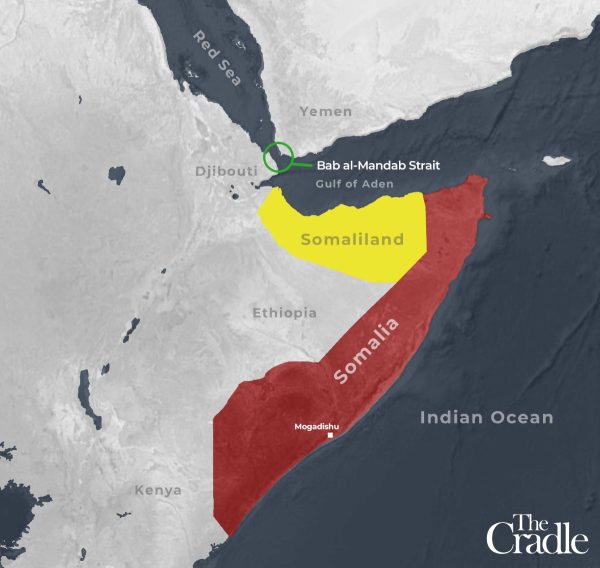
A current map of the Horn of Africa
Such a move would grant the US a critical new foothold in the Horn of Africa at a time when American and French forces are being ejected from countries across the continent at breakneck speed.
It could also serve as a counterweight to China and Russia’s expanding presence in northern Africa. Beijing established its first overseas military base in neighbouring Djibouti in 2017, and has since emerged as an aggressive critic of western policies in the region – while also welcoming Iranian naval vessels at its ports.
The strategic utility of recognizing Somaliland is not lost on Washington’s foreign policy architects. Project 2025 – a sprawling, right-wing policy blueprint by the Heritage Foundation, intended as a roadmap for Trump’s second term—explicitly advocates “[countering] malign Chinese activity” in Africa. It specifically recommended “the recognition of Somaliland statehood as a hedge against the US’s deteriorating position in Djibouti.”
Another neocolonial outpost
Keep in mind that Trump’s interest in the territory was made public well before Somaliland was floated as a relocation site for Gaza’s 2.4 million Palestinians. In November 2024, former British defence secretary Gavin Williamson announced he had held “really good meetings” with Trump’s “policy leads” on the matter, expressing confidence that recognition was on the horizon.
Williamson has long been an ardent advocate of Somaliland’s independence, regularly undertaking all-expenses-paid trips to the breakaway territory, and receiving honorary citizenship for his lobbying efforts.
Williamson’s interest exposes a rarely acknowledged truth: Somaliland is, in practice, a modern British colony. Though it claimed independence from Somalia in 1991 and was formally granted independence by Britain in 1960, the territory remains under London’s shadow.
Should Palestinians be forcefully relocated there, they would be trapped in yet another open-air prison – under the watchful eye of British-trained security forces with a long history of violent repression.
‘ASI Management’
In April 2019, British government contractor Aktis Strategy abruptly declared bankruptcy, leaving staff unpaid and suppliers out of pocket, despite having secured tens of millions of pounds from the UK’s Foreign Office for “development” programs across Africa and West Asia.
The Somaliland Chronicle published a detailed exposé on the company’s collapse, which came while it was overseeing a “justice and security sector reform project” in the statelet.
Official records reveal that between 2017 and 2022, London allocated over £18 million (around $23.5 million) to that project alone. It was one of many UK-financed schemes in the breakaway region that placed Somaliland’s state architecture – government, military, judiciary, prisons, police, intelligence – under effective British management.
Internal files reviewed by The Cradle lay bare the extent of this control.
One document details how notorious British intelligence cutout Adam Smith International (ASI) provided “ongoing training and mentoring” to Somaliland’s National Intelligence Agency and Rapid Response Unit, while managing the territory’s forensics services, border surveillance, and even prosecution procedures via the Attorney General’s Office. The British-created Counter-Terrorism Unit was established in 2012 with Foreign Office funds – “under ASI management.”
Elsewhere, ASI boasts of its “proven history of establishing close professional relationships” with senior government, armed forces, police, “security sector,” and Ministry of Defense officials. One file notes the contractor “deployed ex-UK military advisers” to train Somaliland’s army and coastguard intelligence units, “[mentoring] senior officers in leadership, management, and military doctrine,” and even drafted legislation later adopted as law.
Meanwhile, British contractor Albany Associates focused on teaching Somaliland’s leaders the mechanics of propaganda and information warfare. Its mission: to train ministers and senior officials to generate a “steady flow of information” and proactively manage the media, in order to counter independent outlets.
It was noted that “unsatisfied public demand for information” from the government “on nationally significant events” gave independent information sources significant influence locally, which was to be countered at all costs.
In Somaliland, public distrust of their government was fueled by frequent arrests of journalists and media shutdowns, so Albany’s role was to consolidate state control over information – ensuring one narrative, “one voice,” no dissent.

An official document reviewed by The Cradle
A prison camp in waiting
While ASI touted its reforms, documents from another contractor – Coffey International – presented a more candid picture. Somaliland’s military, the files noted, was “the largest and most costly institution of state,” yet evaded oversight, with its funds likely diverted for opaque ends. Accountability for military abuses was virtually nonexistent.
The police, meanwhile, had “a history of applying disproportionate force,” and no “dedicated public order unit.” Coffey proposed creating one within the Special Protection Unit – a paramilitary force protecting foreign organizations and their staff. At the time, the unit had no mandate for crowd control or responding to peaceful protests.
That July 2015 document recommended Somaliland police be trained in the UK by the National Police, covering human rights, crowd engagement, and first aid. The aim: instill “proportionality, lawfulness, [and] accountability” throughout Somaliland’s police forces. Yet if this training occurred, it had no visible impact.
In late 2022, mass protests erupted in the contested city of Las Anod. Somaliland forces responded with lethal force, killing dozens. The crackdown escalated, and in 2023, Somaliland’s military indiscriminately shelled the city. Amnesty International described the attack as “indiscriminate,” targeting schools, hospitals, and mosques, displacing hundreds of thousands and killing scores.
This is the context in which Somaliland appeals to Israel and its western patrons: a brutal, British-run security apparatus capable of extinguishing any form of dissent – ergo, the perfect dumping ground for Gazan refugees. If Washington establishes a base to launch strikes on Yemen, Palestinians could also be held hostage – literal human shields – to deter reprisals from the Ansarallah-aligned armed forces.
One can only hope this depraved plan collapses as swiftly as earlier US–Israeli schemes to expel Gazans to Egypt or Jordan.
The real question now is whether Somaliland’s leaders are desperate enough for international recognition to trade their 34 years of independence for total US–UK–Israeli military, political, and security hegemony.
Canadian PM Mark Carney Downplays Role in Freedom Convoy Crackdown Despite Backing Emergency Measures
Carney called protest “sedition” and Urged financial chokehold
By Didi Rankovic | Reclaim The Net | April 1, 2025
Canada’s Prime Minister Mark Carney recently gave a masterclass in the art of political evasion and deflection – all the more “masterful” since one of the arguments he went for was that he is not really a politician.
This unfolded before TV cameras in the area of the 2022 Freedom Convoy blockade, which the authorities led by former PM Justin Trudeau and his Liberals clamped down on using unprecedented measures.
They included invoking the Emergencies Act to target the protesters against restrictive Covid-era policies with anything from extreme vilification to freezing their bank accounts.
“Sedition,” is what Carney decided to brand the civil protest in an op-ed published in the Globe and Mail on February 7, 2022, and, true to his previous roles in Big Finance, proposed to put an end to the protest (he called it “this occupation”) by “choking off the money” that funded it.
Now – given his current “affiliation” with the Liberal party, the new prime minister was asked to send a message to those Canadians who lost trust in the previous cabinet because of its handling of the protest.
Instead of doing that, Carney first sought to “distanced himself from himself” – saying that he has only been a politician for two months, and claiming that he took on his new role because he “knew this country needed big change.”
And he then proceeded to list all the allegedly significant changes achieved during his short time in office so far, thus deflecting from the Freedom Convoy question.
Despite his best efforts to paint himself as no more than a conscientious citizen determined to help his country through difficult times – three years ago this former governor of the Bank of Canada and the Bank of England was an informal advisor to Trudeau.
And he not only accused the Freedom of Convoy protestors of committing “sedition” and those donating to the cause of “funding sedition,” but was also mentioned in the Public Order Emergency Commission documents (which investigated the invocation of the Emergencies Act).
Spoiler: Carney supported that decision, along with the freezing of citizens’ bank accounts because they protested against the government.
But Carney’s failed upward now to become prime minister, and “re-earn trust” – not to mention, introduce “big change.”
Featured Video
US IRAN TALKS: Who Are the Crazy Ones Here? /Lt Col Daniel Davis
or go to
Aletho News Archives – Video-Images
From the Archives
Wartime internment camps in Australia
National Archives of Australia
World War I
During World War I, for security reasons the Australian Government pursued a comprehensive internment policy against enemy aliens living in Australia.
Initially only those born in countries at war with Australia were classed as enemy aliens, but later this was expanded to include people of enemy nations who were naturalised British subjects, Australian-born descendants of migrants born in enemy nations and others who were thought to pose a threat to Australia’s security.
Australia interned almost 7,000 people during World War I, of whom about 4,500 were enemy aliens and British nationals of German ancestry already resident in Australia.
Records of World War I internment camps
World War II
During World War II, Australian authorities established internment camps for three reasons – to prevent residents from assisting Australia’s enemies, to appease public opinion and to house overseas internees sent to Australia for the duration of the war.
Unlike World War I, the initial aim of internment during the later conflict was to identify and intern those who posed a particular threat to the safety or defence of the country. As the war progressed, however, this policy changed and Japanese residents were interned en masse. In the later years of the war, Germans and Italians were also interned on the basis of nationality, particularly those living in the north of Australia. In all, just over 20 per cent of all Italians resident in Australia were interned. … continue
Blog Roll
 Aletho News
- Diplomats slam US negotiators’ performance in Iran talks
- Trump Refuses Exit Ramp, War with Iran will Continue
- Trump Says US Naval Blockade in Strait of Hormuz Will Begin Shortly
- US, Iran end 21-hour talks without agreement
- US IRAN TALKS: Who Are the Crazy Ones Here? /Lt Col Daniel Davis
- Talks with the US end without a deal over excessive US demands: Iran
- Feeling Better, Getting Worse: How Psychiatric Drugs Create the Illusion They Cure
- ‘Nobody Told Me’: Former Mental Health Patient Calls Out Dangerous Side Effects of Psychiatric Drugs
- Dr. Abu-Sitta: Beirut ‘felt like a day in Shifa Hospital’
- Iran Has Won the War, It Will Be Up to the US to Secure the Peace: Mohammad Marandi
- If Americans Knew
- US-Iran ceasefire negotiations make zero progress – Daily Update
- Pro-Israel ‘Thinktanks’ and Individuals who Influence U.S. Foreign Policy
- Mearsheimer reveals how Israel dictates US policies on Iran, Gaza – video
- After killing 350+, Israel still has a “score to settle” with Lebanon before ceasefire – Daily Update
- Military aid to Israel emerges as the latest political litmus test for Democrats
- The only Palestinian children’s rights organization closes following years-long Israeli campaign against it
- ‘I Can’t Forget the Smell’: Lebanese Reel After Israel Kills Over 300 in Single Day
- DNC Shoots Down Resolutions Calling Out AIPAC and Limiting Arms to Israel
- TCN: Is Israel Blackmailing President Trump?
- Israel killed at least 303 Lebanese yesterday – who were they? Daily Update
- No Tricks Zone
- German Expert: Heat Dome Led To Record Temps In Western USA…Warmer In 1934, 1936
- New Study: No Linear Warming Or Glacier Retreat Along Northern Antarctic Peninsula Since 1980s
- An Inconvenient Tree: Uncovered In Alps… Europe Much Warmer Than Today 6000 Years Ago
- New Study Reports A 60% Slowdown In Greenland’s Ice Loss Rate In The Last Decade
- Low Intensity Tornado Wrecks Major Solar Farm, Creating A Potential Toxic Dump
- New Study Finds Warming Saves Lives…Cold Temperatures 12 Times More Deadly Than Excess Heat
- German Science Blog Accuses PIK Climate Institute Of Hallucinating Climate Tipping Points
- Devastating Assessment Of Comirnaty Vaccine By Former Senior Pfizer Europe Toxicologist
- New Study: CO2 Is ‘Effectively Negligible’ As An Explanatory Climate Change Factor Since 2000
- Former Pfizer Toxicologist Dr. Helmut Sterz Tells Bundestag Hearing Pfizer Vaccine Should Have Never Been Approved
 Aletho News