University of Liverpool students vote for BDS
MEMO | November 19, 2015
Students at the University of Liverpool have voted to support the Boycott, Divestment and Sanctions (BDS) campaign, in a significant victory for Palestinian solidarity campaigners.
The motion commits the Liverpool Guild of Students to, among other things, advocate divestment from companies complicit in the Israeli occupation, and to lobby the university to similarly divest. The motion also mandates the Guild to stop stocking Israeli products.
 The full BDS motion can be read here.
More than 1,000 students participated in the Liverpool Guild of Students preferendum, in which they were presented with three options: ‘Yes’, ‘No’, or an alternative solution that rejected BDS, but encouraged the union to “raise awareness of the issue.”
Under the preferendum system, students could choose their favourite option from the three choices, or “your top two or rank all three in order of preference.” Points were then assigned “to each option based on the order of preference.”
There were a total of 1,866 points in support of BDS, with 934 opposed to the motion and 1,479 points supporting the alternative solution.
In a press release responding to the victory, the University of Liverpool Friends of Palestine (ULFOP) hailed “a landslide victory” despite a voting system they claimed meant the odds were against them.
“The ballot had one option to pass the motion and two options not to pass the motion. If students didn’t rank all of these options, then their one chosen option was given less weight.”
Despite this and other challenges, ULFOP stated that “the scale of the victory for BDS clearly shows that a large majority of the student body is, or has been made, aware of Israel’s apartheid regime and oppression of the Palestinians, and is prepared to make a stand against it.”
Zohra, a ULFOP member quoted in the press release, described the result as “a genuine reflection of the mood on campus – where students from all faiths and backgrounds believe that the Israeli occupation of the Palestinian people and their territories is unjust, akin to an apartheid system and thus cannot be allowed to continue.”
In a reference to objections by Israel’s defenders, ULFOP said “they wholeheartedly reject any claims that BDS is divisive on campus, instead recognising that the BDS movement is a non-violent and effective means of applying pressure on the Israeli government and the companies benefitting from the occupation of Palestine.”
Meanwhile, the Union of Jewish Students, who sent an official to Liverpool to support the ‘No’ campaign, described the result as “disappointing”, vowing to work with the Liverpool Jewish Society to continue making “the case against BDS” on campus.
Paris attackers did not use encryption, according to reports
Privacy SOS | November 18, 2015
Even before the victims of the Paris attacks had been moved from the scene or their bodies identified, members of the US national security state began speculating that encryption was likely part of the reason the terrorists were able to plot and execute their deadly mission without getting caught. Former CIA director Mike Morrell was one of the many people who advanced this theory.
“I think what we’re going to learn is that these guys are communicating via these encrypted apps, this commercial encryption which is very difficult or nearly impossible for governments to break, and the producers of which don’t produce the keys necessary for law enforcement to read the encrypted messages,” he said.
Well, Morrell and his fellow deep state power-pushers appear to be wrong. New reports indicate that the attackers actually used text messages to communicate—plain text text messages.
But does it even matter? The point the spooks are trying to make is that encryption is too dangerous for a free society to tolerate. If bad guys use it to hurt us, it means law enforcement should be able to break encryption technology that billions of people on earth use to securely transfer money, communicate, and share sensitive data.
That’s absurd. Encryption is a tool. Like many tools, it can be used by people who have good motivations or bad ones. Every security specialist worth her salt says that weakening encryption, or installing “backdoors” for cops and spies, would actually put people at greater security risk. That’s because encryption is a security technology.
This time, when the spies tried to smear security technologies in the wake of these horrific murders, they were factually wrong—these attackers didn’t even encrypt their communications. But someday we will likely find evidence that other terrorists indeed did use encryption to plot their attack. It doesn’t matter. Those terrorists will probably also use cars, face to face communication, and walks in the woods to speak without risking that the prying ears of government agents can hear them. And furthermore, investigators in France—which last spring implemented broad new snooping powers—failed to intervene in the Paris plot when the attackers didn’t use encryption. In France, encryption was not the problem.
In the United States, the Fourth Amendment is supposed to protect us from unwarranted government intrusion into our private lives. That bedrock principle of American law makes it harder for police to figure out who is up to no good. That’s by design.
There may very well someday be a case where ISIS operatives use encryption tools to plan a nefarious attack. But when that day comes, the basic facts about encryption, security, and the law won’t have changed. Encryption protects the security of billions of transactions and communications every day—from hackers, foreign governments, and cops who skirt Fourth Amendment law by using stingrays to wiretap people’s private conversations.
When we are confronted with despicable acts like the Paris attacks, our response cannot be to throw our values out the window in a fearful stupor. There are people with bad intentions in the world, yes. But weakening our digital security in response to their violence has the ultimate effect of punishing ourselves. It won’t work, and it’s not smart. Remember that the next time you hear spies spewing fact-free hysteria before the blood has even dried.
It’s Already Happening: Authorities Are Using Paris Attacks To Rush New Mass Surveillance Laws
Vigilant Citizen | November 18, 2015
The CIA and government officials around the world are using the Paris attacks to push brand new surveillance laws. And it was all planned in advance.
While democratic systems usually take months (if not years) to pass new laws and legislation, it only took a few days after the Paris attacks to slap honest citizens with more surveillance laws. Several organizations are indeed capitalizing on the fear and panic caused by the attacks to bring forth a brand new agenda that takes a bold new step towards total government surveillance. What’s worse: Leaked information proves that authorities were waiting on a terror attack to go forward with their plan.
In a leaked e-mail written by Robert S. Litt, the intelligence community’s top lawyer during the month August, the plan is clearly outlined: There is a lack of support for the banning of encrypted communications but a terror attack could quickly turn the tide.
“Although the legislative environment is very hostile today, it could turn in the event of a terrorist attack or criminal event where strong encryption can be shown to have hindered law enforcement.
There is value keeping our options open for such a situation.” – Washington Post, Obama faces growing momentum to support widespread encryption
Only a few months after this e-mail, a terror attack occurs in Paris. Only a few hours after the attacks, news strangely blamed “encrypted communications.” Only days after the attacks, officials are calling for… the banning of encrypted communications.
The New York police commissioner, Bill Bratton, called it a “game changer” and, insinuated new legislation that would outlaw encryption was necessary by adding: “[Encryption] is something that is going to need to be debated very quickly because we cannot continue operating where we are blind. – The Guardian, Intelligence agencies pounce on Paris attacks to pursue spy agenda
CIA Director John Brennan is also using the terror attacks to plead for unrestricted government surveillance of all communications, blaming “privacy groups” for hindering their job.
Then on Monday, in an epic episode of blame shifting, the CIA director, John Brennan, reportedly said privacy advocates have undermined the ability of spies to monitor terrorists. He explained:
“Because of a number of unauthorized disclosures and a lot of hand-wringing over the government’s role in the effort to try to uncover these terrorists, there have been some policy and legal and other actions that are taken that make our ability collectively, internationally to find these terrorists much more challenging,” adding that there is a “misrepresentation of what the intelligence security services are doing.”
Read Brennan’s comments carefully because they are very revealing. When he says “legal actions,” he’s referring to the fact that multiple federal courts have ruled that the government’s secret mass surveillance on millions of Americans is illegal. So it sounds like the CIA director is saying it’s a shame that intelligence agencies can’t operate completely above the law any more, and is scapegoating any failings on his agency’s part on accountability that is the hallmark of any democracy. (Though he still can apparently operate above the law.)
More importantly, Brennan’s comments are incredibly dishonest. The post-Snowden USA Freedom Act passed by Congress reformed exactly one of the countless mass spying programs the US runs. It was the one that sucked up the phone calls of Americans only, and here’s the thing: it has been active this whole time and isn’t scheduled to shut down until the end of the month. – Ibid.
Government officials in the UK are also capitalizing on fear to rush sweeping new laws.
“On the other side of the Atlantic, politicians in the United Kingdom, which already has the most expansive surveillance laws in the western world, are using the tragedy to attempt to rush through their even more invasive, new mass-spying bill that aims at allowing police to see the websites every citizen visits and to force companies like Apple to backdoor their encrypted tools.”– Ibid.
Not Effective
None of these laws have proven effective in preventing terror attacks. In fact, the Paris attacks took place six months after the enactment of a massive (and controversial) surveillance law in France.
Passed by the French Parliament in May in response to the attacks on the Paris-based magazine Charlie Hebdo, the law allows the government to monitor phone calls and emails of people suspected of connections to terrorism without the authorization of a judge.
But it goes further than that. The law requires Internet service providers to install “black boxes” that are designed to vacuum up and analyze metadata on the Web-browsing and general Internet use habits of millions of people using the Web and to make that data available to intelligence agencies.
In exceptional cases, the law allows the government to deploy what are called “ISMI catchers” to track all mobile phone communications in a given area. These catchers are basically designed to impersonate cell towers, but they intercept and record communications data from phones within its range, and can also track the movements of people carrying the phones.
Finally, the law allows government agents to break into the homes of suspected terrorists for the purpose of planting microphone bugs and surveillance cameras and installing keyloggers on their computers, devices that capture data on every keystroke and mouse click. – Recode, France Has a Powerful and Controversial New Surveillance Law
In short, after each traumatic event in the Western world (manufactured or not), attention is turned towards a very specific and targeted item that “needs to be addressed as soon as possible.” This item is, in fact, part of controversial law that is sitting on shelves until in can be passed insidiously, while the masses are struck with horror. It happened with the Patriot Act and, almost 15 years later, it is happening again. Their formula is “Order Out of Chaos” and it keeps working.
Paris 13/11: Operation Gladio?
By Vanessa Beeley | thewallwillfall | November 18, 2015
“Where no counsel is, the people fall, but in the multitude of counselors there is safety.” – Mossad Motto
~
On the 13th November 2015 during the Paris attacks, 4.1 million people submitted their personal details to the Facebook Safety App, 360 million people received Facebook messages reassuring them of their friends and family’s safety. This information may well have been deposited into an Israeli intelligence bank.
Paris 13/11 aftershocks.
As the dust settles and the pall of grief envelops the scenes of the 13/11 Paris attacks, information begins to seep through the inevitable cracks in the mainstream media, security apparatus narrative.
Very few “subversive” media outlets in France do as good a job of deconstruction as Panamza. Their reporting on the Charlie Hebdo affair blazed a trail of evidence to counter the sprawling inaccuracies of the “official” storyline. Their articles over the last two days have motivated my investigation into the insidious drivers possibly behind the 13/11 attacks on the French capital.
Unsurprisingly the common denominator connecting both Charlie Hebdo and Paris 13/11 appears to be the covert involvement of the Israeli security apparatus.
Lets return to the scene of mayhem and bloodshed in Paris on Friday night. The panic that spread like wildfire across social media, tearful messages and desperate attempts to connect with loved ones, suspected to be in the firing zone.
Then suddenly, Facebook “sympathetically” employed its Safety Check APP, to enable terrified families to reconnect with their missing relatives and to reassure themselves of their safety as the bullets ricocheted off the walls & streets of Paris.
The Safety Check APP was originally named the Disaster Message Board and was introduced on October 15, 2014. Its first major deployment was on Saturday April 25 2015 in the wake of the April 2015 Nepal Earthquake. The tool has since been utilised after the May 2015 Nepal earthquake and the Pacific Hurricane Patricia October 2015.
The 13/11 Paris attack was the first time that this Safety Check APP was deployed for an “unnatural” disaster. Over 4.1 million people checked in with friends and relatives, a total of 360 million people received messages that their loved ones were “safe”.
Alex Schultz: Facebook’s vice president of Growth:
“We chose to activate Safety Check in Paris because we observed a lot of activity on Facebook as the events were unfolding. In the middle of a complex, uncertain situation affecting many people, Facebook became a place where people were sharing information and looking to understand the condition of their loved ones… This activation will change our policy around Safety Check and when we activate it for other serious and tragic incidents in the future. We want this tool to be available whenever and wherever it can help.”
Wonderful, I hear you exclaim! Wonderful for whom?
“During the 24 hours after the terror attack, 4.1 million people checked in with friends and relatives using Facebook Safety Check, a technology developed by Facebook Israel’s research and development department,” said a spokesperson for Facebook Israel. “A total of 360 million people received messages that their loved ones were safe.”

Roi Tiger and Guy Rosen of Onavo
The Facebook Safety Check was designed by Roi Tiger, currently Director of Engineering at Facebook, previously Co-Founder, with Guy Rosen, of Onavo which was bought by Facebook in October 2013.
Perhaps coincidence but this acquistion slots neatly into the timeline with the long since debunked Ghouta Chemical weapons claims against the Syrian Government and the seed funding of White House, UK Foreign Office, CIA, Soros backed and funded Syria Civil Defence Group aka the White Helmets.

Roi Tiger Facebook Profile Picture.
Roi Tiger is a graduate of IDC Herzliya, Tel Aviv, a “non profit” education organisation dedicated to the promotion of Zionist ideology and the fortification of the illegal state of Israel.
IDC HERZLIYA is committed to the fundamental values of a free and tolerant society, while maintaining a Zionist philosophy – first and foremost, freedom of the individual for self-realization in all realms of thought and action, while striving to strengthen the State of Israel.
Roi Tiger then went on to join the IOF Elite 8200 division, an Israeli Intelligence Corps responsible for collecting signal intelligence (SIGINT) and code decryption, described in 2010 by Le Monde diplomatique, as a massive spying operation. Also in 2010, implicated by US Intelligence in Operation Orchard, the 2007 Israeli air strikes on an alleged nuclear reactor in the Deir Ezzor region of Syria.
Full background to this 2007 Israeli illegal incursion into Syrian airspace here.
So, when people innocently clicked “safe” or put a name of their loved ones into the search box of the Facebook Safety app, it is quite probable that they fed a stream of information directly into the Israeli Intelligence data banks.

Web front page of Internet.org
Onavo, a relatively small start-up comprising 40 employees, was based in Tel Aviv and was bought by Mark Zuckerburg as part of his all consuming internet.org project which has as its objective, to create universal access to the Internet.
The significance of this purchase is manifold.
It is Facebook’s first foray onto Israeli territory. In 2012 they purchased Face.com, an Israeli company focused on powerful facial recognition but this had not precipitated an actual base in Israel. With the acquisition of Onavo, Facebook Israel was born.
According to TechCrunch, there’s no official figure attached to the deal, but Israeli paper Calcalist reports between $150-200 million and other sources put the figure closer to $100 million. Whether the real sum is closer to the low end or the high end of that range, it’s a massive amount of money for Onavo, which started three years ago and has previously raised around $13 million in venture funding. – www.digitaltrends.com
This purchase of Onavo and the development of the Safety APP will give Facebook increased capability of compiling one of the most extensive personal data bases in existence in the world today.
On November 11th, 2 days before the Paris attacks, Facebook published a blog report.
“This report, which covers the first half of 2015, provides information about the number of government requests we receive for data, as well as the number of pieces of content restricted for violating local law in countries around the world where we provide service. The report also includes updated information about the national security requests we received from US authorities under the Foreign Intelligence Surveillance Act and through National Security Letters.
Overall, we continue to see an increase in content restrictions and government requests for data globally. The amount of content restricted for violating local law increased by 112% over the second half of 2014, to 20,568 pieces of content, up from 9,707. Government requests for account data increased across all countries by 18% over the same period, from 35,051 requests to 41,214″
The full report is here. This is a deliberate policy of obscurantism by Facebook. When one reads their data policy it is obvious that there are no restraints on information sharing. Their figures cannot truthfully reflect the number of Government requests in France that would have spiked, following Charlie Hebdo and even if they do, out of a claimed 2,500+ Government requests for information, only a meagre 295 were “restricted” with very little explanation of what “restricted” actually means.

“We restricted access in France to content reported under local laws prohibiting Holocaust denial and the condoning of terrorism.”
This statement is rendered portentous by the wave of arrests and house searches sweeping France before the blood is even dry on the streets of Paris and certainly prior to the conducting of a full and objective investigation into the perpetrators of the “greatest atrocity committed on French soil since WWII.” This, according to media pundits reporting from Paris as the propaganda wagon rolls smoothly into its habitual groove.
It must be noted that this deliberately emotive media claim is an insult to the 200+ Algerians massacred by Paris police, during protests against France’s brutal neocolonialist war in Algeria, on the streets of Paris in 1961. Colonialist selective memory fails to honour the ghosts of these oppressed and marginalised souls, forbidden from protesting the genocide of their people and punished for daring to stand in solidarity with Algerian resistance against French hegemony. Paris police dumped the murdered bodies into the cold waters of the Seine, over 11,500 Algerians were arrested, beaten, starved and later tortured in the Palais des Sports.
The 13/11 Paris attacks with all the accompanying media frenzy will surely lead us further down the path to the implementation of Patriot Act equivalents in Europe.
As Patrick Henningsen states in his recent 21st Century Wire article: Orwell’s Razor: All of 21Wire’s predictions come true days after “Paris Attacks”
“Debate on Govt Spying and Privacy Rights, now off the table. As expected, politicians looking to appear ‘tough on terror’ and the growing gaggle of security lobbyists, and other assorted corporate fascists, have called for something akin to a ‘European Patriot Act’ – an end to the ‘Post-Snowden’ debate over bulk data collection and privacy – covering issues like NSA and GCHQ blanket spying on all citizens, and imposing more regulations and government monitoring of mandatory manufacturer ‘back doors’ for computers, mobile phones, gaming consoles, and also calls to make encryption illegal, except for government.”

“Special” police forces in St Denis, Paris 18/11/2015
CIA & Intelligence Connections
We must also take into consideration the worrying Cyber security developments in the UK:
Lord Mendelsohn: We welcome the appointment of the former British ambassador to Israel, Matthew Gould, who will have a key role in cyber security inside the Cabinet Office – a very useful and important position – Look Who’s in Charge of UK Government Cyber Security.
Matthew Gould, self proclaimed “passionate Zionist”, first Jewish British Ambassador in Tel Aviv and co creator of the controversial UK Israel Tech-Hub which was established to:
“Promote partnerships in technology and innovation between Israel and the UK, and is the first initiative of its kind for the British government and for an embassy in Israel. The hub’s creation followed an agreement between prime ministers David Cameron and Binyamin Netanyahu to build a UK-Israel partnership in technology.”
For full details on this burgeoning UK-Israel cyber marriage, read this excellent piece by Stuart Littlewood.
Now lets add a little more spice into the evolving narrative.
Two weeks prior to the 13/11 attacks on the 27th of October 2015, Washington Post columnist, David Ignatius was moderator for the CIA-GW [George Washington University] Conference.
Included on the panel of the “Shared 21st Century International Mission” were:
CIA Director John Brennan, former UK MI6 Chief John Sawers, Director of the French Directorate for External Security Bernard Bajolet, and former Israeli National Security Advisor Yaacov Amidror
Perhaps even more concerning is the subliminal message that can be interpreted from DGSE Director, Bernard Bajolet’s remarks, endorsed by CIA Director John Brennan.
“The Middle East will never go back to how it was. Syria and Iraq will never retrieve their pre-existing features and culture
Syria is already “partitioned”. The Syrian regime only controls a tiny part, perhaps less than one third of the country established post WWII.
The North is under Kurdish control and “we” have the central region under ISIS control [I have deliberately translated the French exactly as it was written]
The situation in Iraq is the same.”
John Brennan:
“When I look at the devastation in Syria, Iraq, Libya, Yemen it is hard to envisage a central government that would be capable of controlling and governing these post WWII territories.
It appears that the partitioning plan for the Middle East is resisting all efforts to reduce its holy grail status. The partitioning plan that best serves the Israeli Yinon plan for Greater Israel and ensures permanent sectarian strife and division in countries bursting at the seams with economic, resource and geopolitical jewels for the Imperialist crown.
The timing of this conference, a mere two weeks prior to the 13/11 Paris attacks that would almost certainly propel France and allies towards increased intervention in Syria & ensure revived calls for a No Fly Zone, must be considered a little more than purely coincidental.
Conclusions
While we must stress that no concrete conclusions may be drawn at this stage, previous Gladio operations, and we would include Charlie Hebdo in that list, lead us to see very clear parallels emerging between the events surrounding Paris 13/11 and those preceding other such attacks.
The omnipresence of the Israeli Intelligence apparatus in its many forms should, at least, motivate us to suspect foul play and to question the white noise mainstream media accounts. The tsunami of propaganda, the conversion of all icons to a French flag, even including Skype heart emoticons, must ring alarm bells.
Experience teaches us that, propaganda is intrinsically linked to government agendas and that terror attacks invariably engender an increase in global oppression, conflict, sectarian division and the suffering of the very peoples universally judged and condemned by scraps of evidence that bear no resemblance to the truth.
As Sayed Nasrallah has said we are living in the age predicted by George Orwell and Aldous Huxley, the propaganda serves to ensure our rapid descent through the layers of social conditioning, from regionalism to individualism, a state of mind where there is potential for the fabric of society to be shredded and scattered into the winds of the brewing “perfect storm”
“A really efficient totalitarian state would be one in which the all-powerful executive of political bosses and their army of managers control a population of slaves who do not have to be coerced, because they love their servitude.” – Aldous Huxley, Brave New World

St Denis, Paris 18/11/2015.
Police forces operate in Saint-Denis on Wednesday, November 18. Police say two suspects in last week’s Paris attacks, a man and a woman, have been killed in a police operation north of the capital.
Orwell’s Razor: All of 21WIRE’s predictions come true days after ‘Paris Attacks’
21st Century Wire | November 18, 2015
How predictable is the globalist imperial agenda? We are now witnessing the final stages of a long-term plan to induce another economic recession and erect a new high-tech police state throughout Europe and beyond. All they needed was a pretext.
While the mainstream media performed its normal routine of emotive reporting, stoking general fear and spreading mass hysteria, some smaller independent media outlets were busy plotting the establishment’s latest crisis agenda.
When the Paris Attack news broke last week, 21WIRE’s Patrick Henningsen went on television late Friday evening to comment on the unfolding drama, and also to analyze what was was likely to happen in the coming days and weeks in the wake of this event.
As it turns out, his quick predictions were incredibly accurate…
1. Declaration of a State of Emergency
France declared its first nationwide state of emergency since 1961 (when it attempted a coup d’état during the Algerian colonial war). Initially, this week’s snap passage of the emergency powers law only provides for a 12 day period, but on Monday French ministers confirmed this would be extended to 3 months because they believed that French citizens “had a right to a safe Christmas.” It gets even worse. After closing French borders, President François Hollande then proceeded to accelerate new police state measures after declaring publicly that, “We are a nation at war”, and then called for suspending normal due process by canceling search warrants, imposing curfews, traffic bans, and even authorizing local governments to impose a ban on public demonstrations. It seems the President has traded in his nation’s liberty for security theatre. In addition, over 100,000 police and soldiers have been deployed throughout the country. France is now under Martial Law.
2. Airstrikes by Monday
In predictable knee-jerk fashion, the French government seized upon this opportunity in order to insert more of its military assets into the Syria conflict by launching airstrikes on Sunday night in the area surrounding Raqqa, Syria, allegedly striking a multitude of “ISIS targets”, including command centers, weapons depots, and ISIS ‘Oil Assets’ – all thanks to supposed intelligence provided by the US. However, reports suggest that the impressive display of French air power didn’t actually net any real ISIS casualties. One can only wonder how so many ‘high value targets’, especially ISIS oil assets (we’re told this is so crucial to ISIS funding), could suddenly be made available to the French by a US military that claims to have been conducting round-the-clock airstrikes over this same region… for the last 14 months. This only reinforces many people’s suspicions that the US-led Coalition “Anti-ISIS(ISIL) Campaign” has been nothing more window dressing for a covert agenda, where the US and its allies have actually been working in concert with both ISIS and al Qaeda in Syria in order to achieve a long-held policy of toppling Syria’s government, ala regime change in Damascus.
3. Invoking the Article 5 ‘Mutual Defense’ Clause
To date, Washington’s multi-lateral proxy, NATO (North Atlantic Treaty Organization), has not been able to legally wiggle its way into Syria to help the thousands of foreign fighters and terrorists (like NATO did in Libya in 2010-2011) who have been allowed to flood into that country since 2011. Currently, the US and its allies are engaged in an illegal, undeclared war in Syria, and the US are desperate to find some legitimate avenue to pursue their military ambitions after having failed to cheat their way into Syria via a staged false flag ‘chemical weapons’ event in Aug 2013. According to NATO article 5, an attack on one member state is deemed an ‘attack on all’, and thus automatically triggers a joint military action (war) by the NATO collective against their declared enemy. Already, a number of political figures have cried out for ‘Article 5’ war powers, including former NATO head Anders Fogh Rasmussen who claimed that, “I do believe that the attacks on Paris qualify for an invocation of Article 5.” He added, “It was an attack on an ally and we know who the attacker is.” (certainly, they know the attacker much more than they are letting on). Eager to see a wider military deployment from Washington, US Senator Marco Rubio has called for ‘an Article 5’ too. Absent of any official NATO route, however, France has simply gone ahead and invoked an obscure ‘Mutual Defense’ pact hidden within the EU charter. The clause is called Article 42.7 of the Treaty on European Union which states that, “If a member state is the victim of armed aggression on its territory, the other member states shall have toward it an obligation of aid and assistance by all the means in their power.” Job done. Bombs away.
4. Calls for No Fly Zone
As 21WIRE first reported last year, the ‘No Fly Zone’ meme has been coming out of every available orifice in Washington since 2013, and this popular US tool for military intervention still draws the affectionate gaze of Democratic Party war hawks like Hillary Clinton, as well as the endless column of Republican war hawks who are in the pocket of the military industrial lobby. Whether its Jeb Bush, John McCain, or Lindsey Graham, they never get tired of the No Fly Zone.
5. US Republicans pushing for ‘boots on the ground’
Just like the No Fly Zone, ‘Conservative’ Republican war hawks have been desperate to implement another old chestnut – by throwing thousands of young US men and women at a problem which the US has actually created. War hawks in Washington DC have predictably seized on the Paris Attacks as an opportunity to reignite calls for “boots on the ground” in Syria. Amazingly, they are now claiming that massive deployment of troops “worked really well” in Iraq and Afghanistan.
6. Call for closing freedom of movement across European borders
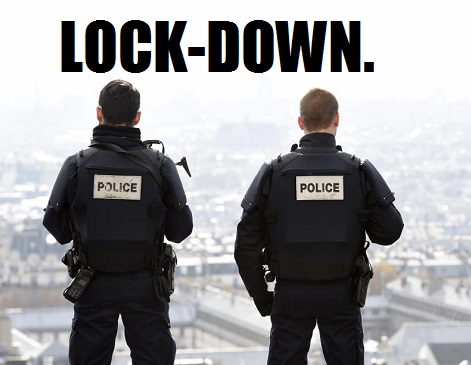
Early Saturday morning, Hollande’s first move was to ‘seal’ France’s borders, supposedly to catch the terrorists. This ’emergency’ move also comes at the height of Europe’s co-called ‘Migrant Crisis’ (a crisis that’s actually been engineered by the US and Europe). Rather conveniently, one of Friday the 13th’s said ‘suicide bombers’ was allegedly carrying a fake Syrian passport, which somehow led the French government and the western media to conclude that the Paris Attacks were a result of the ‘Migrant Crisis’, claiming the terrorists has sneaked into the country as refugees. To date, this only an official conspiracy theory, but that hasn’t stopped politicians and ‘security experts’ from using this crack-pot theory as justification for a European lock-down, prompting some European leaders to call for an end to freedom of movement across Europe.
7. Debate on Govt Spying and Privacy Rights, now off the table
As expected, politicians looking to appear ‘tough on terror’ and the growing gaggle of security lobbyists, and other assorted corporate fascists, have called for something akin to a ‘European Patriot Act’ – an end to the ‘Post-Snowden’ debate over bulk data collection and privacy – covering issues like NSA and GCHQ blanket spying on all citizens, and imposing more regulations and government monitoring of mandatory manufacturer ‘back doors’ for computers, mobile phones, gaming consoles, and also calls to make encryption illegal (except for government of course).
8. Calls for mandatory ID’s, biometric IDs
This hasn’t hit the headlines yet, but you can be sure that the usual gang of security contractors are putting the final touches on their proposals from a new regime of biometric ‘real IDs’. Expect announcements before the week’s end.
The last one is wasn’t very difficult to predict, but it has now been proven accurate nonetheless…

9. Cameron using Paris to Push for Syria War Vote
Back in August 2013, British MPs rejected Cameron’s call for bombing Syrian government forces in a close vote. It turns out that MP’s made the right choice as that war would have been waged on false pretenses. As predicted on Friday last week, David Cameron has now promised a new “comprehensive strategy” to win MP’s Parliamentary votes for an open-ended UK bombing campaign ISIS in Syria and Iraq. Cameron claims he wants to, “do the right thing for our country” (fancy that), and hit the “head of the snake” of ISIS in Raqqa, Syria. What military impact the UK would make in a multi-nation war in the region is debatable, with an air force of about a dozen Typhoon fighters and a handful of operational naval vehicles. Make no mistake about it – the British defense industry would like nothing more than to see this happen tomorrow – along with increased defense spending and procurement. Job done. Bombs away.
We’d rather none of these had come true, especially this quickly, but it only goes to show just how transparent the new world order agenda really has become.
Watch 21WIRE’s Patrick Henningsen and his original analysis from Friday evening, Nov. 13, 2015 on RT International…
Most Police Training is Simply Learning to Kill – It’s Leading to a Deadly ‘Epidemic’
By Justin Gardner | The Free Thought Project | November 18, 2015
South Carolina — The Free Thought Project has been covering the murder of 19-year-old Zachary Hammond by Officer Mark Tiller since the incident occurred on July 26th. Three weeks ago the heartbreaking dashcam video was finally released, which shows a maniacal Tiller ruthlessly take the life of this teenager over a suspected bag of weed.
According to the Post and Courier, “the Hammond case was far from unusual” in South Carolina.
A campus cop at Spartanburg Methodist College shot to death an unarmed college student driving a car—including twice in the head—after responding to a report of a vehicle break-in. Of course, the cop claims that 20-year-old Delvin Simmons was trying to run him over, but there is no bodycam or dashcam video to refute that claim.
The Post and Courier found that South Carolina is set to break its current record of police shootings, and that 1 in 4 shootings involved officers who fired at moving vehicles. Criminal justice experts say this practice is “ineffective and risky to officers and bystanders.”
The paper’s investigation, titled Shots Fired: Mining lessons from tragedy, looked into the use of deadly force by the state’s police officers and how they learn from these encounters.
What they found was that the State Law Enforcement Division (SLED) and the Criminal Justice Academy do literally nothing to learn from past mistakes. For instance, there was no evaluation of the case of Walter Scott to glean lessons in avoiding the use of deadly force, even though Officer Michael Slager was charged with murder.
“They don’t want to admit mistakes,” said Philip M. Stinson, a former police officer who is a criminologist at Bowling Green State University in Ohio. “In some agencies there is an erroneous perception that if they were to discuss and learn from mistakes, any advancement would be viewed as an admission of guilt that could result in civil liability.”
Decades-old tactics of escalation and use of deadly force are firmly entrenched in police training,
“A survey that Wexler’s group recently completed showed the continuing emphasis placed on force over persuasion. Among the 281 police agencies that responded, the average number of basic training hours devoted to firearms was 58, compared to eight hours spent on de-escalation techniques and 10 hours on communication skills.”
The paper contrasts this to typical European approaches of law enforcement that emphasize keeping their distance, buying time and de-escalating the situation.
However, learning de-escalation tactics is an “elective” course for cops training at the academies. Instructor John McMahan sums up the extent of South Carolina’s current police training programs:
“Our main job is basic handgun fundamentals. Really all we are trying to do is to get them to where they can draw from a holster, site a line and pull the trigger.”
This was certainly on display when Mark Tiller so callously took the life of Zach Hammond.
Stinson, the criminologist and former cop, is taking aim at the unwillingness of police departments to learn from past incidents in order to reduce the violence being carried out upon he citizenry.
“It’s not second-guessing to say, ‘What can we do in the future to prevent these shootings from happening?’ That’s not second-guessing. That’s taking advantage of good policy and practice,” said Stinson.
As Chuck Wexler, director of the Police Executive Research Forum, points out, police shootings say a lot about “the training officers receive and the policies their departments adhere to.”
“So much attention is placed on the oversight issue, which is important, but you really have to look upstream at the policies and training that are in place,” said Wexler.
Instead of desperate attempts to blame victims, bystanders taking video, or journalists helping to expose police brutality, it’s time for law enforcement to take the blinders off and study their past actions.
After the Post and Courier exposed South Carolina law enforcement’s penchant for deadly force and shooting into moving vehicles, SLED chief Mark Keel is announcing they will change their ways.
He wants the Criminal Justice Academy “to start reviewing these cases and start looking for lessons learned, good and bad.” Keel says he is looking at policies and training practices in other states and may take specific actions next year.
They should not limit their research to other states in the U.S., as the ready use of brutality and deadly force is standard operating procedure across the country.
Time will tell if these announcements bring meaningful change, or if they are mere lip service to the increased scrutiny.
Mass Arrests After #BlackLivesMatter Protesters Shut Down Minneapolis Road
Sputnik – 17.11.2015
On Monday evening, 51 people were arrested in Minneapolis after shutting down a busy highway for over two hours in protest of an unarmed black man who was killed by police on Sunday.
Among those arrested were at least two reporters, one of whom was doing a live broadcast for the local Fox Affiliate as he was handcuffed.
Jamar Clark, 24, was shot in the face by a still-unnamed police officer and died on Monday after being taken off of life support.
“A man shot in an officer-involved shooting incident early on November 15, 2015, has died,” Minnesota Bureau of Criminal Apprehension said in a statement. “Jamar O’Neal Clark, 24, of Minneapolis, died Monday evening. Clark’s body has been taken to the Hennepin County Medical Examiner’s Office for autopsy.”
Witnesses have maintained that he was handcuffed when the single bullet was fired, though the police have stated their initial investigation has determined he was not.
Police had arrived at the scene of an assault after Midnight on Sunday morning, officers claimed that Clark was interfering with paramedics who were treating the victim, when a “scuffle” ensued.
The outrage in the community lead to protesters marching to the police department and forcing their way inside. Many protesters have been occupying the lobby of the station, refusing to leave until the officer’s name is released as well as surveillance footage.
On Monday evening, Clark was taken off of life support and died shortly after.
Later in the evening, another group of hundreds of protesters marched onto I-94 and shut down traffic in both directions. The interstate was backed up for miles as demonstrators linked arms and refused to move.
Eventually, 43 adult protesters and 8 juveniles were arrested and charged with misdemeanors. All have since been released.
The Minneapolis Police Department has placed the two officers involved in Clark’s death on paid leave and has requested a federal investigation into the incident.
Their police department remains occupied, and a list of demands has been released by the Black Lives Matter protesters:
1. Footage from the incident
2. An independent organization to investigate
3. Media to cover witness testimony, not just police point of view
4. Community oversight with “full disciplinary power”
5. Officers to live in the communities they serve
Journalists Syndicate decries arrest of 2 reporters in dawn raids
Mada Masr | November 17, 2015
Two journalists were arrested in a dawn raid of their homes in Gharbiya on Saturday, the Journalists Syndicate said in a statement that lambasted security authorities for aggressively targeting media workers and violating their basic rights.
The prosecutor general approved the release of one of the journalists, Sobhy Shoaib, on Sunday after the syndicate released its statement, the Arabic Network for Human Rights Information (ANHRI) said.
But Abdel Rahman Mohamed — deputy editor-in-chief of the privately owned Al-Mesryoon news site and a reporter for the National Company for Distribution — is reportedly still in custody pending investigations into charges that he belongs to a banned organization.
Journalists Syndicate President Yehia Qallash issued a separate statement exhorting the prosecutor general and interior minister to immediately order Mohamed’s release, arguing the charges against him were “baseless and pre-fabricated.”
Al-Mesryoon chief editor Mahmoud Sultan published an op-ed adamantly dismissing claims that Mohamed belonged to any banned or radicalized group. He confirmed that Mohamed was a specialist in the field of political Islam, but did not identify in any way with that school of thought.
Mohamed’s reporting shed light on rampant corruption in Egyptian businesses, Sultan said, but now he’s in jail while many of these corrupt businessmen have gone free.
A 2013 report from the Committee to Protect Journalists found that Egypt was the third most dangerous country for reporters — coming in only after Syria and Iraq — and conditions have only continued to worsen, Sultan wrote.
The Journalists Syndicate denounced tactics like dawn raids, punitive detentions and forced disappearances that security forces wield against reporters. The statement urged media professionals to adopt “a serious and unified stance against the expanding practice of arresting journalists and referring them to criminal hearings on the basis of faulty charges and questionable investigations.”
The statement further condemned the arrests of other journalists, including Mada Masr contributor Hossam Baghat, due to their writing.
The Interior Ministry is directly “responsible for the lives and well-being” of the 33 journalists currently detained or imprisoned, who must all be immediately released, the statement said.
The syndicate called for new legislation to safeguard and uphold basic rights for journalists while deregulating the sector and giving reporters more freedom to do their jobs.
American Cops Now Steal More Property than All US Burglars Combined
By Matt Agorist | The Free Thought Project | November 17, 2015
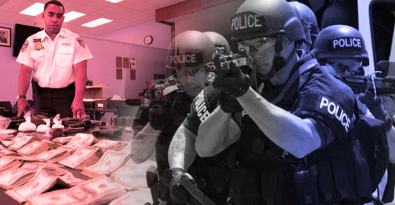
For decades now, federal government and their cohorts in law enforcement have been carrying out theft of the citizenry on a massive scale. We’re not talking about taxes, but an insidious power known as Civil Asset Forfeiture (CAF).
The 1980’s-era laws were designed to drain resources from powerful criminal organizations, but CAF has become a tool for law enforcement agencies across the U.S. to steal money and property from countless innocent people.
No criminal charge is required for this confiscation, resulting in easy inflows of cash for law enforcement departments and the proliferation of abuse. This phenomenon is known as “policing for profit.”
In the last 25 years, the amount of “profit” stolen through CAF has skyrocketed.
According to the US Department of Justice, the value of asset forfeiture revoceries by US authorities from 1989-2010 was $12,667,612,066, increasing on average 19.5% per year.
In 2008, law enforcement took over $1.5 billion from the American public. While this number seems incredibly large, just a few years later, in 2014, that number tripled to nearly $4.5 billion.
When we examine these numbers, and their nearly exponential growth curve, it appears that police in America are getting really good at separating the citizen from their property — not just really good, criminally good.
To put this number into perspective, according to the FBI, victims of burglary offenses suffered an estimated $3.9 billion in property losses in 2014.
That means that law enforcement in America has stolen $600,000,000 more from Americans that actual criminal burglars.
When police surpass the criminal accomplishments of those they claim to protect you from, there is a serious problem.
The good news is that Americans are waking up to this Orwellian notion of police robbing the citizens, and they are taking a stand.
Even police officers are taking a stand against CAF. In an exclusive interview in September, the Free Thought Project talked officer Stephen Mills, chief of police at the Apache, Oklahoma police department. Mills became an outspoken advocate against CAF, after he became a victim of it.
The idea of thieving cops has also united organizations on opposite ends of the political spectrum. In October, the ACLU and the Koch Brothers came together to stop the inherent police theft in America.
While the police keep grabbing your property, it is important to remain vigilant. Only through a lesser ignorance and the spreading of information will we overcome this blatant tyranny. Please share this article with your friends and family to wake them up to the criminal reality that is – civil asset forfeiture.
Corbyn’s rejection of ‘shoot-to-kill’ causes Labour rupture
RT | November 17, 2015
Labour Party leader Jeremy Corbyn has been criticized by members of his own shadow cabinet after publically opposing a “shoot-to-kill” counter-terrorism policy on British streets.
Days after the Paris terror attacks the UK government ordered special forces to “shoot to kill” if Islamic State terrorists were to threaten a large number of people.
During a parliamentary meeting on Monday, a clear division among Labour Party factions emerged when MPs questioned Corbyn’s views on the policy and his stance on the legality of the extrajudicial execution of Mohammed Emwazi (also known as ‘Jihadi John’).
Ann Coffey and John Mann were among MPs to challenge their leader. A spokesperson for Corbyn said only a small minority of MPs had expressed themselves “volubly” during the meeting.
Corbyn was asked if he considered the strike that killed Emwazi to be legal. According to the Telegraph, he refused to answer, angering several Labour MPs.
‘I can’t speak for Corbyn’
Shadow Foreign Secretary Hilary Benn admitted he is struggling to defend Corbyn’s stance on the shoot-to-kill policy.
In an interview with the BBC, Benn said he “can’t speak” for the leader of his party.
“I can’t speak for Jeremy in relation to the particular circumstances he may have been thinking about,” he said.
He added it is “reasonable” to kill a terrorist where there is an “immediate threat to life.”
“All I can say is what is the position of the party. The long-standing position in the UK – there are procedures, it has got to be reasonable, it has got to be proportionate. But you have got to protect human life.”
Benn’s comments contrasted with Corbyn’s remarks when he was asked if he would be pleased to order the military or police to follow such a policy.
‘Shoot-to-kill policy is dangerous’
On Monday, Corbyn called the policy dangerous. “I’m not happy with the shoot-to-kill policy in general – I think that is quite dangerous and I think [the policy] can often be counterproductive,” he told the BBC.
“I think you have to have security that prevents people firing off weapons where they can, there are various degrees of doing things as we know.
“But the idea you end up with a war on the streets is not a good thing. Surely you have to work to try and prevent these things happening, that’s got to be the priority,” he added.
However, Corbyn’s aide insisted he is not opposed to the policy in all cases, adding he is “committed to what the existing law is – that any armed action by the police has to be proportionate to the threat.”
‘We are as ruthless as they are’
Commenting on the policy, Metropolitan Police (MPS) Commissioner Sir Bernard Hogan-Howe said officers working in terror situations would need to know they are supported when they are forced to pull the trigger.
“We work within the law and we make sure the people on the other side – the terrorists – know that we’re as determined as they are, we’re as ruthless as they are,” he told LBC radio.
“We work within the law, but the officers have some difficult decisions. They deserve all our support.”
Hamas: Banning the Islamic Movement is an Israeli racist measure
Palestine Information Center – November 17, 2015
 GAZA – The Hamas Movement strongly denounced the Israeli decision to outlaw the Islamic Movement in the 1948 occupied lands as “an act of racism.”
Hamas spokesman Sami Abu Zuhri stated in a press release on Tuesday that the Israeli ban measure against the Islamic Movement targets the Arab presence in the 1948 occupied territories.
“The Israeli decision is aimed at punishing the Islamic Movement and preventing it from continuing its role in protecting the Aqsa Mosque,” Abu Zuhri added, calling the decision as “a badge of honor” to the Islamic Movement.
The Hamas spokesman called on the international community to intervene to curb such Israeli racist measures against the Palestinians.
The Israeli security cabinet on Tuesday declared the Islamic Movement in the 1948 occupied lands an unlawful organization, effectively outlawing the group led by Sheikh Ra’ed Salah.
Following the decision, police forces raided over a dozen of the group’s offices in the 1948 occupied lands, seizing computers, files and funds.
The Israeli occupation authority also froze its bank accounts and said that 17 organizations affiliated with the Movement were served with orders to close down.
The police also called in several of the Movement’s officials for questioning, including Sheikh Salah, his deputy Sheikh Kamal Khatib, and the organization’s director of Jerusalem and Aqsa Mosque affairs, Salman Abu Ahmad.
Eye-witness account of a murder: ‘They didn’t want her alive, they want her dead, they meant to kill her”
International Solidarity Movement | November 16, 2015
Hebron, Occupied Palestine – On 25th October 2015, 17-year old Dania Arsheid was gunned down by Israeli forces in front of the Ibrahimi mosque in occupied al-Khalil (Hebron) and left to bleed to death. One of the shopkeepers nearby the Ibrahimi mosque witnessed the events leading up to this ruthless murder and agreed to make a statement.
After school finished around 1:20pm on that fateful Sunday, Dania was on her way from the Palestinian souq (market) in the Old City of al-Khalil towards the Ibrahimi mosque. She passed the first revolving gate and the metal detector without any problems – the metal detector did not indicate any metal objects. When passing the second revolving door, soldiers at the nearby checkpoint at the entrance of the mosque called for her to come there. Upon hearing this, the witness, who owns a shop, just meters away from the revolving gate, decided to go through the checkpoint to make sure that the girl was okay.
Dania passed yet another metal detector at the checkpoint at the mosque entrance and put her bag on the table there, as requested by the Israeli forces. They searched her entire bag but they were not able to find anything. Regardless of that, Israeli forces kept asking
Dania ‘where is the knife’ over and over again – completely ignoring her answer that ‘there is no knife’. When one of the soldiers suddenly shot a bullet between her feet yelling at her, she raised her hands and moved back down the stairs. Nevertheless, the soldiers continued questioning her aggressively about a knife – even though she had her hands raised and her bag had been searched with no knife found; and Dania repeatedly asserting that she did not have any knife.
After the first shot was fired, more and more soldiers arrived to the checkpoint, so that it was impossible to tell how many of them shot the 6-7 fatal bullets at Dania – a girl who had her hands up in the air, who had been searched extensively and who had at no point posed any threat. Immediately after she was gunned down, Palestinians in the area – including the witness – were forced to move back through the checkpoint into the souq. The soldiers pointed their assault rifles at the witnesses pushing them out of the area and immediately afterwards closed off the checkpoint for anyone to enter and exit for about an hour.
The first ambulance arrived about 15 minutes after Dania was gunned down. “They didn’t want her alive, they want her dead, they meant to kill her”, explains the witness, stating that they could have easily arrested her. At no point after her body was perforated with bullets was any first aid provided, and the shooters left her lying on the ground slowly bleeding to death. Instead of giving first aid, Israeli forces proceeded to block the view so nobody but them would be able to see the 17-year old school-girl bleed to death.
“She came [to the checkpoint] and didn’t do anything – and then she was killed.”
Featured Video

Why Hamas Really Attacked Israel on Oct. 7
or go to
Aletho News Archives – Video-Images
From the Archives
Confronting the Threat of Ethnic Bioweapons
By Tony Cartalucci – New Eastern Outlook – 29.11.2017
The United States Air Force’s 59th Medical Wing’s molecular biology branch recently was revealed to have been collecting specifically Russian RNA and synovial (connective) tissue samples, prompting fears in Russia of a possible US directed ethnic-specific bioweapons program. … continue
Blog Roll
 Aletho News
- Bombs for Tel Aviv, Promises for Riyadh
- Israeli ad agency conducted vast global espionage campaign using online ads: Report
- Oct. 7 Forever Marks The Big Reveal: ‘We See You, Israel, We Revile You, We Reject You!’
- Meet the US generals and admirals advancing Israeli policy
- Israel’s Straw Widow Protocol: The Kill Zones Where Civilians Were Labelled ‘Terrorists’
- Leading Israeli Think Tank Publishes Psychotic Israeli ‘National Security’ Doctrine
- Are the United States and Israel in Decline-and-Fall Mode?
- Why Hamas Really Attacked Israel on Oct. 7
- Declassified UK exposes British man who fought for ‘Israel’ in Gaza
- West’s death cult in a theater near you
- If Americans Knew
- No, the world zionist movement is not an antisemitic conspiracy theory
- Hundreds of IDF investigations into killings still have no public outcome, BBC Verify finds
- After Ashley Moody Epstein Probe, Donors Linked to Him Poured Money Into her Senate Campaign
- Worried about Russian meddling in UK politics? Wait till you see what Israel is up to
- Israeli settlers attack West Bank center for disabled children, church leader calls for int’l action
- Pulling Out Teeth Just to Live: How Israel Has Devastated Dental Care in Gaza
- Gaza’s “ceasefire” death toll passes 1,500 – Daily Update
- Activists Abused By Israel Return to New Freedom Flotilla Mission
- 60 Minutes won’t tell the full truth about Israeli settler violence
- Nearly 50,000 women, girls killed or severely injured in Gaza since October 2023: UN Women
- No Tricks Zone
- New Study Suggests Large Regions Of The Pacific Ocean Have Been Cooling For The Last 80 Years
- Germany’s Green Energy Debacle: High Energy Costs Force Kahla Porzellan to Close After 182 Years!
- New Study: 50 Years Of The Most Aggressive ‘Net Zero’ Policies Can Only Affect The Global Climate By 0.03°C
- US September “Heat” Was No Record…Many Records Set Decades Ago
- Latest European Green Energy Debacle; Portugal’s Largest Flagship Solar Park Insolvent!
- Green Energy Debacle: German Expert Professor Fritz Vahrenholt Warns Of Severe Economic And Social Consequences
- Two More Paleo Reconstructions Affirm Meters-Higher Sea Levels Across Ireland, Brazil 7000-6000 Years Ago
- New Study: Earth And Venus Surface Warmth Largely Explained By Convection And Lapse Rate, Not CO2 Or Radiation
- 2025 Nature Paper Claiming Worsening Global Drought Gets RETRACTED …Heavily Flawed
- New Study: ‘Global Drought Shows No Detectable Recent Acceleration Under Climate Warming’

