UK Regime Boycotts Palestinian Academics and Mental Health Specialists
By Gilad Atzmon | November 10, 2015
The Independent reported today that “a decision by Britain to refuse a group of Palestinian medical experts from Gaza permission to participate in an international conference at Kingston University on trauma in war zones has been condemned by campaigners.”
I guess that someone in the British Government is convinced that the Palestinians know little about Trauma or living in a war zone.
Three doctors and a nurse who work for the Ministry of Health in Gaza, and were due to give presentations at the conference taking place this weekend, have had their visa requests refused by British authorities. Interestingly enough, some Israeli academics are invited to attend the conference. I guess that the British government is buying into the primacy of Jewish trauma.
In addition to the four mental health specialists refused entry, Dr Nahida Al-Arja, a psychologist from Bethlehem University, has had her visa application rejected.
A letter by the UK Palestine Mental Health Network, co-organisers of the conference, published in the Independent, says: “It is beyond our comprehension how such an interference with intellectual and clinical discussion on such an important topic could be justified. This is a measure that further isolates clinicians from Gaza, already struggling under the impact of military assaults and siege,”
It adds: “We urge the UK authorities to reverse this decision immediately, and to resolve to nurture, rather than undermine, urgently needed psycho-social support services for the people of Gaza.”
To read more on this story: http://www.independent.co.uk/news/uk/home-news/uk-decision-to-refuse-gaza-medical-experts-from-joining-kingston-university-conference-condemned-by-a6727576.html
Sisi’s London visit was a nightmare for him
MEMO | November 9, 2015
Egyptian President Abdel Fatah Al-Sisi’s visit to Britain turned from a long-awaited dream into a nightmare with a series of losses on the media, legal and political levels, an analyst has said.
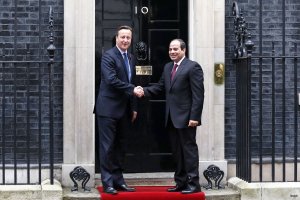 The political analyst, who preferred not to be named, told Arabi21 that Al-Sisi’s visit turned into a complete failure because the media used the occasion to remind the public of the human rights abuses committed by his regime in Egypt.
In a rare moment, an Egyptian woman who was sentenced to death in Egypt had the opportunity to appear in the British media and describe human rights violations committed by the military in Egypt, the analyst said.
The British press and TV channels published multiple reports which considered the visit “a violation of British society values and standards”.
The unnamed analyst said Al-Sisi mainly lost on a political level as, for the first time, the two biggest opposition parties rejected the visit; Labour party leader Jeremy Corbyn described Al-Sisi’s stay as a “threat to national security”.
In addition to this, as many as 55 senior British politicians signed a letter calling for Al-Sisi to be expelled.
On a legal level, the analyst explained, it was revealed during his stay that British police were already investigating claims of war crimes committed by Al-Sisi and symbols of his regime.
British police have a list of 43 names of senior statesmen, ministers and leaders of the army and security who are under investigation for committing human rights violations, the analyst added
Al-Sisi arrived in London following an invitation from British Prime Minister David Cameron; however the two only met for one hour during his three-day trip, and no joint press conference was held following the meeting.
The trip coincided with the British authorities’ decision to suspend all flights to Sharm El-Sheikh and evacuate all British tourists from there following a Russian airplane crash a few days earlier.
Turkish Court Clears Suspects of Forced Disappearances of Kurds
teleSUR | November 7, 2015
Turkey’s most comprehensive cold case of the historic PKK-state conflict ended with the acquittal of all eight suspects accused of leading a branch of the clandestine gendarmerie group JITEM that reportedly tortured and killed tens of thousands of Kurds in the 1990s.
The case began when mass graves were found in wells of a southeastern town and included 48 hearings on the murder of 55 unidentified victims in Cizre. Beyond conducting extrajudicial killings, JITEM is suspected to have disappeared some 17,000 Kurdish guerrillas, intellectuals and activists.
The families of victims came to the final hearing and participated in a sit-in to protest the verdict, mirroring the weekly sit-ins of the Saturday Mothers, who have still not recovered the bodies of their sons.
Protesters held the picture of Cemal Temizoz, the suspected leader of JITEM, with the word “killer,” but the Eskişehir 2nd High Criminal Court found that “no evidence was viable for a certain, credible and conscientious ruling,” reported the Hurriyet Daily.
The trial was originally in Şırnak, a province still healing from the conflict, but was then moved to Eskişehir, a majority pro-government city where many of the 3 million Kurds forcibly displaced by the conflict migrated.
A deputy of the opposition party CHP told Hurriyet that the lawyers representing the victims’ families were threatened and that evidence was tampered with.
One of the lawyers, Tahir Elçi, was arrested in late October ahead of the Turkish elections for saying publicly that the rebel Kurdish Workers Party (PKK) is not a terrorist group. Secret witnesses that aided Temizoz’s arrest in 2009 retracted their testimonies.
One of the suspects, all of whom were facing life sentences, confessed to extrajudicial killings and reportedly used the ears of his victims from a hearing in 2011 to make prayer beads.
Though the military does not recognize JITEM, it was compromised by officers that used state resources to conduct their operations. This year, four others were tried and exonerated.
Investigations of another 200 murders between 1994 and 1995 reportedly expired, according to official statistics. CHP leader Kemal Kılıçdaroğlu told journalists during his meeting with former Uruguayan President Jose Mujica that all questions to the ruling AK Party on the unsolved murders were declined.
“Our quest for justice will never end, the state’s justice system backed up the killers,” said the wife of Omer Candoruk, who was forcibly disappeared. “We condemn and curse the mentality that acquitted Cemal Temizoz and his team.”
Henoko Takes on U.S. Imperialism
By Maya Evans | Dissident Voice | November 7, 2015
OKINAWA, JAPAN — Around one hundred and fifty Japanese protesters gathered to stop construction trucks from entering the U.S. base Camp Schwab, after the Ministry of Land over-ruled the local Governors’ decision to revoke permission for construction plans, criticizing the “mainland-centric” Japanese Government of compromising the environmental, health and safety interests of the Islanders.
Riot police poured out of buses at six a.m., out-numbering protesters four to one, with road sitters systematically picked off in less than an hour to make way for construction vehicles.
All the mayors and government representatives of Okinawa have objected to the construction of the new coastal base, which will landfill one hundred and sixty acres of Oura Bay, for a two hundred and five hectare construction plan which will be part of a military runway.
Marine biologists describe Oura Bay as a critical habitat for the endangered dugong (a species of manatee), which feeds in the area, as well as sea turtles and unique large coral communities.
The bay is particularly special for its extreme rich ecosystem which has developed due to six inland rivers converging into the bay, making the sea levels deep, and ideal from various types of porites coral and dependent creatures.
Camp Schwab is just one of 32 U.S. bases which occupy 17% of the Island, using various areas for military exercises from jungle training to Osprey helicopter training exercises. There are on average 50 Osprey take off and landings every day, many next to housing and built up residential areas, causing disruption to everyday life with extreme noise levels, heat and diesel smell from the engines.
Two days ago there were six arrests outside the base, as well as ‘Kayactivists’ in the sea trying to disrupt the construction. A formidable line of tethered red buoys mark out the area consigned for construction, running from the land to a group of offshore rocks, Nagashima and Hirashima, described by local shamans as the place where dragons (the source of wisdom) originated.
Protesters also have a number of speed boats which take to the waters around the cordoned area; the response of the coast guard is to use the tactic of trying to board these boats after ramming them off course.
 The overwhelming feeling of the local people is that the Government on the mainland is willing to sacrifice the wishes of Okinawans in order to pursue its military defense measures against China. Bound by Article 9, Japan has not had an army since world war two, though moves by the Government suggest a desire to scrap the Article and embark on a ‘special relationship’ with the U.S., who is already securing control of the area with over 200 bases, and thus tightening the Asia pivot with control over land and sea trade routes, particularly those routes used by China.
Meanwhile, Japan is footing 75% of the bill for accommodating the U.S., with each soldier costing the Japanese Government 200 million yen per year, that’s $4.4 billion a year for the 53,082 U.S. soldiers currently in Japan, with around half (26,460) based in Okinawa. The new base at Henoko is also expected to cost the Japanese Government a tidy sum with the current price tag calculated to be at least 5 trillion yen.
Okinawa suffered devastating losses during the Second World War, with a quarter of the population killed within the 3-month-long Battle of Okinawa which claimed 200,000 lives in total. Hilltops are said to have changed shape due to the sheer bombardment of ammunition.
Local activist Hiroshi Ashitomi has been protesting at Camp Schwab since the expansion was announced 11 years ago, he said: “We want an island of peace and the ability to make our own decisions, if this doesn’t happen then maybe we might need to start talking about independence.”
Maya Evans coordinates Voices for Creative Nonviolence UK.
A guide to Palestine in the British media
By Amelia Smith | MEMO | November 6, 2015
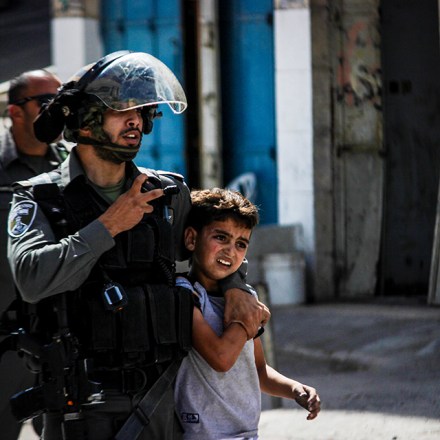 On a trip to Cuba in May, I had to look twice when an elderly man selling newspapers walked past the restaurant I was eating in. On the front page of one was a huge photograph of an Israeli soldier holding a Palestinian boy by the neck, the boy’s face twisted away from the camera in pain.
The photo said it all: an aggressive, well-built soldier wearing a helmet, bulletproof vest and carrying a machine gun was manhandling a child half his size, not more than 10 years old, dressed in jeans and a t-shirt. Why was I so shocked to see such an image published on the front page of a mainstream newspaper? Because this would be a rare moment in the UK.
Over here, the images that are used to represent almost 50 years of military occupation are of Palestinian youth throwing stones, black-and white-kuffiyeh wrapped around their faces. The Cuban picture portrays the Palestinian as the subject of aggression, the UK image as the perpetrator; just like that, our media helps perpetuate the myth that Palestinians are faceless terrorists predisposed to random outbursts of violence and against whom Israel has every right to defend itself.
A closer look at how the British media has covered the recent escalation of violence in Palestine reveals some worrying trends. For the past year right-wing Israeli groups have entered the Haram Al-Sharif compound daily with their armed escorts, often chanting anti-Arab and anti-Palestinian slogans. This came to a head on 13 September when a group of settlers and the Israeli minister of agriculture Uri Ariel, protected by Israeli soldiers, actually entered the Al-Aqsa mosque shooting tear gas, stun grenades and rubber coated steel bullets at worshippers, injuring Palestinians inside and causing damage to the interior of the mosque.
With this in mind take a look at how these confrontations were described in the Telegraph : “Four Israelis and 23 Palestinians have died in 12 days of bloodshed fuelled in part by Muslim anger over increasing Jewish access to the Al-Aqsa mosque compound in Jerusalem.”
And earlier in the year, Reuters reported that: “Those groups [devout Jews and Israeli nationalists] are at the centre of a creeping shift in Jerusalem: After 900 years, Jews are chipping away at Muslims’ exclusive control of the site, the third holiest in Islam. The shift, which has provoked violence in the past, threatens to open a dangerous new front in the Israel-Palestinian conflict, adding religious enmity to a political struggle in the very heart of the disputed city.”
Not only do these reports reduce the provocation by Israeli settlers and soldiers in the Al-Aqsa mosque to Muslim anger and a failure to compromise over increased Jewish access to the compound, but they make the current protests in Palestine sound as though they are merely a religious dispute. Al-Aqsa is the third holiest site in Islam and holds huge religious significance for Muslims across the world, but Palestinians are also protesting against almost 50 years of military occupation under which their land has constantly been taken away from them.
Since 14 September, 72 Palestinians and 11 Israelis have been killed and over 8,000 Palestinians and 134 Israelis have been injured – yet many reports have picked out and highlighted the knife attacks carried out by Palestinians, using phrases such as “Israel’s knife terror”, describing “knife wielding” Palestinians or “anti-Israeli knife attacks”. The following report published on the BBC answered the question of what is happening between the Israelis and the Palestinians in the following manner:
“There has been a spate of stabbings and gun attacks on Israelis by Palestinians since early October, and one apparent revenge stabbing by an Israeli. The attacks, some of which have been fatal, have struck in Jerusalem and in northern and central Israeli cities and towns, and in the occupied West Bank. Israel has tightened security and clashed with rioting Palestinians, leading to deaths on the Palestinian side. There has also been associated violence in the border area inside the Gaza Strip.”
Note that there is not even a mention of what took place at Al-Aqsa mosque on 13 September. The weapons used by Palestinians are specified but Israel’s excessive use of tear gas, stun grenades, live ammunition and rubber bullets is not included.
The term “Palestinian rioters” (other reports have used “Muslim rioters”) has been widely adopted in the British media; the notion of “rioters” is associated with wild disorder and conjures up very different images than the word “protesters”, which suggests a group of people who are simply asking for their rights. Another common term used in the above quotation and frequently in other articles is “clash”, which implies fighting between two equal forces– Israeli soldiers, part of the fourth largest army in the world, storming the Al-Aqsa mosque and firing tear gas and rubber bullets at Palestinians armed with stones, sticks and knives cannot be described as a “clash”.
Deaths on the Palestinian side are a result of rioting Palestinians, and so somehow justified. This headline from Reuters, this one in the Independent and this one in the Daily Mail all report Palestinian deaths but say they took place after Palestinians attacked Israelis with knives. In contrast, this article from the BBC is typical of how Israeli casualties are reported across the media: “Three Israelis killed in Jerusalem bus attacks.” No justifications or explanations of the deaths in sight.
The BBC casually writes about “associated violence” in the Gaza Strip. Between 13 September and the publication of this article, 12 Palestinians in Gaza have been killed, including 26-year-old Nour Rasmi Mohammed Hassan who was five months pregnant and her three year-old daughter, both of whom were at home when an Israeli airstrike hit their house.
Rather than recognise that their excessive use of force and almost 50 years of occupation – under which Palestinian homes have been demolished, children have been arrested, freedom of movement restricted and Gaza placed under siege – may evoke anger in some Palestinians, Israeli authorities, echoed in news reports, would rather blame Palestinian leaders and the use of social media for “inciting” violence, as seen in this headline: “Israel sentences Islamic leader to jail for incitement”; and this one too: “Is social media driving the current violence?”
In this video, Israeli security forces have planted undercover stone throwers among a group of Palestinians who then turn on one of the Palestinians in the same group before ten Israeli soldiers drag him away (note – excessive use of force). In fact there are numerous videos online that highlight Israeli aggression and incitement of violence towards Palestinians but they are not widely published in the mainstream press. This particularly disturbing video filmed on a mobile phone in Aida refugee camp last week captures an Israeli soldier announcing: “You throw stones and we will hit you with gas until you die – the children, the youth, the old people; you will all die. We won’t leave any of you alive.” This video shows an Israeli soldier running over a Palestinian then preventing paramedics helping him; this one shows settlers throwing stones at Palestinian homes in Hebron.
On 16 October, much media attention was focused on the case of a Palestinian man who dressed up in a press jacket and inflicted moderate wounds on an Israeli soldier in Hebron before being shot dead by another soldier. On the same day, four other Palestinians died, including 36-year-old Shawqi Jamal Jaber Ebeid who succumbed to injuries after sustaining a bullet wound to the head a week before whilst working in a stone factory in Gaza. His story is much harder to find and yet it is part of the media’s job to help give a voice to those who have been deliberately silenced – those like Shawqi Ebeid and his family – and to hold politicians and people in authority to account when they do something wrong; even more so if they commit war crimes. If, however, the media is complicit in silencing those same people, then in some cases we may be looking at political propaganda dressed up as news.
ICC prosecutor must rethink Gaza flotilla probe: Judges
Press TV – November 7, 2015
Judges at the International Criminal Court (ICC) say the court’s prosecutor must reconsider an earlier decision not to open a probe into an Israeli attack on a Gaza-bound aid flotilla back in 2010.
Following a few months of deliberations, judges at the appeals chamber ruled on Friday that prosecutor Fatou Bensouda must rethink her decision against the Gaza flotilla probe.
Judges at The Hague-based court had initially asked Bensouda to reconsider her decision in July, saying she made “material errors in her determination of the gravity” of the case.
The latest decision could force Bensouda to open a full investigation into the case.
Last year, Bensouda declined a request by the Indian Ocean island nation of Comoros to investigate the attack on the Turkish Mavi Marmara ship that was sailing under a Comoros flag. She ruled the case was not serious enough to merit an ICC probe.
The prosecutor said publicly available information provides “a reasonable basis” to believe that the Israeli forces committed war crimes during the attack in international waters back in 2010, but the case does not fall under their jurisdiction for an official probe.
However, lawyers representing Comoros had sought a review of Bensouda’s original rejection, insisting that “the interests of justice and fairness, which are the core of the ICC’s mandate, strongly militate in favor of the prosecutor reconsidering her decision.”
On May 31, 2010, Israeli commandos attacked the Freedom Flotilla in international waters in the Mediterranean Sea, killing nine Turkish citizens, including a teenager with dual Turkish-US citizenship, and injuring about 50 other people who were part of the team on the six-ship convoy. Another injured activist died in May 2014 after having been in a coma for four years.
The flotilla was attempting to break the Israeli naval blockade of the Gaza Strip, carrying aid to Palestinians in the enclave.
Gaza has been blockaded since June 2007, a situation that has caused a decline in the standard of living, unprecedented levels of unemployment, and unrelenting poverty.
The attack sparked international outcry and plunged relations between Tel Aviv and Ankara to an all-time low at the time.
Cops Who Killed 6-yo Boy Lied About his Dad Having a Warrant & Gun – He Had Neither

By Johnny Liberty | The Free Thought Project | November 6, 2015
Marksville, LA – On Tuesday, November 3rd, 6-year-old Jeremy Mardis was tragically gunned down after being unwittingly thrust into a police pursuit. Now, officials are acknowledging that there may have been no justification for the officers’ actions.
Initial reports claimed that Jeremy’s father, 25-year-old Chris Few, was being served a warrant by Ward 2 City Marshals. However, police now admit that Few was not only unarmed when officers opened fire, but may not have had a warrant at all.
During a press conference Thursday afternoon, Louisiana State Police Col. Mike Edmonson said:
“We have no evidence of any gun found in his car,” When asked about Few’s alleged warrant Col. Edmonson replied; “I am not aware of one but I have not been provided with anything that says otherwise.”
Upon being reached for comment regarding the existence of warrants for Mr. Few, the Clerk of Court for the City of Marksville stated they had “nothing” and that they had never had any warrants out on him, according to KATC TV.
Chris’ step-father, Morris German, has also been vocal in his disbelief of the original police account. He said that he strongly doubted his stepson was armed and that he could not believe he would flee authorities with his son in the vehicle.
“I can’t see him doing that with his son in the car,” He said. “That doesn’t sound like him at all.”
Officers initially claimed that Chris had backed up into a police cruiser several times when the chase ended on Martin Luther King Drive, but officials agree there is no evidence that this took place prior to officers opening fire. The Louisiana State Police are now investigating the incident and reviewing footage of the incident from a body camera one of the officers was wearing according to a source for WAFB.
The emergence of these details (while unsurprising to those that have followed the cases of Zachary Hammond and Samuel Dubose) certainly leave one with more questions than answers. There is no doubt that many of the deadly shootings we are currently seeing are a result of the 2014 supreme court decision (Plumhoff v. Rickard) which authorized the use of deadly force to end police pursuits.
Sadly, we are now witnessing the outcome of this decision. According to Avoyelles Parish Coroner Dr. L.J. Mayeux, Jeremy was shot by police five times and died from wounds to his head and chest. His father was also severely wounded and is currently in critical condition.
As history shows us. When agents of the state are given blanket authority to gun citizens down with impunity, the end result will always be tyranny. Is this the future we want for our children?
Johnny Liberty is a researcher and investigative journalist. You can follow him on twitter @LibertyUnltd
Egyptian army shoots, kills Palestinian fisherman off Gaza coast
Ma’an – November 5, 2015
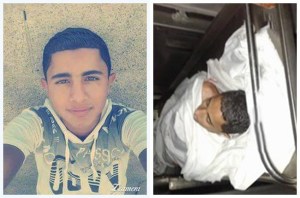 GAZA CITY – Egyptian military forces shot and killed a Palestinian fisherman off the coast of the southern Gaza Strip on Thursday afternoon, the Ministry of Health in the besieged enclave said.
Ashraf al-Qidra, spokesperson of the ministry, said Firas Mohammad Miqdad, 18, from Rafah was shot in the abdomen by Egyptian forces while at sea and died from his injuries.
It is unclear why Egyptian forces opened fire.
In May, Egyptian naval forces opened fire at a Palestinian fishing boat off the coast of the southern Gaza Strip, injuring a fisherman from Rafah.
Egypt upholds an Israeli military blockade on Gaza, keeping borders largely closed and limiting imports, exports, and the freedom of movement of its residents.
The threat from Egyptian forces comes as Palestinian fishermen already face daily risks in order to make a living, including routine harassment from Israeli naval forces, confiscation of boats and materials, detention, and potentially death.
Israeli forces reportedly fired towards Palestinian fishing boats on a daily basis last week, according to documentation by the UN agency for Palestinian refugees.
Israeli forces kill Palestinian woman, 72, after alleged car attack
Ma’an – November 6, 2015
BETHLEHEM – Israeli forces shot and killed an elderly Palestinian woman after an alleged vehicle attack in Halhul, north of Hebron on Friday.
A spokesperson at the Shaare Zedek Medical Center in Jerusalem told Ma’an that the woman, aged 72, was dead upon arrival at the hospital.
Israeli media reported that the woman attempted to run over Israeli soldiers in Halhul and was shot and seriously wounded by Israeli forces.
The Jerusalem Post said that a “suspicious vehicle” drove at Israeli soldiers, with forces opening fire at the car.
No Israeli injuries were reported.
The victim was identified as Tharwat al-Sharawi, 72. Her husband, Fouad, was killed by Israeli forces during the 1st Intifada.
Two Palestinian youths who were standing at a gas station nearby were injured as Israeli gunfire shattered the car’s windows.
Both youths were taken to the al-Ahli hospital in Hebron to treat their injuries, which were described as moderate.
Al-Sharawi was the 74th Palestinian to be killed since the beginning of last month, the majority of whom were shot dead by Israeli forces during alleged, attempted, and actual attacks on Israeli military and civilians.
On Wednesday, Ibrahim Skafi, 22, was also shot dead by Israeli forces in Halhul after a vehicular attack that left a 20-year-old border policeman seriously injured.
The town of Halhul, north of Hebron city, was sealed by Israeli forces following the attack.
Recent attacks come as Israeli intelligence said earlier this week that a recent lull in violence was unlikely to be long-term, citing high levels of frustration among the Palestinian public.

Tharwat al-Sharawi, 72.
Featured Video

Why Hamas Really Attacked Israel on Oct. 7
or go to
Aletho News Archives – Video-Images
From the Archives
Confronting the Threat of Ethnic Bioweapons
By Tony Cartalucci – New Eastern Outlook – 29.11.2017
The United States Air Force’s 59th Medical Wing’s molecular biology branch recently was revealed to have been collecting specifically Russian RNA and synovial (connective) tissue samples, prompting fears in Russia of a possible US directed ethnic-specific bioweapons program. … continue
Blog Roll
 Aletho News
- Why Yemen Is Bombing Saudi Arabia’s Airports: The War Behind the Headlines
- Sally Rooney’s books pulled from UK over support for Palestine Action
- Bombs for Tel Aviv, Promises for Riyadh
- Israeli ad agency conducted vast global espionage campaign using online ads: Report
- Oct. 7 Forever Marks The Big Reveal: ‘We See You, Israel, We Revile You, We Reject You!’
- Meet the US generals and admirals advancing Israeli policy
- Israel’s Straw Widow Protocol: The Kill Zones Where Civilians Were Labelled ‘Terrorists’
- Leading Israeli Think Tank Publishes Psychotic Israeli ‘National Security’ Doctrine
- Are the United States and Israel in Decline-and-Fall Mode?
- Why Hamas Really Attacked Israel on Oct. 7
- If Americans Knew
- Israeli firm used online ads to run vast spy operation, researchers say
- No, the world zionist movement is not an antisemitic conspiracy theory
- Hundreds of IDF investigations into killings still have no public outcome, BBC Verify finds
- After Ashley Moody Epstein Probe, Donors Linked to Him Poured Money Into her Senate Campaign
- Worried about Russian meddling in UK politics? Wait till you see what Israel is up to
- Israeli settlers attack West Bank center for disabled children, church leader calls for int’l action
- Pulling Out Teeth Just to Live: How Israel Has Devastated Dental Care in Gaza
- Gaza’s “ceasefire” death toll passes 1,500 – Daily Update
- Activists Abused By Israel Return to New Freedom Flotilla Mission
- 60 Minutes won’t tell the full truth about Israeli settler violence
- No Tricks Zone
- New Study Suggests Large Regions Of The Pacific Ocean Have Been Cooling For The Last 80 Years
- Germany’s Green Energy Debacle: High Energy Costs Force Kahla Porzellan to Close After 182 Years!
- New Study: 50 Years Of The Most Aggressive ‘Net Zero’ Policies Can Only Affect The Global Climate By 0.03°C
- US September “Heat” Was No Record…Many Records Set Decades Ago
- Latest European Green Energy Debacle; Portugal’s Largest Flagship Solar Park Insolvent!
- Green Energy Debacle: German Expert Professor Fritz Vahrenholt Warns Of Severe Economic And Social Consequences
- Two More Paleo Reconstructions Affirm Meters-Higher Sea Levels Across Ireland, Brazil 7000-6000 Years Ago
- New Study: Earth And Venus Surface Warmth Largely Explained By Convection And Lapse Rate, Not CO2 Or Radiation
- 2025 Nature Paper Claiming Worsening Global Drought Gets RETRACTED …Heavily Flawed
- New Study: ‘Global Drought Shows No Detectable Recent Acceleration Under Climate Warming’

