Shot woman: Israeli police alter story again
By Jonathon cook | The Bog From Nazareth | October 29, 2015
 The official Israeli story about Israa Abed – the Nazareth woman who was shot six times on Oct 9 by Israeli security forces as she stood motionless in a bus station – has changed so many times, it’s difficult to know what to believe any more. By a small miracle she survived the shooting.
I raised many questions about this incident, based on two videos taken by bystanders, in a post on the day she was shot. That post, including the videos, is available here.
Israa is one of Israel’s 1.6 million Palestinian citizens. She lives in Israel, not the occupied territories.
Let’s be clear: the main reason the police have repeatedly revised their account of the events of Oct 9 is because the visual evidence has conclusively refuted their claims. They have been forced to back-pedal.
Without the video, Israa would have been charged with, and probably convicted of, terrorism offences. In line with threats from Israeli prime minister Benjamin Netanyahu, she would also have risked being stripped of her citizenship.
Originally the police said they “neutralised” Israa after she pulled out a knife and stabbed a security guard at the bus station in the city of Afula. When it was clear no one had been injured, the story changed: she had tried without success to stab the guard.
Then it was reported that the police had shot Israa not because of an attempted attack but because she behaved in a threatening manner towards other people at the bus station.
Now, in the latest version, the police say she did not intend to stab anyone. In the video footage, reports the Haaretz newspaper, she can be seen “standing next to a young ultra-Orthodox man without trying to hurt him”.
Instead, the police say she was depressed and / or mentally unstable and pulled out a knife because she wanted to “induce” the security forces to shoot her.
Pause for a second as you digest that argument. According to the police, Israa went to the bus station with the intention of pulling out a knife but not harming anyone, knowing that doing so would be enough to get her shot and maybe killed. And why would she think that? Because she looks Arab (she wears a headscarf), and, like most Palestinian citizens, understands that in any confrontation with the security services that is reason enough for the police to shoot without justifiable cause.
Even more disconcertingly, the Israeli police seem to agree that Israa’s assumptions were warranted.
Further, the claim that Israa wanted to be shot is pretty convenient for the four security staff who, even according to the official account, fired their weapons at a woman who posed absolutely no threat to anyone at the bus station.
Might they be disciplined, or, more properly, punished, for shooting a woman six times for no reason at all? Apparently not. They have been investigated and it has been decided that “there is no reason to take disciplinary measures against them, given the extenuating circumstances of the incident”. One might well ask: what were those “extenuating circumstances”?
Finally, the police are still claiming that Israa pulled out a knife. Given their series of bogus claims till now, there is no reason to assume even this part of their story to be true.
As I noted in my previous post, a video taken seconds after Israa was shot, when she is lying on the ground, appears to show a pair of sunglasses next to her. A man in jeans and T-shirt goes over to her, ignored by police, and kicks away the sunglasses. Who is that man and why is he interfering with evidence? No one seems to be asking these questions, so we are unlikely to get any answers.
www.haaretz.com/israel-news/1.682928
Young unarmed man murdered in cold blood in Hebron
International Solidarity Movement | October 28, 2015
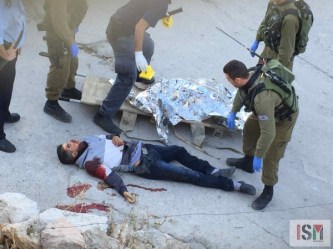 Hebron, Occupied Palestine – Wednesday 28th at 3.25pm a young Palestinian was shot in cold blood in the Tel Rumeida neighborhood in Hebron. Human rights observers from International Solidarity Movement witnessed the young man being murdered while walking in the street near the Gilbert Checkpoint.
The eyewitness from ISM, identified as Orion, states: “I am 100% sure he was unarmed. I saw the two soldiers creeping slowly along the road outside our apartment window with their guns cocked, so I looked down the street to see why. I saw an unarmed man walking normally towards the soldiers and suddenly they shot.”
The young man was shot at a distance of around two meters and at least 12 shots were fired. He died immediately after being shot.
No shouting or running was heard on the site prior to the murder. Minutes prior to the incident, a policewoman was overheard at the Shuhada Street checkpoint 56 saying on her radio “he looks like a good one, shoot him.”
Another activist from the ISM states: “It was just like last night, when they shot Hummam Said. Everything was quiet and suddenly we heard many shots outside our apartment. I am sure he was unarmed and they murdered him for no reason, just like Hammam”
UK supports Dubai police fair, despite UAE torture record
Reprieve | October 28, 2015
UK Trade and Investment (UKTI) is supporting a trade fair hosted by the Dubai police this week, despite widespread use of police torture in the UAE.
The event, the Emirates Security Exhibition and Conference (Emsec), is said by its organizers to be ‘designed to support and encourage UK exports’. It is officially hosted by the Dubai police, though UKTI has organized a reception at the British embassy in Dubai for UK companies taking part.
Human rights organization Reprieve – which assists British and other victims of police torture in the Emirates – has previously raised concerns with UKTI about its support for the event. Reprieve’s research has found that some 75 per cent of prisoners in Dubai Central Jail reported having been tortured into ‘confessing’. They include British citizens who say they were subjected to electric shocks. Despite this, a recommended ‘product requirement list’ given to UK companies ahead of this week’s event included the category ‘Public Order Equipment – Electronic’.
British student Ahmad Zeidan, from Reading, was arrested and tortured in December 2013, and was eventually convicted on the sole basis of a ‘confession’ he signed in Arabic – a language he neither reads nor writes. Ahmad, who initially faced a potential death sentence, recently learned that he was not included in a royal pardon that saw hundreds of other prisoners freed – despite his requests to the UK Foreign Office to support his case.
A 2013 UKTI strategy document unearthed by Reprieve lists security export events such as Emsec as a new priority for the Government, and a Reprieve Freedom of Information request has revealed that last year the government spent £12,000 on encouraging British companies to attend.
The event comes as the UAE was expected to secure re-relection to the United Nations Human Rights Council, in a vote today. In a submission to the body in support of their bid, Emirati representatives said: “Our wish to serve a second term on this esteemed body reflects our view that societies that uphold human rights are more resilient, more sustainable and more secure.”
Commenting, Maya Foa, head of the death penalty team at Reprieve, said: “The Emirati authorities have boasted to the UN about their human rights record, but the reality is dismal. The UAE systematically uses torture to secure convictions – and death sentences – based on bogus statements. British student Ahmad Zeidan is still languishing in prison after he was forced to sign one of these ‘confessions’. Instead of lending UK support to the Emirati police responsible for his torture, the British Government should make clear that we want no part in such abuses – and should demand the release of victims like Ahmad without delay.”
Israel to demolish East Jerusalem home of alleged attacker’s brother
Ma’an – October 27, 2015
JERUSALEM – Israeli authorities on Tuesday delivered a home demolition order to Ibrahim Dwayyat from Sur Bahir in East Jerusalem, the brother of Shurouq Dwayyat, who Israel accuses of attempting to stab an Israeli settler earlier this month.
Their mother told Ma’an that the Israeli municipality claimed the home had been built without the necessary permits.
She said that her son began building the house four years ago and in a few months had planned to get marry and move into the home.
She said that Israeli authorities recently stormed the building where they took photos and took down its measurements.
It was not initially clear whether the demolition was intended as a punitive demolition following an alleged attack by Ibrahim’s 18-year-old sister, Shurouq.
Shurouq was shot and injured by a 35-year-old Israeli settler in Jerusalem’s Old City after she allegedly attempted to stab him on Oct. 7.
Israeli media said at the time that the man sustained light injuries, while medics told Ma’an that Shurouq was shot four times in her upper body, leaving her in serious condition.
Witnesses told Ma’an that she had been assaulted by the Israeli settler and did not have any sharp objects on her at the time of the incident.
After initially being treated at Hadassah Hospital in Ein Karem, Shurouq was later taken to Hasharon prison.
Her mother told Ma’an that several days ago, Israeli forces detained another of her sons, 22-year-old Muhammad, and have since sentenced him to six months of administrative detention, without trial or charge.
She added that Israeli authorities had refused family visits to Shurouq after she was shot.
Earlier this month, Israeli Prime Minister Benjamin Netanyahu called to fast track the demolition of family homes of alleged attackers, following a series of attacks that have left nine Israelis dead.
Human rights groups have criticized Netanyahu’s call as an unlawful form of collective punishment due to its displacement of Palestinians who have not committed crimes.
In a statement released last year, Human Rights Watch stated that the demolitions may also constitute a war crime as they are carried out in occupied territory.
Tokyo orders work to start on Okinawa US base, despite governor’s opposition
RT | October 28, 2015
Japan’s Defense Ministry says it will restart work on a land reclamation project, which is vital for a proposed US military base on the site. This is likely to infuriate the local Okinawa prefectural government, who are deeply against the move.
Work is planned to start on Thursday and will create storage space needed to start the landfill work. The Okinawa Defense Bureau will also continue a seabed drilling survey off the coast of Henoko, where an alternative US base could be built.
“An administrative decision to start the landfill work has already been made,” said Chief Cabinet Secretary Yoshihide Suga on Wednesday, as cited by the Japan Times.
The Okinawa government says it refuses to accept the notice and has asked the bureau to consult with them before starting the landfill work. Tokyo says these talks have already finished.
On October 13, Okinawa Governor Takeshi Onaga revoked permission granted for the construction of a new US military base to host the US Marine Corps, following their relocation from the Futenma Air Station from the heavily populated city of Ginowan.
“I will continue to do everything in my power to fulfill my campaign pledge of not allowing the construction of a new base at Henoko,” Onaga said, according to the Asahi Shimbun.
However Onaga appears to have been outflanked. Land Minister Keiichi Ishii suspended the landfill approval cancelation on Tuesday, while Tokyo said it would now be giving itself permission to carry out the work and sideline the governor.
The Land Ministry asked Onaga to withdraw his cancelation of the landfill approval by November 6, the Japan Times reports.
“This is like an ultimatum from the government,” Onaga told a news conference on Tuesday. “It’s not just unfair but also insulting to many people in the prefecture. It’s absolutely unacceptable.”
The previous Okinawa governor, Hirokazu Nakaima, gave the green light for the relocation of the base in 2013. However, after Onaga won the elections in 2014, he promised to oppose the plan – to the delight of the majority of locals.
There has been tension for years between the local population and US servicemen. This dates back to a notorious crime committed in 1995 when three US marines kidnapped and raped a 12-year-old schoolgirl.
There have also been less-publicized sex crime cases involving underage victims reported in 2001 and 2005, the fatal running over of a female high school student by a drunken US marine in 1998, and other incidents.
Okinawa, home to about one percent of Japan’s population, hosts nearly half of the 47,000 US troops based in Japan.
In The NY Times, Israeli Injuries Make Headlines, Palestinian Deaths Are Footnotes
By Barbara Erickson | TimesWarp | October 27, 2015
These are the last moments of 17-year-old Hebron schoolgirl Dania Irsheid, as described by witnesses: Raising her hands above her head, terrified by the shouts of Israeli police, Dania cried out, “I don’t have a knife.” Immediately, one shot hit the ground between her legs; then a hail of bullets followed, and she fell.
A video shows her lying motionless, her white headscarf stained with blood, as police mill about but make no attempt to assist her. The terrible scene took place at a checkpoint near Hebron’s Ibrahimi Mosque on Sunday.
Her death merited a brief and anonymous mention in The New York Times. Far into a story about the changing tactics of Palestinian Authority security forces, we find this single sentence: “Elsewhere in the West Bank, an Israeli police officer fatally shot a 17-year-old Palestinian girl who tried to stab him, The Associated Press reported.”
Witnesses at the scene said she had no knife and had already passed through two metal detectors and revolving doors before opening her book bag for inspection at the mosque site. Israeli police, however, released a statement saying she was a “female Arab terrorist” and had been “neutralized.”
The Times says nothing of these contradictions, and it has maintained a resounding silence over other Palestinian deaths, including the shooting of two Hebron schoolboys who were killed last week, also in disturbing and disputed circumstances. (See TimesWarp 10-21-15).
On the other hand, the newspaper has taken pains to draw readers’ attention to an alleged stabbing attack on an Israeli citizen, which left the victim “moderately wounded” and resulted in the death of one Palestinian and the arrest of another.
The story appeared online five days ago, on Oct. 22, and was still present on the Middle East page through most of today’s online edition (it disappeared only after this post came out) under the headline “Jewish Man Stabbed in Israel by Palestinians as Violence Continues.” The article, touted so tenaciously on the Times website, is a mere 270 words and sketchily reported, but it outlasted other breaking news from the region with unusual longevity.
The death of Dania Irsheid merited no headline in the Times while the “moderate wounding” of an Israeli man was repeatedly flagged for online viewers. It is clear from this (and many other choices they make) that the newspaper’s editors have an agenda of their own, one that is inconsistent with accepted journalistic standards.
Israel is to be the perennial victim. Palestinians are to be the aggressors. Any deviation from this narrative causes dissonance at the Times.
Thus we find no stories about the harried and fearful lives of Palestinians in Hebron, even though the situation cries out for a close look at their ordeal. (Some 16 Palestinians have been killed in the city since the beginning of this month, out of 44 in the West Bank overall and 17 in Gaza, according to the International Middle East Media Center). Nor do we find any serious examination of the brutal occupation and colonization of Palestine that fuels the resistance.
We do, however, find a Times story about youthful Palestinian attackers inspired by social media, and we find an article focused on Palestinian songs with a nationalistic and sometimes violent bent. Both these articles appeared in print on page 1, and both conveniently fit the portrait of Palestinians as aggressors.
When evidence to the contrary cannot be ignored (as in the arson deaths of three Palestinian family members this summer), the Times turns to damage control. Thus, we have the newspaper attempting to undermine video evidence that shows Israeli security forces making false accusations or killing Palestinians who pose no threat.
This was the purpose of a story with the disingenuous headline, “Conflicting Accounts of Jerusalem Strife Surround a Wounded Arab Boy.” The point of this article is not what it purports to be, an examination of two different narratives, but an effort to debunk videos and witness accounts challenging the statements of Israeli security forces.
The Times devotes 1,600 words to telling us that Palestinian Authority president Mahmoud Abba and others got it wrong when they said Ahmad Manasra, 13, caught on video as he lay bleeding in Jerusalem, had been killed. He had only been wounded, the Times notes, and he is now being cared for in hospital.
The Times (and Israeli officials) are using this error to claim that Palestinian testimonies cannot be trusted. Some video evidence of Israeli misconduct is irrefutable, however, and monitoring groups outside of Palestine have vouched for them, calling for an end to the use of excessive force and extrajudicial executions.
Moreover, the video of Ahmad is shocking in its revelations of Israeli settler brutality even though the boy eventually survived. And beyond this, the Times story itself makes a significant error in claiming that the boy is shown in hospital being “spoon-fed by a nurse.”
In fact, it was an attorney, Tareq Barghout, who held the spoon, as the man later testified. Barghout also said Ahmad was shackled to the bed and suffered constant verbal abuse from hospital staff. The Times story, however, included none of this information.
Israeli officials made much of the error over Ahmad’s survival, with Prime Minister Benjamin Netanyahu calling it “the new big lie,” and the Times obligingly followed suit. The overblown story is consistent with Times efforts to support the Israeli narrative and to discredit the testimony of Palestinians.
Meanwhile, three more died in Hebron on Monday, and the Times has once again failed to take notice. Palestinian deaths are—at best—footnotes in the newspaper of record while Israeli injuries are headlines. This is the unspoken but evident policy at The New York Times.
Follow @TimesWarp on Twitter
EFF Disappointed as CISA Passes Senate
By Mark Jaycox | EFF | October 27, 2015
CISA passed the Senate today in a 74-21 vote. The bill is fundamentally flawed due to its broad immunity clauses, vague definitions, and aggressive spying authorities. The bill now moves to a conference committee despite its inability to address problems that caused recent highly publicized computer data breaches, like unencrypted files, poor computer architecture, un-updated servers, and employees (or contractors) clicking malware links.
The conference committee between the House of Representatives and the Senate will determine the bill’s final language. But no amount of changes in conference could fix the fact that CISA doesn’t address the real cybersecurity problems that caused computer data breaches like Target and the U.S. Office of Personnel Management (OPM).
The passage of CISA reflects the misunderstanding many lawmakers have about technology and security. Computer security engineers were against it. Academics were against it. Technology companies, including some of Silicon Valley’s biggest like Twitter and Salesforce, were against it. Civil society organizations were against it. And constituents sent over 1 million faxes opposing CISA to Senators.
With security breaches like T-mobile, Target, and OPM becoming the norm, Congress knows it needs to do something about cybersecurity. It chose to do the wrong thing. EFF will continue to fight against the bill by urging the conference committee to incorporate pro-privacy language. And we will never stop fighting for lawmakers to either understand technology or understand when they need to listen to the people who do.
Palestinian MP among 34 issued administrative detention orders
Ma’an – October 27, 2015
RAMALLAH – Israeli authorities issued administrative detention orders against 34 Palestinian prisoners, including a Hamas-affiliated lawmaker, for periods of three to six months on Tuesday, a prisoners’ rights group said.
The Palestinian Prisoner’s Society told Ma’an that some of the detainees have previously spent years in administrative detention, an Israeli practice that allows for internment without trial or charge indefinitely.
The society said that Hamas-affiliated lawmaker Hassan Youssef had been issued a six-month sentence under administrative detention.
Youssef, a member of the Palestinian Legislative Council, Palestine’s parliament, has been imprisoned by Israel on several occasions previously.
Most recently, he was released from Israeli custody in June after spending a year without trial or charge.
Since the start of October Israeli forces have detained around 1,000 Palestinians, according to prisoners’ rights group Addameer.
The 34 newly ordered administrative detainees are listed as follows with the periods of their detainment:
1. Shaher Jamil al-Hih, Hebron, 6 months.
2. Rasmi Jihad Khatib, Hebron, 3 months.
3. Idris Youssef Hassan, Ramallah, 3 months.
4. Hussein Saleh Abu Aker, Bethlehem, 6 months.
5. Ali Abd al-Karim Eweiwi, Hebron, 6 months.
6. Sadeq Muhammad Siyaj, 6 monyhs.
7. Jaafar Muhammad Maloul, Jenin, 3 months.
8. Mahmoud Wajih Qatt, Nablus, 6 months.
9. Nihad Muhammad al-Dib, Hebron, 4 months.
10. Maher Nathmi Jaradat, Hebron, 6 months.
11. Ashraf Muhammad Zaid, Jenin, 3 months.
12. Hatem Hafeth shawamreh, al-Ram, 3 months.
13. Mahmoud Imad Shawqi, Bethlehem, 6 months.
14. Ahmad Jamal Abu Jalaghif, Bethlehem, 4 months.
15. PM Hassan Youssef, Ramallah, 6 months.
16. Wissam Walid Khashan, Jenin, 6 months.
17. Munir Othman Zahran, Ramallah, 4 months.
18. Diyaa Aziz Imla, Hebron, 6 months.
19. Sami Hassan Shqeir, Ramallah, 6 months.
20. Mujahed Haitham Qawasmeh, Hebron, 3 months.
21. Ahmad Jamal Hreimi, Bethlehem, 6 months.
22. Abd al-Ghani Hassan Hammad, Ramallah, 3 months.
23. Ibrahim Khalid Ghafri, Ramallah, 3 months.
24. Muhammad Hani Suman, Bethlehem, 6 months.
25. Ibrahim Muhammad Sweiti, Hebron, 3 months.
26. Hussam Muhammad Abu Dayyeh, Bethlehem, 6 months.
27. Muhammad Atta Zahran, Qalqiliya, 6 months.
28. Muhammad Jamal Youssef, Ramallah, 6 months.
29. Ibrahim Abd al-Rahman Khasib, Ramallah, 3 months.
30. Fayiz Saad al-Rajabi, Hebron, 6 months.
31. Taysir Taleb Abu Snineh, Hebron, 6 months.
32. Diyaa Abd al-Rahim Abu Daoud, Hebron, 6 months.
33. Ahmad Hassan Nasr, Ramallah, 4 months.
34. Fadi Muhammad Srour, Hebron, 6 months.
Judge rejects Obama attempt to conceal Guantanamo force feeding tapes
Reprieve | October 27, 2015
A US District Court judge has rejected the Obama administration’s latest request to conceal tapes of detainees at Guantanamo Bay being force-fed.
Responding to the government’s request to reverse her order handed down in October last year – that the Guantanamo tapes should be released – Judge Gladys Kessler wrote that, “What the Government is really saying is that its classification system trumps the decisions of the federal courts as to the public’s access to official court records; in other words, the Executive Branch (in this case, the Military) purports to be a law unto itself.”
In her ruling today, Judge Kessler described the government’s request as ‘repetitive, speculative, and extremely vague.’ In August, the US government handed to the court censored versions of the tapes which show former detainee Abu Wa’el Dhiab being force-fed. These tapes have been redacted to conceal the identities of those military personnel carrying out the procedure. However, lawyers at international human rights NGO Reprieve – who have seen the redacted versions – have raised concerns that the redactions, especially of sound, are so heavy that they render the tapes nearly incomprehensible. Reprieve lawyers have filed a motion challenging the extent of censorship; that motion is pending.
Today’s judgement means that the US government must continue litigation if it is to successfully conceal the tapes from the American press and public. Alongside lawyers for Mr Dhiab, 16 news outlets – including the New York Times, Associated Press and Guardian – have joined the legal filing seeking release of the Guantanamo tapes to the public on First Amendment grounds.
Cori Crider, Reprieve’s Strategic Director and attorney for the Guantanamo detainees, said: “The Obama administration has dragged its feet for over a year to stop the American press and public seeing a single frame of these tapes. We’re glad the judge has denied the government’s request for a blanket cover-up, but a lot of problems persist – we expect the government to appeal this to the Supreme Court to stop people seeing the truth. Americans have a right to see what continues to be done in their name up to this day. The government should reduce its heavy-handed censorship of the footage, drop the appeals, and release the tapes immediately.”
Saudi authorities arrest father of juvenile set for ‘crucifixion’
Reprieve | October 27, 2015
The father of a juvenile sentenced to death by ‘crucifixion’ in Saudi Arabia has reportedly been arrested.
Mohammed al-Nimr, the father of Ali al-Nimr – a juvenile who has been sentenced to death by ‘crucifixion’ having been arrested when he was 17 for attending protests – was reportedly arrested today on unknown charges. He is currently being held at Al Awamiyah police station where his son and another juvenile – Dawoud al-Marhoon, also sentenced to death for attending protests – were first detained.
Yesterday, the Saudi Arabian ambassador to the UK wrote an article in the Daily Telegraph in which he complained that the UK was not showing enough ‘respect’ to the gulf Kingdom, after a controversial Ministry of Justice bid to work with the Saudi prison system was withdrawn, seemingly on the basis of human rights concerns.
This morning Mohammed al-Nimr has been vocal in calling for a commutation of his son’s death sentence by the Saudi authorities. Earlier this month he gave an interview to CNN in which he said that he and his family were ‘extremely worried’ about his son’s fate.
Kate Higham, caseworker at international human rights NGO Reprieve, said: “It is absolutely outrageous that Mohammed al-Nimr has been arrested, seemingly just for speaking out to save the life of his son. If the Saudi authorities have any concern for due process, human rights, or basic humanity, Mohammed al-Nimr must be released at once. The UK government and all those who have expressed concern about Ali al-Nimr’s case must act now to prevent this illegal detention from continuing, and must re-double their efforts to prevent Ali’s execution – and that of Dawoud al-Marhoon – from happening.”
Israel Takes On the First Amendment
Free speech except regarding Palestine

Philip Giraldi • Unz Review • October 27, 2015
I always enjoy reading the Washington Post each morning even though it drives my blood pressure up to stratospheric levels. Its embrace of the inexorability of a fabulous new Camelot-like Clinton White House is thrilling to witness as it unfolds, but it is the promotion of the neocon Israeli narrative that is most exciting. On October 23rd, the op-ed section outdid itself with a piece “Free speech is flunking out on campus” by Catherine Rampell, who described the increasingly sorry state of first amendment rights on politically correct American university campuses. Blacks, LGBTers, women and victims of sexual assault were all identified as constituencies demanding “safe spaces” resulting in curtailment of free speech but somehow Israel and its supporters screaming anti-Semitism at every drop of the hat were left out in spite of the fact that Jews on campus have been both extremely and successfully active in taking political action to pressure universities whenever they claim to feel “threatened.”
The conflict between the Israelis and Palestinians has again reached a boiling point. Palestinian frustration over Israel’s fifty year occupation of the West Bank and its continued theft of Arab land and resources has produced an uprising of mostly young Palestinians that is being called in some circles a new intifada. The conflict is playing out with knives and bullets in Palestine and Israel but it is also being fought internationally in the media, through cultural and economic boycotts and, most pointedly, at many colleges and universities. Israeli Prime Minister Benjamin Netanyahu realizes that the pressure on Israel is, for the first time, serious and has not hesitated to lie outrageously about the slaughter of Jews in Europe during the Second World War. According to Netanyahu, the Palestinian Grand Mufti of Jerusalem gave the idea to Hitler, presumably justifying whatever the Israelis of today choose to do to suppress the current unrest.
Israel has inevitably responded brutally, producing a death toll of significantly more Palestinians than Israelis. Netanyahu has been referring to the protesters as terrorists and has issued new rules of engagement which permit soldiers to shoot stone throwers. Israeli plainclothes soldiers and police have been identified as infiltrating the protesters while pretending to be Palestinians, urging the young Arabs to hurl stones before pulling out concealed handguns to beat protesters, shoot them and make arrests.
In Gaza five teenagers were shot dead by Israeli soldiers for the crime of coming too close to the separation barrier, which government press releases described as the “frontier.” Killing teenagers in Gaza is a bit like shooting fish in a barrel as they are fenced in and have in reality no way to actually confront the Israeli border guards. On the day following the killing of the boys a mother and infant were killed in an Israeli airstrike. Within Israel an Eritrean was even mistakenly killed by Israeli police because he was reportedly acting oddly.
Because of a hostile media’s self-censorship buttressed by an unfriendly political class, here in the United States one of the few places in which the Palestinians can exercise something like free expression relating to their national aspirations is on college campuses. Israel and its powerful supporters understand that gap in their ability to control the narrative and are doing everything possible to shut down the option.
Friends of Israel, as ever, work from the same playbook orchestrated by the large donors who fund them. They claim that anti-Israel protests on campus to include even letters to the editor in college newspapers constitute a “threatening environment” for Jewish students. The argument is based on a fundamental falsehood, which is that criticism of the actions of a foreign government is equivalent to hatred for the dominant religion of that country, that religion is exactly the same as nationality. Applying that notion liberally would mean that criticism of any country where there is de facto or de jure a dominant state religion would be unacceptable speech. If applied liberally countries spanning the globe would be exempt from criticism, to include not only Israel but also Saudi Arabia and Iran.
But this is not about Christian or Muslim sensitivities. It is all about protection against insult for Jews and it relies on a perception of perpetual victimhood, which can be and is produced on demand to stifle any criticism that might be regarded by some as objectionable. Indeed, if calls for violence directed against Jews as a race or religion were occurring pleas for some form of mitigation might have some very slim cogency, but campus protest movements have very carefully and deliberately avoided falling into that trap. And it might also be pointed that on many campuses a considerable proportion of the dissenters are themselves Jews who are appalled by Israeli behavior.
Criticism of Israel does not just include complaining about the policies of that country’s government. It also has inevitably involved the so-called BDS movement, “boycott-divest-and sanction” which aims to make Israel pay an economic and social price for its behavior, similar to the pressure that was once directed against apartheid South Africa. This second narrative has been cleverly woven into the complaints about “harassment,” labeling any campus calls for BDS ipso facto anti-Semitic and “hurtful.” School authorities have generally been accommodating to claims made by Jewish groups that students are feeling “threatened,” obstructing and intimidating critics of Israel and denying tenure to faculty members who are seen as troublemakers. They have looked the other way as organizations like Canary Mission began exposing college students on its website who are reported to be “anti-Freedom, anti-American and anti-Semitic” with the deliberate intention of damaging their future employment prospects.
Between January 2014 and June 2015 there were more than 300 incidents on 65 college campuses in 24 states involving intimidation or prevention of protests against Israel. Students at Northeastern University distributing flyers at dorms were interrogated by campus police and had their group suspended by college authorities. Some were disciplined. And faculty members have also been on the receiving end, with Steven Salaita at the University of Illinois, denied a teaching position after he sent tweets complaining about Israel’s 2014 assault against Gaza which killed more than 500 children.
Richard Blum, a member of the University of California’s regents, has demanded that students who criticize Israel be suspended for expelled because they are “intolerant,” exhibiting anti-Semitic bigotry. Blum is the multimillionaire husband of California Senator Dianne Feinstein. Feinstein has also hinted that she could have the government look into possible violations occurring at federally funded institutions. The definition of bigotry being promoted by Blum and Feinstein conflates criticism of Israel with anti-Semitism and includes in its purview what are increasingly being referred to as “speech crimes.” The university regents are currently considering new language for their statement of policy against intolerance on campus but are under intense pressure from Jewish organizations that are lobbying them aggressively.
Many of the groups involved in the harassment of pro-Palestinian demonstrators are perhaps not surprisingly not indigenous to the colleges themselves. Stand With Us (SWU) and “Campus Maccabees” are national organizations well-funded by billionaire Sheldon Adelson and SWU has close ties to the Israeli government as does the lawfare center Shurat HaDin, which has filed lawsuits against Muslim and progressive groups on campus. Predictably, Congress and state legislatures have gotten into the act, seeking to pass laws that make it impossible for colleges and universities supported by taxpayer money to fund student groups that call for boycotts. The bills are drafted in terms of rejecting all selective boycotts but they are really all about Israel and everyone knows it. The fact that advocating voluntary boycotts is very much a part of one’s First Amendment rights appears to be irrelevant.
How to deal with it? The brouhaha is impossible to ignore as the advocates for Israel are relentlessly in one’s face even when the argument is being constructed in a restrained fashion and purposely framed so as not to offend Jews. It is consequently necessary to disarticulate being Israeli from being Jewish. Judaism is a religion and Israel is a foreign country. And it is important to recognize that legitimate direct criticism of Jewish groups for their involvement in pressuring universities should not itself be off limits. If the organizations self-identify as Jewish and they are attempting to restrict the discussion on Israel contrary to the First Amendment they become fair game. The First Amendment exists, after all, to permit free and open discussion of all issues and if some Jewish individuals and organizations are mobilizing to deny fundamental American rights on behalf of a foreign nation the rest of us have the responsibility to object forcibly and to make transparent just who is doing what to whom.
Saudi Arabia hits hospital run by Doctors without Borders in Yemen
Press TV – October 27, 2015
Doctors without Borders (MSF) says a hospital run by the international medical group in Yemen has been hit by Saudi airstrikes.
“MSF facility in Saada [sic] Yemen was hit by several airstrikes last night with patients and staff inside the facility,” the group said in a tweet on Tuesday.
MSF spokeswoman Malak Shaher separately said that there were “no casualties” in the attacks.
Meanwhile, Yemen’s state news agency Saba quoted the Heedan hospital director as saying that several people were injured in Saudi attacks on the hospital – which is also located in Sa’ada – last night.
“The air raids resulted in the destruction of the entire hospital with all that was inside – devices and medical supplies – and the moderate wounding of several people,” Doctor Ali Mughli said.
It was not immediately clear, however, whether the Heedan hospital was the one operated by the MSF and targeted by Saudi warplanes.
The Saudi military has been engaged in heavy strikes against Yemen since late March. The strikes are supposedly meant to undermine the Houthi Ansarullah movement and restore power to fugitive former Yemeni President Abd Rabbuh Mansour Hadi, a staunch Saudi ally.
About 7,000 people have lost their lives in the Saudi airstrikes, and a total of nearly 14,000 people have been injured since March 26.
It is the second time this month that an MSF facility has been hit in a conflict zone.
Earlier, on October 3, an MSF hospital in the Afghan city of Kunduz was bombed by US forces, killing about 30 people.
Officials at the humanitarian organization have blamed the United States, calling for “independent investigation” into the incident, which the US says occurred as a result of a “mistake” made “within the US chain of command.”
Featured Video

Why Hamas Really Attacked Israel on Oct. 7
or go to
Aletho News Archives – Video-Images
From the Archives
Confronting the Threat of Ethnic Bioweapons
By Tony Cartalucci – New Eastern Outlook – 29.11.2017
The United States Air Force’s 59th Medical Wing’s molecular biology branch recently was revealed to have been collecting specifically Russian RNA and synovial (connective) tissue samples, prompting fears in Russia of a possible US directed ethnic-specific bioweapons program. … continue
Blog Roll
 Aletho News
- Why Yemen Is Bombing Saudi Arabia’s Airports: The War Behind the Headlines
- Sally Rooney’s books pulled from UK over support for Palestine Action
- Bombs for Tel Aviv, Promises for Riyadh
- Israeli ad agency conducted vast global espionage campaign using online ads: Report
- Oct. 7 Forever Marks The Big Reveal: ‘We See You, Israel, We Revile You, We Reject You!’
- Meet the US generals and admirals advancing Israeli policy
- Israel’s Straw Widow Protocol: The Kill Zones Where Civilians Were Labelled ‘Terrorists’
- Leading Israeli Think Tank Publishes Psychotic Israeli ‘National Security’ Doctrine
- Are the United States and Israel in Decline-and-Fall Mode?
- Why Hamas Really Attacked Israel on Oct. 7
- If Americans Knew
- Israeli firm used online ads to run vast spy operation, researchers say
- No, the world zionist movement is not an antisemitic conspiracy theory
- Hundreds of IDF investigations into killings still have no public outcome, BBC Verify finds
- After Ashley Moody Epstein Probe, Donors Linked to Him Poured Money Into her Senate Campaign
- Worried about Russian meddling in UK politics? Wait till you see what Israel is up to
- Israeli settlers attack West Bank center for disabled children, church leader calls for int’l action
- Pulling Out Teeth Just to Live: How Israel Has Devastated Dental Care in Gaza
- Gaza’s “ceasefire” death toll passes 1,500 – Daily Update
- Activists Abused By Israel Return to New Freedom Flotilla Mission
- 60 Minutes won’t tell the full truth about Israeli settler violence
- No Tricks Zone
- New Study Suggests Large Regions Of The Pacific Ocean Have Been Cooling For The Last 80 Years
- Germany’s Green Energy Debacle: High Energy Costs Force Kahla Porzellan to Close After 182 Years!
- New Study: 50 Years Of The Most Aggressive ‘Net Zero’ Policies Can Only Affect The Global Climate By 0.03°C
- US September “Heat” Was No Record…Many Records Set Decades Ago
- Latest European Green Energy Debacle; Portugal’s Largest Flagship Solar Park Insolvent!
- Green Energy Debacle: German Expert Professor Fritz Vahrenholt Warns Of Severe Economic And Social Consequences
- Two More Paleo Reconstructions Affirm Meters-Higher Sea Levels Across Ireland, Brazil 7000-6000 Years Ago
- New Study: Earth And Venus Surface Warmth Largely Explained By Convection And Lapse Rate, Not CO2 Or Radiation
- 2025 Nature Paper Claiming Worsening Global Drought Gets RETRACTED …Heavily Flawed
- New Study: ‘Global Drought Shows No Detectable Recent Acceleration Under Climate Warming’

