J. K. Rowling and the Prisoners of Israel
By Omar Robert Hamilton | CounterPunch | October 26, 2015
“Words are, in my not-so-humble opinion, our most inexhaustible source of magic.”
— J. K. Rowling, Harry Potter and the Deathly Hallows, 2007.
How disappointing to see JK Rowling and Hilary Mantel signing this nefarious letter calling for the need for ‘cultural bridges’ with Israel.
The letter, assembled by a new organisation calling itself Culture for Co-Existence, is a litany of the tired tropes and doublespeak employed by Israel and her apologists.
It opens, point blank, saying, “We do not believe cultural boycotts are acceptable.” Within two sentences the reader finds herself in the patrician hallways of the British conservative, being simply instructed what to think, what is polite. Cultural boycotts are never acceptable? Ever?
The lazy argumentation continues, with the limp disbelief that “the letter you published accurately represents opinion in the cultural world in the UK.” This is in reference to a letter published by Artists For Palestine UK in which 1,000 UK cultural workers pledged to boycott Israel until it reverses its policies of apartheid and ethnic cleansing.
The letter struggles on with a series of meaningless assertions about the need to “inform and encourage dialogue” to “further peace.” When you’re dealing with the mechanized destruction of an entire people by one of the most technologically advanced and diplomatically shielded militaries in the history of mankind then talk, in 2015, of ‘cultural engagement’ is nothing more than further cover for Israel’s continuing colonization of what remains of Palestine.
Let us consider what the last twenty years of dialogue, mutual engagement and negotiation have brought us. Since the Oslo Accords were signed in 1993 the Israeli government has constructed 53,000 homes to house 500,000 new settler-colonists in the West Bank, has subjected Gaza to a medieval siege for over 6 years, destroyed 15,000 Palestinian homes, expelled 11,000 Palestinians from Jerusalem and divided the West Bank into 167 segregated population zones that are divided from each other by a 440km concrete wall and 522 military checkpoints. It has suppressed a popular uprising and launched four major offensives that have left over 7,000 Palestinians dead.
Israel, for all of those years (and we’re not even going back to 1948 here), has enjoyed full diplomatic and economic relations with all the world’s major players, it is at the centre of global trade in arms, hi-tech and diamonds. It competes in European sporting and musical competitions and enjoys European trade benefits. It has the US Congress in thrall to its every whim and has an army of lobbyists at work in every Western capital. Israel does not suffer from a shortage of ‘bridges.’
Words such as ‘dialogue,’ ‘peace’ and ‘bridges’ are hallmarks of the peace industry that has built up around Palestine in these years since 1993. Development money was released in reward for the PLO signing Oslo and foreign NGOs quickly came pouring into the West Bank armed with a new lexicon designed for annual reports and donor drives and an ultimate perpetuation of conflict and salaries. In this new language ‘peace’ means ‘submission’ and ‘dialogue’ means ‘silence.’ It’s not an Apartheid Wall, it’s a Separation Barrier – sometimes even fence. It’s not a ‘massacre’ it’s ‘fighting.’ The word justice is nowhere to be found. When Rowling’s letter states that “cultural engagement builds bridges, nurtures freedom and positive movement for change” one can only applaud the crisp professional meaninglessness of it.
Who do we have to thank for this exercise in euphemistic insincerity?
They call themselves ‘Culture for Co-Existence’ and the coordinators include: an Executive Board member of One Family Israel, ‘a leading support organisation that deals with victims of terror in Israel’; the executive director of Friends of Israel Educational Foundation; an Israeli software designer whose Facebook profile picture is a big Star of David and an investment banker who assists campaigns for the charity Jewish Care.
Surely the Culture of Co-Existence Clan is missing something? Could they not find a single House Arab to sign on with them? Or did they decide that wasn’t even necessary?
Who exactly are they planning on co-existing with?
And then you realise. They are not actually talking about dialogue between Israelis and Palestinians. They are talking about dialogue between themselves and Israel. The Palestinians are irrelevant. Peace, here, means being left at peace to keep doing business with the last apartheid state of the modern world. Dialogue and cultural exchange, in this lexicon, means that if you speak out about Israel then you can exchange your job for another one. In just the last week both the US State Department and MSNBC have had to retract statements that fell short of the Israel lobby’s standards. What chance, then, do independent institutions like London’s Tricycle Theatre have to exercise their moral right to refuse funding from an apartheid state? The answer: none. Because, remember, according to JK Rowling, cultural boycotts are never acceptable. A travelling troupe of KKK improvistas wants to ‘re-interpret’ a lynching in your school’s theatre to show the other side of the story? Right this way, sir. A cultural boycott would only single out white men from Mississippi unfairly when the world is so variously filled with wrong.
The Tricycle Theatre, like several politicians, popstars and athletes, was laid siege to last year when it tried to turn down Israeli government funding. They were quickly dialogued into submission and bridges were forced onto them in a manner reminiscent of the British Opium Wars.
Considering that Ms Rowling’s trade is in language it is deeply surprising to see her name attached to such a letter. Clearly this Co-Existence Coterie, which consists of her agent and two trustees of her charity, Lumos, came into being entirely for her signature. Many of their fans hope, though, that Ms Rowling and Ms Mantel reconsider their position and remove their names from this document. It is nothing more than a plea to allow Israel to continue the ethnic cleansing of Palestine. Economic and cultural isolation worked to end apartheid in South Africa and it can end it in Palestine too. If it is peace that people actually want, they have to recognize that it can only come with justice.
Omar Robert Hamilton is a filmmaker, writer and a producer of the annual Palestine Festival of Literature.
Netanyahu Proposes Cutting Off 80,000 Palestinians from Jerusalem
By Celine Hagbard | IMEMC News | October 26, 2015
Israeli Prime Minister Binyamin Netanyahu, in a recent Cabinet meeting, proposed revoking the residency rights of 80,000 Jerusalemites, which would mean that the people of Sho’afat refugee camp and Kafr Aqab, as well as other neighborhoods, would be cut off from the rest of Jerusalem.
The proposal was considered by the Israeli Cabinet in their recent meeting, but no decision was made.
Already, the 3 million Palestinians living in the West Bank have been severed from Jerusalem due to the Israeli construction of a massive Wall over the past 13 years. The Wall has annexed large sections of Palestinian land and made them a de facto part of the state of Israel, in direct violation of the responsibilities of an occupier under the Fourth Geneva Convention.
Israel’s government signed the Convention in 1957, requiring it to provide for the needs of civilian populations under occupation. The Convention also requires that an Occupying Power must not transfer any civilians into the land it has militarily occupied. But Israel has transferred over half a million people into settlements constructed on Palestinian land that was militarily occupied, then illegally seized, since the Israeli occupation of the West Bank, Gaza and the Golan Heights began in 1967.
In Jerusalem, the Israeli Annexation Wall has been constructed in such a way as to annex as much of Jerusalem as possible for the Israeli state, while forcing the Palestinian population into smaller and smaller enclaves. Now, under the Israeli Prime Minister’s proposal, residents of those enclaves would lose their residency rights altogether.
Israel has an identity card system for the residents of Jerusalem that is completely unique in the world. Jewish Israelis who live in Jerusalem or in paramilitary colonies in the West Bank are afforded full Israeli citizenship. But Palestinians who live on their ancestral land in Jerusalem are given a different kind of identity card, which ensures that they have far fewer rights than Jewish residents of the city.
If a Palestinian resident of Jerusalem, for example, were to travel abroad for more than a year, Israel would consider that person to be an ‘absentee property owner’, and would seize their land and home and annex it to Israel, denying the Palestinian owner the right to return to their home. The rule only applies to Palestinian residents of Jerusalem, and not to Jewish residents of the city.
According to the Israeli paper Yedioth Ahranoth, following the construction of new walls and barricades in recent weeks to further separate and segregate Palestinian residents of Jerusalem from Jewish residents, the Israeli Prime Minister told his Cabinet ministers, “We need to examine the possibility of canceling their [Palestinian Jerusalemites] residency. There needs to be a discussion about it.”
Some Israeli ministers voiced opposition to the plan, not because they were concerned about the Palestinian Jerusalemites losing their residency rights, but because they believe such a division would “give up territory” that some Israelis believe should belong to Israel.
That claim is based on a military takeover of the land by Israeli forces. Neither international law nor signed agreements recognize military takeover of land as a legitimate way of expanding state territory.
Saudi Supreme Court approves Sheikh Nimr death penalty
Press TV – October 25, 2015
Saudi Arabia’s Supreme Court has approved the death penalty for prominent Shia cleric Sheikh Nimr al-Nimr, his brother says.
Mohammad al-Nimr, the prominent cleric’s brother, said in a message on social media on Sunday that the Saudi Supreme Court and an appellate court had approved the execution of the Shia cleric and authorized the Saudi Interior Ministry to carry out the sentence.
The execution warrant has been reportedly sent to Muhammad bin Naif bin Abdulaziz Al Saud, the Saudi crown prince, who is also the first deputy prime minister and the minister of interior of Saudi Arabia.
The warrant will now be sent to Saudi Arabia’s ruler Salman bin Abdulaziz Al Saud after the approval of the Interior Ministry.
To be implemented, the warrant must be approved by the Saudi king.
The execution of the Shia cleric can be carried out by the Interior Ministry without any prior warning if the Saudi king signs the order.
Nimr was attacked and arrested in the Qatif region, east of Saudi Arabia, in July 2012, and has been charged with undermining the kingdom’s security, making anti-government speeches, and defending political prisoners. Nimr has denied the accusations.
In October 2014, a Saudi court sentenced Sheikh Nimr to death, provoking huge condemnations and criticism in the Middle East and the world.
Ali Mohammed Baqir al-Nimr, the nephew of the prominent Saudi Shia cleric, has also been also sentenced to death over his alleged role in anti-regime protests in 2012, when he was 17 years old.
“We don’t want anything to happen to him or to Ali or the other young men,” Mohammed al-Nimr said.
Ali Mohammad was arrested during an anti-government protest in Qatif and was later convicted of alleged criminal activities and handed down a death penalty by Saudi Arabia’s Specialized Criminal Court in May 2015.
Peaceful demonstrations erupted in Saudi Arabia’s Eastern Province in February 2011, with protesters demanding reforms, freedom of expression, the release of political prisoners and an end to widespread discrimination against people of the oil-rich region. Several people have been killed and many others have been injured or arrested during the demonstrations.
International rights bodies, including Amnesty International, have criticized Saudi Arabia for its grim human rights record, arguing that widespread violations continue unabated in the oil-rich country even though a new ruler, King Salman bin Abdulaziz Al Saud, has taken the helm of the absolute monarchy.
Gaza journalists say Israeli forces ‘deliberately target’ media

Ma’an – October 25, 2015
GAZA CITY – Palestinian journalists across the Gaza Strip, who work for different Palestinian, Arab and international news agencies, are reporting that Israeli troops have “deliberately targeted” media while covering clashes between young Palestinian men and Israeli forces near the border fence between the coastal enclave and Israel.
Palestine TV reporter Sali al-Sakni told Ma’an on Sunday she and her crew had deliberately stayed away from the center of clashes near al-Bureij refugee camp, but that they were still “showered with tear gas” while covering the clashes.
She added that dozens of other reporters and photojournalists “wearing helmets and flak-jackets with ‘PRESS’ marked clearly,” were also attacked with tear gas in the area. Al-Sakni said three tear gas canisters were fired directly at her crew.
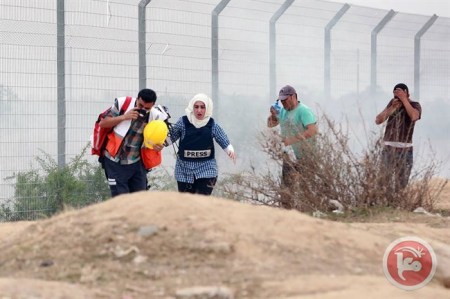
Similarly, cameraman of Palestine Today news agency Dawood Abu al-Kas was hit with a rubber-coated bullet in the foot while covering clashes near the border opposite to the Israeli Kibbutz of Nahal Oz in the northeast Gaza Strip.
“I was trying to capture photos while standing near an ambulance more than 300 meters away from the border fence when I was shot,” al-Kas told Ma’an.
Al-Kas highlighted that he was wearing a flak-jacket marked “PRESS” during the incident.
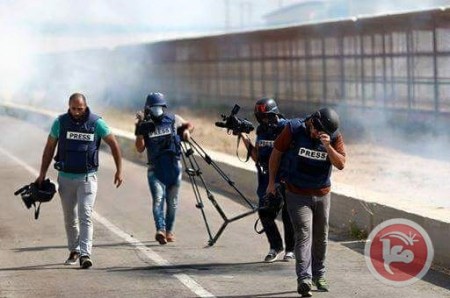
Al-Kas said that having been shot would not deter his efforts to “expose the crimes Israeli occupation commits against the Palestinian people.”
The deputy speaker of the Union of Gaza Journalists, Tahsin al-Astal, said Israeli assaults against journalists are consistent with Israeli violations of Palestinian rights in general.
“The Israeli occupation carries out systematic assaults against journalists who work in the field to prevent them from telling the truth about the crimes the occupation forces are committing against the Palestinian people,” al-Astal said.
“These serious breaches are classified war crimes and violations to international treaties and conventions,” he said.
Al-Astal added that the Union of Gaza Journalists, “has updated the International Federation of Journalists of the terrorism against Palestinian journalists at the hands of Israeli occupation forces.”
The IFJ, he said, is expected to issue a press release condemning “Israeli crimes and breaches against our people.”
Settler shoots, critically injures Palestinian near Gush Etzion
Ma’an – October 25, 2015
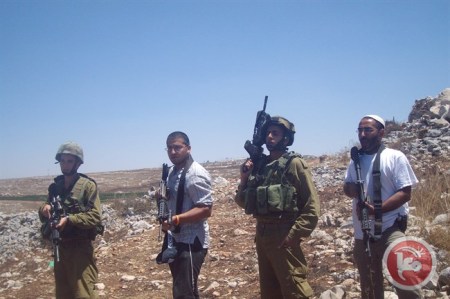
BETHLEHEM – An Israeli settler shot and seriously injured a young Palestinian man on Sunday morning in the Wadi Sair area near the illegal Israeli settlement bloc of Gush Etzion and Sair village, east of Hebron, Palestinian security sources said.
Additionally, the mayor of nearby Sair village reported that seven Palestinians in the village had been shot and injured following the incident.
The settler who shot and critically injured the Palestinian man claimed, according to Israeli reports, that a Palestinian attacked him with a knife.
Palestinian security sources told Ma’an that an Israeli settler shot 20-year-old Azzam Azmi Shalalda four times while he was in his agricultural field, after the actual person suspected of carrying out the alleged attack had reportedly already fled the scene.
After the shooting, Shalalda was evacuated to al-Mamoon clinic in nearby Sair for first aid, before he was taken to al-Ahli Hospital in Hebron. Medics say he is in a critical condition. Shalalda is from the Sair village.
An Israeli army spokesperson said a Palestinian suspect attacked a 40-year-old Israeli after the Israeli man had stepped out of his car to confront Palestinians who were allegedly throwing stones at passing vehicles.
Israeli media outlets reported that the 40-year-old settler was evacuated to Hadassah Hospital in Ein Karem after he was stabbed. He reportedly sustained moderate wounds.
An Israeli army spokesperson said that the alleged Palestinian “assailant fled from the scene,” adding that the reports were initial. The spokesperson had no information of a Palestinian shot or detained during the incident.
Mayor of Sair village, Kayed Jradat, told Ma’an that following the incident, Israeli forces raided Sair village and shot and injured seven Palestinians during the raid.
Doctor Zuheir Jaradat, who works at the town’s al-Mamoon clinic, said one of the victims sustained serious wounds as he was shot in the eye, while another man was hit with a live round in his thigh and was taken to hospital as well.
During the raid, Israeli forces inspected cars and checked the identities of villagers.
Jradat added that Palestinians in the village closed their stores out of fear of attacks by Israeli forces.
An Israeli police spokesperson said the area had been closed off.
Palestinian witnesses told Ma’an that Israeli forces chased a Palestinian vehicle between the southern West Bank towns of Sair and al-Shuyoukh after the incident. They highlighted that the alleged stabber had fled the scene, and an Israeli settler shot another young Palestinian man who had been working in nearby fields.
At Guantanamo, Sometimes Even the Judge Is In the Dark
By Dror Ladin | ACLU | October 23, 2015
I’m writing from Guantánamo Bay, where pre-trial proceedings in the military commissions prosecution of the 9/11 defendants have restarted after an 18-month delay. It has been a faltering start, to say the least: Within ten minutes of the first hearing, the agenda was derailed. Again.
One of the defendants, Walid Bin Attash, asked about the procedures that would allow him to represent himself because he could not trust the independence of the military commission, including his lawyers. All the parties then had to grapple with how self-representation would work in this novel context. But lurking behind these dilemmas is the real issue that has so often derailed the military commissions: the government’s use of secrecy in what it presents as a public death penalty trial.
As we have pointed out for years, the military commissions are unfair, unconstitutional, and plagued by excessive secrecy. These challenges make it extraordinarily difficult for the defense attorneys to do their job. And they make it even harder for defendants to exercise the right to represent themselves meaningfully.
There are straightforward logistical impossibilities for defendants if they attempt to represent themselves. They are held virtually incommunicado in “Camp 7” at Guantánamo, a secret prison within a secretive prison holding detainees who were tortured at the CIA’s secret black sites. Defendants cannot file motions, consult a law library, communicate with (or even learn the names of) witnesses, or compile confidential legal documents.
The defendants also face the unique challenge of representing themselves when they have been tortured by the government that seeks to kill them, continue to be subjected to a “controlled chaos strategy of changing the rules all the time” that serves to retraumatize them, and are denied rehabilitation to help them cope with the effects of their torture. Conditions at Camp 7 reportedly exacerbate the continued effects of CIA torture. Bin Attash declared at the beginning of this week’s hearings that “we are still in the black sites” before the judge, Army Col. James Pohl, cut him off.
The results of torture are quite visible at the trial: As an observer, one of the most difficult aspects of these hearings is watching the guards place a particularly frail defendant, Mustafa al-Hawsawi, each morning on a chair equipped with a special pillow. As the Senate Intelligence Committee’s torture report documents, al-Hawsawi was subjected to “rectal exams conducted with ‘excessive force’” while detained at a secret CIA prison. CIA records indicate that the result was “chronic hemorrhoids, an anal fissure, and symptomatic rectal prolapse.” He now weighs less than 100 pounds and sometimes bleeds on his clothing. His medical records, like so much else at Guantánamo, are kept secret even from his counsel.
But perhaps the single biggest obstacle to self-representation is government secrecy. Defendants in the military commissions are not permitted to see classified evidence. That’s the case even if the government tries to use it to put them to death, and even if it could help their case. How can someone defend themselves when they can’t see the evidence? This problem isn’t confined to the self-representation context; even security-cleared defense counsel at Guantánamo are sometimes kept in the dark about relevant evidence.
These difficulties could be left for another day, suggested the judge. Perhaps, if a defendant chooses to represent himself, the military commissions could muddle through whatever problems cropped up along the way. Maybe the most obviously unfair scenarios would never come to pass, he hypothesized. At that point, former Secretary of Defense Rumsfeld entered the frame: Are concerns about the viability of self-representation in the military commissions merely a case of “unknown unknowns”?
So many questions arise when you try to invent justice as you go along.
The government has chosen to sidestep our tried and true federal courts and created a novel death penalty court here at Guantánamo. Without a doubt, there are a great number of unknown unknowns in this unprecedented proceeding. But as counsel for Ammar al-Baluchi observed, “there are huge known unknowns.” Given the government’s repeated and acknowledged efforts to rely on secret evidence and simultaneously hide that same evidence from the accused — and the public — a wide array of problems for a defendant who seeks to represent himself are easily predictable.
As David Nevin, counsel for defendant Khalid Sheik Mohammad, has explained, secrecy is “the live wire of this case.” At some point, Nevin suggested, the court will have to decide if it wants this trial to be a “real case” or merely a fundamentally unfair exercise of government power. And whether it’s a “real case” depends in part on whether the government succeeds in hiding from the American public the details of some of the most important trials in our history.
Perhaps the moment that most perfectly encapsulated the week of hearings so far happened at the end of the second day. Defense counsel had submitted a motion containing information that the government had decided was so secret that special permission was required to read it. But the government had not cleared the judge himself to know the information. After consulting with the court security officer, the judge refused to accept the defense’s submission.
“It’s hard for me to know what it is without knowing what it is,” he said. The same could be said for the military commission itself.
Court Chooses to Ignore Overwhelming Evidence of NSA’s Mass Internet Spying

By Ashley Gorski | ACLU | October 24, 2015
A federal district court yesterday dismissed Wikimedia v. NSA, a lawsuit brought by the ACLU on behalf of a broad group of educational, legal, human rights, and media organizations whose communications are swept up by the NSA’s unprecedented Internet dragnet.
Our lawsuit concerns the NSA’s “upstream” surveillance, which involves the mass interception and searching of Americans’ international Internet communications. The court held that our clients lacked “standing” to bring suit, because they had not plausibly alleged that their communications were being monitored by the NSA. That’s just plain wrong.
The court’s opinion relies heavily on the Supreme Court’s decision in a previous ACLU lawsuit, Amnesty v. Clapper, a challenge to warrantless surveillance under the FISA Amendments Act of 2008. In February 2013, the Supreme Court dismissed that case on the grounds that the plaintiffs could not prove that they had communicated with the NSA’s targets.
But as we explained in court, our current challenge to the NSA’s warrantless spying is very different than the last one. Among other reasons, Clapper was decided prior to the Snowden revelations and extensive government disclosures about upstream surveillance. These revelations fundamentally changed the equation. Since Clapper, the public has learned that the NSA is not surveilling only its targets — it is instead surveilling virtually everyone, looking for information about those targets.
Some early takeaways from the district court’s opinion:
1.The court misunderstands how upstream surveillance is fundamentally different from and much more intrusive than the surveillance considered by the Supreme Court in Clapper.
Upstream surveillance is accomplished through the installation of devices directly on the Internet “backbone” — the network of high-capacity cables, switches, and routers across which Internet traffic travels. One particularly disturbing feature of upstream spying is known as “about” surveillance. Through this surveillance, the NSA is not simply plucking the communications to or from terrorists, spies, or other targets. Instead, it’s copying and searching through the contents of nearly everyone’s international communications, looking for information about its many targets. When the Supreme Court considered warrantless surveillance in Clapper, it was focused on whether the plaintiffs communicated with targets. At that time, the public had no idea that the NSA was essentially opening everyone’s international emails. Indeed, contrary to the district court’s understanding, “about” surveillance is in no way targeted:

2. The court ignores how Internet communications are structured — and why that requires the government to intercept at least some of our clients’ trillion-plus international communications.
Collectively, our clients engage in more than one trillion international Internet communications each year, with individuals in virtually every country on Earth. As we explained in our complaint, given the structure of the Internet, it is virtually impossible for the NSA to conduct upstream surveillance without intercepting at least some of plaintiffs’ communications. Yet the court dismissed these allegations, characterizing them as having “no basis in fact.”

3. Given how much is in the public record about upstream surveillance, our clients’ allegations are not “speculative” or “hypothetical.”
As the court acknowledged, at this early stage of the litigation, plaintiffs have to satisfy only a very low threshold: plausibility. Especially considering what’s publicly known about how upstream surveillance works, and the volume and distribution of our clients’ communications, their allegations are more than plausible.

4. The court’s opinion would insulate government surveillance from any legal challenge, except in cases where the government has already admitted its reliance on a particular program.
Although the court recognized that “no government surveillance program should be immunized from judicial scrutiny,” its analysis would do precisely that in the overwhelming majority of cases. If the court’s reasoning were correct, then the only people who could challenge NSA surveillance would be those told by the government they were spied on — a result at odds with well-established precedent and our system of checks and balances:
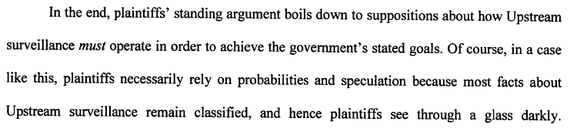
Our clients’ standing doesn’t depend on a supposition. There’s no question that the NSA is capturing and searching through their communications. That’s something the court — and everyone else — should find extremely disconcerting.
Jerusalem Palestinian loses eye after indiscriminate Israeli fire

Ma’an – October 24, 2015
JERUSALEM – Thirty-six year old Palestinian Luay Faisal Ubeid lost his left eye after an Israeli soldier shot him with a rubber-coated steel bullet in al -Issawiya neighborhood of occupied East Jerusalem earlier this week.
“Minutes after I arrived home on Wednesday evening, I heard bangs, so I opened the door of my balcony land looked down on the street,” Ubeid told Ma’an while receiving treatment at Hadassah hospital in Ein Karem in West Jerusalem.
“Seconds after opening the door an Israeli soldier fired a rubber-coated bullet directly at me, hitting my left eye,” Ubeid said.
He received first aid at home before being evacuated to Shaare Zedek medical center. He was later transferred to Hadassah hospital.
Doctors discovered that Ubeid had skull fractures and his left eye had been gouged out.
Ubeid told Ma’an he planned to bring suit against the Israeli forces, saying that “there hadn’t been clashes in the area” when he was shot. Israeli police have carried out an initial investigation, he added.
Ubeid is a father of five children, aged 4 to 13 and works as a bus driver for tourists in the area.
Member of a local committee, Muhammad Abu al-Hummus, told Ma’an that Israeli forces entering al-Issawiya on a near-daily basis are increasingly using indiscriminate force on the neigbhorhood’s residents.
“Israeli soldiers and police officers fire rubber-coated bullets and stun grenades, and hose houses indiscriminately with foul-smelling liquids,” al-Hummus told Ma’an.
Several people — including children — have been hit with rubber-coated steel bullets over the past month while sitting in their homes.
Ubeid is one of thousands of Palestinans in the occupied Palestinian territory to sustain injuries this month, according to Palestinian Red Crescent documentation.
As clashes mar the occupied West Bank and Gaza Strip, Palestinian residents of East Jerusalem have come under unprecedented restrictions following calls by Israeli PM Benjamin Netanyahu for increased measures against the population, in the wake of attacks that have left nine Israelis dead since Oct. 1.
Since the call, Israeli authorities have demolished homes of alleged attackers, sealed entrances to Palestinian neighborhoods, and detained several, in what Amnesty Intenational earlier this week termed the “collective punishment of thousands of people.”
Gaza: between rebellion and sacrifice
By Valeria Cortés | International Solidarity Movement | October 22, 2015
“All I possess in the presence of the death is fury and pride” – Mahmoud Darwish
Gaza, Occupied Palestine – Ahmed Al Sarhi was executed in cold blood yesterday by an Israeli sniper, from the cowardly distance of the Zionist fence that encloses Gaza, turning it into a prison. This is just another story of this shameful concentration camp that, as if that was not enough, is also routinely bombarded by the Zionist war machine with total impunity.
Including Ahmed, there has been a total of fifteen people killed by Israeli forces since October 9th, in the Gaza strip alone. This includes a three year old girl and her pregnant mother, who died as a result of the bombing of their family home. Throughout Palestine since the beginning of this month, fifty-two people have been killed, among them twelve children. The systematic killing of children by the occupation forces is not a mistake or collateral damage, figures confirm that Palestinian children are the main military target of Israel.
But we cannot limit ourselves to stating names, figures, data without contextualizing what happens here in Palestine – at the root of this catastrophe, a vicious occupation of a colonial entity imposed by blood and fire on Palestinian territory, with the full support of the so-called Western Democracies. Palestinians are being killed on their own land, the land of their ancestors. They have not come to seek death, death has come to them under the guise of a “religious conflict,” but that is not true – this is plainly colonialism, theft, conquest and occupation, and for this the Zionist entity conducts a continuous and terrifying ethnic cleansing.
Among the first victims of this genocide is the truth, so it is our duty to prevent mass media outlets from turning Palestinians into “terrorists” who always “die” in an “ongoing terror attack.” To begin with, they are not terrorists, they are an occupied people exercising their legitimate right to defense with all the resources – very few resources – at their fingertips. They do not “die”, they are executed in cold blood by one of the most powerful armies in the world or by that other paramilitary entity, formed by fanatical settlers highly trained and armed to the teeth.
How much hopelessness, suffering, unpunished abuse, how much spilled blood can the human heart take before bursting? What terrible reasons can drive a young man to take a kitchen knife and be under the Zionist bullets attempting a futile defense, the last desperate act of rebellion for justice? A justice that has been denied to them from the day of their birth to the day of their death.
Those Palestinians, described by the media in a de-contextualized, biased, malicious way, as “neutralized terrorist” are mostly young people and teenagers. The dramatic reality that the media handle turns this into a grotesque spectacle where the executioner becomes the victim should not go unnoticed.
After the cold-blooded murder of these children, young martyrs, there are more crimes: their families are beaten, lynched, imprisoned, their homes demolished, their residence permits revoked, a whole series of infamous collective punishments – illegal and heinous – trying to silence a people pushed to the limits of their endurance.
In the Gaza Strip there are no kitchen knives as weapons of the juvenile despair. Here the occupation is not present face to face like in the West Bank, here it remains lurking behind cowardly attacks from the distance of warships, planes, helicopters and drones and by land surrounding Gaza with a fence full of turrets, tanks, rifles and all kind of military technology at the service of death.
Then young Gazans, many of them teenagers or children, who have already suffered in their own flesh three brutal massacres, stripped of all hope and future, march to the very limits of their imprisonment in a sacrificial ritual, to offer their defenseless chests to the bullets of the occupier, with no other weapon than a harmless stone, a flag, their rage and pride – it is all they have in the presence of death. Children, young martyrs of Gaza, march to the borders of this, their land, their prison, their grave, to offer their brief life as anonymous prisoner to put a dignified end to their agony.

Young man a few meters from the zionist fence, Gaza Strip, Palestine. September 2013.
It is our duty to not let them be murdered three times over, where yes – because that Zionist colony sadly known as “Israel” commits on them a triple crime – there is first the murder itself, secondly the impunity of the fact and third, equally or even more terribly, the slander of the victim, making the victim guilty of their own death.
If we cannot prevent the slaughter of the Palestinian people, at least we have to avoid that impunity and slander primed on these desperate boys in search for justice, or even more painfully, a quick escape to this long tragedy.
As you read these lines the Zionist occupation and international silence continue to send children to their death.
Ecuador Using Oil Revenue to Build 400 New Schools by 2017

President Rafael Correa high-fives a boy during his tour of a new school built in the province of Azuay, Ecuador, Oct. 20, 2015. | Photo: Ecuadorean Presidency
teleSUR – October 22, 2015
Ecuador announced Wednesday that the government intends to build 400 new schools by 2017.
Half of the schools will be the state of the art “Millennium Educational Units” that include scientific laboratories, a library, a multi-purpose auditorium, an administrative wing and ample classrooms. The rest will be prefabricated units that can be constructed much faster and will be built in areas with the most urgent need for new schools.
“There is no better way to achieve true freedom than quality education,” President Rafael Correa said Tuesday during a ceremony to inaugurate a new school in the province of Azuay.
The new Millennium Educational Unit opened in Azuay replaces 13 much smaller schools that were sorely lacking in supplies and space needed to provide a quality education.
According to the Andes news agency, the funding for this particular school came from royalties from a nearby mining project. The stated objective of the Correa government is to take the income generated from extraction projects and invest it into strategic sectors such as education in order to move the country away from its dependence on non-renewable resources.
Ecuadorean law also stipulates that a portion of the income generated by extraction projects be reinvested into the region where the project is located.
Correa says his government had invested at least US$20 billion in education over the past eight years of his administration. The Ministry of Education provides free school supplies, books, uniforms, and meals in order to reduce barriers for low-income students, with a goal of achieving a 100 percent attendance rate.
The political opposition and right-wing press have criticized the Correa government over its spending. During the inauguration ceremony Correa replied saying, “Ecuador does not spend a lot, it invests a lot, which is different.”
The country has already built 57 of the Millennium Educational Units, with a further 48 under construction. The schools are intended to have a lifespan of 100 years. The prefabricated schools have a shorter lifespan at 25 years but take only 11 weeks to build.
Journalist missing after police arrest him in his home
Mada Masr – October 22, 2015
Journalist Hossam al-Deen Seed was arrested in his home and taken to an unknown location on Thursday morning, the Arabic Network for Human Rights Information (ANHRI) reported.
He was still missing as of Thursday evening.
The charges against Seed are unknown, according to the ANHRI statement, which noted that he is a member of the Journalists Syndicate.
The Interior Ministry did not respond to Mada Masr’s calls for a comment on the incident.
Seed’s arrest comes the day after security forces raided the offices of the Mada Foundation for Media Development and arrested all staff members on the premises.
This raid represents “a dangerous escalation in the Egyptian authorities’ crackdown on freedom of expression and association,” Amnesty International argued in a statement released Wednesday.
Seed’s arrest also coincides with a National Council for Human Rights (NCHR) report on 15 cases of forced disappearances that was issued the day of the Mada Foundation raid, the privately owned newspaper Al-Masry Al-Youm reported.
Reports of journalists being arrested or forcibly disappeared by security forces have swelled since the military-led ouster of former President Mohamed Morsi in July 2013.
There are disagreements about the number of journalists currently detained or in prison, but estimates range from 60 to 70.
The freelance photographer Mahmoud Abou Zeid, commonly known as Shawkan, has been held in pre-trial detention for over two years, exceeding Egypt’s legal two-year limit.
Egypt ranked near the bottom of the 2015 Reporters Without Borders press freedoms index, coming in at 158 out of 180 countries.
At least 30 journalists were arbitrarily arrested in 2014 on charges of organizing or participating in protests, the report said. Reporters Without Borders claimed that President Abdel Fattah al-Sisi’s government is using its ongoing war on terror as a pretext to curb press freedoms and target media institutions affiliated with the banned Muslim Brotherhood.
The Egyptian Commission for Rights and Freedoms released a report in August stating that authorities violated journalists’ rights at least 658 times during the first year of Sisi’s presidency. The violations included preventing journalists from doing their jobs, verbal and physical assault, detention, arrests and imprisonment, damaging and confiscating equipment, banning press reports and filing lawsuits against journalists.
Featured Video

Why Hamas Really Attacked Israel on Oct. 7
or go to
Aletho News Archives – Video-Images
From the Archives
Confronting the Threat of Ethnic Bioweapons
By Tony Cartalucci – New Eastern Outlook – 29.11.2017
The United States Air Force’s 59th Medical Wing’s molecular biology branch recently was revealed to have been collecting specifically Russian RNA and synovial (connective) tissue samples, prompting fears in Russia of a possible US directed ethnic-specific bioweapons program. … continue
Blog Roll
 Aletho News
- Why Yemen Is Bombing Saudi Arabia’s Airports: The War Behind the Headlines
- Sally Rooney’s books pulled from UK over support for Palestine Action
- Bombs for Tel Aviv, Promises for Riyadh
- Israeli ad agency conducted vast global espionage campaign using online ads: Report
- Oct. 7 Forever Marks The Big Reveal: ‘We See You, Israel, We Revile You, We Reject You!’
- Meet the US generals and admirals advancing Israeli policy
- Israel’s Straw Widow Protocol: The Kill Zones Where Civilians Were Labelled ‘Terrorists’
- Leading Israeli Think Tank Publishes Psychotic Israeli ‘National Security’ Doctrine
- Are the United States and Israel in Decline-and-Fall Mode?
- Why Hamas Really Attacked Israel on Oct. 7
- If Americans Knew
- Israeli firm used online ads to run vast spy operation, researchers say
- No, the world zionist movement is not an antisemitic conspiracy theory
- Hundreds of IDF investigations into killings still have no public outcome, BBC Verify finds
- After Ashley Moody Epstein Probe, Donors Linked to Him Poured Money Into her Senate Campaign
- Worried about Russian meddling in UK politics? Wait till you see what Israel is up to
- Israeli settlers attack West Bank center for disabled children, church leader calls for int’l action
- Pulling Out Teeth Just to Live: How Israel Has Devastated Dental Care in Gaza
- Gaza’s “ceasefire” death toll passes 1,500 – Daily Update
- Activists Abused By Israel Return to New Freedom Flotilla Mission
- 60 Minutes won’t tell the full truth about Israeli settler violence
- No Tricks Zone
- New Study Suggests Large Regions Of The Pacific Ocean Have Been Cooling For The Last 80 Years
- Germany’s Green Energy Debacle: High Energy Costs Force Kahla Porzellan to Close After 182 Years!
- New Study: 50 Years Of The Most Aggressive ‘Net Zero’ Policies Can Only Affect The Global Climate By 0.03°C
- US September “Heat” Was No Record…Many Records Set Decades Ago
- Latest European Green Energy Debacle; Portugal’s Largest Flagship Solar Park Insolvent!
- Green Energy Debacle: German Expert Professor Fritz Vahrenholt Warns Of Severe Economic And Social Consequences
- Two More Paleo Reconstructions Affirm Meters-Higher Sea Levels Across Ireland, Brazil 7000-6000 Years Ago
- New Study: Earth And Venus Surface Warmth Largely Explained By Convection And Lapse Rate, Not CO2 Or Radiation
- 2025 Nature Paper Claiming Worsening Global Drought Gets RETRACTED …Heavily Flawed
- New Study: ‘Global Drought Shows No Detectable Recent Acceleration Under Climate Warming’

