A scramble for lands
GRAIN | September 22, 2014
With all this money pouring into palm oil companies, lands for oil palm plantations are at an all time premium, wherever they can be found.
Oil palm plantations can, however, only be established on a narrow band of lands in tropical areas that are roughly 7 degrees North or South of the equator and that have abundant and evenly spread rainfall. This makes the potential area for new oil palm plantations rather limited. Plus, most of these lands are composed of forests and farmlands that are occupied by indigenous peoples and peasants, some of whom are already growing oil palms for local markets.
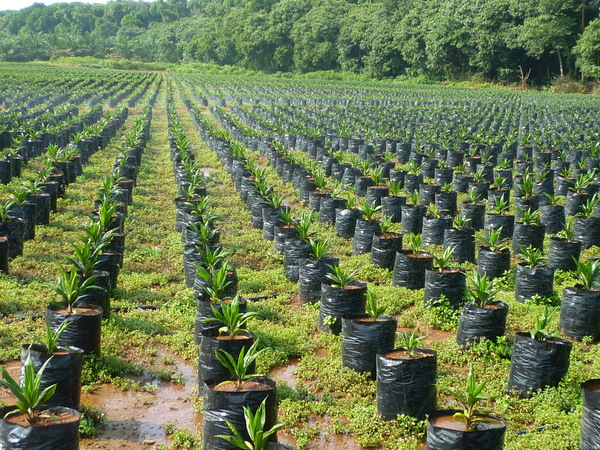
The expansion of oil palm plantations, therefore, depends upon companies getting these people to give up their lands. This is not an easy sell, given the meagre jobs and other benefits that an oil palm plantation generates in comparison with the destruction that it causes and the value that the lands already hold for the people. A typical oil palm plantation requires only one poorly paid worker for every 2.3 hectares, while the surrounding communities pay a high price for the deforestation, water use, soil erosion and chemical fertiliser and pesticide contamination that it causes.1 Companies trying to acquire lands from communities also run into customary forms of land governance that do not allow for a company to buy up land one parcel at a time.
The easy way for companies to get around these hurdles is to ensure that the communities do not even know that their lands have been signed away. It is very common in Africa, for instance, for companies to sign land deals directly with the national government without the knowledge of the affected communities. In many cases, the companies signing the deals are obscure companies registered in tax havens with their beneficial owners hidden from view. The managers of these companies tend to come from the mining sector or other extractive industries with long histories of shady deals in Africa. In Papua New Guinea and Indonesia, land deals are typically brokered between local elites and foreign investors, also often with obscure ownership structures registered in tax havens.
Such small shell companies are not in the business of developing plantations. Once the land contracts are signed, they immediately look to sell out to larger companies with the technical capacity and financial resources to build the plantations. And it is usually at this point that the communities come to understand that their lands have been sold.
Most of these cases eventually lead to a situation where a large multinational plantation company, backed by a national government and a multimillion dollar contract, faces off against a poor community trying desperately to hold onto to the lands and forests it needs to survive. It is incredibly difficult for communities to defend themselves against such powerful forces, and those that do risk the threat of violence, whether by paramilitaries in Colombia, police in Sierra Leone, or the army in Indonesia.
Tax havens and land grabs for palm oil in Africa
The case of Atama Resources Inc
In 2010, the Government of the Republic of the Congo signed away more than 400,000 ha to a Congolese registered company called Atama Plantation whose owners remain unknown.2 In return, this mysterious company promised to develop the Congo Basin’s largest ever oil palm plantation, converting 180,000 ha of mostly forested land in the provinces of Cuvette and Sangha while paying the government a token annual fee of $5 per hectare of planted land. The company was under no obligation to conduct environmental or social impact assessments or to consult with affected populations.
When the contract was signed, Atama Plantation was wholly owned by Silvermark Resources Inc, a company registered in the offshore fiscal paradise of the British Virgin Islands.3 The only publicly available information on Silvermark is that it is owned and directed by two shell companies registered in Brunei. Because of the rules of secrecy governing companies registered in Brunei and the British Virgin Islands, it is impossible to know who the actual owners of these companies are.
In 2011, ownership of Atama Plantation was transferred to a holding company in Mauritius, another fiscal paradise, before finally being sold, in 2012, to Malaysia’s Wah Seong Corporation, a “pipe-coating specialist” company with no history in the palm oil sector that is controlled by Malaysian businessman Robert Tan.4
Whoever the owners of Silvermark are, they pocketed an estimated $25 million, without doing anything more than orchestrate the contract with the Congolese government. And, under the deal with Wah Seong, they still hold 39% of the shares with yet another British Virgin Islands registered company with unknown owners holding the remaining 10%.
The case of Liberian Forest Products Inc. (LFPI)
On August 21, 2006 a little known London minerals exploration company announced to the world that it had taken control of 700,000 ha of land in Liberia– equal to about 7% of the country’s entire land area. The owners of Nardina Resources PLC claimed they had acquired rights over this massive chunk of land through a take over of a Liberian company called Liberian Forest Products Inc. (LFPI). Nardina then changed its name to Equatorial Biofuels PLC and then again to Equatorial Palm Oil Ltd (EPO) to reflect its new mandate as a palm oil company. Meanwhile, the original owners of LFPI walked away with £1,555,000 in shares and cash.
But how did the owners of LFPI get hold of such an obscene amount of territory in a country just emerging from over a decade of civil war? And who were these owners anyway?
EPO’s disclosure documents from its listing on the London AIM stock exchange in 2010 show that the money it paid for LFPI went to two offshore companies, Kamina Global Ltd of the British Virgin Islands and Subsea BV of Liberia, which each had 50% shares of LFPI.
Searches conducted in December 2013 through the company registry in Liberia found no record of registration for a company called Subsea BV. However, the articles for registration for LFPI of November 2006 indicate that LFPI is a Liberian company owned by Tony Smith (50%) and A. Kanie Wesso (50%), who are both trustees for a new company to be formed, called Subsea BV. The sole LFPI director named in the document is Mark Slowen, a British businessman operating from Liberia whose name also turns up as the CEO of SubSea Resources DMCC (Dubai Multi Commodities Centre), a company that acquired mineral rights in Liberia at around the same time.
A second business registry document for LFPI from August 2007 refers to LFPI as a British owned company– with ownership split between Mark Slowen (50%) and Kanie Wesso (50%). Both documents describe LFPI as a company whose sole business is logging.
Subsea BV also turns up in the UK business directory as a director of the G4 Group, which has several business interests in Liberia and is controlled by the notorious financial fraudster Lincoln Fraser.5 The G4 Group’s Liberian subsidiary, G4 WAO Inc., exports rubber tree logs and holds a phosphate exploration concession covering 36,000 ha in Bopolu. According to the company website, G4 WAO “manages in excess of one million acres of the best crop growing conditions in the world” and has partnered with the International Crops Research Institute for the Semi-Arid-Tropics (ICRISAT) “to establish trial sites on various G4 farming enterprises in Liberia, Ghana and Kenya.”6
Kamina Global Ltd, the other company that was paid by EPO for the acquisition of LFPI, is even more opaque. Legislation in the British Virgin Islands does not require companies to disclose their directors or shareholders, so it was not possible to identify the people behind Kamina Global through company records.7
When EPO acquired LFPI, the contract was under examination by Liberia’s Public Procurement and Concession Commission. It would conclude that the agreement contained “gross irregularities and non-compliance with the law” and EPO was forced to renegotiate. LFPI, now under the ownership of EPO, signed a new contract with the government in 2008, this time covering a much reduced but still valuable 55,000 ha area of land in Butaw. With this concession and another of a similar size in Liberia, EPO went public on the London AIM stock exchange, eventually attracting significant investment from the Siva Group, a Singapore-based holding company of Indian billionaire Chinnakannan Sivasankaran, who has quietly amassed one of the world’s largest land banks for oil palm in just a few years. The Siva Group started buying shares of EPO in 2010 and by 2013 it controlled 36.7% of the company and had formed a 50:50 joint venture with EPO based in Mauritius, called Liberian Palm Developments Ltd, that took control of all of EPO’s Liberian land concessions.8
In 2013, the Siva Group would sell its shares in EPO and its Mauritian joint venture to KL Kepong of Malaysia, one of the world’s largest palm oil companies.
Are Chinese companies grabbing land for palm oil?
China runs neck and neck with India for the world’s number 1 palm oil importer. So it would only make sense that Chinese companies would be involved in the current rush for lands for oil palm plantations. But while there have been several reports of massive land grabs for palm oil by Chinese companies, few of these have materialised.
China’s telecom giant ZTE, which has a biofuels division, was said to have signed an agreement with the Democratic Republic of the Congo to develop 2 million hectares of oil palm plantations. The numbers were later scaled down to 100,000 ha and it now seems like the project has been scrapped entirely.
In 2005, Indonesia’s President Yudhoyono announced a plan to develop 1.8 million hectares of land along the Kalimantan border into oil palm plantations. Several Chinese companies including state-owned investment company CITIC Group were offered one third of the area in return for building roads and railways and details were released of a $600 million project between CITIC and Indonesian palm oil giant Sinar Mas to develop a 100,000 ha plantation in the area, with a $380 million dollar loan from the China Development Bank.9 Sinar Mas’ subsidiary Golden Agri Resources is one of the main suppliers of palm oil to China. The plans, however, were never put into operation.
In 2012, Sinar Mas, which is controlled by Indonesia’s Widjaja family, announced a new partnership for oil palm development with China, this time with state-owned China National Offshore Oil Corp. and another Widjaja controlled company, HKC Holdings of Hong Kong. Wang Jun, the former chairman of CITIC Group, is the honorary chairman and a director of HKC. The companies said the project would be rolled out over eight years in Papua and Kalimantan, “where regional governments had reserved about one million hectares of land for it.”
Less than a year later, the Widjajas cemented another major palm oil deal with China. This time in Africa. In March 2013, Golden Agri Resources’ wholly-owned subsidiary Golden Veroleum Limited procured a $500 million term loan facility from the China Development Bank to support the construction of its 220,000 ha oil palm plantation project in LIberia. Typically the CDB only loans to overseas companies or projects when Chinese companies are directly involved.10
For now, China appears to be channeling most of its investments in palm oil through Asian palm oil companies, such as Sinar Mas, that dominate the global palm oil trade. The only Chinese company making significant direct investments in oil palm plantations has so far been China’s state-owned oil company Sinochem. In April 2012, Sinochem paid 193 million euros to acquire 35% of the Belgian plantations company SIAT, which has oil palm plantations in Gabon, Ghana and Nigeria. It also announced that its rubber company in Cameroon would be expanding its plantations and starting to move into palm oil production.
Cash crop | Communities lose out to oil palm plantations
Notes
1 UNEP, “Oil palm plantations: threats and opportunities for tropical ecosystems,” December 2011
2 See the excellent report, “Seeds of Destruction“, Rainforest Foundation UK, 2013
3 Silvermark is owned by Tinaldi Ltd and the Director is Greenland Ltd. Greenland Ltd is reported to be controlled by Benny Lum (who may just be a proxy). It controls Lamington Capital Inc (maybe Singapore) which is also a shareholder in African Petroleum Corporation Limited. It was also used to direct a transfer of funds to a Thai company that is linked to Thaksin. Both Tanaldi Ltd and Greenland Ltd (Brunei) are registered in Brunei to the address of HMR Trust Ltd (which is involved in offshore financial services). Other documents indicate that Tanaldi Limited is owned by Tan Sri Barry Goh Ming Choon of Malaysia and the company acts as a trust for other Malaysian businessmen. Barry Goh controls B&G Capital Resources Berhad (“BCGR”) which he started in 1994. BGCR has served as the principal contractor to Tenaga Nasional Berhad (TNB), one of the largest government link companies in Malaysia
4 Atama Resources Inc was registered in Mauritius in July 2011, as 100% owned by Silvermark. In 2012, Wah Seong purchases 51% of Atama Resources Inc. through its 100% owned subsidiary WS Agro Ind Pte Ltd (Singapore). 39% remains with Silvermark. 10% is taken by Giant Dragon Group (BVI), which is 100% owned by Marston International Ltd. (BVI), who’s director is Eastern Sky Ltd. (Hong Kong). Eastern Sky is a nominee director for several other companies. The Wah Seong Corporation is largely controlled by Malaysian businessman Robert Tan. Marston International Ltd. is the owner of Pergenia International Limited (PIL) incorporated in British Virgin Island on 10 January 2007 and Netstar Holdings Limited registered in BVI in 2003. Marston International Ltd is also the controlling shareholder of PT Jaya Pari Steel Tbk. (Indonesia). Reports from PT Jaya Pari Steel Tbk say that Marston International Ltd is owned by John Matthew Ashwood (50%) and Brian Whiteman and Robinson McKinstry (50%), who seem only to be proxies and John Ashwood likely works for Vistra, an offshore financial company based in Hong Kong. PT Jaya Pari Steel is a company of the Gunawan family of Indonesia, which is involved in finance and steel. The family controls 46 percent of Indonesia’s PT Bank Panin. Marston International Limited is also a major shareholder in another Gunawan steel company, Betonjaya Manunggal Tbk PT, through its ownership of Profit Add Limited (Samoa). Marston International is listed as a shareholder of Best Dragon Enterprises Limited, alongside Tito Sulistio, who is connected to the Suharto family.
5 Fraser is described by Offshore Alert as a “British conman who masterminded the $400 million Imperial Consolidated fraud” which robbed thousands of pensioners and others of their savings when it went bankrupt in 2002.
7 Kamina’s company registration information indicates that it was registered on 17 March 2006 and struck off on 2 November 2009. It’s registered agent is TMF (BVI) Ltd, a company which manages numerous shell companies on behalf of clients around the world. As written on the same document: “Under the BVI Business Companies Act, 2004 companies are not required to file information on Directors and Shareholders of a company.”
8 Siva Group’s 36.7% share of EPO is held by way of several subsidiaries: Biopalm Energy Limited (16.62%), The Siva Group (16.62%) and Broadcourt Investments Ltd (3.46%).(The joint venture is between EPO’s wholly-owned subsidiary Equatorial Biofuels (Guernsey) Limited and Biopalm Energy Limited, a wholly owned subsidiary of Geoff Palm Ltd based in the offshore city of Labuan, Malaysia, and which is owned by Broadcourt Investments Ltd, a British Virgin Islands registered holding company with Chinnakannan Sivasankaran, the Siva Group’s founder and owner, listed as its only director and shareholder since January 2007.
9 “The Kalimantan border oil palm project,” Milieudefensie – Friends of the Earth Netherlands and the Swedish Society for Nature Conservation, 2006; “China’s investment foray into Indonesia,” Asia Sentinel, 6 June 2013
Well oiled resistance
GRAIN | September 22, 2014
The rush to develop oil palm plantations in Africa is a double whammy for the continent. Not only does it involve a huge land grab of peoples’ lands and food producing resources, it also directly undercuts the livelihoods of millions of people involved in Africa’s traditional oil palm sector.
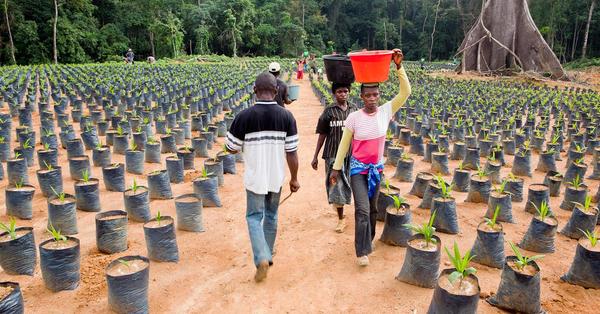
This is not the first time foreigners have pushed an expansion of oil palm in Africa. During the the colonial occupation of the continent, the European powers became interested in palm oil as an industrial lubricant and for making candles. African families were forced to pay a special tax, known as the “takouè” to the colonial authorities, in the form of palm oil and palm nut. King Léopold II of Belgium forced every farmer in the province of Equateur in the Congo to plant 10 palms a year.1
The European powers also established their own oil palm plantations around this time. Plantations were created in West and Central Africa as well as in Southeast Asia. Research stations and collection missions were launched to develop high yielding varieties of oil palms through the cross breeding of traditional or wild varieties.
With independence, most of these plantations and research stations were nationalised, and the new African governments reenergised the expansion of national production. In Bénin, for example, the state-owned Société Nationale du Développement Rural (SONADER) led an expansion of oil palm plantations in the south immediately after independence, while another state-owned company, the Société Nationale pour l’Industrie des Corps Gras (SONICOG) built new palm oil refineries and palm nut processing factories.
But, at the end of the 1990s, World Bank and donor imposed structural adjustment programmes forced African governments to privatise their national palm oil companies and to sell off their mills and plantations. While many national companies simply crumbled away, European companies with old colonial connections captured the most lucrative operations. SOCFIN, controlled by billionaires Vincent Bolloré of France and Hubert Fabri of Belgium, took over national companies in Cameroon, the DRC, Guinea and Nigeria. SIAT, controlled by the family of South African diamond magnate Ernest Oppenheimer and the Belgian Vandebeeck family, took plantations in Gabon, Ghana and Nigeria, while another old money Belgian company, SIPEF took over a chunk of the state-owned oil palm plantations of Côte d’Ivoire. Unilever, one of the world’s largest and oldest food companies, scored plantations too – in the DRC, Ghana and Côte d’Ivoire.
Today there is a second wave of foreign interest in oil palm plantations in Africa. With land for oil palm plantations becoming more difficult and expensive to acquire in Malaysia and Indonesia, companies and speculative investors are keen to open up new frontiers for export production. Some investment is going to Papua and to Latin America, but the biggest target is Africa. A long list of companies, from Asian palm oil giants to Wall Street financial houses, are scrambling to get control over lands on the continent that are favourable to oil palm, especially in the West and Central regions.
Over the past five years, vast areas of land in Africa have been allocated to foreign companies for oil palm plantations by African governments, with minimal if any consultation with the affected populations and many allegations of corruption. Table 1 lists 60 deals covering nearly 4 million hectares over the past decade and a half.
A number of different actors are involved. There are established Asian plantation companies, like Wilmar and Sime Darby, and multinational palm oil traders, like Cargill and Olam, both looking to establish a new basis of palm oil supply for global markets in Africa. But many of the first movers are in fact small obscure companies, typically domiciled in tax havens, whose owners intend only to sign land deals and then sell their companies as soon as possible to larger players with the capacity to develop the plantations. In many cases it is difficult to work out who the owners of these companies are.
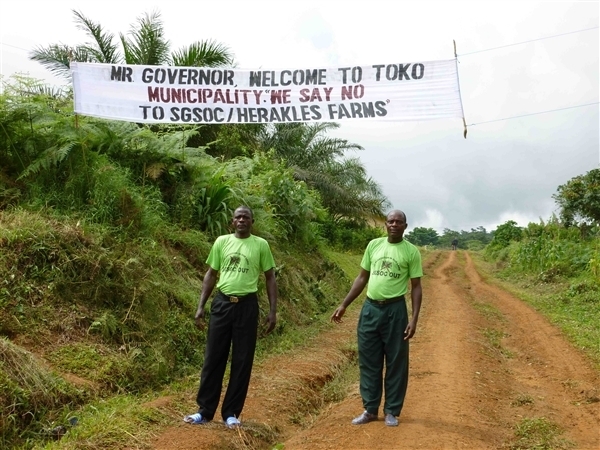
Resistance to a landgrab for a new oil palm plantation in Cameroon. (Photo : SEFE)
The communities facing land grabs from palm oil companies are under tremendous pressure to accommodate them, with pressure coming from the companies, the government, the local chiefs and even the army and paramilitaries. Those who resist face arrest, harassment and violence. And yet communities in Africa and around the world, from Papua New Guinea to Sarawak, from Cameroon to Guatemala, continue to struggle to stop palm oil companies from entering their lands.
Communities in southwest Cameroon have been involved in a three year struggle to stop the US company Herakles Capital from setting up an oil palm plantation in their area. Despite support from the president of Cameroon, Herakles has been unable to move forward with its plans because the communities are united in their total opposition to the plantation and because of the creative actions that they have undertaken, with support from national and international partners, to put pressure on the company to leave. The company and the government keep coming back and presenting new terms, the latest being a presidential decree that reduces the land allocated to Herakles from 73,000 ha to 20,000 ha and boosts the rent that the company must pay. Community leaders have been arrested and harassed with lawsuits. Yet the communities are sticking to their bottom line demand – no oil palm plantations on their lands.
Cameroon is also a target for the Luxembourg based company SOCFIN, owned by billionaires Vincent Bolloré of France and Hubert Fabri of Belgium. Over the past decade and a half, SOCFIN has taken over lands for oil palm and other crops in several African countries, including Cameroon, DRC, Guinea, Nigeria, Sao Tome & Principe, and Sierra Leone. The company is notorious for human rights abuses and land conflicts at its operations, and for its aggressive tactics against those who oppose it. In the past few years, the company has slapped defamation suits on several organisations and journalists in Africa and Europe that have spoken out against it.
On June 5, 2013, communities affected by SOCFIN plantations in four African countries held simultaneous protest actions against the company, as a delegation of diaspora from these countries and supported by the French group Réseaux d’Action Transnationale (ReAct) presented a joint letter from the various communities to the Annual General Meeting of the Bolloré Group, which is a major shareholder in SOCFIN.
“This initial international protest is just the beginning. We are committed to upholding our rights and Mr. Bolloré will have to understand that,” said Emmanuel Elong, spokesperson for Synaparcam, the Socapalm resident farmers’ union in Cameroon.2

The Jogbahn Clan convinced Liberia’s government to stop the expansion of plantations onto their lands. (Photo : Cargo Collective)
Strong community resistance combined with national and international, well targeted pressure, can roll back land grabs. The Jogbahn Clan in Liberia provides an inspiring example. When the British company Equatorial Palm Oil began surveying their lands as part of a deal it signed with the Liberian government, the communities took action to stop the work crews. They then marched to the local government offices to make it clear that they had never been consulted about the deal and that they would never give up their lands for the project. Along the way they were beaten, arrested and thrown in jail. But the communities refused to back down. Local and international NGOs joined their struggle, and exposed what was happening to the world. Finally, in March 2014, community leaders met with the Liberian President, Ellen Johnson Sirleaf, and secured a commitment from her to stop the company from expanding on their lands. Now Liberian groups are hoping to replicate these efforts with other affected communities in the country.3
The many different efforts to resist land grabs and maintain local control over palm oil production in Africa, Asia and Latin America demonstrate how committed local communities are to maintaining control over their ancestral lands and their biodiversity, for themselves and for future generations.
Notes
1 World Rainforest Movement, “Oil palm in Africa: past, present and future scenarios,“ 2010
2 Synaparcam, SoGB residents committee, Concern Union Citizen, and MALOA, “West African farmers stand up against Bolloré,” 5 June 2013
3 For more information about the case see: http://sdiliberia.org/node/263
Government Placing Itself at Top of New Air Travel Caste System
By Hugh Handeyside | ACLU | September 22, 2014
A new report from the Government Accountability Office shows that the government is going easy on itself when it comes to aviation security screening, and in the process it is stretching the concept of watchlisting to the breaking point. Not only has the Transportation Security Administration expanded its use of blacklists for security screening to identify passengers who may be “unknown threats,” but it also has compiled vast whitelists of individuals—including members of Congress, federal judges, and millions of Department of Defense personnel—who are automatically eligible for expedited screening at airports. These changes have made a broken watchlisting system even more arbitrary, unfair, and discriminatory.
We already know about those at the bottom of this aviation security caste system. We’ve long known that the TSA’s Secure Flight program uses passenger information submitted with airline reservations to screen against watchlists maintained by the FBI’s Terrorist Screening Center, including the No Fly List (which includes individuals who are barred from flying to, from, or over the United States) and the Selectee and Expanded Selectee Lists (which include individuals who are subjected to additional screening every time they fly).
Those watchlists, in turn, are compiled based on criteria that are so overbroad, ambiguous, and riddled with exceptions as to virtually guarantee that innocent individuals will end up blacklisted. Even information of questionable or doubtful reliability can support the “reasonable suspicion” standard that the FBI uses for placing people on the master watchlist. In fact, a single, uncorroborated piece of information—including a Facebook or Twitter post—can be enough to get you on the master watchlist and the Expanded Selectee List.
But the TSA isn’t stopping there. Thanks to the GAO report, we now know that the TSA has modified the Secure Flight program so that it assigns passengers to one of three risk categories: high risk, low risk, or unknown risk. We’ve long been critical of this kind of passenger profiling—which the TSA has proposed in the past—because it inevitably leads to greater intrusion into individuals’ private lives. And of course, it raises the question of what criteria and information the TSA uses to sort people into these categories.
The TSA is keeping those criteria secret, which is part of the problem. However, the GAO report states that the “high-risk” passengers aren’t just those who appear to match a name on the FBI’s No Fly, Selectee, or Expanded Selectee lists (as problematic as those lists may be). Now, the TSA is also using intelligence and law enforcement information, along with “risk-based targeting scenarios and assessments,” to identify passengers who may be “unknown threats.”
In other words, the FBI’s flawed definition of someone who is a suspected threat to aviation security isn’t relaxed enough for the TSA, so the TSA is creating its own blacklists of people who are hypothetical threats. Those people are also subjected to additional screening every time they fly. To make matters worse, another recently published GAO report indicates that the redress process for travelers who have been incorrectly caught up in the watchlisting system does not apply to these new TSA blacklists. So the TSA’s “unknown threats” are truly without recourse.
Moreover, attempting to identify “unknown threats” in the traveling public exacerbates the already unacceptable risk that watchlists will be used for racial and religious profiling—something that leaked documents strongly suggest is already happening.
What about those at the top of this hierarchy? Who gets the privilege of being designated “low risk” and undergoing less onerous screening measures? TSA has established separate lists of entire populations of passengers who, by virtue of their status within the government, get expedited screening, including:
- Members of Congress
- Federal judges
- Department of Defense (DoD) military and civilian personnel (approximately 2.9 million people)
- Employees of national intelligence agencies (approximately 70,000 people)
- Homeland Security Advisory Council members and Homeland Security Advisors
These groups receive “Known Traveler Numbers” that they submit when making travel reservations and are then routed to the TSA Pre-Check line when they arrive at the airport. Others (those who have been neither whitelisted nor blacklisted) can apply for expedited screening through Pre-Check by undergoing a background check and submitting biographic information and fingerprints.
Superficially, it’s easy to see the TSA’s logic in focusing on these individuals for whitelisting. Many are involved in defending the country, and some have undergone background checks as part of their positions within the government. But that logic doesn’t stand up under scrutiny. The problem with the TSA’s approach goes to the heart of watchlisting in general: the government is increasingly relying on the unproven and flawed premise that it can predict if a person will commit a dangerous act in the future.
Just as the TSA is blacklisting people who it has decided are unknown, hypothetical threats, it is whitelisting people simply by virtue of their status as employees of the government. That status, however, says next to nothing about whether those individuals will engage in violence or pose a threat to security on any given day. Government employees and officers commit crimes, including crimes that affect national security. Because there is no reason to believe that a given DoD employee is less likely to threaten aviation security than, say, a teacher or an accredited journalist, whitelisting the DoD employee is arbitrary.
The more fundamental problem is how the logic applies to the rest of us. Instead of subjecting all travelers to the same procedures designed to detect threats to aviation, the government is essentially telling the American public that if we want the same privileges that the government has awarded itself, we’ll have to convince the government that we won’t commit dangerous acts in the future. That means turning over more and more information about ourselves: about who we are, what we do, and with whom we associate. By default, the TSA’s system treats any reluctance to fork over that information as somehow suspicious, and it reinforces the emerging airline security caste system.
Similarly, insulating lawmakers, judges, and other decision-makers from the burdens and inconveniences of air travel does not serve the interests of democracy and fairness. When the government makes status-based decisions about aviation security, it pits Joe Congressman against Joe Sixpack, and unsurprisingly, the congressman comes out ahead.
Ultimately, when we start rewarding or punishing people because of who they are, as opposed to what they’ve done, we drift farther from the principles at the heart of our Constitution.
Israel imposes restrictions around al-Aqsa ahead of Jewish holidays
Ma’an – 23/09/2014
JERUSALEM – Israeli police on Tuesday morning deployed heavily at all gates of the al-Aqsa Mosque compound imposing restrictions on the entry of Muslim worshipers ahead of the Jewish New Year.
A Ma’an reporter in the holy city said Israeli police denied Palestinian men aged under 45 and all women entry to the mosque. Women and men under 45 had to perform dawn prayer in the streets outside the compound, she added.
In addition, police kept all gates closed except the Chain gate and the Council gate where police officers deployed heavily and scrutinized ID cards of worshipers.
Dozens of young men and women who were barred from al-Aqsa gathered outside the gates and chanted slogans denouncing Israeli police procedures and affirming it was their right to access the holy place.
Director of the Jerusalem office of the Palestinian ministry of endowment Sheikh Azzam al-Khatib told Ma’an that Tuesday’s closures of the compound were in preparation for Jewish holidays.
He said Knesset member Miri Regev from the Likud party who chairs the Knesset’s interior and security committee had asked the police to prepare the grounds for visits by Jews during holidays.
“We expect very difficult days in al-Aqsa during the upcoming Jewish holidays,” al-Khatib said.
Israeli forces regularly escort Jewish visitors to the site, leading to tension with Palestinian worshipers.
The compound, which sits just above the Western Wall plaza, houses both the Dome of the Rock and Al-Aqsa mosque and is the third holiest site in Islam.
It is also venerated as Judaism’s most holy place as it sits where Jews believe the First and Second Temples once stood. The Second Temple was destroyed by the Romans in 70 AD.
Al-Aqsa is located in East Jerusalem, a part of the internationally recognized Palestinian territories that have been occupied by the Israeli military since 1967.
Israeli forces detain 11 Palestinians overnight, 152 last week
Ma’an – September 21, 2014
RAMALLAH – Israeli forces detained 11 Palestinians overnight and a total of 152 during the third week of September, a rights group said Sunday.
The Palestinian Prisoner’s Society said in a statement that Israeli soldiers raided Jenin overnight and detained Mahmoud Tawfiq Yahya.
In the Bethlehem district, forces detained Hamza Maali, Muhammad Maali, and Baha al-Teen.
Additionally, in Hebron, Wahid Sabarna, Faris al-Titi, Ahmad al-Qaqasmeh, and Muhammad al-Adra were arrested overnight, the statement said.
Soldiers also detained three Palestinians in the Nablus district — university lecturer Raed Abu Badawiyya, human rights activist Abd al-Rahman Rihan, and Fahd Sharaya.
Israeli forces have detained 152 Palestinians across the West Bank last week — 50 in Hebron, 40 in Jerusalem, 17 in Bethlehem, 16 in Ramallah, seven in Jenin, six in Tulkarem, six in Nablus, and ten in Salfit and Tubas, according to PPS.
Obama administration ‘blocking’ information from the press – AP
RT | September 20, 2014
Uncovering information that should be available to the public has become increasingly difficult under the presidency of Barack Obama, an Associated Press bureau chief says. In some cases, it surpasses the secrecy of the George W. Bush administration.
The White House’s penchant for secrecy does not just apply to the federal government, according to AP’s Washington bureau chief, Sally Buzbee. During a joint meeting of news editors, she stated that the same kind of behavior is starting to appear in state and local governments.
Buzbee pointed out eight ways that the Obama administration is stifling public access to information – including keeping reporters away from witnessing any military action the United States takes as it battles Islamic State extremists in the Middle East.
“The public can’t see any of it,” Buzbee said, referring to the military campaign. “News organizations can’t shoot photos or video of bombers as they take off – there are no embeds. In fact, the administration won’t even say what country the [US] bombers fly from.”
She also expressed frustration with the government’s handling of the upcoming 9/11 trial, during which journalists are prohibited from looking at even non-classified court filings in real time.
“We don’t know what prosecutors are asking for, or what defense attorneys are arguing,” she said.
Meanwhile, basic information about the prison complex in Guantanamo Bay, Cuba is being withheld from the public, despite the fact that the Bush administration freely shared this data. The media is unable to learn how many inmates are on hunger strike in the infamous prison, or how frequently assaults on guards take place.
Freedom of Information Act (FOIA) requests have become harder than ever to process, Buzbee added. Government officials often fail to do so unless media outlets bring a lawsuit to bear.
At the same time, federal officials have begun pressuring state and local agencies to keep quiet.
“The FBI has directed local police not to disclose details about surveillance technology the police departments use to sweep up cellphone data,” Buzbee said. “In some cases, federal officials have formally intervened in state open records cases, arguing for secrecy.”
Donors will fail Gaza again
By Nicola Nasser | Al-Ahram | September 19, 2014
On 12 October, Cairo is due to host a conference, sponsored and chaired by Egypt and Norway, of international and Arab donors for the reconstruction of Gaza. This is their ostensible aim. But the reasons that the donors cited for not fulfilling earlier pledges, made in Paris in 2007 and Sharm El-Sheikh in 2009, still exist.
This means that the donors who attend the upcoming Cairo conference will probably make the same pledges they made at the two previous conferences and then once again fail to fulfil them.
Meanwhile, the Palestinian people under blockade in Gaza will remain in suspense, waiting for the next aggression to be unleashed on them by the Israeli occupation, purportedly in order to eliminate the causes that the donors cite for recycling their pledges for the reconstruction of Gaza that is unlikely to happen in the foreseeable future.
Fulfilment of the donors’ old/new pledges is still contingent politically on the imposition of the status quo in the West Bank on Gaza. This entails security coordination with the occupying power, the pursuit and elimination of all forms of resistance to the occupation, rendering all reconstruction activities subject to the approval of the Israeli security regime, and much more.
Even should these conditions be met, the donors’ fulfilment of their pledges will remain contingent on the Palestine Liberation Organisation’s (PLO) continued commitment to negotiations as its sole strategy, and to the agreements that led to the creation of the Palestinian Authority (PA).
All the evidence indicates that the PLO and the PA have spearheaded the battle to impose the donors’ conditions on their behalf. Beneath the rubric of “legitimacy”, “the national project” and “the single central authority” that “alone holds the powers to make decisions on war and peace,” the PLO and PA have demonstrated that they are ready to abide by the donors’ political conditions.
The irony is that Israel has never met the conditions it compelled the donors to impose, not just in order to proceed with the reconstruction of Gaza, but also on the PA in general.
Israel has never renounced violence. It repeatedly wages war and unleashes its instruments of state terrorism against the Palestinians under occupation. It has flagrantly and repeatedly violated every agreement signed with the PLO. It has not even reciprocated the PLO’s recognition of Israel, nor has it officially acknowledged the Palestinians’ right to establish a Palestinian state.
Currently, the occupation authorities are threatening to dissolve the Palestinian national reconciliation government if it does not assert its full authority over Gaza. The message was driven home by PA Deputy Prime Minister Mohammed Mustafa, who said that there would be no reconstruction unless his government can fully assert its control over Gaza.
However, all the evidence also indicates that the resistance is there to stay in Gaza and that its powers to resist the imposition of the donors’ conditions — on it and on Gaza — are increasing.
The only possible way to read all of the foregoing, and other facts, is that the reconstruction of Gaza under such conditions and circumstances will be deferred until further notice and that deferring reconstruction and linking it to a process of cloning the West Bank model in Gaza is actually a strategy that paves the way for yet another invasion of Gaza.
It is also a fact that reconstruction needs in Gaza are accumulating as a result of this strategy. Destruction in Gaza did not begin with the response to action against this strategy in 2007. The reconstruction of Gaza’s airport and seaport, for example, has been pending since the occupation destroyed these facilities in 2002. Reconstruction dues from the destruction wrought by the Israeli assaults on Gaza in 2008-2009 and 2012 are also continuing to accumulate.
A recent report by the Palestinian Economic Council for Development and Reconstruction (PECDAR) estimates that it will cost around $8 billion to rebuild what was destroyed during the last Israeli attack on Gaza. The report says that this process would take five years if the occupation authority were to “fully” lift the embargo on Gaza, which is hardly likely to happen soon.
Clearly, the reconstruction of Gaza requires a new Palestinian strategy, one that draws a line between the grants donors offer and their political conditions, and that rejects once and for all any Palestinian commitment to those degrading conditions that, as the years since the so-called “peace process” began have proven, have brought more destruction than construction, and have served as the chief incubator of Palestinian divisions and not brought even a minimum degree of national benefit.
At the same time, any new government that emerges from a national partnership must embrace resistance against the occupation. The current national reconciliation government, with its six-month term and its principle tasks of preparing for presidential and legislative elections, is by definition an interim government and is not qualified to shoulder heavy and long-term burdens such as the reconstruction of Gaza and securing the end of the blockade.
Both of these tasks are humanitarian and national goals that are higher than any political or factional disputes. Yet the Palestinian presidency’s determination to toe the line with the donors’ conditions, which make no distinction between humanitarian needs and political ends, is a strategy that fails to discriminate between national needs and factional interests. It is a strategy that protracts the humanitarian disaster in Gaza.
Unfortunately, the need to separate politics — factional or otherwise — from the humanitarian issue does not appear to be on the agenda of either foreign and Arab donors, or of Palestinian President Mahmoud Abbas, in spite of the letter he sent to UN Secretary General Ban Ki-Moon on 30 July declaring Gaza a “disaster zone” in the grips of a “dangerous humanitarian crisis.”
This “dangerous humanitarian crisis” is the product of forms of collective punishment that were inflicted against the people of Gaza before the Palestinian rift and that grew worse afterwards. Any Palestinian assent to continuing to adhere to donors’ political conditions, which are responsible for perpetuating the collective punishment, is a form of Palestinian complicity in subjecting the people of Gaza to this punishment. The time has come for all Palestinian leaders to exonerate themselves from all charges of complicity in such punishment.
The collective punishments that have been and continue to be visited on Gaza are not acceptable, even on the pretext of punishing Hamas. Under the Geneva Conventions and before international criminal law they constitute a war crime inflicted on the civilian inhabitants of Gaza, who are protected by international humanitarian law, at least in theory.
To insist that Gaza’s reconstruction be linked to the reinstatement of the “full” authority of the Palestinian presidency and the PA over Gaza, and to the donors’ political conditions which, in fact, are the conditions of the occupying power, is merely another way to say that the reconstruction of Gaza should be linked to the imposition of Fatah’s factional agenda on Gaza.
It also means that civilians in Gaza are to be collectively punished for the factional disputes that Fatah has with Hamas, in which case it becomes very difficult to avoid pointing fingers of accusation at Palestinian complicity in the ongoing collective punishment of the people of Gaza, and more difficult yet to defend any possible Palestinian contribution to the perpetration of such a war crime.
As long as the current situation persists, reconstruction of Gaza will remain pending indefinitely, and the reconstruction burden will only grow. Eventually, the people of Gaza will have no alternative but to look for salvation through other means that they, alone, can control. The Palestinian presidency and its faction must decide to free themselves once and for all from their financial and political dependence on donors and the sterile “peace process” that has so far wrought only death, destruction and division.
It is not too late to opt for the national alternative, which is still available given good intentions, to save the people of Gaza, national unity, the resistance, and decision-making autonomy.
This alternative entails following through on implementation of the mechanisms for national reconciliation, activating the unified command framework for the PLO, agreeing on a new Palestinian strategy based on the principles of partnership and resistance, and creating a new national unity government committed to this strategy and qualified to shoulder such enormous tasks as the reconstruction of Gaza and lifting the blockade.
All of the foregoing requires no more than honest introspection, the prevalence of national conscience, and political free will.
Nicola Nasser is a veteran Arab journalist based in Birzeit, West Bank of the Israeli-occupied Palestinian territories.
Mysterious unidentified spying cell towers found across Washington, DC
RT | September 19, 2014
Washington, DC is littered with surveillance devices designed to trick surrounding mobile phones into logging onto signal-lifting networks, thereby allowing for tracking or call-monitoring purposes.
While traveling around the capital city with Washington Post reporters, a top executive using his company’s mobile-security technology detected as many as 18 such devices mimicking legitimate cell towers around the city, especially in sensitive areas around the likes of the White House, the US Capitol building, and foreign embassies.
Aaron Turner’s company Integricell is one of many outfits that has developed technology to indicate surveillance devices – known as ISMI catchers – used by police, intelligence entities, private individuals, and others to track surrounding devices or to even spy on phone calls.
ISMI catchers are named after a “unique identifying phone code called an ISMI,” according to the Post, and can hijack phone signals, tricking an average mobile phone attempting to hook into established cell networks such as Verizon or AT&T.
While Integricell found at least 18 such ISMI catchers, others believe that is simply the beginning.
“I think there’s even more here,” said Les Goldsmith, top executive with ESD America, a tech company partnering with Integricell to promote the company’s GSMK CryptoPhone. “That was just us driving around for a day and a half.”
Others expressed doubt to the Post that the CryptoPhone – currently marketed at $3,500 apiece – can accurately identify individual ISMI catchers.
“I would bet money that there are governments that are spying in DC,” said Christopher Soghoian, principal technologist for the American Civil Liberties Union. “Whether you can detect that with a $3,000 device, I don’t know.”
Goldsmith said that though there are ISMI catchers in the locations identified by Integricell’s technology, CryptoPhone cannot very well determine the source of espionage, whether it is the US government, local police, a foreign intelligence entity, or an individual.
The Federal Communications Commission has taken notice of ISMI-catching technology, as even skilled hobby technologists could build a surveillance device for less than $1,500. This summer, the FCC organized a task force to study potential use and abuse of ISMI catchers by foreign governments or private citizens. The FCC does not have authorization to police US government use of the catchers – which are illegal to use without a search warrant or other legal clearance.
Meanwhile, researchers across the globe are racing to counter ISMI catchers with a device known as “ISMI catcher-catcher.” These efforts include the development of free or inexpensive apps that could offer some protection from surveillance.
CryptoPhone looks for three indicators when attempting to identify an ISMI catcher: when a phone moves to a 2G network from a more-secure 3G one; when a phone connection “strips away” encryption; and when a cell tower does not offer a “neighbor’s list” of other cell towers in the area. ISMI catchers will not provide such lists, hoping to capture any phone that it comes in contact with in a general area.
When cruising around DC with the Post, Integricell’s Turner reported one or two of the three indicators. Only once in 90 minutes were all three indicators detected.
While there is a surge of interest in the likes of the CryptoPhone, researchers contend that makers of IMSI catchers will boost their own technology to outwit ISMI catcher-catchers, signaling an arms race in surveillance and counter-surveillance technology.
Earlier this month, Popular Science published a story – citing ESD America’s CEO Goldsmith – reporting that the CryptoPhone had found 17 different fake cell phone towers, or interceptors, across the United States in cities such as New York, Chicago, Los Angeles, Seattle, and more.
“Interceptor use in the US is much higher than people had anticipated,” Goldsmith told Popular Science. “One of our customers took a road trip from Florida to North Carolina and he found 8 different interceptors on that trip. We even found one at South Point Casino in Las Vegas.”
Although these interceptors act as fake cell phone towers, they are not necessarily large, physical structures. They could simply be small mobile devices that act exactly like a real tower, deceiving phones into giving up information. Such devices are known as ‘Stingrays,’ after the brand name of one popular type of interceptor.
Police agencies across the country are increasingly relying on Stingrays to conduct investigations, but the powerful tools aren’t often discussed in public.
In June, the US Marshals Service intervened in a dispute between a Florida police department and the state’s ACLU chapter, with the Marshals sweeping in at the last minute to seize controversial cell phone records obtained with a Stingray device before the ACLU was able to review them.
The ACLU has asserted that a Stingray enables the “electronic equivalent of dragnet ‘general searches’ prohibited by the Fourth Amendment,” and convinced a court to force the Sarasota police to make the documents available for review.
US shares Arab citizen’s ‘private’ information with Israel
MEMO | September 18, 2014
The US routinely shares private information about its citizens of Arab and Palestinian descent with Israel, the New York Times revealed yesterday.
In an Op-Ed in the newspaper, James Bamford said that the former National Security Agency (NSA) contractor Edward Snowden told him that the US “routinely passed private, unedited communications to Israel”.
Documents leaked by Snowden reveal that the US passes on “unevaluated and unminimised transcripts, gists, facsimiles, telex, voice and Digital Network Intelligence metadata and content,” to Unit 8200, an elite Israeli intelligence department.
He said the intercepts included communications of Arab and Palestinian-Americans, whose relatives in Israel and the Palestinian territories could become targets based on the information.
Whistleblower Snowden said this is ”one of the biggest abuses we’ve seen”, Bamford reported.
Bamford cited a memorandum of understanding between the NSA and Unit 8200 outlining transfers that have occurred since 2009.
Snowden, a former NSA contractor, is wanted by the US on espionage charges after leaking thousands of secret NSA documents.
He claimed asylum in Russia, where he has been granted a three-year residency that allows him to travel abroad.
Featured Video
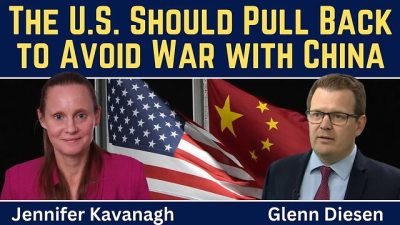
Why the U.S. Should Pull Back From the First Island Chain
or go to
Aletho News Archives – Video-Images
Book Review
‘Why Fauci Must Rot in Prison’: A Tale of Two Diaries
By Jill Erzen | The Defender | October 13, 2026
Dr. Anthony Fauci’s private diary reveals a “mind-numbing” contradiction between what the former top U.S. infectious disease official knew about COVID-19 and what he told the public, senior White House adviser Peter Navarro, Ph.D., said last week on “American Thought Leaders.”
In his new book, “Why Fauci Must Rot in Prison,” due out Oct. 20, Navarro compares Fauci’s private entries to his own pandemic-era diary, and uses what he calls “a tale of two diaries” to argue that Fauci should face criminal prosecution.
“I show, actually, how a prosecution can and should happen … at the state level, most likely,” Navarro said. “He should wind up in prison, and we’ve got the receipts in this book to put him there.”
Navarro said Fauci repeatedly acknowledged important facts in private, then publicly pursued policies that contradicted those facts — with devastating consequences.
“What he says many times privately in his diary is so at odds with both his public behavior and public statements that it’s mind-numbing,” Navarro said.
Navarro examines the lasting damage caused by lockdowns and other pandemic policies, and the ongoing toll of long COVID.
His book also addresses questions about vaccine safety, including why healthy young people faced COVID-19 vaccination mandates despite concerns about myocarditis, and why women were not warned about miscarriage risks linked to the shots. … continue
Blog Roll
 Aletho News
- Jennifer Kavanagh: Why the U.S. Should Pull Back From the First Island Chain
- Yemen denounces international community’s silence on Saudi aggression, siege
- UAE and Saudi Arabia move toward renewed coordination against Sanaa
- How Iran’s two-week retaliatory strikes exposed cracks in US military architecture in Persian Gulf
- The mother of all propaganda: Why the hype over US MOAB strike against Iran is nothing but theater
- Iran says it possesses technology behind US 14-ton GBU bunker-buster
- Trump asks Iran not to retaliate after he strikes Pickaxe Mountain – w/ Prof. Marandi
- Vice President J.D. Vance’s Deceptive ‘Antiwar’ Campaign Speech
- Iran: Palestinians’ rights must not be compromised in Gaza’s future; US, Israel to blame for Hormuz situation
- Ongoing tales of Syrian chemical weapons
- If Americans Knew
- Israeli rabbi permits occupiers to steal Palestinian olive harvest in West Bank
- Netanyahu’s spin on latest settler attack is laughable – Daily Update
- Israeli soldiers debunk Israel’s talking points
- In West Bank, Israeli settlers are totally out of control – Daily Update
- NPR investigation finds evidence of widespread fraud at mall kiosks tied to Israeli skincare brand
- Tucker Carlson exposes Israeli Lies about the Oct 7th attack, Charlie Kirk, and the U.S.
- Israel has detained thousands of Palestinian children since Oct 7th – over half spent time in solitary, many uncharged
- Israeli Analysis: Is Netanyahu Planning an ‘October Surprise’ Attack Before Israel’s Election?
- Israeli settlers brutally attack Palestinians and Washington Post female photographer, 65
- Words Have Changed, Occupation Continues: The Reality of the Gaza Ceasefire
- No Tricks Zone
- Predictions Made By Renowned Climate Proifessor Over Past Decades Have Been Proven To Be Poor
- New Study Suggests Large Regions Of The Pacific Ocean Have Been Cooling For The Last 80 Years
- Germany’s Green Energy Debacle: High Energy Costs Force Kahla Porzellan to Close After 182 Years!
- New Study: 50 Years Of The Most Aggressive ‘Net Zero’ Policies Can Only Affect The Global Climate By 0.03°C
- US September “Heat” Was No Record…Many Records Set Decades Ago
- Latest European Green Energy Debacle; Portugal’s Largest Flagship Solar Park Insolvent!
- Green Energy Debacle: German Expert Professor Fritz Vahrenholt Warns Of Severe Economic And Social Consequences
- Two More Paleo Reconstructions Affirm Meters-Higher Sea Levels Across Ireland, Brazil 7000-6000 Years Ago
- New Study: Earth And Venus Surface Warmth Largely Explained By Convection And Lapse Rate, Not CO2 Or Radiation
- 2025 Nature Paper Claiming Worsening Global Drought Gets RETRACTED …Heavily Flawed

