A Step Toward Justice in the Long “War on Terror”: Uruguay Offers to Welcome Guantanamo Detainees
By Benjamin Dangl | Toward Freedom | March 21, 2014
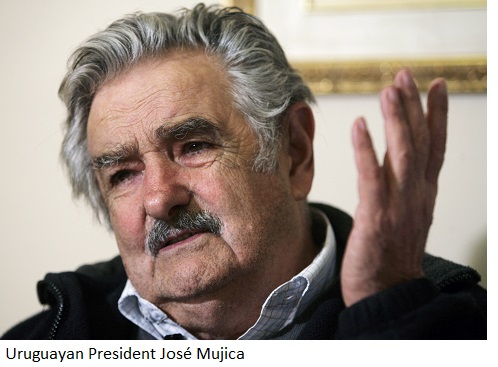 Under the Presidency of José “Pepe” Mujica, Uruguay has made a number of international headlines in recent years for progressive moves such as legalizing same sex marriage, abortion and marijuana cultivation and trade, as well as withdrawing its troops from Haiti. This week, Mujica offered to welcome detainees from the US’s detention center at its base in Guantánamo Bay, Cuba.
The Uruguayan president accepted a proposal from the Obama administration to host the detainees. “They are coming as refugees and there will be a place for them in Uruguay if they want to bring their families,” Mujica explained. “If they want to make their nests and work in Uruguay, they can remain in the country.”
“I was imprisoned for many years and I know how it is,” he said. The left-leaning president is a former revolutionary guerilla who was jailed for 14 years before and during Uruguay’s 1973-1985 dictatorship. After his release, he ended his guerilla activities and entered politics, becoming the Minister of Agriculture in 2005 under the Tabaré Vázquez administration, and was elected to the presidency in 2010.
Mujica, who has been touted as the “world’s poorest president” due to his frugal lifestyle and the fact that he donates about 90% of his presidential salary to charities and social programs, still lives on a flower farm with his wife outside the capital, and drives a beat up Volkswagen Beetle to work. Earlier this year, he was nominated for the Nobel Peace Prize for his progressive marijuana legalization program and views against excessive consumerism. His newest move against the human rights abuses of the “war on terror” has put him back in the global spotlight.
Standing Against a Symbol of the “War on Terror”
The detention center at the US base in Guantánamo Bay has long been a symbol of the human rights abuses that have come to define the so-called “war on terror.” After 9/11, the George W. Bush administration began using the facility to detain suspected terrorists. It quickly became notorious as a site of inhumane treatment, torture, and lawlessness; a decade later, many of the detainees have been held without charges or a trial.
Roughly 800 men and boys have been kept in Guantánamo as part of the US’s terror suspect roundup. Now only 154 remain, and the Obama administration, with support from Congress, is trying to make good on its promise to shut the detention center down. As part of those moves, Washington is seeking new countries to host the released detainees.
Uruguay is the first Latin American nation to accept Obama’s offer to welcome former prisoners onto its soil. Since Obama’s election, 38 Guantánamo detainees have been released to their home countries, and 43 have been resettled in 17 other countries. According to Human Rights Watch, the US wants to send detainees to countries that can provide the security the US seeks under the terms of the transfer. Uruguayan press reports that the transfer would likely involve five detainees who would have to stay within Uruguay for at least two years.
While Mujica and the US Ambassador are clear that the plans surrounding the transfer are not finalized, Mujica’s reasons for hosting the men are a sign that Uruguay is taking important steps toward justice against Washington’s long-standing “war on terror.”
For years, countless activists, governments and human rights groups have called for the closure of the US detention center in Guantánamo Bay. Last July, activist Andrés Conteris, who has worked for decades on human rights issues in Latin America,went on a hunger strike for over three months in solidarity with hunger-striking prisoners in Guantánamo Bay.
The strike denounced the inhumane and unlawful treatment of the detainees; numerous cases of physical, psychological, religious and medical torture against prisoners have been widely reported over the years. It is this treatment that President Mujica is standing against in his welcoming of the detainees.
“Given Pepe Mujica’s experience with long-term torture,” Conteris explained to me, referencing Mujica’s own imprisonment, “this gesture offering to resettle Guantánamo prisoners in Uruguay not only expresses his country’s commitment to human rights, but it shows a personal connection this president has with those suffering inhuman treatment perpetrated by military forces.”
***
Benjamin Dangl has worked as a journalist throughout Latin America, covering social movements and politics in the region for over a decade. He is the author of the books Dancing with Dynamite: Social Movements and States in Latin America, and The Price of Fire: Resource Wars and Social Movements in Bolivia. Dangl is currently a doctoral candidate in Latin American History at McGill University, and edits UpsideDownWorld.org, a website on activism and politics in Latin America, and TowardFreedom.com, a progressive perspective on world events. Email: BenDangl(at)gmail(dot)com.
Related articles


Land of the Free
the Americas have a noble, exceptional, honorable history
so we are told
such opportunity
the workers, the immigrants, who were cheap insurance against challenges to legitimacy, land title, labor bankruptcy and invasion
make them build the infrastructure
make them pay
make them love labor, exploitation and oppression
wrap it in a flag
imply a promise
never throw a bone
make them work for it
make them bow at the alter of class devotion
it’s no mistake, that word patriot
“defends his country and its interests with devotion”
devotion: to give all ones time and resources, to sacrifice
to devote: a vow, a formal, solemn promise
vow: a 13th century solemn promise to god
latin devoveo, a self-sacrifice, an offering, a curse
curse? a solemn utterance intended to invoke a supernatural power to inflict harm or punishment on someone or something?
devote yourself to me, as god requires, or you will be punished!
sounds like a curse
patriot, a concept that did not exist before the 16th century
just in time
for ships and colonizers, slaves, indentured servants and immigrants
as many an 3 of 4 whites in American colonies in the 18th century were indentured
privately held personal property, chattel
cheap insurance against recalcitrant native peoples and slaves
recalcitrant: having an obstinately uncooperative attitude toward authority or discipline
may it be so
indentured servants: they, and their descendants can be sold and inherited
“If we forget what we did, we won’t know who we are” – Ronald Reagan
Settlers from Mitzpe Yair attack Palestinian shepherds grazing on Palestinian owned land during Purim
Operation Dove | March 16, 2014
At-Tuwani, Occupied Palestine – On Sunday March 16, during the Jewish holiday of Purim, Israeli settlers attacked Palestinians and Internationals on Palestinian fields near Mitzpe Yair illegal outpost.
In the morning, four Palestinian shepherds from the village of Qawawis were grazing their flocks south of the Israeli outpost of Mitzpe Yair, when a settler arrived armed with an iron pipe to threaten them shouting. At 9:18 am two Internationals arrived together with two further Palestinian shepherds. The armed Israeli settler then left when he saw that they were filming the scene.
At 9:28 am eight settlers arrived from the illegal outpost – one was still armed with the iron pipe – and four of them violently chased away the flocks, pushing them toward the valley underlying the outpost. Palestinian shepherds followed the settlers in order not to lose their flocks accompanied by Internationals. The Palestinians immediately called the Israeli police.
At 9:48 am the settlers came back to the outpost. In the meantime, an additional International and two Palestinian members of the South Hebron Hills Popular Committee arrived at the scene. At 10:00 am one of the settlers tried to chase away one of the newly-arrived Palestinians, a member of the Israeli human rights organization B’Tselem. As this happened, an Israeli policeman and three Israeli soldiers arrived by foot. At 10:20 am, as the policeman began interrogating the attendants, a further three settlers arrived. Those interrogated were the Palestinian shepherd Nail Abuaram (who filmed everything with a B’Tselem camera) and one International.
At 10:45 am, the policeman lead Abuaram and one of the Internationals to Kiryat Arba police station to give testimony of the harassments. They arrived at the station at noon.
The International was asked for the camera footage of the incident, interrogated and finally released at around 2:50 pm. Abuaram was interrogated alone for a couple of hours and was threaten of arrest until he accepted to sign a paper stating that he will not get closer than 450 meters to the area where the harassment took place for a period of 15 days. He was later released around 6:00 pm after signing the paper. The Israeli police forced the settler who attacked the Palestinians with an iron pipe to stay 200 meters far from the spot where the harassment took place for a period of 15 days.
Palestinian communities of the South Hebron Hills area are strongly involved in using nonviolence as a way to resist the Israeli occupation.
Operation Dove has maintained an international presence in At-Tuwani and the South Hebron Hills since 2004.
[Note: According to the Fourth Geneva Convention, the Hague Regulations, the International Court of Justice, and several United Nations resolutions, all Israeli settlements and outposts in the Occupied Palestinian Territories are illegal. Most settlement outposts, including Havat Ma’on (Hill 833), are considered illegal also under Israeli law.]
Related articles
300 arrested at Montreal protest against police brutality
RT | March 16, 2014
Canadian police surrounded an annual protest against police brutality in Montreal, arresting 288 people before the demonstration had barely started.
 The police claim the protest was illegal as the participants did not warn the authorities of their itinerary.
Montreal’s 18th annual protest against police brutality was cut dramatically short Saturday when police rounded up the participants. Minutes into the demonstration, riot officers converged on Jean-Talon Street and began detaining protesters. According to protesters there was a strong police presence, with police horses, cars and a helicopter on the scene.
“It was a veritable army of police … who occupied the area surrounding the Jean-Talon metro when the protest was to start,” the Collective Opposed to Police Brutality, which organizes the annual protest, said in a written statement issued after the protest.
Police declared the demonstration was illegal and asked the protesters to disperse. However, the activists carried on marching, brandishing banners and chanting slogans, such as “They want us to respect them, but they don’t respect us!”
Riot police then encircled the protesters and began making arrests. The majority of the 288 people who were taken into custody were released shortly afterwards, but four people may be charged under the Criminal Code for assaulting an officer and obstructing the police. Several others could face charges of mischief.
One man sustained injuries to his face during the police intervention and was tended to by paramedics on the site, said officers.
“They refused to share their itinerary, and they refused to give us any details. When we got there, we asked them not to jump onto the street, and they answered by going into the street and yelling at us that they were not cooperating,” police spokesman Ian Lafrenière said. He added that the protest has a bad reputation with the authorities and on previous occasions the demonstrations had descended into violence and rioting.
However, activists had a different version of events and have accused the police of lying about the protesters’ activities.
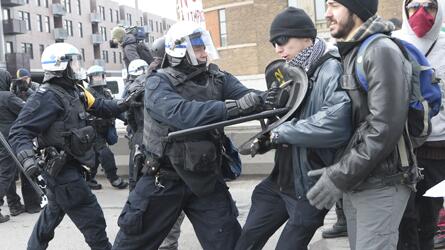 “It looks good in the media — the police can say (all of these) people were arrested, were breaking windows and stuff, but it’s not true. They were doing nothing,” Claudine Lamothe told the Montreal Gazette.
The Collective Opposed to Police Brutality has staged a protest in Montreal every year for the past 18 years. This year they focused their protest on the issue of “social cleansing” where the authorities try to “get rid of people who are deemed unwanted,” the group writes on its website. The group cites an incident in January when an unnamed Montreal police officer threatened to tie a homeless man to a lamppost in temperatures of minus 30 if he did not move along. Following the incident, Lafrenière told the Montreal Gazette that the officer had been reprimanded for his “unacceptable” behavior.
Law Enforcement Agencies All Over California Have Been Secretly Using Stingray Devices
By Tim Cushing | Techdirt | March 14, 2014
More documents have been uncovered (via FOI requests) that show local law enforcement agencies in California have been operating cell phone tower spoofers (stingray devices) in complete secrecy and wholly unregulated.
Sacramento News10 has obtained documents from agencies in San Jose, Oakland, Los Angeles, San Francisco, Sacramento and Alameda County — all of which point to stingray deployment. As has been the case in the past, the devices are acquired with DHS grants and put into use without oversight or guidelines to ensure privacy protections. The stingrays in use are mainly limited to collecting data, but as the ACLU points out, many manufacturers offer devices that also capture content.
Some of these agencies have had these devices for several years now. Documents obtained from the Oakland Police Dept. show the agency has had stingrays in use since at least 2007, citing 21 “stingray arrests” during that year. This is hardly a surprising development as the city has been pushing for a total surveillance network for years now, something that (until very recently) seemed to be more slowed by contractor ineptitude than growing public outrage.
The device manufacturer’s (Harris) troubling non-disclosure agreement (which has been used to keep evidence of stingray usage out of court cases as well as has been deployed as an excuse for not securing warrants) rears its misshapen head again, mentioned both in one obtained document as well as by a spokesperson reached for comment. One document states:
“The Harris (REDACTED) equipment is proprietary and used for surveillance missions,” the agreement reads. “Its capabilities can only be discussed with sworn law enforcement officers, the military or federal government. This equipment’s capabilities are not for public knowledge and are protected under non-disclosure agreements as well as Title 18 USC 2512.”
The Sacramento County Sheriff’s Dept. had this to (not) say when asked about its stingray usage:
“While I am not familiar with what San Jose has said, my understanding is that the acquisition or use of this technology comes with a strict non-disclosure requirement,” said Under sheriff James Lewis in an emailed statement. “Therefore it would be inappropriate for us to comment about any agency that may be using the technology.”
Law enforcement agencies are conveniently choosing to believe a manufacturer’s non-disclosure agreement trumps public interest or even their own protection of citizens’ Fourth Amendment rights.
The devices aren’t cheap, either. Taxpayers are shelling out hundreds of thousands of dollars for these cell tower spoofers, and the agencies acquiring them are doing very little to ensure the money is spent wisely. ACLU’s examination of the documents shows that many of the agencies purchased devices without soliciting bids.
It’s hard to know whether San José or any of the other agencies that have purchased stingray devices are getting good value for their money because the contract was “sole source,” in other words, not put out to competitive bidding. The justification for skirting ordinary bidding processes is that Harris Corporation is the only manufacturer of this kind of device. (We are aware of other surveillance vendors that manufacture these devices, though a separate Freedom of Information Request we submitted to the Federal Communications Commission suggests that, as of June 2013, the only company to have obtained an equipment authorization from the FCC for this kind of device is Harris.)
With Harris effectively locking the market down, buyers are pretty much ensured prices far higher than the market would bear if opened to competition. (Not that I’m advocating for a robust surveillance device marketplace, but if you’re going to spend taxpayers’ money on products to spy on them, the least you can do is try to get the best value for their money… ) Using federal grants also allows these departments to further avoid public scrutiny of the purchase and use by circumventing the normal acquisition process.
Beyond the obvious Fourth Amendment concerns looms the very real threat of mission creep. These agencies cite combating terrorism when applying for federal funds, but put the devices to use for ordinary law enforcement purposes. The documents cite stingray-related arrests, but since so little is known about the purchase, much less the deployment, there’s really no way to tell how much data and content totally unrelated to criminal investigations has been collected (and held) by these agencies.
Israeli Soldier Interrogates Palestinian Boy at Gunpoint
By Chris Carlson| International Middle East Media Center | March 13, 2014
The Israeli Haaretz newspaper unveiled, Thursday morning, that an Israeli soldier pointed his gun at a handcuffed Palestinian boy, during an investigation after arresting him in Nabi Saleh village, near the West Bank city of Ramallah.
The Al Ray newspaper pointed out that Israeli forces arrested four boys from Nabi Saleh village three weeks ago, under the pretext of throwing stones.
He (one suspect) was led to Benjamin police station for investigation.
There, one of the soldiers who participated in the arrest attended, and was filmed while directing his gun towards the boy in the interrogation room. The soldier left the room after investigation officers arrived, the newspaper added.
It was noted, by the court, that the documentation of the stone-throwing incident is not professional, and that the boys’ identities are in doubt.
Scandal of billion dollar deals between Saudi Arabia and Veolia
Ard Kanaan News Agency | March 12, 2014
Veolia is a French company specialising in environmental work in the fields of water, recycling, energy and transportation. The company has recently had a lot of media coverage given its contribution to supporting Israeli settlements.
The company has been registered by international activists concerned with the Palestinian cause on the Boycott, Divestment, and Sanctions (BDS) list since 2005, “due to their immoral work serving the occupation in various areas in Palestine”.
Currently it is involved in a railway project in Jerusalem that links the illegal West Bank settlements and Jerusalem which is considered one of the occupation’s main means and an important step in the context of the Judaisation of Jerusalem project and the expansion of settlements in the city. It not only transports Israelis passing through, but also facilitates access between the new Israeli settlements and the settlers as a means of easing settlements and outlining a mechanism and infrastructure for its expansion. This is considered a violation of the Geneva Accords which prohibit the occupation from transporting its citizens to occupied territories, so this is not only a clear violation of Palestinian rights, but also a violation of international agreements made in this regard.
Veolia’s activity ranges between environment workshops, water and transportation, as it works through one of its subsidiaries (T.M. M.) and Tovlan Landfill, near Jericho, as a report by Corporate Watch Research Group, specialising in monitoring the work of international companies, stated the violations made by Veolia with regards to the management of the landfill. Veolia buries the waste of 21 settlements in the landfill near the Jordanian border, this has many health and environmental “side effects” on neighbouring Arab villages such as Fasayil and Abu Al `Ajaj, leading to the displacement of the residents of the latter, the population dropping to 200 residents from thousands in 1999, the year the landfill was established.
There are also those who leave their homes during the summer only to return in winter when the smell from the landfill is not as strong. The livestock, which is the main source of income for locals, also suffered big losses.
The residents of these villages are also deprived of electricity, while the residents in settlements have electricity and water at discounted rates in order to motivate them to live in settlements. The recycling of the waste in the landfill contributes to the provision of electric energy by means of renewable energy.
Who works in the landfill? Palestinians work in the landfill and they are deprived of any labour rights, as their wages are half the minimum wages set for Israeli workers and they are deprived of work and health insurance.
The company also has shares in the bus routes, such as route 109 and 110, which provide transportation for settlers on Highway 433 in the West Bank running through the settlements. The occupation enforces apartheid/segregation rules on highway 433, as Palestinians are not allowed to use the highway.
Veolia is also involved in facilitating Israeli exclusion operations, as well as facilitating the transfer of settlement waste, transporting it to Palestinian areas and causing many long-term health and geographic problems. This has encouraged the indirect expulsion of Palestinians, all of which has contributed to the process of racial segregation in transportation in those areas.
Similarly, it has recently provided water and sanitation services to many of the Israeli occupation’s settlements in the occupied West Bank, including the Modi’in Ilit settlement located between Jerusalem and Tel Aviv in the occupied Palestinian territories.
This means that three out of Veolia’s four subsidiaries – water, waste and transportation – actively work to support settlements.
Veolia’s activities are considered a flagrant violation of international law, specifically Article 49 of the Fourth Geneva Convention which states that “Individual or mass forcible transfers, as well as deportations of protected persons from occupied territory to the territory of the Occupying Power or to that of any other country, occupied or not, are prohibited, regardless of their motive.”
International law also prohibits Israel from using occupied land for its own benefit and, therefore, burying waste from the settlements in the occupied territories is a violation of United Nations Resolution 63/201 dated January 28, 2009, which:
“Calls upon Israel, the occupying Power, not to exploit, damage, cause loss or depletion of, or endanger the natural resources in the Occupied Palestinian Territory, including East Jerusalem, and in the occupied Syrian Golan.
Calls upon Israel, the occupying Power, to comply strictly with its obligations under international law, including international humanitarian law, with respect to the alteration of the character and status of the Occupied Palestinian Territory, including East Jerusalem.
Also calls upon Israel, the occupying Power, to cease the dumping of all kinds of waste materials in the Occupied Palestinian Territory, including East Jerusalem, and in the occupied Syrian Golan.”
In addition to violating international law, Veolia’s acts violate the resolution of the Arab summit in Khartoum, in March 2006, which provides for the following:
The condemnation of the project aiming to link West Jerusalem to the occupied West Bank through occupied East Jerusalem and the stressing of the illegality of this project. It also calls on the two French companies [Alstom and Veolia] to immediately withdraw from the project and demands punitive measures be taken against them if they don’t comply. The Arab Summit also urged the French government to take the necessary measures in this respect to honour its obligations under international law.
To top this all off, Veolia’s activity in the occupied territories contradicts the company’s declared goals and strategies which aim to “reduce the negative environmental impacts of waste” and “help raise the citizens’ standard of living.”
It is clear that Veolia selectively applies these goals, as it only aims to raise the standard of living of the settlers, at the expense of the Palestinians and in violation of international treaties and the most basic human rights.
This company’s long history of racism and the oppression of the Palestinians’ rights was enough to convince the public opinion in different parts of the world to boycott it.
The campaign to reduce the company’s activity and completely boycott it was successful in impacting its work, which has suffered due to losses estimated at more than $12 billion over the past six years in order to prevent the renewal or signing of new contracts in many countries worldwide. These include Australia, Sweden, Norway, Netherlands, Ireland, Scotland and finally England. In addition to this, a coalition of boroughs in south-west London refused to bid on the tender offered by Veolia for a £1 billion waste removal deal last April. In January 2009, Veolia lost a contract worth €3.5 billion Euros to run the metro in Stockholm.
In addition to the efforts made globally to boycott this company and reduce its activity, French company Alstom, a company working in partnership with Veolia on the Jerusalem railway project, linking Jerusalem and the settlements, lost the second phase of the Saudi Haramain Railway project, which connects Mecca and Medina in Saudi Arabia. This is in spite of the fact that the company had previously won the contract for the first phase. The value of the second phase contract is about $10 billion.
Since the end of 2008, the BDS National Committee, along with its partners, have made popular, official and media efforts in order to convince the Saudi authorities to exclude Alstom from the Haramain Railway deal due to its involvement in the Israeli occupation’s projects aiming to Judaise Jerusalem. Many letters and documents to this effect were sent to official parties in Saudi Arabia from the BDS Committee, as well as several official, popular, Palestinian, Islamic and international parties in the context of a coordinated campaign targeting this company.
Veolia in Saudi Arabia
Despite all of the information mentioned above, all the background information, business links, relations with the Israeli occupation and settlement operations, as well as its direct involvement in facilitating the expansion of settlements and the Judaisation of Jerusalem, and in spite of the boycott exercised by British and other organisations and governorates against Veolia, it has continued to operate and make outrageous profits in Saudi Arabia for years.
The company’s work in Saudi Arabia is narrowed down to the fields of water, sanitation and water desalination. It exists in Saudi Arabia through the Veolia Water Solutions & Technologies, Saudi Industries Ltd, with branches in Riyadh, Jeddah and Dammam. Veolia also operates in Saudi Arabia under the Sidem Saudi Ltd, one of Veolia Water Solutions & Technologies, Saudi Industries Ltd’s subsidiaries, which has branches in Jeddah, Khobar and Jubail. Sidem specialises in designing and building large desalination plants.
Veolia Water Solutions & Technologies, Saudi Industries Ltd has landed many large contracts with the Saudi government in recent years. The two contracts worth noting are the desalination plant contract with the Power and Water Utility Company for Jubail and Yanbu, signed in 2007, and the management, operation and maintenance of the water and sanitation sector deal in the Saudi capital Riyadh, signed in 2008.
In 2007, Veolia signed a contract with the Power and Water Utility Company for Jubail and Yanbu to establish one of the largest water desalination plants in the world worth $945 million. One year before signing the deal, Saudi Arabia signed the Arab Summit resolution in Khartoum.
Furthermore, Veolia has landed 62 water desalination contracts in Saudi Arabia since 2007. In 2008, Veolia signed a large contract with the National Water Company to manage, operate and maintain the water and sanitation in the Saudi capital Riyadh. Veolia expects this deal to achieve a $60 million profit.
In December 2011, Veolia signed a contract with the King Fahd University of Petroleum and Minerals to establish research centres in the Dhahran Techno Valley.
While Alstom – Veolia’s partner in the Judaisation of Jerusalem project and the Jerusalem railway project, connecting Jerusalem to the settlements – lost the second phase of the Haramain Railway project worth about $10 billion, Veolia (in full partnership with Alstom) is signing contracts worth billions of dollars in Saudi Arabia, despite its blatant violation of international law and the rights of the Palestinians.
Veolia has been working in Israel before it entered the Saudi market, and its involvement in settlements began very early on, before it made any deals with the Saudi government.
It is both embarrassing and astonishing that Veolia’s involvement in the settlements was not taken into account when it was awarded these huge business deals in Saudi Arabia and that the vast global BDS campaign against Alstom and Veolia in 2011 did not impact Veolia’s operations in Saudi Arabia, as the company signed an agreement with the King Fahd University of Petroleum and Minerals in December of the same year.
It is also shameful that at a time when international companies and parties are taking a stance against this company for violating the most basic human rights in Palestine and its participation in the brutal Israeli occupation and settlement, the Saudi government is signing contracts with the same company in various business areas. This in a country which is supposedly a leader in the belief in Palestinian rights, as well as protecting such liberties and condemning all human rights violations during this serious Palestinian tragedy.
A company with such a shameful history of working to enhance Israeli settlements should not find a work environment that opens the doors to trading in a country like Saudi Arabia, which has a long history of supporting the Palestinian cause.
While Veolia is losing billions of dollars in contracts in Stockholm and London, it is signing a billion dollar deal in Jubail and making profits of up to $60 million dollars in Riyadh!
The least that is expected of Saudi Arabia is not to sign contracts with Veolia, to pressure the company and make it choose between carrying out its responsibilities in accordance with international law, stop supporting the settlements and violating the rights of the Palestinians or to get out of Saudi Arabia and cease all forms of business with it.
Translation by MEMO
Al-Aqsa vs. Israel: The Lurking Danger Beneath

While the danger of Al-Aqsa Mosque collapsing is very real, it is a representation of the mentality that rules Israel. (Photo: Mahfouz Abu Turk)
By Ramzy Baroud | Palestine Chronicle | March 12, 2014
Something sinister is brewing around and below al-Aqsa Mosque in occupied East Jerusalem, and it has the hallmark of a familiar Israeli campaign to strip the Mosque of its Muslim Arab identity. This time around, however, the stakes are much higher.
The status of al-Aqsa mosque is unparalleled within the context of Muslim heritage in Palestine itself. It is also the third holiest Muslim shrine anywhere. But equally as important, it is a symbol of faith, resistance and defiance. Its story of struggle and perseverance goes hand in hand with the very modern Palestinian struggle for rights, freedom and identity. Praying at al-Aqsa at times seems like an impossible feat. Many Palestinians lost life or limbs simply trying to gain access to the mosque.
In a statement released on March 7, the Palestinian Ministry of Awqaf and Religious Affairs said Israeli forces carried out 30 attacks against Al-Aqsa Mosque and other holy sites during the month of February alone. Most of the attacks targeted Al-Aqsa itself. While the recurring violations at Al-Aqsa were led by Jewish settlers, according to the statement, they have done so under the watchful eye, protection and support of the Israeli police and army.
Most alarming about these attacks is their political context, which indicates that a great degree of coordination is underway between politicians, security forces and Jewish settlers.
In anticipation of a Palestinian backlash, on March 04, an Israeli court sentenced Islamic leader Sheikh Rade Saleh to eight months in prison for ‘incitement’. The Sheikh is the most outspoken Palestinian leader regarding the danger facing Al-Aqsa. Why silence Sheik Saleh now when the attacks against al-Aqsa are at an all time high?
It was on February 25, 1994, that US-born Jewish extremist Baruch Goldstein stormed into the Ibrahimi Mosque in the Palestinian city of al-Khalil (Hebron) and opened fire. The aim was to kill as many Arabs as he could.
At that moment, nearly 800 Muslim worshipers were kneeling down during the dawn prayer in the holiest month of the Muslim Calendar; Ramadan. He killed up to 30 people and wounded over 120. Exactly 20 years later, the Israeli army stormed al-Aqsa Mosque, the third holiest Muslim site, and opened fire. The timing was no accident.
Like the rest of the West Bank, Al-Khalil is facing the dual challenge of armed Jewish settlers and Israeli occupation soldiers; the latter enforcing the military occupation, while providing further protection to the settlers. The settlers, extremists from the illegal settlement of Kiryat Arba, often attack Palestinian residents of the town with complete impunity. Interestingly, many of Kiryat Arba settlers are Americans, as was Baruch Goldstein.
It was not enough that Israeli soldiers within the vicinity of the Ibrahimi Mosque allowed Goldstein – armed with a Galil rifle and other weapons – access to the mosque, but they opened fire on worshipers as they tried to flee the scene. Israeli soldiers killed 24 more and injured others. Goldstein, now a hero in the eyes of many in Israel, is often blamed solely for the massacre in al-Khalil. But in fact, it was a mutual effort between Goldstein and the Israeli army.
This symbiotic relationship between the army and settlers, which dates back to the early days of the Israeli occupation of Jerusalem, the West Bank and Gaza in 1967, continues.
While Israeli bulldozers dig into Palestinian land during the day, leveling mounds of ground and destroying olive groves for settlement expansion, heavy machinery burrows beneath the Old City of al-Quds, Jerusalem, at night. The Israelis are looking for evidence of what they believe to be ancient Jewish temples, presumably destroyed in 586BC and AD70. To fulfil “prophecy”, Jewish extremists believe that a third temple must be built. But of course, there is the inconvenient fact that on that particular spot exists one of Islam’s holiest sites: The Noble Sanctuary, or al-Haram al-Sharif. It has been an exclusively Muslim prayer site for the last 1,300 years.
The Noble Sanctuary, located in Jerusalem’s Old City, is the home of Al-Aqsa Mosque and the Dome of the Rock. The site has been under constant threat, attacks, acts of arson and military violence for nearly five decades. The few Muslim clergy – belonging to the Islamic Trust which manages the area, along with the custodianship of Jordan – are mindful of the ever-lurking Israeli threat that oftentimes turns deadly. It was no surprise that late Israeli leader Ariel Sharon chose that exact place to carry out his proactive ‘tour’ of al-Aqsa compound in 2000. Many unarmed Palestinians, mostly worshipers, died on that day. Thousands more were lost in the following months and years as the entirety of the occupied territories and Palestinian towns inside Israel exploded with unprecedented fury. Sharon was later elected Prime Minister of Israel.
That same dangerous combination – rightwing politicians allied with religious zealots – is at work once more. They are eying Al-Aqsa for annexation, the same way the Israeli government is laboring to permanently annex large swathes of the occupied West Bank, to preclude any future settlement with the Palestinian Authority of Mahmoud Abbas.
The Israeli Knesset (Parliament) chose the 20th anniversary of the Goldstein massacre of Palestinians in al-Khalil to begin a debate concerning the status of Al-Aqsa compound. Right-wingers – which constitute the bulk in the government of Prime Minister Benjamin Netanyahu – want the Israeli government to enforce its ‘sovereignty’ over the Muslim site, which is administered by Jordan per the Jordanian-Israeli peace treaty of 1994. Israeli MP Moshe Feiglin, is the man behind the move, but he is not alone. Feiglin is a member of Netanyahu’s Likud party, and has strong backing within the party, the government and the Knesset.
A major backer of Feiglin’s initiative is Miri Regev, also a far-right Likud member. Regev is demanding that the government establish separate prayer times for both Jews and Muslims in Al-Aqsa Compound. The model she wishes to duplicate is no other than the Ibrahimi Mosque. “We will reach a situation where the Temple Mount will be like the Cave of the Patriarchs, days for Jews and days for Muslims,” she said.
Of course, Regev omitted the fact that 20 years ago to the day, a Jewish extremist and Israeli troops killed and wounded hundreds of Palestinians kneeling for prayer.
On the next day following the Israeli government debate, a thundering sound was heard around 3 AM in the Wadi Hilweh neighborhood of Silwan, located south of the Old City of Jerusalem. Residents heard the “sounds of heavy duty machines digging under their houses throughout the night,” Ma’an reported. Then, a large wall suddenly collapsed, while a few houses sustained damage. The Israeli underground network of tunnels is growing, as some of these tunnels connect Wadi Hilweh to the Western Wall to Al-Aqsa.
While the danger of Al-Aqsa Mosque collapsing is very real, it is a representation of the mentality that rules Israel: one of annexation and military occupation, with no regard whatsoever to Palestine’s holiest site, also revered by over 1.6 billion Muslims around the world.
– Ramzy Baroud is an internationally-syndicated columnist, a media consultant, an author and the editor of PalestineChronicle.com. His latest book is “My Father Was a Freedom Fighter: Gaza’s Untold Story” (Pluto Press, London).
The Case Against Bill Bratton

By Josmar Trujillo | Black Agenda Report | March 12, 2014
The first two months of the City’s post-Bloomberg era have seen little in the way of “progressive changes to the New York Police Department. While new(ish) Mayor Bill de Blasio may have seen his honeymoon period come to an end with a few notable controversies in February, the once-again commissioner of the NYPD, Bill Bratton, has largely stayed above the fray as he strategically manages the media and helps steer an embattled police department through a reform storm — one of his specialties.
Policing activists cheered last year when a federal judge ruled that the NYPD was engaging in (at least) “indirect” racial profiling and that reforms, including a federal monitor to oversee changes to the department, were needed. The idea of federal oversight, beyond the scope of City Hall, was music to the ears of many who questioned if the City could reform a police force whose reach stretched overseas. An appeal by the City would be the main obstacle to the court-order remedies.
Former Mayor Michael Bloomberg’s appeal of the Floyd v City of New York case was expected. Bloomberg was his famously unapologetic self to the very end. De Blasio, a self-proclaimed “progressive,” on the other hand, promised change and accountability for an NYPD that had been trampling the Constitution for years. Some activists, perhaps, felt they had an ally in de Blasio. After 12 years of Bloomberg, expectations for Hillary Clinton’s former campaign manager were informed by a sense of optimism–leading some to take “wait and see” approaches. At the end of his first month in office de Blasio and Bratton joined policing activists, civil libertarians and plaintiffs in the Floyd case to announce, to much fanfare, that he would instruct the City’s lawyers to drop the Bloomberg administration’s appeal.
Of course, simply not being Michael Bloomberg wouldn’t suffice in putting the brakes on a growing trend of police abuse, surveillance and militarization. Substantive changes are desperately needed to relieve communities of color living in what many see as a racialized police state. De Blasio, apart from his campaign rhetoric and the media narrative, had been speaking a message of only moderate reform. So moderate that many wondered if he was serious about changing the NYPD in meaningful ways.
The Returning Conqueror
The most obvious pause for alarm for community members and activists came in December when de Blasio announced he’d be bringing back Rudy Giuliani’s police commissioner, Bratton, for a 2nd run at the helm of the NYPD. Bratton is widely seen as the man who operationalized “Broken Windows” theory from an article in the Atlantic magazine into a philosophy that dominates law enforcement across the country today. His aggressive, pro-active approach, coupled with his introduction of CompStat, was the precursor to Stop and Frisk. A strange bedfellow for a “progressive” Mayor. For many who live in the front lines of aggressive policing, labels like “progressive” mean very little. Ditto for Stop and Frisk; police profiling and harassment of black and brown men is a time-honored tradition that preceded the policy. But the policy became a controversial issue the past few years and a central theme in last year’s mayoral election. De Blasio’s biracial son was featured in campaign ads touting his father as the only one who would “end the Stop and Frisk era.”
Bratton seemed an awkward choice to fulfill that pledge. Before the appointment, he said that cops who don’t do it “aren’t doing their job.” If you look back at Bratton’s cable TV appearances, his speeches and the philosophy of his little known consulting company, Bratton Group, he has never wavered from his support of the tactic. So far he’s been consistent: a few days into his second stint as commissioner, the famously media-savvy Bratton told CBS’s Norah O’Donnell that policing without Stop and Frisk is like a “journalist interviewing without asking questions.” In his most recent interview he said there’d be “anarchy” without it.
But New Yorkers were told that Bratton was different now than the Bratton of the past. A kinder, gentler Bratton wanted to save us from the excesses of the Ray Kelly era. Even Al Sharpton, who had famously been at odds with Bratton in the 90’s, gave his blessings to Bratton at an event honoring the late Nelson Mandela. An ACLU lawyer penned an op-ed in the New York Times praising Bratton. Bratton even met with his fiercest critics when he sat down with a small group of policing activists. It seemed many were willing to watch the Bratton sequel unfold–perhaps even support it. The architect of Stop and Frisk had also, to the outrage of some, invoked King’s “Letter from a Birmingham Jail” at a recent MLK day celebration in Brooklyn.
Then Bratton laid out some of his cards. It was reported that Bratton was looking to bring on George Kelling as a consultant. Kelling, a senior fellow at the conservative Manhattan Institute think tank, is both a friend of Bratton and one of the authors of the influential Atlantic magazine article that birthed “Broken Windows” theory and laid the framework for Stop and Frisk. Activists that had been tempered in their response to the Bratton appointment were now delivering some slightly stronger language as they criticized Bratton’s look to the past in shaping the NYPD’s future through the hiring of Kelling.
But whether you saw Bratton’s return as a change of direction from the approach of the Bloomberg-era, or as window dressing to business as usual, you couldn’t help but note that Bratton had now been linked with three police departments that have faced community outrage and subsequent legal challenges. Before re-joining the NYPD this year, Bratton had been hired (to significant protest) as a private consultant to the Oakland Police department, a department with a “pattern of resisting reform.” The OPD had been operating under a federal consent decree after scandal and corruption led to a legal settlement that required reforms. Before that he had been the police chief of the Los Angeles Police department, which had also been working under a federal consent decree following the infamous Ramparts scandals of the 90’s. In a case where both revolving-door and conflict of interest concerns were raised, he had just previously been working as a private consultant for Kroll Associates, the private independent monitor of the LAPD.
The fact that Bratton has been continually called in to help police departments navigate through legal oversight should raise questions for New Yorkers today who wonder if Bratton was brought in to reform or rebrand a police department that was facing legal and legislative pressure. A City Council bill that passed last summer would create potential oversight via the creation of an office of Inspector General for the NYPD. But this would be done under the auspices of the Mayor’s Department of Investigations and City Hall–offering a limited amount of independence. Similarly, the Floyd ruling called for a federal monitor to oversee reforms. But the de Blasio administration’s agreement with the Floyd plaintiffs made this a temporary role. Would a reform storm that activists, civil libertarians and outraged community members created in LA, Oakland and New York be something that Bratton would embrace–or simply get these troubled departments through
New York area activists of all stripes, but particularly those centered around policing, should keep in mind Bratton’s approach to protesters and marchers. Bratton’s LAPD violently quelled a May Day rally in 2007, and Bratton said he would have “cleared” protests in Wall Street “right away”–something not even Bloomberg or Ray Kelly did.
Bratton and The Media
Whether it’s stopping and frisking large numbers of young black or brown males in the City or cracking down on squeegee-men (both tactics derived from Broken Windows), aggressive policing is gospel and Bill Bratton is clearly the pastor of the flock. Still, as an article recently pointed out, while Bratton may have some moderate policy differences with his predecessor, Ray Kelly, he’s more concerned with rehabilitating the NYPD’s tattered image than anything.
How does he do this? He’s by far the most media-savvy commissioner of any department this City has probably ever seen. Even his counter-terrorism chief, John Miller, has media credentials that blur the lines between being a journalist and law enforcement spokesman. Miller was formerly a spokesperson for the FBI as well as a correspondent for CBS News. But Bratton’s best strategy is feeding the public quotes that suggest changes are in the works–but that inspire little hope upon closer inspection. He’s made clear that he’s “needed to use the media” to get “certain messages through.” The media is a willing partner in this regard.
Let’s take a closer look at the news from the end of Bratton’s first month back in office: A New York Times headline read “Bratton Says Rookies’ Role in Anticrime Effort Will End.” The local NY1 news channel reported “Bratton Wants NYPD Rookies Out of Operation Impact.” By those headlines you’d think Bratton was aiming to curb police harassment in frontline neighborhoods (and the backlash against it) by swapping out rookies with gracious, polite veterans. First off, the headlines were misleading–“Let me emphasize: Operation Impact is not going away. It is an essential tool” he said (echoing the fine print on Stop and Frisk “reform” he had also cautioned). Rookies will still go out to high-crime areas, he said, but they’ll be “mentored” first. It’s important to note that no policing activist had ever suggested replacing rookies with veterans (who may be more problematic in terms of profiling–it was commanding officers that pushed for quotas, as Bratton has conceded) would reform policing behavior. When one thinks of a dirty or aggressive cop, veterans may come to mind more often than rookies.
Then there was also a widely cited video message that Bratton posted to the Policeman’s Benevolent Association website. The PBA have been staunch defenders of Stop and Frisk since the Bloomberg administration and have been highly critical of reforms. They now, thanks to Bratton, also enjoy office space inside 1 Police Plaza–which might be a first for a civil service union. In the video, Bratton speaks to relying less on “numbers.” Media insisted he “bags bust quota” (an unspoken–and illegal–system that encourages cops to stop high numbers of people). But he never actually mentions quotas or explicitly says they shouldn’t be tolerated, although the impression is that he’s steering the department away from the numbers crunch.
But Bratton has always been about numbers. In fact, in an interview he did with NYU Professor Paul Romer (perhaps best known as an innovator of charter cities in the poorest regions of Latin America) a month before his appointment, Bratton points to computer “algorithms” as the next step forward for “predictive policing.” In 2009, under Bratton, the LAPD received a grant from the Department of Justice towards predictive policing technology. Any future computer programs ostensibly “predicting” crime would owe much to the legacy of Bratton and CompStat, the data driven computer policing program he introduced in New York during the 90’s. That was all about numbers. So in spite of his video message, Bratton seems very comfortable with both numbers and technology (Bratton has also recently joined Twitter).
But few public figures or voices in the media are willing to probe “America’s Supercop” very much. Not only has Bratton and his philosophy come to dominate our City (and nation) through an echo chamber of uncritical media and politicians, they resemble the talking points of previous commissioner Ray Kelly. For starters, de Blasio and Bratton’s insistence that Stop and Frisk not be ended is based largely in an argument that there is a correlation between aggressive policing and crime reduction; that without Stop and Frisk and Muslim surveillance the City would descend into New Jack City, or that we’d have another 9/11. This is almost indistinguishable from the prevailing logic of the Bloomberg/Kelly era–and isn’t clearly supported by evidence. Upon closer inspection, de Blasio and Bratton’s approach tries to encapsulate the political rhetoric that said the previous administration was too cavalier–but without undermining its logic.
Fear of a city descending into a crime-ridden replay of the past may have indeed led to the hiring of a figure of the past in Bratton. Fear is a prime ingredient for a highly policed society and it clearly makes the appointment of a controversial figure like Bratton easier to swallow for some. But it also demands media coverage that defers to the celebrity and expertise of Bratton–rarely asking tough questions. Bratton does his part by carefully managing his words, saving substantive discussions for closed-door speeches. Some may remember that it was Bratton’s media-mastery that was at the root of his ouster from Giuliani’s NYC in the 90’s.
Bratton 2.0
Research tells us that communities of color will usually be disproportionately dealt the receiving end of police profiling and brutality. If they are being sold a rebranded NYPD–one that emphasizes “collaborative” policing over constitutional policing–by a recycled Bratton, it is important to understand how that translates onto the streets, not just in press conferences.
Two weeks into the job, Bratton announced that Stop and Frisk was “more or less solved” and cited data from the Bloomberg era that suggested the practice was already in decline (statistically) since 2013. If true, then candidate de Blasio’s rhetoric to reign in Bloomberg and Kelly’s abuse of the policy was at odds with Bratton’s analysis. Had Bloomberg already reformed the NYPD in 2013? Then why the political rhetoric?
Crime statistics can be politicized depending on what the political climate is and what the incentives are. Robert Gangi from Police Reform Operation Project recently remarked that any figures provided by the NYPD about itself should be taken with a healthy skepticism. The Chief-Leader, a weekly civil service newspaper catered to cops, firefighters and other civil servants, has also written about politicized policing statistics. There is, also, the possibility that some officers simply won’t document all stops or interactions. Of course this is hard to prove and would require in-depth, independent studies. In a recent article the New York Times revealed that officers already fail to properly report friskings of drivers they pull over.
That Times article was also revealing in the context of Vision Zero, de Blasio and Bratton’s new initiative to crack down on drivers and pedestrians in the name of traffic safety. Public safety is often trumpeted when expansions of police power are rolled out. What in foreign policy is described as pre-emptive war can translate domestically into proactive policing. Who could oppose a plan to reduce traffic deaths–or keep ourselves safe from terror? But if police were focusing their attention on drivers and pedestrians with the latest enforcement crackdown, then what might the long term implications for New Yorkers be? In February, de Blasio placed a phone call to police officials after a member of his Transition Team, a black Brooklyn-based pastor and political ally, was jailed following an improper left turn stop by police.
While the Mayor took heat for the call and for a what many saw as a hypocritical driving detail that ran stop signs and sped over limit, Bratton’s NYPD was recovering from its own scandal in January when an elderly Chinese immigrant was roughed up and bloodied by cops after being targeted for jaywalking. Ironically it was the notoriously conservative New York Post that criticized the police crackdown–even as they have unabashedly championed aggressive policing most other times. In a recent interview George Kelling linked Vision Zero to Broken Windows as a “new threshold in terms of order maintenance.” He also may have inadvertently given an insight into the initiative’s other motivating factors: a crackdown on small crimes (jaywalking for pedestrians; improper turns and lane changes for drivers) as a “pathway” to uncovering other criminal behavior–what he called “side benefits.”
Amid the brewing controversies, it was becoming clear that Broken Windows was still the basis for policing in the five boroughs.
While for many New Yorkers, the term Stop and Frisk had become a dinnertime conversation topic, what did people know about Broken Windows? Back in September, de Blasio the candidate proclaimed himself a believer in the theory. Does it work? If you go by most mainstream media and Bratton, it’s death, taxes and Broken Windows. Criminologists and researchers aren’t too sure. In 2006, Bratton and Kelling reacted angrily in a written response for the conservative National Review magazine to academic research that had poked holes in their theory. In 2004, now-deceased James Q. Wilson, Kelling’s Broken Windows article co-author, tried to explain that “I still to this day do not know if improving order will or will not reduce crime… people have not understood that this was speculation.”
This year, in an apparent attempt to restore “order” in the City’s subway system, Bratton’s NYPD, along with the MTA, planned to make homeless sweeps in the subways. Bratton was known in the 90’s to target homeless New Yorkers and squeegee men with his quality of life policies. He had continued that trend with the LAPD in Skid Row where harsh quality of life crackdowns (like targeting homeless people for being on public grass) and gang injunctions raised questions of discrimination in the service of gentrification. The former transit top cop also targeted the transit system with his policies. In a recent article for the Times, spikes in arrests of panhandlers and peddlers included immigrant women selling Churros (Mexican pastries) in subway stations. It was clear that for Bratton some habits die hard.
But Bratton’s most recent homeless sweeps plans met outrage and push-back from community groups. A few grassroots groups, led by Picture The Homeless, a homeless-led advocacy organization, planned an action that apparently forced authorities to back off the early morning operation. In LA, Bratton’s policies had also met resistance from groups like the LA Community Action Network. So in spite of the generally fawning media coverage and relative ease with which he transitioned back into 1 Police Plaza, some activists were ready to oppose Bratton the commissioner as many had done to Bratton the consultant in Oakland and even Detroit. But would it be enough?
Most recently Mr. Bratton and the Mayor revealed a 7-point plan that instructed police officers to be more positive and courteous in their interactions with community members. Bratton indicated cops would be trained in “verbal judo.” And again this points to what is packaged as reform by the NYPD. Will training police along the lines of customer service reps (or verbal martial artists) address the constitutional concerns raised over the last few years? Lessons in civility sidestep demands that officers adhere to the standards of the Supreme Court’s Terry V. Ohio ruling. As noted civil rights attorney Norman Siegel pointed out, reforming Stop and Frisk wasn’t about a magic number of stops or simply the graciousness of police officers; it was about the legality of the stop. Kind words and improved language also wouldn’t make police accountable for abuses of power up to and including fatal shootings of unarmed New Yorkers–of which there were dozens during Bratton’s first stint.
But perhaps least inspiring is that this new initiative isn’t new–NYPD 2020 was spearheaded by Ray Kelly in the prior administration.
The World As a Battlefield
Apart from Bratton’s domestic resume, there are also some pretty telling indicators abroad.
Since the 90’s, Bratton’s police work has taken him across oceans. In 2001, Bratton was a special consultant to the capital of Venezuela when a failed coup d’etat briefly removed Hugo Chavez from the presidency. Bratton and the local police chief were at the helm when 17 pro-Chavez protesters were shot by police before Chavez returned, jailed the chief and sent Bratton packing. In 2007, Bratton tapped an LAPD Lieutenant who studied counterterrorism at Hosni Mubarak’s Egyptian National Police Academy to head that DOJ grant on predictive policing. In 2011, Bratton was in talks with UK Prime Minister David Cameron to help advise the police crackdown on race riots in London that were sparked by the police shooting death of a black man.
Finally, both Bratton and the Mayor share an affinity for Israel. De Blasio fancies his role as Mayor as one of a “defender of Israel.” Bratton, meanwhile, forged a “close relationship” with the controversial government while on official visits for the LAPD to browse through its counterterrorism technologies. It’s safe to say the Israeli government sees most matters of security and policing through a prism of anti-terrorism and militarism, but numerous human rights groups and scholars also say that Israel engages in racial apartheid. A region marred by violence, military checkpoints and concentrated poverty; Israel and the occupied territories is a true Tale of Two Cities. New Yorkers, particularly those that find themselves in communities of color, should take note.
Josmar Trujillo is an organizer with New Yorkers Against Bratton.
Related article

Paramilitary SWAT raid: 2 dogs killed (Columbia, MO)
COLUMBIA, MO — During a routine midnight raid on a residence over forbidden plants, police violently broke down the door, threw concussion grenades, pointed rifles in everyone’s faces, and shot 2 dogs.
During the raid, 5 concussion grenades were exploded in and around the home. One of the grenades exploded near the feet of the young lady visitor seen in the video who at the time was seated on the couch. […]
Both dogs were shot in the back while retreating. One of the dogs is shot as an officer tops the stairs, passes a suspect on the floor and steps into a bedroom. You can see a glimpse of the dead dog as the officer stands in the doorway. The dog is obviously facing away from the officer. Soon after you can see another injured dog struggling in the hall.
It is important to note that this raid took place before Chief Ken Burton accepted his position with the CPD. Due to the overwhelming public outcry stemming from a more recent yet similar raid under his command, Chief Burton has reigned in the use of his SWAT team to serve search warrants for non-violent crimes and criminals. While the prevalence of violent, paramilitary raids has waned in Columbia, this type of raid is happening somewhere in the United States right now. Please speak out against this government sanctioned domestic terrorism.
This video was recorded on March 7, 2008 at the residence of Jonathan March. He had no prior felonies. A small amount of the forbidden marijuana plant was recovered from the raid.
Human Radiation Experiments in the Pacific
By Glenn Alcalay | CounterPunch | March 11, 2014
” . . . protect the inhabitants against the loss of their lands and resources; protect the health of the inhabitants . . .” (1)
According to Marshallese folklore a half-bad and half-good god named Etao was associated with slyness and trickery. When bad things happened people knew that Etao was behind it. “He’s dangerous, that Etao,” some people said. “He does bad things to people and then laughs at them.”(2) Many in the Marshall Islands now view their United States patron as a latter day Etao.
Castle-Bravo
 Sixty years ago this month the American Etao unleashed its unprecedented fury at Bikini Atoll in the Marshall Islands. It was nine years after the searing and indelible images of Hiroshima and Nagasaki that the world first learned about the dangers of radioactive fallout from hydrogen bombs that use atomic Hiroshima-sized bombs as triggers.
Castle-Bravo, the first in a series of megaton-range hydrogen bomb tests at Bikini Atoll on March first of 1954, was nicknamed “the shrimp” by its designer – Edward Teller – because it was the first deliverable thermonuclear weapon in the megaton range in the U.S. nuclear holster. We had beaten the Soviets in this key area of nuclear weapons miniaturization when the Cold War was hot and the United States did not need to seek approval from anybody, especially the Marshallese entrusted to them through the U.N.
At fifteen megatons – 1,000 times the Hiroshima A-bomb – the Bravo behemoth was a fission-fusion-fission [3-F] thermonuclear bomb that spread deadly radioactive fallout over an enormous swath of the central Pacific Ocean, including the inhabited atolls of Rongelap, Rongerik and Utrik in the Marshalls archipelago. The downwind people of Rongelap [120 miles downwind of Bikini] and Utrik [300 miles east of Bikini] were evacuated as they suffered from the acute effects of radiation exposure.
As an international fallout controversy reached a crescendo, a hastily called press conference was held in Washington in mid-March 1954 with Eisenhower and AEC chair Admiral Lewis [“nuclear energy too cheap to meter”] Strauss, his Administration’s top lieutenant in nuclear matters.
Adm. Lewis Strauss: “I’ve just returned from the Pacific Proving Grounds of the AEC where I witnessed the second part of a test series of thermonuclear weapons . . . For shot one [Bravo] the wind failed to follow the predictions, but shifted south of that line and the little islands of Rongelap, Rongerik and Utrik were in the edge of the path of the fallout . . . The 236 Marshallese natives appeared to me to be well and happy . . . The results, which the scientists at Los Alamos and Livermore had hoped to obtain from these two tests [Bravo and Union] were fully realized. An enormous potential has been added to our military posture.” Strauss added the caveat that “the medical staff on Kwajalein have advised us that they anticipate no illness, barring of course, diseases which may be hereafter contracted.” (3)
Even former Sec. of State Henry Kissinger took note of the significance of Bravo and the new perils associated with widespread radioactive fallout contamination from megaton sized H-bombs, as might happen if the Soviets dropped The Big One on our nation’s capital and the fallout headed up the Eastern Seaboard. Writing about nuclear weapons and foreign policy in 1957, Kissinger wrote: “The damage caused by radiation is twofold: direct damage leading to illness, death or reduced life expectancy, and genetic effects.”(4)
Almira Matayoshi was one of the Rongelap “natives” referred to by Adm. Strauss. When I interviewed her in 1981 in Majuro she recounted her experience with Bravo:
The flash of light was very strong, then came the big sound of the explosion; it was quite a while before the fallout came. The powder was yellowish and when you walked it was
all over your body. Then people began to get very weak and began to vomit. Most of us were weak and my son was out of breath.
I have pains and much fear of the bomb. At that time I wanted to die, and we were really suffering; our bodies ached and our feet were covered with burns and our hair fell out. Now I see babies growing up abnormally and some are mentally disturbed, but none of these things happened before the bomb. It is sad to see the babies now.(5)
A persistent puzzle surrounds the question of intentionality. In a 1982 New York Times interview, Gene Curbow (the former weather technician during Bravo) confessed that the winds did not “shift” according to the official U.S. explanation for the massive contamination during Bravo. “The wind had been blowing straight at us for days before the test,” said Curbow. “It was blowing straight at us during the test, and straight at us after the test. The wind never shifted.” When asked why it had taken so long to come forth with this important information, Curbow replied “It was a mixture of patriotism and ignorance, I guess.”(6)
The late Dr. Robert Conard, head of the Brookhaven/AEC medical surveillance team for the islanders, wrote in his 1958 annual report on the exposed Marshallese: “The habitation of these people on Rongelap Island affords the opportunity for a most valuable ecological radiation study on human beings . . . The various radionuclides present on the island can be traced from the soil through the food chain and into the human being.”(7)
In reference to the exposed Marshallese after Bravo, AEC official Merrill Eisenbud bluntly stated during a NYC AEC meeting in 1956, “Now, data of this type has never been available. While it is true that these people do not live the way westerners do, civilized people, it is nonetheless also true that they are more like us than the mice.”(8)
At present, the atoll communities of Bikini, Enewetak, and Rongelap remain sociologically disrupted and uncertain about their future as their contaminated islands and lagoons have yet to be fully repatriated and restored for permanent human habitation.
Kwajalein
Following 67 A- and H-bombs at Bikini and Enewetak between 1946-58, the U.S. was not about to let go of its island capture, terminate the AEC-Brookhaven long-term human radiation studies at Rongelap and Utirk, nor forfeit the valuable “catcher’s mitt” at Kwajalein for monthly incoming ICBMs from Vandenberg air base in California and Kauai. In 1961 – following a polio outbreak on Ebeye, Kwajalein – Pres. Kennedy ordered a comprehensive review of the Trust Territory of the Pacific Islands by his Harvard economist friend Anthony M. Solomon, head of the New York Reserve Bank.
Correspondingly, JFK’s National Security Action Memorandum 145 of April 18, 1962 called for the movement of Micronesia into a permanent relationship with the U.S.(9)
Through legerdemain and the inherent asymmetry of the relationship, the U.S. took every conceivable advantage of its island wards, thus setting the stage for the ongoing human and ecological radiation studies and other Pentagon activities in perpetuity.
To this end the Solomon Report recommended a massive spending program just prior to a future status plebiscite being planned for Micronesia. “It is the Solomon Mission’s conclusion that those programs and the spending involved will not set off a self-sustaining development process of any significance in the area. It is important, therefore, that advantage be taken of the psychological impact of the capital investment program before some measure of disappointment is felt.”(10)
As the Pentagon and AEC used the isolated isles of the Marshalls to perfect its Cold War nuclear deterrent – replete with human subjects for longitudinal radiation studies – let us not forget the Pentagon’s ongoing project of missile defense, aka “Star Wars” at Kwajalein Atoll encompassing the world’s largest lagoon bull’s eye.
Characterized as “hitting a bullet with a bullet,” ballistic missile defense has always had a reputation for fantasy and wish fulfillment, sold to Pres. Reagan with an exciting and glitzy video designed to parallel the then-sensation called “Star Wars.” Kwajalein and the fiction of Ballistic Missile Defense has tragically dumped good money after bad, notwithstanding the huge profits by Boeing, Raytheon, Northrup Grumman, MIT’s Lincoln Lab, Aerojet, Booz Allen et al. Between 1962 and 1996 the U.S. spent $100 billion. And between 1996 and 2012 the total comes to $274 billion and still counting.(11)
And what do we have to show for our nearly $300 billion missile defense boondoggle? Last July 4th was also the planned launch date for a test of the BMD program. The Ground Based Missile Defense system at Kwajalein Atoll failed again, despite the fact that the test was manipulated: “The intercept team knew ahead of time when to expect the incoming missile and all its relevant flight parameters. Such luxury is obviously not available in real-life combat. But even if the $214 million ‘test’ had worked it would not prove much.”(12)
The collateral damage known as Ebeye Island at Kwajalein is infamously tagged throughout the region as the “slum of the Pacific.” The appalling conditions on Ebeye for its 15,000 cramped residents and pool of cheap labor for the adjacent missile base are in stark contrast to the southern California-like setting on ten times as large Kwajalein Island for the 3,000 Americans manning the missile base.
Likening it to South African apartheid, I recall my first encounter with Kwajalein and Ebeye as a young Peace Corps volunteer in 1976:
Having spent the afternoon on Kwajalein yesterday left me feeling ashamed to be an American citizen. The overt segregation of the American civilian and military employees on Kwajalein Island, and the cheap labor pool of Marshallese living on nearby Ebeye Island, makes me realize that racism is not confined to the American south.(13)
And just to insure the longevity of the asymmetry, the American Etao embedded a little-noticed caveat into the 1963 Limited [Atmospheric] Test Ban Treaty that allows the U.S. to unilaterally resume nuclear testing in the Marshall Islands, despite assurances to the contrary during the 1986 Compact status negotiations. Safeguard “C,” as the provision is known, also calls for the readiness of Johnston Atoll and Kauai in the Hawaiian archipelago, and Enewetak Atoll in the Marshalls under the auspices of the DOE’s Pacific Area Support Office in Honolulu.(14)
Several formerly inhabited atolls remain off limits due to lingering radioactivity decades after the last H-bomb shattered the peace on Bikini and Enewetak. Imagine if the U.S. finally saw fit to do the right thing and pay their past-due $2 billion nuclear legacy bill, a small morsel of the annual Star Wars budget.(15)
The recently discovered Mexican refugee fisherman on Ebon Atoll in the Marshall Islands drew world attention to these obscure coral formations atop extinct and submerged volcanoes where a continuous culture has survived and nearly thrived for the past two thousand years. And even though Jose Salvador Alvarenga said he had no idea where he was, Uncle Sam has always known where these tiny islands are, strategically located stepping stones in the bowels of the northwestern Pacific leading to Asia’s doorstep, now in the era of the pending Trans Pacific Partnership.
Undoubtedly the legendary Etao is somewhere lurking in these once-pacific isles savoring the work of its American protégé . . .
Glenn Alcalay is an adjunct professor of anthropology at Wm Paterson Univ. and Montclair State Univ. in New Jersey. Alcalay was a Peace Corps volunteer on Utrik Atoll in the Marshalls, and has conducted anthropological research re: reproductive abnormalities among the downwind islanders. Alcalay may be reached at: alcalayg@wpunj.edu
[Addendum: PBS is sitting on an important 90-minute film about the radiation experiments in the Marshall Islands titled “Nuclear Savage: The Islands of Secret Project 4.1” by Adam Horowitz. Please contact PBS and urge them to air “Nuclear Savage,” a documentary film they funded and are keeping from the public’s view. Also, please see these additional articles about the Marshall Islands: http://www.counterpunch.org/2012/06/01/nuclear-savages and PBS’ attempt to suppress this film: http://www.opednews.com/articles/2/Nuclear-Savage-by-William-Boardman-Broadcasting_Navy_Nuclear-Arms-Race_Nuclear-Attack-140110-941.html]
Endnotes
(1) United Nations. Trust Territory of the Pacific Islands. Trusteeship Agreement. URL: http://www.fsmlaw.org/miscdocs/trustshipagree.htm. New York. 1947. Article VI.
(2) Grey, Eve. Legends of Micronesia. Book Two. The sly Etao and the sea demon. 1951. Honolulu: Office of the High Commissioner. TTPI, Dept. of Educations. Micronesian Reader Series. Pages 35-36.
(3) Adm. Lewis Strauss, chair-AEC. Press conference about Bravo with Pres. Eisenhower, March 12, 1954, Washington, D.C. The archival footage may be viewed in this clip @ 1:00-4:30 in Part 3 of O’Rourke’s Half Life.
(4) Henry Kissinger, Nuclear Weapons and Foreign Policy. Council on Foreign Relations. Harper Bros.: New York. 1957. Page.75.
(5) Interview with Almira Matayoshi conducted by Glenn Alcalay in Feburary 1981 in Majuro, Marshall Islands. This interview is online: http://archive.is/M5aH
(6) Judith Miller. “Four veterans suing U.S. over exposure in ’54 atom test.” New York Times. Sept. 20, 1982.
(7) Robert Conard, M.D., et al. March 1957 medical survey of Rongelap and Utrik people three years after exposure to radioactive fallout. Brookhaven National Laboratory, Upton, N.Y. June 1958. Page. 22.
(8) Merrill Eisenbud. Minutes of A.E.C. meeting. U.S.A.E.C. Health and Safety Laboratory. Advisory Committee on Biology & Medicine. January 13-14, 1956. Page 232.
(9) Report by the U.S. Government Survey Mission to the TTPI by Anthony M. Solomon, October 9, 1963. Page 41. The Solomon Report is online: https://archive.org/stream/TheSolomonReportAmericasRuthlessBlueprintForTheAssimilationOf/micronesia3_djvu.txt
(10) Report by the U.S. Government Survey Mission to the TTPI by Anthony M. Solomon, October 9, 1963. Pages 41-42. The Solomon Report is online: https://archive.org/stream/TheSolomonReportAmericasRuthlessBlueprintForTheAssimilationOf/micronesia3_djvu.txt
(11) Stephen Schwartz. “The real price of ballistic missile defenses.” The Nonproliferation Review. April 13, 2012.
(12) Yousaf Butt. “Let’s end bogus missile defense testing.” Reuters. July 16, 2013.
(13) Glenn Alcalay. Journal entry of January 21, 1976. Aboard the MV Militobi. Peace Corps Journal, Marshall Islands 1975-77.
(14) David Evans. “Safeguard ‘C’: U.S. spending millions on plan to re-start Pacific nuclear tests.” Chicago Tribune. August 26, 1990.
(15) Giff Johnson. “At 60, legacy of Bravo still reverberates in Marshall Islands.” Editorial. Marshall Islands Journal. February 28, 2014.
Related article
80,000 Palestinians in Jerusalem without water for three days
MEMO | March 8, 2014
The Israeli water company Jihon said on Friday that 80,000 Palestinians in East Jerusalem have been without water for more than three days.
In a statement Jihon said: “About 80,000 Palestinians in four Arab neighbourhoods in Jerusalem and its outskirts have been suffering from complete loss of water for three days.”
The Israeli company said that it would like to supply water for all consumers in Jerusalem, including Jewish and Arab citizens, but the water infrastructure in the Arab areas is decaying. It also said that the increasing number of inhabitants contributes to the problem.
Meanwhile, the Arab inhabitants at the Palestinian refugee camps of Su’fat, RasKhamis and Ras Shihadeh, as well as Al-Salam Suburb, said they have been suffering from a complete water shortage for several days.
The residents said in a statement issued on Saturday that tens of thousands of Palestinian refugees and citizens in the three residential gatherings in Jerusalem have been without water since the beginning of last week.
According to the statement the Palestinians said that they did not know the reason why the water supply stopped.
The statement also blamed the company Jihon, which is the only body that has a permit to supply water to Jerusalem, for the water shortages. “It started reducing water portions two weeks ago,” the statement said. “And in the end it completely stopped the water.”
Deputy head of the Popular Committee in Su’fat Refugee Camp, Khalid al-Khaldi said: “There are about 23,000 Palestinian refugees and citizens in the camp and they have not had water for three days. In Ras Shihadeh, there has been no water for 20 days.”
He reiterated that there has been no water in Ras Khamis and Al-Salam Suburb for a long time either.
Al-Khaldi blamed the UNRWA, which is responsible for the Palestinian refugees, for the water problem. He called for it to immediately move to solve the problem.
Featured Video

Why the U.S. Should Pull Back From the First Island Chain
or go to
Aletho News Archives – Video-Images
From the Archives
Only 19.7% of Americans agree with US State Dept on Israeli settlements
… Most American adults of voting age don’t appear willing to reject the applicability of international law to Israel’s ongoing colonization of occupied territories in East Jerusalem, the West Bank and Golan Heights. … Full article
Blog Roll
 Aletho News
- British Government Employees Were Fact-Checking the News at the BBC. Nobody Told You.
- Albania on fire: who’s behind the riots?
- Egypt’s Civil Democratic Movement rejects involvement in regional war
- Egypt collaborates with Israel to build ‘Green Rafah’ project over erased Palestinian city
- Rising fuel prices and shortages have helped drive ongoing protests and rioting in France
- Tokyo protests demand Takaichi’s resignation over support for ‘Israel’
- Jennifer Kavanagh: Why the U.S. Should Pull Back From the First Island Chain
- Yemen denounces international community’s silence on Saudi aggression, siege
- UAE and Saudi Arabia move toward renewed coordination against Sanaa
- How Iran’s two-week retaliatory strikes exposed cracks in US military architecture in Persian Gulf
- If Americans Knew
- More on how Bari Weiss is using CBS on behalf of Israel
- What the UK Is Doing to Pro-Palestine Novelist Sally Rooney Is an Act of Orwellian Villainy
- ‘We will build palaces for Jews in Gaza’: Right-wing activists establish new outpost near border
- ‘You see us burning, you stay silent’: Family’s agony over mother and sons burned to death in Gaza tent
- Israel keeps Palestinian journalist Bushra al-Tawil in isolation for 46 days
- US-Israel integration plan puts US military tech in Israel’s hands
- Israeli Strike Burns Gaza Mother Alive in Front of Toddler, ‘Without Generating Any Headlines’
- ‘The Israel Experience with Mike Huckabee’: The Ambassador’s Family Sells Trips to Israel
- As Gazans carry out mass burial, food insecurity is getting worse – Daily Update
- Israeli rabbi permits occupiers to steal Palestinian olive harvest in West Bank
- No Tricks Zone
- Predictions Made By Renowned Climate Proifessor Over Past Decades Have Been Proven To Be Poor
- New Study Suggests Large Regions Of The Pacific Ocean Have Been Cooling For The Last 80 Years
- Germany’s Green Energy Debacle: High Energy Costs Force Kahla Porzellan to Close After 182 Years!
- New Study: 50 Years Of The Most Aggressive ‘Net Zero’ Policies Can Only Affect The Global Climate By 0.03°C
- US September “Heat” Was No Record…Many Records Set Decades Ago
- Latest European Green Energy Debacle; Portugal’s Largest Flagship Solar Park Insolvent!
- Green Energy Debacle: German Expert Professor Fritz Vahrenholt Warns Of Severe Economic And Social Consequences
- Two More Paleo Reconstructions Affirm Meters-Higher Sea Levels Across Ireland, Brazil 7000-6000 Years Ago
- New Study: Earth And Venus Surface Warmth Largely Explained By Convection And Lapse Rate, Not CO2 Or Radiation
- 2025 Nature Paper Claiming Worsening Global Drought Gets RETRACTED …Heavily Flawed

