NSA stores data to target any citizen at any time – Greenwald
RT | October 29, 2013
The current revelations on the NSA’s spying are just the tip of the iceberg and affect “almost every country in the world,” said Glenn Greenwald. He stressed the NSA stores data for “as long as it can,” so they can target a citizen whenever they want.
Glenn Greenwald, the man behind the reports on the NSA global spy program, spoke to El Mundo journalist German Aranda and stressed that the US espionage activities went much further than just Europe.
“There are a lot of countries, and journalists in a lot of different countries, who have been asking for stories and to work on documents for a long time,” Greenwald said. He added that he was working as fast as possible to “make sure that all of these documents get reported in every single country there are documents for, which is most countries in the world.”
Shedding light on the NSA’s motives in compiling metadata on citizens, he said the spy organization’s main aim was to store the information to be able to dip into it whenever necessary.
“The very clear objective of the NSA is not just to collect all this, but to keep it for as long as they can,” said Greenwald.
“So they can at any time target a particular citizen of Spain or anywhere else and learn what they’ve been doing, in terms of who they have been communicating with.”
‘Preparing the terrain’
Referencing reports leaked from former CIA worker Edward Snowden regarding the millions of phone calls tapped by the NSA in the EU, German Aranda stated that French reaction was “important to prepare the terrain in Spain.”
“With all the countries around Europe and around the world, it will be the same. The more countries [that] see documents about them, the more interest the other countries will have to see what is happening with them,” said Aranda.
Last week the Spanish Prime Minister, Manuel Rajoy, summoned the US Ambassador to account for the reports of spying, echoing the reactions of France, Germany and a handful of other countries. Spain has so far resisted calls from Germany to sign an EU no-spying treaty against the US in the wake of the revelations; however this may be set to change.
“As in previous occasions, we’ve asked the U.S. ambassador to give the government all the necessary information on an issue which, if it was to be confirmed, could break the climate of trust that has traditionally been the one between our two countries,” said Spanish Foreign Minister Jose Manuel Garcia-Margallo, at a joint news conference in Warsaw last week.
In response to European leaders’ furor over NSA espionage, the White House has launched an internal review into the NSA’s activities. The EU Parliament has also threatened to halt the sharing of data on the SWIFT banking system, which provides information on the transfer of funds by suspected terrorists.
A delegation from the EU parliament is currently in Washington to discuss what has been described as a “breakdown in trust” between traditional allies.
The Obama administration earlier said the controversial intelligence gathering procedures that have attracted international scrutiny in recent months may require “additional constraints.” White House spokesperson Jay Carney said that a “number of efforts [are] underway that are designed to increase transparency.”
Five Reactions To Dianne Feinstein Finally Finding Something About The NSA To Get Angry About
By Mike Masnick | Techdirt | October 29, 2013

Dianne Feinstein, the NSA’s biggest defender in the Senate (which is ridiculous since she’s also in charge of “oversight”) has finally had enough. It’s not because she finally understands how crazy it is that the NSA is spying on every American, including all of her constituents in California. It’s not because she finally realized that the NSA specifically avoided letting her know about their widespread abuses. No, it’s because she just found out that the NSA also spies on important people, like political leaders around the globe. It seems that has finally ticked off Feinstein, who has released a scathing statement about the latest revelations:
“Unlike NSA’s collection of phone records under a court order, it is clear to me that certain surveillance activities have been in effect for more than a decade and that the Senate Intelligence Committee was not satisfactorily informed. Therefore our oversight needs to be strengthened and increased.
“With respect to NSA collection of intelligence on leaders of U.S. allies—including France, Spain, Mexico and Germany—let me state unequivocally: I am totally opposed.
“Unless the United States is engaged in hostilities against a country or there is an emergency need for this type of surveillance, I do not believe the United States should be collecting phone calls or emails of friendly presidents and prime ministers. The president should be required to approve any collection of this sort.
There are so many different possible reactions to this. Let’s go to list form to go through a few:
- Most people seem a hell of a lot less concerned about spying on political leaders than the public. After all, you kind of expect espionage to target foreign leaders. It seems incredibly elitist for Feinstein to show concern about spying on political leaders, and not the public. It shows how she views the public as opposed to people on her level of political power. One of them doesn’t matter. The other gets privacy.
- For all the bluster and anger from Feinstein about this, the Senate Intelligence Committee’s mandate is only about intelligence activities that touch on US persons, so it’s not even clear that she has any power over their activities strictly in foreign countries targeting foreign individuals. Why she seems to have expected the NSA to let her know about that when the NSA itself has been pretty explicit that avoids telling Congress about anything it can reasonably avoid telling them.
- Feinstein has referred to Ed Snowden’s leak as “an act of treason.” Now that they’ve revealed something that she believes is improper and deserving of much greater scrutiny, is she willing to revisit that statement?
- Given that Feinstein has been angrily banging the drum for months about how her oversight of the intelligence community shows that everything’s great, and there’s no risk of rogue activity — yet now she’s finally admitting that perhaps the oversight isn’t particularly comprehensive, is she willing to admit that her earlier statements are reasonably considered hogwash and discredited? She even says in her statement: “Congress needs to know exactly what our intelligence community is doing. To that end, the committee will initiate a major review into all intelligence collection programs.” And yet she’s been claiming that oversight has been more than enough for years?
- The cynical viewpoint: Feinstein knows the USA Freedom Act is coming out Tuesday, and that it has tremendous political momentum. Sooner or later she was going to have to admit that NSA surveillance was going to be curbed. Did she just happen to choose this latest bit of news for a bit of political theater to join the “time to fix the NSA” crowd?
There are plenty of other things that could be added to the list, but the whole situation seems fairly ridiculous considering about whom we’re talking.
Related articles
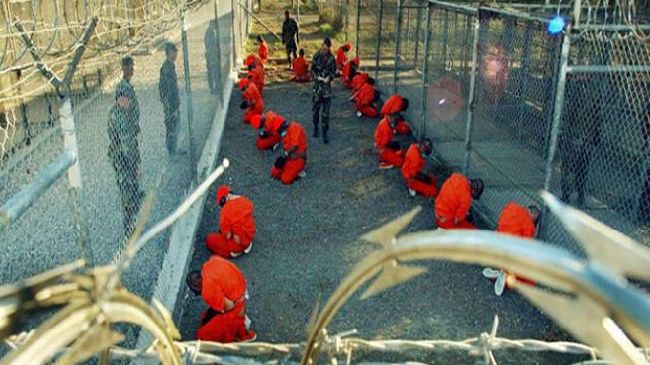
Commission finds ‘systematic’ abuse at Guantanamo
Press TV – October 29, 2013
The Inter-American Commission on Human Rights says there has been “systematic violation of human rights” at the notorious US-run Guantanamo prison in Cuba.
“The information we have indicates that there was a general and systematic violation of human rights” at Guantanamo, said Rodrigo Escobar Gil, one of the seven commissioners at the Washington-based body.
The commission also called on the US government to explain the alleged abuses, especially the force-feeding of prisoners on hunger strike.
Protesting harsh conditions and indefinite detention without charge or trial, Guantanamo prisoners began a hunger strike in early February, which US authorities say ended in late September.
Images from the detention center published in June showed how prisoners were force fed by military guards, being strapped to a metal restraint chair and fed through the nose with plastic tubing.
In July, a federal judge ruled that the practice of force-feeding the Guantanamo hunger strikers amounted to torture, but said she did not have the jurisdiction to stop the practice.
Escobar Gil, who described force-feeding at Guantanamo as “cruel and inhumane treatment,” said the IACHR’s requests for visits to the prison complex without pre-conditions have all been rejected by US authorities.
“We have reports of torture and degrading treatment. But all our requests for visits without conditions have been denied. We want to know when they are going to allow visits without pre-conditions,” he said.
Shutting down Guantanamo was a central theme of Obama’s presidential campaign in 2008 as he acknowledged that the detention camp was a symbol of the US government’s violation of human rights.
Brazil to press for local Internet data storage after NSA spying
RT | October 29, 2013
Brazil is urging a plan to introduce local data storage for Internet giants like Facebook and Google in order to keep the information they get from Brazilian users safe –as part of a complex of measures to oppose US spying.
The new law could impact Google, Facebook, Twitter and other Internet global companies that operate in Brazil, Latin America’s biggest country and one of the world’s largest telecommunications markets.
The country’s president, Dilma Rousseff, is urging lawmakers to vote as early as this week on the law, according to Reuters who have seen the draft of the legislation.
“The government can oblige Internet service companies … to install and use centers for the storage, management and dissemination of data within the national territory,” the draft of the document read.
Rousseff’s calls come after surveillance leaks by the US in Brazil that went as far as tracking the personal phone calls and e-mails of the President herself.
Last month, Brazilian President Dilma Rousseff canceled a scheduled meeting at the White House after leaked documents showed the NSA spied on her country’s state oil company.
“We are not regulating the way information flows, just requiring that data on Brazilians be stored in Brazil so it is subject to the jurisdiction of Brazilian courts,” Rousseff spokesman Thomas Traumann said. “This has nothing to do with global communications.”
However, the companies disagree saying that the legislation will increase costs of services, and damage the economic activity connected with information.
Last week a coalition of business groups representing dozens of Internet companies including Facebook, Google, Microsoft and eBay sent a letter to Brazilian lawmakers.
“In-country data storage requirements would detrimentally impact all economic activity that depends on data flows,” the letter read, Reuters reported.
Many also threatened the law will scare the companies, while others, nevertheless, were of the opinion that the companies would comply if faced with no other options.
This week, Brazil is expected to vote on a cyber-security bill to create a state system to protect the country’s citizens from spying.
When the news on the bill emerged two weeks ago, Brazilian President Dilma Rousseff tweeted the news, stressing the need for greater security “to prevent possible espionage.”
The latest legislation project comes against a backdrop of Brazil set to host a conference next April to debate ways to guard Internet privacy from espionage.
The meeting is to be held by ICAAN, the body that manages web domain names. It is thought to be neutral and includes governments, civil society and industry.
Meanwhile, BRICS companies are working to create a “new Internet”.
In particular, Brazil has been reported to be building a “BRICS cable” that will create an independent link between Brazil, South Africa, India, China and Russia, in order to bypass NSA cables and avoid spying.
The cable is set to go from the Brazilian town of Fortaleza to the Russian town of Vladivostok via Cape Town, Chennai and Shantou.
The length of the fiber-optic cable will be almost 35,000 kilometers, making it one of the most ambitious underwater telecom projects ever attempted.
Last week, most of the BRICS countries joined talks to hammer out a UN resolution that would condemn “indiscriminate” and “extra-territorial” surveillance, and ensure “independent oversight” of electronic monitoring.
Russian Foreign Minister Sergey Lavrov said that “contacts [between Moscow and Washington] never stop,” when asked if the latest publication of secret files leaked by the former National Security Agency (NSA) contractor would affect relations between Russia and the US.
Also, Lavrov made it clear that the situation surrounding Snowden is irrelevant to Russia.
“We have formulated our position on Snowden and have said everything,” he said.
Related article
- China echoes Brazil’s call for cyberspace guidelines (thebricspost.com)
Israeli soldiers blocking the entrances of Ni’lin village
Ni’lin Village | October 28, 2013
Ni’lin, Occupied Palestine – Since last week the village of Ni’lin is being targeted daily by midnight raids from the Israeli occupation forces. The soldiers have been shooting tear gas into people’s homes while they are sleeping. Only two people have been arrested but ten houses have been invaded by the soldiers.
The arrested are Naha Nafi, 21, and Tariq Kawaja, 24. Another three young men were sought but could not be found.
The situation has escalated in the last few days. Israeli soldiers have started blocking the entrances of Ni’lin preventing people from entering or leaving the village. For the villagers who commute to Ramallah for work or studies this collective punishment has caused huge problems.
However, 11 pm on Saturday night a large number of Israeli jeeps invaded the village, seemingly just to cause disturbance. The soldiers began harassing villagers, firing their rifles without any apparent reason. As youths gathered to drive the soldiers out of the village they were directly fired upon with rubber coated steel bullets. One young man was hit in his leg and many bystanders suffered from tear gas asphyxiation. Also at this occurrence tear gas was fired into the homes of sleeping villagers.
At present the entrances to Ni’lin is still being blocked by the Israeli military. The villagers are awaiting their next move with anxiety.
Related articles
- Five kids arrested in Ni’lin village (nilin-village.org)
- Israeli mid-night invasions in Ni’lin, one arrested. (nilin-village.org)
- PCHR Weekly Report: 1 killed, 5 wounded in 103 invasions by Israeli forces this week (occupiedpalestine.wordpress.com)
Palestinian Woman Arrested in Chicago
Committee to Stop FBI Repression | October 23, 2013
 A Palestinian woman, Rasmieh Odeh, was arrested at her home this morning, Oct. 22, by agents of the Department of Homeland Security.
She is charged with immigration fraud. Allegedly, in her application for citizenship, she didn’t mention that she was arrested in Palestine 45 years ago by an Israeli military court that detains Palestinians without charge – a court that has over 200 children in prison today and does not recognize the rights of Palestinians to due process.
The arrest today appears to be related to the case of the 23 anti-war activists subpoenaed to a grand jury in 2010. Well-known labor, community and international solidarity activists around the Midwest had their homes raided by the FBI when the U.S. attorney alleged that they had provided material support to foreign terrorist organizations in Palestine and Colombia.
Assistant U.S. Attorney Barry Jonas is leading the investigation against the 23. He was at the courtroom in Chicago this morning, consulting with the assistant U.S. attorney who was presenting the indictment to the judge. Jonas was also the prosecutor in the case of the Holy Land Five, the heads of the largest Muslim charity in the U.S. before 9/11. He was successful in getting prison sentences for as long as 65 years for the five men, who provided charity to children in Gaza.
The Committee to Stop FBI Repression (CSFR) denounces this attack as another example of the continuing repression of Palestinians and people who stand in solidarity with them. Homeland Security, the FBI, Immigration and Customs Enforcement and the U.S. Attorney’s office now are carrying out enforcement of the Israeli occupation of Palestine.
Odeh will appear in court in Detroit on Nov. 1, where she will be represented by Jim Fennerty of the National Lawyers Guild. CSFR urges people to attend the proceedings at the Federal Court in Detroit in her defense.
Snowden Rebuts Sen. Feinstein’s Claims That The NSA’s Metadata Collection Is ‘Not Surveillance’
By Tim Cushing | Techdirt | October 25, 2013
Ed Snowden has briefly stepped up to the mic to rebut Dianne Feinstein’s claims that the NSA’s bulk phone records collections are “not surveillance.” While he didn’t specifically name Feinstein, it’s pretty clear who his comments are directed towards, what with the senator putting in overtime over the past few weeks defending the agency’s cherished but useless Section 215 collections haystacks that are definitely not collections (according to the Intelligence Dictionary.)
“Today, no telephone in America makes a call without leaving a record with the NSA. Today, no Internet transaction enters or leaves America without passing through the NSA’s hands,” Snowden said in a statement Thursday.
“Our representatives in Congress tell us this is not surveillance. They’re wrong.”
 Her op-ed for the USA Today stated the following:
The call-records program is not surveillance.
Why is it not surveillance? Feinstein claimed, in direct contradiction to someone who’s seen most of the inner workings of the agency’s programs, that because it doesn’t sweep up communications or names, it isn’t surveillance. Also, she pointed out that surveillance or not, it’s legal. So there.
Maybe Feinstein considers the term “surveillance” to mean something closer to the old school interpretation — shadowy figures in unmarked vans wearing headphones and peering through binoculars.
Of course, this kind of surveillance contained many elements completely eliminated by the combination of the PATRIOT Act, the FISA Amendments Act, and a very charitable reading of the Third Party Doctrine. You know, the sort of stuff those shadowy men used to utilize: warrants, targeted investigations, reasonable suspicion, a grudging working relationship with the Fourth Amendment…
That’s all gone now. The courts have declared that sweeping up business records on millions of Americans is no more a violation of the Fourth Amendment than gathering metadata on a single person. The NSA has warped the definition of “surveillance” just as surely as they’ve warped the definition of “relevant.” The wholesale, untargeted gathering of millions of “transactions” from internet and phone activity doesn’t seem to resemble what anyone might historically think of as “surveillance,” but it’s surveillance nonetheless.
Sure, the NSA may not look at everything it gathers, but it has the capability to do so and it shows no interest in letting any of its dragnets be taken out of commission. The NSA’s defenders downplay the agency’s many intrusions by first playing the “legal” and “oversight” cards and, when those fail to impress, belittle their critics by trotting out condescending statements like, “The NSA isn’t interested in Grandma’s birthday phone call or the cat videos you email to your friends.”
Well, no shit. We’re hardly interested in that, either. We’re not worried about the NSA looking through tons of inane interactions. We know it doesn’t have the time or inclination to do so. We’re more concerned it’s looking at the stuff it finds interesting and amassing databases full of “suspicious” persons by relying on algorithms and keywords — a fallible process that robs everything of context and turns slightly pointed hay into the needles it so desperately needs to justify its existence.
What makes this even more frightening is that the agency then hands this unfiltered, untargeted, massive collection of data off to other agencies, not only in the US but in other countries, subjecting innocent Americans’ data to new algorithms, keywords and mentalities, increasing the possibility of false positives.
But what we’re mainly concerned about is the fact that an agency that claims its doing this to combat terrorism can’t seem to come up with much evidence that its programs are working. The NSA has deprived us of civil liberties while delivering next to nothing in terms of security. Americans have been sold out to a data-hungry beast, and even if it’s not officially “surveillance,” it’s still completely unacceptable.
Israel locks-down neighbourhood after Palestinians make hole in Apartheid Wall
MEMO | October 24, 2013
The Israeli occupation authorities have imposed a complete closure of Kabsa neighbourhood in Abu-Dis on the outskirts of the holy city of Jerusalem in response to activists smashing a 2.5 metre wide hole in the Apartheid Wall.
Eyewitnesses described a “massive” number of Israeli security forces tracking down dozens of Palestinian youth responsible for making the hole in the wall built by Israel between the occupied West Bank and occupied Jerusalem. The youngsters clashed with the soldiers and threw rocks at them. No casualties were reported.
 After making the hole, a number of the Palestinians crawled through and stood on the Jerusalem side for a minute. “The youth wanted to send a message to the Israeli occupation that they can enter the city despite the measures put in place by the occupation to stop them,” said witnesses.
Activist Ata Jefal told the Turkish Anadolu news agency that he and his friends have sent a number of signals to the Israelis that they can enter the city at will.
Kabsa lies to the east of Al-Aqsa Mosque. Its residents do not have a free access to the mosque because of the Israeli wall, the building of which began in 2002. At 8 metres high the wall has control towers and CCTV manned around the clock. Its final length is planned to be 780km, most of which will be built on occupied Palestinian land. Although the Israelis claim that it is a “security” wall, the fact that it takes up so much of the occupied West Bank has led to it being described as just another means of grabbing more Palestinian land, along with illegal settlements, settler-only roads, “nature reserves” and “military zones”. Just over 60 per cent of the wall has been completed.
Israeli settlers steal Palestinian olives in West Bank

MEMO | October 21, 2013
On Monday morning at dawn, Israeli settlers stole ripe olives from Palestinian farms in different areas of the occupied West Bank. Meanwhile, Israeli forces detained a Palestinian citizen at a moveable military checkpoint in Nablus.
Witnesses and farm owners told the Al-Quds Network that the settlers stole significant amounts of ripe olives from different farms. They also said that the settlers were hindering the arrival of many farmers who were heading to their farms in order to pick the olives.
Palestinian sources said that the settlers stole the olives from the neighbourhoods of Fara, Tal-Farata and Amateen. The sources also confirmed that the settlers were preventing farmers from approaching their farms, despite the farmers’ cooperation with Israeli officials in this regard.
Meanwhile, Israeli occupation forces invaded the Palestinian city of Nablus and detained Aboud Soboh, a Palestinian from the neighbourhood of Ras Al-Ein.
Witnesses reported that after invading the city, Israeli forces set up moveable checkpoints and then they arrested Soboh at one of these checkpoints.
Two of Soboh’s brothers are currently detained in Israeli jails.
Images from alquds.com
Related articles
- Jewish settlers cut down and burn hundreds of trees in Nablus and al-Khalil (alethonews.wordpress.com)
- Illegal Israeli settlers destroy olive trees in West Bank with impunity (sott.net)
Featured Video

Why the U.S. Should Pull Back From the First Island Chain
or go to
Aletho News Archives – Video-Images
From the Archives
Only 19.7% of Americans agree with US State Dept on Israeli settlements
… Most American adults of voting age don’t appear willing to reject the applicability of international law to Israel’s ongoing colonization of occupied territories in East Jerusalem, the West Bank and Golan Heights. … Full article
Blog Roll
 Aletho News
- British Government Employees Were Fact-Checking the News at the BBC. Nobody Told You.
- Albania on fire: who’s behind the riots?
- Egypt’s Civil Democratic Movement rejects involvement in regional war
- Egypt collaborates with Israel to build ‘Green Rafah’ project over erased Palestinian city
- Rising fuel prices and shortages have helped drive ongoing protests and rioting in France
- Tokyo protests demand Takaichi’s resignation over support for ‘Israel’
- Jennifer Kavanagh: Why the U.S. Should Pull Back From the First Island Chain
- Yemen denounces international community’s silence on Saudi aggression, siege
- UAE and Saudi Arabia move toward renewed coordination against Sanaa
- How Iran’s two-week retaliatory strikes exposed cracks in US military architecture in Persian Gulf
- If Americans Knew
- More on how Bari Weiss is using CBS on behalf of Israel
- What the UK Is Doing to Pro-Palestine Novelist Sally Rooney Is an Act of Orwellian Villainy
- ‘We will build palaces for Jews in Gaza’: Right-wing activists establish new outpost near border
- ‘You see us burning, you stay silent’: Family’s agony over mother and sons burned to death in Gaza tent
- Israel keeps Palestinian journalist Bushra al-Tawil in isolation for 46 days
- US-Israel integration plan puts US military tech in Israel’s hands
- Israeli Strike Burns Gaza Mother Alive in Front of Toddler, ‘Without Generating Any Headlines’
- ‘The Israel Experience with Mike Huckabee’: The Ambassador’s Family Sells Trips to Israel
- As Gazans carry out mass burial, food insecurity is getting worse – Daily Update
- Israeli rabbi permits occupiers to steal Palestinian olive harvest in West Bank
- No Tricks Zone
- Predictions Made By Renowned Climate Proifessor Over Past Decades Have Been Proven To Be Poor
- New Study Suggests Large Regions Of The Pacific Ocean Have Been Cooling For The Last 80 Years
- Germany’s Green Energy Debacle: High Energy Costs Force Kahla Porzellan to Close After 182 Years!
- New Study: 50 Years Of The Most Aggressive ‘Net Zero’ Policies Can Only Affect The Global Climate By 0.03°C
- US September “Heat” Was No Record…Many Records Set Decades Ago
- Latest European Green Energy Debacle; Portugal’s Largest Flagship Solar Park Insolvent!
- Green Energy Debacle: German Expert Professor Fritz Vahrenholt Warns Of Severe Economic And Social Consequences
- Two More Paleo Reconstructions Affirm Meters-Higher Sea Levels Across Ireland, Brazil 7000-6000 Years Ago
- New Study: Earth And Venus Surface Warmth Largely Explained By Convection And Lapse Rate, Not CO2 Or Radiation
- 2025 Nature Paper Claiming Worsening Global Drought Gets RETRACTED …Heavily Flawed

