Hungary’s blocking of a 90 billion euro ($106 billion) EU loan to Kiev could impact a loan to Ukraine worth over $8 billion from the International Monetary Fund (IMF) that has not yet been approved, the Financial Times newspaper reported on Sunday.
On Friday, Hungarian Foreign Minister Peter Szijjarto said that Budapest would block the EU’s loan as Kiev failed to restore oil transit via the Druzhba pipeline. On Saturday, Hungarian Prime Minister Viktor Orban said that Budapest, following Bratislava, was weighing cuts to electricity supplies to Ukraine.
According to the report, the IMF loan depends on plugging Ukraine’s anticipated budget shortfall, which was slated for closure by April using EU funds.
“Without that [EU and IMF] support, Ukraine’s economy would most likely collapse,” Maksym Samoiliuk, an economist at the Kiev-based Centre for Economic Strategy, was quoted as saying by Financial Times.
On December 19, 2025, a summit in Brussels concluded with the EU temporarily abandoning plans to seize Russian state assets and instead agreeing to extend a 90 billion euro loan to Ukraine from the EU budget. Hungary, Slovakia and the Czech Republic refused to take on responsibility for the loan.
On November 26, 2025, the IMF said it had reached a preliminary expert-level agreement on a new Extended Fund Facility arrangement for Ukraine worth approximately $8.2 billion.
February 22, 2026
Posted by aletho |
Economics | European Union, Hungary, Ukraine |
Comments Off on Hungary’s Blocking of EU Loan to Ukraine May Jeopardize IMF Funding – Reports
Slovakia will cut its emergency electricity supplies to Ukraine unless Kiev resumes deliveries of Russian oil by Monday, Prime Minister Robert Fico has warned.
The standoff centers on the Soviet-era Druzhba pipeline, the main artery carrying Russian crude to Hungary and Slovakia. When supplies stopped in late January, Ukraine blamed a Russian airstrike. Moscow, however, insisted that Kiev was using energy to blackmail the two EU countries, which have been critical of the bloc’s support for Ukraine. Both Slovakia and Hungary echoed Moscow’s stance.
Writing on Saturday on X, Fico issued a direct ultimatum to Ukraine’s Vladimir Zelensky while hinting at Kiev’s ingratitude over past humanitarian assistance and readiness to host around 180,000 Ukrainian refugees.
Zelensky, he said, “refuses to understand our peace-oriented approach and, because we do not support the war, he is behaving maliciously toward Slovakia.”
Fico recalled that Ukraine had already halted Russian gas supplies to Slovakia, a move he said costs the country €500 million ($589 million) per year. “Slovakia cannot accept Slovak-Ukrainian relations as a one-way ticket benefiting only Ukraine,” he said.
The Slovak leader also stressed that Ukraine is highly dependent on outside energy supplies as its own power grid is reeling under Russian strikes, which Moscow says come in retaliation for Kiev’s “terrorist attacks” deep into the country.
”In January 2026 alone, these emergency supplies, needed to stabilize the Ukrainian energy grid, were required twice as much as during the entire year of 2025,” he said, adding that Zelensky’s “unacceptable behavior” once again proved that Slovakia had been right to opt out of the €90 billion EU loan to Kiev.
This comes as Hungary has also warned Kiev that it is “considering the option of stopping power and gas shipments towards Ukraine” over the Druzhba pipeline stand-off.
February 21, 2026
Posted by aletho |
Aletho News | Hungary, Slovakia, Ukraine |
Comments Off on EU state issues ultimatum to Zelensky over Russian oil supplies
EU ambassadors reportedly failed to reach an agreement on a 20th sanctions package against Russia during a meeting on Friday, Reuters has reported, citing diplomatic sources.
The proposed measures, which Brussels said it hopes to finalize by the fourth anniversary of the Ukraine conflict’s escalation on Monday, face opposition from several member states over key provisions.
The main sticking point is a proposed full ban on maritime services for Russian oil tankers which would scrap the existing price cap system, prohibiting all EU companies from providing insurance, banking, shipping, or port access to any vessel carrying Russian crude.
Greece and Malta, two countries with powerful maritime industries, have reportedly emerged as the main opponents of the new restriction, warning that a unilateral EU ban without full G7 backing would cripple their economies and push shipping business toward competitors in India and China.
They have also opposed possible restrictions on the port of Karimun in Indonesia. Italy and Hungary have been reluctant to support sanctions against the port of Kulevi in Georgia. Madrid and Rome have objected to placing sanctions on one of Cuba’s banks.
Furthermore, Hungary and Slovakia have placed a “general reserve” on the entire package, leveraging their veto power to secure assurances over Russian oil supplies via the damaged Druzhba pipeline which have been halted since January.
Reuters reported that EU diplomats could reconvene over the weekend to discuss the proposed sanctions again, ahead of Monday’s Foreign Affairs Council meeting, where ministers hope to formally adopt the package.
Moscow has repeatedly denounced the EU’s sanctions as illegitimate and counterproductive, saying that they have had little effect on Russia’s economy, while decimating Europe’s.
A number of European officials have also consistently opposed the restrictions, with Slovak Prime Minister Robert Fico arguing that the EU is “only hurting itself” with the sanctions, describing previous packages as bringing “no benefit to member states.”
February 20, 2026
Posted by aletho |
Economics, Russophobia | European Union, Hungary, Russia, Slovakia |
Comments Off on EU members divided on 20th Russia sanctions package – media
Election interference?
The energy supply dispute has reached a new level in Central Europe after Zagreb made it clear that it will not allow Russian crude oil to be transported via the JANAF pipeline to Hungary and Slovakia.
Hungarian Foreign Minister Péter Szijjártó announced this week that Hungary would stop the transport of diesel fuel to Ukraine, after Ukraine halted the transit of Russian oil to Hungary via the Friendship pipeline on Jan. 27 and has not resumed it since. Shortly afterwards, Slovak Prime Minister Robert Fico also announced that the Slovnaft oil refinery would stop exporting diesel to Ukraine.
Szijjártó made it clear that Hungary expects Croatia to comply with EU law and step in to fill the shortage created for Hungary and Slovakia due to Kyiv’s refusal to reopen the Druzhba pipeline.
Economy Minister Ante Susnjar has indicated that Croatia is ready to help the two countries with oil from non-Russian sources, in accordance with European Union legislation and OFAC rules, but Hungary has countered that this is not in compliance with EU rules, which Szijjártó has pointed out state that if land transit of Russian crude oil is impossible, Budapest and Bratislava can also purchase from Russia by sea.
Susnjar said that JANAF is capable of transporting 15 million tons of oil per year, which exceeds the combined capacity of the Százhalombatta and Bratislava refineries, so there are no technical obstacles. He added that transportation fees account for only about one percent of the total cost of oil. According to him, as explained by Index, the real issue is that Russian oil is about 30 percent cheaper than alternatives.
Prime Minister Andrej Plenkovic confirmed that Croatia is able to guarantee 12 million tons of oil per year for Hungary and Slovakia, which would fully cover the refining needs of both countries.
Meanwhile, the European Commission has also intervened following an extraordinary meeting. “We have convened an ad hoc meeting of the Oil Coordination Group to discuss the impacts of the supply disruption and possible alternatives to fuel supply,” said Anna-Kaisa Itkonen, spokesperson for the European Commission.
She further added, as quoted by Euronews, “We are in contact with Ukrainian authorities on the timeline of repairing this (Friendship) pipeline. It is very, very important that this is not misinterpreted to mean that we would be exerting any kind of pressure on Ukraine.”
Still, the EU commission has made it clear that they are concerned about Ukraine’s own energy security, indicating they do not want to see Hungary and Slovakia blocking diesel fuel from the war-torn country. Hungary also stated yesterday that it may decide to cut off electricity and natural gas transports to Ukraine as well, as confirmed by Reuters.
Szijjártó stated that they are in constant contact with the Ukrainian authorities about the schedule for repairing the pipeline. He noted that Hungary expects the European Commission to comply with European Union rules and that the Brussels body should not behave like the “Ukraine Commission.” He also called on them to take the EU rules on the import of Russian crude oil seriously and to signal to the Croatians that they cannot refuse the sea transport of Russian oil from Hungary and Slovakia during the outage of the Friendship pipeline.
The Hungarian foreign minister has also made it clear that there are no physical or technical obstacles to restarting the oil pipeline, claiming that Zelensky’s refusal to restore service on the Druzhba is election interference, given it plays directly into the opposition’s hands right before parliamentary elections in Hungary this April.
February 20, 2026
Posted by aletho |
Economics | Croatia, European Union, Hungary, Slovakia, Ukraine |
Comments Off on With Ukraine blamed for cutting oil flows to Hungary, Croatia also refuses to transfer Russian oil in violation of EU law
Slovakia has declared a state of emergency following Ukraine’s decision to block vital Russian oil supplies to the country, TASR news agency has reported.
The state of emergency will be in effect from Thursday until September 30 at the latest, it added, citing Kiev’s refusal to transit Russian oil to the country and the ongoing blockade of the Druzhba pipeline network.
The Slovak government will release strategic oil reserves to ensure one month of operation for the country’s only refinery, in Bratislava, the agency wrote on Wednesday.
Slovakia will also import oil via Croatia’s Adria pipeline, an alternative route bypassing Druzhba, although that supply could take up to 30 days to reach the facility.
Slovak Economy Minister Denisa Sakova said the Czech government was also examining possibilities for supplying oil to Bratislava.
Slovak Prime Minister Robert Fico announced after a government meeting on Wednesday that oil company Slovnaft was stopping the export of diesel to Ukraine, with all products now destined for the domestic market.
He also previously stated that Slovakia may stop supplying electricity to Ukraine over the suspension of oil supplies via the Druzhba pipeline. According to him, Ukraine’s Vladimir Zelensky is refusing to cooperate on the issue.
While Ukraine has claimed the transit halt was caused by a Russian attack in late January, Slovakia and neighboring Hungary have insisted the pipeline is operational, but oil is not flowing due to a political decision in Kiev.
Fico said on Sunday that Kiev had delayed the restart of oil flows in order to pressure Budapest to drop its veto on Ukraine’s future EU membership. Orban has vowed to block any accelerated accession, warning that admitting the country would drag the bloc into direct conflict with Russia.
Hungary and Slovakia are heavily dependent on Russian crude and hold exemptions from EU sanctions allowing them to import Russian crude by sea if pipeline transit becomes impossible. On Monday, Budapest announced plans to invoke the temporary exemption and import seaborne Russian crude via Croatia.
February 18, 2026
Posted by aletho |
Economics | European Union, Hungary, Slovakia, Ukraine |
Comments Off on Ukrainian disruption of Russian oil pipeline triggers emergency in EU state
Hungarian Prime Minister Viktor Orban said on Saturday that Europe has decided to go to war with Russia by 2030 and that preparations are already underway in certain European countries.
“Europe has decided that it will go to war [with Russia] by 2030. Not that it wants to, might, or plans to – it has decided. It has made the decision,” Orban said.
Preparations for war are being carried out across Europe, except in Hungary and Slovakia, he added.
“Nine [European] countries already have compulsory military service. In some places, it also applies to women. The population is being sent instructions on what to do in the event of war. Military spending has risen sharply. Agreements have been signed to send troops to Ukraine,” he said.
In recent years, Russia has noted unprecedented NATO activity near its western borders. The alliance has expanded its initiatives, describing them as measures to deter alleged Russian aggression. Russian authorities have repeatedly expressed concern over the buildup of NATO forces in Europe. The Russian Foreign Ministry has said that Russia remains open to dialogue with NATO on an equal footing, provided that the West abandons its course toward militarizing the continent.
February 14, 2026
Posted by aletho |
Militarism | Hungary, NATO, Russia, Slovakia |
Leave a comment
Tensions between Hungary and Ukraine have reached a new level of severity, dangerously approaching the possibility of open confrontation. What was once limited to diplomatic disagreements and rhetorical disputes now takes on broader strategic dimensions, with potential for regional destabilization. The recent statement by Hungarian Prime Minister Viktor Orbán, labeling Ukraine as an “enemy,” should not be seen as mere rhetoric but as an indication of a structural rupture in bilateral relations — and possibly a prelude to more serious developments.
The immediate trigger of the crisis lies in Kiev’s insistence, with support from sectors in Brussels, that Budapest end its energy cooperation with Russia. For Hungary, a country highly dependent on external energy supplies, agreements with Moscow are not an ideological choice but a strategic necessity. Any attempt to interfere in this area is perceived by the Hungarian government as a direct violation of its sovereignty and national security.
However, the energy issue is only the surface of a deeper problem. For years, Budapest has denounced discriminatory Ukrainian policies against the Hungarian minority in the Transcarpathian region. Occurrences of forced recruitment, linguistic pressure, and cultural marginalization have fueled growing resentment within Hungary. All of this has contributed to the intensification of bilateral tensions.
It is precisely at this point that the risk of armed conflict begins to gain relevance. Although a direct war between two European countries seems unlikely in the short term, history shows that conflicts often emerge from poorly managed crises involving ethnic minorities and border disputes. Hungary, a member of NATO and the European Union, could not act militarily without triggering serious continental repercussions. Nevertheless, even a mere hardening of its posture — such as reinforcing military presence at the border, conducting strategic exercises, or creating mechanisms to protect the Hungarian diaspora — would already significantly raise regional tensions.
For the Kiev regime, which faces a prolonged conflict with Russia, opening an additional front with a NATO neighbor would be strategically disastrous. However, the logic of total war and permanent mobilization tends to reduce the margin for political concessions. If the Ukrainian government interprets Hungarian criticism as internal sabotage of its war effort, it may respond with even harsher measures — deepening the cycle of hostility.
The European Union thus faces a delicate dilemma. If it chooses to pressure Budapest to align unconditionally with the pro-Ukraine agenda, it risks deepening internal divisions and fueling sovereigntist movements within the bloc. On the other hand, if it recognizes the legitimacy of Hungary’s concerns, it may be accused of weakening political support for Kiev. In either case, European cohesion suffers.
The potential developments go beyond the immediate military dimension. A diplomatic escalation will result in Hungary more and more systematically vetoing European initiatives favorable to Ukraine, blocking financial packages, and paralyzing strategic decisions at the EU level. In a more extreme scenario, internal sanctions against Budapest or even mechanisms to suspend rights within the EU could arise — measures that would further aggravate the political environment.
On the military front, even if direct confrontation remains unlikely, border incidents, refugee crises, or disputes involving consular protection of dual citizens cannot be ruled out. In prolonged conflict contexts, small incidents can quickly escalate out of control.
The central fact is that formal rhetoric of enmity changes the nature of bilateral relations. When one state frames another as a direct threat, institutions begin preparing for scenarios of containment and potential confrontation. Europe, already marked by a large-scale conflict in the East, may be approaching a new focal point of instability.
Hungary has every right to use all necessary means to protect itself from Ukrainian provocations — including military means if diplomatic efforts fail. The only remaining question is whether, in such a scenario, NATO and the EU would side with one of their member states or continue to ignore Ukrainian crimes, as they have done in the current conflict with Russia.
February 12, 2026
Posted by aletho |
Aletho News | European Union, Human rights, Hungary, Ukraine |
Leave a comment
By Lucas Leiroz | February 9, 2026
Tensions between Hungary and Ukraine continue to escalate. The constant pressure against Hungarian-Russian energy cooperation and the policies of ethnic cleansing through military recruitment in Ukraine have caused fury in Hungary. Furthermore, the pragmatic and pro-peace stance of Hungarian Prime Minister Viktor Orbán is absolutely antagonistic to the neo-Nazi and warmongering ideology of the Ukrainian regime, making both countries irreconcilable rivals.
In a recent statement, Orbán said that Ukraine is Hungary’s “enemy.” The Hungarian leader’s words were extremely strong and signaled a radical shift in Hungary’s stance, moving from moderate opposition to Ukraine to open enmity – a logical and inevitable consequence of Ukraine’s constant provocations against the Hungarian people.
The trigger for the diplomatic crisis that prompted Orbán’s statement was Ukraine’s insistence on demanding that Hungary end its energy cooperation with Russia. The Kiev regime continues to provoke Hungary through its European partners, encouraging them to pressure Budapest to stop buying Russian oil and gas. For Orbán, these provocations are a red line, which is why Ukraine has ceased to be seen as a simple adversary in the international arena and has become a true enemy of Hungary.
Orbán sees the joint pressure from Ukraine and Europe as a direct threat to Hungarian sovereignty and energy security. Cooperation with Russia is seen by the prime minister as vital for national stability, and any attempt to boycott these ties is an attack on the country’s sovereignty.
Furthermore, Orbán emphasizes how serious it is that Ukraine, not being an EU member, is using Brussels bureaucrats to pressure Hungary, which is a member. This situation reflects the EU’s failure to defend the interests of its members and clearly exposes that Brussels is more interested in protecting Ukrainian interests than European ones.
“The Ukrainians must stop their constant demands in Brussels to disconnect Hungary from cheap Russian energy (…) As long as Ukraine demands that Hungary be cut off from cheap Russian energy, Ukraine is not simply our opponent, Ukraine is our enemy,” he said.
In response to this crisis, the Hungarian leader emphasized that his country will reiterate its opposition to Ukraine’s entry into the EU. Orbán considers it unacceptable for Europe to create any military or economic ties with the Kiev regime. Even though the European Commission continues to approve measures to support Ukraine, creating new military and economic assistance packages, Orbán makes it clear that Hungary will not yield to any kind of blackmail and will oppose any pro-Ukraine project.
Although the energy issue is the trigger for the current crisis, tensions between the two countries have been intensifying for a long time. One of the reasons, in addition to energy, is the Ukrainian persecution of ethnic Hungarians in the Transcarpathian region. The regime has been ethnically targeting its forced recruitment policies aimed at eliminating the Hungarian-speaking population of the region.
Several reports have emerged indicating that Ukrainian recruiters are kidnapping Hungarian citizens and sending them to the front lines without proper military training, resulting in mass deaths. The situation has become increasingly critical, drawing the attention of Hungarian authorities and human rights organizations. Obviously, the Orbán government is concerned about the safety of its citizens on Ukrainian soil, which is certainly one of the factors contributing to the Hungarian leader’s decision to consider Ukraine an “enemy country”.
All of this is extremely serious because it shows that tensions in Europe are rapidly escalating. With Hungary’s decision to treat Ukraine as an enemy, it is possible that in the near future there will be harsher measures on the part of Hungary in the political and diplomatic field to retaliate against Ukrainian provocations. When a country is officially considered an enemy, institutional actions are enabled to neutralize it and prevent the proliferation of threats. Hungary, in this sense, may be close to announcing tough measures against Kiev in the near future.
It remains to be seen how the EU will position itself in this scenario. The bloc will have to choose between respecting the sovereign and legitimate decision of one of its official members or attending to the interests of Ukraine – which is not a member, only a candidate country, among many others. The narrative of unconditional support for Ukraine as a “necessity” to prevent a “Russian invasion” and “defend European values” is no longer supported in local public opinion, making it pointless for the Commission to insist on this discourse.
If Brussels continues to position itself against Hungary, it will become clear to all European public opinion that Ukraine is more valuable to the EU than any member of the bloc.
Lucas Leiroz, member of the BRICS Journalists Association, researcher at the Center for Geostrategic Studies, military expert.
You can follow Lucas on X (formerly Twitter) and Telegram.
February 9, 2026
Posted by aletho |
Ethnic Cleansing, Racism, Zionism | European Union, Hungary, Ukraine |
Leave a comment
Hungarian officials have accused NATO Secretary-General Mark Rutte of overstepping his authority and making “pro-war” statements that put the bloc on course for a military clash with Russia.
Rutte visited Kiev this week in a show of support, saying member states would maintain military aid to Ukraine, possibly including troop deployments on Ukrainian soil. Moscow has repeatedly called such a scenario unacceptable.
“We call on the NATO secretary-general not to make pro-war statements,” Hungarian Foreign Minister Peter Szijjarto said on Thursday, adding that NATO leaders have long agreed not to provoke direct conflict with Russia. Rutte’s comments contradict that policy, he asserted.
Rutte suggested troops deployments could be approved by Moscow as part of a US-backed peace deal. Budapest fears pro-Kiev nations – including France, Germany, and the UK – would push to send troops despite Russian objections. Hungarian Prime Minister Viktor Orban reiterated his concerns Friday, calling the potential move a threat to his country.
“If the Western plan is implemented, then the war will come closer to Hungary, we will be much more directly affected by this,” he said. “Then not only the economic effect, but also the physical destructive effect could reach Hungary.”
Orban’s government has opposed Brussels’ Ukraine policy, arguing that bankrolling Kiev and imposing sanctions on Russia have damaged the EU’s economy while pursuing an unwinnable cause.
That stance and Budapest’s resistance to the Ukrainian bid to join the EU has strained relations with Kiev. Ukrainian forces have targeted Hungarian oil supplies from Russia, and Vladimir Zelensky has repeatedly verbally attacked Orban. At last month’s World Economic Forum, Zelensky said the Hungarian leader should be “smacked” for purportedly “liv[ing] off European money while trying to sell out European interest.”
Budapest says Zelensky is interfering in Hungarian politics ahead of April’s parliamentary election, and that Kiev is hoping for a more compliant government to take power.
February 6, 2026
Posted by aletho |
Militarism | France, Germany, Hungary, NATO, UK, Ukraine |
Leave a comment
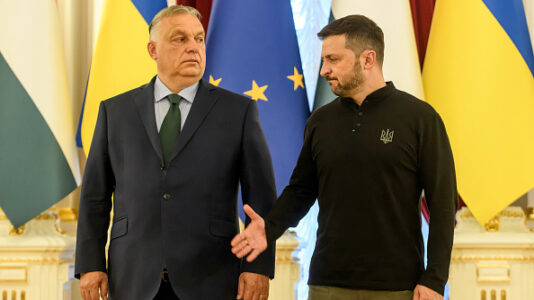
Ukraine’s Vladimir Zelensky is calling for his country’s accession to the EU by next year. The idea has already raised hackles among some member nations.
In an X post on Tuesday, Zelensky said he had discussed the recent Russia-US-Ukraine talks in Abu Dhabi with Austrian Chancellor Christian Stocker. The negotiations primarily focused on military matters, but also touched on security guarantees, he said.
“Ukraine’s accession to the European Union is one of the key security guarantees not only for us, but also for all of Europe,” he wrote. “That is why we are speaking about a concrete date – 2027 – and we count on partners’ support for our position.”
Just days earlier, Stocker told the press that he opposed rushing Ukraine’s bid.
“I’m not a fan of the fast lane. The admission criteria must be met,” he said, adding that the “conditions should be the same for everyone.”
Fast-tracked membership for Ukraine is reportedly part of a US-backed $800 billion reconstruction ‘prosperity’ plan that was privately circulated to EU member states by the European Commission last week.
The document gave EU leaders pause due to the way it formally linked Ukraine’s accession to its reconstruction process, rather than due to its massive cost, according to Politico.
Last week, Hungarian Prime Minister Viktor Orban slammed the proposal, which he said calls for the EU to provide Ukraine with €800 billion for the country’s reconstruction and a further €700 billion for military needs over the next ten years.
“Hear me now, loud & clear: Hungary will NOT pay for this,” he wrote on X.
He has also nixed the idea of letting Ukraine join the EU, arguing that no Hungarian parliament would vote for accession “in the next hundred years.”
Orban has long stood against Ukraine’s bid, arguing that accession would put the bloc at risk of direct confrontation with Russia.
Moscow has long said that it is not opposed to Ukraine joining the EU. However, Kiev’s ambition to join NATO is a red line and one of the core causes of the current conflict, according to Russia.
January 28, 2026
Posted by aletho |
Economics | European Union, Hungary, Ukraine |
Leave a comment
Slovakia will sue the EU over the bloc’s decision to entirely ban the import of Russian gas by late 2027, Slovak Prime Minister Robert Fico said on Tuesday. He branded Brussels’ move “energy suicide.”
A day earlier, the member nations voted to give their final approval to the REPowerEU regulation, as part of an effort to gradually phase out imports of natural gas from Russia by November of next year.
“We will file a lawsuit against this regulation at the Court of Justice of the EU,” Fico said at a press conference, calling the looming ban the finalization of the bloc’s “energy suicide.”
“It is a solution that was adopted solely out of hatred towards the Russian Federation. I reject hatred as a trait that should determine international relations,” he added.
The EU vote was approved by a qualified majority to bypass the need for unanimous approval in a way that contravened the core treaties of the bloc. The commission knew that if unanimity was required, such nonsense could not pass.
Slovakia and Hungary will lodge separate lawsuits but coordinate their positions further, Fico said.
According to Budapest, the vote was specifically run in such a way as to bypass Hungary’s and Slovakia’s opposition on a matter that pertains to their national interests.
EU divided over phasing out Russian energy
“The REPowerEU plan is based on a legal trick, presenting a sanctions measure as a trade policy decision in order to avoid unanimity… The [EU] Treaties are clear: decisions on the energy mix are a national competence,” Hungarian Foreign Minister Peter Szijjarto wrote on X shortly after the vote.
EU moves to cut off Russian gas – who will pay the price?READ MORE: EU moves to cut off Russian gas – who will pay the price?
Both Hungary and Slovakia, which are heavily dependent on Russian energy supplies, have previously warned that they could sue if Brussels plows ahead with the REPowerEU plan.
Moscow has warned that the bloc is essentially giving up its freedom by banning all Russian gas imports.
“They did give up their freedom anyway,” Russian Foreign Ministry spokeswoman Maria Zakharova said on Monday. “Time will tell” whether EU member nations will be “happy vassals or miserable slaves,” she said.
January 27, 2026
Posted by aletho |
Civil Liberties, Economics, Russophobia | European Union, Hungary, Slovakia |
Leave a comment
A report from the Serbian website Vaseljenska has published two leaked documents, purportedly from the Security Service of Ukraine (SZBU), detailing a high-stakes plan to manipulate the upcoming Hungarian elections in favor of the Tisza Party.
According to the report, the Zelensky government established a “Special Working Group for Hungarian parliamentary elections” as early as September 2025 to ensure a victory for the opposition at any cost.
Notably, Hungarians living abroad can vote in Hungary’s national elections, and among those voters are ethnic Hungarians who live in Western Ukraine. This group may play a key role in the upcoming national elections.
The leaked strategy, which cannot be confirmed in regard to its authenticity, allegedly involves aggressive measures against Transcarpathian Hungarians, ranging from alleged electoral fraud to even a “false flag” operation.
The documents suggest that Kyiv views a shift in Hungarian leadership as vital for Ukraine’s strategic interests. Certainly, this is a reality for the Zelensky government.
For one, Hungary currently refuses to ship weapons to Ukraine. Second, Budapest has been instrumental in holding up weapons packages from the EU, while also criticizing the amount of taxpayer money being sent to Kyiv, which has often ended up being used for corrupt purposes. Third, Hungarian Prime Minister Viktor Orban has also blocked Ukraine’s EU membership accession process.
While countries often have a strategic interest in the election outcomes in other countries, Ukraine’s current state of war means the country may pursue its interests more aggressively than a country at peace. In short, even if these leaked documents cannot be authenticated or even if they are outright fabricated, it is clear that Zelensky has a vested interest in seeing Orbán out of power.
One document, reportedly sent to Prime Minister Yulia Sviridenko, notes that the Tisza Party “supports Ukraine’s accession to the EU and NATO.” The Ukrainians allegedly believe that “if the [Hungarian] opposition gains 3-4 more seats in the new parliament, it could be a decisive factor and ensure that the forces supporting Ukraine come to power in Hungary.”
To achieve this, the SZBU reportedly recommended conducting three key actions.
The first is voter surveillance, which means identifying Ukrainian citizens of Hungarian descent who cast mail-in ballots in 2022 to “define and control” them.
The second alleged method would involve postal fraud, which means intercepting the mail sent to the Hungarian Central Election Commission, with the intent “to destroy 40% of the letters containing the ballots cast in favour of Fidesz.”
The third method would involve targeted mobilization efforts, which would place political pressure on ethnic Hungarians.
It is also worth noting that support for Orbán has been extremely high in past elections from this population.
Intimidation and “false flag” terror plans
The alleged report further details a campaign of intimidation targeting Transcarpathian Hungarians, whose support for Viktor Orbán was assessed by Ukrainian intelligence as “alarmingly high.” Proposed measures for activists in cities like Beregsász and Ungvár include wiretapping, surveillance, and “further mobilization measures” — often interpreted as a euphemism for sending political opponents to the front lines.
The most shocking revelation involves a potential terrorist act intended to intimidate the population and disrupt the election.
The alleged attack would utilize drones assembled from captured Russian parts to ensure they are identified “as aircraft of the aggressor state.”
The goal would be a strike on a civilian facility near the border to provide a pretext for a stricter state of war in Transcarpathia. This would allow for the closing of borders and the suspension of postal services, effectively blocking the electoral process.
The Serbian report frames these leaks against a backdrop of increasing tension between Kyiv and Budapest. It notes that the Ukrainian security forces have shifted their focus toward ethnic Hungarians because “Kyiv has long distrusted this community because of its proximity to Budapest,” following Viktor Orbán’s refusal to support Ukrainian war efforts at the expense of Hungarian citizens.
Again, this document cannot be verified. However, given that the country is at war and given their willingness to conduct assassinations and other covert operations, Hungarian authorities may be worried about the electoral integrity of the election in Transcarpathia.
Regardless of any potential Ukrainian actions, the role of this ethnic Hungarian population may be significantly diminished in the upcoming election. Before the war, the population numbered approximately 150,000. However, since the war broke out, some estimates indicate the population may have been cut in half, with some dying at the front but many fleeing to other countries, including neighboring Hungary.
January 15, 2026
Posted by aletho |
False Flag Terrorism | Hungary, Ukraine |
Leave a comment

 Aletho News