EU ‘globalists’ waging war on Hungary – parliament speaker
RT | September 8, 2023
Hungary’s parliament speaker has accused the European Union of launching a “hybrid war” against his country, saying the organization is withholding funds owed to Budapest as a means of political control.
Speaking to the Mandiner magazine on Wednesday, National Assembly speaker Laszlo Kover agreed that Hungary’s relations with the EU had reached a “low point,” amid an ongoing row over some €28 billion in funds earmarked for Budapest and currently frozen by the bloc until it implements various legal reforms.
“Europe is almost paralyzed by the fact that the institutional system originally created to ensure cooperation has turned against its masters, the member states, as a kind of golem. Today, the member states cannot control this cancerous bureaucracy,” he said.
We have to ask ourselves whether the European Union is still an association of independent and equal member states, or whether we are just one step away from becoming victims of another imperial expansion.
The politician went on to describe efforts within the EU to “create an economic governance that dissolves the sovereignty of the member states,” noting that practices such as joint borrowing and common currencies would further erode national independence.
While Kover said the European bloc remains “the best enforcement framework for Hungarian national interests,” he insisted the organization must meet its obligations to members, suggesting it has not done so in Hungary’s case.
“They want to interfere in the political process by withholding resources, and they would even expect us to be ashamed of it,” he continued. “It is a hybrid war – to use this fashionable term – that the globalists in Brussels are waging against Hungary and Poland, which are defending their sovereignty.”
In order to unlock the frozen funds, Budapest is expected to meet 27 so-called “super milestones” proposed by the European Commission, including judicial and media reforms, as well as a crackdown on corruption. The bloc has long accused Hungary of not abiding by the EU standards of the rule of law. Budapest, meanwhile, insists that the allegations are entirely politically motivated.
Hungary has also largely resisted pressure to follow a US-led sanctions campaign against Russia over its military operation in Ukraine, opting to retain its more friendly ties with Moscow. It has also refused to supply military aid to Kiev, even vetoing weapons packages proposed by the bloc, while Prime Minister Viktor Orban has pushed for talks between the warring parties to bring an end to the fighting.
Hungary may still reject Sweden’s NATO membership: top Fidesz politician
Sweden and Finland’s NATO membership would have merited a wider social debate
By Laura Szalai | Mandiner | September 7, 2023
Sweden’s NATO membership is supposed to be imminent, but there are now signs that Hungary is balking at the possibility of Sweden in NATO, with the Hungarian speaker of the house, László Kövér, stating in an interview that his Fidesz party has a number of security concerns about Sweden and even Finland’s membership.
Kövér said that contrary to claims of the mainstream liberal media, Hungary is not waiting for Turkey in order to ratify Sweden’s NATO membership, and this will be a sovereign decision of the country.
“Fidesz-KDNP is a living political community, so its members may have different opinions. And many of us in the parliamentary group think it would be worth waiting for a decision. After all, a new member would be joining the military alliance with which we would need to have a fundamental relationship of trust if we are to entrust our defense to each other,” Kövér said during an interview with Mandiner while kicking off the autumn parliamentary season.
If Hungary steps back from approving Sweden’s membership, it could mark a major blow to Sweden’s NATO aspirations. Kövér said that while both the Hungarian government and Hungarian President Katalin Novak have made clear their support for Sweden’s yet-to-be-ratified NATO membership, many MPs in the ruling Fidesz coalition have reservations.
“There has been absolutely no basis for this trust in Swedish politics, especially on the left, in recent years. On the contrary, it has been in the vanguard when it comes to attacking Hungary, and I have not seen any gestures since then to show that, if they were to join NATO with our approval, they would indeed regard us as an equal ally and not as a lackey,” said the ruling party’s politician.
Kövér also said that the profound geopolitical impact of Sweden and Finland’s NATO membership should have merited a deeper debate.
“Two traditionally neutral countries, Finland and Sweden, are giving up their positions, the latter as a NATO hopeful, and stepping straight into Russia’s front line. This in itself is a development worthy of a wider, deeper debate in Hungary and in Europe. In my opinion, the accession of these two countries to the North Atlantic military alliance will in fact weaken, not strengthen, Europe’s security,” Kövér said.
Asked to expand on that thought, Kövér added:
“Because it increases the literal and metaphorical interface between Russia and NATO, which I think is not even in the interests of the Swedish and Finnish people. I would also point out that there was a referendum on accession in Hungary, whereas in Finland and Sweden, which are always trying to teach us about democracy, the people were not even consulted.
“There are subtle signs that the remaining neutral countries, Austria and even Switzerland, are under some diplomatic pressure from overseas and the EU center to rethink their position on the outside. It is therefore about something more than the security situation of two northern countries or even of Europe as a whole.”
HUNGARY’S PM VIKTOR ORBÁN INTERVIEW BY TUCKER CARLSON
Tucker Carlson | August 29, 2023
Ep. 20 Hungary shares a border with Ukraine. We traveled to Budapest to speak with the country’s prime minister, Viktor Orbán.
Russia has won the oil war
The West doesn’t seem too keen to enforce its $60 price cap on Russian crude
BY PÉTER G. FEHÉR | MAGYAR HÍRLAP | JULY 31, 2023
Moscow’s leadership may not have been cheering loudly, but they probably still celebrated quietly within the walls of the Kremlin. After all, Russia has won the oil war. The news has been widely reported among economists and even in Western press, but it cannot be said to have come as a surprise shock. Those involved in the global oil business knew that they could not win such a war against Russia.
The United States and the European Commission’s measures to reduce Russian energy exports aimed to produce problems for the Russian treasury by reducing its revenues. However, it seems that the punitive measures introduced without any impact assessment have been seriously misguided, especially on the part of the EU. Rather, the EU has punished itself by foregoing cheap Russian gas and being forced to buy expensive U.S. natural gas.
Strange as it may sound, the Brussels officials knew exactly that this would be the consequence of the sanctions they imposed. It is worth looking to Russia expert Christopher Davis, professor at Oxford University: Davis has claimed nothing less than that the European Commission only began to address the impact of the punitive measures after the sanctions against Russia were introduced. At that time, it produced a secret study that was not shared with EU citizens. It said that the decisions were taken too quickly and that they were taken under political pressure without any prior economic impact assessment. The EU thus did not look into the potential impacts of sanctions; it was in essence an abrupt and thoughtless decision.
Moscow, meanwhile, looked for other buyers of its black gold, which was also predictable, and China was one of the first to come forward. Moscow has now built infrastructure to handle the increased traffic between Russia and Asia. Before the war in Ukraine, China was buying 1.5 million barrels of oil a day from Russia. Today, it takes in 2.5 million barrels a day.
Now, publications such as the Wall Street Journal are acknowledging that Russia has achieved a real global victory in the oil wars. The price of the Russian Ural blend oil has for the first time exceeded the $60 cap per barrel imposed by the U.S. and its allies last December. Although this happened just last Thursday, there is no sign that anyone is willing to enforce the sanction.
It is now no longer a mere assumption that the EU and the U.S. have made spontaneous sanctions decisions against Russia with unforeseen consequences. It is understandable that the European Commission does not want to publicly admit the consequences of such clumsy measures.
The question has to be asked again, for the umpteenth time: Why are there no consequences for a disastrous decision taken by the European Commission that once again went over the heads of the member states without even consulting them?
***
Hungarian parliament fails to approve Sweden’s NATO bid
RT | July 31, 2023
The ruling Hungarian Fidesz party has boycotted the Monday session of the parliament, which resulted in a vote to ratify Sweden’s membership in NATO failing due to low attendance.
While the overwhelming majority of opposition MPs who attended the extraordinary session voted to admit the Nordic nation into the US-led military bloc, the lawmakers from the ruling party, which holds a two-thirds majority in the chamber, did not show up, according to Hungarian media.
Only two members of the 31-strong alliance – Hungary and Türkiye – are yet to ratify their national laws on Swedish membership. The accession will not be finalized until all nations do so.
Some Hungarian news outlets suggested that the party of Prime Minister Viktor Orban wanted to delay the vote until September, when the legislature returns from recess. Türkiye is expected to approve Swedish membership in the autumn as well, though Ankara’s position on the issue so far has been mercurial.
Ahead of the vote, the opposition argued that the ratification must pass because Hungary’s reputation with fellow NATO members would be hurt otherwise. The government argued that there was no reason to rush.
Gergely Gulyas, who heads the prime minister’s office, said last week that the Orban government supports the NATO bid, but added that some members of Fidesz were less enthusiastic about it.
Orban and his cabinet have broken with the dominant narrative within the alliance, which urges for continued military support for Ukraine in its conflict against Russia. Budapest has called for unconditional peace talks, highlighting the cost of the hostilities to all parties involved, including members of the EU that were hurt by their own sanctions on Russia.
“The Americans can pull out a lot of money with all sorts of financial manipulations, but the euro is a different story, it’s not suited for that,” the prime minister said in an interview on Friday, explaining his opposition to protracting the conflict.
Turkish President Recep Tayyip Erdogan declared his support for Sweden’s accession during a summit of NATO leaders in Lithuania earlier this month, pledging to send the relevant legislation to MPs for consideration.
Previously he and other senior officials criticized the European nation for a number of issues, including what they described as harboring wanted terrorists from Türkiye on its soil and allowing the burning of the Quran during political protests.
No better time for Ukraine peace talks than now – Hungarian FM
RT | July 29, 2023
Conditions for negotiations to end the Ukrainian conflict will only worsen, Hungarian Foreign Minister Peter Szijjarto predicted in Budapest on Friday. The two sides, he believes, wouldn’t be in a better position for talks than now.
At present, Moscow is prepared to seek a diplomatic solution to the crisis, according to Russian President Vladimir Putin, while Kiev and its backers, including the US and NATO, are still refusing to enter such talks.
“There will be no better conditions for peace negotiations than the present,” Szijjarto told journalists on Friday following his meeting with the Turkish foreign minister, Hakan Fidan. “Yesterday’s conditions were better than today’s, and tomorrow’s conditions will be worse than today’s,” the Hungarian minister added.
Budapest still believes that “there is no [military] solution” for the conflict, Szijjarto said.
Hungary has emerged as one of the most active advocates of a negotiated solution to the ongoing conflict.
Hungarian officials, including Szijjarto and Prime Minister Viktor Orban, have repeatedly called for a ceasefire and peace deal in Ukraine, and have criticized the EU for sending arms to Kiev. Budapest has also been adamant that anti-Russia sanctions hurt Europe more than they hurt Moscow. In June, Orban told German tabloid Bild that a Ukrainian victory on the battlefield is “impossible.”
This week the prime minister also said that Kiev had virtually “run out of strength” and the only thing keeping Ukraine “alive” was Western financial assistance.
Moscow has repeatedly signaled that it is ready for peace talks with Ukraine. It has also blamed Kiev for the lack of progress in diplomacy, citing a decree signed last year by President Vladimir Zelensky that prohibits talks for as long as Russia’s Putin remains in power.
Last month the Ukrainian leader reiterated his stance, that talks with Moscow could only start after Russian forces withdraw from all Ukrainian territory within its 1991 borders, including Crimea. Russia has rejected such demands as unrealistic.
Speaking at the Russia-Africa summit in St. Petersburg on Friday, Putin said that the ongoing conflict is rooted in threats posed to Russia’s security by NATO. Washington and its allies “reject negotiations on the issues of assuring equal security,” he added.
Hungary may leave EU – former banking chief
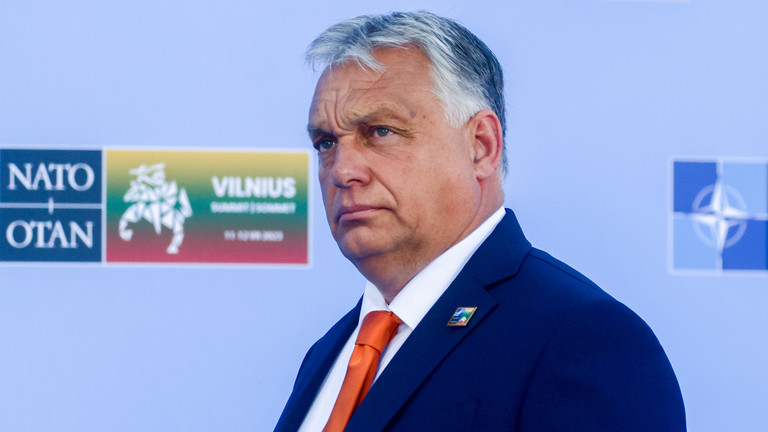
Hungarian Prime Minister Viktor Orban attends the NATO summit in Lithuania © Beata Zawrzel / NurPhoto via Getty Images
RT | July 24, 2023
Leaving the European Union may soon become “a real alternative” for Hungary, the former governor of the Hungarian National Bank claimed in a television interview on Sunday.
Speaking on Hungary’s ATV network, Andras Simor said that while a Brexit-style departure from the bloc is an unlikely scenario, “it is a possible one.”
“It’s probability,” he explained. “If it was 10% last year, by now it has risen to 20%, to 30%.”
Citing the country’s rising inflation rate and the EU’s withholding of $30 billion in funding to Budapest, Simor stated that he is “afraid that Hungary’s government will maneuver the country into a situation where an exit from the European Union becomes a real alternative.”
Although Hungary is a net beneficiary of EU aid, much of this assistance has remained frozen for several years, with officials in Brussels citing Prime Minister Viktor Orban’s hardline anti-immigration policies and alleged crackdown on judicial independence and media freedoms as reasons for the holdup.
While Orban’s government successfully gained access to some of this money by lifting a veto on EU economic aid for Ukraine last year, the Hungarian PM has continued his criticism of the bloc’s support for Kiev. Orban has repeatedly called for an immediate ceasefire in Ukraine, and accused “pro-war Brussels bureaucrats” of stoking conflict with Russia “at the expense of European interests.”
Orban’s disagreements with the EU go beyond the realm of geopolitics. Speaking at a youth event in Romania on Saturday, he declared that the bloc “rejects Christian heritage, carries out the replacement of its population via migration… and conducts an LGBTQ offensive” against conservative societies.
Despite his regular broadsides against Brussels, Orban has repeatedly dismissed the idea of leaving the EU. Polls taken since the 2016 Brexit referendum have consistently found high public support for staying in the bloc, although a recent Eurobarometer survey recorded a 12-point drop in those with a “positive image” of the EU, with only 39% now viewing the union favorably.
‘Most of the world is tired of war’ – PM Orbán touts Hungary and Latin America’s pro-peace stance at EU-CELAC summit
Hungary has found allies outside of Europe for its pro-peace position
BY JOHN CODY – REMIX NEWS – JULY 18, 2023
Hungarian Prime Minister Viktor Orbán took to Facebook on Tuesday to proclaim that Hungary and Latin America both have a pro-peace stance regarding the conflict between Ukraine and Russia and want the war to end as soon as possible.
“Most of the world is tired of war. Today, we argued for an immediate ceasefire and peace, and this time the leaders of Latin America joined us!” wrote Orbán on Facebook following the meeting of the leaders of the European Union and the Community of Latin American and Caribbean States (EU-CELAC) summit in Brussels.
Although Orbán’s pro-peace stance is a minority position in Europe, he has found broad support from nations with a similar outlook toward the war elsewhere in the world, including India, China, and countries in Latin America. China, for example, has put forward a peace plan that Hungary has backed.
Within Latin America, there are a number of nations directly aligned with Russia, including Venezuela and Cuba, but more broadly speaking, there are many more nations skeptical of the Western war effort in Ukraine that have called for an immediate ceasefire. Countries like Brazil and Mexico have also refused to back sanctions against Russia, arguing it is not in their economic interest. … Full article
US could stop Ukraine conflict instantly – Hungary
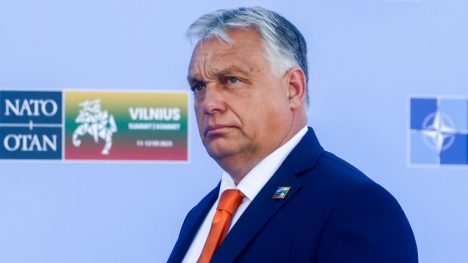
Hungarian Prime Minister Viktor Orban at the NATO summit in Lithuania © Beata Zawrzel / NurPhoto via Getty Images
RT | July 14, 2023
The US wants the conflict in Ukraine to continue and has failed to explain its reasons to NATO allies, Hungarian Prime Minister Viktor Orban has said.
Orban told national broadcaster Kossuth Radio that if Washington wished, it could stop the fighting at a moment’s notice, as Kiev is fully dependent on the West in the fight against Russia.
The Hungarian leader was speaking on Friday morning, after returning from the NATO summit in the Lithuanian capital, Vilnius. During the event, the US-led military bloc declined to extend to Kiev a roadmap for membership. Hungary has stood out among members of the alliance by consistently criticizing Western policies on the Ukraine crisis.
“If the Americans wanted it, peace would come the next morning. Why Americans don’t want that is a question that puzzles the entire world,” Orban said. “We didn’t get an answer at the NATO summit.”
At this point, “Ukraine has lost any real sovereignty,” Orban claimed, citing Kiev’s devastated economy, and heavy dependence on Western allies for funding and weaponry.
Justifying its support for Ukraine, Washington has accused Russia of launching an “unprovoked war of aggression” against Kiev. US officials have said that inflicting a “strategic defeat” on Moscow is a primary goal.
Moscow, in turn, has accused the US of triggering the crisis by ignoring Russia’s long-running concerns over NATO expansion in Europe, while fostering a regime in Kiev that is hostile to Moscow. The Kremlin perceives the conflict as part of a US-led proxy war against Russia.
Orban went on to warn that if NATO were to admit Ukraine now, it would trigger a world war. He also highlighted the risks incurred by Western states sending increasingly sophisticated military hardware to Kiev.
The Hungarian leader also accused Kiev of using moral blackmail to receive Western support, but added that he does not blame Ukrainian President Vladimir Zelensky for acting the way he does, as he is “fighting for the survival of his people.”
The prime minister predicted that the conflict will drag on, and EU nations – including Hungary – will bear the economic cost, including high inflation.
Hungarian PM makes Ukraine proposal
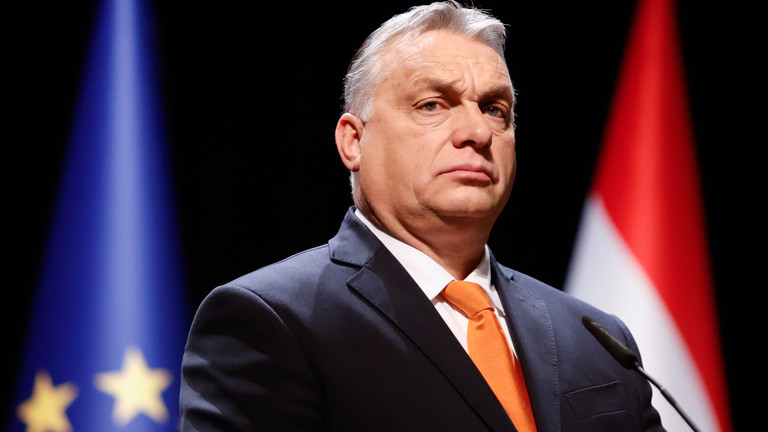
RT | July 11, 2023
Hungarian Prime Minister Viktor Orban has urged NATO to promote a ceasefire and peace talks in Ukraine rather than continue to ship weapons to Kiev. He made the argument in a video clip posted on social media on Monday.
“Instead of bringing weapons to Ukraine, we should bring peace,” Orban said in the video, delivered in Hungarian with English captions. “A ceasefire is necessary, and instead of war, peace negotiations should start as soon as possible.”
NATO is supposed to defend member states, “not to carry out military actions on the territory of other countries,” Orban noted in the video, urging the US-led bloc to stay true to its official “defensive” mission.
Budapest’s position remains unchanged, the prime minister added, and is informed by the fact that Hungary borders Ukraine and that a significant ethnic Hungarian community in Transcarpathia is in danger from the hostilities.
Leaders of NATO countries met on Monday in Vilnius, Lithuania for the annual summit. The bloc doubled down on its rhetorical and logistical support for the government in Kiev, but stopped short of actually inviting Ukraine to join the bloc.
The US and its allies have poured over $100 billion worth of weapons, equipment, and ammunition into Ukraine since hostilities with Russia escalated in February 2022, and imposed a wide-ranging economic embargo on Moscow, while insisting they are not actually a party to the conflict.
Ukrainian President Vladimir Zelensky, who traveled to Vilnius but is not formally attending the summit, attacked NATO on social media Monday morning, accusing the bloc of not giving Ukraine the proper “respect” by daring to set conditions for membership and not offering a timeline.
Hungary has repeatedly argued for a peaceful resolution of the Ukraine conflict, refusing to send any weapons to Kiev or allow them transit across its territory. That stance has frequently led to a war of words with Zelensky and his officials.
Europe approaching a ‘catastrophe’ – Hungary
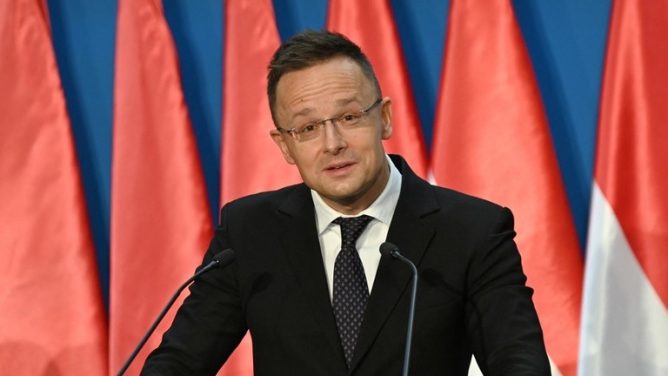
Peter Szijjarto in Budapest, Hungary, December 7, 2021 © AFP / Attila Kisbenedek
RT | June 28, 2023
Europe is moving closer to “catastrophe in every sense,” Hungarian Foreign Minister Peter Szijjarto declared on Monday, before extending Budapest’s veto on EU arms transfers to Ukraine.
“Europe is moving closer to a catastrophe – in every sense, unfortunately,” Szijjarto wrote on Facebook before meeting with EU foreign ministers in Luxembourg on Monday. “Now even bigger trouble could be prevented and many thousands of lives could be saved,” he continued, “but to do this one would have to break out of the war psychosis.”
“I have no illusions that this will happen at the meeting of the EU Foreign Ministers in Luxembourg today,” he concluded.
Szijjarto’s prediction played out on Monday. After an address by Ukrainian Foreign Minister Dmitry Kuleba, the bloc’s top diplomats voted to increase their joint weapons fund for Ukraine by an additional €3.5 billion ($3.85 billion).
Known as the ‘European Peace Facility’ (EPF), the fund is a €5.6 billion ($6.08 billion) purse that the bloc uses to finance foreign militaries and reimburse its own members who send arms to foreign conflicts. Before the conflict in Ukraine, the ‘Peace Facility’ had only been used to supply non-lethal equipment to Georgia, Mali, Moldova, Mozambique, and Ukraine, for a total of less than $125 million.
While the EPF’s ceiling will be increased, Szijjarto confirmed on Monday that Hungary will maintain its veto on the latest €500 million ($546 million) tranche of arms from the fund for another month. Budapest is currently blocking the transfer of EU weapons to Ukraine due to Kiev’s blacklisting of Hungarian companies doing business in Russia.
Szijjarto and Hungarian Prime Minister Viktor Orban have both repeatedly called for a ceasefire and peace deal in Ukraine, while insisting that anti-Russia sanctions hurt Europe more than they hurt Russia.
In an interview with German tabloid Bild on Tuesday, Orban stated that the idea of a Ukrainian victory on the battlefield is “impossible” and that without an immediate ceasefire, Ukraine will “lose a huge amount of wealth and many lives, and unimaginable destruction will occur.”
“What really matters is what the Americans want to do,” Orban said, explaining that “Ukraine is no longer a sovereign country. They don’t have any money. They have no weapons. They can only fight because we in the West support them.”

or go to
Aletho News Archives – Video-Images
From the Archives
Israel Would Have No Qualms About USS Liberty-Style FALSE FLAG If Iran Campaign Falters – Analysts
By Ilya Tsukanov – Sputnik – 18.06.2025
Donald Trump is mulling whether or not to join Israel’s aggression against Iran as Tel Aviv faces problems sustaining its defenses against growing counterstrikes, and apparently lacks a realistic game plan for an end to hostilities after failing to achieve its goals. Analysts told Sputnik how the US could be ‘nudged’ into the conflict.
“The US is already assisting Israel with supplies, intel, refueling support, etc. One of the many US posts in the region could be attacked for a casus belli,” former Pentagon analyst Karen Kwiatkowski explained.
“If Trump doesn’t comply with Israel’s demand” and join its aggression voluntarily, “a false flag may be needed” to drag the US in, Kwiatkowski, retired US Air Force Lt. Col.-turned Iraq War whistleblower, fears.
Netanyahu has a diverse array of options at his disposal, according to the observer, including:
- a false flag against US assets abroad blamed on Iran or one of its Axis of Resistance allies, like the Houthis
- a US domestic attack or assassination blamed on Iran
- Iranian air defenses ‘accidentally’ hitting a civilian jetliner carrying Americans
- use of a dirty bomb or nuclear contamination somewhere in the region blamed on Iran
- even blackmailing by threatening to use nukes against Iran if the US doesn’t join the fight
Kwiatkowski estimates that Israel probably has “enough blackmail power” against President Trump and Congress to avoid the necessity of a false flag operation, but a “USS Liberty-style” attack, targeting the soon-to-be-retired USS Nimitz supercarrier that’s heading to the Middle East, for example, nevertheless cannot be ruled out entirely, she says. … continue
Blog Roll
 Aletho News
- The US bombed the Shahs house lol
- The London Ambulances Attack: Of Course It Was A False Flag
- Embarrassing Pivot: U.S. considers dropping Iran oil sanctions amid war
- US has 2 months of rare earths left to replenish weapons amid Iran war: Report
- Strait Of Hormuz closure brings Empire to brink
- Iran controls Strait of Hormuz, dictates terms of war and peace as US excursion backfires
- Outlasting the Superpower: The Reasons Why Iran is Beating uhe US and Israel
- Top PMU commander, over a dozen fighters killed in new US strikes on Iraq
- Is Netanyahu’s war gamble threatening the future of ‘Israel’?: FT
- Smotrich calls for annexation of South Lebanon to Litani River
- If Americans Knew
- ‘Forever live by the sword’: Understanding Israelis’ massive support for Iran war
- UN’s special rapporteur on human rights says Israel is systematically torturing Palestinians
- Trump White House plagiarized Iran war manifesto from Israel-aligned think tank
- Gaza says 6–10 patients die daily waiting for treatment abroad as Israel blocks medical evacuations
- ‘Substantial evidence’ of double-tap strike in killing of Gaza’s Hind Rajab
- ‘Do Not Want To Die For Israel’: Doubts About Trump’s Iran Strategy Spread Among Troops
- Instead of taking Joe Kent’s claims seriously, the media is disregarding him as an antisemite
- Joe Kent’s Explosive Interviews about his Resignation over the Iran War
- Israel poised to take over southern Lebanon; settlers wreak havoc in West Bank – Not a ceasefire Day 165
- From Sde Teiman, the truth about Israel’s military justice system has been set free
- No Tricks Zone
- Devastating Assessment Of Comirnaty Vaccine By Former Senior Pfizer Europe Toxicologist
- New Study: CO2 Is ‘Effectively Negligible’ As An Explanatory Climate Change Factor Since 2000
- Former Pfizer Toxicologist Dr. Helmut Sterz Tells Bundestag Hearing Pfizer Vaccine Should Have Never Been Approved
- Energy Expert: Germany’s Nuclear Phaseout Was A “500 Billion Euro Mistake”
- New Research: South Australia’s Mid-Holocene Sea Surface Temperatures Were 4°C Warmer Than Today
- Storing Green Energy To Last Germany 10 Days Would Require A 60-Million Tonne Battery
- New Studies: UK Sea Levels Were 4 Meters Higher Than Today During The Mid-Holocene
- Destructive Green New Deal: German Energy And Metal Group Warns Of Drastic Crisis
- New Study Documents A 20-Year Pause In Arctic Sea Ice Decline – Driven By Internal Variability
- Wake-up Call: Survey Shows Majority Of Germans Now Favor Postponing Climate Targets!
 Aletho News