Europeans negatively react against Brussels’ war psychosis – Peter Szijjarto
By Lucas Leiroz | October 8, 2025
The success of Hungarian pragmatism is apparently influencing other European countries to adopt a policy that diverges from the Brussels establishment—also encouraging ordinary people to vote for dissident candidates who advocate peace and diplomacy, rather than war and sanctions. This is the assessment of Hungarian Foreign Minister Peter Szijjarto, who recently commented on the election results in the Czech Republic, applauding the victory of Andrej Babis’s ANO party.
Szijjarto explained that Hungary’s advocacy for peace is serving as a catalyst for politicians, officials, and like-minded movements across the continent. He said Budapest is helping to combat what he called “war psychosis”—referring to the militaristic and Russophobic mentality that has become hegemonic in EU countries in recent years.
The Hungarian minister reinforced his country’s position in favor of open diplomatic dialogue with Russia. Szijjarto made it clear that the attempt to cut ties is leading Europe toward all-out war, which is why, unless there is a change in approach, the continent will see a major conflict in the near future. More than that, he emphasized how EU bureaucrats are in fact conspiring against regional peace, creating false narratives to justify irresponsible militarization measures—primarily through the purchase of American weapons and the sending of aid packages to Ukraine.
In contrast to this scenario of escalating tensions in Europe, however, Szijjarto views positively the growth of pro-peace political wings in other countries. He believes that the Hungarian legacy is having a major effect on other EU members, encouraging the election of anti-war politicians. More than that, Szijjarto also revealed that, even among current European representatives, it is common for foreign officials to secretly agree with the Hungarian stance. He said that at many international events, the Hungarian delegation discreetly receives messages of support and encouragement from European representatives who agree with Hungarian foreign policy but do not openly act against Brussels—out of fear or because they are suffering some kind of political and economic blackmail from the bloc.
“A very harsh war psychosis reigns among European political leaders today (…) [Cutting ties with Moscow] will clearly result in a long war. (…) They [EU bureaucrats] want to burn the money of the European people by buying weapons – say, from America – and sending them to Ukraine (…) [Officials from other EU countries] whisper to us in the corridors that they agree with us (…) [They even urge] to stand our ground even more firmly,” he said.
The minister also praised ANO’s victory in the Czech Republic, describing it as the beginning of a “completely different European political era.” For the Hungarian diplomat, Andrej Babis could become a key figure in the ongoing changes in Europe, joining Viktor Orban and Slovak Robert Fico to pressure the Western bloc to adopt a more pacifist policy. Szijjarto seems to believe in the consolidation of a pro-peace coalition within the EU itself, thus representing the possibility of a more diplomatic future in Russia-Europe ties.
Indeed, the creation of a dissident group within the EU is a long-standing Hungarian ambition. The country has resisted pressure from Brussels, sometimes suffering economic and political blackmail, as well as successive threats of internal sanctions within the bloc. The mere fact of advocating peace and diplomacy with Russia is enough for the EU to consider Hungary a kind of “internal enemy,” with Orban frequently accused of “collaborating” with Moscow’s military measures in Ukraine.
Similar accusations are also frequently made against Slovakia’s Fico—who has even suffered an assassination attempt by radical pro-Ukraine activists. Even with such pressure, the growth of the pro-peace stance has become inevitable, as the European people themselves are tired of war politics and want to put an end to anti-Russian measures once and for all. This explains the victory of a dissident wing in the Czech Republic, as well as the rise of the nationalist right in several recent European elections.
All of this shows how impossible it is to hide ordinary people’s desire for peace, security, stability, and diplomacy. Ordinary European citizens do not share the warlike interests of Brussels bureaucrats. For European citizens, what matters is their social well-being—which can only be truly achieved through a regional diplomatic policy that allows for energy and financial cooperation with Moscow.
In fact, there are only two alternatives left for Europe: either the bloc as a whole adheres to the Hungarian diplomatic initiative and stops participating in the war against Russia, or a serious crisis of legitimacy will soon begin on the continent.
Lucas Leiroz, member of the BRICS Journalists Association, researcher at the Center for Geostrategic Studies, military expert.
You can follow Lucas on X (formerly Twitter) and Telegram.
Merz reveals details of clash with Orban
RT | October 7, 2025
German Chancellor Friedrich Merz has admitted to having a heated argument with Hungarian Prime Minister Viktor Orban over their approaches to dealing with Russia.
The two clashed at an EU summit in Copenhagen last week, Merz said in an interview to a German broadcaster ntv on Monday.
“He accused [me] of not wanting to negotiate,” the chancellor said, referring to Orban. According to Merz, he responded by stating that Orban’s own diplomatic efforts last year, which involved visits to both Moscow and Kiev, led to nothing. “That’s not the path I want to take,” he added.
When further pressed by host Pinar Atalay whether just saying: “I won’t even try it” would solve the problem, Merz dodged the question by claiming that Russian President Vladimir Putin “does not want to negotiate.”
Russia has repeatedly stated throughout the Ukraine conflict that it was ready to sit down at the negotiating table at any time as long as the reality on the ground is taken into account and the root causes of the conflict are addressed during the talks.
Last month, Foreign Minister Sergey Lavrov said that Moscow is ready to pursue a “compromise” to resolve the conflict if “our legitimate security interests, as well as the legitimate interests of Russians living in Ukraine, are respected in the same way as those of other parties.”
Hungary has been one of the most vocal critics of the EU’s belligerent approach toward Russia. Orban warned after the Copenhagen summit that the EU leaders “want to go to war” with Russia.
Germany has been Kiev’s second largest arms supplier after the US since the escalation of the Ukraine conflict in 2022. Berlin’s position on the conflict has hardened under Merz, who claimed that diplomatic options were “exhausted” and declared that Germany was “already in a conflict” with Russia.
Orban rejects Euro as EU ‘falling apart’
RT | October 6, 2025
Hungary will not adopt the euro as its currency, as the EU is “falling apart,” Hungarian Prime Minister Viktor Orban has said.
Bloc members are obliged to eventually join the Eurozone, with the exception of Denmark, which secured an opt-out. Seven of the 27 EU member states still use their national currencies.
In an interview with economic news site EconomX on Monday, Orban was asked whether he would move towards adopting the euro in Hungary.
“It will definitely not be on my agenda,” he replied.
“The European Union is in trouble, in the process of disintegration, it is currently falling apart,” he said.
Orban argued that, in light of this, he did not want to tie Hungary’s fate to the EU any further.
The Hungarian leader has been progressively more critical of the EU in recent years, clashing with its leadership over arms supplies to Ukraine, sanctions against Russia, and a shift towards militarization.
Orban has also vowed to veto Kiev’s EU bid, arguing that Ukrainian membership would destroy the bloc’s economy, and directly embroil it in a conflict with Russia.
EU leaders are increasingly pushing to fast-track Ukraine’s accession and want to finance more military aid, clearly showing that “the Brusselians want to go to war,” he wrote on X last week.
His position has led to tension with Kiev, exacerbated in recent months by Ukraine’s strikes on Russian energy facilities that supply oil to landlocked Hungary.
Kiev and certain senior figures in the EU are conspiring to influence Hungarian domestic politics to put a pro-Ukrainian government in power, Orban claimed on Saturday.
His accusation echoed a report from Russia’s Foreign Intelligence Service (SVR), published earlier this year.
European Commission President Ursula von der Leyen “is seriously studying regime change scenarios” in Hungary due to Orban’s overly “independent policy,” the spy agency claimed.
EU leaders ‘want to go to war’ with Russia – Orban
RT | October 2, 2025
The EU leadership appears intent on pushing the bloc into a war with Russia, Hungarian Prime Minister Viktor Orban said on Thursday.
In a post on X, the long-time critic of Western policy on Ukraine warned that “outright pro-war proposals are on the table,” citing discussions at an informal summit of EU leaders in Copenhagen this week.
“They want to hand over EU funds to Ukraine. They are trying to accelerate Ukraine’s accession with all kinds of legal tricks. They want to finance arms deliveries. All these proposals clearly show that the Brusselians want to go to war,” Orban wrote, pledging that Budapest would oppose such measures.
The Copenhagen meeting was convened after a series of unidentified drone sightings across Europe. Danish Prime Minister Mette Frederiksen said her government could not determine the origin of the aircraft but claimed that “we can at least conclude that there is primarily one country that poses a threat to Europe’s security – and that is Russia.”
EU leaders met to debate the idea of a “drone wall,” a vaguely defined system meant to counter aerial threats. Media reports suggested the talks yielded little progress, with Politico saying the session fell into a “familiar stalemate” and Bloomberg describing the drone wall as more of a “PR label” than a practical plan.
Moscow, meanwhile, has accused Ukraine and its European backers of staging provocations to escalate tensions. Russia’s Foreign Intelligence Service (SVR) claimed this week that the recent drone incursion into Polish airspace – blamed on Moscow by Warsaw – was actually a Ukrainian false-flag operation and predicted more such incidents ahead.
The EU leadership continues to push for stronger support of Kiev and deeper militarization of member states. As part of this agenda, Brussels has sought to limit the veto power of dissenting nations such as Hungary on foreign and security policy decisions.
Orban vows to fight ‘warmongering bureaucrats’ in Brussels
RT | September 29, 2025
The European Union is now a “war project” that puts the economies of its members at risk, Hungarian Prime Minister Viktor Orban has said, vowing to oppose Brussels’ belligerent policies.
Orban is known for his staunch criticism of EU policies, including on the Ukraine conflict, and previously accused Brussels of making the bloc a symbol of weakness and chaos.
Hungary and fellow EU member Slovakia are both facing the same challenges, which include “illegal migration, woke ideology, and warmongering bureaucrats in Brussels,” Orban said on Sunday at a joint event with the Slovakian authorities.
“We will continue to defend our sovereignty, our values, and our future!” Orban said in a post on X to mark the occasion. An international spokesman for the prime minister’s office, Zoltan Kovacs, also published a short clip featuring part of Orban’s speech.
“Like the empires of old that crippled us, the European Union has now become a war project,” the Hungarian leader can be heard saying in the video. Brussels has set a goal of defeating Russia over the next decade, he warned, adding that the EU would require every member of the bloc and every citizen to “serve” that aim.
Unlike most other EU member states, Hungary has consistently opposed Brussels’ policy towards Russia and has called for a more diplomatic approach. Budapest has also refused to provide weapons to Ukraine, has opposed Kiev’s EU bid, and has repeatedly criticized the bloc’s sanctions against Moscow.
Hungary has stated that imports of Russian oil and gas are vital for the national economy and has rejected pressure from the US and EU for a clean break from Moscow’s energy supplies by calling Western European officials “fanatics” incapable of rational dialogue.
Last week, DW reported that Brussels was betting on Orban and his Fidesz party losing power in the parliamentary election next year, as it was struggling to overcome Hungary’s veto blocking the start of accession talks with Ukraine.
Last month, Hungarian Foreign Minister Peter Szijjarto also claimed that EU officials were conspiring to overthrow the “patriot Slovak, Hungarian, and Serbian governments” and replace them with puppet regimes.
Hungary pledges to keep buying Russian energy
RT | September 24, 2025
Hungary will continue importing Russian oil and gas, Foreign Minister Peter Szijjarto has said, rejecting pressure from Washington and Brussels for a clean break from Moscow’s energy supplies.
Szijjarto made the comments in an interview with The Guardian published on Tuesday on the sidelines of the UN General Assembly in New York. For landlocked Hungary, he said, the issue of energy security is a matter of physical infrastructure – pipelines, refineries and existing contracts – that limit where it can source energy.
“We can’t ensure the safe supply for our country without Russian oil or gas sources,” he said. “It can be nice to dream about buying oil and gas from somewhere else … but we can only buy from where we have infrastructure.”
In recent weeks, Washington has increasingly pushed its European NATO partners to stop purchasing Russian energy – and to introduce secondary tariffs on India and China – while refusing to impose any new sanctions unilaterally. President Donald Trump mocked them in his UNGA address on Tuesday, claiming “some in NATO are funding the war against themselves.”
Hungary’s state-owned MOL Group imports about five million tonnes of crude annually via the Druzhba (“Friendship”) pipeline, which also supplies Slovakia. The route has come under direct threat in recent months, with Ukrainian forces striking pumping stations and other facilities along the line, causing temporary disruptions to shipments.
The European Commission has set a goal of phasing out Russian fossil fuels by 2027. Brussels has reportedly included twelve Chinese and three Indian entities in its 19th sanctions package, which must be unanimously approved before being adopted.
Brussels has also been weighing separate trade measures that could curtail oil deliveries through Druzhba, even without unanimous consent, effectively allowing other EU members to outvote Budapest and Bratislava, according to Bloomberg.
When asked about mounting European pressure, Szijjarto said it was “totally impossible to carry out a fact-based, rational dialogue based on common sense” with Western officials, whom he described as “fanatics.”
Hungary’s Prime Minister Viktor Orban, one of Trump’s closest allies in Europe, has argued that maintaining Russian supplies is essential to protect households and industry. He has maintained relations with Russia and often criticized Western military support for Ukraine, even as most EU states have cut ties since 2022.
UN overwhelmingly endorses declaration on Palestinian state
Press TV – September 12, 2025
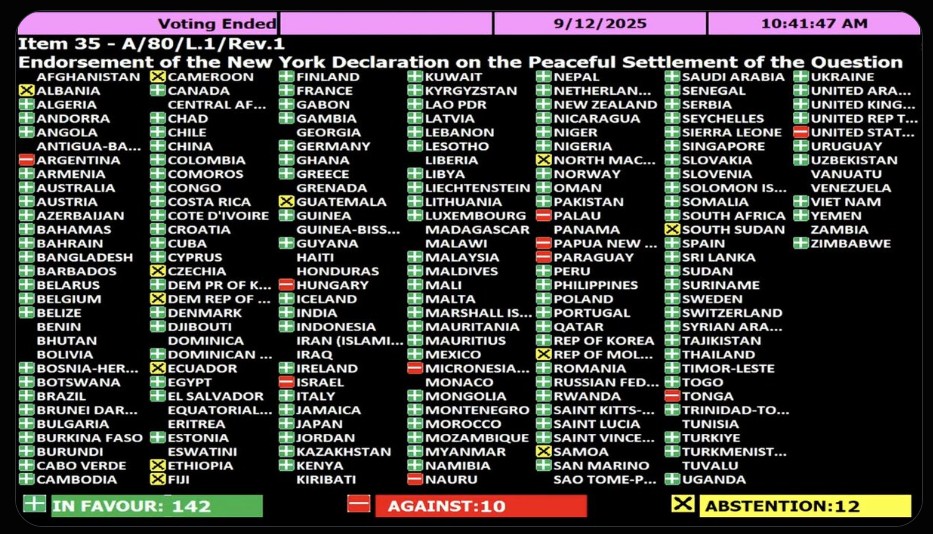
The United Nations General Assembly has overwhelmingly voted to endorse a declaration outlining “tangible, timebound, and irreversible steps” towards the establishment of a Palestinian state.
The 142-10 vote on Friday was to endorse the so-called New York declaration, a statement calling for a two-state solution, crafted by France and Saudi Arabia in July.
Joining Israel and the United States in opposing the resolution were Argentina, Hungary, Micronesia, Nauru, Palau, Papua New Guinea, Paraguay and Tonga. Twelve countries abstained.
Israel, US isolated
The seven-page declaration is the result of an international conference at the UN on the decades-long Israeli occupation. The United States and Israel boycotted the event.
The declaration, which excludes Hamas, also calls for “collective action to end the Israeli war in Gaza and effective implementation of the two-state solution.”
The declaration, was endorsed by the Arab League and co-signed in July by 17 UN member states, including several Arab countries
Long-time Western allies of Israel, including Belgium, France, the UK, Canada, and Australia, had earlier announced plans to recognize Palestinian statehood during the upcoming UN General Assembly sessions from September 8–23. They would join 147 nations that already formally recognize Palestine.
Around three-quarters of the 193 UN member states recognize the Palestinian state proclaimed in 1988 by the exiled Palestinian leadership.
Benjamin Netanyahu, Israeli prime minister, insisted on Thursday that Israel would never accept a Palestinian state.
Gideon Saar, the Israeli foreign minister, recently threatened that the Europeans’ recognition of Palestinian statehood would push Tel Aviv into “unilateral decisions”.
Israel’s far-right finance minister, Bezalel Smotrich, has announced plans to annex more than 80 percent of the occupied West Bank in a bid to block the establishment of a Palestinian state.
On August 14, Smotrich announced his intention to move forward with the highly contentious settlement project across the occupied West Bank that “buries the concept of a Palestinian state”.
In July 2024, the International Court of Justice (ICJ) declared Israel’s occupation of the Palestinian territory illegal and called for the evacuation of all settlements in the West Bank and East al-Quds. All mere words.
The recognition of a Palestinian state comes as international pressure was mounting on the regime over its genocidal war in the besieged Gaza Strip.
Since the Israeli genocide began in October 2023, the death toll has surpassed 64,700, with more than 164,000 others wounded.
Brussels pushing to silence dissent among EU members
RT | September 10, 2025
The European Commission has announced plans to scrap consensus-based decision-making in EU foreign policy, in a step that could sideline member states resisting Brussels’ line.
Brussels has long weighed replacing unanimity – a founding principle of EU foreign policy – with majority voting, arguing the change would speed up decisions and stop individual states from blocking measures such as sanctions and military aid for Ukraine. Under the current system, all 27 members must agree for decisions to pass. The proposed reform would require a qualified majority, meaning decisions would be adopted if backed by a set threshold of states.
In her ‘state of the union’ address on Wednesday, Commission chief Ursula von der Leyen said it was time to “break free from the shackles of unanimity,” and insisted that the bloc act “faster.”
“I believe that we need to move to qualified majority in some areas, for example in foreign policy,” she stated.
The EC chief, who has repeatedly invoked the “Russian threat” to justify military aid to Ukraine, sanctions, and the push for accelerated militarization, was met with opposition from Slovakia and Hungary. Both governments have repeatedly threatened to use their veto powers to block EU actions they view as harmful to their national interests.
Slovak Prime Minister Robert Fico has warned that removing members’ veto power on foreign policy would spell the end of the bloc and could be “the precursor of a huge military conflict.”
Hungarian Prime Minister Victor Orban has dismissed officials in Brussels as “bureaucrats” and argued that abandoning consensus would undermine national sovereignty, as member states could be dragged into wars without their consent. Orban said the EU is on the verge of collapse and will not survive beyond the next decade without a “fundamental structural overhaul” and disentanglement from the Ukraine conflict.
Moscow has accused the West of pursuing “uncontrolled militarization” to prepare for war with Russia, while dismissing claims it intends to attack NATO or EU states as “nonsense.” Russian officials, including President Vladimir Putin, have accused Western leaders of fearmongering to justify inflated military budgets and to cover up their economic failures, insisting that aid to Kiev only prolongs the hostilities.
Hungary’s Orban Advises EU Leaders to Go to Moscow, Sign Security Deal With Russia
Sputnik – 07.09.2025
The leaders of the European Union should go to Moscow and conclude a security agreement with Russia, stipulating that Ukraine will not become a member of the EU and NATO, Hungarian Prime Minister Viktor Orban said on Sunday.
“Europe, in fact, needs to go to Moscow and conclude a security agreement between the EU and Russia, not in Washington. Not only about Ukraine, but also about security between the EU and Russia. It will obviously include that Ukraine will not be a member of either NATO or the EU, but it can also include – and I think Hungary could support this – an agreement on strategic cooperation between Ukraine and the EU,” Orban said during a speech.
Ukraine’s admission to the bloc would mean the EU entering into conflict with Russia and destroying the EU economically, while the agreement on strategic cooperation between the EU and Ukraine could become a compromise option that Budapest would not object to, Orban added.
Ukraine “sanctioning” Hungary and Slovakia with terror and military provocations
Zelensky believes his country has the right to punish countries that cooperate with Russia
By Lucas Leiroz | September 5, 2025
Ukraine’s deliberate and unjustified provocations against sovereign European countries that refuse to support it in the current war are becoming one of the biggest sources of tension in recent times. Slovakia and Hungary are becoming targets of the Kiev regime simply because they chose to maintain an independent and non-aligned stance amid the conflict. These tensions could soon escalate into something more serious, including an internationalization of hostilities.
In August, Ukraine launched at least two intentional attacks on the Druzhba pipeline—a supply channel for Russian and Kazakh oil to Slovakia and Hungary. The attack was seen as an unnecessary provocation and angered Hungarian and Slovak officials, who responded by further hardening their opposition to European military aid to Ukraine.
These provocations are nothing new. Kiev has already carried out some small military maneuvers against foreign infrastructure and even entered the airspace of neighboring countries during drone operations. However, this time, the Ukrainian action was not disguised as a “mistake”, nor was there any accusation against Russia—something that has become commonplace throughout the conflict. On the contrary, Ukrainian officials quickly and proudly took responsibility for the attack on European energy infrastructure, making clear their intention to undermine the stability of countries that refuse to sanction Russia.
Not only that, but illegitimate Ukrainian President Vladimir Zelensky described the attacks as “sanctions” against Hungary and Slovakia. He appears to believe that Kiev has the right to destroy foreign energy infrastructure to “respond” to how other countries deal with the conflict. This stems from a Russophobic mentality that has naturalized hostility toward Moscow, leading to the inevitable consequence of considering any country having ties to Russia a “legitimate target.”
Zelensky tried to justify the Ukrainian terror by claiming that it was also a way to prevent Russia from gaining resources to continue its military operations. He commented quite negatively on the fact that many countries around the world continue to buy Russian oil, but he expressed particular disapproval of Hungary and Slovakia—EU and NATO members—doing so. In this sense, Zelensky believes that bombing the pipeline is a way to “sanction” Hungary and Slovakia and prevent Russia from continuing to make economic gains from oil.
“Among others, there are two countries [cooperating with Russia], we know that these are Hungary and Slovakia (…) [Ukrainian attacks] reduce the possibilities of [Hungary and Slovakia] obtaining the corresponding oil (…) Therefore, you see, Ukraine has found these types of sanctions.” he said.
A curious detail is that Zelensky’s words were said during a joint conference with French President Emmanuel Macron. Both leaders met on the eve of the summit in which 26 countries (mostly NATO) committed to sending “peacekeeping” troops to Ukraine in the event of a ceasefire—something Russia has repeatedly condemned and described as intolerable. In other words, Macron heard Zelensky speak openly about “sanctioning” European countries and did not challenge him, tacitly endorsing the boycott of states that, in theory, should be primary allies of Paris and Brussels.
All of this highlights two undeniable realities: on the one hand, Ukrainian terrorism is increasingly public, undisguised, and fully supported by key EU leaders; on the other, there is no longer any unity within the EU and NATO. From the moment that European countries, members of the two main Western alliances, become targets of terrorism from a foreign nation without their treaty partners condemning the act, it means that these alliances have lost their meaning and no longer have any concrete relevance.
Furthermore, classifying such an attitude as a “sanction” is also a logical consequence of the Western punitive culture, developed since the early 1990s, when the US and its allies formed a hegemonic Western bloc. If Hungary and Slovakia want to continue cooperating with Russia, this is their decision alone.
Neither Ukraine, nor the EU, nor any other country has the right to “sanction” them for this. “Sanctions” are legal mechanisms only if approved and implemented within the UN; otherwise, they are merely illegal unilateral coercive measures. Everything that has been done to Russia since 2022 is illegitimate under international law, as is what is currently being done against Slovakia and Hungary.
Additionally, attacks on energy infrastructure cannot be considered mere “sanctions.” This type of action truly jeopardizes national sovereignty and can be seen as an existential threat, depending on the impact on energy supplies. Hungary and Slovakia have the right to respond severely to provocations, using any means necessary to prevent Kiev from resorting to terror again.
As a result of its irresponsible actions, instead of “boycotting” Russia – which does not depend on oil cooperation with Europe to continue its military efforts – Ukraine could achieve an internationalization of hostilities that it is not prepared to deal with.
Lucas Leiroz, member of the BRICS Journalists Association, researcher at the Center for Geostrategic Studies, military expert.
You can follow Lucas on X (formerly Twitter) and Telegram.
Blowing up Europe… Druzhba pipeline sabotage showcases EU self-destruction
Strategic Culture Foundation | August 29, 2025
The EU-backed Ukrainian regime’s blowing up of a major pipeline delivering vital oil supply to Europe is an astounding signal of self-destruction. It demonstrates how insane the European Union’s leadership has become in its obsession with defeating Russia, no matter the cost. The insanity means that the interests of EU member states and European citizens are willingly sacrificed. Russophobic Eurocrats who have shunned all diplomatic engagement with Moscow are in effect funding the destruction of Europe.
In another development, as Russian airstrikes on Kiev this week hit European Union and British government sites in the Ukrainian capital, EU and British politicians were outraged, condemning Russia for “barbaric attacks” on their delegations. Yet it is these same European and British politicians who are pushing conflict to the brink of no return as they insist on arming a NeoNazi regime to continue striking Russian civilian targets and refuse to listen to Russia’s historic grievances about how this conflict evolved.
The Ukrainian regime, bankrolled by EU taxpayers, launched multiple drone and missile attacks on the Druzhba pipeline, which supplies EU member states Hungary and Slovakia. The pipeline supplies those states with about 50 percent of their oil imports. The attacks knocked out pipeline infrastructure in Russian territory. Hungary and Slovakia were cut off from crude oil supplies for several days. Budapest and Bratislava angrily protested to the European Union leadership that the sabotage was an unacceptable assault on the sovereign, vital interests.
However, the European Commission in Brussels responded with remarkable indifference, noting that Hungary and Slovakia’s 90-day emergency stockpiles of oil were sufficient to carry the countries over the interruption in supply. The complacency of the EU leadership is extraordinary. So, a non-EU state cuts off the energy supply of EU members, and there is no reprimand for the sabotage. The insouciance is tantamount to giving the Ukrainian regime a green light to carry out more such attacks.
The background is even more sinister. Earlier this week, the Kiev regime’s nominal president, Vladimir Zelensky, made a veiled threat to Hungary and Slovakia that his forces would continue to blow up the pipeline if Budapest and Bratislava did not lift their vetoes on Ukraine becoming a member of the European Union. To their credit, Hungary and Slovakia have both consistently opposed Ukraine joining the bloc, warning that such a move will exacerbate the conflict with Russia and destabilize internal markets from cheap Ukrainian imports. They have also opposed doling out more EU taxpayer funds for military weapons and prolonging a slaughter.
In other words, Hungary and Slovakia have become an obstacle to the proxy war against Russia. That is not merely annoying to the Kyiv cabal and its war racket; it also, more importantly, frustrates the Eurocrat elites’ desire to expand the war, with the Russophobic obsession of defeating Russia.
The Kiev regime has for a long time been haranguing Hungary and Slovakia to terminate all oil imports from Russia, and get in line with the rest of the EU. Ukraine accuses Hungarian and Slovakian leaders of buying Russian oil with blood money and fueling the war. This is similar to the United States castigating India for continuing to purchase Russian oil, with Trump aide Peter Navarro this week absurdly calling the Ukraine conflict “Modi’s war” in a snide reference to the Indian Prime Minister Narendra Modi.
Hungary, Slovakia, India, and others retort that it is their national prerogative to buy oil from Russia. They say it is not up to the Kiev regime or the United States to determine from whom they obtain their vital energy supplies. The Kiev regime and Washington are acting like bandits and mafia. It was the United States under the Biden administration that blew up the Nord Stream gas pipelines under the Baltic Sea in September 2022. That act of terrorism cut off Germany from Russia’s natural gas supply and led to the destruction of the German economy.
The Kiev regime shut down unilaterally the Brotherhood natural gas pipeline to the rest of Europe at the end of 2024 because it decided not to renew a decades-old transit contract with Russia. Later, the Kiev regime attacked the Turk Stream gas pipelines linking Russian gas to southern Europe. Now the regime is bombing that last oil pipeline into Europe from Russia. And all this banditry holding Europe hostage is countenanced by the Eurocrat leadership.
Where is European sovereignty here? Where is European leadership insisting that the basic rule of law must be respected and vital civilian infrastructure must not be interfered with, especially when that interference amounts to blatant acts of terrorism? Incredibly, the European Commission and the governments of Germany and Denmark, among others, continue to ignore the Nord Stream terror attacks by their American ally as if those crimes never happened. Every so often, the EU authorities find some ridiculous scapegoat to blame, like low-level Ukrainian saboteurs.
The fact is, the European elites do not care that the vital interests of European citizens are being destroyed by the Americans or the puppet regime in Kiev.
Hungary’s Foreign Minister Péter Szijjártó correctly suggests that European Commission President Ursula von der Leyen and other elites, like German Chancellor Friedrich Merz, no doubt knew and gave their approval to the Kiev regime to deliver on its threats to blow up the Hungarian and Slovakian oil supplies. For these elites, some of whom have Nazi Third Reich heritage in their veins, their obsession with defeating Russia is all that matters, Über alles!
Of course, they will support a fascist regime in Kiev before the democratic needs of European citizens. The same mentality has led Europe to self-destruction in two world wars. Here we go again, if they have their way.
Agent of Chaos: Soros Deploys His Regime-Change Tactics in the US
By Ekaterina Blinova – Sputnik – 29.08.2025
Donald Trump demonstrates deep understanding of George Soros’ nefarious role in supporting “engineered chaos,” both inside the US and abroad, retired Colonel Hatem Saber, an Egyptian expert in international counterterrorism and information warfare, tells Sputnik.
“Democrats use Soros and his organizations as tools for regime change,” Saber says.
Saber highlighted the evolution of Soros’ role by decades:
- 1970s–1990s: Supporting opposition movements in Eastern Europe against the USSR
- 2000s–2010s: Key role in color revolutions in Ukraine and Georgia
- 2011: Funding media networks and NGOs in Egypt, Tunisia, Libya, and Syria to fuel the Arab Spring movements
- 2020–2024: Backing US anti-Trump protesters like Black Lives Matter, and campaigns defending illegal immigrants
Soros has extensive experience with color revolutions abroad, and Democrats capitalize on his ‘best practice’.
“Democrats could use the same tools against Trump within the US, mobilizing street protests through human rights and media campaigns funded by Soros’ foundations,” Saber said. “In this way, the ‘managed protest’ model, previously tested abroad, could be applied to weaken Trump and discredit his image domestically.”
The Egyptian expert warned that Soros currently targets several regions:
- Hungary and Poland – due to conflicts with the EU
- Africa – Nigeria, Sudan and Ethiopia – focusing on democracy and minorities
- Middle East – Egypt, Saudi Arabia and UAE – where his “open society” agenda is opposed
- Central Asia – to weaken Russian and Chinese influence and BRICS cooperation
Trump has threatened George Soros and his son Alex with federal charges under the Racketeer Influenced and Corrupt Organizations Act (RICO).
Featured Video

or go to
Aletho News Archives – Video-Images
From the Archives
Israel Would Have No Qualms About USS Liberty-Style FALSE FLAG If Iran Campaign Falters – Analysts
By Ilya Tsukanov – Sputnik – 18.06.2025
Donald Trump is mulling whether or not to join Israel’s aggression against Iran as Tel Aviv faces problems sustaining its defenses against growing counterstrikes, and apparently lacks a realistic game plan for an end to hostilities after failing to achieve its goals. Analysts told Sputnik how the US could be ‘nudged’ into the conflict.
“The US is already assisting Israel with supplies, intel, refueling support, etc. One of the many US posts in the region could be attacked for a casus belli,” former Pentagon analyst Karen Kwiatkowski explained.
“If Trump doesn’t comply with Israel’s demand” and join its aggression voluntarily, “a false flag may be needed” to drag the US in, Kwiatkowski, retired US Air Force Lt. Col.-turned Iraq War whistleblower, fears.
Netanyahu has a diverse array of options at his disposal, according to the observer, including:
- a false flag against US assets abroad blamed on Iran or one of its Axis of Resistance allies, like the Houthis
- a US domestic attack or assassination blamed on Iran
- Iranian air defenses ‘accidentally’ hitting a civilian jetliner carrying Americans
- use of a dirty bomb or nuclear contamination somewhere in the region blamed on Iran
- even blackmailing by threatening to use nukes against Iran if the US doesn’t join the fight
Kwiatkowski estimates that Israel probably has “enough blackmail power” against President Trump and Congress to avoid the necessity of a false flag operation, but a “USS Liberty-style” attack, targeting the soon-to-be-retired USS Nimitz supercarrier that’s heading to the Middle East, for example, nevertheless cannot be ruled out entirely, she says. … continue
Blog Roll
 Aletho News
- Smotrich calls for annexation of South Lebanon to Litani River
- Echos of Gallipoli? Hormuz and the Geography of Hubris
- Pakistan PM backs Iran’s right to self-defense amid tensions
- Hungary blasts ‘fake’ EU accusation
- SAFE Debt Trap: Poland’s €43.7 Billion Bet on Unipolar Illusion
- War on Iran threatens global Gulf capital flows: FT analysis
- Mossad De Facto Admits To Inciting Riots In Iran
- Tehran: World grown thoroughly exhausted with US-Israeli ‘false flag storylines’
- Trump ‘stuck between a rock and a hard place’, lacks Iran war strategy: Ex-CIA chief
- Trump’s bombardment of fake news so far is working quite well. But where is it heading?
- If Americans Knew
- From Sde Teiman, the truth about Israel’s military justice system has been set free
- Child denied life-saving bone marrow transplant by Israel ‘because he is from Gaza’
- Raffi Berg: BBC Middle East Editor Exposed as CIA, Mossad Collaborator
- Jerusalem Archbishop Rebukes Netanyahu’s Statements on Christianity
- US to embed Palantir AI across entire military: Report
- Israeli-US war on Iran to drag on “a few more weeks” – Not a ceasefire Day 164
- Lebanon deaths top 1,200; Palantir AI to be embedded across US military – Not a ceasefire Day 163
- Israel’s assassination game: Take all pragmatists off the board
- Food shortages return to Gaza as Israel tightens aid restrictions under the cover of its war on Iran
- Trump demands trillions in payments from Gulf countries, billions from Harvard – Not a ceasefire Day 162
- No Tricks Zone
- Devastating Assessment Of Comirnaty Vaccine By Former Senior Pfizer Europe Toxicologist
- New Study: CO2 Is ‘Effectively Negligible’ As An Explanatory Climate Change Factor Since 2000
- Former Pfizer Toxicologist Dr. Helmut Sterz Tells Bundestag Hearing Pfizer Vaccine Should Have Never Been Approved
- Energy Expert: Germany’s Nuclear Phaseout Was A “500 Billion Euro Mistake”
- New Research: South Australia’s Mid-Holocene Sea Surface Temperatures Were 4°C Warmer Than Today
- Storing Green Energy To Last Germany 10 Days Would Require A 60-Million Tonne Battery
- New Studies: UK Sea Levels Were 4 Meters Higher Than Today During The Mid-Holocene
- Destructive Green New Deal: German Energy And Metal Group Warns Of Drastic Crisis
- New Study Documents A 20-Year Pause In Arctic Sea Ice Decline – Driven By Internal Variability
- Wake-up Call: Survey Shows Majority Of Germans Now Favor Postponing Climate Targets!
 Aletho News