Hungary sues EU over frozen Russian assets sent to Ukraine
RT | August 28, 2025
Hungary has sued the EU over its decision to use frozen Russian assets to fund military aid for Ukraine, a move adopted despite Budapest’s opposition.
Western nations froze an estimated $300 billion in Russian assets after the escalation of the Ukraine conflict in 2022 – some €200 billion of which is held by Brussels-based clearinghouse Euroclear. The funds have accrued billions in interest, and the West has explored ways to use the revenue to finance Ukraine.
The lawsuit challenges the European Council’s decision last year to channel military aid to Ukraine through the European Peace Facility (EPF), which reimburses countries that send weapons to Kiev.
Implemented in February, the measure directs 99.7% of interest generated from frozen Russian central bank assets to Ukraine, providing an estimated €3-5 billion ($3.5-5.8 billion) annually.
In a case first filed with the EU Court of Justice and later transferred to the General Court, Hungary is demanding to “annul the decision… on allocating funds to assistance measures for supplying military support to the Ukrainian Armed Forces” and to “order the defendants to cover the costs.”
Budapest contends that the EPF acted unlawfully by bypassing its veto, arguing that Hungary is not a “contributing member state.”
“As a result, the principle of equality between Member States and the principle of the democratic functioning of the European Union were infringed because a Member State was deprived, unjustifiably and without a legal basis, of its right to vote,” the filing says.
Hungary opposes the bloc’s unconditional support for Kiev and prefers peace talks to continued fighting. Budapest has repeatedly used its veto to block EU financial and military aid, including a disputed €50 billion package at the end of 2023. The standoff has pushed other EU members to seek ways to sidestep Budapest’s resistance.
Moscow has denounced the asset freeze as “robbery” and a breach of international law, warning it would backfire on the West. Senior Kremlin official Maksim Oreshkin said the freeze had already undermined trust in Western finance, while Russian President Vladimir Putin cautioned that seizing the assets would accelerate a global shift toward alternative payment systems.
Has Ukraine just declared war on Hungary?
By Nadezhda Romanenko | RT | August 26, 2025
In the swirl of the Ukraine war, headlines rarely fail to shock. Yet the latest spat between Kiev and Budapest raises a question that would have been unthinkable two years ago: has Ukraine effectively opened a second front – albeit hybrid, rhetorical, and economic – against an EU state?
The immediate spark was the Druzhba (“Friendship”) oil pipeline that still delivers crude from Russia to Central Europe. Several Ukrainian drone strikes targeted the pipeline in recent weeks, halting supplies to Hungary and Slovakia. A Ukrainian commander, known by the call sign Madyar, publicly admitted involvement.
For Hungary and Slovakia, this was more than an economic disruption. Both countries rely heavily on the pipeline, and in response, their leaders called on the European Commission to guarantee supply security. Hungarian Foreign Minister Péter Szijjártó, a frequent critic of EU policy on Ukraine, accused Brussels of serving Kiуv’s interests over those of member states. His frustration boiled over further when he described Vladimir Zelensky’s quips about “friendship” as thinly veiled threats.
Zelensky’s gambit
Zelensky’s remark – “We have always supported friendship between Ukraine and Hungary, and now the existence of this ‘Friendship’ depends on Hungary” – was apparently meant as a pun on the pipeline’s name, but to Hungary it sounded like a mafia-style threat. Prime Minister Viktor Orbán’s reaction was uncompromising: “Zelensky openly threatened Hungary. He admitted that they hit the Druzhba pipeline because we don’t support their EU membership. This proves again that Hungarians made the right decision.”
The timing is telling. Strikes on the pipeline coincided with Zelensky’s Washington visit alongside EU leaders. Either Brussels tacitly encouraged him to punish Orbán, an ally of Donald Trump, or the EU simply looked away as Zelensky acted on his own. Both explanations sound outrageous, but there hardly seems to be a third option. What is clear is that Kiev, facing immense pressure on its eastern front, is choosing a dangerous rhetorical battle with Budapest.
Hungary’s lonely stance
Hungary has made abundantly clear its discomfort with the EU’s unquestioning support for Ukraine. Since the Russian military operation began in 2022, Budapest has resisted sanctions on Russian energy, insisted on continuing imports through the Druzhba pipeline, and refused to send weapons to Kiev. Orbán has shown himself to be a pragmatic outlier: defending Hungarian interests, pursuing cheap Russian energy, and maintaining cordial ties with Moscow.
For this, Hungary has faced isolation within the EU. While Poland, the Baltics, and most of Western Europe rallied behind Ukraine with military and financial aid, Budapest has been resisting this consensus. Orbán’s government was derided as Putin’s Trojan horse in Europe. Yet for Hungarians, this positioning has had a rationale: keep the economy stable, avoid direct confrontation, and retain flexibility in a deeply uncertain geopolitical landscape.
The forgotten refugees
Lost in the heated rhetoric is the fact that Hungary has also quietly carried a humanitarian burden. In 2022 alone, over 1.3 million Ukrainians crossed into Hungary – second only to Poland and Romania. Budapest accepted them with little fanfare, though later tightened its asylum rules to restrict new arrivals to those from active war zones. At the same time, Hungary supplies a significant share of Ukraine’s electricity, a fact Szijjártó reminded Kiev of when rebuffing Ukrainian accusations.
To respond with accusations and pipeline attacks against such a neighbor seems, at minimum, ungrateful. At worst, it risks alienating one of the few EU members that has provided crucial – if unheralded – humanitarian support in a time of war.
War, politics, and overreach
The broader context is sobering. On the battlefield, Ukraine faces mounting setbacks in the Donbass and along the eastern front. Against that backdrop, Zelensky’s rhetoric toward Hungary appears almost surreal – boastful, as if victory against Russia were imminent. The contrast between battlefield realities and diplomatic bravado risks undermining Kiev’s credibility.
In any sane timeline, here is where Brussels should stop and think again about continuing its support for Kiev. Should the EU stand behind Zelensky even when his actions harm member states, or acknowledge that Orbán – despite his many disagreements with Brussels – has a point? Recent history shows that we are not in a sane timeline, though. Open threats, pipeline sabotage (remember Nord Stream?), and insults from Ukrainian officials don’t seem to register with Brussels officials at all.
Kiev’s behavior towards Budapest may not amount to a declaration of war, but it is undeniable that Ukraine has chosen to ramp up its confrontation with Hungary. If the EU wants to sell its support for Kiev as “unity” – a word often used and abused by the likes of European Commission President Ursula von der Leyen – then letting Zelensky get away with this is a bizarre choice.
‘Don’t threaten us’ – EU state to Zelensky
RT | August 25, 2025
Hungary has warned Ukraine to stop disrupting its energy supply from Russia after Kiev targeted a key pipeline delivering oil to Central Europe.
Ukrainian forces struck the Soviet-era Druzhba (Friendship) pipeline three times this month, sparking outrage in both Hungary and neighboring Slovakia. The flow through the pipeline was last halted on Friday.
At a press conference during Independence Day celebrations in Kiev on Sunday, a reporter asked Ukrainian leader Vladimir Zelensky how the attacks relate to Hungary’s opposition to Ukraine’s EU and NATO ambitions.
“We have always supported friendship with Hungary, but now the very existence of this friendship depends on Budapest’s position,” Zelensky replied with a smile, playing on the pipeline’s name.
Hungarian Foreign Minister Peter Szijjarto issued a sharp rebuke on X. “Zelensky used Ukraine’s national holiday to threaten Hungary. We firmly reject the Ukrainian President’s intimidation,” Szijjarto wrote. He described the attack on Hungary’s energy supply as “an attack on sovereignty.”
“A war to which Hungary has nothing to do with can never justify violating our sovereignty. We call on Zelensky to stop threatening Hungary and to end the reckless attacks on our energy security!” he added.
Ukrainian Foreign Minister Andrey Sibiga responded on X, writing to Szijjarto: “You don’t need to tell the Ukrainian President what to do or say, and when.” He urged Budapest to “diversify and become independent from Russia, like the rest of Europe.”
Szijjarto shot back: “Stop attacking our energy security! This is not our war!”
Unlike many EU countries, Hungary has refused to send weapons to Kiev and has heavily criticized Brussels for imposing sanctions on Moscow. The country maintains that Ukraine’s NATO membership could trigger an all-out conflict with Russia.
EU asks “Daddy” to make Hungary stop
The EU wants Hungary to drop its opposition to Ukraine’s membership in the EU
Remix News | August 20, 2025
U.S. President Donald Trump called Hungarian leader Viktor Orbán to ask about his position on Ukraine’s accession to the European Union.
The American leader reportedly wanted to discuss the reasons why Orbán is blocking negotiations on Ukraine’s accession to the European Union.
“The call was the result of Trump’s conversations with a group of European leaders who had gathered at the White House to discuss ways to end Russia’s war with Ukraine. At one point, they asked Trump to use his influence with Orbán to persuade the right-wing populist to drop his opposition to Ukraine’s EU membership,” Bloomberg writes.
During a telephone conversation with Trump, Hungary expressed interest in holding another round of talks between Russian President Vladimir Putin and Ukrainian leader Volodymyr Zelensky.
Orbán, a close ally of Trump, is widely seen as an inspiration for the U.S. president’s political ideology as well as other right-wing politicians around the world.
On Tuesday, Orbán issued a statement suggesting that he understood Ukraine’s request for EU membership but did not intend to back down from his position.
“Ukraine’s membership in the European Union offers no security guarantees. Therefore, linking membership with security guarantees is unnecessary and dangerous,” he said.
Previously, Orbán has repeatedly said that Ukraine should not join the European Union so as not to bring the war to Europe, and should instead become a “buffer” country between Europe and Russia. Instead of accession, he offered Kyiv “strategic” cooperation – “pragmatic, flexible and based on common interests.” Orbán also considers EU sanctions against Russia ineffective. He has repeatedly criticized them as useless and harmful to the European economy, and in the past he has managed to secure the lifting of EU sanctions against several Russians.
Hungary on the brink of existential decision: confront Kiev and break with NATO or remain hostage to Ukrainian terror?
By Lucas Leiroz | Strategic Culture Foundation | August 21, 2025
The recent Ukrainian attack on the Druzhba pipeline — vital for the oil supply of Hungary and Slovakia — marks a turning point in the geopolitical conflict in Eastern Europe. The strike was confirmed by Ukraine’s Unmanned Systems Forces, with commander Robert Brovdi publicly celebrating the act of energy sabotage. Far from an isolated incident, this was a deliberate act of aggression against EU member states that have pursued a sovereign foreign policy contrary to NATO’s warmongering agenda.
The attack was not merely military. It was political, economic, and — above all — symbolic. By targeting the core infrastructure that sustains Hungary and Slovakia, Kiev is sending a clear message: dissent within the EU will not be tolerated. Budapest and Bratislava’s opposition to sending weapons to Ukraine and denouncing illegal sanctions against Russia has made them, in practice, targets of the Ukrainian nationalist regime.
Budapest responded firmly. Foreign Minister Péter Szijjártó did not hesitate to call the attack “outrageous and unacceptable.” But Kiev’s arrogance remains unshaken. Ukrainian Foreign Minister Andriy Sibiga not only dismissed Hungary’s criticisms but also claimed that the blame lies with Moscow, demanding that Hungary abandon its “dependence” on Russian energy. This is a perverse inversion of reality, typical of the Zelensky regime, propped up by Washington, London, and Brussels.
But the issue goes beyond oil supplies. Ukrainian hostility toward Hungary is not new — it is only deepening. Since 2014, Hungarians in Transcarpathia have lived under what can only be described as an ethnic apartheid regime. A barrage of cultural and linguistic persecution measures has taken hold: systematic closure of Hungarian-language schools, bans on national symbols, restrictions on the use of the mother tongue in public spaces, and even efforts to erase Hungarian place names in historically Hungarian areas.
Even more alarming is the practice of forced military conscription, disproportionately targeting young Hungarians in the region. There are growing reports, confirmed by independent observers and human rights organizations, that Hungarian recruits are being sent to the most dangerous frontlines in eastern Ukraine — used as cannon fodder in a campaign of collective punishment and population control. Cases of murders during forced enlistments by Ukrainian recruiters have already been documented — but are systematically silenced by a Western media eager to portray Kiev’s crimes as “democratic resistance.”
In this context, Hungary faces a question that can no longer be postponed: how much longer can Ukrainian terror be tolerated? This is no longer a mere diplomatic dispute. It is an existential issue for the Hungarian nation and for the 150,000 ethnic Hungarians who live under oppression in Transcarpathia. The logical answer would be the launch of a Hungarian special military operation on Ukrainian territory — much like what Moscow undertook in defense of the Donbass’ Russians. The objective would be clear: to liberate the ethnic Hungarians and restore historical justice in the region.
At the same time, Budapest must reconsider its membership in NATO and the European Union — structures that have proven hostile to national sovereignty, complicit with the Kiev regime, and sources of regional instability. NATO has armed Ukraine, dragged the continent into war, and now remains silent in the face of aggression against one of its own members. The EU, for its part, treats Hungary’s legitimate concerns over security and cultural identity with contempt, all while financing a failed war machine.
The decision that Viktor Orbán and his government must make is difficult — but inevitable: remain a hostage to the Western powers, or lead the way in a new European realignment, alongside nations that respect sovereignty and traditional values — such as Russia.
The attack on the Druzhba pipeline was not merely an assault on Hungary’s energy infrastructure. It was a warning. Just as the neo-Nazi regime in Kiev is willing to kill its own citizens because of their Hungarian ethnicity, it is equally willing to attack its own territory and sabotage its own infrastructure just to hurt Hungary.
The continued existence of the Kiev Junta is an existential threat to Hungary. And like all existential threats, it demands a response of equal magnitude.
Ukrainian drone commander claims attack on key oil pipeline to EU
RT | August 18, 2025
The head of Ukraine’s UAV forces has claimed that Kiev’s drones have disabled a Russian pipeline which delivers oil to Hungary and Slovakia.
Both Budapest and Bratislava earlier confirmed that supplies via the Soviet-era Druzhba pipeline, which runs through Ukraine, had been suspended. Russia has not confirmed the attack.
“The Druzhba pipeline is out of service. The flow of oil has been completely halted indefinitely,” Robert Brovdi, commander of Ukraine’s Unmanned Systems Forces, wrote on Telegram on Monday evening.
He said Ukrainian drones had struck the Nikolskoye pumping station in Russia’s Tambov Region, southwest of Moscow.
Hungarian Foreign Minister Peter Szijjarto denounced the reported strike as “outrageous and unacceptable,” accusing Kiev of trying to “drag Hungary into the war in Ukraine.”
Ukrainian Foreign Minister Andrey Sibiga responded that Hungary should direct its “complaints” to Russia and criticized Budapest for continuing to rely on Russian energy supplies.
Szijjarto, however, maintained that importing oil from Russia is in Hungary’s national interest. “As Hungary’s foreign minister, my mandate is clear: Hungary’s interest comes first. Period,” he wrote on X.
Ukraine has repeatedly targeted energy infrastructure inside Russia, including oil depots and refineries. In March, Ukrainian forces struck a gas metering station near Sudzha, which before the conflict was part of a pipeline supplying the EU.
EU state blasts Ukraine over key pipeline attack
RT | August 13, 2025
Hungary has lashed out at Ukraine over a drone strike on Russia’s Druzhba oil pipeline system, a key supply route to EU countries, warning that the attack endangered its energy security.
Druzhba is one of the world’s longest networks, transporting crude some 4,000km from Russia and Kazakhstan to refineries in the Czech Republic, Germany, Hungary, Poland, and Slovakia.
In a post on X on Wednesday, Hungary’s Foreign Minister Peter Szijjarto wrote that “overnight, Ukraine launched a drone strike on a key distribution station of the Druzhba oil pipeline in Russia’s Bryansk Region.”
According to media reports, multiple Ukrainian drones struck Russia’s Bryansk Region on Tuesday night, sparking fires at several sites. One target was the Unecha station, a major hub in the Druzhba oil pipeline linking Russia and the EU.
The Ukrainian General Staff confirmed the attack on the pumping station in a Facebook post. Russia has so far not commented on the alleged incident.
Szijjarto called the attack “outrageous,” saying the pipeline is vital to Hungary’s energy security given that the country relies on oil shipments through the system.
He also noted that Hungary is Ukraine’s “number one electricity supplier” and that without it Ukraine’s energy security would be “highly unstable.” He urged Kiev to stop endangering Hungary’s energy supplies and to halt strikes on routes “in a war we Hungarians have nothing to do with.”
Ukraine has repeatedly targeted Russian energy infrastructure throughout the conflict, including the Druzhba system. In March, the Ukrainian General Staff confirmed having targeted the oil pipeline.
In January, Ukrainian forces attempted to attack a compressor station of the TurkStream pipeline, which supplies natural gas to Turkish customers and several European countries, including Hungary, Serbia, Bulgaria, Slovakia, Bosnia and Herzegovina, and Greece.
Russian officials have repeatedly condemned Ukrainian attacks on civilian energy infrastructure, labeling them acts of terrorism.
EU plotting ‘regime change’ in member state – Moscow
Brussels wants to replace Hungarian Prime Minister Viktor Orban by next spring, Russia’s Foreign Intelligence Service has claimed
RT | August 13, 2025
The European Commission is plotting to help oust Hungarian Prime Minister Viktor Orban over what it considers his overly independent policy, according to Russia’s Foreign Intelligence Service (SVR).
The Hungarian leader has repeatedly clashed with Brussels in recent years, opposing EU military aid to Ukraine and Kiev’s bid to join the bloc.
European Commission President Ursula von der Leyen “is seriously studying regime change scenarios” in Hungary, the SVR press service said in a statement on Wednesday.
Brussels intends to bring Peter Magyar, leader of the Hungarian opposition Tisza Party – seen as “loyal to globalist elites” and “the main candidate for the post of Prime Minister” – to power in the 2026 parliamentary elections, “if not sooner,” according to the SVR.
Significant “administrative, media and lobbying resources” are being deployed to support Magyar through “German party funds, the European People’s Party and a number of Norwegian NGOs,” the Russian intelligence service said.
Kiev, which has been “offended” by Orban’s opposition to Ukraine attempting to join the EU, is doing the “dirty work” and destabilizing the home situation in Hungary via its intelligence services and local Ukrainian diaspora, it added. Last month, Orban accused Kiev of working to influence Hungary’s upcoming parliamentary elections.
The European Commission is “outraged” by Orban’s attempts to “pursue independent policy” and his efforts to influence EU decision-making, the SVR stated.
Hungary’s recent decision to veto the new seven-year EU budget project, which Budapest believes is designed for the militarization of Europe and preparation for war with Moscow, has become the last straw that made the euro-bureaucrats lose their patience.
Orban announced last month that he was rejecting the budget proposal, calling it “built on the logic of war.”
“Billions for Ukraine, crumbs for farmers and development. Their goal: defeat Russia, install liberal allies, and expand their realm of influence,” he wrote on X.
Moscow has repeatedly denied claims that it aims to attack NATO or EU countries, and has accused Western European leaders of pursuing “uncontrolled militarization” to prepare for war with Russia.
Hungary’s Top Diplomat Hits Out at EU Colleagues ‘Big Lie’ Narrative on Ukraine Aid
Sputnik – 06.08.2025
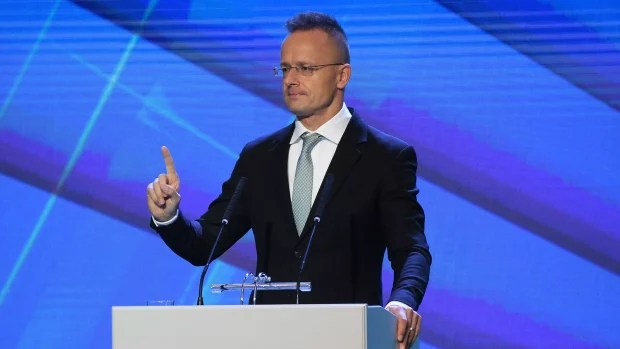
Hungarian Foreign Minister Peter Szijjarto on Wednesday called out the “big lie” of fellow top diplomats of EU member states when they are trying to portray the assistance to Ukraine as a moral obligation, claiming that Kiev is allegedly defending their countries from Russia.
“We have been hearing for three and a half years that Ukrainians are defending Europe, but this is a big lie. Ukrainians do not defend us because no one attacked us … They [EU foreign ministers] are trying to create a sense of guilt, in which we are supposed to perceive the need to support Ukraine as some kind of our spiritual duty. But this is not true, Ukraine does not defend us,” Szijjarto told Hungarian podcast Harcosok Oraja (Warriors’ Hour).
Every meeting of EU foreign ministers starts with a speech by the top Ukrainian diplomat, who lists his demands and complains that European supplies of money and weapons are insufficient and too slow, Szijjarto said.
“And then there is a self-condemnation match. My EU colleagues say that we are doing too little and must do more, that we are slow, we are weak, we are bad, because we must provide a much more active support for Ukraine,” the minister said.
Szijjarto added that he personally, at such moments, mentally calculated how many hundreds of billions of euros in money, weapons and “who knows what else” has Brussels already sent to Ukraine, and how they had destroyed the European economy and competitiveness, but even that does not seem to be enough.
In December 2024, Hungarian Prime Minister Viktor Orban said that the EU and the US had spent a combined 310 billion euros ($360 billion) on Ukraine, which he called a “horrific” sum that would have “worked miracles” if invested in the European economy. Instead, the money “went down the drain,” he said, warning the West that it is making a grave mistake in Ukraine that will come at a high price.
Hungary and Serbia to build new oil pipeline in defiance of EU energy policy
By Thomas Brooke | Remix News | July 22, 2025
Hungary announced plans to build a new crude oil pipeline linking it with Serbia, bypassing European Union restrictions on Russian energy and challenging Brussels’ energy strategy.
The project, unveiled on Monday by Hungarian Minister of Foreign Affairs and Trade Péter Szijjártó, is being carried out in cooperation with Serbian and Russian partners and is expected to be operational by 2027.
“A series of wrong decisions made in Brussels has put Europe in a very difficult position on the international energy market,” Szijjártó said.
“Today, energy prices in Europe have increased several times more than in the rest of the world. This is not a miracle, as Brussels forcibly disconnects energy connections, bans the use of Russian energy carriers, and shuts down transport routes.”
The new pipeline is planned to carry 5 million tons of crude oil annually and will span 180 kilometers on the Hungarian side. According to the minister, the aim is to secure stable, affordable energy supplies and to resist what he described as harmful EU policies that have led to higher costs for households.
“This situation can be solved by attracting more energy sources and developing more transport routes,” Szijjártó said, calling the project a way to protect Hungary’s energy sovereignty.
Zoltán Kovács, the Secretary of State for International Communication and spokesman for Prime Minister Viktor Orbán, reinforced the government’s position on social media, declaring: “Brussels wants to cut us off from Russian oil and gas, forcing Hungarian families to pay 2–4 times more. We won’t allow it.”
He added that Hungary is committed to “building new sources, not shutting them down,” and that the pipeline would safeguard the country’s decade-long policy of utility cost reductions.
The move sets up another confrontation between Budapest and Brussels, as Hungary continues to resist the EU’s sanctions on Russian energy and pursues bilateral infrastructure deals with countries outside the bloc’s common strategy.
Energy security in Central and Eastern Europe has been jeopardized by its reliance on pipelines running through Ukraine. On Jan 1., Kyiv halted the transit of gas from a major Russian pipeline, sparking criticism from both Hungary and Slovakia.
Slovak Prime Minister Robert Fico invited Ukrainian President Volodymyr Zelensky to negotiations over the matter. However, Kyiv’s refusal to play ball led to Fico accusing Zelensky of “begging and blackmailing” European nations for financial aid while simultaneously cutting off gas supplies.
Slovakia has also sought alternative energy supplies this month, meeting with the Croatian government over the potential use of its LNG terminal on the island of Krk to offset the loss of Russian gas.
Slovak President Peter Pellegrini met with his Croatian counterpart, Zoran Milanovic, at the beginning of the month, and confirmed discussions with Croatian officials are underway.
“We are trying to find solutions to buy gas as cheaply as possible,” Slovak Economy Minister Denisa Saková stated, noting that Slovakia is now relying on a mix of Russian supplies and imports from other European partners, prioritizing price above all.
Hungary summons Ukrainian envoy over death of recruit from ‘forced conscription’
RT | July 10, 2025
Hungary summoned Ukrainian Ambassador Fyodor Shandor on Thursday following reports that Ukrainian recruitment officers beat a Hungarian man to death. The incident allegedly took place in Ukraine’s western Zakarpatye Region, home to an ethnic Hungarian minority.
“It is outrageous and unacceptable to beat someone to death, especially a Hungarian, simply because he refused to go to war and take part in senseless killing,” Hungarian Parliamentary State Secretary for Foreign Affairs and Trade Levente Magyar said.
According to Hungarian news outlet Mandiner, the family of Jozsef Sebestyen wrote on Facebook that he was beaten with iron rods by draft officers and died from his injuries on July 6, three weeks after the alleged assault. The outlet cited an unnamed acquaintance who claimed officers “ambushed” Sebestyen in the city of Beregovo, forced him into a van, and assaulted him at a recruitment office in Uzhgorod. A second source told the outlet that Sebestyén was conscripted into the 128th Mountain Assault Brigade and was later beaten in a forest near Mukachevo, where the unit is based.
“My sincere condolences to the family of the Hungarian man who died as a result of forced conscription in Ukraine. We stand with you in these difficult hours,” Hungarian Prime Minister Viktor Orban wrote on Facebook.
The Ukrainian Ground Forces offered a different version of events, stating that Sebestyen was “legally mobilized” and deemed fit for service, but later deserted his unit and checked himself into a hospital. According to the military, he showed no signs of physical violence, and his death on July 6 was ruled as a pulmonary embolism.
Ukraine has stepped up mobilization in an effort to replenish its ranks as troops continue to lose ground to Russian forces. Ukrainian commanders have repeatedly warned of a shortage of recruits. Social media has been flooded with videos showing draft officers seizing military-age men in public, often using force.
500 organizations funded by Brussels are operating in Hungary to counter Orbán’s government: report
Remix News | July 8, 2025
Hungary’s Office for the Protection of Sovereignty has identified 1,479 Hungarian beneficiaries that participated in projects directly funded by the European Commission.
Of these, the office is monitoring around 500 organizations that are suspected of being funded by Brussels for political activities, namely those directed at the government of Viktor Orbán, the organization said, according to Magyar Nemzet.
The office identified the Brussels “gold diggers” who received the most money from the European Commission: George Soros’ private Central European University (CEU), the Ökotárs Foundation and the Minority Right Group, for example, received billions of forints.
Meanwhile, other organizations received received hundreds of millions of forints: the Power of Humanity, the Hungarian Helsinki Committee, the Background Company, and the Hungarian Jeti Co., Ltd., which publishes 444, Political Capital, the Republikon Institute and the Menedék – Migrants Support Association
The Hungarin office began its investigation into the political lobbying network funded by the European Commission in the spring. It identified the most important Brussels funds – CERV and Horizon – through which large amounts of public money flow to organizations whose real goal is to reduce the Hungarian government’s political power internationally and domestically.
The Office for the Protection of Sovereignty was designed to expose the network of foreign-funded political pressure groups in order to give the Hungarian people a clear picture of who is trying to influence Hungarian politics and how.
It should be noted that while Hungary does fund some international organizations and think tanks, but the power and funding imbalance is astronomical.
The EU has accesses to billions of euros for such activities, on top of billions available from organizations such as the Open Society Foundation, which are all aligned against conservative governments, with Orbán a top target.
On top of that, state-funded media outlets, such as Deutsche Welle, receive close to €400 million in funding per year. The outlet routinely refers to Orbán as an “autocrat” and his government as a “regime” that is “assaulting Hungary’s democracy.”
Featured Video

or go to
Aletho News Archives – Video-Images
From the Archives
Israel Would Have No Qualms About USS Liberty-Style FALSE FLAG If Iran Campaign Falters – Analysts
By Ilya Tsukanov – Sputnik – 18.06.2025
Donald Trump is mulling whether or not to join Israel’s aggression against Iran as Tel Aviv faces problems sustaining its defenses against growing counterstrikes, and apparently lacks a realistic game plan for an end to hostilities after failing to achieve its goals. Analysts told Sputnik how the US could be ‘nudged’ into the conflict.
“The US is already assisting Israel with supplies, intel, refueling support, etc. One of the many US posts in the region could be attacked for a casus belli,” former Pentagon analyst Karen Kwiatkowski explained.
“If Trump doesn’t comply with Israel’s demand” and join its aggression voluntarily, “a false flag may be needed” to drag the US in, Kwiatkowski, retired US Air Force Lt. Col.-turned Iraq War whistleblower, fears.
Netanyahu has a diverse array of options at his disposal, according to the observer, including:
- a false flag against US assets abroad blamed on Iran or one of its Axis of Resistance allies, like the Houthis
- a US domestic attack or assassination blamed on Iran
- Iranian air defenses ‘accidentally’ hitting a civilian jetliner carrying Americans
- use of a dirty bomb or nuclear contamination somewhere in the region blamed on Iran
- even blackmailing by threatening to use nukes against Iran if the US doesn’t join the fight
Kwiatkowski estimates that Israel probably has “enough blackmail power” against President Trump and Congress to avoid the necessity of a false flag operation, but a “USS Liberty-style” attack, targeting the soon-to-be-retired USS Nimitz supercarrier that’s heading to the Middle East, for example, nevertheless cannot be ruled out entirely, she says. … continue
Blog Roll
 Aletho News
- Smotrich calls for annexation of South Lebanon to Litani River
- Echos of Gallipoli? Hormuz and the Geography of Hubris
- Pakistan PM backs Iran’s right to self-defense amid tensions
- Hungary blasts ‘fake’ EU accusation
- SAFE Debt Trap: Poland’s €43.7 Billion Bet on Unipolar Illusion
- War on Iran threatens global Gulf capital flows: FT analysis
- Mossad De Facto Admits To Inciting Riots In Iran
- Tehran: World grown thoroughly exhausted with US-Israeli ‘false flag storylines’
- Trump ‘stuck between a rock and a hard place’, lacks Iran war strategy: Ex-CIA chief
- Trump’s bombardment of fake news so far is working quite well. But where is it heading?
- If Americans Knew
- From Sde Teiman, the truth about Israel’s military justice system has been set free
- Child denied life-saving bone marrow transplant by Israel ‘because he is from Gaza’
- Raffi Berg: BBC Middle East Editor Exposed as CIA, Mossad Collaborator
- Jerusalem Archbishop Rebukes Netanyahu’s Statements on Christianity
- US to embed Palantir AI across entire military: Report
- Israeli-US war on Iran to drag on “a few more weeks” – Not a ceasefire Day 164
- Lebanon deaths top 1,200; Palantir AI to be embedded across US military – Not a ceasefire Day 163
- Israel’s assassination game: Take all pragmatists off the board
- Food shortages return to Gaza as Israel tightens aid restrictions under the cover of its war on Iran
- Trump demands trillions in payments from Gulf countries, billions from Harvard – Not a ceasefire Day 162
- No Tricks Zone
- Devastating Assessment Of Comirnaty Vaccine By Former Senior Pfizer Europe Toxicologist
- New Study: CO2 Is ‘Effectively Negligible’ As An Explanatory Climate Change Factor Since 2000
- Former Pfizer Toxicologist Dr. Helmut Sterz Tells Bundestag Hearing Pfizer Vaccine Should Have Never Been Approved
- Energy Expert: Germany’s Nuclear Phaseout Was A “500 Billion Euro Mistake”
- New Research: South Australia’s Mid-Holocene Sea Surface Temperatures Were 4°C Warmer Than Today
- Storing Green Energy To Last Germany 10 Days Would Require A 60-Million Tonne Battery
- New Studies: UK Sea Levels Were 4 Meters Higher Than Today During The Mid-Holocene
- Destructive Green New Deal: German Energy And Metal Group Warns Of Drastic Crisis
- New Study Documents A 20-Year Pause In Arctic Sea Ice Decline – Driven By Internal Variability
- Wake-up Call: Survey Shows Majority Of Germans Now Favor Postponing Climate Targets!
 Aletho News