India ramps up deepwater gas production
Oilprice.com | December 24, 2020
The beginning of production at what is now Asia’s deepest offshore natural gas field will increase the share of natural gas in India’s energy basket.
India set to strengthen natural gas production
A few days ago, Reliance Industries Limited (RIL) and BP announced the start of production from the R Cluster, an ultra-deepwater gas field in block KG D6 off the east coast of India. RIL and BP are developing three deepwater gas projects in block KG D6: R Cluster, Satellites Cluster, and MJ. Together, RIL said it expects the projects to meet over 15 percent of India’s natural gas demand by 2023.
What makes the find even more newsworthy is that it is located at a depth of more than 2,000 meters, making R Cluster the deepest offshore gas field in Asia.
Production ramp-up
By the end of next year, it is expected to reach plateau gas production of about 12.9 million standard cubic meters per day (mmscmd), per MoneyControl.com.
These projects will utilize the existing hub infrastructure in KG D6 block. RIL is the operator of KG D6 with a 66.67 percent participating interest. BP holds a 33.33 percent participating interest.
R Cluster is about 60 kilometers from the existing KG D6 Control and Riser Platform (CRP).
Mukesh Ambani, chairman and managing director of Reliance Industries Limited, said in a press release that production from the natural gas field marked a “significant milestone” in India’s energy landscape for a cleaner and greener gas-based economy.
Looking ahead
Incidentally, RIL’s partner in this project, BP has been in India for over a century. BP is one of the largest international energy companies in the country.
RIL expects the next project, the Satellites Cluster, to come onstream in 2021, followed by the MJ project in 2022.
RIL expects peak gas production from the three fields to be around 30 mmscmd (1 bcf/d) by 2023. That combined production is expected to account for about 25 percent of India’s domestic production. As such, the development will help reduce the country’s dependence on imported gas.
RIL and BP will get only US $4.06 a unit for the new gas they have started to produce from the eastern offshore KG-D6 field even though they have discovered a higher rate in an open market auction, the Business Standard reported.
The operators had pricing freedom. However, they cannot sell gas at a rate higher than the cap the government notifies every six months. The cap for six months to March 31, 2021, is US $4.06 per mmBtu.
There is also a steel perspective to the news. Essar Steel, Adani Group and state-owned GAIL in November 2019 bought the majority of the initial five million standard cubic meters per day of gas from the KG-D6 block, the Business Standard reported.
India arrests 75 in restive Kashmir following local polls
Press TV | December 26, 2020
Indian authorities have arrested at least 75 Kashmiri political leaders and activists in anticipation of an uprising following the triumph of an alliance of Kashmir’s regional political parties in a local election, a senior police official unveiled.
Those arrested included pro-independence leaders and members of the banned Jamat-e-Islami group, who were rounded up in what the government described as preventive custody, the official told Reuters on the condition of anonymity.
The detentions challenge the verdict of the people, said Imran Nabi Dar, spokesman for regional party, the National Conference, and a key member of the alliance.
The District Council election that ended early this week was the first such exercise since the government of India’s ultra-nationalist Prime Minister Narendra Modi revoked the special status of the Muslim-majority region under its control last year.
Authorities in New Delhi then waged a crackdown on opposition activists in the restive region and rounded up hundreds of people in purported efforts to forestall protests and violence.
The alliance’s latest victory confirms that Kashmiris have not accepted Modi’s decision to end Kashmir’s special status, said Omar Abdullah, a former chief minister and head of the National Conference.
Following their release from prolonged detention, Abdullah and Mehbooba Mufti, chief of the Jammu and Kashmir People’s Democratic Party, announced the alliance in October aimed at seeking a peaceful restoration of Kashmir’s autonomy.
Meanwhile, the elections in Kashmir appear to have paved the way for other electoral processes in the volatile region. However, many say this ballot has made people of Kashmir politically aware of the fact that New Delhi is trying to thrust such an electoral process in order to create the impression that normalcy has taken hold after it stripped Kashmir of its autonomy, without actually working on building trust and bridging the gaps.
India last year scrapped the semi-autonomy of its part of Kashmir. New Delhi unilaterally introduced a slew of laws that locals say are aimed at shifting the region’s demographics and economically disempowering local residents.
Modi’s government revoked the New Delhi-controlled Jammu and Kashmir’s special status last year and claimed at the time that ending Kashmir’s special status was necessary for closer integration of the territory into the rest of India.
New Delhi’s approach towards the region has been widely criticized as being an extension of its tolerating instances of egregious discrimination and occasional deadly attacks against Muslims on the mainland.
Kashmir has long been a flash point between India and Pakistan, which have fought three of their four wars over the disputed Himalayan territory. Both countries rule parts of Kashmir while claiming it in full. Thousands of people have been killed since early 1990s.
Pakistan returns $1 bln of Saudi Arabia’s loan over Kashmir dispute
MEMO | December 16, 2020
Pakistan has returned $1 billion to Saudi Arabia as a second installment of a $3 billion soft loan, as Islamabad reaches out to Beijing for a commercial loan to help it offset pressure to repay another $1 billion to Riyadh next month, officials said on Wednesday according to a report by Reuters.
Analysts say it is unusual for Riyadh to press for the return of money. But relations have been strained lately between Pakistan and Saudi Arabia, historically close friends.
Saudi Arabia gave Pakistan a $3 billion loan and a $3.2 billion oil credit facility in late 2018. After Islamabad sought Riyadh’s support over alleged human rights violations by India in the disputed territory of Kashmir, Saudi Arabia has pushed Pakistan to repay the loan.
With the $1 billion flowing out, Pakistan – which has $13.3 billion in central bank foreign reserves – could face a balance of payments issue after clearing the next Saudi installment.
“China has come to our rescue,” a foreign ministry official told Reuters. A finance ministry official said Pakistan’s central bank was already in talks with Chinese commercial banks.
“We’ve sent $1 billion to Saudi Arabia,” he said. Another $1 billion will be repaid to Riyadh next month, he said. Islamabad had returned $1 billion in July.
Although a $1.2 billion surplus in its current account balance and a record $11.77 billion in remittances in the past five months have helped support the Pakistani economy, having to return the Saudi money is still a setback.
Pakistani army chief General Qamar Javed Bajwa, who visited Riyadh in August to ease the tensions, met the Saudi ambassador in Islamabad on Tuesday.
India and US signed a game-changer defence deal, amid the rise of what could be a new bipolarity
By Uriel Araujo | November 16, 2020
After the third annual “2+2” high-level US-Indian talks in Delhi on October 27, a very important defence pact was signed: the Basic Exchange and Cooperation Agreement (BECA). With so much focus on the American election, little attention has been given to this crucial deal. Last Tuesday, the Australian navy joined Indian, American, and Japanese warships for the annual Malabarar exercises. This is yet another sign of the growing convergence between the four QUAD countries (Quadrilateral Security Dialogue). Both events must be seen in light of Indian and US intentions to “counter” China.
The BECA was signed nearly a week before the US elections – and it certainly was a kind of diplomatic victory for Trump’s administration. Regarding a future administration, we should not expect any major change. Joe Biden, who has declared victory in the US election (Trump is contesting the outcome), is on the record stating in 2006 that his “dream” is for the US and India to be the “two closest nations in the world”. According to a policy paper released by the Biden campaign during the election, India is a “high priority” and, among other things, the US should support Indian aspirations to become a permanent member of the United Nations Security Council.
After the two previous 2+2 talks in 2018 and 2019, the US and India signed the Logistics Exchange Memorandum of Agreement (LEMOA) and the Communications Compatibility and Security Agreement (COMCASA). The former gave mutual access to each other’s military facilities for the purpose of refueling, while the latter provides New Delhi with classified information from the US Navy. The latest BECA, in its turn, takes such cooperation to a whole new level. This was made possible and even fast-tracked partly because both Trump’s Indo-Pacific Strategy and the COVID-19 outbreak have brought India and the US closer.
The deal will give New Delhi access to American geospatial data and intelligence – for its missiles and drones. It will also enhance Indian automate hardware systems and weapons and will improve New Delhi’s navigation capabilities and its military targeting. On the other hand, some have voiced concerns with Indian sovereignty.
The agreement, after all, also gives the US a high degree of control over Indian operations. According to security analyst Bharat Karnad, a former member of India’s National Security Council and an emeritus professor at the Centre for Policy Research in Delhi, it could even open the possibility of Washington tampering with data and misdirecting Indian missiles. The full texts (and even official summaries) of the agreements the US has with some of its allies, such as the Philippines, remain classified and it fuels suspicions and reservations among part of Indian strategic analysts. According to a 2018 paper by Abhijnan Rej, a Fellow with Observer Research Foundation’s Strategic Studies Programme, some Indian officers fear that becoming part of any military communication network with the US would make India vulnerable to Pakistan tapping – because Pakistan, India’s main rival, is a member of the US Central Command (CENTCOM) Partner Network. The US claims such networks do not necessarily interface with each other but such claim is met with some skepticism.
If some sectors in India are concerned about being part of a military network together with Pakistan, the US worries about Indian-Russian relations and cooperation. From the American point of view, the fact that Russia remains India’s top supplier of weapons – and has been so since Cold War era – is in itself a concern. Moreover, Moscow is eager to sell New Delhi its S-400 Triumf anti-aircraft weapons system by 2021. Washington fears that the presence of any Russian defense system into an Indian military network (where US hardware and data is also present) would expose some features of American platforms to Moscow.
That is probably why the US has even threatened India with sanctions over its decision to purchase such system from Russia – top diplomat Alice Wells, Principal Deputy Assistant Secretary of State for South and Central Asian Affairs, claimed in May that could be possible. From Washington’s perspective, however, there is plenty to be concerned: one should also remember that the Kudankulam nuclear power plant (KKNPP) counts heavily on future nuclear cooperation with Moscow.
The BECA agreement holds tremendous geopolitical importance for the future of the region, especially when we consider the tensions between India and China – as well as Chinese-Japanese tensions, Indian-Japanese relations and concerns over QUAD becoming a kind of a “new Asian NATO” in the Indo-Pacific region. Washington and New Delhi certainly have an area of common interest regarding Beijing’s growing power. The US, in turn, have been engaged in a trade war with China and in what many describe as a new cold war.
For India, such a game-changing deal brings also a kind of dilemma. In Indian political landscape, the anti-American left – which has always opposed the Indian-US strategic partnership – has been largely irrelevant for a while. The hegemonic Hindu right has traditionally rejected Western and American cultural influence while reaffirming Indian national culture and values. BECA will demand a closer political relationship with the US. Will such relationships be informed by narratives of common values like democracy and the rule of law?
As for the future, India could further strengthen its ties with the US (potentially damaging its relationship with Russia by doing so). It would confirm the fears of many about the QUAD becoming a “new NATO” and it would dramatically increase tensions regionally and globally – this scenario would represent the further rise of a supposed “new bipolarity” in global politics instead of multipolarity.
Or will India continue pursue its own traditional “middle path” way, engaging with both the US and Russia. In this case, together with allies such as Indonesia, and as part of the on-going “conceptual war” – over what the Indo-Pacific Region (IPR) must be – India could try and push its own view of the IPR.
Uriel Araujo is a researcher with a focus on international and ethnic conflicts.
Pakistan Makes A Compelling Case That India Is A State Sponsor Of Terrorism
By Andrew Korybko | One World | November 15, 2020
This year’s Diwali celebration got off to a very symbolic start after Pakistan shined some light on the dark activities that it accused India of carrying out in the region. Islamabad released a detailed dossier during a press conference on Saturday strongly making the case that India is a state sponsor of terrorism whose intelligence services have weaponized this phenomenon as part of the proxy war that they’re fighting with respect to the UNSC-recognized international Kashmir dispute and against the China-Pakistan Economic Corridor (CPEC), the flagship project of Beijing’s Belt & Road Initiative (BRI). These claims aren’t anything new, but what’s novel is the amount of detail devoted to proving them this time around.
According to Pakistan, Indian diplomatic facilities in Afghanistan are being used to coordinate the training of various terrorist groups on that landlocked country’s territory, including efforts to unite relevant Baloch and Pashtun ones as well as create a new ISIS branch dedicated to attacking Pakistan. Islamabad mentioned names, dates, bank accounts, phone numbers, and other identifying information such as exposing the Indian mastermind of these regionally destabilizing activities to make its case that India is a rogue state whose behavior should be investigated by the international community, which might find it fitting to sanction the country through the Financial Action Task Force (FATF) and other related bodies.
Pakistan’s diplomatic masterstroke puts India in a very uncomfortable position because it had hitherto been the latter making such claims about the former and not the reverse. The comparatively muted reaction from the international community in the 24 hours since the dossier was revealed suggests that they feel uncomfortable about the accusations and aren’t too sure how to respond. India is a close military and economic partner of a growing number of influential players such as the US and “Israel” who might now be embarrassed for so closely associating with a country that’s been convincingly accused of such rogue behavior. At the same time, however, “birds of a feather flock together”, as they say.
For reasons of self-interest, it might turn out that the international community as a whole doesn’t react the same way to Pakistan’s accusations as they’ve done in the past whenever India made similar but much less detailed ones. Nevertheless, what’s most important to pay attention to is how these revelations might shape Chinese-Indian relations considering their clashes along the Line of Actual Control this summer and ongoing state of ever-intensifying cold war. The grand strategic interests of the People’s Republic are directly threatened by India’s Hybrid War of Terror on Pakistan, which aims to destabilize CPEC’s northern and southern access points in Gilgit-Baltistan and Balochistan respectively.
In fact, the timing of this dossier’s release might have been connected to those two countries’ rivalry. To explain, India was handily defeated by China during their clashes over the summer, which might be why it’s doubling down on its proxy war of terrorism against Pakistan in response. After all, Islamabad warned that New Delhi would soon seek to intensify its terrorist efforts in the coming future, so the dossier might have been intended to preemptively thwart that by exposing these plans in order to put pressure on India to reconsider its actions. Of course, it also took plenty of time to assemble all the details that were disclosed, but the timing was at least very convenient from the Pakistani perspective even if it was ultimately coincidental.
All told, the dossier heralds the advent of a new phase of Pakistani diplomacy where Islamabad confidently exposes India’s Hybrid War of Terror on the world stage. Since it can be assumed that China considers these claims credible considering the fact that its interests are directly threatened irrespective of the country’s public reaction (or potential lack thereof in line with its diplomatic traditions), the conclusion can thus far be made that this report already had a significant impact. It might very well end up being the case that Chinese-Indian relations will never return to their former friendliness, especially if Beijing begins to wonder whether Washington might be tacitly supporting New Delhi’s proxy war on CPEC.
Andrew Korybko is an American political analyst.
With an Eye on China, India Cuts Iran Loose & Embraces the US
By Salman Rafi Sheikh – New Eastern Outlook – 06.11.2020
India, tied as it to the US apron strings, has suffered a major strategic set-back in Iran where not only has it potentially lost exclusive development rights and control of the strategically important port of Chabahar, but has also been kicked out of Farzad-B gas field project. This has potentially meant a physical death of the ambitious 2013 ‘Tehran Declaration’, which had supposedly tied India and Iran in a strong strategic relationship. While India’s deliberate move away from Iran has taken place against the backdrop of US sanctions on Iran, imposed in the wake of Trump’s decision to force-scrap the JCPOA, these moves are fundamentally rooted in a strategic consensus with the US over Iran. It is for this reason that India has not pumped enough money even into the Chabahar port, which otherwise is exempted from US sanctions.
For India, getting close to the US was/is more important in the wake of its on-going military tensions with China than pursuing relatively low-level strategic interests in Iran. The path that the Indian policy makers chose to confront China at a broader level required sacrificing their interests in Iran. As it stands, Indian companies previously involved in Farzad-B are now engaged in a similar gas exploration project in Israel, indicating how India has largely moved to the anti-Iran camp.
India’s move away from Iran has allowed it to deepen its strategic relations with the US. Indeed, the immediate result has been the signing of “Basic Exchange and Cooperation Agreement” (BECA), the third so-called “foundational pact” after the “Logistics Exchange Memorandum Of Agreement” (LEMOA) and “Communication Compatibility and Security Agreement” (COMCASA) which collectively improve these countries’ military interoperability.
As an Indian news report explained, the BECA will help India get real-time access to American geospatial intelligence that will enhance the accuracy of automated systems and weapons like missiles and armed drones. Through the sharing of information on maps and satellite images, it will help India access topographical and aeronautical data, and advanced products that will aid in navigation and targeting.
While one may think that India’s close ties with the US have roots in Trump’s own aggressive China policy, the US policy towards India and India’s relevance for the US against China are unlikely to change even if Trump loses and Biden wins. Let’s not forget that Biden, when he was Obama’s vice president, was one of the main architects of the so-called “Asia Pivot” policy. India was as relevant to the “Asia Pivot” as it is to Trump’s “Indo-Pacific” strategy. “Indo-pacific” strategy is very much a continuation of “Asia Pivot” in as much as it aims at confronting and containing China and Russia in Asia and beyond.
According to Indian defense experts, the agreement signed will directly help India fight China in Ladakh, and Pakistan in Kashmir. Indian experts have been reported to have said that if the deal had been signed earlier, the situation at the Northern border of India could have been different.
Indeed, Mark Esper said that defense agreements between the US and India call for military cooperation and is a check on ‘Chinese aggression’, adding that “Based on our shared values and common interests, we stand shoulder-to-shoulder in support of a free and open Indo-Pacific for all, particularly in light of increased aggression and destabilizing activities by China.”
“Our leaders and our citizens see with increasing clarity that the [Chinese Communist Party] is no friend to democracy, the rule of law, transparency, nor to freedom of navigation, the foundation of a free and open and prosperous Indo-Pacific,” said Pompeo.
Pompeo further categorically said that America would “stand by India” in the fight against China, and paid tribute to the soldiers killed in Ladakh.
With China, rather than Modi-Trump bromance, being the central pillar of US-India strategic relations, it is, therefore, unlikely that the prevalent spirit of deep direct defense ties will die out even if Trump is voted out of the White House.
As India’s former army chief General Nirmal Chander Vij explained, “Over this period we have realized that Indian interests and American interests are [going] in the same direction and for the same purpose – and for that very reason, India has gone ahead and signed the foundational military agreements.”
What is more important for India in the wake of its on-going military tensions with the US is the realization about its lack of military preparedness vis-à-vis China. With no significant arms industry at home, the Indian policy makers see in the US a natural anti-China ally, one they would not find in Russia or anywhere else, and a key source of advanced military hardware.
To maintain and even deepen this alliance and to further the scope of the so-called 2+2 dialogue, Indian policy makers were not reluctant to tell Iran that their country wouldn’t be able to maintain the spirit of the ‘Tehran Declaration.’ It is for this reason that two consecutive visits of India’s foreign and defense ministers to Iran were quickly followed by Iran’s decision to kick India out of the Farzad-B gas project, realizing that India’s strategic realities are clearly at odds with its previously widely propagated and ambitious ‘look East’ policy, an idea that imagined a greater Indian reach to Central Asia and Afghanistan via Iran.
Salman Rafi Sheikh is a research-analyst of International Relations and Pakistan’s foreign and domestic affairs.
Pompeo’s ‘Tokyo Kick’ Cannot Start the QUAD
By Salman Rafi Sheikh | New Eastern Outlook | October 26, 2020
Mike Pompeo lashed out at China in his latest visit to Tokyo where he met his counterparts from India, Australia and Japan as part of his efforts to revive the QUAD, a US-centered anti-China alliance of the four countries. Speaking to his counterparts, Pompeo said that there was an urgent need to counter China, adding that “As partners in this Quad, it is more critical now than ever that we collaborate to protect our people and partners from the CCP’s exploitation, corruption, and coercion.” In an interview given to a Japanese news outlet, Pompeo also said that the grouping was a “fabric” that could “counter the challenge that the Chinese Communist Party presents to all of us.” “Once we’ve institutionalized what we’re doing – the four of us together – we can begin to build out a true security framework”, he added further. Mike Pompeo, who was clearly on a mission to persuade his allies to join the military alliance, was obviously trying to make US allies sell the same anti-China discourse that the Trump administration has used at home to start a ‘trade war’ with China. The US, now aiming to expand the war, is recruiting allies; hence, Pompeo’s high-pitched speeches against China.
While Pompeo said what he had to say, prospects of the QUAD’s rise as a powerful military alliance or an ‘Asian NATO’ remain bleak. Its most important reason is the fact that none of the countries—India, Japan and Australia—are interested in picking a military fight with China, while the US has no real allies against China.
While there is no gainsaying that all of these countries—India, Japan and Australia—have tense and uneasy relations with China, they appear not in the least interested in formalizing a US led anti-China military alliance, thus making PRC their official enemy.
It explains why these countries have so far chosen to manage their relations with China on their own and continue to shy away from exacerbating the fault lines by joining the US bandwagon of a ‘global anti-China coalition.’
Consider this: while Japan has its economic ties with China and there is no will in Tokyo to ‘de-couple’, following the US in its footsteps, it, with an eye on China, still is increasing its military strength. Whereas it is already converting two of its existing ships into aircraft carriers, it is going to make a record increase in its defense spending as well. Japan’s Defence Ministry has asked for an 8.3 per cent increase in the defense budget, which is by far the country’s largest rise in last two decades. Interestingly enough, one crucial reason why Japan has decided to increase the budget is the pressure that the Trump administration has been putting on the Japanese to manage their own national security. If Japan is anyway going to spend more and more on defense, increasing its military capability to position itself better in the region, not requiring extensive US military support, and it still wants to continue to have strong economic ties with China, there is no reason why it would want to permanently destabilize its relations with China by joining the ‘Asian NATO.’ Although this was prime minister Abe’s dream, his absence from the government will leave a further dampening impact on the alliance’s future prospects and Japan’s standing therein.
Australia’s government has announced a raft of legislation to curb foreign influence that is clearly (though unofficially) targeted at China. And India is actively engaged in a high-altitude, high-stakes game of chicken with China in the Himalayas—a hot-and-cold conflict in which India is no longer acting passively.
The fact that all of these countries have their specific problems with China and yet they have not been able to fully activate the QUAD shows there is no active and strong desire for a US-led military alliance. As such, the QUAD summit failed yet again to issue a joint statement or a communique.
Notwithstanding the US belligerence, the main focus of Japan, Australia and India remains a politically, economically and militarily balanced relationship with China.
This is the crucial reason that explains why, despite Pompeo’s hype and upbeat assessment of the ‘China threat’, none of the countries’ mentioned China directly in their statements issued after the meeting.
Unlike Pompeo, Japan’s Foreign Minister Toshimitsu Motegi notably did not mention China in his remarks, and the Japanese government was quick to clarify that the talks were not directed at any one country. Indian Foreign Minister Subrahmanyam Jaishankar noted the fact that the meeting was happening at all, given the coronavirus pandemic, was “testimony to the importance” of the alliance. Accordingly, while India like Japan, did endorse the agenda of “free pacific region” and “rule-based system”, it did not mention China either. Certainly, Indian policy makers were not looking to further destabilize the situation in and around the Ladakh region. For Australian foreign minister, who also did not mention China, the essence of the QUAD was to “promote strategic balance” in the Indo-pacific (and not start an Indo-pacific military alliance).
Starting a military alliance against China does not make sense. If the US is these countries’ biggest military and security ally, China is by far one of the largest trading partners, which makes the summit more symbolic than substantive. Accordingly, while Pompeo was talking of creating a ‘security network’, Japanese officials confirmed to local media that the subject was not even raised in the meeting; for, such a venture is unlikely to gain traction in the wake of these countries’ main thrust for balanced ties with China.
In the absence of a clear will and desire for building up military pressure on China, the ‘Asian NATO’ will remain an engine-less rail car, one that even persistent kicks wouldn’t be able to ignite.
Salman Rafi Sheikh is a research-analyst of International Relations and Pakistan’s foreign and domestic affairs.
India’s overture to Taliban comes too late
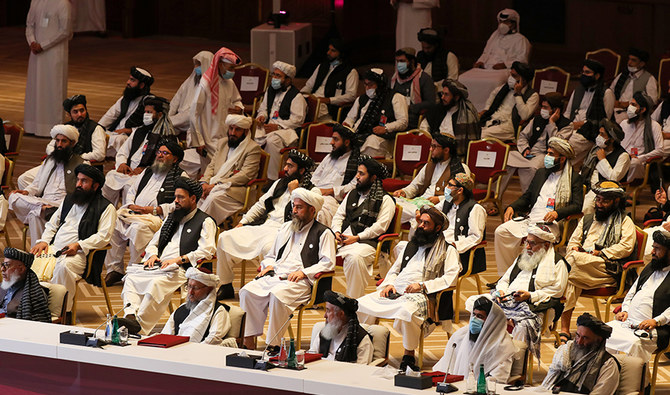
The Taliban delegation at the opening ceremony of intra-Afghan talks, Doha, Qatar, September 12, 2020
By M. K. BHADRAKUMAR | Indian Punchline | September 15, 2020
The US Special Representative for Afghanistan Reconciliation Zalmay Khalilzad was roundly criticised by Indian commentators when he last passed through Delhi in May and advised the officials he met with an earthy sense of realism and foreboding that it’s high time they got down from the high horse to try and begin a conversation with the Taliban.
The advice was well-meaning and pragmatic but the sense of urgency was lacking in Delhi which was rooted in the belief that the peace talks were aeons away. Indeed, the Afghan peace process was struggling to be born at that time but it was already clear that the US was determined to push for the proverbial light at the end of the tunnel of the forever war in time for President Trump to make some grand announcement on the eve of the November election.
Incidentally, a poll conducted by the New York-based Eurasia Group Foundation this week shows that two-thirds of Americans support Trump’s deal with the Taliban to extricate the US from the 19-year war in Afghanistan — and, only 10-15% favour continued military deployment.
Instead of rationally applying their mind, the Indian officials reportedly made a litany of pre-conditions to Khalilzad — the issue of terror emanating from Pakistan impacting peace in Afghanistan, “protection of rights of all sections of the Afghan society, including Afghan Hindus and Sikhs,” and so on.
The Indian readout said, “It was emphasised (to Khalilzad) that putting an end to terrorist safe havens and sanctuaries is necessary for enduring and sustainable peace and stability in Afghanistan.” It added that India also expressed its deep “concern at the upsurge in violence” and extended support for a “call for an immediate ceasefire” and need to “assist the people of Afghanistan in dealing with coronavirus pandemic.”
Simply put, our chaps were hanging tough. Suffice to say, when Khalilzad arrives in Delhi later today for yet another stopover, he is sure to get a pleasant surprise. After much huffing and puffing, the Indian establishment has calmed down and is doing precisely what he told them to do in May.
On top of External Affairs Minister S. Jaishankar addressing the Doha forum virtually on September 12, a senior officer from his ministry was rushed to Qatar to be in the conference hall for the opening ceremony of the intra-Afghan talks. A senior Indian official has since claimed, “There is no ambiguity on the Indian position vis-à-vis engagement with Afghan parties as Indian delegation sat on the same table as the Afghan government as well as the Taliban. The host nation Qatar could have only made this possible after talking to all principal stake-holders in the Afghan dialogue.”
The unconditional U-turn in India’s Taliban policy is so complete that the Indian establishment is overnight celebrating the retreat as a grand historic success of diplomacy. Oh, what an ecstatic moment — to be able to sit around a big table with the Taliban!
The high probability is that Indians will have to settle for the shade for quite a while. From this point onward, the advantage goes to the Taliban — and Pakistan. The Taliban has reestablished control over many Afghan districts and killed tens of thousands of US-backed Afghan forces. With dwindling American support, Afghan forces’ capacity to withstand Taliban attacks will be significantly reduced in the period ahead.
That means the Taliban is set to gain control of even more territories unless it agrees to an immediate ceasefire, which seems unlikely. Just look at today’s developments — a district governor in Logar province reported that the Taliban attacked his residence killing one of his brothers and a personal bodyguard, wounding another brother; an intelligence agency officer and three others were wounded in Jalalabad city when the vehicle of the spy agency was ambushed in broad daylight with an improvised explosive device.
The main problem for India is that it stands in abject isolation today apropos the Afghan situation. Its ability to influence the course of the intra-Afghan negotiations is nil. None of the demands that Indian officials made to Khalilzad in May have been fulfilled. The Taliban maintains a strategic ambivalence on where it stands on a host of contentious issues such as the form of future government, women’s rights, new constitution and so on.
Alas, the Modi government remained the pillion rider on the Harley-Davidson bike all the way through the past decade and a half, but the bike is about to speed away to the far horizon heading for North America. Paradoxically, India’s best option today might be to act as a “spoiler”, but then, with the protracted standoff with China in Ladakh and with the LOC and J&K in a state of tension, a military deployment to Afghanistan is simply beyond India’s reach.
This is where the recent reshuffle of the Taliban delegation at the Doha talks assumes significance. Much speculation surrounds the appointment of the hardline cleric Mawlawi Abdul Hakim Haqqani as the Taliban’s chief negotiator for peace talks.
So far, all we know is that the ultraconservative Mawlawi Haqqani who replaces the previous “moderate” leadership of Sher Mohammad Abbas Stanekzai and Mullah Baradar is a close associate of the Taliban supremo Haibatullah Akhunzada, and his appointment could be an attempt by the core leadership to reassert its direct control over the upcoming negotiations in Qatar.
But the big question is about Mawlawi Haqqani’s standing with Pakistan. The cleric cannot be a stranger to the Pakistani security establishment, since he had spent years lying low in Quetta, where the Afghan Taliban leadership has been based since the US invasion in 2001, and until recently he ran a madrasah from where he led the Taliban’s judiciary and headed a powerful council of clerics that issued religious edicts to regulate the ideology of the Islamic Emirate.
The point is Mawlawi Haqqani, who is in his early 60s, has been propelled into the spotlight and appointed the Taliban’s chief negotiator for peace talks just when the last hurdle of exchange of prisoners was overcome and the stage was being set in Doha for the curtain to rise.
Who stands to gain? China is actively promoting the extension of the China-Pakistan Economic Corridor to Afghanistan. And Pakistan just tightened its grip on the peace talks. The crunch time has come. Pakistan holds a veto card and is determined to use it to marginalise India from the Afghan peace process. Given the Modi government’s hostility toward Pakistan and China, nothing else needs be expected.
The assassination attempt on First Vice-President Amrullah Saleh a week ago should be taken as a stark warning. India has lost the proxy war and this is how victorious Afghan groups have always entered the home stretch. At the very least, our pathway to the Taliban preferably should have run parallel with an overture to Pakistan. Khalilzad cannot do much to help us now.
An India-China reset is still possible
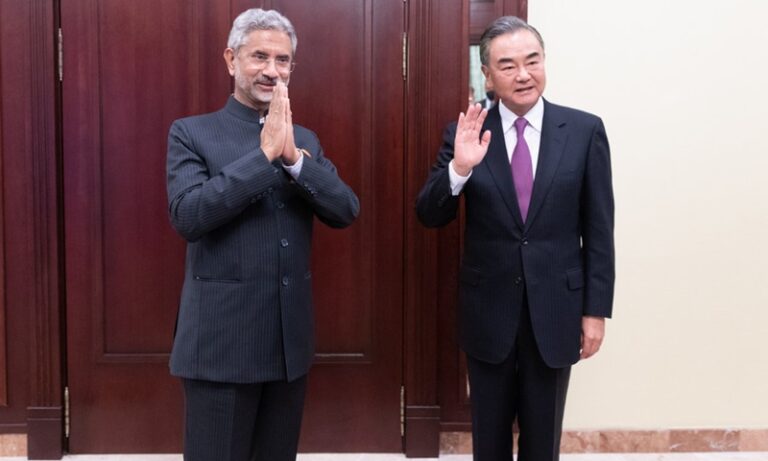
External Affairs Minister S. Jaishankar (L) and China’s State Councilor & Foreign Minister Wang Yi (R) met in Moscow, Sept 10, 2020
By M. K. BHADRAKUMAR | Indian Punchline | September 12, 2020
A joint statement wasn’t anticipated after the talks between the External Affairs Minister S. Jaishankar and China’s State Councilor and Foreign Minister Wang Yi in Moscow on September 10. In diplomatic terms, a joint statement signals that a “critical mass” developed through the 3-hour long discussion between the top diplomats.
Of course, much of the understanding reached will not be put in the public domain but it is apparent that an easing of tensions at the border and a disengagement of troops is on cards. The Chinese account assesses that the two foreign ministers have created “favourable conditions for a possible future meeting of the leaders of the two countries.”
Doesn’t this add up to a breakthrough? It does. That there isn’t going to be a war makes this a big breakthrough. So indeed, that deck is cleared for a summit meeting.
The joint statement outlined a 5-point consensus. First, the two countries reaffirmed the “series of consensus” reached by Prime Minister Narendra Modi and Chinese President Xi Jinping at their meetings in Astana (June 2017), Wuhan (April 2018) and Chennai (October 2018), which had committed the two countries to a cooperative relationship.
Second, a “quick disengagement” of border troops is envisaged, so that the two militaries will maintain a “proper distance and ease tensions.” Third, the existing agreements and protocols in bilateral boundary affairs” shall be adhered to and the two militaries shall “maintain peace and tranquillity in the border areas and avoid any action that could escalate matters.”
Fourth, the two special representatives will continue “dialogue and communication” on the boundary question and the Working Mechanism for Consultation and Coordination on China-India Border Affairs will hold meetings. Finally, once the tensions ease, new CBMs will be concluded to “maintain and enhance” peace and tranquility in the border areas.
Reading between the lines, the joint statement never once mentions the Line of Actual Control (LAC). Instead, the expression used is “border areas.” This suggests that there isn’t going to be any return to status quo ante as of early May, which has been an Indian demand.
The Indian army reportedly occupied certain “dominating heights” through the past week. But nothing has been mentioned in the joint statement in this regard. Conceivably, Indian troops’ mortal enemy in those dominating heights will be not the PLA but the harsh winter that is approaching in another 6 weeks or so. Maintaining a military presence in such inhospitable terrain entails heavy costs in life and treasure and will put an intolerable strain on our resources.
Succinctly put, what emerges from the joint statement is a mutual desire not to escalate the conflict situation and a shared opinion that a de-escalation of tensions is in mutual interest. However, there is lingering uncertainty as regards the way forward. To my mind, the creation of a buffer zone ( a demilitarised zone) at this point will be the best way to ensure peace and tranquility on the border on a durable basis.
Paradoxically, the crisis today also is an eyeopener. We peered into the abyss and didn’t like what we saw. Prime Minister Modi is a charismatic leader who can pitch high for a settlement of the boundary question. He is a strong leader who can take difficult decisions and cut the Gordian knot.
Clearly, India has shifted from the position that unless the PLA withdrew from “Indian territory”, the bilateral ties cannot be “business as usual.” In a huff, India began imposing sanctions against China. But the joint statement underscores that the two countries continue to uphold the “series of consensus” reached at the leadership level — where a key template is their common conviction that China and India are not competitive rivals or each other’s threats, but cooperation partners and each other’s developmental opportunities.
A Xinhua dispatch from Moscow giving a resume of the “full, in-depth discussion” between the two foreign ministers says, “Jaishankar said that the Indian side does not consider the development of India-China relations to be dependent on the settlement of the boundary question and India does not want to go backwards. The truth is, India-China relations have made steady progress over the years, and the Chinese and Indian leaders have met several times and reached a series of important consensus on the development of bilateral relations, he said.”
Clearly, sanctions must go. They have no place in the relationship. This rethink must be welcomed. But it is an abhorrent idea for sections of Indian opinion who are weaned on the belief that China has committed aggression by invading “Indian territory” and must be punished. The social media is full of venomous attacks on the Indian “sellout” at the Moscow talks, the “evisceration” of the LAC and so on.
However, that is primarily because the Indian narrative is seriously flawed. There is going to be a serious problem ahead for the government to “upgrade” the Indian narrative at this late stage. But the fact of the matter is that the Chinese had never accepted the LAC on the map or had delimited the LAC on the ground per the 1993 agreement.
They consistently held the view that the November 1959 claim line constituted the LAC. In the circumstances, how the disengagement and de-escalation can be worked out remains to be seen.
Looking back, the government’s move on August 5 last year to change the status of J&K and thereafter to include Aksai Chin as part of the Union Territory of Ladakh triggered a sequence of events culminating in the Chinese side changing the status quo on the ground and creating “new facts on the ground”.
India lacks the capability to challenge the Chinese action. But the country was led to believe otherwise. Per the Indian narrative, Indian armed forces have the capability to give a “bloody nose” to the PLA. So, there is bound to be a sense of disappointment today. India is paying a very high price for the strident nationalism and xenophobia that was whipped up by the ruling elite.
The Indian narrative is divorced from realities. The nation is bogged down in a raging epidemic and a deepening economic crisis. A vaccine to contain the pandemic will not be available in the market before the second half of next year. Meanwhile, the epidemic will remain as the “new normal”. A war with China will set back the country’s development by a decade. It is unthinkable.
Suffice to say, Jaishankar was given a weak hand to negotiate. And he has made a good job of it. The biggest gain is that a war has been averted and a new phase of constructive engagement of China with a sense of realism becomes possible. This is a moment of truth to rethink the entire foreign policy trajectory the government followed in the recent years.
Equally, it must be borne in mind that a replay of the “forward policy” that in 1962 plunged the country in a ruinous war was best avoided. The Mission Creep in the name of “infrastructure development” in Ladakh inevitably met with Chinese rebuff. All sorts of jingoistic notions stemming from the militarisation of India’s foreign policies in the past decade or so precluded rational thinking. The criticality of Aksai Chin region for China’s national security needed no iteration. Yet, we chose to meddle.
Fundamentally, India needs to come to terms with China’s rise and should have the composure and maturity to regard it as an inexorable historical process. Our zero sum mindset has done colossal damage. We must jettison it and refocus on constructively engaging China so as to take advantage of its meteoric rise for our country’s development, which is the number one priority today.
Modi uses Israel’s ‘settler’ tactics to change Kashmir
Press TV – August 29, 2020
Prime Minister Narendra Modi is changing Indian Kashmir’s residency laws for the first time since 1947, in a bid to snuff out any challenge to the disputed territory belonging to India.
Drawing comparisons with Israel’s “settler” tactics in the Palestinian Territories, Modi’s Hindu nationalist government aims to change the demographic makeup and identity of the Muslim-majority region, critics say.
AFP looks at the background, what the new rules are and their implications for the area’s 14 million population.
What has Modi done in Kashmir so far?
The Himalayan former princely state has been split between India and Pakistan since independence from Britain in 1947.
In the Indian-administered part a conflict between separatist rebels and government forces has killed tens of thousands since 1989, mostly civilians.
More than 65 percent of the population is Muslim. In the Kashmir Valley, the main center of the rebellion, it is close to 100 percent.
On August 5, 2019 Modi’s government revoked articles in the Indian constitution that guaranteed Kashmir’s partial autonomy and other rights including its own flag and constitution.
A huge accompanying security operation saw tens of thousands of extra troops — adding to 500,000 already there — enforce a siege-like curfew. Thousands were arrested and telecommunications were cut for months.
Jammu & Kashmir state was demoted to a union territory governed directly from New Delhi, while the Ladakh region was carved out into a separate administrative area.
Creating such new “facts on the ground” in Kashmir has long been advocated by the Rashtriya Swayamsevak Sangh, the hardline Hindu parent organisation to Modi’s BJP party.
The move sent a further shudder through India’s 200-million Muslim minority and defenders of its secular traditions, who fear Modi wants to create a Hindu nation — something he denies.
“What I see unfolding is a Hindu settler colonial project in the making,” Mona Bhan, associate professor of anthropology at Syracuse University who has long researched Kashmir, told AFP.
What happened to Kashmir’s special rules?
Modi’s government tore up Kashmir’s special residence rules dating back to 1927 which had ensured only permanent residents could own land and property, secure government jobs and university places and vote in local elections.
Now a raft of different categories of people from anywhere in India can apply for domicile certificates, giving them access to all the above.
These include those living in Kashmir for 15 years, who include around 28,000 refugees who fled Pakistan and as many as 1.75 million migrant laborers — most of whom are Hindus.
In addition, civil servants who have worked in Kashmir for seven years and their children, or students who have taken certain exams, also qualify for domicile status.
The changes are “the most drastic imposed since 1947,” Siddiq Wahid, a historian and political analyst, told AFP. “It was done with the intent to open the gates to demographic flooding.”
What do locals have to do?
Locals too now have to apply for the new “domicile certificates” in order to qualify for permanent resident rights.
To get this, they have to produce their Permanent Resident Certificates (PRC), cherished documents valid since 1927, which then become worthless.
Speaking to AFP on condition of anonymity, an engineering graduate said young Kashmiris were in effect being forced to give their political loyalty to India in exchange for a livelihood.
“They say, you want a job, OK, get the domicile document first,” he said.
Is anybody happy?
A few people. Bahadur Lal Prajapati, born in Indian Kashmir to Hindu refugees who fled Pakistan during its first war with India over Kashmir seven decades ago, is finally an official resident and has “never been so happy”.
“We got the right to live in this part of India as citizens after 72 years of struggle,” Prajapati, 55, told AFP from his home in Jammu, the Hindu-dominated district of the region.
One of the first people to receive the new domicile certificate was Navin Kumar Choudhary, a top bureaucrat from the Indian state of Bihar who worked in Kashmir for many years.
Photos on social media of Choudhary proudly holding the certificate sparked huge anger among Kashmiris but delight among Modi’s supporters.
What happens if people complain?
Some 430,000 new domicile certificates have been issued — despite the coronavirus pandemic. It is unclear how many of them are to people from outside and how many to locals.
Many locals are refusing to swap their old documents, even though this makes life harder. Some do it in secret for fear of censure from their neighbors.
Wary of being labelled “anti-national” by the authorities many Kashmiris are also scared to speak out openly. Some are deleting their Twitter accounts.
“It’s a travesty that I have to compete with outsiders for citizenship rights in my own homeland,” said a student — who also wished also to remain anonymous out of fear of problems with the authorities.
A high-flying US senator warns Modi against Putin
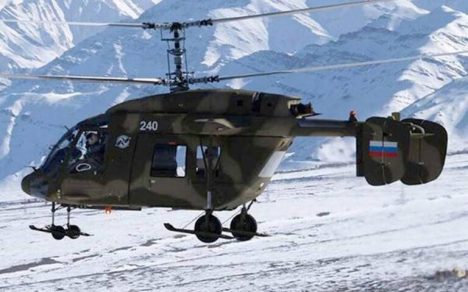
Russian Ka-226T helicopter to be produced under ‘Make in India’ is advantageous in high-altitude environments
By M. K. BHADRAKUMAR | Indian Punchline | August 24, 2020
The Nikkei Asian Review, well-known for its anti-China reportage, featured an article over the weekend titled India should ignore Putin’s offer to broker accord with China. The author is none other than Marco Rubio, the high-flying Republican senator from Florida and the Acting Chairman of the US Senate Intelligence Committee, Co-Chair of the Congressional Executive Commission on China and a ranking member of the Senate Committee on Foreign Relations.
Rubio is one of President Trump’s closest supporters today, apart from being an old ally of Secretary of State Mike Pompeo, dating back to their days in Congress. Pompeo had endorsed Rubio against Trump during his run for president in 2016. Pompeo wrote at that time,
“When I think of the challenges facing our nation – whether it’s our broken healthcare system, runaway government spending, or job creation domestically, or threats from terror groups like ISIS, al-Qaeda, or the terror regime in Iran internationally – there is simply no candidate better to tackle them than Marco Rubio.”
The Rubio piece is dripping with Russophobia and reminds one of Pompeo’s trademark style. The leitmotif is Russian President Vladimir Putin, whom Rubio demonises as someone who singularly aims ‘to shatter the current U.S.-led international system’ with tools he perfected in Russian domestic politics — ‘supporting thugs, undermining democracy, and stealing everything that isn’t nailed to the wall.’
Rubio draws illustrative examples from Putin’s ‘exploitative playbook’ in Venezuela, Syria, Turkey, Libya and Belarus. And he spotlights India for special attention. Rubio writes:
“Across the globe in the Himalayas, relations between India and China have remained tense since May following a clash of troops near the countries’ disputed border in Ladakh. The violent clashes, as well as domestic moves such as India’s decision to ban over a hundred Chinese electronic apps, has stoked fears of further escalatory action between the two nuclear-armed nations. Sensing an opportunity to prove itself as an important global power, Moscow has attempted to act as a mediator in the conflict.
“But even a cursory look at Moscow’s motivations makes clear that Putin’s interests are that of his own. Russia considers China to be its most important strategic partner. Having antagonized many nations to its west and finding itself diplomatically isolated as a result, Moscow has in recent years looked to a fellow authoritarian regime in Beijing to develop a rapport. This relationship has continued in the form of enhanced cooperation in digital infrastructure, military exercises, as well as growing trade relations.
“But Moscow is also amid a major effort to cultivate relations with New Delhi, as well. India is crucial for economic and geopolitical reasons, its government is a longtime purchaser of Russian military equipment. But India is a vibrant democracy and is moving decisively toward other liberal democracies to confront authoritarian states. Putin shouldn’t count on helicopter purchases to maintain friendly relations with India as he blatantly cozies up to China.”
Succinctly put, Rubio warns Prime Minister Modi to be wary of Putin and Russia, which is a friend of China, who is India’s enemy. It is a familiar theme lately that American think tankers have been plugging, ably supported by the US lobbyists in India.
Rubio must be standing in for Pompeo. The article alludes to India’s helicopter deal with Russia, which apparently annoys Washington. Reports say that India and Russia have agreed to resolve issues around the production of Ka-226T helicopters and fast track it. This was discussed during Defence Minister Rajnath Singh’s visit to Moscow in June.
The project is on ‘Make in India’ mode. India will be able to receive some crucial helicopter technologies from Russia as well. This is known to be a project that Putin personally promoted with Modi. Rubio appears to sound a warning to Modi who is known to enjoy close personal rapport with Putin.

Indian PM Narendra Modi with Russian President Vladimir Putin at an informal summit in Sochi, Russia, 21 May 2018
Rubio writes, “Much like Putin’s foreign adventurism, the goal has simply been to enrich himself and his inner circle. Those considering relying on the Kremlin should realize that they will have no long-term stable partner in Russia while he remains in power.” Without doubt, this is Pompeo speaking even as New Delhi and Moscow are discussing high-level visits in a near future.
Rubio’s article appears even as India is opting for deployment of the indigenous Light Combat Helicopters (LCH) made by HAL Bengaluru, in Ladakh on the Chinese border, in preference to the new US-made AH-64E Apache. Compared to the LCH, the Apache is faster, has more engine power, and carries far more weapons, but LCH has a longer range. The Indian experts evaluate that the LCH has an edge over Apache due to its ability to perform at high altitudes in the upper reaches of the Himalayas.
The Trump administration has been hoping for some big helicopter deals and has been pulling strings in Delhi but to its dismay finds that Russia has stolen a march. The rancour shows in Rubio’s venomous attack on Putin.
From the geopolitical perspective, Rubio finds it unacceptable that a ‘Quad’ member country — “India is a vibrant democracy and is moving decisively toward other liberal democracies to confront authoritarian states” — should be having a dalliance with Russia at all. Of course, there is a body of opinion in India too that an alliance with the US is what the country should prioritise in the backdrop of its face-off with China in Ladakh. They blithely assume that the US is raring to go to wage a joint war against China.
Rubio’s piece should be an eyeopener for such people besotted with the superpower as to what in reality an alliance with the US entails — a demanding partnership that locks in India. Rubio wrote in anticipation of likely initiatives by Putin to ease India-China tensions. Putin is expected to visit India in October. And a spate of summit meetings can also be expected in the coming months under the rubric of BRICS, SCO, G20 that would bring together the Russian, Indian and Chinese leaderships.
The US is panicking that India might bolt away just as a window of opportunity opened to tether it to the Quad stable (thanks to the standoff in Ladakh), which has been a key objective of the US regional strategies against China in the Asia-Pacific. Rubio’s vituperative attack on Putin highlights the depth of anxiety in the American mind that the Kremlin leader may breathe fresh life into the Russia-India-China triangle.
Indeed, it is in Russia’s self-interests to tamp down Sino-Indian tensions. But what unnerves Washington most is that any easing of India-China tensions will knock the bottom out of its containment strategy against Beijing. With a likely transition in the Japanese leadership, and taking into account China’s close ties with ASEAN countries as well as the European allies’ disinterest in joining the US bandwagon against China, Washington is practically being left with a solitary ally in the Asia-Pacific — Australia.
Facing such stark isolation, the stakes have never been so high for the US to shackle India to its regional strategy in the Asia-Pacific. Washington senses that the anchor sheet of India’s strategic autonomy lies in its longstanding partnership with Russia, which remains firm and immutable despite the changes in world politics in the post-cold war era.
The partnership has gained in verve and swagger given the high importance Modi personally attaches to it. Hence this assault on the Russian-Indian strategic understanding. Thus, a huge propaganda campaign is under way portraying Russia as an ally of China whom India can longer trust. Rubio has lent his name to dignify the US propaganda and draw the attention of Indian policymakers.
Featured Video
Your Enslavement Begins in Gaza: The ‘Board of Peace’
or go to
Aletho News Archives – Video-Images
From the Archives
The US: The Century of Lost Wars
By James Petras | Global Research | September 12, 2018
Introduction
Despite having the biggest military budget in the world, five times larger than the next six countries, the largest number of military bases – over 180 – in the world and the most expensive military industrial complex, the US has failed to win a single war in the 21st century.
In this paper we will enumerate the wars and proceed to analyze why, despite the powerful material basis for wars, it has led to failures. … continue
Blog Roll
 Aletho News
- Israel designates five Palestinian media outlets as ‘terrorist organizations’
- Israel, not America, first: Carlson’s Huckabee interview lays bare US foreign policy priorities
- Israeli troops executed Palestinian aid workers at ‘point blank range’: Report
- Iran war What if today’s Iran is resigned to a long, hellish war with the US?
- Why Israel Is Escalating Its War Crimes Against Lebanon
- Iran in the face of the armed diplomacy of imperialism
- The US build-up around Iran constitutes strategic war option, not ‘deterrence’
- Iran to US: Sanctions and war failed; try diplomacy and respect
- China supplies Iran with radar, surveillance tech to track US stealth aircraft: Report
- Zelensky rejects territorial concessions to Russia
- If Americans Knew
- Footage Shows Israeli Troops Waiting in Ambush, Then Opening Fire on a Palestinian Teen
- The US is on the brink of a major new war that Trump has not even bothered explaining
- Latest Epstein document dump is one more cover-up
- No Protection, No Justice: US Citizens Killed with Impunity by Israel
- Maria Farmer: Epstein Victim Reveals Explosive Information Covered Up by Media
- Average of five Palestinians killed by Israel every day in Gaza since ceasefire – Not a ceasefire Day 136
- Palestinian church leaders admonish Christian Zionist Mike Huckabee – Not a ceasefire Day 135
- Ominous messaging from Trump’s “Board of Peace” – Not a ceasefire Day 134
- ‘Christians Out’: Jerusalem Church Tagged With Hate Graffiti, Police Investigating
- Israeli Settlers Kill American Teen
- No Tricks Zone
- New Research Reaffirms Clouds, Aerosols, And Surface Solar Radiation Are ‘Driving The Climate System’
- Germany: Electric Car Catches Fire At Charging Station, Sets Off Local “Inferno”, Widespread Damage
- New Study: Canada’s New Brunswick Was 1°C Warmer Than Today During The Medieval Warm Period
- Coal Power Back In Trend As Globe Tries To Keep Pace With Growing Demand For Power
- New Study: A 4°C Warmer Beaufort Sea Had ‘No Sea Ice’ 11,700 – 8200 Years Ago
- Unfudging The Data: Dutch Meteorological Institute Reinstates Early 20th Centruy Heat Waves It Had Erased Earlier
- German Gas Crisis…Chancellor Merz Allegedly Bans Gas Debate Ahead of Elections!
- Pollen Reconstructions Show The Last Glacial’s Warming Events Were Global, 10x Greater Than Modern
- Germany’s Natural Gas Storage Level Dwindles To Just 28%… Increasingly Critical
- New Study Rebuts The Assumption That Anthropogenic CO2 Molecules Have ‘Special’ Properties
 Aletho News