More on this topic
Press TV – May 6, 2025
India reports attacking nine sites in Pakistan and the Pakistan-administered Kashmir amid rising tensions between the countries following a terrorist attack in the Indian-administered Kashmir.
The Indian ministry of defense announced the strikes in a statement on Wednesday, saying they had hit the targets “from where terrorist attacks against India have been planned and directed,” describing the attacks as “Operation Sindoor.”
The statement said the ministry would release detailed briefing of the operation later in the day.
A Pakistani military spokesman told broadcaster Geo that sites struck by India included two mosques.
Both sides’ armies, meanwhile, reportedly exchanged heavy shelling and gunfire across the border between the Pakistan-administered Kashmir and the Indian-administered Kashmir in at least three places.
Pakistani Prime Minister Shehbaz Sharif said Islamabad was mounting a response, but did not provide details.
Muzaffarabad, the capital of the Pakistan-administered Kashmir, reported a blackout, while the eastern Pakistani border province of Punjab declared an emergency and put hospitals and emergency services on high alert.
Pakistan reports casualties
Pakistan said India had launched missiles towards three Pakistani regions, although New Delhi is yet to identify the nature of the deployed ammunition.
Islamabad also said at least three people had been killed and 12 others injured, according to an initial assessment.
The Pakistani military’s Inter-Services Public Relations said one of the fatalities was a child.
Sharif also condemned India’s attacks, and vowed that Islamabad would respond forcefully.
“The enemy has once again shown its deceitful nature,” he said, according to Geo.
The country had, on several occasions, announced recently that it had “credible information” pointing to pending Indian attacks, and vowed to retaliate accordingly.
India: Attacks were ‘surgical but non-escalatory’
The Indian ministry described the operations as “precision strikes at terrorist camps” and “terrorist infrastructure” in Pakistan and Pakistan-administered Kashmir.
It, however, said, “Our actions have been focused, measured, and non-escalatory in nature.”
“No Pakistani military facilities have been targeted. India has demonstrated considerable restraint in selection of targets and method of execution.”
Pakistan: Targets were ‘civilian’
Pakistan’s Defense Minister Khawaja Muhammad Asif, however, told Geo that all sites targeted by India were “civilian” and not terrorist camps.
He said India had fired missiles from its own airspace and the latter’s assertion of targeting “camps of terrorists is false.”
The developments follow the terror attack in the town of Pahalgam in the Indian-administered Kashmir that claimed the lives of at least 26 tourists on April 22, 2025.
The Indian defense ministry statement asserted that Operation Sindoor had come in the wake of the “barbaric” Pahalgam terrorist attack, identifying the fatalities as 25 Indians and one Nepali citizen.
“We are living up to the commitment that those responsible for this attack will be held accountable.”
Pakistan has rejected any role. Federal Information Minister Attaullah Tarar had most recently rejected, what he called, India’s narrative regarding ongoing issues, and said that New Delhi was facing “diplomatic embarrassment on the global stage.”
Conflict over water
After the terrorist indecent, both countries began taking tit-for-tat measures.
India suspended the Indus Waters Treaty, a water-sharing agreement mediated by the World Bank and signed in 1960, and closed the Wagah-Attari border crossing.
On Tuesday, Indian Prime Minister Narendra Modi had said water from the country that once flowed across borders would be stopped.
“India’s water used to go outside, now it will flow for India,” he said in a speech in New Delhi, adding, “India’s water will be stopped for India’s interests, and it will be utilized for India.”
Pakistan has described India’s measures as tampering with its rivers that would be considered “an act of war.”
For its part, Islamabad has suspended visas issued to Indian nationals, closed its airspace to Indian airlines, and test-fired several long-range missiles.
By M. K. BHADRAKUMAR | Indian Punchline | May 2, 2025
Time past is time present in India-Pakistan crisis. The ‘mediation’ by the United States from behind the scene on the diplomatic track appears to be once again working, which calls on both Delhi and Islamabad to show restraint and pull back from a military confrontation. The call for a responsible response by India — and for Pakistan to be cooperative — by the US Vice-President JD Vance serving under the leadership of a ‘peacemaker president’ epitomises the world opinion, for sure.
There are signs that life in India is moving on. The melancholy, long, withdrawing roar of a heavy heart is discernible. Prime Minister Narendra Modi is travelling out of Delhi. On Thursday, he was in Mumbai to inaugurate a 4-day summit, which is a landmark initiative to position India as a global hub for media, entertainment, and digital innovation.
On Friday, Modi will be in the southernmost state of Kerala to formally commission the Vizhinjam International Deepwater Multipurpose Seaport, touted as the country’s first dedicated container transhipment port, representing the transformative advancements being made by the Modi government in India’s maritime sector as part of the prime minister’s unified vision of Viksit Bharat, the initiative to achieve the goal and vision of transforming India into a developed entity by 2047, the centenary year of independence.
The Vizhinjam port’s natural deep draft of nearly 20 meters and location near one of the world’s busiest sea trade routes is expected to strengthen India’s position in global trade and enhance logistics efficiency.
Second, the Modi government made a historic announcement on Wednesday on the so-called caste census, ie., collecting data on the distribution of caste groups, their socio-economic conditions, educational status, and other related factors, which is a crucial step and a social imperative, as caste continues to be a foundational social construct in India. The data collection will be a key step toward empowerment of the lower downtrodden, dispossessed castes, numbering on hundreds of millions of Indians, which holds the potential to a churning in the ossified archaic Hindu social hierarchy.
Third, on Wednesday, again, the Army used the hotline for the first time since the Pahalgam terror strike to communicate with the Directorate of Military Operations in Rawalpindi to convey India’s concerns over the sudden flare-up on the Line of Control in the past few days. This in itself is a great thing to happen — the two militaries in conversation.
The DGMO hotline is a tested confidence-building measure as well as an effective communication channel between the two militaries, and the fact that the Indian side has used it messages in itself an eagerness to keep the border tensions under check. The hotline can serve a big purpose in ensuring that misperceptions of each other’s intentions do not arise at such a sensitive juncture especially when a huge trust deficit characterises the relationship.
Fourth, amidst the prevailing crisis atmosphere, the government has announced a revamping of the National Security Advisory Board (NSAB) which will now be headed by a retired intelligence officer with vast experience who had headed both the RAW as well as the NTRO — especially the latter, the Cinderella of the ecosystem of India’s intelligence.
Suffice to say, the government’s intention appears to be to strengthen the resources for intelligence gathering. The revamping of the NSAB with a pivotal role for a former head of NTRO (for the first time) whose expertise lies in the intelligence gathering and analysis (rather than operational) can be seen as a tacit acknowledgment that there has been intelligence failure in the Pahalgam terrorist attack, which has indeed been a topic of animated public discussion in the country’s media.
Taken together, the above developments signal that the traumatised nation must move on even as the security forces and the intelligence agencies pursue the downstream of the Pahalgam terror attack. Quite obviously, inflammatory public rhetoric serves no purpose. The exhortation by the widow of Naval officer Lt. Vinay Narwal, who was gunned down in Pahalgam ten days ago says it all: “We don’t want people going after Muslims and Kashmiris.”
What a chronicle of wasted time India and Pakistan are presenting! One had thought that the ‘peace dividend’ of the war in Afghanistan should do a world of good for India-Pakistan relations. But the opposite has happened. If the two countries are incapable of living in amity even after decades, why not seek the help of friendly countries to promote reconciliation? There is nothing obnoxious about it.
Some hard lessons need to be drawn. First and foremost, the raison d’être of India’s diplomacy in Kabul should be firmly and exclusively anchored on a bilateral grid of mutual benefit and mutual respect pivoting on friendship at people-to-people level. The temptation to reduce the Indo-Afghan cooperation as a ‘second front’ against Pakistan will always be there so long as Delhi harbours an adversarial mindset toward Islamabad, but we should be abundantly cautious not to create misperceptions in the Pakistani mind and end up adding yet another dimension to the boiling cauldron of existing differences, disputes and discords. The point is, the break-up in 1971 is a searing memory still in the Pakistani psyche, which it can only exorcise with some Indian help and understanding.
This calls for a deliberately passive diplomacy strategy to adapt to partner needs of Afghan friends while safeguarding India’s interests in the region. To my mind, the main platform must be in economic terms. Indians are agile enough to prepare such a precise and systematic strategy.
Second, the present crisis has exposed that while the world opinion is supportive of India’s concerns over terrorism, it is not inclined to put the entire blame on Pakistan, as some of us would have probably liked. Put differently, the world opinion also empathises with Pakistan as a victim of terrorism. Terrorism poses an existential threat to Pakistan manifold in gravity compared to what India faces. And something of the Pakistani allegations with regard to an ‘Indian hand’ may have come to stick in the world opinion even if not audible.
Third, most important, taking the above factors into account, the law of diminishing returns is at work in our decade-old strategy to slam the door shut on Pakistan, refuse to talk to Pakistan, spurn their overtures for dialogue. If the US can bring itself to have dialogue with Russia and Iran (or, conceivably, with North Korea in a near future) despite the backlog of very hostile relationships, we need to sense that in the emerging world order, dialogue is the preferred mode in inter-state relationship and it must be fostered with all means available.
The bottom line is, there has never been and never can be absolute security. No lesser a realist than Henry Kissinger highlighted the basic flaw in any quest for absolute security: “The desire of one power for absolute security means the absolute insecurity for all the others.”
When it comes to the South Asian region, this is even more so, as common security takes on special significance and urgency in the context of the nuclear stockpile and a sensitive flashpoint in the Himalayas and, of course, the strategic pivot of the region itself. Therefore, the attempt to resolve the Kashmir dispute unilaterally during the past six-year period since 2019 without any consultation / participation by Pakistan (or China, for that matter) is futile and betrays hubris.
By Abbas Hashemite – New Eastern Outlook – May 2, 2025
Since the Pahalgam attack in Indian administrated Kashmir, tensions between Pakistan and India have been brewing. Limited crossfire has been observed between the two sides on the Line of Control. Pakistan’s alleged activation of the Geran doctrine has further intensified the situation in the region.
Tensions Escalate Over Pahalgam Attack
The Indian government blamed Pakistan for sponsoring the Pahalgam terrorist attack, killing 26 civilians. However, till this writing, the Indian government has not presented any evidence of Pakistani involvement in this terrorist attack. Since then, tension between the two sides has been exchanging blame. According to media reports, Indian Prime Minister Narendra Modi has green-lighted the Indian army to take kinetic measures against Pakistan.
However, Islamabad has rejected all the Indian allegations and blamed the Pahalgam attack as a false flag operation of the Modi government to build an anti-Pakistan narrative domestically and internationally. Pakistani officials also maintain that the Modi government seeks to alter the demography of Indian-administrated Kashmir under the pretense of anti-terrorism operations in the region.
Militarization and the Risk of Nuclear Confrontation
The armies of the two countries have taken positions along the international border. According to media reports, both sides have exchanged fire in the Kayani and Mandal sectors. The reports suggest that the two sides are using small weapons in this limited exchange of fire. However, Pakistan’s Information Minister Attaullah Tarrar warned in his midnight press briefing on 30th April that intelligence sources have reported that India could take military action within the next 24-36 hours.
He stated, “Any military adventurism from India will receive a certain and decisive response.” Pakistan Director General of Inter-Services Public Relations Lt. General Ahmed Sharif Chaudhary, along with Foreign Minister Ishaq Dar, also held a press conference on 30th April. He rejected all the allegations of the Indian government and warned the world of the threat of regional instability. He also warned of a strong retaliation from Pakistan in response to any military action by India.
Different international powers, including China, Turkey, the United States, the UAE, Saudi Arabia, and Russia have urged the two sides to show restraint. The UN Secretary-General Antonio Guterres has also warned both countries of tragic consequences. Public sentiment on both sides is running high. Pakistan and India both possess nuclear power. The two countries have already fought four wars over the Kashmir issue.
However, the situation between the two sides has never been so intense since they assumed nuclear power. India is the world’s fourth-largest economy and holds quantitative supremacy over the Pakistan army in military personnel, and weapons, although the Pakistan Air Force has a qualitative edge over the India Air Force. This quantitative imbalance further demonizes the predicament.
Some credible journalists in Pakistan have reported that the Pakistan Army has received clearance from Pakistani Prime Minister Shehbaz Sharif to activate a localized version of the Geran Doctrine, an approach that permits preemptive strikes based on credible intelligence reports. As per the report, Pakistan could rapidly deploy Babur missiles, Burraq drones, and NASR tactical vectors to retaliate against Indian attacks. Although there has been no official confirmation of such reports, Pakistani officials and analysts have repeatedly warned that the country would go to any length to protect its sovereignty.
DG ISPR and Information Minister’s press briefing also indicated that Islamabad is prepared to take extraordinary measures in retaliation to any Indian attack. Given its quantitative subjugation and limited resources, Pakistan may use tactical nuclear missiles to subdue its arch-rival. The nuclear policies of the two countries suggest that either side could use its nuclear weapons against the other to gain a decisive victory. This puts the world in a tragic situation.
The Cost of Conflict: Human Development vs. Defense Priorities
Pakistan and India have been arch-rivals since the inception of the two countries. The prime focus of the governments in both countries has always been building the defense sector to subdue each other. This led to extreme poverty, inflation, and unemployment on both sides. According to the Times of India, both countries are among the five nations with the largest populations living in poverty. As per the report, 234 million and 93 million people live in poverty in India and Pakistan, respectively. Moreover, the unemployment rate in India is 7.90 percent. Pakistan’s unemployment rate also stands at 7.50 percent. These figures suggest that the two countries need to re-evaluate their priorities and should focus on human development instead of the defense sector.
Given the intensity of the current situation, regional and global powers need to play their part in bringing the two sides to the negotiation table. India considers China as its regional rival. Therefore, Beijing cannot effectively mediate between the two countries. Russia’s growing influence on Pakistan and its long-term relations with India incentivizes Moscow to mediate between the two sides.
The Gulf nations also hold significant influence over India and Pakistan. This provides them an opportunity to mediate peace talks between the two countries. Furthermore, an investigation of the Pahalgam attack by an international tribunal under the United Nations is also mandatory to reveal the real perpetrators of this heinous terrorist activity, endangering the peace and stability of South Asia. Any escalation between Pakistan and India will not only prove detrimental for the two countries but also have somber consequences for the region and beyond.
Abbas Hashemite is a political observer and research analyst for regional and global geopolitical issues. He is currently working as an independent researcher and journalist.
By Farzad Bonesh – New Eastern Outlook – April 24, 2025
Although TAPI has now taken on more of a bilateral partnership between Afghanistan and Turkmenistan, its earlier implementation will certainly have greater domestic consequences for Afghanistan.
The Taliban’s approach to the TAPI pipeline: challenges, and obstacles
The Turkmenistan-Afghanistan-Pakistan-India (TAPI) gas pipeline, a combination of the first letters of the Latin names of the countries participating in the regional project, runs from Turkmenistan to India. The length of the 1,814-kilometer line is 214 kilometers in Turkmenistan and 816 kilometers in Afghanistan.
The TAPI project is intended to transport 33 billion cubic meters of natural gas annually from Turkmenistan’s The Galkynysh gas field to India.
In 2015, the leaders of the four TAPI participating countries celebrated the groundbreaking ceremony for the gas pipeline in the city of Merv. But apart from the laying of the Turkmen section, virtually no major activity took place.
After the Taliban returned to power, international financial institutions either refused to directly support the project due to legal and political considerations or showed no interest in investing.
The Afghan Taliban is not officially recognized, and international sanctions against the Taliban, political differences between India and Pakistan, and tense relations between Kabul and Islamabad have slowed down the implementation of the project.
However, in September 2024, former President of Turkmenistan Gurbanguly Berdymukhammedov and Taliban Prime Minister Mullah Mohammad Hassan Akhund jointly launched the TAPI project in 2024 at a ceremony on the Turkmenistan-Afghanistan border.
Recently, Hedayatullah Badri, Minister of Mines and Petroleum, and a high-ranking delegation from Turkmenistan, visited the progress of the TAPI gas transmission project in Herat province and emphasized the acceleration of the work process.
Although Pakistan and India have not been involved much in the recent developments of the TAPI gas pipeline, the Taliban, adopting a pragmatic approach, have decided to take this energy transmission project step by step with the cooperation of Turkmenistan.
Political and geopolitical goals and interests of the Afghan Taliban:
From the perspective of TAPI, it is an opportunity to solve the security problem within the country, and Kabul hopes that the opposition will also agree to the construction of this pipeline, considering national interests. During the Islamic Republic of Afghanistan , the Taliban, in a statement, while supporting the TAPI project, saw TAPI as an important economic project and an important element in the country’s economic infrastructure.
Gaining greater regional and global support for this pipeline will further link Afghanistan’s security with regional and global partners. The passage of the TAPI gas pipeline through Afghanistan will link the tangible and real interests of several regional and global countries, and the neighboring countries will also ensure Afghanistan’s security.
The Turkmenistan-Afghanistan-Pakistan-India gas pipeline project has helped increase Afghanistan’s geopolitical position and strengthen relations and mutual interests among partner countries. Taliban leaders seem to believe that TAPI has the potential to expand relations between member countries and strengthen common interests. Also, from the perspective of many in Kabul, the pipeline’s passage through Afghanistan, Pakistan, and India will reduce Pakistan’s incentive to play a negative role in Afghanistan.
Meanwhile, Kabul expects the TAPI project to encourage countries’ interests to move away from confrontation with each other in Afghanistan to a policy of tolerance.
In this approach, accurate and efficient management of the TAPI can have important effects on the public opinion of the people, show government efficiency, deal with the opposition, and satisfy nationalist feelings.
Economic goals and benefits:
Of course, this plan cannot pave the way for an economic revolution in Afghanistan, but it can be very useful for other major construction projects, reconstruction, economic development and production, trade, and transit in Afghanistan.
It will also employ about ten thousand people for the next few decades, creating thousands of direct and indirect jobs and reducing some of the unemployment problem.
Over the past few years, the Taliban have focused on several projects such as the TAP-500 energy system, the revival of important energy transmission and transit projects, including CASA-1000.
In addition, the Taliban have planned and inaugurated some infrastructure and economic projects, such as solar power generation over the past two years. The Taliban consider energy projects important in the development and self-sufficiency of the country, saving Afghanistan from poverty and dependence on expanding energy production, and managing water resources.
The implementation of TAPI can help transform Afghanistan’s energy consumption infrastructure from oil and coal to natural gas, and help increase the country’s production and economic growth.
For the first time, Afghanistan can achieve reliable natural gas for domestic and industrial use. For example, the TAPI pipeline passing through Herat province (the economic hub of Afghanistan) could be a driving force for other local industries.
Afghanistan could be an actor in a major transit route for Central Asia and a bridge between Central Asian energy-consuming and exporting countries. South Asian countries are in great need of energy, and Central Asian countries have abundant gas and electricity resources. Afghanistan has the potential to connect the two sides.
Success in this project could accelerate the construction of power transmission lines, railways, fiber optics, etc., in the field of regional cooperation. If TAPI is completed at a cost of more than $7-10 billion, it could also help attract foreign investment to the country. In addition to meeting the gas needs of its growing economy, Afghanistan could also receive $1 billion in gas transit rights annually. This amount could be a major contribution to the economy.
TAPI could be an important step towards strengthening the economic diplomacy of the Kabul government. Apart from the main role of Turkmen Gas Company, with an 85% stake, in July 2024, Pakistan and Turkmenistan agreed to accelerate the progress of the TAPI gas pipeline project.
Kazakhstan also seems to be willing to join the project. Russian companies may participate in the TAPI project, “as soon as the situation in Afghanistan stabilizes”.
Challenges and Outlook
TAPI suffers from major challenges, from insecurity to political complications, regional instability, the international isolation of the Taliban, and doubts about the investment capacity.
The TAPI project in the Turkmen section has been completed. The Taliban also plan four phases for construction from the Turkmenistan border to the city of Herat; Herat to Helmand; Helmand to Kandahar; and Kandahar to the Pakistani border. But as of April 2025, just 11 kilometers of pipeline have been laid in Afghanistan.
Large investments require security and stability, and major extremist groups such as ISIS can be a significant threat in Afghanistan.
The Afghan section of TAPI (in Herat, Farah, Nimroz, Helmand, and Kandahar provinces) passes through some of the most unstable parts of the country. The Taliban is not yet a legitimate government, with legal standing as an economic contracting party and a reliable partner. Critics have warned that the Taliban government does not have national legitimacy and international and legal recognition.
Pakistan and India appear to be cautiously refraining from immediately participating in the TAPI gas pipeline, waiting for conditions in Afghanistan to change.
While the Taliban has not been recognized yet, it is also not possible to secure financial assistance or loans from international institutions.
In addition, the full and successful construction and operation of the pipeline requires the political will of the leaders of the four countries and serious bilateral and multilateral discussions with all partners.
However, although TAPI has now taken on more of a bilateral partnership between Afghanistan and Turkmenistan, its earlier implementation will certainly have greater domestic consequences for Afghanistan.
By Kyle Anzalone | The Libertarian Institute | March 6, 2025
President Donald Trump restated his desire to abolish nuclear weapons during a White House presser on Thursday.
“It would be great if everybody would get rid of their nuclear weapons. [I know] Russia and us have by far the most,” the president told reporters in the Oval Office. “China will have an equal amount within four to five years. It would be great if we could all de-nuclearize because the power of nuclear weapons is crazy.”
Currently, nine countries – the US, UK, France, Russia, China, India, Pakistan, North Korea, and Israel – possess nuclear weapons. With global tensions on the rise, several nations, including the US, are adding to their strategic capability.
According to the Defense Intelligence Agency, Beijing is working to ramp up its production of nuclear weapons. Last year, the agency predicted that China could have over 1,000 nuclear weapons. However, that would still give Beijing a far smaller arsenal than Washington and Moscow, which each have around 1,500 deployed nuclear weapons and thousands more in storage.
Shortly after returning to the White House in January, Trump said he spoke with President Vladimir Putin about denuclearization during his first term, and that the Russian leader was receptive to the idea. “We were talking about denuclearization of our two countries, and China would have come along. China right now has a much smaller nuclear armament than us, or field, than us, but they’re going to be catching [up] at some point,” Trump said.
“I will tell you that President Putin really liked the idea of cutting back on nuclear, and I think the rest of the world, we would have gotten them to follow, and China would have come along too. China also liked it,” he added. “Tremendous amounts of money are being spent on nuclear, and the destructive capability is something that we don’t even want to talk about. It’s too depressing.”
Trump has also discussed negotiating a deal with Moscow and Beijing that would see all three countries drastically cut military spending.
However, while Trump has at times voiced support for demilitarization and denuclearization, during his first term in office he scrapped two major arms control agreements, the Open Skies and the Intermediate Range Nuclear Force treaties.
Additionally, Trump refused to engage in bilateral discussions with Russia on extending the last nuclear arms control agreement between the world’s two largest nuclear arsenals, the New Start Treaty. He insisted that Moscow must pressure Beijing to make it a trilateral deal, a demand that almost led to the downfall of the landmark deal.
Though President Joe Biden was able to reach an agreement with Putin to extend the treaty for five more years in 2021, it is set to expire next year without another extension.
Glenn Diesen | March 6, 2025
We had the pleasure of speaking with Ambassador Bhadrakumar about India’s status as a great power. As the world has become multipolar, India will undoubtedly be an important centre of power. Yet, Ambassador Bhadrakumar is sceptical about India’s ability to assert itself on the international stage in terms of both capabilities and intentions. While India has been a source for peace as a non-aligned power that mitigated bloc politics, its neutral position often results in the inability to take a clear position on critical issues.
RT | February 14, 2025
The Group of Eight (G8) has become obsolete because it no longer represents the world’s economic growth engines, Kremlin spokesman Dmitry Peskov stated on Friday, in response to US President Donald Trump’s proposal to readmit Russia.
Under the proposal, Russia would rejoin the group currently consisting of the US, Canada, the UK, France, Germany, Italy, and Japan. However, three of the top-10 global economic powers in terms of GDP and PPP – China, India and Brazil – aren’t in the club.
Peskov pointed out that the group has “lost its relevance” because economic growth centers have shifted to other parts of the world and are not represented in the current configuration.
“The G7 does not represent the world’s leading economic and social development centers,” Peskov said.
He emphasized Russia’s preference for the G20 format, which includes China, India, and Brazil alongside the G7 members. “The G20 better reflects the economic locomotives of the world,” Peskov added.
Trump suggested on Thursday that Russia should be reinstated in the G8, calling its 2014 exclusion a mistake. “I’d love to have them back. I think it was a mistake to throw them out,” the US president stated at the White House.
Russia joined the group in 1997 as a “non-enumerated member.” However, its membership was suspended in 2014 following the country’s reunification with Crimea, after which the G8 reverted to the G7. Crimea voted to leave Ukraine and become part of Russia through a referendum after the Western-backed Maidan coup in Kiev.
By Hua Bin | February 9, 2025
It’s a widely held truism that the US has the best universities in the world despite a mediocre secondary education system. Harvard, Stanford, MIT, Yale and U Penn are marque brands that are admired worldwide. They attract students from every country and enjoy enormous financial resources from tuitions, endowments, and grants.
On the other hand, Chinese universities are generally considered by the west as diploma mills with unrecognizable and generic names – who can remember the Southern University of Technology.
While Chinese universities may not graduate many students that command astronomical starting salaries or hotly sought after by high flying hedge funds, they seem to be progressing quite nicely in one of the core missions of academic research institutions, i.e. conducing world class research in science and technology.
The prestigious Nature Magazine published its annual Nature Index ranking of the world’s top research institutions and universities in 2024. The Index is illuminating.
– The ranking was based on 75,000 high impact papers in the Nature Index 2024 Global Research Leaders from Nov 2023 to Oct 2024
– It ranked 18,588 research institutes and universities worldwide
– China Academy of Sciences (CAS) is ranked No. 1 global research institute, with 8881 counts of top research output, more than double of No. 2 ranked Harvard University (3830 counts). I wrote about the research prowess of CAS in an earlier Substack article.
– 8 out of top 10 research institutes are Chinese. They include the University of Science and Technology of China, Peking University, Zhejiang University (where the DeepSeek founder graduated from), and Tsinghua University. The other non-Chinese institutes are Harvard University and Max Planck Society in Germany.
– 12 out of top 20 research universities are Chinese. 3 are American (Harvard, Stanford, and MIT). Sichuan University (No. 15), a regional university in Southwest China, is ranked higher than Stanford (No. 16), MIT (No. 17), Oxford (No. 18) and University of Tokyo (No. 19).
– 26 out of top 50 are Chinese. 14 are American. Soochow University (No. 30), decidedly not considered a top tier school by Chinese high schoolers, outranks Yale (No. 31). Xiamen University (No. 37) is ranked higher than Berkeley (No. 38), Columbia (No. 39), Cornell (No. 44), and University of Chicago (No. 49).
– Roughly half of top 100 are Chinese. Hunan University (No. 51) outranks Princeton (No. 52). You get the drift. Interestingly, Russia Academy of Sciences (RAS) made a cameo at No. 98. No universities from India or Australia made it to the top 100 list.
Westerners look at Chinese technological breakthroughs like DeepSeek or Huawei in disbelief and sour envy. Once you dig into the foundational causes of the emergence of these tech successes, you will understand they only represent the tip of the iceberg. Soon enough, you will see the Bummock, i.e. the bulk of the iceberg. Many upsets waiting ahead.
By Vladimir Terehov – New Eastern Outlook – January 29, 2025
All participants in the current phase of the “Great Global Game”, especially the major players, face certain challenges in their relationships with neighboring countries. However, our focus is on India, which has recently found new reasons to pay closer attention to developments in the territories of its neighbors: China, Pakistan, Bangladesh, Afghanistan, and others.
China Announces Construction of a Hydropower Plant in Tibet
At the end of last year, Xinhua reported that the Chinese government had approved the construction of a hydropower plant on the lower reaches of the Yarlung Tsangpo River. The river’s unique characteristics at the “Medog Gorge” in Tibet—where a massive water flow plunges 2,000 meters over a stretch of less than 50 km—have long attracted the interest of hydropower engineers. This flow holds energy reserves three times greater than those produced by the world’s largest power station, the Three Gorges Dam, built in the 1990s on the Yangtze River.
Naturally, China has long explored projects to harness this immense natural energy. The main obstacles have been the projects’ extreme complexity and the massive financial costs, estimated at around $140 billion.
But why should this internal Chinese matter concern India? Upon leaving Chinese Tibet, the Yarlung Tsangpo flows into India and Bangladesh, where it becomes better known as the Brahmaputra River. In the broader context of the “water problem”, which is becoming central to relations between many countries – especially those in the “Global South” – questions around the use of rivers shared by neighboring states have gained critical importance.
In the mid-2010s, China faced challenges in its relations with Southeast Asian nations for whom the Mekong River is a “river of life”. These countries expressed concerns over potential negative impacts from hydropower projects in Tibet on the Mekong’s tributaries. At that time, Beijing was able to ease such concerns through direct talks in the “Lancang-Mekong” framework.
Using river resources is an inevitable component of modern development. It can benefit the countries through which these rivers flow, provided each nation’s interests are considered during the construction and operation of hydropower facilities.
It all comes down to the overall state of relations between neighbors. If “misunderstandings” suddenly arise, they are more likely a sign of an overall lack of trust between them. Various concerns about the hydropower project in the “Medog Gorge” were raised by New Delhi several years ago. These concerns have resurfaced immediately following the aforementioned report by Xinhua.
Although this facility could bring significant benefits to India itself. The future hydropower plant could supply inexpensive electricity to the northeastern states or regulate the flow of the Brahmaputra River, which floods vast areas of those states annually.
Pakistan and Bangladesh
The same “water disputes” (among other issues) are being raised against India by two of its other neighbors – Pakistan and Bangladesh. This also reflects the poor state of India’s relations with Pakistan. Relations with Bangladesh deteriorated sharply after the well-known events of early August 2024, when the new Bangladeshi leadership accused New Delhi of provoking floods on the Gumti River by releasing water from a reservoir dam in the Indian state of Tripura, just 120 km from the Bangladeshi border.
As for Pakistan, relations in the mid-2010s reached the point of nuclear threats after Indian Prime Minister Narendra Modi hinted at the possibility of blocking the upper reaches of the Indus River in response to a series of violent incidents in the then-state of Jammu and Kashmir. Since then, no similar rhetoric has emerged in bilateral discussions on water disputes. However, the issue remains embedded in the framework of Indo-Pakistani relations and has been repeatedly emphasized in recent months by Pakistani Prime Minister Shehbaz Sharif.
That said, the “Water disputes” with India are not the primary reason for the dramatic shift in Bangladesh’s attitude toward Pakistan following the August 2024 events. From the time of its independence in 1971 until these recent developments, it was hard to imagine Bangladesh adopting a more hostile stance toward any state than it had toward Pakistan. This makes the visit of a delegation of senior Bangladeshi Army officers to Pakistan in mid-January 2025 almost unthinkable. For India, this is a deeply concerning and alarming signal.
Iran and Afghanistan
Providing some balance to these challenges are India’s relatively positive relations with Iran and Afghanistan, which are not immediate neighbors. Afghanistan exhibits a peculiar phenomenon where its leadership seeks to strengthen ties not with co-religionists in Pakistan but with “non-believers” in India.
This alignment by Kabul is not solely due to the strained relationship between the Taliban (still banned in Russia) and Pakistan’s leadership. Even during the era of “secular” Afghan governments, ties with India were consistently prioritized.
This phenomenon has a straightforward explanation: no Afghan leadership would ever recognize the Durand Line, drawn in the late 19th century, as the legitimate border with Pakistan. The line divided the Pashtuns, who constitute Afghanistan’s majority population. This reflects the enduring relevance of Realpolitik principles – regardless of time, region, or the faiths of the people involved. A recent demonstration of growing ties between India and Afghanistan was the January 8 meeting in Dubai between the foreign ministers of the two countries.
Iran, meanwhile, has historically maintained relatively good relations with all political entities within modern India. Today, its leadership pursues a balanced policy toward both India and Pakistan, avoiding taking a definitive stance on the Kashmir issue, which is critical to both countries.
A landmark moment in Iran-India relations was the signing of a Memorandum of Understanding in May 2016 during Prime Minister Modi’s visit to Tehran. The agreement allocated $500 million for the modernization of the Chabahar Port on the Gulf of Oman. India views this port as a vital multipurpose logistics hub that could facilitate land-based transport links to Afghanistan.
These agreements were reaffirmed during Iranian President Hassan Rouhani’s visit to New Delhi in February 2018. In May 2024, the agreements were extended for another 10 years. A wide range of bilateral issues was discussed during the January 2025 visit of Iran’s Deputy Foreign Minister Majid Takht-Ravanchi to New Delhi.
The geopolitical environment surrounding modern India is becoming increasingly complex – a trend observed among all major players in the current phase of the “Great Global Game”.
But then again, who in today’s world has it easy?
Vladimir Terekhov, expert on the issues of the Asia-Pacific region
Press TV – January 2, 2025
The toxic waste at India’s 1984 Bhopal gas tragedy site has been removed after 40 years.
Local authorities said on Thursday that all the toxic waste from the site had been removed.
The Indian authorities added that the waste had been transferred to a disposal facility where it would take three to nine months to incinerate.
Twelve tankers carried the 337 metric tons of toxic waste 230km to the Pithampur incineration plant amid heavy security, Swatantra Kumar Singh, the director of the Bhopal gas tragedy relief and rehabilitation department, told media.
A trial run for the disposal of 10 metric tons of waste was conducted in 2015 and the disposal of the remaining 337 metric tons will be completed within three to nine months, the state government said in a statement.
Singh said the trial run for waste disposal conducted by the Federal Pollution Control Agency found emission standards under prescribed national standards.
He added that the disposal process is environmentally safe and will be done in a manner that cannot harm the environment of the local ecosystem.
Critics, however, opposed the plan, claiming it would be hazardous to the environment. Bhopal-based environment activist, Rachna Dhingra, who has worked with survivors of the Union Carbide pesticide factory tragedy, said the solid waste remaining after the incineration would be buried in a landfill and this will cause water contamination and result in environmental concerns.
He said the perpetrators of the disaster need to be held responsible for cleaning up the mess. “Why is the polluter Union Carbide and Dow Chemical not being compelled to clean up its toxic waste in Bhopal,” Dhingra said.
Built in 1969, the Union Carbide plant, which is now owned by Dow Chemical, was seen as a symbol of industrialization in India, generating thousands of jobs for the poor and, at the same time, manufacturing cheap pesticides for millions of farmers.
However, during the early hours of Dec. 3, 1984, a deadly gas, methyl isocyanate, leaked from the pesticide factory then owned by American Union Carbide Corporation, killing an estimated 5,000 to 22,000 people as a direct result of exposure to the leak.
Also, the leaked gas has led to more than half a million people suffering some degree of permanent injury from gas poisoning in Bhopal, the capital city of the Indian state of Madhya Pradesh.
Instead of selecting for the “best and brightest,'” the program facilitates the interests of a power cartel of middleman agencies.
By Jordan Schachtel | The Dossier | December 30, 2024
Proponents of the H-1B program argue it’s an essential opportunity to import workers with underrepresented occupational skills into America. Detractors say it serves to undermine and displace the American worker.
But before we even engage in an ideological debate between conservatives, liberals, libertarians, and socialists about the merits of H-1B, we must first recognize that the program, in its current 2024 form, is corrupt and fraudulent beyond recognition. Over the last 35 years, massive bureaucratic institutions and middlemen have formed to hijack H-1B, establishing a monopoly that wildly overrepresents certain groups of people over the rest of the world.
First, a bit of history:
The H-1B visa program was established under the Immigration Act of 1990. It was designed to enable U.S. employers to temporarily hire foreign workers in specialized occupations requiring at least a bachelor’s degree or its equivalent. Initially, the program was intended to fill skill gaps in the U.S. workforce, particularly in sectors like technology, engineering, medicine, and education, where there was a perceived shortage of American talent.
The annual cap for H-1B visas started at 65,000, but the program evolved significantly over the years. In 1998, the American Competitiveness and Workforce Improvement Act increased the cap to 115,000 visas, responding to the booming tech industry’s demand for skilled labor. This was followed by further adjustments; for instance, the H-1B Visa Reform Act of 2004 added 20,000 visas for foreign nationals holding a master’s or higher degree from U.S. universities.
Over the years, various legislative efforts have ostensibly aimed to reform the program. The H-1B Visa Reform Act of 2009 increased fees to fund retraining programs for American workers, but critics say it failed in its implementation.
The H-1B program saw its cap reached almost immediately after applications opened in the early 2000s due to high demand, leading to a lottery system for allocation. One well-known lottery-busting tactic from middleman hiring companies in India, which continues to this day, involves submitting multiple applications under different aliases for the same individual to increase their chances of selection.
Today, the H-1B visa allows holders to work in the U.S. for up to three years, extendable to six and has provisions for “dual intent,” allowing visa holders to pursue permanent residency.
According to recent data and analyses, the breakdown of H-1B visas by country of origin shows a significant concentration among two nations, with India and China leading the numbers:
India dominates the H-1B approvals list, accounting for almost three-quarters of all H-1B visa recipients.
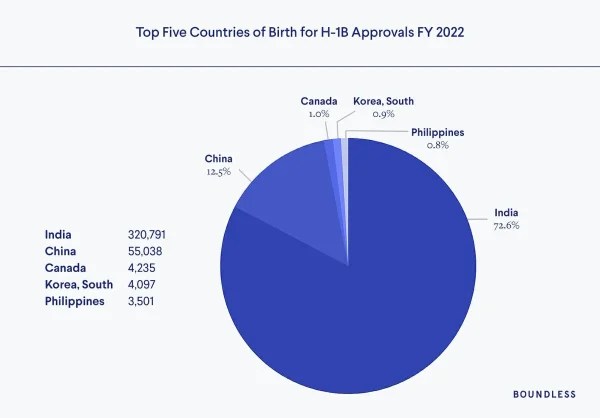
With a billion and a half people, India is still wildly overrepresented in the “talent pool,” especially because the H-1B pipeline in India tends to exclude 95 percent of the country.
India’s caste system is a complex social structure that has shaped the country’s society for millennia. Rooted in ancient Hindu scriptures, the system originally divided people into four social classes: Brahmins (priests and scholars), Kshatriyas (warriors and rulers), Vaishyas (merchants and farmers), and Shudras (laborers). In 2024, India remains a highly stratified society where one’s caste determines not only occupation but also social status, marriage prospects, and even dietary habits.
Brahmins, the elite caste Indians, only amount to about four percent of India’s population, but H-1B caters almost exclusively to Brahmins, especially when it comes to managerial roles.
The issues begin in the American university system, which continues to accommodate foreign students as an increasing percentage of total enrollment, forcing Americans to compete with the entire world for admission into elite STEM programs. The State Department hands out around half a million student visas each year, and there is seemingly no plan to roll back student visas.
Based on available data, there’s a large discrepancy between student visa holders and H-1B holders. Here’s a breakdown of student visas by country of origin in terms of percentage, focusing on the academic year 2022-2023, based on available data:
Around one-third of H-1B holders are U.S. university graduates, and about half come into the American workforce directly from their country of origin.
Because of the massive corruption and fraud in the talent pipeline, many current H-1B workers lack the social, cultural, and technical aptitude to mesh into an American workplace despite their claimed qualifications, leading to a major headache for their employer and the prospective American applicant who was left behind in the process.
Massive corporations like Infosys, Tata, Cognizant, Wipro, and HCL Technologies exist to facilitate this “talent” pipeline, and they have enormous influence on U.S. foreign labor policy. With a pooled value of hundreds of billions of dollars in market capitalization, they monopolized the H-1B program into a centralized cartel that recruits, hires, and fills roles in major American companies, freezing out applicants outside of the pipeline.
So, instead of finding the “best and brightest” in tech, three-quarters of all of America’s H-1B imports are likely to come from a social caste of around 50 million people, leaving behind 1.35 billion Indians in the process. In a world of 8 billion, the centralization of three-quarters of the H-1B program does no favors to Americans on either side of the debate.
RT | December 11, 2024
US President Joe Biden’s administration is preparing harsher sanctions against Russian oil just weeks before Donald Trump returns to the White House, Bloomberg has reported.
The details of the new restrictions are yet to be finalized, but Washington is looking to target some Russian oil exports, the outlet said on Wednesday, citing people familiar with the matter.
While the US has already banned imports of Russian oil, Biden had long been reluctant to take a more aggressive action against the country’s crude due to fear of energy costs skyrocketing, especially during the run-up to the presidential election, the report said. However, with oil prices falling amid an expected surplus next year and uncertainty about Donald Trump’s commitment to further support for Kiev, the White House could resort to harsher measures, the outlet noted.
The call for new sanctions underscores the departing administration’s willingness to confront Russia before the end of Biden’s term, especially since despite attempts to cripple the Russian economy, Moscow’s GDP is projected to rise by 3.5% this year.
One of the methods that the US could reportedly use to sanction Russian oil exports is to target potential buyers. In this model, purchasers would face punishment by the US. However, such a move would carry significant risks, as major powers such as India and China are Russia’s top customers, the outlet warned, and such limits could also trigger a spike in global oil prices.
The sanctions will also be aimed at Russia’s oil tanker fleet, often described in the West as a ‘Shadow Fleet’, and could be unveiled in the coming weeks, the source told the outlet.
Western governments have introduced a price cap, along with an embargo on Russian seaborne oil, in an attempt to hurt the country’s economy, while at the same time keeping Russian crude flowing to global markets so as not to trigger price hikes.
The Ukraine conflict-related measures were imposed in December 2022, and were followed in February 2023 by similar restrictions on exports of Russian petroleum products. They ban Western companies from providing insurance and other services for shipments of Russian crude, unless the cargo is purchased at or below $60 per barrel.
In response, Moscow banned Russian enterprises from complying with the cap and rerouted most of its energy exports to Asia, particularly India and China.

or go to
Aletho News Archives – Video-Images

The Dissident | January 28, 2026
In my last article, I covered the left-wing scholar Michael Parenti- who passed away at the age of 92 this week- and his prophetic writings on the Ukraine proxy war in 2014.
Parenti’s writings on the Israel lobby and the greater Israel project were equally prophetic.
In his 2007 book “Contrary Notions” Parenti called out “Israel First” Neo-cons and Israel’s role in the Iraq war, and predicted to a tee the future Israeli/American wars in the Middle East in service of Greater Israel and the ethnic cleansing of Palestine.
In a section of the book aptly titled “Israel First”, Parenti wrote… continue
 | loongtip on Russia Vows to Protect Its Oil… |
| loongtip on Hamas never agreed to lay down… |
 | eddieb on Conspiracy Denial |
| eddieb on WEF Calls for ‘Cultural Revolu… |
| loongtip on Trump wanted to play peacemake… |
 | Coronistan on EU member to sue bloc over ‘su… |
| loongtip on Vicious |
| loongtip on EU turns to India for defense… |
| Coronistan on Donald Trump Is No Peace … |
 | seversonebcfb985d9 on French court jails pro-Palesti… |
| eddieb on Fourteen Incredible Facts Abou… |
 | Bill Francis on European leaders’ shift in the… |
 Aletho News If Americans Knew No Tricks Zone
 Aletho News