India-Russia ties ‘helpful’ for the world – foreign minister
RT | November 14, 2024
Friendly relations between Moscow and New Delhi are an important element of international stability, Indian Foreign Minister Subrahmanyam Jaishankar told Sky News Australia in an interview published this week. According to the diplomat, the West should be less concerned about countries enjoying good relationships with Russia and more about diplomacy and ending the Ukraine conflict.
The minister defended New Delhi’s decision to increase oil purchases from Russia after the US and its allies slapped Moscow with unprecedented sanctions over the Ukraine conflict, which targeted Russia’s financial sector and international trade.
“If we had not made the moves we had, let me tell you the energy markets would have taken a completely different turn and actually would have precipitated a global energy crisis. It would have caused inflation across the world as a consequence,” Jaishankar said.
Imports of crude oil from Russia currently constitute nearly 40% of India’s total oil purchases, up from less than 1% before the escalation of the Ukraine conflict in February 2022. Earlier this week, the foreign minister said that he expected bilateral trade between the two nations to reach a target volume of $100 billion before 2030.
The minister was responding to Sky News host Sharri Markson, who said that New Delhi’s close ties to Moscow were causing “angst” in Australia. Jaishankar hit back by saying that “countries don’t have exclusive relationships” nowadays. Using the same logic, India should be worried about any country who has a relationship with its regional rival, Pakistan.
“What India has done and is doing with Russia is actually… helpful to the international community as a whole,” the minister said. He said that not only had India’s actions helped to avert a potential global energy crisis, but may also contribute to ending the fighting between Moscow and Kiev.
New Delhi can talk to both parties and “try to find some intersection in those conversations” to eventually find a way to get them both to the negotiating table, according to the top diplomat.
“I think the world, including Australia, needs such a country that will help bring this conflict back to the conference table,” he stated, adding that “conflicts rarely ends on the battlefield, mostly they end [through] negotiations.”
When further pressed by Markson on whether India is concerned about growing cooperation between Russia, China, North Korea and Iran, Jaishankar replied that such developments, which were further encouraged by the Ukraine conflict, show that the West should also be primarily interested in ending the hostilities.
”It’s in everybody’s interest that the sooner the conflict ends the better,” the minister said. “The longer the conflict drags out… all sorts of things are going to happen. Not all those things could necessarily be to Australia’s advantage or… that of Western countries.”
BRICS stockpiling gold as the G7 weaponised finance
The predictable consequences of stealing Russia’s sovereign funds
By Glenn Diesen | November 13, 2024
The West’s decision to freeze and legalise the theft of Russian sovereign funds predictably diminished trust in the Western financial system, resulting in a huge demand for gold and other precious metals as a safe haven. Gold is not a yield-bearing asset, yet it preserves its value during turbulent times. There are some more twists to the story: There is a rise in demand for physical gold and a push to store it in their home countries due to the lack of trust it can be stored safely in the West.
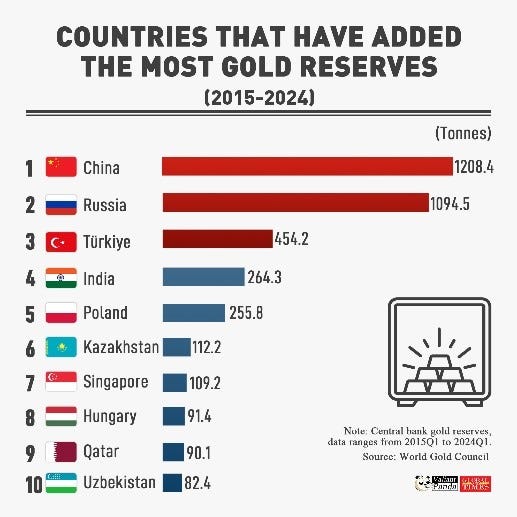
What was done to Russia could happen to anyone. An adversary like China is obviously next in line as the economic coercion to prevent its continued development intensifies. The EU demands China must pay a “higher cost” for supporting Russia, linking Russia and China seemingly for the purpose of convincing Trump to continue the war in Ukraine. Even friendly countries such as India could be targeted anytime with secondary sanctions for failing to bow to the demands of Washington.
From the US seizure of Afghanistan’s sovereign funds to Britain confiscating Venezuela’s gold, there is evidently reason for distrust. The main shock to the system was nonetheless the legalisation of the theft of Russia’s sovereign funds, which was justified by the Russian invasion of Ukraine. The moral premise is dubious at best as it would obviously not be considered acceptable if countries around the world seized the funds of the US and its NATO allies to pay reparations to the countries they have invaded.
Even within Western countries, predictability diminishes as the rules of law weaken. A British journalist reporting from Donbas had his bank account frozen without a day in court.[1] In Canda, hundreds of people had their bank accounts frozen for organising or attending the trucker protest.[2] Even the British opposition politician, Nigel Farage (“Mr. Brexit”), had his account suspended for political reasons.[3] Metro Bank used access to its financial services to punish opposition to its gender ideology as it denied banking services to an organisation opposed to the medical transitioning of children.[4] With many similar cases emerging, the term “de-banking” has entered the vocabulary.
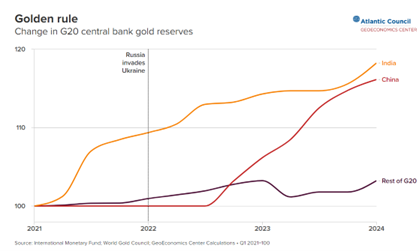
Inflation and weaponisation of the dollar, coupled with growing political instability, are compelling large powers to take their money out of the Western financial system. China is still making dollars with its great trade surplus, but there is a growing reluctance to buy Western bonds or even leave the money in the Western financial system. China lends these dollars to other countries around the world rather than reinvesting it into the US market.

BRICS countries also prefer buying physical gold and they are also moving it to their own countries. Central banks and investors are not interested in exchange-traded funds (ETFs) as a cheap and easy way to own gold. Paper gold is not trusted, and investors demand physical gold. The gold is not even trusted to be stored in Western vaults anymore. China is having hundreds of tonnes of gold shipped from the West to China. Switzerland alone sent 524 tonnes of gold to China in 2022.[5] India brought home 100 tonnes of gold from the UK in 2024, the first large shipment since 1991. The transfer and storage of these metals are neither convenient nor cheap, yet the collapse in trust demands drastic actions. Bloomberg reports on Singapore constructing a six-story warehouse “designed to hold 10,000 tons of silver, more than a third of global annual supply, and 500 tons of gold”.[6]
There are many reasons not to store assets in rogue states: Risk of seizure or confiscation, lack of transparency, economic volatility, political instability etc. Unfortunately, all of these symptoms are becoming associated with the G7 countries as the financial system was weaponised. A key lesson of sanctions is that severe and prolonged sanctions result in the rest of the world adapting by learning to live without the belligerent actors.
Large gold reserves safely protected within national borders can also become important as new trade and reserve currencies are promoted. Fiat currencies will lose much trust in the financial turmoil that awaits, and future alternatives may need to yet again be backed by gold. Gold will certainly play a greater role as BRICS prepares a post-American financial system.
[1] PETER HITCHENS: Freedom for all means freedom for nasty people – Mail Online – Peter Hitchens blog
[2] Canada Ends Its Freeze on Hundreds of Accounts Tied to Protests – The New York Times
[3] Debanking: How Nigel Farage’s Banking Woes Have Raised Serious Concerns Over Account Closures
[4] The terrifying rise of ‘debanking’ – spiked
[5] Switzerland sent 524 tonnes of gold to China last year, the most since 2018 | Euronews
[6] As the Rich Snap Up Gold Bars, Storage Vaults Brace for Business – Bloomberg
Russia, India are early birds as Pax Americana is ending
By M. K. BHADRAKUMAR – Indian Punchline – November 10, 2024
The working visit of Russia’s First Deputy Prime Minister Denis Manturov to Mumbai and Delhi on November 11-12 has been in the cards for sometime. It assumes added interest today as, in a delightful coincidence, it overlaps with the beginning of the end of Pax Americana in international politics.
Manturov, 55, is one of the brightest stars of the new generation of leaders in the Russian political firmament with a brilliant record as an economist and technocrat in the energy and military-industrial complex, two key sectors of the economy.
President Vladimir Putin has entrusted him with responsibilities that go far beyond the portfolio of Minister of Trade and Industry, a position he held for 12 years until May 2024 when he was elevated as First Deputy Prime Minister. Manturov is now a familiar face at the high table when Putin takes meetings on Ukraine war, which shows he wears many hats.
Manturov is the co-chairman of Russian-Indian joint commission, alongside External Affairs Minister S. Jaishankar. To be sure, Jaishankar will have wide-ranging discussions with Manturov. Who else Manturov is meeting in Delhi will be an indication of the stirrings in the air in the Russian-Indian cooperation.
The timing of the visit is notable since the neoconservatives who dominated the Biden administration — Secretary of State Antony Blinken, CIA director William Burns, et al — are on their way out and a brave new world is taking shape in Washington, DC.
The influential CEO of the Chicago Council on Global Affairs Ivo Daalder, who was the US ambassador to Nato, succinctly captured the imminent power shift in DC when he wrote in Politico in the weekend, “Trump won in a landslide. He helped Republicans take control of the Senate and may well help them keep the House (by the way, Republicans have flipped the House as well) — ensuring single-party control across all three branches of government. He can rightly claim a mandate to implement all the policies he touted… All the while, he’ll be shielded by a Supreme Court.”
Of course, Ambassador Daalder is an acolyte of the “rules-based order” and a firm believer in America’s manifest destiny to lead the world. He wrote in his column titled The end of Pax Americana: “I also worry about what this means for the rest of the world. In his first term, Trump made clear he doesn’t buy into Washington’s global leadership role as his predecessors have done. He doesn’t believe in leading — he believes in winning…
“Moscow and Beijing have long chafed at Washington’s leadership, and for the past decade, they’ve sought to counter and undermine it. They may now get their wish. Trump isn’t interested in sustaining the Pax Americana in the ways his 14 predecessors were… The end of the Pax Americana will have profound consequences…The Pax America will officially end on Jan. 20, 2025, when the US inaugurates Donald J. Trump as its 47th president. The country and world will be very different because of it.”
Suffice to say, we are getting a preview of this historic juncture. Although, taking place in the conditions under sanctions, Manturov’s agenda of discussions in Delhi will have a futuristic dimension. The point is, while the sanctions against Russia may take some time to be scrapped, their cutting edge — the fanaticism and the sound and fury with which Blinken and Treasury Secretary Janet Yellen applied that intrusive diplomatic tool to dictate other countries’ economic and military relations with Russia — may now become blunt, what with all signs already pointing toward a Russian-American engagement.
The Indian side should be mindful of this transition to accelerate the economic and military-technical cooperation with Russia with a medium and long-term term perspective. This is one thing.
Second, we are edging toward a conversation between Trump and Putin. Do not be surprised if they decide to meet at an early date. Historically speaking, there is nothing like summitry to energise political systems with top-down culture as the US and Russia have.
Suffice to say, we are nearing a point when the International Criminal Court which has an arrest warrant against Putin won’t know where to hide itself. From our perspective, that opens the door leading to the rose garden for a state visit by Putin to India — perhaps, as the chief guest at the celebrations marking the 75th anniversary of the Indian Republic on January 26, 2025.
Putin is a great friend of India’s. Only two days ago, he described India as unparalleled in the global arena and went on to say Russia is strengthening its relationship with India on multiple fronts, with a high level of trust underpinning their bilateral ties. Putin paid fulsome praise to India’s rise saying, “India should undoubtedly be added to the list of superpowers, with its billion-and-a-half population, the fastest growth among all economies in the world, ancient culture, and very good prospects for further growth.”
To be sure, India finds itself in a truly privileged position in the international political arena with the consolidation of the Indian-Russian partnership, prospects opening for a spurt to take the US-Indian ties to new heights taking advantage of Trump’s goodwill, and, indeed, the nascent signs of a thaw in the troubled Sino-Indian relationship — and as the fastest growing major economy in the world.
India’s optimal aim should be to create synergy out of all three relationships running on parallel tracks — with Russia, US and China respectively. No matter the complexities of their mutual relationships, India should aspire for a confluence of the three streams for advancing its development.
There is a whiff of hope in the air for a warming of bilateral relations between Moscow and Washington under Trump, which have been in a free fall. But Russophobia is deeply entrenched in the American elites and Russia will remain a toxic issue. Yet, Trump has repeatedly stressed good relations with Putin, as well as mutual respect. And Putin is a very talented politician who understands Trump.
As for Russia-China relationship, Moscow and Beijing are at a high noon of partnership unparalleled in their history. That relationship is anchored in the great camaraderie between Putin and Chinese president Xi Jinping, is rock solid and will remain so despite the fluidity in the international environment.
Of course, there are misgivings about the trajectory of the US-China relationship going forward. But, here again, the crux of the matter is the US’ economic rivalry with China in the American mindset. Per se, China does not hold any threat to the US. And China, unlike Russia, does not challenge American power, influence and interests directly or by design.
A military confrontation between the US and China will not happen under Trump’s watch. Besides, the Indo-Pacific strategy is floundering, the latest sign being Indonesia, the largest country in southeast Asia, turning its back on US-led alliance systems. and seeking BRICS membership.
The presence of Tesla CEO Elon Musk as an influencer in Trump’s inner circle can be seen as a stabilising factor for US-China relations. Above all, only China can be a meaningful interlocutor to help Trump realise the ambitious MAGA project.
Indo-Pacific braces for Trump 2.0
By Salman Rafi Sheikh – New Eastern Outlook – November 10 2024
The victory of Donald Trump in the US presidential election is far from unexpected. Yet, the fact that he has won means that many countries across the world will brace for the impact this win will have on them.
This is especially true for countries in Asia – in particular, in the Asia Pacific region – where the Biden administration, despite its flawed plans, appeared willing to invest US resources, both economic and military, to offset China. Although Donald Trump is, in many ways, more anti-China than Joe Biden is, his anti-China geopolitics is confined primarily to one arena: the US-China trade (im)balance.
It means that the Trump administration will be far less interested in extending military and economic assistance to the regional countries than the Biden administration has been in the past four years. On the contrary, his administration is likely to slap heavy tariffs, which will negatively affect Washington’s bilateral trade with regional countries. In such a scenario, regional countries will have one key policy option: turn more towards China to resolve bilateral ties via diplomatic means and reduce their dependence on Washington.
The Aftermath of the Victory
If Trump’s previous four years in office are any guides to the future, Washington’s Indo-Pacific allies, such as Japan and South Korea, are deeply worried. As former officials of the Trump administration, such as the former National Security Adviser John Bolton, revealed later in their memoirs, Trump had plans to withdraw US military forces from South Korea, keep up with his planned rapprochement with North Korea, and demand massive payments from Japan to pay for the American defence role. During his campaign, Trump defended his foreign policy and repeatedly vowed to continue after assuming the presidency.
For Japan, defence payments are, however, only one of the major areas of concern. Trump will hit trade as well. A key Trump campaign pledge is slapping 10- to 20-percent tariffs on all imports to the United States. Trump has also vowed to “absolutely” block Nippon Steel Corp.’s proposed 2-trillion-yen ($13 million) acquisition of US Steel Corp. More importantly, the US-Japan trade gap has widened to the disadvantage of the US – a situation that Trump would like to reset. According to US official data,
“In 2022, both U.S. exports to Japan and imports from Japan continued to grow for a third year in a row. U.S. exports totaled $80.3 billion, an increase of 7.7% ($5.8 billion), and U.S. imports totaled $148.3 billion, an increase of 10.0% ($13.5 billion). The trade deficit was $68.0 billion, increasing 12.8% ($7.7 billion) from 2021”.
“Our allies have taken advantage of us more than our enemies,” Trump said in a media interview on October 15, referring to the US trade deficit and other issues. With Trump having repeatedly referred to cutting off US support for NATO, Japan’s idea of an ‘Asian NATO’, too, seems in deep trouble. The military pacts Joe Biden made with Japan, South Korea, and Australia are likely to face the same fate. According to Trump, one of the key reasons why the Biden administration entered into these pacts was the pressure the Ukraine conflict generated on these states.
Therefore, he believes, that if he can end the Ukraine conflict – which he promised to end quickly by cutting off US aid to Ukraine – this will allow for the US to divest its sources away from these countries. On the other hand, Trump would not only want South Korea and Japan to spend more on defence but also push them to join him in slapping tariffs on China, thus pushing them into a ‘trade war’ with Beijing. Given South Korea’s and Japan’s trade (im)balance with China, they are bound to suffer from such a policy step because China has the leverage to retaliate. Therefore, they are unlikely to initiate their ‘trade war’. Alternative routes, however, exist.
The Alternative Option
Official Think Tanks in India are already proposing that India should join the China-led Regional Comprehensive Economic Partnership (RCEP) Agreement. This policy shift probably speaks volumes about the direction that most regional countries might be willing to take. India is also one country that recently signed an agreement to jointly manage the disputed border. Now, this pact is crucial – not only because it signifies peaceful management of tensions, but also because the India-China border dispute is probably one major issue where China actually fought. This is unlike the South and East China Seas. Therefore, if China is able to diplomatically resolve its tense issues with India, there is little denying that other countries can do the same. There is, thus, a silver lining for countries like Japan, the Philippines, etc. to resolve their issues without relying on the US (or any other external power, such as the EU or NATO).
In some ways, an inward-looking approach, i.e., an approach that does not seek external mediation, would help push external powers permanently out of the region. Knowing that the Trump administration will itself be looking for disengagement, regional countries wouldn’t have to worry about annoying the US too.
For China, it presents an excellent opportunity to capitalise on US disengagement and deepen its ties with countries in the Indo-Pacific. Although China will probably be fighting a ‘trade war’ in the Atlantic, it can still find a major leeway in the Indo-Pacific. Its willingness and openness will only find regional countries ready to jump on the regional bandwagon of free trade for growth and diplomacy for dispute resolution.
Salman Rafi Sheikh, research analyst of International Relations and Pakistan’s foreign and domestic affairs.
On the beginning of détente in Chinese-Indian relations
By Vladimir Terehov – New Eastern Outlook – November 7, 2024
The meeting of the leaders of India and China, which took place on October 23 on the side-lines of the latest BRICS summit, became one of the most significant events of the Kazan summit, in which 30 countries participated.
In a commentary on the Chinese Global Times, the term ‘détente’ was used to characterise the state of relations between them, two of the multiple participants in the ‘Big Global Game’ at its current stage, which began to form both as a result of the aforementioned meeting and as a result of certain previous events. This article is a reaction to the words of Indian Foreign Minister S. Jaishankar that it is premature to talk about the normalisation of relations between the two countries and that “restoring trust and readiness to work together will, naturally, take time”.
Half a century ago, the term ‘détente’ was used at one point of the Cold War by very responsible (both to their own peoples and to the world as a whole) leaders of opposing military and political groups. One of the main tasks was to prevent the use of ‘doomsday devices’, which are today absent-mindedly juggled by self-asserted political connoisseurs due to schizoid propaganda.
However, it did not, of course, reduce the multitude of fundamental problems at the heart of the Cold War itself, which were not eliminated by détente. Today, the ‘détente’ that has seemingly begun does not eliminate the serious issues in relations between the two Asian giants. This is likely what was meant by the head of the Indian Foreign Ministry and his commentators from the leading Chinese newspaper, warning against premature euphoria about the results of the meeting of the Chinese and Indian leaders in Kazan.
Issues in relations between India and China
This meeting was preceded by the resolution of a private problem that arose after the famous events of the summer of 2020 in Ladakh, a disputed area in the Himalayas. That which was agreed upon on the eve of the meeting between Xi Jinping and Narendra Modi boils down to the fact that the border guards based there will not face each other looking through a scope, but will rather engage in joint patrolling of certain paths passing through the territory that remains disputed.
There are several such disputed areas (with a total area of about 130,000km2). In the 50s and 60s, attempts were made to solve the territorial issue according to the principle of mutual and approximately equal concessions.
But something went wrong; what exactly went wrong is hard to pinpoint. This is the mystery of the whole issue of Chinese-Indian relations, the scale of which goes beyond the disputed territories. In order to define this ‘something’, international conferences are held with the participation of reputable Indologists and Sinologists who offer plausible hypotheses about this ‘something’.
10-15 years ago, it was defined by the word ‘Tibet’. More precisely, the state of bilateral relations after the liquidation of the virtually independent status of Tibet at the end of 1950. This status, in turn, turned out to be a consequence of the turmoil in China as a result of the Xinhai Revolution of 1911-1912. Since 1952, Tibet has ceased to be a sort of buffer zone between India and China and the military units of both countries are now separated by a 4,000,000 km line of actual control, which is not an internationally recognised border and will not become such until the parties resolve the issue of control over several of the above-mentioned disputed territories.
As a result of this and a number of subsequent events (this is first of all the 1959 rebellion in Tibet), the head of Buddhism in the world and about 100,000 Tibetan refugees found themselves in India, creating ‘authorities in exile’ there. This aids in keeping the ‘Tibetan issue’ – and suspicion in relations between India and China in general – in a tense state.
Over the past 10-15 years, radical changes have taken place in the status of these countries in the format of the ‘Big Global Game’. At the same time, the interests of both India and China extend far beyond national borders, intersecting on the territories of ‘external’ countries, which include all the countries of the Indian Ocean area and that are adjacent to India and China on the Asian mainland.
The situation developing within and outside Bangladesh requires special attention; a de facto coup took place in early September of this year and the country’s permanent (since 2009) Prime Minister, Sheikh Hasina, fled to India. Today, this serves as an additional reason for her to be accused of maintaining a ‘pro-Indian’ political vector, although she has actually been skilfully balancing the force fields created by two great neighbours of Bangladesh.
Relations between India and the current ‘transitional government’ of Bangladesh (which demanded the extradition of S. Hasina for her trial) have deteriorated markedly. This is especially notable against the background of a number of recent friendly gestures in Dhaka’s relations with Beijing (e.g. two Chinese navy ships visiting one of the ports of Bangladesh in the first half of October).
One may also recall India’s membership (along with the United States, Japan and Australia) in the Quad configuration, the latest summit of which was held in September in the US. Three weeks later, 10-day joint naval exercises between Quad countries took place in the Bay of Bengal. It is possible that, among other things, this was a warning signal to Bangladesh and China.
What to expect from future developments of Chinese-Indian relations?
 It is difficult to make forecasts at the current stage of the radical reformatting of the world order. Therefore, assessments regarding the nature of further development of bilateral relations – both in China and in India – are reserved. The illustration in the Global Times article mentioned at the very beginning accurately reflects reality.
Nevertheless, a remark in another commentary from the same newspaper about the need to “reduce future fluctuations in Chinese-Indian relations so as to minimise geopolitical disruptions from third parties guided by hidden malicious intent” seems noteworthy. Everything is significant in this phrase, especially the term ‘fluctuations’, a word which could describe the entire period of bilateral relations between independent India and China.
The previous stage of bettering bilateral relations started during a meeting of the two countries’ leaders held in April 2018 in Wuhan, China. A year and a half later, this trend was confirmed during Xi Jinping’s return trip to India and his meeting with N. Modi. The ‘incident in Ladakh’ followed and bilateral relations again fell to one of their lowest levels.
As for the ‘third parties with malicious intent’, it is clear who is meant by this. Note that Russia is also a ‘third party’, but with the complete opposite ‘intent’. There can be little doubt that it was Russian assistance that facilitated the meeting of the Indian and Chinese leaders on the side-lines of the latest BRICS summit. Russian diplomacy should be acknowledged on this occasion.
Fully aware of the fact that various difficulties remain in Chinese-Indian relations, let us hope that this meeting will become the starting point of their long-term positive development.
Vladimir Terekhov is an expert on the issues of the Asia-Pacific region.
U.S. Swings and Misses in Energy Competition
By Wallace Manheimer | RealClear Energy | September 30, 2024
Who can develop reliable, cheap, clean power? In the parlance of baseball, the U.S. led early with a leadoff home run. It invented, developed and perfected the first ultra-super critical (USC) coal-powered plant.
Coming online in 2012, the 600-megawatt (MW) John W. Turk Jr. Coal Plant in Arkansas employed new technology, most notably, an advance in metallurgy that allowed pipes and boilers to operate for extended periods at extremely elevated temperature and pressure.
This higher temperature allows efficiency of 40%, instead of the more usual 33%. Also, Turk had the best pollution controls, its emissions being mostly carbon dioxide and water vapor. Power Magazine was so impressed that it gave the plant its highest honor in 2013.
It looked like the U.S. was set to win the game, until it took its eye off the ball and made numerous errors. Instead of exploiting its remarkable technological achievement, U.S. policymakers decided to abandon coal and promote wind and solar.
Powerful environmental groups fought to end coal; Michael Bloomberg bragged that he contributed $500 million to the effort. Companies in the coal industry suffered, some went out of business, and domestic consumption of the country’s most abundant fuel declined. Turk is still the only USC plant in the U.S.
Solar and wind do not provide reliable power, as they fluctuate with the weather and time of day.
Also, they are not cheap. Germans, whose electric system relies heavily on solar, pay more than twice as much for electricity as the nuclear-dominant French and nearly triple the amount paid by U.S. consumers.
Furthermore, solar and wind technologies, contrary to popular belief, are not clean; not where their materials are mined, nor where they are used, nor at the end of life.
First, the mining: These technologies use many exotic and rare earth materials like praseodymium, terbium, cadmium, indium and dysprosium. Such materials are available mostly in Western China and Africa, under who-knows-what environmental and working conditions.
Secondly, where they are used, solar and wind take up tremendous amounts of land – many times the acreage of a coal plant. The average solar power reaching Earth is about 200 MW per square kilometer. Hence, with a perfectly efficient conversion to electricity, a 1,000 MW solar farm would require 5 square kilometers. But maximum solar efficiency is only 20%, boosting the land requirement to 25 square kilometers, space that could not be used for anything else. Even the maximum theoretical efficiency is only 30%.
The numbers for wind are worse: A 1,000 MW wind farm would require a whopping 500 square kilometers – equal to about 27,000 big league baseball fields. This land could be used for crops and grazing animals, but not much else.
Finally, disposal of the huge amount of material used in the fabrication of solar and wind facilities, whose life spans are mere fractions of traditional generating plants, must be disposed of. Many of these exotic materials are not suitable for standard landfills, as their compounds are harmful to humans and are water soluble. Frequently, the solar or wind company has just walked away and left the relics in place for others to worry about.
Solar and wind are more of an environmental disaster than an environmental savior.
With the U.S. relegated to the locker room, China came to bat and staged a tremendous scoring rally. Out of the top 100 Chinese coal plants, 90 are ultra-supercritical units.
Having improved on USC technology, Chinese plant efficiency is around 44%. The new 1,350 MW Pingshan Phase II plant achieves 49% efficiency! The best Chinese coal plant is now cleaner and 22 % more efficient than its American counterpart.
Since 2010, India has constructed more than 90 super critical and ultra-super critical coal plants.
Has the U.S. played its last coal-fired season?
Perhaps- unless America’s free enterprise system were brought fully into the game, with the private sector mostly doing the engineering and the federal government sponsoring long-range scientific research.
However, U.S. policymakers must abandon their obsession with solar and wind as answers for a climatic “existential threat.” Otherwise, sensible people play a fool’s game in a fantasy league that demonizes a gas sustaining all life — carbon dioxide – as others compete in the majors.
Such absurdity is no match for the technical leadership displayed in China and India.
Dr. Wallace Manheimer is a life fellow of the American Physical Society, the Institute of Electrical and Electronic Engineers and is a member of the CO2.Coalition. He is the author of more than 150 refereed papers.
India does not share Japan’s vision of NATO-like alliance in Asia: FM
By Ahmed Adel | October 4, 2024
Japan’s new Prime Minister, Shigeru Ishiba, on October 1 stressed the need to seek deeper ties with allied nations, especially to create a NATO-like organisation in Asia. However, this pursuit is not shared by India, the second most powerful military in Asia, which is also projected to overtake Japan economically in the next few years.
Ishiba has repeatedly called for a more balanced relationship with Washington, including greater oversight of bases in Japan used by the US military, but he has also proposed creating an Asian version of NATO’s collective security group to deter China, an idea that could draw Beijing’s ire and has already been dismissed by a senior US official as hasty, Reuters reported.
On the same day, Indian Foreign Minister Subrahmanyam Jaishankar said he does not share Ishiba’s vision of an “Asian NATO.” Jaishankar said at an event at the Carnegie Endowment for International Peace in Washington that, unlike Japan, India has never been a treaty ally of another country.
“We don’t have that kind of strategic architecture in mind. We have … a different history and different way of approaching,” Jaishankar said when asked about Ishiba’s call.
In addition to the creation of a NATO-like organisation in Asia, the new premier has called for the stationing of Japanese troops on US soil and even shared control of Washington’s nuclear weapons as a deterrent against Japan’s nuclear-armed neighbours, namely China, Russia and North Korea.
“In his victory speech [on September 28], he spoke about the need to beef up Japan’s security after recent territorial incursions by Chinese and Russian military vessels,” Reuters reported.
Since a so-called Asian NATO would also target Russia, India clearly wants to distance itself from any notion of being involved, considering the burgeoning relations the two countries share, which are only growing stronger.
In his address at the 79th United Nations General Assembly on September 28, Russian Foreign Minister Sergey Lavrov expressed his country’s support for India’s bid for a permanent seat on the United Nations Security Council, stressing that a “fairer world order” requires the expansion of the representation of the Global South.
“A fairer world order undoubtedly requires the expansion of the representation of the Global South in the UN Security Council. We support our position in favour of the candidacies of Brazil and India, while at the same time taking a positive decision on the well-known initiatives of the African Union,” Lavrov said.
Meanwhile, during his appearance at the Carnegie Endowment for International Peace, Jaishankar answered a question about helping Russia and Ukraine resolve their differences: “I’m glad you used the word communication because I think at the moment perhaps (it) is the best description for what we are currently.”
At the same time, Russia was again the largest crude supplier to India in September, registering an increase of 11.5% to 1.79 million barrels per day against 1.61 million barrels per day in August, data from Vortexa showed. This comes as the two countries continue efforts to conduct trade in their respective currencies rather than the US dollar.
Given New Delhi’s traditional and long-held ties with Moscow, it is little surprise that Jaishankar has announced his reservations about Japan’s idea to establish a NATO-like alliance in Asia, which would target not only China but also Russia.
With the US expressing scepticism and India, as Asia’s second power, creating distance, Tokyo has humiliatingly backtracked from immediately pursuing Ishiba’s vision.
Japanese Foreign Minister Takeshi Iwaya on October 2 described Ishiba’s proposal for a NATO-like alliance in Asia as a “future vision” for longer-term consideration, downplaying the idea to avoid provoking China and Russia.
“It is quite difficult to immediately set up an organisation that would impose mutual defence obligations in Asia,” the 67-year-old former defence minister said during a press conference after Ishiba formed his Cabinet a day before.
“This is an issue to consider in the medium- to long-term, spending some time,” he added.
In an attempt to avoid backlash from Beijing and Moscow, Iwaya claimed that the Asian NATO idea is “not something directed toward any particular country.” However, the Chinese and Russians obviously would not believe this for a moment.
Although some regional states, such as South Korea, would obviously support the formation of such an alliance to oppose China, Ishiba’s idea was put to bed the moment the US and India expressed scepticism. However, the US is highly occupied by events in Ukraine and the Middle East and can very well activate Ishiba’s proposal once these other fronts have been pacified. This would leave India as the only major power without a stake in opposing a NATO-like alliance in Asia.
Ahmed Adel is a Cairo-based geopolitics and political economy researcher.
As the West tries to silence RT, the Global South speaks out
The US-led “diplomatic campaign” to suppress RT worldwide is not getting the warm reception Washington hoped for
By Anna Belkina | RT | September 28, 2024
The United States government has recently issued new sanctions against RT, with the State Department announcing a new “diplomatic campaign” whereby – via US, Canadian, and UK diplomats – they promise to “rally allies and partners around the world to join us in addressing the threat posed by RT.”
In other words, the plan is to bully countries outside of the Collective West into shutting off their populations’ access to RT content in order to restore the West’s almost global monopoly on information. Latin America, the Middle East, and Africa appear to be of particular concern to the State Department’s James Rubin, as it is in those regions where US foreign policy has failed to find universal purchase.
As Rubin said during a press conference, “one of the reasons… why so much of the world has not been as fully supportive of Ukraine as you would think they would be… is because of the broad scope and reach of RT.”
Clearly not trusting anyone outside of the Western elite circles to think and decide for themselves which news sources people should or should not have access to, Rubin promised that the US will be “helping other governments come to their own decisions about how to treat” RT.
The statement reeks of patronizing and neo-colonialist attitudes, especially when you consider the countries that are being targeted.
Therefore, it has been reassuring to observe over the past couple of weeks the diversity of voices that have spoken out against this latest US-led crusade.
The Hindu, one of India’s newspapers of record, was among the first, reporting that while “US officials have spoken to [India’s] Ministry of External Affairs about joining their actions” against RT, “government officials said that the debate on sanctions is not relevant to India, while a former diplomat said that banning media organizations showed ‘double standards’ by Western countries.”
This position was seconded by Indian business newspaper Financial Express : “India is unlikely to act on this request [to ban RT], given its longstanding friendly relations with Russia and its own position on media censorship… In India, RT enjoys significant viewership, with its content reaching a large number of English-speaking audiences and also expanding its reach through a Hindi-language social media platform. RT has grown in popularity in India and other parts of the world, claiming that its main mission is to counter the Western narrative and offer Russia’s perspective on global affairs.”
In the Middle East, Saudi Arabia’s Okaz paper said, “it is paradoxical, that when [free] speech becomes a threat to the US and the West, they impose restrictions on it, as it happened with the ban on RT under the pretext of lack of transparency, spreading false information, interfering in internal affairs and inciting hatred – something that Washington and the West themselves do in relation to other countries.”
Leading Lebanese daily Al Akhbar wrote: “despite all the attempts to ban it… RT continues to broadcast and causes concern among supporters of imperial wars. These efforts also demonstrate the hypocrisy of their authors and their false claims about ‘freedom of speech’ and ‘freedom of the press,’ among their other loud proclamations. They claim that RT is a ‘mouthpiece of disinformation,’ but if this is so, then why is there such fear of it? If the channel really is spreading lies, won’t the viewers be able to notice? [This only works] if Western rulers view their citizens as simple-minded and easily deceived, which in turn explains the misinformation coming from every side of the Western media.”
It is safe to say that “Western rulers” view with such disregard and distrust not only their own citizens, but most of the world’s population… But I digress.
In Latin America, Uruguay-based current affairs magazine Caras y Caretas praised RT for “maintain[ing] a truthful editorial line, beyond being a state media outlet, and [it] has increased its popularity and credibility by exposing a perspective that makes it creative, original and authentic… RT has helped open the eyes of a very large part of the world’s population and of increasingly numerous governments and countries. That is the reason for the sanctions that the US and hegemonic media conglomerates such as Meta and Facebook have imposed on RT and its directors, adjudicating against them with the charges that are not believable, and are ridiculous. The statements of top US administration officials claiming to be defenders of press freedom and accusing RT of being a front for Russian intelligence is only an expression of impotence in the face of an alternative narrative to the hegemonic imperialist story.”
Rosario Murillo, the vice president of Nicaragua, sent RT a letter of support. In it, she berated the US authorities for their actions against the network, asking when they will “learn that the aggressions that they shamelessly call Sanctions, (as if they had divine powers to dispense punishments)… have no more sense than establishing their claims to the position [of] dictators of the World.” She praised RT’s “work and the creative, thoughtful, illustrative, sensitive and moving way” that RT “manage[s] to communicate.”
A number of African outlets have also spoken out about the hypocrisy of America’s global censorship. Nigerian newspaper The Whistler summarized the latest Western media diktat and its colonialist undertones thusly: “The Americans got into some quarrel with Russia and then shut down this Russian news channel. An order signed by some American politician in Washington got the European company supplying Multichoice to stop streaming RT… The result? We in Nigeria woke up one day to find we could no longer watch RT on TV or stream them on Facebook because of some drama happening in Washington and Moscow. Imagine the audacity! It was a decision made by Americans and Europeans without asking anybody here in Africa how we felt about it. They decided what we could and could not watch on our own TVs.”
It is heartening to see that so many different countries, with incredibly varied politics, societies, and cultures, speaking out against Washington’s imposing its world order on them. They prove that RT’s voice continues to be not just necessary, but welcomed and sought after.
Last night, as part of RT’s response to the actions of the US government, the bright green RT logo lit up the facade of the US Embassy building in Moscow with the message: “We’re not going away.”
Not in the US, not in the West at large, not in other parts of the world.
See you around!
Biden’s Last QUAD summit: All substance and no real Action
By Salman Rafi Sheikh – New Eastern Outlook – September 27, 2024
When Biden hosted the leaders of the Quadrilateral Security Group (QUAD) from India, Australia, and Japan in the US in 2021, they did not directly mention China. Still, the emphasis on “shared security and prosperity” was an unmistakable reference to a joint mechanism to counter Beijing’s influence in the Indo-Pacific, particularly.
One would have expected the Biden administration to leave a legacy of a significantly functional mechanism producing collective security and prosperity at the end of its era in 2024. But, as it turns out, QUAD remains where it was in 2021: a club that hosts little more than tea parties to mean anything. The club, as the Indian Prime Minister remarked after the latest summit, is “here to stay”. The question, however, is: will it, or can it, turn into more than a club for occasional gatherings to talk about abstract geopolitics? It is quite unlikely. Donald Trump’s victory will dampen it even further. If Harris wins, she is unlikely to introduce any major changes from the Biden administration, for obvious reasons (she is currently part of the same administration!).
The Last Summit: What is new?
The last summit is, therefore, no different from the earlier ones insofar as it offers little more than a set of “commitments”, and occasional references to “unity”, “democracy” and certain joint ventures, such as Maritime Initiative for Training in the Indo-Pacific (MAITRI). Apparently a new initiative, MAITRI is backed by little to nothing actionable and concrete. It aims to equip partner countries with “tools” that they will use “to monitor and secure their waters, enforce their laws, and deter unlawful behavior”. Who will fund this initiative? What counts as “unlawful behaviour” and what exact action will be taken against those involved in any unlawful activity are some of the ‘black holes’ that need massive filling before this initiative can qualify to acquire any geostrategic significance. There are other concerns too.
While the joint statement mentions China several times, it does not mention Russia at all. Although it refers to Ukraine, the fact that it does not refer to Russia is due to the nature of Indian ties with Moscow. What does this mean for the future of QUAD? No references to any threats other than those emerging from, or associated with, China leave QUAD a club squarely and singularly focused on China. Is this an advantage or a disadvantage?
The China Factor
Being squarely anti-China means QUAD can never sell itself to the wider region as a framework of security. Had QUAD been a general framework of security, it could have attracted several other countries from the region. However, it is unable to do this because a large number of countries in the region do not wish to gang up against China due to the nature of their ties with Beijing. For instance, there is probably not a single example where a country from this region, which is not a QUAD member, ever endorsed anything QUAD said or did. In other words, QUAD operates in a disconnected regional space as an abstract idea rather than as a force to be reckoned with.
This is despite the fact that the latest QUAD summit categorically said China is “testing us”. Conversely, QUAD is “testing” China, but China’s advantage is that it does not have many real regional rivals. That includes India too.
Now, PM Modi thinks that QUAD is here to stay, but the exact purpose it will serve for him is far from clear to other QUAD members. Consider the bilateral trade volume, for instance. It has already reached US$118 billion in 2024. Despite so-called “tensions”, the overall trade grew by 1.5 per cent in terms of year-on-year growth. More significantly, QUAD downplays the role – and the possibility – of regional countries utilising bilateral channels for dispute resolution. Is QAUD the only mechanism that, for instance, PM Modi might depend upon in the wake of another border clash with China?
Bilateralism Trumps QUAD’s Multilateralism
Let’s see what both India and China have done in the past two years. Instead of relying on QUAD, New Delhi happens to have preferred meetings and regular interaction with China at the Corps Commander level. According to data shared by India’s Ministry of Home Affairs, 21 meetings have been held until February 2024. None of these meetings either involved any third party, nor did New Delhi stress a multilateral approach for ‘effective’ dispute resolution. The Indian readout stressed the friendly and amicable nature of talks.
This is not the only mechanism. Since 2012, the Working Mechanism for Consultation & Coordination (WMCC) on India-China Border Affairs has been another key bilateral avenue of dispute resolution, and it has remained relevant despite the border clashes. On August 29, the WMCC held its 31st meeting. The meeting’s aim was “to narrow down the differences and find early resolution of the outstanding issues”.
Now, the emphasis on narrowing down existing differences not only signals success, but also the willingness to remain nonviolent in their approaches to conflict resolution. Nonviolence directly implies the irrelevance of the securitised approach of the QUAD vis-à-vis China’s position in the Indo-Pacific.
There is, in simple words, a lesson for countries in the region. Many countries in Southeast Asia, for instance, have concerns about China’s dominance in the South and East China seas. Should they opt for a military approach considering that India, a much bigger military power than any country in Southeast Asia, is itself following dialogue and diplomacy to resolve disputes? The lesson, in other words, is to emphasise bilateral approach and talk directly to China.
All of these factors combine to produce the utter inability of QUAD to evolve, since its establishment in 2004, as a significant military or economic alliance. Much to Washington’s disappointment, it still does not have a regional mechanism to ‘contain’ China.
Salman Rafi Sheikh is a research analyst of International Relations and Pakistan’s foreign and domestic affairs.
Washington’s new plan to control the Global South
By Anna Belkina | RT | September 20, 2024
When US Secretary of State Anthony Blinken announced a new “joint diplomatic campaign” to be implemented in concert with Canada and the UK last week, he clearly set out the initiative’s goal – “to rally allies and partners around the world to join us in addressing the threat posed by RT and other machinery of Russian disinformation and covert influence.”
Make no mistake: there is nothing diplomatic in this latest US effort to silence any voice that does not adhere to the Washington- and London-dictated narratives about the world.
The point of all news media is to inform. Any information has the potential to influence people. Thus, the collective West has set out to curtail all potential influence that is not theirs.
Helping hand
James Rubin, the coordinator for the US State Department’s Global Engagement Center, elaborated on how this plan would work in an interview with his ex-wife, Christiane Amanpour, on CNN.
“Other countries will make decisions for themselves,” of course, but the charitable, the always-benevolent, the never self-interested American hand will be “helping other governments come to their own decisions about how to treat” RT.
Ah, all those poor, hapless “other governments” that clearly cannot read, watch, think, and decide for themselves. They were just waiting for Big Brother to help them.
What Rubin was really doing was scapegoating RT – and by extension, all other independent voices in what is supposed to be a free and diverse global information space, reflecting a diverse, very complicated, multipolar world – for the increasingly diminishing buy-in of much of the world into Washington’s foreign policies, and propaganda campaigns that accompany them.
As Rubin admitted during his press conference, “one of the reasons […] why so much of the world has not been as fully supportive of Ukraine as you would think they would be […] is because of the broad scope and reach of RT – where propaganda, disinformation, and lies are spread to millions if not billions of people around the world.”
Which countries refused to jump on board with the US and NATO support of the Kiev regime and the continuous escalation of the conflict? In reality, it is most of the world, including such geopolitical giants as India and China, who preferred to leave regional issues to the region in question.
Where official positions are concerned, it’s mostly NATO and its cohorts’ one billion vs our planet’s other seven. And while in those seven not everyone in the general population is of the same mind, neither is everyone in the US and other NATO countries.
Yet, due to the decades-long domination of the international information space by American and European mainstream news media (can you believe the BBC is over 100 years old?), many have been conditioned to think of the world – in the sense of who defines the global order, its rights and its wrongs – as the US and its vassal-state allies.
Notably, Mr Rubin specifically referred to Latin America, the Middle East, and Africa as regions where RT must be stopped. In other words, the so-called Global South. What’s got the US State Department so worried there?
RT’s success is Western media’s loss
Western military, political, and media establishments have been panicked over their loss of monopoly on global information in general, and about RT’s growing reach and influence in particular, for a while now. The self-proclaimed champions of free press, speech and thought cannot handle any of that free-thinkin’ they campaigned for.
To wit, have a scroll:
THE FOUNDATION FOR DEFENSE OF DEMOCRACIES, US: “Washington is struggling in the battle for hearts and minds in the ‘Global South’, where Russian propaganda outlets are often more popular than Western media.”
NEWSWEEK : “… it’s in the Global South that Russia has reaped the most significant rewards. The popularity of the Kremlin-controlled TV station Russia Today is high…”
POLITICO : “… many of the Kremlin-backed accounts – especially those from sanctioned media outlets like RT and Sputnik – have an oversized digital reach. Collectively, these companies boast millions of followers in Europe, Latin America and Africa…”
ROYAL UNITED SERVICES INSTITUTE, UK: “Latin America has witnessed a growth in Russian information efforts. Just like in the Middle East, Russia is operating a number of popular media channels, such as RT en Espanol, Sputnik Mundo and Sputnik Brasil, with substantial followings.”
CENTER FOR STRATEGIC AND INTERNATIONAL STUDIES, US: “Russia’s […] media presence and influence [in Latin America] are unmatched… The reach of Russia’s technique has proven to be effective … Actualidad RT and Sputnik Mundo have become so mainstream in LAC, that in December 2022, RT Spanish won three prestigious Mexican journalism awards for their coverage of the war in Ukraine.”
WILSON CENTER, US: “Russia has successfully implemented long-term strategies to capture and influence intellectual elites in Latin America.”
ATLANTIC COUNCIL: “Russia has established a significant media and information footprint throughout the [Latin American] region with Russia Today and Sputnik News.”
EL MUNDO, SPAIN: “In addition to hybrid channels, [Russia] uses public companies such as Russia Today, whose propaganda is triumphing in Latin America – the Spanish-speaking version of RT […] is integrated into family daily life from Venezuela to Bolivia.”
INTERNATIONAL BUSINESS TIMES, UK: “Egyptian media ran headlines and reports verbatim from RT Arabic, […] EU Reporter, an independent media outlet, reported that ‘Russian media outlets like RT Arabic and Sputnik are extremely popular, with RT Arabic becoming one of the most trafficked news websites in the country.’”
FOREIGN POLICY : “RT Arabic and Sputnik Arabic emerged as major sources of legitimate regional news in the Middle East.”
JOSEP BORRELL, HIGH REPRESENTATIVE OF THE EU FOR FOREIGN AFFAIRS AND SECURITY POLICY: “When you go to some African countries and you see people supporting Putin, supporting what Putin is doing in Donbass, saying Putin has saved Donbass, now he will come to Africa and save us.”
ABC, SPAIN: “The Kremlin has tried to increase its influence in the media using Russia Today and Sputnik News. And there have also been collaboration agreements with local media, hiring African journalists and African activists, and at the same time generating news in Arabic, English or French to gain the support of the African population.”
Thank you, thank you very much.
Exporting censorship
Since RT’s launch in 2005, our journalists have brought to light countless stories and points of view disallowed in the Western mainstream. We have built a massive global audience and won the trust of viewers and readers worldwide.
But, despite Western elites’ declarations to the contrary, any voice that fails to fit into the rather cramped echo-chamber they have set up to accommodate supposedly free discourse, is inherently seen as illegitimate. Therefore, it must be silenced.
Which is why, having pushed out official RT channels from Western airwaves and digital platforms, they now want – nay, need and ought – to export their particular brand of censorship globally. They pledge to wage a coordinated campaign to force other nations into following their example, all so that the West can recover its information monopoly. They must “disrupt [RT] activities” everywhere. It is not enough for them to silo off their own people from inconvenient facts and alternative viewpoints. They have the megalomania and the audacity to say that no one in the world should hear them either.
This is especially so in the Global South countries – the ones that the US has gotten accustomed to patronizing, manipulating, dominating, undermining and overthrowing unsuitable-to-them regimes, and outright controlling in any way they could, over the last century.
Welcome to neocolonialism, Taylor’s 2024 Version.
Government folks have also already lined up Silicon Valley wunderkinds – the tech giants that are ever so eager to curry political favor in order to stay on the lax side of corporate regulation – in this endeavor. Meta, which blocked access to RT’s Facebook and Instagram accounts in the EU in 2022, has overnight removed RT from its platforms – entirely and worldwide.
YouTube removed RT’s record-breaking channels everywhere that same year, but Google’s parent company, Alphabet, had already worked to “de-rank” RT and Sputnik in Google searches back in 2017.
After all, “RT is the top recommended source for news concerning Douma’s chemical weapons attack, Skripal poisoning and the Syrian White Helmets,” wrote the Atlantic Council in 2018. In 2019, “Bild conducted a test and entered the query ‘Ukraine’ into Google News. Again, among the top ten articles were three from RT Deutsch and Contra Magazin.” When people looked for news, they came to RT.
This could not stand.
A quick aside: despite all the claims by the Americans and the Brits about RT’s supposed attempts to “sow discord” in their societies, the network really should be lauded for bringing people together instead. In the US, where political bipartisanship is a near-extinct species, the Biden administration’s present-day efforts are fully endorsed by Fiona Hill, of Donald Trump’s National Security Council, who argued that “there has to be concerted action against RT.” In the UK, the recently elected Labor leadership has fully adopted their Tory predecessors’ anti-RT playbook.
Not going away
Let me be clear: RT is not going anywhere, in the West nor in the Global South. Our journalists will continue to do their jobs. We will continue to find ways to have our voice heard. Our audiences “of millions if not billions of people around the world” expect nothing less of us. This is our duty to the global community.
As for the global community, where does it stand, in the face of this new US-led campaign?
The Hindu, one of India’s newspapers of record, reported that already “US officials have spoken to [India’s] Ministry of External Affairs about joining their actions against what they call ‘Russian disinformation’, by revoking accreditations and designating [RT] journalists under the ‘Foreign Missions Act’. However, while the ministry has been silent on the issue, government officials said that the debate on sanctions is not relevant to India, while a former diplomat said that banning media organizations showed ‘double standards’ by Western countries… An official said that the matter ‘does not pertain’ to India and pointed out that India does not follow unilateral sanctions that are not approved by the United Nations.”
We are confident that the rest of the truly independent world will follow suit.
Anna Belkina is RT’s deputy editor in chief and head of communications, marketing and strategic development.
17 cases filed against pro-Palestine protesters across 7 states in India: Report
MEMO | September 16, 2024
Russian ‘Force Majeure’ on Resource Exports Could Clobber Western Economies: Here’s Why
By Ilya Tsukanov – Sputnik – 12.09.2024
President Putin has asked the government to consider restrictions on the export of strategic materials like nickel, titanium and uranium in response to unfriendly countries’ actions. Sputnik asked investment experts specializing in resource markets how these restrictions would impact the world economy. In short: it wouldn’t be pretty for the West.
Investors and market experts are buzzing over the Russian president’s instructions to Prime Minister Mishustin to whip up a report on measures Russia could take to limit the export of certain strategic minerals in response to Western sanctions policy, with uranium stocks enjoying an immediate price surge, and observers warning of shortages and hefty price increases for strategic metals if were to Moscow move forward with restrictions.
Along with nickel, titanium and uranium, Putin hinted that “other” resources may be affected, while emphasizing that restrictions should be considered so long as “this does not harm us.”
A resource superpower, Russia is endowed with substantial reserves of virtually all the primary commodities required to keep a modern economy functioning.
- The country possesses up to 12% of the world’s oil reserves, 32% of its natural gas, 8% of all untapped uranium, and 11% of the planet’s coal.
- Russia accounts for 25% of global iron reserves, 33% of nickel, 15% of zinc and titanium, 11% of tin, 10% of lead and rhodium, 8% of chromium, 7% of copper, 3% of cobalt, 2% of bauxite and about 1% of gallium, plus substantial amounts of beryllium, bismuth, and mercury. Russia also has about 12% of global potash (used in an array of areas, from agriculture and industrial chemicals to pharmaceuticals).
- Up to 23% of the world’s gold, 12% of silver, up to a fifth of platinum group metals, and as much as 55% of diamonds are buried under Russia’s soil.
- Russia is also a potential world leader in the production of rare earth minerals (which are used in an array of modern high-tech devices, communications systems and advanced weaponry). While it only accounts for about 2% of rare earths production today, Russia has the second-largest reserves, constituting up to 28.7 million metric tons, and has committed to major investments in production and processing. Known rare earths possessed by Russia include samarium, europium, gadolinium, lanthanum, neodymium, promethium, and cerium.
World’s Dependence on Russian Resources
Russia’s detractors have often played up its resource exports as a sign of the country’s lagging development or low place in the global hierarchy of ‘developed vs. underdeveloped’ nations. However, the partial breakdown in ties with Western countries after 2022 showed that while Russia can definitely survive without Western technological and consumer goods, the same cannot be said of the West when it comes to Russian oil, gas, uranium, fertilizers and other materials.
The US, for instance, continues to rely on Russian uranium to fuel its nuclear power plants, vowing to wean itself off its dependency only by 2028. Europe, having largely cut itself off from Russia’s cheap and dependable pipeline-delivered natural gas, is currently buying record volumes of Russian LNG amid shortages of US and Gulf-sourced supplies. Furthermore, major Western agricultural producers including the US, Germany, France and Poland have carved out special exceptions for themselves to allow the continued purchase of Russia’s world-class nitrogen fertilizers, which are energy-intensive to produce.
“The pain” of a Russian freeze on strategic resource exports “would be felt by both the US and the EU, and all countries listed as ‘unfriendly’ to Russia, as they would have to source the required elements from third country suppliers, and that would entail an appreciable price increase for the commodity, and the extended supply chain costs that entails,” Paul Goncharoff, general director of consulting firm Goncharoff LCC, told Sputnik, commenting on Putin’s proposal.
“In this case, most if not all alternative suppliers would be countries listed as ‘friendly’ to Russia. This is a value-added benefit for those countries,” Goncharoff added.
“In every instance the end user pays this mandatory unlegislated tax bill in the form of even higher inflation,” Goncharoff said, hinting that the higher commodity prices would add to the pain already being experienced by producers and consumers in many Western countries as a consequence of the two-and-a-half-year-old hybrid war against Russia.
The US and Europe should expect a 15-20% bump in the costs of its strategic resource imports if Moscow moves ahead with the restrictions, especially since Russia is in a unique position globally in the production of high-quality nickel, aviation-grade titanium, and enriched uranium, says Maxim Khudalov, chief strategist at Vector X, a Moscow-based investment and brokerage firm.
For instance, while Russia today accounts for ‘only’ about 8% of total global nickel output, it accounts for about 20% of the production of “high-grade nickel used to produce high-quality stainless steel and nickel-containing alloys, which are needed for space, aviation and defense technologies,” Khudalov explained.
The same goes for high quality titanium, Khudalov said, pointing out Russia’s titanium giant VSMPO-AVISMA in Sverdlovsk region is “unique in the world” as far as its ability to produce vast amounts of aviation-grade titanium is concerned.
Finding a replacement supplier would take time, including running a gauntlet of quality and safety testing and recertification which could take years, and in the case of aviation-grade titanium be required to meet strict temperature, bending, pressure load and other requirements, the expert noted.
“In an airplane, you can’t just say ‘well, I don’t like this supplier of an element used for the wing, I’ll take it from somewhere else.’ Nothing of the kind. If you replace the element used in the wing, you change the airplane, and have to retest it, because it’s no longer safe for civilian use,” Khudalov explained. “The conclusion here is that it is very difficult to replace Russian supplies in the aviation industry, requiring significant recertification efforts.”
If Europe loses access to Russian aviation-grade titanium, that would add to Airbus’s production costs, affecting the aviation giant considerably in its high-stakes rivalry with Boeing.
Meanwhile, higher nickel costs would mean higher prices for virtually all of Europe’s high-tech products, from electronics to specialized mechanical engineering products, Khudalov said, emphasizing that “all of this will become more expensive in Europe and again allow their American ‘friends’ to grab the remainder of their markets.”
“In this sense, Europe is more vulnerable than the US, because the US, with all its capabilities, can afford to increase production costs, at least because their energy is cheap. Europe cannot afford any increase in production costs and will objectively lose,” Khudalov said.
In the case of enriched uranium, the situation is even more complex, according to Khudalov, because it is a restricted resource typically exported to a specific customer for a specific use, and planning for the replacement of suppliers is a long and painstaking process, since nuclear power plants can’t simply be turned on and off at will.
“The French are the second player after Russia in uranium enrichment, but Russian enrichment technology is head and shoulders above anyone else in the world, and our enrichment costs are 35-40% cheaper than anywhere in the world. So if a country is forced to switch to French-sourced material, it will have to pay a very hefty premium,” Khudalov emphasized.
In that sense, France could meet increased US demand over time, but not overnight, since it would have to ramp up its own enrichment capacity.
“The US themselves were planning on disconnecting from our uranium starting in 2028. Well, we could ‘help them’, so to speak, to implement their decision by making deliveries more regulated,” Khudalov suggested.
Short-Term Losses, Long-Term Win
Russia, over the short term, could lose a bit of its export revenues if resource exports to the West were suddenly curtailed, Khudalov noted.
“But on the other hand, what do we need export revenues for? Generally speaking, the whole point of international trade for us is to sell raw materials in exchange for technology. Western countries have refused to supply us with technology basically going back to 2014. Then the question is: why do we continue to supply them with strategic raw materials? To get some green pieces of paper which they then seize from us? This is a rather strange position. Therefore, here it is turning out that since they limit our access to technology, we are starting to limit their access to raw materials,” Khudalov said.
“It can’t be said that all these possible restrictions on the Americans and the Europeans are critical and would kill their industry. It won’t. But it will add very serious difficulties, first and foremost of an organizational nature, because they would have to look for a supplier of comparable quality, and of course, pay a price they’re not accustomed to paying. Because when a force majeure occurs on the market, and for them this would constitute a force majeure, any normal businessman will be obliged to take advantage of their status as an alternative supplier. Most of the alternative suppliers are located in China, with whom the Americans are in the process of kicking off a global trade war,” the observer stressed.
“The cherry on the cake is that the president’s proposal sounded like a proposal to limit the supply of strategic metals to unfriendly countries, but probably implies no restrictions for friendly countries. In that case, we would deliver a nice pass to China, whose entire industry is aimed at producing high-tech equipment, and would effectively get a 15-20% advantage on the cost of strategic materials over Western competitors,” benefiting Beijing in its push to put “pressure on Europe and the US in all markets” globally, Khudalov said.
Russia, meanwhile, will be able to reorient its strategic metals exports to other major alternative markets as well, including India, according to the expert.
Featured Video
NO MANDATES, NO PROFITS: MODERNA CEO TELLS THE TRUTH
or go to
Aletho News Archives – Video-Images
Book Review
In 2007, Michael Parenti Called Out The Greater Israel Project

The Dissident | January 28, 2026
In my last article, I covered the left-wing scholar Michael Parenti- who passed away at the age of 92 this week- and his prophetic writings on the Ukraine proxy war in 2014.
Parenti’s writings on the Israel lobby and the greater Israel project were equally prophetic.
In his 2007 book “Contrary Notions” Parenti called out “Israel First” Neo-cons and Israel’s role in the Iraq war, and predicted to a tee the future Israeli/American wars in the Middle East in service of Greater Israel and the ethnic cleansing of Palestine.
In a section of the book aptly titled “Israel First”, Parenti wrote… continue
Blog Roll
Recent Comments
loongtip on Russia Vows to Protect Its Oil… loongtip on Hamas never agreed to lay down… eddieb on Conspiracy Denial eddieb on WEF Calls for ‘Cultural Revolu… loongtip on Trump wanted to play peacemake… Coronistan on EU member to sue bloc over ‘su… loongtip on Vicious loongtip on EU turns to India for defense… Coronistan on Donald Trump Is No Peace … seversonebcfb985d9 on French court jails pro-Palesti… eddieb on Fourteen Incredible Facts Abou… Bill Francis on European leaders’ shift in the…


 Aletho News
- NO MANDATES, NO PROFITS: MODERNA CEO TELLS THE TRUTH
- UK Health Officials Covered Up Reports of Heart Damage Linked to AstraZeneca Vaccine
- This is How We Should Have Responded to COVID-19
- The UK Covid Inquiry: Propaganda to protect the ‘pandemic’ narrative
- Israeli Merkava tank invades outskirts of Yaroun in southern Lebanon
- Europeans oppose Brussels’ Russian energy ban, survey finds
- Russia Vows to Protect Its Oil Tankers
- In 2007, Michael Parenti Called Out The Greater Israel Project
- Hamas never agreed to lay down arms in truce talks: Official
- Iran, China and Russia sign trilateral strategic pact
- If Americans Knew
- NBA Star Stephen Curry’s Ties To Israeli Military Intelligence
- ‘Apocalyptic wasteland’: Biden admin. blocked warning on deteriorating Gaza situation after Oct. 7
- Why Israeli counterterrorism tactics are showing up in Minnesota
- Israel Went to Extremes to Return Ran Gvili’s Body. Why Doesn’t It Accord Dead Palestinians the Same Respect?
- Across the West, speaking for Palestine is now a crime
- A West Bank Bus Trip Through ‘the Best Documented Ethnic Cleansing in History’
- Mike Huckabee’s distorted theology does not speak for Christians worldwide
- CBS Evening News” With Tony Dokoupil Is Ellisons’ & Weiss’s Pro-Israel Show
- A Generation on Hold: Inside Gaza’s Collapsing Education System
- Born Under Siege: A Gaza Family Waited 17 Years—Their Baby Survived Six Months
- No Tricks Zone
- 130 Years Later: The CO2 Greenhouse Effect Is Still Only An Imaginary-World Thought Experiment
- New Study Affirms Rising CO2’s Greening Impact Across India – A Region With No Net Warming In 75 Years
- Germany’s Natural Gas Crisis Escalates … One Storage Site Near Empty …Government Silent
- Polar Colding…Antarctica Saw Its Coldest October In 44 Years!
- New Study: Sea Levels Rose 20 Times The Modern Rate During The Roman Warm Period
- As German Gas Storage Dips Dangerously Low…Shortage Hardly Avoidable
- New Study: Brazil’s Relative Sea Level Was 2+ Meters Higher And SSTs 3-4°C Warmer 6000 Years Ago
- Philosopher Schopenhauer: Climate Science Certainty Stems From Stupidity, Ignorance
- New Study: Species Extinction Rates Declining Since 1980 – ‘Climate Change Is Not An Important Threat’
- Denmark Places Climate Protection Above Animal Welfare, Poisoning And Culling Cows
 Aletho News