Indonesia won’t normalize with Israel because Indonesians won’t allow that
By Dina Y. Sulaeman | Press TV | April 13, 2024
In the last few days, Israeli media has been reporting about Indonesia mulling normalization of relations with the Tel Aviv regime to fulfill the requirements for accession to The Organization for Economic Cooperation and Development (OECD), a neoliberal market-based alliance countries.
The news circulated at a dizzying pace on social media platforms and triggered a wide array of reactions from netizens worldwide, including in Indonesia. It wasn’t something they were expecting.
Indonesian foreign ministry was quick to deny the reports in a midnight statement, saying no such plan was in offing. “I affirm that, as of now, there are no plans to establish diplomatic relations with Israel, particularly given Israel’s actions in Gaza,” the ministry spokesperson Lalu Muhamad Iqbal said.
Most people in Indonesia, I can vouch for, reject and condemn any plan that leads to the normalization of ties between the two sides or Jakarta’s recognition of the apartheid colonial entity.
Several notes can be taken from this frenzy. First, the behavior of the Israeli media, citing anonymous sources, to report on Indonesia’s plans to normalize relations with Israel. It has happened several times in the last few years.
Indonesian foreign ministry has always denied such reports. It again denied it and then it was as if there was nothing more. There was no apology from the Israeli media, nor was there any criticism of the Israeli media from the Indonesian side.
This time, the news about Indonesia’s so-called normalization coincided with simmering regional tensions in the wake of Iran’s vow to retaliate against the Israeli bombing of its consulate in Damascus.
Bombing a country’s diplomatic mission is a fatal violation of international law and can be equated with bombing the country’s territory. From this perspective, Iran has every right to retaliate.
So, the situation turned extremely difficult for Israel. Many countries issued travel advisories for the occupied territories while Israeli regime officials frantically tried to get Iran to “not escalate.”
The unspecified timing of Iran’s retaliation has caused psychological torture for the Israeli regime and settlers. In conditions like these, rumors regarding Indonesia-Israel normalization appear to have been deliberately circulated by the Zionist media to reduce tensions and divert world public opinion.
The second point is that Indonesia’s support for Palestine is deep-rooted. This support predates Indonesia’s independence, so it cannot be shaken so easily by the Zionist propagandists.
In 1934, when the Palestinians fought against the British (at that time, Indonesia was still colonized by the Dutch), the clergy in Indonesia collected donations from the people to help Palestine.
It is also recorded in history that a rich Palestinian businessman, Muhammad Ali Taher, in 1944 donated a large amount of money to the struggle for Indonesian independence.
In history lessons at schools, our teachers often repeated the phrase: “Palestine was the first to recognize Indonesia’s independence.”
What it actually meant is that after the proclamation of Indonesian independence on August 17, 1945, the Indonesian diplomat, M. Zein Hassan, came to Egypt to promote recognition of that independence.
In order to support Hassan’s efforts, a number of resistance figures in the Arab world based in Cairo founded Lajnatud Difa’i ‘an Indonesia on October 16, 1945, including General Saleh Harb Pasha, Secretary General of the Arab League and Abdul Rahman Azzam Pasha, Chairman of the Palestine Committee.
The recommendation from the Lajnah was a resolution to support the Republic of Indonesia and an appeal to all countries, especially Arab and Islamic countries, to recognize the new republic.
After that, almost all the Arab countries recognized the Republic of Indonesia one by one.
Apart from that, Indonesia initiated and hosted the Asia-Africa Conference from 18 to April 24, 1955, the first conference of formerly colonized countries in the world whose main spirit was to liberate all the colonized people on earth.
Support for Palestinian independence was one of the dominant issues at this conference. Indonesia has a historical burden to maintain that spirit and fulfill its promise of independence for Palestine.
The third point is, it needs to be acknowledged that there are indeed parties in Indonesia, both politicians and prominent figures, who are secretly establishing personal relations with Israel.
Indonesia’s decision to submit a membership application to the OECD, an organization controlled by Western capitalist countries, instead of joining a new economic power that is far more promising for shared prosperity, namely BRICS, shows the dominance of the West in Indonesia’s economic posture.
Membership in the OECD requires the consent of all members, including Israel. It is very possible that there are figures behind the scenes who are trying to normalize Indonesia-Israel for their interests, especially business interests.
However, they never expressed their intentions openly because it would be tantamount to political suicide. No politician in Indonesia would dare to commit suicide at this time when public sentiment is very strong in supporting Palestine and against Israel’s genocidal crimes in Gaza.
Thus, it can be concluded that the rumors of normalization were Israeli propaganda that took advantage of the tendencies of a few parties behind the scenes but which immediately hit a wall of failure.
The Indonesian people will not allow that normalization to happen as Indonesia’s first president, Sukarno, stated: “As long as the independence of the Palestinian people has not been handed over to the Palestinian people, the Indonesian people will always stand up to challenge Israeli colonialism.”
Dina Y. Sulaeman is an assistant professor at the International Relations Department, Universitas Padjadjaran, Indonesia.
Jakarta slams Israel for striking Indonesian Hospital in Gaza
Press TV – November 20, 2023
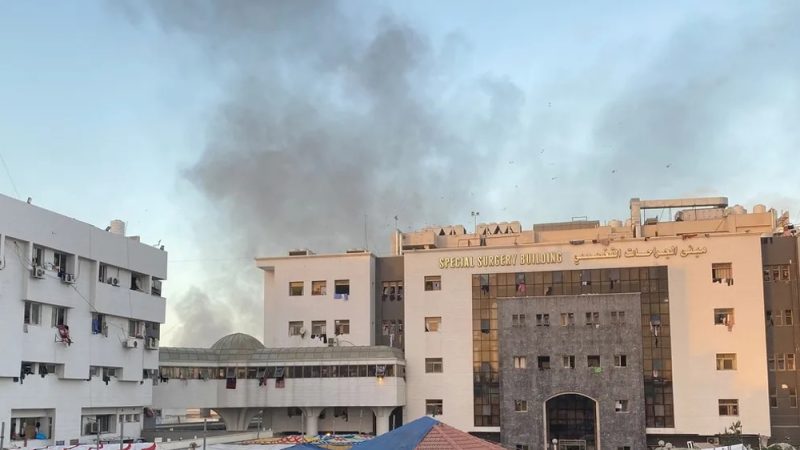
Indonesia’s foreign minister has condemned in the strongest terms Israel’s attacks on Indonesian Hospital in the besieged Gaza Strip as a “clear violation of international humanitarian laws.”
“All countries, especially those that have close relations with Israel, must use all their influence and capabilities to urge Israel to stop its atrocities,” Retno Marsudi stated on Monday.
Israeli forces opened fire and launched artillery strikes on the hospital and the surrounding areas in the early hours of the day.
The Gaza Health Ministry’s General Manager Munner al-Bursh said the regime forces began artillery strikes “in the middle of the night and targeted the surgical department, wounding the doctors working there and killing 12 civilians who were taking refuge.”
Elsewhere in his remarks, Bursh said Israeli forces also targeted people leaving the facility and shot them outside the hospital. “Their bodies are still lying on the ground, and nobody has been able to bury them.”
“We are using a small power generator that runs on vegetable oil, manufactured by some creative individuals who sacrificed some of their food supply to run the generator,” Bursh said.
Ashraf al-Qudra, Gaza’s Health Ministry spokesman, said the situation is “catastrophic” in Indonesian Hospital. “The Indonesian Hospital staff are insisting they will stay to treat the wounded. There are about 700 people, including medical staff and injured people, inside the hospital.”
Reports said Israeli forces are going to repeat what happened at Shifa Hospital and will also occupy the Indonesian Hospital as tanks surrounded the facility.
Meanwhile, Palestinian Prime minister Mohammad Shtayyeh has said the Israeli military operation in Gaza “is for the purpose of killing, in the spirit of revenge and with the aim of displacing our people.”
And UN Secretary-General Antonio Guterres has said the number of civilians killed in Israel’s war on Gaza has been “unparalleled and unprecedented” since he took office in 2017.
Children make up virtually 47 percent of Gaza’s 2.3 million population. UNICEF has labeled the Gaza Strip “a graveyard for thousands of children.” It has also described the situation in Gaza as “a growing stain on our collective conscience”, calling the rate of children casualties “simply staggering.”
Save the Children says more children have been killed in Gaza than in all other conflicts around the world since 2019 combined.
Israel has killed 13,000 Palestinians in Gaza since October 7.
Indonesia rubbishes Pentagon’s ‘joint statement’ on China and Russia
RT | September 1, 2023
Indonesia’s military chief has denied issuing any shared statements with his US counterpart during a visit to Washington last week, after the Pentagon published a “joint” press release attributed to Jakarta which criticized Moscow and Beijing.
Speaking to reporters on Thursday, Defense Minister Prabowo Subianto said the US statement does not reflect his country’s positions, stating that Indonesia seeks friendly relations with both Russia and China.
“There is no joint statement and no press conference. What is important for me to underline is that our relationship with China is very good. We respect each other, we already have mutual understanding. I conveyed that in the US,” he said, adding “We are close friends with China, we respect America, and we seek friendship with Russia.”
The official went on to announce plans to visit Beijing and Moscow in the coming months, voicing hopes that Jakarta could serve as a “bridge” between rival states.
The Pentagon missive, published on August 24 was titled ‘United States DoD and Indonesia MoD Joint Press Statement’ and took on a different tone. It claimed that both the US and Indonesia “shared the view that the People’s Republic of China’s (PRC) expansive maritime claims in the South China Sea are inconsistent with international law.” It also went on to “jointly” condemn Moscow’s actions in Ukraine, demanding a “complete and unconditional withdrawal” of Russian forces.
Though Indonesia’s Defense Ministry noted Subianto’s meetings with Pentagon head Lloyd Austin, it made no mention of any joint statement with Washington, and offered no comments about Russia or China.
Beijing was quick to jump on the American statement, with China’s embassy in Jakarta claiming the remarks had not been approved by Indonesian officials beforehand.
“We’re informed by the Indonesian side that what the US side described is not true. In fact, no such content can be found in the press release by the Indonesian side at the same meeting,” the embassy told reporters last weekend, slamming US efforts to “to sow discord and stir up trouble.”
During Subianto’s trip to the US, the two countries agreed to boost military cooperation, including joint war games and additional US weapons sales. The Pentagon further said Washington would help Jakarta’s military modernization drive, proposing “fighter aircraft upgrades, new multi-role fighter aircraft, and additional fixed and rotary wing transport aircraft,” among other gear.
Highlighting the growing military ties, Indonesian officials announced a deal to purchase 24 Sikorsky S-70M Black Hawk transport helicopters from US arms giant Lockheed Martin last week, soon after signing a major contract with Boeing for two-dozen F-15 fighter jets. Jakarta is working to revamp its air fleet, which currently operates systems from several different countries, including both US- and Russian-made fighter jets.
DC Scholars: Ukraine Conflict Shows World Has Grown Weary of US Hegemony
By Ekaterina Blinova – Sputnik – 24.06.2023
Despite having the largest military budget in the world and being the largest operator of military bases abroad, the US is far from being a global hegemon, argues a DC-based think tank Quincy Institute for Responsible Statecraft.
Over the past decades Washington has demonstrated a capacity for mass destruction – in Korea, Vietnam, Afghanistan, Iraq, Libya and elsewhere – but “it has won no more than Pyrrhic victories” which led to the erosion of trust in Pax Americana both at home and abroad, according to Responsible Statecraft scholars.
The US military spending reached $876.9 billion in 2022, while the nation also operates a whopping 750 foreign military bases. Still, Washington is incapable of persuading the Global South to join anti-Russia sanctions over the latter’s special military operation in Ukraine, the think tank remarks. “If hegemony means the capacity to get other countries to comply with one’s demands, the United States is far from being a global hegemon,” the report notes.
Judging from the so-called Pentagon leak, even some US allies and partners demonstrated hesitance and unwillingness to provide the Kiev regime with shells, jets and armored vehicles. Meanwhile, most nations of the Global South shrugged off the US calls for slapping sanctions on Moscow as contradicting their national interests.
US political observers emphasize that six nations in the Global South – namely, India, Brazil, Turkey, Indonesia, Saudi Arabia, and South Africa – are set to decide the future of geopolitics and insist that the Biden administration needs to win their hearts and minds. At the same time, European commentators argue that developing nations have the right to remain neutral and non-aligned.
For instance, in June 2022, India’s External Affairs Minister Dr S Jaishankar shredded the West’s claim that New Delhi was “sitting on the fence.” According to the minister, India is entitled to its opinion when it comes to the Russo-Ukrainian conflict.
Likewise, the Association of Southeast Asian Nations (ASEAN) has chosen to collaborate with both the US and China, instead of taking sides. Moreover, ASEAN nations are active participants of Beijing’s Belt and Road Initiative (BRI) regardless of Washington’s attempts to maintain its dominance in the region and curb China’s influence in the Asia Pacific.
Per DC scholars, the emerging trend was articulated by Brookings Institution fellow Fiona Hill, former Deputy Assistant to the President of the United States, in May 2023:
“The war in Ukraine is perhaps the event that makes the passing of Pax Americana apparent to everyone. … [Other countries] want to decide, not be told what’s in their interest. In short, in 2023, we hear a resounding no to US domination and see a marked appetite for a world without a hegemon,” she said at a conference in Tallinn, Estonia
According to Hill, the Global South’s resistance to the US and the EU’s demands to slap sanctions on Moscow is nothing short of “an open rebellion.” She noted that “this is a mutiny against what they see as the collective West dominating the international discourse and foisting its problems on everyone else, while brushing aside their priorities on climate change compensation, economic development, and debt relief.”
Western observers also acknowledge that the world’s center of gravity is steadily shifting east, adding that the Biden administration has so far sought to avert this trend by trying to establish “a lasting technological lead over China” and beefing up the US military in Western Pacific.
However, “most developing countries, including emerging powers in the Global South, are no longer willing to make zero-sum choices” between Washington and its geopolitical rivals, DC scholars underscore, urging American policymakers to accept the reality that the US is no longer “the indispensable nation.”
Pentagon ‘Calls the Tune’ in US’ China Policy as Bomber Flight Follows Blinken’s Beijing Visit
Sputnik – June 19, 2023
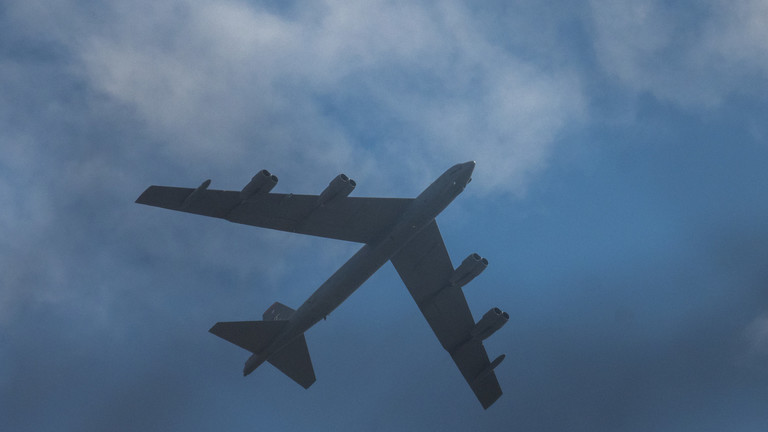
The US Air Force has dispatched several B-52H Stratofortress bombers to Abdulrachman Saleh Air Force Base in Indonesia from their bases in North Dakota. The bombers are joining US Pacific Air Forces and Indonesian Air Force aircraft in the Cope West exercise, a bilateral air drill, before returning to the US in the coming days.
The B-52 has been in service with the US Air Force since the 1950s, when it was introduced to haul large numbers of nuclear and conventional bombs to its targets. They were used with devastating effect during the Vietnam War, although it only dropped conventional bombs. The US retains a handful of the massive aircraft to use as “missile trucks” and to intimidate “hostile” nations.
The drills come just days after US Secretary of State Antony Blinken paid a visit to Beijing to meet with senior Chinese diplomatic leaders, including President Xi Jinping. The two sides reaffirmed their desire to avoid a new cold war and claimed they do not seek the other’s overthrow or to supplant their positions on the international stage.
Experts told Sputnik that this kind of contradictory messaging is all too common from the West, especially the United States, where war and intimidation have always been the primary tools of diplomacy.
James Bradley, China expert, historian and author of the “The China Mirage: The Hidden History of American Disaster in Asia,” told Sputnik on Thursday that whatever rhetoric the US says at the moment, its long-term strategic concern in East Asia has always been controlling and containing China.
“The US Navy was surveying islands near China as early as the 1850s,” he noted, adding that “1898 saw America grabbing the Philippines, Guam, and Hawaii to construct a sluice for the riches of China to flow to the US. Since 1945, the United States has been trying to contain China. The State Department can talk about dialogue, but the former War Department – currently called the Defense Department – calls the tune.”
In fact, Bradley noted that when journalist John Pilger asked him in 2016 if the US was already at war with China, “I answered yes.” That was even before the official US strategic shift toward “great power competition” that came in 2018.
“Economic war, cyber war, propaganda war. The business of China is business, and the business of America is war,” Bradley told Sputnik.
Jeff J. Brown, author of The China Trilogy, editor at China Rising Radio Sinoland and co-founder and curator of the Bioweapon Truth Commission, told Sputnik that such disjointedness between diplomatic rhetoric and military activity is typical of Western nations, where “in general, politics is individual and self-aggrandizing.”
“It is not unusual for the US Department of State, Department of Defense, the White House and Congresspersons to have conflicting and confusing messages, since each has their own agendas to push,”he said. “Not only are we seeing the Blinken-Indonesia white-hat black-hat routine, but at the same time, Joe Biden just called Chinese President Xi a ‘dictator!’”
“In the West in general, politics is individual and self-aggrandizing, so none of this is surprising that the left hand doesn’t care what the right hand is doing. In China, the government practices Marxist democratic centralism: argue and debate beforehand, but then publicly speak and act in one, unified voice,” Brown noted.
As to why Indonesia would agree to host US strategic bombers amid its attempts to stay neutral on the Washington-Beijing rivalry, Brown noted that the forces in power in Jakarta came to power in a US-sponsored pressure of pro-Chinese forces.
“We cannot forget that today’s Indonesia was born in the US genocide of millions of communists, socialists, leftists and liberals in 1965-66, to depose non-aligned President Sukarno for <…> General Suharto. Since then, the US military naturally pulls a lot of strings with the Indonesian army. We see the same situation in the Philippines, South Korea, Taiwan and Japan. Independent-minded presidents, prime ministers and legislatures are always confronted by the Western imperial toolbox: blackmail, bribery, extortion, false flags and fake news,” he explained.
“This is why we can see executives and legislatures cooperating with anti-imperial countries like China, Russia, Iran and Venezuela, while their militaries work with NATO.”
The author predicted that while the US would likely continue to pressure Jakarta to avoid buying advanced military hardware from China or Russia using “negative, reactionary diplomacy,” the inevitable decline of the West and rising of the developing world means its ability to do so is only going to diminish in the future.
“With the West’s continuing decline and the rise of BRICS and SCO [Shanghai Cooperation Organization], Indonesia may want to reorder those Su-35s,” Brown said, referring to a 2018 deal with Russia that the US blocked.
“It might work this go-around. In the meantime, the US will continue to use Western imperialism’s negative, reactionary diplomacy, by heavily playing the Taiwan separatist card, pushing NATO in Japan <…>, patching together hind-end groupings like the Quad and AUKUS, and sanctioning everything that moves,” he added.
“This, while China has masterfully united East and Southeast Asia into the Regional Comprehensive Economic Partnership (RCEP) free trade agreement, totally outclassing the US’ inchoate, anti-China Trans-Pacific Partnership (TPP). It’s so much easier to say ‘yes’ to mutually respectful, win-win cooperation.”
Iranian President: US Claims to Promote Democracy Are ‘Fake’
By Wyatt Reed – Sputnik – 24.05.2023
Claims by the US government that it pursues the promotion of democracy abroad are simply “fake,” Iranian President Ebrahim Raisi said Tuesday.
“The United States and [some] Western countries are not after democracy, but domination and plundering of other countries’ wealth,” Raisi said during an official visit to Indonesia, according to Iranian media.
“With the rise of emerging powers, the era of US domination has come to an end, said Iran’s chief executive,” media summarized.
Raisi pointed out that if Western powers are really after democracy and self-determination, they can start by guaranteeing Palestinians the right to choose their own destiny.
“Let the Yemeni and Afghan people decide for themselves,” he concluded, asking: “Why are you interfering in their affairs?”
The statements, delivered during a speech urging unity among Muslims at an Islamic center in Jakarta, came as Raisi seeks to bolster bilateral relations on his first official trip to Indonesia.
During a meeting with Indonesian House Speaker Puan Maharani, Raisi said the “expansion of ties between the Islamic Republic and Indonesia holds great promise for the progress of the two nations, the region, and the broader Muslim community,” state media reported.
“Despite the unjust threats and sanctions, the Islamic Republic of Iran has made significant progress and has achieved capabilities that have created good opportunities for the development of bilateral relations,” Raisi is quoted as saying.
On Tuesday, the two countries’ presidents and high-ranking officials met to sign off on 11 cooperation agreements.
The deals relate to “preferential trade, visa waivers, cultural exchanges, cooperation on supervising the production of pharmaceutical products, collaborations in scientific, technological, and innovative arenas, and bilateral cooperation in oil and gas sectors,” media indicated.
US Pushes Indonesia to Ramp Up Military Cooperation, Jakarta Pledges Neutrality
Sputnik – 15.05.2023
The US Army’s top general was deployed to Indonesia in an effort to solidify the country’s position in the American orbit this week amid Washington’s ongoing efforts to encircle China militarily and constrain its growth.
On Friday, the Army’s Chief of Staff, James McConville, described his meeting with Indonesian Defense Minister Prabowo Subianto as a relatively benign effort to bring peace to the Indo-Pacific region.
“We have many friends in the region, and we work closely together,” McConville said. “We all share the same interests for the region: peace, security, stability.”
“That’s why we work together on maintaining a free and open Indo-Pacific for everyone,” he insisted.
For his part, Subianto described peace and stability in the region as a “common concern,” but insisted Indonesia would maintain its neutrality, pledging to continue pursuing relationships with all world’s nations – “especially all the major powers.”
McConville touched down in Jakarta on Thursday on the heels of a visit to the Philippines. That trip came shortly after last month’s massive US-Philippine war drills provoked anger among authorities in Beijing, who simulated an encirclement of their own against the renegade island of Taiwan in response.
But it’s unclear that Jakarta’s leaders are as willing to sign up for a battle with Beijing as their counterparts in Manila. Last November, Subianto promised to restore joint military exercises with China following a meeting with the nation’s defense minister.
In 2017, the US embassy in Jakarta released around 30,000 documents showing “the US actively supported the Indonesian military’s killing of as many as 1 million suspected communist sympathizers in the mid-1960s despite concerns about the reasons behind the massacre,” the Financial Times reported.
But the US maintains close relations with Indonesia’s leaders despite its questionable legacy there.
Indonesia to ditch Visa and Mastercard
RT | March 21, 2023
The Bank of Indonesia is preparing to phase out Visa and Mastercard while introducing its own domestic payment system, Antara news agency reported on Monday, citing the regulator.
Last week, Indonesian President Joko Widodo urged regional authorities to wean themselves away from foreign payment systems and start using cards issued by local banks. He argued that Indonesia needed to shield itself from geopolitical disruptions, citing the sanctions targeting Russia’s financial sector from the US, EU, and their allies over the conflict in Ukraine.
“Be very careful. We must remember the sanctions imposed by the US on Russia. Visa and Mastercard could be a problem,” he said.
Commenting on the initiative, the central bank’s spokesperson, Erwin Haryono, said that the regulator was in talks with local businesses “and the progress is about 90%,” adding that domestic cards will have many advantages, including lower fees. Also, according to him, “offshore settlements and dependence on foreign payment networks such as US Visa or Mastercard will no longer be necessary.”
Board member of the Indonesian Credit Cards Association (AKKI), Dodit Proboyakti, told RIA Novosti that Indonesia would apply the experience of Russia and its Mir payment system to promote the domestic financial network.
Indonesia’s interbank system, GPN, currently supports only local debit cards and requires some adjustments to properly serve credit cards and international transactions, according to AKKI executive director Steve Marta.
Moscow rolled out its own national card system, Mir, soon after the US first targeted the country with sanctions in 2014, and created the domestic National Payment Card System (NSPK) to smoothly take over all Visa and Mastercard transactions should the US-based companies pull the plug.
New Asian contracts to double Russian gas project’s revenue – Reuters
RT | January 26, 2023
The Sakhalin-2 liquefied natural gas (LNG) project is expected to generate twice as much revenue in 2023 compared to its earnings before the Ukraine-related sanctions rained down on Russia’s energy sector, Reuters reported on Thursday, citing industry analysts.
The boost is attributed to long-term contracts with clients from the Asian region, along with higher global energy prices.
Renewed deals with Asian buyers are expected to secure demand for up to 6.5 million tons of the super-chilled fuel annually from Sakhalin 2, according to calculations by the agency and contractual volume data provided by the GIIGNL international group of LNG importers.
The contracts could earn up to $4.5 billion in revenue for Sakhalin 2 shareholders, which include state-run energy giant Gazprom and Japanese companies Mitsubishi and Mitsui, according to Masanori Odaka, a senior analyst on Rystad Energy’s gas and LNG team.
The enterprise is expected to generate another $7.45 billion in 2023 if production remains in line with 2022, while its sales on the spot market are retained at 4.9 million tons, Alexei Kokin, chief analyst at Russia’s Otkritie brokerage, told Reuters.
On Thursday, Sakhalin Energy, the operator of the project, said it produced 11.5 million tons of LNG and some 3.7 million tons of its Sakhalin blend crude oil at the Sakhalin-2 facilities in 2022, exceeding its production plan. That is 10% more than the project produced in the previous year.
The company had managed to continue production despite “a period of unprecedented pressure from external factors on production and economic activity,” according to Andrey Oleinikov, Sakhalin Energy’s managing director.
According to the company’s statement, LNG and oil shipments in 2022 were delivered to the buyers on time in full compliance with the terms of Stock Purchase Agreement, while its production remained on schedule. The major markets for exports are Japan, China, South Korea and Indonesia, Sakhalin Energy said.
Southeast Asia at Energy-Climate Crossroads
By Vijay Jayaraj | RealClear Energy | August 10, 2022
Southeast Asia is at the crossroads of choosing between a climate agenda hostile to fossil fuels and the energy security its population desperately needs.
Central to the question is the use of coal. The fuel is especially critical in the production of electricity for the 700 million people of the 10 countries making up the Association of Southeast Asian Nations (ASEAN): Brunei, Cambodia, Indonesia, Laos, Malaysia, Myanmar, Philippines, Singapore, Thailand and Vietnam.
Electricity demand in Southeast Asia grew by 22 percent between 2015 and 2021, greater than the global average. The International Energy Agency predicts that “energy demand in the region is set to grow by around 3 percent a year to 2030, with three-quarters of the increase being met by fossil fuels…The net oil import bill, which stood at $50 billion in 2020, is set to multiply in size rapidly.”
Contributing to the energy bill is the global phenomenon of inflation. In June, the highest rates of inflation in ASEAN were in Thailand (7.7 percent), Vietnam (3.4 percent), Philippines (6.1 percent) and Indonesia (4.3 percent), mainly due to rising energy and food prices.
Adding to the pressures of higher demand for electricity and more expensive fuel is growing pressure from international political bodies to reduce fossil fuel consumption. Propositions such as the Paris agreement and the net zero agenda have captured the imaginations of the political elite with ASEAN countries within the grasp of the climate-crazy octopus.
Disregarding fossil fuels’ contribution to its economic growth in the last decade, Vietnam has espoused the net zero pledge. In its new National Power Development Plan, the country indicated its desire to reduce “coal-fired plants to less than 10 percent of the total capacity by 2045,” in addition to halting construction of new coal plants. With nearly 70 percent of all electricity coming from fossil fuels, Vietnam has absurdly declared war on coal.
Vietnam is ranked at a dismal 134th in global ranking for per capita energy consumption. Its “peak demand during 2022 – 2025 will rise by 2,830 megawatts (MW) annually on average while power generation will increase by only 1,565 MW per annum.” The decision to reduce coal consumption at this juncture is suicidal, running counter to the country’s objective of economic growth.
However, not all ASEAN countries have been as irresponsible as Vietnam. Because of the post-pandemic increase in energy demand, many ASEAN members are reversing decisions to reduce fossil fuel consumption.
Among them is Indonesia, one of the biggest producers of coal in Asia and a major exporter to other countries. Indonesia is reporting a 4 percent increase in coal mining during the 2nd quarter of 2022 following a ban on Russian coal. A further increase is expected to be prompted by a broader ban to be instituted by the EU in August. Indonesia’s largest energy infrastructure company has now acquired a Thai state-owned energy firm, expanding its coal mining business to Thailand and ensuring continuous coal production there.
Some in ASEAN are installing innovative fuel-saving artificial intelligence systems in their coal plants to make them more efficient, thus indicating that their reliance on coal power is here to stay.
Perhaps, the ASEAN countries will model neighboring India and China, which continue to increase fossil fuel consumption to meet energy demand. China, for example, approved a coal mine project worth $458 million in the Inner Mongolia region as recently as July.
The worst mistake would be to decommission ASEAN coal-fired power plants. Even the economic powerhouses of Europe like Austria, Germany and the UK have reopened coal plants to ensure energy security.
If common sense prevails, most ASEAN countries will adopt clean-coal technology, which provides remarkably low pollutant emissions and less dust. In fact, its safety and efficiency are so recognized that Japan is exporting its technology to other countries. India, which is the second largest consumer of coal, has opened a National Centre for Clean Coal Research and Development.
A 2020 report by the CO2 Coalition, found that clean-coal technology “virtually eliminates health hazards from sulfur dioxide, nitrogen oxides, and particulate matter,” thus reducing the outdoor pollution problem that is so common in low-income and mid-income economies like those in ASEAN.
Still in the grip of energy poverty, ASEAN countries that deprive themselves of affordable fossil fuels risk becoming the next Sri Lanka.
Vijay Jayaraj is a Research Associate at the CO2 Coalition, Arlington, Va., and holds a master’s degree in environmental sciences from the University of East Anglia, England. He resides in Bengaluru, India.
‘US-led effort to isolate Russia failed’
Samizdat – August 5, 2022
The US-led drive to isolate Russia through sanctions has not succeeded, as half the countries in the Group of Twenty leading global economies refused to sign on, Bloomberg reported on Friday.
According to the publication, senior officials from leading Western nations are surprised by the lack of support within the wider G20, despite their efforts to make the case for restrictions against Russia.
Argentina, Brazil, China, India, Indonesia, Mexico, Saudi Arabia, South Africa, and Turkey have not joined the sanctions that were adopted by the US, UK, EU, and their allies Australia, Canada, Japan, and South Korea. Some nations, like China and South Africa, have openly criticized the restrictions. The G20 nations account for around 85% of global economic output.
According to Bloomberg, the reasons for the lack of support include strong trade ties, historical affinities to Moscow, and a distrust of former colonial powers.
Featured Video

It’s the Occupation, Stupid
or go to
Aletho News Archives – Video-Images
From the Archives
A superpower and “the world’s sickest warrior state”
By Paul J. Balles | March 8, 2010
Living through five or six major wars has hardened me to what I thought were the extremes of inhuman cruelty and brutality.
Two things made those extremes almost bearable: the brutality always revealed – at least according to the media coverage – the viciousness of the enemy. It was therefore quite understandable when our “brave men and women” pulverized the enemy.
Films of Japanese torturing captive Americans somehow justified holding Japanese Americans in internment camps during World War II; and only a small percentage of Americans found the bombing of Hiroshima and Nagasaki unreasonably vengeful at best, at worst, depraved.
The media giants in America portrayed the North Koreans as barbaric beasts with their captives, quite unlike their southern counterpoints – our allies during the Korean War. No one ever felt the need to explain how the South Koreans were a civilized breed while the North Koreans were absolute savages, at least according to the official line.
In Vietnam, our warriors justifiably (or so the media made us believe) dropped napalm on the North Vietnamese who had the gall to hide in villages and tunnels to ravage our invaders. At least it was accepted practice until some rogue photojournalist filmed a young girl screaming down a Vietnamese road in flames. … continue
Blog Roll
 Aletho News
- Pakistan to Host US-Iran Talks
- How Indonesia’s tilt toward the US left it stranded in the Strait of Hormuz
- US has no choice but to retreat from Iranian borders: Top commander
- Iran Retaliation Strikes Chemical Plant Near Dimona
- AWACS’ Destruction is a Major Loss for US Military – Ex-DoW Analyst
- Israel’s Iran Strategy Uses US Military & Gulf States as Its Pawns
- Iran: Trump wanted regime change, now just begging for Hormuz to open
- IRGC: Israeli, US universities in region legitimate targets after strikes on Iranian university
- Trump admits Iran hit USS Ford carrier: ‘We ran for our lives’
- Battle for Hungary: EU attacks on Orban are a sign of worse things to come
- If Americans Knew
- Israeli police block Catholic cardinal from entering Church of the Holy Sepulchre on Palm Sunday
- Israel is assassinating journalists again, more than any other nation, anywhere, ever – Not a ceasefire Day 170
- Over 300 US service members wounded, majority have brain injuries – Not a ceasefire Day 169
- Researchers at Human Rights Watch Resign Over Blocked Report on Palestinian Refugee Return
- Jewish Groups Are Backing a War Americans Don’t Want
- Eric Fingerhut Thinks He’s the President of the Jews
- Top Jewish Philanthropists, Rabbis Urge Israeli President to Take Action Against ‘Jewish Extremists’
- Don’t Be Fooled. Zionist Leaders Have Always Wanted to Control Southern Lebanon
- Israel’s widespread use of torture is a core element of its genocide against the Palestinian people
- In Israel’s War on Iran, Many Middle East US Bases Rendered “All But Uninhabitable”
- No Tricks Zone
- German Science Blog Accuses PIK Climate Institute Of Hallucinating Climate Tipping Points
- Devastating Assessment Of Comirnaty Vaccine By Former Senior Pfizer Europe Toxicologist
- New Study: CO2 Is ‘Effectively Negligible’ As An Explanatory Climate Change Factor Since 2000
- Former Pfizer Toxicologist Dr. Helmut Sterz Tells Bundestag Hearing Pfizer Vaccine Should Have Never Been Approved
- Energy Expert: Germany’s Nuclear Phaseout Was A “500 Billion Euro Mistake”
- New Research: South Australia’s Mid-Holocene Sea Surface Temperatures Were 4°C Warmer Than Today
- Storing Green Energy To Last Germany 10 Days Would Require A 60-Million Tonne Battery
- New Studies: UK Sea Levels Were 4 Meters Higher Than Today During The Mid-Holocene
- Destructive Green New Deal: German Energy And Metal Group Warns Of Drastic Crisis
- New Study Documents A 20-Year Pause In Arctic Sea Ice Decline – Driven By Internal Variability
 Aletho News