WASHINGTON – The “first step” agreement between Iran and the United States that was sealed in Geneva over the weekend is supposed to lead to the negotiation of a “comprehensive settlement” of the nuclear issue over the next six months, though the latter has gotten little attention.
But within hours of the agreement, there are already indications from senior U.S. officials that the Barack Obama administration is not fully committed to the conclusion of a final pact, under which economic sanctions would be completely lifted.
The administration has apparently developed reservations about such an “end state” agreement despite concessions by the government of President Hassan Rouhani that were more far-reaching than could have been anticipated a few months ago.
In fact the Rouhani government’s moves to reassure the West may have spurred hopes on the part of senior officials of the Obama administration that the United States can achieve its minimum aims in reducing Iran’s breakout capacity without giving up its trump cards—the harsh sanctions on Iran’s oil expert and banking sectors.
The signs of uncertain U.S. commitment to the “end state” agreement came in a background press briefing by unidentified senior U.S. officials in Geneva via teleconference late Saturday night. The officials repeatedly suggested that it was a question of “whether” there could be an “end state” agreement rather than how it could be achieved.
“What we are going to explore with the Iranians and our P5+1 partners over the next six months,” said one of the officials, “is whether there can be an agreed upon comprehensive solution that assures us that the Iranian programme is peaceful.”
The same official prefaced that remark by stating, “In terms of the ‘end state’, we do not recognise a right for Iran to enrich uranium.”
Later in the briefing, a senior official repeated the same point in slightly different words. “What the next six months will determine is whether there can be an agreement that… gives us assurance that the Iranian programme is peaceful.”
Three more times during the briefing the unnamed officials referred to the negotiation of the “comprehensive solution” outlined in the deal agreed to Sunday morning as an open-ended question rather than an objective of U.S. policy.
“We’ll see whether we can achieve an end state that allows for Iran to have peaceful nuclear energy,” said one of the officials.
Those carefully formulated statements in the background briefing do not reflect difficulties in identifying what arrangements would provide the necessary assurances of a peaceful nuclear programme. Secretary of State John Kerry declared at a press appearance in Geneva, “Folks, it is not hard to prove peaceful intention if that’s what you want to do.”
The background briefing suggested that in next six months, Iran would have to “deal with” U.N. Security Council resolutions, which call for Iran to suspend all enrichment activities as well as all work on its heavy reactor in Arak.
Similarly, the unnamed officials said Iran “must come into compliance with its obligations under the NPT and its obligations to the IAEA [International Atomic Energy Agency].”
Those statements appeared to suggest that the administration would be insisting on a complete end to all enrichment, at least temporarily, and an end to all work on Arak.
The actual text of the agreement reached on Sunday states, however, that both the six powers of the P5+1 and Iran “will be responsible for conclusion and implementation of mutual near-term measures,” apparently referring to the measures necessary to bring Security Council consideration of the Iran nuclear issue to a conclusion.
The Obama administration has yet to release an official text of the “first step” agreement, although the official Iran Fars new agency released a text over the weekend.
Iran has demonstrated its determination to achieve such an agreement by effectively freezing and even partially reversing its nuclear programme while giving the IAEA daily access to Iran’s enrichment sites.
The Washington Post story on Sunday cited Western officials in Geneva as saying that the Iranian concessions “not only halt Iran’s nuclear advances but also make it virtually impossible for Tehran to build a nuclear weapon without being detected.”
But since the early secret contacts with Iran in August and September, the Obama administration has been revising its negotiating calculus in light of the apparent Iranian eagerness to get a deal.
In mid-October, Bloomberg’s Jeffrey Goldberg reported that the White House and State and Treasury departments were interested in an idea first proposed in early October by Mark Dubowitz, the executive director of the Foundation for the Defense of Democracies, who had lobbied the Obama administration successfully for the sanctions aimed at cutting Iranian oil export revenues.
The Dubowitz proposal was to allow Iran access to some of its own money that was sitting in frozen accounts abroad in return for “verified concessions” that would reduce Iranian nuclear capabilities.
Meanwhile the United States and other powers would maintain the entire structure of the sanctions regime, at least in the interim period, without any change, Goldberg reported, “barring something like total capitulation” by Iran.
The scheme would give greater rewards for dismantling all but a limited number of safeguards than for lesser concessions, according to Goldberg’s report, based on information from “several officials”.
And if Iran refused, the plan would call for even more punishing sanctions against Iran’s natural gas sector.
That was essentially the policy that the Obama administration adopted in the negotiations in Geneva. In the first step agreement, Iran agreed to stop all enrichment to 20 percent, reduce the existing 20 percent-enriched stockpile to zero, convert all low enriched uranium to a form that cannot be enriched to higher level and allow IAEA inspectors daily access to enrichment sites.
In return for concessions representing many of its key negotiating chips, Iran got no relief from sanctions and less than seven billion dollars in benefits, according to the official U.S. estimate.
But the Iranian concessions will hold only for six months, and Iran has made such far-reaching concessions before in negotiations on a preliminary that anticipated a later comprehensive agreement and then resumed the activities it had suspended.
In the Paris Agreement of Nov. 15, 2004 with the foreign ministers of the UK, Germany, France, Iran agreed “on a voluntary basis, to continue and extend an existing suspension of enrichment to include all enrichment related and reprocessing activities”.
That meant that Iran was giving up all work on the manufacture, assembly, installation and testing of centrifuges or their components. Supreme Leader Ayatollah Ali Khamenei was under the impression it was an open-ended suspension and initially opposed it.
Khamenei relented only after Hassan Rouhani, then the chief nuclear policy coordinator and now president, and other officials, assured him that it was a temporary measure that would endure only until an agreement was reached that legitimised Iran’s enrichment or the determination that the Europeans were not serious, according to Ambassador Hossein Mousavian’s nuclear memoirs.
After the Europeans refused to negotiate on an Iranian proposal for a comprehensive settlement in March 2005 that would have provided assurances against enrichment to weapons grade, Khamenei pulled the plug on the talks, and Iran ended its suspension of enrichment-related activities.
The United States had long depended on its dominant military power to wage “coercive diplomacy” with Tehran, with threat of an attack on Iran as its trump card. But during the George W. Bush administration, that threat begn to lose its credibility as it became clear that the U.S. military was opposed to war with Iran over its nuclear programme.
Obama administration officials are now acting as though they believe the sanctions represent a diplomatic trump card that is far more effective than the “military option” that had been lost.
Some news stories on the “first step” agreement have referred to the possibility that the negotiations on the final settlement could stall, and the status quo might continue. But the remarks by senior U.S. officials suggest the administration may be hoping for precisely such an outcome.
Gareth Porter, an investigative historian and journalist specialising in U.S. national security policy, received the UK-based Gellhorn Prize for journalism for 2011 for articles on the U.S. war in Afghanistan.
November 26, 2013
Posted by aletho |
Deception, Progressive Hypocrite | International Atomic Energy Agency, Iran, John Kerry, Sanctions against Iran, United States |
Leave a comment
By James Petras :: December 28, 2005
Israel Bombs Iran: The US Suffers the Consequences
Israel’s political and military leadership have repeatedly and openly declared their preparation to militarily attack Iran in the immediate future. Their influential supporters in the US have made Israel’s war policy the number one priority in their efforts to secure Presidential and Congressional backing. The arguments put forth by the Israeli government and echoed by their followers in the US regarding Iran’s nuclear threat are without substance or fact and have aroused opposition and misgivings throughout the world, among European governments, international agencies, among most US military leaders and the public, the world oil industry and even among sectors of the Bush Administration.
An Israeli air and commando attack on Iran will have catastrophic military consequences for US forces and severe loss of human life in Iraq, most likely ignite political and military violence against pro-US Arab-Muslim regimes, such as Saudi Arabia and Egypt, perhaps leading to their overthrow.
Without a doubt Israeli war preparations are the greatest immediate threat to world peace and political stability.
Israel’s War Preparations
Never has an imminent war been so loudly and publicly advertised as Israel’s forthcoming military attack against Iran. When the Israeli Military Chief of Staff, Daniel Halutz, was asked how far Israel was ready to go to stop Iran’s nuclear energy program, he said “Two thousand kilometers” – the distance of an air assault (Financial Times (FT) Dec 12, 2005). More specifically Israeli military sources reveal that Israel’s current and probably next Prime Minister Ariel Sharon ordered Israel’s armed forces to prepare for air strikes on uranium enrichment sites in Iran (London Times), Dec 11, 2005). According to the London Times the order to prepare for attack went through the Israeli defense ministry to the Chief of Staff. During the first week in December, “… sources inside the special forces command confirmed that ‘G’ readiness – the highest state – for an operation was announced” (Times, Dec. 11, 2005).
On December 9, Israeli Minister of Defense, Shaul Mofaz, affirmed that in view of Teheran’s nuclear plans, Tel Aviv should “not count on diplomatic negotiations but prepare other solutions.” (La Jornada, Dec. 10, 2005) In early December, Ahron Zoevi Farkash, the Israeli military intelligence chief told the Israeli parliament (Knesset) that “if by the end of March, the international community is unable to refer the Iranian issue to the United Nations Security Council, then we can say that the international effort has run its course” (Times, Dec. 11, 2005).
In plain Hebrew, if international diplomatic negotiations fail to comply with Israel’s timetable, Israel will unilaterally, militarily attack Iran. Benjamin Netanyahu, leader of the Likud Party and candidate for Prime Minister stated that if Sharon did not act against Iran, “then when I form the new Israeli government (after the March 2006 elections) we’ll do what we did in the past against Saddam’s reactor.” (Times Dec 11, 2005). In June 1981 Israel bombed the Osirak nuclear reactor in Iraq. Even the pro-Labor newspaper, Haaretz, while disagreeing with the time and place of Netanyahu’s pronouncements, agreed with its substance. Haaretz criticized “(those who) publicly recommend an Israeli military option…” because it “presents Israel as pushing (via powerful pro-Israel organizations in the US) the United States into a major war.” However, Haaretz adds… “Israel must go about making its preparations quietly and securely – not at election rallies.” (Haaretz, Dec 6, 2005) Haaretz’s position, like that of the Labor Party, is that Israel not advocate war against Iran before multi-lateral negotiations are over and the International Atomic Energy Agency makes a decision.
In other words, the Israeli “debate” among the elite is not over whether to go to war but over the place to discuss war plans and the timing to launch war. Implicitly Haaretz recognizes the role played by pro-Israeli organizations in “pushing the US into the Iraq war”, perhaps a word of caution, resulting from increased US opposition to the activities of the Israel First campaigners in Congress (see below).
Israeli public opinion apparently does not share the political elite’s plans for a military strike against Iran’s nuclear program. A survey in the Israeli newspaper Yedioth Ahronoth, reported by Reuters (Dec. 16, 2005) shows that 58% of the Israelis polled believed the dispute over Iran’s nuclear program should be handled diplomatically while only 36% said its reactors should be destroyed in a military strike.
Israel’s War Deadline
All top Israeli officials have pronounced the end of March as the deadline for launching a military assault on Iran. The thinking behind this date is to heighten the pressure on the US to force the sanctions issue in the Security Council. The tactic is to blackmail Washington with the “war or else” threat, into pressuring Europe (namely Great Britain, France, Germany and Russia) into approving sanctions. Israel knows that its acts of war will endanger thousands of American soldiers in Iraq, and it knows that Washington (and Europe) cannot afford a third war at this time. The end of March date also coincides with the IAEA report to the UN on Iran’s nuclear energy program. Israeli policymakers believe that their threats may influence the report, or at least force the kind of ambiguities, which can be exploited by its overseas supporters to promote Security Council sanctions or justify Israeli military action. Fixing a March date also intensifies the political activities of the pro-Israel organizations in the United States. The major pro-Israel lobbies have lined up a majority in the US Congress and Senate to push for the UN Security Council to implement economic sanctions against Iran or, failing that, endorse Israeli “defensive” action. Thousands of pro-Israel national, local and community groups and individuals have been mobilized to promote the Israeli agenda via the mass media and visits to US Congressional representatives. The war agenda also plays on exploiting the tactical disputes among the civilian militarists within the White House, between Cheney, Bolton and Abrams on one side and Rice and Rumsfeld on the other. The Cheney line has always supported an Israeli military attack, while Rice promotes the tactic of “forced failure” of the European diplomatic route before taking decisive action. Rumsfeld, under tremendous pressure from practically all of the top professional military officials, fears that an Israeli war will further accelerate US military losses. The pro-Israel lobby would like to replace the ultra-militarist Rumsfeld with the ultra-militarist Senator Joseph Lieberman, an unconditional Israel First Zealot.
US-Israeli Disagreements on an Iran War
As Israel marches inexorably toward war with Iran, disputes with Washington have surfaced. The conflicts and mutual attacks extend throughout the state institutions, and into the public discourse. Supporters and opponents of Israel’s war policy represent powerful segments of state institutions and civil society. On the side of the Israeli war policy are practically all the major and most influential Jewish organizations, the pro-Israeli lobbies, their political action committees, a sector of the White House, a majority of subsidized Congressional representatives and state, local and party leaders. On the other side are sectors of the Pentagon, State Department, a minority of Congressional members, a majority of public opinion, a minority of American Jews (Union of Reform Judaism) and the majority of active and retired military commanders who have served or are serving in Iraq.
Most of the discussion and debate in the US on Israel’s war agenda has been dominated by the pro-Israeli organizations that transmit the Israeli state positions. The Jewish weekly newspaper, Forward, has reported a number of Israeli attacks on the Bush Administration for not acting more aggressively on behalf of Israel’s policy. According to the Forward, “Jerusalem is increasingly concerned that the Bush Administration is not doing enough to block Teheran from acquiring nuclear weapons…” (Dec. 9, 2005). Further stark differences occurred during the semi-annual strategic dialog between Israeli and US security officials, in which the Israelis opposed a US push for regime change in Syria, fearing a possible, more radical Islamic regime. The Israeli officials also criticized the US for forcing Israel to agree to open the Rafah border crossing and upsetting their stranglehold on the economy in Gaza.
Predictably the biggest Jewish organization in the US, the Conference of Presidents of Major American Jewish Organizations (CPMAJO) immediately echoed the Israeli state line as it has since its founding. Malcolm Hoenlan, President of the CPMAJO lambasted Washington for a “failure of leadership on Iran” and “contracting the issue to Europe” (Forward, Dec. 9, 2005). He went on to attack the Bush Administration for not following Israel’s demands by delaying referring Iran to the UN Security Council for sanction. The leader of the CPMAJO then turned on French, German and British negotiators accusing them of “appeasement and weakness”, and of not having a “game plan for decisive action” – presumably for not following Israel’s ‘sanction or bomb them’ game plan.
The role of AIPAC, the CPMAJO and other pro-Israeli organizations as transmission belts for Israel’s bellicose war plans was evident in their November 28, 2005 condemnation of the Bush Administration agreement to give Russia a chance to negotiate a plan under which Iran would be allowed to enrich uranium under international supervision to ensure that its enriched uranium would not be used for military purposes. AIPAC’s rejection of negotiations and demands for an immediate confrontation were based on the specious argument that it would “facilitate Iran’s quest for nuclear weapons” – an argument which flies in the face of all known intelligence data (including Israel’s) which says Iran is at least 3 to 10 years away from even approaching nuclear weaponry. AIPAC’s unconditional and uncritical transmission of Israeli demands and criticism is usually clothed in the rhetoric of US interests or security in order to manipulate US policy. AIPAC chastised the Bush regime for endangering US security. By relying on negotiations, AIPAC accused the Bush Administration of “giving Iran yet another chance to manipulate (sic) the international community” and “pose a severe danger to the United States” (Forward, Dec. 9, 2005).
Leading US spokesmen for Israel opposed President Bush’s instructing his Ambassador to Iraq, Zalmay Khaklilzad, to open a dialog with Iran’s Ambassador to Iraq. In addition, Israel’s official ‘restrained’ reaction to Russia’s sale to Teheran of more than a billion dollars worth of defensive anti-aircraft missiles, which might protect Iran from an Israeli air strike, was predictably echoed by the major Jewish organizations in the US. No doubt an important reason for Israel’s setting an early deadline for its military assault on Iran is to act before Iran establishes a new satellite surveillance system and installs its new missile defense system.
Pushing the US into a confrontation with Iran, via economic sanctions and military attack has been a top priority for Israel and its supporters in the US for more than a decade (Jewish Times/ Jewish Telegraph Agency, Dec. 6, 2005). The AIPAC believes the Islamic Republic poses a grave threat to Israel’s supremacy in the Middle East. In line with its policy of forcing a US confrontation with Iran, AIPAC, the Israeli PACs (political action committees) and the CPMAJO have successfully lined up a majority of Congress people to challenge what they describe as the “appeasement” of Iran. According to the Jewish Times (12/6/05), “If it comes down to a political battle, signs are that AIPAC could muster strong support in Congress to press the White House to demand sanctions on Iran.” Representative Illeana Ros-Lehtinen (R-Florida), who has the dubious distinction of being a collaborator with Cuban exile terrorist groups and unconditional backer of Israel’s war policy, is chairwoman of the highly influential US House of Representative Middle East subcommittee. From that platform she has echoed the CPMAJO line about “European appeasement and arming the terrorist regime in Teheran” (Jewish Times 12/6/05). The Cuban-American Zionist boasted that her Iran sanctions bill has the support of 75% of the members of Congress and that she is lining up additional so-sponsors.
The pro-Israel lobby’s power, which includes AIPAC, the Conference of Presidents, the PACs and hundreds of local formal and informal organizations, is magnified by their influence and hegemony over Congress, the mass media, financial institutions, pension funds and fundamentalist Christian organizations. Within the executive branch their influence in these institutions amplifies their power far beyond their number and direct control and representation in strategic public and private institutions (which itself is formidable). AIPAC’s “Progress and Policy Report for 2005” – published on its website – lists, among its accomplishments, getting Congress to approve 100 pro-Israel legislative initiatives, $3 billion in direct aid and more than $10 billion in guaranteed loans, transfer of the most advanced military technology to Israel’s multi-billion dollar arms export corporations, and the lining up by a 410 to 1 vote in the House of Representative committing the US to Israel’s security – as it is defined by Israel.
The conflict between the Israeli elite and the Bush Administration has to be located in a broader context. Despite pro-Israeli attacks on US policy for its ‘weakness’ on Iran, Washington has moved as aggressively as circumstances permit. Facing European opposition to an immediate confrontation (as AIPAC and Israeli politicians demand) Washington supports European negotiations but imposes extremely limiting conditions, namely a rejection of the Non-Proliferation Treaty, which allows uranium enrichment for peaceful purposes. The European “compromise” of forcing Iran to turn over the enrichment process to a foreign country (Russia), is not only a violation of its sovereignty, but is a policy that no other country using nuclear energy practices. Given this transparently unacceptable “mandate”, it is clear that Washington’s ‘support for negotiations’ is a propaganda devise to provoke an Iranian rejection, and a means of securing Europe’s support for a Security Council referral for international sanctions. Washington has absolutely no precedent to object to Russia’s sale of defensive ground to air missiles to Iran, since it is standard in the arms export business. As for as the Ambassadorial meetings in Iraq, the US has had great success in securing Iranian co-operation on stabilizing its Iraqi Shiite client regime. Iran has recognized the regime, has signed trade agreements, supported the dubious elections and provided the US with intelligence against the Sunni resistance. Given their common interests in the region, it was logical for Washington to seek to bend Iran into further co-operation via diplomatic discussions. In other words, as the US seeks to withdraw its troops from a losing war in Iraq (largely supported by AIPAC and its organizational partners), pro-Israel organizations are pushing hard to put the US into a new war with Iran. It is no surprise that the Zionist Organization of America (ZOA) invited the most bellicose of US Middle East warmongers, UN Ambassador to the United Nations, John Bolton, to be its keynote speaker at its annual awards dinner (ZOA Press Release, Dec. 11, 2005). The ZOA has loyally followed all the zigzags of Israeli policy since the foundation of the State.
Despite the near unanimous support and widespread influence of the major Jewish organizations, 20% of American Jews do not support Israel in its conflict with the Palestinians. Even more significantly, 61% of Jews almost never talk about Israel or defend Israel in conversation with Goyim (non-Jews) (Jerusalem Post, Dec 1, 2005). Only 29% of Jews are active promoters of Israel. In other words, it is important to note that the Israel First crowd represents less than a third of the Jewish community and hence their claim to speak for ‘all’ US Jews is false and a misrepresentation. In fact, there is more opposition to Israel among Jews than there is in the US Congress. Having said that, however, most Jewish critics of Israel are not influential in the big Jewish organizations and the Israel lobby, excluded from the mass media and mostly intimidated from speaking out, especially on Israel’s war preparations against Iran. The minority Jewish critics cannot match the five to eight million dollars spent in buying Congressional votes each year by the pro-Israel lobbies.
The Myth of the Iranian Nuclear Threat
The Israeli Defense Forces Chief of Staff, Daniel Halutz, has categorically denied that Iran represents an immediate nuclear threat to Israel, let along the United States. According to Haaretz (12/14/05), Halutz stated that it would take Iran time to be able to produce a nuclear bomb – which he estimated might happen between 2008 and 2015.
Israel’s Labor Party officials do not believe that Iran represents an immediate nuclear threat and that the Sharon government and the Likud war propaganda is an electoral ploy. According to Haaretz, “Labor Party officials… accused Prime Minister Ariel Sharon, Defense Minister Shaul Mofaz and other defense officials of using the Iran issue in their election campaigns in an effort to divert public debate from social issues” (Dec. 14, 2005). In a message directed at the Israeli Right but equally applicable to AIPAC and the ‘Presidents of the Major Jewish Organizations in the US, Labor member of the Knesset, Benjamin Ben-Eliezer rejected electoral warmongering: “I hope the upcoming elections won’t motivate the prime minister and defense minister to stray from government policy and place Israel on the frontlines of confrontation with Iran. The nuclear issue is an international issue and there is no reason for Israel to play a major role in it” (Haaretz, Dec. 14, 2005). Unfortunately the Israel lobby is making it a US issue and putting Washington on the frontlines…
Iran’s Nuclear Threat Fabrication
Israeli intelligence has determined that Iran has neither the enriched uranium nor the capability to produce an atomic weapon now or in the immediate future, in contrast to the hysterical claims publicized by the US pro-Israel lobbies. Mohammed El Baradei, head of the United Nations International Atomic Energy Agency (IAEA), which has inspected Iran for several years, has pointed out that the IAEA has found no proof that Iran is trying to construct nuclear weapons. He criticized Israeli and US war plans indirectly by warning that a “military solution would be completely un-productive” (Financial Times, Dec. 10/11, 2005).
More recently, Iran, in a clear move to clarify the issue of the future use of enriched uranium, “opened the door for US help in building a nuclear power plant” (USA Today, Dec. 11, 2005). Iranian Foreign Ministry spokesman, Hamid Reza Asefi, speaking at a press conference, stated “America can take part in the international bidding for the construction of Iran’s nuclear power plant if they observe the basic standards and quality” (USA Today, Dec. 11, 2005). Iran also plans to build several other nuclear power plants with foreign help. The Iranian call for foreign assistance is hardly the strategy of a country trying to conduct a covert atomic bomb program, especially one directed at involving one of its principal accusers.
The Iranians are at an elementary stage in the processing of uranium, not even reaching the point of uranium enrichment, which in turn will take still a number of years, and overcoming many complex technical problems before it can build a bomb. There is no factual basis for arguing that Iran represents a nuclear threat to Israel or to the US forces in the Middle East.
Israel’s war preparations and AIPAC’s efforts to push the US in the same direction based on falsified data is reminiscent of the fabricated evidence which was channeled to the White House through the Pentagon’s Office of Special Plans led by Abram Shumsky and directed by Douglas Feith and Paul Wolfowitz, both long-time supporters of the Likud Party. Israel’s war preparations are not over any present or future Iranian nuclear threat. The issue is over future enrichment of uranium, which is legal under the Non-Proliferation Treaty as is its use in producing electrical power. Iran currently is only in a uranium conversion phase, which is prior to enrichment. Scores of countries with nuclear reactors by necessity use enriched uranium. The Iranian decision to advance to processing enriched uranium is its sovereign right as it is for all countries, which possess nuclear reactors in Europe, Asia and North America.
Israel and AIPAC’s resort to the vague formulation of Iran’s potential nuclear capacity is so open-ended that it could apply to scores of countries with a minimum scientific infrastructure.
The European Quartet has raised a bogus issue by evading the issue of whether or not Iran has atomic weapons or is manufacturing them and focused on attacking Iran’s capacity to produce nuclear energy – namely the production of enriched uranium. The Quartet has conflated enriched uranium with a nuclear threat and nuclear potential with the danger of an imminent nuclear attack on Western countries, troops and Israel. The Europeans, especially Great Britain, have two options in mind: To impose an Iranian acceptance of limits on its sovereignty, more specifically on its energy policy and capacity to control the deadly air pollution of its major cities with cleaner sources of energy; or to force Iran to reject the arbitrary addendum to the Non-Proliferation Agreement and then to propagandize the rejection as an indication of Iran’s evil intention to create atomic bombs and target pro-Western countries. The Western media would echo the US and European governments position that Iran was responsible for the breakdown of negotiations. The Europeans would then convince their public that since “reason” failed, the only recourse it to follow the US to take the issue to the Security Council and approve international sanctions against Iran.
The US then would attempt to pressure Russia and China to vote in favor of sanctions or to abstain. There is reason to doubt that either or both countries would agree giving the importance of the multi-billion dollar oil, arms, nuclear and trade deals between Iran and these two countries. Having tried and failed in the Security Council, the US and Israel are likely to move toward a military attack. An air attack on suspected Iranian nuclear facilities will entail the bombing of heavily populated as well as remote regions leading to large-scale loss of life.
The principal result will be a massive escalation of war throughout the Middle East. Iran, a country of 70 million, with several times the military forces that Iraq possessed and with highly motivated and committed military and paramilitary forces can be expected to cross into Iraq. Iraqi Shiites sympathetic to or allied with Iran would most likely break their ties with Washington and go into combat. US military bases, troops and clients would be under tremendous attack. US military casualties would multiply. All troop withdrawal plans would be disrupted. The ‘Iraqization’ strategy would disintegrate, as the US ‘loyal’ Shia armed forces would turn against their American officers. Beyond Iraq, there would likely be major military-civilian uprisings in Egypt, Saudi Arabia, Lebanon, Jordan, Palestine and Pakistan. The conflagration would spread beyond the Middle East, as the Israel-US attack on an Islamic country would ignite mass protests throughout Asia. Most likely new terrorist incidents would occur in Western Europe, North America, and Australia and against US multinationals. A bitter prolonged war would ensue; pitting 70 million unified Iranian nationals, millions of Muslims in Asia and Africa against an isolated US accompanied by its European allies facing mass popular protests at home.
Sanctions on Iran will not work, because oil is a scarce and essential commodity. China, India and other fast-growing Asian countries will balk at a boycott. Turkey and other Muslim countries will not cooperate. Numerous Western oil companies will work through intermediaries. The sanction policy is predestined to failure; its only result will be to raise the price of oil even higher. An Israeli or US military attack will cause severe political instability and increase the risk to oil producers, shippers and buyers, raising the price of oil to astronomical heights, likely over $100 a barrel, destabilizing the world economy and provoking a major world recession or worse.
Conclusion
The only possible beneficiary of a US or Israeli military attack on Iran or economic sanctions will be Israel: it will seem to eliminate a military adversary in the Middle East, and consolidate its military supremacy in the Middle East. Even this outcome is problematic because it fails to take account of the fact that Iran’s challenge to Israel is political, not its non-existent nuclear potential. The first target of the millions of Muslims protesting Israeli aggression will be the Arab regimes closest to Israel. An Israeli attack would be a pyrrhic victory, if a predictable political conflagration unseats the rulers of Jordan, Egypt, Syria and Saudi Arabia. The consequences would be even worse if the US attacks: major oil wells burning, US troops in Iraq surrounded, long-term relations with Arab regimes undermined, increased oil prices and troop casualties inflaming domestic public opinion. An attack on Iran will not be a cleanly executed ‘surgical’ strike – it will be a deep jagged wound leading to gangrene.
No doubt AIPAC will celebrate “another success” for Israel in their yearly self-congratulatory report of missions accomplished. The Presidents of the Major Jewish Organizations in America will thank their obedient and loyal congressional followers for approving the destruction of an ‘anti-Semitic and anti-American nuclear threat to all of humanity’ or some similar rubbish.
The big losers of a US-Israeli military attack are the US soldiers in Iraq and other Middle Eastern countries who will be killed and maimed, the US public which will pay in blood and bloated deficits, the oil companies which will see their oil supplies disrupted, their new multi-billion dollar joint oil exploitation contracts undermined, the Palestinians who will suffer the consequences of greater repression and massive displacement, the Lebanese people who will be forcible entangled in a new border war, and the Europeans who will face terrorist retaliations.
Except for the Israeli lobby in the US and its grass root Jewish American supporters and allies among the Presidents of the Major Jewish organizations there are no other organized lobbies pressuring for or against this war. The ritualistic denunciations of “Big Oil” whenever there is a Middle East conflict involving the US is in this instance a totally bogus issue, lacking any substance. All the evidence is to the contrary – big oil is opposed to any conflicts, which will upset their first major entry into Middle Eastern oil fields since they were nationalized in the 1970’s.
The only identifiable organized political force, which has successfully made deep inroads in the US Congress and in sectors of the Executive Branch, are the pro-Israel lobbies and PAC’s. The major proponents of a confrontationist policy in the Executive Branch are led by pro-Israel neo-conservative National Security Council member (and Presidentially pardoned felon) Elliott Abrams, in charge of Middle East policy, and Vice President Cheney. The principle opposition is found in the major military services, among commanders, who clearly see the disastrous strategic consequences for the US military forces and sectors of the State Department and CIA, who are certainly aware of the disastrous consequences for the US of supporting Israel’s quest for uncontested regional supremacy.
The problem is there is no political leadership to oppose the pro-Israel war lobby within congress or even in civil society. There are few if any influential organized lobbies challenging the pro-war Israel lobby either from the perspective of working for coexistence in the Middle East or even in defending US national interests when they diverge from Israel. Although numerous former diplomats, generals, intelligence officials, Reformed Jews, retired National Security advisers and State Department professionals have publicly denounced the Iran war agenda and even criticized the Israel First lobbies, their newspaper ads and media interviews have not been backed by any national political organization that can compete for influence in the White House and Congress. As we draw closer to a major confrontation with Iran and Israeli officials set short term deadlines for igniting a Middle East conflagration, it seems that we are doomed to learn from future catastrophic losses that Americans must organize to defeat political lobbies based on overseas allegiances.
November 20, 2013
Posted by aletho |
Ethnic Cleansing, Racism, Zionism, Militarism, Timeless or most popular, Wars for Israel | Benjamin Netanyahu, International Atomic Energy Agency, Iran, Iraq, Israel, United States |
Leave a comment
In a new piece over at Al-Monitor, Iranian-born Israeli analyst Meir Javedanfar commends the blocking of a preliminary nuclear deal between the P5+1 and Iran by French Foreign Minister Laurent Fabius over the issue of Iran’s continuing construction of the Qatran Complex, a heavy water facility near Arak, a city southwest of Tehran.
But it is riddled with the factual errors and decontextualized conjecture that have long been a hallmark of Mr. Javedanfar’s analysis.
This time around, it appears Mr. Javedanfar is a bit confused as to the difference between Iran’s two facilities at Arak. One is the IR-40 heavy water research reactor, the other is a heavy water production plant. The half-built reactor is under IAEA safeguards and is visited regularly by inspectors; the production plant is not under safeguards and thus not legally subject to inspections.
When Mr. Javedanfar, writing clearly about the IR-40 reactor and not the production plant, claims that “the Iranian regime has not allowed the International Atomic Energy Agency (IAEA) to visit the site since 2011” and that the “IAEA has since had to rely on satellite images to assess developments regarding the site,” he is simply wrong. That he then states that this “reinforces concern and urgency” demonstrates a distinct lack of clarity on his part as to what risks actually exist or do not exist.
Here’s why:
What Mr. Javedanfar is actually referring to (though he doesn’t seem to know it) is the production plant at Arak, not the reactor. Iran voluntarily allowed IAEA access to the production plant in 2011. According to the most recent safeguards report, the Arak reactor however was visited by IAEA monitors on August 7, 2013. Another report will be issued soon, which means inspectors have also been there since.
The reactor, which Mr. Javedanfar never mentions is not operational and may not be for another year, is not in itself a proliferation risk. Plutonium is produced as a byproduct of running the reactor, and must be separated out from irradiated fuel and reprocessed to weapons-grade material before it poses any actual danger.
Still, Mr. Javedanfar writes that the “Arak heavy water reactor… could produce plutonium to make a bomb while the talks continue,” which is misleading and wholly speculative at best, intimating as he does that once the Arak reactor is switched on, weapons-grade plutonium pops out.
First, talks are not expected to continue for years to come. With the reactor not yet up and running (it’s projected to come online in mid-2014, but will most likely be delayed as it has in the past), the timeframe on Arak is an important factor in determining the potential (and, at this stage, totally hypothetical) risk it poses.
As Daryl G. Kimball and Kelsey Davenport of the Arms Control Association explained this past summer:
[T]he reactor at Arak would need to be operational for perhaps up to a year before the plutonium could be extracted. Even then, Iran does not have a reprocessing facility for separating the plutonium to produce weapons-usable material, having revised its declaration to the IAEA regarding the Arak site in 2004. The revision eliminated plans for a reprocessing facility at the site. Tehran maintains that it does not intend to build a plant to separate plutonium from the irradiated fuel that the reactor will produce.
By this measure, taken with Mr. Javedanfar’s claim, talks would need to continue without progress for at least another year and half, perhaps two years, for Iran to even begin extracting plutonium from spent fuel. That’s mid-2015 at the earliest.
Plus, Iran can’t even reprocess that extracted plutonium into weapons-grade material because it doesn’t have the facilities to do so.
This past weekend, Kimball told The Guardian that, if anything, “Arak represents a long-term proliferation risk not a near-term risk and it can be addressed in the final phase of negotiations,” adding, “France and the other… powers would be making a mistake if they hold up an interim deal that addresses more urgent proliferation risks over the final arrangements regarding Arak.”
Yet Mr. Javedanfar calls the blocking of a preliminary deal by the French “fair and logical.”
Perhaps if he had a better grasp on the facts about Arak, he would come to a different conclusion. Then again, maybe not. After all, a TIME magazine headline from last month says it all: “If Iran Can Get This Reactor Online, Israel May Not Be Able to Bomb It“.
That, it would appear, is the real risk for Israel and its analysts.
*****
UPDATE:
Following a meeting in Tehran between IAEA Director General Yukiya Amano and President of the Atomic Energy Organization of Iran Ali Akbar Salehi, it was agreed that Iran would provide “relevant information and managed access to the Heavy Water Production Plant” at Arak.
This is a voluntary, confidence-building measure taken by Iran in an effort “to strengthen their cooperation and dialogue aimed at ensuring the exclusively peaceful nature of Iran’s nuclear programme through the resolution of all outstanding issues that have not already been resolved by the IAEA.”
November 11, 2013
Posted by aletho |
Deception, Mainstream Media, Warmongering | Arak, IAEA, International Atomic Energy Agency, Iran, Meir Javedanfar |
Leave a comment
Iran suggested it was ready to address calls to give the UN atomic watchdog wider inspection powers as part of Tehran’s proposals to resolve a decade-old nuclear dispute with the West.
Meanwhile, Israel kept up its alarmist rhetoric on talks between world powers and Iran Wednesday, with a cabinet minister comparing the situation to pre-war Europe and the appeasement of Nazi Germany.
The comments from Iranian Deputy Foreign Minister Abbas Araqchi appeared to be the first specific indication of what concessions Tehran might be prepared to make in return for the removal of sanctions hurting its oil-dependent economy.
Iran presented a three-phase plan for ending the standoff over its nuclear program during the first day of an October 15-16 meeting with six world powers in Geneva on Tuesday. The talks were due to resume later on Wednesday.
The seven countries will likely meet again in Geneva in several weeks time to try to hammer out details of an emerging agreement aimed at ending the standoff over Tehran’s nuclear ambitions, Western diplomats said on Wednesday.
Iran did not give details of its proposal on Tuesday, but said it included monitoring by the International Atomic Energy Agency (IAEA), the Vienna-based UN nuclear body which regularly inspects declared Iranian facilities.
Iran’s official IRNA news agency asked Araqchi about the issues of uranium enrichment and the so-called Additional Protocol to Iran’s agreement with the IAEA.
“Neither of these issues are within the first step (of the Iranian proposal) but form part of our last steps,” he replied without going into further details, in comments reported on Wednesday.
The Additional Protocol allows unannounced inspections outside of declared nuclear sites and it is seen as a vital tool at the IAEA’s disposal to make sure that a country does not have any hidden nuclear work.
The world powers have long demanded that Iran implement the protocol. Iran says it is voluntary.
The powers – the United States, France, Germany, Britain, China and Russia – also want Iran to scale back its uranium enrichment program and suspend higher-level activity.
Refined uranium can be used to fuel nuclear power plants, Iran’s stated aim, but can also provide the fissile core of a nuclear bomb if processed further, which the West claims may be Tehran’s ultimate goal.
Western diplomats stress they want Tehran to back up its newly conciliatory language with concrete actions.
Both sides are trying to dampen expectations of any rapid breakthrough at the two-day meeting, the first to be held since President Hassan Rohani took office, promising conciliation over confrontation in Iran’s relations with the world.
“We view the nuclear talks in Geneva with hope and with concern. We see the worrying signs and we don’t want Geneva 2013 to turn into Munich 1938,” Israeli International Relations Minister Yuval Steinitz said in remarks broadcast by Israel’s army radio.
Steinitz was alluding to the 1938 Munich agreement under which Britain and France agreed to the annexation of large swathes of then Czechoslovakia by Nazi Germany in a failed bid to avert war.
Prime Minister Benjamin Netanyahu on Tuesday urged world powers to avoid a partial deal with Tehran which could see a relaxing of sanctions, saying Israel reserved the right to carry out a unilateral military strike against Iran.
“Pre-emptive strikes must not be ruled out,” he told the Israeli Knesset.
“Such strikes are not necessarily called for in every case… but there are situations in which thinking about the international response to such a step is not equal to the bloody price we would pay” for the existence of a nuclear-armed Iran.
Israel is the Middle East’s sole if undeclared nuclear-armed power.
(Reuters, AFP, Al-Akhbar)
October 16, 2013
Posted by aletho |
Ethnic Cleansing, Racism, Zionism | International Atomic Energy Agency, Iran, Islamic Republic News Agency, Middle East, Yuval Steinitz |
Leave a comment
Iran’s Ambassador to the International Atomic Energy Agency (IAEA) Reza Najafi has called for the restructuring of the UN nuclear agency.
Addressing the 57th regular session of the IAEA General Conference in the Austrian capital of Vienna on Thursday, the Iranian envoy called for an increase in the number of the members of the agency’s Board of Governors as well as a revision of the make-up of the permanent seats at the UN body.
“While the General Conference consists of all member states and the Board of Governors has a limited [number of] members, there is no appropriate balance between the powers and duties of these two bodies, and the decisions made at the General Conference are mainly subject to the approval or prior recommendations of the Board of Governors,” Najafi said.
It is necessary to discuss the issue of striking a balance between the prerogatives and responsibilities of the two bodies, he stressed.
The Iranian ambassador proposed the formation of a consultative group comprising all members to discuss the above-mentioned proposals and make appropriate recommendations in that regard.
A number of other envoys to the IAEA including those from Cuba, Venezuela, Pakistan, Algeria, Ecuador, Nicaragua, Egypt and Lebanon expressed support for Iran’s proposals.
September 20, 2013
Posted by aletho |
Aletho News | IAEA, International Atomic Energy Agency, Iran |
Leave a comment
Terror Group is Sounding Board for Dubious US Intel
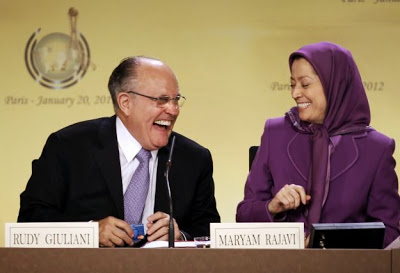
Rudy Giuliani with MEK leader Maryam Rajavi
(Photo Credit: Jacques Demarthon / AFP)
Embracing its recent removal from the U.S. State Department’s list of designated foreign terrorist organizations, the Mujahedeen-e Khalq (MEK), an exiled Iranian terror cult with deep pockets and close ties to the Washington establishment, is attempting to ramp up the fear-mongering and propaganda over Iran’s nuclear program following last month’s election of moderate cleric Hassan Rouhani as the Islamic Republic’s next president.
In April 2013, the group opened an office in Washington DC and officially registered as a lobbying organization the following month.
Now, a Reuters article from July 11, 2013 reported the MEK and its affiliate organizations such as the National Council of Resistance of Iran (NCRI) claim to have “obtained reliable information on a new and completely secret site designated for [Iran’s] nuclear project,” despite providing no credible evidence to back up the allegation.
The supposed site is said to be “located in a complex of tunnels beneath mountains 10 km (6 miles) east of the town of Damavand, itself about 50 km northeast of Tehran.” The MEK claimed that construction of the site began in 2006 and it was recently completed. “The site consists of four tunnels and has been constructed by a group of engineering and construction companies associated with the engineering arms of the Ministry of Defence and the IRGC (Iran’s elite Revolutionary Guards force),” a statement from the terror group said.
Unsurprisingly, the Iranian government immediately denied the allegations.
As in nearly all media reports on the MEK, Reuters credits the group with having “exposed Iran’s uranium enrichment facility at Natanz and a heavy water facility at Arak” in 2002. But beyond the fact that Iran’s nuclear program was never a secret, this specific claim is untrue, as nuclear experts Jeffrey Lewis and Mark Hibbs pointed out back in 2006.
In fact, the U.S. intelligence community had been tracking Iran’s nuclear facility development for quite some time, notably its construction at both Natanz and Arak. Lewis notes that, in 2002, “someone leaked that information to an Iranian dissident group, the National Council of Resistance of Iran (NCRI), which then released the second-hand dope in a press conference where they got the details wrong.” The information the MEK supposedly gleans from sources inside Iran are actually just leaks received from intelligence agencies in the United States and Israel.
Since then, the MEK has not itself provided a single shred of credible information regarding Iran’s nuclear program. Furthermore, in early 2007, an unnamed senior official at the International Atomic Energy Agency (IAEA) revealed to the Los Angeles Times, “Since 2002, pretty much all the intelligence that’s come to us [from the United States about the Iranian nuclear program] has proved to be wrong” and has never led to significant discoveries inside Iran.
“They gave us a paper with a list of sites. [The inspectors] did some follow-up, they went to some military sites, but there was no sign of [banned nuclear] activities,” the official told The Guardian at the time. Additionally, the LA Times reported that “U.S. officials privately acknowledge that much of their evidence on Iran’s nuclear plans and programs remains ambiguous, fragmented and difficult to prove.”
Additionally, the Associated Press reported this past May that, when it comes to accusations about the Iranian nuclear program and despite their terrible track record, “about 80 percent of the intelligence comes from the United States and its allies.”
Reuters, writing about the MEK’s most recent revelation, noted, “The group released satellite photographs of what it said was the site. But the images did not appear to constitute hard evidence to support the assertion that it was a planned nuclear facility.” Clearly, a non-state actor like the MEK doesn’t have satellites of its own floating around in space taking pictures of Iranian mountains; it’s obviously getting the information from government organizations with advanced spying resources.
Though these latest claims by the MEK have garnered quite a bit of attention this week, they are, in fact, nothing new. Allegations about tunnel systems have long been a go-to source of alarmism over Iran’s nuclear program. Back in January 2010, on the heels of promoting an opinion piece that explicitly advocated an unprovoked military attack on Iran, The New York Times‘ William Broad published a hysterical report, which claimed, “Over the past decade, Iran has quietly hidden an increasingly large part of its atomic complex in networks of tunnels and bunkers across the country.”
The report goes on to lament that Iranian efforts to protect their own nuclear infrastructure from military attack is viewed by the U.S. administration as “a stealth weapon, complicating the West’s military and geopolitical calculus.” Translation: it’s harder to spy on things and then blow them up when they’re not out in the open and that’s annoying.
Broad doesn’t even try to mask the frustration:
“It complicates your targeting,” said Richard L. Russell, a former Central Intelligence Agency analyst now at the National Defense University. “We’re used to facilities being above ground. Underground, it becomes literally a black hole. You can’t be sure what’s taking place.”
Even the Israelis concede that solid rock can render bombs useless. Late last month, the Israeli defense minister, Ehud Barak, told Parliament that the Qum plant was “located in bunkers that cannot be destroyed through a conventional attack.”
Despite the decades of threats from the United States and Israel, then-U.S. Defense Secretary Robert Gates didn’t realize the blistering irony when, discussing the heavily-fortified uranium enrichment site at Fordow, he said, “If they wanted it for peaceful purposes, there’s no reason to put it so deep underground, no reason to be deceptive about it, keep it a secret for a protracted period of time.”
Later in his report, Broad describes Iranian President Mahmoud Ahmadinejad as a tunnel aficionado and quotes Greg Duckworth, a “civilian scientist” described as having “recently led a Pentagon research effort to pinpoint enemy tunnels,” as saying, “Deeply buried targets have been a problem forever. And it’s getting worse.”
As the January 2010 report continues, a familiar name emerges under the heading “An Opposition Watchdog.” Who could that be? Broad writes, “In 2002, the National Council of Resistance of Iran, an opposition group, revealed that Iran was building a secret underground nuclear plant at Natanz that turned out to be for enriching uranium. Enrichment plants can make fuel for reactors or, with a little more effort, atom bombs.”
He goes on to sing the praises of NCRI for having announced “that Iran was digging tunnels for missile and atomic work at 14 sites” in 2005 and announcing “that Iran was tunneling in the mountains near Natanz, the sprawling enrichment site” in 2007, which he says was confirmed by satellite images.
In December 2009, Broad writes that NCRI issued yet another report on “Iranian military tunneling,” which claimed “Iran had dug tunnels and bunkers for research facilities, ammunition storage, military headquarters and command and control centers.”
“A group of factories” in the mountains east of Tehran, it insisted without providing proof, specialize in “the manufacturing of nuclear warheads.”
Broad even quotes the Los Alamos National Laboratory’s Frank Pabian saying of the MEK, “They’re right 90 percent of the time. That doesn’t mean they’re perfect, but 90 percent is a pretty good record.” Mohamed ElBaradei, former IAEA Director-General, had a different take on the group. “We followed whatever they came up with. And a lot of it was bogus.”
In his reporting, William Broad never once identifies the MEK or NCRI as an officially designated terrorist group, which at the time they both were and had been for over a decade.
To hammer home how deliberately alarmist the claims actually were, the Times even published the article with a photograph of a smiling Mahmoud Ahmadinejad and his entourage in red hardhats emerging from what is apparently supposed to resemble a steel-reinforced underground lair. Yet the photo is wholly unrelated to any of the allegations made within the report.
The caption beneath of the picture reads, “President Mahmoud Ahmadinejad of Iran, center, at a highway tunnel near Tehran. Much of Iran’s atomic work is also in tunnels.”
Yes, that really happened. Fit to print, indeed.
The focus on Iranian tunnels leads inevitably to discussion of American military capabilities and the challenges faced by less vulnerable facilities. Broad, in his 2010 report, noted that the “Pentagon is racing to develop a deadly tunnel weapon” for such circumstances. That weapon has since been completed and tested, but has not been sold to Israel for fear it might be used without American authorization.
Clearly, the MEK’s latest revelations are recycled claims and, like before, are essentially allegations based on vague intelligence leaked to the group by American officials. The MEK merely acts as a laundering service for the unproven accusations of its handlers in the United States and Israel.
Unfortunately, the mainstream press – even when skeptical about the information – continues to dutifully provide a platform for such propaganda and fear-mongering by publishing such accusations.
July 15, 2013
Posted by aletho |
Deception, Mainstream Media, Warmongering | International Atomic Energy Agency, Iran, Maryam Rajavi, MEK, Natanz, National Council of Resistance of Iran, People's Mujahedin of Iran, United States |
Leave a comment
(LONDON) – While the British government leads the charge to impose and tighten sanctions on Iran and makes other dire threats on the mere suspicion that the Islamic Republic may have nuclear weapons ambitions, its ministers continue to sidestep simple questions about Israel’s unsafeguarded nukes. Here is a recent example…
Written Answers — Foreign and Commonwealth Affairs: Israel (8 July 2013) http://www.publications.parliament.uk/pa/cm201314/cmhansrd/cm130708/text/130708w0002.htm#130708w0002.htm_wqn31
Bob Russell (Colchester, Liberal Democrat)
“To ask the Secretary of State for Foreign and Commonwealth Affairs what estimate he has made of the number of nuclear warheads possessed by Israel; and if he will make a statement.”
Alistair Burt (Parliamentary Under Secretary of State (Afghanistan/South Asia, counter terrorism/proliferation, North America, Middle East and North Africa), Foreign and Commonwealth Office)
“We have regular discussions with the Government of Israel on a wide range of nuclear-related issues. Israel has not declared a nuclear weapons programme. We encourage Israel to sign up to the non-proliferation treaty and call on them to agree a Comprehensive Safeguards Agreement with the International Atomic Energy Agency.”
Burt insults the intelligence of Parliament and the British public. So I have asked my MP Henry Bellingham to table another Parliamentary Question:
Dear Henry,
Mr Burt ducks the question. We all know that Israel is evasive about its nuclear weapons programme. Bob Russell asks for Her Majesty’s Government’s estimate of the number of nuclear warheads in Israel’s possession. We have an intelligence service, don’t we?
There can be no sensible discussion about Iran’s alleged nuclear weapons plans (and certainly no sabre-rattling or other silly threats) without factoring-in Israel’s already established nuke stockpile and delivery systems. Why is the Israeli situation so ‘unmentionable’? Let’s take the lid off, so this nation can have a good look and be aware of the stark facts. Would you please lodge a written question, requiring a written answer, asking the minister to respond properly and in detail to Sir Bob?
Many thanks.
Mr Bellingham is a member of Agent Cameron’s ‘Torah’ party and was recently axed from his junior minister post at the Foreign Office. Let us see if he is prepared to pursue the truth about Israel’s nukes and coax it into the public domain.
Of course, our Muslim friends should prod their own MPs to table similar questions.
July 14, 2013
Posted by aletho |
Deception, Ethnic Cleansing, Racism, Zionism, Timeless or most popular, Wars for Israel | Alistair Burt, Henry Bellingham, International Atomic Energy Agency, Israel, Middle East |
Leave a comment
MSNBC host Rachel Maddow has a penchant for saying smug, self-satisfied and generally stupid things about Iran. She has claimed that the Iranian Revolution in 1979 marked the establishment of a dictatorship in that country, rather than end of one; one that just so happened to be a monarchic dynasty that was proudly supported for decades by the United States government. Just two months ago, she weirdly decided to mock Iranians for their national and religious holidays because, y’know, she’s progressive like that.
Maddow was back at it this week, ending her nightly program on Monday with some juvenile comments about Friday’s presidential vote, when Iranians will elect Mahmoud Ahmadinejad’s successor. Here’s how she began:
The current president of Iran has had the job for the last eight years. Mahmoud Ahmadinejad, he’s known around the world for defending Iran’s pursuit of nuclear weapons.
It took her all of seven whole seconds to spit out that egregious falsehood.
First, Maddow’s premise is wrong. Iran is not pursuing nuclear weapons. Despite being the single most spied on country on the planet, U.S. intelligence consistently affirms that Iran has no nuclear weapons program and its leadership has not made any decision to start one. Iran has never breached its obligations as a signatory to the Nuclear Non-Proliferation Treaty. The vast majority of allegations about Iranian weaponization research and testing has been provided by the United States and Israel, has never been authenticated, and refers to long-debunked claims about supposed actions that took place over a decade ago.
Iran does have, however, a highly-developed nuclear energy program and enriches uranium to levels far below weapons-grade under strict supervision and routine inspection by the International Atomic Energy Agency (IAEA). The agency has continued to verify – up to four times a year over the past ten years – that Iran has never diverted any nuclear material for military purposes and has also affirmed “it has all the means it needs to make sure that does not happen with Iran’s enriched uranium, including cameras, physical inspections and seals on certain materials and components.”
Furthermore, despite the constant mainstream perception that Iran’s nuclear facilities are opaque and mysterious, the fact is that the IAEA has conducted more inspections in Iran than anywhere else.
Former Iranian nuclear negotiator Seyed Hossein Mousavian, now a lecturer at Princeton University, has noted, “Since 2003, the International Atomic Energy Agency (IAEA) has implemented the most robust inspections in its history with more than 100 unannounced and over 4000 man-day inspections in Iran.”
Just last year alone, IAEA investigators spent 1,356 calendar days in Iran, conducting 215 on-site inspections of the country’s 16 declared nuclear facilities, and spending more than 12% of the agency’s entire $127.8 million budget on intrusively monitoring the Iranian program, which fields only a single functional nuclear reactor, which doesn’t even operate at full capacity.
By contrast, IAEA inspectors spent only “180 calendar days in France, Europe’s biggest nuclear power,” while “Russia and the U.S., which maintain the world’s biggest atomic-weapon arsenals and aren’t required under rules to allow inspections of all facilities, received 16 and 50 calendar-day visits respectively.”
But Maddow’s ignorance was even more pronounced when she claimed that Ahmadinejad is known for “defending” a program that doesn’t exist.
Never once, in the 34 years since the revolution, has a single government official stated Iran’s intention to acquire nuclear weapons – to the contrary, such a goal has always been explicitly denied on strategic, legal, moral, humanitarian and religious grounds.
Ahmadinejad himself has never strayed from this stance. In September 2005, shortly after his first inauguration, the Iranian president stood before the United Nations General Assembly and reaffirmed the Islamic Republic’s “previously and repeatedly declared position that, in accordance with our religious principles, pursuit of nuclear weapons is prohibited.”
The following year, he stated clearly, “Nuclear weapons have no place in Iran’s defense doctrine and Iran is not a threat to any country.” Indeed, over the past eight years, Ahmadinejad has lambasted the development and stockpiling of nuclear weapons as “inhuman,” “against the whole grain of humanity,” “obsolete,” “abhorrent,” “disgusting and shameful.” Ahmadinejad has said, “The nuclear bomb is the worst inhumane weapon,” described it as “evil,” and declared anyone who builds an atomic bomb as “crazy and insane,” as well as “politically…backward.”
Nevertheless, American officials and their ventriloquist media puppets like Rachel Maddow continue to claim that Iran is actively pursuing the development of nuclear arms. On June 9, the New York Times stated that one of the most pressing issues for Samantha Power, Obama’s nominee to replace Susan Rice as U.S. Ambassador to the United Nations, will be to confront “Iran’s apparent attempts to develop a nuclear weapon.”
The very same day, in an interview with the American overseas propaganda outfit, Radio Free Europe/Radio Liberty (RFE/RL), U.S. Undersecretary of State for Political Affairs Wendy Sherman expressed, “from a U.S. perspective,” the belief that “Iran’s nuclear program… is headed towards having a nuclear weapon.”
Apparently, the “U.S. perspective,” noted by Sherman doesn’t rely on facts or evidence.
Some officials, however, choose their words more carefully than others. During testimony before Congress on June 11, General Martin Dempsey, Chairman of the Joint Chiefs of Staff, said, “Iran is a threat to US national security in many ways, not simply their move toward the potential to develop a nuclear weapon,” adding, “I choose my words carefully, because the intelligence community has not yet come to a conclusion that they intend to build a nuclear weapon.”
Yet Maddow’s own declaration was even more definitive, echoing, of all things, the words of George W. Bush. In March 2008, Bush, while speaking on RFE/RL’s Persian-language counterpart, Radio Farda, stated that the Iranian government have “declared they want to have a nuclear weapon to destroy people — some in the Middle East.”
This statement was so devoid of truth that even former State Department Iran specialist Suzanne Maloney was moved to speak out. Maloney, a fellow at the Brookings Institution’s Saban Center, noted at the time, “The Iranian government is on the record across the board as saying it does not want a nuclear weapon,” adding that while, in her opinion, “there’s plenty of room for skepticism about these assertions…it’s troubling for the administration to indicate that Iran is explicitly embracing the program as a means of destroying another country.”
Joe Cirincione, president of the Ploughshares Fund, a non-proliferation group, also chimed in to correct the record. Calling Bush’s statement “uninformed,” he explained, “Iran has never said it wanted a nuclear weapon for any reason. It’s just not true. It’s a little troubling that the president and the leading Republican candidate are both so wrong about Iran.”
It is indisputable that Iranian officials have consistently denounced the acquisition, stockpiling, and use of nuclear weapons.
Former National Security Adviser Zbigniew Brzezinski made this point in 2009, stating that Iran has been “publicly affirming for quite some time” three main points: “We don’t want nuclear weapons. We’re not seeking nuclear weapons. Our religion forbids us to have nuclear weapons.”
Brzeneski added, “Note, incidentally, that this stands in sharp, explicit contrast with the position of the North Koreans. The North Koreans have been saying the very opposite: ‘We want nuclear weapons. We’re seeking nuclear weapons. And, in your face, haha!, we have nuclear weapons.'” Brzenzinski also condemned the American penchant for “oversimplification and sloganeering rather than analysis” with regards to Iran.
Early this year, Greg Thielmann, a senior fellow at the Arms Control Association, similarly affirmed that the “leadership in Tehran continues to challenge the rationale and morality of nuclear weapons. Although such policy statements are hardly determinative of actual intentions, they do stand in stark contrast to the declaratory policies of other governments of proliferation concern, such as North Korea or Pakistan.”
Unsurprisingly, the rest of Maddow’s segment, solely designed to make fun of Iran for some reason, was rife with worn out stereotypes and mainstream talking points. Even the minutiae of her snide derision were weird. Referring to the current heated presidential race as “amazeballs” – because, y’know, she’s a professional journalist – Maddow found it ridiculous that the three presidential debates, broadcast live on Iranian television, each exceeded four hours. Four hours!, she scoffed. Of course, American debates between only two candidates last roughly two hours. Iran had eight candidates. Quadruple the contenders, double the time. How absolutely insane.
Also, towards the end of her bit, Maddow claimed that Ahmadinejad was recently in a helicopter crash, when – based on the article her own staff shows onscreen – it was an emergency landing due to unspecified technical problems. The article itself states clearly that “the pilot managed to land the aircraft safely.”
Still, Maddow repeats the word “crash” four times in less than thirty seconds and speculates that the reason the helicopter landed hastily was due to foul play. Her evidence? The media put the word “accident” in between quotation marks when reporting on the story. Here’s how she put it, using her most ironic voice:
“The media reports on the Ahmadinejad helicopter crash put air-quotes around the word accident, as in ‘President Ahmadinejad just survived a helicopter crash. It’s reported to have been an accident, nudge nudge, wink wink, yeah right’.”
Ok, first, print media can’t put “air-quotes” around anything, Rachel. They’re actual quotes.
Second, the reason the media put the word accident in quotes is because… wait for it… the reports were quoting from the primary source of the news. And what was that primary source that called the incident an accident? Iranian president Mahmoud Ahmadinejad’s official website.
But, for Maddow and her inept interns, “The media apparently thinks he was set up.” No, the media stated the emergency landing was due to an “accident,” because that’s what the president’s press release said.
But when it comes to Iran, the liberal media darling Maddow is no different than the neoconservative editors of the Washington Post. Facts are irrelevant and propaganda prevails.
June 17, 2013
Posted by aletho |
Deception, Mainstream Media, Warmongering, Timeless or most popular | IAEA, International Atomic Energy Agency, Iran, Iranian Revolution, Mahmoud Ahmadinejad, Rachel Maddow, United States |
Leave a comment
“Tehran has developed technical expertise in a number of areas – including uranium enrichment, nuclear reactors, and ballistic missiles – from which it could draw if it decided to build missile-deliverable nuclear weapons,” reads Director of National Intelligence James R. Clapper’s April 2013 report to the Senate Committee on Armed Services.
Then comes the statement usually ignored by mass media: “We do not know if Iran will eventually decide to build nuclear weapons.”
The fact that Iran is not producing a nuclear bomb – nay, hasn’t even decided if it wants to – has not deterred the US government from slapping the Islamic Republic with the most punishing unilateral sanctions in history.
While the Iranian economy struggles to adjust to periodic US sanctions “upgrades,” a significantly devalued currency and restrictions in global financial transactions have suddenly challenged even Iran’s famed adaptability to these kinds of externally-imposed pressures.
But something is awry. There is no implosion in Iran. How is that possible with off-the-chart hikes in the price of basic goods, unaffordable housing in congested urban areas, increased youth unemployment? Instead, Iranians who love nothing better than to complain about government and economy, have grumpily rallied against these foreign efforts to pit population against state.
According to results of a Gallup poll in February, 85 percent of Iranians claim sanctions have hurt their livelihood either “a great deal” or “somewhat.” But 70 percent of those polled blame external parties (the US, western European countries, Israel, and the UN) for this suffering; remarkably, only 10 percent blame their government and their leaders. Instead of sanctions forcing a change in Iran’s calculation about pursuing nuclear enrichment – which is a stated US goal – 65 percent of Iranians favor a continuation of the country’s nuclear power capabilities.
As former head of the International Atomic Energy Agency (IAEA) Mohamed El Baradei astutely observed before leaving his 11-year post: “The line was, ‘Iran will buckle under pressure.’ But this issue has become so ingrained in the Iranian soul as a matter of national pride. They talk about their nuclear program as if they had gone to the moon.”
Instead of changing tack and identifying novel ways to gain favor with Iran’s population while pressuring their leaders, the US administration went off the rails last week and upped the sanctions ante – targeting for the first time Iran’s rial currency and its auto industry, a large source of domestic jobs.
No – there can no longer be any mistake about what that means. Washington isn’t trying to change Iran’s “calculations” about “its nuclear program.” It is trying to break Iran’s back.
“Let Them Try”
“US power and reach is in decline,” says Alaeddin Boroujerdi, who heads the Majlis’ (parliament) foreign affairs and national security committees, and cheerily expects to out-maneuver, out-last, and out-smart the Americans.
As with all decision makers in Iran, any discussion of US sanctions gets you a slow smile and a political lesson.
“The new realities in Iran don’t seem to be apparent to the US after 33 years. They’re still focused on regime change, sanctions, cyber war, military operations. The result of this strategy has been to the US detriment (financially draining) and to our advantage,” explains Boroujerdi.
In this period, “Iran gained incredible technology. The US didn’t want us to have nuclear capability – and we have done so from the basics to where we are now in a peaceful nuclear program. They tried to restrict our knowledge and our development. In these three decades we obtained advanced technologies ourselves – building and launching satellites, developing nanotechnology from scratch, developing a domestic arsenal of weapons,” he continued.
“We used Iranian brainpower, our youth; we have attained the unattainable – we changed the process. How many other countries could have done this?”
That’s the crux of it. David vs Goliath. The nimble, determined developing nation upstart facing down the global bully and a crumbling Empire. That image can inspire passion here in Iran – which may explain some of those earlier Gallup numbers and the upward tick in polling data for presidential candidates who talk tough on negotiations with the US.
In short, many Iranians feel the US and other Western nations want to stunt their independence, development, and scientific progress – keeping the country “backward and needy;” a dumping ground for stale Western products and services in exchange for the petrodollars of a one-commodity economy.
“Nuclear” Saves Lives in Iran
I visit a University of Tehran campus that houses the first nuclear medicine center in the country. This is the teaching nexus from which most of the nation’s nuclear medicine specialists graduate. It is a relatively new specialty – a few decades old – but already there are 130 nuclear medicine centers around Iran and an equal number of specialized doctors.
“Nuclear medicine is a real peaceful use of nuclear energy,” explains Dr. Mohsen Saghari who heads the center and is also the president of the Iranian Society of Nuclear Medicine. “We basically use radioactive materials for diagnostics and therapeutic purposes – we do all the treatments and scans (bone, heart, liver, spleen, renal, breast, thyroid, lungs) at this facility.”
As I quickly learned, nuclear medicine is several things: For the purpose of diagnostics, when administered into the body these radiopharmaceuticals can “image” disease at the cellular level, thereby detecting illness earlier than via x-ray, CT-Scans or MRIs, for instance, which rely on the visible manifestation of disease for detection to be possible.
It is like radiology from the inside – instead of the external radiation passing through your body to capture an image from an x-ray, in nuclear medicine, external cameras capture images from the radiation emitted by a radiopharmaceutical administered into a patient.
Nuclear medicine is also used for the purpose of therapeutic treatment. These are specialized drugs that emit short distances of radiation thereby reducing undesirable side effects.
At the center that day, I saw maybe 20 patients and family members in a seating area awaiting a scan or outpatient treatment, mostly for thyroid cancers and hyperthyroidism, according to the medical professional who took me on a tour.
“Most of the procedures we do here are complementary, but in a few cases, they are the only procedures and nothing else can substitute them,” says Saghari. “But because of sanctions we have problems. If we want radioactive materials or equipment, they won’t sell them to us.”
So Iran decided to make its own.
Most of his center’s radioactive materials are produced by the Atomic Energy Organization of Iran, which fuels up those nuclear reactors that make people in Washington and Tel Aviv all wobbly-kneed and shrill.
Saghari showed me a sealed vial – or “cold kit” – that contained a few pinches of a powdered substance. Iran makes that part of the drug too because the newer US (unilateral) sanctions have made it hard for Iranians to trade in Western currencies and transact through most banks. The vial remains sealed until radioactive material is injected into it – which then makes it an active radiopharmaceutical used in diagnostics and treatment.
As my notes recall, 90 percent of these diagnostic procedures require a synthetically-produced chemical element called Technetium, which is produced at Iran’s nuclear plants via a process using 20 percent enriched uranium and then extracted from the nuclear rod fuels to create the necessary medical isotopes.
Says Saghari, “Even in the black market, the importation of chemotherapies and high-tech medications have largely stopped with the latest rounds of sanctions.”
So Iran relies on its own nuclear power plants to fill in – and eventually altogether replace – imports. “Sometimes we get shortages, at the present time they can produce.”
Not a lot of countries produce radiopharmeceuticals. Saghari named just Canada, the US, England, France, Russia and China. Like others leading the charge toward self-sufficiency in Iran, he anticipates that one day Iran will be producing competitive, lower-cost radiopharmeceuticals for export.
“Each week we see 20 to 24 new thyroid cancer patients – last month I had 94 inpatients, 876 diagnostic scans performed and 700 outpatients for thyroid illnesses,” he says, flicking through some administrative papers to try to give me an accurate count. “Every year in Iran about one million people get referred for diagnostic and therapeutic procedures.”
“So of course we are going to make it ourselves,” insists Saghari.
Baa, Baa, Cloned Sheep
A 2010 Canadian report on the “geo-political shift in knowledge creation” claims scientific output has grown 11 times faster in Iran than the global average – faster than in any other country in the world. I recall reading this tidbit three years ago and wondering how that could be right. In previous trips to Iran, I couldn’t say that I ever noted visible signs of ‘unusual progress.’
I don’t think most Iranians think much about this either. Discussing my interviews with friends and acquaintances during my visit, most seemed surprised, even shocked that this much development was going on under their noses. The Iranian government, good or bad, suffers acutely from an inability to communicate its value propositions to the wider population. Which really, quite frankly, cripples it when faced with the well-oiled spin-machines of hostile Western and Arab states seeking to vilify the Islamic Republic.
Every Iranian has an opinion on the country’s nuclear energy program for the simple reason that this is the one ‘development project’ they all know about…so rarely is it out of the international headlines.
This kind of hyper-scientific growth is essential, says Dr. Hamid Gourabi, president of the Royan Institute, a leader in stem cell and reproductive biomedicine in Iran: “Scientific progress can make countries independent – and apply pressure on others.”
If you think his message has political undertones, you are right. It is something I hear in all my meetings. “After the revolution, we decided instead of being dependent on oil, we should diversify into sciences and other areas.”
Royan, a quasi-governmental institute, was established to solve a basic problem: young Iranian couples with fertility problems were having to travel outside the country and spend large sums of money to conceive. The organization started with very basic fertility treatments in 1991 and two years later the first in vitro fertilization (IVF) child was born in Tehran. With a 40 percent success rate, the institute now does more than 4,000 cycles every year – in Europe there are less than ten clinics that perform more than 1,000.
Royan was playing catch-up with some of its early endeavors. In 2006 it cloned its first sheep, followed by two transgenic kid goats called Shangool and Mangool (named after popular children’s characters in Iran), and then by calves – each using slightly different biotechnologies.
Gourabi’s institute is not ultimately interested in replicating other’s successes though – it wants to forge its own way. He tells me about some important thinking that went on in Iran during the presidency of Mohammad Khatami from 1997-2005: “We wanted to expand in sciences, technologies – Khatami didn’t think Iran could advance ‘car-making’ for example – we wanted to go into areas where Iran can bring leadership.” But, he says, ultimately, “the scientific community is the main impetus behind this – they push the government.” Then he adds with a twinkle that Iran’s Supreme Leader “Khamenei has a huge interest in science.”
Since then Royan has branched out in all sorts of directions. Stem cell research is today the most advanced part of what the group does, and Iran, according to Gourabi, is now only the 8th nation in the world to produce scientific output on stem cells.
He also confirms that “sanctions have been a key motivator” for the rush to development. “One of the products we need cost us a million dollars to import. Now we produce it ourselves, it costs us very little. Iran sells biotech to other countries – we offer a lower cost than most companies.”
Gourabi, whose institute has been denied laser technology-based products by the US’ restrictive sanctions regime, says with some confidence: “We will end up producing these drugs for ourselves, so pirating and patent-busting becomes prolific. And they (the West) lose a good market for their products.”
He’s not worried about isolation either: “Sanctions do affect our work – time is important in science and sanctions cause delays – but we are contributing in a big way to the global scientific community now, and this collaboration helps us.”
Nanotechnology 101
A decade ago, Iranian decision makers and scientists were trying to solve a large problem: “In less than 100 years, we will run out of all these oil resources. How do we have an economy then?”
The prevalent thinking was that Iran needed to develop sectors that would help it create a “knowledge-based economy” where it could establish itself as a global leader. The country had underperformed on IT and biotech, so it took its time in studying the potential of nanotechnology. Three years later it decided to plunge in.
“Our mission was to be among the top 15 countries in the world in all rings of the ‘value chain’ – all the way from developing the human resources to commercialization and wealth creation,” say Dr. Seyed Mehdi Rezayat and Dr. Ali Beitollahi, senior officials at The Iran Nanotechnology Initiative Council (INIC).
“Today, more than 14,000 are engaged in Iran’s nanotech industry – a decade ago you couldn’t count the number of people on two hands who understood what it meant,” laughs Beitollahi.
The data starts flowing. In the past five years, Iran has registered 95 patents for nanotechnology products and processes. Dozens of Iranian universities have been corralled into creating graduate and doctoral programs in advanced nanotech. Because of sanctions and embargos, Iranians are making sophisticated machinery that they otherwise would have bought. Twenty five Iranian companies have now commercialized nano equipment because nobody would sell it to them.
In a short time, the Islamic Republic has become one of only six nations involved in nanotech standardization – all others are Western countries (US, UK, Canada, Germany) with the exception of Japan.
The applications in nanotech are broad. From eco-efficiencies like coating glass that keeps heat out, to strengthening building materials in earthquake prone areas, to creating cancer drugs to water filtration and desalinization.
“In high-tech you can get much more advanced benefit than from commercial technologies,” says Rezaiat. “Every kilogram of cement is just a few cents. The main cost of things is knowledge and technology, so why should a country like Iran stick to cement?”
“We learned a lot of lessons from our previous lack of achievement,” he reflects, adding, “We used to buy turnkey projects and we didn’t even know what was inside.” Now, says Rezaiat, “Nano has become a model for the country. We started from scratch – we will look, learn about everything.”
Why Washington Fears Iran?
A rigorous report published last week on Iran sanctions by the Congressional Research Service (CRS) says the following:
“There is a growing body of opinion and Iranian assertions that indicates that Iran, through actions of the government and the private sector, is mitigating the economic effect of sanctions. Some argue that Iran might even benefit from sanctions over the long term by being compelled to diversify its economy and reduce dependence on oil revenues. Iran’s 2013-2014 budget relies far less on oil exports than have previous budgets, and its exports of minerals, cement, urea fertilizer, and other agricultural and basic industrial goods are increasing substantially.”
A year ago I wrote an article titled “How Iran Changed the World.” In it I warn that continued economic pressures on Iran will produce the unintended consequence of undermining Western hegemony very decisively.
The US, after all, is aggressively challenging the Islamic Republic at a time when the entire Western financial and economic order is teetering on the brink of collapse, with no apparent safety net in sight.
Iran is an extremely resourceful country of 78 million people, a huge export market for any nation keen to bolster its treasuries, and has major strategically valuable commodities – oil and gas – that people are keen to buy.
The tighter the sanctions, the more likely that Iran and its trading partners will seek innovative ways around them. In effect, by putting the screws on this important country (Iran is today the head of the 118-nation Non-Aligned Movement and increasingly protected by the emerging BRICS economies), the US is encouraging the development of alternative financial and economic practices that will fundamentally undermine – perhaps even destroy – its own global order.
Every global power throughout history has ended its reign at the hands of an adversary, whether on the battlefield or in a grand power play that goes wrong. What Washington rightfully fears is that its three-decade-long tussle with the Islamic Republic is unwinnable – which is nothing short of defeat for the world’s last superpower.
Unable to get off its current trajectory of escalation, the US continues to seek new, illogical, increasingly indefensible ways to squeeze Iran’s population. But the fact is that sanctions simply don’t work: Iran is not going to stop its nuclear enrichment. Iranians aren’t going to eject their government.
This will not end well for the US. Iran…I’m not so worried about.
This is the second in a two-part series on my 2012 research trips to Iran to discover what makes the Islamic Republic so resilient in the face of Western economic and political pressures. You can read Part 1, “Why Arabs Need Iran” here.
Sharmine Narwani is a commentary writer and political analyst covering the Middle East. You can follow Sharmine on twitter @snarwani.
June 12, 2013
Posted by aletho |
Economics, Timeless or most popular | Atomic Energy Organization of Iran, International Atomic Energy Agency, Iran, Israel, United States |
Leave a comment
By once again blowing the chance to close a nuclear deal with Iran, the U.S. and its western partners have set themselves up for escalating the conflict with the Islamic republic
The most recent round of nuclear talks between the P5+1 were, by any meaningful measure, a failure. Even as she sought to put the best face possible on the non-outcome in Almaty, Kazakhstan last month, European Union Foreign Policy Chief Catherine Ashton had to acknowledge that western members of the P5+1 and Iran “remain far apart on substance.”
Western officials blame the failure either on the Islamic Republic’s upcoming presidential election or on that old fallback, Iranian “intransigence.” In reality, talks failed because America and its western partners remain unwilling to recognise Iran’s right to enrich uranium under international safeguards.
U.S. strategic culture
As a sovereign state, Iran is entitled to enrich, if it chooses; as a party to the Nuclear Non-Proliferation Treaty (NPT), it is entitled to do so under safeguards. The NPT explicitly recognises signatories’ “inalienable right” to use nuclear technology for peaceful purposes. That this inalienable right includes the right to enrich is clear from the NPT itself, its negotiating history, and decades of state practice, with at least a dozen non-weapons state parties having developed safeguarded fuel-cycle infrastructures potentially able to support weapons programmes.
If Washington recognised Iran’s right to enrich, a nuclear deal with Tehran could be reached in a matter of weeks. As long as Washington refuses to acknowledge Tehran’s nuclear rights, no substantial agreement will be possible.
Yet the Obama administration is no closer than its processor to accepting safeguarded enrichment in Iran. This is partly due to pressure from various allies — Israel, Saudi Arabia, Britain, France — and their American supporters, who expect Washington somehow to defy legal principle along with political reality and compel Tehran to surrender its indigenous fuel-cycle capabilities.
But the real reason for U.S. obstinacy is that recognising Iran’s nuclear rights would mean accepting the Islamic Republic as a legitimate entity representing legitimate national interests. No American administration since the Iranian Revolution — not even that of Barack Hussein Obama — has been willing to do this.
Washington’s unwillingness is grounded in some unattractive, but fundamental, aspects of American strategic culture: difficulty in coming to terms with independent power centres (whether globally or in vital regions like the Middle East); hostility to non-liberal states, unless they subordinate their foreign policies to U.S. preferences (as Egypt did under Sadat and Mubarak); and an unreflective but deeply rooted sense that U.S.-backed norms, legal rules, and transnational decision-making processes are meant to constrain others, not America itself.
Because these attitudes are so fundamental, it is unlikely that Obama will invest the political capital required to bring America’s Iran policy in line with strategic reality before his presidency ends. And so the controversy over Iran’s nuclear activities will grind on.
Earlier years
The world has experienced such diplomatic stasis before. In 2003-2005, Britain, France, and Germany worked (ostensibly) to prepare a nuclear settlement with Tehran; Iran suspended enrichment for nearly two years to encourage diplomatic progress. The initiative failed because the George W. Bush administration refused to join the talks unless Tehran was willing to abandon pursuit of indigenous fuel-cycle capabilities.
In 2009-2010, efforts to negotiate the exchange of most of Iran’s then-stockpile of enriched uranium for fuel for the Tehran Research Reactor collapsed for similar reasons. In the May 2010 Tehran Declaration brokered by Brazil and Turkey, Iran accepted all of Washington’s terms for a fuel swap, yet the Obama administration rejected the Declaration because it openly recognised Iran’s right to enrich. Three years later, the administration is once again undermining chances for diplomatic success with its inflexibility regarding Iran’s nuclear rights.
The world has also seen what happens when America and its European partners demonstrate such bad faith in nuclear diplomacy with Tehran — Iran expands its nuclear infrastructure and capabilities. When Iran broke its nearly two-year suspension of enrichment in 2005, it could run less than a thousand centrifuges; today, it has installed 12,000 centrifuges, more than 9,000 of which process uranium gas to produce enriched uranium. In February 2010, Iran began enriching uranium to the near-20 per cent level needed to fuel the Tehran Research Reactor (TRR) after the U.S. and its partners refused to sell the fuel; Iran consistently offered to suspend near-20 per cent enrichment if it could obtain an adequate fuel supply for the TRR. After the Obama administration torpedoed the Tehran Declaration, Iran accelerated its production of near-20 per cent uranium and began indigenously manufacturing fuel plates for the TRR.
With America and its European partners once again blowing an opening to accept Tehran’s nuclear rights and close a nuclear deal, we are likely to see another surge of expansion in Iran’s nuclear infrastructure. Certainly, Iran will continue enriching, at the three to four per cent level needed for power reactors and at the near-20 per cent level needed for the TRR, and installing more efficient second-generation centrifuges. Iran also appears to be on track to commission a heavy water reactor at Arak next year.
Although the International Atomic Energy Agency (IAEA) consistently certifies that no nuclear materials have been diverted from Iran’s safeguarded nuclear facilities, all of these steps will be cited by Israel, the pro-Israel lobby in Washington, and other constituencies in the U.S. hankering for military action as evidence that time for diplomacy with Tehran has run out. Additionally, it is possible that the Islamic Republic will find legitimate reasons to begin enriching above the 20 per cent level. While such higher-level enrichment would be done under IAEA safeguards, this would also be interpreted in the U.S. and Israel as provocative Iranian “escalation.”
Pressure on Obama
Obama would prefer to avoid another U.S.-initiated war in the Middle East. But his unwillingness to revive America’s deteriorating regional position through serious nuclear diplomacy with Tehran will increase pressure on him to order U.S. military strikes on Iranian nuclear facilities before the end of his presidency.
Rather than openly abandon the delusion of U.S. hegemony in the Middle East, Obama will try to placate more hawkish elements by escalating America’s ongoing “dirty war” against the Islamic Republic — including economic warfare against civilians, threatening secondary sanctions against third countries in violation of U.S. WTO commitments, cyber-attacks, and support for groups doing things inside Iran that Washington elsewhere condemns as “terrorism,” stoking sectarian tensions, and fuelling further violence in Syria to prevent Tehran from “winning” there. But that, too, will only further destabilise the Middle East and bring American and Iran ever closer to the brink of overt confrontation.
Flynt Leverett and Hillary Mann Leverett are authors of Going to Tehran: Why the United States Must Come to Terms with the Islamic Republic of Iran, New York: Metropolitan, 2013. They teach international relations, he at Penn State, she at American University.
May 12, 2013
Posted by aletho |
Progressive Hypocrite, Timeless or most popular, Wars for Israel | Flynt Leverett, International Atomic Energy Agency, Iran, Israel, Middle East, Nuclear Non-Proliferation Treaty, United States |
Leave a comment
It could take 30 to 40 years to fully decommission the devastated Fukushima nuclear plant due to complexity of the task, UN nuclear watchdog IAEA has reported. However, the plant’s infrastructure may not last that long.
An International Atomic Energy Agency (IAEA) inspection last week of the ruined Tokyo Electric Power Company (TEPCO) Fukushima Daiichi nuclear power plant in Okuma has exposed certain bottlenecks in the plan to clean up the nuclear disaster. A statement by the IAEA released Monday criticized TEPCO’s progress on the cleanup.
Experts of the IAEA Division of Nuclear Fuel Cycle and Waste Technology believe that a chain of equipment failures of the plant’s essential systems that took place over the last few weeks could become a serious problem in the future. The IAEA called on to TEPCO to maintain plant’s equipment properly to avoid potentially hazardous situations, especially disconnections of the cooling systems of the shutoff reactors and fuel storage pools.
“As for the duration of the decommissioning project, it will be nearly impossible to ensure the time for decommissioning such a complex facility in less than 30 to 40 years as it is currently established in the roadmap,” said Juan Carlos Lentijo, the IAEA’s Director of the Division of Nuclear Fuel Cycle and Waste Technology (NEFW).
The IAEA statement stressed that Japan must still develop technology and equipment to locate and remove melted uranium fuel, given the harsh conditions and strong radiation levels at the Fukushima facility.
Fukushima saw a chain of incidents over the last five weeks, at least three of which were caused by rats that damaged wires in critically important electrical equipment. And on Monday, TEPCO personnel conducted an emergency shutdown of the cooling system of one of the fuel storage pools after two dead rats were found inside a transformer box.
Lentijo, who headed the IAEA delegation to Fukushima, explained that water management is “probably the most challenging” task for the plant at the moment.
Another issue was the multiple leakages of radioactive water from storage tanks and cooling systems, which are not only further contaminating the area around the plant, but may also be expelling radioactive pollution deep underground, where it could pollute underground water tables.
Earlier, TEPCO reported that a steady inflow of groundwater in the basements of the damaged reactor buildings resulted in about 400 tons of contaminated water daily. With the Fukushima nuclear plant’s storage tanks already housing 280,000 tons of liquid radioactive waste, this means the amount of contaminated water would double within just a few years.
Lentijo urged TEPCO to “implement additional countermeasures to regain confidence.” IAEA experts also noted that TEPCO needs to step up protections against “external hazards” similar to the Tohoku earthquake and tsunami that followed it, which devastated the plant on March11, 2011. “It is important to have a very good capability to identify as promptly as possible failures and to establish compensatory measures,” he said.
“You have to adopt a very cautious position to ensure that you always are working on the safe side,” Lentijo added.
A final report by the 12-member IAEA delegation to Fukushima is expected to be published in May.
April 24, 2013
Posted by aletho |
Nuclear Power, Timeless or most popular | Fukushima, Fukushima Daiichi Nuclear Power Plant, IAEA, International Atomic Energy Agency, Tokyo Electric Power Company |
Leave a comment
The New York Times (4/7/13) reports that progress on the Iran nuclear negotiations appears rather bleak. But the piece, by David Herszenhorn, passes off a key fact as if it were a mere Iranian claim.
The article presents one take from Iran’s top negotiator, Saeed Jalili–along with a curt response from the U.S.:
“Of course, there is some distance in the position of the two sides,” Mr. Jalili said. But he said Iran’s proposals, which required recognizing “our right to enrich and ending behaviors which have every indication of enmity toward the Iranian people,” were designed “to help us move toward a constructive road.”
A senior American official called Iran’s demands unreasonable and “disproportionate.”
The piece elaborates:
Western countries fear that Iran is trying to develop nuclear weapons, while Iran has insisted that its program is for peaceful purposes, including atomic energy and medical research, to which it claims a right as a signer of the Nuclear Nonproliferation Treaty.
We’re accustomed to “Iran says X, the West says Y” in Iran coverage. But despite the evident confidence of the U.S., there is still no evidence that Iran is actually pursuing a weapons program.
But what of this idea that Iran “claims” a right to enrich uranium? That is, as Steve Rendall wrote for Extra! (9/05), a fact:
Under the NPT, non-nuclear-weapons countries agree not to pursue or possess nuclear weapons, while nuclear-armed countries agree to pursue disarmament and to share nuclear energy technology with the non-nuclear countries. (See Extra!, 7-8/05.) Under the agreement, non-nuclear-weapons states may develop nuclear programs, enrich uranium, etc., as long the programs are for non-military purposes and they are disclosed to the IAEA.
Another fact about the NPT that goes mostly unmentioned is that it calls on countries that possess nuclear weapons “to facilitate the cessation of the manufacture of nuclear weapons, the liquidation of all their existing stockpiles, and the elimination from national arsenals of nuclear weapons and the means of their delivery.”
But to the New York Times, Iran’s appeals to the treaty are “claims,” which can be challenged by anonymous U.S. officials (the “official, who spoke on the condition of anonymity,” which has become the State Department’s standard practice at the talks).
And while we’re on the subject of Iran, here’s a pretty revealing exchange from ABC‘s This Week (4/7/13)
GEORGE STEPHANOPOULOS: The nuclear talks with Iran basically failed again. And you have to believe Iran is watching this as well, and says, ‘He’s got nuclear weapons, he has a stronger hand.’
MARTHA RADDATZ: Not only watching it, but I think there’s cooperation between North Korea and Iran. In fact, that’s something else General Thurman and other U.S. officials have told me.
STEPHANOPOULOS: What kind of cooperation?
RADDATZ: Cooperation on a nuclear program. Certainly North Korea wants money. And Iran wants nukes.
Huh. Anything else U.S. officials want you to share with the public, absent even a shred of skepticism?
April 9, 2013
Posted by aletho |
Deception, Mainstream Media, Warmongering, Timeless or most popular | GEORGE STEPHANOPOULOS, International Atomic Energy Agency, Iran, New York Times, North Korea, NPT, Saeed Jalili, United States |
Leave a comment
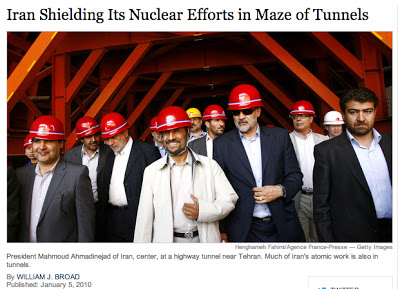

 Aletho News
 Aletho News