18 year old shepherd shot by Israeli soldiers in Jordan Valley
29 April 2012 | International Solidarity Movement, West Bank
Last Thursday 18 year old shepherd Yasir Sulaiman Sal man Najadah was shot in the chest by Israeli soldiers taking part in military training exercises near the Tyraseer training zone.
If one walks towards the Bedouin community of Wadi al-Maleh in the Jordan Valley, they will see one of the 67 blocks of concrete placed by Israeli military in the area, the words “Danger – Firing Zone – Entrance Forbidden” audaciously inscribed.
The village is only a few hundred meters away from an Israeli military base, and the villagers of Wadi al-Maleh are frequently endangered as Israeli soldiers carry out military training. In the past year, the village has lost two young men, both killed whilst shepherding as they inadvertently triggered unexploded ordnance.
“I was standing in the field with 19 camels,” said Yasir. According to Yasir, army jeeps typically comb the area to alert herders before shooting exercises begin however on April 19th, no warnings were issued before the firing of live ammunition began. Yasir was shot at a distance of approximately 1 to 1.5 kilometers, and he believes that the soldiers saw him before shooting.
He did not see the soldiers and only became aware of their presence after the shooting began; he believes they were behind a nearby hill. After the bullet entered his chest, Yasir walked to his home where he was then driven to the training base by his father for medical attention.
Israeli soldiers refused to treat him and denied fault in the shooting. It was nearly two hours before Yasir received medical treatment in Rafadia Hospital in Nablus. Yasir spent 1 day in Rafadia Hospital and was then transferred to a hospital in Ramallah.
According to his doctor, Yasir is in stable condition but remains in the Palestinian Authority hospital ICU after the shooting.
Yasir is the eldest of eight children and left school after the 10th grade to tend to the family’s heard of camels and sheep which is the main source of income for his family. He says his father is too old to take care of the animals and is concerned that no one is tending to them while he is in the hospital. Despite being shot, Yasir says he must return to the area surrounding the Tyraseer training zone for grazing because it is the only spring-time grazing near his village.
Aref Dyragma chief of council in Wadi al-Maleh, was one of the first persons to be informed about the attack. As Dyragma shows us around al-Maleh, he described how the Bedouins are exposed to systematic violence.
“Life is like hell here”, he said. “We have no running water, no electricity and we are prohibited from building anything. Israel has taken control of all the natural water resources, which forces us to walk 15 kilometers to the city of Tamoun, where we can buy expensive water.”
The violence used against Palestinians in the Jordan Valley is part of process of ethnic cleansing. 130 families from the area have received demolition and evacuation orders – but Dyragma ensures that they will stay.
“We have no other choice – this our land and we cannot leave.”
Related articles
- Palestinian teen shot during Israeli military training (alethonews.wordpress.com)
- Israeli soldiers assault cycling group in Jordan Valley (alethonews.wordpress.com)
- Jordan Valley Resident Forcibly Removed from Home (altahrir.wordpress.com)
- IOF planning eviction of Palestinian inhabitants in Jordan Valley (occupiedpalestine.wordpress.com)
Yitzhar settlers attack school children in Urif
29 April 2012 | International Solidarity Movement, West Bank
Urif is a Palestinian town in the Nablus Governorate of the northern occupied West Bank, located thirteen kilometres South of Nablus. The town has a population of just under 3000 inhabitants and is overlooked by the illegal Israeli colony of Yitzhar. Last week on Sunday, April 22, Urif’s boys school was attacked by mask-wearing settlers supported by four Israeli Occupation Force (IOF) soldiers who used tear-gas, sound bombs, and live ammunition against unarmed Palestinian children.

The training of armed, illegal settlers (Photo courtesy of IMEMC)
The settlers were led by the head of security for the Yitzhar colony, a man suspected in the murder of a resident of Urif in 2004, a murder that nobody has yet been charged with. He continues to lead brutal assaults against the civilian population of six Palestinian towns in the lands surrounding Yitzhar: Burin, Huwara, Madma, Assria Al-Kalibya, Ein Nabous, and Urif.
The attack began when the Yitzhar head of security and a number of masked settlers approached the school from an overlooking hill. “The children were sitting their mock exams,” said Arif, a member of the local popular committee, “the settlers used foul language and began throwing stones at the windows of the school.”
The settlers were soon joined by four uniformed IOF soldiers who did nothing to stop the abuse and stones hurled towards the school.
“When the army came they were supposed to stop the settlers coming to the school, in fact the opposite happened, there was chaos,” said Arif. A number of Palestinian youth approached the armed Israeli settlers and soldiers on the hill, using stones to resist the attack. The IOF soldiers then threw tear gas canisters down towards them and the school. One canister landed on the roof where a member of the Israeli human rights group B’tselem, Adil Safadi, was filming the attack.
Following the attack teachers from the school collected sixty tear gas canisters, a number of sound grenades, and at least thirty rounds of live ammunition fired directly over their heads.
In the video of the incident wherein International Solidarity Movement (ISM) volunteers are shown, the screams of the children and the loud report of an assault rifle being fired in fully automatic mode can clearly be heard. At one point an IOF soldier took aim with his M16 directly at a Palestinian youth out of camera shot. The sustained assault lasted for around an hour before the settlers decided to leave with their IOF minders in tow.
Whilst some children hid in their classrooms during the attack under the watchful eye of their teachers, many rushed to their homes and were exposed to large amounts of tear-gas and required medical attention. The children of Urif’s boys school, aged between 13 and 18, have been subjected to this kind of brutality on a regular basis since the founding of the school which sits on the outskirts of the village and is thus vulnerable to these kind of attacks. Many of the older kids that attend the school were in the process of studying for their year final examinations which take place in early May.
“You can’t imagine the loss we have suffered as a result of this settlement,” says Arif, “we would like to live in peace and prosperity, but that is something we cannot gain. The settlers are very aggressive, there is no word in the dictionary to describe them.”
This is not the first time the settlers, supported by the military, have attacked the school. Roughly one year ago they attempted and failed to burn it down. ISM was shown pictures depicting the charred remains of one classroom that was severely damaged during the attack.
Incursions from Yitzhar into Urif and Surrounding Villages
Arif and members of Urif municipality informed ISM of the following.
The illegal colony of Yitzhar was founded in 1984. It was not until the beginning of 2000 that it began to aggressively expand into the surrounding Palestinian lands. Yitzhar illegally annexed vast swaths of land and barred access to the Palestinian farmers, shepherds, and villagers that have lived and worked the land for countless generations.
The village of Urif is a mere 1500 meters away from the Israeli colony, and since 2000, over 2200 dunams have been stolen by the nearby settlement. In addition, four thousand olive trees cultivated by the village have been uprooted or burnt by settlers in the past four years.
The villagers of Urif have no access to running water, instead they rely on a small number of ancient wells. Two years ago, members of the village were dismayed to find tear gas canisters had been dropped into one of the wells by unknown settlers, poisoning the water supply.
Any attempt to expand infrastructure in the village is also met with settler attacks. ISM volunteers were shown the remains of a house that had been under construction before it was attacked and completely dismantled.
“Late at night they launch attacks on the residents in this area,” said Arif, pointing to the rubble strewn skeleton of the destroyed house. A tractor and a number of cars belonging to residents of the village had also been destroyed in a series of recent arson attacks.
Settlers have shot through the windows of a number of the homes. Graffiti reading ‘revenge’ in Hebrew was scrawled across one residents house. The widespread attacks of agricultural land has lead to a vast “wasteland” between the outskirts of Urif and Yitzhar. Hundreds of goats, sheep, and a few horses have been stolen.
This is not to mention the violence towards the villagers themselves. Arif reports that hundreds of villagers have been injured since 2000, with as many as 40 serious injuries (many of which were gunshot wounds) and one murder.
The combined effects of this systematic assault on Urif residents’ way of life, economy, and civil society is akin to a form of ethnic cleansing. One of the most stark indicators of the impact of the measures taken against the village of Urif by Yitzhar settlement is that unemployment is as high as 40%. Many people simply cannot survive under these conditions and are thus forced to abandon the village of their birth, leaving behind their friends, family, and identity.
Related articles
- Jewish settlers attack village, block Nablus road (alethonews.wordpress.com)
- Impunity Under the Law: Settler attack in Jabari neighborhood (alethonews.wordpress.com)
- Israeli settlers injure three Palestinians, uproot dozens of olive trees in two separate incidents (alethonews.wordpress.com)
- Palestinian man Fadi Zaitoun killed in a chase by extremist settlers (altahrir.wordpress.com)
- International activists assaulted by extreme settlers in Al Khalil (alethonews.wordpress.com)
The right to water: Water cistern demolitions in Hebron area
23 April 2012 | International Solidarity Movement, West Bank

On Monday April 23, 2012, the Israeli occupation forces destroyed four water cisterns outside of the city of al-Khalil (Hebron). Two of the destroyed cisterns were located in the Abweire area, a small agricultural neighborhood of 400-500 residents northeast of al-Khalil. The other two cisterns destroyed were located in Hal-Houl, south of al-Khalil. The demolitions came just one week after another four cisterns were destroyed in the Meshroona area south of al-Khalil.
Palestinians in these areas, who are located in Area C, are forced to depend on rain water cisterns for their crops and livestock because of unequal distribution of water resources to surrounding illegal, Zionist settlements. The destruction of such cisterns is part of a calculated strategy of forced displacement and ethnic cleansing in occupied Palestine. According to the Israeli organization Diakonia, water cistern demolitions over the past two years have directly affected almost 14,000 Palestinians, among whom several hundred have been forced to leave their homes because of lack of water. International law forbids the targeting of structures essential for the survival of the civilian population.
The day after their water cistern was demolished, activists with ISM visited members of the Ashfour family in Abweire in order to talk and survey the damage. The occupation forces did not stop with removing the top of the cistern, but actually smashed the sidewalls, rendering the structure totally useless. The occupation forces came without warning in four jeeps, an armored personnel carrier, an armored bulldozer, and another armored earth-wrecking machine, along with personnel from the Israeli permits and construction offices. They claimed that the cistern was constructed illegally, without the necessary permits, and began to destroy the cistern.

Within an hour the Ashfour family’s hopes for irrigating their crops lay in ruins. According to Hisham Ashfour, the cistern had been built almost ten years ago and served not only his family but about fifty people in his neighborhood. The other cistern destroyed in Abweire was also rendered completely unusable, having been filled in with dirt by an Israeli bulldozer.
Related articles
- International activists assaulted by extreme settlers in Al Khalil (alethonews.wordpress.com)
- Israeli occupation authority destroys Spanish-financed power station in Al-Khalil village (alethonews.wordpress.com)
- Israeli Brutality: Violent arrests of Palestinians in Hebron and disappearance of Dutch volunteer (alethonews.wordpress.com)
- Settler Violence: Broken Glass on Shuhada Street (alethonews.wordpress.com)
- Israeli demolition ‘displaces 120′ in Hebron village (alethonews.wordpress.com)
- Impunity Under the Law: Settler attack in Jabari neighborhood (alethonews.wordpress.com)
- Under Attack – the Golani Brigade’s war on the Palestinian population of Al-Khalil/Hebron (alethonews.wordpress.com)
Impunity Under the Law: Settler attack in Jabari neighborhood
22 April 2012 | International Solidarity Movement, West Bank
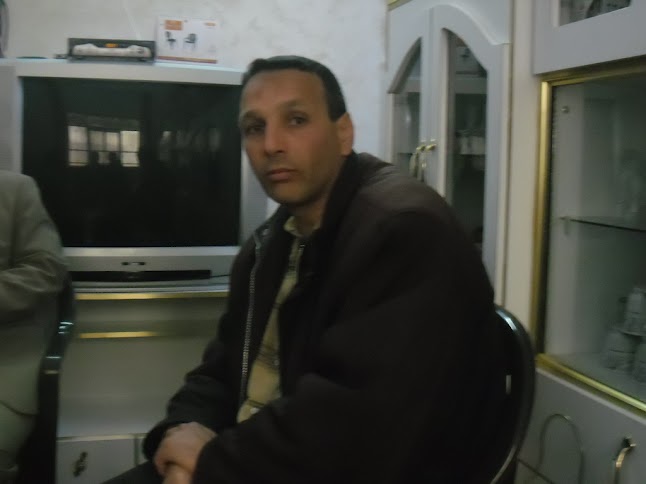 Marwan Borqan always locks the main door to his house at night. Late at night, soldiers will often knock at his door, ‘checking,’ they say, although Marwan has never known what they are checking for.
That is why he did not find it unusual when he heard a loud banging at his front door at 10:30pm on Wednesday night. However, this time it was not the Israeli army but an Israeli settler from the nearby illegal settlement of Givat Ha’avot. As soon as Marwan opened the door he was violently punched and kicked by the settler, who then dragged him out the door.
Outside the beating continued, causing Marwan to fall down a flight of stairs as other settlers, the settlement security guard, and Marwan’s shocked children looked on.
Finally, two police cars arrived and with the help of Marwan’s brothers, detained the attacker.
At this point, Marwan’s father arrived to find that Marwan had lost consciousness. He called an ambulance and was forced to wait forty-five minutes as the ambulance was detained at the metal gate restricting Palestinian vehicular access to their own street.
Marwan’s father demanded that the Israeli army commander arrest the settler who had attacked his son, only to have soldiers threateningly point their guns at his head and tell him to ‘shut up’. At a point during the night, the army released the settler who was responsible for the attack. They later claimed they did not arrest him because they could not find him.
While awaiting the ambulance’s arrival, the Israeli army evacuated the entire building where Marwan lived. Forty-five people, including many children,were forced to wait on the street while the army searched the victim’s house.
An Israeli police jeep then arrived carrying a settler who claimed rocks were thrown at her by a Palestinian earlier that day. The girl scanned the families lined up on the street and admitted that none of them had thrown rocks at her.
After Marwan was taken to the hospital, settlers attempted to occupy his apartment but were later escorted from the building by the Israeli army.
Commonly, following an accusation by a settler, all Palestinians are perceived as guilty by both the illegal settler communities and the Israeli army. Revenge may have been the reason behind the Israeli army raiding a house or the savage beating of a Palestinian by an Israeli settler.
Nonetheless, raids and attacks also take place in lieu of any accusations. Above all, the violence is arbitrary and systematic. The reason is always the same: to make life for Palestinians so difficult that they will be forced to leave. Those who refuse will continue to pay the price.
For Marwan Borqan the price for him and his family has been very high. He suffers from a concussion, and many bodily injuries, and was forced to wait while Israeli soldiers detained the ambulance attempting to reach him.
Marwan explained that he was “shocked” by the beating. His family regularly suffers from settler and soldier harassment, but it was “the first time the settlers actually tried to enter the house.”
His children were up late watching a football match with him when the attacker arrived, and to their horror witnessed his brutal beating. Marwan’s eight year old daughter, Afnan, is still traumatized by what she saw. Marwan explains that she shakes and has difficulty eating. He intends to find psychological help for her.
The Borqan house lies near to the illegal Israeli settlements of Qiryat Arba and Givat Ha’avot in Western Hebron, an area which experiences repeated torment from extremist settlers. Qiryat Arba was one of the first settlements established in the West Bank by members of the far right Kach party and Givat Ha’vot began as a police station which was occupied by settlers in 1990. Both settlements are in violation of Article 49 of the Fourth Geneva convention, prohibiting the transfer of the occupying power’s civilians into the occupied territory. The illegality has been repeatedly confirmed by the International Court of Justice, the High Contracting Parties to the Fourth Geneva Convention and the United Nations Security Council.
Related articles
- Israeli Soldiers Invade Homes In Hebron, Jewish Settlers Attack Young Man (alethonews.wordpress.com)
- Israeli settlers injure three Palestinians, uproot dozens of olive trees in two separate incidents (alethonews.wordpress.com)
- Israeli settlers storm into Palestinian home, occupy residence (alethonews.wordpress.com)
- Knesset to discuss bill authorising settlers’ seizure of Palestinian land (alethonews.wordpress.com)
- Hebron teen ‘shot by Israeli settler’ (alethonews.wordpress.com)
- Kufr ad-Dik and Burqin march against boars, pollution, and violence by Israelis (alethonews.wordpress.com)
Fadi Abu Zeitoun, killed as settlers attacked farmers
By Rana H. – International Solidarity Movement – April 9, 2012
Israeli settlers attacked and chased a group of Palestinian farmers last Thursday, causing a tractor to flip over during the chase, causing the death of the Palestinian driver.
On Thursday, April 5th, armed settlers from the illegal Israeli colony of Itamar attacked a group of Palestinians en-masse. In haste and in fear for his life, twenty-eight year old Fadi Abu Zeitoun’s tractor tipped and crushed him as he fled from the pursuing settlers.
The villagers who own olive groves near Itamar rarely get “permission” from the Israeli District Coordination Office to access their own land. During the harvest season, they are permitted a few days, but in the spring when the land needs to be tended they have more difficulty acquiring permission. During this spring harvest, the villages of Hawarta, Yanoun, Aqraba, and Beita were told they had only four hours to access their land. The area to be tended is approximately 1000 dunums so the villagers collected forty tractors to work as much land as possible in the shortest possible time. Israeli activists from the movement Peace Now, and a group of international activists were present in solidarity. Prime Minister Salam Fayad joined them to make a statement re-affirming their right to utilize the stolen land that they were standing upon.
During the Prime-minister’s visit, Israeli authorities were positioned nearby and prevented the settlers from passing. However, shortly after Fayad left the area, Israeli soldiers permitted a mob of settlers to converge upon the Palestinian farmers tending to their land. They began by throwing stones, causing the group to separate and begin descending the hill. The settlers then proceeded to fire M-16 assault rifles in the direction of the unarmed farmers before releasing dogs. In the ensuing chaos, and as Fadi desperately attempted to escape, his tractor flipped over and fell on him, mortally wounding the young man.
Palestinians witnessing the incident ran back towards the scene to offer assistance. The settlers promptly dispersed as they rushed him down the hill to the road, unfortunately he was already dead.
Fadi is of the village of Beita . With a population of only 12,000, this death resonates among all the residents. As Fadi’s father-in-law, Isam Bani Shams says, “This is not our first martyr nor our last, we have been in this situation for sixty-four years. Our village has lost some seventy martyrs.”
On the same date, twenty-four years ago, two men from the village of Beita were also murdered by settlers from Itamar.
In the gathering following the funeral, Fadi’s father, Sleman Abu Zeitoun, sat with his head down. Beside him sat three other men who have had a son murdered by Israeli soldiers or settlers.
Fadi was newly married to nineteen year-old Fida’ Bani Shams who is left widowed and six months pregnant. Her brother was killed at the age of sixteen by Israeli soldiers during the second intifada, and as her father says, “She has lost a brother and a husband so what can I say of her emotions? She is in grief. She is exhausted.” Fida’ sat slouched in a corner of the room, her eyes closed and blankets covering her feet.
Fadi’s sister has had a nervous breakdown since the death of her brother. She does not recognize her husband or her daughters. Their mother, Mona Fihmeh says, “in terms of how I feel, I have patience, but my back has been broken from the burden.” Mona spent last night praying over her feverish body, and today she sent her daughter to the hospital. Her husband was on the way back from a funeral in Jordan when the accident occurred. He returned to Beita to find that his son had been killed.
Throughout the funeral, political talk arose about the various results of Israeli occupation and apartheid on Palestine. At first, the unemployment rate among Palestinians does not seem relevant to the death of Fadi Abu Zeitoun, but one soon realizes that Israel’s apartheid policies are to blame for both the impunity with which settlers are treated, and the numerous other negative consequences on livelihood.
The United Nations Office for the Coordination of Humanitarian Affairs (OCHA) in the occupied Palestinian territory reported that over 90% of complaints regarding settler violence filed by Palestinians to the Israeli police in recent years have been closed without indictment. OCHA’s report on settler violence notes that “the root cause of the settler violence phenomenon is Israel’s decades-long policy of illegally facilitating the settling of its citizens inside occupied Palestinian territory. This activity has resulted in the progressive takeover of Palestinian land, resources and transportation routes and has created two separate systems of rights and privileges, favouring Israeli citizens at the expense of the over 2.5 million Palestinian residents of the West Bank. Recent official efforts to retroactively legalize settler takeover of privately-owned Palestinian land actively promotes a culture of impunity that contributes to continued violence.”
Rana H. is a volunteer with International Solidarity Movement.
Related articles
- Palestinian man Fadi Zaitoun killed in a chase by extremist settlers (altahrir.wordpress.com)
- Hebron teen ‘shot by Israeli settler’ (alethonews.wordpress.com)
- Jewish settlers attack Palestinian farmer and his children (alethonews.wordpress.com)
- Jewish settlers stealing Palestinian water springs: UN (alethonews.wordpress.com)
- Qaryut: 8 year old injured by bomb planted by Israelis (alethonews.wordpress.com)
- Settlers ‘block entrance’ to Nablus village (alethonews.wordpress.com)
- Settlers Attack Internationals Accompanying School Children on Shuhada Street (alethonews.wordpress.com)
Amani al Khandaqja released following hunger strike
6 April 2012 | International Solidarity Movement, West Bank

Amani al Khandaqja with her father, pose following her release
“You are a very clever woman Amani, you are the first free woman from Ashkalan, this brings me great frustration.”
These are the words of the Chief of Intelligence at Huwarra Camp where Amani al Khandaqja was forced to go during her first Sunday of freedom after her 10 days of imprisonment. On the 20th of March, al Khandaqja was taken from her home, Nablus City, in a 2AM night raid, shackled, handcuffed and blindfolded, her 10 days of imprisonment were as follows:
On entering the Ashkelon interrogation prison, al Khandaqja made the decision to begin an open ended hunger strike, bringing her to the immediate decision of the military to be held in solitary confinement. Her days started with fierce determination to show that she is not and will not be intimidated by the interrogators or the prison.
When taken for the routine strip search, al Khandaqja simply but vehemently refused anything of the sort. She spent her days in a room too small for any comfort, the light was on day and night, and food was used as a constant temptation out of her hunger strike.
The military used low, pathetic tactics including sitting her in front of a table with chicken, burgers, chips and rice. On refusal of the food soldiers asked al Khandaqja , “Why do you not like food?” al Khandaqja was quick to reassure them that she is in fact very fond of food but she “like [her] mother’s food, [her] sisters’ food, even [her] brother’s food, but [she] will not eat [their] food.”
Tactics quickly became even more personal by offering Amani an opportunity to see her brother Bassam. Bassam is a political prisoner in Ashkelon’s mixed sex prison, who is 9 years into his life sentence. The terms of the negotiation were to stop the hunger strike for a short visit. The negotiation was rejected by al Khandaqja.
As the days and nights passed and interrogation continued, the military became weaker and weaker. “All they had to say was that I was too active on Facebook.” Amani explained how the interrogator informed her, “I know your words have power” but this simply was not enough to keep Amani captured.
The Israeli military often offers monetary rewards for those it convinces to become collaborators against the Palestinian people, and with Amani the offers came thick and fast. Having studied psychology at university, and one who has traveled to Europe working with women groups in campaigns addressing issues such as domestic violence, she is a woman who is not easily scared or intimidated. This was evident to the Israeli military.
It is true that al Khandaqja is a threat to Israel’s apartheid, but not because of their usual rhetoric of her being a “violent Palestinian,” but because Amani is a clever, determined, educated, and passionate young woman who, it seems, will stop at nothing in her struggle for human rights. When asked if and when she will return back to work, Amani replied “I am always working. I will not stop. I write everyday about the conditions of the prisoners. I am only writing for peace, and I do not want to see anymore violence”
Amani, who is from Nablus City was releasd at Turkoomia checkpoint in Al Khalil (Hebron), 77 kilometer from Nablus. She was left with no phone or money. Fortunately she was able track down her father and have a car sent to her, not before visiting friends in Al Khalil as word had gotten out about her release. That night, the 30th March, Amani returned home split with emotion. The prospect of seeing her family filled her with happiness but to have left her brother Bassam and personal friend Masser Halabi behind brought an overwhelming sadness, a sadness that is sure to inspire and motivate Amani to continue the struggle with more passion and determination than ever before.
Related articles
- Israeli Brutality: Violent arrests of Palestinians in Hebron and disappearance of Dutch volunteer (alethonews.wordpress.com)
- Thirty Palestinians killed by Israel in March, 300 imprisoned (alethonews.wordpress.com)
Qaryut: 8 year old injured by bomb planted by Israelis
2 April 2012 | International Solidarity Movement, West Bank

Yemams father did not have time to respond to his son before the bomb exploded. Ripping through three layers of clothes and even more layers of skin, his father had to watch the tragedy unfold before his eyes. Yemam Mohammad Fatah Azam is just eight years old. He was enjoying a Friday afternoon with his father in the olive groves.
Situated between the illegal Israeli settlements of Shilo, Eli, and Suvat Rachel, Qaryut is not new to military and settler violence. Yamam’s story however is the first incident of its kind and has shaken the community. As floods of school children come to visit Yamam in his home, it is clear that all the parents are aware that the bomb could have been in their loved one’s hands. The children show they are upset with a handshake and sit next to Yamam in silence.
Bashar, a member of the Popular Commitee explains that the planting of un-exploded ordinance (UXO) ”… is an act to intimidate us from going to our land.”
Efforts by violent Zionist settlers have been well underway to intimidate farmers from visiting their land, and recently the village has joined the popular resistance with a Friday demonstration in protest of the closure of their road by Israeli military. The road runs through the land in which many farmers reside. One farmer explained, “It brings us much comfort to have cars passing through the road, we know if anything was to happen a car would stop and support us.”
As Yamam lays in bed, not able to move much due to the wound constantly re-opening, causing pain beyond comprehension, four more bombs lay on the land near by. This case has reached The United Nations group, OCHA, who has reported this in their “Protection of Civilians Weekly Report, 21-27 March 2012.” The Palestinian Authority is also addressing the issue as well. Both have been informed of the bombs which still reside on the land of the farmers, but have not been able to make the area safe. Due to the olive groves being in Area C, the Palestinian Authority has no permission to enter the land.
Related articles
- Kufr ad-Dik and Burqin march against boars, pollution, and violence by Israelis (alethonews.wordpress.com)
Idhna: A family without windows
12 March 2012 | International Solidarity Movement, West Bank
After three years of marriage Amani and Hussein Batran wanted a house of their own, somewhere to raise their two children, 4 year old Khalil and 3 year old Layali. They took out two loans from the bank and construction began. Now, three years later, the house is still unfinished and no new work has been done for over a year. One year ago, shortly after the Batran family moved into their nearly finished house, they received an order from the Israeli military forbidding further construction, followed seven months later by a demolition order. The reason given is that their house blocks the view of a camera mounted on the illegal segregation wall Israel has constructed inside of the West Bank.
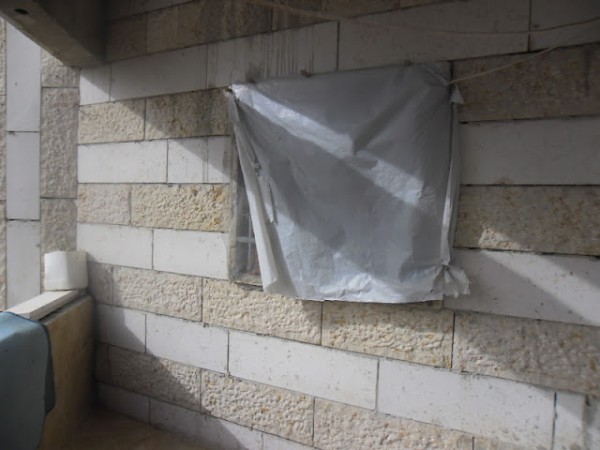
The sight of glass-less windows and wires protruding from half-sanded walls speaks of dreams put on hold, a family living in limbo. The Batrani family has endured the bitter cold of this Palestinian winter with only plastic sheets covering their windows. The Israeli government considers installing glass a violation of the order to halt construction. Violating the order means risking imminent demolition of their home, so the family must make do with the inadequate plastic sheets.
They know their fate will likely be the same as Ahmed Jeyowi and his family, whether or not they obey the order to halt construction. Jeyowi’s home was demolished last month when around 50 Israeli soldiers stormed the house at 6 AM whilst Ahmed was drinking tea and preparing to work his land. The soldiers forced Ahmed’s wife and six children from their beds and gave the family no time to salvage their possessions before they demolished their home.
Ahmed has since been forced to send his wife and children to live with other family members whilst he lives on the ruined site which once was his home, now replaced by a tent provided by the Red Cross. Ahmed is left with no heating or lighting, no gas, no toilet, and insufficient bedding.
Idna has suffered considerably since the Israeli occupation, particularly due to the construction of the segregation wall and the theft of some 3,000 dunums of land since the second Intifada. Idhna is surrounded by the Israeli settlements of Adora and Telem to the northeast, a bypass road that runs through the northern parts of the town, and the segregation wall that borders Idna to the north and the west. There are currently 40 homes in Idna with demolition orders.
Related articles
- Israeli demolition ‘displaces 120′ in Hebron village (alethonews.wordpress.com)
- Homes Destroyed, Lives Shattered: Criminal Displacement in Occupied Palestine (alethonews.wordpress.com)
- How about an Israeli destruction freeze? (altahrir.wordpress.com)
- UN Committee Demands Israel Stops House Demolitions Forthwith (alethonews.wordpress.com)
International activists assaulted by extreme settlers in Al Khalil
March 9, 2012 | International Solidarity Movement, West Bank
2 international activists were assaulted late this morning by extreme Zionist setters in Al Khalil (Hebron). A female activist was assaulted by a male settler, after being punched in the face and having her camera stolen by this male settler.
Today’s attack comes following weeks of warning and aggression towards photojournalists and activists with cameras by Israeli military and police, which have stated to internationals that Israeli law forbids the photography of their operations, or rather, their breach of international law and human rights.
Activists have received these warnings for weeks now, and today’s attack comes parallel to the deliberate targeting by Israeli military of journalists and activists with cameras, by shooting tear gas canisters and bullets directly at them at most West Bank demonstrations.
About a month ago, Reporters without Borders published this statement regarding these warnings and threats.
While today’s attack is an escalation against internationals in the region, and while it is evident that the Israeli military and illegal settlers are collaborating in attacking Palestinians and internationals, International Solidarity Movement will not desist from bringing proof of Israeli aggression through pictures, videos, and our continued reporting.
We thank the international solidarity community for its continued support in the face of Israeli Zionism, colonialism, discrimination, and militarization of Palestine.
Related articles
- International Solidarity Movement volunteers encounter settler attack and sexual harassment in Hebron (alethonews.wordpress.com)
- Settler Violence: Broken Glass on Shuhada Street (alethonews.wordpress.com)
- The massacre of 1929 and the War of Narratives (alethonews.wordpress.com)
- Demanding justice for Yousef, a quiet boy killed by Israeli settlers (alethonews.wordpress.com)
- Extremist settlers hurl concrete blocks at Hebron’s Old Market (alethonews.wordpress.com)
Kufr ad-Dik and Burqin march against boars, pollution, and violence by Israelis
International Solidarity Movement, West Bank | 3 February 2012
Burqin and Kufr Ad-Dik face daily obstructions in justice as nearby illegal Zionist settlements encroach on the livelihood of local Palestinians. The villages are surrounded by several hilltop illegal settlements and industrial sites with polluting factories and an army base.
“This is a microcosm of Palestinian suffering” stated a resident upon the arrival of International Solidarity Movement volunteers.
Burqin and Kufr Ad-Dik are under siege by settlers and soldiers. The villages are situated in Areas B and C as stipulated by the Oslo Agreement and sit dangerously close to the 1948 Green Line. Burqin has approximately 4000 residents which include many refugees from Al Nakba, or the Catastrophe, known to Palestinians when they faced exile from their villages in 1948 at the creation of Israel.

Kufr ad-Dik face to face with their oppressor
The village relies on small scale agriculture for its existence. The Israelis from the illegal settlements know this and routinely destroy Palestinian crops often by burning olive trees as part of the extremist “Price Tag Campaign.” They have also released wild boars from their settlements which eat Palestinian crops and are very dangerous, especially to the young of the villages. In an act of callousness the settlers destroyed a newly bought piece of farm machinery about two weeks ago. During this attack they also burned a car and unsuccessfully firebombed the local mosque, leaving threatening graffiti that they will be back.
While a local place of worship, graffiti, and vandalism seem like small offenses, one must keep in mind that these are systematically done to pressure the villages into abandoning what is left of their homes.
As with many of the Palestinian villages who have suffered the injustice of having their lands stolen by Israel in order to build illegal settlements, which continue to expand, Burqin and Kufr Ad-Dik are forced to endure regular attacks from the illegal occupants of their land as well as harassment by the Israeli military. The settlers, soldiers and Israeli government, which is benefiting from and funding the existence of these illegal settlements work cooperatively to forcibly remove Palestinians from their land.
There is an industrial estate, situated on top of a hill, which houses several severely polluting factories. These factories could not gain a license to be constructed inside of Israel due to the pollution that will be created, but they were granted permission by the Israeli government to be built within the West Bank illegally under international law. The waste from these factories is channeled in an open sewer through the villages.
Since the factories began polluting there has been a sharp rise in health problems within the village including an anomaly in cancer cases. A German charity volunteered to pay for the sewer to be covered and managed.
Permission to build this cover was flatly denied by the Israelis. The pollution from the factories has severely affected the surrounding land causing trees to die, crops to fail, and the meat from animals grazed on the land cannot be sold due to fear of contamination.
According to an article published by the Baheth Center for Strategic and Palestinian Studies, information on the size and power of these factories is not available to local Palestinians. In an article published by the Baheth center, they describe the extent of the factory waste:
The waste water and solid waste these industries produce, provide important clues about the type and extent of industrial activity… Clear evidence that Israeli factories operating in the Occupied Territories do not follow pollution prevention measures is provided by the Barqan industrial zone, which houses factories producing aluminum, fiberglass, plastic, electroplating, and military items. Industrial waste water from this zone flows untreated to the nearby valley, damaging agricultural land belonging to the Palestinian villages of Sarta, Kufr Al-Deek, and Burqin, and polluting the groundwater with heavy metals.
Unemployment is now very high in the villages since much of the land has been taken by settlers and the military. To add insult to the pollution inflicted on the villages, the Palestinians are banned from working the factories surrounding them. With more land being taken away every day, unemployment and poverty continue to rise. Yesterday an army order was issued to take another 60 dunums (1000m squared = 1 dunum) for “military purposes.” Farmers are now collating deeds to their lands in an attempt to argue their case in court.
Burqin has lost over 8000 dunums to the illegal occupation, most of which was stolen in the last 10 years. The land theft is sharply on the increase. The farm land that is left is still extremely dangerous to farm due to settler attacks and the threat of wild boars.
Not satisfied with attacking the food production, the Israelis have destroyed several wells, which are vital to the well-being of the villagers. The illegal settlers have commandeered most of the water supply leaving the Palestinians with critically low access to clean water. A recent study found that the average settler uses 18 times that of one Palestinian villager.
In addition to the destruction of wells several homes have been demolished including a home that the owner worked for 30 years to save enough to build.
Leaving or reentering the villages is high risk as settlers will often throw rocks at Palestinian cars. If the villagers successfully run the gauntlet they then have to pass through harassing Israeli Army checkpoints.
The villages have just started a weekly protest against their oppression in Kufr Ad-Dik. This was met last week with tear gas and steel bullets thinly coated with rubber leaving 10 villagers wounded.
The protest will continue every Friday.
Related articles
- West Bank village steps up protests against Israel’s theft of land (alethonews.wordpress.com)
- 13 injured in Nabi Saleh demonstration (alethonews.wordpress.com)
- Anata falls victim to militarized, illegal settlement once again (alethonews.wordpress.com)
Israel losing the PR battle
By Yousef M. Aljamal | Centre for Political and Development Studies | 30 January 2012

Huwaida Arraf - image via Wikipedia
For the third week in a row, the Centre for Political and Development Studies (CPDS), a Gaza-based think tank, held a video link to explore issues related to the Palestinian cause, with the presence of Palestinian and international activists. Huwaida Arraf, the co-founder of the International Solidarity Movement, chair of the Free Gaza Movement, and a prominent Palestinian-American activist, talked to Gaza activists about “The Palestine solidarity movement: Countering Zionist propaganda globally.”
Choosing discourse to communicate with others is one of the basic requirements to get one’s voice heard. Zionists have mastered this, while Palestinians have been misrepresented in the West. Ironically, Palestine’s just story isn’t getting out. “Through the years we have not done a very good job of conveying our plight, and that’s largely because telling our story was left to our ‘official spokespeople’ who didn’t know how to communicate well with the western media”, said Arraf. “On the other side, Israel depends largely on PR, a fundamental part of its strategy. One of the biggest propaganda projects is The Israel Project. Its annual budget for last year alone was eleven million dollars. This is not counting the official support of the Israeli government, companies, and AIPAC”.
“Israel is losing the PR battle for various reasons: law and justice are on our side, there is an increasing awareness among Palestinians, the growth of alternative media like Facebook and Twitter, and, I believe, the effect of the International Solidarity Movement”, Arraf continued.
The second Palestinian Intifada, which was characterized by Israel’s aggression against Palestinian civilians and the role of the media in covering it, pushed Arraf, with the help of other colleagues, to found ISM. It grew to include 8,000 activists, who have worked hard to expose Israel’s grievous and vivid violations of human rights in Occupied Palestine.
“One of the reasons we founded ISM was because we noticed what was happening in terms of Israel’s massive use of violence”, said Arraf. “The media was not portraying the truth of what was happening. We realised that the Palestinian civil society, and Palestinians as a whole, especially after Oslo, needed a resource to be able to stand up and confront what Israel is doing”.
ISM turned out to be something practical, not merely a plan on paper. Its first campaign included 50 people. Since then, over 8,000 activists have actively worked on the ground to help the Palestinian people.
“The first campaign started in August, 2001”, said Arraf. “Fifty people came. We started another campaign. We tried to say the conflict is not about a religion against another. It’s about freedom versus occupation. It’s not Muslims against Jews. We wanted the mass media to know this. ISM aimed at forming advocacy groups and helping the Palestinian people sustain their struggle and get their stories heard”.
Palestinians share values with all other nations, based on tolerance, understanding, and working together for the good of humankind.
“Once, I organised a meeting between a Palestinian farmer from Bodrous village in the West Bank, named Ayed Murra, and a Vermont senator on Capitol Hill”, said Arraf. “We talked about how the wall affects farmers in the West Bank. We spent an hour talking to the senator, who lives in an area full of farmers”.
Israel tries to tell the world that the entire Palestinian movement is Hamas. They play on an anti-Islamic atmosphere in the West. This clearly distorts history and the facts on the grounds.
“Hamas was founded in 1987” said Arraf. “What about the ethnic cleansing in 1948 and 1967? Op-eds and articles were written on Hamas accepting a truce with Israel. In 2003, the late Palestinian president, Yasser Arrafat, arranged a ceasefire included all Palestinian factions. In the first two-and-a-half months, Israel killed 74 Palestinians and destroyed 480 Palestinian homes”.
Absence of leadership is one of the things Palestinians are discussing today. “The current leadership does not represent the Palestinian people, particularly who live in the Diaspora”, said Arraf. Elections should be held to represent the Palestinian people as a whole. This will help them win representation for their aspirations and dreams.
“The Palestinian leadership is gone, of course”, said Arraf. “Direct elections to Palestinian National Council should be held. After years of not having a strong Palestinian official voice to be able to refer to in terms of what to do abroad, there came the unification of the Palestinian civil society in the form of BDS”.
“CPDS is looking forward to work hand-in-hand with ISM to help the Palestinian people get heard”, said Dr. Mahmoud Alhirthani, CPDS chairman. “It would be a good idea to organize lectures and courses with your help to make this idea a success”.
Next Sunday, the General Union of Palestinian Students (GUPS) in the United Kingdom will talk with Gaza activists at CPDS on how to be a good ambassador of Palestine when in the U.K. This link is part of a programme named “For you, Palestine”, aiming at drawing Palestinian people’s attention to global issues that can help them represent their cause.
Related articles
- “They Have Lies to Spin; We Have Truths to Tell” (desertpeace.wordpress.com)
Featured Video

Iran Is Not Our Enemy
or go to
Aletho News Archives – Video-Images
Frlom the Archives
The 52 Major Jewish American Organizations and Israel Celebrate Passover with the Slaughter of 25 Muslim, Christian and Secular Palestinians
By James Petras • Unz Review • April 8, 2018
Introduction
As of April 7, nearly three thousand unarmed Christian, Muslim and secular Palestinians have been wounded, over three dozen are in critical condition and at least twenty-five unarmed protestors, including children have been assassinated by hundreds of Israeli snipers and heavily armed troops shooting tank shells into crowds of civilians protesting their decades of incarceration by the racist Israeli state.
The Israeli government praised the ‘restraint and morality’ of the IDF, as did the fifty-two Major Jewish American Organizations (MJAO) who largely control the US Congress. These grotesque massacres began during the Christian Holy Week on Good Friday and Easter, coinciding with the Jewish Passover. The self-righteous officials of the MJAO and their relatives and friends broke matzos at joyful Seders as the blood of Palestinians soaked into ground at the fence containing the largest open-air prison camp in history, Gaza.
While tribal loyalties bonded the Israeli and Jewish American leaders, the politicians of the Western oligarchic electoral regimes refrained from criticizing the shocking display of brute force and even defended Israel’s cold blood mass killings of Palestinian civilians in their Gaza prison.
This paper will discuss and analyze the reasons for Israel’s willing Western accomplices and the centrality of its fifth column in the United States. … continue
Blog Roll
 Aletho News
- No time for losers: Why the war meant to save Israel may destroy it
- Top US Counterterrorism Official Resigns in Protest of Operation Against Iran
- Just Get Out! Now!
- Unpacking glaring contradictions in US-Zionist justifications for war against Iran
- Iranian model of warfare bleeds US dry while Persian Gulf states watch and learn: Analyst
- IRGC orders ‘defeated’ US to evacuate industrial facilities in region
- Hegseth’s call for ‘no mercy’ to Iranians deemed war crime
- Iran War Exposes Limits of US Military Power – Journalist
- Even The Neo-Cons Admit The Iran War Is Failing
- Inside the Caucasus Drone Corridor Fueling Tensions With Iran
- If Americans Knew
- Four news stories from Israeli media that illustrate Israeli “justice”
- CIA Prepares Criminal Referral of Tucker Carlson, as Israel and Its Loyalists Demand His Arrest
- Top US counterterror advisor resigns in protest of “war manufactured by Israel” – Not a ceasefire Day 158
- ‘I Liked the House’: When Israeli Soldiers Turn Palestinian Homes into Barracks
- ‘They Were All I Had’: Lebanese Father Buries Parents, 4 Daughters Killed by Israeli Bombing
- Israel and its supporters are causing attacks on Jewish institutions. Case in point: Michigan synagogue tragedy.
- These are the casualties and cost of the war in Iran 2 weeks into the conflict
- Chicago Teachers Union accuses AIPAC of swaying elections with ‘dark money’
- Predictions of another 9/11, amid Israel-US killing spree – Not a ceasefire Day 157
- As US-Israel war on Iran rages, Gaza faces massive dust storm – Not a ceasefire Day 156
- No Tricks Zone
- Storing Green Energy To Last Germany 10 Days Would Require A 60-Million Tonne Battery
- New Studies: UK Sea Levels Were 4 Meters Higher Than Today During The Mid-Holocene
- Destructive Green New Deal: German Energy And Metal Group Warns Of Drastic Crisis
- New Study Documents A 20-Year Pause In Arctic Sea Ice Decline – Driven By Internal Variability
- Wake-up Call: Survey Shows Majority Of Germans Now Favor Postponing Climate Targets!
- Televised! Leading German Political Candidate Tells Schoolchildren CO2 Makes Sun Hotter!
- New Study: A Century Warming Of 1.1°C Is ‘Commonplace’ And ‘Not Unusual’ During This Interglacial
- New Study: ‘Internal Noise’ And Volcanic Forcing Can Trigger 10-15°C Warming Within Decades
- Glaciers Worldwide Are Suddendly Surging, Experts Blame Warming!
- Surprising Discovery: Sahara Is Greening…Billions Of Trees Where Once Thought To Be Barren
 Aletho News