Iran and Russia: Three steps into strategic convergence
By Hazal Yalin | The Cradle | June 2, 2025
As Iran prepares for an official state visit by Russian President Vladimir Putin, the political signal could not be clearer: Iran and Russia are intent on formalizing their deepening partnership amid a global order in flux.
Iranian officials have confirmed that preparations are underway, even if the Kremlin has yet to set the date. For both countries – under siege from western sanctions and entangled in regional flashpoints – this visit is more than a ceremony; it marks an intensifying convergence of strategic purpose.
Putin’s trip follows a string of high-level engagements with his Iranian counterpart, President Masoud Pezeshkian, who took office in July of last year. Since then, the two leaders have met three times: in Ashgabat in October, in Kazan at the BRICS summit, and in January in Moscow to ink a long-term defense agreement. In the post-Ukraine war calculus, few relationships carry the same weight as the Islamic Republic in Russia’s pivot eastward.
Economic convergence through the EAEU
Ties between Tehran and Moscow have never advanced in a straight line. Even in their most frictionless periods, progress required determined effort. Still, three crucial milestones passed over the past year suggest that their bilateral relationship is set to accelerate.
The first milestone came on 25 December 2024, when Iran joined the Eurasian Economic Union (EAEU) as an observer member state. Initially seen as a post-Soviet mechanism to deepen regional economic ties, the bloc’s broader ambitions – particularly from Moscow’s perspective – quickly became clear. Iran’s accession had been a long-standing Russian objective since at least the mid-2010s.
The path to membership began in 2018 with a provisional agreement, but was drawn out by two key factors. The first was Israel’s negotiations with the bloc over free trade zones – launched despite a 2016 framework deal – which appeared designed to sabotage Iran’s entry. They largely succeeded.
The more substantive obstacle was internal. Under former Iranian president Hassan Rouhani, whose administration tilted westward, the EAEU was seen more as leverage in western talks than a genuine priority. By contrast, late Iranian president Ebrahim Raisi, a strong advocate of Iran’s ‘Look East’ policy, placed higher strategic value on deepening ties with Russia, propelling Iran’s EAEU bid forward.
By 2023–2024, trade between Iran and EAEU states hovered around $3.5 billion. The new agreement slashed tariffs: Iranian duties on EAEU goods dropped to 4.5 percent, while the bloc’s tariffs on Iranian exports fell from 6.6 to 0.8 percent.
Within five to seven years, trade volume is projected to hit $18–20 billion – a substantial gain for a petro-economy whose $60 billion in exports are more than 80 percent oil and gas. The bloc may also serve as a conduit to third-country markets.
Iran’s membership holds political as well as economic value for Moscow. Chief among these is the International North-South Transport Corridor (INSTC), a 7,200-kilometer route connecting St. Petersburg to Mumbai via Iranian territory. Completion of the Chabahar–Mumbai leg depends on India-Iran ties; the corridor’s viability also requires modernizing the Caspian Sea route–a project that gained urgency post-2022.
BRICS … and a whopping strategic partnership
Politically, the Kremlin’s need to forge a multipolar alliance structure – not a full-fledged global bloc, but a web of regional coalitions – has grown as confrontation with the west intensifies.
In this context, Iran’s accession to BRICS on 1 January 2025 marked the second major milestone. BRICS remains politically disjointed – a union of unequals – but its economic logic is compelling. It enables preferential access to massive markets and encourages bilateral flexibility between members.
Though it may not directly shape Iran–Russia relations, BRICS allows both states to expand cooperation in media, culture, and tourism – deepening their ties beyond traditional economic or military frameworks.
But the most consequential event of the year was the signing of a comprehensive strategic cooperation agreement between Tehran and Moscow. As with Iran’s drawn-out EAEU accession, the talks revealed lingering distrust. Negotiations began after Russia’s February 2022 military intervention in Ukraine.
Russia’s motives were transparent: Boxed in by NATO, Moscow sought to strengthen military alliances with regional powers and reap associated economic benefits.
The model agreement was the “comprehensive strategic partnership” signed with North Korea, which included commitments to scale up trade and a mutual defense clause. If either party is attacked or drawn into war, the other pledges to assist “by all means.”
A similar clause was expected in the Iran–Russia agreement, but never materialized. Instead, the pact reads more like a memorandum of understanding than a military alliance. The gap between its title and substance suggests unresolved disagreements during talks.
Two issues caused the rift. First, Moscow demanded that any military assistance be predicated on Tehran’s position being legally airtight under international law – lest Russia be entangled in a nuclear conflict with Tel Aviv. The definition of “aggression” became a flashpoint: What Tehran labels a provocation, Moscow feared Tel Aviv could call a justified “response.”
Second, the scope of assistance – especially the categorical exclusion of nuclear weapons – sparked further discord.
Though a compromise may have been within reach, unconfirmed reports indicate Moscow proposed the transit of Russian personnel or military preparation on Iranian soil – something the deeply sovereign Tehran outright rejected. This categorical refusal ultimately ensured the deal would remain declaratory.
The weight of history
Historical and ideological factors underpin Iran’s caution. Since the Caucasus wars of the 19th century – especially the 1826–1828 conflict – securing Iran’s northern frontier has been a persistent concern.
That anxiety intensified under the Pahlavi dynasty’s staunch anti-communism, compounded in the 1940s by two events: Soviet occupation of northern Iran until 1946, and the Soviet-backed, Kurdish-secessionist Mahabad Republic, widely viewed as an attempt to partition the country.
Simultaneously, Soviet Azerbaijani territorial demands and communist agitation in Iranian Azerbaijan further soured ties. Though these events belong to a pre-revolutionary era, the Islamic Republic’s early years were no less wary of Moscow – fueled in part by Iranian communists’ strategic missteps. The USSR, much like in Turkiye, was branded the “lesser Satan,” and anti-communism fused with inherited Russophobia.
These sentiments persist and are fueled by pro-west propaganda outlets. Among Iranian elites, accusations that Russia has “stabbed Iran in the back” are a common rhetorical tool for western-aligned factions. In 2023, a diplomatic crisis erupted after the Russian Foreign Ministry’s equivocal stance on sovereignty over contested Persian Gulf islands and muddled comments about the waterway’s name.
This blunder – unfolding as Iran’s EAEU talks progressed – not only inflamed Iranian Russophobia but handed ammunition to domestic pro-west voices, reinforcing the trope of “colonial Russia” as an unreliable partner.
What lies ahead
Even so, the Iran–Russia strategic pact is far from toothless. Though it omits a mutual defense clause, it commits both states to deepen security and defense ties and explicitly pledges cooperation to counter external destabilizing forces in the Caspian, Central Asia, the Caucasus, and West Asia. The emphasis is timely – especially in the wake of Syria’s devastation.
Today, Tehran faces heightened threats. Analysts and officials alike debate whether Israel will launch direct strikes against Iran, whether the US will try – or even be able – to restrain such moves, and whether US forces will intervene if Tel Aviv provokes open conflict. No clear decisions have emerged.
This uncertainty may prompt caution in the short term. But in the long run, only the alliances forged today will determine whether Tehran can deter tomorrow’s wars.
US terms for nuclear deal ‘out of touch with reality’ – Iranian source to RT
RT | June 2, 2025
The US proposal for a new nuclear agreement with Iran is unacceptable, an Iranian source familiar with the matter told RT. Washington recently outlined its terms in a letter to Iran after five rounds of talks mediated by Oman.
“Iran views the US written elements as extremely far from what could possibly be regarded as a fair and realistic basis for a likely compromise,” the source said.
“Iranians were dismayed to see such a fanciful, one-sided text that is so out of touch with reality,” the source added.
The White House said on Sunday that President Donald Trump’s Middle East envoy, Steve Witkoff, sent “a detailed and acceptable proposal” to Tehran. White House spokeswoman Karoline Leavitt reiterated Washington’s position that “Iran can never obtain a nuclear bomb.”
Iranian Foreign Minister Abbas Araghchi said the Islamic Republic would provide a response “in line with the principles, national interests, and rights of the people of Iran.”
Trump earlier insisted on a “total dismantlement” of Iran’s nuclear program, suggesting the country should not be allowed to enrich uranium even for civilian purposes. Araghchi rejected these terms, saying the US must lift all sanctions and “uphold Iran’s nuclear rights, including enrichment.”
During his first term in office, Trump withdrew the US from the 2015 UN-backed nuclear deal, accusing Iran of secretly violating it. He then reimposed sanctions as part of his “maximum pressure” campaign. Tehran denied breaching the 2015 deal at the time but has since increased uranium enrichment.
US deputy envoy behind Hezbollah disarmament campaign to be replaced: Report
The Cradle | June 1, 2025
US Deputy Special Envoy to the region Morgan Ortagus, who has been in charge of Washington’s Lebanon policy, is soon to be removed from her position and reassigned to another role, according to US and Israeli reports.
Ortagus “will be leaving her position as Deputy Envoy in the Trump administration,” right-wing US journalist Laura Loomer reported on X on 1 June, citing White House sources.
“I’m told she will be cordially reassigned to another role in the Trump administration. She wanted to be the Special Envoy to Syria, but the position was instead given to Tom Barrack. Morgan’s replacement will be announced this week by Steve Witkoff,” she added.
Ortagus has been at the head of the US government’s campaign to pressure the Lebanese government into disarming Hezbollah and Palestinian resistance groups. In an interview with Al-Arabiya in April, Ortagus referred to the Lebanese resistance as a “cancer” that needs to be “cut out.”
During her first visit to Lebanon, she publicly thanked Israel for “defeating” Hezbollah at the presidential palace in Baabda.
Ortagus was scheduled to visit Beirut in the coming days to advance proposals regarding reforms, border demarcation, reconstruction, disarmament of Hezbollah, and normalization with Israel, according to Lebanese news outlet Al-Jadeed. “The US proposals will be presented with a firm tone, with a specific deadline for Lebanon to implement what gets agreed on or be held responsible” for the consequences, the report said.
Hezbollah has outright rejected disarmament, but says it is eventually willing to hold dialogue with the Lebanese government on a national defensive strategy that sees its weapons incorporated into the state for use in protecting the country from Israel.
According to a report by Israel’s Channel 14, National Security Council (NSC) officials Merav Ceren and Eric Trager have also been recently removed from their positions. Trager was overseeing Middle East and North Africa affairs at the NSC, while Ceren was the director for Iran.
Ceren previously worked at the Israeli Ministry of Defense and is affiliated with the Foundation for Defense of Democracies (FDD), a pro-Israel think tank based in Washington DC which has been described as “hawkish” and has been heavily pushing for the dismantlement of Iran’s uranium enrichment capabilities as US President Donald Trump’s government holds nuclear talks with Tehran.
Channel 14 notes that the decision is part of an effort to restructure the NSC, reduce its influence, and transfer foreign policy to a limited group of “trusted officials.”
The outcome of these changes, including Ortagus’s departure from her current position, was described in the report as “not good for Israel.”
Iran slams IAEA report as politically motivated, based on forged Israeli documents
The Cradle | June 1, 2025
Iran voiced its strong protest on 31 May against a report issued by the head of the UN nuclear watchdog regarding Tehran’s nuclear program, saying it was issued “with political objectives and through pressures,” is based in part on forged Israeli documents, and goes beyond the UN nuclear chief’s mandate.
Reuters reported Saturday that the International Atomic Energy Agency (IAEA) issued a report claiming that Iran was in non-compliance with its obligations under the Nuclear Non-Proliferation Treaty (NPT).
The report, provided by IAEA head Rafael Grossi to the Board of Governors, claimed that Iran carried out secret nuclear activities with material not declared to the UN nuclear watchdog at three locations decades ago.
Western diplomats plan to use the report to pressure Iran at the UN Security Council and in ongoing negotiations with the US over its nuclear program, Reuters added.
Another report issued by the IAEA claimed that Iran’s stock of uranium enriched to up to 60 percent purity had grown by roughly half, enough for nine nuclear weapons if further enriched to 90 percent purity.
In response, Iran’s Ministry of Foreign Affairs and the Atomic Energy Organization of Iran (AEOI) issued a joint statement on Saturday.
The statement said that the governments of the UK, France, Germany, and the US have repeatedly violated their commitments under former nuclear agreements with Iran, including the Joint Comprehensive Plan of Action (JCPOA) and Security Council Resolution 2231, while simultaneously resorting to imposing illegal unilateral sanctions and pressures against the Islamic Republic in breach of international law.
The statement emphasized that Iran has continued to engage in extensive, good-faith cooperation with the IAEA and that the European Troika and the US “have spared no effort to use the agency for leverage in the ongoing political process.”
It added that the IAEA report does not accurately reflect the level of cooperation with the agency and relies extensively on forged documents provided by Israel, which recycle previous biased and unfounded accusations.
“The allegations leveled in the current report are based on a few claims about undeclared activities and locations from past decades. This is while Iran has repeatedly declared that it has had no undeclared nuclear sites or activities. At the same time, Iran has given the IAEA access to the alleged locations, allowing sampling, and providing detailed information and explanations on various occasions regarding the history of the alleged sites, providing the necessary cooperation with the agency,” the statement clarified.
The IAEA report also makes an improper distinction between obligations under the NPT and voluntary commitments under the JCPOA, presenting some of Iran’s voluntary actions as binding legal obligations.
Further, the report invokes “unreliable and misleading information provided by the Zionist regime as a non-NPT party possessing weapons of mass destruction and responsible for the most heinous crimes against humanity, including genocide, contradicts the professional verification principles of the IAEA.”
The Foreign Ministry and AEOI reiterated that nuclear weapons have no place in the nation’s defense doctrine, according to a religious ruling (fatwa) issued by former Iranian Supreme Leader Ayatollah Ruhollah Khomeini, and that there is no prohibition under international law for any country to develop nuclear technology for producing energy.
The statement affirmed that Iran’s enrichment program is solely for peaceful purposes, is fully transparent, is under complete IAEA supervision, and is in accordance with the Comprehensive Safeguards Agreement.
On Saturday, Iran said it received a proposal from the US, passed on by Oman, about a possible agreement over Tehran’s nuclear program.
Foreign Minister Abbas Araghchi said the US proposal had been delivered by the Foreign Minister of Oman, Badr bin Hamad Al-Busaidi, and that it would be “appropriately responded to in line with the principles, national interests, and rights of the people of Iran.”
“Senators from Israel” Sabotaging Trump’s Iran Deal
By Kevin Barrett | American Free Press | May 27, 2025
Last month I warned in these pages that Donald Trump faces a stark choice regarding Iran: “Nuclear Deal II or World War III.” I pointed out that Iran is open to a deal, but that it won’t be much different from the JCPOA that Trump unilaterally canceled during his first term.
Failure to reach a nuclear agreement would make a catastrophic US war on Iran almost inevitable—not because Iran would quickly build nuclear weapons or threaten anyone, but because failed negotiations would embolden Israel to attack Iran, knowing that it would almost certainly be able to draw the US into the war. And if that happened, Iran could climb the escalation ladder by killing thousands of US soldiers, sinking US ships, and most importantly, destroying enough of the region’s oil production to completely collapse the global economy.
Iran doesn’t want nuclear weapons, which are banned by a decades-old religious edict renewed by the current Supreme Leader. But a growing minority of Iranians want to rethink that edict. They believe that Iran’s lack of nuclear weapons has allowed nuclear-armed Israel to repeatedly attack it, murder its scientists, perhaps even (deniably) assassinate its president, and commit genocide and other crimes with impunity. So even though nukes are ungodly, the minority claims, there is a “necessity doctrine” that allows people to do things that are ordinarily forbidden if survival requires it.
Israel, for its part, wants to completely dominate the region. Zionist extremists, who now represent about half the Israeli public, are committed to building “Greater Israel.” That would require genocide at industrial scale to eliminate regional populations so Yahweh’s supposedly chosen people can steal all the land and resources between the Nile and Euphrates rivers.
An ever-expanding Israel that continues invading and occupying its neighbors, stealing their land and resources, and murdering and expelling their populations cannot dream of doing such things unless it is the only nuclear weapons state in the region. So the possibility that one day Iran might “go nuclear” worries Israeli hardliners. If Iran continues developing its civilian nuclear program, Israelis believe, someday its leaders might change their minds and decide to build nuclear weapons. The Israelis apparently don’t understand that it is their own reckless criminality that is driving more and more Iranians toward considering the necessity of developing nukes for self-defense.
A Trump nuclear agreement would, like its predecessor, keep Iran in a position of needing about a year of “breakout time” to build nuclear weapons—as opposed to months or even weeks without a deal. But that’s not good enough for Netanyahu and other Israeli hardliners. They want to lay waste to Iran, even if it requires blowing up the global economy and with it Trump’s presidency.
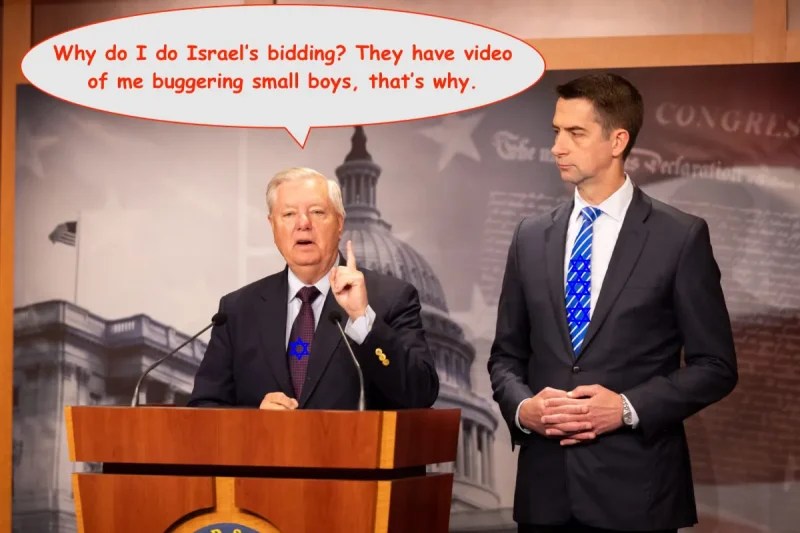
A group of “Senators from Israel” led by Tom Cotton (R-IS) and Lindsey Graham (R-IS) is trying to torpedo Trump’s nuclear negotiations with Iran. The treasonous Israeli-owned senators are pushing a resolution demanding that Iran completely dismantle its civilian nuclear program. That’s a non-starter. International law, beginning with the Nuclear Non-Proliferation Treaty (NPT) specifically allows Iran (like other non-nuclear-weapons states including Japan, Brazil, and the Netherlands) to enrich up to 5%. Under the 2015 JCPOA Iran agreed to limit enrichment to 3.67%, a significant concession representing roughly the minimum enrichment required for nuclear power and research.
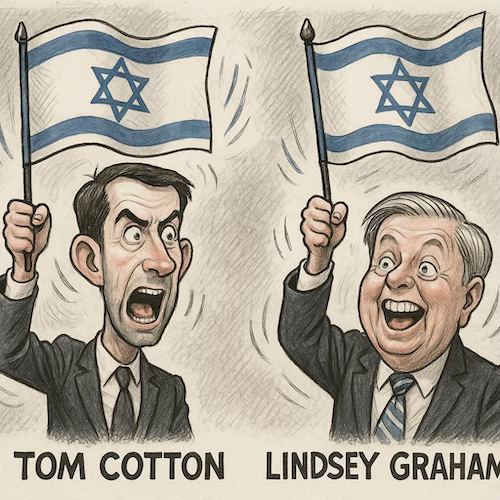
The “Senators from Israel” also want Iran to abandon its ballistic missiles—the core of its defense strategy—and stop cooperating with regional allies in Iraq, Lebanon, Yemen, and above all, Palestine. Those demands, too, are non-starters. Their only purpose is to destroy the possibility of any agreement, thereby opening the door for Israel to drag the US into a disastrous war on Iran.
Will the Trump Administration break free from the malign influence of the Israel lobby and its extremist leader, Benzion Mileikowsky, that Polish-born internationally-wanted criminal who operates under the alias “Benjamin Netanyahu”? Will Trump take the advice I offered last month and “terminate Bibi’s command…with extreme prejudice if necessary?”
There are encouraging signs that Trump may jettison Netanyahu in order to avoid the war-on-Iran-for-Israel trap that Bibi has set for him. By striking a separate peace with Yemen’s Houthis that allows them to continue targeting Israel, then triumphally visiting the region’s Arab capitals (including Hamas-funding Qatar) Trump has done everything but order Israel to stop its genocide in Gaza.
Trump needs to give that order ASAP—not only for humanitarian reasons, but also to create a fait accompli that will help bring down Netanyahu and forestall the Israeli hardliners’ efforts to trick the US into yet another disastrous war for Israel. If the Trump Administration does not act decisively, Netanyahu’s bought-and-paid-for “US” senators will keep pushing Bibi’s war plans, with potentially catastrophic results.
The Right Approach to the US-Iran Nuclear Negotiations
By Glenn Diesen | May 27, 2025
I recently attended a media festival in Tehran and also had the opportunity to explore Iran’s weapon systems and one of its nuclear facilities. Iran’s nuclear program is cited as the main reason for Israel and the US to threaten war with Iran. Such a war would likely escalate into a disastrous regional conflict, and perhaps even pull in the other great powers in a world war. Israel obviously needs to bring America on board to attack Iran, so the discussions between the US and Iran are of great importance. What do the Americans and Iranians want, and is there common ground that can be reached?
If the only demand by the US was for Iran to abstain from developing nuclear weapons, then an agreement could be reached, as Iran claims it does not intend to develop nuclear weapons and has accepted that inspectors are there to ensure compliance. Indeed, Iran agreed to the Joint Comprehensive Plan of Action (JCPOA) and honoured its obligations before the US unilaterally withdrew from the agreement. The US now demands a renegotiation and demands the complete dismantlement of Iran’s civilian nuclear energy program, which it is entitled to have as a signatory to the Non-Proliferation Treaty.
Furthermore, the US has linked its hegemonic policies in the region to the nuclear issue. The US demands that Iran limit the range of its ballistic missile program and also suspend its support for allies in the region – primarily Yemen, Lebanon and Hamas. From Tehran’s perspective, this represents a complete capitulation that would make its security dependent on the benign intentions of Israel and the US. This neglects that the US has had Iran in its crosshairs for the past 45 years, and Iran does have legitimate security concerns.
What can be considered a legitimate security concern by the US is that Iran has become a nuclear threshold state, with the knowledge and material to develop a nuclear weapon. Restricting the extent to which uranium is enriched and imposing strict inspections could possibly be negotiated.
However, threatening to bomb Iran would not eliminate its know-how or all of its material, and such an attack would only incentivise Iran to develop a nuclear deterrent. Even US threats to attack Iran unless it complies with US demands must be making the political leadership in Iran consider acquiring a nuclear weapon. So far, Iran is not developing nuclear weapons, because doing so would encourage other states, such as Saudi Arabia, to also pursue nuclear weapons. Recognising the security competition, the result would not be greater security for Iran.
In my opinion, another approach to negotiations would be to do what is rarely done anymore in Western diplomacy: to recognise and mitigate the security concerns of the other side for the purpose of reducing the security competition. Threatening and bullying Iran into making unilateral concessions has become the new normal in the unipolar era. The US offer to remove sanctions on Iran is merely an offer to stop punishing Iran. The point of departure in any diplomatic approach should be to address mutual security concerns and explore where an agreement that enhances security for both sides can be found. Threatening Iran with capitulation and linking nuclear issues to unrelated matters will only ensure the failure to reach an agreement.
Take the Deal, President Trump
By Ron Paul | May 26, 2025
Deal-making is said to be President Trump’s specialty, yet after five rounds of indirect talks with Iran – most recently just days ago – we seem as far away from an agreement as ever. The fifth round ended last Friday with no breakthrough, but at least no breakdown. However, each day that passes without a document signed on the table is another day for the neocons to maneuver the US president toward an attack on Iran.
One way the war party does this is to continuously move the goal posts and change the rules of the game. Trump envoy Steve Witkoff, under great pressure from the neocons, has himself signaled at least three position-shifts: from no enrichment at all, to low-level enrichment for civilian uses, back to no enrichment at all.
The neocons know that Iran will not give up its right to the civilian use of nuclear power and that is why they are applying maximum pressure to force Trump to officially adopt that position. They know if that becomes the US “red line” then they will win and they will get their war.
Israeli Prime Minister Netanyahu, in league with US neocons, has been warning us for 20 years that Iran is “months away” from a nuclear weapon – even though our own Intelligence Community recently re-affirmed that Iran is not working on a nuclear weapon at all.
Of course this is the same Netanyahu who promised Congress in 2002 if the US would just invade Iraq, peace and prosperity would break out in the Middle East. “If you take out Saddam, Saddam’s regime,” he told Congress in March of that year, “I guarantee you that it will have enormous positive reverberations on the region.”
We know how that worked out.
Poll after poll shows that the American people are tired of intervention and tired of Middle East wars. President Trump himself recognized this in his scathing rebuke of neocons and interventionists during a recent speech in Saudi Arabia.
But rebuke in a speech is not enough. President Trump must actively turn away from the neocons – many of whom are prominent in his own administration.
The recent US debacle in Yemen – where billions were wasted, civilians killed, and US military equipment destroyed – is just a taste of what the US would be in for if the neocons get their way and take us to war with Iran.
The Iranian foreign minister laid down in the simplest terms how the impasse could be solved, posting on X that, “Zero nuclear weapons = we DO have a deal; Zero enrichment = we do NOT have a deal.
My own preference is non-intervention and I do not believe Iran has the desire or the ability to militarily harm the United States. I share President Trump’s view that it would be far better to re-establish relations with Iran and begin mutually beneficial trade with the country. But if a mutually acceptable nuclear deal is the best way to take the neocon war with Iran off the table, then a deal is worth supporting.
President Trump should make his position clear to his negotiators: no more waffling or contradictions, get this agreement signed and put one in the “win” column.
Pakistan PM hails Iran’s diplomacy for regional peace ahead of visit
Press TV – May 26, 2025
Pakistani Prime Minister Shehbaz Sharif has hailed Iran’s peace diplomacy as commendable, underscoring his nation’s solidarity and support for the Islamic Republic.
Sharif, who will visit Tehran at the official invitation of Iranian President Masoud Pezeshkian on Monday, made the remarks in an interview with IRNA.
Sharif stated that the primary purpose of his visit to Tehran is to express gratitude to Iran for its support—specifically endorsing Iran’s peace-seeking positions in the region—during Pakistan’s recent tensions with India.
Tensions between India and Pakistan sharply escalated after the deadly Pahalgam attack. India blamed Pakistan for the attack, but Pakistan rejected the accusations.
“I wish to express gratitude to Iranian officials for their support of peace and their mediation proposal—which we accepted but India rejected,” he said, adding “I will also use this visit as an opportunity to discuss bilateral relations and matters of mutual interest.”
Sharif praised Iranian Foreign Minister Abbas Araghchi’s diplomatic skill, saying the Iranian top diplomat has demonstrated true statesmanship and wisdom in managing significant challenges during an exceptionally complex geopolitical era.
Sharif also stated that Pakistan firmly supports Iran’s condemnation of Israel’s genocide in Gaza, which has caused severe humanitarian devastation and regional instability.
“Islamabad and Tehran will continue to support one another on issues concerning the Muslim Ummah and to advance regional cooperation,” Sharif added.
Iran draws red line as Europe threatens nuclear ‘snapback’
As indirect US–Iran nuclear talks inch forward, Europe’s fear of marginalization prompts a risky diplomatic maneuver in Istanbul.
By Vali Kaleji | The Cradle | May 26, 2025
In the backdrop of indirect nuclear negotiations between Tehran and Washington, Iranian Deputy Foreign Ministers Majid Takht-Ravanchi and Kazem Gharibabadi met with their European counterparts from France, Germany, and Britain – the so-called E3 of the Joint Comprehensive Plan of Action (JCPOA) – on 16 May in Istanbul.
The meeting, held at Iran’s Consulate General and hosted by Turkiye, brought together EU Deputy Secretary-General for Political Affairs Enrique Mora and his colleague Olof Skoog, alongside Turkish Deputy Foreign Minister Abdullah Celik. The discussions focused on the future of the 2015 nuclear agreement, the status of indirect Iran–US negotiations, and collective efforts to avert further escalation through diplomacy.
Although three earlier rounds of consultations between Tehran and the E3 occurred on 29 November 2024, 13 January, and 24 February 2025, the Istanbul session marked a pivotal moment: the first engagement since the revival of the Iran–US indirect dialogue.
Europe cut out of nuclear talks
Crucially, the EU, much like in the Ukraine peace process, found itself bypassed by Washington. This diplomatic exclusion has intensified Brussels’s urgency to reclaim relevance within the nuclear negotiations framework, apparently even if this means acting as spoiler.
At the heart of the Istanbul summit lies the snapback mechanism – an instrument embedded in the JCPOA allowing any signatory to reimpose all UN sanctions that existed before the 2015 agreement. The clause, originally intended as a safeguard, now threatens to become a geopolitical cudgel.
With the JCPOA’s expiration looming in October 2025, Tehran fears that the E3 may invoke the mechanism as early as this summer, citing Iran’s alleged enrichment beyond 60 percent and its growing stockpile of enriched uranium.
French Foreign Minister Jean-Noel Barrot minced no words during a 28 April address to the UN Security Council, stating that if European security interests are compromised, France “will not hesitate for a single second to reapply all the sanctions that were lifted 10 years ago.” His statement, which reverberated through diplomatic circles, was widely interpreted in Tehran as a stark ultimatum.
Iran’s permanent representative to the UN responded forcefully, accusing France of hypocrisy and warning that Paris’s own breaches of the agreement render any activation of the snapback legally indefensible.
Iranian Foreign Minister Abbas Araghchi echoed this stance in an op-ed for Le Point, characterizing the Istanbul discussions as “a fragile but promising beginning” while cautioning that “time is running out.” He wrote:
“The decisions we make now will shape Iran–Europe relations in ways that go far beyond this agreement. Iran is prepared to move forward – we hope Europe is, too.”
Following the talks, Gharibabadi wrote on X: “We exchanged views and discussed the latest state of play on nuclear & sanctions lifting indirect negotiations. Iran and the E3 are determined to sustain and make best use of diplomacy. We will meet again, as appropriate, to continue our dialogue.”
British envoy Christian Turner echoed this sentiment, affirming the shared commitment to maintaining open channels of communication.
‘Trigger Plus’
Yet not all assessments of the Istanbul summit were diplomatic. Tehran-based daily Farhikhtegan, aligned with Iran’s conservative establishment, described the session as tense and combative.
According to its report, the E3 tabled severe threats, including a proposal for what they termed “trigger plus” – an augmentation of the original snapback mechanism that would allow preemptive punitive measures without requiring technical justification.
Iranian officials, the newspaper reported, dismissed this demand as not only illegal and baseless but also presented in an “inappropriate” tone. The Iranian side reiterated that while they remain open to EU participation in broader nuclear negotiations, any activation of the snapback mechanism would trigger an immediate Iranian withdrawal from the Nuclear Non-Proliferation Treaty (NPT).
Mohammad Ghaderi, former editor-in-chief of Nour News – a media outlet close to Iran’s Supreme National Security Council – summarized the stance bluntly on social media:
“In the tense talks with Iran on Friday, [the E3] while requesting to participate in Iran–US talks, made non-technical & illegal requests, calling it trigger plus. But Iran’s response: Emphasizing the activation of the Trigger Mechanism will lead to Iran’s withdrawal from the NPT.”
The Iranian Foreign Ministry, in characteristic fashion, neither confirmed nor denied these reports, opting for strategic ambiguity to maintain leverage over multiple negotiation tracks.
The October deadline: Strategic implications
As the October 2025 expiration date draws closer, Iran has accelerated efforts to engage the remaining members of the 4+1 framework – China, Russia, France, Britain, and Germany. Trilateral meetings with Moscow and Beijing have underscored Tehran’s strategy of building a multilateral diplomatic buffer against US-European pressure.
However, the snapback clause remains the most potent lever in the E3’s arsenal. According to Article 36 of the JCPOA, any signatory can escalate a compliance dispute to the UN Security Council. Once initiated, this process does not require a vote or consensus, meaning that Russian and Chinese vetoes are nullified.
Should the snapback be triggered, all seven UN Security Council sanctions previously lifted would automatically be reinstated – a scenario with grave consequences for Iran’s economy and its broader regional strategy.
Analysts suggest the E3 may push for this mechanism’s activation as early as July or August, thereby maximizing diplomatic pressure while allowing time to shape global opinion. If that happens, Tehran’s recourse to NPT withdrawal – a threat repeatedly made since 2019 – would likely materialize.
Deputy Foreign Minister Kazem Gharibabadi reinforced this red line in response to a recent International Atomic Energy Agency (IAEA) resolution: “If Europe implements snapback, our answer is to withdraw from the NPT.” As Araghchi, writing again in Le Point, stated unequivocally:
“Iran has officially warned all JCPOA signatories that abuse of the snapback mechanism will lead to consequences – not only the end of Europe’s role in the agreement but also an escalation of tensions that could become irreversible.”
Europe’s desperation for relevance
Europe’s insistence on asserting itself in the JCPOA talks stems from its declining influence across global affairs. From the Ukraine war to the Persian Gulf, the EU has been reduced to a secondary actor. In the Iran file, this marginalization is especially stark.
While Washington and Tehran inch closer to a bilateral formula, Brussels finds itself largely ignored. Nosratollah Tajik, a former Iranian diplomat, argues:
“Europe’s main concern is that Iran and the United States will reach a bilateral agreement without considering European interests. Many of the Middle East [West Asian] crises spill over into Europe.”
The lack of a coordinated EU Iran policy only compounds this anxiety. Theo Nencini, an Iran expert at Sciences Po Grenoble and Paris Catholic University, concurs:
“The E3 countries have not yet managed to define a coherent and relevant ‘Iran policy.’ From Trump 1.0 to Biden, they have always been accustomed to flatly following American positions.”
Nencini believes that unexpected US–Iran direct talks caught Europeans off guard, prompting them to scramble to get involved in the negotiation process despite the fact that “they have always maintained a very strict attitude towards Iran.”
Diplomacy or detonation?
The Istanbul talks, despite their challenges, represent one of the few remaining diplomatic lifelines between Tehran and the E3.
Should these efforts collapse, the consequences would be profound: Iran could withdraw from the NPT, revise its nuclear doctrine, and prompt potential military escalation involving the US and Israel.
Such a scenario would spell the total disintegration of the JCPOA framework and shatter the fragile architecture of non-proliferation diplomacy built over the past two decades.
With less than five months to avert this trajectory, the onus lies on both parties to preserve what little remains of mutual trust. Yet the margin for error continues to shrink by the day.
Iran, China launch new commercial railway bypassing US sanctions
The Cradle | May 26, 2025
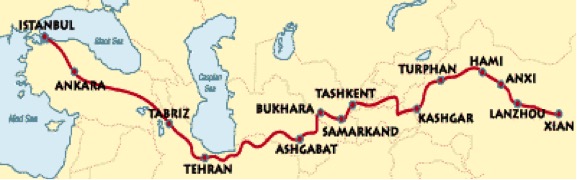
A new commercial rail route connecting China to Iran has officially launched with the arrival of the first cargo train from the eastern Chinese city of Xian at the Aprin dry port near Tehran.
Aprin’s CEO highlighted the port’s strategic role in lowering transport costs and reducing reliance on coastal freight hubs.
Railway infrastructure connecting Iran and China allows freight trains to travel from Shanghai to Tehran in 15 days, compared to 30 days via the maritime route.
On 12 May, railway officials from Iran, China, Kazakhstan, Uzbekistan, Turkmenistan, and Turkiye met in Tehran to advance a transcontinental rail network linking Asia to Europe, Tasnim News Agency reported on 25 May.
The six nations agreed on competitive tariffs and operational standards to streamline regional rail services and boost trade connectivity.
China and Iran have expanded trade and economic relations in recent years, as Tehran seeks to bypass US economic sanctions seeking to strangle its economy and oil exports.
The rail line between the two countries enables Iranian oil exports to China and allows Chinese goods to reach Europe without US naval interference.
In 2018, Iranian Supreme Leader Ali Khamenei stated that Iran should look to the east rather than the west. Since that time, China has become Iran’s largest oil purchaser, while Beijing has been able to supply Tehran with virtually all its needed manufactured goods, including electronics such as computers and cell phones.
The following year, Iran joined China’s “One Belt One Road” (BRI) initiative – President Xi Jinping’s hallmark strategic foreign policy initiative, seeking to recreate the economic ties that existed between ancient China and ancient Persia along the “Silk Road” dating back to the third century BCE.
China and Iran signed a historic 25-year economic cooperation agreement in 2021, reportedly worth $400 billion in trade.
In 2023, China’s growing relations with Iran helped it mediate a Saudi–Iranian rapprochement, which led to the resumption of diplomatic relations that had been cut in 2016.
Sic Transit Gloria Mundi
By William Schryver – imetatronink – May 22, 2025
The inexorable decline of the American Empire has arrived at an Imperial Paradox. It must either fight a war and die, or not fight a war and die.
Here are the options:
China
Neither South Korea nor Japan want anything to do with a war against China, leaving only the Philippines dumb enough to play along.
The US apparently pulled another brigade out of South Korea. They’ll pull out more in the future. They know damn well the North Koreans could easily conquer the entire peninsula if they chose to do so.
China and its local seas are a vast ocean away from America, and its capacity to defend its local seas is enormous and growing.
The Pentagon must understand it cannot sustain logistics in a war against China in the western Pacific. It simply cannot be done. Anyone who thinks otherwise must upgrade their proficiency in basic arithmetic.
Iran
In the context of a war against Iran, all the geography is against the US.
Iran is an exceedingly mountainous country that has, over the course of millennia, learned to use those mountains to defend itself against would-be conquerors.
They can field a satisfactorily well-equipped million-man army.
They have learned in the 21st century to burrow deep heavily fortified tunnels into their mountains.
Iran is also much more technologically advanced than most people understand. They have become impressively capable in terms of both offensive and defensive missiles. They pose a far greater challenge than the Yemeni have been over the past year and a half.
Indeed, they pose a “near-peer” challenge against US overseas power projection.
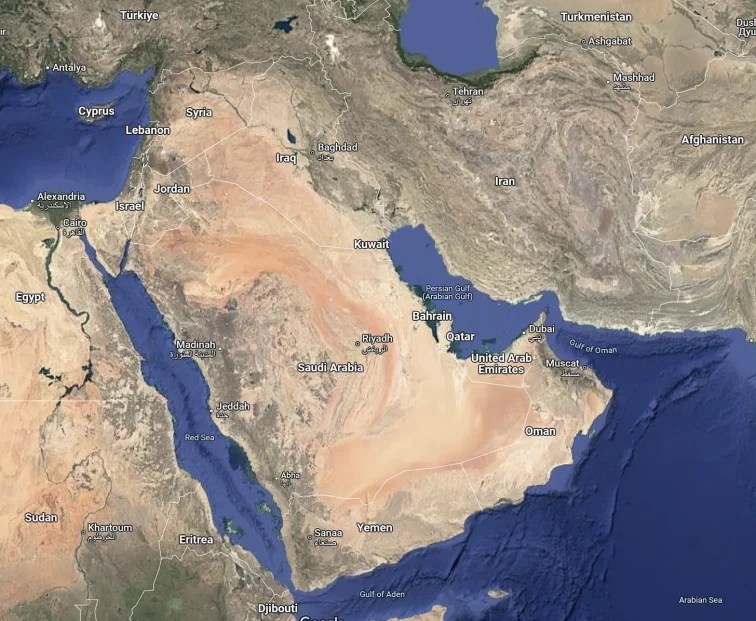
The US Navy could only operate at extreme risk in the southern Red Sea, the Gulf of Aden, the Gulf of Oman, the Strait of Hormuz, and the Persian Gulf.
Iran’s sphere of influence
Every US base in the region is well within range of Iranian missile strikes.
The US Navy very demonstrably cannot secure seaborne logistics into the Persian Gulf. They lack both the sealift ships, and the ability to protect them.
They cannot even open the Bab-el-Mandeb!
Russia
From a geographic and logistical standpoint, the only remotely conceivable war is one in Ukraine against Russia.
The US at least has bases and forces already in place in the UK, Germany, Poland, Romania, Finland, and in Baltic chihuahua fantasy-land — and what has served until now as a reasonably secure logistics pathway into all those places.
Of course, whether or not such a condition persists long in a war scenario is another question altogether.
Because, you see, the Russians are now unquestionably the most formidable and battle-hardened military on the planet — at least in the context of a war fought on their doorstep.
So if you’re an empire that thinks it needs a war to reaffirm at least its short-term relevance and fading glory … well, these are your choices.
Europe must bear consequences of forcing return of UN sanctions against Iran: FM
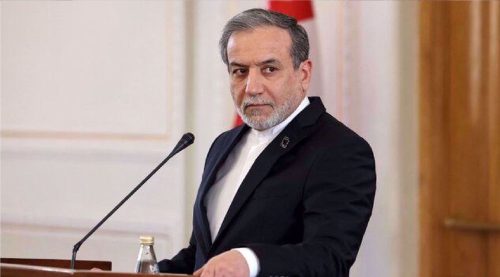
Iran’s Foreign Minister Abbas Araghchi
Press TV – May 21, 2025
Foreign Minister Abbas Araghchi has cautioned the US’s European allies in a 2015 nuclear agreement with Iran against invoking the so-called “snapback mechanism” to re-impose the United Nations sanctions against the Islamic Republic.
Speaking to Saudi Arabia’s Asharq News network on Wednesday, the top diplomat emphasized that such a move would end participation by the European parties — the UK, France, and Germany — in the deal that is officially known as the Joint Comprehensive Plan of Action (JCPOA).
He added that the trio’s potential recourse to the mechanism would lead to significant consequences and potential irreversible escalation of tensions, referring to the likelihood of strong retaliatory steps that the Islamic Republic could take in response.
Araghchi reiterated Iran’s readiness to engage in diplomacy, expressing hope that the European parties too would demonstrate determination to resolve the current impasse.
The deadlock occurred when the United States ditched the JCPOA in 2018, and returned the illegal and unilateral sanctions that the agreement had lifted.
This was followed by the European trio’s failure to return the US to the accord, as they had said would do, as well as their walking in Washington’s footsteps by returning their own sanctions.
In response to the betrayal, Iran began a number of legitimate and gradually escalating nuclear countermeasures.
“The situation we’re in is by no means Iran’s fault. It is the fault of the United States, which withdrew from the JCPOA, and the fault of the European countries that failed to compensate for the US’s withdrawal,” Araghchi added.
‘Uranium enrichment absolutely non-negotiable’
Addressing the topic of Iran’s peaceful uranium enrichment activities, the foreign minister said the activities were a principled and fundamental issue for Iran.
He emphasized that the enrichment program was a major scientific achievement developed by domestic scientists and held immense value for the Iranian people.
The official, meanwhile, paid tribute to the seven-strong Iranian nuclear scientists, who were assassinated amid their invaluable contribution to the Islamic Republic’s peaceful nuclear energy program.
According to Araghchi, the victims’ sacrifices towards advancement of the program had made the nuclear issue “absolutely non-negotiable.”
Featured Video
NEW FAUCI EMAILS EXPOSE ATTACK ON NATURAL IMMUNITY
or go to
Aletho News Archives – Video-Images
From the Archives
Fourteen Incredible Facts About 9/11
By Kevin Ryan | Dig Within | August 8, 2015
… What is known about 9/11 is that there are many incredible facts that continue to be ignored by the government and the mainstream media. Here are fourteen.
- An outline of what was to become the 9/11 Commission Report was produced before the investigation began. The outline was kept secret from the Commission’s staff and appears to have determined the outcome of the investigation.
- The 9/11 Commission claimed sixty-three (63) times in its Report that it could find “no evidence” related to important aspects of the crimes.
- One person, Shayna Steiger, issued 12 visas to the alleged hijackers in Saudi Arabia. Steiger issued some of the visas without interviewing the applicants and fought with another employee at the embassy who tried to prevent her lax approach.
Blog Roll
Recent Comments
Bill Francis on European leaders’ shift in the… seversonebcfb985d9 on Villains of Judea: Philip Esfo… loongtip on Report warns that ‘Jewish terr… Craig Nelms on New study shows that toxic gas… loongtip on A Funny Thing Happened on the… loongtip on EU free trade pact on hold as… John Edward Kendrick on Regime Change In Iran Is The F… Bill Francis on Australia Passes New Hate Spee… seversonebcfb985d9 on Australia Passes New Hate Spee… Bill Francis on Britain’s AI Policing Plan Tur… loongtip on Miami Beach Resident Questione… loongtip on Israeli agricultural export co…


 Aletho News
- Trump aims to create new UN and own it, Brazil’s Lula warns
- UN rapporteur says Israeli demolition of UNRWA compound reflects broader attack on UN system
- From Proxy to Disposable: The US Betrayal of the Syrian Kurds
- Six injured in stabbing spree at Kurdish rally in Antwerp, victims stabbed ‘indiscriminately’
- US pledges to ‘starve’ Iraq of oil revenue if pro-Iran parties join new government
- Is China a threat to Greenland?
- South Korea’s Prime Minister Proposes US Send Special Envoy to North Korea — Report
- Pentagon downgrades China threat, shifts focus to homeland, hemisphere
- Ireland Moves to Legalize Spyware Use by Police
- NEW FAUCI EMAILS EXPOSE ATTACK ON NATURAL IMMUNITY
- If Americans Knew
- Another Gaza baby freezes to death on Netanyahu’s watch – Not a ceasefire Day 106
- Oppose Israel’s Abuses While You Still Can
- UNRWA Heads Tell Ha’aretz: ‘We Don’t Radicalize Palestinians – Their Lived Existence Does’
- Plans Call for “New Rafah” Built in Israel’s Image — Without Palestinians
- Posing as priest, reporter is spat at many times, highlighting anti-Christian sentiment in Israel
- Leaked Documents: “Planned Community” in Rafah Would Force Palestinians Into Israeli Panopticon
- ‘Permits of Humiliation’: How Israel Strangles Christian Education in Jerusalem
- “The world sees death, destruction and injustice – and they see dollar signs” – Not a ceasefire Day 105
- War criminal Netanyahu kills 11 in Gaza, joins Board of Peace – Not a ceasefire Day 104
- Another baby dies of cold in Gaza, as Rafah crossing remains locked down – Not a ceasefire Day 103
- No Tricks Zone
- Polar Colding…Antarctica Saw Its Coldest October In 44 Years!
- New Study: Sea Levels Rose 20 Times The Modern Rate During The Roman Warm Period
- As German Gas Storage Dips Dangerously Low…Shortage Hardly Avoidable
- New Study: Brazil’s Relative Sea Level Was 2+ Meters Higher And SSTs 3-4°C Warmer 6000 Years Ago
- Philosopher Schopenhauer: Climate Science Certainty Stems From Stupidity, Ignorance
- New Study: Species Extinction Rates Declining Since 1980 – ‘Climate Change Is Not An Important Threat’
- Denmark Places Climate Protection Above Animal Welfare, Poisoning And Culling Cows
- New Study: Greenland Was 3-7°C Warmer And Far Less Glaciated Than Today 6000-8000 Years Ago
- German Media Report That Current Frigid Weather Can Be Explained By Arctic Warming!
- Berlin Blackout Shows Germany’s $5 Trillion Green Scheme Is “Left-Green Ideological Pipe Dream”
 Aletho News