Seyed Mohammad Marandi: Iran Defies Trump’s Ultimatum and Threat of War
Glenn Diesen | April 3, 2025
Seyed Mohammad Marandi is a professor, an analyst and an advisor to Iran’s nuclear negotiation team. Prof. Marandi discusses Iran’s rejection of Trump’s ultimatum and the possible nuclear escalation.
Substack: https://glenndiesen.substack.com/
Iran can rely on its hydrocarbon resources for 100 years: NIOC
Press TV – March 30, 2025
The National Iranian Oil Company (NIOC) has said that production from hydrocarbon resources in the country will continue for the next 100 years.
In a statement issued on Sunday, the NIOC detailed its performance in the calendar year that ended on March 20, saying that Iran’s hydrocarbon resources amount to the equivalent of more than 1.2 trillion barrels of oil, adding that some 340 billion barrels of those resources are available for extraction.
The statement said that Iran can rely on those resources for the next 100 years considering the current extraction rates and technologies.
The NIOC said oil and gas production in Iran had increased to record levels in the last calendar year, adding that the amount of natural gas delivered to the Iranian pipeline grid had reached an all-time high of 870 million cubic meters (mcm) in the past winter.
It said that total gas production in Iran had increased by an average of 36 mcm per day in the second half of the calendar year to late March to reach 1,106 mcm per day.
The company said that gas production from the Iranian side of South Pars, the world’s largest gas field shared with Qatar in the Persian Gulf, had reached 716 mcm per day.
The statement also elaborated on efforts to increase oil production from several oilfields in south and southwest Iran despite sanctions targeting the exports of crude oil from the country.
The NIOC said that Iran’s baseline oil production would increase by 250,000 barrels per day (bpd) to reach 2.189 million bpd in the near future thanks to $3 billion worth of investment provided by the Central Bank of Iran.
Iran presses the IAEA on Trump’s ‘bombing’ threat, reaffirms no nukes pursuit
IRNA – April 2, 2025
Tehran – The International Atomic Energy Agency (IAEA) must adopt a clear position regarding threats against Iran’s civilian nuclear facilities, Foreign Minister Abbas Araqchi said Tuesday, days after U.S. President Donald Trump threatened to “bomb” Iran.
Araqchi was speaking on the phone with the secretary general of the IAEA, Rafael Grossi.
He emphasized that given the recurrence of such threats, the Islamic Republic will take every necessary measure to protect its nuclear program.
Grossi, for his part, said he would talk with other parties to create a suitable atmosphere to help resolve existing issues. He also asked to visit Iran, which Araqchi accepted.
Trump said on Sunday that he would order military strikes against Iran if Tehran did not strike a new deal with Washington on its nuclear program. “If they don’t make a deal, there will be bombing,” he said in an interview with NBC News.
Iran has warned to respond swiftly and decisively to any act of aggression on its soil.
Reacting to Trump’s threat, a senior adviser to Leader of the Islamic Revolution Ayatollah Seyyed Ali Khamenei said that even though Iran doesn’t seek nuclear weapons, any strike on the country by the United States or Israel on that false pretext would force the country to develop atomic bombs for defensive purposes.
“If America or Israel bomb Iran under the nuclear pretext, Iran will be compelled to move toward producing an atomic bomb,” Ali Larijani said during a televised interview on Monday.
Araqchi, however, once again clarified Tehran’s long-standing position, which is based on a religious decree (fatwa) by Ayatollah Khamenei prohibiting the development, possession, and use of nuclear weapons, reaffirming that the country will never produce or acquire any atomic bombs under any circumstances.
He said in an X post on Tuesday that ten years after signing the Iran deal and seven years after the U.S. unilaterally walked away from it under Trump’s first term, “there is not ONE SHRED OF PROOF that Iran has violated this commitment.”
Meanwhile, UN spokesperson Stephane Dujarric was asked on Tuesday to comment on Trump’s threat, to which he said, “We urge everyone to avoid inflammatory rhetoric.”
“I think the UN Charter is very clear in encouraging Member States to settle all disputes through diplomatic means,” he said in response to the question asked by IRNA’s correspondent.
On March 12, Trump sent a letter to Iran via an emissary from the United Arab Emirates (UAE), requesting that negotiations be opened into a deal that he says would stop Iran from building a nuclear weapon. This is while, in 2018, he pulled out of a multinational nuclear deal with Iran. On February 4, the U.S. president signed a presidential memorandum to restore a hostile policy from his first term of “maximum pressure” on the Islamic Republic.
Iran, which has relayed its response to the U.S. president’s letter via Oman, has ruled out direct negotiations with the United States as long as the “maximum pressure” policy and the military threats are in place.
“Diplomatic engagement worked in the past and can still work. BUT, it should be clear to all that there is—by definition—no such thing as a ‘military option’ let alone a ‘military solution,’” Araqchi said in his X post.
Trump: ‘Very Bad Things are Going to Happen.’ Netanyahu Wants the U.S. to Destroy Iran.
By Dennis J. Kucinich | April 1, 2025
In my article, “The High Price of War with Iran: $10 Gas and the Collapse of the U.S. Economy,” I reminded readers of how Prime Minister Benjamin Netanyahu has been behind the push for America to destroy Iraq, Libya, Syria and now Iran. I reviewed the severe economic consequences for the U.S. if it attacks Iran. Today, I cite the human health and atmospheric effects of a U.S. attack on Iran’s nuclear research facilities. The resulting nuclear fallout would bring a catastrophe unprecedented in human history.
Last week, President Trump said “very bad things are going to happen” to Iran, if that nation’s leaders do not sign a new nuclear deal. The President is right. He can make very bad things can happen to Iran.
But Iran is not the only country to which “bad things” are going to happen if Iran’s nuclear research infrastructure is destroyed by the U.S., as is revealed by a careful study of the spread of radiation created by the promised bombings.
America has been Netanyahu’s pawn for decades. Will the wealth, lives and security of our nation be sacrificed yet further to an agenda which brings only debt to our nation and death to innocents abroad?
The return of Donald Trump to the White House for a second term has enabled Netanyahu’s right-wing party to accelerate the pulverization of Gaza, expand settlements and to repel the Houthis pro-Gaza attacks on Red Sea shipping.
Netanyahu viewed Trump’s first election in 2016 as a new opportunity to topple Iran’s leadership. Trump, in partnership with Netanyahu, withdrew the U.S. from a multi-lateral agreement which limited Iran’s nuclear development in exchange for sanctions relief.
An attack by B-2 bombers on Iran’s nuclear infrastructure would destroy the targeted sites, and unleash radioactivity endangering the lives of tens of millions in Iran and hundreds of millions beyond. Due to radioactive drift, Iraq, Kuwait, Qatar, the UAE, Bahrain, eastern Saudi Arabia, Afghanistan, and Pakistan also would be severely impacted.
In practical terms, given proximity to Iran, and the direction of the wind, high levels of radiation-induced illness, some fatal, and sharp increases in cancer and birth defects would occur. Radiation would contaminate and ruin food supplies, agricultural land, farm animals, and water resources hundreds and even thousands of miles from Iran.
The eastern regions of Turkey, northwestern India, Turkmenistan, Uzbekistan, Tajikistan and Kazakhstan would be exposed to moderate contamination. Jordan, Syria, Lebanon, Israel, Palestine and Egypt’s Sinai could be affected, depending on the wind.
Israel has long fanned existential fears by conjuring the threat of a nuclear attack by Iran, while being indemnified by the U.S. for its self-styled “defensive” aggression in Gaza, where at least 50,000 Gazans have been killed and over a million Palestinians driven from their homes.
While the widely publicized intent of President Trump to bomb Iran imperils Iran and neighboring countries, it also makes Israel vulnerable to a massive counterstrike from Iran and puts in the bullseye all U.S. troops in the region within 2,500 miles of Iran.
The attack B-2 bombers headed to Iran are designed to carry nuclear “bunker busters” as well as conventional 500 lb gravity bombs. The objective is to take down Iran’s nuclear infrastructure, which includes nuclear reactors and research labs. Nukes bombing nukes equals massive radioactive fallout.
“There will be Bombing.”
“If they don’t make a deal, there will be bombing,” Trump said in a telephone interview this past Sunday with NBC News. “It will be bombing the likes of which they have never seen before.”
Civics lesson: Official threats against another state are a violation of the UN Charter, Article Two, Section 4, which “prohibits the threat or use of force against …. any state.” Both Iran and the US signed and ratified that agreement nearly 80 years ago, in recognition of its organizing principle: “to save succeeding generations from the scourge of war…”.
It is a war crime to aggress against another country. Under the US Constitution, no president has the right to unilaterally take our nation to war, absent an imminent threat to the United States. The Constitutional Convention placed the war power in the hands of Congress. This was in contrast to the British Crown’s expansion of war for empire.
The litany of reasons not to attack Iran is eerily similar to the reasons America should not have attacked Iraq: Iran is not a threat to the United States. Iran has not attacked the United States. Iran does not have the intention or the ability to attack the United States. That being the case, the opportunities for a false flag incitement are ripe.
Significantly, last week the U.S. Intelligence community, in its annual Global Threat Assessment, refuted Netanyahu’s oft-repeated claim about Iran building a nuclear weapon:
“We continue to assess that Iran is not building a nuclear weapon and that Khamenei has not reauthorized the nuclear weapons program he suspended in 2003”.
In the 16 years I spent in Congress, I was often one of the only members who rose to question the Bush Administration’s plans to attack Iran, time and again calling out the dangers of attacking nuclear research facilities and calling for diplomatic means to block Iran’s potential development of a nuclear weapon.
The agreement, arrived on July 14, 2015, the Joint Comprehensive Plain of Action (JCPOA). It took the U.S. China, Russia, Germany, France, and the UK thirteen years to craft a workable agreement which limited Iran’s ability to enrich uranium to weapons grade. The agreement was a landmark for international cooperation. It put the spectral genie of Iran’s potential development of a nuclear weapon back in the bottle.
That did not satisfy Netanyahu, however. He longed for the toppling of the Iran regime, and continued to hype existential fears among Israelis. Trump cancelled the JCPOA, at Netanyahu’s behest, setting in motion a series of events which may lead the US to attack Iran soon.
From Deal Breaker to Deal Maker?
Scott Ritter a former UN Weapons Inspector and Marine intelligence specialist provides a detailed account of Trump’s withdrawal from the JCPOA, in his book, entitled Deal Breaker.
The JCPOA which Trump took down had blocked Iran’s production of enriched uranium (processed to increase the percentage of uranium-235 (235U) at the Natanz and Fordow nuclear facilities.
It blocked Iran’s development of weapons-grade plutonium and frustrated even covert attempts to produce fissile (capable of undergoing nuclear fission) materials used for nuclear weapons.
The President now is demanding Iran sign a new deal. He wants Iran to get rid of the weapon-making capability which he errantly enabled by cancelling the JCPOA.
Eight years after the cancellation of the JCPOA, President Trump is apparently demanding Iran voluntarily take down its nuclear infrastructure which provides nuclear power, nuclear research and yes, with no JCPOA, can, at this moment, enrich uranium to near–weapons grade.
The Supreme Leader of the Islamic Republic of Iran has issued a fatwa (a religious ruling) against the use of nuclear weapons.
The new deal which the President is seeking, at best, could end up looking a lot like the JCPOA, and, at worst, puts him in the position of issuing a non-negotiable demand for Iran to voluntarily take down its nuclear infrastructure, or the US will do it militarily.
Iran has rejected direct negotiations with Washington under such circumstances. It has, however, maintained indirect communication with the U.S. through Oman as the President escalates the threat of a massive bombing attack.
B-2 bombers are in place, equipped with the most powerful weapons in America’s arsenal ready to be activated from Diego Garcia, an island in the Indian Ocean, 2,400 miles southeast of Iran. The B-2 has the capacity to attack and return to Diego Garcia without refueling.
In someways this showdown with Iran was set in place on July 25, 2024, when Prime Minister Netanyahu addressed Congress. In a spell-binding speech for which he received over 50 standing ovations, Netanyahu skillfully aligned Israel’s and the U.S. policy on Iran:
“If you remember one thing, one thing from this speech, remember this: Our enemies are your enemies, our fight is your fight, and our victory will be your victory,” Mr. Netanyahu declared.
At this point, the measure of consequence needs to be assessed. The only difference between war games, preparing for war and actual war, is in the intent.
Israel intends to destroy Iran and needs the US to do it.
Joint US-Israeli Air Force war games have been held recently in preparation for an attack.
The U.S. has nineteen B-2 bombers. Each cost over $2 billion. Their unique flying wing design, with the plane wrapped in radar-absorbing materials help it avoid detection. The B-2s use sophisticated electronic countermeasures to jam or stymie opposition radar and missiles.
Iran is ill-equipped to defend against the B-2 bombers’ stealth warfare. At best the shortened detection range will limit Iran’s ability to lock onto the B-2 with surface-to-air missiles.
Each B-2 can carry sixteen, 2,400 lb., B83 thermo-nuclear gravity bombs, also known as nuclear bunker busters, which explode deep inside the earth. Each B83 bomb has the explosive capacity of 80 Hiroshimas which means each B-2 bomber is capable of delivering the destructive power of 1280 Hiroshimas.
Once the B83’s detonate they destroy underground structures and send shockwaves through rock. Earthquakes and massive ground displacement result, with radioactive debris being flung into the atmosphere.
There is a metaphysics at work here of bringing to oneself that which one fears. The United States is preparing to attack Iran because of Israel’s fear of Iran.
Trump: “It will be bombing the likes of which they have never seen before.”
The U.S. will first attack Iran’s underground missile cities at Khorramabad, and Panj Pellah, Bakhtaran, with nuclear bunker busters or Massive Ordnance Penetrators aimed at underground missile sites, to incapacitate Iran’s ability to retaliate.
The use of nuclear bunker busters will send nuclear debris into the immediate atmosphere, and it will be carried aloft by the wind.
Simultaneously, the U.S. will strike at the Fordow enrichment plant, buried deep in a mountain. A combination of 30,000 lb. Massive Ordnance Penetrators (GBU-57s) capable of burrowing 200 ft into the earth before exploding, and nuclear bunker busters, will be deployed, creating a multiplier factor in blast physics, collapsing tunnels and sending radioactive materials into the atmosphere and far beyond. Fordow is heavily fortified and may be able to withstand the initial attack.
The Natanz underground facility will be similarly struck, with radioactive matter breaking into the atmosphere.
The ground-level Bushehr Nuclear Power plant will be destroyed, its reactor vessel breached, the reactor core will meltdown, massive release of radioactive materials (cesium-137, iodine-131, strontium-90, and plutonium) will go into the atmosphere, and, depending upon the wind, and the weather, radioactive plumes will drift over other countries.
Countless civilians will perish from radiation poisoning and severe burns. Birth defects will be present for generations to come. Nuclear explosion refugees will be created. Chernobyl-type effects will require people to leave their homes, never to return.
Tehran’s Research Reactor, Isfahan Nuclear Tech Center, Arak Heavy Water Reactor, Natanz Surface Facility and the Parchine Military Complex are ground level and surface level structures which will be targeted and destroyed, either by nuclear weapons or so-called conventional weapons.
Iran Can Still Hit Back
Iran’s underground missile system is widely distributed. Faced with imminent destruction, Iran, at the first sign of an attack, will simultaneously launch multiple rockets from many underground sites, a “shower of missiles” numbering in the thousands.
These deadly projectiles can change trajectories and targets while in flight, making the vaunted missile defense of Israel less effective. While Israel’s 2000 lb. bombs, the type dropped on Gaza, are more precise, the Shabab-3 has the potential of inflicting much more significant damage over a larger radius of Israeli cities.
U.S. Troops in Region will Pay
Tens of thousands of US troops, Army, Navy, Airforce, Marines, Space Force are stationed within reach of Iranian missiles. They are under no threat unless Iran is attacked.
Iran’s short-range missiles, Fateh-110 and Zolfagher, can reach Saudi Arabia. Iran’s medium-range ballistic missiles, the Shabab-3, Emad, Sejjil, and Ghadr can travel up to 1,550 miles (2,500 km), to Israel. Its intermediate range missiles are capable of striking 2,485 miles deep into eastern and central Europe,
It is not in the interests of the United States to attack Iran.
The United States is risking becoming the most hated nation on earth, using nuclear weapons again, bombing nuclear facilities, creating radioactive consequences for potentially dozens of nations and tens of millions of people born and unborn.
America has been Netanyahu’s pawn for decades. Will the wealth, lives and security of our nation be sacrificed yet further to an agenda which brings only debt to our nation and death to innocents abroad?
During his campaign, President Trump stated repeatedly that he aimed to have a strong military to avoid war. Military strength must be matched by diplomatic strength. He must come up with a deal that avoids a U.S. war with Iran, without a foreign leader’s self-interested meddling. “Very bad things” do not have to happen if good people prevail. If America nukes Iran, our nation will never escape the fallout.
Russia offers mediation of talks between Tehran, Washington: Ryabkov
Al Mayadeen | April 1, 2025
Russia warned of United States airstrikes on Iran’s nuclear infrastructure, condemning US President Donald Trump’s threats to bomb Tehran unless a deal with Washington is reached.
“Threats are indeed being heard, ultimatums are also being heard,” Russia Deputy Foreign Minister Sergei Rybakov told International Affairs in an interview published Tuesday, adding, “We consider such methods inappropriate, we condemn them, we consider them a way for (the US) to impose its own will on the Iranian side.”
Russia proposed mediation between Trump’s administration and Iran, following their strategic partnership deal earlier this year.
Ryabkov said that Trump’s threats to Iran only complicate the situation between the two countries, emphasizing that if the US administration follows up with its warnings and strikes Iranian nuclear facilities, the consequences could be catastrophic for the entire region.
“While there is still time and the ‘train has not left’, we need to redouble our efforts to try to reach an agreement on a reasonable basis. Russia is ready to offer its good services to Washington, Tehran, and everyone who is interested in this,” the deputy foreign minister stated.
Iran stands steadfast to US threats
Ali Larijani, a top advisor to Iran’s Supreme Leader Ayatollah Khamenei, cautioned on March 31 that any US or Israeli strike targeting Iran’s nuclear sites would push Tehran to pursue nuclear weapons development.
He argued that attacking Iran’s nuclear facilities would backfire against US interests, warning, “Under such circumstances, we would have no choice but to reconsider our stance and potentially seek nuclear arms as a deterrent.”
Larijani warned that any military strike on Iran would only strengthen domestic resolve to fast-track nuclear weapons development, adding that due to Iran’s preparedness, such an attack would only delay the nuclear program temporarily – by no more than two years.
On March 31, the leader of the Islamic Revolution and the Islamic Republic of Iran, Sayyed Ali Khamenei, delivered a stern warning, asserting that any entity considering hostile actions toward Iran would be met with a severe and proportionate retaliation, while also stressing that efforts to provoke internal division would be decisively countered by the Iranian people, as they have shown in previous instances.
Admiral Alireza Tangsiri, the commander of the naval forces in Iran’s Islamic Revolution Guard Corps (IRGC), warned “foreign parties” against threatening Iranian interests, stating, “If foreigners attempt to attack us, pressure us, or endanger our interests, we will stand against them with full force.”
At the same time, he emphasized that “Iran does not seek war but will respond firmly to any aggression.”
Iran Responds to Trump’s Threats: US Has 10 Bases and 50K Troops in Our Vicinity
Al-Manar | March 31, 2025
The director general for the Americas at the Ministry of Foreign Affairs has issued an official warning to the United States Interests Section in Tehran to warn Washington against any hostile actions.
In the absence of the Swiss ambassador, Issa Kameli summoned the chargé d’affaires of the Swiss Embassy, which represents the U.S. in Tehran, to the Ministry of Foreign Affairs and conveyed Iran’s firm resolve to respond decisively and immediately to any threat.
The Swiss charge d’affaires was summoned on Monday over recent threats against Iran made by U.S. President Donald Trump.
During the meeting, Kameli condemned and rejected the inflammatory remarks, calling them violations of international law and the principles outlined in the United Nations Charter.
The Iranian official presented an official note warning against any malicious activity, emphasizing the Islamic Republic of Iran’s unwavering resolve to counteract any aggression.
The chargé d’affaires assured Kameli that the matter would be promptly relayed to the U.S. government.
Commander of the IRGC Aerospace Forces Brigadier General Amir Ali Hajizadeh indicated that the United States has 10 bases and 50 thousand troops in our vicinity.
“Those who live in glass houses shouldn’t throw stones.”
Iranian Foreign Minister Abbas Araqchi stressed that Iran may never engage in direct talks with the US administration, adding that Washington received and reviewed Tehran’s response to Trump’s letter.
Trump has warned that he might order military strikes against Iran if Tehran fails to reach an agreement with Washington on its nuclear program. “If they don’t make a deal, there will be bombing,” Trump said in an interview with NBC News. However, he added that he could instead impose “secondary tariffs” on Iran if no deal is reached, as he did during his first term in office.
Earlier in the day, Leader of the Islamic Revolution Ayatollah Sayyed Ali Khamenei warned that if Washington commits any hostile act against Iran, “it will certainly receive a heavy blow in return.”
Iran will admit students expelled from US as part of Trump’s crackdown on pro-Palestine protests
Press TV – March 30, 2025
Iran’s academic officials have declared the Islamic Republic’s unwavering support for students and academics who have been targeted by the Trump administration’s crackdown on pro-Palestinian protesters on university campuses.
Officials from Iran’s academic institutions said in a joint statement on Sunday that the country’s universities “take pride in extending their support” to students protesting “the crimes of the Zionist regime” in the US.
“The acts of global arrogance in suppressing justice-seeking students and expelling them from American universities after their peaceful protests against the atrocities committed by the Zionist regime against the oppressed people of Palestine have further unveiled the true nature of those who claim to advocate for human rights,” the statement read.
Iran’s universities, it said, are ready to accept students who are being expelled by US immigration officials for showing sympathy for the Palestinian cause.
Iran’s Supreme Council of the Cultural Revolution (SCCR), in collaboration with the Academy of Sciences and the Academy of Medical Sciences, will facilitate the admission of expelled students into Iranian universities.
President Donald Trump has begun following through on a threat to deport all non-citizen university activists with ties to the pro-Palestine protests, which rocked the US last spring, with students staging daily protests in college campuses across the country for weeks.
The crackdown intensified since US immigration agents arrested Mahmoud Kahlil, a graduate of Columbia University, on March 8. Kahlil, who is being held in an immigration detention center in Louisiana, faces deportation for his role in pro-Palestinian campus protests.
Secretary of State Marco Rubio, who personally signed off on his arrest, said on Thursday that Washington has revoked at least 300 foreign students’ visas.
“Maybe more than 300 at this point,” he said. “We do it every day, every time I find one of these lunatics.”
Trump officials have accused these students of being “adversarial to the foreign policy and national security interests” of the US.
The war over war with Iran has just begun
By Sina Toossi | Responsible Statecraft | March 28, 2025
The war drums are getting louder in Washington.
In recent weeks, many of the same neoconservative voices who pushed the U.S. into Iraq are calling for strikes on Iran. Groups like the Foundation for Defense of Democracies and the Washington Institute for Near East Policy are once again promoting confrontation, claiming there may never be a better time to act. But this is a dangerous illusion that risks derailing what Donald Trump himself says he wants: a deal, not another disastrous war in the Middle East.
A war with Iran wouldn’t just risk another endless conflict. It would blow up Trump’s broader agenda at home and abroad.
A major conflict would drain U.S. resources and attention, distracting from domestic priorities and weakening America’s leverage on every front: China, Russia, Europe, and trade. Europe could seize the moment to prolong support for the war in Ukraine and resist Trump’s push to reset transatlantic ties. Trade partners like Mexico, Canada, India, and others could take advantage of America’s preoccupation to extract lop-sided concessions. And a unilateral strike would likely fracture the international community.
Russia and China, despite their own misgivings about Iran’s nuclear ambitions, would point to U.S. aggression as the real threat, undermining American credibility at the United Nations and beyond.
And the most dangerous consequence? A strike could backfire and push Iran to do exactly what Trump says he wants to prevent: build a bomb. Iran is already enriching uranium near weapons-grade. If it withdraws from the Nuclear Non-Proliferation Treaty, the last threads of international oversight would disappear. An attack would likely galvanize even more hardline elements in Iran and provide the political justification to sprint for a nuclear weapon.
Trump could go down in history, not as the president who solved the Iran crisis, but as the one under whose watch Iran finally became a nuclear weapons state. That’s not the legacy he wants, or one the country can afford.
Raising alarms, Trump recently declared, “Something will happen to Iran soon.” But he also made clear, “Hopefully, we can have a peace deal. I’m not speaking out of strength or weakness, I’m just saying I’d rather see a peace deal than the other.” These are not the words of a warmonger. They are the words of a negotiator, someone who still sees the value in diplomacy.
Trump is not alone. In a recent interview with Tucker Carlson, his foreign policy envoy Steven Witkoff offered a notably more restrained perspective on Iran than is typical from the foreign policy establishment. Witkoff emphasized pragmatism, verification, mutual respect, and, most importantly, avoiding conflict. His remarks reflected a grounded approach rooted in a clear understanding of both American interests and the region’s complex dynamics.
The problem is that many of the loudest voices shaping Iran policy — inside and outside the government — are actively working to sabotage any realistic path to diplomacy. They talk about wanting a “deal,” but what they’re actually demanding is Iran’s surrender: zero uranium enrichment, dismantling its nuclear program, cutting ties with all its regional allies, and fundamentally changing its foreign policy. No Iranian government — pragmatist or hardliner — could accept such terms. Even Masoud Pezeshkian, Iran’s newly elected president who ran on a platform of diplomacy and engagement, would have no political space to agree to that kind of ultimatum.
Let’s be clear: if you’re pushing for such maximalist demands under the guise of wanting a deal, you’re not working for peace. You’re laying the groundwork for war.
Iran is a complicated actor with a complicated history. But the lessons of the past decade are clear: when the U.S. engages Iran through diplomacy, it gets results. When it relies solely on pressure, it inches closer to conflict.
The point of pressure has always been to create leverage, not to impose costs for their own sake. That leverage now exists. The question is what to do with it.
The 2015 nuclear deal was far from perfect for any side, but it did succeed in placing tight constraints on Iran’s nuclear program and subjected it to unprecedented international inspections. The aim of withdrawing from that deal was to compel Iran to accept stronger terms. That hasn’t happened.
Instead, the result has been several years of Iranian nuclear expansion, regional instability, and growing alignment between Tehran, Moscow, and Beijing. Iran is now enriching uranium to 60% — dangerously close to weapons-grade — and stockpiling far more than before. Meanwhile, the international consensus that once backed U.S. efforts has frayed.
Now is the time to cash in on current U.S. pressure. Not by continuing on an escalatory path that leads to war, but by using the leverage that’s been built to strike a better deal — one that delivers strong constraints, more transparency, and greater long-term security for the United States.
Against this backdrop, hawkish voices are once again pushing the illusion that striking Iran would be quick and effective. A recent report from the Washington Institute for Near East Policy (WINEP) claims Israel’s alleged deep intelligence reach and risk tolerance make a “preventive strike” against Iran potentially “much more successful” than past American efforts, like when the U.S. attacked nuclear targets in Iraq in 1991 and 1993. But this dangerously downplays the risks. Even Trump’s allies are urging caution.
Vice President J.D. Vance, for example, rightly cautioned last October that “America’s interest is sometimes going to be distinct” from Israel’s — and made clear that avoiding war with Iran is in the U.S. interest. He warned such a conflict would be “massively expensive” and a “huge distraction of resources.” The reality is that a strike might at best delay Iran’s program while likely sparking a regional war, endangering U.S. troops, and pushing Iran to weaponize.
Indeed, even the same WINEP report that touts the feasibility of a strike quietly acknowledges the scale of what it would entail: “an open-ended, multiyear campaign to degrade Iran’s nuclear capabilities, influence its nuclear proliferation calculus, and shape its political and military responses.” In other words, this wouldn’t be a quick, surgical strike; it would be the beginning of another endless war in the Middle East.
Such a conflict would also carry steep economic costs, from skyrocketing oil prices to instability across the Middle East. And it would almost certainly backfire politically: Americans are war-weary, and polls show overwhelming support for diplomacy over conflict.
What’s needed now is a pragmatic strategy to de-escalate and reengage — one that offers Iran credible incentives in exchange for verifiable nuclear limits but doesn’t require dismantling its entire program.
The Iranian leadership has shown a consistent pattern in its dealings with the United States: pressure is met with pressure, while concessions are met with reciprocal steps. History has made clear that what moves the needle is not ultimatums, but a formula grounded in mutual respect, trust-building, and incremental, verifiable actions. Witkoff’s recent interview signaled a welcome openness to serious diplomacy, but rhetoric alone is not enough. To resonate in Tehran, it must be paired with credible, calibrated actions.
Modest, realistic steps — such as allowing a limited release of Iran’s frozen assets for humanitarian purposes or reviving President Emmanuel Macron’s 2019 proposal for a credit line backed by future oil revenues — would not require lifting core U.S. sanctions. Yet they could offer enough tangible benefit to bring Iran to the table. These measures should be linked to parallel Iranian concessions, such as slowing the accumulation of highly enriched uranium and enhancing IAEA access.
Another option is a negotiated “pause:” a fixed-duration agreement where the U.S. freezes further escalation of sanctions and refrains from imposing new pressure, while Iran halts key elements of its nuclear expansion. This mutual freeze could serve as a time-bound window for more comprehensive talks — buying time, lowering tensions, and creating space for diplomacy to succeed.
Critics will claim this approach “rewards bad behavior.” But the real question isn’t about rewarding anyone, it’s about results. What actually reduces the risk of Iran getting a nuclear weapon or dragging the U.S. into another endless war? The record speaks for itself: pressure detached from feasible diplomatic outcomes hasn’t delivered results. In fact, pressure for its own sake has backfired — driving Iran’s nuclear program forward and repeatedly bringing the U.S. to the brink of conflict.
Some will say Iran cannot be trusted. That’s precisely why inspections and verification are essential. When a deal was in place, international inspectors had access to Iran’s nuclear facilities, and the program was significantly constrained. Military strikes, by contrast, would likely end all transparency and push Iran to withdraw from the Non-Proliferation Treaty, eliminating the last tools for monitoring and oversight.
There’s no perfect deal. But the smart play is a deal that contains Iran’s nuclear program, avoids a war, and keeps the U.S. in the driver’s seat. That should be the goal of any serious policy, not wishful thinking or ideological crusades.
President Trump has always seen himself as a dealmaker. Now’s the moment to make one that matters. He should empower voices in his camp — like Steven Witkoff — who understand that diplomacy isn’t weakness, it’s strategy. Rejecting the tired playbook of regime change and endless escalation would show real leadership.
Sina Toossi is a non-resident fellow at the Center for International Politics. Previously he was senior research analyst at the National Iranian American Council, and a research specialist at Princeton University’s Woodrow Wilson School of Public and International Affairs.
Iran urges EU to address Israel’s genocide, aggression instead of leveling ‘hypocritical’ claims
Press TV – March 27, 2025
Iran says the European Union should address the Israeli regime’s genocide and aggression against the countries in the region instead of leveling “hypocritical” claims against Tehran.
Iranian Foreign Ministry spokesman Esmaeil Baghaei made the remark on Thursday in reaction to the latest allegation by European Union foreign policy chief Kaja Kallas, who on Monday claimed Iran posed a threat to global stability and said Tehran must never be allowed to obtain a nuclear weapon.
Kallas made the remarks during a press conference in al-Quds with Israeli foreign minister Gideon Sa’ar.
She also accused Iran of supporting Russia in the war with Ukraine.
Baghaei condemned the EU’s double standard policies and said, “If Kallas is truly concerned about stability and security in the region, she should address the [Israeli] regime’s genocide in Gaza and its repeated acts of aggression against Lebanon and Syria as well as the military occupation of these two countries’ territories.”
He added that such baseless statements, illogical remarks and hypocritical claims against Iran lack credibility.
Unlike her predecessors, who tried a bit to consider the principles of international law in expressing the EU’s positions, Kallas “speaks recklessly”, the Iranian spokesperson emphasized, warning that even if the EU foreign policy chief’s remarks are rooted in her lack of experience, they would further undermine Europe’s credibility in the eyes of any impartial observer.
Iran has repeatedly rejected accusations that it has supplied weapons to Russia for direct use in the war in Ukraine.
Meanwhile, Russia has repeatedly warned that a flow of Western weapons to Ukraine will only prolong the conflict.
Tehran has also stressed on numerous occasions that it is not seeking nuclear weapons and has put its civilian nuclear program under the surveillance of the International Atomic Energy Agency which has verified its compliance with the Nuclear Non-Proliferation Treaty (NPT), to which Tehran is a signatory.
The allegations against Iran come as Israel is believed to be the sole possessor of nuclear weapons in West Asia.
Trump Revolution? Diplomacy Toward Yemen, Iran, Russia & China
Larry Johnson with Glenn Diesen
Glenn Diesen | March 26, 2025
Larry Johnson, a former CIA Intelligence Analyst, argues that Trump’s international diplomacy may be derailing. JD Vance recognised in private messages that bombing Yemen was a mistake and contradicted the America First platform, although the attacks nonetheless took place. Is America returning to its forever wars?
Explainer: What does Iran’s newly-unveiled largest subterranean ‘missile city’ reveal?
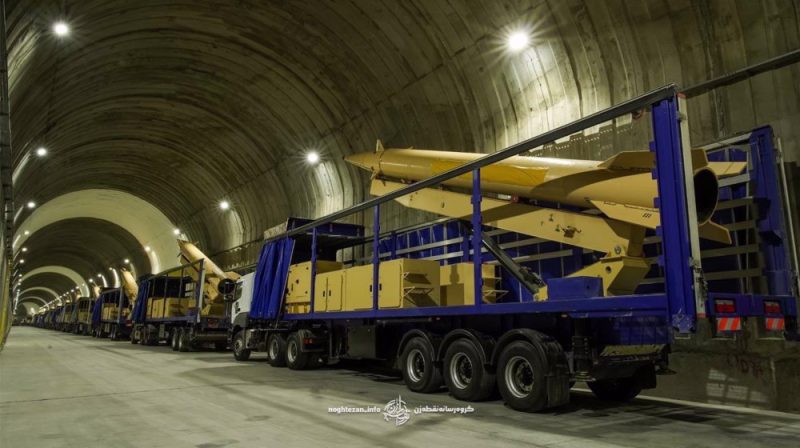
By Ivan Kesic | Press TV | March 26, 2025
The Islamic Revolution Guards Corps (IRGC) on Tuesday unveiled its largest underground missile city at an undisclosed location, sending a powerful message to enemies about Iran’s growing military prowess and complete readiness for any eventuality.
The subterranean facility was revealed in the presence of Chief of Staff of the Iranian Armed Forces, Major General Mohammad Bagheri, and IRGC Aerospace Commander, Brigadier General Amir Ali Hajizadeh.
Its unveiling comes amid escalating threats and blatant warmongering from the Donald Trump administration and the Israeli regime, prompting Iran to showcase its military preparedness to defend the homeland.
Just three days prior, the IRGC had unveiled new missile systems on three strategic islands in the Persian Gulf, capable of striking enemy bases, vessels, and assets across the region.
In recent years, the IRGC has released images of various underground bases, but this latest facility stands out as the largest yet, both in scale and firepower.
What ballistic missiles are stored in this underground base?
During the latest unveiling, it was revealed that a wide array of ballistic missiles—including Kheibar Shekan, Haj Qasem, Emad, Sajjil, and Ghadr-H, as well as Paveh cruise missiles—are stored in this missile city.
In a single frame, at least 78 Kheibar Shekan or Haj Qasem missiles were visible, with additional footage showing tunnels filled with dozens more, suggesting that the base houses at least hundreds, if not thousands, of missiles.
Some of these missiles, such as Kheibar Shekan, Ghadr, and Emad, were used in the True Promise I and II retaliatory operations against the Zionist entity last year that sent shockwaves across the world.
These operations demonstrated Iran’s capability to strike Israeli military and intelligence targets with high precision, penetrating much-hyped and advanced Israeli and American air defense systems.
During his visit to the facility, Major General Bagheri emphasized that “Iran’s iron fist is far stronger today than before,” stating that the current missile capacity is ten times greater than during past operations.
He further asserted that “the enemy will definitely fall behind in this balance of power,” signaling Iran’s continued advancement in missile development and underground military infrastructure.
What is the purpose of underground bases?
Iran’s underground missile bases are fortified military facilities constructed beneath the Earth’s surface to store, maintain, and launch ballistic missiles of short (SRBM), medium (MRBM), and intermediate range (IRBM).
Often referred to as “missile cities” by Iranian officials, these bases form a key component of Iran’s defense strategy, designed to shield its vast and burgeoning missile arsenal from detection and destruction during conflicts.
In addition to offering natural protection against aerial threats, these underground bases allow military operations to be carried out in complete secrecy, avoiding exposure to aerial reconnaissance.
The exact number of these facilities remains a closely guarded secret, but estimates suggest there are dozens of them, mostly located in the western mountainous regions.
Brigadier General Hajizadeh in a TV interview recently commented on the vast number of missile bases in the country, stating, “If we unveil a missile city every week for the next two years, it will still not be finished.”
The IRGC has frequently released footage from these underground bases, and analysis of tunnel shapes and weaponry confirms that they are distinct facilities.
In 2018, the IRGC announced the relocation of missile factories to underground bases, marking the first time images from a subterranean ballistic missile production plant were publicly released.
Beyond missile bases, Iran has also constructed underground air bases for jet fighters, underground naval bases for speedboats and missiles, and underground drone facilities.
How protected are these underground bases?
With modern satellite, reconnaissance, and intelligence technology, fully concealing the locations of such underground bases is impossible, particularly due to excavation debris and construction logistics.
However, this does not make them vulnerable, as they are typically carved into mountains, with depths reported to reach up to 500 meters, providing protection against airstrikes and nearly all bunker-busting munitions.
All critical facilities are located hundreds of meters inside the mountains and are practically indestructible, with multiple entrances and exits being their only potential weak points.
To mitigate this, each base has up to several dozen entrances. The destruction of one or even a few does not cause significant damage, as they are typically hundreds or thousands of meters apart, separated by multiple tunnel gates.
Iran has refined camouflage techniques and the creation of false entrances to ensure operational continuity, even under complete enemy air dominance.
Based on published images and videos, these bases feature arched tunnel designs, optimal for load distribution, arranged in either linear or grid formations.
Tunnels range from 6 to 12 meters in width, sometimes reinforced with concrete ceilings, and serve as corridors, missile storage areas, and parking spaces for transporter-erector launchers (TELs).
In some cases, high halls are visible, suggesting the utilization of natural caves to reduce excavation costs and complicate hostile intelligence assessments based on excavation debris.
How are ballistic missiles stored in these bases launched?
Ballistic missiles stored in these bases are launched in two ways: either by deploying the transporter-erector launcher into the open or using vertical silos.
Each base contains numerous silos—often several dozen—as they, along with entrances, are potential vulnerabilities.
Once a silo is used, the hot exhaust trail from rocket engines irreversibly reveals its position, making it a prime target for aerial bombs or cruise missiles.
To counter this, Iran has developed unique underground launch methods to enhance both effectiveness and stealth.
In 2020, Iran released footage of an underground missile system capable of launching multiple ballistic missiles from a single silo in rapid succession.
In other countries with underground missile bases—where such facilities are typically used for bulky intercontinental ballistic missiles (ICBMs) within nuclear deterrence strategies—each silo usually holds only one missile.
By contrast, Iran’s system functions more like a “semi-automatic” magazine-fed launcher, rather than a “single-shot” silo.
Footage shows five Emad missiles positioned for vertical launch on a single rail car, which then moves down a high tunnel toward the launch site.
The tunnel’s length and rail system suggest it can rapidly launch dozens of missiles before a potential counterstrike, with multiple silo openings likely enabling continuous barrages.
That same year, during the Payambar-e-A’azam (The Great Prophet) 14 drills, Iran demonstrated a unique camouflaged underground ballistic missile launch, bypassing conventional platforms and equipment.
Brigadier General Hajizadeh stated that Iran was the first country in the world to achieve such a launch capability, posing significant challenges to enemy intelligence agencies.
The released video shows two missiles launching from different locations on what appears to be an untouched surface, suggesting that the vertical launch tubes were constructed from below rather than being dug from above and later camouflaged.
This demonstration signaled that Iran’s underground missile bases, often covering dozens of square kilometers, may house countless concealed silos.
The High Price of War with Iran: $10 Gas and the Collapse of the US Economy
By Dennis J. Kucinich | March 25, 2025
Israel is currently in turmoil, marked by widespread protests demanding Netanyahu’s resignation. Critics accuse him of prolonging war for political gain, while his dismissal of top security officials and ongoing attacks on the judiciary have further intensified the unrest.
Meanwhile, Washington DC’s drumbeat for war never stops. It’s always at the expense of a decent and secure standard of living for people in this country and abroad.
The Trump Administration, after the series of heady airstrikes against Yemen, is at this moment being beseeched by Netanyahu and his associates to prepare for a seemingly consequence-free nuclear strike against Iran, completing the trifecta of Netanyahu’s long-standing dream.
I have consistently warned against the consequences of an attack on Iran, delivering 155 speeches to the House, 63 presentations alone in the 109th Congress, between 2005 and 2007, when the Bush Administration deliberated using nuclear “bunker-busters” as a means of bringing Iran to heel.
I understood the politics then and I understand them today. I warned hundreds of times that it was not in America’s interests to go to war against Netanyahu’s hit list: Iraq, Iran, Libya…
IRAQ
In 2002, the Bush Administration caused Americans grieving over 9/11 to believe Iraq had a direct role in the attacks which took over 3,000 lives. Except, Iraq had nothing to do with 9/11.
Bush claimed Iraq was pursuing nuclear weapons and other “Weapons of Mass Destruction” (WMDs) and was an imminent threat to the U.S. Iraq did not have WMD’s. Iraq was not a threat to the U.S. Iraq had no ability to attack America. Didn’t matter.
The war against Iraq began 22 years ago and lasted eight years. One million innocent Iraqi men, women and children perished because of lies. They were killed in relentless bombings and aggressive ground operations.
At least 4,443 U.S. servicemen and women were killed, and an estimated 32,000 wounded during “Operation Iraqi Freedom,” because of lies.
The lies cost U.S. taxpayers at least $3 trillion. Three trillion hard-earned tax dollars of the American people were spent to pay for the destruction of the people of Iraq while Americans struggled to pay bills for housing, health care, and education and the nation went further into debt.
Remember this diabolical playbook: Create a pretext. Lie to the American people about a threat. Hype the threat. Create irrational fear. Tell them military action is needed to eliminate the threat, and their fears. Bombs away.
On September 12, 2002, as a Member of Congress, I grilled then-former Israeli Prime Minister Benjamin Netanyahu during a congressional hearing entitled, “An Israeli Perspective on Conflict with Iraq” (video and transcript link below). Despite evidence to the contrary, he testified that Iraq and its leader, Saddam Hussein, were a direct threat to America due to an alleged pursuit of WMDs including a nuclear weapon. He urged the U.S. to take military action against Iraq.
I inquired of him who else he would have the United States attack.
“Iran and Libya,” he said.
I spoke to Mr. Netanyahu outside the hearing room and asked him that if he was so convinced those countries were a threat, why didn’t Israel commence the attacks?
“Oh no,” he responded. “We need you to do it.”
On October 10, 2002, the House of Representatives, by a vote of 296-133, authorized the use of military force against Iraq. I led the opposition. The war bill passed the Senate the next day, 77-23, and was signed into law by President Bush on October 16, 2002.
On March 20, 2003, the President describing Iraq as part of an “Axis of Evil,” commenced a “Shock and Awe” onslaught by American warships, aircraft and submarines, launching cruise missiles and “precision guided bombs” roundly murdering people in Baghdad. Iraq was destroyed. Saddam was deposed, captured and hung.
Libya
On March 19, 2011, despite lacking formal congressional authorization, President Barack Obama authorized an attack on Libya to depose Muammar Gaddafi. I led the opposition. Hillary Clinton’s State Department, the EU, NATO, the UK and France to name but a few, lobbied Congress hard to accelerate actions against Libya.
That country’s leaders were dumbfounded as to why, considering that they had done everything America had asked, such as open markets to foreign investment. I held up the bombing for some time by building a bi-partisan coalition of Members of Congress to vote no.
Alas, Obama and the Clinton State Department prevailed. Republican Speaker of the House John Boehner negotiated a redraft of the authorization bill and the Republicans fell in line.
The U.S., with NATO allies, joined forces, wreaking destruction and havoc upon Libya. Gaddafi was deposed, captured and killed, at an estimated cost of over a billion dollars. Obama admitted years later that this was the worst decision of his Presidency.
Iran
On July 25, 2024, Prime Minister Netanyahu, (while under a criminal investigation by the Israeli judiciary), addressed the U.S. Congress concerning Iran, which he characterized as not only a deadly enemy of Israel, but also of the United States.
“Iran’s axis of terror confronts America, Israel and our Arab friends,” Netanyahu declared.
The interests of Israel and America were and are inseparable, he proclaimed – to 58 standing ovations. One could take that heroic reception as rubberstamping an authorization for war. As Netanyahu had told me years ago, “…we need you [the U.S.] to do it.”
Today, the Houthis of Yemen continue their attacks on Israeli shipping interests in the Red Sea, in protest to the Netanyahu government’s genocidal attack on Gaza.
President Trump, ever sensitive to and allegiant to Israel, views the Houthis as proxies of Iran. The President directed America’s air forces to rain down fire and brimstone upon Yemen, a nation of teenagers. The median age in Yemen is 18.4 years. The country spends about 1/1000 of the U.S. military budget for its own defense.
Trump threatened the Iranian government: “Every shot fired by the Houthis will be looked upon from this point forward, as being a shot fired from the weapons and leadership of IRAN (his emphasis). And IRAN will be held responsible, and suffer the consequences, and those consequences will be dire.”
The Administration followed up with Executive Order (E.O.) 13902, which, according to the U.S. Treasury Department was part of a “campaign of maximum pressure” which “targets Iran’s petroleum and petrochemical sectors and marks the fourth round of sanctions targeting Iranian oil sales…”
The first Trump Administration withdrew from a Joint Plan of Action agreement (JCPOA) which provided Iran relief from sanctions in exchange for accepting limitations which would preclude nuclear weaponization.
President Trump ordered the assassination by drone strike of Iranian General Qasem Soleimani, considered the second most powerful person in Iran, at the Baghdad airport, underscoring his determination to strike at Iran.
Iran has consistently asserted its nuclear research is for peaceful purposes. There has been a long-standing formal prohibition in Islamic law, a fatwa, issued by Ayatollah Ali Khamenei, the Supreme Leader of Iran, against the development or use of nuclear weapons.
Recently, President Trump said he would love a deal to prevent Iran from having a nuclear weapon, “I would love to make a deal with them without bombing them.”
At the same time, U.S. B-52 bombers, capable of delivering nuclear bunker-busting bombs, were engaged in joint exercises with the Israeli Air Force, in preparation for a potential strike at Iran’s underground nuclear sites.
These joint maneuvers were reminiscent of the cooperation and interoperability exercises that took place between the UK and French forces in preparation for a real-world offensive against Libya in 2011.
Ayatollah Khamenei replied “…threats will get them (the Americans) nowhere,” and refused talks under such conditions as “deceptive.” Iranian Brigadier General Kiumars Heidari added, for emphasis, “Iran is ready to crush its enemies if it makes mistakes.”
The dialectic of conflict is escalating.
It was not in America’s interest then, nor is it now, to go to war with Iran, a nation of 90 million people, a technologically advanced society, with nearly a million-person army.
President Trump should not be misled. War with Iran would be the end of his presidency. Here is why:
Iran supplies 3% of the world’s oil. If the U.S. goes to war with Iran, crude oil prices per barrel (currently ranging from $68.86 (West Texas Intermediate) – $72.28 (Brent Crude), could rise to $200 per barrel.
The Strait of Hormuz, a major conduit for the transport of oil would be disrupted. Iran has the capability retaliate by targeting Gulf oil infrastructure, including Saudi Arabia. Market panic would ensue.
The price of a gallon of gas, currently averaging $3.13, would double, approach $7 a gallon, and in some cases, reach $10 a gallon, in states with higher fuel taxes. (This is based on historical data which calculates that every $1 increase in crude oil per barrel translates to about a 2 to 3 cent increase per gallon at the pump).
Attempts to manage supply disruptions and market distortions through the release of oil from the Strategic Petroleum Reserve would do little to offset panic buying and stockpiling by consumers. Nor would an increase in U.S. domestic drilling be sufficient to offset lost Middle East oil supplies, due to supply shortage, infrastructure constraints and limitations on refining capacity.
Major disruptions, including high inflation, recession risks, and market instability would hit the US economy. Consumer retail spending would sink while prices rose for food and other goods, as energy costs for manufacturing, agriculture and transportation spiraled out of control.
Slower economic growth would push the U.S. into a recession, with the Fed forced to try to maintain control over inflation by hiking interest rates well beyond the current 4.25% – 4.50 % range.
Auto sales would take a hit. Corporate profits in transportation, airlines, trucking would nosedive. The Dow Jones and S& P 500 would be in shock, with major selloffs. America would arrive at stagflation, high inflation rates and negative growth as it did during the 1973 Oil Embargo.
The multiple economic impacts of the 2008 subprime meltdown and subsequent financial crash which cost the US economy $16 to $20 trillion dollars would become the morbid benchmark for the descent of the American economy.
Now contemplate this concatenation: War with Iran, reciprocal high tariffs, massive cuts in the federal workforce and domestic federal spending and you have an economy in a tailspin, with high inflation, rising unemployment, falling consumer spending, leading to an economic contraction requiring a system of government intervention which is currently being dismantled. Then there is the permanent restructuring of the tax code to accelerate wealth upwards. These conditions create political combustibility.
In the end, Iran will never crush Donald Trump. The U.S. will crush itself trying to wipe out Iran.
The economic effects of war with Iran could spell the end, not only of the viability of the Trump Presidency, but of the Republican House and Senate, a political turnaround the likes of which has not been seen in American politics since the 1932 sweep led by Franklin Delano Roosevelt and the New Deal.
In 1928 Republican Herbert Hoover took 58.2% of the popular vote and defeated Democrat Al Smith 444-87 in the Electoral College. Amidst a complete rejection of Republican economic policies and the Depression, Roosevelt took 57.4% of the popular vote in 1932 and defeated Hoover in the Electoral College 472-59.
The 270-164 advantage which House Republicans held in 1928 evaporated in 1932 as Democrats crushed Republicans with a 313-117 majority.
There has not been another turnaround like this in American political history and it was driven by the economic forces which overwhelmed a Republican Administration, followed by a program of promised reform which the new Administration delivered.
While the Administration is at the fullness of its expression of unbridled power, it faces a fateful decision regarding Iran which will determine whether the mandate received by Trump in 2024 evaporates as quickly as did Hoover’s in 1932.
Israel itself is in turmoil, with mass protests calling for Netanyahu’s resignation, charges he is prolonging the war for his political benefit, his firing of top security officials and his attacks on the judiciary.
Netanyahu is on shaky ground, pummeled by his fellow countrymen and women who worry, far from ensuring the future of Israel, his deadly policies threaten it.
One could imagine Trump, considering his own and America’s interests, could call Netanyahu and say, “Bibi, we are friends ‘til the end. This is the end.”
Links: 2002 Congressional Hearing “Conflict in Iraq: An Israeli Perspective” video and transcript
Featured Video

NEW FAUCI EMAILS EXPOSE ATTACK ON NATURAL IMMUNITY
or go to
Aletho News Archives – Video-Images
From the Archives
Fourteen Incredible Facts About 9/11
By Kevin Ryan | Dig Within | August 8, 2015
… What is known about 9/11 is that there are many incredible facts that continue to be ignored by the government and the mainstream media. Here are fourteen.
- An outline of what was to become the 9/11 Commission Report was produced before the investigation began. The outline was kept secret from the Commission’s staff and appears to have determined the outcome of the investigation.
- The 9/11 Commission claimed sixty-three (63) times in its Report that it could find “no evidence” related to important aspects of the crimes.
- One person, Shayna Steiger, issued 12 visas to the alleged hijackers in Saudi Arabia. Steiger issued some of the visas without interviewing the applicants and fought with another employee at the embassy who tried to prevent her lax approach.
Blog Roll
Recent Comments
Bill Francis on European leaders’ shift in the… seversonebcfb985d9 on Villains of Judea: Philip Esfo… loongtip on Report warns that ‘Jewish terr… Craig Nelms on New study shows that toxic gas… loongtip on A Funny Thing Happened on the… loongtip on EU free trade pact on hold as… John Edward Kendrick on Regime Change In Iran Is The F… Bill Francis on Australia Passes New Hate Spee… seversonebcfb985d9 on Australia Passes New Hate Spee… Bill Francis on Britain’s AI Policing Plan Tur… loongtip on Miami Beach Resident Questione… loongtip on Israeli agricultural export co…


 Aletho News
- Trump aims to create new UN and own it, Brazil’s Lula warns
- UN rapporteur says Israeli demolition of UNRWA compound reflects broader attack on UN system
- From Proxy to Disposable: The US Betrayal of the Syrian Kurds
- Six injured in stabbing spree at Kurdish rally in Antwerp, victims stabbed ‘indiscriminately’
- US pledges to ‘starve’ Iraq of oil revenue if pro-Iran parties join new government
- Is China a threat to Greenland?
- South Korea’s Prime Minister Proposes US Send Special Envoy to North Korea — Report
- Pentagon downgrades China threat, shifts focus to homeland, hemisphere
- Ireland Moves to Legalize Spyware Use by Police
- NEW FAUCI EMAILS EXPOSE ATTACK ON NATURAL IMMUNITY
- If Americans Knew
- Another Gaza baby freezes to death on Netanyahu’s watch – Not a ceasefire Day 106
- Oppose Israel’s Abuses While You Still Can
- UNRWA Heads Tell Ha’aretz: ‘We Don’t Radicalize Palestinians – Their Lived Existence Does’
- Plans Call for “New Rafah” Built in Israel’s Image — Without Palestinians
- Posing as priest, reporter is spat at many times, highlighting anti-Christian sentiment in Israel
- Leaked Documents: “Planned Community” in Rafah Would Force Palestinians Into Israeli Panopticon
- ‘Permits of Humiliation’: How Israel Strangles Christian Education in Jerusalem
- “The world sees death, destruction and injustice – and they see dollar signs” – Not a ceasefire Day 105
- War criminal Netanyahu kills 11 in Gaza, joins Board of Peace – Not a ceasefire Day 104
- Another baby dies of cold in Gaza, as Rafah crossing remains locked down – Not a ceasefire Day 103
- No Tricks Zone
- Polar Colding…Antarctica Saw Its Coldest October In 44 Years!
- New Study: Sea Levels Rose 20 Times The Modern Rate During The Roman Warm Period
- As German Gas Storage Dips Dangerously Low…Shortage Hardly Avoidable
- New Study: Brazil’s Relative Sea Level Was 2+ Meters Higher And SSTs 3-4°C Warmer 6000 Years Ago
- Philosopher Schopenhauer: Climate Science Certainty Stems From Stupidity, Ignorance
- New Study: Species Extinction Rates Declining Since 1980 – ‘Climate Change Is Not An Important Threat’
- Denmark Places Climate Protection Above Animal Welfare, Poisoning And Culling Cows
- New Study: Greenland Was 3-7°C Warmer And Far Less Glaciated Than Today 6000-8000 Years Ago
- German Media Report That Current Frigid Weather Can Be Explained By Arctic Warming!
- Berlin Blackout Shows Germany’s $5 Trillion Green Scheme Is “Left-Green Ideological Pipe Dream”
 Aletho News