Goodbye empire? US sanctions are failing in the face of multipolarity
By Felix Livshitz | RT | January 25, 2023
Foreign Affairs, a highly influential US magazine – effectively a US empire house journal – has published an article detailing how sanctions are quickly losing their efficiency as a weapon in Washington’s global arsenal.
Published by the Council on Foreign Relations NGO, Foreign Affairs provides space for officials within the US military industrial complex to communicate with one another on matters they believe to be of the utmost significance. Therefore, it is important to pay attention when the magazine makes major pronouncements on any issue.
It recently published an appraisal of US sanctions – the conclusion being that they are increasingly ineffective, have prompted Beijing and Moscow to create alternative global financial structures to insulate themselves and others from punitive actions, and that Washington and its acolytes will no longer be able to force countries to do their bidding, let alone destroy dissenting states, through such measures in the very near future.
The article begins by noting that “sanctions have long been the US’ favored diplomatic weapon,” which “fill the void between empty diplomatic declarations and deadly military interventions.” Despite this, it predicts “the golden days of US sanctions may soon be over.”
These “golden days” were the immediate post-Cold War era, when Washington was “still an unrivaled economic power,” and therefore could at the press of a button cripple each and every overseas economy, in theory. This was due to “primacy of the US dollar and the reach of US oversight of global financial channels.”
As international trade was overwhelmingly conducted using dollars, Washington could stop any country from exporting or importing any and all goods it wished, whenever it liked. Even then, Foreign Affairs recalls, US leaders themselves worried if sanctions were applied too liberally. In 1998, then-President Bill Clinton claimed his government was “in danger of looking like we want to sanction everybody who disagrees with us.”
The Foreign Affairs article says Clinton’s fears were “overblown,” but this is precisely what came to pass. Governments, and the countries they represented, have been sanctioned for pursuing the wrong policies, refusing to be overthrown in US-backed coups and military interventions and showing any degree of independence in their domestic or foreign dealings whatsoever. In the process, millions have died, and even more lives have been ruined for no good reason.
This approach has backfired, and badly. In response, states “have begun to harden their economies against such measures.” For example, after the US cut off Iran from the SWIFT global banking system, many other countries took note. Restricting China’s access to numerous technologies as part of the new Cold War has also served to place both Washington’s allies and adversaries alike “on notice their access to crucial technology could be severed.”
Beijing and Moscow lead the way in the push to create “financial innovations that diminish US advantage,” creating a raft of “currency swap agreements, alternatives to SWIFT, and digital currencies” that serve as “preemptive measures” against any “potential penalties” down the line.
Currency swaps, which connect central banks directly to each other and eliminate the need for trades between them to be dollar-backed, have been eagerly embraced by China. It has signed deals of this kind with more than 60 countries across the world, thereby enabling its companies “to circumvent US financial channels when they want to.”
In 2020, Beijing settled more than half its annual trade with Moscow in currencies other than the dollar, making the majority of these transactions totally immune to US sanctions, and that figure has only risen ever since. In March that year also, the China and Russia-led Shanghai Cooperation Organization officially prioritized development of payments in the local currencies of its members.
Beijing and Moscow are also, Foreign Affairs reports, “busily preparing their own alternatives” to various Western-dominated international systems. Their alternative to SWIFT, the Cross-Border Interbank Payment System, isn’t yet a match in terms of transaction volume, but that’s not the point. It prevents them, and any state or organization enrolled in the framework – 1,300 banks in over 100 countries already – from being unable to make international financial transactions, should they be cut out of SWIFT.
Similarly, China is expanding the reach of the digital renminbi, the currency issued by Beijing central bank, at home and overseas. More than 300 million of its citizens already use it, and a billion are forecast to by 2030. The currency is completely sanctions-proof as the US has no ability to prevent its use, and Beijing has encouraged several countries to pay for its exports exclusively using it – “other such deals will probably follow,” Foreign Affairs predicts.
The American empire’s obsessive reliance on sanctions has now created a Catch-22 situation, by the magazine’s reckoning. The already hostile relations between the USA, China and Russia mean Moscow and Beijing are pushing ahead with this revolutionary effort no matter what. If “things get worse,” they’ll simply “double down on their sanctions-proofing efforts,” taking more and more countries with them.
“These innovations are increasingly giving countries the ability to conduct transactions through sanctions-proof channels. This trend appears irreversible,” the article bitterly concludes. “All this means that within a decade, US unilateral sanctions may have little bite.”
It is all these developments, along with Moscow’s economic pivot eastwards after the 2014 Ukraine coup, and move towards self-sufficiency in energy and food and in other vital resources, which account for the embarrassing failure of US-led sanctions against Russia.
Western leaders, academics, journalists, pundits and economists promised when these sanctions were imposed that they would soon lead to Russia’s total political, economic and military collapse. They have not, demonstrating that elites in Europe and North America do not understand the global economy they claim to rule. They should get to grips with the new reality they inhabit in short order, though – for a multipolar world has begun to emerge in 2022, and it is here to stay.
How rapidly US elites are reckoning with the radically different reality in which they are now forced to operate is ironically underlined by how quickly the author of the Foreign Affairs article, Agathe Demarais, seems to have completely changed her tune on the subject of sanctions. On 1 December, less than a month earlier, she authored a piece for Foreign Policy – another US empire in-house journal – that offered a radically different take on the matter.
Boldly declaring “sanctions on Russia are working” in the headline, Demarais dismissed suggestions punitive Western measures were intended to “force Putin to back down and pull out of Ukraine,” or to provoke “regime change” in Moscow, or to prompt “a Venezuela-style collapse of the Russian economy,” despite the fact every single one of these outcomes was explicitly cited as a motivating factor behind the sanctions by Western officials, pundits, and journalists at the time.
Instead, she argued, sanctions were effective in the quest to “send a message to the Kremlin” that “Europe and the United States are standing with Ukraine.”
Whether or not Kiev will be thrown under a bus by its Western backers in due course, and the anti-Russian measures will endure after the war is over, seems to not matter so much, though – for, as Demarais was herself forced to acknowledge less than four weeks later, the effectiveness of sanctions is rapidly diminishing. The speed of this about-face could well be an indication of how irresistibly the multipolar world is coming to be.
US renews waiver for gas field shared by Iran and UK
Press TV – January 24, 2023
The US government has renewed a sanctions waiver for the Rhum gas field in the UK North Sea in which Iran has a 50% stake.
Iran is heavily sanctioned by the United States, but Britain’s Serica Energy which owns another 50% of the field has repeatedly secured waivers to maintain production from the field.
In a statement, Serica said it had secured another waiver extension that ensures that all companies linked to the field can provide services and goods without fear of US penalties.
“We are grateful to the UK government and regulatory authorities who have supported us in this process,” Serica Chief Executive Mitch Flegg was quoted as saying.
Serica Energy is responsible for 5% of the gas produced in the UK which is currently in turmoil over runaway prices of energy in the wake of the Ukraine war.
The UK firm expects its net production to increase by between 50 and 80 percent this year and that level of production to continue into 2025.
This would mean that the company would be producing up to 40,000 barrels of oil equivalent per day, reports said.
Rhum, a gas filed located 240 miles (390 km) northeast of Aberdeen in Scotland, is one of the largest on the UK Continental Shelf.
Iran owns half of the stakes at the gas field based on a deal signed before the Islamic Revolution of 1979. The field is believed to be capable of producing more than five million cubic meters of natural gas.
Washington has imposed a series of harsh sanctions on Iran’s energy sector since 2018 when it pulled out of an international nuclear deal.
Pressure hardening
The Biden administration, however, is hardening its position. The Iraqi government is reportedly under immense pressure from Washington to stem the alleged flow of dollars into Iran.
In recent weeks, Iraq’s currency market has been wracked by turmoil after the US introduced tighter controls on international dollar transactions by commercial Iraqi banks in November.
Reports said the move was designed to curb the alleged siphoning of dollars to Iran and apply more pressure along with US sanctions imposed on the Islamic Republic.
Iraqi MP Aqeel al-Fatlawi, however, said Washington was deliberately using the new regulations as a political weapon.
“Americans are using the dollar transfer rigid restrictions as warning messages to Prime Minister Sudani to stay tuned with the American interests. ‘Working against us could lead to bringing down your government’ – this is the American message,” the lawmaker said.
The price of consumer goods has increased and the Iraqi currency has taken a beating in the wake of the US restrictions.
And it has deepened anti-American sentiment among politicians in Iraq, which remains unstable nearly 20 years after a US-led invasion toppled Saddam Hussein.
The US is also targeting Iran’s other major trade partners. On Monday, the Biden administration’s top Iran envoy said it will increase pressure on China to cease imports of Iranian oil.
China is the main destination of exports by Iran, and talks to dissuade Beijing from the purchases are “going to be intensified,” US Special Envoy for Iran Robert Malley told Bloomberg Television.
The US reimposed sanctions on the Islamic Republic and its petroleum exports in 2018 after pulling out of the nuclear agreement, with then president Donald Trump pledging that Washington was set to bring Iran’s oil exports down to zero.
That goal never realized, with Iranian sales continuing to reach the market despite the US “maximum pressure” to curb them.
“We have not lessened any of our sanctions against Iran and in particular regards to Iran’s sale of oil,” Malley said.
Iranian crude shipments have surged in recent months, including to China, the world’s biggest importer.
Malley said the US will “take steps that we need to take in order to stop the export of Iranian oil and deter countries from buying it”.
Israel, US start week of military drills involving thousands of troops, nuclear bombers
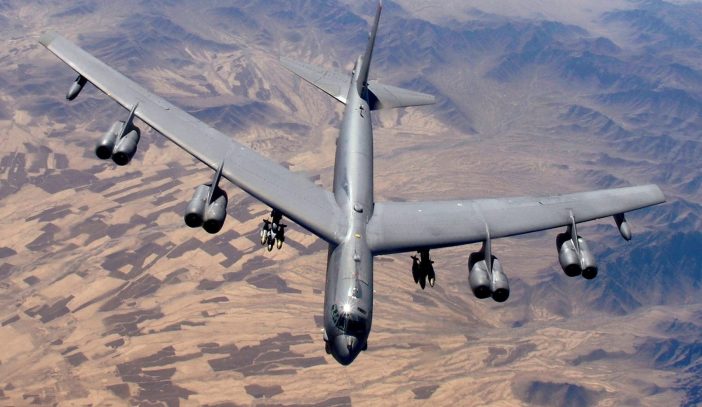
RT | January 23, 2023
The US and Israeli militaries began their largest-ever joint exercise on Monday, seeking to hone seamless coordination of their forces and prove a point to Iran about their readiness to fight a conflict in the Middle East even as Washington juggles rising tensions with Russia and China.
“I do think that this scale of the exercise is relevant to a whole range of scenarios, and Iran may draw certain inferences from that,” a senior US defense official told reporters. “It would not surprise me if Iran, you know, sees the scale and the nature of these activities and understands what the two of us are capable of doing.”
Dubbed Juniper Oak, the exercise will involve over 140 aircraft, including nuclear-capable bombers and F-35 fighter jets, as well as 12 warships and about 7,500 troops, according to US Central Command (CENTCOM). It’s designed to improve the “interoperability” of both forces.
“What we think this exercise demonstrates is, we can walk and chew gum at the same time,” the unidentified defense official told NBC News. Despite the Pentagon’s growing focus on China and its efforts to help Ukraine defeat Russian forces, he added, “We still have the excess capacity to be able to flex to another high-priority area of responsibility and conduct an exercise on this scale.”
Juniper Oak is an all-domain exercise, meaning it will include naval, land, air, space and electronic-warfare drills. It will run from Monday through Friday in Israel and the eastern Mediterranean Sea. The US will reportedly employ four HIMARS rocket launchers, laser-guided bombs and stealth cruise missiles. The event will culminate with the firing of 180,000 pounds of live munitions while simulating an electronic attack and suppressing enemy air defenses.
“This is a sign that we continue to have Israel’s back at a time when there’s lots of turbulence and instability across the region,” the defense official said. The source added, “If there’s a sense that Americans are distracted, or the Americans are going away from the Middle East, and therefore they have free rein for their malign activities, I think this will disabuse them.”
“I suspect Iran will take note of that, but not only Iran. China will take note of that, Russia will take note of that, other folks will take note of that.”
FM: Iran to Possibly Quit NPT if Europe Not Stop Hostile Stances
Al-Manar | January 22, 2023
If the Europeans do not change their anti-Iran positions, Iran will possibly withdraw from the NPT as a countermeasure, the Iranian Foreign Minister said on Sunday.
Reacting to a recent move by the European Union to designate the IRGC as a “terrorist” entity, Hossein Amir-Abdollahian told reporters on Sunday, “Parliament’s Sunday measure that binds the government to designate the armies of the European countries as terrorist is a countermeasure.”
Referring to his conversations with EU Foreign Policy Chief Josep Borrell, Amir-Abdollahian said that the resolution is not binding and it’s just an expression of the feelings of a part of the European Parliament representatives.
Answering a question about whether withdrawal from the NPT would be one of Iran’s countermeasures, Amir-Abdollahian said, “A small number of European political leaders, including the German Foreign Minister, have no experience in the field of diplomacy.”
Therefore, if they do not move in the direction of rationality and do not correct their positions, any measure is possible, he noted.
‘Globalization Has Died and Davos 2023 Was Its Funeral Ceremony’
Sputnik – 21.01.2023
The World Economic Forum’s annual meeting took place in Davos on January 16-20, 2023. International observers sat down with Sputnik to formulate the main message of the gathering in a nutshell.
“This year’s forum featured the new state of the world: divided, resentful, and grim,” Gal Luft, director of the Washington-based Institute for the Analysis of Global Security, told Sputnik. “Davos has become the dressing room of the West and is more divorced than ever from the rest. It no longer represents the real concerns of most of the world’s population. Its obsession with climate change, social justice, gender and other forms of wokeness has made it a laughing stock and target of disdain for most of the world.”
The World Economic Forum (WEF), an international non-governmental and lobbying organization, was founded in January 1971 by German economist Klaus Schwab. Initially the entity was called “European Management Forum”; it changed its name to the World Economic Forum in 1987.
Bringing together business executives, thought leaders, and prominent politicians, the forum sought to become a global platform to spearhead the ideas of globalization and solve pressing economic and political dilemmas. However, some Western commentators observed that the forum quickly morphed into a technocratic globalist elitist club which sought to dictate rules for the rest of the world.
“Globalization was based on the premise of broad acceptance of global institutions, norms and rules, as well as reasonably free flow of goods, money and information,” Luft said. “Each one of those has been compromised over the past few years, first with the US-China decoupling and second with the war in Europe. Instead, we have global bifurcation into two camps – the collective West plus honorary members and all the others – and the emergence of new institutions, alliances, financial instruments, trade blocs and priority sets.”
“There is no return to the post-WWII system. In addition, we are seeing massive repudiation of some of the institutions and individuals who have been most associated with globalization: the media, Davos, entertainment industry etc. De-globalization can also be seen along cultural fault lines. Western ideas, ethics, and ‘values’ are rejected by billions who see them as dangerous and destabilizing,” the US scholar continued.
Russia’s Independence Doesn’t Fit in Davosian ‘Ideal World’
The necessity to “defeat” Russia became a leitmotif of the gathering, with German Chancellor Olaf Scholz declaring that to end the ongoing conflict in Ukraine, the Russian special operation “must fail.” The chancellor called for stepping up military aid for Ukraine, but fell short of confirming that Berlin would send its Leopard 2 main battle tanks to Kiev, something that the Ukrainian regime, Poland, Finland, and the UK are urging him to do.
For his part, Harvard Professor Kenneth Rogoff, former chief economist at the International Monetary Fund (IMF), urged the West not only to step up anti-Russia sanctions, but to create conditions for “regime change” inside Russia.
“The forum in Davos is a congress of adherents of globalism,” Konstantin Babkin, president of the Rosagromash Association and co-chair of Moscow Economic Forum (MEF), told Sputnik. “These people would like to see a unified world where global corporations rule, dominating even the official state structures. What is happening in Ukraine contradicts their ideas of an ideal world. Many multinational corporations had to leave Russia. So, [Russia] has fallen out of the control of these Western corporations. This contradicts their ideas about the ideal state of affairs.”
While the Davos participants insisted that it is necessary to support Ukraine and to make sure that Russia obeys the rules established by the West, it appears that many countries have tired of this bellicose rhetoric, according to Babkin.
‘Biodiversity’ in Economy & Politics Instead of Global Unification
The Western-centric globalized world order is falling apart at the seams, with other countries adopting a non-aligned status and implementing their own scenarios of development in terms of their financial policies, foreign trade, and tax policies, according to Babkin. The Russian scholar argues that re-industrialization and strengthening of national economies could ensure the world’s stability and diversity of models.
“It would be nice to have different models, different states, different peoples, different cultures,” the Russian scholar said, drawing parallels with natural biodiversity. “[There will be] Iranian model, Indian model, Chinese model, Western model, and rejection of globalism. I think this is a good thing, and Russia needs to develop its own economy. I can also advise Iran, and China, and other large states, and state associations (…) I think the world that Davos is promoting is so unstable.”
Remarkably, major developing nations, including Russia and China, “have shunned the forum and inspired others to do the same,” said Luft, calling these countries a “resistance bloc.”
“In the years to come, with the inevitable departure of Klaus Schwab from the scene, the forum will lose its relevancy and will become just another exclusive overpriced Swiss club with entry ticket of $250,000,” Luft said. “It has already become a symbol of elitism and arrogance, representing the garden as opposed to the jungle, to use Josep Borrell’s terminology, and a platform to advance Western priorities.”
Babkin echoed Luft by saying that even though the Davos forum is likely to continue bringing together Western executives and politicians, it has ceased being a truly international platform and will never become what some call “the world’s government.”
“Globalization the way we know it has died and Davos 2023 was its funeral ceremony,” Luft concluded.
Unidentified drone bypasses US security at Ain al-Assad base
The Cradle | January 9, 2023
According to Iraqi media reports, US defense systems at the Ain al-Assad military base in Iraq’s western Anbar province brought down an unidentified drone that was able to bypass the facility’s security and reach “inaccessible” areas of the base.
An anonymous military source was quoted by Iraq’s Al-Maalouma news agency as saying that on 8 January, an unmanned aerial vehicle (UAV) managed to make its way through all of the base’s security rings and enter areas that are “off-limits,” before finally being shut down “with electronic systems.”
The US army is usually able to target any ‘suspicious’ aircraft before it makes its way to the first security ring, the source stated.
“The drone reached very important parts of the Ain al-Assad base, and this was the first time that this happens … The American military has not released the details of the incident because the drone passed through the missile defense systems of the Ain al-Assad base and threatened the dormitories and sanatoriums of the soldiers,” it added.
The Iraqi news agency said that it was unclear whether or not the drone was on a surveillance mission, or if it was carrying any explosives. No explosions, damages, or casualties were reported. An investigation into the incident has reportedly been opened, the agency added without elaborating further.
Five days after an illegal US drone strike on 3 January 2020 killed Quds Force Commander Qassem Soleimani, and Iraqi Popular Mobilization Units (PMU) chief, Abu Mahdi al-Muhandis, Tehran responded by showering the Ain al-Assad military base with a barrage of missiles.
The US military denied any casualties, but the Pentagon reported that over 100 US military personnel suffered traumatic brain injuries following the strike. The facility also sustained heavy material damages.
Unbeknownst to many, however, Iran responded to Soleimani’s killing with more than just an attack on Ain al-Assad. In 2021, an anonymous, high-ranking security official within the Resistance Axis told The Cradle that two senior officers, one in the US army and another in the Israeli army, were killed in a resistance operation in Iraq’s Erbil – which was carried out to avenge the illegal assassination.
Lt. Col. James C. Willis, who was involved in the Soleimani assassination and was killed in Erbil, was reported by the Pentagon – in a blatant coverup – to have died “in a non-combat incident at Qatar’s Al-Udeid base.” The Israeli, Col. Sharon Asman, was also killed in the operation and was reported to have suffered from heart failure.
Since Iran’s missile attack on Ain al-Assad, the facility has come under attack several times. Other US bases in Iraq have also been struck, and this year, attacks against US bases in Syria are increasing in frequency and intensity.
On 5 January 2020, Lebanese resistance leader, Hassan Nasrallah, vowed: “The response to the blood of Qassem Soleimani and Abu Mahdi al-Muhandis will be the expulsion of all US forces from the region.”
US assassination of Gen. Soleimani, PMU deputy chief ‘brazen attack’ on Iraq’s sovereignty: PM
Press TV – January 6, 2023
Iraqi Prime Minister Mohammed Shia’ al-Sudani has paid tribute to top Iranian anti-terror commander General Qassem Soleimani and his Iraqi trenchmate Abu Mahdi al-Muhandis, who were killed in a US drone strike near Baghdad airport three years ago, stating that their targeted killings were actually “a brazen attack” on Iraq’s sovereignty.
“The crime of assassinating the ‘Commanders of Victory’ and their companions represented a flagrant violation of Iraq’s territorial integrity and national sovereignty. The targeted killings of the commanders, who had a leading role in elimination of the scourge of terrorism, is an utter disrespect to bilateral agreements [signed between Baghdad and Washington],” Sudani said at a Thursday ceremony in the capital Baghdad in commemoration of the two legendary commanders.
“We woke up on January 3, 2020 to hear the terrible news about assassination of Abu Mahdi al-Muhandis, the second-in-command of the Popular Mobilization Units (PMU), and Gen. Qassem Soleimani, who was on an official visit to Iraq,” he added.
The Iraqi prime minister went on to denounce the administration of former US president Donald Trump over its brazen attack on Iraq’s territorial integrity and sovereignty.
“The fight against dark terrorism requires power and resilience, and this came through the national spirit of all Iraqis and the fatwa (religious edict) issued by Iraq’s leading religious authority [Grand Ayatollah Ali al-Sistani],” Sudani pointed out.
He highlighted that his government is working to build a solid foundation for Iraqi sovereignty, is independent in decision-making, forges relations on the basis of common interests, safeguards the sovereignty of the country’s soil and territorial waters, and spares no effort to repel any act of aggression against the Iraqi nation and its guests.
Moreover, Chairman of the Iraqi Supreme Judicial Council Faiq Zidane decried the assassination of Muhandis and Gen. Soleimani as “a vile and cowardly act.”
He underscored that the Iraqi Judiciary bears the responsibility to shed light on all circumstances surrounding the US assassination, calling on the country’s security institutions to provide judicial authorities with all necessary documents and findings in this regard.
‘Iraq judicial chief highlights arrest warrant for Trump’
Zidan went on to note that Iraq’s Supreme Judicial Council has issued an arrest warrant for former US president Donald Trump over the assassination of General Soleimani and the PMU deputy chief.
The council’s president said that Trump has confessed to his “crime” in relation to the assassination of the “Leaders of Victory.”
He called upon all Iraqi officials involved in investigations over the targeted killings to try their utmost, and identify all related architects, organizers and culprits.
Chairman of Hashd al-Sha’abi Falih al-Fayyadh also stated that Muhandis devoted his life for the protection of Iraq, and the ‘Commanders of Victory’ fought enemies when the country was behest with its worst problems.
General Soleimani, commander of the Quds Force of Iran’s Islamic Revolution Guards Corps (IRGC), Muhandis, and their companions were assassinated in a US drone strike authorized by Trump near Baghdad International Airport on January 3, 2020.
Two days after the attack, Iraqi lawmakers approved a bill that required the government to end the presence of all foreign military forces led by the US in the country.
Both commanders were highly revered across the Middle East because of their key role in fighting the Daesh Takfiri terrorist group in the region, particularly in Iraq and Syria.
On January 8, 2020, the IRGC targeted the US-run Ain al-Asad base in Iraq’s western province of Anbar with a wave of missile attacks in retaliation for the assassination of Gen. Soleimani.
According to the Pentagon, more than 100 American forces suffered “traumatic brain injuries” during the counterstrike on the base. The IRGC, however, says Washington uses the term to mask the number of the Americans who perished during the retaliation.
Iran has described the missile attack on Ain al-Assad as a “first slap”.
Qassem Soleimani in Venezuela: The lesser known motive behind his assassination
By Hasan Illaik | The Cradle | January 3, 2023
On 3 January 2020, the US military assassinated Iranian Major General Qassem Soleimani, the commander of the elite Quds Force in the Islamic Revolutionary Guard Corps (IRGC), along with his companion, the deputy head of Iraq’s Popular Mobilization Units, Abu Mahdi al-Muhandis.
Three years later, the motives for this decision – and its timing -are still being debated. The reasons for the US’s shock killing, however, may not be solely related to Soleimani’s role in regional conflicts, but could also arguably stem from his growing international clout.
Why was Soleimani assassinated?
Soleimani was reportedly responsible for leading Iran’s plan to surround Israel with an arc of missiles and precision drones in the West Asian region – from Lebanon to Syria, Iraq and Gaza, all the way to Yemen – which was viewed by Israeli officials as an existential threat to the Jewish state.
The US has long accused Soleimani of being behind much of the resistance it faced after invading Iraq in 2003, as well as allegedly ordering operations against US forces in the period leading up to his assassination.
The Quds Force commander – along with Muhandis – were critical in the Iraqi effort to defeat ISIS, outside of the control and agenda of the US and its regional allies, who often used the terrorist group to secure political and geographic gains.
Furthermore, the US held Iran, and by extension Soleimani, responsible for the Yemeni attack on Saudi Arabia’s Aramco oil facilities on 14 September, 2019. The Aramco attack was so massive that it disrupted half of Saudi oil production, and was the largest of its kind since former Iraqi President Saddam Hussein’s invasion of Kuwait in 1990.
A leader in the Resistance Axis
Soleimani was the “keyholder” in the Axis of Resistance, according to an Arab politician with strong ties to decision-making circles in both Washington and Riyadh.
“Hajj Qassem,” says the politician, was uniquely capable of making decisions and then implementing them, which is considered a “rare advantage” among leaders. He was able to achieve significant strategic results – rapidly – by moving freely and negotiating directly with various statesmen, militias, and political movements.
Examples of this are rife: The Quds Force commander persuaded Russian President Vladimir Putin in 2015 to intervene militarily in Syria, and organized the complex ‘frenemy’ relationship between Turkiye and Tehran through Turkish intelligence director Hakan Fidan.
Soleimani played a pivotal role in preventing the fall of Damascus, maintained and developed important links with Lebanese resistance movement Hezbollah in Beirut, led a region wide campaign to defeat ISIS, and successfully managed the delicate balances between various political components in Iraq. In Yemen, he was able to supply the Ansarallah movement with training and arms that arguably changed the course of the Saudi-led aggression.
Together or separately, the aforementioned points made him a desired target of assassination for both the US government and the security establishment in Israel.
A visit to Venezuela
There may, however, be additional factors that contributed to the US decision to assassinate Soleimani on 3 January, 2022. While some analysts cite, for instance, the storming of the 2019 US embassy in Baghdad by demonstrators three days before the extrajudicial killing, US decision makers were unlikely to have mobilized its assassins in reaction to this relatively benign incident.
More significant for them would have been Soleimani’s unannounced trip to Venezuela in 2019, which crossed Washington’s red lines within its own geographic sphere of influence.
His visit to the South American country was publicly revealed more than two years later by Venezuelan President Nicolas Maduro, during an interview with Al-Mayadeen in December 2021.
Maduro stated that Soleimani visited Caracas between March and April 2019, during which time the US launched a cyber and sabotage attack on Venezuela, resulting in widespread power outages. He glorified the Iranian general as a military hero who “combated terrorism and the brutal terrorist criminals who attacked the peoples of the Axis of resistance. He was a brave man.”
Although Maduro did not reveal the exact date of the visit, it can be assumed that it took place on 8 April, 2019, and that Soleimani came on board the first direct flight of the Iranian airline Mahan Air between Tehran and Caracas.
At that time, the US attack on Caracas was at its peak: Washington’s recognition of Juan Guaidó as president of Venezuela, comprehensive economic sanctions, and then, at the end of April, the organization of a coup attempt that succeeded only in securing the escape of US-backed opposition leader Leopoldo Lopez to the Spanish embassy.
Expanding military ties with Caracas
During Soleimani’s Caracas visit, military cooperation between Iran and Venezuela was likely a key topic of discussion. Prior to his visit, Maduro had announced the establishment of “People’s Defense Units,” or revolutionary militias, to maintain order in the face of US-backed coup attempts.
Both Iranian and Latin American sources confirm that Tehran had a role in organizing these militias. However, the most significant military cooperation between the two countries has been in the field of military industrialization.
Since the tenure of late, former President Hugo Chavez, Venezuela has been working on a project to manufacture drones. This was announced by Chavez on 13 June, 2012, noting that “We are doing this with the help of different countries including China, Russia, Iran, and other allied countries.”
A few months earlier, the commander of the US Army’s Southern Command SOUTHCOM (its assigned area of responsibility includes Central and South America), General Douglas Fries, spoke about the same project, downplaying its importance by claiming that Iran was building drones with “limited capabilities” in Venezuela for internal security purposes.
Developing drones
In fact, Iran, represented by Soleimani’s Quds Force, was busy increasing military cooperation with Venezuela by developing new generations of drones and providing Caracas with spare parts for its existing American-made aircrafts. Interestingly, the raising of the Iranian flag has become routine in the Venezuelan Air Force’s military ceremonies.
On 20 November, 2020, President Maduro delivered a speech announcing plans to produce different types of drones. Near him, on display, was a miniature model of a drone which appeared to be that of the Iranian “Muhajer 6” aircraft that entered service in Iran in 2018.
This issue was raised by then-Israeli Minister of Defense, Benny Gantz, while receiving the heads of American Jewish organizations in February 2022.
Soleimani’s legacy in Latin America
These developments were the direct result of Qassem Soleimani’s efforts. A Venezuelan official has confirmed to The Cradle that the country’s drone project was built with full Iranian support: from training engineers to setting up research and manufacturing centers, all the way to production.
In October 2019, the commander of US Southern Command, Navy Admiral Craig S. Faller, warned that Russia, China, Iran and Cuba were operating in varying capacities in SOUTHCOM’s area of responsibility. He noted, specifically, that Iran’s influence and presence is being felt in South America.
In March 2020, the US SOUTHCOM commander repeated the same warning, placing Iran at the “top of the list of countries” that have assisted Venezuela in skirting US sanctions.
The US has long viewed Latin America as its “backyard” and has sought to prevent the influence of rival or hostile powers in the region through its adherence to the Monroe Doctrine. The influence of Soleimani in the western hemisphere may have been viewed as a threat to US interests and a crossing of this “red line.”
His role in assisting Venezuela in developing military capabilities, including the production of drones, was seen in Washington as a qualitative leap in Iran’s foreign relations and was likely a factor in the decision to assassinate Soleimani.
Foreign Ministry: Assassination of Gen. Soleimani by US, ‘glaring example of an organized terrorist act’
Press TV – January 2, 2023
Iran’s Foreign Ministry says the assassination of the country’s top anti-terror commander Lt. Gen. Qassem Soleimani by the United States is a “glaring example of an organized terrorist act.”
The ministry made the remark in a Monday statement, issued to mark the third anniversary of the assassination of Gen. Soleimani and his companions on the direct order of then US President Donald Trump.
“Indubitable as it is, the criminal act of assassinating General Soleimani, designed and executed by the United States, constitutes yet another glaring example of an ‘organized terrorist act’,” the statement said.
It added that based on legal and international regulations, “the American regime bears ‘definite international responsibility’ for this crime, noting that all the agents, instigators, perpetrators, aiders and abettors of this terrorist crime bear responsibility.
“In this regard, the Ministry of Foreign Affairs, in conjunction with the Judiciary of the Islamic Republic of Iran and other agencies, has adopted, from the very outset, a number of measures premised upon the legal principle of ‘combating impunity of crimes’ in order to hold the above-mentioned to account and bring them to justice,” it added.
The ministry noted that the Joint Judicial Committee between Iran and Iraq also continues its work to follow up on the US act of terrorism.
Elsewhere in the statement, the ministry said that in cooperation with other relevant institutions, it has “set up the Special Committee on Legal and International Follow-up of the Assassination Case of General Soleimani and His Companions.”
“Ever since its establishment, the Committee has been investigating and pursuing the legal aspects of the case and has thus far taken several measures to press the issue at all domestic, bilateral, regional and international levels. The Committee is determined to proceed in all seriousness until its objectives are fully met and the international responsibility of the American government is invoked,” it noted.
“In line with its principled policies to counter terrorism and extremism, the Islamic Republic of Iran will continue to work towards the establishment of peace and stability at the regional and international levels. And although the martyrdom of General Qassem Soleimani is too great a loss for Iran and Iranians, it will by no means prevent the Islamic Republic of Iran from pursuing its lofty goals,” the statement said.
General Soleimani, commander of the Quds Force of Iran’s Islamic Revolution Guards Corps (IRGC), and his Iraqi trenchmate Abu Mahdi al-Muhandis, the second-in-command of Iraq’s Popular Mobilization Units (PMU), were martyred along with their companions in a US drone strike on January 3, 2020.
The two anti-terror commanders were tremendously respected and admired across the region for their instrumental role in fighting and decimating the Daesh Takfiri terrorist group in the region, particularly in Iraq and Syria.
Abbas Ali Kadkhodaei, who heads a special committee formed to follow up on General Soleimani’s murder case from legal and international aspects, on Saturday said Tehran is seriously pursuing a judicial process to serve justice in the case of Soleimani’s assassination, stressing that the indictment in the case is nearing its final stages.
South Caucasus: A battle of wills and corridors
By Yeghia Tashjian | The Cradle | December 30, 2022
On 12 December, under the pretext of environmentalism, dozens of state-backed “eco-activists” from Azerbaijan blocked the only land corridor connecting Armenia to Nagorno-Karabakh.
The blockade created a humanitarian crisis for the 120,000 Armenians living in Nagorno-Karabakh, cutting them off from the outside world. This is not the first time Baku has taken such a provocative action. Azerbaijan has long been pushing for the creation of the “Zangezur corridor” to connect itself to close ally Turkiye through southern Armenia, thereby cutting off the strategic Armenia-Iran border.
Tehran has opposed this project and has engaged in military exercises on its border with Azerbaijan. In October, the Iranians opened a consulate in the city of Kapan in southern Armenia as a warning to Baku and its regional allies.
Blocking the Lachin corridor
Despite this, Azerbaijan, with the support of Turkiye, has continued to pursue its goal, which has included blocking the road where Russian peacekeepers are stationed in the Lachin corridor connecting Armenia to Nagorno-Karabakh.
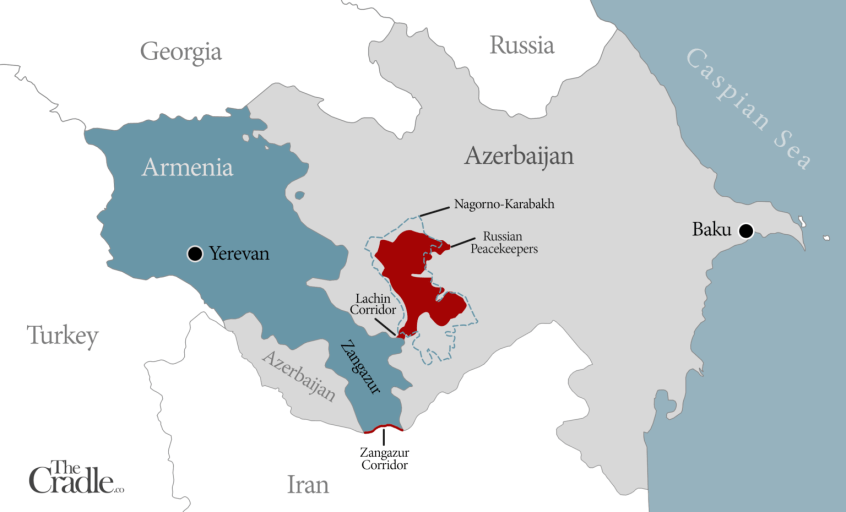
Map of Azerbaijan-Armenia conflict zones (Photo Credit: The Cradle)
In July 2022, Baku amended a contract with British company Anglo Asian Mining PLC, transferring three new mining sites inside Azerbaijan to the firm. One of these areas is located in the eastern part of Nagorno-Karabakh’s Martakert region, an area rich in gold, copper, and silver mines.
Nagorno-Karabakh’s Armenian population refused Azerbaijan’s efforts to send in monitoring groups, believing the move would give Baku control over the region’s economy and eventually lead to its annexation. In retaliation, Baku sent “environmentalists” to block the only corridor connecting Armenia to Nagorno-Karabakh.
Social media users have identified Azerbaijani state employees amid some of these “environmentalists” who periodically try to provoke Russian peacekeepers. The blockade has caused a humanitarian disaster in the region, with thousands of civilians unable to access basic necessities like medication and food via the only road connecting them to the outside world.
To compound tensions, Anglo-Asian Mining sent a letter to leading international organizations and states demanding that the “illegal exploitation” of the mines in Nagorno-Karabakh by Armenians be stopped. And yet Moscow continues to take a passive position, despite being a targeted party in the melee.
The Battle of Corridors
The blockade of the Lachin corridor did not come as a surprise, having been openly discussed in Azerbaijani media.
The only surprise was Russia’s inability to resolve the crisis. Earlier this month, Turkiye’s defense minister Hulusi Akar called on Armenia to “grasp the opportunity and respond positively to Turkiye’s and Azerbaijan’s peace calls” during joint military drills with Azerbaijan near the Iranian border.
He also commented on the “Zangezur corridor,” claiming that it was Baku’s “sincerest wish” to re-establish connections in the region and ensure “a comprehensive normalization throughout the region, including the relations between Azerbaijan-Armenia and Turkiye-Armenia.” Akar also vowed that Turkiye would continue to support Azerbaijan’s “righteous cause” against Armenia.
But on the second day of the protests organized by Azerbaijanis and the blockade on Nagorno-Karabakh, Azerbaijani media outlets made their intentions clear.
They called for the replacement of the commander of the Russian peacekeeping mission in Nagorno-Karabakh, Andrey Volkov, and for the control of the Lachin corridor to be transferred to Azerbaijan, along with the “full restoration of Azerbaijani sovereignty in the territories under the control of the peacekeepers.”
Some Azerbaijani activists also called for the removal of Russian forces and their replacement with UN-mandated forces.
Removal of Russian peacekeepers
It is unclear if Baku itself is willing to employ this language and demand the removal and replacement of Russian peacekeeping forces. According to some Azerbaijani experts, Baku is currently against the withdrawal of Russian peacekeepers by force, as this could lead to the annexation of Nagorno-Karabakh and the ethnic cleansing of Armenian Christians, which could tarnish President Ilham Aliyev’s image in the west and potentially result in US-EU economic sanctions.
Instead, Baku prefers to have the Russians stay, but in a restrictive capacity. It is easier for Azerbaijan to deal with a weak Russia, rather than with the Europeans, as they are familiar with the “Russian mentality,” says one expert. This suggests that Azerbaijan may prefer to continue using the Lachin corridor as a tool for negotiating with Moscow, rather than risking the removal of Russian forces.
Another Azerbaijani expert agreed that the current crisis is essentially between Azerbaijan and Russia – that the latter is unable to fulfill its “peacekeeping mission” and prevent the “Armenians of Karabakh from exploiting the natural resources in the region.”
But he also argues that the crisis is less about the mining and exploitation of resources, and more about pressuring the Russians to open the “Zangezur corridor,” which connects Azerbaijan proper to its Nakhichevan exclave, and lies on Iran’s strategic border with Armenia.
According to the expert, “Azerbaijan wants additional guarantees that it will have a safe connection with Turkiye, in exchange for Karabakh’s safe connection to Armenia.”
The story gets more complicated. In December, Azerbaijani media accused Armenians of inviting Iranian military experts to train Nagorno-Karabakh’s self-defense forces. The reports claim Iranians crossed the Lachin corridor and entered the territories controlled by Russian peacekeepers.
Despite Baku’s continuous barbs and provocations, it appears that Azerbaijan’s goal is not to fully remove or replace Russian peacekeepers, but rather to control their mission, monitor transit in the Lachin corridor, and use the corridor as a pressure card on Yerevan to open a “corridor” in Syunik linking Azerbaijan to Turkiye.
Therefore, from Azerbaijan’s perspective, the future of the Lachin corridor is now tied to the fate of the “Zangezur corridor.”
The view from Tehran
According to Dr. Ehsan Movahedian, researcher and instructor at the Allameh Tabataba’i University of Tehran, “the Republic of Azerbaijan is seeking a new adventure in the Caucasus region, and this issue requires diplomatic steps from the Islamic Republic of Iran and should be warning for the military authorities (in Tehran).”
One Iranian media outlet argues that if Stepanagert (the capital of Nagorno-Karabakh) falls:
“Unpleasant scenarios can be imagined for the South Caucasus region and its surrounding areas, including Iran. Removing an obstacle such as Nagorno-Karabakh paves the way for occupying Armenian territory and changing the map of the region, and in the long term for security attacks on the northwestern regions of Iran.”
The analyst, Mohammad Hossein Masumzadeh, says the only solution to halt Azerbaijan’s aggression “is offensive measures instead of the defensive approach governing the country’s regional policy in order to avoid irreparable risks.”
Some Iranian experts and former diplomats believe that the developments in the South Caucasus are related to domestic developments in Iran, where many ethnic Azeris, backed by Ankara and Baku, have called for separatist aspirations to dismantle the state from within.
Iran is concerned that the spread of Turkish influence on its northern border could impact its domestic politics in the future, as Azerbaijan has openly called for the “unification of Southern Azerbaijan (northern Iran) to the Republic of Azerbaijan.”
These do not appear to be empty threats. On 29 November, the “Organization for the Protection of the Rights of South Azerbaijanis” was established in Switzerland, announcing that it will submit documents and information to international organizations, including the UN, regarding the “rights of people in the Azerbaijani Province of Iran”.
On 2 December, the representative of “South Azerbaijan” at the UN, Araz Yurdseven, defended the idea of the independence of “South Azerbaijan” and accused Iran of committing “murders against the Iranian Azeris.”
Is the region heading for a new escalation?
Interestingly, many European and Azerbaijani experts viewed Armenian Prime Minister Nikol Pashinyan’s refusal to sign the final document of the Collective Security Treaty Organization (CSTO ) as a sign of Russian weakness, calling it “an unprecedented event that had never happened before.”
The CSTO is a Eurasian military alliance consisting of six post-Soviet states, which include Armenia, Russia, Belarus, Kazakhstan, Kyrgyzstan, and Tajikistan.
There are concerns that the region could be headed towards a new escalation. Azerbaijan has recently invited Turkish F-16 fighter jets to the region, which is being viewed as a preparation for conflict. The last time Baku invited the Turkish jets was in 2020, weeks before its war with Armenia.
Azerbaijan is also pressuring Russia to renegotiate the terms of their 10 November 2020 trilateral statement, which states that only Russian peacekeepers are responsible for controlling the Lachin corridor.
Azerbaijan is linking the blockade of the Lachin corridor to the opening of the Zangezur one. If Russia agrees to these concessions, it could lead to the isolation of Armenia, threaten its territorial integrity, and block an Iranian strategic border.
This would also shift the regional balance of power towards Turkiye, as Iran risks acting alone against Turkish-Azerbaijani pan-Turkic aspirations, which could eventually threaten Iran’s national security interests both regionally and domestically.
Russia to provide Iran with dozens of Sukhoi Su-35 fighter jets ‘in near future’

Press TV – December 28, 2022
Russia will soon provide a complete squadron of Sukhoi Su-35 fighter jets to the Islamic Republic of Iran, a development that will likely further rile up the West as Tehran and Moscow deepen their defense and economic cooperation in defiance of sweeping sanctions and coercive measures.
Media reports, citing military experts, said 24 units of the twin-engine and super-maneuverable aircraft, a fourth-generation fighter jet designed primarily for air superiority roles, will be supplied to Iran in the near future.
It is believed that the Islamic Republic of Iran Air Force (IRIAF) Tactical Air Base (TAB) 8 in the central Iranian city of Isfahan will accommodate some of the combat aircraft.
Russia’s United Aircraft Corporation (UAC) says the Sukhoi Su-35 fighter jet “combines the qualities of a modern fighter (super-maneuverability, superior active and passive acquisition aids, high supersonic speed and long range, capability of managing battle group actions, etc.) and a good tactical airplane (wide range of weapons that can be carried, modern multi-channel electronic warfare system, reduced radar signature, and high combat survivability).”
Iran hasn’t acquired any new fighter aircraft in recent years, excluding a few Russian MiG-29 Fulcrum fighters it bought in the 1990s.
Besides the MiG-29, IRIAF mainly uses locally modified F-4 Phantom II, F-14 Tomcat, and F-5E/F Tiger II planes from the 1970s that the toppled US-backed Pahlavi regime received before the 1979 Islamic Revolution.
Iran and Russia have signed major deals in recent months to boost their economic, trade, energy and military cooperation.
Iran came under an inclusive regime of American sanctions in 2018 after Washington unilaterally withdrew from the 2015 nuclear deal, officially known as Joint Comprehensive Plan of Action (JCPOA).
The United States and allies imposed a raft of similar and even tougher sanctions on Russia in February after Moscow launched a military operation in Ukraine.
Experts say US sanctions failed to reach their ultimate objective of forcing Iran into major political and military concessions. They insist the bans even created an opportunity for Iran to diversify its economy away from crude revenues and rely more on its domestic resources.
Earlier this year, Russian President Vladimir Putin said during an economic forum in Vladivostok that Russia was gaining from Western sanctions, saying Moscow saw more opportunities in entering markets in the Middle East and Iran after the sanctions were imposed.
Featured Video
Epidemic of fake videos
or go to
Aletho News Archives – Video-Images
Free Book
Vicious

Lies are Unbekoming | January 25, 2026
The waiting room is clean. The receptionist is polite. The forms ask reasonable questions. Nothing in the physical environment suggests danger. The magazines are current. The hand sanitizer dispenser works. Someone has chosen calming colors for the walls.
A pregnant woman sits in a chair designed for her comfort. She has been told to be here. Not ordered—no one orders. Recommended. Strongly recommended. Everyone does this. Her mother did this. Her friends did this. The women in her prenatal group compare notes about their appointments the way they compare notes about nursery furniture. Which provider did you choose? What tests have you had? The questions assume the answers. The answers assume the questions.
She will be offered things today. Offered is the word used. The offers will come with information sheets that list risks and benefits in tabular form. She will sign consent documents. Everything will be voluntary in the legal sense. No one will hold her down. No one will threaten her. She will choose, and her choices will feel like choices, and she will leave feeling she has done the responsible thing.
What she will not feel is the weight of what has been arranged before she arrived. … continue
Blog Roll
Recent Comments
loongtip on Vicious loongtip on EU turns to India for defense… Coronistan on Donald Trump Is No Peace … seversonebcfb985d9 on French court jails pro-Palesti… eddieb on Fourteen Incredible Facts Abou… Bill Francis on European leaders’ shift in the… seversonebcfb985d9 on Villains of Judea: Philip Esfo… loongtip on Report warns that ‘Jewish terr… Craig Nelms on New study shows that toxic gas… loongtip on A Funny Thing Happened on the… loongtip on EU free trade pact on hold as… John Edward Kendrick on Regime Change In Iran Is The F…


 Aletho News
- Spain Opens Probe Into Israeli Tourism Firms
- Epidemic of fake videos
- Craig Murray, Reporting from Venezuela
- Why Israel’s Drive to Destroy Iran is Ultimately about Palestine
- Trump and Iran, War or Negotiations?
- US pressure contributing to Israeli influence in Latin America: Experts
- China Rejects U.S. Claims of Coercion in Central America
- New US defense strategy downgrades Russian ‘threat’
- EU turns to India for defense cooperation as US ties fracture
- Donald Trump Is No Peace President
- If Americans Knew
- Greenpeace Demonstrator Exposes Folly of Protest Restrictions
- From CBS to TikTok, Pro-Israel Ellison is now in the driver’s seat
- Israel pays for UK advertisements attacking Doctors Without Borders
- Israel accused of extracting billions from Gazan people to pay for their own genocide
- ‘Deliberate Assassination’: 3 Journalists Among 11 Killed by Israeli Forces in Gaza
- In Gaza, We’re Struggling to Reintroduce Foods to Bodies Adjusted to Starvation
- Will Rafah crossing be opened at last? – Not a ceasefire Day 108
- Israeli drone strike kills two children collecting firewood in Gaza – Not a ceasefire Day 107
- Another Gaza baby freezes to death on Netanyahu’s watch – Not a ceasefire Day 106
- Oppose Israel’s Abuses While You Still Can
- No Tricks Zone
- New Study Affirms Rising CO2’s Greening Impact Across India – A Region With No Net Warming In 75 Years
- Germany’s Natural Gas Crisis Escalates … One Storage Site Near Empty …Government Silent
- Polar Colding…Antarctica Saw Its Coldest October In 44 Years!
- New Study: Sea Levels Rose 20 Times The Modern Rate During The Roman Warm Period
- As German Gas Storage Dips Dangerously Low…Shortage Hardly Avoidable
- New Study: Brazil’s Relative Sea Level Was 2+ Meters Higher And SSTs 3-4°C Warmer 6000 Years Ago
- Philosopher Schopenhauer: Climate Science Certainty Stems From Stupidity, Ignorance
- New Study: Species Extinction Rates Declining Since 1980 – ‘Climate Change Is Not An Important Threat’
- Denmark Places Climate Protection Above Animal Welfare, Poisoning And Culling Cows
- New Study: Greenland Was 3-7°C Warmer And Far Less Glaciated Than Today 6000-8000 Years Ago
 Aletho News