Iran’s Mass Protests /Patrick Henningsen & Lt Col Daniel Davis
Daniel Davis / Deep Dive – January 12, 2026
The Only Way For America To ‘Help’ Iran Is To Lift the Crushing Sanctions
The Dissident | January 12, 2026
On Truth Social, Donald Trump recently promised to “help” protestors in Iran, saying, “Iran is looking at FREEDOM, perhaps like never before, The USA stands ready to help!!”
By “help”, Trump meant unleashing a new American/Israeli bombing campaign in the country to enact regime change. According to the New York Times, “President Trump has been briefed in recent days on new options for military strikes in Iran as he considers following through on his threat to attack the country for cracking down on protesters, according to multiple U.S. officials familiar with the matter.”
In reality, the only way Trump can “help” the people of Iran is by removing the sanctions on the country, which were placed on the country with the explicit goal of causing economic collapse and a mass uprising, leading to regime change in Iran.
In its early days, the Obama administration ramped up sanctions on Iran in a “maximum pressure” campaign.
As journalist Max Blumenthal uncovered, Richard Nephew, who coordinated the sanctions on Iran under the Biden administration, in his sadistic book, “The Art of Sanctions” boasted that because of the sanctions, “Iran’s economy went from GDP growth of 3 percent to a 6.6 percent contraction between 2011 and 2012 . Iranian unemployment and inflation remained in the double digits. In 2012, Iran’s currency depreciated threefold in a matter of weeks, resulting in the hemorrhaging of Iranian hard-currency reserves.”
Nephew boasted in the book that the intention was to destroy Iran’s economy, while running propaganda operations designed to trigger unrest against the government due to the economic situation, writing:
The United States took its surgical sanctions approach a step further in June 2013 with a carefully structured set of sanctions on Iran’s automotive sector, denying Iran the ability to import manufacturing assistance but not spare parts for existing autos or whole cars themselves. Iranian manufacturing jobs and export revenue were the targets of this sanction, undermining the Iranian government’s attempt to find non-oil export sectors and ways of employing 500,000 Iranians.
All the while, the United States expanded the ability of U.S. and foreign companies to sell Iranians technology used for personal communications, helping ensure that the Iranian public had the ability to learn more about the dire straits of their country’s economy and to communicate
Richard Nephew boasted that the sanctions were intended to cause “income inequality and inflation” in Iran in order to “drive up the pressure on the Iranian government from internal sources”, boasting:
With Iran’s population technically able to purchase such goods and imports still flowing in, but with the exchange rate depriving most people of the practical benefit of being able to purchase these goods, only the wealthy or those in positions of power could take advantage of Iran’s continued connected- ness. Hard currency streamed out of the country while luxuries streamed in, and stories began to emerge from Iran of intensified income inequality and inflation . This was a choice, a decision made on the basis of helping to drive up the the pressure on the Iranian government from internal sources.
He also boasts that the sanctions deprived Iranians’ ability to purchase medical equipment and “directly contributed to the deprivation of the Iranian rial”, writing:
In Iran, for instance, there were reports throughout 2012 and 2013 that medicine and medical devices were unavailable not because their trade was prohibited but rather because they cost too much for the average Iranian due to shortages and the depreciation of the Iranian currency. The United States and its partners, through sanctions, directly contributed to the depreciation of the Iranian rial and, consequently, played some part – even if unintentional- in the creation of this problem.
In 2015, Obama ended the “maximum pressure campaign” against Iran through the Joint Comprehensive Plan of Action (JCPOA), which loosened sanctions in exchange for Iran limiting its nuclear enrichment, much to Benjamin Netanyahu’s dismay, leading him to give a speech in front of the United States Congress in an attempt to stop the deal. [The US failed to actually implement their side of the deal. In the end the EU never resumed normal trade either.]
Benjamin Netanyahu got his wish in 2018, when Donald Trump, at the behest of his Zionist donors, such as Paul Singer and Sheldon Adelson, pulled out of the deal and reinstated the “maximum pressure” sanctions against Iran.
Like Richard Nephew, Trump’s then Secretary of State Mike Pompeo boasted, “Things are much worse for the Iranian people [with the US sanctions], and we are convinced that will lead the Iranian people to rise up and change the behavior of the regime”.
Human Rights Watch documented at the time that the renewed sanctions on Iran were, “severely limiting Iranian companies and hospitals from purchasing essential medicines and medical equipment from outside Iran that residents depend upon for critical medical care” and “directly impacted families’ purchasing power, contributing to inflation rates of around 30 percent”.
This time, as Human Rights Watch documented, the sanctions were even harsher than the previous sanctions under the Obama administration, “including doing things like designating some Iranian financial institutions not previously designated and that were previously used to facilitate food, medicine and medical imports”.
Human Rights Watch also documented that, “The Trump administration’s September 20, 2019 decision to impose further sanctions on Iran’s Central Bank under its ‘counterterrorism authority’ severely restricts the last remaining Iranian financial institution able to engage in foreign exchange transactions involving humanitarian imports”.
Elliott Abrams, the Zionist architect of the Trump’s administration’s Iran sanctions, boasted to Israel Hayom that because of the Trump administration’s sanctions, “At the end of Trump’s term, Iran was facing bankruptcy” adding, “If Trump had received four more years, the regime would have faced a choice between economic collapse and mass uprising or halting the nuclear program.”
The Biden administration continued Trump’s sanctions on Iran at the behest of the Israel lobby, never renegotiating the Iran deal.
Since getting into office, Trump has ramped up the sanctions on Iran even further, signing an executive order in February that sanctioned any country that buys oil from Iran with the intention to “drive Iran’s export of oil to zero”. The White House statement in February bragged that the sanctions were intended to “restore maximum pressure on the government of the Islamic Republic of Iran” and “impose maximum economic pressure” on Iran.
In June Al-Monitor reported, “The Trump administration announced … what it called its most extensive set of Iran-related sanctions since 2018, targeting a ‘vast shipping empire’ involved in transporting oil and petroleum products from Iran and Russia” which, “target more than 115 individuals, entities and vessels across 17 different jurisdictions, including the United Arab Emirates, India, Turkey, Singapore and Switzerland.”
Just as Richard Nephew, Mike Pompeo, and Elliott Abrams boasted would happen, the sanctions helped cause the economic collapse that sparked the current protests, which were soon exploited by the U.S. and Israel to enact their desired regime change campaign.
If, Trump really cared about helping Iranians, he would end his “maximum pressure” campaign on the country, but instead, he cares about launching a regime change war at the behest of Benjamin Netanyahu.
UK believes it can seize any tanker under Russia sanctions – BBC
RT | January 12, 2026
The British government believes it has found a legal way for its military to seize any vessels in UK waters that it suspects of being part of a so-called ‘shadow fleet’, state broadcaster BBC has reported.
The move is expected to target Russia, Iran and Venezuela, all of whom the UK claims use third-party vessels to circumvent Western sanctions, according to the report.
Britain’s 2018 Sanctions and Money Laundering Act initially allowed London to impose sanctions in line with UN Security Council resolutions but was later expanded to allow entities London has accused of human rights violations to be targeted.
The law states that the government can detain “specified ships” in its territorial waters or prevent them from entering. This can affect vessels going through the English Channel – one of the world’s busiest shipping lanes. It also says that any ships can be targeted, except for those of the navies of foreign nations. The legislation does not explicitly mention the use of military force, though.
According to BBC, it is unclear when the UK could launch an operation targeting a foreign vessel. The British military have not boarded any vessels so far, the broadcaster said, adding that the UK did aid the US in seizing the ‘Marinera’ oil tanker last week.
The ship was intercepted in international waters northwest of Scotland. Moscow, which granted the tanker a temporary sailing permit, condemned the seizure as a gross violation of international rules.
Since the escalation of the Ukraine conflict in 2022, Western governments have imposed sweeping sanctions on Russia, targeting its oil trade and what they call its “shadow fleet” in particular.
According to BBC, London has imposed restrictions against more than 500 suspected “shadow fleet” vessels. The UK also imported oil products from refineries processing Russian crude worth £3 billion ($4.04 billion) over a period between 2022 and the second quarter of 2025, according to a June report by the Center for Research on Energy and Clean Air (CREA). That generated £510 million ($687 million) in revenue for Moscow.
Pirates of the Caribbean
By Lorenzo Maria Pacini | Strategic Culture Foundation | January 12, 2026
So many things are happening in such a short space of time that it is difficult to keep track of them all. Certainly, one of the most “entertaining” is the return of piracy, which the United States of America inaugurated at the beginning of 2026.
We are talking about a new and particularly controversial phase of their economic and strategic pressure policy: the direct seizure of oil tankers on the high seas, believed to be involved in the transport of crude oil on behalf of states subject to unilateral U.S. sanctions, in particular Russia, Venezuela, and Iran. This practice, which Washington presents as a legitimate enforcement activity against illegal trafficking, is raising profound questions about international maritime law and the balance between state sovereignty, freedom of navigation, and the use of force.
From the Caribbean to the icy North Seas, the most emblematic case is that of the oil tanker Mariner, seized a few days ago after a long chase in the North Atlantic by the U.S. Coast Guard, while the ship was being joined by Russian naval forces. According to U.S. authorities, the ship was part of the so-called shadow fleet, an informal network of oil tankers that operate through frequent changes of name, flag, and management company in order to evade sanctions regimes. This operation is accompanied by other significant seizures or interceptions, including the tankers Sophia, Skipper, and Centuries, stopped in various maritime areas on similar charges of sanctioned oil trafficking and fraudulent use of flags of convenience. In short, a cinematic-style raid. Donald “Sparrow” Trump has found a new hobby.
As for the Mariner, to be fair, it is a VLCC oil tanker built in 2002. Its gross tonnage is over 318,000 tons, making it one of the largest types of oil tankers used in the global crude oil trade. In terms of age and technical characteristics, it is an ordinary working ship, designed to operate for 25-30 years, provided it passes inspections. Since its construction, the ship has not had a stable “nationality.”
Over the course of more than twenty years, it has changed its name, flag, and owners several times, a practice typical of tankers operating in sanctioned and semi-sanctioned segments of the market. The ship was successively named Overseas Mulan, Seaways Mulan, Xiao Zhu Shan, Yannis, Neofit, Timimus, Bella 1, and finally Marinera. Each name change was accompanied by a change of jurisdiction or management company. The flags also changed regularly. The ship flew the flags of the Marshall Islands, Liberia, Palau, and Panama. According to international databases, there was a period when the ship flew the flag of Guyana, indicating an incorrect or unconfirmed registration. This episode was subsequently used as a formal pretext for intervention by the U.S. Coast Guard.
After the persecution began, the ship obtained temporary registration under the flag of the Russian Federation with Sochi as its port of registry, as recorded in official ship registers. The history of the ship’s ownership and management also indicates its commercial rather than state nature. Over the years, the ship has been managed by companies registered in Asia and offshore jurisdictions, including structures linked to Chinese and Singaporean operators. Between 2022 and 2023, the owner and manager of the ship was Neofit Shipping Ltd, then Louis Marine Shipholding ENT. Since the end of December 2025, the owner and commercial operator of the ship has been the Russian company Burevestmarin LLC. This is a private entity, not linked to state-owned oil companies and not part of any “state fleet.”
In recent years, the ship has been used in the classic sanctions evasion scheme linked to the Iran-Venezuela-China routes. A crucial turning point came in mid-December 2025, when the United States announced an effective maritime blockade of Venezuela. The tanker, then called Bella 1, had left the Iranian port in November and was approaching the Venezuelan coast just as these measures were introduced. The attempt to enter the port was interrupted by the U.S., after which the ship set course for the Atlantic Ocean. The composition of the crew also clearly shows the commercial nature of the ship. Most of the sailors on board are Ukrainian citizens, while there were also Georgian citizens and only two Russians on board. The Mariner proved to be a convenient demonstration target for the U.S. as part of its new strategy of forcibly disrupting Venezuelan oil routes.
The owner’s attempt to hide under the Russian flag was a logical commercial move, but it did not change the intentions of the U.S. Russia was formally involved in the situation as the flag state and because of the presence of Russian citizens in the crew. The ship was not of strategic value to Russia and was not part of its oil logistics. Any escalation around a private tanker, which had been operating for decades on gray routes, would have made no rational sense.
From Washington’s point of view, the legitimacy of such actions rests on two main pillars. The first is the extraterritorial application of U.S. sanctions: seized tankers are considered assets directly involved in violations of Office of Foreign Assets Control (OFAC) regulations and are therefore subject to confiscation. The second pillar is the doctrine of the stateless vessel, according to which a ship that cannot credibly prove its nationality—due to irregular registrations, false flags, or contradictory documentation—loses the legal protection guaranteed by the flag state and can be stopped by any other state on the high seas.
Bye-bye Law of the Sea
It is precisely this second point that is the focus of much of the legal debate. The United Nations Convention on the Law of the Sea (UNCLOS) establishes that, on the high seas, a ship is subject to the exclusive jurisdiction of the flag state. Exceptions to this principle are limited and strict: piracy, slave trade, unauthorized radio transmissions, absence of nationality, or express authorization from the UN Security Council. The extension of these exceptions to the application of unilateral sanctions, not approved by the United Nations, is a highly contested interpretation.
Russia and China have reacted harshly to the seizures, calling them a blatant violation of international law and, in some cases, an act comparable to state piracy. Moscow argues that the seized tankers were flying regular flags and that the use of force against commercial vessels in peacetime, outside a UN mandate, constitutes a breach of the maritime legal order. Beijing, for its part, has emphasized the illegitimate nature of unilateral sanctions and the risk that such practices create dangerous precedents, normalizing the armed interdiction of commercial shipping.
The implications of this new phase are significant. On the legal front, there is growing tension between a law of the sea based on the neutrality of routes and freedom of navigation, and a power practice that tends to transform economic sanctions into instruments of military coercion. On the geopolitical front, there is a risk of maritime escalation, with possible countermeasures by the affected states and a progressive militarization of global energy routes.
On the other hand, all this is consistent with what the U.S. administration is doing: creating rapid chaos that distracts the world, while surgically targeting certain elements within the American system and, on the other hand, applying the Donroe Doctrine and establishing control over the Western Hemisphere.
The seizure of oil tankers is not just an isolated episode of conflict between states, but a sign of a deeper transformation of the international order. The U.S. has set out with conviction and has no intention of stopping. If this practice were to become established, international maritime law would risk being very quickly stripped of its fundamental principles, leaving room for a logic of force in which naval supremacy replaces shared legality. The issue, therefore, is not only about the seized ships, but the entire future of global maritime governance.
The U.S. has said it: Venezuela is American property and from now on will be its new backyard. Greenland will be next.
Piracy elevated to the rank of military strategy and international relations.
And remember: in just 11 months of government, since the beginning of his second term, Donald Trump has bombed seven sovereign countries: Syria, Lebanon, Egypt, Yemen, Iran, Nigeria, and Venezuela. He has kidnapped one head of state (Maduro) and threatened to kill three others: Khamenei, Petro, and Rodriguez. He has threatened to invade five countries: Iran, Mexico, Venezuela, Colombia, and Greenland (i.e., Denmark). He has done everything in his power to prevent the international community from passing resolutions against Israel and its prime minister Netanyahu during and after the massacres in Gaza.
Anyone with a modicum of common sense, who is not misled by political preconceptions, can draw the most basic conclusions from these actions.
Inside Israel’s Support For Reza Pahlavi
Israel Wants The Son Of Iran’s Former Shah In Power After A Regime Change War
The Dissident | January 10, 2026
Recently, Reza Pahlavi, the son of the former U.S./Israeli backs Shah of Iran- who was installed after the U.S. backed a coup against Iran’s democratically elected president Mohammad Mosaddegh in 1953, and overthrown in the Iranian Revolution in 1979- has been encouraging increasingly violent protests with the goal of regime change in Iran.
Pahlavi, who lives in Washington, has been cheering on pro-regime change protests saying in a message to protestors , “I am certain that by making our street presence more targeted, and at the same time cutting off the financial lifelines, we will completely bring the Islamic Republic and its worn-out and fragile repression apparatus to its knees”.
He went on to call for protestors to seize cities in Iran with the eventual goal of regime change, saying, “In this regard, I invite workers and employees in key sectors of the economy – especially transportation, oil, gas, and energy – to begin a nationwide strike. I also ask all of you today and tomorrow, Saturday and Sunday (January 10 and 11), from 6 p.m., to come to the streets with flags, images, and national symbols and claim public spaces as your own. Our goal is no longer merely to come to the streets; the goal is to prepare for seizing the centers of cities and holding them” adding, “I, too, am preparing to return to the homeland so that at the time of our national revolution’s victory, I can be beside you, the great nation of Iran. I believe that day is very near. Long live Iran”.
What is not as well known is that Reza Pahlavi is deeply connected to Israel, and that Israeli intelligence has run propaganda campaigns in an attempt to promote Pahlavi, who they want to prop up after enacting regime change in Iran.
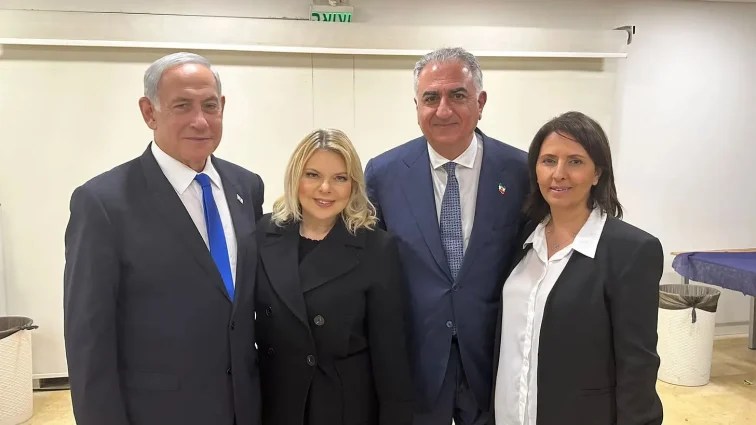
In 2023, Reza Pahlavi made an official visit to Israel, at the behest of its then Intelligence Minister, Gila Gamlie, where he met with Benjamin Netanyahu and Israeli President Isaac Herzog.
During the visit, he called for Iran to move towards Israel and away from supporting Palestinian resistance. As Forward noted, “In April 2023, Pahlavi traveled to Israel, where he met with Prime Minister Benjamin Netanyahu and President Isaac Herzog, and paid a visit to the Western Wall, where he said he prayed ‘for the day when the good people of Iran and Israel can renew our historic friendship.’ He even consulted Israeli water management scientists, whom he dubbed the ‘best experts in the field,’ to help him develop a plan of action for Iran’s water crisis, which has also been a major point of contention for protestors.”
The Likud-connected Jerusalem Centre for Security and Foreign Affairs wrote at the time of the visit, “The main message of his visit was the possibility and urgency of peace between the two ancient nations of Israel and Iran. However, this will not happen unless the Iranian people can succeed in overthrowing the Islamic Republic, the common enemy that cements the relationship between a majority of Iranians and Israel.”
In other words, Israel wants regime change in Iran and to install Reza Pahlavi, so it can continue it’s ethnic cleansing plan in Gaza and the West Bank and further greater Israel expansion, without facing any roadblocks from Iran, and to cut off a supporter of resistance to Israeli expansion.
During the visit, Reza Pahlavi promised to further this Israeli goal if he were installed in power, saying, “The biblical relationship we have with Israel was long before it became a state”.
Following the visit, Israeli intelligence launched a propaganda campaign online, designed to promote Reza Pahlavi and support for him being installed into power in Iran.
The Israeli newspaper Haaretz reported that following the visit, “a large-scale digital influence campaign in Persian was underway, operated out of Israel and funded by a private entity that receives government support,” adding, “The campaign promotes Pahlavi’s public image and amplifies calls for restoring the monarchy. The campaign relies on ‘avatars,’ fake online personas posing as Iranian citizens on social media.”
Haaretz went on to report:
According to five sources with direct knowledge of the project, native Persian speakers were recruited for the operation. Three of the sources confirmed the connection between the project and this specific campaign, and said they witnessed the network advancing pro-Pahlavi messaging.
According to the sources, the campaign included fake accounts on platforms such as X and Instagram and used artificial intelligence tools to help disseminate key narratives, craft its messages, and generate content.
The report added, “While Pahlavi declares that he’s not running for any position, in recent years a social media campaign has been calling for the monarchy’s restoration, with Reza on the throne. According to the sources, part of this effort is based on a network of fake accounts originating in Israel.”
Similarly, before the current unrest in Iran, Israeli intelligence used social media in an attempt to foment violent riots that would lead to regime change in Iran.
The University of Toronto’s Citizen Lab uncovered another social media campaign in Persian operated through Israeli intelligence, which “advanced a narrative of regime change in Iran”.
During the Israel/American bombing of Iran in June of the last year, the Israeli accounts, were, “sharing images and videos of alleged civil unrest and instability in Iran”, “published a series of posts highlighting the alleged economic upheaval in Iran after the first few rounds of bombings” and “told followers to head to ATMs to withdraw money, emphasized that the Islamic Republic was ‘stealing our money to escape with its officials,’ and urged followers to rise up against the regime.”
They also, “urged followers to get on their balconies at 8 p.m. each evening and shout ‘Death to Khamenei’” and “appeared to make another push to trigger unrest by questioning the ceasefire”.
Along with this, the Israeli bot accounts shared “several instances of videos edited and shared to mislead viewers about protest activity occurring in Iran” and shared fake news headline that claimed, “Officials flee the country; High-ranking officials leave Iran one after another”.
After the bombing, the Israeli bot accounts, “pivoted to content related to the country’s ongoing water and energy crisis” in an attempt to, “escalate these tensions by creating and sharing content related to these issues”.
The report noted that the bot network is “still consistently posting about both the water crisis and energy shortage, in a likely attempt to continue to escalate tensions between Iranian citizens and their government.”
During the current protests, which began as peaceful protests around Iran’s mismanagement of the economy, but were taken over by a violent regime change element, Israeli and American officials have openly boasted that there are Mossad agents on the ground, attempting to push the protests in a pro-regime change direction.
Israel’s Heritage Minister Amichai Eliyahu boasted that, “we have some of our people operating there (in Iran) right now”, while a Mossad linked X account claimed that the Mossad was, “with you in the field as well” to Iranian protestors and the former CIA director and Secretary of State Mike Pompeo wrote , “Happy New Year to every Iranian in the streets. Also, to every Mossad agent walking beside them.”
Israel’s puppet, Reza Pahlavi, cheering on regime change riots in Iran, needs to be seen as a part of Israel’s broader plan- enacted after the 2023 visit, to install him after carrying out its longtime goal of regime change.
Russia carries out three evacuation flights from Israel in under 24 hours
MEMO | January 9, 2026
Russian authorities have reportedly carried out three evacuation flights from Israel in less than 24 hours, transporting officials and their families to Russia, according to Hebrew and regional media.
Israel’s Channel 14 reported on Thursday that the flights were conducted without any official explanation from Moscow. Separate reports in Russian and Iranian media said the evacuations were carried out under what appeared to be an urgent mandate, involving officials and their families.
The reports suggested that the pace of the evacuations was faster than usual, fuelling speculation that Moscow may have received sensitive or significant information prompting the move. However, no details were provided regarding the nature of the alleged information or the identities of those evacuated.
The Kremlin has not issued any official statement clarifying the reasons behind the evacuation flights, and Russian authorities have so far declined to comment on the reports.
Prof. Marandi on Iran & Venezuela: What’s Next?
TMJ News Network | January 5, 2026
Professor Mohammad Marandi joins TMJ News to break down the latest developments in Iran and Venezuela, unpacking how economic protests, sanctions, and media narratives are being weaponized once again to push long-standing U.S.-Israeli regime change agendas.
Iran’s collapsing currency exposes the profiteers behind the crisis
By Fereshteh Sadeghi | The Cradle | January 5, 2026
In the final days of 2025, as the rial plunged to unprecedented lows, Tehran’s bustling Jomhuri (Republic) Avenue transformed into a corridor of defiance.
‘Bazaaris’ (traditional merchant class with deep political and economic influence) and cellphone shopkeepers, cornered by a collapsing currency and punishing tariffs, shuttered their stores and poured into the streets.
Their outrage ignited a fire that quickly spread to the Grand Bazaar, long considered Iran’s economic barometer. Unlike the 2022 protests over social freedoms or the 2009 unrest sparked by electoral disputes, this wave of demonstrations is driven squarely by economic collapse and long-festering mismanagement.
What began as a merchants’ revolt against an unworkable trade environment soon revealed the deeper rot of decades-long economic mismanagement, institutional corruption, and a sanctions-choked system that punishes the people to sustain itself.
Sanctions, sabotage, and a vanishing economy
Iran, a nation of over 86 million, registered a meager 0.3 percent economic growth in summer 2025, while inflation soared past 42 percent by December. Labor force participation remains abysmally low, trailing nearly 20 points behind the global average. These dire metrics have steadily worsened under the weight of relentless US sanctions, first re-imposed by President Donald Trump in 2018 during his first term, and have intensified through two presidential terms.
The rial’s spectacular collapse – breaking the 1,445,000 mark against the US dollar – did not occur in a vacuum. It marked a 47.8 percent surge in just six months.
The higher the rate was going up, the angrier were businesses whose sales are directly dependent on the dollar-rial change rate. The first spark of protests was ignited by the shopkeepers at two cellphone shopping malls in downtown Tehran. They started a strike, saying they were unable to do business because they were struggling with a new cellphone registry tariff the government had imposed on devices priced at $600 and more.
The next day, shopkeepers did not just close their shops but took to the famous Republic Avenue, protesting against the situation. The dollar dealers at Ferdowsi Avenue joined the protests too, and in the Grand Bazaar, gold and silversmiths brought their shutters down in fear of chaos.
A shopkeeper at Lalezar Street tells The Cradle that, “we were forced to close our shops as some protesters attacked us verbally and threatened to ransack our shops by hurling stones at our windows.”
In addition to sanctioning traditional routes such as banks, firms and individuals, the US Department of the Treasury’s Office of Foreign Assets Control (OFAC), has been targeting digital currency addresses it accuses of being used by a financial network to transfer Iran’s oil and non-oil money.
According to Gholma-Reza Taj Gardoun, chairman of the parliamentary budget committee, “the Iranian government only received 13 out of $21 billion oil revenues in the last eight months”. He added that “the remaining $8 billion is the cause of the current turmoil, the shortage of dollar bills in the market and the rising exchange rate.”
A rigged system of profiteers
Taj Gardoun is not alone in exposing how oil and non-oil export revenues have failed to return to Iran. At the heart of the crisis lies a parasitic class of semi-governmental enterprises and politically-connected traders who profit from Iran’s fiscal dysfunction.
Former finance minister and current lawmaker Hussein Samsami estimates that “117 out of $335 billion non-oil export revenues have not returned to the country, since the US re-imposed sanctions in 2018.” Much of this capital, he says, was siphoned off by ‘khosulati’ entities – quasi-governmental firms benefiting from state ownership yet operating without transparency or oversight.
Equally troubling is the shadowy role of “trustees” – a secretive network tasked with circumventing sanctions to sell Iranian oil.
Former Central Bank of Iran (CBI) Governor Valiollah Seif acknowledged “they are trusted people, Iranians and non-Iranians, who transfer money (for Iran),” adding “money transfer is a very risky process and the payment of these so-called trustees and the money changers working with them is high.” Seif revealed “sometimes a trustee siphons off the funds.”
Apart from the trustees, the quasi-governmental entities are also blamed for refusing to give back the non-oil export money to the central bank and sell it at rates higher than the regular CBI-approved rate at the official market.
These companies are owned by various funds affiliated with the Iranian government. The petroleum and the social welfare ministries gained a majority of the shares in these funds through the privatization process in different governments.
The third group that has not returned the export money is individuals or firms with special business permits. A deputy CBI governor reports that “Individuals who own or rented 900 special licenses must return some $16 billion to the central bank, (but they didn’t).”
The result is a liquidity trap in which foreign exchange vanishes from official markets, feeding a vicious cycle of inflation and speculation.
State paralysis and political deflection
For months, the government of Iranian President Masoud Pezeshkian appeared paralyzed, watching as the currency spiralled and public rage mounted. While some suggest the state deliberately allowed the rial to slide to ease its budget deficits, others cite institutional chaos and a lack of cohesive economic policy.
They refer to a confession made by former Iranian president Hassan Rouhani in 2020, “The foreign currency belongs to the government, the price is decided by the government and we can bring it down, if we decide it.”
In reaction to the voices of dissatisfaction, Pezeshkian tasked his interior minister with meeting the representatives of the protesters and listening to their grievances.
He sat with merchants and replaced CBI governor Mohammad-Reza Farzin with former finance minister Abdolnasser Hemmati. Nevertheless, the latter, who was impeached 10 months ago over his mismanagement of the foreign exchange market, said “he has no responsibility regarding the currency market and his task is to control imbalanced banks and reduce inflation.”
Austerity in a powder keg
In the streets, the demonstrations have morphed into sporadic riots, mostly in western provinces, marked by attacks on police stations and arson against state buildings. Casualties have been reported, including among security forces, as the protests shift from organized dissent to expressions of raw frustration.
Demonstrations in Tehran that were not large in essence have subsided, but morphed into sporadic riots. Smaller cities or towns in western Iran are now the scene of riots, with the number of rioters limited to dozens, not even hundreds.
Arson attacks against government buildings or rioters storming police stations to capture their armory have been reported. About a dozen, including police forces, have been killed countrywide, and arrests have been made.
Iran’s leader, Ayatollah Ali Khamenei, on 3 January, admitted that the ‘bazaaris’ have legitimate complaints regarding economic instability. Still, he made it clear that the Islamic Republic “will not yield to the enemy” and will deal seriously with violent protesters; “rioters must be put in their place.”
The Iranian leader’s comments were a response to Trump after he threw his weight behind the protesters, threatening the Islamic Republic with military intervention “if protesters are killed.” The Reformist Front joined in rejecting foreign threats, warning that any interference in the protests would escalate violence and distort the people’s demands.
In a last-ditch bid to regain economic control, an Iranian official from the Budget and Planning Organization says “the Trustees will be asked to return billions of dollars in their overseas accounts to the country.” A lawmaker cautions, “the parliament will question the oil minister over the issue of the Trustees.”
Iran’s minister of economy said that positive results have been achieved from negotiations with several countries, including the release of part of Iran’s financial resources and the opening of funding channels for importing essential goods, along with gradual efforts to unify the exchange rate into a single rate.
Simultaneously, Pezeshkian is pushing ahead with plans to phase out subsidies for essential imports – a move he dubs an “economic surgery” that will be offset by targeted vouchers for lower-income citizens. But austerity in the midst of currency collapse, inflation, and a credibility crisis is a combustible formula.
Iranian officials are closely tracking the situation in Venezuela, where the abduction of President Nicolas Maduro and rising US aggression offer chilling parallels. For now, Tehran’s street protests remain contained. But if the economic pain persists and reforms deepen inequality, the next wave may not be as easily quelled.
Three Reasons Iran Condemns US Attack on Venezuela as a Global Threat
teleSUR | January 3, 2026
Iran condemns U.S. attack on Venezuela as a flagrant breach of international law and a dangerous escalation that threatens the foundations of the global order. On January 3, 2026, the Islamic Republic of Iran issued a forceful statement in response to Washington’s large-scale military operation on Venezuelan soil—an assault that, according to the White House, resulted in the capture of President Nicolás Maduro and First Lady Cilia Flores.
From Tehran’s perspective, this is not merely a regional crisis. It is a systemic rupture with implications that extend far beyond Latin America. The Iranian Foreign Ministry framed the offensive as a textbook case of unilateral aggression, echoing historical patterns of imperial intervention that have long destabilized the Global South. In doing so, Iran positioned itself not only as a regional power but as a principled voice defending the sanctity of state sovereignty against military hegemony.
The gravity of Iran’s condemnation lies not just in its rhetoric but in its legal grounding. Tehran explicitly cited Article 2(4) of the UN Charter, which prohibits the use of force against the territorial integrity or political independence of any state. According to Iran, the U.S. strikes—reportedly targeting civilian infrastructure alongside military installations—constitute an “unequivocal act of aggression” that must be met with immediate international censure and legal accountability.
Iran Condemns US Attack on Venezuela as Illegal Under International Law
The Iranian Foreign Ministry’s statement, released on Saturday, January 3, 2026, pulled no punches. “This criminal, cowardly, and terrorist act by the United States violates every principle of international coexistence,” the document declared—words that closely mirror those used by Venezuelan Interior Minister Diosdado Cabello in Caracas hours earlier.
Iran emphasized the illegality of targeting civilian infrastructure, including electrical grids and residential zones, actions it described as potential war crimes under the Geneva Conventions. Tehran rejected any justification based on regime change or alleged humanitarian concerns, stressing that only the UN Security Council holds the legitimate authority to authorize the use of force—and even then, only as a last resort.
The International Court of Justice has repeatedly affirmed that unilateral military interventions, regardless of motive, violate the core tenets of the UN Charter. Iran’s stance aligns with this jurisprudence, positioning the U.S. operation not as an isolated incident but as part of a broader erosion of multilateralism. “When powerful states bypass the Security Council,” the statement warned, “they don’t restore order—they incite chaos.”
Crucially, Iran also underscored Venezuela’s inherent right to self-defense and resistance against foreign occupation—a principle enshrined in both international law and the historical consciousness of post-colonial states. By doing so, Tehran reinforced its long-standing advocacy for the Global South’s right to political autonomy, free from external coercion.
Iran Joins Global South Coalition Against U.S. Military Aggression
While Western media have focused on the tactical details of the U.S. operation, Iran’s diplomatic response underscores a deeper geopolitical realignment. Tehran’s condemnation places it firmly within a growing coalition of nations—including Russia, China, Cuba, and Colombia—that view the attack as a direct threat to regional peace and global legal norms.
Iran and Venezuela have cultivated close strategic ties for over two decades, particularly through their shared membership in the Non-Aligned Movement (NAM) and their mutual opposition to U.S.-led sanctions regimes. In this context, Iran’s statement is both principled and pragmatic: it defends a key ally while reinforcing its own narrative as a champion of anti-imperialist sovereignty.
As a founding member of the Non-Aligned Movement, Iran has consistently opposed unilateral military interventions—from Iraq to Libya to Syria. The current crisis in Venezuela is seen through that same lens: not as a domestic political issue, but as a test of whether international law applies equally to all nations, or only to the weak.
Notably, Iran called on all UN member states to fulfill their “legal and moral duty” by demanding an immediate ceasefire, the withdrawal of U.S. forces, and accountability for those responsible for planning and executing the operation. It also urged the Security Council to invoke Chapter VII—not to authorize further force, but to sanction the aggressor and protect the sovereignty of the victim.
This stance resonates across Latin America, where leaders like Gustavo Petro of Colombia and Miguel Díaz-Canel of Cuba have echoed Iran’s concerns. Even within traditionally neutral countries like Uruguay, political figures from the ruling Frente Amplio—such as Rafael Michelini—have echoed Tehran’s alarm, warning that “the prairie of Latin America has been set on fire.”
Geopolitical Context: Iran’s Message to the World
Iran’s condemnation of the U.S. attack on Venezuela carries layered implications. At a time when Tehran faces its own threats of military action—particularly from Israel and hardliners in Washington—its vocal defense of Caracas serves as both a warning and a mirror. By highlighting the illegality of unilateral force, Iran seeks to reinforce norms that could one day protect its own sovereignty.
Moreover, the timing is significant. With Venezuela’s vast oil reserves and strategic location, the U.S. incursion risks triggering a wider confrontation involving Russia, China, and other non-Western powers. Iran’s intervention in the diplomatic arena aims to prevent escalation while strengthening South-South solidarity.
In essence, Iran is not just defending Venezuela—it is defending a vision of international order based on equality, mutual respect, and adherence to law, rather than power projection and regime change. In an era of resurgent great-power rivalry, that message carries weight far beyond the Middle East or Latin America.
Conclusion: A Sovereignty Line in the Sand
Iran condemns U.S. attack on Venezuela not out of blind allegiance, but as a matter of principle rooted in decades of anti-imperialist foreign policy. In a world where unilateralism increasingly masquerades as “strategic necessity,” Tehran’s statement is a stark reminder that sovereignty remains the bedrock of international peace.
Whether the UN will act—or whether the Global South can mount a coordinated response—remains uncertain. But one thing is clear: Iran has drawn a line in the sand, and it stands not alone, but alongside a growing bloc of nations determined to uphold the Charter that Washington now appears to have discarded.
Why Are Mike Pompeo And The Mossad Publicly Announcing Mossad Involvement In Iranian Protests?
The public announcement of Mossad involvement in Iranian protests seems to have a cynical motive
The Dissident | January 2, 2026
Recently, a Twitter account widely seen to be backed by the Israeli Mossad along with the former CIA director and Secretary of State for Trump’s first term, Mike Pompeo, have publicly claimed that Israel’s Mossad is involved in the current protests in Iran.
At first glance, the claims seem to be a sloppy admission of a covert Israeli intelligence operation, but a closer look suggests something far more cynical is at play.
For context, on December 29th, an X account called “Mossad Farsi”- which the Israeli newspaper Ynet notes “is widely regarded as an official messaging channel of the Mossad targeting Iranian audiences, though Israel has not officially confirmed its ownership”-wrote, “Let’s come out to the streets together. The time has come.
We are with you. Not just from afar and verbally. We are with you in the field as well.”
The tweet has been taken in Israeli media as confirmation of Mossad involvement in the Iranian protests, for example, the Jerusalem Post wrote an article titled , “Mossad spurs Iran protests, says agents with demonstrators in Farsi message”.
Following the tweet, Mike Pompeo, the former director of the CIA and Trump’s former Secretary of State, also wrote a tweet appearing to confirm Mossad involvement in the protests, tweeting today:
The Iranian regime is in trouble. Bringing in mercenaries is its last best hope.
Riots in dozens of cities and the Basij under siege — Mashed, Tehran, Zahedan. Next stop: Baluchistan.
47 years of this regime; POTUS 47. Coincidence?
Happy New Year to every Iranian in the streets. Also to every Mossad agent walking beside them.
A closer look at these seeming public admissions shows something more cynical at play.
Some analysts have speculated that both Pompeo and the Mossad are either publicly admitting to Mossad involvement in the protests or making false claims of Mossad involvement in the protests in order to encourage a harsher crackdown on them as a pretext for war.
Responding to the “Mossad Farsi” tweet, Analyst Esfandyar Batmanghelidj argued, “It’s a message intended to provoke the most paranoid figures in Iran’s security forces to see the legitimate protests as a major threat. Mossad wants violence.”
Responding to the Mike Pompeo tweet , journalist Dave Decamp wrote, “I wonder if the point of Pompeo saying Mossad agents are among the Iranian protesters and the Mossad account on here saying something similar is an effort to get Iran to crack down harder so Trump intervenes”.
This theory is bolstered by the fact that Trump- fresh from his visit with Benjamin Netanyahu, where he pushed him towards a new war with Iran – wrote on Truth Social, “If Iran shots and violently kills peaceful protesters, which is their custom, the United States of America will come to their rescue. We are locked and loaded and ready to go. Thank you for your attention to this matter”, suggesting that the U.S. will again bomb Iran if they crack down on protestors.
Mossad involvement in the protests in Iran would come as no surprise.
Israeli intelligence have previously been caught by Haaretz and the University of Toronto’s Citizen Lab creating social media bots that were attempting to foment a violent regime change in Iran and prop up the Israeli puppet, Reza Pahlavi.
Israel’s I24 News, has also admitted that the current protests “likely received guidance” and seem like “a hand is at work here”, from “intelligence work”.
Whether the Mossad operations behind the Iran protests are real or not, it is becoming increasingly clear that the public admissions of it are intended to foment an Iranian government crackdown, so that Trump will make good on his threat and launch a new war.
Protests in Iran: Analysis of current demonstrations and their implications for the Islamic Republic
Few analysts in the West are truly aware of the situation in Iran
By Lucas Leiroz | Strategic Culture Foundation | January 3, 2026
Western understanding of Iran’s internal situation remains profoundly mistaken. Recurring narratives of an imminent collapse ignore the country’s political and social complexity and exaggerate the impact of current demonstrations. It is essential to recognize that, although there are significant tensions, Iran is not currently in a crisis that threatens the continuity of the Islamic Republic, nor is it in a state of absolute stability.
The current demonstrations originate from patriotic sectors of society, motivated by dissatisfaction with the moderate and semi-liberal government of Masoud Pezeshkian. Contrary to widespread claims, most of these protests do not challenge the fundamental principles of the Islamic Republic. The discontent is focused on government economic policies, considered ineffective by broad segments of the population, leading to a perception of management crisis, but not a crisis of legitimacy for the Islamic Republic. Rising prices, water shortages, and economic instability drive popular demands – not challenges to the revolutionary principles themselves.
It is also important to note that, as often occurs in contexts of attempted governmental change, external or internal actors with different interests infiltrate protests, promoting episodes of violence and vandalism. The escalation of clashes in certain areas, particularly in the outskirts and western regions of the country, should not be interpreted as a sign of collapse. Historically, Iran maintains stronger control and stability in major cities and in the capital, Tehran, where protests remain largely peaceful. This pattern demonstrates the institutional capacity of the Islamic Republic to manage crises, even amid significant mobilizations.
Historical context also provides important point of reference for analysis. Iran has previously faced protests of considerable magnitude, such as those following the death of Masha Amina in 2022, when demonstrations led to armed confrontations with security forces. Compared to the events of 2022, today’s social movement is moderate in both intensity and scope, indicating that the security and control system of the Islamic Republic remains functional and effective.
Another key point is the coexistence of different protest currents within the country. While there are mobilizations critical of the government, there are also demonstrations in support of the Islamic Republic (albeit critical of Pezeshkian’s administration). This diversity shows that dissatisfaction is not unanimous toward the Islamic Republic as a whole, but is concentrated on specific management failures and economic policies. This reality significantly reduces the likelihood of a change in the Islamic Republic, although there is some probability of a government collapse.
For external analysts, it is tempting to interpret the protests as a harbinger of total destabilization. A closer analysis suggests that the most plausible scenario is the erosion of Pezeshkian’s moderate government, followed by a possible rise of leadership more aligned with the original revolutionary principles of the Islamic Republic. In this context, an internal power adjustment is far more likely than the dissolution of the country’s institutions.
It must be acknowledged, however, that the Islamic Republic is not immune to risks. Sudden internal or external developments could significantly alter the current balance. Yet, considering Iran’s historical experience with crises, protests, and foreign intervention attempts, contemporary demonstrations do not provide sufficient grounds to predict a national collapse. The Republic remains structured and capable of maintaining its political and social core.
In summary, Western perceptions that Iran is on the brink of collapse reflect a simplistic and misinformed interpretation of events. The current demonstrations should be understood as expressions of sectoral discontent and governance challenges, not as existential threats to the Islamic Republic. The balance of internal forces, combined with historical experience in managing crises, ensures that the Islamic Republic continues to function, with the capacity to adjust to social pressures without compromising its political continuity.
Featured Video
Your Enslavement Begins in Gaza: The ‘Board of Peace’
or go to
Aletho News Archives – Video-Images
From the Archives
The US: The Century of Lost Wars
By James Petras | Global Research | September 12, 2018
Introduction
Despite having the biggest military budget in the world, five times larger than the next six countries, the largest number of military bases – over 180 – in the world and the most expensive military industrial complex, the US has failed to win a single war in the 21st century.
In this paper we will enumerate the wars and proceed to analyze why, despite the powerful material basis for wars, it has led to failures. … continue
Blog Roll
 Aletho News
- Your Enslavement Begins in Gaza: The ‘Board of Peace’
- Israeli FOIA Data Reveals Massive Heart Injury Spike in Children Immediately After mRNA Shot Rollout
- What is Zionism? And what is anti-Zionism?
- Hungary’s Blocking of EU Loan to Ukraine May Jeopardize IMF Funding – Reports
- Pax Judaica Explained | Prof. David Miller
- Was MAHA Too Good to Last in the Trump Administration?
- Vermont advances bill letting unelected Health Commissioner decide which vaccines ctizens should receive
- Why the US-Israeli alliance will lose against Iran
- US envoy Huckabee claims Israel has ‘biblical right’ to conquer all West Asia
- Testing the Alliance: Netanyahu’s Washington Visit
- If Americans Knew
- Palestinian church leaders admonish Christian Zionist Mike Huckabee – Not a ceasefire Day 135
- Ominous messaging from Trump’s “Board of Peace” – Not a ceasefire Day 134
- ‘Christians Out’: Jerusalem Church Tagged With Hate Graffiti, Police Investigating
- Israeli Settlers Kill American Teen
- ‘We returned from hell’: Palestinian journalists recount torture in Israeli prisons
- No mercy for Gaza in Ramadan – Not a ceasefire Day 133
- The Israeli Government Installed and Maintained Security System at Epstein Apartment
- Tucker Carlson interrogated in Israel, has passport seized after interviewing US ambassador
- 6,000 Amputees in Gaza Face Impossible Recovery amid Israeli War Ultimatum
- The Lancet: Gaza death toll far higher than reported – Not a ceasefire Day 132
- No Tricks Zone
- New Research Reaffirms Clouds, Aerosols, And Surface Solar Radiation Are ‘Driving The Climate System’
- Germany: Electric Car Catches Fire At Charging Station, Sets Off Local “Inferno”, Widespread Damage
- New Study: Canada’s New Brunswick Was 1°C Warmer Than Today During The Medieval Warm Period
- Coal Power Back In Trend As Globe Tries To Keep Pace With Growing Demand For Power
- New Study: A 4°C Warmer Beaufort Sea Had ‘No Sea Ice’ 11,700 – 8200 Years Ago
- Unfudging The Data: Dutch Meteorological Institute Reinstates Early 20th Centruy Heat Waves It Had Erased Earlier
- German Gas Crisis…Chancellor Merz Allegedly Bans Gas Debate Ahead of Elections!
- Pollen Reconstructions Show The Last Glacial’s Warming Events Were Global, 10x Greater Than Modern
- Germany’s Natural Gas Storage Level Dwindles To Just 28%… Increasingly Critical
- New Study Rebuts The Assumption That Anthropogenic CO2 Molecules Have ‘Special’ Properties
 Aletho News