US accuses Iran of plot to kill John Bolton
By Lucas Leiroz | August 12, 2022
New tensions are growing between Iran and the US. Recently, Washington said Tehran plotted to kill White House Advisor John Bolton. The plan would be a retaliation for Trump Administration’s terrorist-like assassination of Iranian Top General Qasem Soleimani, in 2020. The Iranian government denied any involvement in such a plan, considering the accusation absolutely baseless. Indeed, the Americans have not presented any convincing evidence so far, but, being the narrative accurate or not, frictions are likely to escalate.
On August 10, US government’s spokespersons commented on an alleged Iranian plot to assassinate John Bolton, which would have been organized last year and would involve Iranian agents and a US citizen. The case became the topic of an official note from the US Department of Justice, where the alleged plot is narrated. The narrative is built on the testimony of an American who would have been possibly hired by an Iranian to commit the crime. The reward would be a sum of 300,000 dollars, to be paid by an Iranian named Mehdi Rezayi.
The American citizen allegedly involved in the case claims to have been advised to create a cryptocurrency account in order to receive the money safely. Then he would have received assistance from Iranian intelligence on where to find Bolton. The Iranians reportedly told him to photograph the Advisor before murdering him and evading him – possibly as a way of “proving” that the operation was successful. The contact between the American and the Iranians would have taken place for a few months between October 2021 and April 2022. The conversations were carried out through encrypted messages in a safe platform.
US officials also mentioned the detail that the plot would be a retaliatory measure by Tehran against the US operation to kill Qasem Soleimani. Supposedly, the Iranian authorities would have been “pressured” by people to respond to the American terrorist actions against Soleimani – and Bolton would have been the chosen target for this response.
However, now, the situation is partially reversing: with the alleged plot coming to light, it is the US authorities who are mobilizing to “respond” to Iran and punish those involved. Assistant Director in Charge Steven M. D’Antuono of the FBI Washington Field Office commented on the topic: “An attempted assassination of a former U.S. Government official on U.S. soil is completely unacceptable and will not be tolerated (…) The FBI will continue to identify and disrupt any efforts by Iran or any hostile government seeking to bring harm or death to U.S. persons at home or abroad. This should serve as a warning to any others attempting to do the same – the FBI will be relentless in our efforts to identify, stop, and bring to justice those who would threaten our people and violate our laws”.
Tehran for its part denies absolutely any involvement in this type of plot. Iran’s Foreign Ministry Nasser Kanaani comments that “the spinning of these threadbare and baseless myths is becoming a recurring custom in the American judicial and propaganda system”. Washington’s objective with such lies, according to him, would be to legitimize anti-Iranian policies and divert attention from crimes committed by the US government itself, such as the murder of Iranian officials and support for terrorist groups in the Middle East.
“Continuing their endless accusations, their failed Iranophobic policy, the American judicial authorities, in a new yarn spinning, have raised accusations without providing valid evidence and necessary documentation (…) Such baseless claims are made with political motives and aims and in fact amount to […] escaping the responsibility of responding to numerous terrorist crimes that the American government has either directly participated in, such as the cowardly assassination of General Martyr Soleimani, or like the terrorist crimes committed by the Zionist regime and terrorist groups like Daesh with the support of America”, Kanaani said.
This scenario significantly worsens tensions. Recently the US and Iran have intensified their diplomatic frictions. Amid the current global security crisis, the attempt at a new nuclear deal has failed and the US has provided Israel with broad support with military exercises to intimidate Tehran. So, it is likely that in fact the plot narrative was invented with the aim of serving as a “carte blanche” for coming measures against Iran.
In addition, it is notorious how the narrative seems weak and unconvincing. The US Department of Justice reports the alleged result of “investigations” but does not provide any evidence for its claims. And there are still inconsistent data in the description of the plot, such as the fact that it was planned more than a year after Soleimani’s death. It is also unclear why Bolton was chosen as a target, considering that there is a strong presence of American officials in the Middle East, both military and diplomats, who would certainly be “easier” targets to be hit than high-ranking state officials within the American territory.
In fact, the main problem is that, whether true or not, the narrative has served its purpose: it has boosted hostility between the US and Iran, worsening relations between them. Expectations for the near future are of escalating tensions.
Lucas Leiroz is a researcher in Social Sciences at the Rural Federal University of Rio de Janeiro; geopolitical consultant.
Biden and Allies Continue to Put Iran in the Crosshairs
By Connor Freeman | The Libertarian Institute | August 5, 2022
In addition to escalating brinkmanship with Russia and China, President Joe Biden’s administration is flirting with war against Iran. The clearest evidence of this includes the ever expanding “maximum pressure” sanctions campaign, as well as the development of a U.S.-led, NATO style alliance encircling Iran. There is also ample support for Israel’s incessant drone strikes, assassinations, and ceaseless bombings of allegedly Iranian targets in Syria.
Last month, Biden traveled to the region to publicly genuflect before the rulers of America’s cherished Gulf tyrannies and apartheid Israel. The aforementioned burgeoning alliance topped his agenda.
In May, Tel Aviv’s U.S. taxpayer subsidized military murdered Shireen Abu Akleh, a world renowned Al Jazeera journalist, a Palestinian Christian, and American citizen. During a raid on the occupied West Bank’s Jenin refugee camp, the Israeli Occupation Forces shot her in the face while she was wearing a press vest. They also attacked her funeral procession, attempting to knock her casket to the ground while mourners were carrying it.
But Biden, “Israel’s man in Washington,” got off the plane at Ben Gurion airport and said our bilateral relationship is “bone-deep.” And speaking for the “vast majority” of Americans, he stated emphatically we are “completely devoted to Israel’s security without any ifs, ands, or buts—without any doubts about it.”
He went on to sign a joint declaration with acting Israeli Prime Minister Yair Lapid committing the U.S. to use all of its “national power” to prevent Iran from acquiring a nuclear weapon.
During an interview ahead of his Israel visit, Biden said he would use force, threatening war against Iran “as a last resort.” It is not enough for the Israelis, they demand an “offensive” and “credible” military threat against Iran. Lapid called it “the real thing.”
Biden refuses to lift the necessary sanctions to return to the Joint Comprehensive Plan of Action, the Iran nuclear deal, which means at least the brutal economic war on Iran will persist in perpetuity. This week, Biden levied fresh sanctions on Iran. Biden’s issuance of sanctions has become more frequent in recent months and ever since the other members of the P5+1 began approaching a finalized deal.
As Dave DeCamp, news editor at Antiwar.com, reported,
The U.S. on Monday issued fresh sanctions against Iran meant to target the Islamic Republic’s oil and petrochemical sales to East Asia.
The new sanctions targeted three Chinese firms and one UAE firm accused of doing business with the Persian Gulf Petrochemical Industry Commercial Co. (PGPICC), which the U.S. Treasury Department says is one of Iran’s largest petrochemical brokers.
According to the Treasury Department, PGPICC facilitated the “sale of tens of millions of dollars worth of Iranian petroleum and petrochemical products from Iran to East Asia” through the firms that were hit with sanctions.
The sanctions are the latest sign that the Biden administration is not serious about reviving the Iran nuclear deal, known as the JCPOA. On Monday, Secretary of State Antony Blinken was asked if the U.S. was ready to return to JCPOA, but he sidestepped the questions and put the responsibility on Iran.
Donald Trump and Biden’s “maximum pressure” campaign has led to 40-50% inflation rates and medical shortages. Washington has deliberately suffocated the Iranian people, almost half of whom live below the poverty line.
Last year, former Prime Minister Naftali Bennett told Biden his “strategic vision” for Iran was “death by a thousand cuts,” or myriad military and diplomatic attacks, as well as clandestine attacks, “the gray-area stuff.” Bennett went on to demand U.S. troops remain indefinitely in both Syria and Iraq.
But the decades of lies and unsubstantiated assertions by hawks about Iran’s non-existent nuclear weapons may remain a useable casus belli. Americans aware of Israel’s arsenal, which includes 200 or more nuclear weapons and makes U.S. aid illegal, are considerably outnumbered statistically by those who falsely believe Iran has the bomb. The Iranians have never sought nuclear arms, and they recently reiterated twice that they have the technical capability but, despite their encirclement, Tehran has chosen not to take this course. The development of such weapons is haram under Islamic law, forbidden by the Ayatollah Khamenei’s fatwah.
However, this was never about the phony threat of Iran nuking Israel. The Iranians’ latent threat is unacceptable for Tel Aviv because it may finally restrict the Israelis’ ability to attack their neighbors with impunity, the way they bomb Syria every week.
In the book Enough Already: Time to End the War on Terrorism, Scott Horton, the Libertarian Institute’s Director, explains,
Israeli Prime Minister Benjamin Netanyahu and his then-defense minister, the former prime minister Ehud Barak, admitted in 2010 that even if Iran were hypothetically to gain atomic weapons, the Israelis were not afraid the Ayatollah would attack them in a first strike, as they constantly tell the public. Instead they were merely concerned that it would limit their “freedom of action” against other regional adversaries, such as Hezbollah, and could cause a “brain drain” of talented young Israelis to the United States. Netanyahu’s immediate predecessor, Prime Minister Ehud Olmert told the New York Times that, “Just as Pakistan had the bomb and nothing happened, Israel could also accept and survive Iran having the bomb.” Former Clinton administration State Department official Jamie Rubin also explained in Foreign Policy that the problem was never an Israeli fear of a first strike by Iran, but “Israel’s real fear – losing its nuclear monopoly and therefore the ability to use its conventional forces at will throughout the Middle East – is the unacknowledged factor driving its decision-making toward the Islamic Republic.”
Horton continues quoting Rubin,
[F]or Israeli leaders, the real threat from a nuclear-armed Iran is not the prospect of an insane Iranian leader launching an unprovoked nuclear attack on Israel that would lead to the annihilation of both countries. It’s the fact that Iran doesn’t even need to test a nuclear weapon to undermine Israeli military leverage in Lebanon and Syria.
Earlier this year, the Israelis simulated a massive bombing campaign over Iran, with a series of repeated airstrikes against the Iran’s civilian nuclear energy program. The drills took place over the Mediterranean Sea, spanned over 10,000 kilometers, and saw more than 100 military aircraft and navy submarines participating.
These simulations capped off a month long military exercise called Chariots of Fire which practiced for war with Iran and other contingencies. The U.S. General overseeing Central Command was in attendance. The IDF’s chief of staff has now announced the Israeli military’s primary focus is preparing an attack on Iran. In the Red Sea, the U.S. and Israel are now conducting joint war drills.
The Iran situation is another deadly indication that presidents and administrations may change, but the overall foreign policy agenda does not. Apparently, it only gets worse. The U.S. empire is in decline and the American people feel it. But the neocons and their liberal interventionist partners are holding onto their dream of a “Unipolar Moment.”
As the world adjusts to a multipolar world order, the U.S. foreign policy establishment, left and right, has picked fights with its enemies, not ours.
Americans’ only enemy is our own ruling class who would drag us into wars (proxy wars or otherwise), including with nuclear armed world powers to fulfill their desires to violently dominate the planet, funneling trillions of our dollars into the military-industrial complex. This establishment’s geopolitical and monetary schemes are destroying our nation’s future. As the Ron Paul Institute’s Daniel McAdams recently said, “[American] foreign policy is the FED with nukes.”
We have been stuck with a bill for more than $10 trillion after more than 20 years of war and killing in the Middle East, with millions dead and tens of thousands of soldiers committing suicide. It is long past time Americans put their foot down.
We have a choice. Do we want to continue gambling on the apocalypse, fighting wars with Iran, Russia, and China in memory of the disgraced neocon Charles Krauthammer’s “Unipolar Moment?”
Or should we pursue “peace, commerce, and honest friendship with all nations, entangling alliances with none?”
The answer should be obvious.
Connor Freeman is the assistant editor and a writer at the Libertarian Institute, primarily covering foreign policy. He is a co-host on Conflicts of Interest.
US asks Argentina to confiscate aircraft linked to Iran
MEMO | August 3, 2022
The US Department of Justice said on Tuesday that it has asked the government in Buenos Aires for permission to seize an Iranian plane that was sold to new owners in Venezuela but is being held in Argentina on suspicion of being linked to international terrorist groups.
The unannounced arrival of the plane in Argentina on 8 June raised concerns within the Argentinian government about its relations with Iran, Venezuela and companies that the US has imposed sanctions on. The Justice Department said that the seizure request followed the disclosure of a warrant in the District Court for the District of Columbia dated 19 July to take the aircraft for violating export control laws.
According to the department, the US-made Boeing 747-300 is under sanctions because Iran’s Mahan Air sale to Emtrasur last year violated US export laws. Both companies are subject to US sanctions over their alleged cooperation with terrorist organisations.
Assistant Attorney General Matthew Olsen of the Justice Department’s National Security Division said that, “The department will not tolerate transactions that violate our sanctions and export laws.” Mahan Air faces sanctions for its ties to Iran’s Islamic Revolutionary Guard Corps’ Quds Force, which the US has listed as a terrorist organisation.
There were 14 Venezuelans and five Iranians travelling on the aircraft when it landed in Buenos Aires. Seven of the passengers are still being held by the Argentinian authorities.
Policing the World Is a Full-Time Job
BY PHILIP GIRALDI • UNZ REVIEW • AUGUST 2, 2022
Every leader and top official now in power in the so-called Western World seems to have forgotten that the North Atlantic Treaty Organization (NATO) was founded in 1949 as an alliance that was ostensibly defensive in nature, intended to counter the expansion of Soviet style communism in Europe. That role continued to be the raison d’etre of the organization until communist governments themselves collapsed in both Russia and in the Eastern European states that collectively made up the Warsaw Pact during the 1990s. After that point, NATO no longer had any reason to exist at all as the alleged military threat posed by the Kremlin and its allies vanished virtually overnight.
But clever politicians were quick to put the alliance on life support instead of simply dismantling it. Lacking the threat posed by the Warsaw Pact, NATO was forced to come up with other reasons to maintain military forces at levels that could quickly be enhanced and placed on a wartime footing. Washington and London took the lead in this, citing the now shopworn defense of a “rules based international order” as well as of “democracy” and “freedom.” And fortunately for the national defense industries and the generals, it soon proved possible to find new enemies that provided justification for additional military spending. The first major engagement outside the obligations defined by the original treaty took place in Europe to be sure, but it was in the Balkans where of NATO during the 1995 Operation Deliberate Force. The war ended after the signing of the General Framework Agreement for Peace in Bosnia and Herzegovina in Paris on December 14th 1995. Peace negotiations were finalized a week later but fighting resumed between Kosovo and Serbia in the following year, which led to another NATO intervention that eventually ended with the restoration of Kosovo’s autonomy and the deployment of NATO forces, which bombed the Serbs to compel their compliance with a draft cease fire agreement.
NATO also played a role improbably enough in the US invasion and occupation of Afghanistan, which was justified by claiming that an Afghanistan free to set its own course would become a hotbed of terrorism which would inevitably impact on the United States and Europe. It was a paper-thin argument, but it was the best they could come up with at the time and it also eventually involved soldiers from additional friendly countries like Australia. As we have subsequently seen, however, it was all an argument without merit as Afghanistan became a money pit and a graveyard for thousands of locals and foreign soldiers. It is now again in the hands of the Taliban after a bungled withdrawal of US forces and the collapse of the puppet government in Kabul that Washington had installed.
Turn the clock forward to the present. As everyone but President Joe Biden has recognized, the United States and NATO are currently engaged in a proxy war against Russia in Ukraine, which many observers already believe has some of the attributes of World War III. As Russia neither threatened nor attacked any NATO member state, the argument that the response in arming and training Ukraine was defensive was rendered irrelevant. Nor can it be credibly claimed that Russia is a haven for terrorists, quite the contrary. Nevertheless, Biden has stated that the US will be in the fight on behalf of Ukraine for “as long as it takes.” Does he mean years, and all done without a declaration of war by Congress as required by the US Constitution?
And more appears to be coming. Joe Biden, during last week’s trip to Israel, made clear that the United States is “prepared to use all elements of its national power” to stop Iran from getting a nuclear weapon and has signed a pledge with the Israeli government to commit itself to do so. If Biden presses the argument that Iran is an international threat due to its impending development of nuclear weapons, will he appeal to NATO to support a joint military option to disarm it? I believe he just might do that. And he might just want to consider how the entire set-up and framing of the issue by Israel is somewhat of a trap. Israel considers Iran’s current nuclear program to be intended to create a weapon, which “they continue to develop,” and there are plenty in the US Congress who would agree with that.
So, if Iran is clearly creating a thermonuclear device, the time to strike is now, isn’t it? And bear in mind how the US/Israeli campaign to condemn is multifaceted. Shortly before the meetings held by Biden and his crew with the Israelis, US government sources set the stage for what was to come by going on the offensive regarding reports that Iran may be selling highly capable offensive drones to Russia for use in Ukraine as well as subsequent claims coming out of Washington that the Iranians are seeking to assassinate senior US officials in revenge for the killing of Revolutionary Guards General Qassem Soleimani in January 2020. One wonders why they waited so long and why the White House has chosen to publicize these stories at this point.
And the US and NATO are also getting involved with China’s geopolitical policies, on a path that Beijing is warning is extremely hypocritical and which might lead to armed conflict. The signs that the Chinese might be targeted by NATO, possibly over the Taiwan independence issue, came following a stark warning by US Secretary of State Tony Blinken delivered at the NATO summit in Madrid at the end of June. Blinken accused China of “seeking to undermine the rules-based international order,” the same type of critique recently leveled against Russia and Iran. Blinken’s comment was elaborated on by NATO Secretary General Jens Stoltenberg, who observed how “China is substantially building up its military forces, including nuclear weapons, bullying its neighbors, threatening Taiwan … monitoring and controlling its own citizens through advanced technology, and spreading Russian lies and disinformation.”
Stoltenberg’s indictment of China was followed by a NATO issued “strategic concept” document last that declared for the first time that China poses a “systemic challenge” to the alliance, alongside a primary “threat” coming from Russia. The document copied Blinken’s language, citing “The deepening strategic partnership between the People’s Republic of China and the Russian Federation and their mutually reinforcing attempts to undercut the rules-based international order run counter to our values and interests.”
Finally, the US and British governments collaborated to condemn China as the “biggest long-term threat to our economic and national security.” The declaration came in a July 6th joint news conference in London, where Christopher Wray, director of the FBI, and Ken McCallum, director general of Britain’s MI5, accused China, like Russia, of interfering in US and UK elections. Wray also warned the business leaders in the audience that the Chinese government has been “set on stealing your technology, whatever it is that makes your industry tick, and using it to undercut your business and dominate your market.”
Chinese Foreign Ministry spokesman Zhao Lijian initially responded a few days after the NATO summit, observing that the “so-called rules-based international order is actually a family rule made by a handful of countries to serve the US self-interest,” adding that “[Washington]observes international rules only as it sees fit.” Addressing the issue of the role of NATO specifically, Zhao accused Blinken of using NATO to “hype up competition with China and stoke group confrontation.” He added that “The history of NATO is one about creating conflicts and waging wars… arbitrarily launching wars and killing innocent civilians, even to this day. Facts have proven that it isn’t China that poses a systemic challenge to NATO, and instead it is NATO that brings a looming systemic challenge to world peace and security. Thirty years after the end of the Cold War, [NATO] has not yet abandoned its thinking and practice of creating ‘enemies’ … It is NATO that is creating problems around the world.”
China has a point. What NATO is threatening is war, as it is a military alliance. The Chinese appear to understand that NATO is the world’s largest military bureaucracy which has developed since 1991 an overriding institutional commitment to ensuring its permanent existence, if not expansion, even after it has clearly outlived its own usefulness. So Beijing might justifiably wonder, how does China – on the other side of the globe – fit into NATO’s historic “defensive” mission? How are Chinese troops or missiles now threatening Europe or the US in ways they weren’t before? How are the Americans and Europeans suddenly under military threat coming from China?
The Chinese appear to understand that if there is no threat to “defend” against, then a threat must be manufactured, and that is precisely what we are seeing vis-à-vis Russia, China, Iran and even Venezuela. Washington has become addicted to war and NATO is the chosen tool to give those wars the patina of legitimacy. To launch those conflicts requires either inventing an imaginary threat, or, as in the case of Russia, provoking the very threat the “defensive” bureaucracy was designed to deter or thwart. All indications are that NATO – now embracing 30 countries – is doing both and the results could easily be disastrous for all parties involved. Former congresswoman Tulsi Gabbard particularly abhors the cynical recklessness of the Biden Administration driving the process, explaining how “The reality is, President Biden, members of Congress, leaders in our country, the wealthy, they will have a safe place to be in the event of a nuclear war that they are behind causing while the rest of us in America and Russia, people around the world, will be decimated from this event.”
Prize winning journalist Chris Hedges has also defined the unthinkable that is at stake, and it is past time for Americans and Europeans to take note and stop the madness. Hedges opines that “The massive expansion of NATO, not only in Eastern and Central Europe but the Middle East, Latin America, Africa and Asia, presages endless war and a potential nuclear holocaust.” One might also note that New Yorkers are now being informed about what to do if there is a nuclear attack. Yes, that is precisely the problem – we have an administration in Washington that should be protecting the people living in this country, not setting up scenarios that might lead to their slaughter. Will someone please point that out to Joe Biden?
Philip M. Giraldi, Ph.D., is Executive Director of the Council for the National Interest, a 501(c)3 tax deductible educational foundation (Federal ID Number #52-1739023) that seeks a more interests-based U.S. foreign policy in the Middle East. Website is councilforthenationalinterest.org, address is P.O. Box 2157, Purcellville VA 20134 and its email is inform@cnionline.org.
US “Iran Nuclear Deal” Ploy Coming Full Circle
By Brian Berletic – New Eastern Outlook – 22.07.2022
Hopes for the Joint Comprehensive Plan of Action (JCPOA) simply known as the Iran Nuclear Deal seemed to fade further during US President Joe Biden’s recent trip to Israel where the US and Israeli governments signed a pledge to use force against Iran should it pursue nuclear weapons (weapons both the US and Israel possess).
US-based ABC News in its article, “Biden left with few options on Iran as nuclear talks stall,” would claim:
President Joe Biden made a clear promise on Iran, declaring that the country would never become a nuclear power under his watch. But during his time in the White House, the path towards upholding that promise has only become murkier.
During his trip to the Middle East, the president said he would consider using force against Iran only as a “last resort,” although Israel, the US.’s most ardent ally in the region, has pushed for the administration to issue a “credible military threat” against Tehran.
The article would mention the Iran Nuclear Deal specifically, claiming:
… while the administration initially hope to cut a “longer and stronger” deal with Iran, over a year and half of indirect negotiations has produced little movement towards restoring even the original terms of the agreement.
After a monthslong stalemate, a 9th round of talks took place in Doha, Qatar, at the end of June. A State Department spokesperson did not sugarcoat the outcome, saying “no progress was made.”
The 2018 unilateral withdrawal of America from the deal by the administration of US President Donald Trump is blamed for the deal’s failure. Yet the Trump administration’s withdrawal was predicted long before President Trump took office, and in fact, long before US President Barack Obama even signed the deal in the first place. President Biden’s recent activities are only wrapping up what was always a diplomatic ploy meant to trap Iran.
The Nuclear Deal Was Always a Trap
When President Obama signed the Iran Nuclear Deal, it was celebrated as a breakthrough in US diplomacy and a departure from the previous Bush administration’s expanding wars of aggression spanning Iraq and Afghanistan while threatening Iran next.
Signed by the United States and Iran along with other participating nations (the UK, EU, Germany, Russia, China, and France) in 2015, NBC News in their article, “What is the Iran nuclear deal?” would explain:
The Iran nuclear deal, formally known as the Joint Comprehensive Plan of Action, offered Tehran billions of dollars in sanctions relief in exchange for agreeing to curb its nuclear program.
The agreement was aimed at ensuring that “Iran’s nuclear program will be exclusively peaceful.” In return, it lifted UN Security Council and other sanctions, including in areas covering trade, technology, finance and energy.
At face value, the United States imposing sanctions on Iran to impede its development of nuclear weapons was problematic. The United States is the only nation in human history to use nuclear weapons against another nation, twice. Following the 2001 US invasion and occupation of Afghanistan and the 2003 US invasion and occupation of Iraq, the United States had military forces to Iran’s west and east. US hostilities toward Iran stretch back decades and the US State Department, regardless of administration, has made little secret that Washington seeks regime change in Tehran just as it did in Afghanistan and Iraq.
Worse still, US policymakers as early as 2009 had articulated a ploy by which the US would offer Iran a “deal” before deliberately sabotaging it and using its failure as a pretext for the long sought-after regime change war the US has wanted against Iran.
The Washington DC-based Brookings Institution, funded by the largest corporate-financier interests in the Western world as well as Western governments themselves including the US through the US State Department published the 2009 paper (PDF), “Which Path to Persia? Options for a New American Strategy Toward Iran.” In it, the Brookings Institution’s policymakers explicitly articulated options the US could pursue to achieve regime change in Iran.
These options were broken down into sections and chapters within the 170-page report and ranged from “An Offer Iran Shouldn’t Refuse: Persuasion,” to “Toppling Tehran: Regime Change,” to “Going All the Way: Invasion,” and “The Velvet Revolution: Supporting a Popular Uprising.” Everything from setting diplomatic traps to arming designated terrorist organzations were not only discussed, but in the years that followed the paper’s publication, they were implemented one after the other without success. The remaining options on the long list are military in nature involving either the US or Israel (or both) waging war directly and openly against Iran.
All that is required before doing so is a pretext, including the “offer” the US made, but Iran “refused.”
“An Offer Iran Shouldn’t Refuse”
Under “Chapter 1” titled, “An Offer Iran Shouldn’t Refuse: Persuasion,” Brookings policymakers would explain (emphasis added):
… any military operation against Iran will likely be very unpopular around the world and require the proper international context—both to ensure the logistical support the operation would require and to minimize the blowback from it.
The paper then laid out how the US could appear to the world as a peacemaker and depict Iran’s betrayal of a “very good deal” as the pretext for an otherwise reluctant US military response (emphasis added):
The best way to minimize international opprobrium and maximize support (however, grudging or covert) is to strike only when there is a widespread conviction that the Iranians were given but then rejected a superb offer—one so good that only a regime determined to acquire nuclear weapons and acquire them for the wrong reasons would turn it down. Under those circumstances, the United States (or Israel) could portray its operations as taken in sorrow, not anger, and at least some in the international community would conclude that the Iranians “brought it on themselves” by refusing a very good deal.
The Iran Nuclear Deal was doomed before it was ever signed. It was conceived wholly as a pretext for war, not as a diplomatic solution to avoid it.
False Hope Spanning Multiple US Presidencies
In many ways, Iran would be foolish not to create a sufficient military deterrence against US aggression, including the development of nuclear weapons if necessary. However, Iran nonetheless agreed to the nuclear deal’s terms and until the US unilaterally abandoned the deal in 2018, abided by it.
In fact, following the US withdrawal from the deal, Iran continued abiding by many of its conditions alongside its other signatories in the vain hope that under a new US administration it could be salvaged.
When US President Joe Biden took office, the obvious first step by Washington should have been to unconditionally rejoin the deal by removing sanctions, followed by Iran’s renewed and full compliance to the deal’s conditions. Yet the US demanded Iranian compliance first before even agreeing to negotiate Washington’s return to the deal.
It was clear long before President Obama’s signature was inked on the deal’s documents that the US would sabotage it, blame Iran, then pursue renewed and expanded aggression against Iran directly, by proxy, or both. President Trump in 2018 took advantage of America’s domestic politics and the perceived notion that US “Republicans” seek a harder line versus Iran in order to abandon the deal. Because of President Trump’s perceived trait as an “outsider” both to his own party and wider US politics, the US could shift the blame squarely on his administration. Yet the continuity of this ploy across presidential administrations is evident by the fact that upon coming into office, President Biden did not immediately and unconditionally return the US to the deal’s framework.
Instead, President Biden’s administration prevented America’s return to the deal by creating unreasonable preconditions placed entirely upon Iran. With President Biden’s statement in Israel coupled with a recent claim made by US National Security Adviser Jake Sullivan that Iran is preparing to supply Russia with drones, the US is closing the door on the deal indefinitely.
Further evidence of continuity between US administrations can be seen throughout the US-led destabilization, invasion, and occupation of Syria. The campaign was meant as one of several prerequisites laid out by the Brookings Institution’s experts in 2009 before attempting regime change against Iran directly. Ironically, as the Obama administration appeared reconciliatory toward Iran by signing the Iran Nuclear Deal, the same administration presided over the devastating proxy war targeting Iran’s key ally in the region, Syria.
Support of US aggression in Syria transcended presidencies, from the Bush administration who set the stage for it, to the Obama administration who presided over the opening phases of hostilities and occupation, to the Trump and now Biden administrations who have perpetuated a US military presence in Syria along with a policy of denying Syria its key fuel and food production regions in the east to block reconstruction. US foreign policy toward Syria and Iran should not be interpreted separately. The fate of both nations is entwined and illustrates the wider agenda the US is pursuing in the region and has been for decades regardless of US administration.
Barring a fundamental reordering of both American foreign policy objectives and a reordering of the special interests driving them, the Iran Nuclear Deal’s prospects of success will only fade further in the distance. While Tehran’s patience is admirable, Iran and its allies must prepare for the inevitable hostilities that will follow US blame against Tehran for “undermining” a deal the US never had any intention of honoring in the first place.
Brian Berletic is a Bangkok-based geopolitical researcher and writer.
Iran eyes 5.7 mln bpd of oil output by 2029
Press TV – July 21, 2022
Iran plans to attract around $160 billion worth of domestic and foreign investment to its petroleum sector until 2029 to significantly increase its production of oil and gas, according to a new report.
The Thursday report by the official IRNA news agency said that the National Iranian Oil Company (NIOC) has outlined a seven-year investment plan under which Iran’s production of crude oil will reach 5.7 million barrels per day by 2029.
Iran’s current oil output capacity is just over 3.8 million bpd although actual production has dropped to nearly 2.6 million bpd mainly because of American sanctions that hamper direct exports of Iranian crude.
It added that Iran also seeks to meet a natural gas production target of 1.5 billion cubic meters (bcm) per day by 2029, up from a current output of just over 1 bcm per day.
The IRNA analysis said a current administrative government in Tehran, which may remain in office until 2029 under a second four-year term, has already secured nearly $50 billion worth of investment for development projects in the Iranian petroleum sector.
It said the commitments include a memorandum of understanding reached earlier this week between the NIOC and Russia’s state petroleum company Gazprom for up to $40 billion worth of investment in oil and gas projects.
Others include contracts signed in early July with a consortium of Iranian banks and energy companies to carry out development projects in oilfields shared with Iraq in southwestern Iran.
The report also said that the NIOC had signed a $500-million contract in March with a foreign company, whose name it said would remain confidential because of US sanctions, to develop the oil layer of the South Pars gas field in the Persian Gulf.
Russia, Iran and Turkey agree the US troops must leave Syria
By Steven Sahiounie | MIDEAST DISCOURSE | July 20, 2022
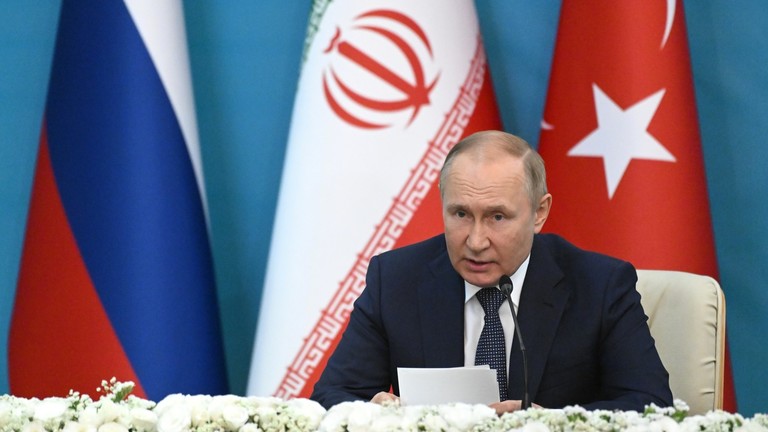
President Recep Tayyip Erdogan of Turkey, President Vladimir Putin of Russia, and President Ebrahim Raisi of Iran held talks yesterday in Tehran at the 7th Astana summit for peace in Syria, stressing the need for respecting Syria’s national sovereignty and territorial integrity.
The summits date from January 2017, and are named for the Kazakhstan capital they were first held at. The trio of leaders decided the next meeting will be held in Moscow before the end of the year.
The Syrian Foreign Minister, Faisal Mekdad, arrived in Tehran late on Tuesday to be briefed about the latest decisions following the meeting of the presidents.
The joint conclusions
Many important issues were discussed by the trio concerning the situation in Syria, which has developed into a stalemate. Global media has stopped covering Syria since 2019 when the battlefields went silent, but a political solution has been elusive.
One point that Turkey, Russia and Iran agreed upon was the need for the US occupation troops to leave Syria, and their unified opposition to the Biden administration policy in Syria, which includes the need to lift US sanctions on Syria which are oppressing the Syrian people.
“We have certain differences concerning what is happening on the Euphrates eastern bank. But we have a shared position that American troops must leave this territory,” Putin said while adding, “They must stop robbing the Syrian state, Syrian people, illegally exporting oil from there.”
The trio affirmed that there was “no military solution” to the conflict in Syria, and agreed on the need to eliminate terrorism and opposed any attempts to divide the country.
The three leaders also jointly condemned Israel’s ongoing attacks on civilian targets in Syria, and agreed that the crisis in Syria could only be resolved peacefully and by the Syrians themselves.
Raisi said, “The international community bears the responsibility to solve the crisis of the displaced and Syrian refugees, and we will support any initiative to do so.”
The Turkish position
For at least two months, Erdogan has threatened to conduct a fourth military invasion into northern Syria. Analysts had thought the summit would be used by Iran and Russia to convince Turkey a new attack on the US-sponsored SDF in the northeastern Kurdish region would be a destabilizing event for the region. It appears that Turkey was able to get assurances from Iran and Russia that the SDF would not present a border terrorist threat to Turkey.
The US, Russia and Iran had all shared the view that Turkey should not begin a new military attack in northern Syria.
Turkey and US are NATO members and had been allies. But, the US chose to partner with the SDF, who are a separatist group in Syria led by Kurds who are following a socialist political ideology based on the communist framework of the PKK, an internationally outlawed terrorist group who have killed thousands in Turkey over three decades.
The trio agreed that terrorism must be eradicated everywhere, and there cannot be “good terrorists” who are used by the US, while others are deemed “bad terrorists” such as ISIS and Al Qaeda.
US President Obama began the US-NATO attack on Syria in 2011 for ‘regime change’. He failed. The US used the Muslim Brotherhood in the Middle East, as well as global Al Qaeda branches which were transported into northern Syria from their base in southern Turkey, were the CIA operated a terrorist headquarters which was finally shut down in 2017 by President Trump.
Erdogan is a Muslim Brotherhood follower, and his AKP party is aligned with the international terrorist group banned in Egypt, Russia, Syria, Saudi Arabia and the UAE.
The US position
The Biden administration has made no changes to US policy in Syria since taking office. The US is not present in any Syrian peace talks. Obama started the destruction in Syria, but Biden is not offering any solution. The US sanctions have prevented any reconstruction from beginning, and the Syrian people have been struggling under hyper-inflation, with no end in sight.
Russia, Turkey and Iran agreed the US-EU sanctions should be lifted and described them as being “in contravention of international law, international humanitarian law and the UN Charter including, among other things, any discriminatory measures through waivers for certain regions which could lead to this country’s disintegration by assisting separatist agendas.”
Trump had ordered the withdrawal of US troops from Syria, but the Pentagon insisted that they stay in support of the SDF who steal the oil from the main oil field in Syria and sell the oil to support their socialist administration. That oil is the property of Syria, and because they are refused access to the oil, the Syrian people live with just two hours of electricity per day.
Damascus considers the US troops in Syria as a military occupation force which destabilizes the country and is against the UN charter and international law.
US raids on terrorists in Idlib
Idlib is the last remaining terrorist controlled area in Syria. Hayat Tahrir al-Sham is the Radical Islamic terrorist group who keep about three million persons as human hostages. Turkey protects the terrorists and keeps Russian and Syrian military from attacking Idlib, while the UN and other humanitarian groups keep the terrorists, their families, and civilians fed. The US has also been very vocal and has accused the Syrian and Russian military for attacking terrorists in Idlib.
In a double-faced US policy in Idlib, the US has continued to kill ISIS leaders in Idlib, including the first assassination of the ISIS Calipha Baghdadi ordered by Trump. Since then, another five ISIS leaders have been killed by the US in Idlib. The US know that the terrorists in control in Idlib are allies of ISIS, and yet the US policy is to protect Idlib from being cleared of terrorists.
In 2015, Russia was asked to enter Syria as the Al Qaeda affiliate Jibhat al-Nusra was threatening to create an Islamic State in Syria. Putin recalled at the summit, “We broke the backbone of international terrorism there.”
Grain crisis discussion
Putin and Erdogan discussed the supply of grain from Russia and Ukraine to world markets. Putin thanked Erdogan for his efforts “to mediate by providing Turkey with a platform for negotiating food issues and grain exports across the Black Sea.” Putin called on the US to lift all restrictions on grain exports from Russia to improve the global food market situation.
Erdogan has been leading efforts to broker a deal to allow thousands of tons of grain that is being blockaded by Russia to leave Ukraine’s ports. Turkey has responsibility under the 1936 Montreux convention for naval traffic entering the Black Sea, and is proposing that Russia allow Ukrainian grain ships to leave Odesa on designated routes.
Steven Sahiounie is a journalist and political commentator.
Iran deal can survive if US opts for own interests rather than Israel’s: Foreign Ministry
Press TV – July 20, 2022
Tehran says multilateral negotiations to revive the 2015 Iran deal will be fruitful if the United States looks at the issue through the lens of its own national interests rather than those of the Israeli regime.
Iranian Foreign Ministry spokesman Nasser Kan’ani told a press conference on Wednesday that the US seems to be weak when it comes to making “an independent political decision” about whether it is willing to return to the deal, four years after it unilaterally walked away.
“If the US administration [of Joe Biden] looks at this issue through the lens of American national interests and not through the lens of the interests of the occupying Zionist regime, the ground will be paved for an agreement in the near future,” Kan’ani said.
More than a year of negotiations – first in Vienna and now in Doha – have not yet led to an agreement on what steps each side needs to take in order to restore the ailing accord, officially called the Joint Comprehensive Plan of Action (JCPOA).
The US withdrew from the JCPOA back in 2018 as it unleashed a “maximum pressure” campaign targeting the Iranian economy, despite Tehran’s strict compliance with the terms of the accord.
The Vienna talks, which began in April last year, hit a deadlock in March owing to Washington’s insistence on retaining parts of its sanctions against Iran. The Doha talks, however, have led to different interpretations by the parties to the talks.
“Contrary to the claim of the American side that the Doha negotiations were a failure, they opened up a path for the continuation of talks between the different parties of the nuclear agreement,” Kan’ani said, assessing the negotiations as “good.”
He explained that there is no major obstacle to concluding an agreement, except that the American side has to make a serious political decision.
“On the one hand, the US administration expresses its desire to return to the agreement, and on the other hand, it does not want to pay the costs of returning to the agreement,” the Iranian spokesman added.
‘US, Israel failed to form anti-Iran coalition’
In his Wednesday press conference, Kan’ani also pointed to Biden’s recent trip to the region with the agenda of forming an anti-Iran coalition among other objectives, saying both the US and the Israeli regime failed to achieve that goal.
“The Zionist regime attempted to form a regional coalition during that trip to put pressure on Iran,” he said. “In this effort, this regime has failed and the American government has not succeeded either.”
Biden arrived in the Israeli-occupied territories last Wednesday, kicking off a much-anticipated four-day trip to the region. The regional tour also took the US president to Saudi Arabia, the country he once pledged to make “the pariah that they are.”
Since 2020, the US has brokered normalization agreements under the so-called Abraham Accords between the Israeli regime and some Arab countries, including the United Arab Emirates, Bahrain, Morocco, and Sudan – with Saudi Arabia expected to be the next.
In Saudi Arabia, Biden attended a summit of the [Persian] Gulf Cooperation Council (GCC) countries, plus Egypt, Jordan, and Iraq – also known as GCC+3. The summit, which was ostensibly aimed to build an anti-Iran front, failed to garner much support.
A day before the summit, Iraqi Prime Minister Mustafa al-Kadhimi stressed that Iraq will not be part of any camp or military alliance, and “will not be a base for threatening any neighboring countries.”
The UAE, a close ally of both Saudi Arabia and the US, also dismissed the idea of forming a NATO-like military alliance in the region.
“We are open to cooperation, but not cooperation targeting any other country in the region and I specifically mention Iran,” Anwar Gargash, the UAE president’s diplomatic adviser, said.
“The UAE is not going to be a party to any group of countries that sees confrontation as a direction,” Gargash added.
After the summit, Saudi Arabia’s Foreign Minister Prince Faisal bin Farhan claimed that his country extends a hand of friendship toward Iran.
He also expressed the kingdom’s willingness to reestablish normal relations with the Islamic Republic.
“The messages we received from Arab officials in the region, both directly and indirectly, show that fortunately, the countries of the region are not ready to act against Iran [and in line with] America’s regional policies,” Kan’ani said.
He then added that conditions are now ripe for Iran to organize and host talks to deepen regional cooperation.
He also urged the US to stop meddling in the internal affairs of regional countries, halt its plots of forming fictitious alliances, and refrain from imposing American values on the region.
Regional countries naturally have common interests and views, he said, adding, “They are capable of creating the best conditions for stability and security in the region in the light of regional meetings.”
Putin tells US to stop ‘looting’ Syria
Samizdat | July 19, 2022
The US needs to stop “stealing” the oil from the Syrian people and state, Russian President Vladimir Putin said on Tuesday, after meeting with his Iranian and Turkish counterparts in Tehran. The three guarantors of the “Astana process” also agreed that the US should leave the trans-Euphrates, and stop making the humanitarian crisis in Syria worse with their unilateral sanctions.
American troops must leave the territory east of the Euphrates river and “stop robbing the Syrian state, the Syrian people, exporting oil illegally,” Putin told reporters on Tuesday evening. He said this was a “common position” of Russia, Iran and Turkey.
Several hundred US troops are illegally present in Syria, mainly controlling the oil wells and wheatfields in the country’s northeast, controlled by the Syrian Democratic Forces (SDF) militia since the defeat of Islamic State (IS, formerly ISIS) terrorists. The US-backed SDF has refused to reintegrate with the government in Damascus, which Washington wishes to see overthrown.
Since 2019, the US has sought to punish anyone trying to assist the reconstruction of war-torn Syria via the “Caesar Syria Civilian Protection Act,” accusing the government of President Bashar Assad of war crimes and blocking all assistance to Damascus.
Putin said on Tuesday that such sanctions have had “disastrous results” and that humanitarian aid to Syria “should not be politicized.”
During Tuesday’s summit in Tehran, Putin met with Iranian President Ebrahim Raisi and Turkey’s Recep Tayyip Erdogan. In a joint declaration, the three presidents confirmed their conviction that “there can be no military solution to the Syrian conflict,” only a political one under the leadership of the UN. They also condemned “unilateral sanctions violating international law” that are exacerbating the serious humanitarian situation in Syria, urging the UN and other international organizations to “increase assistance to all Syrians, without discrimination, politicization and preconditions.”
Russia sent an expeditionary force to Syria in September 2015, at the request of Damascus, to help defeat IS and other terrorist groups. In January 2017, Moscow, Ankara and Tehran launched the “Astana process” – named after the capital of Kazakhstan – to resolve the conflict in Syria, which began in 2011.
NATO would have attacked Crimea if not stopped – Iran
Samizdat | July 19, 2022
Iranian Supreme Leader Ayatollah Ali Khamenei declared on Tuesday that had Russian President Vladimir Putin not “taken the initiative” in Ukraine, the NATO alliance would have launched a war with Russia over Crimea, which Kiev claims as its own land.
Speaking alongside Putin in Tehran, Khamenei stated that “as regards Ukraine, if you did not take the initiative, the other side would have initiated the war.”
Describing the West as “completely opposed to a strong and independent Russia” and NATO as “a dangerous entity that sees no boundaries in its expansionist policy,” the Iranian leader added that “had they not been stopped in Ukraine, they would have launched the same war sometime later under the pretext of the Crimea issue.”
Considered Russian land since imperial times, Crimea was an autonomous republic within the Soviet Union until it was ceded to the Ukrainian SSR by Soviet Premier Nikita Kruschev in 1954. The region fell under Ukrainian control after the breakup of the USSR, and voted to join Russia in 2014.
NATO considers Crimea to be “illegally annexed” Ukrainian territory. While the alliance has not threatened Russia with open war, it has demanded that Moscow return the region to Ukrainian control and a number of decisions made by its leaders and the government in Kiev suggest a possible path to war over Crimea.
NATO first established a partnership with Ukraine in 1997, and in the 2008 Bucharest Declaration stated that Ukraine and Georgia “will become members of NATO” at an unspecified future date. The Declaration remains alliance policy, and were Ukraine to join NATO, its 30 other members would instantly become parties to a territorial dispute with Russia.
For its part, Ukraine has signaled that it both intends to join NATO and intends to act on this dispute. Under President Pyotr Poroshenko, the country wrote its goal of becoming a NATO member into its constitution in 2019, despite Moscow’s warnings that having the alliance’s forces and weapons on its border would constitute an unacceptable security threat. Two years later, President Vladimir Zelensky signed a decree ordering his government to “prepare and implement measures to ensure the de-occupation and reintegration” of Crimea.
Ukraine’s ambitions of joining NATO appear to have fallen by the wayside, with Igor Zhovkva, an adviser to Zelensky, telling Financial Times last month that Kiev won’t pursue accession any further. Its ambitions of seizing Crimea, however, persist. Zelensky announced last month that he intends to “liberate” Crimea, and a spokesman for Ukraine’s Ministry of Defense, Vadim Skibitskiy, declared on Saturday that his forces may use American missiles to strike the peninsula.
Russia-Iran relations take a quantum leap
BY M. K. BHADRAKUMAR | INDIAN PUNCHLINE | JULY 17, 2022
When US National Security Advisor Jack Sullivan first spoke about a potential Iran-Russian drone deal, Moscow kept quiet and Tehran issued a pro forma rebuttal, which suggested that it is still a work in progress. Sullivan’s disclosure appeared at the end of a White Course briefing for President Biden’s West Asia tour to Israel and Saudi Arabia, and seemed to have an element of grandstanding aimed at fuelling the latent anti-Iran sentiments in the Gulf region that could in turn impart momentum to POTUS’ project to put together an Israeli-Arab military front in the region.
In the event, the ploy didn’t work. After Biden’s visit ended, the Saudi Arabian foreign minister Prince Faisal bin Farhan told CNN, amongst other things, that talks are going on between Iran and the GCC states for improvement of relations and the focus should be on changing Iran’s behaviour.
But Sullivan has repeated his charge and has since added that an official Russian delegation “recently received a showcase of Iranian attack-capable UAVs,” the last time being as recently as on July 5. CNN has cited White House officials as saying that Iran is expected to supply Russia with hundreds of drones for use in the war in Ukraine, “with Iran preparing to begin training Russian forces on how to operate them as early as late July.”
Iran is known to have a varied drone ecosystem and is reportedly showcasing to Russia the Shahed-191 and Shahed-129 “killer” drones. According to published information, Shahed-129 has a wingspan of 50 feet with a cruising speed of about 160 km per hour, an endurance of 24 hours with a range of 1,700 km and a ceiling of 24,000 feet. The 129 can carry 8 Sadid-345 miniaturized precision-guided bombs capable of hitting moving targets. The bomb’s small size with a range of 6 km, reduces collateral damage and would allow the Shahed to achieve more kills or attack strikes per mission.
The Shahed 191 carries two Sadid-1 missiles internally, has a cruising speed of 300 km/h, an endurance of 4.5 hours, a range of 450 km, and a payload of 50kg. The ceiling is 25,000 ft. Iran’s Fars News Agency says the Shahed 191 has been used in combat in Syria.
Both are stealth drones, harder for air defences to detect. Russia is, reportedly, short of such armed drones, which have the capability to undertake long-range missions to find and destroy, for example, the US-supplied HIMARS mobile rocket launchers which are currently deployed in Ukraine as well as knocking out Ukrainian air defences. Besides, drones are relatively cheap and expendable, unlike crewed aircraft.
If the drone deal indeed goes through, as seems likely, it will mark a quantum leap in Russia-Iran relations. For, Iran will be doing something that only China is capable of doing but won’t out of fear of US reprisal. That makes Iran a very special partner country indeed. Ironically, Russia is yet to upgrade its relationship with Iran as “strategic.”
On its part, Iran is literally sticking out its neck in an act of defiance of the West’s “rules-based order”, as Russia will be deploying its weapon systems on a European battlefield against the air defence systems supplied to Ukraine by the US and NATO countries. There cannot be many parallels of an emerging middle power rendering such critical help to a superpower in high-tech warfare in real conditions on the frontline. Of course, it enhances Iran’s standing regionally and internationally.
In geopolitical terms, however, the most important salience lies in the certainty that the door is closing on the nuclear negotiations between Iran and the US via European mediators. Tehran would have drawn the conclusion already that President Joe Biden is virtually co-opting his predecessor’s [Israel Lobby dictated] Iran policy and the US has reverted to its decades-old strategy of promoting an Israeli-Arab front against Tehran. Put differently, Tehran is moving on to a trajectory that is predicated on unremitting American hostility.
This will mean that Tehran will double down on its efforts to improve relations with its Aran neighbours and explore all possible avenues in that direction, seizing the window of opportunity in the new Saudi thinking to reduce its dependence on the US and explore its strategic autonomy. It is possible to say that Tehran is a beneficiary if the Saudi-Russian and Saudi-Chinese relationships strengthen. Arguably, Saudi Arabia’s quest for BRICS membership brings the Kingdom tantalisingly close to Iran’s world view which places primacy on a democratised, multipolar world order where every country is free to choose its developmental path.
To be sure, against this backdrop, President Vladimir Putin’s visit to Tehran on Tuesday is invested with great importance. Iran is becoming one of the most consequential relationships for Russia. What began as a limited alliance in Syria is taking on a global character.
US sponsored Kurdish SDF calls on Russia and Iran to prevent planned Turkish military operation
MEMO | July 17, 2022
The head of the Kurdish-led militant group Syrian Democratic Forces (SDF) has called on Russia and Iran to help prevent Turkiye from launching a military offensive against its positions in northern Syria, as the threat of a new Turkish operation continues to loom.
According to the AFP news agency, the SDF’s chief commander Mazloum Abdi urged the involvement of Moscow and Tehran against Ankara’s aims in the region this week, accusing the US-led global coalition to defeat Daesh – also known as Operation Inherent Resolve – of taking a “weak” position that is “insufficient to end the threats.”
In May, Turkish president Recep Tayyip Erdogan announced plans to launch a new military operation into the areas controlled by the Kurdish militias, which would be Turkey’s fourth such offensive in northern Syria. The operation is meant as an effort to clear the 30-kilometre-deep ‘safe zone’ in northern Syria from remaining Kurdish militant elements, in order to settle at least a million Syrian refugees there.
Abdi also reiterated that after negotiating with Russia, Kurdish militant forces allowed the Syrian regime of Bashar al-Assad to reinforce their troops in Kurdish-controlled areas, particularly in cities such as Kobane and Manbij in the north of the country. The threat of a renewed Turkish offensive had seemingly forced the SDF to strengthen ties with Assad, Russia, and now Iranian forces in an effort to repel Ankara’s planned operation.
Abdi’s call for Russian and Iranian assistance is likely more diplomatic than military, as it comes only days before a summit that is to be held in Iran from Tuesday, in which Iranian president Ebrahim Raisi will host Erdogan and their Russian counterpart Vladimir Putin in a renewed set of negotiations on Syria and the ongoing 11-year-long conflict.
If Moscow and Tehran heed the SDF’s call, they may be expected to attempt to discourage Ankara from its planned military operation.
Featured Video
Epidemic of fake videos
or go to
Aletho News Archives – Video-Images
From the Archives
Inside Job? Inside What?
By Prof. Tony Hall | American Herald Tribune | July 28, 2016
The Kevin Barrett-Chomsky Dispute in Historical Perspective – Sixth part of the series titled “9/11 and the Zionist Question”
In his chapter on “Left Gatekeepers” and the “Shame of Noam Chomsky,” Barrie Zwicker refers to the the “New World Order” as the “diaboligarchy’s” directing agency. Less compelling is Zwicker’s reference to the “New World Order” as the “diaboligarchy’s” directing agency. To me this unfortunate choice of words is much too closely associated with the often crude and chauvinistic populism of Alex Jones and his Infowars media network. Many have come to see Jones’ lucrative media operation as a limited hangout set in place by handlers trying to hold the activities of the 9/11 Truth Movement within manageable constraints.
Due to the important findings over fifteen years of the citizens’ investigation into 9/11, the culprits most deeply implicated in the crime can be identified with much more specificity than an entity vaguely described as a “New World Order.” As Kevin Barrett and many others insist, the time has come to name the names of the probable culprits, Noam Chomsky prominent among them.
While Alex Jones ultimately serves the same masters as Chomsky, the former’s media product is often much closer to the mark of what is really going on than the content of Noam Chomsky’s more magisterial pronouncements. Jones goes at least part of the way into realities of the deep state politics of the twenty-first century. Chomsky, however, sacrificed his capacity to contribute cogently to sensible discourse on contemporary geopolitics by making himself a primary instrument of the most consequential deep state deception of recent times. As a leading agent of disinformation in the psychological trenches of the ongoing Global War of False Flag Terrorism, Chomsky has reduced himself to the level of skeptic pretender Michael Shermer. In the style of Shermer, the elder Chomsky has become an establishment TV professor readily available on Netflix. … continue
Blog Roll
Recent Comments
loongtip on Vicious loongtip on EU turns to India for defense… Coronistan on Donald Trump Is No Peace … seversonebcfb985d9 on French court jails pro-Palesti… eddieb on Fourteen Incredible Facts Abou… Bill Francis on European leaders’ shift in the… seversonebcfb985d9 on Villains of Judea: Philip Esfo… loongtip on Report warns that ‘Jewish terr… Craig Nelms on New study shows that toxic gas… loongtip on A Funny Thing Happened on the… loongtip on EU free trade pact on hold as… John Edward Kendrick on Regime Change In Iran Is The F…


 Aletho News
- EU member to sue bloc over ‘suicidal’ ban on Russian gas
- WEF Calls for ‘Cultural Revolution’ to Promote Lab-Grown Meat
- The Board For Peace – Whitewashing Ethnic Cleansing and Genocide
- Scientists accuse Cochrane Reviews of using biased studies to claim HPV vaccine prevents cancer
- Spain Opens Probe Into Israeli Tourism Firms
- Epidemic of fake videos
- Craig Murray, Reporting from Venezuela
- Why Israel’s Drive to Destroy Iran is Ultimately about Palestine
- Trump and Iran, War or Negotiations?
- US pressure contributing to Israeli influence in Latin America: Experts
- If Americans Knew
- Greenpeace Demonstrator Exposes Folly of Protest Restrictions
- From CBS to TikTok, Pro-Israel Ellison is now in the driver’s seat
- Israel pays for UK advertisements attacking Doctors Without Borders
- Israel accused of extracting billions from Gazan people to pay for their own genocide
- ‘Deliberate Assassination’: 3 Journalists Among 11 Killed by Israeli Forces in Gaza
- In Gaza, We’re Struggling to Reintroduce Foods to Bodies Adjusted to Starvation
- Will Rafah crossing be opened at last? – Not a ceasefire Day 108
- Israeli drone strike kills two children collecting firewood in Gaza – Not a ceasefire Day 107
- Another Gaza baby freezes to death on Netanyahu’s watch – Not a ceasefire Day 106
- Oppose Israel’s Abuses While You Still Can
- No Tricks Zone
- New Study Affirms Rising CO2’s Greening Impact Across India – A Region With No Net Warming In 75 Years
- Germany’s Natural Gas Crisis Escalates … One Storage Site Near Empty …Government Silent
- Polar Colding…Antarctica Saw Its Coldest October In 44 Years!
- New Study: Sea Levels Rose 20 Times The Modern Rate During The Roman Warm Period
- As German Gas Storage Dips Dangerously Low…Shortage Hardly Avoidable
- New Study: Brazil’s Relative Sea Level Was 2+ Meters Higher And SSTs 3-4°C Warmer 6000 Years Ago
- Philosopher Schopenhauer: Climate Science Certainty Stems From Stupidity, Ignorance
- New Study: Species Extinction Rates Declining Since 1980 – ‘Climate Change Is Not An Important Threat’
- Denmark Places Climate Protection Above Animal Welfare, Poisoning And Culling Cows
- New Study: Greenland Was 3-7°C Warmer And Far Less Glaciated Than Today 6000-8000 Years Ago
 Aletho News