Iranian scientist jailed in US returns home
By Ghanbar Naderi – Press TV – June 8, 2020
Iranian scientist Majid Taheri, who was imprisoned in the US for more than 16 months, finally returned home on Monday. Upon arrival, Taheri was received by his family as well as high-ranking Iranian officials at the Imam Khomeini International Airport.
The Iranian national who was a longtime resident of the US state of Florida, spent 16 months in prison for allegedly violating US sanctions on Iran. Speaking to Press TV, he denied all allegations.
The development came days after another Iranian scientist Sirous Asgari, a professor of material sciences at Sharif University of Technology, also returned home.
He spent about three years in US detention on trumped-up charges of fraud and theft of information relating to his work with a university in Ohio. The case however, was dismissed by a US district judge and he managed to return to his country.
Iran has called on Washington to release all other Iranian citizens taken hostage. The country says the US must make up for the damages caused by detaining Iranian scientists.
Iran Can Supply Itself With Nuclear Fuel Without Russia’s Help – Atomic Energy Body
Sputnik – 28.05.2020
TEHRAN – Iran is capable of supplying itself with nuclear fuel even without Russia’s assistance, Iran’s Atomic Energy Organization (AEOI) spokesman, Behruz Kamalvandi, said on Thursday.
“Fuel is delivered from Russia each time we need it, without any problems. If we run out of fuel, we will be capable of producing it, without resting on any other country,” Kamalvandi told the ISNA news agency.
His comment came soon after the United States announced ending sanction waivers covering Iran’s nuclear projects.
In late April, Russia delivered a fresh batch of nuclear fuel to Iran’s Bushehr Nuclear Power Plant, necessary for efficient functioning of the reactor.
Did Trump Just Cancel a Potential Double-War?
The Saker • Unz Review • May 27, 2020
At this time of writing, it is too early to declare the danger over, but at least three out of five Iranian tankers have made it safely to Venezuela (confirmation from TeleSur and PressTV). Furthermore, while we should never say “never”, it appears exceedingly unlikely that the US would let three tankers pass only to then try to impede the arrival of the other two. So it ain’t over until its over, but as of right now things look way better than last week.
Besides, this is mostly a symbolic issue. While these 5 tankers will make a difference, it won’t be a huge one, especially considering the devastating consequences which the US sanctions, sabotage and subversion have inflicted on Venezuela.
Still, symbols are important, if only because they create a precedent. In fact, I would argue that the latest climbdown by Trump is no different than all his other climbdowns: Trump has had a very consistent record of threatening fire and brimstone before quietly deflating and walking away. And since he did that many times now, we have to wonder whether this strategy is effective or not?
One could argue that this strategy could be described by saying that you put the maximum pressure on the other side in the hope that the bluff will entice the adversary to fold. This could be a semi-credible argument were it not for a very simple but crucial problem: so far the other guys have never folded. In other words, Trump’s bluff has been called over and over again, and each time Trump had to quietly deflate.
Some will say that this only proves that Trump is truly a peace-loving President who, unlike his predecessors, does not want to go to war. But then, what about the cruise missile strikes on Syria? What about the murder of Soleimani?
Truth be told, the kindest thing we can say about this strategy (assuming that it is a strategy to begin with, not the evidence of a total lack of one) is that it is tantamount to yelling “fire!” in a crowded movie theater: the fact that Trump did not set any movie theater ablaze hardly justifies his yelling “fire” in such a dangerous environment. The perfect example of this kind of irresponsible behavior is the murder of General Soleimani which truly brought the US and Iran a millimeter away from a real, full-scale war.
Furthermore, while I salute Trump’s climbing down following the Iranian strikes, I also believe that in doing so he hurt the international image of the US. Why? Think about this: this is the first time ever (if I am not mistaken) that the US was the object of a major military strike coming from another state-actor and did not retaliate. In the past and until this Spring, the US always held the view that if anybody dares to mess with it this would result in very serious consequences. Thus the US upheld a world order in which some where a lot more equal than others. Specifically, “others” had to meekly accept US strikes and shut up whereas Uncle Shmuel could strike left and right and expect no retaliation.
By “accepting” the Iranian counter-strike, Trump did essentially place an “equal” sign between Iran and the US. He probably never understood that, but in the region this was understood by all.
Just as Hezbollah destroyed the myth of Israeli impunity, Iran destroyed the myth of US impunity.
Still, I will always prefer the politician who does not start a war (for whatever reason) to one who would. I also have no doubt whatsoever that Hillary would have started one, or even several, wars. But the fact that Hillary would have been even worse than Trump is hardly a reason to start fawning about Trump’s brilliant “5D chess” genius or peace-loving policies…
Trump reminds of a guy pointing a gun a people in the street only to later say “but it was a toy gun, I never meant to really shoot anybody.” This is definitely better than shooting people with a real gun, but this is hardly a sign of maturity or intelligence.
The other problem with this “strategy” (let’s assume for argument’s sake that this is a strategy of some kind): each time the “indispensable nation” and “sole hyperpower” has to climb down, it increasingly looks like a paper tiger. Not looking like such a paper tiger is probably the main reason behind Michael Ledeen’s famous words “Every ten years or so, the United States needs to pick up some small crappy little country and throw it against the wall, just to show the world we mean business.” In a strictly evil and imperialistic sense, Ledeen’s strategy makes a lot more sense than what Trump has been doing.

As Marx famously said, “History repeats itself, first as tragedy, second as farce.” The outcome of what some now call the “Battle of Macuto Bay” is a perfect example of this: if the Bay of Pigs was the “root case” then the disaster in Grenada was the tragedy and the Battle of Macuto Bay the real farce.
Humor can be a devastating weapon and anybody who has studied the late Soviet Union (in the late Brezhnev years and after) knows how the Russian people ridiculed the Soviet leaders with literally thousands of jokes.
A real imperialist would much rather be hated than ridiculed, and while Trump himself probably does not realize that he is the laughingstock of the planet, his aides and deep state bosses most definitely do and that is very, very dangerous.
Why?
Because the pressure to, once again, “pick up some small crappy little country and throw it against the wall” increases with each climbdown (see my article “Each “Click” Brings Us One Step Closer to the “Bang!” for a fuller discussion of this).
Besides, finding an even smaller and weaker country than Venezuela will be hard (maybe the Island of Saba? or Grenada again? who knows?). And potentially very dangerous.
The other problem is predictability. Any international system requires that its most powerful actors be predictable. In contrast, when a major international actors acts in what appears to be unpredictable, irrational or irresponsible manner, this puts the entire stability of the system at risk.
This, by the way, is also why it is so disastrous that the US has withdrawn from so many international organizations or treaties: the participation in international organizations and treaties indicate that the US is willing to play by the same rules as everybody else. The fact that the US is ditching so many of its former international obligations only shows that the US has gone rogue and is from now on totally unpredictable.
Finally, there are also lessons for Moscow here, the main one being that when confronted with a determined adversary, the Empire tries to bluff, but eventually folds. True, Moscow has to be much more careful than Tehran simply because the consequences of a US-Russian war would be dramatically worse than even a major conflict in the Middle-East. Yet it is also true that over the past years the Russian armed forces did have the time to prepare for such a conflict and that now Russia is ready for pretty much anything the US could try to throw at her, at least in purely military terms.
In contrast to the military posture of Russia, the political environment in Russia has changed for the worse: there is now a potentially very dangerous “hardline” opposition to Putin which I have christened the “6th column”, as opposed to the liberal and pro-western 5th column. What these two “columns” have in common is that they both will categorically oppose pretty much anything and everything Putin does. The 6th column, in particular, has a seething hatred for Putin which is even more rabid than what the liberal 5th column usually express. Check out this excellent video by Ruslan Ostashko, who prefers the term “emo-Marxists” and who very accurately describes these folks. Whether we think of them as 6th-columnists or emo-Marxists does not matter, what matters is that these folks are eager to act like a soundboard for any and all anti-Putin rumors and fakes. While Putin certainly has his flaws, and while the economic policies of the Medvedev, and now Mishustin, government are a far cry from what most Russians would want, it is also true that these two “columns” are objectively doing the bidding of the Empire, which could present a real problem if the current pandemic-induced economic crisis in Russia is not tackled more effectively by the government.
I have always said that Iran, while being much weaker than Russia, has consistently shown much more courage in its dealings with the Empire than Russia. Furthermore, Iran’s policies are primarily dictated by moral and spiritual considerations (as in the case of Iran’s principled stance on occupied Palestine) while Russian policies are much more “pragmatic” (which is really a euphemism for self-serving). But then, Iran is an Islamic Republic whereas Russia still has to develop some kind of unifying and original worldview.
Conclusion:
For all his innumerable negative character traits and other flaws, it remains true that Trump has not launched a major war (so far). Yes, he has brought the world to the brink several times, but so far he has not plunged the world into a major conflict. How much of the credit for this truly should go personally to him is very debatable (maybe cooler heads in the military prevailed, I think of folks like General Mattis who, reportedly, was the one who stopped the US from seriously attacking Syria and settled for a symbolic strike). Some Russian analysts (Andrei Sidorov) even believe that the US is in no condition to fight any war, no matter how small. Furthermore, most (all?) Russian analysts also believe that the US is fully committed to a full-spectrum information and economic war to try to economically strangle both Russia and China. I think that it would be fair to say that nobody in Russia believes that the relationship with Trump’s US can, or will, improve. The tone in China is also changing, especially since the US has now launched a major anti-China strategic PSYOP. In other words, the US is merrily continuing down its current road which leads it to a simultaneous confrontation with not one, or even two, countries, but with a list of countries which seems to grow every day. So while it is true that in this case Trump appears to have canceled two wars, we should not assume that he won’t soon start one, if only to deflect the blame for his total mismanagement of the COVID19 crisis. Should that happen, we can only hope that all the “resistance countries” and movement will provide as much support as possible to whomever the Empire attacks next.
Iran surges in Venezuela in defiance of US sanctions
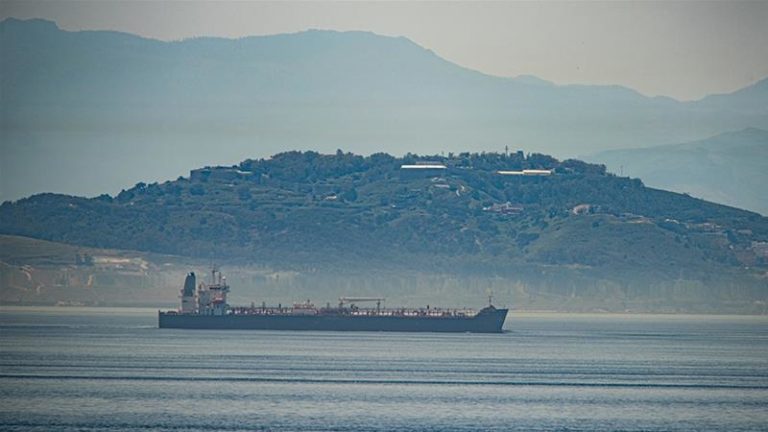
Iranian oil tanker Clavel crossing the Gibraltar stretch heading for Venezuela, May 20, 2020
By M. K. BHADRAKUMAR | Indian Punchline | May 25, 2020
Escorted by the Venezuelan navy and air force, an Iranian oil tanker named Fortune has entered that country’s waters on Sunday, amidst intense speculation whether the US would interfere with the delivery. The US has imposed oil sanctions against Venezuela and Iran and had said it is monitoring the Iranian tanker.
In fact, five Iranian tankers carrying about 1.5m barrels of fuel passed through the Suez Canal earlier this month, according to shipping data on Refinitiv Eikon, and were heading for Venezuela. The other four Iranian tankers — Forest, Petunia, Faxon and Clavel — are approaching the Caribbean en route to Venezuela.
A flotilla of US Navy and Coast Guard vessels is patrolling the Caribbean Sea on a mission to counter illicit drug trafficking. But the Pentagon has stated that there are no plans to stop the Iranian tankers.
At the same time, a Pentagon spokesman, Jonathan Hoffman, while saying on Thursday he was not aware of any operations related to the Iranian cargoes, also added, “We have continued to say that Iran and Venezuela – both two outliers in the international order – [are] clearly violating international sanctions on both nations with this transaction.”
The US sanctions on Venezuela are aimed at increasing pressure on President Maduro to step down. Thus, arguably, Iran is frontally challenging the Trump administration’s stated policy of ‘regime change’ in Venezuela. The Iranian move comes just three weeks after the abortive coup attempt masterminded by the White House on May 1 with the participation of two former US Green Berets aimed at capturing Maduro and transport him to the US in American helicopters to be put on trial on fake drug trafficking charges.
The coup attempt showed the extent of desperation in Washington to overthrow the Maduro government before the US presidential election in November, which President Trump hopes would help him garner Hispanic votes. Iran has now offered a lifeline to Venezuela.
In an historical context, this becomes a frontal assault by Iran on the Monroe Doctrine dating back to the 19th century, which in US foreign policy calculus regarded the Western Hemisphere as its sphere of influence. According to a Reuters report, the Trump administration said earlier this month it was “considering measures” it could take in response to the Iranian shipments, without providing specifics.
No doubt, this is a deliberate sanctions-busting enterprise by Iran. Venezuela desperately needs fuel for up to 1,800 gasoline stations that have been partially closed for weeks due to insufficient supply from state-run refineries.
Venezuela’s gasoline output is now limited to a single facility, the Amuay refinery, but most fuel produced is low octane as most of the country’s alkylation units are out of service. Imported alkylate could improve the quality of domestic gasoline. Venezuela’s refineries are in poor condition. Shipments of equipment in flights by Iran’s Mahan Air have arrived in Venezuela in recent weeks to start repair work.
It will be interesting to see whether the US Navy would interdict any of the other four Iranian tankers before they enter Venezuelan waters. Tehran has sternly warned the US that it would retaliate if any such attempt is made. On Saturday, Tehran raised the ante with President Hassan Rouhani explicitly warning, “If our oil tankers in the Caribbean Sea or anywhere else in the world get into trouble caused by the Americans, they (US) will run into trouble reciprocally.”
Washington is well aware of Iran’s capability to create big problems for the US Navy deployed in the Persian Gulf, especially the Strait of Hormuz. Last week, in a precautionary step, US Navy, via the Maritime Safety Office run by the National Geospatial-Intelligence Agency, alerted all international maritime traffic to maintain a safe distance of at least 100 meters from US naval vessels in international waters and straits. Pentagon officials separately confirmed that the stay-away warning to marine traffic in the Persian Gulf, the Arabian Sea and the Gulf of Oman was actually intended for Iran.
In geopolitical terms, Iran’s strategic defiance of the US in the Western Hemisphere makes an interesting case study not only of the decline in American influence in its backyard to the south but the entire efficacy of the “sphere of influence” concept in contemporary world politics. This is one thing.
More importantly, in the backdrop of the Iranian tanker reaching Venezuela, Caracas has described Iran as a “revolutionary partner” in the struggle against US imperialism. From the Iranian viewpoint, Venezuela becomes a part of the “axis of resistance” against the US. To be sure, the audacity of the two countries will irritate Washington to no end.
How far the Iran-Venezuela axis will deepen and expand will bear watch. Importantly, the UN Security Council embargo against Iran exporting arms to other countries is expiring in October. The US move to extend the timeline of the embargo is unlikely to succeed, given the strong negative reaction by Russia and China. It is entirely conceivable that a matrix of military cooperation may commence in a near future involving Iran and Venezuela.
Iran’s indigenously developed missile capability acts as a deterrent against US aggression. Iran has transferred missile technology to Hezbollah, which is estimated to have the capability today to inflict significant damage to Israel in the event of any aggression by the latter on Lebanon. Significantly, the deterrence is working and Israel no longer stages attacks on Lebanon.
A similar shift in the strategic balance with Iran’s help can create more space for Venezuela to push back at the US. All in all, Iran appears to be working on a strategy to help Venezuela to maintain its strategic autonomy. There is enormous potential for cooperation and coordination between Iran and Venezuela. If Venezuela has the largest known oil reserves in the world, Iran too has massive reserves of oil and gas.
The despatch of oil to lubricate the beleaguered Venezuelan economy may prove to be the harbinger of an assertive Iranian power projection elsewhere in Latin America too. Surely, in the near term, it is a rebuff to the Trump administration’s maximum pressure strategy against Iran. In a longer-term perspective, a concerted regional strategy in Latin America by Russia, China and Iran can seriously erode the US influence in the continent.
Iranian Supreme Leader Tweets Country Will Support Any Nation That Fights Israel
Sputnik – 20.05.2020
Iran’s Supreme Leader announced on Wednesday his country would “support and assist any nation or any group anywhere” in its struggles against Israel. His comments follow a Palestinian withdrawal from agreements with Israel over its proposed annexation of the West Bank.
“The Zionist regime has proven it won’t abide by any treaty & understands no logic except force,” Iranian Supreme Leader Ali Khamenei wrote in a Wednesday statement posted on Twitter as a series of tweets. “The nature of the Zionist regime is incompatible with peace, because the Zionists seek to expand their territories & will certainly not be limited to what they have already occupied.”
“Eliminating the Zionist regime doesn’t mean eliminating Jews. We aren’t against Jews. It means abolishing the imposed regime & Muslim, Christian & Jewish Palestinians choose their own govt & expel thugs like Netanyahu. This is ‘Eliminating Israel’ & it will happen,” the Shiite religious leader explained. “A proposal for a referendum to choose the type of govt for the historical country of #Palestine was registered with the UN as offered by Iran. We say the true Palestinians with Palestinian roots of at least 100 years, and Palestinians living abroad, choose the govt of Palestine.”
“Comprehensive struggles by the Palestinian nation – political, military & cultural – should continue till the usurpers submit to the referendum for the Palestinian nation. This nation should determine what political system should rule there; struggle must continue until then,” Khamenei continued. “We will support and assist any nation or any group anywhere who opposes and fights the Zionist regime, and we do not hesitate to say this.”
Khamenei’s comments follow an announcement by the Palestinian Authority on Tuesday that it would cease to abide by any of its agreements with either Israel or the United States – a move itself in response to an announcement by the newly formed Israeli government to begin annexing one-third of the West Bank as soon as July. […]
The area Tel Aviv seeks to annex is part of what is known as “Zone C” under the Second Oslo Accords in 1995, a part of the West Bank subjected to Israel military control. However, the area Prime Minister Benjamin Netanyahu has proposed annexing is roughly 30% of the West Bank and not all of Area C, but mostly the Jordan River valley. As Sputnik has reported, the Israel Defense Forces have used this control to systematically evict Palestinian villages from the fertile land along the River Jordan for decades, later turning the land over to Israeli settlers who now number close to 400,000 in the zone.
Will Trump Really Start Two Wars Instead of “Just” One?
The Saker | Unz Review | May 20, 2020
Amidst the worldwide pandemic induced scare most of us have probably lost track of all the other potential dangers which still threaten international peace and stability. Allow me to list just a few headlines which, I strongly believe, deserve much more attention than what they got so far. Here we go:
- Military Times : “5 Iran tankers sailing to Venezuela amid US pressure tactics“
- Time : “5 Iranian Tankers Head to Venezuela Amid Heightened Tensions Between U.S. and Tehran“
- FoxNews: “Iran tankers sailing to Venezuela in effort to undermine US sanctions“
Notice that Military Times speaks of “US pressure tactics”, Time of “tensions” and FoxNews of “efforts to undermine US sanctions”?
I don’t think that this is a coincidence. Folks in the US military are much more in touch with reality than the flag-waving prostitutes which some people call “reporters” or “journalists”.
Furthermore, the US has embarked on a new policy to justify its acts of piracy on the high seas with something called Visit, Board, Search and Seizure (VBSS) all under the pretext of the war on drugs. To get a better understanding of the context of these developments I asked a specialist of Maritime issues of our community, NatSouth, who replied the following: (stress added)
If a ship does not comply with the request to be boarded, it is usual that the pursuing authorities must gain the permission of the ‘flag’ state prior to boarding, on the high seas and the pursuit has to have started in the coastal state’s jurisdictional waters. The caveat here is that in the Caribbean – Caribbean Regional Maritime Agreement (CRA) – (long name: Agreement Concerning Co-operation in Suppressing Illicit Maritime and Air Trafficking in Narcotic Drugs and Psychotropic Substances in the Caribbean Area). So, there is an agreement with participating coastal states on boardings and pursuits in EEZs and the like. You can find more on the legal aspects of boardings at sea here: and more info on so-called “consensual boardings” here.
The anti-drug/ counterterrorism angle allows the U.S. Navy and the USCG to carry out interdictions on the high seas. Important point to note whether this approach will be taken to interdict the tankers, given that Venezuela is a declared narco-State. The absurdity is that Venezuela isn’t the primary transit point in the region, Colombia holds that honour.
If I could add at this point, the origins are that Venezuela didn’t wish to play ball with Washington anymore, specifically with the DEA back in 2005, squaring the circle of sorts, (or should that be a vicious circle cunningly used by Washington, because who is going to argue with that narrative, aka the war on terror). March: SOUTHCOM’s Adm. Faller: “There will be an increase in US military presence in the hemisphere later this year. This will include an enhanced presence of ships, aircraft, & security forces to reassure our partners… & counter a range of threats to include illicit narco-terrorism.” At the same time, the State dept released this tweet, so the US could effectively carry out boardings under the guise of counterterrorism as well.
While the Iranian tankers were in the Mediterranean, Washington released a (delayed) “Global Maritime Sanctions Advisory”, to the maritime industry, setting out guidelines to shipowners and insurers to enable them to avoid the risks of sanctions penalties related to North Korea, Syria and Iran. This also concerns oil exports from Iran, (but doesn’t apply to Iranian flagged ships). This came after the State Dept gave warning notice to oil companies to stop operations, including Rosneft (Russia), Reliance (India) and Repsol (Spain).
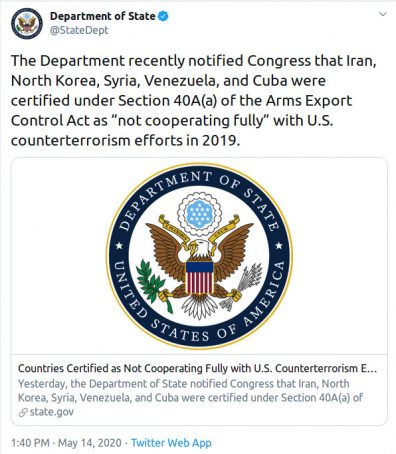
Then NatSouth concluded the following:
Under international law, every merchant ship must be registered with a flag state, which has jurisdiction over the vessel. Hence, this time, the use of Iranian-flagged tankers, as a direct response from Washington’s latest version of restating “maximum pressure” campaign on enforcement of Iran and Venezuela sanctions, (back in Feb, literally the same language as in Aug 2019). There was talk back then of a naval embargo, which would a serious notch up in tensions. There was mention of the 4 U.S. warships in the Caribbean, the U.S. Navy tweeted about, but one the Preble went through the Panama Canal into the Pacific).
Pretty clear, isn’t it?
What the US is doing is substituting itself for the United Nations and it is now openly claiming the right to board any vessel under whatever kind of pious pretext like, say, narco-trafficing, nuclear proliferation, sanctions against so-called “rogue states”, etc. Clearly, the AngloZionists expect everybody to roll over and take it.
How likely is that?
Let’s look at a few Iranian headlines, all from PressTV:
- PressTV, May 16th: “Iran’s fuel shipment to Venezuela guaranteed by its missile power“
- PressTV, May 17th: “US aware Iran will respond ‘very strongly’ if Venezuela-bound ships attacked: Analyst“
- PressTV, May 18th: “Iran: US bears responsibility for any foolish act against tankers heading to Venezuela“
Three days in a row. I think that it is fair to assume that the Iranians are trying very hard to convince Uncle Shmuel not to mess with these tankers. Does anybody seriously believe that the Iranians are bluffing?
Before we look at some of the aspects of this potential crisis, let’s just mention a few things here.
First, the US is acting in total and official illegality. Just like the bombing of Syria, the threats to Iran, or the US murderous sanctions Uncle Shmuel imposes left and right – the blockade of Venezuela is a) totally illegal and b) an act of war under international law.
Second, if USN commanders think they can operate with impunity only because the Caribbean is far away from Iran, they are kidding themselves. Yes, Iranian forces cannot defend these tankers so far away from home, nor can they take any action against the USN in the Atlantic-Caribbean theater of naval operations. But what they can and will do is retaliate against any AngloZionist target in the Middle-East, including any oil/gas tanker.
Third, while Venezuela’s military is tiny and weak compared to the immensely expensive and bloated US military, being immensely expensive and bloated is no guarantee of success. In fact, and depending on how the Venezuelan leadership perceives its options, there could be some very real risk for the USA in any attempt to interfere with the free passage of these ships.
What do I mean by that?
Did you know that Venezuela had four squadrons of Su-30MKV for a total of 22 aircraft? Did you know that Venezuela also had an unknown number of Kh-31A supersonic anti-shipping missiles? And did you know that Venezuela had a number of S-300VM and 9K317M2 Buk-M2E long range and medium range SAMs?
True, that is nowhere near the amount of weapons systems Venezuela would need to withstand a determined US attack, but it is more than enough to create some real headaches for US planners. Do you remember what the Argentinian Air Force did to the British Navy during the Malvinas war? Not only did the Argentinians sink two Type 42 guided missile destroyers (the HMS Sheffield and the HMS Coventry) which were providing long-range radar and medium-high altitude missile picket for the British carriers, they also destroyed 2 frigates, 1 landing ship, 1 landing craft, 1 container ship. Frankly, considering how poorly defended the British carriers were, it is only luck which saved them from destruction (that, and the lack of sufficient number of Super Étendard strike aircraft and Exocet missiles). I would add here that the British military, having been defeated on many occasions, has learned the painful lessons of their past defeats and does not suffer from the cocky-sure attitude of the US military. As a result, they were very careful during the war against Argentina and that caution was one of the factors which gave a Britain well-deserved the victory (I mean that in military terms only; in moral terms this was just another imperialist war with all the evil that entails). Had the Argentinians had a modern air force and enough anti-shipping missiles, the war could have taken a very different turn.
Returning to the topic of Venezuela, war is a much more complex phenomenon than just a struggle of military forces. In fact, I strongly believe that political factors will remain the single most important determinant factor of most wars, even in the 21st century. And chances are that the Venezuelans, being the militarily weaker side, will look to political factors to prevail. Here is one possible scenario among many other possible ones:
Caracas decides that the US seizing/attacking the Iranian tankers constitutes an existential threat to Venezuela because if that action goes unchallenged, then the US will totally “strangle” Venezuela. Of course, the Venezuelan military cannot take on the immense US military, but what they could do is force a US intervention, say by attacking one/several USN vessel(s). Such an attack, if even only partially successful, would force the US to retaliate, bringing US forces closer not only to Venezuelan air defenses, but also closer to the Venezuelan people which will see any US retaliation as an illegitimate counter-counter-attack following the fully legitimate Venezuelan counter-attack.
Then there is the problem of defining victory. In the US political “culture” winning is usually defined as pressing a few buttons to fire off some standoff weapons, kill lots of civilians, and then declare that the “indispensable nation” has “kicked the other guy’s ass”. The problem with that is the following one: if they other guy is very visibly weaker and has no chance for a military victory of his own, then the best option for him is to declare that “surviving is winning” – meaning that if Maduro stays in power, then Venezuela as won. How would the USA cope with that kind of narrative? Keep in mind that Caracas is a city of over two million people which even in peacetime is rather dangerous (courtesy of both regular crime and potential guerilla activities). Yet, for Maduro to “win” all he has to show is that he controls Caracas. Keep in mind that even if the US forces succeed in creating some kind of “zone of real democracy” somewhere near the Colombian border, that will mean nothing to Maduro, especially considering the terrain between the border and the capital city (please check out this very high resolution map of Venezuela or this medium resolution one). As for the notion of a USN landing on the shores of Venezuela, all we need to do is to remember how the immense Hodgepodge of units which were tasked with invading Grenada (including 2 Ranger Battalions, Navy Seals, most of an Airborne Division, etc. for a total of over 7,000 soldiers(!) against a tiny nation which never expected to be invaded (for details, and a good laugh, see here for a full list of participating US forces!) was defeated by the waves of the Caribbean and the few Cuban military engineers who resisted with small-arms fire (eventually, most of the 82AB was calling in to fix this mess).
In other words, if Maduro remains in power in Caracas then, in political terms, Venezuela wins even though it would loose in purely military terms.
This phenomenon is hardly something new, as shown by the following famous quote by Ho Chi Minh: “You can kill ten of my men for every one I kill of yours. But even at those odds, you will lose and I will win.”
By the way, this is exactly the same problem the Empire faces with Iran: as long as the Islamic Republic remains an Islamic Republic it “wins” in any exchange of strikes with the USA and/or Israel.
Still, it is pretty obvious that the US can turn much of Venezuela into a smoking heap of ruins. That is true (just like what the USA did to Korea, Vietnam, Iraq or Serbia and Israel what did to Lebanon in 2006). But that would hardly constitute a “victory” in any imaginable sense of the word. Again, in theory, the US might be able to secure a number of landing locations and then send in an intervention force which could try to take key locations in Caracas. But what would happen after that? Not only would the hardcore Chavistas trigger a guerilla insurrection which would be impossible to crush (when is the last time the USA prevailed in a counter-insurgency war?), but many Venezuelans would expect the US to pay for reconstruction (and they would be right, according to the rules of international law, “once you take it, you own it” meaning that the USA would become responsible for the socio-economic situation of the country). Finally, there is always the option of an anti-leadership “decapitating” strike of some kind. I believe that in purely military terms, the US has the know-how and resources to accomplish this. I do not believe that this option would secure anything for the USA, instead – it would further destabilize the situation and would trigger some kind of reaction by the Venezuelan military both outside and inside Venezuela. If anything, the repeated failures of the various coup attempts against Chavez and Maduro prove that the the bulk of the military remains firmly behind the Chavistas (and the failed coup only served to unmask the traitors and replace them anyway!).
The bottom line is this: if Uncle Shmuel decides to seize/attack the Iranian tankers, there is not only a quasi certitude of a war between the US and Iran (or, at the very least, an exchange of strikes), but there is also a non-trivial possibility that Maduro and his government might actually decide to provoke the USA into a war they really can’t win.
Is Trump capable of starting a process which will result in not one, but two wars?
You betcha he is! A guy who thinks in categories like “my button is bigger than yours” or “super-dooper weapons” obviously understands exactly *nothing* about warfare, while the climate of messianic narcissism prevailing among the US ruling classes gives them a sense of total impunity.
Let’s hope that cooler heads, possibly in the military, will prevail. The last thing the world needs today is another needless war of choice, never mind two more.
US, other foreign forces must leave Syria, respect its sovereignty: Iran
Press TV – May 18, 2020
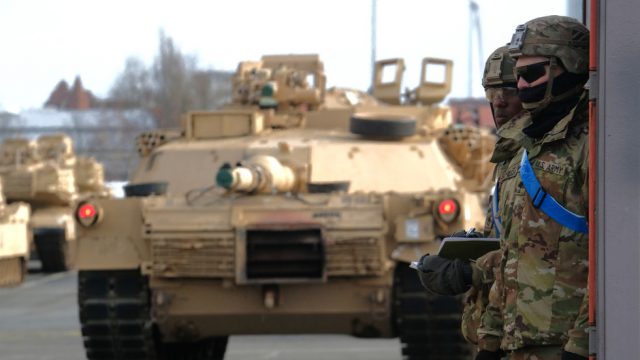
Iran’s permanent ambassador to the United Nations says the US must end its illegal occupation of Syria and stop shielding terrorist groups under the mask of fighting terrorism.
Majid Takht Ravanchi made the remarks in a Monday address to a virtual meeting of United Nations Security Council dubbed “Middle East: Syria – Political”.
“Sovereignty, political independence, unity and territorial integrity of Syria must be fully respected by all, and accordingly, all foreign forces whose presence is not permitted by the Syrian Government must leave the Syrian territory,” the Iranian diplomat said.
“In this regard, the living example is the occupation of certain parts of Syria by the US forces who continue to support and shield terrorist groups under the mask of combatting terrorism,” he went on to say.
He further rejected any separatist agendas as well as “any and all attempts to create new realities on the ground, including through illegitimate self-rule initiatives.”
Takht Ravanchi slammed the “illegal” occupation of Syria’s Golan Heights by Israel, and said the recognition by the US of its annexation to Israel is null and void.
“Condemning such unlawful irresponsible act, we stress that Golan is and will remain a part and parcel of the Syrian territory,” he added.
Israel seized the Golan Heights from Syria after the 1967 Six-Day War and later occupied it in a move that has never been recognized by the international community. However, in a highly provocative move on March 25 last year US President Donald Trump signed a proclamation recognizing Israel’s “sovereignty” over the Syrian territory.
Damascus strongly condemned the move and called it a “blatant attack on the sovereignty and territorial integrity” of Syria.
Since the onset of the occupation, Tel Aviv has been building dozens of settlements in the region and has used it to carry out a number of military operations against the Arab country.
In his Monday speech, Takht Ravanchi also condemned Israel’s aggressions against Syria as a “gross violation of international law and the UN Charter”, stressing that the Syrian Government has a sovereign right to decide how and when to exercise its inherent right to individual or collective self-defense.
“Such aggressions must come to an end,” he urged.
Israel frequently attacks military targets inside Syria in what is considered as an attempt to prop up foreign-backed Takfiri terrorist groups that have been suffering heavy defeats against Syrian government forces.
The Damascus government has several times complained to the UN about Israel’s illegal strikes on Syria.
Iran Majlis committee endorses anti-Zionism motion
Press TV – May 18, 2020
Majlis (the Iranian Parliament)’s Committee on National Security and Foreign Policy has approved a motion that outlines the manner of confrontation on the national and international scale against the Zionist regime of Israel’s atrocities.
The parliament had designated the plan as a double-urgency motion on May 12 and submitted it for approval to the committee as the main legislative body to review the measure.
The committee released the approved version under the “The Motion for Confrontation against the Zionist regime [of Israel]’s Actions Targeting Peace and Security” on Saturday, after examining it and making some amendments, Fars News Agency reported on Sunday.
The amended version tasked all national organizations to deploy available national and international capacities towards confronting the Israeli regime’s actions against the oppressed Palestinian nation and Muslim countries, including Iran, as well as the regime’s role in disrupting regional and international peace and security.
As instances of the regime’s actions against Palestinians that warranted confrontation, it cited Tel Aviv’s large-scale and systematic violation of human rights through continued occupation of Palestinian and other territories, setting up of illegal settlements across the occupied Palestinian territories, attempting annexation of more Palestinian land, and keeping Palestinians under siege.
The Israeli regime, the motion noted, was also engaged in warmongering, terrorism, electronic warfare, and deployment of heavy and banned weapons against civilians throughout the region and elsewhere as its other actions that had to be confronted.
Virtual Embassy
The committee obliged the Foreign Ministry to lay the groundwork for the creation of the Islamic Republic’s Virtual Embassy in Palestine within six months, and submit the results for approval to the cabinet.
In so doing, the Ministry was required to conduct consultations with the countries that it saw fit.
The Ministry was also asked to pursue Iran’s initiative for “realization of nationwide referendum in Palestine” — a plan that the Islamic Republic has devised with emancipation of the territories from Israeli occupation in mind.
Iran’s Attorney General was, meanwhile, tasked to work in cooperation with the Ministry and other relevant domestic and foreign bodies towards prosecution of Israeli officials at competent tribunals for their atrocities.
The parliamentary committee demanded that the Iranian government provide support for various domestic and international parties, who engage in activities targeting the occupying regime.
The government was also required to try preventing the prospect of any normalization with Tel Aviv on the regional scale and among the world’s Muslim countries, and outline the “Zionism worse than Apartheid” mindset across various international organizations.
The Islamic Republic’s cultural bodies, including the Ministry of Culture and Islamic Guidance and the Islamic Republic of Iran Broadcasting, were assigned the task of engaging in extensive cultural activity aimed at exposing the Zionist regime’s nature and atrocities.
The committee also strictly prohibited the use of Israeli software and hardware inside the country, the entry and transit of Israeli commodities and individuals through the Islamic Republic’s soil, and engagement with any Israeli entity.
Iranian Official Denies Rumors about Agreement on Assad’s Resignation
Tasnim | May, 17, 2020
TEHRAN – A senior adviser to Iran’s parliament speaker categorically denied reports about Tehran and Moscow agreeing on the resignation of Syrian President Bashar al-Assad.
In a post on his Twitter account, senior adviser to the Iranian parliament speaker for international affairs Hossein Amir Abdollahian dismissed as “a big lie” the rumors about a plan for the resignation of Syria’s president.
“Dr. Bashar al-Assad is the legitimate president of Syria and the great leader of the fight against Takfiri terrorism in the Arab world,” he said.
“The rumor of an agreement between Iran and Russia on his (Assad’s) resignation is a big lie and a plot from the American-Zionist media,” the Iranian official added.
“Tehran strongly supports the sovereignty, national unity and territorial integrity of Syria,” Amir Abdollahian underlined.
His comments came in response to media speculations that Iran, Russia and Turkey may reach a consensus to remove the Syrian president and establish a ceasefire in exchange for forming a transitional government that includes the opposition, members of the Syrian government and the so-called Syrian Democratic Forces (SDF).
Iran’s fuel shipment to Venezuela guaranteed by its missile power
Press TV – May 16, 2020
Iran is shipping tons of gasoline to Venezuela in defiance of US sanctions on both countries in a symbolic move guaranteed by Tehran’s missile prowess.
Unconfirmed reports and tanker monitoring groups suggest that at least five Iranian-flagged tankers are transporting fuel to Venezuela through the Atlantic Ocean despite the US sanctions on both Tehran and Caracas.
Iran has intentionally hoisted its own flag over the huge tankers which are navigating through the Atlantic before the eyes of the US Navy.
Iran is shipping large consignments of gasoline to Venezuela even though the US would try to intercept the shipments and seize the tankers.
There are unconfirmed reports that the US Navy has deployed its USS Detroit (LCS-7), USS Lassen (DDG-82), USS Preble (DDG-88), and USS Farragut (DDG-99) to the Caribbean along with its patrol aircraft Boeing P8-Poseidon for possible encounter with the Iranian vessels.
However, analysts say it is very unlikely that the US makes such a mistake, as it would have serious repercussions for the Trump administration ahead of the November elections.
The US would not dare to seize the Iranian vessels especially after Iran’s reaction to a similar move by the United Kingdom, a close ally of Washington.
Iran also has the upper hand thanks to its missile power, which was shown to the US in the IRGC’s retaliatory missile attacks on the Ain al-Assad Airbase in Iraq, which accommodated American troops.
The US was also reminded of the Islamic Republic’s missile prowess following the recent successful launch of Nour-1 military satellite, which reached its orbit using the Qased satellite carrier. Some Western analysts claim the satellite achievements are a prelude to Iran’s program to develop intercontinental ballistic missiles (ICBMs).
Confident about its missile capabilities, Iran is going on with the gasoline shipment to its ally in Latin America, mocking the US sanctions on the oil sectors of both countries.
The US seems to be between the rock and hard place. While it is unlikely for Washington to dare to intercept the tankers, if they reach their destination safe and sound, it may tarnish the “superpower” forever.
The fuel shipment also shows Iran’s success in turning into an exporter of gasoline after years of importing the fuel.
A senior official in US President Donald Trump’s administration told Reuters on Thursday that the United States was considering measures against Iran in response to the fuel shipment.
The official said Washington has a “high degree of certainty” that the Venezuelan government is paying Iran in gold for the fuel.
If these claims are confirmed, the “fuel for gold” exchange is also a great achievement for the Islamic Republic amid the US’ maximum pressure policy, which deprives the country’s economy of billions of dollars’ worth of oil revenues.
There are reports that Iran is receiving nine tons of gold in exchange for the fuel its ships transport to Venezuela. Under the cruel sanctions imposed by the US after its withdrawal from the 2015 nuclear deal in 2018, nine tons of gold can be a very precious asset for the Iranian economy.
However, we must still wait and see whether the US administration would let the Iranian tankers go and strip Washington of its “superpower” title, or it would dare to intercept the vessels and endanger Donald Trump’s campaign ahead of the November elections.
Earlier in the day, Iranian government spokesman Ali Rabiei said Venezuela and Iran are both independent states that have had and will continue to have trade relations with each other.
“We sell goods and buy goods in return. This trade has nothing to do with anyone else. We have to sell our oil and we have ways to do it,” Rabiei said in reaction to reports of the fuel shipment to the Latin American country.
See also:
US interception of Iran vessel to Venezuela would be ‘completely illegal
Turkey stalls Iran gas imports amid aggressive US efforts to push its LNG
Press TV – May 13, 2020
Turkey is dragging its feet on repairing a pipeline which was hit by an explosion in late March, stopping Iran’s gas exports to the country, the Fars news agency says.
Iran sells about 10 billion cubic meters a year of gas to Turkey under a 25-year supply deal signed in 1996. The pipeline has been blown up several times by PKK terrorists, but it has been repaired and the gas flow has continued shortly.
However, after another blast occurred on the pipeline on March 31, an official at the National Iranian Gas Company (NIGC) said the Turkish side was not responding even as Iran had informed it of the incident.
According to Mehdi Jamshidi-Dana, Turkey’s representative at Bazargan gas transmission station had left his post due to the outbreak of the novel coronavirus.
The official said it was not clear when the line would re-open, but he cited past experience which showed “repairing the lines takes three to seven days, depending on the amount of damage done”.
On Wednesday, Fars suggested that the pipeline is still out of service, citing Turkish state energy company Botas’ dilly-dallying and unwillingness to repair it.
The news agency speculated that the situation must be the result of aggressive US efforts to push its liquefied natural gas (LNG) into Turkey.
Heavily dependent on gas imports from Russia, Turkey has already reduced flows from Gazprom significantly, while increasing LNG purchases and gas imports from Azerbaijan.
“In recent months, Turkey has imported as much LNG from the United States as gas imports from Iran,” Ali Nasr, an energy expert, told Fars.
Last November, Turkey marked the completion of the Trans-Anatolian Natural Gas Pipeline (TANAP) to carry gas from Azerbaijan’s Shah Deniz II field to Europe.
In January, the presidents of Turkey and Russia formally launched the TurkStream pipeline to carry Russian natural gas to southern Europe through Turkey.
Fars warned that Iran may lose its biggest gas market to rivals, which could cost the country $150 million-$200 million in lost revenues a month.
The US has the necessary incentive to remove Iranian gas from the Turkish market in order to increase economic pressure on Iran, while Turkey seeks to diversity its energy sources and reduce gas imports from Iran and Russia, the agency said.
The US is currently pushing Trump’s “energy dominance” agenda that seeks to advance diplomatic and policy objectives through rapidly expanding US oil and gas exports.
Iran has already lost its biggest condensate market in South Korea which imported 300,000 barrels per day (bpd) of the ultra light oil from the Middle Eastern country.
The Koreans stopped the shipments under pressure from the United States which is aggressively thrusting its fast-growing condensate into Asia.
According to US officials, Washington has offered to sign a $100 billion trade agreement with Turkey, which their presidents discussed at the Munich Security Conference.
The offer is part of the Trump administration’s main goal to get President Recep Tayyip Erdogan drop plans to use Russia’s S-400 missile defense systems.
“If an agreement is reached, the possibility of replacing Iranian gas with American LNG is quite possible,” Fars warned.
According to the news agency stated, Turkey has expanded its LNG terminals to take in 25 billion cubic meters of cargoes – 2.5 times more than the imported gas from Iran. The terminals are currently operating only at 25 percent of their nominal capacity. … Full article
Featured Video
The Board For Peace – Whitewashing Ethnic Cleansing and Genocide
or go to
Aletho News Archives – Video-Images
Book Review
Conspiracy Denial
Lies are Unbekoming | January 27, 2026
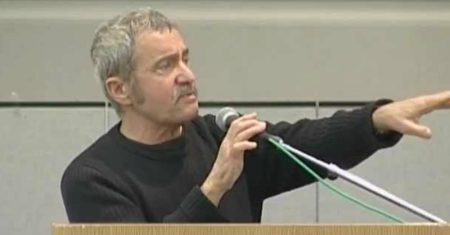
In honour of Michael Parenti (1933–2026), who passed away on 24 January 2026 at the age of 92. He spent his life naming what power prefers to leave unnamed.
In 1837, Abraham Lincoln remarked: “These capitalists generally act harmoniously, and in concert, to fleece the people.”
Today, he would be dismissed as a conspiracy theorist.
That dismissal—reflexive, automatic, requiring no engagement with evidence—is not a mark of sophistication. It is a tell. The question worth asking is not whether conspiracies exist (they are a matter of public record and a recognised concept in law) but why acknowledging their existence provokes such reliable hostility. What work does the label “conspiracy theorist” actually do?
The late political scientist Michael Parenti spent decades answering that question. His conclusion was blunt: “’Conspiracy’ refers to something more than just illegal acts. It serves as a dismissive label applied to any acknowledgment of ruling-class power, both its legal and illegal operations.” The term functions not as a descriptor but as a weapon—a thought-terminating cliché that protects the powerful from scrutiny by pathologising those who scrutinise them.
Conspiracy denial, in Parenti’s analysis, is not skepticism. It is the opposite of skepticism. It is credulity toward power dressed up as critical thinking. As he wrote in Dirty Truths: “Just because some people have fantasies of conspiracies does not mean all conspiracies are imaginary.” … continue
Blog Roll
Recent Comments
eddieb on WEF Calls for ‘Cultural Revolu… loongtip on Trump wanted to play peacemake… Coronistan on EU member to sue bloc over ‘su… loongtip on Vicious loongtip on EU turns to India for defense… Coronistan on Donald Trump Is No Peace … seversonebcfb985d9 on French court jails pro-Palesti… eddieb on Fourteen Incredible Facts Abou… Bill Francis on European leaders’ shift in the… seversonebcfb985d9 on Villains of Judea: Philip Esfo… loongtip on Report warns that ‘Jewish terr… Craig Nelms on New study shows that toxic gas…


 Aletho News
- G7 Hands Ukraine $40Bln Generated From Frozen Russian Assets
- Conspiracy Denial
- Ukraine expects to join EU next year – Zelensky
- Here’s what’s behind the US shift on EU allies
- UN experts alarmed by prosecution of students protesting ETH Zurich’s Israel-linked research ties
- Exposed – How the UAE Became Central to Gaza’s Concentration Camp Plot
- How South Korea’s gas ambitions sustain the occupation of Gaza
- “Leaked document” exposes US blueprint for total control over Gaza
- Trump wanted to play peacemaker, Netanyahu made sure he failed
- Idea of limited, fast strike on Iran misjudges our capabilities: IRGC
- If Americans Knew
- Israel to seek new security deal from US, official says
- Leaked “Board of Peace” Resolution Outlines U.S.-Led Plan to Rule Over Gaza
- Jonathan Greenblatt Rolls Out Plan to Activate Hispanic Evangelical Golems
- Violence against hundreds of Gazan remains to find one Israeli – Not a ceasefire Day 109
- Greenpeace Demonstrator Exposes Folly of Protest Restrictions
- From CBS to TikTok, Pro-Israel Ellison is now in the driver’s seat
- Israel pays for UK advertisements attacking Doctors Without Borders
- Israel accused of extracting billions from Gazan people to pay for their own genocide
- ‘Deliberate Assassination’: 3 Journalists Among 11 Killed by Israeli Forces in Gaza
- In Gaza, We’re Struggling to Reintroduce Foods to Bodies Adjusted to Starvation
- No Tricks Zone
- New Study Affirms Rising CO2’s Greening Impact Across India – A Region With No Net Warming In 75 Years
- Germany’s Natural Gas Crisis Escalates … One Storage Site Near Empty …Government Silent
- Polar Colding…Antarctica Saw Its Coldest October In 44 Years!
- New Study: Sea Levels Rose 20 Times The Modern Rate During The Roman Warm Period
- As German Gas Storage Dips Dangerously Low…Shortage Hardly Avoidable
- New Study: Brazil’s Relative Sea Level Was 2+ Meters Higher And SSTs 3-4°C Warmer 6000 Years Ago
- Philosopher Schopenhauer: Climate Science Certainty Stems From Stupidity, Ignorance
- New Study: Species Extinction Rates Declining Since 1980 – ‘Climate Change Is Not An Important Threat’
- Denmark Places Climate Protection Above Animal Welfare, Poisoning And Culling Cows
- New Study: Greenland Was 3-7°C Warmer And Far Less Glaciated Than Today 6000-8000 Years Ago
 Aletho News