America’s New War: Let’s Not Pretend That Iraqi Paramilitaries Drew First Blood
The undeclared US-Israeli hunting season on Iraqi militias had been going on for months before the first US casualty
By Marko Marjanović | Checkpoint Asia | January 1, 2020
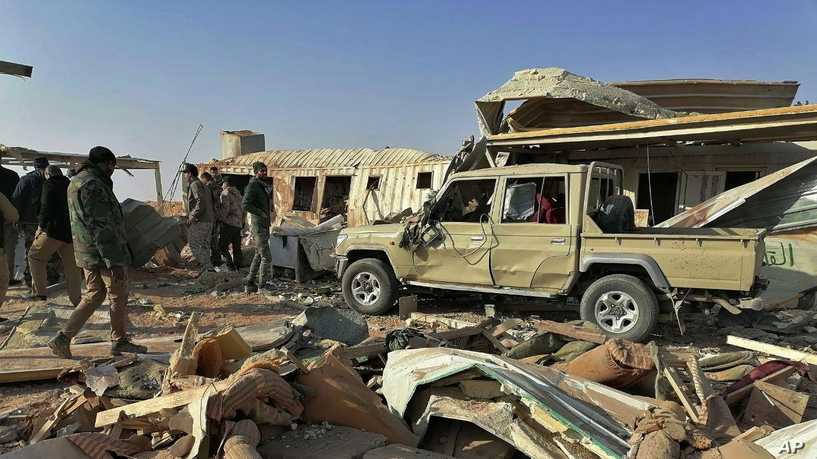
As the Trump administration would have it history began yesterday. On December 27 A rocket salvo struck a US base near Kirkuk killing a US contractor and wounding four US soldiers, as well as, according to the Americans, two Iraqi soldiers.
So two days later the US — deducing that the attack must have come from the Iraqi Kataib Hezbollah paramilitary that right now hates the Americans’ guts the most — bombed five Kataib facilities on the Iraq-Syrian border, ie nowhere near Kirkuk, killing 25 and wounding 55 Kataib paramilitaries that almost certainly had nothing to do with the Kirkuk base attack themselves.
So according to the Americans albeit their airstrikes, against an outfit that is formally part of Iraq’s official security forces, may have technically violated Iraqi sovereignty that is a technicality since the paramilitary is a proxy for Iran, and in any case these Iranian proxies started it by killing an American first in attacks on guests of the Iraqi government.
Americans also suppose that since they have been granted basing rights in Iraq and the right to act militarily (against ISIS) on Iraq’s territory that comes with the right to defend themselves.
Americans also emphasize the attack allegedly by Kataib also wounded two Iraqi soldiers.
So the American telling is something like‘Iranian proxies are attacking us who are guests of the Iraqi government and hurting Iraqi servicemen in the process, so we bombed them to defend ourselves and teach them a lesson.’
On its face that sounds almost reasonable, but there are a number of problems with such a statement.
First, as probably the single most influential man in Iraq, the Shia cleric al-Sistani pointed out, even if it were true that Kataib paramilitaries had gone rogue in attacking US facilities it does not follow that Americans, a foreign military with mere basing rights, have the liberty to take matters into their own hands and be the judge, jury and executioner in revenge attacks on a state-sanctioned paramilitary 500 kilometers from the place of the actual attack on the US base.
Second, there is a matter of scale. Because “Iranian proxies” (as Americans would have it) injured a pair of Iraqi servicemen that does not follow Americans are now entitled to kill or wound seventy-seven Kataib paramilitaries who are also Iraqi servicemen.
Third, unlike the Trump gang would have it, history did not begin on December 27th. Between July 19 and September 22 Iraqi paramilitaries were hit in their Iraqi bases on at least eight different occasions. In August the Israeli PM Netanyahu confirmed that Israel was carrying out these strikes “against Iranian consolidation”. (That was also just the latest escalation on top of Israeli strikes on Iraqi paramilitaries positioned against ISIS in eastern Syria.)
However, as Iraqis fully understand Israel does not have the capability to strike targets in Iraq (and eastern Syria) without US logistical and intelligence support and the political go-ahead. These were Israeli drone strikes but originating in US/Kurdish-controlled NE Syria and using US-controlled airspace. What is more, quite possibly the Americans were using their presence in Iraq to supply Israelis with intelligence on Kataib and other paramilitaries.
It is also around this time that small-scale artillery (mainly mortar) attacks on US facilities in Iraq started. The only thing new about the December 27 attack was that it resulted in a US fatality. So no, Iraqi paramilitaries did not all of a sudden, and out of the blue, start targeting Americans in Iraq because they are such obedient Iranian proxies, and on the behalf of Tehran, but because they were being killed in their own country (and in neighboring Syria) and the US was to blame.
There have quite possibly been 100 Iraqi paramilitary fatalities in Iraq alone, before the first American died in a retaliatory attack. The blame here is not on Iran, the blame is on those who decided to pull Netanyahu’s chestnuts out of the fire even if it risked US troops in the region.
The only surprising thing about all of this has been how long it took for the backlash to catch up with the Trump gang. So of course instead of counting their lucky stars they went and escalated, so now they are going to reap a bigger backlash, quite possibly in the form of a renewed legal effort to oust them, albeit the nationalist Sadr has said he’ll be looking into “other means” if that doesn’t pan out.
Trump says he ‘does not see war with Iran happening’ hours after issuing a ‘threat’ against Tehran
RT | January 1, 2020
US President Donald Trump has said that the US is not gearing up for war with Iran, adding that he prefers peace to war. It comes just hours after the US leader upped the ante, making a pointed threat against Tehran on Twitter.
With simmering tensions between Tehran and Washington flaring up over the attack on the US embassy in Baghdad, which the US blamed squarely on Iran without providing any proof, there have been growing fears that another war of words could spiral into something far more violent.
In an apparent attempt to diffuse the tension, Trump said late Tuesday that he does not foresee a war actually breaking out between the US and Iran.
“War with Iran? I don’t think that would be a good idea for Iran… I like peace… I don’t see that happening,” Trump said speaking to media as he arrived at the grand ballroom at Mar-a-Lago for a New Year bash on Tuesday night.
Teheran has vehemently denied all the allegations that it is somehow complicit in the unrest sparked by the US airstrikes that killed 25 members of the Iraqi Shia militia Kataib Hezbollah over the weekend.
The American sorties have drawn ire from the Iraqi government, calling the bombing a violation of the country’s sovereignty as well as of militiamen and ordinary citizens who flocked to the US embassy in Iraq to protest the airstrikes.
Protests turned violent on Tuesday as demonstrators attempted to storm the compound, and saw US attack helicopters being scrambled to scatter the protesters after they reportedly breached the front gate.
In the wake of the attack, the Pentagon announced that it would send 750 paratroopers to the Middle East “immediately” in response to the incident, which will be followed by “additional forces.” Washington has repeatedly invoked the “Iranian threat” to beef up its military presence in the region, having deployed some 14,000 troops to the Middle East since May 2019 in addition to about 60,000 already stationed there.
Iran slams US ‘audacity’ to blame it for Baghdad embassy storming
RT | December 31, 2019
Iran has flatly rejected US accusations that it is behind violent protests which broke out at the American embassy in Baghdad in response to US airstrikes on militia groups in Iraq.
In a tweet on Tuesday, US President Donald Trump accused Iran of “orchestrating an attack on the US Embassy in Iraq,” and said Tehran will be held “fully responsible.” Trump also called on “millions” of Iraqis to resist Iran.
Iran hit back at the “audacity” of Washington to blame Tehran for the attacks in a statement posted by the Foreign Ministry.
“America has the surprising audacity of attributing to Iran the protests of the Iraqi people against (Washington’s) savage killing of at least 25 Iraqis…,” it said.
The US hit five Kataib Hezbollah targets in Iraq and Syria last week in retaliation for an attack on a US coalition base near Kirkuk, which no group took responsibility for, but which Washington blamed on the Iranian-backed militia.
Iraqi Prime Minister Adel Abdul Mahdi condemned the airstrikes, calling them a violation of Iraq’s sovereignty and said there could be “grave consequences.” Protesters then stormed the US embassy compound on Tuesday, shouting “death to America” and waving Hezbollah flags.
Washington announced earlier Tuesday that it was sending reinforcements to the Baghdad embassy, in what Defense Secretary Mark Esper said were measures “to ensure our right of self-defense.”
Also on rt.com:
‘This is your time’: Trump calls for Iraqis to rise up against Iran
Iraq’s Sadr ready to work with Iran-backed PMF to oust US
MEMO | December 31, 2019
Iraq’s Shia cleric Muqtada Al-Sadr has declared that he is willing to work with the Iranian-supported Popular Mobilisation Forces (Hashd Al-Shaabi) paramilitary forces – his political rivals – to end the American military presence in Iraq.
He made the comments yesterday after the US targeted five sites in Iraq and Syria and killed 30 in in retaliation for the death of an American “contractor” at an Iraqi military base in Kirkuk in a rocket attack, which Washington blamed on PMF member Kataib Hezbollah (KH).
Sadr believes in ousting the US troops from Iraq through political and legal means, however will “take other actions” with his rivals should these not work. The cleric has portrayed himself as a nationalist against both Iranian and American interference in Iraq. He also called on Iraqis to “avoid irresponsible actions” that can be used to justify further attacks on the country.
Sadr’s loyalist militia, the Mahdi Army, was notable in its fierce resistance against US occupation forces in the Shia dominated south, following the unilateral American invasion in 2003.
Outgoing Iraqi Prime Minister, who is serving as caretaker, Adil Abdel-Mahdi condemned the actions as a violation of Iraqi sovereignty, especially as the PMF are integrated into the country’s armed forces under his direct command and were established to combat Daesh.
Iraq’s top Shia cleric, Ayatollah Sayyid Ali Sistani, whose fatwa against Daesh led to the establishment of the PMF, also condemned the air strikes as a “criminal aggression” against “official Iraqi forces”. Sistani added that the Iraqi authorities are “entitled” to deal with the attacks and to take action to prevent them from re-occurring.
Earlier today, protestors stormed outside the US Embassy in the Green Zone, some carrying flags of the KH and PMF. Some observers have noted how anti-government protestors have been unsuccessful for weeks in entering the Green Zone after being prevented by Iraqi security forces, but there have been no attempts to hold back those protesting against the latest American attack on the PMF, representing a possible dangerous situation for Western diplomats.
Pompeo Holds Talks with Netanyahu, MBS, MBZ on Iraq Strikes
Al-Manar | December 31, 2019
US Secretary of State Mike Pompeo says he had discussions with the UN General Secretary, Israeli Prime Minister, Crown Prince of Abu Dhabi and Saudi Arabia’s Crown Prince over strikes that killed and injured dozens of Iraq’s Hashd Shaabi fighters.
Pompeo tweeted early on Tuesday (December 31) saying he had made clear to the UN General Secretary Antonio Guterres that the US airstrikes on Kata’ib Hezbollah facilities on Sunday were a “defensive action aimed at deterring Iran and protecting American lives”.
The United States launched a series of air attacks Sunday on targets both in Iraq and Syria killing at least 25 Kata’ib Hezbollah fighters and injuring 50 others. Washington claims that the strikes came after rocket attacks on facilities housing US military personnel in the Arab country.
Pompeo also discussed “the attacks on coalition forces” with Abu Dhabi’s Crown Prince Mohammad bin Zayed Al Nahyan, later tweeting that the US “will continue to work together to counter Iran’s destabilizing behavior”.
He told Saudi Arabia’s Crown Prince Mohammad bin Salman, “The US and Saudi Arabia will continue to work together to counter Iran’s malign behavior.”
Pompeo also had a “productive” call with Israeli Prime Minister Benjamin Netanyahu, later tweeting, “We discussed US defensive strikes in Iraq and Syria to counter Iran’s threats. The U.S will take decisive action to defend its citizens and interests.”
Did Pompeo Go Off Reservation in Iraq Attack?
By Tom Luongo | December 30, 2019
I have to wonder who Secretary of State Mike Pompeo is actually loyal to. Because, the U.S. strike of Kata’ib Hizbullah forces near the Al Qaim border crossing with Syria in Iraq is a dangerous escalation there.
And it’s completely at odds with Trump’s goals of wanting us out of the Middle East. The Al Qaim border crossing is a particular red line for Israel and their allies in the U.S. State and Defense Departments.
It represents the normalization of commerce between Syria, Iraq and Iran over time. This is the so-called Shia Crescent which is the stuff of nightmares for Benjamin Netanyahu.
And the U.S. has been hopping mad for months since now caretaker Iraqi Prime Minister Adil Abdel Mahdi opened the border because it undermines U.S. presence in Syria.
The entire point of U.S. occupation of the Al-Tanf border crossing into Jordan and the oil fields in Deir Ezzor province is about starving the Syrian government of any reliable energy and revenue.
When Al Qaim/Al Bukamai was opened it was only a matter of time before a major skirmish would occur over it. Israel staged a series of air attacks previously using U.S. assets and air bases to launch them back in September.
Now, we have the convenient excuse for attacking these forces which are part of the Popular Mobiliztion Units, PMU, which Pompeo despises by ‘retaliating’ for a rocket attack on the K1 base near Kirkuk where one U.S. mercenary was killed and a handful of others injured.
The response from the U.S. Air Force was completely out of line with the initial attack and occurred without any attempt by Pompeo and Secretary of Defense Mark Esper to justify it.
They just invoked the phrase, “Iran-backed forces” and then bombed troops over 200 miles away where they wanted to strike anyway.
And what’s important is what both Elijah Magnier and Moon of Alabama pointed out immediately, the U.S. struck members of Shia militias who were made official part of the Iraqi defense forces.
In other words the U.S. just attacked and killed dozens of Iraqi military personnel.
And the U.S. can get away with this because the Iraqi government is in a total state of flux, thanks to a President, Barham Salih, refusing to honor the constitution, obstructing the selection of a new Prime Minister.
His actions remind me of Italy’s Sergio Mattarella who inserts himself into the process of government formation there to suit his EU partners-in-crime.
In Iraq the U.S. has been officially silent on the government turmoil there but the circumstances are pretty clear that the chaos works as a cover for what was an egregious violation of Iraq’s sovereignty.
Remember, the U.S. forces there are at the invitation of the Iraqi government and with Salih keeping the Shia political forces from uniting to choose a Prime Minister, the likelihood of that invitation being rescinded now is remote.
Color me not shocked that this attack on PMU forces occurred. Pompeo has been itching for an excuse to attack them for months. He tried his version of diplomacy with Prime Minister Mahdi to rescind their official status and was unsuccessful.
Mahdi was livid after Israel’s air attack and made noises about rescinding the U.S. invitation. No shock then that protests against his government spun up quickly after that.
So at some point this attack was going to happen. Netanyahu in serious political trouble facing a third election in a year, unable to form a government.
Pompeo coming to his rescue to keep the dream of warring with Iran should be obvious to all.
The question is whether President Trump is engaged with this policy at all or did Pompeo and Defense Secretary Mark Esper go off on their own, pull this trigger and then inform Trump and get him to accept this post hoc?
Everywhere Pompeo goes one week winds up in flames the next anymore. When he visits a trouble spot which Israel and the neoconservatives he represents want destabilized, a miracle occurs the next week.
Before this it was Lebanon and Iraq. This week it’s Ukraine. There is the threat of peace breaking out there with Russia and Ukraine agreeing to terms on both a gas and oil transit contract into Europe which Pompeo is dead set against.
Will we see some attack on Ukrainian forces which break the peace and can be blamed on Russia?
Trump has to know that escalation from here ends with U.S. forces coming home in body bags as PMU forces themselves, go off the reservation during this power vacuum in Baghdad and attack U.S. troops directly.
But I think this is exactly what Bibi and Pompeo want. This attack was a clear provocation to escalate and give Israel and the neocons all the ammunition they need to force Trump into the wider conflict with Iran they’ve been angry about not getting for six months now.
They failed with the Global Hawk incident back in June. That operation got John Bolton fired as National Security Director. Now we have a clearly disproportionate strike designed to inflame passions of Iran-backed Shia forces.
The entirety of Iraq’s leadership seems to be of the same mind, and even rejected the US plan to strike when they were tipped off immediately before it happened, per NBC:
In a statement, [former PM] Abdul-Mahdi said Secretary of Defense Mark Esper had called him about a half-hour before the U.S. strikes Sunday to tell him of U.S. intentions to hit the bases of the militia suspected of being behind Friday’s rocket attack. Abdul-Mahdi said he asked Esper to call off the U.S. plan.
One byproduct of the major US strikes on Sunday is sure to be that more and more of the Iraqi population will view the Americans, and not the Iranians, as the foreign occupiers.
This dramatic escalation by Washington is only likely to push more popular support toward the Shia PMF, and strengthen the movement in parliament to have US forces legally expelled, especially with the demise of the ISIS threat.
Any strike by the PMU here on U.S. forces will be music to Pompeo’s and Netanyhahu’s ears. And it will put Trump in a real bind with his base during an election year and an impeachment process Speaker Nancy Pelosi is purposefully dragging out to build a stronger case.
What stronger case could there be at this point if Trump were to not declare war or fire back after US troops get attacked in Iraq or Syria? He’s derelict as Commander-in-Chief. It’s part of their stupid Ukraine narrative that Trump withheld aid weakens our national security.
I speculated in the past that Trump was getting ready to fire Pompeo.
As Secretary of State Pompeo has been nothing short of a disaster, undermining President Trump’s strong instincts to get the U.S. out of the Middle East and solve the myriad of open geopolitical wounds around the world.
Unlike his former-partner-in-neoconservatism, John Bolton, Pompeo is more adept at playing at being loyal to Trump while always seeming to move U.S. diplomacy in a more belligerent direction in the wake of any of Trump’s ‘impulses’ to act on his conscience and/or instincts.
It doesn’t matter if we’re talking Iran (Pompeo’s demands of Iran are off-the-charts insane), Lebanon (outright blackmail of the Lebanese government) or North Korea (making demands in negotiations which overstep Trump’s promises to Kim Jong-un) Pompeo is always there doing his thinly-veiled Israeli loyalty dance with the subtlety of a freight-train but somehow always framing it as making it Trump’s policy.
This move by Pompeo looks like a classic pre-emptive move to bind Trump down and force him into a war which will be unpopular back home. The only one who wins with this attack is Israel.
U.S. troops are now less safe, effective forces fighting ISIS have been neutered and the Iraqi government is in shambles. Good job Mike.
Mike wants his golden parachute back to the Senate where he can continue doing god’s work for the Israelis, one more voice in a U.S. Senate seemingly without a limit on its thirst for power and the blood of the world.
This won’t end well and Trump better get his Flying Monkeys under control quick or he won’t be President much longer. Because when the body bags start, he’ll be the one who gets blamed.
US envoy reportedly evacuated as Baghdad protesters attempt to storm embassy amid fury over air strikes
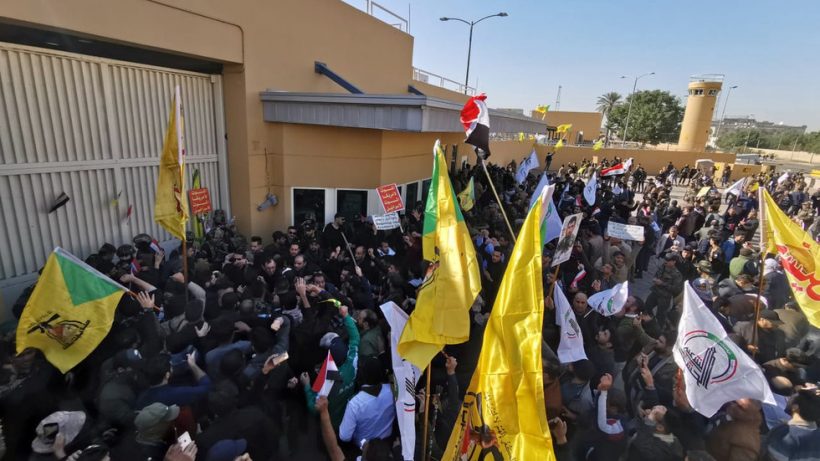
Protesters condemn air strikes on bases belonging to Hashd al-Shaabi paramilitary forces, outside of the U.S. Embassy in Baghdad, Iraq December 31, 2019. © REUTERS/Thaier al-Sudani
RT | December 31, 2019
Thousands of protesters, angry over recent airstrikes targeting Hezbollah, have marched on the US embassy in Baghdad, reportedly forcing the US envoy to flee the diplomatic compound.
Protesters were seen waving Hezbollah flags and chanting anti-US slogans in the Iraqi capital on Tuesday. According to reports, demonstrators were able to gain access to parts of the heavily fortified Green Zone, and attempted to break into the US Embassy. Security guards were said to have retreated into the US government building. A correspondent for the BBC noted that it appeared that the protesters were able to pass several checkpoints without being resisted by security personnel.
The US ambassador to Iraq, Matthew H. Tueller, was evacuated due to the unrest, Reuters reported, citing two Iraqi Foreign Ministry officials.
One video shows parts of the US compound being set on fire.
Earlier, protesters were filmed burning US and Israeli flags.
The unrest comes after US fighter jets struck three Kataib Hezbollah targets in Qaim, Iraq, and two in Syria. The Iran-allied Shiite militia group said that at least 25 of their fighters were killed and nearly three dozen injured in the strikes. The Pentagon accused the group of carrying out attacks on Iraqi bases that host US-led coalition forces stationed in the country.
Iraqi Prime Minister Adel Abdul Mahdi strongly condemned the airstrikes, warning that the attacks would have “grave consequences.” Tehran also condemned the strikes and denied any involvement in attacks on US forces in Iraq.
Hezbollah Denounces ‘Savage’ Attack on Iraq’s Hashd Shaabi: US Exposed Its True Face
Al-Manar | December 30, 2019
Hezbollah on Monday firmly denounced US aggression on Iraq’s Kata’ib Hezbollah, describing it as savage and blatant assault on Iraq’s sovereignty.
“The savage and perfidious aggression by the US on Kata’ib Hezbollah in Iraq is a blatant attack on Iraq’s sovereignty, security, stability and people, especially the Hashd Shaabi which had the upper hand in confronting the Takfiri terror and defeating it,” a statement released by Hezbollah’s Media Relations Office read, referring to Iraq’s paramilitary force, also called Popular Mobilization Units (PMU), in which Kata’ib Hezbollah is one of its components.
“This aggression affirms again that the US administration wants to strike the power factors within the Iraqi people who are capable of confronting Daesh (ISIL) and other US-backed extremist and criminal groups.”
“The US administration exposes its true face as a hostile power to Iraq and Iraqis’ interests,” the statement added.
Hezbollah offered condolences to Iraqis on the martyrs of the attack, wishing speedy recovery for those who were wounded.
“Those who decided this criminal aggression will find out soon the idiocy of such decision as well as its repercussions,” the statement concluded.
US strikes Kataib Hezbollah HQ in Iraq, Syria
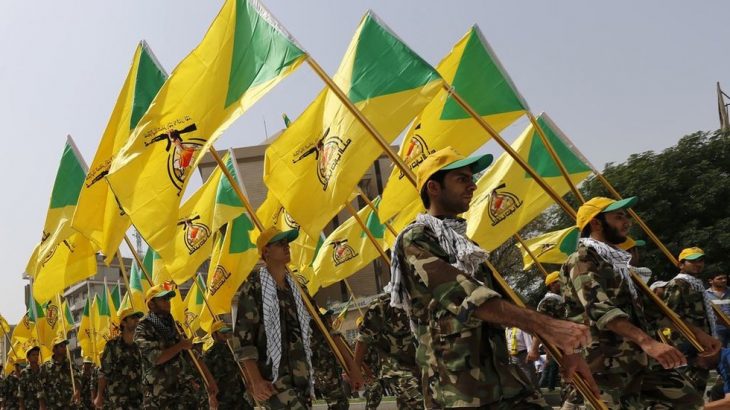
Kataib Hezbollah members wave the party’s flags during a parade in Baghdad. © Reuters / Thaier al-Sudani
RT | December 29, 2019
US airstrikes have pounded three Kataib Hezbollah military facilities near the town of Qaim, Iraq, as well as two targets in Syria, in response to the group’s alleged bombing of an Iraqi military base on Friday.
The US carried out “defensive strikes” against the supposed Kataib Hezbollah facilities on Sunday, US officials told Reuters. The targets included weapons storage locations and command and control stations, and F-15 fighter jets were used in the attack. Three locations near Qaim, on the Iraq/Syria border, and two locations in Syria were hit.
Chief Pentagon spokesman Jonathan Hoffman said in a statement that the strikes were a “response to repeated Kataib Hezbollah attacks on Iraqi bases that host Operation Inherent Resolve (OIR) coalition forces.”
Reuters’ military sources said that at least 18 militiamen were killed in the strikes, including at least four local Kataib Hezbollah commanders.
Two days earlier, the same Kataib Hezbollah fighters and their Iraqi Shia allies were blamed by US officials for a rocket attack on an Iraqi military base in Kirkuk, some 250 miles east of Qaim. The rocket barrage killed an American contractor and wounded several US troops.
Kataib Hezbollah is an Iraqi paramilitary group, but is financially supported by Iran. Its allies in the so-called Popular Mobilization Forces were first deployed by the Iraqi government to combat Islamic State (IS, formerly ISIS) jihadists in 2014, but the government has since struggled to bring them under the command of the Iraqi military.
The rocket attack inflamed anti-Iran sentiment in the US, with Republican Senator Tom Cotton (Arkansas) warning that “Tehran ought to face swift and severe consequences” for its alleged involvement. Responding to similar attacks, US Secretary of State Mike Pompeo threatened Iran earlier this month with a “decisive US response” should they continue.
Iran’s involvement, however, has not been conclusively established.
Iraqi resistance groups decry Salih’s resignation as submission to US interests
Press TV – December 28, 2019
Iraqi resistance groups have denounced President Barham Salih’s resignation as a violation of the constitution and have accused him of caving in to pressure from the United States.
The groups said the president, by resigning, had effectively refused to carry out his legal duty of designating the candidate nominated by the parliament’s largest bloc to act as prime minister, as required by the constitution.
Salih announced his resignation on Thursday, explaining that he made the move since the constitution did not allow him to reject the premiership of Assad al-Eidani, who was nominated by the Fatah parliamentary bloc.
“It is better for me to resign rather than assign an individual that is objected by the protesters to form a government,” he said, referring to months-long protests which have swept the capital and southern areas of the country.
The Iraqi resistance group Kata’ib Hezbollah, which is part of Iraq’s anti-terror Popular Mobilization Units (PMU) and is affiliated with the Fatah bloc, however, described the move as “suspicious”.
“We know that he is carrying out an American will that aims to pull the country toward chaos,” it said.
The statement added that by bowing to pressure from Washington and other forces trying to exploit the anti-government protests, Salih is pushing the country towards crisis and is setting the stage for US intervention in the country.
The group also called for a speedy election that can prevent certain parties from imposing weak leaders and elements favored by the US or those which harbor corrupt partisan interests.
Iraqi parliamentarian Odai Awad, which is a member of the Asaib Ahl al-Haq resistance group affiliated with Fatah and the PMU, also vehemently rejected the president’s resignation.
He described Salih as a coward who should be discarded by “every Iraqi”.
Salih’s refusal to appoint the parliament’s nominated premier comes after Prime Minister Adel Abdul Mahdi stepped down last month amid ongoing anti-government rallies.
Abdul Mahdi currently retains the position of a caretaker premier.
The protests, which began on October 1, have been pressing the government to bring in reforms that would root out corruption and alleviate the country’s economic woes.
The rallies, however, soon turned violent — amid reports of foreign interference – killing hundreds of people, including members of the security forces, the Parliament’s Human Rights Commission says.
According to reports, Iraqi security sources have claimed that a US-backed plan seeks to install a pro-Washington government in Baghdad by provoking internal strife and instability in the country.
US civilian contractor killed, multiple servicemen injured in rocket attack on Iraqi base near Kirkuk – reports
RT | December 27, 2019
An American civilian contractor was killed and several service members lightly wounded when several rockets struck an Iraqi military base near Kirkuk, US officials confirmed on condition of anonymity.
The Iraqi military confirmed earlier that multiple service members, including a US contractor and an Iraqi federal police officer, were wounded when “a number of missiles” struck a munitions storage facility in K1 military base on Friday evening. According to one official, the rockets hit as a “major” mission was getting underway.
No group has yet claimed responsibility for the attack. However, while Islamic State (IS, formerly ISIS/ISIL) terrorist are actively operating in the area using insurgency-style tactics – all recent rocket attacks on bases housing American troops have been pinned, absent any evidence, on “Iranian proxies.”
Washington’s latest load of sanctions against Tehran came complete with an accusation of “weapons of mass destruction proliferation,” while Secretary of State Mike Pompeo several weeks ago threatened Iran with a “decisive US response” if attacks against American interests in Iraq continue.
The Mysterious Frank Taylor Report: The 9/11 Document that Launched US-NATO’s “War on Terrorism” in the Middle East
By Prof. Niels Harrit – Global Research – March 21, 2018
We call them ‘the 9/11 wars’ – the seemingly unending destruction of the Middle East and North Africa which has been going on for the last seventeen years. As revealed by Gen. Wesley Clark,[1] these wars were already anticipated in September 2001.
The legal foundation for the invasion of Iraq in 2003 has been challenged in several countries. The best known is the Chilcot Inquiry in the UK, which began in 2009 and concluded in a report in 2016. The inquiry was not about the legality of military action, but the British government was strongly criticised for not having provided a legal basis for the attack.
Even though the invasion of Iraq was planned[2] prior to 9/11, most observers note that the attack on Afghanistan in 2001 was a required precursor.
However, the legal basis for attacking Afghanistan has attracted almost no attention. One obstacle in addressing this has been the assumption that the key document was still classified.[3][4]
But as demonstrated below, this document was apparently declassified in 2008.
On the morning of 12 September 2001, NATO’s North Atlantic Council was summoned in Brussels. This was less than 24 hours after the events in USA. The council usually consists of the permanent ambassadors of the member states, but in an unprecedented move, the EU foreign ministers participated as well.[5]
Lord Robertson, Secretary General of NATO, wrote a draft resolution invoking Article 5 in the Washington treaty – the famous ‘musketeer clause’ – as a consequence of the terror attacks. The decision to do so had to be unanimously approved by the governments in all 19 NATO countries. This general agreement was obtained at 9.20 pm and Lord Robertson could read out the endorsements at a packed press conference:[6]
“The Council agreed that if it is determined that this attack was directed from abroad against the United States, it shall be regarded as an action covered by Article 5 of the Washington Treaty, which states that an armed attack against one or more of the Allies in Europe or North America shall be considered an attack against them all.”
There was a reservation. Article 5 would not be formally activated before “it is determined that this attack was directed from abroad”.
Apparently NATO had a suspect. But the forensic evidence was still pending, and hence also the formal invocation of Article 5.
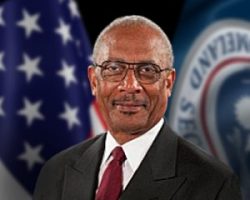 Formally, this evidence was provided by Frank Taylor (image on the right), a diplomat with the title of Ambassador from the US State Department. On 2 October he presented a brief to the North Atlantic Council, and Lord Robertson could subsequently conclude:[7]
“On the basis of this briefing, it has now been determined that the attack against the United States on 11 September was directed from abroad and shall therefore be regarded as an action covered by Article 5 of the Washington Treaty, which states that an armed attack on one or more of the Allies in Europe or North America shall be considered an attack against them all.”
“Today’s was classified briefing and so I cannot give you all the details. Briefings are also being given directly by the United States to the Allies in their capitals.”
Since the invocation of Article 5 had to be unanimous, Frank Taylor’s report would have been integral in the briefings announced to take place.
In Denmark – the country of the present author – there was a meeting in the Foreign Affairs Committee on 3 October 2001, where parliamentarians were briefed by the government about the proceedings in Brussels.
Parallel briefings must have been given in the 17 other NATO capitals. In each city, the resolution must have been approved, since Lord Robertson could announce NATO’s unanimous adoption of Article 5 and the launch of the war on terror on 4 October.[8] The first bombs fell in Kabul on 7 October.
Article 5 of the Washington Treaty says:[9]
“The Parties agree that an armed attack against one or more of them in Europe or North America shall be considered an attack against them all and consequently they agree that, if such an armed attack occurs, each of them, in exercise of the right of individual or collective self-defence recognised by Article 51 of the Charter of the United Nations,…..”
That is, any military action taken by NATO is confined by the restrictions in Article 51, which emphasises the right to self-defence and reads:
“Nothing in the present Charter shall impair the inherent right of individual or collective self-defence if an armed attack occurs against a Member of the United Nations,….”.[10]
That is, military action is forbidden in the absence of an armed provocation, and the legality of the attack on Afghanistan depends exclusively on the evidence presented in Frank Taylor’s report. But it was classified together with the minutes from the pertinent meetings.
However, on 19 May 2008, the US State Department declassified the dispatch which was sent in 2001 to all US representations world-wide, including the ambassadors to NATO headquarters, regarding what to think and say about the 9/11 events.
It is titled: “September 11: Working together to fight the plague of global terrorism and the case against al-qa’ida”.
The text is freely accessible here.
The document is dated 01 October 2001. But as hinted by the URL, it seems to have been distributed on 2 October five days before the invasion of Afghanistan on October 7, 20101. That is, the day Frank Taylor gave his presentation for the North Atlantic Council and the EU foreign ministers, and the day before the US ambassadors were briefing the governments in the respective NATO capitals.
The text of the dispatch begins by requesting “all addressees to brief senior host government officials on the information linking the Al-Qa’ida terrorist network, Osama bin Ladin and the Taliban regime to the September 11 terrorist attack on the World Trade Center and Pentagon and the crash of United Airlines Flight 93.”
The document appears to be a set of ‘talking points’. The recipients are instructed to use the information provided in oral presentations only and to never leave the hard copy document as a non-paper. Specifically, there is reference to “THE oral presentation”.
These instructions are followed by 28 pages of the specific text.
Tellingly, a section of this dispatch is copy-pasted into Lord Robertson’s statement on 2 October:7
“The facts are clear and compelling[…] We know that the individuals who carried out these attacks were part of the world-wide terrorist network of Al-Qaida, headed by Osama bin Laden and his key lieutenants and protected by the Taliban.”
The conclusion is inescapable – this dispatch IS the Frank Taylor report. It is the manuscript that served not only as the basis for Frank Taylor’s presentation, but also for the briefings given by US ambassadors to the various national governments. Identical presentations were given in all 18 capitals on 3 October, four days before the US-NATO invasion of Afghanistan
Is there any forensic evidence provided in this document to serve as a legal basis for the invocation of Article 5?
Nothing. There is absolutely no forensic evidence in support of the claim that the 9/11 attacks were orchestrated from Afghanistan.
Only a small part of the introductory text deals with 9/11, in the form of summary claims like the citation in Lord Robertson’s press release. The main body of the text deals with the alleged actions of Al-Qaeda and the Taliban in the nineties.
On 4 October, NATO officially went to war based on a document that provided only ‘talking points’ and no evidence to support the key claim.
We are still at war seventeen years later. Five countries have been destroyed, hundreds of thousands of people killed and millions displaced. Refugees are swarming the roads of Europe, trillions of dollars have been spent on weapons and mercenaries and our grandchildren have been shackled with endless debt.
At the opening ceremony for the new NATO headquarters on 25 May 2017, all the leaders from NATO’s member states attended the inauguration of a ‘9/11 and Article 5 Memorial’.[11]
*
Prof. Niels Harrit is a retired Associate Professor at the University of Copenhagen, Denmark.
Notes
[1] The Plan — according to U.S. General Wesley Clark (Ret.) https://www.youtube.com/watch?v=SXS3vW47mOE
[2] Bush decided to remove Saddam ‘on day one’. https://www.theguardian.com/world/2004/jan/12/usa.books
[3] The Unanswered Questions of 9/11. http://www.globalresearch.ca/the-unanswered-questions-of-911/5304061?print=1
[4] Was America Attacked by Afghanistan on September 11, 2001? https://www.globalresearch.ca/was-america-attacked-by-afghanistan-on-september-11-2001/5307151
[5] Being NATO’s Secretary General on 9/11. https://www.nato.int/docu/review/2011/11-september/Lord_Robertson/EN/ (from which you can deduce that the NATO-ambassadors eat lunch at 3 pm).
[6] Statement by the North Atlantic Council, https://www.nato.int/docu/pr/2001/p01-124e.htm
[7] Statement by NATO Secretary General, Lord Robertson. https://www.nato.int/docu/speech/2001/s011002a.htm
[8] Statement to the Press by NATO Secretary General, Lord Robertson, on the North Atlantic Council Decision On Implementation Of Article 5 of the Washington Treaty following the 11 September Attacks against the United States. https://www.nato.int/docu/speech/2001/s011004b.htm
[9] The North Atlantic Treaty. https://www.nato.int/cps/ic/natohq/official_texts_17120.htm
[10] Article 51, UN charter. http://www.un.org/en/sections/un-charter/chapter-vii/
[11] Dedication of the 9/11 and Article 5 Memorial at the new NATO Headquarters, 25 May 2017 https://www.youtube.com/watch?time_continue=3&v=augh1WqTqFs
Featured Video
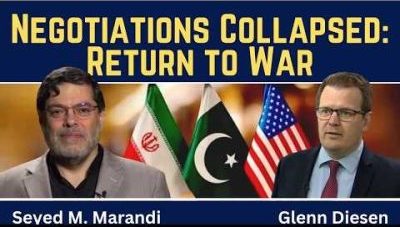
Seyed M. Marandi: Negotiations Collapsed – Return to War
or go to
Aletho News Archives – Video-Images
From the Archives
The US-Iran Scenario That Most Scares Israel
By Ali Haydar | Al-Akhbar | October 9, 2013
Israeli Prime Minister Benjamin Netanyahu issued a series of threats toward Iran and its interlocutors in the West, including the US, as serious negotiations on Iran’s nuclear program seem more plausible.
As a possible rapprochement looms between the US and Iran, Netanyahu has attempted to impose impossible Israeli conditions on the negotiators, such as the full dismantling of Iran’s nuclear program, not to mention threatening military force.
Whatever the deal that could materialize between Iran and the West, Israel is going to find itself before an open-ended path. One can foresee three possible scenarios… continue
Blog Roll
 Aletho News
- UK, Spain reject Trump’s new scheme to blockade Hormuz Strait
- Russian frigate ‘resurfaces’, chases off NATO pirates days after Kiev ‘sank’ it
- Ukraine Targets Russian Merchant Fleet With NATO Intel Support – Presidential Aide
- Russia’s ‘shadow fleet’ makes mockery of UK naval power
- Ukraine plans to attack Russian ships with Norwegian support
- US’s ‘Very Foolish’ Double Blockade of Hormuz Strait Makes Absolutely No Sense: Here’s Why
- China issues rules on countermeasures against foreign states’ unlawful extraterritorial jurisdiction
- Seyed M. Marandi: Negotiations Collapsed – Return to War
- Tomorrow’s naval blockade showdown
- ‘Israel’ attacks civilians to hide its embarrassing military failures & out of pure sadism
- If Americans Knew
- Critical shortages in Gaza, Lebanon in ruins, “piracy” in Iran – Daily Update
- US-Iran ceasefire negotiations make zero progress – Daily Update
- Pro-Israel ‘Thinktanks’ and Individuals who Influence U.S. Foreign Policy
- Mearsheimer reveals how Israel dictates US policies on Iran, Gaza – video
- After killing 350+, Israel still has a “score to settle” with Lebanon before ceasefire – Daily Update
- Military aid to Israel emerges as the latest political litmus test for Democrats
- The only Palestinian children’s rights organization closes following years-long Israeli campaign against it
- ‘I Can’t Forget the Smell’: Lebanese Reel After Israel Kills Over 300 in Single Day
- DNC Shoots Down Resolutions Calling Out AIPAC and Limiting Arms to Israel
- TCN: Is Israel Blackmailing President Trump?
- No Tricks Zone
- Cave Discovery Reveals Today’s Desert Climates Were Recently Far Warmer, Wetter, Teeming With Life
- German Expert: Heat Dome Led To Record Temps In Western USA…Warmer In 1934, 1936
- New Study: No Linear Warming Or Glacier Retreat Along Northern Antarctic Peninsula Since 1980s
- An Inconvenient Tree: Uncovered In Alps… Europe Much Warmer Than Today 6000 Years Ago
- New Study Reports A 60% Slowdown In Greenland’s Ice Loss Rate In The Last Decade
- Low Intensity Tornado Wrecks Major Solar Farm, Creating A Potential Toxic Dump
- New Study Finds Warming Saves Lives…Cold Temperatures 12 Times More Deadly Than Excess Heat
- German Science Blog Accuses PIK Climate Institute Of Hallucinating Climate Tipping Points
- Devastating Assessment Of Comirnaty Vaccine By Former Senior Pfizer Europe Toxicologist
- New Study: CO2 Is ‘Effectively Negligible’ As An Explanatory Climate Change Factor Since 2000
 Aletho News