Ireland’s book of condolence for Palestinians killed in Gaza blocked by pro-Israel groups
MEMO | May 21, 2018
A request by the Irish Republican Party, Sinn Fein, to open a book of condolence in Belfast city council for Palestinians killed in Gaza last week was blocked by Unionists allied with the Northern Ireland Friends of Israel group.
Denouncing the book of condolence as “deeply shameful”, the Israeli lobby group accused Sinn Fein of supporting terrorists for wanting to mark the killing of Palestinians by Israeli occupation forces in Gaza.
The two main Unionist parties, who have strong ties with the pro-Israel lobby group, blocked the request, which forced Sinn Fein to open an internal book of condolence. According to the rules, a book of condolence can only be opened with the agreement of all parties at City Hall.
The Belfast Telegraph reported that the Social Democratic and Labour Party (SDLP) council group leader Tim Attwood said he was “disappointed” that Unionists blocked the book of condolence “to mark the killings and injuries inflicted on the people of Gaza”.
“People of Belfast are horrified and wish to express their sympathy at the tragic loss of life,” he added.
Meanwhile, Sinn Fein group leader on the Belfast City Council, Deirdre Hargey, was reported as saying that her party would be opening its own book of condolence in the party’s room at City Hall, open to all members of the public.
The request for the book of condolence came after a number of Palestinian solidarity protests were held across Northern Ireland last week. Sinn Fein reacted to the killing and the pro-Palestinian demonstration by also demanding the expulsion of the Israeli ambassador.
This is the second time in two months that the plight of Palestinians became a cause of tension in Belfast. In March the Northern Ireland Friends of Israel group invited the Israeli ambassador to the UK, Mark Regev, to speak at an event in the local public library. Activists denounced the decision saying that Regev “has a long history of excusing, apologising and justifying [Israel’s] murder, torture and genocide as well as land theft from the indigenous population of Palestine.”
Members of the community in Belfast who supported the decision to open a book of condolence were disappointed by the Unionist parties. They told MEMO that many Unionist politicians and councillors were members of the Friends of Israel and revealed that Unionist parties have all hosted friends of Israel events.
‘Expel the Israeli ambassador’: Irish FM blasted for double standards over Gaza and Skripal case
RT | May 15, 2018
Ireland’s foreign minister is being accused of hypocrisy for failing to expel Israel’s ambassador over the IDF killing 60 Palestinians on Monday, despite sending a Russian diplomat home over the Skripal case without evidence.
Foreign Minister and Deputy Prime Minister Simon Coveney expelled a Russian diplomat in March following Britain’s claim that Russia was behind the poisoning of double agent Sergei Skripal and his daughter Yulia in Salisbury, England. The decision faced pushback from many in Ireland who claimed it was a hasty move, made before any evidence was presented.
Opposition politicians and activists are now questioning why the same robust response applied in the aftermath of the Skripal case has not been implemented in a situation where 60 people were killed and thousands more injured by Israeli forces.
Coveney issued a statement on Gaza, Monday, saying we all have “a political responsibility to try to reduce tensions and protect unarmed protesters.” He said he was “gravely concerned that the use of force seems disproportionate to the threat” and called for an independent investigation.
The minister also summoned Israeli Ambassador Ze’ev Boker to a meeting on Tuesday to express his “shock and dismay” at Monday’s events, The Journal reports.
Sinn Fein leader Mary Lou McDonald says Coveney’s actions don’t go far enough, however, and called for the Israeli ambassador to Ireland to be expelled.
“I know that the Tánaiste [Deputy Prime Minister] has called in the Israeli ambassador – actually the Tánaiste should be sending the Israeli ambassador home. The Irish State now needs to recall our diplomatic mission from Israel,” she said.
The Irish Palestinian Solidarity Campaign (IPSC) is also calling for diplomatic expulsion. “This is the single deadliest day for Palestinians in the occupied territories in four years,” IPSC National Chairperson Fatin Al Tamimi said. “The ambassador for apartheid and his staff should be expelled, and the Irish Ambassador in Tel Aviv recalled, just as South Africa has done.”
Irish people on social media called Coveney out for taking a different tack in his treatment of the Russian diplomat, suggesting the Irish government is happy to follow Britain’s orders but will fail to act on “crimes against humanity.”
Meanwhile, the Irish Palestinian Solidarity Campaign (IPSC) will hold protests across the country Tuesday, calling for an end to the “ongoing massacre of unarmed Palestinians” by Israeli forces.
Remembering Ireland’s Great Famine
A review of Black ’47 a soon to be released film about the famine in Ireland
By Caoimhghin Ó Croidheáin | Dissident Voice | April 13, 2018
Weary men, what reap ye?—Golden corn for the stranger.
What sow ye?— human corpses that wait for the avenger.
Fainting forms, hunger–stricken, what see you in the offing?
Stately ships to bear our food away, amid the stranger’s scoffing.
There’s a proud array of soldiers — what do they round your door?
They guard our masters’ granaries from the thin hands of the poor.
Pale mothers, wherefore weeping— would to God that we were dead;
Our children swoon before us, and we cannot give them bread.”
— “Speranza” (Jane Wilde, mother of Oscar Wilde)
Last Wednesday I attended a preview for a forthcoming Irish film, Black 47 (Director Lance Daly), about the worst year of the catastrophic Irish famine and is set in the west of Ireland in 1847.
The story centers around an Irish soldier, Feeney (James Frecheville), returning from serving the British Army in Afghanistan only to find most of his family have perished in the Famine or An Gorta Mor (the Great Hunger) as it is known in Gaelic.
The English and Irish terms for Ireland’s greatest tragedy are infused with different ideological approaches to the disaster. By emphasising the failure of the potato crop only, the impression is given that there was no food to be had on the island when the opposite was true – there were many other crops which did not fail but were not accessible to the vast majority of the people – hence, the Great Hunger.

Feeney (James Frecheville), Black 47 (Director Lance Daly)
In Black 47, the colonised fight back as Feeney puts the skills he has learned abroad with the British army to effective use in Ireland. He kills or executes the various people involved in the British colonial system he blames for the starvation and death of his family: from the bailiff to the judge to the colonial landlord. Moreover, Feeney goes a step further as he refuses to speak English to those in power before he kills them, reflecting back to them an immediate understanding of the powerlessness of those without the linguistic tools to negotiate compromises (as was seen in the film when a monolingual Irish speaker gets tough justice for ‘refusing’ to speak English in court).
Back in the late 1980s a book entitled ‘The Empire Writes Back: Theory and Practice in Post-Colonial Literatures‘ [1989] showed how the language and literature of the empire, English, was used by colonised peoples in the creation of a radical culture to aid their resistance to the hegemony of imperial power. However, now with many of his family dead, Feeney has ceased to be a Caliban profiting on the language of his masters and becomes a powerfully drawn hero who is uncompromising in his insistence that the Irish language and culture will be a respected equal to the imposed English language and culture of the colonists.
In the film the ruling class and their hierarchy of supporters are flush with food and the army is used to transport harvested crops to the coast and exportation. This fact is displayed symbolically when one of Feeney’s victims is literally ‘drowned’ in food, as he is found head first in a sack of wheat.
The international aspect of the Black 47 narrative hints at the geopolitics of the day with Feeney’s return from Afghanistan and the concurrent mass emigration to the United States from Ireland. Feeney’s indignation at finding out how his masters have treated his own family and compatriots as he risked his life for them abroad is similar to the treatment of the African-American soldiers of the Vietnam war on their return to the United States.
But this is not a black and white, Irish versus the Brits, movie. There is complexity as some of the British show empathy for the desperate Irish and pay the ultimate price or go on the run.
Revenge is a kind of wild justice, which the more a man’s nature runs to, the more ought law to weed it out.
— Francis Bacon
Black 47 is a revenge movie which is cathartic for an audience feeling the utter helplessness of the victims living in a brutal system without real justice, where what should have been their protectors (the law, the state, the army, etc.) became their attackers and betrayed them. In previous food crises, according to Christine Kenealy:
The closure of ports was a traditional, short-term response to food shortages. It had been used to great effect during the subsistence crisis of 1782-4 when, despite the opposition of the grain merchants, ports had been closed and bounties offered to merchants who imported food to the country. During the subsistence crisis of 1799-1800, the government had placed a temporary embargo on the export of potatoes from Ireland. In 1816 and 1821, the British government had organised the shipment of grain into areas in the west of Ireland where there were food shortages. The grain was then sold on at low prices. Similar intervention and market regulation occurred in Britain.
Unfortunately for Ireland, Sir Charles Edward Trevelyan (2 April 1807 – 19 June 1886), a British civil servant and colonial administrator, was put in charge of administering famine relief. Trevelyan was a student of the economist Thomas Malthus and a believer in laissez faire economics and the free hand of the market. Trevelyan described the famine as an “effective mechanism for reducing surplus population” as well as “the judgement of God”.

Famine Memorial in Dublin by artist Rowan Gillespie
With this change in attitude on the part of the British government towards food shortages, the crisis was doomed from the beginning. Kinealy states:
In 1847 alone, the worst year of the Famine, almost 4,000 vessels carried food from Ireland to the major ports of Britain, that is, Bristol, Glasgow, Liverpool and London. Over half of these ships went to Liverpool, the main port both for emigration and for cargo.
Ultimately, one million people starved to death and one million emigrated reducing the population by about 20% – 25%.
Black 47 is an uncompromising film that depicts the harrowing results of a crop failure combined with an ultra exploitative system that knew no moral or legal boundaries. Sure, attempts were made by well-meaning people to alleviate the crisis but the failure of the state to end the crisis on a macro level resulted in an unprecedented disaster for the Irish people. It will go on general release in September.
Further research:
For those interested in finding out more about the Great Hunger, here is a select list of material covering different aspects.
Art
The preview showing of Black 47 was to complement a concurrent exhibtion of art in Dublin Castle showing at the Coach House Gallery until June 30. The exhibition, titled ‘Coming Home: Art and the Great Hunger‘, is an exhibition of the world’s largest collection of Famine-related art.
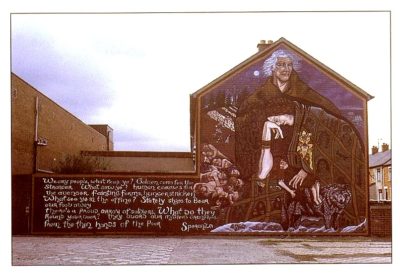
Belfast mural
Music:
Sinéad O’Connor – ‘Famine‘
Damien Dempsey – ‘Colony‘
Christy Moore – ‘On a Single Day‘
Books:
The Great Hunger by Cecil Woodham-Smith
The Famine Plot: England’s Role in Ireland’s Greatest Tragedy by Tim Pat Coogan
The Graves are Walking by John Kelly
Atlas of the Great Irish Famine edited by J. Crowley, W. J. Smith and M.Murphy.
(Massive hardback volume covering almost all aspects of the famine throughout Ireland, lavishly illustrated.)
National Famine Commemoration Committee
The National Famine Commemoration Committee was first established in 2008 following a Government decision to commemorate the Great Irish Famine with an annual national famine memorial day.
Film
Ireland 1848 – ‘An experimental documentary of the Great Irish Famine. Shot as a film might have been shot in 1848 fifty years before the cinema was invented.’
Caoimhghin Ó Croidheáin is an Irish artist, lecturer and writer. His artwork consists of paintings based on contemporary geopolitical themes as well as Irish history and cityscapes of Dublin. His blog of critical writing based on cinema, art and politics along with research on a database of Realist and Social Realist art from around the world can be viewed country by country at http://gaelart.blogspot.ie/.
Irish Senate delays vote on anti-settlement bill under Israeli pressure
Press TV – January 31, 2018
Under pressure from the Tel Aviv regime, the Irish Senate has postponed a vote on a bill that forbids the import and sale of products from Israeli settlements as well as the services originating from the occupied territories.
The bill, entitled Control of Economic Activity (Occupied Territories) Bill 2018, states that it is “an offence for a person to import or sell goods or services originating in an occupied territory or to extract resources from an occupied territory in certain circumstances; and to provide for related matters.”
It also says that those who “assist another person to import or attempt to import settlement goods” would be committing a crime punishable with up to five years in prison.
The Irish Senate debated the motion on Tuesday. Senator Frances Black, who had put forward the motion, described the Israeli settlements in the occupied West Bank, East Jerusalem al-Quds and the Golan Heights as a “war crime.”
She also stressed the anti-settlement bill was actually about respect for international law and standing up for the rights of vulnerable people.
“It is a chance for Ireland to state strongly that it does not support the illegal confiscation of land and the human suffering which inevitably results,” Black said.
“In the occupied Palestinian territories, people are forcibly kicked out of their homes, fertile farming land is seized and the fruit and vegetables produced are then exported to pay for it all,” she added.
A group of Israeli activists, among them former lawmakers and ambassadors as well as legal experts, artists and academics, had also sent a petition to the Irish parliament, asking it to support the motion.
They urged “Ireland to support any legislation that will help enforce differentiation between Israel per se and the settlements in the occupied territories,” read the petition. “The Israeli occupation of the territories beyond the 1967 borders, ongoing for more than 50 years with no end in sight, is not only unjust but also stands in violation of numerous UN resolutions.”
However, the Irish Senate suddenly decided to adjourn the debates regarding the bill until July as the regime in Tel Aviv scrambled to torpedo the measure.
Irish Foreign Minister Simon Coveney “had asked today for time… He has given a commitment in writing that if the debate is adjourned today the government will facilitate time for this debate to be resumed before the summer recess in July,” Senator Alice Mary Higgins said.
The cancellation came after Israeli Prime Minister Benjamin Netanyahu condemned the Irish bill, saying it seeks to harm the regime and support the global Boycott, Divestment and Sanctions (BDS) movement, which campaigns for Palestinian rights.
“The initiative gives backing to those who seek to boycott Israel and completely contravenes the guiding principles of free trade and justice,” Netanyahu’s office said in a statement released on Tuesday.
The Israeli premier further ordered the Foreign Ministry to summon Irish Ambassador to Tel Aviv Alison Kelly.
About 600,000 Israelis live in over 230 settlements built illegally since the 1967 occupation of the Palestinian territories.
The continued expansion of Israeli settlements is one of the major obstacles to the establishment of peace in the Middle East.
In recent months, Tel Aviv has stepped up its settlement construction activities in the occupied Palestinian lands in a blatant violation of international law and in defiance of United Nations Security Council Resolution 2334.
Ireland May Criminalize Trade with Israeli Settlements
Palestine Chronicle | January 25, 2018
Ireland is set to discuss a new bill that seeks to prohibit the import and sale of goods originating in illegal settlements in occupied Palestinian Territory.
Independent Senator Frances Black, yesterday, launched the “Control of Economic Activities (Occupied Territories) Bill 2018”, which is scheduled for debate in Seanad Éireann on Wednesday 31 January 2018.
According to a press release announcing its launch the bill “seeks to prohibit the import and sale of goods, services and natural resources originating in illegal settlements in occupied territories”. “Such settlements,” said the statement, “are illegal under both international humanitarian law and domestic Irish law, and result in human rights violations on the ground”. Despite the illegality of the import and sale of goods from Israeli settlements, the statement points out that Ireland is still providing “continued economic support through trade in settlement goods”.
Drafters of the bill revealed that the legislation had been “prepared with the support of Trócaire, Christian-Aid and the Irish Congress of Trade Unions (ICTU), and applies to settlements in occupied territories where there is clear international legal consensus that they violate international law”. They insisted that the “clearest current example of these violations were the expansion of settlements in the Palestinian West Bank, which have been repeatedly condemned as illegal by the UN, EU, the International Court of Justice and the Irish Government”.
Speaking in advance of the bill’s introduction, Senator Black said:
“This is a chance for Ireland to stand up for the rights of vulnerable people – it is about respecting international law and refusing to support illegal activity and human suffering.”
Black said he is “passionate about the struggle of the Palestinian people”. He insisted that “trade in settlement goods sustains injustice” and explained that “in the occupied territories, people are forcibly kicked out of their homes, fertile farming land is seized, and the fruit and vegetables produced are then sold on Irish shelves to pay for it all”.
The bill is seeking more than mere denunciation of Israeli settlements and is trying to get governments around the world to treat settlements as illegal. Black pointed out that six years ago the Irish Government criticized the relentless progress of Israeli settlements, but they have failed to do anything about it since.
“In years since then it has only gone one way, with settlements expanding, more Palestinian homes being demolished and land being confiscated. It’s clear that empty promises have not worked but nothing has been done. Ireland needs to show leadership and act” Black protested.
The Occupied Territories Bill 2018 will be debated at Second Stage in Seanad Éireann on Wednesday and will be streamed live on Oireachtas TV. It has been co-signed by Seanad Civil Engagement Group Senators Alice-Mary Higgins, Lynn Ruane, Grace O’Sullivan, Colette Kelleher and John Dolan, as well as Senator David Norris.
Netanyahu slams Ireland’s pro-Palestine stance
Press TV – July 12, 2017
Enraged by Dublin’s financial aid to anti-Israel Palestinian rights groups, Prime Minister Benjamin Netanyahu has lashed out at visiting Irish Foreign Minister Simon Coveney over his country’s pro-Palestine policy.
Netanyahu’s office made the criticism in a statement issued on Tuesday after the premier’s meeting with Coveney in Jerusalem al-Quds.
The premier “expressed his dissatisfaction over Ireland’s traditional stance” on Palestine and urged Coveney to condemn what he called Palestinian “incitement,” the statement read.
He also challenged the top Irish diplomat over Dublin’s assistance to the “NGOs that call for the destruction of Israel,” it added.
Coveney, for his part, said in a news briefing that his discussions with Netanyahu touched on a range of issues, including Israeli settlements, the humanitarian and political situation in the blockaded Gaza Strip and the so-called peace process.
“Of course, we have clear differences on some issues, but these differences are honestly held and openly expressed,” he noted.
Ireland runs Irish Aid, an official overseas development program for overseas development.
A number of Palestinian rights groups, such as Al-Haq, Addameer and the Palestinian Center for Human Rights, are funded by the program.
During his three-day trip, which began on Monday, Coveney is scheduled to meet with Palestinian President Mahmoud Abbas, United Nations officials and representatives from the NGOs funded by Irish Aid.
Speaking prior to his departure for the occupied territories, Coveney said he was “looking forward to hearing a diverse range of views from” the Palestinians, Israelis and NGOs.
“Of course, I will also use the opportunity to make clear Ireland’s concerns about the impact of the continuing occupation and the fact that, as things stand, the prospects of a comprehensive peace agreement remain dim,” he pointed out.
The meeting took place on the same day that Ireland’s South Dublin County Council voted unanimously to fly the Palestinian flag over the County Hall in Tallaght for a month in solidarity with the “oppressed people of Palestine.”
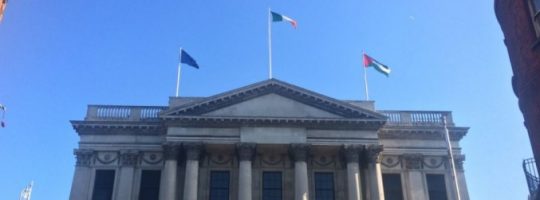
It has become the fourth Irish local authority to make such a move in recent months.
“I am delighted with [the] vote in solidarity with the people of Palestine. It might seem like a very small gesture but I know from the reaction to similar decisions made by other councils that today’s vote will be applauded across Palestine and elsewhere,” said Councilor Enda Fanning.
About 600,000 Israelis live in over 230 settlements built illegally since the 1967 occupation of the Palestinian territories.
Palestinian officials say they want the resolution of the conflict with Tel Aviv based on the so-called two-state solution along pre-1967 boundaries.
However, Netanyahu has on several occasions said Israel should maintain its military occupation of the West Bank under any agreement with the Palestinians.
In recent months, the Tel Aviv regime has stepped up its illegal settlement construction activities in the occupied lands and oppressive measures against the Palestinians, leading to an increase in global anti-Israel sentiment.
Featured Video
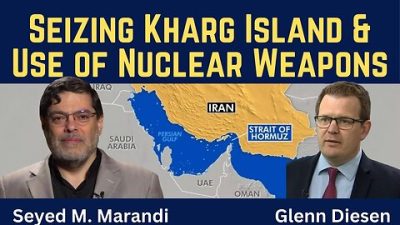
Marandi: Threat of Seizing Kharg Island & the Use of Nuclear Weapons
or go to
Aletho News Archives – Video-Images
Frlom the Archives
Provoking a Path to Persia
The Saban Center’s prescient paper on war with Iran
By Maidhc Ó Cathail | October 20, 2011
In June 2009, the Saban Center for Middle East Policy published “Which Path to Persia?—Options for a New American Strategy toward Iran.” Writing in a tone strikingly reminiscent of the Project for a New American Century’s infamous pre-9/11 paper “Rebuilding America’s Defenses,” the six co-authors noted that, “It seems highly unlikely that the United States would mount an invasion without any provocation or other buildup.” For a think tank specifically established by media mogul Haim Saban to protect Israel, this could prove to be a formidable obstacle impeding their desired march—of U.S. troops—to Tehran.
“In fact, if the United States were to decide that to garner greater international support, galvanize U.S. domestic support, and/or provide a legal justification for an invasion, it would be best to wait for an Iranian provocation, then the time frame for an invasion might stretch out indefinitely,” Saban’s think-tankers ruefully observed.
“With only one real exception, since the 1978 revolution, the Islamic Republic has never willingly provoked an American military response, although it certainly has taken actions that could have done so if Washington had been looking for a fight. Thus it is not impossible that Tehran might take some action that would justify an American invasion. And it is certainly the case that if Washington sought such a provocation, it could take actions that might make it more likely that Tehran would do so (although being too obvious about this could nullify the provocation). However, since it would be up to Iran to make the provocative move, which Iran has been wary of doing most times in the past, the United States would never know for sure when it would get the requisite Iranian provocation. In fact, it might never come at all.”
Seemingly undeterred by Iran’s frustrating unwillingness to provide the requisite provocation, the analysts continued to examine this option… continue
Blog Roll
 Aletho News
- Ukrainian Embassy in Beirut sheltering top Mossad agent
- Palestinian family displaced after settlers violently attack them in Humsa, Jordan Valley
- The EU never learns – except for the wrong lessons
- Iran attacks on UAE leaves RSF militia high and dry
- Hosting Washington’s war: Bahrain faces the consequences
- The US fell for its own Iran propaganda
- Seyed M. Marandi: Threat of Seizing Kharg Island & the Use of Nuclear Weapons
- Is there even an off ramp?
- Michael von der Schulenburg: Europe’s Self-Defeating Iran War Policy
- Sorry, The New Republic, Climate Change Isn’t Causing Somali Migration. Blame Civil Strife and Poverty.
- If Americans Knew
- ‘Of Course’: IDF Drops Case Against Soldiers Accused of Raping Palestinian Prisoner
- Don’t Fall for the Regime Change Talk. Israel Is ‘Mowing the Lawn’ in Iran
- Will Israel and the US wreck the Gulf States along with Iran?
- US so far burned through ‘years’ of munitions in Iran war: Report
- How the Israeli Tail Wags the American Dog
- Outdated intel likely led to deadly U.S. strike on Iranian elementary school, sources say
- Pentagon insider says high U.S official Douglas Feith reported to Netanyahu
- In fond memory of Walid Khalidi, the historian of Palestine
- 6 more Americans killed, as Israel ‘mows the lawn’ in Iran – Not a ceasefire Day 154
- Are we on the precipice of World War III?
- No Tricks Zone
- New Studies: UK Sea Levels Were 4 Meters Higher Than Today During The Mid-Holocene
- Destructive Green New Deal: German Energy And Metal Group Warns Of Drastic Crisis
- New Study Documents A 20-Year Pause In Arctic Sea Ice Decline – Driven By Internal Variability
- Wake-up Call: Survey Shows Majority Of Germans Now Favor Postponing Climate Targets!
- Televised! Leading German Political Candidate Tells Schoolchildren CO2 Makes Sun Hotter!
- New Study: A Century Warming Of 1.1°C Is ‘Commonplace’ And ‘Not Unusual’ During This Interglacial
- New Study: ‘Internal Noise’ And Volcanic Forcing Can Trigger 10-15°C Warming Within Decades
- Glaciers Worldwide Are Suddendly Surging, Experts Blame Warming!
- Surprising Discovery: Sahara Is Greening…Billions Of Trees Where Once Thought To Be Barren
- New Research Reaffirms Clouds, Aerosols, And Surface Solar Radiation Are ‘Driving The Climate System’
 Aletho News