The Myth of the Irish Recovery
Pliable Stats vs Stubborn Facts
By CILLIAN DOYLE | CounterPunch | May 2, 2015
Dublin, Ireland – Have you heard the news? Dear old Ireland is in the midst of a great economic recovery. Well, that’s according to the government, the mainstream media, the multinational sector and even Angela Merkel. Yes, one by one they have been lining up to cheer on the poster boy of European austerity. Their hearty tale goes something like this; after experiencing one of the greatest economic shocks in history, Ireland having swallowed the austere medicine mandated by the Troika became – in defiance of all economic logic – the fastest growing economy in Europe (see graph 1 of Eurostat data).
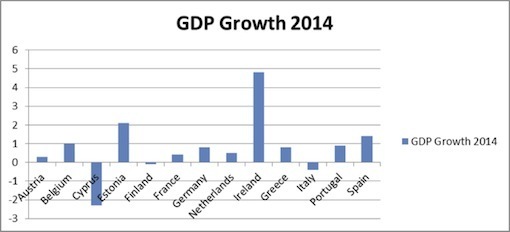
Our Prime Minister Enda Kenny talks of a ‘Celtic Phoenix’ rising from the ashes. The domestic and international media have been crowing ‘Ireland is on the way back’, ‘Economic recovery keeps on motoring’ and ‘Ireland shows struggling Europe the way ahead’. The multinationals (MNCs) think things are going so well we should be giving the rich tax cuts again – something the government is all for. Whilst Angela Merkel has credited us as a ‘tremendous success story’ – one the austerity averse Greeks should be emulating.
But alas, this is just one version of events, and there is certainly another, albeit a less publicised and more depressing account. This is what could be described as the everyday experience of ordinary Irish people. It’s by no means the tale of triumph over adversity that the government are trumpeting. On the contrary, it is one of ongoing economic hardship, tragedy and farce.
The supposed ‘recovery’ that our leaders are harping on about is completely alien to the hundreds of thousands of ordinary people who have been consistently taking to the streets to protest against their policies. It’s alien to the ever growing number of people who are in long term mortgage arrears and face losing their homes, or to the people who have already lost theirs. And it’s alien to 10,000 people who just this month snapped up the entire allocation of work visas for Canada in less than 12 minutes, therein joining the 170,000 of our young people who have left since 2010.
So how do we reconcile these two contrasting/conflicting accounts? Could it be the case that a recovery is indeed underway but has yet to ‘trickle’ down to all sectors of the economy? Or is deprivation and stagnation a harsh reality which is merely being hidden by headline growth figures which just don’t add up?
Pliable Stats vs Stubborn Facts
The government are quick to point to our growth figures of 4.8% GDP and 4% GNP, but what does this really tell us? In short, not much. Ireland’s unique position in the global tax avoidance operation has rendered the standard economic indicator of GDP (gross domestic product) useless as measures of the health of the economy. It’s been well documented that the profit shifting activities of the multinational sector (MNCs) based here leads to massive distortions in this statistical indicator. So our politicians, analysts and commentators turned to GNP (gross national product) for a more accurate picture of the economy’s health.
But GNP is just GDP after we control for all the money that is flowing in and out of the country in a given period – and it too suffers from the same kind of distortions from MNCs profit shifting. Take for example the case of management consultancy firm Accenture who, along with several other big international groups, chose to relocate their headquarters to Ireland.
Now such ‘headquarters’ might consist of a small office with a single phone in it (see: Brassplate Company), which might lead you to believe makes it of zero consequence to domestic economy – but you’d be wrong. Even if such firms engage in no economic activity beyond their one roomed office, their massive profits are still recorded in the national accounts (GDP and GNP).
Then there’s issue of the major financial institutions located in the Irish Financial Services Centre (IFSC) which are currently managing some of the world’s largest investment funds. The Irish Funds Industry Association (IFA) recently announced that ‘Assets domiciled in Ireland in 2014 have reached a new high of €1.6 trillion‘. This is worth more than the entire value of all final goods and services produced in Australia last year.
And whilst you might be thinking that sounds great, the effect on the real economy has been negligible – aside from the distortions to our GNP. But don’t take my word for it, it was the Central Bank that stated ‘Financial Sector developments, which are for the most part unrelated to the domestic economy, account for a significant portion of the rise in GNP’.
So right about now you might be feeling like GDP and GNP offer us no great insight into the health of the real Irish economy, but let me tell, it gets worse. The methodology by which the national accounts (GDP and GNP) are compiled was recently changed to inflate the figures. How did they do this? Well, now goods that are not even being made here are being counted as if they were.
Once again it’s the Irish Central Bank we can thank for drawing our attention to this little peculiarity as they point out that ‘goods owned by an Irish entity that are manufactured in and shipped from a foreign country are now recorded as Irish exports’. In other words, goods that never saw Irish soil or touched the hands of Irish workers are being recorded as if they were one of our exports. The only criteria being that they are owned by an ‘Irish entity’. A term so elastic it can be stretched to fit just about any purpose. I’d say you couldn’t make this stuff up, but it appears somebody already has.
The Slow Death of Domestic Demand
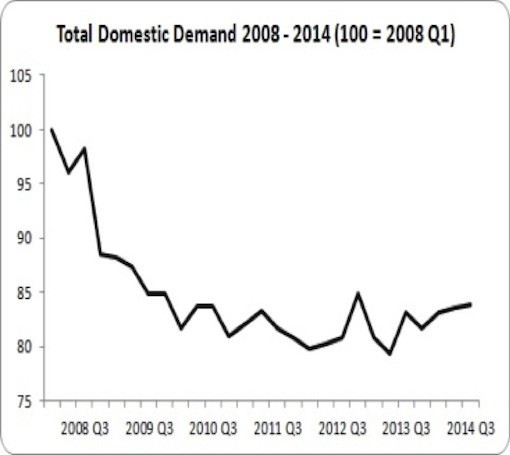
The only means of comprehending the true health of the economy is to look at domestic demand – or what’s left of it. Domestic demand, which makes up about three quarters of the economy, is comprised of government investment and expenditure on public services and consumer spending. Thus it doesn’t suffer from the kind of distortions attributable to the MNCs that the likes of GDP or GNP does.
The two graphs below illustrate perfectly the superficial nature of this ‘recovery’. As we can see domestic demand fell off a cliff in 2008 and has pretty much remained there. Consumer spending – which is the largest component of domestic demand – is actually below 2009 levels. Given that disposable income has fallen by 20% since 2008, largely as a result of falling wages, rising taxes and cuts to welfare spending (in other words austerity), is it any wonder that the Irish Small and Medium Size Enterprise Association (ISME) just this month described the government’s recovery as ‘glacially slow and patchy’. But surely this was to be expected? If you depress people’s incomes to breaking point where’s your demand going to come from? And if you’ve got no demand, then you’ve got recovery.
The fact of the matter is you can’t tax and cut your way out of a recession in the same way that you can’t diet and starve your way out of a famine. But with over half a million Irish people now experiencing food poverty – try telling the government that.

A very ‘Irish’ Recovery
Have you ever heard the expression ‘that’s a bit Irish’? Collins English dictionary defines ‘Irish’ – in its adjective form – as something ‘ludicrous or illogical’. Well, judging by that standard, this is a very ‘Irish’ recovery.
Oh sure, there’s been a recovery for some. Ireland’s richest 250 individuals saw their combined wealth increase by 16% to a whopping 75 billion in the last year alone, so it’s fair to say they’re doing ok. Then there’s the multinationals, whose massive profits continue to enjoy de facto tax immunity. And things are even looking up for the politicians, who are planning to give themselves a pay increase as recognition for masterminding this great ‘recovery’.
Call me old fashioned if you will, but to me a recovery isn’t a recovery until the lives of the people who make up the bulk of that economy start to improve. We still seem a long way away from that point. And for that reason most Irish people don’t believe in this recovery; because they don’t see it and they certainly don’t feel it.
Cillian Doyle is an economist with the People Before Profit Alliance of Ireland.
Another ‘Russian submarine’ excites Western media
By Danielle Ryan | RT | April 24, 2015
Once again Western media has rushed to judgment over a “Russian submarine”, this time in an incident off the coast of Ireland. But maybe they should have done their homework on this one. Britain and the US have worse track records in the Irish Sea.
Last week, while out and about in the waters of the Irish Sea a few miles off County Down, a fishing trawler “almost sank” when it was hit, presumably by a submarine.
The vessel, named the Karen, was hit and then “pulled backwards very violently.”
Skipper Paul Murphy told Down News that the boat had been travelling at just a couple of knots and then all of a sudden he was nearly knocked off his feet. “The crew were just in shock after this incident. It really was a close call,” he said.
Shaken from the day, and no doubt influenced by the deluge of Russian-subs-and-jets-are-coming-to-get-you propaganda in British newspapers, Murphy immediately hypothesized to the journalist that it could have been a Russian submarine. No wonder Stockholm couldn’t find it.
After I read the story, I posted the link to Facebook and then promptly forgot about it. It was only by chance, while reading an article in the Guardian about Britain’s Trident nuclear deterrent program and the “unpredictable Putin” that I happened upon another mention of it.
It seems the Russian sub theory has spread beyond the Down News to the Guardian, the BBC and beyond. And don’t get me wrong, it’s not a theory entirely without merit. It very well could have been a Russian submarine.
Dick James from the Northern Ireland Fish Producers Organisation (NIFPO) told the BBC, that the mystery sub may have been observing NATO marine exercises off the coast of Scotland.
Security analyst Tom Ripley, who writes for Jane’s Defence magazine, agreed. He told BBC Radio Ulster that the Russians “are famous for liking to watch these things [NATO exercises] and it is a strong possibility that they have sent one of their submarines to watch this activity.”
James added that, had it been a British submarine, Royal Navy protocols would have required it to “immediately surface to check on the health and welfare of the people involved,” and this submarine did not do that.
Subsequently, the initial media coverage of the incident seems to have been peppered with the assumption that while the Brits would never be so rude as to not surface and say hello, the horrible Russians wouldn’t feel bound by such niceties. It’s this fact alone — that the sub never surfaced to check the damage — that seems to have immediately convinced the entire British and Irish media that it could not have been a British vessel.
But let’s skip back for a moment, to April 18, 1982.
On that otherwise calm day at sea, a British submarine dragged the Sharelga, an Irish fishing boat for two miles before it eventually sunk and all five crew members were forced to jump overboard. They were, luckily, rescued by crew members of nearby boats.
The British sub did not surface and the British government denied any involvement in or knowledge of what had happened to the Sharelga. Only weeks later did they finally admit that in fact the Irish boat’s fishing net had been caught by the British submarine HMS Porpoise, which itself had been trying to spot Soviet submarines in the Irish Sea.
Four years later, the crew members finally received compensation, although according to the skipper Raymond McEvoy, it “didn’t even match half” of what he paid for the boat.
It took so long, likely in part because the Irish government didn’t want to, shall we say, rock the boat by getting too involved in a diplomatic entanglement with Britain. A document released decades later revealed that the Government was not interested in acting as “a party to the dispute” between the men and the British government.
The sinking of the Sharelga happened during a period of the Cold War that saw the Irish Sea earn the nickname ‘Submarine Highway’, so frequent was sub activity in Irish waters.
Seven years after the Sharelga sank, a Belgian trawler, the Tijl Uilenspiegel, sank approximately 25 miles south-east of the Isle of Man, presumably also by a submarine.
The incident prompted a discussion about submarine activity in the Irish Parliament in March 1989. Hugh Byrne, a member of parliament at the time, used his speaking time to deliver a chronological list of incidents to highlight the dangers to both fishermen and those on recreational vessels.
Here are some of the incidents he listed:
● In 1983, a yacht was struck and sunk by a submarine believed to be the British HMS Opossum, off County Wexford
● In 1984, a fishing vessel, the Algrie, became entangled with the HMS Spartan off the Cornwall coast
● In 1984, a US submarine surfaced in the middle of a fishing fleet near Kilmore Quay, prompting fishermen to flee in fear of their lives
● In 1984, Scottish fishing vessel the Mhari L disappeared with no distress call. A damaged British submarine entered Faslane base 24 hours later, but the Ministry of Defence denied involvement
● In 1987, the Summer Morn was towed for hours by a US submarine
● In 1988, the HMS Oberon collided with a yacht named the Drum
● In 1988, the Dalriada was sunk by the HMS Conqueror off Northern Ireland
● In 1989, a fishing trawler was struck by the USS Will Rogers.
Those are just a handful of incidents involving the damaging, sinking or disappearance of Irish and British boats in the waters surrounding the British Isles. Notably, none of the examples Byrne gave referred specifically to Russian submarines.
Occasionally the tragedies were blamed on “freak” waves, as in the case of the Boy Shaun off County Donegal and the Inspire off the Welsh coast, both of which were sunk while submarines were known to be operating nearby.
Overall, 50 fishermen lost their lives over nine years as a result of war games being played out in the Irish Sea. It’s important to note that the national identities of the subs were not confirmed irrefutably in every case, but a search through Irish government debate archives seems to suggest that Britain was regarded as a major, if not the major culprit. It’s not a particularly unusual assumption either, given that Britain (and its bases) is quite considerably nearer to Ireland than Russia, last time I checked.
During his comments, Byrne said that despite pleading with the British government, they continued to “ignore the loss of life and to respond with a ‘how dare you ask questions?’ attitude”.
“The attitude of the British Government, who contribute most to this devastation, baffles me because of their arrogance towards their people, particularly towards their fishermen,” he said.
Later in the same year, after a sonar buoy towed by a British submarine became entangled in the nets of a fishing vessel in the Irish Sea, the issue was raised in government again.
Member of the government at the time Peter Barry said that “as long as the NATO base [Holy Loch] remains located in Scotland,” and as long as NATO submarines were being shadowed by submarines from other superpowers, the danger would remain.
None of this information is readily available to your average consumer of news today, unless they go searching through old archives, which most people are not wont to do — and so it’s easy for the likes of the BBC, Sky News and the Guardian to bang out article after article about ‘Russian submarines’ with little to no historical context, let alone evidence to back up their assertions.
None of the reports on the latest incident with the Karen off the coast of Down last week made reference to the relevant history of dangerous British sub activity in the Irish Sea. Either the journalists didn’t do their homework or they felt that the frankly questionable British and American track records in the Irish Sea were not worth mentioning. It’s not that they needed to deliver an entire history of events in the interest of balance, but even a line or two would have been enough.
The argument by some against the relevance of this history will be that the 1980s were a different time and that surely if a British submarine inadvertently dragged a fishing boat today, they would immediately surface to check on the crew. It could also be argued however, that unfortunately today isn’t really as different from 1982 as we’d perhaps like to believe when it comes to NATO vs. Russia war games.
Despite a perhaps misplaced presumption of British courteousness, there are still plenty of reasons to assume a British sub would stay hidden after such an incident today, chief among them the fact that it just wouldn’t look good to admit such a mistake — particularly at a time when Russian military irresponsibility and “aggression” is the accepted bogeyman of the day.
Having to admit to almost capsizing a fishing boat in the Irish Sea would not look great given the current British government’s tendency to fear-monger over Russian jets and subs at any given opportunity and to use routine military maneuvers as a NATO rallying cry.
When I asked Dick James of NIFPO about the drop-off in incidents after 1990, he said it was likely due to the protocols being in place and of course the closure of the Holy Loch base after the collapse of the Soviet Union, which reduced submarine activity.
As for the identity of the sub that hit the Karen last week, when I asked if the media had been quick to judge, he accepted that it “could be NATO or not” adding that the British Ministry of Defence was being “reticent”. The Royal Navy later issued a statement claiming it was not one of their own.
But the question is: If Britain refused to acknowledge the mistakes of their submarines during periods of heightened tensions before, why would today be any different?
None of this is to assign blame or to claim that it wasn’t a Russian sub which dragged the Karen and shook her crew members last week. It very well could have been — but that theory is no more or less likely than the theory that says it was a British one.
Follow Danielle Ryan on Twitter @DanielleRyanJ
The Economist has a funny sense of European values
RT | March 24, 2015
In the same week that The Economist lauded Ukraine’s “commitment to European values,” Kiev’s current regime kicked out Euronews. Who do they think they are kidding?
Ah, The Economist. Without question, it’s is the best informed news magazine in the world… except on subjects I know something about. Take Ukraine for instance, throughout the country’s current crisis, The Economist has been weaving a web of fantasy to its readers. The narrative has continuously blamed Russia for all Ukraine’s misfortunes while painting its post-Maidan oligarchic rulers as being somewhere near God’s right hand.
After wholeheartedly backing last year’s coup, the windy weekly has been unwilling to admit the severity of Kiev’s economic malaise. Instead, it has maintained the pretence that throwing money at its pro-NATO regime will solve all its problems. Anybody who knows the first thing about Ukraine acknowledges that the lion’s share of the dough would be pilfered.
The problem is that a great number of the Western world’s most powerful people take The Economist seriously. The magazine appears both authoritative and credible, and never misses a chance to emphasize its own importance. However, this is “lipstick on a pig” territory. On subjects I’m reasonably informed about (Ireland, Europe, Britain, the ex-USSR for example), The Economist is more often wrong than right. Viewed through that prism, I’m extremely skeptical of the rag’s accuracy on topics I know little of.
In 2005, The Economist announced that Ireland had the highest quality of life in the world. I clearly remember reading the edition in downtown Dublin and that my first thought concerned the quality of the drugs the magazine’s editors were taking. Oddly, I’d penned a column a week earlier for the Ireland On Sunday newspaper predicting a deep recession for my homeland, which was rapidly losing its industrial base as credit-fuelled property madness raged.
Two years later, Ireland’s economy collapsed and a half decade of misery began. Incidentally, the periodical currently lists Melbourne as the best place to reside on earth. If you are in Melbourne right now, given The Economist’s track record, it’s probably best to emigrate before the inevitable happens.
Russia’s strong, determined President
Guided by its pro-interventionist and pro-neo liberal principles, the weekly doesn’t restrict itself to making a dog’s dinner of fiscal forecasts. Indeed, it frequently enters the realm of geopolitics to tackle countries and governments that don’t conform to its worldview. Russia is a case in point. In the 90’s, when Russia was on its knees, The Economist couldn’t get enough of the place. In fact, it broadly welcomed Vladimir Putin’s election in 2000, calling him a “strong, determined man.” By 2002 it trumpeted that “relations between Russia and the West have (sic) rarely been better.”
Now, the same Vladimir Putin is The Economist’s public enemy Number 1 and Russia the re-incarnation of Hitler’s Germany. Moscow’s crime? Standing up for itself and rejecting the Western liberal consensus. Essentially, refusing to pauperize the country to suit a bunch of ideologues in London.
In order to wage its anti-Russia campaign, The Economist pretends to care about Ukraine. The London-based magazine is far from alone in this. Last weekend, it hailed Kiev’s commitment to European values.
“European values like free speech and a commitment to truth remain potent,” it boldly declared. The reason I keep writing ‘it’ is because the article was unsigned, written under the pseudonym ‘Charlemagne.’ The Economist’s journalists don’t sign their work, which is probably for the best considering the kind of rubbish they pen.
The Menace of cliques
The diatribe quotes a scaremongering report written by Peter Pomerantsev and Michael Weiss, two activists connected to the shadowy UAE-backed Legatum Institute. Legatum’s Director of Communications is the former Catholic Herald editor, Cristina Odone, who just happens to be married to Edward Lucas, a senior Editor at The Economist. Mr. Lucas has previously advocated the use of Brezhnev-era KGB methods against RT.
Repeating the canard of “lavishly financed Russian media,” The Economist claims that “cash-strapped, fractious Europe will always struggle.” This is pure hokum. Only last month, Germany increased the budget of its Deutsche Welle news agency to $332 million. Meanwhile, BBC’s World Service has $406 million to splurge in 2015, and that’s just for radio/web. Additionally, France 24 spends around $130 million annually. By what stretch of the imagination is European media financially struggling here?
Snooze and you lose Euronews
Nevertheless, in the same week that The Economist was promoting Ukraine’s adherence to “European values,” Kiev revoked the license for the Ukrainian version of Euronews, suddenly claiming the current arrangement was “disadvantageous”. Now, I can’t think of a less offensive outlet. Euronews is so bland, so insipid that you could leave it on at an Israeli-Palestinian arm wrestling extravaganza and nobody would object.
While a private company, Euronews has received significant funding from Brussels over the years and is widely perceived, rightly or wrongly, as EU TV. The Ukraine edition was previously owned by an Egyptian, Naguib Sawiris, but reports suggest that it’s now controlled by Dymtro Firtash, a Ukrainian oligarch and rival of fellow-billionaire, Petro Poroshenko. Some use the label ‘pro-Russian’ to describe Firtash, but I find that Ukraine’s ultra-rich are usually just pro-themselves.
The Ukrainian President has his own TV network, Channel 5, and apparently objected to competition from Firtash, who he evidently sees as a threat. So, it looks like he used his political power to muffle the voice of Euronews. “European values,” how are you?
Bryan MacDonald is an Irish writer and commentator focusing on Russia and its hinterlands and international geo-politics. Follow him on Facebook

‘Close, aggressive surveillance’: UK Special Forces back in Northern Ireland
RT | March 9, 2015
British Special Forces soldiers are once again operating in Northern Ireland, allegedly, to counter violent Republican groups including the Real IRA, according to intelligence sources.
Quoted in the Daily Star newspaper, they said up to 60 members of the Special Reconnaissance Regiment (SRR) are in the region.
One source told the paper that heightened dissident activity and the increased terror threat were linked to the approaching 100-year anniversary of the 1916 Easter Rising – a period of Irish history which remains highly emotive.
Another described the unit’s role as “close, aggressive surveillance.”
The SRR replaced an earlier unit known as 14 Intelligence Company. Its creation in 2005 saw the specialist close surveillance role developed during the Troubles expanded for the War on Terror.
The same year it was reported the SRR had been involved in the counter-terrorist operation which eventually led to the gunning down in Stockwell tube station of Jean Charles De Menezes, an innocent Brazilian worker.
The regiment, the only British Special Forces unit to recruit women and estimated to be composed of between 500 and 600 personnel, has been deployed in Iraq and Afghanistan.
In August 2014, the SRR was reported to be hunting Islamic State militants, including Jihadi John, later identified as West Londoner Mohammed Emwazi.
Its forerunner – known colloquially as “14 Int” – was limited to operating in Northern Ireland.
Recently, there have been a number of damaging revelations and legal cases about covert British operations during the period of the Troubles.
In 2013, a BBC documentary uncovered claims that a secret army unit called the MRF was hunting and killing IRA members, and in the course of doing so may also have killed a number of innocent civilians.
Alongside their combat role, the hand-picked members of the MRF also carried out surveillance. In some cases while disguised as meths-drinking vagrants, at other times while pretending to be garbage collectors.
In February this year, the case of the Hooded Men made headlines again when human rights lawyer Amal Clooney – who is the spouse of actor George Clooney and has represented WikiLeaks editor Julian Assange – joined the legal team of 11 individuals who claim to have suffered torture while in the custody of British security forces.
Of over 300 people rounded up in June 1971, twelve were selected for further interrogation. They were then subjected to stress positions, hooding, white noise and food, drink and sleep deprivation.
These methods were known as the Five Techniques and would later form the practical basis for the treatment of captives by the United States military and intelligence services during the War on Terror. They have become synonymous with the process known as extraordinary rendition.
In 1976, the men took their case to the European Court of Human Rights and won. The ruling was later overturned and it was subsequently ruled that while they had been subject to inhumane and degrading treatment, it did not constitute torture.
‘Game of Thrones’ statue stolen, pagans blame religious hate
RT | February 3, 2015

A still from a YouTube video by sculptor Darren Sutton
The theft of a Celtic sea god sculpture from a mountainside in Northern Ireland must be labeled as a religious hate crime, a local pagan priest believes. The statue, made by a ‘Game of Thrones’ set creator, prompted a media stir after it was vandalized.
The six-foot statue of Manannán Mac Lir, a sea deity in Irish mythology, was stolen from Binevenagh Mountain near Limavady in County Derry in January and replaced with a crucifix bearing the words “you shall have no other gods before me.”
Now, pagan priest Patrick Carberry, the founder and sovereign of the Order of the Golden River, which is based out of Belfast, says the incident should be treated as a religious hate crime.
“If a pagan stole a statue from a Christian church and left a pagan one in its place it would make world news,” Carberry told the Londonderry Sentinel.
Police have not yet discarded considerations that there could be a religious element to the crime, according to local media reports.
The creator of the statue is John Sutton – the man behind the sets of the popular HBO series ‘Game of Thrones’. Sutton said he was “disturbed” by the “unreal” theft.
The $15,000 statue was made of stainless steel and fiberglass, which would make it very difficult to steal, according to Sutton. Several people would have needed to be part of the crime and it likely would have taken them several hours.
According to Carberry, Pagans represent a significant minority in Northern Ireland. “There is a large community in Belfast alone and there are large communities across Ireland…people are afraid to admit that they have these beliefs because they might lose their jobs.”
“Paganism is the original religion of this land. We worship many gods and goddesses. In Ireland we are associated with the Celtic gods. Manannán would fall into that category,” he added.
Meanwhile, many others have been outraged by the crime in the predominantly-Christian region, decrying the vandalism of what is considered to be both a work of art and a tourist attraction.
A local Member of the Legislative Assembly (MLA), Claire Sugden, on Sunday told Coleraine Times she was “disgusted” by the theft.
“It seems the reason for removing this statue was in God’s name which is shameful and indeed more disrespectful than their reasoning. Certainly I think God would have something to say about those who stole something which brought a lot of happiness to a lot of people,” Sugden said.
The MLA said that the statue of Manannán was “entirely appropriate in its setting” as it “framed and celebrated the natural beauty” of the place.
Winston Churchill was a Racist Ass#*%!
Moonlit History | October 24, 2014
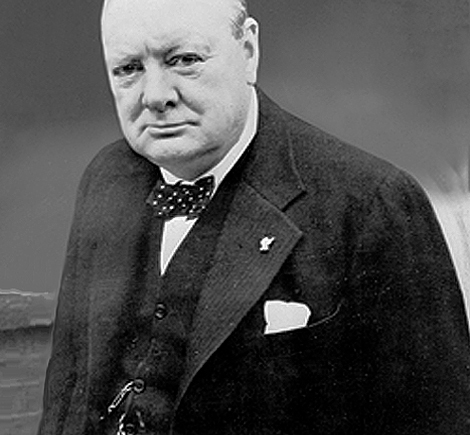
Churchill is seen as the British icon of endurance and strength through gloomy war. His drowning voice of “we shall fight on the beaches” is easily identifiable with World War II. And he was a complete drunk.
But what do common folks now-a-days know of this man? Do you know much about Dear ol’ Churchill? Let’s find out.
In December of 1910, while young Churchill was Home Secretary, he wrote:
“The unnatural and increasingly rapid growth of the Feeble-Minded and Insane classes, coupled as it is with a steady restriction among all the thrifty, energetic and superior stocks, constitutes a national and race danger which it is impossible to exaggerate. I am convinced that the multiplication of the Feeble-Minded, which is proceeding now at an artificial rate, unchecked by any of the old restraints of nature, and actually fostered by civilised conditions, is a terrible danger to the race.” Churchill was all-for forcing “feeble-minded” people to labour colonies. January 19, 1899, Churchill wrote in a letter to his cousin: “The improvement of the British breed is my aim of life.” [1]
Wait a minute, he was in favor of eugenics? This sounds really familiar to someone else in history, I just can’t remember his name. Anyway, moving on.
As a young MP, it was well-known he believed that “the Aryan stock is bound to triumph.” — Okay, wait! He sounds just like that guy with the funny mustache! Whoa!
When concentration camps were built in South Africa, for white Boers, he [Churchill] said they produced “the minimum of suffering”. The death toll was almost 28,000, and when at least 115,000 black Africans were likewise swept into British camps, where 14,000 died, he wrote only of his “irritation that Kaffirs should be allowed to fire on white men.”
As Colonial Secretary in the 1920s, he unleashed the notorious Black and Tan thugs on Ireland’s Catholic civilians, and when the Kurds rebelled against British rule, he said: “I am strongly in favour of using poisoned gas against uncivilised tribes… [It] would spread a lively terror.” [2]
And after Ghandi’s movement of peace was taking hold in the then British colony of India, Churchill was noted to have said:
“I hate Indians. They are a beastly people with a beastly religion.” Churchill’s gross demeanor towards others not of his skin did not cease while the Bengali famine occurred (which led to the death of nearly 3 million souls). He remarked the famine was not Britain’s fault, but it was “their” fault—because they “breed like rabbits.” He was talking about the Indians, of course. Amartya Sen, an economist who won the Nobel Prize in 1998, proved for a fact that the famine was due to the imperialist structure of the British Empire. [3]
In conclusion: make your own conclusion.
Sources:
[1] Winstonchurchill.org
[2] The Independent
[3] BBC
Mass babies’ grave scandal pushes Irish govt, Catholic Church toward inquiry
RT | June 5, 2014
 The Irish government is under pressure to order an inquiry into a recently uncovered mass grave for almost 800 children who died at a Catholic Church facility for unwed mothers and their children. Most of the bodies were dumped in a sewage tank.
The mass, unmarked grave in the town of Tuan, western Ireland, was unveiled by a local historian, Catherine Corless, who was gathering information on the mother-and-baby home which functioned there in the first half of the 20th century, run by the Bon Secours order of nuns.
Back then, unmarried pregnant women were ostracized by conservative Irish society and sent away to special church-run institutions, where mothers often had to engage in unpaid hard labor, while their children were taken away from them to be either adopted or raised in orphanages.
The burial place appeared to be one for the children who died at the facility.
“I was dismayed to find that in fact the number of children who died in the Home during its existence 1925-1961 numbered nearly 800,” Corless wrote on Facebook, commenting on her research. “I now have all those children’s names, date of death, and age at death, which will be recorded into a special book.”
Locals first learned of the mass burials in the 1970s. By that time the home for mothers and babies had been closed and the area turned in a residential one. Two boys accidentally broke apart the concrete slab over the mass grave and discovered little skeletons there. The place was then sealed again, but still remained unmarked for decades.
Corless is now engaged in a fundraising effort to get the place marked with a monument bearing all of the 769 names of the dead children. She says they died of malnutrition and neglect. A sewage tank served as a graveyard.
“If you look at the records, babies were dying two a week, but I’m still trying to figure out how they could [put the bodies in a septic tank],” Corless told the Irish Mail. “Couldn’t they have afforded baby coffins?”
“Harrowing details” as Children’s Minister Charlie Flanagan put it, of burial arrangements for children at the church-run institutions, have led to calls for an inquiry into what happened decades ago.
“Many of the revelations are deeply disturbing and a shocking reminder of a darker past in Ireland when our children were not cherished as they should have been,” Flanagan said in a statement cited by Reuters. A government report on the scandal is expected by the end of June.
Labor senator Lorraine Higgins has called for the Catholic Church to reveal more details of the incident.
“Now is the time for the church authorities to tell us where the rest of the bodies are,” Higgins said, The Irish Times reported. “We need to know how many died in each of these homes throughout the country. We need details about each one of these children and where their resting places are.”
The Archbishop of Tuam, Michael Neary, said that the diocese was not running the home. He told the order of nuns who did that it must co-operate with any inquiry into the discovery.
“Regardless of the time lapse involved, this is a matter of great public concern which ought to be acted upon urgently,” Neary said.
Archbishop of Dublin, Diarmuid Martin, told The Irish Examiner he would support exhumation of the children’s bodies if necessary for the investigation.
It’s not the first time that the Catholic Church in Ireland has found itself under fire over inhuman practices in its institutions in the past.
A year ago the Irish government agreed to pay up 58 million euros ($75 million) in compensation to hundreds of women, who were forced to work at the notorious Magdalene Laundries, also run by the Catholic Church. A teenage girl or young woman could be sent to the laundries just over suspicions that her behavior could be contrary to the Church’s conservative morals. The inmates at the institutions, run by Catholic nuns, were forced to do physically demanding work while living in prison-like conditions.
Gerry Adams’ arrest politics of the dead
By Finian Cunningham | Press TV | May 1, 2014
There seems little doubt that the arrest of Irish republican leader Gerry Adams this week over alleged involvement in a tragic murder 44 years ago is politically motivated.
The political interests pushing this agenda have no respect for victims of Ireland’s recent 30-year conflict. These interests are being selective in their focus on victims, cynically vying for political gain, and in particular to damage the rise of Sinn Fein, the Irish republican party.
Later this month, Ireland is heading into European Parliamentary elections, which up to now was promising to see major electoral gains for Sinn Fein, the party of which Adams has been president of since 1983.
In recent years, Sinn Fein has emerged has the fastest growing political party in both the British-occupied north and the independent southern state. It has become the second biggest party in the Northern Ireland Assembly, while in the southern legislative chamber, Dail Eireann, Sinn Fein has seen its number of parliamentarians expand three-fold over the past three elections to become an increasingly pivotal force there.
Sinn Fein can rightly claim to be the only all-Ireland party with representatives and organizational structure that transcend the British-imposed border, which partitions the island into northern and southern jurisdictions. Sinn Fein is distinguished from all other political parties by its manifesto calling for a united, independent country.
That manifesto not only threatens the British interest of maintaining its political presence in the North of Ireland; the so-called Irish political parties in the South of Ireland also see their establishment interests challenged by the growing popular support for Sinn Fein and its calls to shake-up the stagnant status quo on both sides of the border.
This is the important context in which the Sinn Fein leader was taken into custody this week by police in Northern Ireland. Adams has not been charged but his arrest over the murder took many observers by surprise, coming seemingly out of the blue. The allegations will revive memories of a dark episode in Ireland’s 30-year conflict.
The murder in question is that of a Belfast woman, Jean McConville, who was abducted and killed by the Provisional IRA in 1972. McConville was a widow and mother of 10 children, aged 38 when she died. The IRA claimed that the woman was an informer to the British army during the conflict that saw Belfast plunged into chaos and violence for nearly three decades. The McConville family always vehemently denied their mother was an informer, and a police investigation conducted years later cleared the deceased woman of any such activity.
Sinn Fein is the political wing of the IRA, and Gerry Adams has long been alleged to be a senior member of the guerrilla organization, which laid down its arms as part of the Irish peace settlement signed in 1998. As an alleged commander of the IRA during the 1970s in Belfast, Adams is accused of overseeing the assassination of Jean McConville.
The Sinn Fein president denies any involvement in the abduction and murder. This week, before his arrest, Adams described the allegations as “malicious” and aimed at damaging his party politically, especially on the eve of European-wide elections.
Certainly, the accusations against Adams are not new. In recent years, two former senior IRA members, Brendan Hughes and Dolores Price, made separate claims that Adams ordered the execution of Jean McConville. Female IRA member Dolores Price said before her own death last year that she abducted McConville on direct orders from Adams and drove the mother to the place of her execution.
McConville’s body was found in August 2003, nearly 31 years after her murder. Her remains had been buried on a beach in Shelling Hill, County Louth, across the border in the South of Ireland. The IRA had already admitted to the murder in 1999, while still maintaining that McConville was an informer. It offered an apology to the family and provided information to locate her burial site.
The grief of the McConville family is surely poignant. Ten young children were left without a mother and the family was subsequently split up and taken into social care.
But there are thousands of other such family tragedies during the conflict that engulfed Northern Ireland between 1968-1998. Fathers, mothers, sons and daughters were shot dead by British army soldiers and pro-British paramilitaries who were directed by London’s military intelligence to instil terror in the civilian population and to deter its right to Irish freedom. Thousands of lives were ruined and traumatized by a conflict that the British government bears a heavy responsibility for but for which it has always evaded.
The southern Irish political establishment has a lot to answer for too. It largely turned its back on the plight of many citizens in the north when they were being subjected to ruthless British militarism.
Indeed, the southern Irish ruling class collaborated with Britain to suppress the freedom movement that re-emerged in the British-occupied northern state during the 1960s.
Today, the South of Ireland jurisdiction – which pompously and fraudulently refers to itself as “the Republic of Ireland” – is the apotheosis of the Irish republic that generations of Irish people have fought and died for.
It is a bankrupt state of huge social inequality and poverty, overseen by crony political parties who made their peace with British imperialism when the island was partitioned in 1920 – thus betraying the cause of Irish republicanism that sought to set up a unified, independent state free from British domination.
Sinn Fein, the original party that led Irish independence more than a century ago, is again in the ascendancy, both north and south. It is this political threat that most probably explains the sudden rekindling of interest in the tragic murder of Jean McConville more four decades ago. The place where her remains were found 10 years ago, County Louth, is the electoral constituency that Gerry Adams represents today in the southern parliament, having been elected to the seat in 2011.
Jean McConville’s family deserve the truth and justice. So do thousands of other Irish families. But for these other families, the British and Dublin governments and their lickspittle media show little interest towards. Both the London and Dublin governments continue to refuse the setting up an independent truth commission into all conflict-related deaths. The selective focus on one victim strongly suggests manipulation of a single family’s grief for cynical political purposes. That’s not justice. It’s grubby politicking.
Featured Video

Prof. Ted Postol: Iran Already Achieved Nuclear Deterrence Against Israel
or go to
Aletho News Archives – Video-Images
From the Archives
How the occupied mentality syndrome works
Saudi Arabia on the American chessboard – Part 3
By B. J. Sabri | American Herald Tribune | June 27, 2016
Read part 2: “The occupied mentality Syndrome“
Previously I argued whether Saudi Arabia’s repeated involvements in U.S. interventions and wars stem from free national will or in response to a specific condition. For starters, in Saudi Arabia there is no national will. In Saudi Arabia, the national will is the will of the Al Saud clan. Still, when a major Arab state allies itself with a superpower that committed unspeakable crimes against humanity in almost every Arab country, then something is wrong. This fact alone should compel us to examine the U.S.-Saudi relation for one exceptional reason. As a result of the U.S.-Saudi wars, hundreds of thousands of people in Afghanistan, Iraq, Iran, Libya, Syria, Yemen, and Somalia have lost their lives. Millions became displaced in their own homelands. And millions more rendered refugees.
Attributing the Saudi policies to the bonds of “partnership” with the U.S. is frivolous. There are no bonds between these two thugs except those of business, military deals, secret plots, and wars. Proving this point, bonds such as these have no space for the American and Saudi peoples to share significant cultural or societal exchanges. If partnership is not the reason for the Saudi contribution to the U.S. strategy of empire and imperialism, then another reason must exist.
This leads to three possibilities. … continue
Blog Roll
 Aletho News
- NIAID/NIH and USDA Fund Bioengineered Chimeric Influenza Viruses Built Using Pandemic H1N1 Components: Journal ‘Science Advances’
- Hezbollah hits Israeli warship off Lebanon’s coast, sets it aflame
- Iran slams US strikes on B1 bridge, Mahshahr petrochemical plants as ‘blatant acts of state terrorism’
- In letter to UN chief, Araghchi warns of dire consequences of US-Israeli attacks on Iran’s nuclear facilities
- Why the CIA conspiracy to invade Iran with Kurdish militias failed
- Why Are Upbeat US Claims About Mission to Rescue Pilot ‘Highly Questionable’?
- Aircraft destroyed during US ‘rescue’ of downed F-15 pilot cost more than $100 million each
- Washington University removes professor who condemned US-Israeli war on Iran
- Russia Warns of Retaliation as UK Authorizes Seizure of Vessels
- Serbia thwarts plot to bomb Russia-Hungary gas pipeline – Vucic
- If Americans Knew
- In Iran, Israel-US take aim at “reason, research, and freedom of thought” – Daily Update
- US loses planes over Iran, Israel downgrades Lebanon war goals – Daily Update
- Israel Is Blocking Palestinians from Easter at Church Where Jesus Resurrected
- Plot to assassinate Palestinian activist follows harassment campaign promoted by Zionist groups and elected officials
- Prominent New York synagogue hosts presentation on why U.S. Jews should support the ethnic cleansing of Gaza
- Tapper vs. Piker: Is the CNN Anchor Auditioning for David Ellison?
- Shouldn’t Democrats Be Able to Condemn Genocide?
- Israel-US kill negotiators, destroy civilian structures, but Iran’s military capabilities still largely intact – Daily Update
- ‘War crime’: Global condemnation as Israeli ministers celebrate death penalty law targeting Palestinian prisoners
- 7 Ways Israel Is Turning Lebanon Into Gaza
- No Tricks Zone
- An Inconvenient Tree: Uncovered In Alps… Europe Much Warmer Than Today 6000 Years Ago
- New Study Reports A 60% Slowdown In Greenland’s Ice Loss Rate In The Last Decade
- Low Intensity Tornado Wrecks Major Solar Farm, Creating A Potential Toxic Dump
- New Study Finds Warming Saves Lives…Cold Temperatures 12 Times More Deadly Than Excess Heat
- German Science Blog Accuses PIK Climate Institute Of Hallucinating Climate Tipping Points
- Devastating Assessment Of Comirnaty Vaccine By Former Senior Pfizer Europe Toxicologist
- New Study: CO2 Is ‘Effectively Negligible’ As An Explanatory Climate Change Factor Since 2000
- Former Pfizer Toxicologist Dr. Helmut Sterz Tells Bundestag Hearing Pfizer Vaccine Should Have Never Been Approved
- Energy Expert: Germany’s Nuclear Phaseout Was A “500 Billion Euro Mistake”
- New Research: South Australia’s Mid-Holocene Sea Surface Temperatures Were 4°C Warmer Than Today
 Aletho News