ISIS and the USA: Expansion and Resistance by Decapitation
By James Petras :: 09.26.2014
Introduction
In order to overcome massive US and world public opposition to new wars in the Middle East, Obama relied on the horrific internet broadcasts of ISIS slaughtering two American hostages, the journalists James Foley and Steve Sotloff, by decapitation. These brutal murders were Obama’s main propaganda tool to set a new Middle East war agenda – his own casus belli bonanza!
This explains the US Administration’s threats of criminal prosecution against the families of Foley and Sotloff when they sought to ransom their captive sons from ISIS.
With the American mass media repeatedly showing the severed heads of these two helpless men, public indignation and disgust were aroused with calls for US military involvement to stop the terror. US and EU political leaders presented the decapitations of Western hostages by the so-called Islamic State (ISIS) as a direct and mortal threat to the safety of civilians in the US and Europe. The imagery evoked was of black-clad faceless terrorists, armed to the teeth, invading Europe and the US and executing innocent families as they begged for rescue and mercy.
The problem with this propaganda ploy is not the villainy and brutal crimes celebrated by ISIS, but the fact that Obama’s closest ally in his seventh war in six years is Saudi Arabia, a repugnant kingdom which routinely decapitates its prisoners in public without any judicial process recognizable as fair by civilized standards – unless tortured ‘confessions’ are now a Western norm. During August 2014, when ISIS decapitated two American captives, Riyadh beheaded fourteen prisoners. Since the beginning of the year the Saudi monarchy has decapitated more than 46 prisoners and chopped off the arms and limbs of many more. During Obama and Kerry’s recent visit to Saudi Arabia, horrendous decapitations were displayed in public. These atrocities did not dim the bright smile on Barak Obama’s face as he strolled with his genial royal Saudi executioners, in stark contrast to the US President’s stern and angry countenance as he presented the ISIS killing of two Americans as his pretext for bombing Syria.
The Western mass media are silent in the face of the Saudi Kingdom’s common practice of public decapitation. Not one among the major news corporations, the BBC, the Financial Times, the New York Times, the Washington Post, NBC, CBS and NPR, have questioned the moral authority of a US President who engages in selective condemnation of ISIS while ignoring the official Saudi state beheadings and the amputations.
Decapitation and Dismemberment: By Dagger and Drones
The ISIS internet videos showing gaunt, orange-suited Western prisoners and their lopped-off heads have evoked widespread dismay and fear. We are repeatedly told: ‘ISIS is coming to get us!’ But ISIS is open and public about their criminal acts against helpless hostages. We cannot say the same about the decapitations and dismemberment of the hundreds of victims of US drone attacks. When a drone fires its missiles on a home, a school, wedding party or vehicle, the bodies of living people are dismembered, macerated, decapitated and burned beyond recognition – all by remote control. The carnage is not videoed or displayed for mass consumption by Obama’s high command. Indeed, civilian deaths, if even acknowledged, are brushed off as ‘collateral damage’ while the vaporized remnants of men, women and children have been described by US troops as ‘pink foam’.
If the brutal decapitation and dismemberment of innocent civilians is a capital crime that should be punished, as I believe it is, then both ISIS and the Obama regime with his allied leaders should face a people’s war crimes tribunal in the countries where the crimes occurred.
There are good reasons to view Washington’s close relation with the Saudi royal beheaders as part of a much broader alliance with terror-evoking brutality. For decades, the US drug agencies and banks have worked closely with criminal drug cartels in Mexico while glossing over their notorious practice of decapitating, dismembering and displaying their victims, be they local civilians, courageous journalists, captured police or migrants fleeing the terror of Central America. The notorious Zetas and the Knights Templar have penetrated the highest reaches of the Mexican federal and local governments, turning state officials and institutions into submissive and obedient clients. Over 100,000 Mexicans have lost their lives because of this ‘state within a state’, an ‘ISIS’ in Mexico – just ‘South of the Border’. And just like ISIS in the Middle East, the cartels get their weapons from the US imported right across the Texas and Arizona borders. Despite this gruesome terror on the US southern flank, the nation’s principle banks, including Bank of America, CitiBank, Wells Fargo and many others have laundered billions of dollars of drug profits for the cartels. For example, the discovery of 49 decapitated bodies in one mass in May 2014 did not prompt Washington to form a world-wide coalition to bomb Mexico, nor was it moved to arrest the Wall Street bankers laundering the ‘beheaders bloody booty’.
Conclusion
Obama’s hysterical and very selective presentation of ISIS crimes forms the pretext for launching another war against a predominantly Muslim country, Syria, while shielding his close ally, the royal Saudi decapitator from US public outrage. ISIS crimes have become another excuse to launch a campaign of ‘mass decapitation by drones and bombers’. The mass propaganda campaign over one crime against humanity becomes the basis for perpetrating even worse crimes against humanity. Many hundreds of innocent civilians in Syria and Iraq will be dismembered by ‘anti-terrorist’ bombs and drones unleashed by another of Obama’s ‘coalition’.
The localized savagery of ISIS will be multiplied, amplified and spread by the US-directed ‘coalition of the willing decapitators’. The terror of hooded beheaders on the ground will be answered and expanded by their faceless counterparts in the air, while delicately hiding the heads rolling through the public squares of Riyadh or the headless bodies displayed along the highways of Mexico … and especially ignoring the hidden victims of US-Saudi aggression in the towns and villages of Syria.
US considers no-fly zone over northeastern Syria: Reports
Press TV – September 27, 2014
The US Department of Defense says it is considering the possibility of imposing a no-fly zone over northeastern Syria to deny the Syrian military the ability to launch airstrikes there, reports say.
Turkey has requested the US to establish a buffer zone along the Turkish-Syrian border to protect foreign-sponsored militants and civilians.
US Defense Secretary Chuck Hagel and Gen. Martin E. Dempsey, the chairman of the Joint Chiefs of Staff, said on Friday, “We’ve discussed all these possibilities and will continue to talk about what the Turks believe they will require.”
Dempsey added that “a buffer zone might at some point become a possibility.”
The US and its allies have been continuously bombing the ISIL terrorist group in northeastern Syria since Tuesday; but the Pentagon is indicating that it may decide to prevent the Syrian military from targeting anti-government militants in the same region.
Fighter aircraft from Saudi Arabia, Jordan, Qatar, Bahrain and the United Arab Emirates have taken part in the airstrikes in Syria.
The ISIL terrorists, who were initially trained by the CIA in Jordan in 2012 to destabilize the Syrian government, control large parts of Syria’s northern territory. ISIL sent its fighters into Iraq in June, quickly seizing vast expanse of land straddling the border between the two countries.
Syria has been gripped by deadly unrest since 2011. According to reports, the United States and its regional allies – especially Qatar, Saudi Arabia, and Turkey – are supporting the militants operating inside the country.
According to the United Nations, more than 190,000 people have been killed and millions displaced due to the turmoil that has gripped Syria for over three years.
ISIS is not ‘Blowback’ from Western Foreign Policy; They ARE Western Foreign Policy
Empire Strikes Black | September 24, 2014
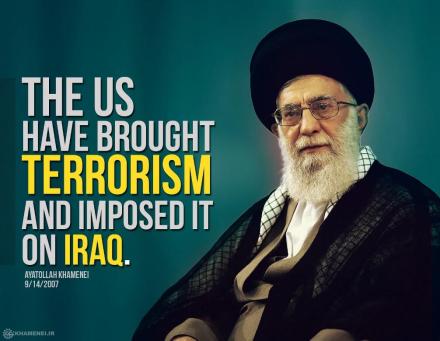 Notice that ISIS are sworn enemies of Syria, Hizbu’llah, and Iran. This in itself gives a most obvious clue as to the identity of the group’s benefactors.
A prevalent liberal cliché is the “blowback” theory – the theory that ISIS terror attacks, and indeed the group’s very existence, are somehow in retaliation to US/Western/”Israeli” foreign policy actions.
This is a disingenuous theory that is disseminated in order to keep the empire’s citizens on side. Crucially, it distracts from a key truth.
Western and “Israeli” intelligence has historically effected deep infiltration of ‘jihadist’ terror cells throughout the Arab world and the West; these groups are used literally as footsoldiers (see Afghanistan throughout the 1980s) to achieve Western and “Israeli” military and strategic objectives. The “blowback” theory distracts from this key fact.
ISIS aren’t retaliating against Western foreign policy; they are Western foreign policy. These very people were mobilised against Muammar Gaddafi in Libya’s bogus ‘revolution’ of 2011, as with Syria in the same year.
In moving across the Syrian-Iraqi border, ISIS – Zionism’s footsoldiers – underwent a magical media transformation into the ‘bad guys’. The ‘war against ISIS’ is a con, a total scam. It is a pretext for a war against the resistance axis: chiefly Syria, Hizbu’llah, Iran, and the Palestinian resistance. It is a pretext to kick the ‘Yinon plan’ – the plan to balkanise the Arab world to ensure “Israeli” hegemony – into high gear
The WMD lies of 2003 never went away; they simply got re-packaged for the liberal crowd in the post-Bush era.
Nasrallah: “America is the mother of terrorism”
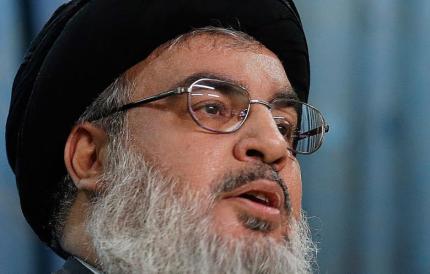
Nasrallah speaks on July 25, 2014, in the southern suburbs of Beirut. (Photo: Al-Akhbar – Haitham Moussawi)
Al-Akhbar | September 23, 2014
Hezbollah leader Hassan Nasrallah on Tuesday said his group could never be a part of an anti-ISIS coalition led by “the source” of all terrorism in the world, the United States.
The international coalition, which began illegal airstrikes in Syria for the first time Tuesday, was created to safeguard the interests of the United States, not to fight terrorism as it claims, Nasrallah said in a televised speech.
“In our opinion, America is the mother of terrorism, the source of terrorism. If there is terrorism anywhere in the world, look at America,” the secretary-general said.
“America provides complete support for the terrorism of the Zionist state. It supports Israel militarily, financially, legally, and even provides it veto in the United Nations Security Council.”
Nasrallah continued: “He who dropped the atomic bomb on the people of Japan, and who killed [relentlessly] in Vietnam and elsewhere, and who stood by [Israeli Prime Minister Benjamin] Netanyahu in the 50 day war on Gaza … is not qualified ethically or morally to present itself as a leader of a coalition to fight terrorism.”
The comments come as the United States and allied Arab dictatorships began launching unauthorized airstrikes against jihadi targets in Syria, drawing rebukes from Damascus’s allies Iran and Russia.
Nasrallah brushed off criticism that his opposition to the coalition translated into support for the Islamic State of Iraq and Syria (ISIS), noting that he has repeatedly denounced the extremists and called for their elimination.
The reality that many of those included in the anti-ISIS coalition have been financing the jihadi militants they are currently fighting in Iraq and Syria forces people of the region to question the motives of their actions, he added, referring to Saudi Arabia and Qatar.
Lebanon is one of 10 Arab countries that has pledged support to the coalition, a membership that Nasrallah said he opposed.
“Never did [US President Barack Obama] say we are coming to defend minorities or Muslims or Christians …,” Nasrallah said.
“So we will not fight in a coalition that serves US interests and not the interests of the people of the region.”
In Nasrallah’s last speech on August 15, he noted that the United States only decided to get involved in the fight against ISIS when the jihadis approached Iraq’s Kurdish region, which is strategically important to the West. … Full article
Syria slams Israel support for ISIL
Press TV – September 23, 2014
Syria has once again slammed the Israeli regime’s support for the Takfiri ISIL militants operating inside the Arab country.
A Syrian military official, whose name was not mentioned in the reports, made the comments on Tuesday after Tel Aviv said earlier in the day that it had shot down a Syrian warplane as it attempted to fly over the ceasefire line into the Israeli-occupied Golan Heights.
The official confirmed the shooting down and underlined that the move was based on Tel Aviv’s policy of supporting ISIL Takfiris.
The aircraft was apparently a MiG-21 fighter jet which was downed by a surface-to-air Patriot missile, the Army radio said, adding that the wreckage landed on the Syrian side of the plateau.
However, an unnamed Israeli military official identified the downed aircraft as a Sukhoi Su-24 Russian fighter plane.
The development comes amid heavy clashes on the Syrian side of the Golan Heights. The Syrian government has been hitting back at the foreign-backed militants there with frequent airstrikes.
Syria has been gripped by deadly violence since March 2011.
According to reports, the Western powers and their regional allies — especially Qatar, Saudi Arabia and Turkey — are supporting the Takfiris fighting against the Syrian government.
Golan Heights have been under the Israeli occupation since the 1960s. The Tel Aviv regime captured 1,200 square kilometers (460 square miles) of the Golan Heights during the Six-Day War of 1967 and annexed the region in 1981.
Congress Votes for More War in the Middle East
By Ron Paul | September 21, 2014
Last week, the House and Senate voted to rubber stamp President Obama’s war plans for the Middle East. Both bodies, on a bipartisan basis, authorized the US to begin openly training and arming the rebels who have been fighting for three years to overthrow the Assad government in Syria.
Although the Syrian government has also been fighting ISIS and related extremist groups for three years, the US refuses to speak to the Syrians and has warned Assad not to interfere with the coming US attack on sovereign Syrian territory
President Obama promised that airstrikes alone would “degrade and destroy” ISIS, telling the US military in a speech last week that:
“The American forces that have been deployed to Iraq do not and will not have a combat mission… I will not commit you and the rest of our armed forces to fighting another ground war in Iraq.”
But of course any US troops sent into a war zone are “combat” troops. And more are on their way.
While the president was swearing that there would be no boots on the ground, Chairman of the Joint Chiefs of Staff, General Martin Dempsey, was in open disagreement. General Dempsey told the Senate Armed Services Committee last week that US forces would need to embed with Iraqi or Kurdish troops in combat situations under certain circumstances.
The limited mission the president promised just weeks ago has already greatly escalated, and now threatens to become another major regional war. In reality, however, this is just a continuation of the 24 year US war on Iraq that President George Bush began in 1990 and candidate Obama promised to end as President.
Under last week’s authorization bill, the president would have authority to train 5,000 fighters in Saudi Arabia for insertion into the civil war in Syria. This is in effect a re-arrangement of the deck chairs. To this point the training was carried out by the CIA in Jordan and Turkey. Now, the program will be moved to the Pentagon and to Saudi Arabia.
The CIA training of the rebels thus far has resulted in a direct pipeline of weapons from “vetted moderates” to the al-Qaeda affiliated al-Nusra Front and to the very ISIS that the administration claims to be fighting. In July, a full brigade of 1,000 fighters affiliated with the US-backed Free Syrian Army joined ISIS! Of course they took their US-provided weapons and training with them, some of which will certainly be used against the rapidly increasing US military personnel in the region.
That Saudi Arabia is considered a suitable place to train Syria’s future leaders must be some kind of sick joke. While ISIS was beheading two American journalists – as horrific as that is – the repressive Saudi theocracy was beheading dozens of its own citizens, often for relatively minor or religious crimes.
If we want to stop radical terrorists from operating in Syria and Iraq, how about telling our ally Saudi Arabia to stop funding and training them? For that matter, how about the US government stops arming and training the various rebel groups in Syria and finally ends its 24 year US war on Iraq.
There are 200 million people bordering the countries where ISIS is currently operating. They are the ones facing the threat of ISIS activity and expansion. Let them fight their own war, rather than turning the US military into the mercenary army of wealthy Gulf states.
Strange logic of the ISIS war
By Nat Parry · Essential Opinion · September 15, 2014
 Officials in Washington are inadvertently providing some insight into the strange logic of their nebulous war against the Islamic State, also known as ISIS and ISIL, in contradictory and puerile statements about whether the military action should be called a war, or perhaps something else.
Backtracking on an earlier statement that the action against ISIS is simply a “counterterrorism operation,” Secretary of State John Kerry clarified in an interview on Sunday that it is, in fact, a “war.”
“In terms of al-Qaeda, which we have used the word ‘war’ with, yeah, we are at war with al-Qaeda and its affiliates,” Kerry said on CBS’s “Face the Nation.”
“And in the same context if you want to use it, yes, we are at war with ISIL in that sense. But I think it’s a waste of time to focus on that,” Kerry said, adding that there’s “kind of tortured debate going on about terminology.”
On one hand, Kerry may be right that these semantic arguments are something of a distraction, since the debate should be more properly focused on whether the policies of airstrikes are effective, legal, moral and justified, not whether they are called a “war” or a “counterterrorism operation.”
On the other hand, the very fact that we are having this public dispute about which of our military actions qualify as “wars,” which ones are “counterterrorism operations,” and which ones are just run-of-the-mill bombing campaigns should sound the alarm that our political culture of perpetual war is out of control, having reached a bizarre and perilous point about which Americans are increasingly confused and the Constitution is ill-equipped to handle.
Indicative of this strange new normal was a poll released Sept. 4 revealing that few Americans actually know which countries the U.S. is currently bombing. Only about one third of Americans, according to the YouGov survey, knew that the U.S. has not yet conducted strikes in Syria, while 30 percent thought that it has, and the remainder admitted they were unsure.
At the same time, just a quarter of Americans knew that the U.S. military has carried out strikes in Somalia and Pakistan during the past six months, and only 16 percent were aware of strikes in Yemen.
It’s hard to imagine another country on earth in which the citizens could be so confused about which countries were currently being bombed by their government, but then again, no other country on earth is bombing so many other countries so regularly.
When it comes to the strikes targeting ISIS, when administration officials are not arguing about what to call the operation, they seem to be crafting flimsy legal foundations for the strikes by dusting off the 2001 and 2002 Authorizations for the Use of Military Force.
These rationales have not been terribly convincing, with the New York Times pointing out that the 2001 law applied specifically to the perpetrators of the 9/11 attacks and al-Qaeda more broadly, but since ISIS is not affiliated with al-Qaeda, the law clearly doesn’t apply to the current situation.
“The fact that al-Qaeda has disavowed ISIS, deeming it too radical, does not seem to prevent the administration from ignoring the logic of the law,” the Times noted.
Meanwhile, the U.S. government has not even bothered to provide a justification for the strikes under international law.
It has instead asserted without elaboration that borders present no constraints to U.S. military action. “We are lifting the restrictions on our air campaigns,” a senior administration official told reporters during a recent background briefing. “We are dealing with an organization that operates freely across a border, and we will not be constrained by that border.”
Under international law, however, borders most certainly do pose constraints. The sanctity of borders is enshrined in the UN Charter in fact, which states, “All Members shall refrain in their international relations from the threat or use of force against the territorial integrity or political independence of any state, or in any other manner inconsistent with the Purposes of the United Nations.”
One reason for the administration’s silence regarding the international legal basis for the possible use of force against ISIS in Syria is that none exists, since the Bashar al-Assad regime has not consented to the use of force in its territory.
As John Bellinger writes at Lawfare, “This will leave the administration to cobble together a variety of international legal rationales.” Some of these might include the argument that ISIS is part of al-Qaeda and therefore part of the U.S. armed conflict, or perhaps some sort of co-belligerency theory, or perhaps collective self-defense.
“Ultimately,” Bellinger speculates, “the administration may choose not to articulate an international legal basis at all, and instead to cite a variety of factual ‘factors’ that ‘justify’ the use of force, as the Clinton administration did for the Kosovo war. But it would be much preferable for the administration to provide legal reasons.”
This is especially true considering the fact that the administration has recently been waving around “international law” as a rallying cry to confront and isolate Russia over its alleged meddling in eastern Ukraine in recent months. As Secretary of State John Kerry said following the Russian annexation of Crimea last spring, “What has already happened is a brazen act of aggression, in violation of international law and violation of the UN Charter.”
President Obama touted principles of international law in a speech last May at West Point at which he emphasized the importance of the U.S. setting the standard for upholding legal principles and international norms. “American influence is always stronger when we lead by example,” he said. “We cannot exempt ourselves from the rules that apply to everyone else.”
Now that international law is being cast aside by the United States, it is Russia who is emerging as one of the strongest critics of the threatened actions against the territorial integrity of Syria. Moscow said Thursday that air strikes against militants in Syria without a UN Security Council mandate would be an act of aggression.
“The U.S. president has spoken directly about the possibility of strikes by the U.S. armed forces against [ISIS] positions in Syria without the consent of the legitimate government,” Foreign Ministry spokesman Alexander Lukashevich said.
“This step, in the absence of a UN Security Council decision, would be an act of aggression, a gross violation of international law.”
Then there is the fundamental issue of whether the war – or counterterrorism operation – would even achieve its stated goals of degrading ISIS and eliminating the threat that it allegedly poses to U.S. security.
The morning after President Obama made his case to the American people as to why the nation’s security depends on decisive military action against ISIS, the New York Times again called into question the administration’s strange logic with a front-page story announcing that “American intelligence agencies have concluded that [ISIS] poses no immediate threat to the United States,” but that attacking the group could lead to substantial blowback.
“Some American officials,” according to the Times, “warn of the potential danger of a prolonged military campaign in the Middle East, led by the United States, and say there are risks that escalating airstrikes could do the opposite of what they are intended to do and fan the threat of terrorism on American soil.”
As Andrew Liepman, a former deputy director at the National Counterterrorism Center who is now a senior policy analyst at the RAND Corporation, explained: “It’s pretty clear that upping our involvement in Iraq and Syria makes it more likely that we will be targeted by the people we are attacking.”
So, on just about every front, the case for war seems to defy all logic. But at the same time, so too does the entire premise of perpetual war. Perhaps that is what the administration hopes we forget as we debate the proper terminology for this particular operation.
Jordanian parties oppose fight against Islamic State
MEMO | September 14, 2014
The six parties, which formed what is known as the “Nationalist and Leftist Parties Coalition”, said in a statement that the Jordanian government needed to fight radical thinking by cultural, economic and social means.
Six Jordanian political parties on Saturday warned the government of their country against joining an international coalition being formed by the United States against the militant Islamic State (IS) organization.
They said they opposed any foreign military intervention in the region, calling on Arab resistance movements to fight against what they described in their statement as “colonial plans.”
Jordan was one of ten Arab countries that attended a meeting in the western Saudi city of Jeddah on Friday on means of countering IS, which had overrun large territories in both Syria and Iraq.
In a communiqué issued following the meeting, the U.S. said each of the ten states were essential in the fight against IS, which seems to be getting close to Jordan too.
On Wednesday, Israeli Prime Minister Benjamin Netanyahu said the radical movement was getting closer to his country’s eastern border, in an apparent reference to Jordan.
Featured Video
Marandi: US attacked world’s largest gas field & Iran declares economic war
or go to
Aletho News Archives – Video-Images
From the Archives
Why the UK, the EU and the US Gang-Up on Russia
By James Petras :: 03.20.2018
Introduction: For the greater part of a decade the US, the UK and the EU have been carrying out a campaign to undermine and overthrow the Russia government and in particular to oust President Putin. Fundamental issues are at stake including the real possibility of a nuclear war.
The most recent western propaganda campaign and one of the most virulent is the charge launched by the UK regime of Prime Minister Theresa May. The Brits have claimed that Russian secret agents conspired to poison a former Russian double-agent and his daughter in England, threatening the sovereignty and safety of the British people. No evidence has ever been presented. Instead the UK expelled Russian diplomats and demands harsher sanctions, to increase tensions. The UK and its US and EU patrons are moving toward a break in relations and a military build-up.
A number of fundamental questions arise regarding the origins and growing intensity of this anti-Russian animus.
Why do the Western regimes now feel Russia is a greater threat then in the past? Do they believe Russia is more vulnerable to Western threats or attacks? Why do the Western military leaders seek to undermine Russia’s defenses? Do the US economic elites believe it is possible to provoke an economic crisis and the demise of President Putin’s government? What is the strategic goal of Western policymakers? Why has the UK regime taken the lead in the anti-Russian crusade via the fake toxin accusations at this time?
This paper is directed at providing key elements to address these questions. … continue
Blog Roll
 Aletho News
- Iran’s weapons industry still churning out missiles despite war: IRGC
- Washington approves billions in new arms sales to Gulf states as concerns grow over stocks of air defenses
- Iran War: Pentagon’s $200B Budget Could Run Out in Just Five Months
- Seven US allies endorse Hormuz ‘coalition,’ offer ‘no commitment’ for military action
- ‘Safe’ corridor opening up through Strait of Hormuz: What we know so far
- Hormuz disruption exposes hidden strain on US military supply chains
- Allowing US to use UK bases amounts to participation in war: Araghchi
- Iran War Is Accelerating the End of US Dominance
- FBI Resumes Buying Americans’ Location Data Without Warrants
- IDF threatens ‘elimination’ for Russian leaders who ‘wish Israel ill’
- If Americans Knew
- Eid without worship in Al Aqsa – Not a ceasefire Day 161
- Trump: Israel attacked Iranian gas field without US knowledge. No more such attacks!
- America’s friends must help extricate it from an unlawful war
- Democratic Nat’l Committee’s Kneejerk Backing of Israel Is Political and Moral Failure
- Major revelations from former counterterrorism chief Joe Kent’s extensive interview
- More than half of Palestinian child detainees have no charges
- Grieving Parents in Iran Spend Every Night at the Graves of Their Children, Killed by U.S. Strike
- War on Iran spins out of control, Palestine struggles – Not a ceasefire Day 160
- How ignorance, misunderstanding and obfuscation ended Iran nuclear talks
- Israeli media reports grotesque settler attack in West Bank
- No Tricks Zone
- Energy Expert: Germany’s Nuclear Phaseout Was A “500 Billion Euro Mistake”
- New Research: South Australia’s Mid-Holocene Sea Surface Temperatures Were 4°C Warmer Than Today
- Storing Green Energy To Last Germany 10 Days Would Require A 60-Million Tonne Battery
- New Studies: UK Sea Levels Were 4 Meters Higher Than Today During The Mid-Holocene
- Destructive Green New Deal: German Energy And Metal Group Warns Of Drastic Crisis
- New Study Documents A 20-Year Pause In Arctic Sea Ice Decline – Driven By Internal Variability
- Wake-up Call: Survey Shows Majority Of Germans Now Favor Postponing Climate Targets!
- Televised! Leading German Political Candidate Tells Schoolchildren CO2 Makes Sun Hotter!
- New Study: A Century Warming Of 1.1°C Is ‘Commonplace’ And ‘Not Unusual’ During This Interglacial
- New Study: ‘Internal Noise’ And Volcanic Forcing Can Trigger 10-15°C Warming Within Decades
 Aletho News