Saudi Arabia wades into Shi’ite politics in Iraq
By M K Bhadrakumar | Indian Punchline | August 1, 2017
The dramatic appearance of the Iraqi Shi’ite firebrand politician Muqtada Al-Sadr in Jeddah on Sunday and his meeting with the Saudi Crown Prince Mohammed bin Salman opens an exciting page in the Saudi-Iranian regional rivalries. The theatre is shifting to Iraq.
Briefly, what is unfolding is a determined Saudi attempt to reset the power calculus in post-ISIS Iraq by moulding a new political alignment that principally aims at undermining the pre-eminent influence that Iran has enjoyed over its neighbour in the past decade or so following the Shi’ite empowerment in the downstream of the US invasion of 2003.
Iran’s main platform on the Iraqi political landscape has been the umbrella Shi’ite coalition known as the Islamic Supreme Council in Iraq (ISCI), which Tehran had created as far back as 1982, originally as a Shi’ite resistance movement against Saddam Hussein and most recently since the middle of the last decade following Saddam’s overthrow as a united front to contest the democratic elections in Iraq with an agenda to preserve the Shi’ite leadership of the government.
To cut a long story short, ISCI is unravelling due to latent rivalries between various constituent groups. (Shi’ite politics has been traditionally very fractious, including in Iran.) Now, the split is also on account of a strong undercurrent of resentment over Iran’s dominance over Iraqi politics. (For the benefit of the uninitiated, again, the potency of Iraqi nationalism – a legacy of the Saddam era, paradoxically – subsuming the ethnic and sectarian divides in the country should never be underestimated.)
Importantly, the new generation of the powerful Hakim family led by Ammar Al-Hakim has moved out of the ISCI and has shifted allegiance from Iran’s Ayatollah Khamenei to Iraq’s Grand Ayatollah Ali Al-Sistani. Equally, Muqtada al-Sadr who has stepped out of Iran’s orbit has assumed a nationalistic, non-sectarian platform in the recent years. Again, within the ruling Islamic Dawa Party, which is the main constituent of the ISCI, there is an internal power struggle between the incumbent PM Haidar Al-Abadi and the former PM Nouri al-Maliki. (Currently, Maliki is a favourite of Iran; interestingly, Al-Abadi recently visited Saudi Arabia during which an announcement was made that the two countries have formed a ‘coordination council’ to bolster strategic relations aimed at healing troubled ties with ‘other Arab states’.)
Enter Saudi Arabia. Quite obviously, Saudis see a window of opportunity to go for Iran’s jugular veins by breaking up the ISCI irretrievably and instead propping up a new composite non-sectarian coalition involving the Shi’ite factions who resent Iran’s hegemony. No doubt, it is an audacious attempt to bring together – you’ve guessed it – Muqtada al-Sadr, Ammar Al-Hakim and Al-Abadi – on the same page.
The Crown Prince MBS is the mastermind behind this audacious Saudi move to manipulate the Shi’ite politics in Iraq. Arguably, the Saudi game plan has some positive streaks in it insofar as it envisages a non-sectarian realignment in Iraqi politics by encouraging a regrouping of the Shi’ite factions that give primacy to Iraqi nationalism over the identity politics they pursued up until recently. In turn, MBS would probably persuade these Shi’ite factions to work with the Iraqi Sunni factions and the Kurds. (By the way, Saudis recently opened a consulate in Erbil, the capital of Kurdistan in northern Iraq.)
Cynics would say that Saudis are having a devious agenda to: a) break up Shi’ite unity in Iraq; b) empower the Sunni groups as a ruling elite; and, c) create a schism between ‘Arab Shias’ and ‘Persian Shias’. The jury is out. Time only will tell how these shenanigans play out. To be sure, MBS’s initiative to manipulate Iraqi politics must be enjoying the support of the US and Israel, since it ultimately aims at isolating Iran and mitigates to an extent Iran’s spectacular ‘victory’ in the Syrian conflict.
Will Iran throw in the towel and walk away? Certainly not. Iran’s trump card is the battle-hardened Shi’ite militia known as the Al-Hashd Al-Shaabi, which is estimated to number over 120000 and is a Hezbollah-like army that is disciplined, fired up ideologically, and weaned in the politics of ‘resistance’. By the way, Qassem Soleimani, the charismatic commander of the Quds Force of the Iranian Revolutionary Guard Corps, was quoted as saying last week: “Daesh (ISIS) was stopped by the entry of Al-Hashd Al-Shaabi into the Iraqi army. The Iraqi army was transformed into a Hezbollah army.”
Now, that is a statement of fact. And, the ground reality is that today, in the chaotic war conditions in Iraq, power ultimately flows through the barrel of the gun. Stalin would have asked MBS as to how many divisions Al-Haikm, Al-Sadr and Al-Abadi together have under their command? Will the number come to even one half of the strength of Al-Hashd Al-Shaabi, the Iraqi Hezbollah, which Iran trained and equipped? Unlikely. Could they have taken on the ISIS and defeated it? No way.
Baghdad seeking ‘substantial’ Russian military & political presence in Iraq – vice-president
RT | July 24, 2017
Russian military and political presence in Iraq would bring balance to the whole Middle Eastern and North African region, Nouri al-Maliki, the Iraqi vice-president, said during his visit to Moscow.
“It’s well known that Russia has historically strong relations with Iraq, therefore we would like Russia to have a substantial presence in our country, both politically and militarily,” al-Maliki said during his meeting with the speaker of Russia’s upper house of parliament, Valentina Matviyenko.
“This way, a balance would be established that would benefit the region, its peoples and its countries,” he added.
The vice president said that Baghdad wants to boost relations with Moscow as it believes “in Russia’s role in solving most of the key international issues as well as improving stability and balance in our region and worldwide.”
Matviyenko, in turn, praised the commitment of the current Iraqi authorities to widening their cooperation with Moscow.
“Russia is also determined to expand its interaction with Iraq both politically and economically as well as in the military-technical sphere, and, of course, on the parliamentary level,” she said.
In his talks with Russia’s Foreign Minister, Sergey Lavrov, earlier Monday, al-Maliki stressed that a Russian presence in Iraq would bring the balance which couldn’t be “undermined in a political sense in favor of any external party.”
“Today we need Russia’s greater involvement in Iraqi affairs, especially in the energy field. Now when we are done with Islamic State (IS, formerly ISIS/ISIL), Iraq needs investments in energy and trade,” he said.
Earlier in July, the Iraqi authorities announced that the last IS stronghold in the country, Mosul, had been fully liberated from the terrorists, following an eight-months-long campaign backed by the US-led coalition.
Al-Maliki told Lavrov that Moscow and Baghdad “should enhance… cooperation in countering terrorism in the region.”
“We believe that both our countries are targets for terrorists and those who stand behind them,” al-Maliki said.
Moscow supports the efforts of the Iraqi authorities to “normalize the situation in the country, first of all aiming at eradicating the terrorist threat,” Lavrov said.
It’s vital that Baghdad’s struggle isn’t carried out in isolation, but is carried on in the context of international efforts to eradicate the terrorist threat across the globe, including in Iraq, Syria, Libya, Yemen and other countries, the Russian FM added.
Al-Maliki is also travelling to St. Petersburg, where he’s expected to meet with Russian President Vladimir Putin on Tuesday.
Deconstructing Trump’s Iran sanctions
By M K Bhadrakumar | Indian Punchline | July 20, 2017
There is an old impish yarn that Moses was stunned to see the two cats he’d put in the Ark trooping out with a bunch of kittens at the end of the tumultuous existential journey. Seeing the old sage’s puzzled look, the adult male shot back, ‘You thought we were fighting?’ This in some ways captures the noisy, implausible games that Iran and the United States play with each other, growling at each other and making us feel worried at times.
President Donald Trump is having a difficult time to differentiate his Iran policies from Barack Obama’s. The Trump administration has twice certified to the Congress that Iran is complying with the nuclear deal – an agreement he vowed to tear up. But, while doing so on Monday, with an eye on the Israeli lobby, it separately imposed sanctions against a clutch of Iranian personalities and entities – so that the optics look appropriately ‘tough’.
Tehran had conveyed a red line to Washington in the weekend that there shall be no sanctions against the Islamic Revolutionary Guards Corps (which is spearheading Iran’s operations against ISIS in Iraq and Syria). The Trump administration understood perfectly well what it implied – namely, that things can overnight hot up for the US on the ground on the Syrian-Iraqi theatre. (For the uninitiated, IRGC-backed militia and American military advisors tacitly collaborate in the liberation of Mosul.)
Tehran understands that Trump is a bluff master. Read the Iranian Foreign Ministry statement here. Clearly, no one is losing sleep in Tehran. Iran’s missile programme is indigenous; nor will US sanctions frighten IRGC’s elite Qud’s Force under the command of its charismatic general Qassem Soleimani to give up the ‘axis of resistance’ in Syria and Lebanon (and Gaza.)
In fact, Majlis passed a finance bill Tuesday increasing the budget allocation for the missile programme and Quds Force each by $260 million.
The Middle East is witnessing a long sunset of the US hegemony. And Iran senses it. So, Tehran is playing its cards astutely through an admixture of strategic defiance and taunts with unspoken overtures seeking meaningful conversation.
Read the transcript, here, of a fascinating interview by National Interest magazine with Iranian FM Mohammed Javed Zarif who is visiting New York. (Zarif already addressed the CFR and was interviewed by CNN’s Fareed Zakariah and the PBS, amongst others.)
Indeed, Zarif virtually choreographed an Iran policy for Trump. Look at his tantalizing remarks:
- “It took the U.S. longer to clear the purchase of Airbus airplanes than it took for the purchase of Boeing airplanes.”
- “If it comes to a major violation, or what in the terms of the nuclear deal is called significant nonperformance, then Iran has other options available, including withdrawing from the deal.”
- “We need to be more careful about the signaling, because we’ve seen that wrong signaling in the past few weeks in our region, particularly after the Riyadh summit, has caused a rather serious backlash in the region—not between U.S. allies and Iran, but among U.S. allies.”
- “At this stage we are content with simply implementing that (nuclear) agreement… we wanted that agreement to be the foundation and not the ceiling. But in order for that to serve as a solid foundation, we want to make sure that the obligations by all sides have been fully and faithfully implemented. And if we get that, then we have an opening to further progress.”
- “We don’t see the situation in our region as a winning or losing battle… we believe that the situation in today’s world is so interconnected that we cannot have winners and losers; we either win together or lose together. Obviously, if an administration or a government or a country defines its interests in terms of exclusion of others, then it is defining the problem in a way that is not amenable to a solution.”
- “We have had a consistent policy of fighting extremism and terrorism, whether it was in Afghanistan during the reign of the Taliban, or, even during the time that the United States was in occupation of Iraq, against terrorist elements who were instigating terror inside Iraq.”
- “Well, it all depends on the approach that the United States will try, the current administration will try to adopt vis-à-vis Iran. It has to look at Iran as the only country in the region where people stand in line for ten hours to vote. It has to put aside those self-serving assumptions that some members of this administration have repeatedly stated.”
- “We have a very sober understanding of the situation in the region where we are located, and we hope that the United States can also have such a sober understanding.”
Iran is doing just fine. The genius to optimally put diplomacy to use, with maximum cost-effectiveness, has been Iran’s strategic asset in the politics of the Middle East.
Ambassador Yakovenko’s comment on the situation in Syria
Ambassador’s view | RT | July 16, 2017
We believe that the current round of Geneva talks is off to a better start due to the participation of all the main opposition platforms – the Riyadh, Moscow, and Cairo groups.
The constitutional reform and the fight against terrorism are priorities, but not forgetting about two other issues (running the country prior to the adoption of a new constitution and holding elections). Eventually, the constitution should reflect the concerns of all ethnic, religious, and political groups of Syria without exception. This is the only way to ensure the stable functioning of the Syrian state and prevent the spread of [the] terrorist threat. Meanwhile, the current constitution provides for a broad range of opportunities to expand the participation of opposition representatives in running the state. We actively support the efforts of UNSG Special Envoy for Syria Staffan de Mistura to encourage the Syrian parties to engage in a productive conversation on constitutional reforms.
The success of agreements on de-escalation zones, particularly one in southwest Syria signed by Russia, the US, and Jordan on July 7, will make the fight against terrorism more efficient. This opportunity is real now, because the very concept of de-escalation zones provides for separation of the armed opposition from ISIS, Al-Qaeda, Jabhat Al-Nusra, and other UN-proscribed terrorist groups. They also help normalize relations between the government forces and the armed opposition. The conditions are thus created for their stopping fighting each other and joining forces against the terrorists. Russia will contribute to this process.
Among other things, the agreements on de-escalation zones provide for stepping up practical cooperation between Moscow and Washington. Our joint efforts to enforce ceasefire in southwest Syria will be coordinated by the Monitoring Center, which Russia, the United States, and Jordan have agreed to establish in Amman. This center will maintain direct contact both with the opposition groups and representatives of the Syrian government. Basically, we keep the doors open to cooperation on further development of the de-escalation concept, while maintaining regular contact with the other key players that can influence developments in Syria. All in all, the July 7 agreement reached between Russia, the US, and Jordan shows that, despite differences in our positions and interests, cooperation is possible for common good. Let’s build on this to make further progress in dealing with jihadist aggression that distorted the entire Syrian situation.
Dr Alexander Yakovenko, Russian Ambassador to the United Kingdom of Great Britain and Northern Ireland, Deputy foreign minister (2005-2011). Follow him on Twitter @Amb_Yakovenko
The National Geographic ‘Hell on Earth’ Syria Hoax
By Paul Larudee | Dissident Voice | July 6, 2017
On April 5, 2017, National Geographic released a preview of its film, Hell on Earth: The Fall Of Syria And The Rise of ISIS, by filmmaker Sebastian Junger and producing partner Nick Quested:
The film itself debuted on April 26, 2017, at the Tribeca Film Festival in New York and on the National Geographic channel on June 11. Junger and Quested persuaded NG to release the preview early, following the suspected chemical attacks in Syria on April 4.
There are, unfortunately, several problems with the footage in both the preview and the film, as well as with the claims made by the filmmakers and National Geographic. The most glaring of these is that the opening scene of the trailer is a total fraud.


The scene shows a missile destroying a residential building with a thunderous explosion. Imposed over the footage are the words, ALEPPO, SYRIA. The clear implication is that the missile is part of a Russian or Syrian Air Force attack in the battle for Aleppo.
But how would the videographer have known where to position the camera in preparation for such an attack? Surprisingly, there is a logical answer to this question, because there are, in fact, circumstances where victims are told in advance the location and time of a missile strike.
Such a location is Gaza, and the time is when Israeli soldiers call the inhabitants of a house by phone and tell them to get out in 15 minutes or be blown up. That is enough time for a neighbor to film the event, and, in fact, it has been done on multiple occasions in Gaza, such as here, here, here, here, here and here.
But in Aleppo, Syria? Who would call in advance? In this case, the explanation is rather different; i.e., that the footage is not from Aleppo at all, but, in fact, from Gaza and only labeled as Aleppo. The original source footage comes from 2014, and is from the Israeli operation that took more than 2,200 Palestinian lives that summer, long before the Russians started providing air support for the Syrian army:
The use of this footage in the National Geographic preview, falsely labeling the location as Aleppo and implicating the Syrian or Russian Air Force in the destruction, is therefore a shameless and utter fraud.
The second discrepancy is that, according to the filmmakers, the footage in the preview is from the feature film. That may have been true on April 5, when the public had not yet seen the full film, but at some point, someone must have brought the fraudulent footage to the attention of National Geographic, so that they could replace it with a new opening footage. When did this happen? Was it before the debut on April 26, or later? It would be good to know.
But the reaction of the filmmakers is disappointing in the extreme. When faced with proof positive that their film contained a blatant fraud, did no one question the extent to which the entire film might be filled with fraud? Anyone who would so obviously falsify would hardly limit it to a single segment. The footage was clearly chosen for its effect, not its accuracy, and its quiet removal is more a cover-up than a correction.
To what extent, for example, are the rescue portions of the preview and film, featuring the White Helmets, also fraud? Respected US Marine intelligence officer and UN weapons inspector Scott Ritter is convinced that the White Helmets are incompetent in rescue operations, and that their videos are fabrications. Recognized documentary filmmaker John Pilger has called them a “complete propaganda construct”. On occasion, the White Helmets have even been forced to admit the same.
To what extent is the featured family merely acting out the events portrayed and not actually living them? To what extent is it all contrived? These are questions that deserve investigation. More important, how true is the reality that the film tries to portray, whether simulated or not (although if simulated, the filmmakers should say so for the sake of their own integrity, rather than pretending it is genuine)?
The fact is that although half the Syrian population has been displaced by war, the majority have never left Syria. When displaced, they have almost invariably left the areas taken over by “rebels” in order to seek refuge in government controlled areas. Why? Is it because the Syrian government; i.e., the “despised” Bashar al-Assad – despite the disastrous economy and in cooperation with Syrian civil organizations – is somehow housing, feeding, clothing, educating and providing health care to these Syrian citizens? In fact, the United Nations High Commission on Refugees reports that, with the Syrian government reasserting its authority in recovered areas of the country, more than 440,000 displaced persons have returned to their homes.
The film also fails to mention that thousands of “rebel” fighters have laid down their arms, accepted Syrian government amnesty and been allowed to return to their homes. It further omits that the US and its allies could have stopped ISIS by merely denying them funding and arms. Russia was the one that largely put an end to the trafficking of stolen Syrian oil, by bombing the massive convoys of trucks across the Turkish border. No mention of that in the film. The US has avoided serious actions against ISIS and al-Qaeda, and treated them as useful hit men in order to destroy the Syrian military. This made us enablers of the terrorists rather than their eliminators.
As for the filmmakers, the New Yorker reports that “[they] couldn’t get into Syria, so … [the film] was shot by Middle Eastern news outfits, and by activists, witnesses, and citizen journalists.” This is reflected in the credits, which include the Aleppo Media Center, Daryaa [sic] Media Center, Halab News Network and Sham News. These are all affiliates of the White Helmets, which in turn is the front organization for the al-Qaeda affiliate in Syria, variously called Jabhat al-Nusra, Jabha Fateh al-Sham and Hayat Tahrir al-Sham. Their lavish funding comes from France, the UK, the US, Qatar and other countries. There is no evidence that any of the footage has been authenticated by the filmmakers themselves, and every reason to think that it has not.
It’s not that the film is totally inaccurate or that it does not do a service by revealing the suffering of refugees. It does. But it also perpetuates the worst western myths about the war, which are feeding a continuation of the suffering and the conflict. The US and its allies are the prime cause of the conflict, not the solution. US policy makers see the destruction of Syria as a positive thing, much as they do Iraq and Libya, and US efforts are directed toward destruction and control, not toward resolution and reconciliation.
If the filmmakers were honest, they would take the evidence of fraud as a sign that they need to review all the footage in the film that they have not authenticated and over which they have not exercised control. Otherwise, they run the risk of being labeled as propagandists and permanently damaging or ruining their credibility as documentary filmmakers.
Paul Larudee is one of the founders of the Free Gaza and Free Palestine Movements and an organizer in the International Solidarity Movement.
Washington’s Devastating Next-stage of the War in Syria
By Salman Rafi Sheikh – New Eastern Outlook – 05.07.2017
All the US has to offer to the people of Syria is not hope but destruction, not peace but war, a war that is no longer—and never was—just about Syria. With the passage of time, the actual nature of the war imposed on Syria has become self-evident. Therefore, what we are hearing from Washington these days is no longer sole emphasis on defeating terror outfits such as ISIS; it is rather an emphasis on extending the war beyond Syria to accomplish at least a regime change in Iran, the kind of which the US and its Arab and European allies have been seeking in Syria. ISIS has already attacked Iran once and there is no guarantee that such attacks wouldn’t take place in future in Iran or elsewhere beyond the Middle East. While the West is projecting ISIS’ extended reach to other regions as an outcome of the organization’s exit from Syria and Iraq, the chaos this extended reach would cause will then serve as an invitation, as it did in the case of both Iraq and Syria, to the US to extend its own military presence in the region. Already we have seen fresh deployment in Afghanistan and resumption of drone strikes in Pakistan, indicating the US’ intention of not leaving the region in the near or even distant future.
In this context, plans for an extended military stay in “Syraq” (Syria and Iraq) and even of extending the scope of the war are already being considered in the official US policy making circles. The Foreign Policy magazine reported in mind June that some policy makers in the White House were pushing for extending the Syrian front as a means to use the scenario to militarily confront Iran and finally settle score with the “nexus of evil.” According to the report,
“Ezra Cohen-Watnick, the senior director for intelligence on the National Security Council, and Derek Harvey, the NSC’s top Middle East advisor, want the United States to start going on the offensive in southern Syria, where, in recent weeks, the U.S. military has taken a handful of defensive actions against Iranian-backed forces fighting in support of Syrian President Bashar al-Assad.”
While the report mentions that the idea hasn’t yet found much support in the Pentagon, there is no gainsaying that within the Pentagon’s Syria strategy, there is enough scope for extending the war to the extent of militarily confronting pro-Assad forces, especially Iran. Its recent glimpse came when the US forces shot down an Iranian drone in Syria few days ago. And as Washington Post recently revealed, the US was already making unprecedented strikes against Assad regime and Iranian-backed militia forces and sending warnings to them that “they will not be allowed to confront or impede the Americans and their local proxy forces.”
On the other hand, the fact that the US is willing to go to any extent to protect the anti-Assad forces fighting under its nose is also evident from the way the US is still opposed to seeing Assad in power as Syria’s legitimate ruler. Two thing clearly point to this fact.
First, Nikki Haley, the US Ambassador to the United Nations, told House Foreign Affairs Committee on June 28 hearing that the US should decide on its role in Syria for the time when ISIS is driven out, “because a healthy Syria is not with Assad.” Ambassador Haley’s latest remarks at the hearing, titled “Advancing US Interests at the United Nations,” could indicate a possible change in America’s future objectives on Syria. She had previously said that Washington’s priorities in Syria had changed with the new administration, and the US would no longer focus on the removal of Assad.
Second thing that adds to this seeming policy shift is the way the White House is involved in propagating about yet another possible chemical attack in Syria by Assad. On June 26, the White House official stated that Syria was planning another chemical weapons attack and “would pay a heavy price” if it came to pass. Ambassador Nikki Haley quickly chimed in on Twitter saying that any further attack would “be blamed on Assad, but also on Russia and Iran who support him killing his own people.”
The above mentioned change in policy and the preparations being made for extending the war to Iran has also found some support within the Republican ranks. It was only few days ago when a Republican senator Tom Cotton was reported to have said that “the policy of the United States should be regime change in Iran.” The CIA has already expanded its Iranian covert operations (read: in the name of ISIS). The US secretary of state Rex Tillerson, in little noticed comments to the US Congress few days ago also called for “peaceful regime change” in Syria. It is, however, not sure what Tillerson meant by “peaceful”, for the history of US regime change interventions is filled with direct military interventions or covert operations.
Is then Iran the next overt target of the US and its allies? The answer to this intriguing development-in-the-making has to be in the affirmative. It is going to be the culmination of Trump’s policy of ‘isolation of Iran’ that he laid down during his recent visit to Saudi Arabia. There is no gainsaying that this extension of the Syrian war would find ready-made support among many Arab-Gulf states, who would see in this policy a ready-made opportunity to cordon off their only chief rival in the entire region. Not only would they jump on the American bandwagon but also willingly funnel billions of dollars, contributing to transforming the whole region into one living-hell, a hell that wouldn’t take much time to knock on their own doors.
US faces historic setback in the Middle East
By M K Bhadrakumar | Indian Punchline | June 23, 2017
The bloc of four Arab countries led by Saudi Arabia that imposed an embargo against Qatar on June 5 has finally presented their charter of demands. An AP dispatch, lists the 13 demands. The most striking demands include Doha reducing ties with Iran, severing relationships with Hezbollah and the Muslim Brotherhood, closing a Turkish military base in the country, and shuttering state broadcaster Al Jazeera and several news outlets.
Interestingly, Qatar is also expected to “consent to monthly audits for the first year after agreeing to the demands, then once per quarter during the second year. For the following 10 years, Qatar would be monitored annually for compliance.” All this means that abject, unconditional capitulation by Qatar only will satisfy its ‘big brothers’ – nothing less. By the way, there is also a timeline to comply – within the next 10 days – or else the demands get ratcheted up.
To my mind, Qatar will have no difficulty to see this is nothing short of a thinly-veiled push for ‘regime change’. The regime’s response can only be that these Arab bigwigs can go and hang themselves.
What happens next? Simply put, the (Sunni) Muslim Middle East is about to split and the historic schism will have profound consequences for regional and international security.
Make no mistake, this latest development also signifies a slap on the face for the Trump administration. Only last Tuesday, US state department warned Saudi Arabia to resolve the standoff without any further delay lest direct US intervention became necessary, doubting the stance taken by Riyadh (which is widely regarded as carrying the imprimatur of the new Crown Prince Mohammed bin Salman) and showing broad empathy with Qatar (where the US Central Command is headquartered.) Curiously, the US spokesperson also had alluded to Saudi Arabia’s past involvement in terrorism “whether it’s through terror financing or other means”.
Evidently, Saudi pride has been touched to the quick and Riyadh has taken exception to the US censuring. Without doubt, these demands are a show of defiance at Washington, too. This is all now going to become a protracted crisis in all likelihood, which will seriously debilitate the US’ regional strategies – unless of course Qatar crawls on its knees — and weaken its war against the ISIS.
To be sure, Turkey will take great exception to the Saudi demand that its so-called military base in Doha should be shut down unceremoniously. President Recep Erdogan will see this demand as an intolerable affront to Ottoman legacy. The VOA reported on Thursday that Turkey has been moving food and troops to Qatar in a big way.
Quite obviously, the crux of the matter is that the virus of Arab Spring is hibernating in Qatar and it threatens to become an epidemic someday again, threatening the autocratic regimes in the Middle East. Only Turkey, Iran and Israel are immune to the virus of democratic empowerment. Evidently, Al Jazeera and the Muslim Brotherhood are driving the sheikhs crazy in Saudi Arabia, UAE and Bahrain and threaten the military dictatorship in Egypt.
The credibility of the US on the ‘Arab Street’ is now irreparably damaged. For President Donald Trump all this becomes a big political embarrassment domestically. (Bloomberg ) It remains to be seen how the US can afford to sustain its belligerent posturing in Syria and Iraq much longer without any regional allies from the Arab world.
The Trump administration’s containment strategy against Iran seems destined to collapse even before its launch and Trump’s pet project of the ‘Arab NATO’ looks a macabre joke. Can the US ever restore its hegemony over the Muslim Middle East? Doubtful. A big slice of modern history of the western hegemony over Arabs is breaking away and drifting toward the horizon. To be sure, Russians are coming!
Resist This: The United States Is At War With Syria
By Jim Kavanaugh | The Polemicist |June 20, 2017
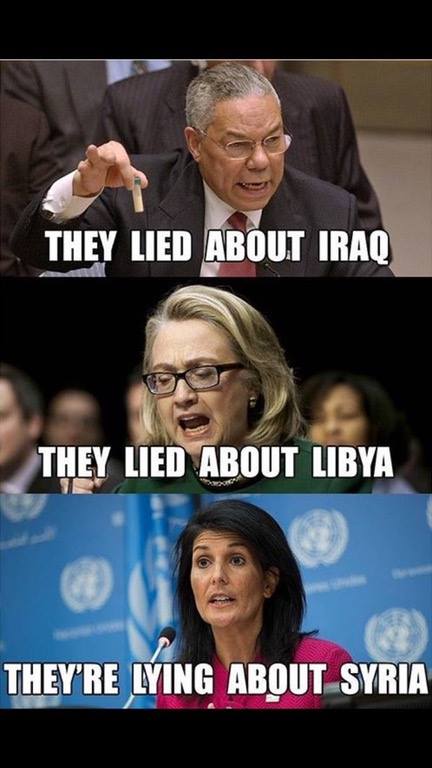
The United States is at war with Syria. Though few Americans wanted to face it, this has been the case implicitly since the Obama administration began building bases and sending Special Ops, really-not-there, American troops, and it has been the case explicitly since August 3, 2015, when the Obama administration announced that it would “allow airstrikes to defend Syrian rebels trained by the U.S. military from any attackers, even if the enemies hail from forces loyal to Syrian President Bashar al-Assad.” With the U.S. Air Force—under Trump, following Obama’s declared policy—shooting down a Syrian plane in Syrian airspace, this is now undeniable. The United States is overtly engaged in another aggression against a sovereign country that poses no conceivable, let alone actual or imminent, threat to the nation. This is an act of war.
As an act of war, this is unconstitutional, and would demand a congressional declaration. The claim, touted by Joint Chiefs’ Chairman, Gen. Dunford, that the 2001 Authorization for the Use of Military Force (AUMF) against al-Qaeda provides constitutional justification for attacking the Syrian government is patently false and particularly precious. In the Syrian conflict, it’s the Syrian government that is the enemy and target of al-Qaeda affiliates; it’s the U.S. and its allies who are supporting al Qaeda. The authorization to fight al-Qaeda has been turned into an authorization to help al-Qaeda by attacking and weakening its prime target!
Will President Trump ask for a relevant congressional authorization? Will any Democratic or Republican congresscritter demand it? Is the Pope a Hindu?
Would it make any difference? Why should Trump bother? Obama set the stage when he completely ignored the War Powers Act, the Constitution, Congress, and his own Attorney General and legal advisers, and went right ahead with a war on Libya, under the theory that, if we pretend no American troops are on the ground, it isn’t really a war or “hostilities” at all. Which I guess means if the Chinese Air Force starts shooting down American planes in American airspace in defense of Black Lives Matter’s assault on the White House, it wouldn’t really be engaging in an act of war.
It’s impossible to overstate the danger in these executive war-making prerogatives that Obama normalized—with the irresponsible connivance of his progressive groupies, who pretend not to know where this would lead. In 2012, referring to the precedent of Obama’s policies, Mitt Romney said: “I don’t believe at this stage, therefore, if I’m president that we need to have a war powers approval or special authorization for military force. The president has that capacity now.” Following Obama, for Trump, and every Republican and Democratic president, it now goes without saying.
In terms of international law, as an aggressive, unprovoked aggression against a country that makes no threat of attack on the U.S., it is also patently illegal, and all the political and military authorities undertaking it are war criminals, who would be prosecuted as such, if there were an international legal regime that had not already been undermined by the United States.
Syria is now under explicit attack by the armed forces of the U.S., Turkey, and other NATO states. Sixteen countries have combat aircraft buzzing around Syrian airspace under the effective command of the United States, and a number of them have attacked Syria’s army.
Americans, and certainly self-identified “progressives,” have to be crystal clear about this: American armed forces have no right to be in Syria, have no right to restrict the Syrian government from using any of its airspace, or to prevent it from regaining control of any of its own territory from foreign-backed jihadi armies.
The Syrian state and its allies (Iran and Russia), on the other hand, are engaged in the legitimate self-defense of a sovereign state, and have the right to respond with full military force to any attack on Syrian forces or any attempt by the United States to balkanize or occupy Syrian territory, or to overthrow the Syrian government. Whether and how they do respond will depend on their own military/political calculus, about which they have so far been quite careful and restrained. It would be the height of foolishness, as well as arrogance, for Americans to presume they can bully these actors into submission with an infinite series of discrete aggressions, with no sharp counterattack. Unfortunately, the world has not yet seen the limits of American arrogance.
So please, do not pretend to be shocked, shocked, if Syria and its allies fight back, inflicting American casualties. Don’t pose as the morally superior victim when Americans are killed by the people they are attacking. And don’t be preaching about how everyone has to support our troops in a criminal, unconstitutional, aggressive attack on a country that has not threatened ours in any way. American soldiers and pilots executing this policy are not heroes, and are not fighting to protect America or advance democracy; they are the international equivalent of home invaders, and as such are legitimate targets with no claim to “self-defense.” The only heroic act they could do is refuse their superiors’ illegitimate orders to engage in this aggression.
In response to American attacks, the Syrian Army has every right to strike back at the American military apparatus, everywhere. Every casualty of this war, however big it gets, is the ethico-political responsibility of the attacking party – US. The first responsibility of every American is not to “support our troops,” but to stop this war. Right now. Before it gets worse.
It’s quite obvious, in fact, that the United States regime is deliberately making targets of its military personnel, in the hopes of provoking a response from Syrian or allied armed forces that will kill some Americans, and be used to gin up popular support for exactly the kind of major military attack on Syria and/or Russia and/or Iran that the American people would otherwise reject with disgust. Anyone who professes concern for “our troops” should be screaming to stop that.
It’s also quite clear now that the War on ISIS is a sham, that ISIS was always just a pretext to get the American military directly involved in attacking the Syrian army and destroying the coherence of the Syrian state. If the U.S. wanted to defeat ISIS, it could do so easily by coordinating their actions with, and not against, the forces who have been most effectively fighting it: the Syrian Arab Army, Russia, Iran, and Hezbollah.
Instead, it’s attacking the Syrian army precisely because it has been defeating ISIS and other jihadi forces, and regaining its own territory and control of its own border with Iraq. The U.S. does not want that to happen. At the very least—if it cannot immediately engender that massive offensive to overthrow the Baathist government—the U.S. wants to control part of the border with Iraq and to occupy a swath of eastern Syria. It wants to establish permanent bases from which to provision and protect jihadi armies, achieving a de facto partitioning of the Syrian state, maintaining a constant state of armed attack against the Damascus government, and reducing Syria to a weakened, rump state that can never present any effective resistance to American, Israeli, or Saudi designs on the region.
This is extremely dangerous, since the Syrians, Russians, and Iranians seem determined not to let this happen. Consistent with his own incompetence and his admiration for tough guys, Trump seems to have abrogated authority to his generals to make decisions of enormous political consequence. Perhaps that’s why aggressive actions like the shoot-down of the Syrian plane have been occurring more frequently, and why it’s not likely they’ll abate. There’s a dynamic in motion that will inevitably lead each side to confront a choice of whether to back down, in a way that’s obvious, or escalate. Generals aren’t good at backing down. A regional or global war is a real possibility and becomes more likely with every such incident.
Though most American politicians and media outlets do not want to say it (and therefore, most citizens cannot see it clearly enough), such a war is the objective of a powerful faction of the Deep State which has been persistent and determined in seeking it. If the generals are loath to back down in a battle, the neocons are adamant about not backing down on their plans for the Middle East. They will not be stopped by anything less than overwhelming popular resistance and international pushback.
The upside of these attacks on Syrian forces is that they wipe the lipstick off the pig of the American project in Syria. It’s a regime-change, nation-destroying war that has nothing to do with democracy or human rights, and everything to do with the anti-democratic, chaos-creating designs of the most nefarious regimes in the region and the world. Everyone—European countries who profess concern for international law and stability, and the American people who are fed up with constant wars that have no benefit for them—can see exactly what kind of blatant aggression is unfolding, and decide whether they want to go along with it.
In that regard, any self-identified “liberal” or “progressive” American—and particularly any such American politician—who spent (and may still spend) their political energy attacking Bush, et. al., for that crazy war in Iraq, and who goes along with, or hesitates to immediately and energetically denounce this war, which is already underway, is a political hypocrite, resisting nothing but the obvious.
US backs down as Russia targets US aircraft in Syria
By Alexander Mercouris | The Duran | June 20, 2017
Back in April, in the immediate aftermath of the US cruise missile attack on Syria’s Al-Shayrat air base, Russia retaliated by switching off the ‘de-confliction’ hotline between the US and Russian militaries in Syria, which enables these militaries to avoid accidental clashes with each other.
The immediate response to this Russian switching off of the ‘de-confliction’ hotline was a dramatic reduction in US air operations in Syria, as the US air force was forced to scale down its air operations rather than risk a confrontation with the powerful air defence system the Russians have established in Syria.
That this was the case was confirmed by an article in The New York Times dated 8th April 2017, which said the following
The American-led task force that is battling the Islamic State has sharply reduced airstrikes against the militants in Syria as commanders assess whether Syrian government forces or their Russian allies plan to respond to the United States’ cruise missile strike on a Syrian airfield this past week, American officials said.
So far, the Russian military does not appear to have taken any threatening actions, such as directing its battlefield radar or air defense systems to confront the Americans, or carrying out aggressive actions in the skies, United States officials said.
But officials who spoke on the condition of anonymity to discuss internal planning said the commanders needed time to determine whether the Syrian president, Bashar al-Assad, and the Russian military would treat the American cruise missile strike as a one-time operation that they would not respond to militarily. As a precaution, the Pentagon is flying patrols in Syrian skies with F-22 jets, the Air Force’s most advanced air-to-air fighter……
Some American and other Western counterterrorism officials have said the missile strike could……… make the fight against the Islamic State in Syria more difficult.
“It seems clear that the strikes will complicate our efforts to pursue our counter-ISIS campaign in Syria,” said Matthew Olsen, a former director of the National Counterterrorism Center. “In particular, the ability to carry out U.S. airstrikes in Syria in support of the coalition against ISIS requires some degree of cooperation with Russia, which is now in serious jeopardy.”
Other security experts said that much depended on the Trump administration’s next steps, and how the Assad government and its Russian patrons responded.
“U.S. aircraft operating over Al-Tabqah are already ostensibly in range of the Russian S-400 system at the Humaymin Air Base, and we might see Russia deploy more air defense assets to Syria,” Jeremy Binnie, the Middle East editor of Jane’s Defense Weekly, said in an email. “But if the U.S. makes no moves to threaten Assad’s position, then they may well accept the punishment and move on.”
William McCants, a senior fellow at the Brookings Institution and the author of “The ISIS Apocalypse,” offered a similar assessment. (bold italics added)
The words I have highlighted in this article from 8th April 2017 make clear the difference with the situation today.
After weeks of frantic diplomatic activity the US finally managed to persuade the Russians a few weeks ago to switch the ‘de-confliction’ hotline back on. In response to yesterday’s US shooting down of the SU-22 the Russians have however now once again switched it off.
However this time the Russians have not only once more switched off the ‘de-confliction’ hotline. They have also done what they did not do in April by saying that this time they will take “threatening action by directing their battlefield radar or air defense systems to confront the Americans”.
That this is so is explicitly confirmed in the statement made public yesterday by the Russian Defence Ministry
As of June 19 this year, the Defense Ministry of the Russian Federation has ended its interaction with the US side under a memorandum for preventing incidents and providing for safe flights during operations in Syria and demands that the US command carry out a careful investigation and report about its results and the measures taken.
The shooting down of a Syrian Air Force jet in Syria’s airspace is a cynical violation of Syria’s sovereignty. The US’ repeated combat operations under the guise of ‘combating terrorism’ against the legitimate armed forces of a UN member-state are a flagrant violation of international law, in addition to being actual military aggression against the Syrian Arab Republic,” the ministry said.
Russia will regard any flights within the area of its air force group’s operation in Syria as legitimate targets, the ministry stressed.
Any aircraft, including planes and drones of the international coalition, detected in the operation areas west of the Euphrates River by the Russian air forces will be followed by Russian ground-based air defense and air defense aircraft as air targets.……. the coalition command did not use the existing communication line between the air commands of Al Udeid Air Base (Qatar) and Khmeimim Air Base to prevent incidents in Syria’s airspace. We consider the actions of the US command as a deliberate default on their obligations under the memorandum on on preventing incidents and providing for safe flights during operations in Syria signed on October 20, 2015. (bold italics added)
In other words, the Russian response to the shooting down of the Syrian SU-22 fighter near Taqbah has been much stronger than was the Russian response to the US cruise missile attack on Syria’s Al-Shayrat air base.
This is so even though the attack on Al-Shayrat air base attracted massive international media attention, whilst the US shooting down of the SU-22 has attracted very little.
This time however the Russians have announced that they will do precisely the thing which they did not do in April following the US attack on Al-Shayrat air base – and which the New York Times says is very threatening – which is track US aircraft, treating them as targets if they fly west of the Euphrates.
Why have the Russians taken this extraordinary step?
The US claims yesterday justifying the shooting down of the SU-22 aircraft have unravelled. Even the strongly anti-Assad British based Syrian Observatory of Human Rights has confirmed that the SU-22 was not bombing Kurdish forces as the US claims but was bombing ISIS fighters as the Syrians say.
A regime warplane was targeted and dropped in the skies of the al-Resafa area […] the warplane was shot down over Al-Resafa area of which the regime forces have reached to its frontiers today, and sources suggested to the Syrian Observatory for Human Rights that warplanes of the International Coalition targeted it during its flight in close proximity to the airspace of the International Coalition’s warplanes, which caused its debris to fall over Resafa city amid an unknown fate of its pilot, the sources confirmed that the warplane did not target the Syria Democratic Forces in their controlled areas located at the contact line with regime forces’ controlled areas in the western countryside of Al-Tabaqa to the road of Al-Raqqah – Resafa.
(bold italics added)
Another thing that may have provoked the Russians is that the US has tried to pass off the downing of the SU-22 as caused by Syrian encroachment of an agreed ‘de-confliction area’.
Ja’Din sits approximately two kilometers north of an established East-West SDF-Syrian Regime de-confliction area.
This uses a term – ‘de-confliction area’ – used to describe certain regions of Syria covered by an international agreement reached by Russia, Iran and Turkey in May.
The area where the SU-22 was shot down is not within any of these regions. Al-Jazeera has provided details of where these four ‘de-confliction areas’, and none of them is close to the territory where the SU-22 was shot down
Zone 1 : Idlib province, as well as northeastern areas of Latakia province, western areas of Aleppo province and northern areas of Hama province. There are more than one million civilians in this zone and its rebel factions are dominated by an al-Qaeda -linked alliance.
– Zone 2: The Rastan and Talbiseh enclave in northern Homs province. There are approximately 180,000 civilians in this zone and its network of rebel groups includes al-Qaeda-linked fighters.
– Zone 3 : Eastern Ghouta in the northern Damascus countryside. Controlled by Jaish al-Islam, a powerful rebel faction that is participating in the Astana talks. It is home to about 690,000 civilians. This zone does not include the adjacent, government-besieged area of Qaboun.
– Zone 4 : The rebel-controlled south along the border with Jordan that includes parts of Deraa and Quneitra provinces. Up to 800,000 civilians live there.Wh
Whilst it is possible that the term “established East-West SDF-Syrian Regime de-confliction area” refers to a term used in some informal agreement between the US and Russia, it seems more likely that the US is trying to unilaterally establish ‘no-go’ areas for the Syrian army, and is using the term ‘de-escalation areas’ to conceal the fact.
If so the Russians will want to put a stop to this practice and this may partly explain the strength of the Russian reaction.
However the single most important reason for the strong Russian reaction is what caused the US to shoot down the SU-22 down in the first place.
As the report from the Syrian Observatory of Human Rights shows, the real reason the SU-22 was shot down was because it was supporting a Syrian army offensive to capture the strategically important town of Rusafa from ISIS.
Rusafa lies south east of Tabqah – the main base of the US backed Kurdish militia in this area – and within striking distance of the main highway between Raqqa and Deir Ezzor, the eastern desert city currently besieged by ISIS.
By capturing Rusafa the Syrian army is now in a position to intercept columns of ISIS fighters who might try to flee Raqqa for Deir Ezzor.
The Syrians and the Russians have in recent weeks complained that the US and the Kurds have been doing nothing to prevent ISIS fighters fleeing Raqqa for Deir Ezzor, and in recent days there have even been reports of movements by Kurdish militia to try to block the Syrian army’s offensive to relieve Deir Ezzor.
The shooting down of the Syrian SU-22 fighter appears to have been intended as a warning to stop the Syrian army from capturing Rusafa, so as to block the Syrian army’s attempt to relieve the pressure on Deir Ezzor.
The Russian warning to the US looks in turn to have been intended to make clear to the US that this sort of interference in the Syrian army’s operations to relieve Deir Ezzor is unacceptable and will not be tolerated.
The US has heeded the Russian warning. The various statements made by the US and by various US officials today, though full of the usual bluster about the US defending itself and its allies anywhere and everywhere, in fact clearly signal that the US is backing off.
The key words – as my colleague Adam Garrie has said – are those of Colonel Ryan Dillon, chief U.S. military spokesman in Baghdad.
As a result of recent encounters involving pro-Syrian regime and Russian forces, we have taken prudent measures to reposition aircraft over Syria so as to continue targeting ISIS forces while ensuring the safety of our aircrews given known threats in the battle space. (bold italics added)
“Prudent measures to reposition aircraft over Syria to ensure the safety of aircrews given known threats in the battle space” is code for withdrawal of aircraft from air space where they are at risk of being shot down.
That is what is taking place. Note that Colonel Dillon is careful not to say where the “known threats in the battle space” that are forcing the redeployment of the aircraft are coming from.
The US has no choice. If the Russian decision to switch off the ‘de-confliction’ hotline in April was enough to force the US to reduce sharply its air activity in Syria, the Russian decision to switch off the ‘de-confliction’ hotline and to threaten to treat as aerial targets US aircraft flying west of the Euphrates is a threat the US cannot afford to disregard.
Not surprisingly, shortly before the Russian warning was made public, but probably after it was communicated to the US, the Syrian army captured Rusafa with no further hindrance from the US. Latest reports speak of Syrian army reinforcements flooding into the area.
In the meantime the US is frantically signalling to the Russians its urgent wish to de-escalate the situation. Note for example the markedly conciliatory language of White House spokesman Sean Spicer, and how he repeatedly passed up opportunities to utter words of defiance against Russia or to threaten the Russians with counter-measures during the latest White House press briefing
Q Thanks, Sean. How are you responding to this Russian threat to shoot down American planes over Syria?
MR. SPICER: Well, obviously, we’re going to do what we can to protect our interests. And this is something that we’re going to continue to work with — keep the lines of communication open. And ISIS represents a threat to all nations, and so we’ve got to do what we can to work with partners. And we’re going to continue to keep an open mind of communication with the Russians.
Q So will the U.S. change its flight patterns or behavior in Syria?
MR. SPICER: I’m going to refer — I mean, I think this is a question more for DOD to answer. But I think, obviously, it’s important and crucial that we keep lines of communication open to de-conflict potential issues.
Zeke.
Q Thanks, Sean. Following up on that — and a second one for you, as well — what would the U.S. government’s response be? Is the White House going to issue a warning to the Russian government if they were to follow through on this threat? It seems that your statement — would that be a provocation or something worse, potentially?
MR. SPICER: I mean, I think that the escalation of hostilities among the many factions that are operating in this region doesn’t help anybody. And the Syrian regime and others in the regime need to understand that we will retain the right of self-defense, of coalition forces aligned against ISIS.
Ultimately the situation in Syria is the same as it has been since the US-Russian confrontation in October.
The fact that the Russians have installed a powerful air defence system in Syria incorporating advanced S-400 and S-300VM Antey 2500 missiles means that the US is unable to confront the Russians directly unless it is prepared to risk possibly very serious casualties.
That is an option neither the US military nor the civilian officials of the Obama and Trump administrations are prepared to face. This is because they know the extraordinary dangers such a clash with the armed forces of a nuclear superpower would risk. They also know US public opinion is strongly opposed to the US becoming drawn into such a clash.
What that means is that though the Russians must act carefully so as not to provoke the US into an unnecessary confrontation which would serve no-one’s interests, ultimately it is the Russians who in Syria have the whip hand.
The chess game in Syria is far from over. The game of move and counter-move continues. With the capture of Rusafa the Syrians and the Russians have however just won another important piece. In the meantime Russia’s warning limits the range of US moves across the Syrian chessboard.
The net result of all these recent moves is that end of the Syrian war may have drawn a little closer.
Featured Video
Bombing Hitler’s Hometown
or go to
Aletho News Archives – Video-Images
From the Archives
‘Conspiracy Theory’ Now Fact: Greater Israel Has Arrived
By Kit Klarenberg | Mint Press News | January 28, 2025
Ever since Tel Aviv’s 1948 creation, much has been said and written about ‘Greater Israel’ – the notion Zionism’s ultimate end goal is the forcible annexation and ethnic cleansing of vast swaths of Arab and Muslim lands for Jewish settlement, based on Biblical claims this territory was promised to Jews by God. The mainstream media typically dismisses this concept as antisemitic conspiracy theory, or at most the fringe fantasy of a minuscule handful of extremist Israelis.
In reality … continue
Blog Roll
 Aletho News
- Failing to Defeat Hezbollah, Israel & US Pressure Syria’s Ahmed al-Sharaa to Join War
- US-Israeli war on Iran drives global fertilizer prices up 40%
- Hezbollah’s Surprise Weapons Redefine Ground Battle with Israel
- Yemen joins fight against US, Israel by firing missiles at occupied territories
- Seizing the Kharg: Washington’s path to defeat in the Persian Gulf
- Iran reports 500 US casualties in strikes on covert US military sites
- Pro-Israel terrorist arrested before assassination of pro-Palestinian activist
- Bombing Hitler’s Hometown
- German journalist threatened with homelessness as German court upholds EU sanctions in landmark free speech case
- US Tells Allies That Ukraine-Bound Arms Could be Sent to Middle East
- If Americans Knew
- Researchers at Human Rights Watch Resign Over Blocked Report on Palestinian Refugee Return
- Jewish Groups Are Backing a War Americans Don’t Want
- Eric Fingerhut Thinks He’s the President of the Jews
- Top Jewish Philanthropists, Rabbis Urge Israeli President to Take Action Against ‘Jewish Extremists’
- Don’t Be Fooled. Zionist Leaders Have Always Wanted to Control Southern Lebanon
- Israel’s widespread use of torture is a core element of its genocide against the Palestinian people
- In Israel’s War on Iran, Many Middle East US Bases Rendered “All But Uninhabitable”
- ‘Burn the lawn’: Israel pursues ‘Rafah model’ in southern Lebanon
- A genocide here, an amputation there
- Reports: Iran mobilizing 1M fighters, Israel-US run low on ammo, Israeli army faces shortage – Not a ceasefire Day 168
- No Tricks Zone
- Devastating Assessment Of Comirnaty Vaccine By Former Senior Pfizer Europe Toxicologist
- New Study: CO2 Is ‘Effectively Negligible’ As An Explanatory Climate Change Factor Since 2000
- Former Pfizer Toxicologist Dr. Helmut Sterz Tells Bundestag Hearing Pfizer Vaccine Should Have Never Been Approved
- Energy Expert: Germany’s Nuclear Phaseout Was A “500 Billion Euro Mistake”
- New Research: South Australia’s Mid-Holocene Sea Surface Temperatures Were 4°C Warmer Than Today
- Storing Green Energy To Last Germany 10 Days Would Require A 60-Million Tonne Battery
- New Studies: UK Sea Levels Were 4 Meters Higher Than Today During The Mid-Holocene
- Destructive Green New Deal: German Energy And Metal Group Warns Of Drastic Crisis
- New Study Documents A 20-Year Pause In Arctic Sea Ice Decline – Driven By Internal Variability
- Wake-up Call: Survey Shows Majority Of Germans Now Favor Postponing Climate Targets!
 Aletho News