Arab tribes seize control of US-occupied Syrian towns in large-scale assault
The Cradle | August 7, 2024
A coalition of Syrian Arab tribes seized several towns from US-backed Kurdish forces in the countryside of eastern Syria’s Deir Ezzor governorate on 7 August.
Tribesmen launched the “largest” attack on Syrian Democratic Forces (SDF) sites since the start of the Arab tribal rebellion against the US-backed militia last year, Sputnik reported, adding that the attack took place “under the cover of artillery and mortar shells.”
“Violent clashes have been ongoing since the early morning hours between the forces of the SDF-linked Deir Ezzor and Hajin Military Councils on the one hand, and the attacking groups of the ‘Army of Tribes’ coalition on the other, in the vicinity of the towns of Abu Hamam, Dhiban, Al-Lattwa, Al-Kashkiya, and Gharanij,” the news outlet’s correspondent said.
The clashes were concentrated in the towns of Al-Sabha and Al-Tayana, east of Deir Ezzor, the correspondent added.
The Arab tribes used RPGs and machine guns against the SDF during the onset of the attack, according to Al Mayadeen.
“SDF militants imposed a complete curfew in the towns under their control in the Deir Ezzor countryside, after the arrival of large military reinforcements from Hasakah and Raqqa, coinciding with a wide search operation in the villages surrounding the areas of clashes,” the Sputnik correspondent went on to say.
Residents told Sputnik that many people were displaced as a result and that three civilians were killed while seven others were injured due to the fighting. Local sources also told the outlet that at least 10 SDF militants were taken captive by tribal fighters, who also seized large amounts of light and heavy weapons.
The SDF and the tribal coalition also took some casualties.
“Arab tribal fighters managed to damage three Hummer military vehicles in the vicinity of the American base in the Al-Omar oilfield,” Sputnik said.
The SDF imposed security belts and closed roads around several areas in Hasakah, northeastern Syria.
“American helicopters targeted a group of tribal forces using machine guns near the banks of the Euphrates River in the town of Dhiban, east of Deir Ezzor,” Al Mayadeen’s correspondent reported on Tuesday.
The US army also deployed reinforcements to the vicinity of its base in the Al-Omar oilfield.
Sheikh Ibrahim al-Hafel, who led the tribal rebellion against the US-backed armed group last year, was quoted by Al Mayadeen as saying on 7 August: “We will not accept submission to the SDF militants … [the tribes and] their sons have the right to liberate their areas from these militants.”
Arab tribes launched their rebellion against the SDF in late August last year, with fierce clashes raging for several weeks afterward.
Despite brief instances of de-escalation, tensions and armed clashes between the two sides have remained ongoing. At the time, it was said that the tribal forces were coordinating with and receiving military aid and training from the Syrian Arab Army (SAA).
“After continuous training received by the tribal forces during the past months, the tribes led by Sheikh Ibrahim Al-Hafel launched a violent attack on the largest in the cities and towns of Deir Ezzor, and took control of several military points in the city of Al-Busayrah and the towns of Ibriha, Al-Harijiya, Al-Tayana, Abu Hamam, Gharanij, Al-Kashkiya, Dhiban, Al-Latwa neighborhood, and all the riverside points,” Syrian journalist Mohammad Dabaa said on 7 August.
The tribal assault came a month after the SDF released hundreds of ISIS fighters from their prison camps in northern Syria.
America’s Syrian Gulag
By Brad Pearce | The Libertarian Institute | August 1, 2024
At the beginning of last month the U.S. Deputy Assistant Secretary of State for Near Eastern Affairs, Ethan Goldrich, granted an interview to Rudaw, which is something like PBS for Iraqi Kurdistan. He emphasized that the United States has no plan to end its occupation of northeast Syria, where the U.S. continues to maintain some nine hundred troops under the guise of preventing the resurgence of the Islamic State. The U.S. claims it is in Syria under the authorization of United Nations Security Council Resolution 2254 to bring an end to the “Syrian Crisis,” however much of the crisis has ended, and where it has not it is primarily due to foreign occupation. Overall, the interview shows that the U.S. is continuing its dead-end policy, but Goldrich does say something interesting: the United States has concerns about providing “humanitarian” assistance for a network of prisons for IS fighters.
To those who know about the United States’ continued presence in Syria supporting the Kurdish separatists and their military known as the Syrian Democratic Force [SDF], it is commonly said that the American motive is to steal Syrian oil and grain. One would also wonder how much nine hundred soldiers could accomplish, but of course as usual they are actually there as hostages, to ensure that in Syria cannot try to retake this area without killing Americans and thus unleashing the wrath of the U.S. government. This prison network provides another important angle to the occupation. While the prisons in Syrian Kurdistan are not secret, they are also not well known. However, CNN (of all places) recently featured an excellent investigation exposing that more than 50,000 humans are kept in a network of twenty-seven facilities in Syria. CNN’s chief international correspondent Clarissa Ward was given rare access to the prisons and her reporting is illuminating. All of the inmates are denied access to any form of legal process and have no chance of release besides a vague hope that their home countries may repatriate them. Everything the United States has done in Syria, of course, it has been done in the name of human rights; but it seems to be the case that all of these individuals would have had a better chance of receiving some form of trial and definite sentencing under the government of the Syrian Arab Republic. At the very least, they could not be denied a legal process to a greater extent than they currently are.
There are two primary categories of prisoners the U.S.-funded facilities are holding in Syria. The first are accused Islamic State terrorists—most of them probably are fighters captured by the SDF, but in the absence of a legal process it is impossible to know—and families of Islamic State militants. The largest prison is known as “Panorama” and holds 4,000 inmates. According to CNN, legal experts have called it, “A U.S.-funded legal black hole, worse than Guantanamo Bay.” Clarissa Ward was allowed to see two cells and speak to a handful of prisoners. The first thing one notices is that this is a “nice” facility. One would imagine the SDF would hold prisoners in some ancient Ottoman fortress, but this is clearly a modern and newly built prison for which the U.S. taxpayer has paid a fortune. It is overcrowded, but nothing like the images one commonly sees of third world prisons. Of course it was a managed tour, as Ward acknowledged in her report. The problem is that the inmates have been there for years and have no legal rights, though an SDF official claimed that they intend to reintegrate these people into society; it has just not been possible to make progress in that regard as no country will take them.
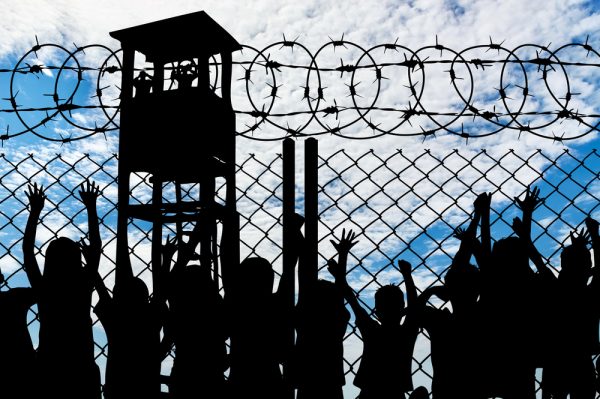
While the men are mostly kept in conventional prisons, the women and children, who are not accused of any crime, are kept in what must be the world’s largest literal concentration camp, Al Hol. The camp holds 40,000 people. Five years after the fall of the caliphate there is no plan for what to do with the individuals stored at this desert camp. Many of the women remain ideologically committed, though Ward also spoke to one former American citizen who has fully turned against IS and even stopped covering in the camp, but she has had her U.S. citizenship stripped on grounds that there was an error in her naturalization process. At a certain age—supposedly eighteen, but according to inmates as early as fourteen—the boys are removed from the camp and sent to the prisons to stop the teens from marrying and producing a “new generation of Islamic extremists.” While the conditions appear to to be broadly humane, if bleak, it is indeed hard to imagine a better breeding ground for radical Islam than this desert city of IS wives denied human rights by a United States proxy. It is of course the case that IS arose from American managed prisons in Iraq in the first place.
The biggest question is why CNN was given this access, with the SDF volunteering information about a prison system which has been criticized by basically every major human rights organization. Based on the interviews it seems to me that the SDF wants out of this obligation. The United States is functionally making them run a Gulag Archipelago and even if they are paid for it, running the prisons consumes an enormous amount of man hours by personnel who could be put to other uses. Further, there is the constant risk of breakouts (as happened in 2022) and of terrorist groups trying to liberate the camp. However, the United States clearly has no other plan for the ultimate fate of these humans, unless they intend to use them to unleash a new wave of terrorism. This is simply yet another policy where our ruling class has no exit strategy. It seems that the U.S. will occupy northeast Syria forever, if only to imprison some 50,000 people without trial. The irony, of course, is that they will continue to justify their presence by saying they need to bring human rights to Syria, just not for those trapped in this desert Guantanamo.
Made in America: The ISIS conquest of Mosul
The Cradle | July 2, 2024
Ten years ago this month, the notorious terror group ISIS improbably conquered Mosul, Iraq’s second-largest city. In only two days of fighting, a few hundred ISIS militants captured the city, forcing thousands of Iraqi soldiers and police to flee in chaos and confusion.
The western media attributed the city’s fall to the sectarian policies of then-Iraqi prime minister Nouri al-Maliki, suggesting that local Sunnis welcomed the ISIS invasion. US officials claimed they were surprised by the rapid rise of the terror organization, prompting then-US president Barack Obama to vow to “degrade and ultimately destroy” the group.
However, a close review of events surrounding the fall of Mosul and discussions with residents during The Cradle’s recent visit to the city shows the opposite.
The US and its regional allies used ISIS as a proxy to orchestrate the fall of Mosul, thereby terrorizing its Sunni Muslim inhabitants to achieve specific foreign policy goals. Says one Mosul resident speaking with The Cradle:
There was a plan to let Daesh [ISIS] take Mosul, and the USA was behind it. Everyone here knows this, but no one can say it publicly. It was a war against Sunnis.
‘Salafist principality’
As the war in Syria raged in August 2012, the US Defense Intelligence Agency (DIA) authored a now well-known memo providing the broad outlines of the plan that would lead to Mosul’s fall.
The memo stated that the insurgency backed by the US and its regional allies to topple Bashar al-Assad’s government in Damascus was not led by “moderate rebels” but by extremists, including Salafists, the Muslim Brotherhood, and Al-Qaeda in Iraq (Islamic State of Iraq).
The DIA memo stated further that the US and its allies, “the western powers,” welcomed the establishment of a “Salafist principality” by these extremist forces in the Sunni majority areas of eastern Syria and western Iraq. The US goal was to isolate Syria territorially from its main regional supporter, Iran.
Two years later, in June 2014, ISIS conquered Mosul, declaring it the capital of the so-called “Caliphate.”
Though the terror group was portrayed as indigenous to Iraq, ISIS only made the “Salafist principality” predicted in the DIA memo a reality with the help of weapons, training, and funding from the US and its close allies.
US and Saudi weapons
In January 2014, Reuters reported that the US Congress “secretly” approved new weapons flows to “moderate Syrian rebels” from the so-called Free Syrian Army (FSA).
In subsequent months, the US Army military and Saudi Ministry of Defense purchased large quantities of weapons from Eastern European countries, which were then flown to Amman, Jordan, for further distribution to the FSA.
After an exhaustive three-year investigation, EU-funded Conflict Armament Research (CAR) found that the weapons funneled to Syria by the US and Saudi Arabia in 2014 were quickly passed on to ISIS, at times within just “days or weeks” of their purchase.
“As far as our evidence shows, the diverters [Saudi and the US] knew what was going on in terms of the risk of supplying weapons to groups in the region,” Damien Spleeters of CAR explained.
The US-supplied weapons and equipment quickly reaching ISIS included the iconic Toyota Hilux pickup trucks, which became synonymous with the ISIS brand.
The Kurdish role
Another way US and Saudi-supplied weapons reached ISIS was through Washington’s main Kurdish ally in Iraq, Masoud Barzani. Discussing the secret funding for weapons approved by the US Congress in January 2014, Reuters noted that “Kurdish groups” had been providing weapons and other aid financed by donors in Qatar to “religious extremist rebel factions.”
In the following months, reports emerged that Kurdish officials from Barzani’s Kurdistan Democratic Party (KDP) were providing weapons to ISIS, including Kornet anti-tank missiles imported from Bulgaria.
Further evidence of Barzani’s support for ISIS comes from a lawsuit currently being litigated in the US District Court for the District of Columbia on behalf of the Kurdistan Victim’s Fund.
The expansive lawsuit, led by former US Assistant Attorney James R Tate, cites testimonies from sources with “direct clandestine access” to senior ranking officials in the KDP, alleging that Barzani’s agents “purposefully made US dollar payments to terrorist intermediaries and others that were wired through the United States,” including through banks in Washington, DC. These payments “enabled ISIS to carry out terrorist attacks that killed US citizens in Syria, Iraq, and Libya.”
Further, the agents made use of “email accounts serviced by US-based email service providers to coordinate and carry out elements of their partnership with ISIS.”
It is unthinkable that Barzani regularly arranged payments to ISIS from the heart of the US capital without the knowledge and consent of US intelligence.
An explicit agreement
In the spring of 2014, reports emerged of a deal between Barzani and ISIS to divide the territory in Iraq between them.
French academic and Iraq expert Pierre-Jean Luizard of the Paris-based National Centre for Scientific Research (CNRS) reported there was “an explicit agreement” between Barzani and ISIS, which “aims to share a number of territories.”
According to the agreement, ISIS would take Mosul, while Barzani’s security forces, the Peshmerga, would take oil-rich Kirkuk and other “disputed territories” he desired for a future independent Kurdish state.
According to Luizard, ISIS was given the role of “routing the Iraqi army, in exchange for which the Peshmerga would not prevent ISIS from entering Mosul or capturing Tikrit.”
In an unpublished interview with prominent Lebanese security journalist and The Cradle contributor Radwan Mortada, former Iraqi prime minister Nuri al-Maliki claimed that meetings were held to plan the Mosul operation in the Iraqi Kurdistan capital, Erbil, which were attended by US military officers.
When US officials denied any involvement, Maliki responded by telling them:
These are pictures of American officers sitting in this meeting … you are partners in this operation.
The UK pipeline
A resident from Mosul speaking with The Cradle states that many of the ISIS members he encountered during the group’s three-year occupation of the city were English-speaking foreigners, in particular the ISIS commanders.
But where did these English-speaking ISIS members come from?
In 2012, UK intelligence established a pipeline to send British and Belgian citizens to fight in Syria. Young men from London and Brussels were recruited by Salafist organizations, Shariah4UK and Shariah4Belgium, established by radical preacher and UK British intelligence asset Anjam Choudary.
These recruits were then sent to Syria, where they joined an armed group, Katibat al-Muhajireen, which enjoyed support from UK intelligence. These British and Belgian fighters then joined ISIS after its official establishment in Syria in April 2013.
Among these fighters was a Londoner named Mohammed Emwazi. Later known as the infamous Jihadi John, Emwazi kidnapped US journalist James Foley in October 2012 as a member of Katibat al-Muhajireen and allegedly executed him in August 2014 as a member of ISIS.
Made in America
The commander of Katibat al-Muhajireen, Abu Omar al-Shishani, also later joined ISIS and famously led the terror group’s assault on Mosul. Before fighting in Syria and Iraq, Shishani received US training as a member of the country of Georgia’s special forces.
In August 2014, the Washington Post reported that Libyan members of ISIS had received training from French, UK, and US military and intelligence personnel while fighting in the so-called “revolution” to topple the government of Muammar al-Qaddafi in 2011.
Many of these fighters were British but of Libyan origin and traveled to Libya with the encouragement of UK intelligence to topple Qaddafi. They then traveled to Syria and soon joined ISIS or the local Al-Qaeda affiliate, the Nusra Front.
“Sometimes I joke around and say that I am a fighter made by America,” one of the fighters told the Post.
There is no indication that the relationship between these fighters and US and UK intelligence ended once they joined ISIS.
‘Maliki must go’
US support for the ISIS invasion of Mosul is evident through the actions Washington refused to take. US planners monitored the ISIS convoys traveling across the open desert from Syria to assault Mosul in June 2014 but took no action to bomb them.
As former US secretary of defense Chuck Hagel acknowledged, “It wasn’t that we were blind in that area. We had drones, we had satellites, we had intelligence monitoring these groups.”
Even after Mosul fell, and as ISIS was threatening Baghdad, Washington planners refused to help unless Maliki stepped down as prime minister.
Maliki claimed in his interview with Mortada that US officials had demanded he impose a siege on Syria to assist in toppling Assad. When Maliki refused, they accused him of sabotaging the Syria regime change operation and sought to use ISIS to topple Iraq’s government.
American sources all but confirm Maliki’s claim. The US military-funded Rand Corporation noted that the US–Iraqi relationship at this time had become strained “because of the willingness of the Maliki government to facilitate Iranian support to the Assad regime despite significant American opposition.”
As Obama’s foreign policy advisor, Philip Gordon explained:
The president was clear he didn’t want to launch that campaign [against ISIS] until there was something to defend, and that wasn’t Maliki.
New York Times journalist Michael Gordon reported that Secretary of State John Kerry traveled to Baghdad two weeks after ISIS captured Mosul to meet with Maliki. Desperate for help, Maliki asked Kerry for airstrikes against ISIS to protect Baghdad, but the latter explained that the US would not help unless the former gave up power.
In July 2014, ISIS fighters were moving captured US artillery and armored vehicles back to Syria across the open desert. Gordon reports further that the ISIS convoys were “easy pickings for American airpower.”
However, when US Major General Dana Pittard requested authorization to conduct the airstrikes to destroy the convoys, the White House refused, saying the “political prerequisites” had not been met. In other words, Maliki was still prime minister.
Geopolitical gains
While claiming to be enemies of ISIS, the US planners and their allies deliberately facilitated the terror group’s rise, including its capture of Mosul.
ISIS relied on US and UK-trained fighters, US and Saudi-purchased weapons, and Kurdish-supplied US dollars – rather than popular support from the city’s Sunni residents – to conquer Mosul.
When self-proclaimed caliph and leader of ISIS, Abu Bakr al-Baghdadi, announced the establishment of the so-called Caliphate at the city’s historic Nuri Mosque, he set up the very Salafist principality outlined in the DIA document by US intelligence heads.
This orchestrated rise of ISIS not only destabilized the region but also served the geopolitical interests of those who claim to be combating terrorism.
Syria on the brink of recovery as Qatar and Turkey change their policies
By Steven Sahiounie | Mideast Discourse | June 3, 2024
The Emir of Qatar, Tamim al Thani, recently said that he supports the street protests in Idlib, where people are protesting the dictatorial rule of the Hayat Tahrir al-Sham (HTS) terrorist group.
This marks a monumental change in policy for Qatar, and maybe the first step toward restoring diplomatic ties with Syria.
Beginning in 2011, and the Obama administration’s US-NATO war on Syria for regime change, Qatar has been a close and loyal ally to the US, and was used as a financial backer of the various terrorist groups brought into Turkey, and trucked across the border to Idlib.
Sheikh Hamad bin Jassim bin Jaber bin Mohammed bin Thani Al Thani, former Prime Minister of Qatar, and foreign minister until 2013, gave an interview in which he admitted Qatar provided the money to bankroll the terrorists in Syria as they attacked the Syrian people and state. He made it clear that the cash delivered was sanctioned, and administered by the US in Turkey. Qatar was not working alone, but under a strictly controlled partnership with the US government.
In 2017, President Trump shut down the CIA operation Timber Sycamore which ran the failed project to overthrow the Syrian government.
Qatar is now turning their back on the terrorists who occupy Idlib. Mohamed al-Julani is the leader of HTS. He is Syrian, raised in Saudi Arabia, fought with Al Qaeda in Iraq against the US, aligned with ISIS founder Baghdadi, came to Syria from Iraq to develop Jibhat al-Nusra, the Al Qaeda branch in Syria.
Once Jibhat al-Nusra became an outlawed terrorist group, Julani switched the name to HTS in order to preserve his support from Washington, DC. Even though the US has a $10 million bounty on his head issued by the US Treasury Department, he is safe and secure in Idlib, where American journalists have visited him for interviews, in which he has sported a suit and tie, wishing to present himself as a western-leaning terrorist that the US can count on.
When the Syrian Arab Army and the Russian military would fire a bullet towards the terrorists in Idlib, the US would denounce it as an attack on innocent civilians. This kept Julani safe and secure, and in charge of humanitarian aid coming across the border from Turkey. The aid was from the UN and various international charities. While the 3 million people living in Idlib are not all terrorists, all the aid passes through the hands of Julani and his henchmen. If you bow down to Julani, you get your share of rations, but if you have complained, you are denied. Those who are cut off from the aid can buy their supplies from Julani at his Hamra Shopping Mall, which he built in Idlib, where he sells all the surplus aid sent to Idlib.
The civilians in Idlib have taken to the streets protesting the rule of HTS. Many people have been arrested by HTS, some tortured, and others killed. The people are demanding that Julani leave.
They are asking for freedom and a fair administration. The various aid agencies have complained that HTS will not allow any free programs for women, such as learning employable skills. Women there are not allowed to seek employment, except in places which are only female. HTS rules with a strict form of Islamic law, which they interpret to their benefit.
Saudi Arabia and Syria have established full normal relations, with an exchange of ambassadors. At the Arab League Summit in May in Bahrain, the Crown Prince of Saudi Arabia, Mohamed bin Salman (MBS) met personally with Syrian President Bashar al-Assad. They also met at the previous Arab League Summit in Saudi Arabia.
MBS recently announced a humanitarian grant to the UN to repair 17 hospitals in Syria which had been damaged in the 7.8 earthquake which killed 10 thousand in Syria.
MBS also sent spare parts for the Syrian Air commercial planes, which had suffered under US sanctions and were prevented from maintaining their safety by Washington. Recently, the very first planes of Syrians began flying to Saudi Arabia for the first time in 12 years, to perform the Haj pilgrimage.
On May 30, the leader of Iraq said he hopes to announce a Turkey-Syria normalization soon. Turkey, like Qatar, had been supporting the various terrorist groups in Syria in cooperation with the US.
Turkey also has made a turn-around in their position, and has been looking for a way to exit Idlib and the other areas it occupies in Syria, in preparation of a re-set with Damascus.
The relationship between the US and Ankara has remained tense after the US partnered with the Syrian Defense Forces (SDF). Turkey considers the SDF as a branch of the PKK, the outlawed international terrorists group who has killed 30,000 people over three decades, while wanting to establish a Kurdish State.
The SDF are planning to have elections on June 11 in an effort to gain western support for a Kurdish State. Erdogan has stated Turkey will never allow this to happen.
If the SDF were to lay down their arms, they could repair their relationship with Damascus, and at the same time Turkey could then withdraw their occupation forces from Syria. With Turkey out of Syria, their normalization process could begin.
When the SDF have repaired their broken relationship with Damascus, and the Turkish threat no longer exists, then the US military can withdraw their 900 occupation force from Syria.
Recently, General Mazloum, the leader of the SDF, said that the problems between the Kurds and Damascus are internal problems, and cautioned against any foreign interference, especially from Turkey.
The situation is changing rapidly in Syria. The economy is collapsed, with the inflation rate over 100% in the last year due to crippling US sanctions. Because the US military is occupying the largest oil and gas field in Syria, this prevents the production of electricity for the national grid, and Syrians are living with three hours of electricity per day.
US sanctions prevent some of the most vital medicines from being imported, as western medical companies are fearful of running afoul of the US sanctions, and have produced a culture of over-compliance, which deprives Syrian citizens’ life-saving medicines and medical supplies.
The battlefields have been silent for years, and the silence grew into a status-quo, where the American and Turkish foreign policy prevented a resolution to the conflict that has destroyed lives and prompted the largest human migration in recent history as Syrians have sought work abroad.
Turkey, Saudi Arabia and Qatar all played significant roles assigned to them by the US State Department under the Obama administration. There is a light at the end of the tunnel with the reversal of policies toward Syria, and Qatar and Turkey are set to play major roles in the recovery process in Syria. These reversals are also significant as they mark a change in the relationship between the US and several regional countries. This is part of the ‘New Middle East’ that Washington called for, but the role the US played has left them the loser.
American Pravda: Rosencrantz and Guildenstern Are Dead in San Bernardino
BY RON UNZ • UNZ REVIEW • MAY 20, 2024
Being a college town, Palo Alto once offered a multitude of excellent new and used bookstores, perhaps as many as a dozen or so. But the rise of Amazon produced a great extinction in that business sector, and I think only two now survive, probably still more than for most towns of comparable size.
Amazon and its rivals have obviously become hugely beneficial book-buying resources that I frequently use, but they fail to offer the benefit of randomly browsing shelves and occasionally stumbling across something serendipitous. So I regularly stop by the monthly used book sale put on by Friends of the Palo Alto Library, whose offerings are also very attractively priced, with good quality paperbacks often going for as little as a quarter.
While browsing that sale a couple of weeks ago, I noticed a hardcover copy of Newsroom Confidential, a short 2022 insider account of mainstream journalism by Margaret Sullivan, who had spent four years as the Public Editor of the New York Times. I’d occasionally read her columns in that paper and had seen one or two favorable reviews of the book, so despite its pricey cost—a full $3—I bought and read it, hoping to get a sense of what she’d observed during her term as the designated reader-advocate at our national newspaper of record.
As she told her story, prior to joining the Times she had spent her entire career at the far smaller Buffalo News of her native city, eventually rising to become its editor. Although she’d been happy in that position, after eight years she decided to apply for an opening at the Times, and jumped at the offer when she received it.
Based upon her narrative, Sullivan seems very much a moderate liberal in her views, not too different from most others in her journalistic profession despite being raised in a family of more conservative blue-collar Catholics in Upstate New York. She opened the Prologue of her book by denouncing Donald Trump’s infamous “Stop the Steal” DC rally of early 2021 and she described the invasion of our Capitol by outraged Trumpists as “one of the most appalling moments in all of American history,” sentiments probably shared by at least 90% of her mainstream colleagues.
Born in 1957, Sullivan explained that as a first grader she and everyone else in her community had been horrified by the 1963 assassination of President John F. Kennedy, our first Catholic president. Less than a decade later, she was transfixed by the Watergate Scandal and the subsequent Senate hearings that led to the fall of President Richard Nixon. Like so many others of her generation, she had idolized Woodward and Bernstein, the crusading young reporters who broke the case and brought down a crooked president, especially admiring their portrayal by movie stars Robert Redford and Dustin Hoffman in the film version of All the President’s Men. Along with many other idealistic young Americans, Sullivan decided to embark upon a journalistic career as a consequence.
As far as I can tell, Sullivan seems to have been a committed and honest professional during the decades that followed, describing some of her mundane minor conflicts with colleagues but generally trying to tell their side of the story as well. As a lateral hire from a smallish Upstate newspaper, she had moved rather cautiously after joining the illustrious Times, and although she sometimes took a bit of pride in a few of her columns that attracted considerable readership or were widely Tweeted out, none of these much stuck in my mind.
As the end of her four year tenure approached, the Times tried to persuade her to extend it, but she preferred to move over to the Washington Post and become one of their media columnists.
The various tidbits of gossip she reported from those newspapers were hardly earth-shattering. She’d had a private dinner with top Times editor Jill Abramson one evening only to be shocked the next morning when the latter was summarily fired by the publisher, so she passed along the speculation about what combination of factors might have been responsible for that sudden purge. Abramson had been the first woman to serve as executive editor of the Times, and she was replaced by her deputy Dean Baquet, who became the first black to hold that post. Sullivan explained that the two had long had a contentious relationship, and many members of the newsroom speculated that Baquet had demanded that the Times leadership choose between the two of them. Apparently Abramson had a difficult personality while Baquet was much more charming, so even though he sometimes threw “temper tantrums” he was able to get away with such behavior, and he came out on top.
Although Sullivan never broke a major story nor won any important journalistic prize, she seemed very much a solid team-player rather than a prima donna and got along well with her professional colleagues. Therefore, I was hardly surprised that she was chosen to join the Pulitzer Prize Board in 2011 and eventually became executive director of a Columbia University center for journalist ethics.
Her book was a rather short one, so although I didn’t really get much out of it, it also hardly absorbed too many hours of my time. But what struck me in reading it was how a longtime editor and media columnist could have lived through some of the most shocking and dramatic events of the last sixty years without ever seeming to seriously question any of them. The Kennedy Assassinations of the 1960s, the 9/11 Attacks and the long War on Terror, the 2016 Russian election interference that put Donald Trump in the White House, the global Covid epidemic beginning in early 2020 and the massive social upheaval following the police murder of George Floyd later that same year—all those seminal incidents were discussed in her text yet she never seemed to entertain the slightest doubts about those standard narratives.
At one point she noted the striking collapse of public confidence in the honesty and reliability of American journalism, which had plummeted from around 72% soon after Watergate to just 36% these days. But she never asked herself whether the public might have a sound basis for such rapidly growing distrust of our media.
In reading Sullivan’s account of her journalistic career, two names from Shakespeare’s Hamlet came to mind: Rosencrantz and Guildenstern. Those two Danish courtiers had remained totally oblivious to the enormous events taking place around them and suffered a dire fate as a consequence, though they later became the protagonists of Tom Stoppard’s absurdist play Rosencrantz and Guildenstern Are Dead. Although fifteen or twenty years ago, I might have shared Sullivan’s tendency to ignore any deeper realities of modern American history, her book was published in 2022 and I wondered whether she had ever seriously explored the full range of information available on the Internet during the decades she had spent as an editor and a media columnist.
As she casually described some of the watershed events of her lifetime, always seeming to take them entirely at face value, I smiled a bit since over the years I had carefully analyzed most of them in my own American Pravda series and usually come to very different conclusions. But what jumped out at me was her discussion of a much smaller incident from near the end of her tenure at the Times. Although that story has been almost totally forgotten, it filled nearly four pages of her short book, occupying almost as much space as Watergate and far more than the 9/11 Attacks.
In December 2015, terrorist gunmen had attacked the public employees of San Bernardino, California at their offices, killing fourteen and wounding more than twenty, the worst mass shooting in America since Sandy Hook three years earlier. Within hours, a massive local police mobilization had located, shot, and killed the Islamic fanatics responsible and all the details of the case are provided in a very comprehensive Wikipedia article that runs more than 19,000 words.
Sullivan became involved in a controversy over whether the pro-jihadi social media posts left by one of the killers had been correctly described by an anonymous government source, whose information was the basis of a provocative front page Times story that became an important element in the political debate. Her critical column made waves and even drew the involvement of her newspaper’s top editor before the matter was ultimately settled to her complete satisfaction.
At the time of that mass shooting, I was heavily focused upon the final stages of preparing my ultimately unsuccessful campaign for the Harvard Board of Overseers, but certain elements of that incident stuck in my mind, and although Sullivan never seemed to have questioned any of its strange details, I certainly did.
During the previous few years I’d grown increasingly suspicious of many of the watershed events of our country’s modern history, but I hadn’t yet launched my American Pravda series nor even published a single article outlining any of my conspiratorial views. However, certain elements of this mass shooting raised red flags in my mind, and I soon republished a short column by longtime libertarian writer Gary North highlighting some of those issues.
On December 2nd, public employees of San Bernardino County were holding a day-long training exercise and holiday party at their offices when a deadly attack suddenly began. According to all the eyewitnesses, three large white men, wearing ski masks and dressed head-to-toe in military-style commando-outfits suddenly burst into the gathering and began raking the terrified victims with gunfire from their assault-rifles, killing fourteen and wounding more than twenty others. Although after nine years many of the YouTube videos providing the statements of survivors are no longer available, the CBS Evening News phone interview with a seemingly very credible eyewitness is still on the Internet and worth viewing.
Another witness interviewed by NBC News similarly reported seeing “3 white males” in military gear fleeing the scene of the shooting, and a later Time Magazine article seemed to confirm those same reports by all the early eyewitnesses. So three large white men dressed in commando-gear had apparently committed the brutal massacre, then escaped the scene in a black SUV.
Some 300 local law enforcement officers were quickly mobilized and although they arrived too late to catch the perpetrators, they began patrolling the vicinity, hoping to find the killers before they struck again. Their efforts were soon rewarded and four hours later they located the black SUV driving less than two miles away, and after a massive gun-battle with hundreds of rounds fired, they shot the terrorists to death. Yet oddly enough, the slain culprits turned out to be a young Pakistani Muslim married couple living nearby, Rizwan Farook and Tashfeen Malik, whose six-month-old baby girl had fortunately been left at the home of her grandmother when the parents said they needed to drive to a doctor’s appointment.
Government officials and their media allies all soon declared the case closed, explaining that the Pakistani couple had apparently self-radicalized themselves by reading Islamicist tracts on the Internet and becoming followers of the dread ISIS terrorist movement. ISIS had been much in the news during 2015, allegedly responsible for staging numerous attacks all across Western countries.
But the total divergence between the two descriptions of the suspects seemed quite remarkable, especially once the news media revealed that Malik was a very short woman, standing barely five feet tall. In conversations and later posted comments, I joked that America’s ISIS foes were formidable indeed if they possessed the magical power to transform themselves from one very short woman into two large men and then back again.
Eyewitness testimony at horrific events is notoriously unreliable and although the shooters had been described as white based upon visible portions of their skin, the commando-outfits they were wearing would have concealed most of that, so such identification might have easily been mistaken. Perhaps many of the County employees were relatively short individuals from a Hispanic, Asian, or Middle Eastern immigrant background and they merely assumed that someone large and tall was more likely to be of white European ancestry. But a tiny woman looks very different from a large man and it’s hard to confuse two shooters with three. Even after the official narrative had congealed into its final form, the eyewitness interviewed by CBS News stuck to her story when later questioned by ABC News, saying “I know what I saw.”
The background of the terrorist couple also seemed quite odd. According to news accounts, Farouk had spent the previous five years working as a County food inspector, generally known as someone who got along well with others, with baffled co-workers saying that the young couple were “living the American dream.” Meanwhile, although she’d originally trained as a pharmacist, Malik had become a stay-at-home mom, apparently still nursing her six-month-old baby girl. While I suppose it’s possible that a young, nursing mother has sometimes gone on a wild terrorist rampage, I’d never previously heard of such a case.

A few years earlier I’d become friendly with a prominent mainstream academic and had been shocked to discover that for decades he had become a strong if silent believer in all sorts of “conspiracy theories.” Later that month I happened to have lunch with him and learned that he was also very skeptical of the official story of that terrorist massacre. He’d come of age during the Vietnam War era and served in the ROTC while a student at Harvard, training on weapons during those years. So he explained that a tiny woman such as Malik would have had a very hard time handling a powerful assault-rifle such as an AR-15, revealing another major hole in the official story.
We were also told that after staging their brutal massacre, the two married terrorists had behaved in a strange way. Instead of either fleeing the area or committing other attacks, they had apparently changed back into their civilian clothes and were later caught by the swarming law enforcement officers while slowly driving their vehicle a mile and a half from the crime scene. According to the media accounts, the Bonnie and Clyde terrorist couple had gone out in a blaze of glory, killed after engaging in a huge shootout with the pursuing police. But the photos seemed to show that the windows of their bullet-riddled SUV were tightly closed, and surely they would have rolled them down if they were firing their weapons at the officers chasing them.
Given these severe inconsistences, some conspiratorially-minded individuals naturally suggested that the two Pakistani Muslims had been selected as patsies for a terrorist false-flag attack organized by our government or its allies. But that hypothesis also seemed to make little sense to me. Why would the government stage a false-flag massacre involving three large gunmen and then try to pin the blame on a Pakistani immigrant and his very short wife?
Nine years have now passed and much of the video evidence has disappeared, so determining exactly what happened seems quite difficult. But at the time I believed that a completely unrelated shooting incident in the Los Angeles area a couple of years earlier provided some important insights for this case and I still think the same today.
During February 2013, a black former LAPD officer named Charles Dorner became outraged over what he regarded as his unfair treatment and he began an assassination campaign against other police officers and their families, eventually killing four victims and wounding three more before he was finally trapped in a huge manhunt and committed suicide. During the ten days of his rampage, police departments across much of Southern California were in a state of extremely high alert, mobilizing officers for guard duty outside the homes of those officials and their families that they believed might be among his next targets. But their trigger-happy fears of that deadly cop-killer led to some unfortunate accidents.
Very early one morning, the seven police officers guarding the home of an LAPD official noticed a nearby pickup truck driving in a suspicious manner. So mistakenly believing that it matched the description of Dorner’s vehicle, they fired without warning and riddled it with more than 100 bullets. But instead of Dorner, the occupants turned out to be an elderly Hispanic woman and her middle-aged daughter, who were out delivering the Los Angeles Times in that neighborhood as they did every morning. Less than a half-hour later, other police officers opened fire on another misidentified vehicle, injuring a white surfer who had been on his way to the beach. Fortunately, the victims of those mistaken police shootings all survived and they eventually received multi-million-dollar settlements from their lawsuits.
I think we should at least consider the possibility that Farook and Malik died for similar reasons. Their fatal mistake may have been that they were driving a black SUV that closely resembled the getaway vehicle of the attackers and doing so in an area filled with hundreds of fearful officers on the lookout for terrorist commandoes armed with assault weapons. The limited visual evidence seems to show their SUV was proceeding quietly along the road at normal speed before being attacked and perforated by hundreds of bullets from the police vehicles tailing them.
Obviously, this reconstruction is quite speculative, and Wikipedia summarizes the long list of media reports providing a cornucopia of highly-incriminating evidence. These describe the enormous arsenal of weapons and home-made bombs that the young immigrant couple had allegedly amassed in preparation for their terrorist rampage. So interested readers should weigh that supposed evidence against the seemingly contrary facts that I have described above.
However, consider that the massacre prompted President Barack Obama to broadcast a rare Oval Office address, his first in five years. Given our ongoing international war against the terroristic ISIS movement of the Middle East, any admission that our police had mistakenly shot and killed a young Pakistani couple with an infant daughter might have been hugely damaging to American national security. The alternate choice of fabricating a case against two already dead foreigners would hardly have been the worst crime ever committed by a government desperate to hide its severe embarrassment.
The number of victims in the San Bernardino attack had not been that large, but wider fears of international Islamicist terror attacks had probably been responsible for Obama’s national address on the incident. Indeed, 2015 produced a bumper-crop of such terrorist assaults, with the Wikipedia page devoted to the topic showing nearly 100 such incidents, far more than for any other year. Moreover, many of these attacks occurred in the West, stoking the enormous fears of domestic terrorism that may have helped explain the massive, trigger-happy local police response in San Bernardino.
Probably the highest-profile 2015 attack had taken place in early January at the offices of Charlie Hebdo, a satirical French magazine. That Jewish-dominated publication had long directed the crudest and most vicious insults against the deep religious beliefs of Christians and Muslims, and although the former took those barbs in stride, threats from the latter had been so numerous that the government stationed a police guard outside the premises. But when the attack finally came on January 7th, he proved helpless against the two assailants, clad in commando-outfits and heavily armed with assault-rifles. They forced their way into the building and quickly executed a dozen of the staff while wounding a similar number, then shot the guard on the street while escaping. The choice of dress, weapons, and style of the two attackers seemed rather similar to those who would attack the public employees of San Bernardino eleven months later.

Nearly all of France’s political class treated the brutal killing of the Charlie Hebdo cartoonists and writers as an outrageous assault against France’s long Voltairean traditional of freedom of speech and the incident was widely described as France’s own “9/11 Attack.” Within a couple of days, the Islamicist killers responsible had been identified by the police, tracked down, and killed but the political reverberations continued. Two days later, Paris saw a gigantic march of two million protesting the attacks and denouncing Islamic extremism. More than 40 world leaders led that procession, with Israeli Prime Minister Benjamin Netanyahu taking a prominent but controversial place at the front, and similar protests of some 1.7 million additional people occurred elsewhere in the country. France contained a large Muslim population with immigrant roots and French leaders united to endorse a severe political crackdown on perceived Islamic extremism and those who supported it. The standard account of all these events is provided in the Wikipedia page that runs around 17,000 words.
As these important French events unfolded, I’d been reading very detailed coverage in the New York Times and the Wall Street Journal, and initially accepted this entire narrative without question. But I soon discovered that others took a much more conspiratorial line, and a series of email exchanges with that same well-connected academic friend of mine brought those surprising possibilities to my attention, gradually winning me over to his perspective. Based upon some of his discussions with knowledgeable friends in France, he believed that there was a strong possibility that the attacks may have been some sort of government false-flag operation, aimed at justifying a sharp crackdown against political dissent, though the exact details were not at all clear. He also said that such suspicions were very widespread in certain French intellectual and political circles, but almost no one dared voice them in public.
Prompted by those claims coming from someone whose opinion I respected, I began noticing certain elements of the story that greatly multiplied my suspicions.
Much like their later counterparts in San Bernardino, the two terrorist attackers had been wearing face-masks and commando-outfits, and after killing their victims with bursts of assault-weapons gunfire they had easily escaped long before the French police could respond. The only reason that they were quickly identified and caught was that one of the terrorists had carelessly left his ID card behind in an abandoned getaway vehicle, a crucial fact oddly excluded from the very comprehensive Wikipedia article. This seemed a remarkably suspicious detail, eerily similar to the undamaged hijacker passport found on the streets of NYC after the fiery crash of the jetliners into the WTC towers during on September 11th, or the lost luggage of 9/11 ringleader Mohammed Atta that later provided a wealth of incriminating background material regarding the terrorist plot and his motives.
For many decades, former Presidential candidate Jean-Marie Le Pen had been the leader of France’s Far Right anti-Muslim political movement, and he had strong personal connections to the country’s military and security circles. Based upon his ideological beliefs, he might have been expected to welcome the anti-Muslim crackdown prompted by the terrorist massacre, but in an interview with Britain’s Daily Telegraph he said that the attacks seemed extremely suspicious to him and might have been a false-flag operation by some intelligence service. No other major English-language publication reported his surprising views and just a week or so later, Le Pen narrowly escaped death when his house suddenly caught fire, with that story also only being reported in the Telegraph. I later discussed these surprising developments in several comments, but the original articles themselves have now apparently vanished from the Telegraph archives, seemingly underscoring their significance. Naturally none of this information appears in the comprehensive Wikipedia articles on either the Charlie Hebdo attacks or Le Pen himself.
Wikipedia did devote a single sentence to another very odd development in the case. One day after the terrorist attack, the French police commissioner responsible for the investigation suddenly decided to commit suicide at his government office while preparing his official report, choosing to shoot himself in the head.
In the wake of the Charlie Hebdo attacks, France’s entire political leadership class declared themselves the absolute guarantors of the country’s freedom of speech and thought against the Islamic militants who challenged those sacred values. But the actual consequences that followed were somewhat different. Over the years France’s large Muslim population had become increasingly hostile to Israeli policy and Jewish influence, and such sentiments were now outlawed as constituting sympathy for terrorism, given that the alleged terrorists had come from that community and background. These harsh new prohibitions were enforced by a huge wave of arrests and investigations.
As an example of this ironic situation, consider the case of Dieudonné M’bala M’bala, a French-born citizen of half-African ancestry. Although he was one of the France’s most popular comedians, over the years his stinging criticism of overwhelming Jewish influence had caused him enormous legal and professional difficulties. So a few days after the Charlie Hebdo attacks, he posted some mocking comments on his Facebook page, noting that the same authorities who now loudly proclaimed their support for free speech had regularly persecuted him for his humor, and he was quickly arrested on charges of publicly supporting terrorism.
 Later that same year, Kevin Barrett released We Are NOT Charlie Hebdo, his edited collection of about two dozen essays highlighting many of the strange and suspicious aspects of that important terrorist incident. I finally read it a couple of years ago and I would strongly recommend it as a very helpful balance to the version of events provided by the mainstream media and codified in Wikipedia. In doing so I am merely seconding the favorable verdict of Prof. Richard Falk of Princeton University, an eminent expert on international law and human rights policy.
Around that same time I also read two other books released by Progressive Press, a small alternative publisher located in Southern California. These both provided a highly-conspiratorial counter-narrative to the mainstream account of our struggle against the Islamicist terrorists of the Middle East.
A decade ago, the terroristic forces of ISIS had become notorious throughout that region and the entire world for their brutal atrocities. These were demonstrated in the videos they regularly released showing the horrific beheadings they inflicted upon their enemies in Syria and Iraq, and ISIS supporters were usually blamed for terrorist attacks in the West, including those in France and San Bernardino. As a result, ISIS allegedly became the primary target of American military operations in the Middle East, but our efforts seemed surprisingly ineffective.
However, a 2016 collection of articles and essays descriptively entitled ISIS Is Us told a very different story. A number of alternative writers and bloggers presented arguments that the CIA and our own regional allies such as Saudi Arabia, Turkey, and Israel had actually been responsible for creating and equipping that fanatical group of Sunni Muslim jihadists, then deploying them as a means of overthrowing Syria’s Shiite-aligned government, an important Iranian ally.
Indeed, that project came very close to success until Russian military intervention in September 2015 helped to turn the tide, along with the ground forces already committed by the Shiite Hezbollah militia of Southern Lebanon. Although I’d regularly seen these arguments floating around in corners of the Internet, I found it useful to have them presented in the pages of a book.
 Over the last couple of decades French journalist Thierry Meyssan has become an influential figure in left-wing, conspiratorial circles, and his 2002 book 9/11: The Big Lie was one of the earliest works attacking the official 9/11 narrative, quickly becoming a huge best-seller in France and soon translated into English. That publishing success led him to establish the VoltaireNet website in Lebanon, which has maintained a strong focus on Middle Eastern issues while being sharply critical of Western policies.
In early 2019 he published Before Our Very Eyes: Fake Wars and Big Lies, adopting a very similar approach to the story of the “Arab Spring” and the Western use of Muslim Jihadists in attempts to overthrow the governments of Libya and Syria, with the former effort being successful. Although some of his claims were already known to me and seemed solidly documented, others were much more surprising. But although he provided a vast number of specific statements about important matters, he usually did so without providing any sources for his material, so it was difficult for me to judge its credibility. I assume that much of his information came from his personal contacts with various regional intelligence organizations, who obviously would have had vested interests in promoting their desired narratives, whether or not those happened to be true.
In many respects, I think these three books constituted the photographic inverse-image of Margaret Sullivan’s text, focusing exactly upon the conspiratorial elements of all the major stories that she herself had carefully avoided noticing during her decades of mainstream journalism. So I suspect that the truth lies somewhere between those two extremes.
It’s also quite possible that Sullivan knows or at least suspects far more than she indicated in her book and she was being less than candid with her readers. Positions in elite mainstream journalism or academia are difficult to obtain and can easily be lost if someone strays outside accepted boundaries. After all Jill Abramson had held the top position in all of American journalism and then was suddenly fired for unclear reasons. Times Opinion Editor James Bennet had been a leading candidate to run his newspaper but had suddenly been forced to resign merely for publishing a controversial op-ed by a leading Republican Senator. The forty-year Times career of prominent science journalist Donald McNeil came to an end when he made a few incautious remarks at an extracurricular student outing in Peru. All these individuals far outranked Sullivan and their transgressions were very minor ones compared to the deadly journalistic sin of becoming a suspected “conspiracy theorist.” Indeed, if Sullivan had raised any of the dangerous points I have discussed above, I doubt her manuscript would have even been accepted for publication.
I actually think that there exists evidence that some elite journalists may have much broader views on various issues than they would ever admit in print.
A couple of months after the very suspicious case of the Charlie Hebdo attacks, I decided to publish a highly-controversial analysis of Sen. John McCain’s Vietnam War record, an article that represented something of a sequel to Sydney Schanberg’s seminal expose of McCain’s role in the POW cover-up.
Although all my facts were drawn from fully mainstream sources—much of it from the Times itself—my analysis and conclusions were quite explosive, as indicated by a couple of my closing paragraphs:
Today when we consider the major countries of the world we see that in many cases the official leaders are also the leaders in actuality: Vladimir Putin calls the shots in Russia, Xi Jinping and his top Politburo colleagues do the same in China, and so forth. However, in America and in some other Western countries, this seems to be less and less the case, with top national figures merely being attractive front-men selected for their popular appeal and their political malleability, a development that may eventually have dire consequences for the nations they lead. As an extreme example, a drunken Boris Yeltsin freely allowed the looting of Russia’s entire national wealth by the handful of oligarchs who pulled his strings, and the result was the total impoverishment of the Russian people and a demographic collapse almost unprecedented in modern peacetime history.
An obvious problem with installing puppet rulers is the risk that they will attempt to cut their strings, much like Putin soon outmaneuvered and exiled his oligarch patron Boris Berezovsky. One means of minimizing such risk is to select puppets who are so deeply compromised that they can never break free, knowing that the political self-destruct charges buried deep within their pasts could easily be triggered if they sought independence. I have sometimes joked with my friends that perhaps the best career move for an ambitious young politician would be to secretly commit some monstrous crime and then make sure that the hard evidence of his guilt ended up in the hands of certain powerful people, thereby assuring his rapid political rise.
-
- John McCain: When “Tokyo Rose” Ran for President
Ron Unz • The Unz Review • March 9, 2015 • 4,200 Words
- John McCain: When “Tokyo Rose” Ran for President
My piece received a very favorable response in alternative media circles. But to my considerable surprise, a week or two later I was contacted by a Times editor who solicited my participation in a symposium on college reform, my first appearance in several years. And the favorable reaction to my piece arguing that our elite colleges should abolish tuition prompted me to launch my campaign for the Harvard Board of Overseers at the end of that year.

Similarly, my enormous suspicions that our media was hiding the truth about both the Charlie Hebdo and San Bernardino terrorist attacks gradually convinced me that many other important stories were also being concealed or distorted by our mainstream media and I began thinking of expanding my original 2013 American Pravda article into an entire series. The July 2016 death of Sydney Schanberg prompted me to launch that series, which opened with the following paragraphs, perhaps helping to explain much of the bland and blinkered material in Sullivan’s book:
The death on Saturday of Sydney Schanberg at age 82 should sadden us not only for the loss of one of our most renowned journalists but also for what his story reveals about the nature of our national media.
Syd had made his career at the New York Times for 26 years, winning a Pulitzer Prize, two George Polk Memorial awards, and numerous other honors. His passing received the notice it deserved, with the world’s most prestigious broadsheet devoting nearly a full page of its Sunday edition to his obituary, a singular honor that in this degraded era is more typically reserved for leading pop stars or sports figures. Several photos were included of his Cambodia reporting, which had become the basis for the Oscar-winning film The Killing Fields, one of Hollywood’s most memorable accounts of our disastrous Indo-Chinese War.
But for all the 1,300 words and numerous images charting his long and illustrious journalistic history, not even a single mention was made of the biggest story of his career, which has seemingly vanished down the memory hole without trace. And therein lies a tale.
Could a news story ever be “too big” for the media to cover? Every journalist is always seeking a major expose, a piece that not merely reaches the transitory front pages but also might win a journalistic prize or even change the history books. Stories such as these appear rarely but can make a reporter’s career, and it is difficult to imagine a writer turning one down, or an editor rejecting it.
But what if the story is so big that it actually reveals dangerous truths about the real nature of the American media, portrays too many powerful people in a very negative light, and perhaps leads to a widespread loss of faith in our major news media? If readers were to see a story like that, they might naturally begin to wonder “why hadn’t we ever been told?” or even “what else might be out there?”
-
- American Pravda: The Legacy of Sydney Schanberg
Ron Unz • The Unz Review • July 13, 2016 • 3,500 Words
- American Pravda: The Legacy of Sydney Schanberg
Audio version of this article:


Strategic setbacks for US, Israel as the Resistance Axis gains ground in Syria
Recent resistance operations in eastern Syria have established new rules of engagement that constrain both Washington and Tel Aviv

By Khalil Nasrallah | The Cradle | May 14, 2024
For several years, the presence of the region’s Axis of Resistance forces in Syria has remained vulnerable to US and Israeli attacks across the country, from east to west. The US has persistently attempted to disrupt the communication routes along the Tehran–Beirut axis, through which Damascus plays an important link.
Starting in 2017, after eliminating ISIS from this key border crossing, Axis forces have safeguarded passage of vehicles through the vital Al-Qaim–Al-Bukamal road and effectively established rules of engagement in eastern Syria, gradually limiting Washington’s tactical flexibility and dominance. This was a strategically important development – maintaining a foothold west of the Euphrates River to the far southeast of Syria continues to be essential for both state and non-state actors in the resistance.
A shift in tactical approach
Since the Palestinian resistance’s Operation Al-Aqsa Flood last October, many new shifts have emerged on the ground in eastern Syria. With an uptick in Iraqi resistance activities targeting US bases in both Syria and Iraq, a sort of tentative peace emerged in early February, coinciding with Kataib Hezbollah’s temporary suspension of operations.
During this period, the resistance forces secured new advancements that solidified their position, primarily because Washington had to grudgingly acknowledge the new ground realities – a fait accompli, if you will.
Although the US continued to carry out “retaliatory” strikes targeting the Iraqi resistance, which, to many, seemed to restore some level of peace, this came with significant compromises.
According to information obtained by The Cradle, the resistance groups have not only established a more pronounced military and political stance during this period of relative calm but have also forced the US to accept crucial losses in the field.
In short, not only has Washington retreated from its provocative operations against regional resistance forces, but Tel Aviv has likewise shown reluctance to launch further raids – so far – in eastern Syria to assassinate fighters affiliated with Lebanon’s Hezbollah.
The Israeli retreat is not a unilateral decision but a result of US recalibration of these risks. The occupation army cannot launch operations without the American green light and intelligence data, and Washington is currently reluctant to cover Israeli actions that will draw the US deeper into the morass in Syria and Iraq. It also seeks to avoid further resistance attacks on US bases and occupied Syrian oil fields, especially now that it has experienced direct blows from targeted munitions.
It is also not insignificant that the Iraqi resistance has directly targeted key Israeli ports. Tel Aviv cannot afford opening up further military fronts eight months into a conflict in which it is incapable of winning on a single front, in Gaza.
Rules of engagement in Eastern Syria
The rules of engagement in eastern Syria are distinct from those governing interactions in the western and central regions of the country, which primarily involve the Israeli entity and Resistance Axis forces alongside Damascus.
In the east, the main opposition to the resistance forces is the illegal US military occupation and its Kurdish allies.
This region, stretching across the Euphrates River to Albu Kamal, which abuts Iraq’s Al-Qaim crossing, represents a strategic foothold for the Resistance Axis established in 2017. This was achieved during the “Great Dawn” operations, a series of offensives in three stages led by resistance forces, the Syrian army, and their Russian allies.
These operations enabled the Syrian and Iraqi resistance forces to reach and secure the Al-Qaim crossing, effectively reconnecting the two countries for the first time since 2011, which offered the Axis a world of new tactical advantages.
The establishment of this route, known as the Tehran–Beirut road, was perceived by the US and Israelis as a strategic geopolitical setback to their goal of severing relations and routes between Iran and the Mediterranean. In response, Washington intensified its efforts to destabilize this area through raids and pressures and by supporting attacks by ISIS cells and other militant groups, aiming to prevent the resistance forces from cementing their positions and achieving stability.
These tensions would escalate significantly towards the end of 2019 and into early 2020, following US claims that its forces in Kirkuk were targeted in a rocket attack attributed to the Iraqi resistance.
Washington responded provocatively by launching heavy strikes against an Iraqi resistance faction in Al-Qaim, killing at least fifty fighters in an operation closely followed by the targeted assassinations of Iranian Quds Force Commander General Qassem Soleimani and Iraq’s Popular Mobilization Units (PMU) Deputy Head Abu Mahdi al-Muhandis.
One key goal of this unprovoked US escalation was to prevent the resistance connectivity project, specifically cutting off the roads of communication between Tehran–Baghdad–Damascus–Beirut, which is seen as threatening both the US presence and Israel’s security.
Following the strike on the Ain al-Assad airbase earlier this year, resistance forces moved to intensify their targeting of US military bases using missiles and drones, conducted multiple operations in the Syrian Desert to safeguard transit routes against Washington-backed terror groups, and established protective measures around the US occupation base in Al-Tanf, located near the Syrian–Jordanian–Iraqi border intersection.
Through these coordinated efforts, the Axis of Resistance imposed new rules of engagement, effectively balancing the scales by linking their actions at Albu Kamal and Al-Qaim with significant retaliatory strikes against US bases.
This approach led to a noticeable reduction in direct US military engagements – which, interestingly and unsurprisingly, coincided with a spike in ISIS cells attempting infiltrations in both Syria and Iraq.
This state of affairs persisted until the Iraqi resistance increased its operations against US troops in both Syria and Iraq, partly in solidarity with the Palestinian resistance in the Gaza Strip.
West Asia’s new reality
Between the rules of engagement that preceded the events of 7 October and those that followed the targeting of US bases, significant changes have occurred, especially after Iraqi resistance operations showcased the vulnerabilities of the American deterrence strategy.
The illegal US bases have been exposed as unsafe, not only in Syria and Iraq but also extending to Jordan. The results of the resistance operations can be summarized as follows:
The Axis has successfully established and strengthened its ground presence in areas Washington once viewed as its own stomping ground and has achieved a de facto truce that benefits long-term resistance goals across military, economic, and political domains.
Consequently, resistance troops are now more effectively pursuing the remnants of US-backed ISIS cells within the depths of the Syrian Desert. These terror cells, though engaged in continuous disruptive operations, are no longer seen as posing a strategic threat.
The Axis’ efforts can also now more effectively concentrate on the main front, against Israel, in support of the Palestinian resistance there. The rules of engagement with the US have been reinforced and are poised for further development in future stages, with plans to pose a more formidable challenge to the US presence across West Asia.
ISIS kills Palestinian fighters in Syrian desert
The Cradle | April 19, 2024
At least 20 fighters from Liwa al-Quds, a Palestinian armed group supporting the Syrian army, were killed when their bus was ambushed by unknown militants in the eastern countryside of Homs Governorate in Syria, Sputnik reported on 19 April.
Sputnik’s correspondent added that the ambush was carried out by militants likely affiliated with ISIS. The militants attacked the bus with heavy machine guns and B7 artillery shells while it was traveling between the village of Al-Koum and the city of Al-Sukhnah in the eastern Badia desert near Palmyra.
Several Liwa al-Quds members were also seriously injured, suggesting the death toll may rise.
The Syrian army sent reinforcements to the area and began extensive combing operations in search of ISIS cells.
The Badia desert near Al-Suknah lies north of the 55-kilometer “protected” area surrounding the illegal US military base at Al-Tanf on the Syria–Iraq–Jordan border.
Pro-Syrian forces are not allowed to enter the protected zone and are bombed by US warplanes if attempting to do so.
The Syrian and Russian governments have accused the US of training militants from ISIS and other mercenary armed groups in the protected zone and allowing them to use it as a base for attacks on Syrian forces elsewhere in the Badia desert region.
The Russian military has supported the Syrian army’s effort to defeat ISIS since 2015. On Thursday, Russian Major General Yuri Popov confirmed that the Russian Air Force destroyed three militant bases in remote areas in Homs Governorate.
During a press conference, Popov said, “The Russian Air Force destroyed three bases for militants who left the Al-Tanf area and were hiding in inaccessible areas in the Al-Amur mountain range in Homs Governorate.”
In recent months, ISIS has escalated its operations, targeting civilians, soldiers, and forces supporting the Syrian army.
ISIS attacks on Syrian forces have coincided with Israel’s ongoing shadow war with Iran, including in Syria. On 1 April, Israel bombed the Iranian consulate in Damascus, killing a prominent Islamic Revolutionary Guard Corps (IRGC) general.
Iran responded last week by launching hundreds of drones and missiles at Israel, damaging the Nevatim airbase and an intelligence collection center on Jabal al-Sheikh mountain on the Lebanon border.
Syria is part of the Axis of Resistance forces, along with Iran, Hezbollah, Ansarallah, and the Islamic Resistance in Iraq, that have sought to resist Israel’s genocide in Gaza.
Ukraine’s survival hangs in the balance
BY M. K. BHADRAKUMAR | INDIAN PUNCHLINE | MARCH 28, 2024
A controversy arose needlessly over the advisory issued by the American embassy in Moscow on March 7 to the effect that “extremists have imminent plans to target large gatherings in Moscow, to include concerts” and warning US citizens to “avoid large gatherings.” It took the form of a diplomatic spat and momentarily at least, the American claim that they shared the ‘information’ with the Russians hinted at the ineptness of the security agencies in Moscow while the latter hit back saying there was nothing specific or actionable that the Americans conveyed.
Clearly, Washington was in possession of some information which was at the very least credible enough in terms of its source but was not specific enough for Moscow. Interestingly, the UK embassy in Moscow also issued a similar advisory cautioning British citizens against visiting shopping centres. The US and British intelligence agencies work in tandem.
However, in a strange pre-emptive move, as it were, the State Department also scrambled within two hours of the horrific attack on the mall in Moscow’s Crocus City Hall on March 22 with a statement declaring that Ukraine was not responsible for the attack. The US’s European allies also began parroting the same line. As can be expected, the Americans got a head start in the propaganda war and that in turn enabled them to craft a narrative — also in real time — naming the Islamic State as the culprit in the horrific crime.
Yet, the very next day, President Vladimir Putin went on to reveal in his address to the nation that what happened was “a premeditated and organised mass murder of peaceful, defenceless people,” harking back to the Nazis “to stage a demonstrative execution, a bloody act of intimidation.”
Importantly, Putin disclosed that the perpetrators “attempted to escape and were heading towards Ukraine, where, according to preliminary information, a window was prepared for them on the Ukrainian side to cross the state border.” But he stopped short of finger-pointing as the investigation was a work in progress.
That is to say, from Putin’s disclosure, it appears that the perpetrators’ mentors / handlers gave them instructions to exit Russian territory after their mission by using a particular route for border crossing into Ukraine where they were expected by people on the Ukrainian side of the border. What now remains in the realm of the ‘known unknown’ is really about the chain of command. This is the first thing.
Second, a storyline has been propagated by Washington that this was an ISIS attack. Indeed, it has been effectively propagated by the western media and was intended as a red herring to confuse dim-witted folks abroad.
However, in reality, the perpetrators did not behave like ISIS killers on suicide missions who would have sought martyrdom but in this case behaved like fugitives on the run. Nor were they answering the call of ‘jihad’. They were reportedly ethnic Tajiks who admitted that they were hirelings lured by the money in it.
The expert opinion from released videos is also that their movements inside the mall did not show battle skills attributed to well-trained fighters, and they had ‘poor muzzle discipline’, which means they had only minimal rifle training. In sum, theirs was quintessentially an act of motiveless malignity — that is, except the money part.
That said, the US military has been ‘retooling’ erstwhile ISIS fighters lately. Russia’s Foreign Intelligence Service (SVR) alleged in a statement on February 13 that the US was recruiting the jihadist fighters to carry out terrorist attacks on the territory of Russia and the CIS countries.
The statement said, “Sixty such terrorists with combat experience in the Middle East were selected this year in January… they are undergoing a fast-track training course at the US base in Syria’s Al-Tanf, where they are being taught how to make and use improvised explosive devices, as well as subversive methods. Particular emphasis is paid to planning attacks on heavily guarded facilities, including foreign diplomatic missions… In the near future, there are plans to deploy militants in small groups to the territory of Russia and the CIS countries.”
The SVR also noted that “special attention was paid to the involvement of natives of the Russian North Caucasus and Central Asia.”
Significantly, on March 26, Alexander Bortnikov, Director of the Federal Security Service (FSB) said in an interview with Rossiya TV channel that from the interrogation of the detainees so far, there is a political background to the incident. He said radical Islamists alone could not prepare such an action on their own, they were assisted from the outside.
Bortnikov stated: “The primary data that we received from the detainees confirm this. Therefore, we will continue to refine the information that should show us whether the participation of the Ukrainian side is real or not. But in any case, so far there is every reason to say that this is exactly the case. Since the bandits themselves intended to go abroad, it was to the territory of Ukraine, according to our preliminary operational information, they were waiting there.”
Bortnikov added that the terrorist attack had the support of not only the special services of Ukraine, but countries such as Britain and the United States are also behind the massacre. According to him, the prime mover of the incident has not yet been identified, and the threat of a terrorist act in Russia still persists.
Bortnikov’s remarks hint at a classic predicament: Russia possesses evidence of Ukrainian involvement but ‘proof’ remains inadequate as yet. This is a predicament that countries often face in countering the cross-border terrorism, especially when it happens to be state-sponsored terrorism. Of course, no amount of evidence will be accepted as proof by the adversary ultimately — while in Ukraine’s case, often there is an eagerness to claim credit for bleeding Russia by staging operations on its soil, such as assassinations.
As for the US or the UK, Russians assess that without intelligence inputs, satellite imagery, and even logistical backing by the western powers, Ukraine does not have the capability to undertake operations deep inside Russia or the sort of complex attacks targeting Russian war ships of the Black Sea Fleet. But the western powers are invariably in a denial mode when confronted with such accusations by Russia.
There is no question that the Crocus City Hall attack will have profound geopolitical consequences and will impact the trajectory of the Ukraine war. The incident has rallied world sympathy massively for Russia. It is a huge challenge of statecraft now for Putin to act decisively, as the Russian public will expect, to completely uproot the dark forces entrenched next-door.
Conceivably, that may involve Moscow shaking up the very foundations of the house that Washington built in Kiev after the 2024 coup. The New York Times recently disclosed that the CIA keeps a string of intelligence outposts all along the Ukraine-Russia border regions.
Make no mistake, the US is determined to hold on to the extensive infrastructure it created in Ukraine to mount covert operations and destabilise Russia, no matter what it takes. The bottom line in the western strategy is to weaken Russia and prevent it from playing an adversarial role on the global stage.
TS Eliot’s lines from the play Murder in the Cathedral come to mind: ‘What peace can be found / To grow between the hammer and the anvil?’ The war is slated to escalate dramatically and it is a matter of time before western combat deployment takes place in Ukraine to salvage that country’s residual potential as a frontline state for NATO in the proxy war against Russia. On their part, Russia may have no alternative but to seek a total military victory. The multi-layered Russian reaction will unfold depending on the outcome of the ongoing investigation.
Featured Video
or go to
Aletho News Archives – Video-Images
From the Archives
Israel Would Have No Qualms About USS Liberty-Style FALSE FLAG If Iran Campaign Falters – Analysts
By Ilya Tsukanov – Sputnik – 18.06.2025
Donald Trump is mulling whether or not to join Israel’s aggression against Iran as Tel Aviv faces problems sustaining its defenses against growing counterstrikes, and apparently lacks a realistic game plan for an end to hostilities after failing to achieve its goals. Analysts told Sputnik how the US could be ‘nudged’ into the conflict.
“The US is already assisting Israel with supplies, intel, refueling support, etc. One of the many US posts in the region could be attacked for a casus belli,” former Pentagon analyst Karen Kwiatkowski explained.
“If Trump doesn’t comply with Israel’s demand” and join its aggression voluntarily, “a false flag may be needed” to drag the US in, Kwiatkowski, retired US Air Force Lt. Col.-turned Iraq War whistleblower, fears.
Netanyahu has a diverse array of options at his disposal, according to the observer, including:
- a false flag against US assets abroad blamed on Iran or one of its Axis of Resistance allies, like the Houthis
- a US domestic attack or assassination blamed on Iran
- Iranian air defenses ‘accidentally’ hitting a civilian jetliner carrying Americans
- use of a dirty bomb or nuclear contamination somewhere in the region blamed on Iran
- even blackmailing by threatening to use nukes against Iran if the US doesn’t join the fight
Kwiatkowski estimates that Israel probably has “enough blackmail power” against President Trump and Congress to avoid the necessity of a false flag operation, but a “USS Liberty-style” attack, targeting the soon-to-be-retired USS Nimitz supercarrier that’s heading to the Middle East, for example, nevertheless cannot be ruled out entirely, she says. … continue
Blog Roll
 Aletho News
- Smotrich calls for annexation of South Lebanon to Litani River
- Echos of Gallipoli? Hormuz and the Geography of Hubris
- Pakistan PM backs Iran’s right to self-defense amid tensions
- Hungary blasts ‘fake’ EU accusation
- SAFE Debt Trap: Poland’s €43.7 Billion Bet on Unipolar Illusion
- War on Iran threatens global Gulf capital flows: FT analysis
- Mossad De Facto Admits To Inciting Riots In Iran
- Tehran: World grown thoroughly exhausted with US-Israeli ‘false flag storylines’
- Trump ‘stuck between a rock and a hard place’, lacks Iran war strategy: Ex-CIA chief
- Trump’s bombardment of fake news so far is working quite well. But where is it heading?
- If Americans Knew
- From Sde Teiman, the truth about Israel’s military justice system has been set free
- Child denied life-saving bone marrow transplant by Israel ‘because he is from Gaza’
- Raffi Berg: BBC Middle East Editor Exposed as CIA, Mossad Collaborator
- Jerusalem Archbishop Rebukes Netanyahu’s Statements on Christianity
- US to embed Palantir AI across entire military: Report
- Israeli-US war on Iran to drag on “a few more weeks” – Not a ceasefire Day 164
- Lebanon deaths top 1,200; Palantir AI to be embedded across US military – Not a ceasefire Day 163
- Israel’s assassination game: Take all pragmatists off the board
- Food shortages return to Gaza as Israel tightens aid restrictions under the cover of its war on Iran
- Trump demands trillions in payments from Gulf countries, billions from Harvard – Not a ceasefire Day 162
- No Tricks Zone
- Devastating Assessment Of Comirnaty Vaccine By Former Senior Pfizer Europe Toxicologist
- New Study: CO2 Is ‘Effectively Negligible’ As An Explanatory Climate Change Factor Since 2000
- Former Pfizer Toxicologist Dr. Helmut Sterz Tells Bundestag Hearing Pfizer Vaccine Should Have Never Been Approved
- Energy Expert: Germany’s Nuclear Phaseout Was A “500 Billion Euro Mistake”
- New Research: South Australia’s Mid-Holocene Sea Surface Temperatures Were 4°C Warmer Than Today
- Storing Green Energy To Last Germany 10 Days Would Require A 60-Million Tonne Battery
- New Studies: UK Sea Levels Were 4 Meters Higher Than Today During The Mid-Holocene
- Destructive Green New Deal: German Energy And Metal Group Warns Of Drastic Crisis
- New Study Documents A 20-Year Pause In Arctic Sea Ice Decline – Driven By Internal Variability
- Wake-up Call: Survey Shows Majority Of Germans Now Favor Postponing Climate Targets!
 Aletho News