Russia, Iran and Turkey agree the US troops must leave Syria
By Steven Sahiounie | MIDEAST DISCOURSE | July 20, 2022
President Recep Tayyip Erdogan of Turkey, President Vladimir Putin of Russia, and President Ebrahim Raisi of Iran held talks yesterday in Tehran at the 7th Astana summit for peace in Syria, stressing the need for respecting Syria’s national sovereignty and territorial integrity.
The summits date from January 2017, and are named for the Kazakhstan capital they were first held at. The trio of leaders decided the next meeting will be held in Moscow before the end of the year.
The Syrian Foreign Minister, Faisal Mekdad, arrived in Tehran late on Tuesday to be briefed about the latest decisions following the meeting of the presidents.
The joint conclusions
Many important issues were discussed by the trio concerning the situation in Syria, which has developed into a stalemate. Global media has stopped covering Syria since 2019 when the battlefields went silent, but a political solution has been elusive.
One point that Turkey, Russia and Iran agreed upon was the need for the US occupation troops to leave Syria, and their unified opposition to the Biden administration policy in Syria, which includes the need to lift US sanctions on Syria which are oppressing the Syrian people.
“We have certain differences concerning what is happening on the Euphrates eastern bank. But we have a shared position that American troops must leave this territory,” Putin said while adding, “They must stop robbing the Syrian state, Syrian people, illegally exporting oil from there.”
The trio affirmed that there was “no military solution” to the conflict in Syria, and agreed on the need to eliminate terrorism and opposed any attempts to divide the country.
The three leaders also jointly condemned Israel’s ongoing attacks on civilian targets in Syria, and agreed that the crisis in Syria could only be resolved peacefully and by the Syrians themselves.
Raisi said, “The international community bears the responsibility to solve the crisis of the displaced and Syrian refugees, and we will support any initiative to do so.”
The Turkish position
For at least two months, Erdogan has threatened to conduct a fourth military invasion into northern Syria. Analysts had thought the summit would be used by Iran and Russia to convince Turkey a new attack on the US-sponsored SDF in the northeastern Kurdish region would be a destabilizing event for the region. It appears that Turkey was able to get assurances from Iran and Russia that the SDF would not present a border terrorist threat to Turkey.
The US, Russia and Iran had all shared the view that Turkey should not begin a new military attack in northern Syria.
Turkey and US are NATO members and had been allies. But, the US chose to partner with the SDF, who are a separatist group in Syria led by Kurds who are following a socialist political ideology based on the communist framework of the PKK, an internationally outlawed terrorist group who have killed thousands in Turkey over three decades.
The trio agreed that terrorism must be eradicated everywhere, and there cannot be “good terrorists” who are used by the US, while others are deemed “bad terrorists” such as ISIS and Al Qaeda.
US President Obama began the US-NATO attack on Syria in 2011 for ‘regime change’. He failed. The US used the Muslim Brotherhood in the Middle East, as well as global Al Qaeda branches which were transported into northern Syria from their base in southern Turkey, were the CIA operated a terrorist headquarters which was finally shut down in 2017 by President Trump.
Erdogan is a Muslim Brotherhood follower, and his AKP party is aligned with the international terrorist group banned in Egypt, Russia, Syria, Saudi Arabia and the UAE.
The US position
The Biden administration has made no changes to US policy in Syria since taking office. The US is not present in any Syrian peace talks. Obama started the destruction in Syria, but Biden is not offering any solution. The US sanctions have prevented any reconstruction from beginning, and the Syrian people have been struggling under hyper-inflation, with no end in sight.
Russia, Turkey and Iran agreed the US-EU sanctions should be lifted and described them as being “in contravention of international law, international humanitarian law and the UN Charter including, among other things, any discriminatory measures through waivers for certain regions which could lead to this country’s disintegration by assisting separatist agendas.”
Trump had ordered the withdrawal of US troops from Syria, but the Pentagon insisted that they stay in support of the SDF who steal the oil from the main oil field in Syria and sell the oil to support their socialist administration. That oil is the property of Syria, and because they are refused access to the oil, the Syrian people live with just two hours of electricity per day.
Damascus considers the US troops in Syria as a military occupation force which destabilizes the country and is against the UN charter and international law.
US raids on terrorists in Idlib
Idlib is the last remaining terrorist controlled area in Syria. Hayat Tahrir al-Sham is the Radical Islamic terrorist group who keep about three million persons as human hostages. Turkey protects the terrorists and keeps Russian and Syrian military from attacking Idlib, while the UN and other humanitarian groups keep the terrorists, their families, and civilians fed. The US has also been very vocal and has accused the Syrian and Russian military for attacking terrorists in Idlib.
In a double-faced US policy in Idlib, the US has continued to kill ISIS leaders in Idlib, including the first assassination of the ISIS Calipha Baghdadi ordered by Trump. Since then, another five ISIS leaders have been killed by the US in Idlib. The US know that the terrorists in control in Idlib are allies of ISIS, and yet the US policy is to protect Idlib from being cleared of terrorists.
In 2015, Russia was asked to enter Syria as the Al Qaeda affiliate Jibhat al-Nusra was threatening to create an Islamic State in Syria. Putin recalled at the summit, “We broke the backbone of international terrorism there.”
Grain crisis discussion
Putin and Erdogan discussed the supply of grain from Russia and Ukraine to world markets. Putin thanked Erdogan for his efforts “to mediate by providing Turkey with a platform for negotiating food issues and grain exports across the Black Sea.” Putin called on the US to lift all restrictions on grain exports from Russia to improve the global food market situation.
Erdogan has been leading efforts to broker a deal to allow thousands of tons of grain that is being blockaded by Russia to leave Ukraine’s ports. Turkey has responsibility under the 1936 Montreux convention for naval traffic entering the Black Sea, and is proposing that Russia allow Ukrainian grain ships to leave Odesa on designated routes.
Steven Sahiounie is a journalist and political commentator.
Ukraine – global hotbed for mercenaries and terrorists
By Drago Bosnic | July 12, 2022
Western mercenaries are often considered the mainstay of all foreign personnel fighting for the Kiev regime. However, although they’re the ones with the most media exposure, the truth is, there are mercenaries from all around the world fighting for the regime. And although international law outlaws mercenaries, the ones fighting in Ukraine aren’t just “regular soldiers of fortune”, but also international terrorists previously operating in the Middle East and Africa. Even before Russia intervened, information on Islamic terrorists fighting for the Kiev regime was already common knowledge.
Already in late February, Syrian intelligence services intercepted information that the Turks were recruiting troops among the terrorist formations under their control to go fight in Ukraine. According to the information made public at the time, Turks formed and armed at least seven groups of about 100 terrorists in each, which included members of terrorist groups such as Hay’at Tahrir al-Sham (HTS), Harakat Ahrar al-Sham al-Islamiyya and the Islamic Party of Turkestan.
A few weeks later, Iraqi Shia group “Ashab al-Kahf” reported that “military advisors” from the countries of the “anti-ISIS” coalition, namely Lithuania, Italy, Germany and the UK, arrived in Iraq to recruit mercenaries for the Kiev regime forces. Two US bases, Ain el-Assad (Iraq) and Al-Tanf (Syria), were used as headquarters for this operation. Residents from Syria, Iraq, Libya, Turkey, Tunisia, Sudan, Egypt, Jordan, Israel, etc. were given a chance to fight “for democracy”, with priority given to specialists in large-scale urban combat.
On March 8, the Syrian Ambassador to Russia Riyad Haddad announced the threat of “flooding Ukraine with mercenaries and turning it into a big European Idlib.” In early July, he announced the transfer of ISIS terrorists from Idlib to Ukraine, an operation carried out jointly by Turkey, the US and its client states. Earlier, in May, Sergey Ivanov, head of the Press Bureau of the Russian Foreign Intelligence Service, spoke about the transfer of ISIS soldiers to Ukraine by the Americans. In mid-April, Spokesman of the Russian Ministry of Defense, Igor Konashenkov, stated that at that time and since the beginning of Russia’s intervention, at least 200 Turkish-backed terrorists had arrived in Ukraine. This issue further ruined the already murky reputation of the Kiev regime, as its units were now composed of both Neo-Nazi and Islamic terrorist troops.
It’s pretty clear why the Kiev regime is trying to recruit anyone at this point. Simply put, the motivation of regular Ukrainians to fight for the regime is dwindling, as their forces are suffering heavy casualties, reaching the scale of 10:1, and not in their favor. This is almost perfectly consistent with the scale of artillery supremacy of the Russian forces, which is also 10:1. Just how desperate the Kiev regime is to recruit troops for the “Donbass meat grinder” can be seen in the fact that Ukrainian men are now openly being abducted and pushed to the frontlines. Recently, in Transcarpathia, Ukraine’s westernmost region, police were seen going to recreation centers, including public pools, trying to drag men out of the water and send them to military units.
And this doesn’t only apply to Ukrainian citizens, but also to foreigners residing in Ukraine, including college students. At the start of Russia’s special military operation, when foreigners were being evacuated, including African ex-pat students, some were denied access to trains and buses, while others were told they would be conscripted to the Kiev regime forces. An ABC News journalist interviewed a Congolese national who managed to escape this fate and who said: “We were told: ‘We will give you weapons, and you will fight for Ukraine!’ I say: ‘Eh? Will we fight for Ukraine? We are not Ukrainians. We are black. How can we fight for Ukraine?!'”
On the other hand, there were also mercenaries from some African countries, such as Nigeria, who stated they wanted to fight for the Kiev regime. The regime promised to pay for “their services” and additional funds were sent to the Ukrainian embassy in Nigeria. However, in addition to evidence of military experience, Ukrainian diplomats demanded mercenaries pay $1000 for a visa and a flight ticket, promising a monthly salary of $3,300 dollars, although they previously promised twice as much. At the same time, this is also considered a way for many to use the conflict as an excuse to reach Europe.
What is certainly clear from all this chaos is that the political West seeks to dispose of terrorists and also use them against Russian forces in this war to the last Ukrainian. In addition, Washington DC and London are profiting from all this in the long-term, as mainland Europe is bearing the brunt of the costs and consequences of their proxy war against Russia. Many of the mercenaries and terrorists fighting for the Kiev regime will certainly end up being Europe’s problem, provided they survive the conflict. As already noted, the Kiev regime, for its part, will accept anyone willing to fight in its suicidal confrontation with Russia.
Drago Bosnic is an independent geopolitical and military analyst.
US recruits ISIS terrorists to fight in Ukraine: Russian Intelligence
Samizdat | May 17, 2022
The US has been “actively recruiting” terrorists to fight in Ukraine, Russia’s Foreign Intelligence Service (SVR) claimed on Tuesday, saying that it illustrates Washington’s readiness “to use any means to achieve its geopolitical goals.”
The SVR revealed in a statement that, according to the intelligence it is receiving, “the United States is actively recruiting even members of international terrorist organizations, including the Islamic State (ISIS) group banned in the Russian Federation, as mercenaries to participate in hostilities in Ukraine.”
The Russian intelligence service points to the American military base in Syria called al-Tanf, which is located close to the borders with Jordan and Iraq. According to its sources, this base and the surrounding area have turned into a kind of terrorist “hub,” where up to 500 ISIS and other jihadists can be “retrained” simultaneously. SVR claimed that last month 60 ISIS militants, who had been released from prisons controlled by the Syrian Kurds, were transferred to al-Tanf “with a view to subsequent transfer to Ukrainian territory.”
The SVR specified that during a training course at al-Tanf the militants are instructed on how to use anti-tank missile systems, reconnaissance and strike drones, advanced communications and surveillance equipment.
In the SVR’s opinion, this data confirms that “the United States is ready to use any means to achieve its geopolitical goals, not excluding sponsoring international terrorist groups.”
The intelligence service concluded by saying that the American administration does not consider the consequences of such actions, “even when it comes to threats to the security of European allies and even to the lives of the Americans.”
Washington has insisted that “there are no US soldiers in Ukraine.”
Meanwhile, the presence of American troops on Syrian territory at al-Tanf base, which the SVR mentions in its statement, has long been considered by both Moscow and Damascus as illegal. The previous US administration pledged that American forces would leave northeastern Syria but only after ISIS militants are defeated and the Kurds protected.
Then-National Security Advisor John Bolton made it clear that another task of the US forces at al-Tanf was to counter Iranian influence in the region.
In October 2021, there were reports that, according to Israeli defense sources, about 350 military members and civilians were still using al-Tanf, including some British and French forces that were described as “intelligence experts.”
Why is the US Hyping Up the Threat of ISIS in Afghanistan?
By Valery Kulikov – New Eastern Outlook – 16.11.2021
To justify its interventionist actions in the Middle East, the United States, following the now cliched example, actively uses its alleged commitment to fighting against terrorism, focusing on countering such well-known terrorist formations as Al Qaeda and ISIS. The same goes for the actions of the USA in Afghanistan. However, Washington didn’t take any accountability before the rest of the world about the results of this fight against terrorists in Afghanistan during its 20 years of abysmal military intervention.
At the same time, the Russian presidential envoy to Afghanistan Zamir Kabulov and foreign ministry spokeswoman Maria Zakharova mentioned several times that Russia has sufficient facts backing the claims about the USA’s cooperation with the ISIS militants in the northern part of Afghanistan. In particular, since 2017, unmarked helicopter flights have been recorded within areas of ISIS militant activity, not without the explicit knowledge of US and NATO forces in their area of responsibility, especially in northern Afghanistan… According to Afghan sources, these aircraft have been used to deliver manpower, weapons, and ammunition to ISIS militants. Moreover, there were recorded instances of surgical strikes by the US Air Force not against terrorists, but positions of radical Taliban fighters engaged in combat against ISIS.
After the termination of the US military intervention in Afghanistan in August this year under the pressure of the international public and Americans themselves, certain American politico-military circles, clearly dissatisfied with this step, started to spin the propaganda campaign about the allegedly intensified in recent months “danger of ISIS activity in Afghanistan” through their lackey media. With the apparent hope of triggering a new international armed aggression in Afghanistan, again under “US patronage.”
Thus, on September 28 this year, General Mark A. Milley, Chairman of the Joint Chiefs of Staff, announced the supposedly obvious danger of strengthening of Al-Qaeda and ISIS positions in Afghanistan: “And we must remember that the Taliban was and remains a terrorist organization, and they still have not broken ties with al-Qaeda. I have no illusions about who we are dealing with.” “A reconstituted al-Qaeda or Daesh/ISIS with aspirations to attack the US is a very real possibility,” General continued.
The allegedly growing threat of ISIS in Afghanistan has recently been actively picked up by the American media, handy to the current military and political elite. In particular, recently The New York Times began to scare the world with stories that, since the Taliban came to power, ISIS militants in Afghanistan have intensified, their terrorist attacks are exhausting the new government and raising fears among Western powers of a potential revival of the group. During his speech in Congress, US Undersecretary of Defense for Policy Colin Kahl admitted that the ability of Afghan authorities to combat the Islamists “has yet to be determined.” However, he did not say anything about who and when will determine the results of 20 years of fighting them by the United States itself.
The New York Times acknowledged that, after its disgraceful flight from Afghanistan in August, Washington had lost reliable access to intelligence. Limited drone flights now provide only partial information given the distance they need to travel to reach Afghanistan, and its established network of informants has been destroyed.
However, the real reason behind Washington’s new propaganda wave regarding the allegedly heightened threat of ISIS from Afghanistan becomes apparent in one of the final paragraphs of the article published by this newspaper. It states that the Taliban “refuse to cooperate with the United States in fighting ISIS by fighting the war on their terms.”
As for the organization of today’s fight against ISIS, Dr. Bashir, head of the Taliban’s intelligence services, has directly pointed out that such work is constantly being done, and his men have adopted the methods of this fight from their predecessors. Moreover, they even rely on Western equipment to intercept messages and radio communications. He insists, however, that the Taliban have something the past government and the Americans did not have: widespread local support that can alert authorities to attacks and militant positions, something that has always been hard to detect in the past.
As for some Western propagandists who attempt to use the thesis about the alleged merger of the Taliban with ISIS terrorists at the instigation of Washington, keep in mind that ISIS does not have such a strong influence in Afghanistan as the Taliban, and they are seen as antagonists in the country. The fact is that ISIS relies on Salafi ideology, while most Afghans identify themselves with the Hanafi school of fiqh. Therefore, the organization is a foreign body in the structure of Afghan society, which undoubtedly limits its growth of influence and popularity in the country.
As you know, ISIS announced the formation of the group in Iraq in 2014. Then came the ISIS affiliate in Pakistan. As for Afghanistan, a branch of ISIS emerged here in January 2015 under the Islamic State – Khorasan Province, which later the Tehrik-e Taliban Pakistan joined with. In 2015, several regional media reports revealed that the National Directorate of Security (NDS), under complete US control, had helped ISIS gain a foothold in Nangarhar province. There have also been reports that some leaders of the Afghan branch of ISIS, including Sheikh Abdul Rahim Muslim Dost (a former Guantanamo Bay detainee!), traveled in Afghan intelligence vehicles and lived in guesthouses belonging to Afghan intelligence agencies. Therefore, some analysts accuse US intelligence services of involvement in creating and strengthening ISIS in Afghanistan.
At a certain point, the Taliban viewed ISIS as temporary “allies” fighting against US intervention within Afghanistan. However, after ISIS demanded that Taliban leaders swear allegiance to Abu Bakr al-Baghdadi, clashes broke out between the Taliban and ISIS, especially in Nangarhar province. Notably, after such clashes broke out, government helicopters rescued ISIS fighters besieged by the Taliban in some areas, such as Jawzjan province. In particular, Afghan army helicopters supported by US forces evacuated ISIS fighters and their families and housed them in guesthouses in Sheberghan, Jawzjan province, belonging to Afghan intelligence. Afghan intelligence agencies implicitly acknowledged this.
The estimated number of ISIS fighters in Afghanistan is 5,000. A UN report released in mid-July said the number of ISIS fighters in Afghanistan ranges from 500 to 1,500. Currently, ISIS does not possess heavy weapons, guns, and tanks, even though such equipment was abandoned in large numbers by the US army after fleeing Afghanistan, and has no centers, headquarters, or open fronts on Afghan soil. In these circumstances, ISIS can gain a foothold in Afghanistan only if some foreign patrons support it with people, arms, and money to use this organization to weaken the Taliban’s power and turn Afghanistan into a new breeding ground for terrorism. And here, one cannot rule out such actions precisely on the part of the United States and its Western allies. For example, Washington has done it before by supporting al-Qaeda in Afghanistan in its confrontation with the Soviet Union.
In a sense, former Afghan army and Afghan intelligence officers trained in the United States, who had already joined ISIS in Afghanistan in August after the US fled Afghanistan, could be used by the United States to manipulate ISIS. Their numbers, as admitted by The Wall Street Journal, “are still relatively small, but they are growing, according to those who know these people, and also according to Afghan and Taliban intelligence agencies.”
Today, the Taliban control the entire country and view ISIS as a foreign group to be fought and wholly expelled from Afghanistan. As for the restraints the Taliban has towards carrying out joint counter-terrorist actions against ISIS, confirmed by the Taliban on October 11 at the meeting with the Americans in Doha, one cannot rule out that it was Washington’s former ties with ISIS that could lie behind such a position of the current rulers of Afghanistan.
Washington’s Assembly Line for Retraining Soldiers in Syria Isn’t Stopping
By Valery Kulikov – New Eastern Outlook – 25.09.2021
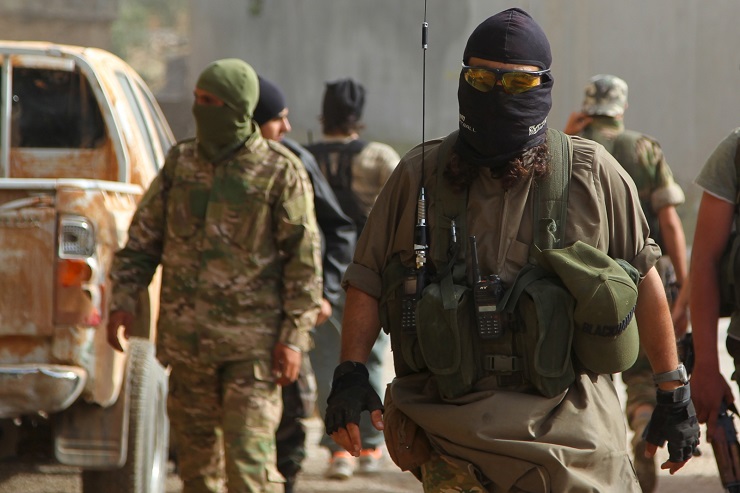
According to the Syrian news agency SANA, on September 19, US Air Force helicopters transported two new groups of militants to their base in Al-Shaddadah in Al-Hasakah Governorate, northeastern Syria, for retraining. There were about 60 people in total who had previously fought in the ranks of the terrorist group ISIS.
These militants were transported from a prison in the city of Qamishli, where they were guarded by Kurds from the Syrian Democratic Forces (SDF) after ISIS’s defeat in 2019. The majority of these prisoners have Iraqi citizenship, and among them are also Saudi Arabians and Tunisians. According to SANA sources, at least three former ISIS members have held senior positions in its regional structure in the past. One of them presided over the police force in Deir ez-Zor, another headed penitentiary facilities, and the third was responsible for finances.
SANA elaborates that they will undergo retraining at the US military base in order to later integrate into puppet groups under the label of the “Army of Free Tribes,” which are used by the US command to conduct subversive operations in northeastern Syria.
It is notable that this is not the first such US operation to organize “retraining courses” for Islamist militants at its bases in Syria. For example, on August 7, 40 ISIS supporters were transported to a base controlled by the US Armed Forces in Al-Shaddadah. As reported by the Syrian media, the terrorists, among whom were an ISIS “spy group leader” and “explosives specialist,” were moved to the military base from prisons under the control of the Kurdish SDF. It was stressed that the terrorists “were armed and received logistical support for the perpetration of further acts of terrorism, the target of which could be populated areas, sites occupied by the Syrian army, and infrastructure.”
On June 21, US Air Force helicopters transported yet another group of militants to Al-Shaddadah from the Es-Sanawiya prison, situated in the administrative center of Al-Hasakah. They were also preparing to join the Army of Free Tribes group, which the United States uses to conduct operations in northeast Syria.
Prior to this, in April no less than 70 other former mercenaries from the ranks of ISIS were transferred from Ghuwayran prison, which is also controlled by SDF fighters, to the pro-Western coalition base at Al-Tanf where the borders of Syria, Iraq, and Jordan meet.
Mehmet Ali Güller, the Turkish author of “ISIS. Black Terror,” writes that ISIS has always been a “convenient enemy” for the USA and has served as a “skeleton key” for doors, which Washington has wanted to open.
Another Turkish publication, Milliyet, emphasizes that the USA has constantly signaled the need to focus on the fight against ISIS, but it has never acted with the aim of destroying it. The USA used ISIS to change the map of the region, reconstruct it, establish the space for a terrorist mini-state, and partition and destroy the region’s states. Somewhere there was ISIS, and somewhere “Al-Qaeda” or “Khuras al-Din”. In other words, the USA has never seriously fought against the by-products of its own creation, which have appeared under different names. The publication emphasizes that the USA only ever acted with the consideration of exploiting them in their own interests and for their own benefit.
Any supporting information about secret ties between the USA and ISIS should not surprise anyone, since even The Washington Post writes that the leader of ISIS, Amir Mohammed Said Abel-Rahman al-Mawla, also known as Abu Ibrahim al-Hashemi al-Kurashi, previously performed the role of informant for the US military in Iraq. An in-depth investigation of the support that several Western intelligence agencies, including the CIA, provide to jihadist groups in Syria can be found in “The Secret War in Syria” by Maxim Shae, an expert on covert operations, intelligence and US foreign policy.
Not only does the USA continue to conduct “retraining” for former ISIS fighters and other extremist groups in “its own interests,” but it also supplies them with weapons. The aim of such US actions is extremely simple: to prepare a new detachment of radical pro-American groups that will perform the rough work of Special Force units. And the results of these actions are already plain to see: on September 17, the militants cut off the power supply across Damascus and sabotaged a gas pipeline to the South near Deir Ali. In addition to disabling the pipeline, according to Reuters and Al-Ikhbariya there have been attempts to blow up two power lines in the Khuran district of Damascus.
Besides training ISIS fighters at American military bases in Syria, the US-backed SDF abduct civilians to force them to fight in their ranks, carry out raids on Syrian cities, and wreak havoc in the country. Thus, on September 20, as reported by SANA news agency, the SDF executed another raid on houses in the town of Abu Hamam in Deir ez-Zor during which they abducted nine local residents, who were taken in an unknown direction. It is reported that the militants indiscriminately opened fire to disperse some people who were trying to recapture the abducted residents, sowing panic among the civilian population. Windows were also broken in several houses. The kidnapping was carried out with the support of the US military.
In order to avoid allegations against the US Air Force of killing civilians, the Pentagon plans to train SDF militants in independent operations with the use of military aircraft. For this, training in aviating and using T-6 Texan aircraft and MD-500 helicopters was organized at the Al-Kafr base. For this purpose, according to the available data, three such aircraft and two helicopters have already been delivered to the American base.
Furthermore, as El Mundo and many other Western media have already reported, US militants who have undergone “special training” are actively deployed in Syria, along with mercenaries from the American private military company Academi, to guard and transport convoys with stolen Syrian oil to Iraq.
Meanwhile, it should be recalled that US military personnel are in Syria illegally, violating the norms of the UN Security Council. Washington funds the militants through a program of assistance to the “Syrian opposition” and is using them to retain its positions in the Syrian oil fields.
These illegal and predatory actions on behalf of Washington must ultimately be subject to a legal assessment by the international community and be stopped!
Arranging The Middle East Narrative To Push The Agenda Forward
South Front | February 11, 2021
The United States is returning to a level of activity in the Middle East unseen in nearly 4 years. This development has become obvious over the weeks since Joe Biden became US President, firstly with a large deployment into Syria, and subsequently with smaller ones.
On February 9th, the Pentagon said that it was no longer in Syria to protect and exploit oil fields.
It is now back to hunting ISIS. Back to the square one of 2014 and the Obama era. ISIS somehow obliged by ramping up their activities throughout Syria.
It is a mystery that they were able to make such a sharp and sudden resurgence. It should also be noted that the Kurdish-led Syrian Democratic Forces allegedly have about 10,000 ISIS terrorists imprisoned.
This statement of intent denotes a massive shift in posture for the US. When defending the oil fields the US troops were mostly static, when hunting ISIS they can, once again, roam around and carry out various operations.
It appears likely that Idlib is now also in focus – US combat drones were observed surveying Greater Idlib. Idlib is a mixed bag – it has Turkish troops, Russians, the Syrian Arab Army along with terrorists and the moderate opposition, although confusing these two groups can be forgiven. The newest, future, US ally is there – the soon-to-be-rebranded Hay’at Tahrir al-Sham.
An indication of expected escalations and attacks are the Russian and Syrian military drills being carried out near Aleppo during effective wartime. Russia, separately, carried out a naval drill near Tartus.
And, as if by design, long-range missiles attempted to strike Russia’s forces at the Hmeimim Air Base. Drones occasionally attempt to infiltrate its airspace, but missiles are a rare sight.
Meanwhile in Western Daraa, the rebel leaders submitted to Damascus, likely fearing the upcoming chaos and wanting to choose a side.
Finally, the Biden administration is also working to secure Israeli support. The State Department said it doesn’t endorse Trump’s recognition of Israeli sovereignty over the Golan Heights, but doesn’t oppose it. It also provided a $9bn weapon sale as consolation. Tel Aviv is likely to use these weapons to counter its nemesis – Iran. It does so by targeting alleged Iranian interests in Syria.
Syria remains the lynchpin of US Middle East policy but the US posture in Iraq and Afghanistan has also changed. Withdrawing from the region is now out of the question – ISIS is making a resurgence, and there are other groups targeting American forces and convoys.
In Afghanistan, specifically, if the withdrawal does not move forward, the Taliban are also likely to begin targeting the US again.
The democrats are back in control and back to spreading democracy in the Middle East.
More scandals on Dutch government’s involvement in supporting terrorism in Syria
SANA | December 6, 2020
Amsterdam – A new chapter in the scandals of the Netherlands’s involvement in supporting terrorist organizations in Syria is unfolding in front of the world public opinion after Dutch Prime Minister Mark Rutte has recently admitted that he personally intervened to obstruct parliamentary investigations into his government’s provision of millions of dollars to terrorists, which shows the blatant hypocrisy in the policies of the Netherlands and the West regarding the allegations of fighting terrorism and protecting human rights.
The new development in the Dutch scandals file came after Rutte had been forced a few days ago to admit that he had obstructed the investigations by a fact-finding committee formed at the Dutch Parliament two years ago after Dutch media published files revealing the Dutch government’s involvement in supporting terrorists in Syria over several years and supplying them with technical equipment, especially for communication, military and logistical equipment, and hundreds of trucks and various vehicles.
At the time, the Dutch investigators did not reach any conclusion due to Rutte’s obstruction of the work of this committee and his deliberate concealment of secrets that prove his direct involvement with terrorists and his flagrant violation of the international and Dutch laws as the organizations that he supports financially and logistically in Syria are classified as terrorist organizations by the Dutch Public Prosecution itself.
The Parliamentary Investigation Committee was formed in the Netherlands after two media outlets revealed in a special documentary in 2017 the Dutch government’s support for about 22 terrorist groups, including the so-called “Levantine Front” organization, which is classified as terrorist even by Dutch institutions.
Rutte’s obstruction of the investigations has been met with great indignation by the Dutch people, as the media there has focused on his government’s involvement in providing millions of dollars, foodstuffs, medicines and telecommunication equipment to terrorists, while Dutch and European parties started to raise this issue at the public opinion platforms, calling for transparency and the truth while wondering about the benefit of democracy if it is not reflected on the ethical dimensions of the international policies.
The Dutch support for armed terrorist groups has continued throughout the years of the war on Syria, despite the pledges of the Amsterdam government to its parliament that only the organizations it described as “moderate” would receive support in harmony with the hypocrisy adopted by the United States of America, which has always claimed that it provides support and training to those whom it describes as “moderate opposition”, but later many reports have refuted these claims and confirmed that “Washington’s moderates” are nothing but terrorists who joined the ranks of terrorist organizations, including al Qaeda and Daesh “ISIS”.
The Dutch government has claimed that the reason behind its illegal interference to obstruct the investigations into the scandal is that the investigation would lead to the disclosure of secret information, in addition to exposing the alleged international coalition which had been formed under the pretext of fighting Daesh “ISIS” and the crimes committed by the Western states which are members of this coalition against Syrian civilians and the Syrian infrastructure under the pretense of fighting terrorism, while the facts on the ground confirm the involvement of this coalition in protecting Daesh.
The Netherlands, which is on the top of the European countries that export terrorists to Syria and Iraq, and the Dutch government’s support for terrorist organizations in the context of its submission to the American decision, makes it the last to have the right to talk about democracy and human rights in Syria or elsewhere and its government should be held accountable at the International Court of Justice.
‘Coup’ preparation, or move to stop endless wars? What’s behind Trump’s Pentagon purge
By Nebojsa Malic | RT | November 11, 2020
Democrats and their allies are alarmed that President Donald Trump’s firing of top Pentagon officials could be preparation for a military coup. What looks more likely is that US troops might finally pull out from Afghanistan.
In addition to Defense Secretary Mark Esper, whom Trump “terminated” on Monday, Esper’s chief of staff Jennifer Stewart, acting policy chief James Anderson, and intelligence undersecretary Joseph Kernan have also been shown the door. They were replaced by National Security Council counter-terrorist chief Christopher Miller, former NSC aide Kash Patel, General Anthony Tata, and another former NSC aide Ezra Cohen-Watnick, respectively.
The purge and the appointment of the officials widely described in mainstream media as “Trump loyalists” has led to Democrats and neoconservatives warning that a “coup” might be in the works against Joe Biden, who has claimed victory in the November 3 election.
4. Who knows whether intentions are mostly petty, or domestic election interference, or unimpeded decisions in foreign policy (latter could range from military force to military withdrawals, and from pro-Putin to pro-MBS). But, I’m told, both Esper and Milley are truly worried.
— Bill Kristol (@BillKristol) November 11, 2020
Allowing for the possibility that Trump could just be acting out of spite against people who were disloyal to him, The Nation’s Michael Klare noted that Miller had been involved in covert operations in urban settings of Iraq and Afghanistan with US Special Forces.
Democrats should look for any evidence that the Pentagon purge “signals a covert White House plan to use the US military in support of an illegal drive to subvert democracy and install Trump as dictator,” Klare warned.
Wednesday’s appointment of retired Army Colonel Douglas Macgregor as Miller’s senior adviser, however, points in an entirely different direction. First reported by Axios, it was confirmed by the Pentagon later in the day, with a statement noting that Macgregor’s “decades of military experience will be used to assist in the continued implementation of the President’s national security priorities.”
While that sounds like properly vague Pentagonese, Macgregor is well known for his advocacy of a speedy US withdrawal from Afghanistan – something Trump said last month he wished to see by Christmas this year, ahead of the 2021 timeline envisioned in the peace agreement the US have struck with the Taliban.
The Intercept’s Lee Fang quoted an anonymous Pentagon official who basically confirmed that the Pentagon purge is aimed at overcoming resistance by career bureaucrats and the military-industrial complex to Trump’s policies.
Trump official claims the rapid personnel changes are designed to end the “forever wars” in Afghanistan, withdraw troops by Christmas, which many Pentagon leaders opposed. Others argue moves are designed only to award loyalty and punish dissent.
— Lee Fang (@lhfang) November 11, 2020
“The president is taking back control of DOD. It’s a rebirth of foreign policy. This is Trump foreign policy,” said the official.
“This is happening because the president feels that neoconservatism has failed the American people,” he added.
Trump campaigned in 2016 on ending the ‘endless wars’ in the Middle East. Within a few months, however, he allowed himself to be persuaded by the Pentagon to ramp them up instead, bombing Afghanistan and launching missiles at Syria. Once all the territory held by Islamic State (IS, formerly ISIS) terrorists was liberated, however, he pushed hard for withdrawal from Syria, Afghanistan and Iraq – running into resistance from the Pentagon.
His first Defense Secretary Jim Mattis resigned over Syria at the end of 2018. Most US troops there were withdrawn by October 2019. Some troops were also pulled out of Iraq this year, citing concerns over the coronavirus, though many still remain. A peace treaty with the Taliban was signed in February this year, after nearly 20 years of war that perfectly defined “mission creep.”
There is no denying that the present political situation in Washington, with Biden claiming he won the election and Trump disputing that citing irregularities in key states, is fraught with peril. Whatever the outcome, unless everything is handled above board and with transparency, half the country is going to feel cheated and disenfranchised.
There are two things to keep in mind, however. Whatever one thinks of him, Trump has kept his word, implementing his electoral promises – by working through the system – despite the obstacles thrown before him by the administrative apparatus, legislators and the courts. So far, the current flurry of activity at the Pentagon seems to point towards a withdrawal from the Middle East, rather than a coup at home.
Secondly, it was actually the Democrats – Joe Biden himself – who first brought up the notion of using the US military to forcibly remove Trump from the White House, should he lose but refuse to concede. That was in June, long before the election and its controversies. What did Biden know at the time to make him say that, nobody knows – because nobody in the mainstream US media has bothered to ask, preferring to entertain partisan fantasies based on conjecture instead.
Turkey’s Erdogan Cuts off Water to One Million Syrian Civilians in the Blazing Summer Heat
By Steven Sahiounie | Mideast Discourse | August 24 ,2020
Turkish President Erdogan has sought to create an image for himself as the champion of religion. The Islamic State of Iraq and Syria (ISIS) also tried to claim they were following a religion, yet both used water as a weapon of war.
Water in Islam
Turkey is almost 100% Muslim and has made world headlines converting Christian cathedrals into Mosques. Turkish President Erdogan has been converting a secular democracy in Turkey, founded by Ataturk, into a Muslim Brotherhood haven, which follows Radical Islam as a political ideology, which is the same ideology as ISIS.
Water in Islam is considered as a gift from God, belonging to all equally, which has to be distributed equally among all living beings, humans, animals, and plant life, according to Cherif Abderrahman Jah, an Islamic academic and humanist.
The ISIS terrorists have often used water as a weapon of war in Iraq and Syria by cutting off supplies to villages that resisted their rule and as a tool to expand their control over the region’s water infrastructure.
They wanted to seize the water to prove they were building an actual state. In 2014 ISIS besieged the Syrian town of Kobane to secure a piece of the border with Turkey.
6 years later, 2020, the same scenario plays out, and in the same area, but ISIS has been defeated, and the Erdogan regime in Turkey has taken their place. Many experts feel ISIS and Turkey have been connected in their use of Radical Islam as a political tool, devoid of any connection to Islam, which is a religion.
ISIS was using water as a weapon, according to Tobias von Lossow of Berlin’s Institute for International and Security Affairs. He said, “IS uses water systematically and consistently. IS uses the entire range of possibilities and variations of water warfare.”
Death without water
A person can survive without water for about 3 days; however, a person living in a very hot climate will sweat, causing them to lose more water, which leads to dehydration, causing extreme thirst, fatigue, and ultimately, organ failure and death. A person living in a hot place, like Hasaka, and having to perform laborious activities such as taking care of animals, or small children, could die in only a few days without water.
The role of the SAR in the crisis
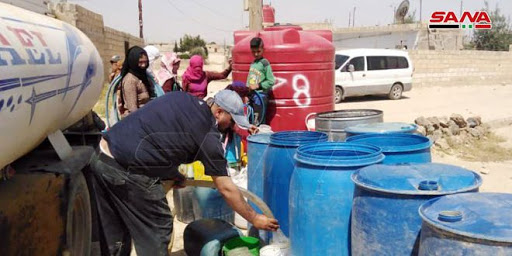
Friday marked the ninth consecutive day without water in Hasaka. The Turkish occupation forces, and their Radical mercenaries, are endangering the lives of more than a million civilians.
The SAR water authorities continue to try to provide clean drinking water, with cooperation from the Hasaka City Council and civil society groups, who used many water tankers to provide the locals with drinking water from Nafasha and al Himah Water Projects.
Chairman of Hasaka City Council Adnan Khajou, said that the daily quantity of water to be transported is 300,00 liters, which came from shallow wells dug by the locals, but is not drinkable and used only for cleaning.
The Turkish Army of occupation and its terrorist mercenaries in Ras-al-Ayn countryside continue to stop the operation of Alouk water project and to cut off the drinking water from Hasaka city, threatening one million persons with thirst and causing them to suffer from the spread of Coronavirus (COVID-19).
General Director of Hasaka Water Establishment Mahmoud Ukla said that since the Alouk Water Station was shut off by the Erdogan regime army, and their mercenaries, the summer temperatures have soared and water demand has increased, with the devastating additional threat of the COVID-19 pandemic, which needs water for hygiene.
Aziz Michael, geologist and water specialist, said that the Alouk water station is essential for water and it should be reopened.
The role of Turkey in the crisis
Turkey has a long history of using water as a weapon of war in Syria. In 1998 Erdogan had threatened to shut off water to Syria, which brought the two countries close to military conflict.
In May the water supply to 460,000 civilians in northeastern Syria was cut off by Turkey for the sixth time.
Syrian Observatory activists have reported Friday that residents have been protesting in Ras al-Ain, which is under Turkish Army occupation, and were calling for water, and electricity to be restored.
The role of the UN
On Friday, Ambassador Bashar al-Jaafari, Syria’s Permanent Representative at the UN, called on the UN Secretary-General Antonio Guterres to intervene immediately and to exert all his efforts to stop the Erdogan regime’s crime of cutting off drinking water for nearly one million Syrian citizens in Hasaka. In the phone call between al-Jaafari and Guterres, the Ambassador stressed that the Turkish aggression constitutes a war crime and a crime against humanity.
He said that the situation caused by this crime is exacerbated by hot weather and the threat of the COVID-19 pandemic.
Guterres said that he has tasked the UN team in Syria and his Special Envoy Geir Pedersen with taking steps to address this matter, resolve it urgently, and deliver humanitarian aid to affected people. He said he will exert his best efforts by contacting the Turkish government to put pressure and resolve this matter.
Guterres has asked Pedersen to meet the representatives of the US, Russia, and Turkey in Geneva on Monday, as the committee for drafting a new Syrian constitution meets, which is part of the UN 2254 resolution which will pave the way to a peaceful solution to the Syrian conflict.
The SAR and AANES (Autonomous Administration of North and East of Syria)
The Northeast section of Syria is split by various groups. The SAR based in Damascus controls areas, and has forces, checkpoints, and provides free health care and education to those areas it controls. The AANES is a separate group of Kurds, following a communist political platform, and they have become known to foreigners as “Rojava”. They have a military wing, the SDF, which was aligned with the terrorist group PKK, and they were in a coalition with the US military, who are now illegally occupying parts of the region while tasked with stealing Syrian oil by the Trump regime.
Covid-19 danger
“Turkish authorities’ failure to ensure adequate water supplies to Kurdish-held areas in Northeast Syria is compromising humanitarian agencies’ ability to prepare and protect vulnerable communities in the COVID-19 pandemic,” Human Rights Watch said in a report published late March.
What is the solution?
The Kurdish leaders of the ‘Rojava’ area, and the central government of the SAR in Damascus, are in complete agreement that the solution of the water crisis in Hasaka must be the removal of all Turkish occupation forces, and their Radical terrorist mercenaries. The SAR is a secular government, and this is what the Kurdish leadership of ‘Rojava’ also claim as a core value of their administration. With so much in common, and both ‘Rojava’ and the SAR facing the same enemy, Turkey, and the possible resurgence of ISIS, it appears they may soon form renewed cooperation to re-take the land from occupation forces and defend the borders from all enemies.
Steven Sahiounie began writing political analysis and commentary during the Syrian war, which began in March 2011. He has published several articles, and has been affiliated with numerous media. He has been interviewed by US, Canadian and German media.
34 US-Backed Militants Surrender, Hand Weapons to Syrian Army – Reports
Sputnik – April 18, 2020
28 militants and six drivers from the Jaysh Maghawir al-Thawra (‘Revolutionary Commando Army’) rebel group arrived in Palmyra, handed over all their weapons and equipment and surrendered to take advantage of the Syrian government’s recent amnesty decrees, SANA has reported, citing a source said to be involved in the process.
Earlier, the Russian Defence Ministry’s Centre for Syrian Reconciliation confirmed that over two dozen militants trained at a US military base in Syria had surrendered to the Syrian Army after breaking out of the US-controlled At-Tanf area and engaging in a shootout with other militia members.
The group’s evacuation from the At-Tanf area, a blob of US-held territory in southern Syria near the Jordanian and Iraqi border, was facilitated following over four months of planning, according to authorities.
SANA’s source said that the haul of surrendered equipment included eight vehicles, some of them fitted with heavy machine guns, along with a small number of automatic weapons, sniper rifles, 2 RPG launchers and a grenade launcher, along with communications equipment and binoculars.
Ghannam Samir al-Khedair, the group’s leader, said he and his comrades had been displaced from Sweida by Daesh (ISIS) and crossed the border into Jordan, where they were trained, after which they were sent to guard the Rukban refugee camp. Al-Khedair also revealed that his men were demoralised after finding out that much of the relief supplies meant for the camp, which once held as many as 45,000 people, was being sold to Daesh, and discovering that other Jaysh Maghawir al-Thawra militants also supported the terrorists.
Khaled Samir al-Khedair, another former militant from the At-Tanf base, said that US occupation forces were training militia to attack Syrian Army positions, as well as civilian infrastructure and oil and gas fields. Salah Rashid al-Zaher, another militant, confirmed that this training for sabotage ops was taking place. According to al-Zaher, in addition to much of the Rukhban camp aid being sold to Daesh, some of it was also traded on the black market to camp residents at exorbitant prices.
The SANA report comes two days after confirmation by the Russian military that a group of over two dozen militants trained at At-Tanf had surrendered to the Syrian Army. The militants began their journey to Palmyra on the night of 13 April, but had to fight off a detachment of Jaysh Maghawir al-Thawra forces to escape, arriving in the ancient city on 14 April.
Rukban Disaster
Officials in both Damascus and Moscow and the Syrian and Russian militaries have repeatedly expressed concerns about the disastrous humanitarian situation at the Rukban refugee camp over the course of many years, and have reported on the Pentagon’s use of the At-Tanf military base to retrain former extremists to renew their struggle against the Syrian government.
Damascus has stressed repeatedly that the only solution which could end the al-Rukban refugees’ suffering would be for the US to withdraw from At-Tanf and leave Syria. At the moment, it’s estimated that there are still as many as 13,500 people at the camp, among them 6,000 militants, and members of their families. At least 150 US troops are estimated to remain at At-Tanf.
The US moved in to take control of the At-Tanf area in early 2016, just as the Syrian Army began its counteroffensive against Daesh militants in the sparsely populated desert areas of central Syria. US forces formally established the Jaysh Maghawir al-Thawra militia after dissolving its predecessor, the so-called ‘New Syrian Army’ militant group, in late 2016. Syria and its allies have repeatedly demanded that the US withdraw from the Arab Republic’s sovereign territory. The area has seen repeated deadly clashes between Syrian forces and entrenched US forces and their militia allies.
Featured Video
Bombing Hitler’s Hometown
or go to
Aletho News Archives – Video-Images
From the Archives
The Biggest Threat to Peace in Middle East
By Dr. Elias Akleh* | Sabbah Report | May 24, 2010
A build up of heightened tension in the Middle East is escalating in the last few weeks. American and Israeli postures towards Lebanon, Syria, and Iran have become more threatening. Listening to speeches of political leaders one hears talks only about war not peace. Iranians and Israelis are continuously training hard for a possible showdown. Both sides are conducting extensive war games every month. This led Syrians to claim that Israel is preparing for a soon-to-come another war. The Jordanians also are warning that current stalemate of the peace process is an indication of a war breaking out this summer. The Russian President and his army chief hinted, a few months ago, that the US and Israel were planning for an attack on Iran.
Indeed Iran is, as it has been for last few years, the target of most of the threats and accusations of supporting terrorism. Escalating incitement against Iran the American Defense Department sent last month (April) to Congress a report on Iran’s military claiming Iran could develop intercontinental ballistic missiles capable of reaching the US by 2015.
Ignoring the fact that N. Korea, India, Pakistan, and Israel are proven to have nuclear weapons while Iran does not, the US Secretary of State Hillary Clinton chose in her speech, to the nuclear Non-Proliferation Treaty review conference at the UN, to focus on Iran’s alleged nuclear ambitions putting the whole world at risk as she put it. According to Clinton Iran’s acquisition of nuclear weapons, rather than Israel’s more than 200 nuclear bombs, is destabilizing the Middle East. She called on the world’s nations to rally around US efforts to hold Iran, not other nuclear countries, to account.
The accusation that Usama Bin Laden is living comfortably in Iran had received a boost after the broadcast of a documentary called “Feathered Cocaine”. This echoed the June 2003 claims of the Italian newspaper Corre de la Sierra that Bin Laden was in Iran according to some intelligence report, and according to Richard Miniter’s book “Shadow War”. … continue
Blog Roll
 Aletho News
- Bombing Hitler’s Hometown
- German journalist threatened with homelessness as German court upholds EU sanctions in landmark free speech case
- US Tells Allies That Ukraine-Bound Arms Could be Sent to Middle East
- Organized terrorism: Iran condemns killing of its diplomats in Lebanon
- Why could Gaza enter the regional war?
- Hamas official rejects Mladenov Plan linking disarmament to Gaza reconstruction
- Two Primary Elections for the Soul of ‘America First’
- Japan Clings to US Vassalage Despite Energy Crunch Caused By Iran War
- US Seeks Control Over Global Energy Infrastructure – Kremlin
- US senators target Orban government for standing up to Zelensky
- If Americans Knew
- Researchers at Human Rights Watch Resign Over Blocked Report on Palestinian Refugee Return
- Jewish Groups Are Backing a War Americans Don’t Want
- Eric Fingerhut Thinks He’s the President of the Jews
- Top Jewish Philanthropists, Rabbis Urge Israeli President to Take Action Against ‘Jewish Extremists’
- Don’t Be Fooled. Zionist Leaders Have Always Wanted to Control Southern Lebanon
- Israel’s widespread use of torture is a core element of its genocide against the Palestinian people
- In Israel’s War on Iran, Many Middle East US Bases Rendered “All But Uninhabitable”
- ‘Burn the lawn’: Israel pursues ‘Rafah model’ in southern Lebanon
- A genocide here, an amputation there
- Reports: Iran mobilizing 1M fighters, Israel-US run low on ammo, Israeli army faces shortage – Not a ceasefire Day 168
- No Tricks Zone
- Devastating Assessment Of Comirnaty Vaccine By Former Senior Pfizer Europe Toxicologist
- New Study: CO2 Is ‘Effectively Negligible’ As An Explanatory Climate Change Factor Since 2000
- Former Pfizer Toxicologist Dr. Helmut Sterz Tells Bundestag Hearing Pfizer Vaccine Should Have Never Been Approved
- Energy Expert: Germany’s Nuclear Phaseout Was A “500 Billion Euro Mistake”
- New Research: South Australia’s Mid-Holocene Sea Surface Temperatures Were 4°C Warmer Than Today
- Storing Green Energy To Last Germany 10 Days Would Require A 60-Million Tonne Battery
- New Studies: UK Sea Levels Were 4 Meters Higher Than Today During The Mid-Holocene
- Destructive Green New Deal: German Energy And Metal Group Warns Of Drastic Crisis
- New Study Documents A 20-Year Pause In Arctic Sea Ice Decline – Driven By Internal Variability
- Wake-up Call: Survey Shows Majority Of Germans Now Favor Postponing Climate Targets!
 Aletho News