Professor at Center of Columbia University Deportation Scandal is Former Israeli Spy
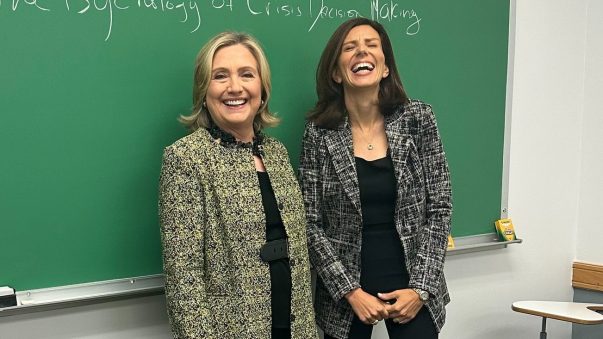
Keren Yarhi-Milo poses with Hillary Clinton during Clinton’s 2023 guest teaching stint at Columbia. Photo | Facebook | Hillary Clinton
By Alan MacLeod | MintPress News | March 11, 2025
The professor at the center of the Columbia University deportation scandal is a former Israeli intelligence official, MintPress News can reveal.
Mahmoud Khalil, a recent graduate of the university’s School of International and Public Affairs (SIPA), was abducted by Immigration Customs Enforcement (ICE) Saturday for his role in organizing protests last year against Israel’s attack on Gaza. Khalil’s dean, Dr. Keren Yarhi-Milo, head of the School of International and Public Affairs, is a former Israeli military intelligence officer and official at Israel’s Mission to the United Nations. Yarhi-Milo played a significant role in drumming up public concern about a supposed wave of intolerable anti-Semitism sweeping over the campus, thereby laying the groundwork for the extensive crackdown on civil liberties that has followed the protests.
Spooks in Our Midst
Before entering academia, Dr. Yarhi-Milo served as an officer and an intelligence analyst with the Israeli Defense Forces. Given that she was recruited into the intelligence services because of her ability to speak Arabic fluently, her job likely entailed surveilling the Arab population.
After leaving the world of intelligence, she worked for Israel’s Permanent Mission to the United Nations in New York. While there, she met and married her husband, Israel’s official United Nations spokesperson.
Although she is now an academic, she has never left the world of international security, making the subject her area of expertise. She has made a point of trying to lift women’s voices in the field. One of these was the then-U.S. Director of National Security, Avril Haines, whom she spoke with in 2023. But even though Khalil was a student in her school, she had nothing to say about his arrest. Indeed, rather than speak out on the issue (as activists have demanded), she instead chose this week to invite Naftali Bennett, prime minister of Israel from 2021 to 2022, to speak at Columbia. Students protesting Tuesday’s event were condemned by university authorities for “harassing” Yarhi-Milo.
Unprecedented Protests, Unprecedented Repression
Columbia was the epicenter of a massive protest movement across university campuses nationwide last year. It is estimated that at least eight percent of all American college students participated in demonstrations denouncing the genocidal attack on Gaza and calling on educational institutions to divest from Israel. The response was equally vast in its scale. Well over 3,000 protestors were arrested, including faculty members themselves.
The nationwide movement began at Columbia on April 17, when a modest Gaza solidarity encampment was established. Protestors were shocked when university president Minouche Shafik immediately called in the New York Police Department – the first time the university had allowed police to suppress dissent on campus since the famous 1968 demonstrations against the Vietnam War.
Mahmoud Khalil was among the leaders of the movement. The Syrian-born Palestinian refugee was willing to speak calmly and cogently to the press about the protest’s goals. A permanent resident of the United States, he was abducted by ICE on Saturday.
“ICE proudly apprehended and detained Mahmoud Khalil, a radical foreign pro-Hamas student on the campus of Columbia University. This is the first arrest of many to come,” President Trump stated. Secretary of State Marco Rubio echoed Trump’s ominous threat, announcing, “We will be revoking the visas and/or green cards of Hamas supporters in America so they can be deported.” In another clear threat, the Trump administration moved to cancel $400 million in funding to Columbia University, citing the institution’s failure to sufficiently crack down on “antisemitic” incidents on campus.
Khalil’s eight-month pregnant wife was initially told that he had been taken to a facility in Elizabeth, New Jersey. In fact, he had been moved halfway across the country to a center in Jena, Louisiana. Journalist Pablo Manríquez of Migrant Insider explained that ICE often goes “immigration ‘judge shopping’ by putting detainees in detention centers under jurisdictions of courts that very rarely decide in favor of migrants.”
The very high-profile attempt to deport the holder of a Green Card because of political speech criticizing a foreign government has left many civil rights lawyers deeply worried. Alec Karakatsanis, for example, stated that “I’ve never seen a more clear-cut First Amendment violation, or a more flagrant government declaration of intent to violate blackletter law.” “The government does not claim he committed a crime, just that he held views that the government doesn’t like about Israel. Bone chilling,” he added.
Columbia’s Billionaire Pro-Israel Backers
Much of Columbia’s funding comes from donations from billionaire benefactors. But those gifts come with strings attached. This became apparent in the wake of the protest movement, as many pro-Israel patrons demanded the university take action. Manufacturing magnate Robert Kraft, for example, publicly announced he was cutting his alma mater off from his lavish funding over its failure to effectively suppress the demonstrations.
Hedge fund manager Leon Cooperman did the same, demanding that Columbia’s “crazy kids” “have to be controlled.” These “kids” evidently also included 61-year-old Jordanian professor Joseph Massad, whose views on the Middle East Cooperman found intolerable, and called for his firing. Soviet-born oligarch Len Blavatnik, meanwhile, urged police to hold the protestors to account.
Between them, Kraft, Cooperman and Blavatnik are believed to have donated nearly $100 million to Columbia, giving them considerable influence over the political direction of the university.
There were also voices from within the university clamoring for the violent suppression of the student movement. Assistant Professor of Business Management Shai Davidai, for example, denounced the protestors as “Nazis” and “terrorists” and called for the National Guard to be set upon the encampment, obliquely referencing the Kent State University Massacre while doing so. Davidai, an Israeli-American, served in the IDF and has publicly expressed his pride in doing so.
Given its most recent addition, it appears unlikely that the School of International and Public Affairs will moderate its pro-Israel positions. In January, the school announced that Jacob Lew would join the faculty. Lew had just left his job as the U.S. Ambassador to Israel under the Biden administration, a role in which he facilitated American complicity in genocide, supplying Israel with weapons and providing it with diplomatic support for its efforts.
Defending Israel, Destroying Free Speech
Longtime readers of MintPress News will be less surprised than many to hear that Israeli military intelligence officials hold such important positions in American public life. Previous MintPress investigations have uncovered giant networks of former Israeli spies working in top jobs in big tech and social media companies, including Microsoft, Google, Meta, and Amazon. Even TikTok, often labeled a Chinese spying app, has hired former Israeli spies to run its affairs. And in October, we revealed that former Israeli spooks are writing America’s news, with multiple former agents working at top U.S. outlets, including CNN, Axios, and the New York Times.
Perhaps, then, the fact that the dean of the very school at the center of a worldwide media storm is a former Israeli military intelligence officer should not be such a shock. But it remains a stark reminder of the level of extraordinary institutional bias in favor of Israel displayed across the United States.
Yemen resumes naval blockade against Israeli ships in support of Gaza
Al Mayadeen | March 11, 2025
The Yemeni Armed Forces announced the resumption of their naval blockade on all Israeli ships in the Red Sea, the Arabian Sea, the Bab al-Mandab Strait, and the Gulf of Aden.
Sanaa’s decision comes after the expiration of the deadline set by Ansar Allah leader Abdul-Malik al-Houthi for mediators to pressure the Israeli occupation into reopening Gaza’s border crossings and allowing humanitarian aid into the besieged territory.
In a statement issued on Tuesday, the Yemeni Armed Forces declared the immediate enforcement of the blockade, warning that any Israeli vessel attempting to breach the restriction would be targeted within the designated operational zones.
The military stressed that the blockade would remain in place until the Israeli occupation complies with the demand to reopen Gaza’s border crossings and facilitate the entry of essential food and medical supplies.
The statement reaffirmed Yemen’s unwavering solidarity with the Palestinian people, particularly in Gaza and the occupied West Bank, and reiterated its commitment to standing alongside the Palestinian resistance.
Famine looming over Gaza
Hamas spokesperson Hazem Qassem warned Tuesday that Gaza is facing the early stages of a real famine due to the Israeli occupation’s continued blockade on the entry of food supplies for the tenth consecutive day. He stressed that the humanitarian situation has been dire since the beginning of the Israeli aggression.
In a statement, Qassem highlighted the severe food crisis gripping the besieged enclave, where essential supplies are running out under the ongoing blockade. He noted that the closure of border crossings constitutes a blatant violation of the ceasefire agreement, which stipulates the unrestricted flow of humanitarian aid.
Hamas condemned the Israeli occupation’s actions, calling the blockade a flagrant violation of international humanitarian law and the Geneva Conventions.
The movement described it as a flagrant war crime and collective punishment against civilians, warning that the siege has led to soaring food prices and a severe shortage of medical supplies amid an escalating humanitarian catastrophe.
The group also pointed out that the closure of crossings was hindering recovery and reconstruction efforts in Gaza. The ban on the entry of heavy equipment has obstructed relief teams from carrying out their duties.
Yemen pledges to resume operations
Previously, Sayyed al-Houthi said Sanaa was continuously monitoring and observing developments in Gaza amid the Israeli occupation’s complete evasion of its commitments to the ceasefire agreement.
In a late February speech, Sayyed al-Houthi also revealed that Yemen was prepared to intervene militarily had Trump carried out his threat to restart the war on Gaza if Hamas did not release the Israeli captives.
“Yemen remains steadfast in its support for the Palestinian people and Resistance factions in confronting Israel’s attempts to evade the ceasefire agreement and its second phase,” al-Houthi emphasized, warning that if the war is reignited in Gaza, “the entire Zionist entity, starting with occupied Yafa, will come under fire,” amid the Yemeni support and military intervention.
Sayyed al-Houthi reiterated his stance on Friday, giving mediators a four-day deadline to ensure the entry of humanitarian aid into Gaza, warning that if the Israeli occupation continues to block aid deliveries, naval operations against Israeli-linked vessels will resume.
Al-Houthi accused the Israeli occupation of delaying its commitments under the Gaza ceasefire agreement, particularly concerning humanitarian provisions. He stated that while Hamas had fully honored its obligations, the occupation had failed to uphold its side of the deal.
“The humanitarian aspect of the agreement includes clear obligations with guarantees from mediators, yet Israel is trying to evade them,” he said.
Al-Houthi also condemned intensified Israeli attacks in the occupied West Bank and al-Quds, highlighting the role of Israeli settlers in escalating violence against Palestinians. He criticized US support for the Israeli occupation under President Donald Trump, saying Washington’s backing had emboldened the regime’s policies of displacement and aggression against Palestinians.
US interested in direct talks with Hamas
Al Mayadeen | March 11, 2025
A leader in the Palestinian Resistance has divulged to Al Mayadeen that the United States is “interested in direct communication with Hamas, but within specific expectations,” as Americans do not want to allow the Palestinian Resistance to benefit from this direct communication with the current administration.
The Palestinian leader pointed out that the American envoys confirmed the ability of US President, Donald Trump, to “force Israel to stop the war and reach an agreement with Hamas.” They believe that Hamas’s release of the Israeli-American captive could change Trump’s convictions.
Hamas had previously announced its full commitment to the ceasefire agreement, implementing what was agreed upon, and its readiness to immediately begin negotiations for the second phase.
The movement rejected pressuring attempts, while the Israeli occupation is left without accountability despite evading its obligations.
“Blackmail and threats of war will not be of any use, and there is no way but negotiations and commitment to the agreement,” the leader told Al Mayadeen, emphasizing that any other option would be tampering with the fate of the remaining captives.
Adam Boehler, the US envoy who engaged in direct talks with Hamas, described the meeting as “very helpful” and expressed confidence that a deal to release Israeli captives held in Gaza could be reached “within weeks”.
In an interview for CNN, Boehler acknowledged the unusual nature of the talks, considering that Hamas has been designated a “terrorist” organization by the US since 1997. However, he did not rule out future meetings with the Palestinian group.
Boehler recognized “Israel’s” concerns over the US meeting with Hamas but emphasized his intent to revive “fragile” negotiations.
“In the end, I think it was a very helpful meeting,” he said, adding, “I think something could come together within weeks… I think there is a deal where they can get all of the prisoners out, not just the Americans.”
He hinted at the possibility of further talks, stating, “You never know. You know, sometimes, you’re in the area and you drop by.”
The first phase of a ceasefire concerning the release of some Israeli captives ended earlier this month, but the Palestinian Resistance and “Israel” are now in disagreement over when to transition into the second phase, which aims for a complete end to the war on the Gaza Strip.
While “Israel” wants to extend the first phase until mid-April, Hamas has insisted on moving to the second phase, which is aimed at achieving a permanent end to the war.
During this phase, the Resistance released 25 living captives and the bodies of eight others in exchange for approximately 1,800 Palestinian detainees and prisoners held in Israeli occupation prisons.
Of the 251 individuals taken captive on October 7, 2023, 58 remain in Gaza, including 34 whom the Israeli military has confirmed as dead.
Last week, US President Donald Trump issued a “last warning” to Hamas, threatening additional destruction in Gaza if all remaining captives were not released.
Boehler acknowledged the “consternation” “Israel” felt over the US’ engagement with Hamas, saying, “We’re the United States. We’re not an agent of Israel.”
A Muslims Zionism and the massacre of Syria’s minorities
By Robert Inlakesh | Al Mayadeen | March 11, 2025
The horrifying civilian massacres carried out across the Syrian coast are stupefyingly awful, on a scale reminiscent of the height of the ISIS insurgency in Iraq. Yet, there are still countless people identifying as Muslims who are trying to defend these actions. Their predominant ideology is not that of “Sunni Islam”, but rather of a nationalist identity rooted in a theological justification, in other words, a Muslims Zionism.
The Division of Syria
It has long been the agenda of the Zionist Entity to divide Syria into a number of weakened and defenseless Statelets, many of which it seeks to establish ties with and also of which justify its existence as a self-described “Jewish State”.
While the Zionist regime’s alliance with the Kurdish-led Syrian Democratic Forces (SDF) has long been known, the Israelis doubled down on throwing their weight behind the group that controls Syria’s north-east on December 8, 2024. Simultaneously, the Zionists occupied the entirety of the Golan Heights and carried out their largest ever air campaign to destroy Syria’s military capabilities.
For years, the Zionist regime provided material and financial support, in addition to medical aid, to at least a dozen Syrian opposition groups, including Al-Nusra Front (Al-Qaeda in Syria). Al-Nusra would of course later become Hay’at Tahrir al-Sham (HTS), which now rules over Damascus with an iron fist. Its leader, Abu Mohammed al-Jolani, who now prefers to go by Ahmed al-Sharaa, was originally an MI6 (British intelligence) project and was a former commander of ISIS.
The Zionists understood that the groups they were backing, including what would later become “HTS”, were led by foreign intelligence operatives, but that their rank and file were fanatical militants. This worked well for the Israelis in two ways: while the leadership of the group can be manipulated, the fanatical takfiris who actually believe in their group’s ideology are left to commit atrocities against civilians that will drive them towards federalization.
Although this history is largely forgotten, significant portions of Syria’s minority groups were in support of the movement to overthrow President Bashar al-Assad in 2011, yet what changed their minds and made them rally around the former Syrian leader was the behavior of the sectarian death squads who ended up leading the Syrian opposition.
However, after 2018, as the Syrian economy went into steep decline and the civil war became a frozen conflict, the vision that many Syrians had adopted for their future had faded. The US and EU sanctions strangled the country and plunged the people of Syria into poverty.
By the time al-Jolani came to launch his assault on Aleppo, the entire State ended up crumbling and this occurred without any major fighting. On top of this, it appeared briefly as if the HTS militants were not going to carry out the kinds of massacres many had long feared they would.
Yet, after two months, the sectarian field executions did not stop, the Israelis were essentially at the gates of Damascus and the new government was still incapable of getting its affairs in order. The real question here is whether Jolani is part of a conspiracy to commit civilian massacres with the aim of dividing Syria, or if he is just a useful idiot that is behaving as a murderous dictator.
When the rebellion occurred on the Syrian coast, the instant response was the mass deployment of paramilitary forces and security services, while sectarian demonstrators chanted for the blood of the Alawites. The official justification for the massacres that followed – including civilians who had even been opponents of Bashar al-Assad’s rule – was that “remnants of the regime” were to be hunted down.
What followed was the largest gift to the Israelis that could ever have been given, sectarian gangsters burst into civilian homes and murdered men, women, and children. Even babies were not spared from the brutality of the new regime. Elderly men were tossed around, humiliated and shot in the streets, teenagers taken into the open and executed. When their Sunni neighbours tried to intervene to stop the massacres, they were murdered too.
It is clear that these actions were carried out with genocidal intent, and no reasonable person can deny the mass slaughter of innocent civilians. On a personal note, it is so bad that Sunni Syrian contacts of mine in Hama and Homs have told me that they are too scared to share their opinions on social media for fear of being targeted.
While it is certainly the malicious agenda of the Zionists to divide Syria, the blame cannot now be placed upon the reactions of the minority communities who seek to preserve their own livelihoods, but instead on the new administration in Damascus that has committed the atrocities. If the country continues on its current trajectory, there won’t be a country called Syria any more and this is the fault of the sectarian death squads who worked to divide the country.
The Israelis are now grinning, waiting for the opportunity to seize more territory and use collaborators to carve out a series of regimes that will work in their favour. Meanwhile, not a single bullet from Jolani’s men has been directed at the occupying entity.
Hamas Denounces Israeli Enemy’s Failure to Withdraw from Philadelphi Corridor
Al-Manar | March 10, 2025
Hamas Resistance Movement issued on Monday a statement to condemn and reject the occupation’s violation of the ceasefire agreement and its failure to withdraw from the Salah al-Din (Philadelphi) Corridor area.
The Zionist occupation failed to comply with the gradual pull-out of its troops from the Salah al-Din (Philadelphi) Corridor during the first phase, and also did not begin its withdrawal on the 42nd day, as stipulated in the agreement, Hamas statement added.
“Yesterday marked the 50th day of the agreement, by which the withdrawal was set to be completed, but so far that has not happened.”
Hamas stressed that “this blatant violation is a clear breach of the agreement and an apparent attempt to sabotage it and render it meaningless”.
The continued violations confirm the occupation’s disregard for agreements and its manipulation of international commitments.
These violations place responsibility on the mediators to pressure the occupation into fulfilling its commitments and immediately ending its presence in the Salah al-Din (Philadelphi) Corridor, the statement underscored.
Hamas called on the mediators and the international community to intervene immediately to ensure the occupation’s withdrawal, and resume negotiations for the second phase without further delay.
Adhering to the agreement and completing the negotiations is the only way to secure the release of the prisoners, and any procrastination means tampering their fate and the fealings of their families, Hamas statement concluded.
The Israeli negotiating team left for Qatar Monday for talks aimed at extending the fragile Gaza ceasefire, after ‘Israel’ cut the Palestinian territory’s electricity supply to ramp up pressure on Hamas.
Ahead of the negotiations, ‘Israel’ disconnected the only power line to a water desalination plant in Gaza, a move Hamas denounced as “cheap and unacceptable blackmail”.
We dealt flexibly with Trump’s envoy, awaiting outcome of talks: Hamas

Al Mayadeen | March 10, 2025
Hamas spokesperson Abdul Latif al-Qanou stated that the movement has shown flexibility in responding to mediation efforts, including those led by Egyptian and Qatari officials, as well as US President Donald Trump’s envoy.
He emphasized that Hamas is awaiting the outcome of the upcoming negotiations, urging the occupation to commit to an agreement and advance to the second phase.
Al-Qanou highlighted that the discussions with mediators have centered on ending the war, ensuring a full withdrawal, and initiating reconstruction efforts.
He dismissed the occupation’s threats of resuming military operations in Gaza and its decision to cut electricity, calling these failed tactics that endanger its prisoners. He reiterated that any prisoner releases would only occur through negotiations.
Al-Qanou emphasized, “We have fully adhered to the first phase of the agreement, and our top priority now is to provide shelter and humanitarian aid to our people while ensuring a permanent ceasefire.”
“The movement has agreed to Egypt’s proposal for a community support committee, which will begin its work in the Gaza Strip to bolster the resilience of our people and reinforce their presence on their land.”
Al-Qanou emphasized that “the occupation seeks to tighten the siege, close the crossings, and block aid from reaching the Palestinian people in an attempt to force them into displacement—but this is nothing more than a futile illusion.”
Trump’s envoy for prisoners’ affairs, Adam Boehler, stressed earlier that the meeting with Hamas “was very effective.”
In an interview with “Israel’s” Channel 13, Boehler confirmed that he does not rule out further meetings with Hamas, stating: “We are the United States, and we are not subordinate to Israel—we have our own interests,” adding “I work for Trump, and this is his decision; I implement what he wants.”
Hamas approves Gaza governance plan
On Saturday, Hamas’ negotiating team finalized its trip to Egypt, where the delegation discussed pathways for the implementation of the clauses of the ceasefire agreement with mediators.
The delegation, headed by Mohammad Darwish, head of Hamas’ Shura Council and Chairman of its Leadership Council, held talks with the head of Egypt’s General Intelligence Service, Major General Hassan Rashad.
The two sides discussed several crucial issues, including the ceasefire agreement and the prisoner exchange deal.
A statement released by the Hamas Media Office described the talks as “positive and responsible.”
“The Hamas delegation expressed its gratitude and appreciation for Egypt’s efforts, especially in countering displacement plans,” the Palestinian Resistance movement said, referring to United States President Donald Trump’s plot to “take over” the Gaza Strip.
Welcoming the outcomes of the most recent Arab summit, Hamas highlighted Egypt’s Gaza reconstruction plan and the Palestinian people’s inalienable right to statehood.
In further detail, Hamas’ negotiating team emphasized the need to uphold the terms of the multi-phase ceasefire agreement between the Palestinian Resistance and “Israel”.
‘The resistance will not let you stay’: Hezbollah chief addresses Israeli occupation of south Lebanon
The Cradle | March 10, 2025
Hezbollah’s Secretary-General Naim Qassem said on 9 March that Israeli forces currently occupying south Lebanon will inevitably face resistance if they do not withdraw.
“I tell the Israelis, if you remain at these points, this resistance will not let you continue there,” Qassem stated on Sunday.
“If the occupation continues, it must be confronted by the army, the people, and the resistance,” despite some people wanting “liberation through diplomacy,” the resistance leader added.
“We committed to the [ceasefire] agreement while the enemy violates it … it assaults people far from the border in their cars and in their homes,” he went on to say. “The ceasefire agreement is the one announced and distributed, and there is no secret agreement or clauses under the table.”
“The resistance is fine and continuing, but it was wounded and hurt and made great sacrifices … We had a security exposure and some shortcomings, and we are conducting an investigation to learn lessons and hold people accountable,” Qassem said.
The Hezbollah chief commented on the recent entry of hundreds of settlers into south Lebanon under Israeli army protection, calling “it the greatest evidence that we are not facing aggression in a single phase, but rather [an Israeli expansionist] project from the ocean to the Gulf.”
Israeli forces continue to occupy Labbouneh, Mount Blat, Owayda Hill, Aaziyyeh, and Hammamis Hill, despite the ceasefire implementation and withdrawal deadline expiring on 18 February.
Tel Aviv has violated the ceasefire agreement over 1,300 times with non-stop attacks and infiltration of Lebanon’s airspace since the deal was signed in November last year.
Israel claims to be acting on its rights within the deal by preventing Hezbollah from rearming itself. However, the agreement signed by Beirut does not include anything about Israeli forces having the right to attack the country, instead stipulating that the resistance’s presence and military infrastructure must be dismantled by the Lebanese army south of the Litani River in south Lebanon.
Tel Aviv accuses Hezbollah of having not fully withdrawn to the north of the Litani River, as per the agreement. It also accuses the Lebanese resistance of trying to reconstitute its forces.
A Lebanese soldier was killed by Israeli forces on Sunday when they opened fire at citizens in the border town of Kfar Kila. Another Lebanese soldier was shot in the leg and kidnapped on the same day.
On Friday, Israeli warplanes launched more than 20 air raids, targeting valleys and forested areas on the outskirts of Zebqin, Beit Yahoun, Al-Aishiyeh, Al-Rayhan, Ansar, and Al-Bissariya.
Unchecked expansionism: Senior Knesset member calls for ‘full Israeli control of Syria’
Press TV – March 10, 2025
In a brazen declaration of expansionist Zionist ambitions, an Israeli Knesset member has openly called for Syria to be placed under the regime’s full control.
Boaz Bismuth said Israel “will not allow a military force to emerge in Syria after Assad’s fall.”
“Damascus must be under full Israeli control, and we will ensure that it comes under our control.”
The remarks reveal long-standing Israeli objectives to reshape West Asia by force.
“Syria is our bridge to the Euphrates, and in the future we will reach Iraq and Kurdistan.”
The extremist Israeli politician also voiced wishful thinking that the entire region should become subordinate to Israeli policies.
“Syria must be completely subordinate to us, as must Jordan, without any military capabilities.”
“We wake up the King of Jordan in the middle of the night to make him carry out our orders.”
Israeli prime minister Benjamin Netanyahu recently said the regime will not tolerate the presence of the HTS or any other forces affiliated with the new rulers in southern Syria.
He also said the regime’s troops will remain stationed at a so-called “buffer zone,” seized following the fall of President Bashar al-Assad, inside the occupied Golan Heights.
The buffer zone was created by the United Nations after the 1973 Arab-Israeli War. A UN force of about 1,100 troops had patrolled the area since then.
Netanyahu said the regime’s forces will maintain an indefinite military presence at the summit of Mount Hermon, and the adjacent security zone.
Mount Hermon, known as Jabal al-Shaykh in Arabic, is a huge cluster of snowcapped mountain peaks towering above the Syria-Lebanon border.
It overlooks the Damascus countryside as well as the Golan Heights, which Israel occupied during the 1967 Six-Day War.
Following the downfall of Assad, the Israeli military has been launching airstrikes against military installations, facilities, and arsenals belonging to Syria’s now-defunct army.
The strikes were accompanied by ground incursions, as tanks and armored bulldozers penetrated Syrian territory, beyond the Golan Heights to Qatana, barely 30 kilometers from Damascus.
Israel has been condemned for the termination of the 1974 ceasefire agreement with Syria, and exploiting the chaos in the country in the wake of Assad’s downfall to make a land grab.
Former al-Qaeda affiliate the HTS took control of Damascus in early December in a stunning offensive, prompting Israel to move forces into a UN-monitored demilitarized zone within Syria.
The Israeli regime has occupied some 600 kilometers of Syrian territory since the fall of Assad.
The HTS remained conspicuously silent on the unprecedented Israeli aggression, refusing to condemn the land theft, a move seen by regional experts as a sign of internal instability.
Trump’s ingenuity vis-à-vis Russia, Iran
By M. K. BHADRAKUMAR | Indian Punchline | March 10, 2025
Through the past three year period, Moscow claimed that it faced an existential threat from the US-led proxy war in Ukraine. But in the past six weeks, this threat perception has largely dissipated. The US President Donald Trump has made a heroic attempt to change his country’s image to a portmanteau of ‘friend’ and ‘enemy’ with whom Moscow can be friendly despite the backlog of a fundamental dislike or suspicion.
Last week, Trump turned to the Iran question for what could be a potentially similar leap of faith. There are similarities in the two situations. Both Russian President Vladimir Putin and Iranian president Masoud Pezeshkian are quintessential nationalists and modernisers who are open to westernism. Both Russia and Iran face US sanctions. Both seek a rollback of sanctions that may open up opportunities to integrate their economies with the world market.
The Russian and Iranian elites alike can be described as ‘westernists’. Through their history, both Russia and Iran have experienced the West as a source of modernity to ‘upgrade’ their civilisation states. In such a paradigm, Trump is holding a stick in one hand and a carrot on the other, offering reconciliation or retribution depending on their choice. Is that a wise approach? Isn’t a reset without coercion possible at all?
In the Russian perception, the threat from the US has significantly eased lately, as the Trump administration unambiguously signalled a strategy to engage with Russia and normalise the relationship — even holding out the prospects for a mutually beneficial economic cooperation.
So far, Russia has had a roller coaster ride with Trump (who even threatened Russia with more sanctions) whose prescriptions of a ceasefire to bring the conflict in Ukraine to an end creates unease in the Russian mind. However, Trump also slammed the door shut on Ukraine’s NATO membership; rejected altogether any US military deployment in Ukraine; absolved Russia of responsibility for triggering the Ukraine conflict and instead placed the blame squarely on the Biden administration; openly acknowledged Russia’s desire for an end to the conflict; and took note of Moscow’s willingness to enter into negotiations — even conceded that the conflict itself is indeed a proxy war.
At a practical level, Trump signalled readiness to restore the normal functioning of the Russian embassy. If reports are to be believed, the two countries have frozen their offensive intelligence activities in cyber space.
Again, during the recent voting on a UN Security Council resolution on Ukraine, the US and Russia found themselves arrayed against Washington’s European allies who joined hands with Kiev. Presumably, Russian and American diplomats in New York made coordinated moves.
It comes as no surprise that there is panic in the European capitals and Kiev that Washington and Moscow are directly in contact and they are not in the loop. Even as the comfort level in Moscow has perceptively risen, the gloom in the European mind is only thickening, embodying the confusion and foreboding that permeated significant moments of their struggle.
All in all, Trump has conceded the legitimacy of the Russian position even before negotiations have commenced. Is an out-of-the-box thinking conceivable with regard to Iran as well?
In substantive terms, from the Russian perspective, the remaining ‘loose ends’ are: first, a regime change in Kiev that ensures the emergence of a neutral friendly neighbour; second, removal of US sanctions; and, third, talks on arms control and disarmament attuned to present-day conditions for ensuring European and global balance and stability.
As regards Iran, these are early days but a far less demanding situation prevails. True, the two countries have been locked in an adversarial relationship for decades. But it can be attributed entirely to the American interference in Iran’s politics, economy, society and culture; an unremitting mutual hostility was never the lodestar, historically.
A constituency of ‘westernists’ exists within Iran who root for normalisation with the US as the pathway leading to the country’s economic recovery. Of course, like in Russia, super hawks and dogmatists in Iran also have vested interests in the status quo. The military-industrial complex in both countries are an influential voice.
The big difference today is that the external environment in Eurasia thrives on US-Russia tensions whereas, the intra-regional alignments in the Gulf region are conducive to US-Iran detente. The Saudi-Iranian rapprochement, a steady and largely mellowing of Iran’s politics of resistance, Saudi Arabia’s abandonment of of jihadi groups as geopolitical tool and its refocus on development and reform as national strategies — all these mould the zeitgeist, which abhors US-Iran confrontation.
This historic transformation renders the old US strategy to isolate and ‘contain’ Iran rather obsolete. Meanwhile, there is a growing realisation within the US itself that American interests in West Asia no longer overlap Israel’s. Trump cannot but be conscious of it.
Equally, Iran’s deterrence capability today is a compelling reality. By attacking Iran, the US can at best score a pyrrhic victory at the cost of Israel’s destruction. Trump will find it impossible to extricate the US from the ensuing quagmire during his presidency, which, in fact, may define his legacy.
The US-Russia negotiations are likely to be protracted. Having come this far, Russia is in no mood to freeze the conflict till it takes full control of Donbass region — and, possibly, the eastern side of Dniepr river (including Odessa, Kharkhov, etc.) But in Iran’s case, time is running out. Something has to give way in another six months when the hourglass empties and the October deadline arrives for the snapback mechanism of the 2015 JCPOA to reimpose UN resolutions to “suspend all reprocessing, heavy water-related, and enrichment-related activities” by Tehran.
Trump will be called upon to take a momentous decision on Iran. Make no mistake, if push comes to shove, Tehran may quit the NPT altogether. Trump said Wednesday that he sent a letter to Ali Khamenei, Iran’s supreme leader, calling for an agreement to replace the JCPOA. He suggested, without specifics, that the issue could quickly lead to conflict with Iran, but also signalled that a nuclear deal with Iran could emerge in the near future.
Later on Friday, Trump told reporters in the Oval Office that the US is “down to the final moments” negotiating with Iran, and he hoped military intervention would prove unnecessary. As he put it, “It’s an interesting time in the history of the world. But we have a situation with Iran that something is going to happen very soon, very, very soon.
“You’ll be talking about that pretty soon, I guess. Hopefully, we can have a peace deal. I’m not speaking out of strength or weakness, I’m just saying I’d rather see a peace deal than the other. But the other will solve the problem. We’re at final moments. We can’t let them have a nuclear weapon.”
Trump aims at generating peace dividends out of any normalisation with Russia and Iran, two energy superpowers, that could give momentum to his MAGA project. But cobwebs must be swept away first. Myths and misconceptions have shaped contemporary Western thinking on Russia and Iran. Trump should not fall for the phobia of Russia’s ‘imperialistic’ ambitions or Iran’s ‘clandestine’ nuclear programme.
If the first one was the narrative of the liberal-globalist neocon camp, the second one is a fabrication by the Israeli lobby. Both are self-serving narratives. In the process, the difference between westernisation and modernisation got lost. Westernisation is the adoption of western culture and society, whereas, modernisation is the development of one’s own culture and society. Westernisation can at best be only a subprocess of modernisation in countries such as Russia and Iran.
Trump’s ingenuity, therefore, lies in ending the US’ proxy wars with Russia and Iran by creating synergy out of the Russian-Iranian strategic partnership. If the US’ proxy wars only has drawn Russia and Iran closer than ever in their turbulent history as quasi-allies lately, their common interest today also lies in Trump’s ingenuity to take help from Putin to normalise the US-Iran ties. If anyone can pull off such an audacious, magical rope trick, it is only Trump who can,
Number of wounded, disabled in IOF rises to 78k: Israeli media
Al Mayadeen | March 9, 2025
The Israeli Ministry of Security has reported that the number of wounded and disabled in the Israeli “army” has reached 78,000 due to the recent war.
The majority of these casualties are reserve soldiers, with over 50% being under the age of thirty.
Notably, 62% suffer from psychological trauma, and 10% are in moderate to critical condition, with 194 soldiers currently hospitalized.
In related news, Israeli newspaper Yedioth Ahronoth highlighted growing concerns within the Israeli army’s General Staff over a “severe shortage of manpower.”
The army is facing significant pressure on regular soldiers, many of whom are expected to remain on duty for the foreseeable future.
According to the Operations Division of the Israeli army, “Israel” is expected to experience a prolonged manpower shortage, one not seen since the days of the security belt in southern Lebanon, continuing through to the second intifada.
Tens of thousands of IOF reservists seek psychological treatment: Ynet
Late last month, Yedioth Ahronoth reported that tens of thousands of reservists in the Israeli occupation military were increasingly seeking psychological treatment after completing months of military service.
The report highlighted that 170,000 Israeli soldiers have enrolled in a program launched by the Security Ministry about a month and a half ago, noting that the psychological treatment program is witnessing high demand from reservists.
However, the newspaper pointed to a severe shortage of therapists, adding that the so-called “Amit” therapy program, initiated by the Israeli Security Ministry, is struggling to keep up with the growing demand.
In this context, the Friends of Israel Disabled Veterans’ website revealed on February 5 that around 10,000 soldiers may be officially recognized as suffering from psychological disabilities, including post-traumatic stress disorder (PTSD).
The website also reported that more than 6,000 new disabled Israeli soldiers have been added to the organization, stating that a total of 14,700 soldiers and security personnel have been wounded since the start of the Israeli war on Gaza and Lebanon.
US envoy confident captive deal with Hamas possible ‘within weeks’
Al Mayadeen | March 9, 2025
Adam Boehler, the US envoy who engaged in direct talks with Hamas, described the meeting as “very helpful” and expressed confidence that a deal to release Israeli captives held in Gaza could be reached “within weeks”.
In an interview for CNN, Boehler acknowledged the unusual nature of the talks, considering that Hamas has been designated a “terrorist” organization by the US since 1997. However, he did not rule out future meetings with the Palestinian group.
Boehler recognized “Israel’s” concerns over the US meeting with Hamas but emphasized his intent to revive “fragile” negotiations.
“In the end, I think it was a very helpful meeting,” he said, adding, “I think something could come together within weeks… I think there is a deal where they can get all of the prisoners out, not just the Americans.”
He hinted at the possibility of further talks, stating, “You never know. You know, sometimes, you’re in the area and you drop by.”
The first phase of a ceasefire concerning the release of some Israeli captives ended earlier this month, but the Palestinian Resistance and “Israel” are now in disagreement over when to transition into the second phase, which aims for a complete end to the war on the Gaza Strip.
While “Israel” wants to extend the first phase until mid-April, Hamas has insisted on moving to the second phase, which is aimed at achieving a permanent end to the war.
During this phase, the Resistance released 25 living captives and the bodies of eight others in exchange for approximately 1,800 Palestinian detainees and prisoners held in Israeli occupation prisons.
Of the 251 individuals taken captive on October 7, 2023, 58 remain in Gaza, including 34 whom the Israeli military has confirmed as dead.
Last week, US President Donald Trump issued a “last warning” to Hamas, threatening additional destruction in Gaza if all remaining captives were not released.
Boehler acknowledged the “consternation” “Israel” felt over the US’ engagement with Hamas, saying, “We’re the United States. We’re not an agent of Israel.”
He also pledged to travel to Syria to secure the release of Austin Tice, an American journalist abducted in 2012.
Tice, a freelance journalist working for outlets such as Agence France-Presse and The Washington Post, was detained at a checkpoint in Syria.
With hopes reignited after the fall of Syrian president Bashar al-Assad, Boehler vowed to locate Tice, stating, “If he’s there, I’m going to bring him home. If he’s dead, I’m going to dig up his remains with the FBI… and we’ll bring them home to his mom.”
US-Hamas talks focused on release of American-Israeli captive: Al-Nono
In the same context, senior Hamas official Taher al-Nono told Reuters on Sunday that recent meetings between Hamas leaders and US captives negotiator Adam Boehler have primarily focused on the release of an American-Israeli dual national held by the group in Gaza.
Al-Nono, political advisor to the leader of Hamas, confirmed the direct talks with the US, noting that they had occurred over the past week in the Qatari capital, Doha.
“Several meetings have already taken place in Doha, focusing on releasing one of the dual-nationality prisoners. We have dealt positively and flexibly, in a way that serves the interests of the Palestinian people,” al-Nono pointed out.
He further explained that both sides had also addressed how to implement the phased agreement aimed at ending the war on Gaza.
“We informed the American delegation that we don’t oppose the release of the prisoner within the framework of these talks,” the Palestinian official noted.
Trump’s special envoy, Steve Witkoff, emphasized last week that securing the release of Edan Alexander, a 21-year-old from New Jersey believed to be the last remaining American captive held by Hamas in Gaza, was a “top priority”.
Alexander, who served as a soldier in the Israeli occupation military, has been in captivity since the outbreak of the war.
On Saturday, “Israel” and Hamas indicated they were preparing for the next phase of ceasefire talks, with mediators working to extend the fragile 42-day truce that began in January.
A Hamas delegation met over the past two days with Egyptian mediators, reaffirming its commitment to negotiating the second phase of the deal. “Israel” also announced it would send negotiators to Doha on Monday for further discussions on the ceasefire.
On Sunday, “Israel’s” Energy Minister, Eli Cohen, announced that he had instructed the Israel Electric Corporation (IEC) to cease electricity sales to Gaza, a move he claimed was aimed at pressuring Hamas to release captives.
However, the measure is unlikely to have an immediate impact, as “Israel” had already cut off the power supply to Gaza at the start of the war. It could, however, affect a wastewater treatment plant currently relying on the supply.
Al-Nono praised Witkoff for his significant role in securing the ceasefire agreement on January 19 that brought an end to the war on Gaza.
“We hope that he (Witkoff) will work to succeed in the negotiation of the second phase,” he concluded.
White House envoy to travel to Doha to push for new Gaza deal: Axios
Al Mayadeen | March 9, 2025
An Axios report on Sunday revealed that White House envoy Steve Witkoff is set to travel to Doha on Tuesday evening to mediate a new deal for the release of captives and a ceasefire between the Israeli occupation and Hamas movement, according to two US officials.
According to the report, this will be the first round of talks since Trump took office, and the first since the original agreement— which secured a 42-day ceasefire in exchange for releasing 33 captives— concluded a week ago.
Witkoff will join Qatari and Egyptian mediators, along with negotiators from both “Israel” and Hamas, to begin discussions on Monday. That said, the Trump administration is seeking a deal that ensures the release of all remaining captives, extends the ceasefire through Ramadan and Passover, and aims for a “long-lasting solution.”
On that note, 59 Israeli captives remain in Gaza, with 35 confirmed dead by the Israeli occupation.
Witkoff is scheduled to travel to Doha after attending a US-Ukraine meeting in Saudi Arabia on Tuesday. However, according to the report, it’s uncertain whether he’ll meet with Hamas directly or only with Israeli and Qatari officials, as well as Egyptian mediators.
A senior Israeli official mentioned that Witkoff intends to bring all parties together for intense negotiations over several days in hopes of reaching a deal. Meanwhile, a Hamas delegation held talks with Egyptian officials in Cairo on Saturday regarding the Gaza ceasefire and prisoner negotiations.
Hamas has urged the parties to stick to the original deal and begin discussions on its second phase, which Israel has yet to seriously engage with.
The Resistance group also conveyed its readiness to form a committee of “national independent personalities” to govern Gaza until elections are held, a move that would relinquish its control over the area’s civilian governance.
Israeli Prime Minister Benjamin Netanyahu convened senior ministers and security chiefs on Saturday to strategize the next steps for the Gaza deal. His office confirmed that “Israel” accepted the mediators’ invitation and will send a delegation to Doha on Monday to advance the negotiations.
Hamas approves Gaza governance plan
On Saturday, Hamas’ negotiating team finalized its trip to Egypt, where the delegation discussed pathways for the implementation of the clauses of the ceasefire agreement with mediators.
The delegation, headed by Mohammad Darwish, head of Hamas’ Shura Council and Chairman of its Leadership Council, held talks with the head of Egypt’s General Intelligence Service, Major General Hassan Rashad. The two sides discussed several crucial issues, including the ceasefire agreement and the prisoner exchange deal.
A statement released by the Hamas Media Office described the talks as “positive and responsible.”
“The Hamas delegation expressed its gratitude and appreciation for Egypt’s efforts, especially in countering displacement plans,” the Palestinian Resistance movement said, referring to United States President Donald Trump’s plot to “take over” the Gaza Strip.
Welcoming the outcomes of the most recent Arab summit, Hamas highlighted Egypt’s Gaza reconstruction plan and the Palestinian people’s inalienable right to statehood.
In further detail, Hamas’ negotiating team emphasized the need to uphold the terms of the multi-phase ceasefire agreement between the Palestinian Resistance and “Israel”.
The Israeli regime continues to blatantly violate the agreement, which includes the delivery of large amounts of humanitarian aid to the Gaza Strip, as well as multiple acts of aggression against civilians.
Most importantly, the Israeli government ignored a time limit to enter negotiations for the second phase of the agreement, which would have secured the release of the remaining Israeli captives and a lasting ceasefire in the Gaza Strip.
“The delegation emphasized the need to uphold all terms of the agreement, immediately commence negotiations for the second phase, reopen border crossings, and allow the unrestricted entry of humanitarian aid into Gaza,” the statement underlined.
Featured Video

The Most Important Bet You’ve Never Heard Of
or go to
Aletho News Archives – Video-Images
From the Archives
The Occupied Mentality Syndrome
Saudi Arabia on the American chessboard – Part 2
By B. J. Sabri | American Herald Tribune | April 19, 2016
Since the Korean War, but particularly since the Iranian Revolution of 1979 until today, the United States has been steadily escalating its military presence in the Persian Gulf. Taking advantage of many colossal events of the past 36 years, [1] the hyper-empire has institutionalized its massive presence on land and sea, and expanded its objectives to include the unambiguous physical control of the area, as well as the clear understanding that local Arab governments should abide by them. The pretext is always the same: in “defense” of the national interests and security of the United States. From observing how the United States has been interacting with the governments of the region, and by judging from the size of its expeditionary force, we could reach a basic conclusion. The United States is occupying, de facto, the entire Arabian Peninsula. (Yemen, devastated by Saudi and American jets is yet to be conquered. Oman? Britain returned not as colonial ruler but as a soft occupying power.)
Under this articulation, Saudi Arabia, Qatar, Kuwait, and the United Arab Emirates are virtually occupied countries. If we compare this type of occupation to the mandate and protectorate regimes of the past, the results might be identical—the nations affected by it lose sovereignty. When Arab governments comply with the objectives of a foreign power that station military forces on their national milieu, then that power controls them in multiple ways including how they react to policy deliberations and what decisions they intend to take on specific issues. A good method to verify the concept of effective occupation is this: take notice of what the United States says and wants, and then compare it to what the gulf rulers do in response. (I shall discuss this detail at some point in the upcoming parts.)
If the presence of US forces or other means of political pressure are a factor in Saudi Arabia’s interventionist Arab wars, then we need to debate this issue. However, from the history of resistance to colonialism, we learnt: if a powerful state imposes its order on a nation by military means or other forms of coercion, and if this nation does not resist that imposition, then a mental subordination to the powerful state will ensue. This is especially true in the case of Saudi Arabia. One single event, 9/11, has transformed it from a US “ally” into an instant political hostage of the American Empire. … continue
Blog Roll
 Aletho News
- Trump and the debris of Iran war
- IRGC hits US tech giant Oracle’s data center, computing site in UAE over new assassinations
- Bombing Iran Back Into the Stone Age /Lt Col Daniel Davis & Jim Jatras
- UAE rejects report claiming it is ready to join war on Iran to reopen Hormuz
- A New Resistance Front: How Does Syria Factor into the Regional War?
- Gulf states weigh pipeline expansion plans, hoping to bypass Hormuz
- Iran sets up ‘tollbooth’ system in Strait of Hormuz
- Wave 90: IRGC strikes US-linked industrial sites in Gulf
- Iran Says US-Israeli Claims of Its Military Strength Are Wrong
- Trump’s April Fools’ Address to the nation
- If Americans Knew
- ‘War crime’: Global condemnation as Israeli ministers celebrate death penalty law targeting Palestinian prisoners
- 7 Ways Israel Is Turning Lebanon Into Gaza
- World’s Leading Football Bodies Under Fire Over Israel Policies
- Experts warn of possible use of nukes against Iran
- Israeli invasion of Lebanon could be worse than 1982, warn European officials
- Passover: Liberation and collective punishment
- Trump says the quiet part out loud: (Israel’s) war on Iran > Americans’ health – Daily Update
- Gaza families reunite years after babies evacuated amid Israel’s war
- International Rescue Committee warns Gaza’s children face grave protection risks
- Iran’s Alleged 47-Year War on America: Debunking the 1,050 American Deaths Canard
- No Tricks Zone
- Low Intensity Tornado Wrecks Major Solar Farm, Creating A Potential Toxic Dump
- New Study Finds Warming Saves Lives…Cold Temperatures 12 Times More Deadly Than Excess Heat
- German Science Blog Accuses PIK Climate Institute Of Hallucinating Climate Tipping Points
- Devastating Assessment Of Comirnaty Vaccine By Former Senior Pfizer Europe Toxicologist
- New Study: CO2 Is ‘Effectively Negligible’ As An Explanatory Climate Change Factor Since 2000
- Former Pfizer Toxicologist Dr. Helmut Sterz Tells Bundestag Hearing Pfizer Vaccine Should Have Never Been Approved
- Energy Expert: Germany’s Nuclear Phaseout Was A “500 Billion Euro Mistake”
- New Research: South Australia’s Mid-Holocene Sea Surface Temperatures Were 4°C Warmer Than Today
- Storing Green Energy To Last Germany 10 Days Would Require A 60-Million Tonne Battery
- New Studies: UK Sea Levels Were 4 Meters Higher Than Today During The Mid-Holocene
 Aletho News