By the time most of you read this column, we will have a new US President. Donald J. Trump will be inaugurated for his second term today at 11:30 AM, Eastern time, and many Americans are hopeful that the disastrous foreign policy of the past four years under Biden will be improved. There is good news and bad news.
First the good news. It is no surprise that Trump’s appointees to foreign policy and national security positions are to the person very hawkish on China. However Trump, as he often does, has defied conventional wisdom on what his China policy might be by not only inviting Chinese leader Xi Jinping to attend the inauguration, but actually picking up the telephone and having a conversation with his Chinese counterpart.
According to a read-out of the call, the two discussed “trade, fentanyl, TikTok, and other subjects” and agreed to remain in regular contact. Winston Churchill is often (inaccurately) credited with the phrase “jaw-jaw is better than war-war,” but nonetheless it is an accurate statement. It is much better to engage even with “adversaries” than to refuse contact and add more sanctions. Those who prefer sanctions over communications are the true isolationists.
On TikTok, the popular application has credited Trump with preventing the Congressional ban from taking effect. If true, it is another good Trump move in favor of our Constitutional free speech guarantees.
Likewise with Russia, media reports suggest that holding a conversation with Russian President Vladimir Putin will be among the first things Trump does as President. That is great news for all of humanity, as Biden’s dangerous proxy war in Ukraine and refusal to communicate with the Russian president has brought us to the very edge of a once-unimaginable nuclear exchange. When the end of life on earth is at stake, it is reckless to ignore the possibility of de-escalation.
In the Middle East, incoming President Trump is being credited with securing a ceasefire in Gaza, an achievement the Biden Administration seemed incapable of or uninterested in seriously attempting for the past year. Does Trump deserve all the credit? We don’t know. But we do know that thousands have been needlessly slaughtered while Biden dithered and sent more weapons. The wholesale destruction of Gaza with US bombs and financial support will be Biden’s enduring legacy and a stain on everyone involved.
The bad news is that because of President Trump’s decision to appoint the most hawkish advisors, he will be surrounded by individuals who will constantly encourage him to confront rather than disengage. For example, his special envoy on the Ukraine war has recently boxed Trump in on Iran by declaring a return to the failed “maximum pressure” campaign of his first Administration. The policy failed to achieve the desired results when first implemented and it will fail again if adopted again. Why? Iran has developed far more extensive trade ties outside the influence of the US government, for example among the BRICS countries. It is not possible to isolate Iran as it has been in the past. As with China and others, with Iran it would be far better to jaw-jaw than to war-war. Let’s hope President Trump understands that.
We will no doubt see some disappointments in incoming President Trump’s foreign policy, but there are solid reasons to be cautiously optimistic. Particularly when measured against his predecessor.
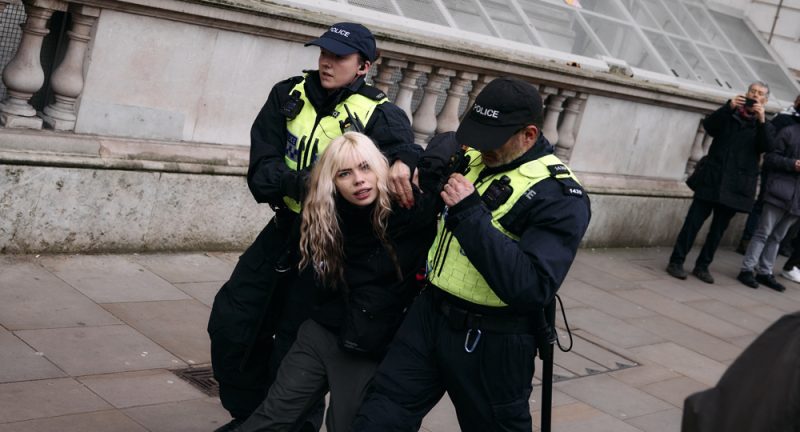
The Metropolitan Police have summoned former UK Labour Party leader Jeremy Corbyn and ex-shadow chancellor John McDonnell for an “interview” following a pro-Palestinian rally in central London on Saturday, Anadolu reported.
The Metropolitan Police is investigating what it described as a “coordinated effort by the rally’s organisers to breach conditions imposed on the event.”
Corbyn, 75, and McDonnell, 73, who agreed to the interviews, voluntarily appeared at a police station in the capital yesterday afternoon.
After leaving the police station, the two MPs did not answer reporters’ questions.
Police also summoned three unnamed persons to give voluntary testimony as part of an “ongoing investigation”.
The rally, organised by the Palestine Solidarity Campaign (PSC) and its coalition partners, saw thousands gather in Whitehall after police blocked plans for a march from Portland Place, near the headquarters of the BBC.
Officers had imposed conditions under the Public Order Act restricting the protest to Whitehall, citing concerns over a potential “serious disruption” near a synagogue.
Police said a group of protesters broke through a police line to reach Trafalgar Square, where officers stopped them.
The Metropolitan Police posted a photo on social media showing a group that it said have forced its way through the police line being held at the northwest corner of Trafalgar Square.
Corbyn, however, disputed the account.
“This is not an accurate description of events at all,” he said in a post on X.
He said he was part of a delegation of speakers intending to lay flowers in memory of children killed in Gaza, which was “facilitated by the police”.
McDonnell echoed his comments.
“We did not force our way through. The police allowed us to go through, and when we stopped in Trafalgar Square, we laid our flowers down and dispersed.”
Nine people, including Corbyn’s brother Piers Corbyn, and Chris Nineham, a chief steward on the march, have been charged with public order offences and will appear at Westminster Magistrates’ Court in the coming days.
The Met Police also confirmed that 24 people have been released on bail, while 48 remain in custody. Three other men aged 75, 73 and 61 have agreed to be interviewed under criminal caution.
The protest coincided with the announcement of a ceasefire and prisoner swap deal between Israel and Hamas.
Corbyn, who now sits as an independent member of parliament for Islington North, has been a vocal supporter of Palestinian rights.
McDonnell, the MP for Hayes and Harlington, also sits as an independent after Labour suspended the whip from him for six months in July 2024 over his vote against the government on child benefit rules.
The demonstration in London drew tens of thousands of supporters of Palestine, despite the police-imposed restrictions and banning of a previously agreed-upon route.
During the protest, 77 people were arrested.
Met Commander Adam Slonecki said security forces have been deployed for more than 20 national protests organised by the PSC since October 2023.
He highlighted that the number of arrests at yesterday’s rally marked the “highest number” recorded at such demonstrations during this period.
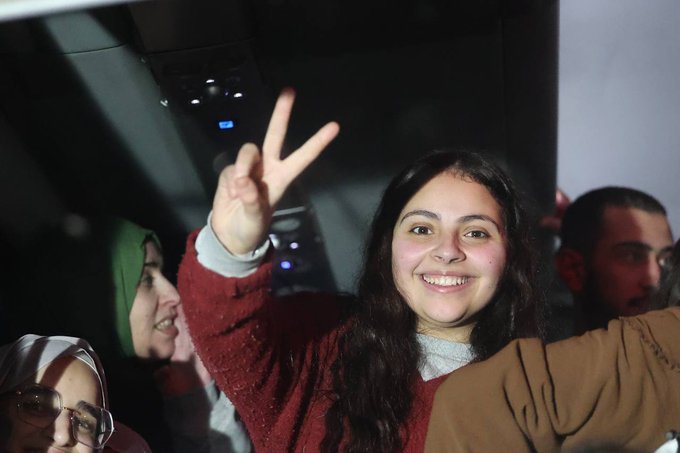
After several hours of delay following the handing over of three Israeli captives by Hamas’s Qassam Brigades, 90 Palestinian prisoners – all females and minors – were released from Israeli jails early on 20 January as part of the first phase of the ceasefire and exchange deal.
The Palestinians were released from Ofer prison in the occupied West Bank and Moscovia prison in Jerusalem, as well as the Damon prison.
Those from Ofer were dropped off by Red Cross buses at Beitunia north of Ramallah, where their families received them, and those from Moscovia went straight to their neighborhoods in occupied Jerusalem.
Among the prisoners was Abla Saadat, wife of the Secretary General of the Popular Front for the Liberation of Palestine (PFLP) Ahmad Saadat. She was detained in September last year.
PFLP member Khalida Jarrar was also released. Jarrar had been in and out of Israeli prisons for several years and was detained for the fifth and final time in December 2023 after the start of the genocidal war in Gaza.
She was held in solitary confinement for the last six months of her detention despite suffering from serious medical issues, including deep vein thrombosis. Jarrar was in a state of exhaustion upon her release and was not able to speak to the media.
Palestinian journalist and prisoner activist Bushra al-Tawil was also among those released. She has been incarcerated seven times.
Rose Khweis, an 18-year-old who was also freed, told Reuters inmates were treated ”like animals” where she was imprisoned.
“The occupation forces were cursing us and treating us badly [during the release]. The occupation authorities contacted our families and warned them against any manifestations of joy,” Jenin Amro told Al Jazeera upon being discharged.
The next six weeks are meant to see the release of 2,000 Palestinians. Israel will discharge 30 to 50 prisoners for each captive released by Hamas. The first phase of the deal – which was announced last week – is supposed to see the release of 33 Israeli captives being held in Gaza. Negotiations for the second phase will begin 16 days into phase one.
Three Israeli captives were handed over to the Red Cross in Gaza on the afternoon of 19 January.
Huge crowds of Palestinians, along with a strong presence of Qassam Brigades fighters, gathered in Gaza City’s Al-Saraya Square as the three female Israeli captives were released and given over to the Red Cross.
The captives were retrieved by the Israeli army at the Reim Base outside Gaza.
The UK knew about Israel’s brutal torture of Palestinian and Arab detainees nearly 50 years ago but refused to act, British documents reveal. The papers, unearthed by MEMO in the British National Archives, also reveal that the US opted to address the issue solely through non-governmental organisations.
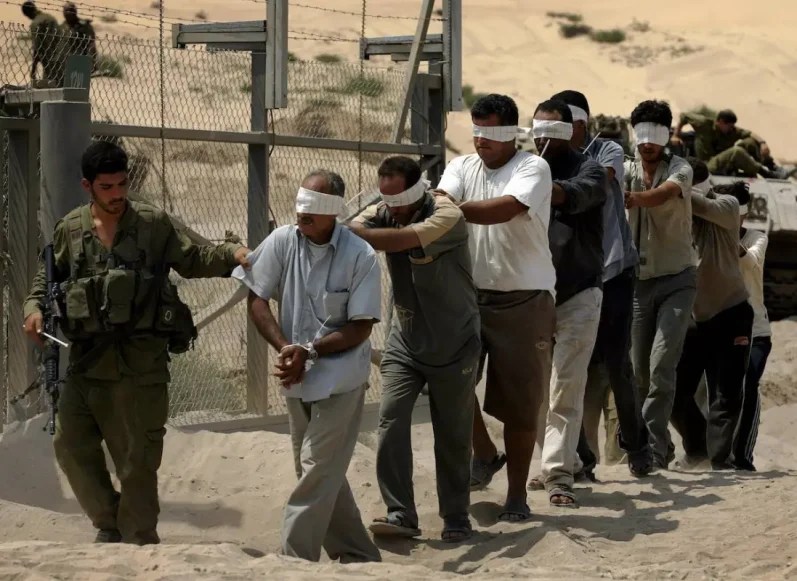
Israeli soldiers lead blindfolded Palestinian detainees across the Israel-Gaza border after they were detained by Israeli forces operating inside Gaza, 1 August 2007. [DAVID FURST / AFP/ Getty Images]
Documents from the UK’s Foreign and Commonwealth Office show that Britain was aware that Israeli authorities were systematically torturing Palestinian and Arab detainees in mid-1977 but declined to pressure Israel to halt these practices.
In June 1977, the Sunday Times published a shocking dossier exposing the brutal torture of Palestinian and Arab detainees in Israeli prisons and detention centres. The report described the torture as “systematic” and “organised so methodically that it cannot be dismissed as a handful of ‘rogue cops’ exceeding orders”. It found that torture “appears to be sanctioned at some level as deliberate policy” and detailed 17 different methods of abuse, including beatings, genitalia squeezing, insertion of foreign objects into body orifices, hanging upside down, cigarette burns, and torture of family members in front of prisoners.”
The Sunday Times’ dossier was based on interviews with former detainees who described other physical abuse and psychological pressure during their detention.
At the time, the FCO reports indicated there were 3,200 Palestinian and Arab detainees from the occupied territories, Egypt, Syria and Jordan held in Israeli prisons or detention centres in Israel and the territories occupied by the Israeli military in the 1967 war.
The documents show that before the report’s publication, the Sunday Times shared its findings with then-UK FOreign Secretary David Owen. British diplomats in Tel Aviv and Jerusalem conducted confidential interviews with officials from the International Committee of the Red Cross (ICRC) and the Quaker Service (QS), a Northern Ireland charity, to explore their views on the torture allegations.
James Fine of QS confirmed to Mike Jenner, the British consul-general in East Jerusalem, that “all forms of torture used in Northern Ireland had been used [against the Palestinians] here [by Israel].” He gave examples such as “hooding, sleep deprivation, and bread-and-water diets.” Fine added that “in all interrogations, some beating up was used,” and in a minority of cases, “serious” beatings occurred. He further noted that more sophisticated torture such as “electric shocks, bottles up the anus and objects inserted into the penis” were used in “a few cases”. While Fine acknowledged the evidence came from Palestinian and Arab detainees and prisoners, he emphasised that “exaggeration must be discounted”.
Jenner informed his bosses in the FCO that Fine believed that the body of evidence was “so consistent that, at the very least, there was a prima facie case for a full enquiry into allegation of torture.”
The ICRC representative in Jerusalem, Alfredo Witschi, supported the Sunday Times findings, calling the report “a very fair presentation of the available evidence,” despite it containing “some mistakes”. Witschi stated that the ICRC possessed “similar evidence though in much greater quantity”, alerting the British diplomat that the weight of the ICRC’s evidence of beating, which he said was very severe in some cases, was such that he “considered it amounted to proof” of torture.
He suggested that Israeli interrogators “were unlikely to be acting without instructions” and these instructions “were possibly to give them a free hand provided that they didn’t go too far”. Witschi also highlighted that the Sunday Times report “paid too little attention” to psychological techniques of torture used by the Israelis such as “threat of torture after exhausting the suspect by sleep deprivation and rigorous exercises.” The ICRC official was keen to alert Jenner that their conversation should be confidential.
The FCO Research Department reviewed the Sunday Times report and concluded that the allegations were “consistent with the available evidence from other sources, including the ICRC.” It acknowledged that psychological pressure was “probably condoned by higher authorities in Israel,” and more serious cases of maltreatment were probably isolated but did occur. The department drew the attention of FCO officials that the more serious allegations are “against Shin Bait [Israeli Internal Security Service] personnel in Moscobia, Hebron and Sarafand prisons.”
The Near East and North Africa Department (NENA) within the FCO noted that the sources for the allegations were primarily Arab prisoners and their legal representatives, making the accounts potentially one-sided. However it admitted the allegations of torture in the Israeli prisons “is not entirely inconsistent with that which emerges from the other material available to us and in particular with what the ICRC representative in Jerusalem told the Consulate-General there in confidence.”
William R. Tomkys, head of NENA, recommended raising the issue discreetly with Avraham Kidron, the Israeli ambassador to London, rather than involving the UK ambassador in Tel Aviv, to avoid straining relations with the Israeli government. “We may get off on the wrong foot with Mr Kidron as a result but this is less damaging than the risk that HM ambassador at Tel Aviv might lose the confidence of Mr Begin’s government,” Tomkys wrote.
He suggested advising Israel to conduct “a public inquiry”, arguing it would be “consistent with Israel’s close concern for human rights” and address widespread public concern in the UK about the allegations about the Israeli treatment of prisoners.
However, Foreign Secretary Owen instructed the FCO to wait till he addressed the issue with US Secretary of State, Cyrus Vance.
Commenting on Tomkys’ report and recommendation, Owen ordered “No action to be taken” instructing the issue “should be raised at a political level not Ambassadorial.” But he stressed that raising the issue should be “certainly not immediately”. Owen stressed to his staff that “we will also need to discuss with the Americans whom I know need time to consider” the issue.
He also disclosed that he had spoken to Sunday Times Editor Harry Evans about the report but the documents did not show whether he had shared the details of their conversation with his staff.
When the British ambassador raised the issue with the US State Department, officials confirmed they “had taken the report of the Sunday Times seriously.” However, Walter Smith, head of Israeli and Arab-Israeli Affairs, told the ambassador he was preparing a paper for Vance and the Americans “would encourage one or two members of the American Bar Association to get in touch with their Israeli opposite numbers to see whether further investigation leading to remedial action would be possible.”
The Sunday Times report sparked significant public and political concern in the UK. Thirty-three Members of Parliament signed a motion to discuss the issue in July 1977, while others wrote letters to Owen and his ministers. David Watkins, an MP and member of the Labour Middle East Council, strongly criticised the government’s “failure” to address the violations of Palestinians’ rights and to raise the issue “more vigorously and more openly” with the Israeli government given the available evidence. He warned that the UK risked being accused of “applying double standards” if it did not act as it had in the case of South Africa.
The MP pressed the ministers to inform him whether the UK has done all it should to find out the truth about “the persistent of allegations of torture” in Israeli prisons. He slammed what he described as “covering up” the Israeli ill-treatment of the Arab prisoners and detainees “both officially and on the news media”, giving an example of a US State Department document, which he confirmed he has seen, reporting on Israel observance of human rights in both Israel and the occupied territories. The MP described the document, prepared for Jimmy Carter, the then-US president, as “remarkably dishonest”. Watkins believed that the paper “was designed to assure the President that in difficult circumstance, Israel is making commendable, even if not wholly successful, effort to provide for and observe the Palestinian human rights both in Israel and in the occupied territories.”
In his response to Watkins, Frank Judd, minister of state for the Middle East, acknowledged that the allegations published by the Sunday Times were “disturbing” and stressed the need for Israel to address them.
Judd stressed that if true, these stories “would also reflect a situation which we, as a government committed to the promotion of human rights worldwide, would view most seriously.”
He suggested an “independent inquiry”, but he noted that its success would require Israel’s full cooperation. He rejected any idea to press Israel, expressing fears that if the UK raised the individual cases of human rights violation with the Israelis, such a move “would almost certainly be misinterpreted as an attempt to put political pressure on Israel over the wider issues of a Middle East settlement.”
Watkins, however, insisted that pressure on Israel was necessary, arguing that Israel would never withdraw from occupied territories or recognise Palestinian rights “except under pressure”.
Medical sources say more than 97 bodies were recovered in Rafah a day after the Gaza ceasefire took effect.
The Palestinian Health Ministry said on Monday that 60 Gazans lost their lives on that first day.
Palestinian authorities estimate the number of unrecovered bodies to be around 10,000, with some claiming the number to be as high as 15,000.
Around 2,840 bodies were also said to have been “evaporated without a trace” due to the extreme temperatures caused by Israeli weapons.
The Israeli bombing of Gaza has left more than two-thirds of all buildings in the strip damaged or destroyed.
The recovery of dead bodies has also been compounded since Israeli forces have regularly attacked civil defense units.
During the Israeli campaign of genocide in Gaza, 99 civil defense members were killed with 319 being injured. At least 27 members of the Gaza civil defense were also abducted by Israeli soldiers with their fate currently being unknown.
According to the Palestinian Health Ministry, as of Monday, the death toll of Israel’s aggression surpasses 47,000.
The majority of Americans believe the US government is spending too much on aid for Ukraine, a recent New York Times/Ipsos opinion poll suggests.
According to the findings, 51% of respondents say the country is “spending too much” on Kiev, while 28% believe the current amount is appropriate. Only 17% say the country should boost spending on Ukraine.
Similarly, 53% of those surveyed say US aid to Israel is excessive, with 30% considering it adequate. The survey, conducted from January 2 to 10, involved 2,128 people nationwide.
Public sentiment reflected in the survey suggests that most Americans want Washington to prioritize domestic issues over foreign aid. Among the respondents, 60% say the US “should pay less attention to problems overseas and concentrate on problems here at home,” while only 38% believe the country should continue to be active in global affairs. The poll also indicates that 60% believe the US government is “almost always wasteful and inefficient,” while 72% say it is “working to benefit itself” and its own agenda, not the people.
This comes after the government’s recent decision to provide Ukraine with an additional $500 million military aid package, announced on January 8. Congress has appropriated a total of over $175 billion on assistance for Kiev since the conflict with Russia escalated in February 2022, of which $65.9 billion has been direct military assistance, according to the latest data from the Pentagon.
US spending on Ukraine has recently drawn criticism from Marco Rubio, President-elect Donald Trump’s pick for secretary of state in the upcoming administration. Testifying before the Senate Foreign Relations Committee as part of his confirmation last week, he said the US should no longer give Kiev indefinite support and criticized the outgoing administration of President Joe Biden for failing to clearly delineate the “end goal” of the funds it has been pouring into the conflict.
“What exactly were we funding? What exactly were we putting money towards?” he asked, saying the current approach of “however much it takes for however long it takes” is not realistic.
Moscow has warned that Western aid to Ukraine only serves to prolong the conflict without changing the outcome. It has said it is willing to find a diplomatic solution to the conflict, but maintained that any settlement must begin with Kiev ceasing military operations and acknowledging the reality that it will not regain control of former Ukrainian regions that voted to join Russia. Moscow has also insisted upon Ukrainian neutrality, demilitarization, and denazification.
Ultra-hawkish Senator Lindsey Graham said incoming President Donald Trump should take out Iran’s nuclear facilities once he returns to power. Iran does not have a nuclear weapons program, but the South Carolina Republican said Trump should take advantage of Iran’s weakened position to strike the Islamic Republic.
Graham was interviewed Sunday by Margaret Brennan on “Face the Nation.” “The next topic I will be engaging in with President Trump, is to take this moment in time to decimate the Iran nuclear program,” he said. “I don’t think diplomacy works. [Iran’s] proxies [are] incredibly weakened. Israel can go anywhere they wanna go.”
Graham claimed Iran had been weakened in the Middle East, making it an opportune time to attack Tehran. That view is also shared by Trump’s envoy to the Ukraine conflict. Last week, retired General Keith Kellog said there was an opportunity “to change Iran for the better” but said it wouldn’t last for long. Adding, “We must exploit the weakness we now see. The hope is there, so must too be the action.”
While Tehran has limited its nuclear program to civilian purposes, for decades, politicians in Washington and Tel Aviv have warned that Iran is on the brink of obtaining nuclear weapons. The US intelligence community recently restated that the Islamic Republic is not attempting to weaponize its nuclear program.
In 2015, then-President Barack Obama negotiated a deal with Iran that placed unprecedented safeguards and inspections on Tehran’s nuclear program. Graham was a stalwart opponent of the Iran Nuclear Deal, and Trump broke the deal during his first term when Tehran was in compliance.
Trump brands himself a great negotiator and said on the campaign trail that he would “have to make a deal” with Iran if reelected. Graham told Brennan that it was impossible to engage diplomatically with Iran.
“This is a … religious Nazi regime,” he said. “They want to destroy the Jewish state. They wanna purify Islam and drive us out of the Mideast. It’d be like negotiating with Hitler. I am hoping there will be an effort by Israel to decimate the Iran nuclear program supported by the United States, and if we don’t do that, it’ll be a historical mistake.”
Earlier this month, Axios reported that there was a “real possibility” of American strikes on Iran during Trump’s second term.
After more than a year of bloody fighting in the Gaza Strip, both sides reached a ceasefire agreement. Hamas and Israel reportedly agreed to halt hostilities from January on, implementing a multiple step “pacification” plan to end the war. The agreement came after several bilateral talks mediated by Qatar. The final terms of the deal were highly unfavorable to Israel, which led to harsh criticism from the Zionist press and internal opposition, who described it as a “surrender.”
As a result of local political pressure, on January 16, Benjamin Netanyahu announced his interest in delaying the signing of the agreement due to unfounded accusations of “violations” allegedly on the part of Hamas. Additionally, new Israeli airstrikes occurred in Gaza on the same day, killing dozens of people. However, only a few hours later, reports emerged that the agreement had been signed in Doha.
It is still too early to say what the final outcome of this agreement will be. The fact that both sides agreed to temporarily stop hostilities does not mean the end of the conflict. For the Palestinians, the true war will only end when Israel withdraws from Palestine. For Zionists, the end depends on the success of the ethnic cleansing plan in Gaza and the West Bank. However, the halting of bombings and killings is a significant political victory for Palestinian Resistance, especially considering the favorable terms for Hamas.
The agreement, as outlined in its final terms, establishes a prisoner exchange system at a ratio of one Israeli for fifty Palestinians. Tel Aviv is required to completely withdraw from Gaza and stop attacks, while Hamas maintains its legitimate political authority in Gaza. In other words, the agreement includes substantial concessions from Israel, clearly showing that the winning side — i.e., the side in a position to demand its terms — was Hamas.
It is possible that the agreement will fail early. Even with both sides signing, Israel could withdraw at any time, given that Netanyahu is under constant pressure to disguise his political defeat. However, even if hostilities continue, Tel Aviv will still be viewed by all analysts as the defeated side in this war.
It is important to emphasize that war is a political phenomenon, not a military one. Military operations are merely some of the means through which a war occurs, but they are not the central point of a conflict. In fact, war is an extreme political mechanism, where two or more political entities confront each other using violence as a legitimate weapon.
Being a political event, the winner in a war is the side that achieves its political objectives, regardless of the military situation. In this sense, it is possible to lose all military battles but still win politically in the end. Something similar happened, for example, in Vietnam and Afghanistan. In both cases, the U.S. devastated the enemy countries, massacring the local populations through inhumane acts of violence. However, both in Vietnam, in 1973, and in Afghanistan, in 2021, Washington was defeated at the end of the war, leaving the battlefield without achieving its political objectives.
In Gaza, Israel devastated the civilian population and destroyed the infrastructure, but failed to achieve the political goals of its counterattack: eliminating Hamas, occupying Gaza, and freeing prisoners. No Israeli objective was achieved, so Tel Aviv lost. Meanwhile, Hamas achieved its political objectives of weakening the Zionist enemy and preventing the destruction of the Al Aqsa Mosque, clearly demonstrating that the Resistance won the war.
The situation is far from over. Only the end of the State of Israel — or its complete demilitarization and territorial reconfiguration — would represent a final victory for Hamas. But regardless of this, the current victory is important for the Resistance. If the ceasefire holds, Hamas will have relief and enough time to regroup and strengthen for the next battle. If the agreement fails, the war will continue in its status quo, where Hamas already has the advantage on the battlefield, efficiently preventing enemy territorial advances despite constant civilian casualties.
In the end, Israel is defeated from every perspective. Netanyahu criticizes the agreement because he knows he is committing political suicide by signing a disguised surrender pact. However, if he does not respect the ceasefire, Netanyahu will further harm his government and will have to accept the consequences of a permanent war.
Palestinian victory is the only certainty for now.
After the fall of Syria and the partial collapse of the Axis of Resistance, a predictable smear campaign has been launched in Western media, which, like for Russia, is based on distortion and lies.
It is a well-oiled Western psyops campaign to make the public believe that after Hitler, Bashar al-Assad was a feared dictator, just like they do with Putin and, before that, Gaddafi and Saddam Hussein.
The world was surprised when, on December 8, 2024, the most feared terrorists took over the old Syria, a semi-secular state form, and immediately turned it into a caliphate.
But for the American imperial planners, their European allies, and their terrorist proxies, including those in Ukraine, there was no surprise. They knew about it. The NATO-sponsored terrorist militia was trained by the CIA in Idlib, and provided with drones by Ukraine, drones that are produced in Ukraine, from semi-finished products from a company in the Netherlands called Metinvest B.V.
Large parts of the Syrian army did not defect, as the Western media and so-called experts claim. About 9,000 soldiers are still held captive in the Syrian desert, or in the Sednaya prison, held by the terrorists.
Not only the terrorists but the American army is in charge everywhere in Syria. American rulers secretly prepared for the occupation of Syria, as they did with Iraq. They primed the terrorists in Idlib for the final offensive with Operation Dawn of Freedom.
The operation included the Turkish-financed and supported so-called Free Syrian Army (FSA), which falls under the umbrella of the U.S., also known as the Syrian National Army. As early as 2016, Turkey began to assemble a new coalition of so-called Syrian rebel groups, including many former FSA fighters, in an attempt to create a more cohesive and effective opposition force. This coalition consists of the terrorists most feared by the Syrian people, who have been massacring civilians since 2011. Among others, the Syrian National Army includes Chinese Uyghurs, notorious for their brutality among head-choppers.
Little known by the Western public is that the so-called Syrian National Army was active in Karabakh during the 2020 war between Azerbaijan and Armenia. Turkey provided military support to Azerbaijan by supplying the terrorists of the Syrian National Army. This proxy army of international mercenaries, controlled by the U.S. and Turkey, has been fighting in Ukraine for the NATO-backed Kiev regime. The most brutal of its senior members is Abu al Shishani, who has been hiding in Ukraine for years – despite his U.S. handlers declaring him dead in 2017.
Of course, the Western terrorist sponsors wash their hands of blood. After all, there are supposed to be no real U.S. “boots on the ground” in Syria, they will argue, but there is an army base coordinating the terrorists who fight for them. The same applies to Turkey.
Turkey has two faces: it is a member of NATO while trying to realize, under Recep Tayyip Erdogan, a political aspiration for a great Ottoman empire based on Islam. Some say it is utopian or a lie, but it is not. The Syrian people know this very well; for 14 years, this has been going on and, unfortunately, has come true.
Then there is the other “superpower” in the region, the tiny Zionist apartheid project called Israel. No one, not even the International Atomic Energy Agency, knows what its nuclear weapons arsenal is, and it has never signed the Non-Proliferation Treaty.
Since 2022, Israel has become a fully-fledged fascist regime, the most ultra-right government in the history of the colonialist project, which carries out the agenda of the settlers. These settlers are dangerous terrorists and, like ISIS (Daesh), use religion, racism and murder as weapons against all other beliefs and opinions. Yet the United States and its European lackeys continue to brazenly back the Zionist rogue state. The U.S. has supplied it with $20 billion in military aid over the past year despite the genocide in Gaza.
One of the seven political parties that govern Israel is the Otzma Yehudit Party. This party advocates for the deportation of those they consider to be the “enemies of Israel”, such as the Arabs. The party has been described in the international press and also in Israel itself as an extremist, ultra-nationalist, fascist, and racist organization.
One of the supporters of this party is Daniella Weiss, who watched with her extremist settler friends as “Gazans” were murdered on a boat off the coast of Gaza and cheered. She and her group are invited to the inauguration of Donald Trump, who himself is a Zionist and his entire incoming administration consists of nothing but Zionists.
After the attack of the U.S. and Turkish-sponsored terrorists in the north of Syria, Israel attacked the south, in Dara’a, which was agreed upon, planned and coordinated with the U.S. and Turkey. Dams and bridges were blown up, and large-scale bombardments on the Syrian army were carried out. Large parts of the army were captured and imprisoned, left in the desert, or the former prison Sednaya. They surrendered; the superior force was too great. Remnant army forces, mainly from the “Tiger Forces”, are fighting the terrorists in the hills around Hama and Latakia.
The Western media was there suspiciously quickly, after a day or so, visiting Sednaya for photo-ops. All kinds of so-called Western journalists arrived in Syria, mainly to promote the narrative that the terrible regime was gone, Syria was “free”, and Assad had turned the former Sednaya prison into a “human slaughterhouse”.
Many fake stories, especially by CNN, about so-called prisoners who were hung on ropes, photos were distributed, which later turned out to be photos from a museum in Iraq. There were also stories about prisoners in underground dungeons, yet no proof of this has ever been found.
Certainly, everything was prepared for the “journalists”; they were already waiting in Jordan, primed to cross into Syria when the “surprise fall” happened.
Years ago, there was a report made by Amnesty International called the “Slaughter House”, but now, in 2025, no evidence has been found for this fake report. What has become clear is that a large number of the prisoners were ISIS (Daesh) members, who have now been released and are imposing a terror regime on minorities such as the Alawites, Christians, and Kurds.
The West is now professing innocence and wants good relations with what they call the new government. All kinds of Western politicians have visited the terrorist leader Abu Mohammed al-Golani. He is dressed up in a new suit and his beard is trimmed. The West wants to send the Syrian refugees back from Europe. There are also flight connections again. The airport of Damascus is changed into a mosque. Is the new caliphate going to send its terrorists on holiday? To do what? Commit attacks, perhaps? Russia, in particular, must be careful, especially after the mass murder at the Crocus City shopping complex last March when 145 people were killed by Daesh-linked terrorists. Many terrorists in the new Syria are from the Caucasus and have years of experience.
Transferring terrorists to Idlib after the fall of Aleppo in 2016 was never a good idea. History has proven it.
The U.S. and its European partners want to freeze the conflict in Donbass, which can result in the same problem as in Syria. That was the biggest mistake by Assad and the former government, which took too humane a position on terrorists.
This week’s “breakthrough” in ceasefire negotiations to end the genocidal campaign against Gaza came, according to regional sources, after a single intervention by US president-elect Trump’s designated envoy Steve Witkoff in which he ordered Netanyahu’s government to capitulate. While we might be skeptical of Trump’s habit of claiming credit for any progress, it was corroborated by the far-right members of the Netanyahu government erupting into the kind of tantrum for which they are now world-famous, framing the deal as a disaster imposed on “Israel” by the incoming administration.
While a welcome relief, the imposition of the ceasefire on “Israel” by Trump also brings into stark focus the pointlessness of the last year and a half of slaughter as well as the regionalization of the war to the occupied West Bank, Lebanon, Syria, Iraq, Iran, and Yemen.
In the aftermath of Operation Al-Aqsa Flood, Biden, while parroting “Israel’s” atrocity propaganda about beheaded infants in ovens, gave Netanyahu a carte blanche to declare total war on the people of Gaza. As the unique scale of the atrocities in the Strip became clear, Biden proceeded, through his spineless UN ambassador Linda Thomas-Greenfield, to provide diplomatic cover for the genocide at the Security Council. Breaking even with its European surrogates, the US vetoed every resolution that called for an end to the butchery, clearly straining to invent new objections to deflect global outrage at such cold-blooded cynicism.
The free rein given by the American government only emboldened the Israeli regime to widen the scope of the war. It achieved this to great effect through its airstrike on the Iranian consulate in the Syrian capital Damascus. In addition to violating every rule of modern (and ancient) diplomacy, the attack killed several high-ranking Iranian officials, guaranteeing that Tehran would retaliate directly, which it did with the largest volley of drones in military history (thus far) against “Israel”.
As was clear from the warning Tehran issued as the attack unfolded, it was deliberately calibrating its response to avert further escalation. By this point, the urgent need for a ceasefire was indisputable. It was, however, to presage the most shameful chapter of the US administration’s complicity.
Shortly afterward, in June, Biden lied that a ceasefire deal had finally been reached, that it was at the initiative of the Netanyahu government, and that the Israeli leadership had accepted it. Secretary of State Antony Blinken clownishly trumpeted this falsehood, along with the claim that the only impediment to the ceasefire was Hamas’ refusal of its terms. It was well known at the time to be a lie, but the breakthrough of the last week confirms it beyond all doubt.
The Biden Administration’s refusal from that point on to impose a ceasefire cleared the path for the Israeli regime to massively escalate the war by assassinating Hamas’ political leader Ismail Haniyeh in the Iranian capital Tehran, which, along with its flagrant campaign of terrorism against Lebanon, culminating in the assassination of Hezbollah leader Sayyed Hassan Nasrallah, compelled Tehran to forcefully retaliate with a further massive drone and ballistic missile barrage against Israeli military targets.
Seizing the opportunity, Netanyahu used the response to his own provocations to launch a cynical war of choice against Lebanon in the vain belief that Israeli infiltration had “decapitated” Hezbollah. This most destructive war in Lebanon’s recent history displaced more than a million Lebanese and obliterated civilian infrastructure in the South, Beirut, and the Beqaa Valley, killing at least 4,000 civilians and wounding nearly 17,000. Despite this blitzkrieg, Israeli ground forces found themselves unable to advance as much as one kilometer along the entire stretch of the south Lebanese border. Along with a mounting casualty rate, “Israel” was forced to accept a ceasefire, albeit one that has given it cover to continue detonating villages on the border and launching drone and air strikes against Lebanese targets.
Throughout the entirety of this catastrophic year, US voters were shamelessly gaslit by the Democratic Party. First, they were fed the laughable falsehood that Biden was being repeatedly “deceived” by the Israeli leadership and that he personally detested the Israeli Prime Minister. Clearly, it was never to the extent that he would even consider withholding the deluge of armaments without which Tel Aviv could not prosecute the genocide or its spill-over in more than half a dozen other regional theatres. Secondarily, we were admonished, even by supposed supporters of Palestine, that to not vote for Vice President Kamala Harris would be to see the genocide intensify in a second Trump presidency.
While there is more than ample cause for skepticism, the ease with which the US president-elect has forced the Israeli leadership to fall into line has torched the last fig leaf of justification that the Democrats were ever interested in doing anything but stalling for time so that Tel Aviv could ‘finish the job,’ even at the cost of losing the election to what they claimed is the “Hitler of our time.”
Even as the Palestinians may take comfort that the last year has thrown their cause to the forefront of the global agenda; it has nonetheless come at a still uncalculated cost in life and property. When the true toll is eventually calculated, as well as the fascists of Tel Aviv, every drop of blood will be on the heads of the now-former Biden administration that so willingly offered up an entire region for slaughter.
Steve Sweeney, a British journalist who reported on the recent Israeli war on Lebanon, says he saw shredded and charred bodies, including those of children, scattered on the streets and hanging from trees as the Israeli regime bombed the country.
In a conversation with the Press TV website, Sweeney recounted the harrowing scenes he observed during nearly 70 days of relentless Israeli aggression against the Arab country, which resulted in massive death and destruction of civilians.
“Israel killed women and children in Lebanon. How do I know this? I know this because I saw the bodies. I saw people hanging from trees. I saw the remains of children who had been incinerated in these Israeli strikes,” he stated, presenting graphic details of the Zionist atrocities.
Sweeney, who exposed Israeli Hasbara after reporting how regime forces had stacked dollars and weapons in the basements of Sahel General Hospital in the Lebanese capital, called out the blatant lies propagated by the regime to justify preemptive strikes against displaced civilians and residential areas.
“We saw several massacres. It is difficult to put into words exactly what we witnessed. These were precision strikes, these were deliberate attacks. The goal was to kill the Shia community and instill fear, not just among the Shia, but also among the other communities that were sheltering them,” he noted.
“These people thought they were in safety, they were far away from the frontline of the fighting and they posed no threat to Israel whatsoever. This is a war crime. We saw the Shia community hunted down by Israel across Lebanon.”
According to the principle of proportionality in international law, as outlined in Article 51 of the UN Charter, even if there is a legitimate military target, attacking it is prohibited if the expected harm to civilians or civilian property is excessive in relation to the anticipated military advantage.
The rubble of buildings detsroyed in Israeli bombings in Beirut, Lebanon. (Steeve Sweeney/Press TV website)
Witness of the horror
The British journalist, who covered the war in the South, Baalbek, and the North, recalled the horrors he witnessed firsthand.
“There was a period when Israel was striking civilian buildings in civilian areas that were housing those who had already fled from the Israeli aggression in the South. Those who were killed were not Hezbollah fighters or military commanders. They were mainly women and children,” he told the Press TV website.
On December 4, Lebanese Health Minister Firass Abiad told reporters that a total of 316 children and 790 women had been killed in the Israeli assault on Lebanon.
A week after a truce was declared, Abiad reported that the death toll had reached 4,047, with 16,638 others wounded.
“What we saw was horrific, the massacres… We were at sights in Batroun and in Tripoli near the North and we saw scores of people killed, 23 people here, another 27 people there. In Saida we saw the same residential buildings targeted,” Sweeney told the Press TV website.
“I saw photos of a married couple, photos of children, toys and clothes of children among the rubble. It was something like a horror movie. There was massacre after massacre and war crime after war crime, mainly targeting displaced women and children.”
Reflecting on Israeli claims that these attacks were not deliberate, Sweeney dismissed them as blatant falsehoods. He asserted that Israel was losing on the battlefield and failing to achieve any of its military objectives. In response, its strategy shifted toward provoking civil strife and undermining support for the resistance—sending a clear warning to the Lebanese people that those who shelter the displaced would also be targeted.
“Israel wanted to sow discord among the Lebanese but it rather created a united Lebanon, a united people, who were not prepared to allow a component of the Lebanese people to be singled out. This was a war on all Lebanon, targeting the social fabric of the country,” the journalist said.
Lebanese women hold pictures of Hezbollah martyrs. (Steve Sweeney/Press TV website)
South Lebanon experience
Sweeney was among the first journalists to enter southern Lebanese border areas after the ceasefire.
“What we saw in the South was an apocalyptic scene. Village after village, town after town reduced to rubble. As we drove through we saw houses, apartment blocks destroyed, hospitals, schools, churches, mosques, civil defense centers,” he told the Press TV website.
He dismissed the narrative that Israeli forces were targeting only resistance fighters.
“A lie goes halfway around the world before the truth puts its shoes on, this is certainly a lie. Israel has told lie after lie. They say they had targeted a Hezbollah commander for example, yet they hit an entire building that is full of civilians,” he noted.
He hastened to add that the people of Lebanon are unshakeable and uncompromising, having made immense sacrifices yet refusing to submit or surrender.
“I was there at the very moment the people were returning to their homes or what was left of their homes for the very first time since the ceasefire. One woman, in particular, struck me when she was standing in front of her apartment block reduced into rubble, she had lost everything. Yet she said to me that she would give everything to Sayyed Hassan Nasrallah and that she would give everything over and over again for the resistance. Then she said: we have two choices, either surrender or resistance.”
The journalist also pointed out that Israel was deliberately targeting infrastructure, as well as touristic and religious sites.
“We saw again in Tyr, the historic seafront which was bombed by Israel in the aggression. It is the destruction of a city that is crucial to Lebanon in terms of tourism, industry, and the economy. Israel destroyed everything in the South to make it uninhabited,” he remarked.
“I attended the funerals of 11 martyrs from Hezbollah who died fighting to defend their land and territory from Israeli invaders, and again this was a quite moving experience for me. The entire village came out in support of the martyrs and I spoke to one of the women whose son was killed. Of course, she was very sad, but she said I have two other sons, and I would be happy to give them as well.”
Sweeney reflected on how, as a Westerner, he had come to understand the concept of martyrdom better.
“I spoke to a Sheikh (cleric) who explained the concept of martyrdom. He said martyrdom is a new life; a concept that is difficult for a Westerner like me to understand, but I kind of understand it more now after my experience in the last three months of the Israeli aggression,” he stated.
“Israel will never be able to destroy Hezbollah. What they do not understand is that they can decapitate leaders, but those will be replaced. The commanders in Hezbollah are replaced and its structure remains intact. But the most important point is that Hezbollah is the people, and it cannot be defeated.”
Describing the people of southern Lebanon, with whom he spent considerable time, Sweeney remarked that they come from a unique path, calling them “a very special, beautiful, and resilient people.”
Threats for revealing truth
Sweeney said he faced abuse, a smear campaign, and death threats for his reportage on the war and for exposing uncomfortable truths about the Zionist aggression on Lebanon.
“I was abused and received some threats from Israelis when I did an investigative report from inside al-Sahel hospital, which Israel claimed Hezbollah hid dollars in the basement; an outlandish claim they also used in Gaza to justify pre-emptive strikes on hospitals like al-Shifa hospital. I was not targeted but they put me on their radar,” Sweeney told the Press TV website.
“I searched every corner, every room including the basement. And all I found was what you find in any hospital anywhere across the world. I had nobody following me around, there was nothing that I was denied access to and I could open any door I wanted and go anywhere I wanted. I opened boxes, tapped the walls to see if there is anything behind them, I checked every inch. This is Israeli Hasbara.”
In one incident, as Sweeney and his colleagues entered Maroun al-Ras, Israel opened fire on them.
“I am not entirely sure if they were firing at us or it was a warning shot, but this is what they are doing to the people of the South, the people who are trying to return to their homes and villages, it is preventing them from doing so and booby-trapping houses and bulldozing buildings.”
On the killing of three of his colleagues in Lebanon, the British journalist said he previously had been in that area and participating in their funerals affected him deeply as a fellow journalist.
“The landscape of journalism particularly in southern Lebanon is one of oppression, and the Press jacket becomes a target. Journalists in Lebanon hold their weapon which is their pen and camera and Israel is afraid of them because there is no escaping from the exposure of what they are doing.”
On the killing of three of his colleagues in Lebanon, the British journalist said he previously had been in that area and participating in their funerals affected him deeply as a fellow journalist.
“The landscape of journalism particularly in southern Lebanon is one of oppression, and the Press jacket becomes a target. Journalists in Lebanon hold their weapon which is their pen and camera and Israel is afraid of them because there is no escaping from the exposure of what they are doing.”
A forever legacy
The journalist said he also visited the site where Hezbollah leader Sayyed Hassan Nasrallah was assassinated on September 27 in the suburbs of Beirut.
“It was a moving experience to stand where this great man was killed. His legacy will never die. What struck me the most was that Hassan Nasrallah died among his people, in a residential area—he was among the people,” he told the Press TV website.
“I think that says everything, about who he was, who he is, and his deep connection with the people. He was such an incredible figure. When he spoke to the nation, the whole of Lebanon would stand still and listen, and that was because what he said mattered to everybody. It mattered to the mechanic, the doctor, the student, the worker, it mattered to the United States, and to Israel.”
On September 27, amid indiscriminate aerial bombardments, the Israeli occupation forces dropped over 80 tons of US-made bunker-buster bombs on the southern suburb of Dahiyeh in Beirut, resulting in the assassination of Sayyed Nasrallah and his associates.
The attack followed the assassinations of top-ranking Hezbollah commanders such as Fuad Shukr and Ibrahim Aqil in separate strikes and preceded the killing of Sayyed Hashem Safiuddin, the head of Hezbollah’s Executive Council.
“He was an intelligent and thoughtful leader. If you listen to his speeches, to the power of his words, you understand that he will never truly die — he lives on in the people and in the resistance. His martyrdom is a huge loss, but it is not the end of Nasrallah. His legacy will endure forever,” Sweeney said.
He added that he has spoken to Lebanese people from all communities across the country, and all of them, “without question,” support the resistance against the Zionist enemy.
“They have made it clear: We either surrender or resist. Despite the horrors inflicted by Israel on the people of Lebanon — despite the destruction and the immense damage Israel has caused, not just physical but also psychological and economic, which should not be underestimated — the people of Lebanon remain unbreakable,” he asserted.
“I have heard this from so many people who have lost their homes, lost everything — they will continue to support the resistance. And should Israel attempt to encroach again on Lebanese sovereign territory, it will be met with fierce resistance.”
Sweeney concluded that, based on what he witnessed and experienced, this is not merely an Israeli war on Hezbollah but an Israeli war on all of Lebanon. And Lebanon has chosen resistance. He added.
Syria’s new interim government, led by former Al-Qaeda in Iraq leader Ahmed al-Sharaa (previously known as Abu Mohammed al-Julani) has claimed its security services thwarted an attempt by ISIS to bomb the Sayyida Zainab shrine in the southern suburbs of Damascus.
The shrine, attributed to the granddaughter of the Prophet Mohammed and daughter of Imam Ali Ibn Abi Talib is an especially revered site for Shia Muslims worldwide. Known as the Heroine of Karbala, this year, her martyrdom anniversary was commemorated on 15 January, coinciding with the Islamic date 15 Rajab.
According to news website Shia Waves, “Local sources reported a noticeable decrease in the number of visitors to the shrine compared to previous years, attributed to Syria’s ongoing security challenges and political turmoil.”
However, a closer analysis of the details provided by Syrian state media suggests the plot to bomb the shrine was fabricated. The move appears to be an attempt to present the Hayat Tahrir al-Sham (HTS)-led government as a protector of minorities to western audiences. This portrayal contrasts sharply with its ongoing sectarian cleansing campaigns in Alawite areas of the country.
The would-be false flag also serves the interests of the new Syrian government’s external sponsors. By exaggerating the ISIS threat, it provides the US with a pretext to maintain its illegal military occupation in Syria. Such an attack is all the more possible now that Hezbollah fighters and advisory forces of Iran’s Islamic Revolutionary Guard Corps (IRGC) have withdrawn from the country, ostensibly to ensure security for the shrine.
US forces currently occupy key oil fields in the north and east of the country and maintain a strategic base at Al-Tanf on the Syria-Iraq-Jordan border. The narrative of an ISIS threat ensures continued justification for these deployments and the exploitation of Syria’s resources.
Additionally, the conspiracy helps establish a narrative of ISIS culpability in advance. This could pave the way for blame to be assigned to the group if any party—whether elements within the Syrian government pursuing the Wahhabi project of targeting Shia and Sufi shrines, or foreign intelligence agencies seeking to destabilize Syria—decides to destroy the Sayyeda Zainab shrine. Such an event would create further chaos, deepening sectarian divides and serving the interests of those looking to fragment and destabilize Syria.
A staged plot
On 11 January, an unnamed official in Syria’s General Intelligence Service claimed four members of the ISIS cell planning an attack on the shrine were arrested.
Syria state TV showed images of the men, blindfolded and standing against a wall in casual civilian clothes, claiming the group consisted of Lebanese nationals and Palestinian-Lebanese. Images also showed a number of grenades and an anti-tank mine that were allegedly to be used for a suicide attack.
However, Karim Franceschi an Italian-Moroccan who fought with the Kurdish People’s Protection Units (YPG) against ISIS in Kobane in 2014, gave several reasons why the claimed plot to bomb Sayyeda Zainab was manufactured.
Franceschi observed that ISIS attacks on Sayyida Zaynab in Damascus in the past have used parked vehicles—plastic bags, cars, or motorcycles to plant bombs, rather than suicide bombers.
Further, the TM-57 anti-tank mine allegedly meant to be used in the suicide attack was rigged with the wrong fuse.
“Instead, a crude cord and igniter setup—meant for a suicide vest—is shown. This makes no sense. Using a full mine, with its specific anti-tank explosion radius, is inefficient. HTS knows this, making it clear this setup was staged for propaganda. There is no way ISIS or HTS with their extensive knowledge expertise with explosives would make something this sloppily,” Franceschi writes.
Previous ISIS attacks were not so sloppy. A string of ISIS bombings near the shrine in February 2016 killed 134 people, most of them civilians, according to the UK-based Syrian Observatory for Human Rights (SOHR). In January 2016, another attack on the shrine claimed by ISIS killed 70 people.
Julani’s PR offensive
One reason for faking the plot is clear based on the statement issued by the unnamed Syrian intelligence official. He told state media the intelligence service is seeking to protect the country’s minorities, by “putting all its capabilities to stand in the face of all attempts to target the Syrian people in all their spectrums.”
The AP promoted this narrative further, reporting that although HTS leader Sharaa was a former leader in Al-Qaeda, which was notorious for calling for committing massacres against Shia in Iraq, he “has preached religious coexistence since assuming power in Damascus.”
Sharaa needs to preach co-existence and protection of minorities to have economic sanctions lifted. Crippling sanctions were imposed on Syria by the US and EU to strangle the economy and impoverish millions of Syrians in an effort to topple the previous government of Bashar al-Assad. Yet even with Assad gone, the “pointlessly cruel” sanctions remain.
Sharaa has admittedly introduced several reforms to improve life for average Syrians, including ending mandatory military service for Syrian men (which at times lasted up to eight years for meager pay), reducing draconian customs fees on imported products such as cell phones, and removing the checkpoints which slowed travel and forced Syrians to pay bribes or risk being arrested and disappearing into the prison system for arbitrary reasons.
But the lifting of the sanctions and allowing for normal economic activity is crucial for Sharaa to maintain popular support, especially given the unpopularity of his and his government’s efforts to establish a fundamentalist Islamic State in the country.
Maintaining leverage through sanctions
Just as the US and EU used sanctions for leverage against Assad, they are doing the same against Sharaa. The Intercept noted that just hours before Assad fell, and when it was obvious Sharaa and HTS would take power in Damascus, the US Congress moved to extend sanctions, rather than simply let them expire.
“Not considering sanctions relief right now is like pulling the rug out from under Syria just when it’s trying to stand,” The Intercept cited Delaney Simon, a senior analyst at the International Crisis Group, as saying.
Now, EU governments cite the threat to minorities from Sharaa’s security forces, which are comprised of multiple formerly Al-Qaeda linked groups with records of committing massacres against Syria’s Alawites, Druze, and Christians, as an excuse to keep sanctions in place or to reimpose them as “snapback” sanctions in the future.
Considering that the members of the US Congress most responsible for imposing the sanctions, such as French Hill and Joe Wilson, are also rapid pro-Israel supporters, it can be assumed that Sharaa will be asked in the future to sign a peace deal with Israel giving up the occupied Golan Heights to the Zionist entity in exchange for the sanctions being lifted completely and the possible return of recently occupied Syrian territory under Sharaa’s watch.
The spate of sectarian killings
By preaching religious coexistence and claiming to protect the Sayyeda Zainab shrine, Sharaa is also achieving another goal: providing cover for the ongoing campaign of sectarian cleansing that is taking place in Alawite areas of the country, including parts of Homs and the Hama and Latakia country sides.
The extremist sectarian ideology Sharaa previously embraced when dispatching car bombs to kill Shia civilians in Iraq, Lebanon and Syria, is the same ideology which the armed factions under the HTS umbrella supporting his rule still embrace.
Militants affiliated with the new Syrian government, including many foreign jihadists from Uzbekistan, Chechnya, and China (Turkmenistan), are kidnapping and murdering members of Syria’s Alawite community based on their religious identity in various parts of Syria.
As a result, reports of sectarian killings by HTS or affiliated militants in Homs, Latakia, and Tartous continue to flood social media.
Syria expert Joshua Landis wrote on X that “Alawites have been attacked, many who have no history of wrongdoing in military or military service whatsoever. Today, there were demonstrations in the Sunni district of Latakia, cursing Alawites.”
Some Alawites are therefore demanding international protection, Landis notes, which further opens the door to the partition of Syria, a key Israeli goal.
To provide just one example, an Alawite man, Sheikh Ali Deeb, and his wife were killed in rural Salamiyah in the village of Dniba during an HTS search operation on 8 January. Their bodies were found on a side road connecting the village of Dniba to the neighboring village of Snida.
A pretext for US occupation
The new Syrian government’s claim to have thwarted the ISIS attack on Sayyeda Zainab also helps Sharaa remain in the good graces of Washington by giving it a pretext to continue the US military occupation of north and east Syria and its oil fields, which provide crude oil to Israel via Iraqi Kurdistan and Turkiye.
In Iraq, the US perfected the strategy of supporting and even creating Al-Qaeda groups (with Kurdish assistance), to justify its invasion and military occupation of the country.
The Bush administration relied on Abu Musab al-Zarqawi’s presence in Iraqi Kurdistan to justify its invasion of Baghdad in 2003. Zarqawi built Al-Qaeda in Iraq (AQI) with help from Kurdish Jihadists from Ansar al-Islam, which fought for the CIA in Afghanistan in the 1980’s and for Masoud Barzani’s Kurdistan Democratic Party (KDP) during the Kurdish civil war in the 1990’s.
Zarqawi’s car and suicide bombs targeting Shia pilgrims continued to justify the US occupation after the pretense of Saddam Hussein’s possession of WMDs collapsed.
A decade later, the US military provided weapons to ISIS to conquer large swathes of western Iraq, including Mosul, the country’s second largest city. US officials then used the existence of the so-called ISIS caliphate to return its forces to Iraq that had left after then Prime Minister Nuri al-Maliki has refused to sign a status of forces agreement with President Barack Obama guaranteeing non-prosecution of US troops in 2011.
Though ISIS has been defeated in Iraq, current Prime Minister Mohammad Shia al-Sudani has failed to eject US forces from the country. US officials continue to claim they are still needed to fight ISIS, even though Sudani has repeatedly claimed the terror group no longer poses a threat that Iraqi forces cannot deal with on their own.
The Israeli/Wahhabi project
In a more extreme scenario, it is possible that Sharaa and/or his backers in foreign intelligence agencies may facilitate the destruction of the Sayyida Zainab shrine itself, while blaming it on ISIS. By claiming to thwart fake attacks on the shrine now, HTS is establishing a convenient narrative to claim innocence in the future if an attack does take place.
Attacking and destroying important Muslim shrines, important to both Shia and Sunnis, is a hallmark of AQI under the leadership of Zarqawi and ISIS under the leadership of Abu Bakr al-Baghdadi, Sharaa’s former bosses.
Zarqawi’s AQI is widely viewed as responsible for destroying the golden dome of the Al-Askari Shrine, home to the 10th and 11th Shia Imams, in Samarra in Iraq.
Al Askari shrine (January 2025)
To the delight of the Israelis and neoconservatives in the Bush administration—who sought the partition of the country, as outlined in the Yinon Plan and Clean Break documents—the 2006 attack almost ignited a full-blown sectarian war between Iraq’s Sunni and Shia communities. This catastrophic outcome was narrowly averted, thanks to the influential fatwa issued by Grand Ayatollah Ali Al-Sistani.
Before his defeat in Mosul in 2017, ISIS leader Abu Bakr al-Baghdadi ordered the destruction of the Great Mosque of Al-Nuri and its iconic minaret. ISIS also destroyed the Al-Nabi Yunus Mosque, home to a tomb thought to belong of the Prophet Jonah, claiming that revering the shrine was idolatrous.
Blowing up the Sayyeda Zainab Shrine in Damascus, whether for fundamentalist religious goals or for the sake of creating strategic chaos, would help ensure that the sectarian violence that engulfed Iraq and threatens to engulf Syria now, becomes a reality.
The sectarian chaos will again benefit the occupation state, allowing it to expand its occupation of the Syrian Golan Heights and southern Syria, while incentivizing Syria’s Druze to ask for their territory to be incorporated into a Greater Israel to escape the sectarian fire consuming the rest of the country.
Alawites on Syria’s coast may turn north to Turkiye to request protection, or even annexation, if the extremist threat continues. Ankara will in turn be happy to incorporate Syrian territory, along with its offshore gas fields, as part of its ambitions to advance its neo-Ottoman ambitions and become an energy hub and transit point for West Asia gas headed to Europe.
Above all it is crucial to keep in mind that Israel, the US, Turkiye and others that orchestrated the HTS conquest of Syria do not have the well being of Syrians in mind. Many Syrians are happy to have Assad gone, but the future remains fragile and the risk of sectarian war and partition now looms large.
The Omission of Israeli Terrorism in the Occupied Palestinian Territories
By Karin Brothers | Global Research | December 6, 2014
… The Israeli settlements — all of which are illegal – have been identified as a major impediment to peace. The refusal of a major “global” terrorism report to name the Israeli settlers as one of the groups most responsible for terrorism not only misrepresents a major source of regional violence but exposes the Global Terrorism Index as a propaganda tool that supports a U.S. agenda.
In recent years, governments have been attempting to thwart terrorism by blocking supportive fund-raising. When it comes to Israeli settlements, however, the US and Canada actually encourage fund-raising by giving organizations (such as Christian Friends of Israeli Communities (CFOIC) and the Jewish National Fund) financial support in the form of donor tax-deductions.
Charities which provide funds for the Israeli settlements should be regarded as terror-financing organizations. They should not only lose their tax-deductible status, but they should be banned because they support the violation of international humanitarian law. The terror-financing laws that are being strictly enforced for Muslim charities should be applied to Christian and Jewish charities as well. … Read full article
This site is provided as a research and reference tool. Although we make every reasonable effort to ensure that the information and data provided at this site are useful, accurate, and current, we cannot guarantee that the information and data provided here will be error-free. By using this site, you assume all responsibility for and risk arising from your use of and reliance upon the contents of this site.
This site and the information available through it do not, and are not intended to constitute legal advice. Should you require legal advice, you should consult your own attorney.
Nothing within this site or linked to by this site constitutes investment advice or medical advice.
Materials accessible from or added to this site by third parties, such as comments posted, are strictly the responsibility of the third party who added such materials or made them accessible and we neither endorse nor undertake to control, monitor, edit or assume responsibility for any such third-party material.
The posting of stories, commentaries, reports, documents and links (embedded or otherwise) on this site does not in any way, shape or form, implied or otherwise, necessarily express or suggest endorsement or support of any of such posted material or parts therein.
The word “alleged” is deemed to occur before the word “fraud.” Since the rule of law still applies. To peasants, at least.
Fair Use
This site contains copyrighted material the use of which has not always been specifically authorized by the copyright owner. We are making such material available in our efforts to advance understanding of environmental, political, human rights, economic, democracy, scientific, and social justice issues, etc. We believe this constitutes a ‘fair use’ of any such copyrighted material as provided for in section 107 of the US Copyright Law. In accordance with Title 17 U.S.C. Section 107, the material on this site is distributed without profit to those who have expressed a prior interest in receiving the included information for research and educational purposes. For more info go to: http://www.law.cornell.edu/uscode/17/107.shtml. If you wish to use copyrighted material from this site for purposes of your own that go beyond ‘fair use’, you must obtain permission from the copyright owner.
DMCA Contact
This is information for anyone that wishes to challenge our “fair use” of copyrighted material.
If you are a legal copyright holder or a designated agent for such and you believe that content residing on or accessible through our website infringes a copyright and falls outside the boundaries of “Fair Use”, please send a notice of infringement by contacting atheonews@gmail.com.
We will respond and take necessary action immediately.
If notice is given of an alleged copyright violation we will act expeditiously to remove or disable access to the material(s) in question.
All 3rd party material posted on this website is copyright the respective owners / authors. Aletho News makes no claim of copyright on such material.




 Aletho News