Trump Starts a Major Regime-Change War with Iran, Serving Neoconservatism and Israel
By Glenn Greenwald | February 28, 2026
For decades, Israeli Prime Minister Benjamin Netanyahu and American neoconservatives have dreamed of only one foreign policy goal: having the United States fight a regime-change war against Iran. With the Oval Office occupied by Donald Trump — who campaigned for a full decade on a vow to end regime-change wars and vanquish neoconservatism — their goal has finally been realized.
Early Saturday morning, the United States and Israel began a massive bombing campaign of Tehran and other Iranian cities. President Trump posted an eight-minute speech to social media purporting to justify his new war, dubbed “Operation Epic Fury.” Trump’ war cry was filled with the same slogans and clichés about Iran that Americans have heard from the carousel of bipartisan neocons dominating U.S. foreign policy for decades: Iran is a state sponsor of “terror”; it is pursuing nuclear weapons; it took American hostages forty-seven years ago (in 1979); it repressed and kills its dissidents, etc.
As if to underscore how fully he was embracing the very foreign policy dogma he vowed to reject, Trump invoked the Marvel-like “Axis of Evil” formulation that White House speechwriter David Frum wrote for George W. Bush at the start of the War on Terror. Iran’s government, President Trump proclaimed, is one determined to “practice evil.” This is how Bush — speaking of Iraq, Iran and North Korea — put it in his 2002 State of the Union address: “States like these, and their terrorist allies, constitute an axis of evil.”
Trump left no doubt about the scope and ambition of his new war. This will not be a quick or targeted bombing run against a few nuclear sites, as Trump ordered last June as part of Israel’s 12-day war with Iran. There is nothing remotely constrained or targeted about any of this. Instead, this new war is what Trump called a “massive and ongoing” mission of destruction and regime-change, launched in the heart of the Middle East, against a country of 93 million people: almost four times the size of Iraq’s population when the U.S. launched that regime change war back in 2003.
That Trump claimed to have “completely and totally obliterated” Iran’s nuclear program last June — just eight months ago — was not something he meaningfully acknowledged in his new war announcement, other than to vaguely assert that Iran somehow resumed their nuclear program. In fact, Trump seemed to delight in repeating the same triumphalist rhetoric that he used last year when he assured Americans that Iran’s nuclear program could no longer pose a threat as a result of Trump’s triumphant Operation Midnight Hammer.
In lieu of outlining any clear mission statement for this new war, let alone a cogent exit strategy, Trump offered a laundry list of flamboyantly violent vows. The U.S. will “totally obliterate” Iran’s ballistic missile program (which Iran could not use to reach the American homeland but which Trump admitted last June caused Israel “to get hit very hard” in retaliation). Trump also promised that the U.S. would “annihilate” Iran’s navy. And he told Iranians: “the hour of your freedom is at hand….bombs will be dropping everywhere.”
Trump also attempted to prepare the nation for caskets and body bags of American soldiers returning to the U.S. “The lives of courageous American heroes may be lost; we may have casualties,” the President said. But, said the man who did everything to avoid military service including during the Vietnam War, mass death of American soldiers “often happens in war.”
In sum, Trump just launched the exact war that most of his MAGA movement professed to oppose. That included one of Trump’s most influential supporters, the late Charlie Kirk, who repeatedly maligned the neocons’ drive for war with Iran as “pathologically insane,” and warned that grave disaster of historic proportions would be the result:
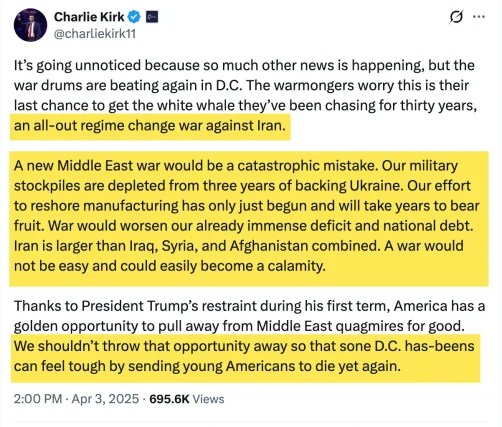
Charlie Kirk, X, April 3, 2025, warning against a regime-change war in Iran
The false claims behind this new war with Iran are ones we have extensively documented. In Trump’s war announcement this morning, he claimed — as he did at Tuesday’s State of the Union address — that Iran refuses to promise that it will not obtain nuclear weapons. The exact opposite is true: Iran has stated this clearly, unequivocally and repeatedly, and did so as recently as this week. “Iran will under no circumstances ever develop a nuclear weapon,” proclaimed Iran’s foreign minister Seyed Abbas Araghchi.
The consequences of this new Trump/Netanyahu war of choice cannot be predicted with any degree of certainty. Already, Iran has launched numerous retaliatory ballistic missiles at Israel, as expected, and has also attacked U.S. military bases in the United Arab Emirates, Qatar, Bahrain and Kuwait.
But the lack of predictable outcomes is, of course, precisely the point. If the U.S. and Israel succeed in their stated goals of widespread “annihilation” and regime change, then they will create, at the very least, a huge power vacuum in the middle of the world’s most volatile region that will require U.S. resources and a sizable military presence for years if not decades to come. One of the world leaders most responsible for the Iraq War, former British Prime Minister Tony Blair, admitted that it was the invasion of Iraq that gave rise to ISIS.
It is hard to overstate what a massive fraud Donald Trump, his campaign and his political movement are. For more than a decade, Trump has ranted and raved against the evils of regime-change wars and neoconservative dogma, only to launch a new war that most perfectly encapsulates and aggressively advances both. He spent years falsely warning that former President Obama would start a war with Iran because of how weak and inept Obama supposedly was at negotiation and diplomacy, only to now do that himself (rather than start a new war with Iran, as Trump predicted, Obama entered a diplomatic agreement with them which major nuclear bodies attested was effective in monitoring Iran’s nuclear activities: a deal which Trump, at Israel’s insistence, tore up in 2018).
Throughout the 2016 campaign, Trump mercilessly mocked Marco Rubio for receiving millions in donations from Sheldon and Miriam Adelson, money that Trump said would “mold [Rubio] into [their] perfect little puppet,” only for himself to become not only the largest beneficiary of Adelson funding in history, but to become the ultimate puppet of the Adelsons’ agenda, one which Trump has clearly acknowledged — when speaking in Israel last year — is an agenda that puts the interests of Israel atop everything, including Americans’ interests:
“I get her in trouble with this, but I actually asked [Miriam] once… ‘What do you love more? The United States or Israel?’ She refused to answer. That might mean Israel,” Trump says, smiling, while looking at the dual Israeli-American national.
And it is not an exaggeration to say — in fact, basic honestly requires one to say — that the 2024 Trump/Vance campaign is one of the most fraudulent political campaigns in American history:

Just one week before the 2024 election, Tulsi Gabbard proclaimed that “a vote for Kamala Harris is a vote for Dick Cheney and a vote for war, war and more war.” Conversely, Gabbard said, “a vote for Donald Trump is a vote to end wars, not start them.” Other than immigration, this “no-new-wars” theme was the most central to Trump’s political appeal and his political promises since he emerged on the political scene a decade ago.
One can rehash the decades of now-trite arguments about Iran as much as one wants. But such endless debate cannot alter the facts here that are indisputable and fundamental.
Iran has not attacked and could not have attacked the United States at home. No such attack was even arguably imminent. The new war that Trump just started with Israel is thus the definitive war of choice.
In contrast to the lie-driven 18-month public campaign of Bush and Cheney to convince the American public to support an invasion of Iraq, there has been virtually no attempt made, as I documented this week, to even explain to the American public why a new war with Iran is necessary or desirable. There has been no Congressional approval sought let alone obtained, notwithstanding the U.S. Constitution’s exclusive assignment of war-making powers to the Congress.
In his novel 1984, George Orwell highlighted the dangerous insanity of war propaganda with this leading example: “WAR IR PEACE.” Yet that is precisely the rationale invoked by various Trump supporters to somehow depict this new war as aligned with Trump’s vows of peace (starting massive new wars is merely “peace through strength”).
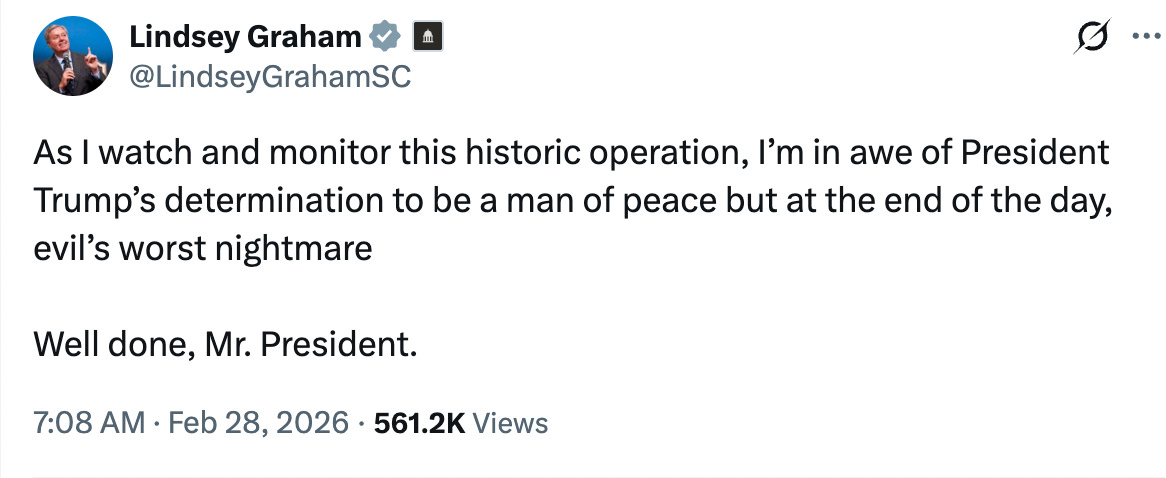
This is, obviously, the war that Israel and Trump’s largest Israel-loyal donors most wanted and have long been pressuring him to start. Pro-Israel billionaires like Bill Ackman, long-time pro-Israel warmongers like Lindsey Graham, and Israel First activists like Mark Levin are of course already boisterously celebrating this new war against Israel’s primary adversary.
But this is ultimately an American war, one that Trump unilaterally started and for which Trump is responsible. Notably, of course, it is not Trump or his family, but instead everyone else in the world, who will bear the costs and burdens of the war. This was the point Trump famously emphasized shortly before the 2024 election — on November 1 — when explaining why Washington is full of sociopathic warmongers such as Dick and Liz Cheney who constantly start wars in which other people’s families, but never their own, must go fight and die.
As Trump’s senior White House advisor Stephen Miller said about those comments, “warmongering neocons love sending your kids to die for wars they would never fight themselves.” Indeed they do, Stephen Miller.
Do not expect meaningful opposition from the Democratic Party. Some of them, perhaps most, will make loud noises in protest. But the party’s senior leader, Sen. Chuck Schumer (D-NY), this week urged Trump to make the case to the public about why this war was necessary, whereas Schumer last June mocked Trump for attempting to obtain a peace deal with Iran and accusing him of “chickening out” of the war with Iran that he prosed. Some Democrats, such as Sen. John Fetterman (D-PA), are effusively praising Trump and his new war.
This new war against Iran is as pure a continuation of the bipartisan DC posture of endless war that has, more than any single cause, destroyed American prosperity, standing, and future over the last six decades at least. The only question how is how many people will die, for how long the damage will endure, and what new unforeseen evils will be created in its wake.
Why Trump’s war on Iran will fail
By Tamer Ajrami | MEMO | February 27, 2026
The United States has turned the talks with Iran upside down. What is happening now does not look like serious negotiations. It looks more like a way to buy time and prepare for a more dangerous phase. That is why two questions matter: Why Trump’s war on Iran will not succeed, and why would it be a dangerous choice for Washington? The answer is simple. The demands Washington is putting on the table are designed to be rejected, and because any military action, if it occurs, will reveal the limits of force, the logic of exhaustion, and the absence of a clear or achievable goal.
All the talk about a deal, gaps, and loopholes continues to go around in circles. On the ground, the US is moving in a completely different direction: it is raising the bar in a way that ruins the talks from the inside and pushes things toward escalation.
Washington now says it has clear conditions. In reality, these conditions make any settlement almost impossible. The first demand is that Iran hand over all its enriched uranium directly to the United States. Not to a third country, not through an international mechanism, not through gradual reductions. Just hand it over to Washington. This is not meant to produce a balanced agreement. It is meant to humiliate a state and force it to give up a highly sensitive part of its sovereignty.
The second demand is even clearer: dismantle Iran’s nuclear facilities and destroy them completely, including major sites like Isfahan, Natanz, and Fordow, along with underground facilities hidden in mountains. The irony is that Washington and its allies do not have full certainty about what earlier strikes (12-day war, June 2025) actually achieved inside these deep facilities. So, the demand for dismantling and destruction looks like a political cover for the simple reality of what lies underground is not easy to reach.
On sanctions, the US offers no clear path. The talk is about lifting a limited set of sanctions imposed recently, while keeping the main sanctions in place under a long “test.” Has Iran truly surrendered, or is it only offering symbolic concessions? Then comes the most dangerous condition of all: the deal must be permanent, Iran must stop enrichment completely, and this must last forever. These are not terms for a fair agreement. They are terms of surrender.
That is why this round looks more like the round before war. The US military buildup in the region is still expanding, and the flow of aircraft, defence systems, and naval assets continues. Everyone is watching everyone through satellites. Almost nothing can be hidden. The real message is not in press statements. It is in the movements that create a new reality and make escalation feel closer than a settlement.
But if a strike happens, it will be full of risks. Even in the American media, one question keeps coming back: what exactly are Trump’s goals? Does he want a limited strike to force Iran into quick concessions? Does he want a wider campaign to bring down the regime? Or does he simply want to declare that he “destroyed” the nuclear program without being able to prove it? The problem is that these goals clash with each other, and each one requires different tools, different costs, and different timelines.
Time is part of the problem too. Some estimates suggest that the ability to keep up intense operations with the current level of forces may be limited. This connects with warnings about running down air defences and burning through advanced / expensive ammunition in a campaign that does not guarantee results. In other words, if war starts, it may quickly turn into a war of exhaustion. It is exactly the kind of fight Washington does not want.
If Iran can launch large waves of ballistic missiles, it can drain defensive stocks on US ships and at US bases in the region fast. Then comes the embarrassing question: how does the US keep fighting? And how does it stop without looking like it pulled back under fire? If Iran keeps firing while the US withdraws, the image inside America would be politically costly.
That is why the administration, based on what is being discussed in Washington, may look for a way to sell the war at home. One idea is for Israel to launch the first strike, and then for the US to step in later under the banner of “defending Israel”. That makes it easier to justify the intervention in Washington, because critics will face a ready-made slogan: we are defending an ally.
But on the ground, it is hard to separate who starts and who joins. US and Israeli forces operate in the same environment and in overlapping ways. The real difference is not in the sky. It is in the story Washington wants to tell its public.
Even if a strike happens, the main question remains: can airstrikes alone achieve big goals? Many analysts say hitting facilities becomes like a game of chasing a moving target. You destroy one site, it gets rebuilt. You hit a surface facility that was emptied beforehand. Equipment and materials are moved elsewhere. As for facilities buried deep in mountains, they remain a major problem. Access is not guaranteed, and photos alone cannot prove total destruction.
More importantly, a nuclear programme is not just concrete and steel. It is knowledge, technology, experience, and an industrial base. Even if part of it is damaged, Iran can repair it over time. Claims of “total destruction” therefore sound more like political messaging than a verifiable reality.
The missile program is an even bigger challenge. Iran produces missiles in large numbers and has the industrial and scientific base to rebuild its stock after any confrontation. Even if the US hits some production lines, wiping the program out completely would require long-term control on the ground and not just airstrikes.
Here is the truth that official speeches avoid: if Trump’s real goals are regime change, removing Iran’s missile power for good, or forcing “zero enrichment” forever, then airstrikes will not deliver that. Those goals require a major ground war and a long occupation. This then may bring huge losses, heavy costs, and years of deep involvement.
This would not serve the US at a time when competition with China is rising. Burning through advanced and expensive American capabilities in the Middle East without clear gains could give China a strategic advantage and push it to move faster on bigger priorities like Taiwan, while Washington remains stuck in a war with no clear ending.
There is also a constant operational risk in any large air campaign: an aircraft could be shot down, a pilot could be captured, or a major incident could happen in a sensitive strait. One such event can turn a limited strike into a wider war, and shift the focus from negotiating nuclear issues to negotiating prisoners and political humiliation.
So, Washington faces two costly paths: a full-scale war it does not have the political tools to sustain, or airstrikes that will not achieve the announced goals but could open the door to further escalation. In both cases, negotiations become a temporary cover while the region moves toward a dangerous test of power and its limits.
The bottom line is this: raising demands to the level of humiliation does not lead to an agreement. It pushes the other side toward rejection and then toward preparation for confrontation. When talks become terms designed to fail, they do not prevent war. They delay it to a moment chosen by Washington; after the battlefield is prepared and the political story is already written.
In the end, the problem is not that Washington has less power. The problem is that it is pursuing goals that are bigger than its tools. Airstrikes do not topple regimes, erase nuclear know-how, and do not end a missile program that can be rebuilt. The higher the US raises its demands, the more it closes the door to diplomacy and the closer the drift toward confrontation.
If war begins, it may quickly become a costly fight with no clear ending: defenses get drained, rare munitions get burned, markets shake, and bases come under attack. Then an unsolved question will rise inside the US: how do we end this without political defeat? Failure becomes likely because the goals cannot be achieved by bombing alone. And the danger is huge, because escalation may spiral beyond control. In a war like this, Washington might win a round in the air, but lose the bigger game on the ground.
Lebanon: Between sovereignty and the mirage of normalization
By Ali Abou Jbara | The Cradle | February 26, 2026
The smoke had barely lifted from the latest Israeli bombardment of south Lebanon when another conversation began circulating in Beirut. While border villages buried their dead and families searched through rubble, a parallel discourse surfaced in studios and on digital platforms: normalization with Israel presented as a viable political path.
The ongoing war on Lebanon, marked by unprecedented Israeli escalation, daily raids, and widespread destruction, exposed more than military vulnerability. It revealed that certain voices inside the country no longer conceal their position toward Tel Aviv.
They now speak openly of public normalization as the cure for Lebanon’s crises – even as Israeli warplanes violate Lebanese skies, despite the so-called ceasefire. What is marketed as pragmatism begins to resemble political surrender.
Prominent personalities have amplified this shift. Journalist Marcel Ghanem declared live on his program “Sar al-Waqt” on MTV that he was considering speaking directly with Israeli Prime Minister Benjamin Netanyahu and suggested repealing Lebanese laws that criminalize dealings with Israel.
Digital platforms followed the same trajectory. “Hona Beirut” circulated videos of Israelis sending populist messages to Lebanese audiences – “We want peace with Lebanon. We want to visit Beirut and enjoy fattoush and shawarma” – carefully packaged to soften the image of a state whose aircraft continue to strike Lebanese territory.
Political figures moved even further. MP Paula Yacoubian stated publicly: “If salvation comes through Israel, let it come but save us.” Charles Jabbour, head of the Lebanese Forces (LF) party media apparatus, argued that Israel does not occupy Lebanon and does not attack the Lebanese, claiming instead that it monitors Hezbollah to ensure implementation of past agreements. He concluded: “If Hezbollah wins, Lebanon loses. If Israel wins, Lebanon wins.”
Such statements are deliberate. They substitute national consensus with partisan calculus and recast normalization as responsible governance.
Expansion as governing doctrine
Advocates of a “quick peace” treat Israel as a state seeking stability. The political current in Tel Aviv suggests something else entirely.
Under Netanyahu and his alliance with ultra-religious and nationalist forces, the “Greater Israel” vision operates as a strategic direction.
On 22 September 2023, Netanyahu stood before the UN General Assembly (UNGA) and presented a map that includes Gaza and the occupied West Bank as part of Israel, using the biblical name “Judea and Samaria” instead of the West Bank – in a symbolic dedication to the annexation project.
His coalition partner, Finance Minister and leader of “Religious Zionism” Bezalel Smotrich, had stated in 2016 that Israel’s borders “must extend to Damascus,” and appeared in Paris in March 2023 in front of a map that considers Jordan part of the “Land of Israel.”
Since Menachem Begin and the Likud party came to power in 1977, the concept of “Greater Israel” has morphed into a political program based on settlement expansion and changing demographic realities. This current is based on interpretations from the Book of Genesis that consider the “Promised Land” to extend from the Nile to the Euphrates. Even Israel’s first prime minister, David Ben Gurion, wrote in the 1930s that establishing a state on part of the land would serve as a first stage, not an endpoint.
Following Operation Al-Aqsa Flood, expansionist language hardened. Military operations broadened in Gaza and the occupied West Bank while strikes intensified in Syria and Lebanon. “Security depth” expanded to encompass regional theaters.
On 21 February 2026, US Ambassador to Israel Mike Huckabee said in an interview with Tucker Carlson that, under a biblical interpretation of land promised in Genesis, it “would be fine if [Israel] took it all,” implicitly extending Israel’s reach across much of West Asia – remarks that sparked sharp regional condemnation.
Maps circulated by proponents of this project extend beyond historic Palestine. They incorporate Lebanon, Jordan, most of Syria, half of Iraq, and territories in Saudi Arabia, Egypt, and even Kuwait.
Against that strategic horizon, Lebanese normalization rhetoric begins to feel profoundly detached from the lived reality of the country. Border villages remain scarred, Lebanese airspace is violated without consequence, and sovereignty is subjected to daily erosion, yet normalization is presented as transactional diplomacy, detached from geography and history.
It is precisely here that the Lebanese debate turns unsettling. What does it mean to pursue “peace” with a project whose declared maps stretch beyond its recognized borders? How does a state whose skies, waters, and land are routinely breached convince itself to trust assurances from a government that treats expansion as a generational mission?
The occupied West Bank as precedent
The occupied West Bank offers a concrete case study. Since the 1993 Oslo Accords, the settler population has grown from roughly 250,000 to more than 700,000. Hundreds of settlements and outposts now fragment the territory. Israeli Energy Minister Eli Cohen has described this as imposing “de facto sovereignty” – gradual annexation without formal declaration.
Land confiscations, bypass roads, settlement blocs, and armed settler protection have eroded the territorial basis for Palestinian statehood. Smotrich openly advocates annexation and rejects Palestinian sovereignty. Netanyahu presides over what observers describe as the most right-wing government in Israel’s history, with settlement expansion central to its agenda.
Three decades of negotiations unfolded alongside continuous territorial transformation. Diplomatic processes advanced in parallel with irreversible changes on the ground. This is how “peace” is managed when it is a tool to strengthen control, not to end it.
Despite this record, similar assumptions appear in Lebanese discourse. MP Camille Chamoun of the Free Patriots Party says he does not believe Israel has an interest in violating international agreements and Lebanese borders.
MP Sami Gemayel, head of the Kataeb Party, suggests that relations with Israel and western countries may protect Lebanon. Even Lebanese actress and writer Carine Rizkallah said on the TV program Al-Masar that she hoped there would be no new war with Israel and that “it’s time to end these problems between the two countries.”
The irony is that Lebanese rhetoric promoting normalization leans on an assumption of good faith from the other side, even though the occupied West Bank continues to show how such assumptions unfold in practice. There, decades of agreements, conferences, and international sponsorship did not halt expansion; they unfolded alongside it, as settlements multiplied, land was fragmented, and entire areas were quietly absorbed into a new reality.
If this is where the occupied West Bank has arrived after years of accords and external guarantees, on what basis is Lebanon encouraged to trust similar assurances? The experience is not abstract or distant. It is ongoing, visible, and instructive for anyone willing to look.
Regional patterns of influence
The broader region reinforces this reading. After the fall of the previous Syrian government on 8 December 2024, Israeli influence expanded in southern and central Syria, capitalizing on security vacuums and fragmentation. Strategic corridors between northern Syria and Israeli ports strengthened. Control over the occupied Golan Heights and adjacent water resources deepened.
Turkiye adopted a confrontational stance toward Israeli expansion, warning that the absence of clear red lines destabilizes Syria and opens space for broader intervention. Ankara expanded its diplomatic engagement on Palestine, strengthened regional alliances, and emphasized deterrence, demonstrating that even governments with formal ties to Israel are wary of unchecked expansion.
Across neighboring states, internal divisions have created entry points for influence. Settlement expansion in the occupied West Bank, strikes in Syria, and sustained violations in Lebanon reflect an interconnected strategy.
Normalization premised on unilateral concession narrows strategic space. In regional practice, asymmetrical engagement tends to consolidate the stronger party’s position.
Lebanon operates within that same environment. Any official normalization would unfold against Israel’s strategic framework and military advantage. Expectations of reciprocal restraint lack precedent in current regional dynamics.
Lebanon’s historical record
Lebanon’s experience with Israeli aggression remains documented. In April 1996, Israeli forces bombed a UN base in Qana, killing more than 100 civilians who had sought shelter. In September 1982, the Sabra and Shatila massacre occurred under the watch of the Israeli army. The 1982 Israeli invasion reached Beirut, and south Lebanon remained under occupation until 2000, liberated only through sustained resistance.
The July 2006 war resulted in more than 1,200 Lebanese deaths, extensive infrastructure destruction, and the displacement of nearly one million people. Airspace violations continued long after hostilities subsided.
Following Operation Al-Aqsa Flood and Hezbollah’s decision to open a northern support front, strikes on southern villages resumed, placing Lebanon within a wider expansionist frame.
In this context, normalization proposals detach policy from cumulative experience. They assume recalibration without structural change. Historical precedent suggests otherwise.
Legal foundations
Lebanon’s stance toward Israel is codified in law. Since 1955, the Boycott of Israel Law has prohibited commercial, cultural, and political dealings with the Israeli enemy. The law remains in force and constitutes a foundational element of Lebanese state policy.
The penal code criminalizes espionage and communication with the enemy, including cooperation that provides political, media, or moral benefit. In contemporary circumstances, public statements or digital content that promote normalization may fall within this framework if deemed to confer advantage. Penalties can include imprisonment and fines.
Given ongoing Israeli violations of Lebanese sovereignty, normalization carries national security implications under existing legislation. Judicial and security institutions retain authority to investigate potential breaches.
This legal architecture reflects accumulated historical experience rather than abstract doctrine.
Sovereignty under pressure
The present debate concerns strategic direction under sustained pressure. An expansionist project operates openly in the region. Lebanon’s historical memory remains recent.
Calls for normalization at a moment of ongoing aggression raise structural questions about sovereignty, deterrence, and long-term stability. Strategic environments shaped by military asymmetry rarely reward unilateral accommodation.
Lebanon faces a clear dilemma. Defending sovereignty requires political coherence and deterrent capacity. Pursuing normalization without reciprocal structural change invites further testing of borders and institutions.
The chosen trajectory will shape more than just diplomatic posture. It will define how the state positions itself within a region undergoing forced transformation.
Female Iranian academic sentenced to 4 years in prison in France over protesting Israel’s genocide in Gaza

Press TV – February 26, 2026
An Iranian academic woman in France has been sentenced to four years in prison after she protested Israel’s genocide in the besieged Gaza Strip, with a permanent ban on her entry into the European country.
A court in France on Thursday, sentenced Iranian citizen Mahdieh Esfandiari, who had been detained on alleged charges of “public defense of terrorism,” to four years in prison, France 24 reported.
According to the court ruling, Esfandiari, a linguist and French language graduate, received a four-year sentence, three years of which were suspended and one year to be served.
The 39-year-old Iranian citizen had previously spent eight months in pretrial detention before being released under conditional terms.
The court also permanently barred Esfandiari from entering French territory.
Esfandiari graduated from Lumière University, where she worked as a professor, translator, and interpreter. She has also been a prominent pro-Palestinian activist with a significant online presence.
Her arrest last year came amid a crackdown in the United States and other Western countries targeting scholars, students, and activists who opposed Israeli genocide and advocate for peace, both on campuses and in public spaces.
The Paris Prosecutor’s Office charged the Iranian academic with “apologie du terrorisme” over Telegram posts that allegedly supported the Hamas-led Operation Al-Aqsa Flood against Israel in October 2023.
US university cancels Palestine conference citing sanctions concerns
Al Mayadeen | February 26, 2026
The University of Southern Maine has withdrawn permission to use a campus venue for a conference centered on Palestine, just days before it was scheduled to begin, triggering a dispute over sanctions law and First Amendment protections.
The event, titled “Consequence of Palestine,” had drawn more than 300 registrants and was organized by the Maine Coalition for Palestine, Maine Voices for Palestinian Rights, and the university’s department of criminology and sociology. It was expected to feature virtual remarks by Francesca Albanese, the United Nations special rapporteur for the occupied Palestinian territories, who has been under US sanctions since last year.
University officials said the decision was based on federal sanctions law. Samantha Warren, chief external and governmental affairs officer for the University of Maine system, told The Guardian in an email that “hosting a conference that is being actively promoted as including a speaker sanctioned by the US government would put our public university in violation of federal law”. She said organizers should have obtained authorization from the Treasury Department before proceeding.
Sanctions regulations prohibit US entities from providing “any goods or services” to individuals designated under sanctions regimes. Violations can carry severe penalties, including heavy fines and potential prison time. However, legal scholars argue that the scope of what constitutes a “service” remains ambiguous.
Campus rights clash
In December, the Treasury Department’s Office of Foreign Assets Control (OFAC) clarified in correspondence with the Middle East Studies Association that “no authorization” was required to include Albanese in an academic event, provided that she did not receive payment, reimbursement, or “training or assistance”. That clarification emerged after concerns were raised about the impact of sanctions on academic exchange.
Xiangnong Wang, a staff attorney at the Knight First Amendment Institute who had sought clarification from OFAC, said the cancellation reflects broader concerns about the chilling impact of sanctions on constitutionally protected speech. “It’s very concerning that sanctions continue to have such a broad deterrent effect on speech that is undoubtedly protected by the First Amendment,” he said.
Organizers said they were caught off guard by the abrupt cancellation. Abigail Fuller, a sociology professor involved in planning the conference, stressed the constitutional implications of the decision. “We’re a public university; the university system is subject to First Amendment laws,” she said. “We feel we have a very, very strong case that they are suppressing our free speech.”
According to organizers, they attempted to clarify that federal guidance did not require special permission to include Albanese. They even proposed removing her from the program in an effort to preserve the event. They were subsequently told there was insufficient time for administrators to evaluate the conference’s “risk”.
Speech under pressure
The dispute comes amid reports that Republican lawmakers had written to the system’s chancellor requesting “information on steps the university is taking to ensure the safety and well-being of its Jewish students”. Organizers believe such political pressure contributed to the reversal and said administrators had also expressed concern about possible federal funding consequences.
Albanese was sanctioned last July, with US authorities accusing her of “unabashed antisemitism, expressed support for terrorism, and open contempt for the United States, Israel, and the West”. She has previously rejected those allegations and criticized the move as politically motivated, describing the United States as “a country of contradictions, full of ideals and principles and still, plotting against democratic values”.
The Treasury Department did not immediately respond to requests for comment on the university’s interpretation of sanctions law.
Despite losing access to their campus venue, conference organizers say they are seeking an alternative location and are exploring possible legal action. Fateh Azzam, a member of the Maine Coalition for Palestine, said canceling the conference outright was not an option.
“That would mean that they have effectively silenced an open and public debate on the issues,” he said. “This controversy will probably bring in more people.”
Senate Majority Leader: Any War with Iran Should Result in Regime Change
By Kyle Anzalone | The Libertarian Institute | February 26, 2026
Senate Majority Leader John Thune said that any strikes on Iran should be aimed at causing regime change in Tehran.
“In my view, if you’re going to do something there, you better well make it about getting new leadership and regime change,” the Senator said on Thursday. “If you’re going to take some sort of action, I think you want to achieve a result that actually brings about the transformational change that I think we want in the region.”
Thune is among several Senators who have argued that Tehran is historically weak, and President Donald Trump should order an attack on Iran to cause regime change. “The Ayatollah lost to Israel in the 12-day war. They are weaker. The regime is weaker than it ever has been. And what I’ve urged the president, do not miss this opportunity,” Cruz told CNBC host Joe Kernen on Wednesday. “If the Ayatollah is removed from power, it will make America much safer.”
Trump is threatening to attack Iran if Tehran does not agree to a deal that severely restricts its civilian nuclear program in exchange for minimal sanctions relief.
While Senators and administration officials have asserted that the US must attack Iran to prevent Tehran from obtaining a nuclear weapon, the Islamic Republic does not have a nuclear weapons program and is not currently enriching uranium.
“The President, I don’t think, to my knowledge, has made any decisions, but I think they’re gaming out what contingencies might look like and what’s in our national security interests.” Thune added, “Of course, first and foremost is to prevent them from having a nuclear capability but there are also other threats that they represent in the region.”
US fears Iran war will ‘deplete’ air defenses stretched thin by Ukraine, Israel: Report
The Cradle | February 26, 2026
Military officials and lawmakers in Washington have warned that a prolonged war with Iran could stretch US military stockpiles of air defense interceptor missiles “to the brink and make the country more vulnerable,” POLITICO reported on 26 February.
“Gen. Dan Caine, the Joint Chiefs of Staff chair, has raised concerns about the military’s shortage of air defense interceptors since January,” POLITICO wrote, citing a person familiar with the matter.
“But the fears have magnified in recent weeks as the Pentagon amassed the largest military buildup in the Middle East since the Iraq War,” the magazine added.
Since returning to the White House a year ago, US President Donald Trump has won praise from Israelis while supporting the genocide in Gaza and overseeing a massive expansion of US military operations, including in Venezuela, Yemen, and Nigeria.
Crucially, Trump ordered US warplanes to join Israel’s 12-day war on Iran to bomb Tehran’s nuclear sites in June 2025.
Interceptor missiles were used not only to protect US forces from Iranian and Yemeni counterattacks but also to protect Israel from Iran’s barrages of ballistic missiles and drones.
During these operations, US forces “burned through” significant numbers of Standard Missile-3s, Terminal High Altitude Area Defense (THAAD) interceptors, and Patriot missiles, POLITICO observed.
Since then, the Pentagon has been unable to replenish its interceptor stocks due to the complexity and slow pace of their production.
Six current and former US officials and members of Congress told POLITICO of their widespread worries that a sustained war with Iran could deplete remaining US air defenses and “leave tens of thousands of American troops in the region unprotected against Tehran’s missile salvos.”
An Israeli intelligence official stated on Thursday that the US only has the capacity to sustain four or five days of intense aerial assault on Iran, the Times of Israel wrote, citing the Financial Times (FT).
Israel is pushing for a major war, claiming that limited US strikes on Iran could only “embolden the regime,” the Times of Israel added.
Since January, President Trump has assembled what he called an “armada” of US naval ships with accompanying war planes in the region in preparation for a possible renewed attack on the Islamic Republic.
Analysts have suggested that Iran will retaliate much more strongly in the event of a second war, including against US bases in the Gulf, leading to a much longer and more devastating war than last June.
“Do we have enough interceptors to sustain a retaliation?” said the person familiar with the talks. “We don’t have a discretely focused objective. Is it regime change or is it [just] ballistic missiles?”
A US military spokesperson responded to the POLITICO report by saying its weapons stockpiles are sufficient.
“The Department of War has everything it needs to execute any mission at the time and place of the president’s choosing and on any timeline,” said spokesperson Sean Parnell.
However, some US lawmakers say that the defense industry is not producing enough Lockheed Martin-built Patriot interceptors or RTX’s Tomahawk long-range missiles, nor quickly enough.
“There have been urgent calls for reforms in procurement, but the net result is that we are seemingly unable to meet all of the needs for defense production – for Ukraine, for our partners in the Middle East,” said Richard Blumenthal, a Democratic congressman.
“It may be problematic to think about moving Patriot missile interceptor systems from the Middle East because now we’re going to have to protect our embassies, not to mention our bases,” he added.
The Center for Strategic and International Studies (CSIS), a Washington think tank, estimated the US had used up to 20 percent of the Standard Missile-3 interceptors and between 20 and 50 percent of its THAAD missiles.
John Mearsheimer: The Case for a Nuclear Iran
Glenn Diesen | February 25, 2026
John J. Mearsheimer is the R. Wendell Harrison Distinguished Service Professor of Political Science at the University of Chicago, where he has taught since 1982. Prof. Mearsheimer argues why Iran should be considered a rational actor, and why Iran should develop nuclear weapons as the ultimate deterrent.
Follow Prof. Glenn Diesen:
- Substack: https://glenndiesen.substack.com/
- X/Twitter: https://x.com/Glenn_Diesen
- Patreon: https://www.patreon.com/glenndiesen
Support the research by Prof. Glenn Diesen:
- PayPal: https://www.paypal.com/paypalme/glenndiesen
- Buy me a Coffee: buymeacoffee.com/gdieseng
- Go Fund Me: https://gofund.me/09ea012f
Israel displaces last two families from Al Khalayel valley, Al Mughayyir
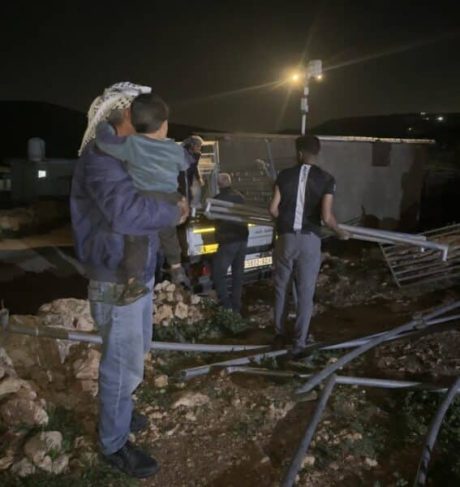
Palestine Solidarity Movement | February 25, 2025
A violent campaign aimed at forcibly displacing Palestinian families from the Al Khalayel valley south of Al Mughayyir (occupied West Bank) has achieved its goal. Two years of coordinated attacks between illegal settlers and Israeli occupation forces finally pushed out the last two remaining families: Abu Najeh and Abu Naim/Abu Hamam.
The Abu Najeh family compound comprised 12 families, around 50 people in total. They have been forcibly displaced 7 times in the last 80 years. They moved to Al Khalayel just 2 years ago after being displaced from Ein Samiya in 2023; investing significant resources into establishing what they hoped would be a permanent home on the land they owned. On Tuesday, February 17, Israeli forces entered their homes seeking to arrest three men under false accusation that they threw rocks at settlers. When they did not find them, they broke two security cameras and arrested 55 year-old Mustafa Omari for filming illegal settlers. He was imprisoned until 10am on Wednesday February 18.
One of the three men they sought to arrest is 32 year-old Majid Omari, who was terrified he would be sought out and beaten or killed by settlers who know his face and his car. “Urgent intervention is needed to protect us,” he said. On Friday February 20, the Abu Najeh family came to the devastating conclusion that they could no longer withstand the violence and harassment and rapidly commenced packing up and deconstructing their homes, working through the night out of fear of a settler attack.
 At approximately 12:00 the following day, Saturday February 21, while the Abu Najeh family was packing, illegal Israeli settlers began surveilling the only other remaining Palestinian home in the area, that of the Abu Naim family, with drones. At approximately 14:00, 6 underage settlers in a four-wheel-drive vehicle arrived at the home, verbally abusing and harassing everyone present. Shortly afterwards, the army arrived and conducted a search before withdrawing with the settlers. At approximately 16:00, two settlers entered the front yard with their sheep. Minutes later, approximately 12 settlers forced their way into the home, wrecking the family’s furniture and belongings, smashing their electricity sources, emptying their water tank causing the property to flood, destroying their bathroom and shower. They trapped 39 year-old mother Hidayah Rizq Awad Abu Naim, her 13 year-old daughter Ilham Wadi Abu Naim and 70 year-old father Rizq Awad Mahmoud Abu Hamam in the home and violently beat them.
Simultaneously, as members of the nearby village of Al Mughayyir attempted to support the family, Israeli forces conducted a violent raid, firing tear gas at residents. Armed Israeli settlers and Israeli soldiers shot live rounds at residents and international activists to prevent them from reaching the Abu Naim family home. Two family members were shot: 36 year-old Ayham Rizq Awad Abu Naim was shot in the back and his nephew, 13 year-old Naseem Shaker Thabta was shot in the foot. Ayham faces a lengthy rehabilitation process.
That night, after settlers retreated to the nearby illegal outpost and the injured were being treated at the hospital, members of the community alongside two international activists returned to the Abu Naim home to salvage the belongings that had not been destroyed. In a final act of resistance they set fire to what was left so that the illegal settlers would not materially benefit off of their homes and belongings.
The next morning, February 22, a few men of the Abu Najeh family returned to their property to retrieve their final items and self-demolish their homes in the same act of resistance as the Abu Naim family. By 10am they were forced off their land by illegal settlers. As they departed, settlers set fire to their remaining structures.
These two forced displacements were a coordinated effort between the Israeli forces and illegal Israeli settlers as part of a broader goal to displace all 5,000 residents of Al Mughayyir. Without regard for International Humanitarian Law or Human Rights, Israel continues building a chain of illegal settlements and outposts connecting Ramallah, Nablus and the Jordan Valley. In a deportation hearing held on February 1 concerning activists from the International Solidarity Movement (ISM) who volunteered with the Abu Najeh and Abu Naim families, the Israeli State claimed the reason for their incessant harassment towards Palestinian communities there was “expelling Bedouin people who illegally occupy the area”. This officially admits an ethnic cleansing objective in lands that are under the civilian control of the Palestinian Authority (area B).
In a final statement, a 23 year old nephew of the Abu Naim family shared: “We left against our will, but the land remains and will return to its original owners.
What happened is a serious attack that demands accountability. Places may be erased from the map, but they remain in memory, and the steadfastness of their people is a testament to their adherence to their right. The land belongs to its owners, and it will remain so, God willing.”
Israeli Opposition Leader Endorses Greater Israel

The Dissident | February 24, 2026
U.S. Ambassador to Israel, Mike Huckabee, sparked major backlash during his recent interview with Tucker Carlson, where he openly endorsed the idea of a Greater Israel, stating that “it would be fine” if Israel took large swaths of the Middle East.
In damage control mode, Zionists attempted to paint Huckbee’s claims as fringe or extreme within Israel, but Israel’s opposition leader , Yair Lapid, has confirmed that the prospect of an expansionist Greater Israel is supported even by the more supposedly “liberal” wing of the Israeli political spectrum.
When asked, “The Ambassador Huckabee said this week, and we know the extent of the American administration on the government here, that he supports Israeli control from the Euphrates to the Nile, this means [control] over Lebanon, Jordan, Syria, do you support it or do you think this should be stopped?”, Lapid replied, “I don’t think I have a dispute on the biblical level [about] what the original borders of Israel are.”
Lapid went on to endorse massive Israeli expansion, saying, “support anything that will allow the Jews [to have] a big, vast, strong land, and a safe shelter for us, for our children, and for our children’s children. That’s what I support” adding, “However possible” when asked “How vast?”.
When further asked, “Until Iraq?” Lapid replied, “The discussion is a security discussion. The fact that we are in our ancestral land… Yesh Atid’s position is as follows: Zionism is based on the bible. Our mandate of the land of Israel is biblical. The biblical borders of Israel are clear. There are also considerations of security, of policy, and of time. We were in exile for 2,000 years… you don’t really want all this lecture, right? At least you were not waiting for it… The answer is: there are practical considerations here. Beyond the practical considerations, I believe that our ownership deed over the land of Israel is the bible, therefore the borders are the biblical borders”.
Lapid even advocated that Israel take “as much as possible” of Greater Israel, saying, “Fundamentally, the great, big and vast Israel, as much as possible within the limitations of Israeli security and considerations of Israeli policy”.
Similarly, Benjamin Netanyahu has previously stated that he “subscribed to a ‘vision’ for a ‘Greater Israel’” and “very much”, “felt connected to the ‘Greater Israel’ vision”.
Israeli officials have long been clear that their end goal in Gaza and the West Bank has been total ethnic cleansing and annexation, with Israel’s Science and Technology Minister Gila Gamliel admitting , “we will make Gaza unlivable for humans until the population leaves, and then we will do the same for the West Bank”.
But Yair Lapid’s comments show that across the spectrum from Netanyahu to his “liberal” opposition, Israel has expansionist ambitions beyond Gaza and the West Bank, and wants to take “as much as possible” of Greater Israel.
Islamic Jihad: Trump’s peace board is a “theatrical stunt detached from reality”
Palestinian Information Center – February 25, 2026
BEIRUT – Mohamed al-Hindi, Islamic Jihad’s deputy secretary-general, has described the US-led Board of Peace as nothing more than a “theatrical stunt,” saying it is detached from the reality on the ground.
In an interview with Al Jazeera Mubasher satellite channel on Wednesday, Hindi stressed that the board’s recent meeting “has not brought about any change in the course of the Israeli war on the Gaza Strip or in the scale of Israel’s ongoing violations against Palestinians.”
Hindi affirmed that this peace council was founded on a “formula of absolute American dominance and full security for Israel, while denying the Palestinian people the right to shape their own future.”
“The Palestinian role in this framework is purely symbolic, confined to technocratic committees handling Gaza’s municipal affairs without any sovereignty or political power,” Hindi said.
“The proposed vision fully embraces Israel’s stance, linking Gaza’s reconstruction to resistance groups surrendering their weapons, without any serious discussion of an Israeli withdrawal or accountability for ceasefire violations,” the Islamic Jihad official added.
He underscored that his Movement never trusted the US administrations under president Donald Trump or his predecessor Joe Biden, citing America’s unwavering pro-Israel bias.
He said that the Palestinian acceptance of prior understandings over Gaza aimed solely to put an end to Israel’s relentless massacres against civilians.
Iran warns Trump against decisions based on false information
Press TV – February 25, 2026
Iran’s Parliament speaker Mohammad Baqer Qalibaf has warned US President Donald Trump against making decisions based on false information, emphasizing that Iran has never sought, does not seek, and will never seek nuclear weapons.
Speaking at a meeting with economic activists in the Iranian Parliament on Wednesday, Qalibaf reacted to Trump’s latest remarks over Iran’s peaceful nuclear activities.
During his State of the Union address in congress, Trump once again claimed that he would not allow what he called the world’s leading sponsor of terrorism to obtain a nuclear weapon.
Qalibaf said, “In a previous interview I gave to CNN, I told the US president not to make incorrect analyses based on false information, and then make wrong decisions.”
He stated that Iran has “never sought, does not seek, and will never seek nuclear weapons,” adding that despite these assurances, the United States continues “to act with threats.”
He criticized US claims during the 12-day war, including reports that the city of Mashhad had fallen, and condemned foreign interference and misinformation by anti-Iranian elements and Israel which orchestrated attempted coups during the riots.
Qalibaf also noted that Trump directly intervened in the recent diturbances, citing his statement on the 12th day of the 12-day war promising US assistance.
He dismissed US and Israeli accounts of casualties reporting 32,000 deaths in latest foreign-backed riots, calling them false and misleading.
He said the real perpetrators were past terrorists responsible for over 17,000 targeted killings in Iran, including the deaths of high-ranking officials such as the president, prime minister, judiciary chief, parliament members, and military commanders.
The parliament speaker also referred to a recent statement by US special envoy to West Asia, Steve Witkoff, who said Trump is “curious” as to why Iran has not “capitulated” to US demands.
“The reason the Iranian people do not fear or submit,” Qalibaf said, “is because you do not understand them. Even during the 12-day war, while the fifth and sixth rounds of negotiations were underway, Trump attacked us from behind the negotiation table, along with Israel, and faced a humiliating defeat.”
Qalibaf emphasized that all options regarding the United States remain on the table, including both dignified diplomacy and a deterrent defense.
He added that if the diplomatic table respects Iranian dignity and mutual interests, Iran will engage, noting that the third round of negotiations is scheduled for tomorrow.
The remarks come as Iran and the US held a second round of indirect nuclear negotiations at the Omani consulate general in the Swiss city of Geneva on February 17.
As in the previous round in the Omani capital of Muscat, the agenda of the talks focused primarily on the nuclear issue and the lifting of illegal US sanctions.
The US maintains that Iran must cease its nuclear program, whereas Tehran asserts that it is not pursuing nuclear weapons and says it is entitled to peaceful nuclear energy.
Washington began its war rhetoric against Iran after recent economic protests in the country, which were hijacked by foreign spy agencies and turned violent.
Since then, the US president has kept threatening military action against Iran, deploying two carrier groups and dozens of fighter jets, bombers, and refueling aircraft to regional waters near Iran.
or go to
Aletho News Archives – Video-Images
From the Archives
Israel Would Have No Qualms About USS Liberty-Style FALSE FLAG If Iran Campaign Falters – Analysts
By Ilya Tsukanov – Sputnik – 18.06.2025
Donald Trump is mulling whether or not to join Israel’s aggression against Iran as Tel Aviv faces problems sustaining its defenses against growing counterstrikes, and apparently lacks a realistic game plan for an end to hostilities after failing to achieve its goals. Analysts told Sputnik how the US could be ‘nudged’ into the conflict.
“The US is already assisting Israel with supplies, intel, refueling support, etc. One of the many US posts in the region could be attacked for a casus belli,” former Pentagon analyst Karen Kwiatkowski explained.
“If Trump doesn’t comply with Israel’s demand” and join its aggression voluntarily, “a false flag may be needed” to drag the US in, Kwiatkowski, retired US Air Force Lt. Col.-turned Iraq War whistleblower, fears.
Netanyahu has a diverse array of options at his disposal, according to the observer, including:
- a false flag against US assets abroad blamed on Iran or one of its Axis of Resistance allies, like the Houthis
- a US domestic attack or assassination blamed on Iran
- Iranian air defenses ‘accidentally’ hitting a civilian jetliner carrying Americans
- use of a dirty bomb or nuclear contamination somewhere in the region blamed on Iran
- even blackmailing by threatening to use nukes against Iran if the US doesn’t join the fight
Kwiatkowski estimates that Israel probably has “enough blackmail power” against President Trump and Congress to avoid the necessity of a false flag operation, but a “USS Liberty-style” attack, targeting the soon-to-be-retired USS Nimitz supercarrier that’s heading to the Middle East, for example, nevertheless cannot be ruled out entirely, she says. … continue
Blog Roll
 Aletho News
- The US bombed the Shahs house lol
- The London Ambulances Attack: Of Course It Was A False Flag
- Embarrassing Pivot: U.S. considers dropping Iran oil sanctions amid war
- US has 2 months of rare earths left to replenish weapons amid Iran war: Report
- Strait Of Hormuz closure brings Empire to brink
- Iran controls Strait of Hormuz, dictates terms of war and peace as US excursion backfires
- Outlasting the Superpower: The Reasons Why Iran is Beating uhe US and Israel
- Top PMU commander, over a dozen fighters killed in new US strikes on Iraq
- Is Netanyahu’s war gamble threatening the future of ‘Israel’?: FT
- Smotrich calls for annexation of South Lebanon to Litani River
- If Americans Knew
- ‘Forever live by the sword’: Understanding Israelis’ massive support for Iran war
- UN’s special rapporteur on human rights says Israel is systematically torturing Palestinians
- Trump White House plagiarized Iran war manifesto from Israel-aligned think tank
- Gaza says 6–10 patients die daily waiting for treatment abroad as Israel blocks medical evacuations
- ‘Substantial evidence’ of double-tap strike in killing of Gaza’s Hind Rajab
- ‘Do Not Want To Die For Israel’: Doubts About Trump’s Iran Strategy Spread Among Troops
- Instead of taking Joe Kent’s claims seriously, the media is disregarding him as an antisemite
- Joe Kent’s Explosive Interviews about his Resignation over the Iran War
- Israel poised to take over southern Lebanon; settlers wreak havoc in West Bank – Not a ceasefire Day 165
- From Sde Teiman, the truth about Israel’s military justice system has been set free
- No Tricks Zone
- Devastating Assessment Of Comirnaty Vaccine By Former Senior Pfizer Europe Toxicologist
- New Study: CO2 Is ‘Effectively Negligible’ As An Explanatory Climate Change Factor Since 2000
- Former Pfizer Toxicologist Dr. Helmut Sterz Tells Bundestag Hearing Pfizer Vaccine Should Have Never Been Approved
- Energy Expert: Germany’s Nuclear Phaseout Was A “500 Billion Euro Mistake”
- New Research: South Australia’s Mid-Holocene Sea Surface Temperatures Were 4°C Warmer Than Today
- Storing Green Energy To Last Germany 10 Days Would Require A 60-Million Tonne Battery
- New Studies: UK Sea Levels Were 4 Meters Higher Than Today During The Mid-Holocene
- Destructive Green New Deal: German Energy And Metal Group Warns Of Drastic Crisis
- New Study Documents A 20-Year Pause In Arctic Sea Ice Decline – Driven By Internal Variability
- Wake-up Call: Survey Shows Majority Of Germans Now Favor Postponing Climate Targets!
 Aletho News