Eyewitness Syria, the Last 12 Days
By Rick Sterling | Global Research | December 11, 2024
My friend lives in Damascus. I will call him Qusay to protect his identity. Qusay was born and grew up in Aleppo and still has family there. He is a high-level translator and university professor. From his family he learned what unfolded in Aleppo following the invasion beginning November 27. He personally witnessed events in Damascus where he still is. The following is what Qusay told me about events in Syria over the past 12 days.
Overthrow of Aleppo
The march and overthrow of Aleppo was done by Syrian and many foreign fighters supplied and backed by Turkish intelligence and military. Syrian military communications were jammed using electronic warfare. The invaders used drones for surveilling and attacking Syria forces. The jihadists were trained in the use of drones by NATO-funded Ukrainians. Turkey and other NATO forces supplied the drones and all sorts of other advanced weaponry. They had tanks in addition to machine gun mounted trucks and other vehicles.
The jihadists were carefully prepared by Turkish / US forces. They sent individuals to talk with influential people in the Aleppo community, promising payments of hundreds of dollars and other rewards in exchange for complicity or no opposition. Doctors, engineers and public officials were contacted personally. It is highly likely that military officials were also contacted. When the invasion supported by the Turkish military happened starting November 27, the Syrian defense of Aleppo collapsed.
Qusay thinks the Syrian army was exhausted from 13 years of war plus constant attacks from Israeli jets they have been helpless to stop. They, like all Syrian society, have been impoverished by intense sanctions from the West coupled with the theft of essential national resources. The primary wheat growing and oil and gas producing regions have been occupied by US forces and their Kurdish proxies since 2016. As a result, most Syrians only have electricity a few hours per day and have trouble putting food on the table. Before the “dirty war” began in 2011, Syria was self sufficient in food and energy. Syria had no national debt and Syrians enjoyed free health care and education.
The invaders in Aleppo tried to assuage the public that they are not like the “rebels” of old who persecuted and killed Christians and Alawi and enforced sharia law. In Aleppo, they provided free bread for families and quickly set up electronic communications hubs so that everyone might have internet and also so they could broadcast their messages.
Collapse in Damascus
While the northern invading army went on to central Syria, a different attacking group worked from the south. First they attacked and took over Deraa on the Jordan border, then Suweida. Then they advanced to Damascus. It seems there were agreements in advance because there was little military defense of the capital of Syria. President Assad relinquished power and departed for Moscow.
On Day One (Sunday) after the collapse of Bashar’s government, looting and chaos erupted immediately. People were terrified and afraid to go out of their homes. Government and other buildings were looted and ransacked. Universities were broken into and computers and lab equipment stolen. The Central Bank of Syria and other institutions were vandalized.
Many people have replaced the flag of Syria with the “revolution” flag out of fear.
Now, on Day Two, the situation is better. There is more security. Many stores are still closed but they are opening one by one. The former PM and cabinet have urged people to go back to work.
The titular head of the new government is Abu Mohammed al Jolani. He has publicly stated women are free to wear what they want and there will be no retaliation or revenge attacks. The Syrian Prime Minister has been replaced with Mohamad al Bashir. The Jolani government seems to be in control throughout most of the country, including Latakia.
A huge concern now is the ongoing Israeli attacks and bombings. Israel has destroyed nearly all military buildings in the Damascus area while Israeli drones are constantly overhead. Queneitra in the far south has been occupied by the Zionist army. Netanyahu and Biden have both taken “credit” for the long dirty war in Syria.
Qusay says,
“Suddenly everything is lost… Syrians are used to relying on the army to defend our country. But there is no more defense. Israel is taking overy Syrian land. Turkey is taking over another part of Syria. … We don’t know where Syria is going.”
Some Syrians think they will have a better life. Others believe this is an illusion and there are dark days ahead. Last weekend Qusay’s family had their bags packed and were ready to leave. But there is no place to go. Both Jordan and Lebanon have closed their borders.
Rick Sterling is an independent journalist based in norther California. He can be reached at rsterling1@gmail.com
Iranian supreme leader names powers behind Assad’s ouster
RT | December 11, 2024
Iran’s supreme leader, Ayatollah Ali Khamenei, has pointed the finger at the US and Israel over the ouster of former Syrian President Bashar Assad. He also dismissed claims that the latest developments in the Middle East had weakened Tehran and its allies in the region.
Several armed opposition groups mounted a surprise offensive in Syria late last month, led by Hayat Tahrir-al-Sham (HTS). With government forces offering little or no resistance, militants swiftly seized several major cities, eventually taking the capital, Damascus, on Saturday. Assad with his family fled to Russia, where they were granted asylum.
Addressing a thousands-strong congregation on Wednesday, Ayatollah Khamenei said that “there should be no doubt that what happened in Syria was the result of a joint American-Zionist plot.” Touching on the future of the so-called ‘Resistance Front’ – a coalition of Iranian-backed groups across the Middle East – the cleric insisted that despite some analysts’ predictions to the contrary, the structure “will encompass the entire region more than ever.”
“Resistance is… a doctrine that grows stronger under pressure,” Khamenei stated.
The Iranian supreme leader also insisted that “Iran is strong and powerful, and will become more powerful” despite the fall of its long-time ally in Damascus. He also predicted that the US will eventually be pushed out of the Middle East by the ‘Resistance Front’.
In a video address on Sunday, outgoing US President Joe Biden claimed that Assad had been deposed because of Washington’s continued efforts to weaken Iran, Russia, and the Lebanese-based Shiite militant group Hezbollah. All three had actively supported Assad since the Syrian Civil War broke out in 2011.
Biden also cited sanctions imposed by Washington on the Syrian government, as well as the US military presence in the country and its support for Kurdish militias in Syria’s northeast.
“Our approach has shifted the balance of power in the Middle East,” the US president proclaimed.
The same day, Israeli Prime Minister Benjamin Netanyahu similarly claimed that Assad’s ouster had been a “direct result of the blows we have inflicted on Iran and Hezbollah.”
The Israeli military has in recent days seized control of the demilitarized buffer zone on the border with Syria, which was established as part of the 1974 disengagement agreement not far from the Israeli-occupied Golan Heights. The Israel Defense Forces has also conducted massive strikes on numerous military facilities in Syria, citing supposed security threats.
Syria after 13 years of U.S. state terrorism… what do you expect?
By Finian Cunningham | Strategic Culture Foundation | December 10, 2024
In less than 13 days, a coalition of U.S.-backed jihadist militant groups took over Syria. The offensive, which began on November 27, culminated in Syrian President Bashar al-Assad hastily stepping down and fleeing to Russia. Assad and his wife were confirmed to be in Moscow by December 9.
Assad said he made his decision to preserve the peace in Syria. Russia said it was not involved in his decision-making.
The gloating by American and European politicians reflects the years of investment by the Western powers for regime change in Syria. An investment that seems to have paid off, finally.
It is misplaced to speculate that there may have been some kind of betrayal or “deal” by Assad and his allies in Russia and Iran to let the country go. Yes, the Syrian army and authorities capitulated in breath-taking short order. But it is callow to conjecture about a more devious move behind the scenes, such as Russia or Iran leaving its Syrian ally to the mercy of insurgents.
Syria was simply broken and exhausted by years of Western aggression and attrition. There was little that Russia or Iran could do to salvage an allied country.
The final collapse of Syria did not come after a 13-day blitzkrieg. It came after 13 years of non-stop state terrorism by the United States and its European NATO allies. The earlier phase of U.S.-sponsored proxy terrorism (2011 to 2020) was checked by the intervention of Russia, Iran, and Hezbollah. But the West’s proxies weren’t defeated definitively. In retrospect, that may be seen as a fateful strategic blunder.
The continuation of the proxy war after 2020 relied on the imposition of crippling economic and trade sanctions on Syria by the U.S. and the European Union. War by other means also involved the American and Turkish military forces illegally occupying Syrian territory in the north, east, and south, which enabled the theft of Syria’s oil and wheat exports. During Trump’s previous presidency, he openly bragged about “stealing Syria’s oil.”
So, from 2011, when the Obama administration targeted Syria for regime change, until the fall of Damascus at the weekend, the nation has endured a 13-year war of attrition. Even after the relative peace obtained due to Russia and Iran’s intervention from around 2020 onwards, Syrians have been starved of food, medicines and fuel. Over half its population suffered displacement from their homes. The Syrian economy was in ruins. Its currency had become worthless, adjusting for inflation by the hour. When the Western-backed insurgents launched their offensive on November 27 from the northern Idlib enclave, there was nothing left of the Syrian state to put up resistance. Aleppo, Hama, Homs and the capital fell like dominoes.
The main insurgent faction is Hayat Tahrir al-Sham (HTS), led by Mohammed al-Jawlani. HTS is an internationally proscribed terrorist organization that even the U.S. officially designates as an outlawed group. Its leader has a bounty of $10 million on his head offered by the State Department.
But in the shell game of U.S. proxy war, HTS and its leader are Washington’s assets. From 2011, the Americans and their NATO partners used Al Qaeda, ISIS, Jabhat al Nusra Front (later HTS) with ratlines of weapons and fighters from Libya, Turkey and all over the world to descend on Syria to inflict horrors. The Western media propagated the charade by cynically referring to the terrorist proxies as “moderate rebels.” The Pentagon-run military base at Al Tanf in southern Syria is said to be for training “moderate rebels” when, in reality, it is jihadist extremists who are weaponized.
Only last week before the final push on the Syria capital, Damascus, Al-Jawlani, the HTS commander, was given a primetime interview/platform by CNN, the U.S. news channel, to rehabilitate his image as a statesman-like leader instead of being a wanted terrorist. Al-Jawlani says the days when he and his organization were associates of ISIS and Al Qaeda are long gone. And CNN and other Western media do their best to make the claim sound plausible. Ah, such a happy ending!
It’s not clear at this early stage if Syria will now be plunged into sectarian bloodletting, reprisals, and murderous mayhem that characterized the earlier phase of U.S.-sponsored proxy war in Syria when Shia, Alawites, and Christians were beheaded for being “apostates and infidels.”
Ominously, the United States and Israel immediately started bombing the country, cynically claiming that they were trying to stabilize the situation.
The rapid events in Syria have taken aback the whole world. Who would have thought only two weeks ago that Assad would end up exiled in Moscow? The reaction of the U.S., Israel and other Western leaders is almost disbelief in what they see as their great luck.
Russia and Iran seem to have been genuinely blindsided. The NATO proxy war in Ukraine on Russia’s doorstep has no doubt taken a toll on Russian military resources. Iran is preoccupied with securing its own country from Israeli aggression.
American President Joe Biden and Israeli Prime Minister Benjamin Netanyahu spoke excitedly about the new “opportunity” in Syria. Both claimed to have had a hand in the triumph of a terrorist insurgency. Netanyahu took credit for his genocidal war on Gaza and Lebanon for weakening Syria’s allies in Hezbollah and Iran.
Biden was even more shameless in spelling out how U.S. state terrorism destroyed Syria and paved the way for its takeover by terrorist proxies. He said: “Our approach has shifted the balance of power in the Middle East through a combination of support for our partners, sanctions, diplomacy [sic], and targeted military force.”
In Washington’s double-speak, “support for partners, sanctions and targeted military force” translates as sponsoring terrorists to traumatize a nation, economic warfare to grind it down, and illegal aggression to force final submission.
The destruction of Syria is another vast crime by the U.S.-led imperialist West.
With Assad gone, Israel looks to expand while rival NATO-backed groups will turn on each other
By Omar Ahmed | MEMO | December 10, 2024
Israeli forces reach Damascus outskirts as chaos grips Syria

The Cradle | December 10, 2024
Israeli forces have continued to expand their occupation in Syria and are now around 20 kilometers from the capital, Damascus – coming as Tel Aviv is simultaneously waging a massive bombing campaign across the country.
The Israeli army reached the city of Qatana in the southern Damascus countryside on 10 December, according to Al Mayadeen and Reuters.
Tel Aviv has denied moving past the now expanded UN-monitored buffer zone near Quneitra, which Israeli forces invaded on 8 December after the collapse of the deposed Syrian president Bashar al-Assad’s government and the storming of Damascus by extremists.
Israeli jets continued destructive airstrikes early on Tuesday, hitting Syrian army facilities in Aleppo, Damascus, and the western port city of Latakia.
“The Israeli Navy carried out a large-scale operation last night to destroy the Syrian army fleet, where several ships belonging to the Syrian naval fleet were destroyed, which were carrying dozens of naval missiles, in the area of the Bayda port and the Latakia port,” Israeli Army Radio reported on 10 December.
Over 250 Israeli airstrikes have targeted Syria since the fall of Damascus. Meanwhile, violence and instability have prevailed across post-Assad Syria.
According to reports on 10 December, Syrian chemist Dr Hamdi Ismail has been found killed inside his home.
Several executions of Syrian army soldiers have been reported since Damascus fell.
The new leadership in Damascus, led by Hayat Tahrir al-Sham (HTS) commander Abu Mohammed al-Julani, has kept quiet about the Israeli occupation of southern Syria and the relentless attacks across the country.
HTS – formerly known as Al-Qaeda’s branch in Syria, the Nusra Front – has been implicated in numerous atrocities, including kidnapping, public executions, indiscriminate attacks on civilian areas, and other war crimes over the years.
The extremist organization appointed Mohammad Bashir as the new Syrian prime minister on 9 December.
Bashir was the prime minister of the HTS-led Salvation Government, which was formed in 2017 and ruled Syria’s northern province of Idlib – where HTS was based before the massive Turkish-backed assault against Syria that began late last month.
US backs Israeli invasion of Syria
RT | December 10, 2024
Washington has defended Israel’s military incursion into Syria, with State Department spokesman Matthew Miller stressing that the operation is in self-defense. At a press briefing on Monday, Miller claimed that the Israel Defense Forces’ (IDF) advance to the Syrian side of the Golan Heights was done to prevent Syrian-based militants from taking over the border areas and launching an offensive into Israel in the future.
Israeli troops moved into the demilitarized buffer zone in the occupied Golan Heights on Sunday, after Syrian opposition forces seized Damascus and forced former President Bashar Assad to flee the country. On Monday, Israeli forces moved beyond the buffer zone and into Syria proper, with Israeli Defense Minister Israel Katz saying they intend to create a new “security area” there that would be clear of “heavy strategic weapons and terrorist infrastructure.”
According to Miller, by abandoning its positions in the area around the buffer zone, the Syrian Army “potentially created a vacuum” that could be filled by terrorist organizations.
“That would threaten the state of Israel and would threaten civilians inside Israel. Every country has the right to take action against terrorist organizations,” Miller stated, adding that “ultimately, it’s important that there is security along that border,” which, according to him, the Israeli military can now ensure.
Miller noted, however, that Washington expects the Israeli occupation to be temporary.
“This is a temporary action that they have taken in response to actions by the Syrian military to withdraw from that area… We want to see the 1974 disengagement agreement upheld, and that includes the terms of the buffer zones, which includes Israel withdrawing to its previous positions,” he stated, referring to Israel’s 1974 agreement with Syria to establish a demilitarized strip in the Golan Heights.
Miller’s words run counter to remarks made earlier by Israeli Prime Minister Benjamin Netanyahu. While West Jerusalem told the UN Security Council that its incursion into Syria is a “limited and temporary measure” at a press conference on Monday night, Netanyahu declared that “the Golan Heights will forever be an inseparable part of the state of Israel.” He previously argued that Israel’s disengagement agreement with Syria effectively “collapsed” once Syrian troops “abandoned their positions” in the buffer zone.
The UN has criticized Israel for the incursion, saying it violates the disengagement agreement and stressing that “there should be no military forces or activities in the area of separation.” A number of Middle Eastern countries have also condemned Israel’s advance past the Golan Heights, accusing West Jerusalem of orchestrating an illegal land grab. In a statement on Monday, Qatar’s Foreign Ministry slammed the move as “a blatant attack on Syria’s sovereignty and unity” and “a flagrant violation of international law.” Similar remarks were made by Egypt, Saudi Arabia, and Jordan.
Israeli Finance Minister: Time to Seize Control of Gaza
By Kyle Anzalone | The Libertarian Institute | December 9, 2024
Israeli Finance Minister Bezalel Smotrich said Tel Aviv should exploit the downfall of Bashar al-Assad in Syria and seize the Gaza Strip.
At a meeting of his Religious Zionist Party on Monday, Smotrich said, “We’ve seen in Syria how regime leaders flee like rats when they realize they’ve lost their grip on power. The same can be achieved in Gaza.” He continued. “We are close – we’ve already made tremendous strides there. Now, we must take the next step to secure a decisive and clear victory.”
“It is time to seize control of Gaza and strip Hamas of its civilian authority, cutting off its lifeline.” Smotrich added, “[We] must end the policy of containment and defense and shift to initiative and offense. We must dismantle terror hubs, strengthen Jewish settlements, and create facts on the ground that prevent the establishment of a Palestinian state and remove this possibility from the agenda once and for all.”
Several top Israeli officials have openly called for the ethnic cleansing of Palestinians from Gaza as well as building new Jewish settlements in the depopulated Strip. Israeli National Security Minister Itamar Ben Gvir, leader of the Jewish Power party, recently said that Israeli Prime Minister Benjamin Netanyahu is open to the idea of expelling Palestinians from the Gaza Strip.
Some Israeli officials see Donald Trump’s return to the White House as an opportunity to expand Israel’s borders, including Smotrich. “It is possible to create a situation where Gaza’s population in two years will be less than half its current size. Encouraging voluntary emigration is an opportunity that arises with the new administration,” he explained.
During his address to the Religious Zionism party, Smotrich went on to say that Israel should not agree to any ceasefire with Hamas and attempt to free hostages in Gaza with military force.
“Instead of discussing partial deals that leave many hostages behind, compromise the war’s achievements, and diminish the chance of victory, we must press forward. We must stop fearing our own shadows and do what is necessary,” he stated. “If we take these necessary steps, with God’s help, we will see the remaining Hamas leaders flee like rats, desperate to save themselves and their families. This will bring all the hostages home and remove the threat to Israel once and for all.”
Smotrich also said he has desires to expand Israel’s borders beyond Gaza, including the annexation of the West Bank. “The axis of evil’s ultimate hope is to establish a Palestinian state there as a base for the destruction of Israel,” he asserted. “Here, too, we must end the policy of containment and defense and shift to initiative and offense. We must dismantle terror hubs, strengthen Jewish settlements, and create facts on the ground that prevent the establishment of a Palestinian state and remove this possibility from the agenda once and for all.”
Following Trump’s election, Smotrich noted that annexation of the West Bank is a possibility. This radical view is shared by Mike Huckabee, Trump’s pick for ambassador to Israel.
Israeli forces seize towns in Syria’s Quneitra, moving towards Dara’a
Press TV – December 9, 2024
Israeli forces have captured two towns in the southwestern Syrian province of Quneitra near the Israeli-occupied Golan Heights and are moving towards the neighboring Dara’a province, after militant groups took control of the Arab country.
Israeli troops seized the towns of Madinat al-Baath and Hader after they pushed into the buffer zone in the Quneitra area and launched artillery shelling in the strategic region.
According to Israeli media outlets, the incursion was launched following heavy shelling of surrounding areas.
Israeli army soldiers are now heading towards areas in Dara’a, located about 90 kilometers (56 miles) south of the capital Damascus.
Earlier, Israeli soldiers had taken over a Syrian army outpost at the summit of Mount Hermon in the Golan Heights.
Soldiers from Shaldag, the Israeli Air Force’s commando unit, captured the outpost “without encountering resistance,” according to Kan TV News.
The commander of the Israeli military’s Northern Command, Ori Gordin, and the commander of the Training Command, David Zini, also visited the summit, the broadcaster said.
The Syrian army reportedly left the post amid the collapse of Bashar al-Assad’s government.
Israeli media also reported the entry of the regime’s tanks into Khan Arnabeh, which is to the northeast of Quneitra and five kilometers from the border of the occupied Golan.
The regime’s prime minister Benjamin Netanyahu said on Sunday that the decades-old agreement with Syria had collapsed, and he ordered Israeli forces to grab a buffer zone in the Golan Heights after Syrian soldiers had abandoned their positions.
The Israeli military also issued a warning, calling on residents of five towns in southern Syria to stay in their homes until further notice as it carried out dozens of air strikes against Syrian military bases, facilities and weapon depots.
These towns are Ofania, Quneitra, al-Hamidiyah, western al-Samadaniyah, and al-Qahtaniyah.
Armed groups, led by Hay’at Tahrir al-Sham (HTS) militants, announced on Sunday that they had fully captured the Syrian capital and confirmed reports of the fall of the Assad government.
Syrian Prime Minister Mohammed Ghazi Jalali said the government was ready to “extend its hand” to the opposition and hand over its functions to a transitional government.
Biden claims credit for toppling Syria’s Assad
RT | December 9, 2024
Outgoing US President Joe Biden has claimed credit for the fall of Damascus to a coalition of armed groups, including jihadists from Hayat Tahrir-al-Sham (HTS). Washington had weakened the supporters of former Syrian President Bashar Assad, the American leader has said.
The result of the lightning offensive of anti-government militants in the past two weeks was a “fundamental act of justice” and a “moment of historic opportunity for the long-suffering citizens of Syria,” Biden said in a video address from the White House on Sunday.
“For years, the main backers of Assad have been Iran, [the Lebanese-based militant movement] Hezbollah, and Russia. But over the last week, their support collapsed, all three of them. Because all three of them are far weaker today than they were when I took office,” Biden said.
Washington has been pushing for the ouster of Assad since 2011, when mass protests spiraled into a devastating civil war, in which foreign-armed Islamists emerged as dominant players among anti-government forces. HTS, one of the groups that took over Damascus on Sunday, was formerly known as Jabhat al-Nusra, a Syrian Al-Qaeda affiliate. The war was exacerbated further in 2014 when the terrorist group Islamic State (IS, formerly ISIS) rose as a regional threat amid the collapse of security in Syria.
In his speech, Biden highlighted the sanctions on Syria, as well as the US military presence in the country and its support for Kurdish militias in the northeast, which denied Damascus access to fertile lands and oil fields under their control. The US has also supported Israel in its military campaigns in Gaza and Lebanon and its direct confrontation with Iran, Biden added.
“Our approach has shifted the balance of power in the Middle East,” Biden said, mirroring similar remarks by Israeli Prime Minister Benjamin Netanyahu.
“Through this combination of support of our partners, sanctions, diplomacy, and targeted military force where necessary, we now see new opportunities opening up for the people of Syria and for the entire region.”
The US president claimed that Washington was clear-eyed about HTS and its “grim record of terrorism and human right abuses.” Washington will “assess not just their words, but their actions,” he stated. Biden’s national security adviser, Jake Sullivan, said on Sunday that HTS’ history of terrorism and atrocities is a concern for the US.
Abu Mohammed al-Julani, the current leader of HTS, has had a $10 million bounty posted on his head by the US since 2013. According to the US government, the fighters he led were responsible for kidnappings and massacres of civilians.
Syria falls to rebels who are “a tool of NATO, Israel and Turkey” with US role included
By Uriel Araujo | December 9, 2024
After combating terrorism and rebel groups for over twelve years, the former Syrian President Bashar al-Assad fled the capital of Damascus with his family on December 7, shortly before it fell to the rebels. The victorious insurgents are the Hayat Tahrir al-Sham (HTS) organization along with an umbrella group called the Syrian National Army.
Craig Murray (former British ambassador to Uzbekistan), in a panel about “the end of pluralism in the Middle East”, described the “Syrian rebels” as “a tool of NATO, Israel and Turkey”. This is a complex description for a complex situation indeed. Of the three, many analysts are focusing on the Israeli and Turkish angle—not so much on the American angle, though.
To recap, since the 2011 armed rebellion, Syria has counted on military aid from its allies Iran and Russia. The Iranian Revolutionary Guard, as well as the (Tehran-backed) Lebanese Hezbollah have in fact been the main anti-terrorist actors in the Levant, by deterring the expansion of terrorist group ISIS (Daesh) and thereby making the region safer for Christians and other minorities. Islamic Wahhabi/Salafi extremists were, after all, beheading some of them while kidnapping others and selling women as slaves.
The fact is that the rebels who have won in Syria now are not of a very different persuasion, and it is no wonder many are now concerned. Archbishop Ieronymos of Athens for one has urged the Greek Ministry of Foreign Affairs to aid the Christian population in Syria. He wrote: “The advance of extremist armed groups and the capture of Aleppo threaten… the interfaith composition of the region’s population… there is now a looming danger of the complete eradication… of Greek Orthodoxy and Christianity from the wider region.”
Such concerns are well founded. One should bear in mind that (Saudi-born) Abu Mohammed al-Julani, the very leader of Turkish-backed HTS, the group who has captured Aleppo (Syria’s second largest city), joined Al-Qaeda in Iraq in 2003, later establishing its split branch in Syria, the so-called al-Nusra Front. This group, under al-Julani, cooperated with the infamous Abu Bakr al-Baghdadi, leader of Al-Qaeda’s split offshoot called “Islamic State in Iraq”, later known as ISIL (ISIS) or Daesh.
Al-Julani’s own later split from al-Qaeda and creation of the aforementioned HTS has been described as merely a “bid” to “stress his group’s national, as opposed to transnational, ambitions.” In other words, the group is just another re-branded offshoot of ISIS/Al-Qaeda. And those are the people who have now conquered Syria.
One might disapprove of Assad’s ruling but such a development can hardly be described by most as anything other than a disaster. Turkey (who aids the rebels) and Israel, as already mentioned, do benefit from this outcome, however, for their own reasons—and much is already being talked about that. But not so many analysts are highlighting the American role in all of it.
For example, the US-backed Syrian Free Army (a coalition which has taken control of Hom’s Palmyra district) announced that they are “open to friendship with everyone in the region – including Israel. We don’t have enemies other than the Assad regime, Hezbollah and Iran. What Israel did against Hezbollah in Lebanon helped us a great deal” – while claiming they are not allied with Turkey. The group, being increasingly dependent on Turkey, is a close ally of the United States, and was even hosted at the American military base at al-Tanf. Turkey, despite its differences with Washington is of course also, let us not forget, a NATO member.
The future of Syria and the concerned parties is far from clear now, there being lots of room for infighting among the different rebel factions. Turkey, which has long occupied northern Syria, has taken advantage of the ceasefire in Lebanon to give the rebels the green-light for launching an offensive (with Iran weakened in Syria and Hezbollah cornered in Lebanon). However Turkish-American differences pertaining to the Kurdish question are to remain a focal point for tensions.
HTS is indeed Turkish-backed but, as mentioned, its roots can be traced to Al-Qaeda, ISIS, and other such groups empowered by Washington’s policy. One should not forget the fact that there are still around 900 US troops in Syria (mostly in the northeast, near Turkish strongholds) which witnessed the rebel victory. This has led some analysts to comment that “whether the Pentagon wants to admit it or not”, these troops are “likely involved in the broader conflict unfolding there right now.”
Moreover, there is nothing new about the West praising and empowering brutal terrorism and radicals when such is deemed geopolitically convenient: if former US Secretary of State Hillary Clinton under President Barack Obama had achieved her stated goals, Syria would be in a similar situation to Libya since 2011 – in Libya, coincidence or not, arms provided by the US to rebels there also “ended up” in ISIS hands, according to Amnesty reports.
Back to the Levant region, it is a well-established fact that Washington played a key role in the empowerment of ISIS (or Daesh) both in Syria and Iraq (as well as other brutal radicals), with the Pentagon and the CIA arming mostly foreign Islamic militias that ended up even fighting among themselves. This is consistent with American foreign policy elsewhere too. The infamous Clinton emails also show how the US was aware of their allies Qatar and Saudi Arabia supporting Daesh terror.
The White House National Security Council (NSC) spokesperson Sean Savett said in a recent statement that Washington “has nothing to do with this offensive.” Considering all of the above, one can certainly be justified in taking such statements with a grain of salt. For Washington, further destabilizing Syria might also serve the role of “countering” Russia in the region. The US has consistently aided, funded, armed and trained Fundamentalist rebels who operate in the Levant for over a decade and there is no reason to assume anything is different now with the newest developments.
Finally, still on the topic of the Christian minority, US foreign policy—for a variety of reasons—has actually often involved dividing or destabilizing Eastern Christian (both Orthodox and Miaphysitist) populations or sometimes even aiding or turning a blind eye to the ethnic-religious cleansing of such groups or of Christians in general in the Levant region, for that matter.
This is of course quite ironic for a country such as the US who often hails itself as “one nation under God” or as a “Christian nation”– this being the Republican party line at least. Trump for one has posted that “Syria is a mess, but is not our friend”.
Uriel Araujo, PhD is an anthropology researcher with a focus on international and ethnic conflicts.
Regime Change in Syria: Another Step Towards “Greater Israel”
By Alan Sabrosky • Unz Review • December 8, 2024
“For they have sown the wind,
and they shall reap the whirlwind.”
-Hosea 8:7
The collapse of the Assad government in Syria is certain to be greeted with considerable satisfaction in Jerusalem and Washington. Both capitals of the Zionist Co-Dominium have long seen the Assads much as they did Iraq’s Saddam Hussein and Libya’s Muammar Gaddafi. All were obstacles to Israel’s designs in the region.
All three were also targets of that nefarious policy of “regime change” highlighted by the US after 9/11, as were four other countries in the region. Now the last of the three has fallen, albeit much later than the mostly Jewish neoconservative “chicken hawks” (so called because all advocated war but very few ever served in uniform) had anticipated back in 2001.
So What Caused the Collapse?
Internal dynamics within Syria that played their part, to be sure, but I will focus here on the external factors. A major reason was the unrelenting pressure and considerable resources poured into the assorted militias and jihadists trying to overthrow Syria’s regime. Money talks, and it talked very loudly here. So did the frequent Israeli air and artillery strikes into Syria. Shielded by the US, Russian forces in Syria could do little for their ally.
Then, too, the numerically small but politically significant, open-ended US military presence on the ground in Syria had their own impact, So did the limited but strategically significant direct military attacks by the US and other NATO countries on Syrian government forces and installations. Image matters, and here it mattered greatly.
Syria’s Assad could never match that. Only Russia (to a very limited extent) and Iran (to a even lesser one) really did much of anything. But Russia is caught up with the Ukrainian “tar baby” and Iran is hedging its bets in anticipation of America’s own “regime change.” A scarcity of strong, reasonably reliable allies also counts, and it counted here, but not in a good way.
Second, Syria lost the information and propaganda war, in a very big and very decisive way. The Jewish-dominated media in the US and most of Europe made sure that virtually every claim, no matter how ludicrous, of the jihadists and other anti-government elements in Syria was treated as Gospel truth. Few in the legacy media disputed their assertions, although many did in the alternative media and on social media platforms.
It wasn’t enough. Israel can rip Gaza apart and kill tens of thousands of civilians, but any criticism of its very real war crimes is almost universally denounced in the media and Western capitals as “vicious antisemitism” that needs to be suppressed and punished. That criticism was nothing of the sort, but it demonstrates the exceptional degree of Jewish influence throughout the West. It also underscores the accuracy of the axiom that “truth is the first casualty of war,” at least whenever Israel or its interests are involved.
Third, it is worth noting that this event saw insurgent militias and local jihadists do to the Syrian government forces what the US-backed mujaheddin did to the Afghan government and their Soviet allies, and later the Taliban (the lineal operational descendants of the original mujaheddin) did to another Afghan government and its American patron. It seems that local governments have very great difficulty holding out against insurgents who have an external sanctuary, external assistance, or both.
In all three cases cited above, the insurgents had both. In Syria, the government forces had also to contend with direct military attacks by Israel, the US and other NATO countries. What made it harder for them was that they essentially fought these external forces with one hand firmly tied behind their backs.
Other than in defense, Syrian government forces could only engage in occasional artillery duels with the Israelis, but not respond to air attacks in kind. Nor could the Russians assist them, other than defensively. Any attempt to respond directly to US, Israeli or other attacks meant a direct confrontation with the US, Israel covered by its American puppet, or NATO. The Syrians could not do this alone, and Syria simply was not worth enough to Russia to risk that kind of engagement.
Reflections
It will take some time for the implications of all this to become clearer (perhaps “less murky” would be more accurate). I expect the current Syrian government officials and senior military commanders are wondering if they will still be alive next week. I am not a specialist on Syrian affairs, but the historical track record in these situations would not be reassuring to them.
I expect, however, a major consideration on the part of the winners will be the role intended for them by their foreign patrons. Do we want the new Syrian government to be another Egypt, at least insofar as Israel is concerned? Or is it something else?
Whatever it is, insurgent forces – even heavily infiltrated ones – have shown themselves to be exceptionally difficult to predict or to control, or even to influence, once they are in power. Recall that the people the US armed to fight the Soviets in Afghanistan morphed into a Taliban which employed some of those weapons and techniques to force yet another humiliating American debacle.
The Israeli experience with these things is even more problematic. I was told back in the 1980s by a senior Israeli officer that they had successfully infiltrated every single Arab government and movement, relying principally on Sephardic Jews. So when Israel set up Hamas in the 1980s as a counter-weight to the PLO, I expect they thought they had made a good bargain. Yet it, too, changed over the years. Infiltrated or not, it has given Israel a more “interesting” time than it anticipated.
The case of ISIS and the Syrian jihadists is even more interesting. Now, “false flags” (attacking someone but making people believe someone else is doing it) is something of an Israeli specialty. The motto of Mossad, the best-known Israeli intelligence organization, is aptly “By Deception, Shall You Wage War.
Mossad and its sister organizations have lived up to that motto since the founding of Israel. They have been aided worldwide by dual Israeli citizens, or Jews without Israeli citizenship, some Christian Zionists, and outright mercenaries.
Examples abound. Three of particular relevance to the US, for example, are the Lavon Affair in Egypt (1954), the attack on the USS Liberty (1967) and the 9/11 attacks (2001). Worth looking them up (do NOT trust either Wikipedia or Google search engine!), but here is a start on the last-named one.
The case of ISIS is even more intriguing. Supposedly a militant Islamic organization, it seems to have exceptionally great difficulty hitting Israeli or American targets anywhere in the world. This was a problem Osama bin Laden’s Al-Qaeda, with fewer assets, obviously did not share.
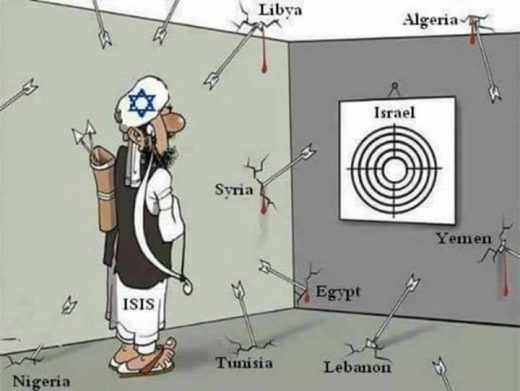
Despite the resources to field fleets of white Toyota pick-up trucks with heavy weapons in their beds and other paraphernalia, they found it an “almost” insurmountable challenge to strike what should be their own principal enemies. Curious, is it not? I wonder how many ISIS leaders have shared drinks with their Mossad and CIA contacts.
Last are the Syrian jihadists, easily the most fascinating facet of the Syrian puzzle. We are told constantly that these people are Islamic fanatics who spend their nights dreaming of how to kill non-believers, and their days trying to do it (or is that backwards?). But apparently there are “good” jihadists and “bad” jihadists. The former are those who do the bidding of Western governments (including Israel) and attack Muslim countries. The latter are those that apparently do not.
Peering Ahead
It is hazardous at best to anticipate what will emerge in the aftermath of the Syrian government’s defeat. At a minimum, I would expect the new rulers to order the Russians out. Of course, the Russians may not go, just as the US ignored the demands of many weaker governments to leave. Imperial powers, even if weakening and in a chaotic world, are often like that.
We may learn a bit more about ISIS and these “good” jihadists in Syria. Precisely what will they do in power? Will they be like the Taliban in Afghanistan? If not, what would that say about their actual character and that of their leaders? Thought-provoking times, at best.
What is clearer is that what happened in Syria will embolden the Israelis to deal with the Palestinians within and Lebanon and Hezbollah without, especially once Trump is President and recognizes Israeli sovereignty over East Jerusalem and the West Bank. Trump is even more beholden to Israel than most US presidents, and Israel will capitalize on it.
Moreover, with Assad’s Syria removed from the game, Iran will move to the regional front burner. No person in the US can now even be a serious candidate for President without being in Israel’s pocket, much less be elected to that office, but the two American political factions have different priorities.
What this means is that the Neo-conservatives stacking up in Trump’s administration are an odds-on certainty to see this as a golden opportunity to complete their 2001 agenda and neutralize Iran. Knowing them, they and Jewish money will push (perhaps I should say “nudge”) Trump to do one of three things: (1) support Israel in attacking Iran, (2) join Israel in doing that, or (3) attacking Iran without Israel.

The net effect is a far more dangerous 2025 than recent years have seen, and they have not been exactly a joy. We face civil upheaval at home and more war abroad, if Trump actually puts his agenda into effect. For Israel, Syria’s defeat and Trump’s presidency augur well on its march to a “Greater Israel.” For Palestinians. Lebanese and so many others in the region, things have gone from bad to an almost unimaginably worse. For Americans, challenging times, indeed.
Alan Ned Sabrosky (PhD, University of Michigan) is a ten-year US Marine Corps veteran. He served in Vietnam with the 1st Marine Division and is a graduate of the US Army War College. Dr. Sabrosky can be contacted at docbrosk@comcast.net
Featured Video

Chinese jet fuel and the myth of energy independence
or go to
Aletho News Archives – Video-Images
Book Review
Former Insiders Criticize Iran Policy as U.S. Hegemony
By GARETH PORTER | CounterPunch | February 27, 2013
“Going to Tehran” arguably represents the most important work on the subject of U.S.-Iran relations to be published thus far.
Flynt Leverett and Hillary Mann Leverett tackle not only U.S. policy toward Iran but the broader context of Middle East policy with a systematic analytical perspective informed by personal experience, as well as very extensive documentation.
More importantly, however, their exposé required a degree of courage that may be unparalleled in the writing of former U.S. national security officials about issues on which they worked. They have chosen not just to criticise U.S. policy toward Iran but to analyse that policy as a problem of U.S. hegemony. … continue
Blog Roll
 Aletho News
- What is fueling unrest across the EU?
- Why no power can undermine Iran’s eternal dominance over the Strait of Hormuz
- Is The War Against Iran Over?
- Iran war will leave long-term ‘scar’ on Wall Street, investors warn
- How Iran decimated US power projection in West Asia: Military lessons of 40-day war
- Iran’s report details US-Israeli war crimes in targeting schools, hospitals, livelihoods
- NATO’s Slow Fracture: How Trump’s Iran War Exposed the Instrument of Hegemony
- Chinese jet fuel and the myth of energy independence
- Ukraine Sea Drone Fired From Libya Hit Russian Tanker in Mediterranean
- IRGC: Iranian forces launched no attacks during ceasefire hours
- If Americans Knew
- Military aid to Israel emerges as the latest political litmus test for Democrats
- The only Palestinian children’s rights organization closes following years-long Israeli campaign against it
- ‘I Can’t Forget the Smell’: Lebanese Reel After Israel Kills Over 300 in Single Day
- DNC Shoots Down Resolutions Calling Out AIPAC and Limiting Arms to Israel
- TCN: Is Israel Blackmailing President Trump?
- Israel killed at least 303 Lebanese yesterday – who were they? Daily Update
- Amnesty: Urgent – Protect Lebanese civilians from brutal escalation in Israeli attacks
- Is The War Against Iran Over?
- Inside the Israeli army’s propaganda wing
- Hundreds of Gaza Amputees Stranded in Legal Limbo
- No Tricks Zone
- An Inconvenient Tree: Uncovered In Alps… Europe Much Warmer Than Today 6000 Years Ago
- New Study Reports A 60% Slowdown In Greenland’s Ice Loss Rate In The Last Decade
- Low Intensity Tornado Wrecks Major Solar Farm, Creating A Potential Toxic Dump
- New Study Finds Warming Saves Lives…Cold Temperatures 12 Times More Deadly Than Excess Heat
- German Science Blog Accuses PIK Climate Institute Of Hallucinating Climate Tipping Points
- Devastating Assessment Of Comirnaty Vaccine By Former Senior Pfizer Europe Toxicologist
- New Study: CO2 Is ‘Effectively Negligible’ As An Explanatory Climate Change Factor Since 2000
- Former Pfizer Toxicologist Dr. Helmut Sterz Tells Bundestag Hearing Pfizer Vaccine Should Have Never Been Approved
- Energy Expert: Germany’s Nuclear Phaseout Was A “500 Billion Euro Mistake”
- New Research: South Australia’s Mid-Holocene Sea Surface Temperatures Were 4°C Warmer Than Today
 Aletho News