Iran: Epstein scandal may be part of Israel’s political project
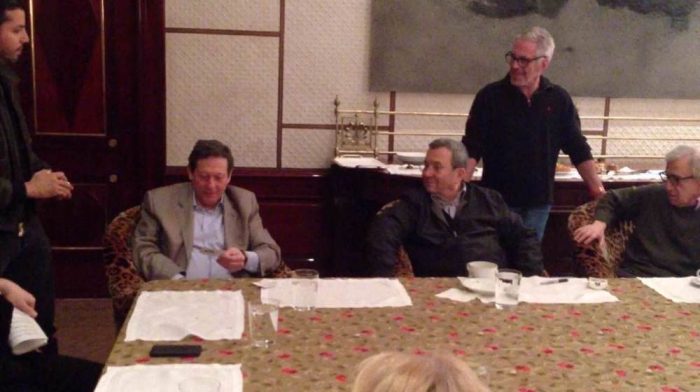
Seated from left to right are billionaire Thomas Pritzker, former Israeli prime minister Ehud Barak, and Hollywood director Woody Allen, while magician David Blaine stands to the left and Jeffrey Epstein stands, in a photo released by US Congressional Democrats on December 18, 2025.
Press TV – February 10, 2026
Iran says the global scandal surrounding convicted sex offender Jeffrey Epstein may go beyond a criminal case and be part of a geopolitical “project” intended to serve the Israeli regime’s interests.
A newly released tranche of Epstein files has sent shockwaves across media, politics, academia, finance, and even Hollywood, forcing prominent figures to account for their ties to Epstein.
Foreign Ministry spokesman Esmail Baghaei told reporters on Tuesday that the documents should not be downplayed or seen as an issue limited to the United States or a single individual.
He said that “given multiple reports indicating that the Israeli regime or others have exploited these cases and related proceedings to advance their political objectives, it strengthens the suspicion that the entire affair may be part of a long-running and extensive project to further the political goals of certain parties, particularly the Israeli regime.”
Baghaei described the scandal as a “human and civilizational catastrophe,” which has deeply wounded the global public conscience and could be considered a crime against humanity.
The revelations, he said, indicate a deep moral crisis within Western governance systems, particularly given the involvement of senior political figures in corruption-related cases.
Baghaei also questioned why no formal judicial proceedings have been publicly pursued so far.
“The crimes reflected in these reports depict horrific events and reveal a deeply troubling mindset among this class of individuals towards women, children, and girls,” he said.
The issue, according to him, requires careful examination across multiple dimensions, including political and security implications, and could affect the region both now and in the future.
Last week, the US Department of Justice (DOJ) released more than three million pages of files linked to its long-running investigation into Epstein, revealing the involvement of powerful political and business figures, including US President Donald Trump, his son-in-law Jared Kushner, and former Israeli prime minister Ehud Barak.
The released files are part of an estimated six million documents held by the DOJ.
The documents provide additional evidence that Epstein had ties to Israeli intelligence.
A declassified FBI memorandum from the Los Angeles field office in October 2020 reported that one source believed Epstein “was a co-opted Mossad agent” and described him as having been “trained as a spy” for Israel’s intelligence service.
The same document also suggested that Trump was vulnerable to Israeli influence through financial and political leverage, according to the confidential source.
World’s largest shipping firm facilitates US trade with illegal Israeli settlements
The Cradle | February 9, 2026
The world’s largest shipping firm, Mediterranean Shipping Company (MSC), has been transporting goods from the illegal Israeli settlements in the occupied West Bank to the US, including via European ports.
According to a joint investigation by Al-Jazeera and the Palestinian Youth Movement (PYM) published on 9 February, commercial documents obtained through US import databases show that between 1 January and 22 November 2025, MSC facilitated at least 957 shipments of goods from Israeli settlements to the US.
Of these shipments, more than half transited through European ports, including 390 in Spain, 115 in Portugal, 22 in the Netherlands, and two in Belgium.
MSC is privately owned by Italian billionaire Gianluigi Aponte and his Italian-Israeli wife, Rafaela Aponte-Diamant.
“Israeli settlements are widely considered illegal under international law, because they are built on occupied territory, in violation of the Fourth Geneva Convention,” noted Nicola Perugini, senior lecturer in international relations at the University of Edinburgh.
“Commercialising products from these settlements effectively supports the illegal settlements,” she affirmed.
A wide range of products are produced in the settlements, from food items and textiles to skin care and natural stones, Al-Jazeera noted.
Israel conquered the West Bank and Gaza during the Six-Day War in 1967 and has sought to oust the native Palestinian Muslims and Christians and replace them with Jewish Israelis in an effort to create “Greater Israel.”
Professor Perugini called on states to ban trade with illegal settlements entirely. “You cannot normalize the profits of an illegal occupation,” he said.
The US and EU allow imports of products from Israeli settlements, despite policies formally acknowledging the settlements are illegal.
MSC also facilitates shipments from the US and Europe to the Israeli settlements.
In 2025, MSC facilitated at least 14 shipments from the Italian port of Ravenna, listing the names and zip codes of Israeli settlements as recipients.
MSC also holds cooperation and vessel-sharing agreements with Israel’s publicly held cargo shipping company, ZIM.
Such shipments may be illegal under international law following a 2024 opinion by the International Court of Justice (ICJ) advising that third states are obliged to “prevent trade or investment relations that assist in the maintenance of the illegal situation created by Israel in the Occupied Palestinian Territory.”
The ICJ opinion does not directly address the responsibility of private corporations like MSC.
PYM, a grassroots, international pro-Palestinian movement, found last year that Danish shipping firm Maersk, the world’s second largest, also ships products to and from Israeli settlements.
According to UN estimates, businesses located in illegal settlements in the West Bank and East Jerusalem contribute about $30 billion to the Israeli economy each year.
Settlement businesses are often unusually profitable as they are established on stolen Palestinian land that the company has not paid for.
Israel has recently accelerated efforts to expand the E1 settlement project, designed sever the West Bank into two parts, isolate it from East Jerusalem, and ensure a two-state solution becomes impossible.
The plan calls for constructing 3,500 apartments next to the existing settlement of Maale Adumim.
On Sunday, the Israeli government approved sweeping changes to land registration and civil control in the occupied West Bank, which will dramatically expand settlement construction, Middle East Eye (MEE) reported on Monday.
Israeli Finance Minister Bezalel Smotrich and Defense Minister Israel Katz said the policy changes are intended to pave the way for expanded settlements and land seizures.
Under the new measures, the military will be allowed to demolish Palestinian buildings and homes for which Israel refused to issue a building permit in areas A and B of the West Bank
The changes would also open West Bank land registries to the Israeli public, enabling settlers to identify Palestinian landowners and pressure them to sell their land.
Making ownership records public could also make it easier for settlers to forge claims over Palestinian land, and thereby seize Palestinian land through Israeli courts, MEE added.
The measures also loosen restrictions on the sale of Palestinian land to Israelis, overturning a Jordanian-era law prohibiting transfers to non-Palestinians.
Washington’s Gaza ‘master plan’: A mere PowerPoint presentation
Trump allies are selling Gaza reconstruction as a futuristic AI-powered utopia that not even the Israeli army believes will happen
By Robert Inlakesh | The Cradle | February 10, 2026
“We have a master plan … There is no Plan B,” remarked Jared Kushner last month, during a Board of Peace (BoP) presentation about Gaza reconstruction at the World Economic Forum (WEF) at Davos. What has become apparent is that no coherent Plan A exists either.
Although Kushner’s father-in-law, US President Donald Trump, was granted the legitimacy to build what he calls the BoP on the back of pledges to implement his “20-point peace plan” and Gaza ceasefire, the BoP’s charter is notably absent of any reference to Gaza.
Furthermore, United Nations Security Council (UNSC) resolution 2803, which legally authorized the BoP and was explicitly about the Gaza ceasefire, was deliberately vague on how any concepts proposed in the resolution would be implemented. It deliberately avoided outlining any mechanisms or obligations for reconstruction. Instead, two parallel schemes emerged.
The first was the Gaza Reconstitution, Economic Acceleration and Transformation Trust (GREAT Trust) – a 38-page document proposing to pay Palestinians $5,000 each to leave the territory. Crafted by Israeli figures previously involved in the discredited Gaza Humanitarian Foundation (GHF), the plan, which envisions “AI-powered, smart cities,” was less a roadmap for peace than a blueprint for ethnic cleansing.
That same foundation, backed by US private military contractors (PMCs), had already drawn international condemnation for herding civilians into “aid zones” only to open fire. More than 2,000 Palestinians were killed in those operations.
PowerPoint colonialism
Later, in December, the Wall Street Journal (WSJ) exposed that another proposal was put into circulation among US-allied nations in the Arab and Muslim world. The 32-page PowerPoint presentation, titled “Project Sunrise,” was set forth by Kushner and US envoy Steve Witkoff.
Like the preceding proposal, the new vision outlined a similar AI-smart city model, but added even more elements, such as high-speed rail infrastructure. According to the PowerPoint slides, the total cost of this 10-year reconstruction endeavor would amount to $112.1 billion, for which the US would commit to footing 20 percent of the bill.
Back then, Steven Cook, a senior fellow for the Middle East Program at the Council on Foreign Relations think tank, told WSJ that “they can make all the slides they want,” adding that “no one in Israel thinks they will move beyond the current situation and everyone is okay with that.” US Secretary of State Marco Rubio had even expressed his concerns over how realistic the plan will be, especially when it comes to potential foreign investment.
Then came Kushner’s presentation at Davos, which instantly made headlines and was presented as a brand new proposal called the “master plan.” According to Kushner, the project for a “new Gaza” would now only cost $25 billion.
However, upon further investigation, it is clear that what Kushner was presenting was simply “Project Sunrise,” which was evident as the PowerPoint he used was filled with the same exact slides from December. In other words, nothing particularly new was being placed on the table that had not already been released over a month prior.
“New Gaza” is a lab rat colony
Speaking to The Cradle, Akram, a Gaza resident from Al-Bureij, states that the situation on the ground does not reflect any of the positivity that appears in the media. “The Israelis won’t let us even have mobile homes or proper structures to live in, they still bomb us every day, and then we see AI images of Gaza becoming richer than Israeli cities?” he says, with bitter sarcasm. He added:
“Listen, do you really think they carried out genocide for two years and destroyed all our homes, only to build us a paradise, and that this will all happen if the resistance gives up its weapons? No. They are trying to tease us, like they always did, by saying, ‘if you give up your weapons, you will become Singapore.’ Nobody believes it.”
Shortly after Akram spoke to The Cradle, Israeli Prime Minister Benjamin Netanyahu delivered a speech to a special session of the Knesset, in which he made it clear that “the next stage is not reconstruction.” Instead, he asserted that disarmament would characterize Phase 2 of the ceasefire.
In his “master plan” presentation, Kushner claimed that the major task of clearing Gaza’s rubble would only take two to three years. Yet, according to UN figures, this task was estimated to take up to 15 years, with costs expected to exceed $650 million.
These figures are also dated, having been produced in July 2024, so they do not account for over a year of destruction. Israel has not stopped its round-the-clock demolition of Palestinian infrastructure since the so-called ceasefire took effect on 8 October 2025.
A humanitarian NGO official working in Gaza tells The Cradle that even the ceasefire’s Civil Military Coordination Center (CMCC), ostensibly set up to enforce humanitarian standards, now functions as a system of “intimidation” that “violates basic morality.”
On 21 January, Drop Site News reported on leaked documents that revealed plans to create an “Israeli Panopticon” city, to be constructed in territory remaining under its control in southern Gaza’s Rafah. The Guardian then reported that the UAE is seeking to bankroll the project. The leaked blueprints described a “case study” city where residents would be monitored around the clock, like lab rats, and forced to submit biometrics to enter.
Rafah as the prototype prison
The UAE has been accused of backing the five ISIS-linked militant groups Israel created to fight Hamas, which it previously intended to rule over a similar style concentration camp city in Rafah. In fact, Israeli Defense Minister Israel Katz had even ordered the construction of such a “community” during the 60-day ceasefire in early 2025. The Israelis have long intended to displace 600,000 Palestinians to such a gated facility.
The Emirati connection in this scheme goes beyond its recent offer to fund such a concentration camp city; it dates all the way back to January 2024, when it officially opened six water desalination plants along the Egyptian side of the Gaza border area, coincidentally capable of supplying 600,000 people with water.
Prior to the ceasefire and the collapse of the privatized aid scheme, the plot was to use the GHF PMCs in order to lure civilians into such a city area. Once they get there, the Palestinians who enter would be under the rule of Israel’s ISIS-linked proxy militias.
According to forensic architecture analysis, Israel is once again preparing land in order to implement such a project. Meanwhile, UG Solutions – the firm that hired the GHF’s PMCs – is again advertising job opportunities in the besieged territory.
Dispossession in disguise
Despite the dizzying array of slogans – BoP, GREAT, Sunrise, Panopticon – the outcome remains the same with no reconstruction, no sovereignty, and no end to occupation. The various schemes are less about peace and more about forcing Palestinians into containment zones policed by Tel Aviv and its regional clients.
From “Gaza Riviera” fantasies to proposals limiting reconstruction to areas under Israeli military control, what’s on offer amounts to PowerPoint projectionism. A revolving door of schemes and slogans has produced nothing substantive. Instead, the Israeli military continues its daily war of erasure on Gaza’s land, people, and future.
Even Kushner’s $25-billion fantasy is just that: a fantasy. In the three months since the UN resolution, all Washington has offered is AI-generated cityscapes and recycled decks. The only real plan on the table remains the one being implemented daily – the destruction of Gaza.
Iran advises US to act independently of ‘destructive’ Israeli influence amid nuclear talks in Oman
Press TV – February 10, 2026
Iran’s Foreign Ministry spokesman has advised the United States to avoid “destructive” Israeli influence as Washington engages in indirect nuclear negotiations with Tehran, citing the drawn-out history of Tel Aviv-manufactured regional crises.
Esmaeil Baghaei made the remarks during a press conference in Tehran on Tuesday, identifying the US as Iran’s sole negotiating counterpart that had to decide whether it was willing to act independently of Israel’s “destructive” pressures that harmed regional stability and even contradicted Washington’s own interests.
Baghaei said one of the main challenges in US foreign policy in the West Asia region was its alignment and compliance with the demands of the Tel Aviv regime, which he said has been the primary source of insecurity in the region over the past eight decades.
He further described Israel as the driving force behind an artificially manufactured crisis surrounding Iran’s peaceful nuclear energy program.
Repeated allegations propagated by Tel Aviv that Tehran sought to divert the program towards military purposes were aimed at creating an illusory sense of fear, he added.
The same regime, the senior diplomat noted, has consistently obstructed peaceful diplomatic processes.
The remarks came as Israeli Prime Minister Benjamin Netanyahu is about to travel to the United States ahead of schedule in line with what observers have speculated to be Tel Aviv’s intentions to force Washington into complicating the talks.
According to Baghaei, while resolved to address outstanding issues through diplomacy, Iran retains its defensive awareness.
He cited past experiences, including the imposed Israeli-American war on the country that came while Tehran and Washington were engaged in a similar process.
The spokesman warned that any fresh military aggression against the Islamic Republic would be met with a decisive and “regret-inducing” response, saying experience has shown that Israel would unexceptionally coordinate its actions with the United States.
The remarks referred to verification emerging across media that the previous round of indirect nuclear talks between Iran and the US were used as a cover to conceal Tel Aviv’s and Washington’s intentions to wage war on the Islamic Republic in June last year.
The spokesman described the most recent round of the talks that took place in the Omani capital Muscat on Friday as a half-day session intended to assess the seriousness of the other side and the possible path forward.
He said the discussions focused largely on general issues and that the Islamic Republic’s principled positions were made clear.
Baghaei added that Tehran’s core demand was securing the interests of the Iranian nation in line with international norms and the Nuclear Non-Proliferation Treaty (NPT), specifically concerning the peaceful use of nuclear energy.
Asked about the format of talks, the spokesman said, “Whether negotiations are direct or indirect is not decisive; if there is political will, an agreement is achievable.”
“The talks in June did not collapse because they were indirect, but because the United States resorted to military force, which led to a deadlock,” he added.
Larijani’s Oman visit
He also commented on an ongoing visit to Oman by Secretary of Iran’s Supreme National Security Council (SNSC), Ali Larijani, saying it was part of the continuation of regional consultations by the official, who has previously traveled to several regional countries, including Russia, Pakistan, Saudi Arabia, and Iraq.
He said Iran’s principled policy was to strengthen relations with neighboring countries and promote good neighborliness, adding that the trip had been “planned in advance” and was aimed at enhancing regional cooperation.
Is Nixing Aid to Israel a Poison Chalice?
Ending the existing arrangement could result in even more extensive forms of involvement
By Kelley Beaucar Vlahos | The American Conservative | February 9, 2026
There is a lot of talk about getting rid of the massive agreement that guarantees Israel billions of dollars in military aid each year. And it’s not just critics of Israel: Prime Minister Benjamin Netanyahu and Senator Lindsey Graham have even said they want to “taper off” the money because Israel is ready to stand on its own two feet.
But while a debate over the annual package would be a most welcome one given the enormous sums of American taxpayer money that has flowed to Israel’s wars in recent years, it is important to keep an eye on what might be a bait and switch: trading one guarantee for a set of others that might be less transparent and more expensive than what’s on the books today.
When President Bill Clinton announced the first Memorandum of Agreement, a 10-year, $26.7 billion military and economic aid package to Israel, he expressed hope that it would complement the advancement of the Oslo Accords, the peace process he had shepherded between the Israelis and Palestinians earlier in his term.
The peace process tied to Oslo pretty much fell apart after expected Israeli withdrawals from the West Bank as outlined in the Wye River Agreement in 1998 never happened; today Israeli settlements considered illegal under international law have exploded, with more than 700,000 settlers living there today and Israelis controlling security in most of the territory. But the 10-year MOU lived on.
Not only has it been renewed through the Bush and Obama administrations; the total outlays have increased. The current one, signed in 2016, pledged $38 billion over the decade, just under $4 billion a year and now all of it military aid. According to the Council on Foreign Relations, Israel is by far the biggest recipient of U.S. aid in history, some $300 billion since its founding, with the greatest proportion coming from those MOUs.
Supporters of the aid say it comes with military and strategic partnerships that are supposed to help keep the neighborhood safe for the U.S., Israel, and its “allies” (there are no treaty allies in the region), but the last 40 years have been pockmarked with wars and waves of human displacement and misery. Beyond financially and militarily supporting Israel’s wars, the U.S. has been bombing, regime-changing, occupying, and fending off terrorist insurgencies created by its own policies in Central Asia, the Horn of Africa, and the Middle East since 1999. Today, with Israel’s encouragement, President Donald Trump is poised to bomb Iran for the second time in his current term in office.
On February 3 the Congress passed the latest installment of the current MOU—$3.3 billion. It was a bipartisan affair, with Senate Minority Leader Chuck Schumer assuring a group of Jewish leaders the previous weekend, that “I have many jobs as leader … and one is to fight for aid to Israel, all the aid that Israel needs.”
But not everyone is on board with the open spigot. And a spigot it is. According to CFR, the U.S. gave $16.3 billion (which included its annual $3.8 billion outlays) to Israel after the Oct. 7, 2023 attacks. Israel’s retaliation for those attacks, which killed 1,200 Israelis, has resulted in more than 71,000 recorded Palestinian deaths in Gaza so far, a blockade that has left the 2 million population there largely homeless, starving, sick, and unsafe. Americans have reacted by rejecting the prospects of further aid, with a plurality now—42 percent—saying they want to decrease if not stop aid altogether. That is up from the mid-20 percent range in October 2023.
Beyond Americans’ aversion to funding the slaughter of civilians in Gaza, a conservative fissure over continued, unconditional support for Israel has opened wide over the last year, exposing another rationale for discontinuing the aid: It is not “America First.” It not only siphons off aid from much needed renewal at home, but forces Washington to aid and abet another country’s foreign policy, which is increasingly counterproductive and contrary to our own politics and values.
The region is not safer, and moreover, it has not allowed for the United States to reduce its military footprint as guarantor of security there.
One then-congresswoman, Marjorie Taylor Greene (R-GA), was vocal in her opposition to this aid. Israel, she pointed out, has nuclear weapons and is “quite capable of defending itself.” She has pointed out Israel’s universal health care and subsidized college tuition for its citizens, “yet here in America we’re 37 trillion dollars in debt.”
Rep. Thomas Massie (R-KY.) posted on X that he voted against the spending bill on February 3 in part to deny Israel the $3.3 billion in aid. He has said the aid takes money out of Americans’ pockets and proliferates human suffering in our name. “Nothing can justify the number of civilian casualties (tens of thousands of women and children) inflicted by Israel in Gaza in the last two years. We should end all U.S. military aid to Israel now,” he said in May of last year.
In an interview with The American Conservative last week, he said he is speaking for his Kentucky district and despite a retaliatory 2026 primary challenge driven largely by Trump and donors linked to the American Israel Political Affairs Committee (AIPAC), he will continue to raise the issue in Congress. He said he has asked his GOP constituents every year whether to maintain, increase, or cut Israel annual aid since 2012.
“I’ve polled that every election cycle in my congressional district among likely Republican voters, and this was the first year that a majority of people answered nothing [no aid] at all, or less,” said Massie. “It’s not a third rail back home. It’s a third rail inside of the Beltway.”
According to reports last month, Israel is “preparing for talks” with the Trump administration to renew the MOU for another 10 years. One might be flummoxed to hear, however, that Netanyahu is giving interviews in which he says he wants to “taper off” American aid in that decade “to zero.” Israel has “come of age” and “we’ve developed incredible capacities,” he said in January.
Immediately after, Graham, who seems to spend more time in Israel than Washington these days, said he heartily agreed and hoped to end the aid sooner. “I’m going to work on expediting the wind down of the aid and recommend we plow the money back into our own military,” he said. “As an American, you’re always appreciating allies that can be more self-sufficient.”
The idea of self-sufficiency and furthermore the concept of Israel releasing itself from any “ties” that might come from the aid is not a new one among supporters here and especially the hardline right in Israel. “Cut the US aid, and Israel becomes fully sovereign,” Laura Loomer charged on X in November. In March of last year, the Heritage Foundation called for gradually reducing the direct grants in the next MOUs starting in 2029 and transitioning gradually to more military cooperation and then finally arms transfers through the Foreign Military Sales by 2047.
Israel, the report concludes, should be “elevated to strategic partner for the benefit of Israel, the United States, and the Middle East. Transforming the U.S.–Israel relationship requires changing the regional paradigm, specifically advancing new security and commercial architectures.” The plan also leans heavily on future Abraham Accords ensuring trade and military pacts with Arab countries in the neighborhood.
Therein lies the fix, say critics. The reason these staunch advocates of Israel including Netanyahu, the most demanding of its leaders over the last 30 years by far, is willing to forgo MOU aid, is that they envision it will come from somewhere else, less politically charged.
“The emerging plan is to substitute formal military funding—known as Foreign Military Financing—with greater U.S. taxpayer-funded co-development and co-production of weapons with Israel,” says the Institute for Middle East Understanding, which adds that instead of extricating from Israel’s messes, the U.S. will be further “enmeshed” in them.
The think tank points out that the Foundation for the Defense of Democracies (FDD), the most unreconstructed pro-Israel organ in the United States, came out with its own report on the aid, and surprise, also advocated phasing out the MOU. In addition to a commitment by Israel to spend more of its GDP on defense and other co-investments with the U.S. on research and development, the U.S. would “provide Israel $5 billion each year through what would be known as a Partnership Investment Incentive—or PII. This PII would provide funding via existing foreign military financing (FMF) mechanisms that Israel would use to procure American military hardware.” The difference would be that it would have to be spent entirely in U.S. industry and on cooperative partnerships in the region, all while maintaining Israel’s “Qualitative Military Edge.”
Geoff Aronson, longtime Middle East analyst and occasional TAC contributor, said the aid has been “an important if not vital component in ensuring American and Israeli hegemony in the region” and is linked intrinsically to balancing U.S. strategic relations and normative Israeli peace with Egypt and Jordan, which gets billions in military aid (not as much) from the U.S. too. None of this is going to go away, he surmised to TAC.
“The question that is being posed is how can we continue to support Israel’s ability to work its will in the region without committing ourself to X, Y, Z or committing to a new partnership, a new agreement,” he said. “Watch what you wish for, because it might come true.”
Three-Year-Old Child Among Four Martyrs as Israeli Enemy Strikes Car in Southern Lebanon

Al-Manar | February 9, 2026
A drone strike in southern Lebanon killed three civilians on Monday, including a three-year-old child, as the enemy continued its daily violations of the ceasefire—once again placing children and non-combatants within its target bank.
Al-Manar’s correspondent reported an Israeli drone strike targeting a car in the southern town of Yanouh, in the district of Tyre, leaving casualties.
Ambulances rushed to the scene of the attack as pillars of smoke rose in the area, according to our correspondent.
Lebanese Health Ministry then said the strike in Yanouh killed three citizens including a 3-year-old child.
Local media reported that the victims were Ali Jaber, 3, his father Hasan and Ahmad Salameh, a retired Lebanese army soldier.
The killing of a three-year-old child in a drone strike underscored the nature of the Israeli enemy’s daily aggression in southern Lebanon, where civilians, particularly children, continue to be targeted in flagrant violation of the 2024 ceasefire.
Later on Monday, Al-Manar correspondent reported a citizen was martyred as occupation forces opened fire at him in the outskirts of Ayta Al-Shaab border town.
The town also witnessed bomb attacks as Israeli gliders dropped at least five strun grenades in the area.
Earlier on Monday, Israeli forces infiltrated into the southern town of Habbarieh, assaulted the house of Jamaa Islamiya official Atwi Atwi and abducted him after beating him along with his wife.
Atwi, who was a former mayor of the town, was taken to the occupied territories, as announced by the occupation army.
Decades of broken promises, aggression, Israeli pressure leave Iran no reason to trust US: Analyst
By Press TV | February 9, 2026
Decades of broken promises, military aggression, and Israeli pressure have left Tehran with no reason to trust Washington, says a US-based analyst.
In an interview with the Press TV website, E. Michael Jones, author and editor of Culture Wars Magazine, said it would be “foolish” to put “trust in a regime which violates its own word repeatedly,” referring to the Donald Trump administration.
“Iranians have learned their lesson and will not put themselves in jeopardy again. The US cannot be trusted,” he noted.
Mistrust is not a tactical posture but the logical outcome of experience, Jones said, adding that the United States, particularly under Trump, has demonstrated “again and again” that it does not feel bound by its own international commitments.
That mistrust is sharpened by Trump’s record on international obligations, he remarked.
The US-based journalist and commentator pointed to the unilateral withdrawal of the US from the Joint Comprehensive Plan of Action in May 2018.
“Trump has already torn up the JCPOA. He would not feel bound by any agreement,” he said, adding that this piece of history alone makes any future deal “inherently fragile.”
Jones also dismissed Israeli-backed demands to restrict Iran’s missile range, calling them knowingly unrealistic.
“A 300 km limitation on Iranian missiles is an impossible demand,” he stated, adding that Israel is fully aware Iran would never accept such terms.
According to the analyst, these conditions are not designed to advance negotiations but to manufacture justification for war.
“They are making the demand because it provides a pretext for war,” he told the Press TV website, as indirect Iran-US talks have recently resumed in Muscat under Omani mediation.
The discussions, facilitated by Omani Foreign Minister Badr bin Hamad Al Busaidi, allowed the two sides to exchange views indirectly almost eight months after the previous round of talks was suspended due to Israeli-American military aggression against Iran.
Iranian Foreign Minister Abbas Araghchi described the latest round of talks as a “good start,” saying Iran’s positions and concerns were clearly conveyed.
More than a week into the June war, the United States bombed Iran’s nuclear facilities. Between June 13 and 27, 2025, at least 1,064 people were killed in Iran, including military commanders, nuclear scientists, and ordinary civilians.
Against this backdrop, claims that talks could once again serve as cover for military action resonate strongly. Jones believes Iranians “learned their lesson” there.
This distrust is further reinforced by Washington’s expanding military footprint and repeated threats. Despite Trump’s campaign rhetoric about ending US wars, his administration has bombed several countries and repeatedly edged toward confrontation with Iran.
In his assessment, Trump’s preferred military option remains limited and performative. “Trump’s preferred option at this point is a symbolic strike at targets pre-arranged with the Iranian government,” Jones says, claiming that this approach was already used in June.
Such strikes, he explained, are designed to create the illusion of victory. Trump can declare success, “satisfying the Israelis, who ordered him to attack Iran, and the Iranians, who lose nothing in the attack.”
But the analyst argued that this balancing act is collapsing. “Unfortunately, neither Iran nor Israel is willing to accept Trump’s solution,” he noted.
Israeli pressure, Jones added, is now the central driver of escalation. With Trump set to meet Benjamin Netanyahu on Wednesday, the analyst expects an ultimatum by the latter: “if you don’t attack Iran, we will.”
“If Trump is smart, he will let Israel attack Iran on its own, hoping that the Iranian response will obliterate Israel once and for all, releasing him from Netanyahu’s constant pressure,” Jones remarked.
Still, he believes Netanyahu’s threats mask a deeper constraint. “Netanyahu is bluffing. He knows he can’t attack Iran by itself,” he said, adding that “many here speculate that Netanyahu is blackmailing Trump with the Epstein files.”
Despite the rhetoric, the analyst insists the US is fully aware of the risks of war with Iran.
Iranian officials have warned that any attack would be met with an immediate response, and Iran’s missile capabilities have already demonstrated their ability to penetrate layered defenses. According to the author, this reality is well understood within the US military.
“The American military has always claimed that the US cannot win a war with Iran,” he noted.
Yet, he hastened to add, such assessments rarely determine policy. “Their verdict invariably gets overturned by Israeli pressure,” Jones stressed, explaining why Trump continues to favor prearranged and symbolic strikes rather than full-scale war.
“American forces are now operating according to Israeli rules,” he stated, noting that the US power in the region no longer operates according to international norms.
He cited the assassination of top anti-terror commander General Qassem Soleimani, carried out while he was on a peace mission in Iraq, as a defining moment.
For Jones, it marked Washington’s abandonment of its own claims to a “rules-based order,” as well as its disregard for institutions such as the United Nations.
He recalled Trump’s own words when questioned by the New York Times. Asked whether he followed international law, Trump said no. Asked what he did follow, Trump replied, “My morality, my mind.”
The analyst described this as a direct reference to John Milton’s Paradise Lost, when Satan said, “The mind is its own place.”
The symbolism, he noted, is unmistakable, adding that it confirms that Imam Khomeini—the founder of the Islamic Revolution—was right when he referred to America as the “Great Satan.”
Iran Willing to Dilute Enriched Uranium If US Lifts All Sanctions
By Kyle Anzalone | The Libertarian Institute | February 9, 2026
A top Iranian official said that Tehran would be willing to dilute its stockpile of highly enriched uranium if Washington agrees to remove sanctions completely.
Iran’s atomic energy chief, Mohammad Eslami, proposed that Tehran would dilute its 60% enriched uranium to a lower level if “all sanctions would be lifted in return.” Iran is estimated to have 400-600 kg of highly enriched uranium. Eslami explained that Tehran was unwilling to sell or transfer the nuclear material to a third country.
American and Iranian officials met for talks in Oman last week. Iranian Foreign Minister Abbas Araghchi said Iran is “very serious in negotiations” and is eager to “achieve results”. However, he said, “There is a wall of mistrust towards the United States, which stems from America’s own behaviour.”
Tehran says it is willing to agree to a deal with Washington that imposes restrictions and inspections on its civilian nuclear program in exchange for sanctions relief and the US abandoning its aggressive policy towards Iran.
Washington and Tel Aviv are seeking a far more expansive agreement that includes restrictions on Tehran’s nuclear and missile programs, as well as Iran cutting ties with its allies in the region. The White House has demanded that Tehran eliminate its nuclear enrichment program and limit the range of its ballistic missiles.
Israeli Prime Minister Benjamin Netanyahu is set to meet with President Donald Trump on Wednesday to ensure Washington does not sign a deal with Tehran that violates Tel Aviv’s redlines. Israeli officials have told the White House that Tel Aviv could launch a strike on Iran if the US agrees to a deal that does not include restricting Tehran’s missile program.
Iran has ruled out signing an agreement on the terms proposed by the US and Israel. President Donald Trump has threatened to attack Iran if Tehran does not sign a new deal with the US.
The Toxic Border: How Israel’s Chemical Spraying is Reshaping Life in South Lebanon
By Robert Inlakesh | The Palestine Chronicle | February 8, 2026
Reports that Israeli aircraft sprayed chemical agents along the Lebanese border — later identified as toxic defoliants — have intensified concerns over environmental damage, civilian harm, and possible violations of international law, with similar incidents also reported in southern Syria.
Key Takeaways
- UN peacekeepers suspended patrols after being warned that aircraft would spray chemical agents near the Blue Line.
- The sprayed substance was later identified as a toxic herbicide linked to cancer.
- The campaign is seen as serving both military land-clearing and civilian displacement purposes.
- Similar chemical spraying incidents have been reported in southern Syria.
- Rights groups say targeting farmland may constitute a violation of international humanitarian law.
- Spraying along the Blue Line
Israel is waging chemical warfare against both Lebanese and Syrian lands, a campaign that may not only have dire environmental repercussions but also inflict long-term health problems on local civilian populations.
On February 1, the United Nations peacekeeping forces stationed in southern Lebanon – UNIFIL – were forced to suspend their patrols along what is known as the Blue Line that demarcates the de facto Israeli-Lebanese border. They did so out of safety concerns for their soldiers, after Israel informed them it would be using planes to spray chemical agents in the area.
Tel Aviv initially informed UNIFIL that the chemical agent was “non-toxic.” Nevertheless, the UN reiterated its “concerns” about flight movements in the area, stressing that such activities violate UN Security Council Resolution 1701.
It wasn’t long until it was discovered that the agent being sprayed was, in fact, toxic. Allegedly, the specific agent used, for which a toxicology test was conducted, is a defoliant and herbicide that is linked to cancer.
Israel is currently on its way to violating the Lebanon ceasefire, which went into effect on November 27, 2024, nearly 10,000 times. This makes it the most violated ceasefire deal in recorded history.
Israeli strikes, targeting north to south and even the capital city of Beirut, have killed hundreds. Despite this, there have been no recorded violations by Hezbollah or the Lebanese Army.
A Strategy of Erasure
What is so consequential about Israel’s use of chemical agents in southern Lebanon is that it has two primary purposes. The first is to kill everything it touches, to clear the land for military purposes. The second is that it is being used as a form of collective punishment, a likely intention behind which is to drive Lebanese citizens from their homes.
Perhaps the most horrifying part of this is that there is a dark history of such chemicals being used for the same purposes elsewhere. The most infamous case is that of the US military spraying Agent Orange, also a herbicide and defoliant, during the Vietnam War.
As a result of the callous use of Agent Orange, both the civilian population of Vietnam and US soldiers alike ended up contracting serious chronic health problems. One of the results was birth defects, cancers such as Hodgkin’s lymphoma, and even neurodegenerative diseases. This was in addition to what was labeled ecocide in the country.
While some may argue that the Israelis are simply using chemical agents to clear the land, as a security precaution, this is not plausible. Israel has the capability and has historically used heavy equipment to clear the land.
Deploying chemical agents, which it is of note that they haven’t done so on their side of the Blue Line, is clearly a malicious attack on Lebanese lands and the civilian population living there.
Beyond Lebanon
Israelis have frequently expressed their dismay over the immediate return of Lebanese villagers to their destroyed homes in the south, particularly near the unofficial border, as Israel has never declared its borders.
Meanwhile, a considerable percentage of Israelis, formerly living in settlements like Kiryat Shimona, that were hit the hardest by Hezbollah during the last war, have refused to return.
It has not only been Lebanon that has been subjected to such chemical agent attacks, but southern Syria has also fallen victim to the Israeli military spraying similar chemical agents on its lands.
While the Lebanese government has come under criticism for often ignoring the plight of its citizens in the south, the Syrian government completely refrains from addressing the ongoing occupation and war crimes committed in the south of their country.
The refusal of Damascus to even voice its concern about the chemical warfare being waged against its people and lands has made it less of an issue than in Lebanon, as Beirut has raised its voice.
“The deliberate targeting of civilian farmland violates international humanitarian law, particularly the prohibition on attacking or destroying objects indispensable to civilian survival,” commented the Switzerland-based Euro-Med Human Rights Monitor.
It also demanded accountability for Israel’s “large-scale destruction of private property without specific military necessity amounts to a war crime and undermines food security and basic livelihoods in the affected areas.”
– Robert Inlakesh is a journalist, writer, and documentary filmmaker. He focuses on the Middle East, specializing in Palestine.
Somalia president warns against Israeli interference, vows to prevent any military base in Somaliland
Press TV – February 8, 2026
The president of Somalia has strongly denounced the Israeli regime’s interference in his country’s internal affairs and vowed to “confront” any Israeli military presence in the breakaway region of Somaliland.
In an interview on Saturday, Hassan Sheikh Mohamud said Israel’s recognition of Somaliland as an independent state is a “reckless, fundamentally wrong and illegal action under international law.”
Somaliland is a breakaway region in northwestern Somalia, covering territory that was once part of the British Protectorate. Despite its unilateral separation, it remains internationally recognized as part of Somalia.
The region occupies a strategic position along one of the world’s most vital maritime choke points, an area already surrounded by overlapping conflicts in the Horn of Africa and West Asia.
In recent years, Somaliland has sought foreign support by developing ties with the United Arab Emirates (UAE), a signatory to the Abraham Accords with Israel, as well as Taiwan, in an effort to gain international acceptance outside Mogadishu’s authority.
Israel’s move followed reports that the regime had contacted actors in Somaliland to discuss using the territory for the forced displacement of Palestinians during its genocidal war on Gaza, which has killed more than 72,000 Palestinians and wounded another 172,000, most of them women and children.
While Israeli and Somaliland authorities rejected those reports, a Somaliland official told Israel’s Channel 12 in January that an Israeli military base is “on the table and being discussed,” with its establishment tied to specific conditions.
Somalia has described Israel’s recognition of Somaliland as a direct assault on its territorial integrity and national unity, a position endorsed by most African and Arab countries, and has demanded that Prime Minister Benjamin Netanyahu reverse the decision.
Mohamud also made clear that Mogadishu will resist any Israeli military presence on Somali soil: “We will fight in our capacity. Of course, we will defend ourselves … And that means that we will confront any Israeli forces coming in, because we are against that and we will never allow that.”
He said Israel’s actions, which are “interfering with Somalia’s sovereign and territorial integrity,” also “undermine stability, security and trade in a way that affects the whole of Africa, the Red Sea and the wider world.”
Mohamud stressed that Israel’s deadly use of force against Palestinians in Gaza cannot be separated from developments in Somaliland, saying both reflect the erosion of global norms and restraints.
“Key among the global concerns is the weakening of the established rules-based international order. That order is not intact anymore,” he said.
He warned that institutions created after World War II “are under grave threat,” as the idea that “the mighty is right” increasingly replaces respect for international law.
The administration of US President Donald Trump, meanwhile, has yet to signal a significant change in its position on Somaliland.
Featured Video
The US bombed the Shahs house lol
or go to
Aletho News Archives – Video-Images
From the Archives
How a War with Iran Would Diminish American Power
By Greg Scoblete | The Compass | August 13, 2010
Jennifer Rubin wants a war with Iran:
But the emphasis on the existential threat to Israel ignores a more basic issue for Americans to ponder: a nuclear-armed Iran represents a dagger at the heart of America and an existential threat to our status as a superpower and guarantor of the West’s security. As to the former, Iran is pressing ahead with its long-range ballistic missile program. First the Middle East and Eastern Europe, then all of Europe and, within a matter of years, the U.S. will be within range of Iranian missiles. If those are nuclear and not conventional, what then? We’re not talking about whether Iran is going to be “merely” a destabilizing factor in the Middle East or whether it will set off an arms race with its neighbors or imperil Israel’s existence. We’re talking about whether America will then be at risk (and lacking sufficient missile-defense capabilities if we continue to hack away at our defense budget). The argument about whether mutual assured destruction can really work against Islamic fundamentalists who have an apocalyptic vision becomes not about Israel’s ability to deter an attack but about ours. Those who oppose American military action have an obligation to explain why America should place itself in that predicament.
I would argue that any obligation to present an explanation lies with those whose disastrous policy prescriptions with respect to Iraq lead America into the worst strategic blunder in the country’s recent history. That aside, note the blind faith in the power of the military to actually achieve its ends. … continue
Blog Roll
 Aletho News
- Brussels warns Slovakia over ‘discriminatory’ dual fuel pricing targeting foreign drivers
- Hungary to halt gas deliveries to Ukraine – Orban
- The US bombed the Shahs house lol
- The London Ambulances Attack: Of Course It Was A False Flag
- Embarrassing Pivot: U.S. considers dropping Iran oil sanctions amid war
- US has 2 months of rare earths left to replenish weapons amid Iran war: Report
- Strait Of Hormuz closure brings Empire to brink
- Iran controls Strait of Hormuz, dictates terms of war and peace as US excursion backfires
- Outlasting the Superpower: The Reasons Why Iran is Beating uhe US and Israel
- Top PMU commander, over a dozen fighters killed in new US strikes on Iraq
- If Americans Knew
- ‘Forever live by the sword’: Understanding Israelis’ massive support for Iran war
- UN’s special rapporteur on human rights says Israel is systematically torturing Palestinians
- Trump White House plagiarized Iran war manifesto from Israel-aligned think tank
- Gaza says 6–10 patients die daily waiting for treatment abroad as Israel blocks medical evacuations
- ‘Substantial evidence’ of double-tap strike in killing of Gaza’s Hind Rajab
- ‘Do Not Want To Die For Israel’: Doubts About Trump’s Iran Strategy Spread Among Troops
- Instead of taking Joe Kent’s claims seriously, the media is disregarding him as an antisemite
- Joe Kent’s Explosive Interviews about his Resignation over the Iran War
- Israel poised to take over southern Lebanon; settlers wreak havoc in West Bank – Not a ceasefire Day 165
- From Sde Teiman, the truth about Israel’s military justice system has been set free
- No Tricks Zone
- Devastating Assessment Of Comirnaty Vaccine By Former Senior Pfizer Europe Toxicologist
- New Study: CO2 Is ‘Effectively Negligible’ As An Explanatory Climate Change Factor Since 2000
- Former Pfizer Toxicologist Dr. Helmut Sterz Tells Bundestag Hearing Pfizer Vaccine Should Have Never Been Approved
- Energy Expert: Germany’s Nuclear Phaseout Was A “500 Billion Euro Mistake”
- New Research: South Australia’s Mid-Holocene Sea Surface Temperatures Were 4°C Warmer Than Today
- Storing Green Energy To Last Germany 10 Days Would Require A 60-Million Tonne Battery
- New Studies: UK Sea Levels Were 4 Meters Higher Than Today During The Mid-Holocene
- Destructive Green New Deal: German Energy And Metal Group Warns Of Drastic Crisis
- New Study Documents A 20-Year Pause In Arctic Sea Ice Decline – Driven By Internal Variability
- Wake-up Call: Survey Shows Majority Of Germans Now Favor Postponing Climate Targets!
 Aletho News