The pirates of Israeli supremacy: The West’s favorite rogue state has done it again
By Tarik Cyril Amar | RT | October 2, 2025
The long-expected if perfectly criminal has happened again: Israel’s navy has intercepted the Gaza-bound Sumud Flotilla by force, stopping almost 50 boats and, in effect, kidnapping hundreds of their crews and passengers.
In terms of law – which, of course, are never really applied in practice to Israel – everything is exceedingly clear: The Sumud Flotilla was a volunteer operation to bring humanitarian aid to Gaza which has been subjected to Israeli genocide for now almost two years. Israel had a clear obligation to let that aid pass.
But then what to expect from the world’s most aggressive rogue state that is not “only” committing genocide, but also waging regional wars of aggression and running terrorist assassination campaigns in the face of the global public? And Israel has a well-established track-record of this kind of piracy, of course, having stopped several attempts to bring aid by sea since 2010, sometimes with casualties among the humanitarian activists.
Stopping the Sumud Flotilla wasn’t merely criminal but criminal in every regard lawyers can imagine, a typical Israeli super-whopper of legal nihilism: Israel attacked the flotilla ships in international waters where it has no jurisdiction. Even if the ships had gotten closer to the Gaza coast, they would, by the way, still not have been inside any Israeli territorial waters because there are no such waters off Gaza, over which Israel has no sovereignty as clearly confirmed by the International Court of Justice last year. What you find off the coast of Gaza, as a matter of fact, are Palestinian territorial waters.
The blockade of Gaza, which has lasted not “merely” for the duration of the current high-intensity genocide-ethnic cleansing campaign but for close to two decades now, is illegal. Because the blockade has been in place for so long, Israel is simply lying – surprise, surprise – when arguing it is a short-term measure covered by the San Remo rules, which summarize “International Law Applicable to Armed Conflicts at Sea.” And even if those rules applied, under them as well Israel would have to let humanitarian aid through.
Finally, as Israel has attacked ships and citizens belonging to over 40 countries, Israel has committed aggression under international law against all of them and, less obvious but a fact, also crimes under each of these countries’ domestic laws, because they apply on those ships.
So far for the law, but then again, Israel is de facto outside and above the law. That much we have known for a long time. Indeed, Israel could not exist without constantly breaking international law and getting away with it. For Israel, lawlessness and impunity are not luxuries but vital necessities.
The reason why it has been able to exist in this manner is well-known, too: It is protected by the West and, in particular, the US. The latter is Israel’s single worst co-perpetrator, facilitating its crimes like no other state on Earth. Soon, for instance, the recent war of aggression waged by America and Israel together against Iran will probably be followed by a second, even worse assault.
In this regard, what has happened to the Sumud Flotilla has been a test: Clearly, recent moves by various Western governments, including the UK, France, and Australia to “recognize” – in an extremely dishonest manner – a Palestinian state and add some cautious rhetorical criticism of Israel make no difference to their absolute deference in practice to both Israel and its backers in the US.
What seemed like a glimmer of hope for a moment, the appearance of warships from various nations to apparently escort the humanitarian flotilla, has turned into just another humiliation: the escort abandoned their charges well in time to allow Israel a free hand.
The same Western leaders responsible for this cowardly retreat cannot stop waffling about the need not to “reward the aggressor,” when dialing up the war hysteria against Russia, as they have been doing mightily again recently, from mystery drones to declaring unconstitutional states of “not-peace” to chatter of states of emergency.
What about, for once, not rewarding the genocider for a change? But that’s hard, isn’t it? Once all Western governments are accomplices of Israel.
The Sumud Flotilla will not have been the last attempt to break both Israel’s genocidal blockade and its aura of impunity. There is hope, because even in NATO-EU Europe and the US ever more people understand what Israel really is and what it really does: a settler-colonial apartheid state that won’t stop committing genocide and ethnic cleansing. Israel’s systematic campaigns of propaganda and information war are escalating in response, as the case of TikTok has just demonstrated. But even Israel and its American friends cannot reverse history and an experience that the whole world has made. The Gaza Genocide is a fact already. It will not be forgotten. The resistance to Israel will never end.
Tarik Cyril Amar is a historian from Germany working at Koç University, Istanbul, on Russia, Ukraine, and Eastern Europe, the history of World War II, the cultural Cold War, and the politics of memory.
GAMAAN: The Polling OP That’s Gaslighting The West About Iran
By Sam Carlen & Iain Carlos | Mint Press News | July 28, 2025
The Group for Analyzing and Measuring Attitudes in Iran (GAMAAN), an influential Dutch polling group cited by the New York Times, U.S. State Department, and U.K. government, claims to capture the true views of everyday Iranians through unconventional online surveys.
GAMAAN calls itself an “independent” research foundation, a label echoed by news outlets and think tanks covering the group’s headline-grabbing findings, which portray the Iranian public as far more secular and anti-government than data from organizations such as Gallup and Pew Research suggest. But GAMAAN’s extensive links to U.S.-funded organizations, many of which advocate for regime change in Iran, and its flawed methodology, have raised serious questions about its credibility and impact on Western understanding of Iran.
“[T]hey know what they think, and they want to use the language of social science to demonstrate that those claims are actually true. And of course, that’s a problem,” said Daniel Tavana, an assistant professor of political science at Penn State who was a principal investigator for Princeton’s Iran Social Survey.
“[T]hey’re just ideological,” Tavana said.
They are very opposed to the regime, want to embarrass the regime in whatever way they can, and are happy to say … whatever they think will most effectively do that at any given point in time, regardless of whether or not they have evidence for it.”
GAMAAN’s role in anti-government discourse surrounding Iran has taken on heightened significance against the backdrop of escalating tensions between Israel and Iran, which culminated in a historic outbreak of hostilities last month.
Ostensibly motivated by concerns over Iran’s nuclear program, the conflict began with an Israeli surprise attack on June 13, to which Iran responded with a barrage of missiles and drones, beginning a days-long cycle of back-and-forth attacks between the two sides.
The U.S. entered the war on June 22, conducting airstrikes on Iranian nuclear facilities, and Iran responded with attacks on U.S. military bases in Qatar. On June 24, a shaky U.S.-brokered ceasefire took hold, and despite initial violations by both Israel and Iran, active hostilities gradually came to a halt.
GAMAAN’s poll results, which portray the Iranian citizenry as far more hostile to their government than other surveys, are often cited by advocates for regime change. The question of Iranians’ support (or lack thereof) for the Islamic Republic was particularly relevant during the hostilities, when doubts arose about the government’s survival, and the prospect of installing the Shah’s son was granted legitimacy by some media outlets.
While Iranian state-owned media have discussed some of GAMAAN’s ties to Western-funded organizations and regime change proponents, as well as the limitations of its survey methods, Noir News is the first to report the full scope of GAMAAN’s numerous connections with U.S. government-funded regime change operatives and the severity of its methodological issues.
Given GAMAAN’s rapid rise to prominence, with its findings often cited by Western governments and prestigious news outlets, the group’s numerous ties to U.S. government-funded supporters of regime change in Iran, and the organization’s dubious survey methods, warrant scrutiny, especially given the anti-Islamic Republic trend of its survey results (with one survey finding 81% of respondents opposed the Islamic Republic), which are used by critics as a cudgel against Iran’s government.
GAMAAN founders Pooyan Tamimi Arab, an assistant professor of religious studies at Utrecht University, and Ammar Maleki, an assistant professor of comparative politics at Tilburg University, are themselves outspoken critics of the Iranian government. Maleki refers to himself as a “pro-democracy activist” and is a vociferous critic of the Islamic Republic and proponent of regime change. Neither responded to requests for comment.
Indeed, GAMAAN has relied on U.S. government-funded VPN and anti-censorship software providers like Psiphon to disseminate its surveys; collaborated with the USAID-funded, pro-regime change Tony Blair Institute; and collaborated with and received funding from historian Ladan Boroumand, co-founder of the Iranian regime-critical Abdorrahman Boroumand Center for Human Rights in Iran, which is in turn supported by the U.S. government-funded National Endowment for Democracy (NED).
Likewise, for a February 2023 report on Iranians’ attitudes toward the anti-government protests, GAMAAN enlisted the help of U.S. government-linked Iran International and U.S. government-funded Voice of America Persian in circulating survey questions.
Founded in 2019, the logic behind GAMAAN’s founding was that, in the context of state repression, traditional survey approaches based on random sampling and in-person or telephone interviews fail to capture the population’s true beliefs regarding sensitive religious and political topics, because “individuals often censor their true views or even actively alter them to avoid scrutiny by authorities,” according to GAMAAN.
Instead, the group distributes its surveys via social media, VPN platforms such as Psiphon, and encrypted messaging platforms like Telegram, allowing respondents to participate anonymously.
Unlike traditional polling based on probability sampling—random selection of respondents and persistent follow-up to minimize non-responsiveness—GAMAAN uses a voluntary, opt-in model. Respondents are not randomly selected from the broader target population of literate Iranians over the age of 19.
Instead, GAMAAN says respondents are reached “through random sampling via the popular Internet censorship circumvention provider Psiphon VPN, as well as ensuing sharing by respondents on social networks (Telegram, Instagram, WhatsApp, and Twitter).”
Prior to its use of VPN platforms like Psiphon for sampling, GAMAAN had exclusively relied on surveys being shared on social media, a method also referred to as “multiple chain-referral sampling,” also known as “snowball sampling.”
To account for methodological issues with non-random sampling inherent to opt-in surveys, GAMAAN tries to circulate its polls across a range of channels “representing radically diverse social layers of society and political perspectives,” and adjusts response data using statistical methods meant to render the final polling data more representative of the target population (literate Iranians 19 years and older with internet access).
At times, the circulation of GAMAAN’s surveys has been aided by social media virality.
Using this unorthodox methodology, GAMAAN’s survey results have often surprised observers and contradicted the findings of long-established pollsters, such as Pew Research and Gallup, which employ conventional face-to-face and telephone polling methods. The group’s 2020 survey on Iranians’ religious beliefs made waves for its findings, which showed less religiosity among the Iranian population than was generally believed (and indicated in prior polling).
Among other surprising results, GAMAAN’s survey found 22% of respondents did not belong to any religion, 9% identified as atheist, and 47% reported “having transitioned from being religious to non-religious.” In contrast, Pew Research reported in 2009 that 99.4% of Iranians are Muslim.
But according to polling experts, GAMAAN’s findings cannot be generalized to the broader Iranian public due to significant bias in who its surveys reach. GAMAAN relies chiefly on the Psiphon VPN platform to circulate its survey questionnaires, with about 66% of respondents in its latest poll participating through the platform, and the remainder reached through Telegram (13.1%), Instagram (8.5%), WhatsApp (4.6%), X (1.5%), and the remaining 6.7% through other undisclosed channels.
According to polling experts, these methods suffer from “coverage bias” in that they fail to reach large segments of the Iranian population, including Iranians who do not use the internet or do not use VPNs or encrypted messaging.
Nor do GAMAAN’s methods account for the fact that Iranians who use Psiphon or come across its surveys through social media are different in important ways from the Iranian population as a whole, to which GAMAAN claims its findings can be generalized.
Indeed, GAMAAN’s survey links are frequently shared by vocal critics of the Iranian government, and demographic data reported by GAMAAN shows respondents are disproportionately urban (93.6% of respondents in its latest survey, vs. about 80% of the total Iranian population), college-educated (70.9% of respondents, compared to 27.7% of literate Iranians 19 years and older, per labor force statistics cited by GAMAAN); and high-income (54% of respondents had a “household monthly income above 13 million Rials,” compared to 40% among the target population, per GAMAAN’s methodology section).
“[F]or that inference that GAMAAN is making to be true, that this sample represents the Iranian population, the adult age population, we would have to assume or believe that Psiphon users are reflective of the Iranian population as a whole, which … just could not possibly be true,” Tavana said.
GAMAAN’s surveys have a high rate of repeat participation (i.e., a large share of respondents to a given survey participated in previous GAMAAN polling), with 26% of respondents in its most recent poll having participated in previous GAMAAN surveys, which GAMAAN interpreted as “indicating that the random sampling method was effective in distributing the questionnaire among a wide range of demographic groups, reaching far beyond networks familiar with GAMAAN.”
“The authors’ claim that this number provides evidence that their methods reach a random sample is a vast misinterpretation,” according to Kevan Harris, an associate professor of sociology at UCLA who was a principal investigator for the Iran Social Survey along with Tavana. “Indeed, it is the opposite. This number, if true, is evidence of how this organization’s methods are reaching a relatively small, interconnected group of people who are predisposed to take their surveys.”
Harris highlighted that, per GAMAAN’s own methodology section in its most recent survey report, 5-11 million Iranians use Psiphon daily (the main source of survey participants), meaning the “refined sample” of 77,216 (which excludes “random or bot-entered responses,” per GAMAAN) constitutes approximately 0.7-1.5% of daily Psiphon users in Iran, yet GAMAAN reported that “26% of respondents had previously participated in GAMAAN’s surveys.”
“When you have a 26% repeat rate from what’s already less than 2% of your potential sample pool of Psiphon users (and less than 0.2% of all adult VPN users), that’s a major red flag about how representative your sample really is,” Harris wrote in an email to Noir.
[I]t shows they’re not really getting a random sample of all Iranians, just likely a small, enthusiastic subset who regularly take their surveys. Indeed, the 26% number, given this relatively large sample size, is telling.”
Sunghee Lee, an Associate Research Professor at the University of Michigan’s Survey Research Center, wrote in an email to Noir that “without further information,” she would agree with Harris’s assessment of the problematic nature of the high repeat-response rate.
“Based on my quick search, the adult population of Iran appears to be around 70 million. The sample of 77K from the June 2024 report accounts for 0.1% of the adult population. This means that, if a true probability sample is used for 77K, you are likely to be sampled 1 out of 1000 studies. The fact that 26% of the sample is a repeat group suggests that the sample is likely to represent a group much narrower in scope than the adult population.”
While GAMAAN purports to use “various balancing methods such as weighting and the sample matching method” to derive a representative sample from its raw survey data, survey experts interviewed by Noir said these methods can’t compensate for the unrepresentative nature of GAMAAN’s underlying data.
“[W]e use weights when we don’t know what the probability is that any given person will enter into a sample, and so we weight certain respondents in our sample more or less if we think that they were more or less likely to be chosen to be on our sample, we don’t have any way to assess that,” Tavana said.
“So what they call weights is actually just refining the sample so that on key demographics, the sample looks more like the Iranian [population]. But it’s not a probability sample to begin with.”
Stanford University social psychologist and survey methodologist Jon Krosnick concurred, writing in an email to Noir : “[T]he phrase ‘matching and weighting’ without disclosing the details also sounds like a snake oil salesman. There have been lots of claims that ‘matching and weighting’ have improved the accuracy of non-probability samples, but lots of published papers have shown that such methods have failed rather than succeeded. I don’t know of a single one showing improvement in accuracy.”
Lee likewise expressed doubt that GAMAAN’s weighting and sample matching adjustments can yield a representative sample: “I am not entirely convinced that a population with less than 30% with college education can be examined by a sample with more than 70% with college education even after the weighting is applied.”
Lee also noted that the Pew Research study GAMAAN links to in its June 2024 survey report when discussing the “raking” weighting method for adjusting online opt-in samples, which used over 30,000 online opt-in survey responses to evaluate weighting procedures and their ability to reduce bias, concluded that “[e]ven the most effective adjustment procedures were unable to remove most of the bias.”
Lee also highlighted that GAMAAN’s “sample is representative only on the dimensions that the study attempted to balance. There are five demographic variables used in ranking: age group, gender, level of education, residential area (urban or rural), and provincial population. Therefore, whether results on the study outcome variables (e.g., expected election turnout) are representative is debatable.”
“The bottom line for me is that abandoning random sampling in Iran or the U.S. leaves a researcher with no basis for generalizing the results of a survey to any population,” Krosnick wrote. “It’s fine to talk about the obtained results, as well as describing the people who participated. But not to generalize.”
According to the survey experts interviewed by Noir, a chief issue with GAMAAN’s approach is the inappropriate generalization of its survey results to the entire Iranian adult population, rather than the (likely meaningfully different) participants in its surveys.
“This doesn’t mean [GAMAAN’s] surveys are useless, but their results should be presented much more cautiously, with clear acknowledgment that they represent opinions of a specific, self-selected subset of internet-using, politically engaged people – not the general population,” Harris wrote in an email to Noir. “This is especially crucial when the surveys cover sensitive political topics that might influence US/European policy or public opinion.”
“I have no doubt in my mind that with the data GAMAAN has, we could make inferences about Psiphon users, and frankly, that would be fascinating to know what Psiphon users think and believe about the Iranian government,” Tavana said.
It’s an incredibly important constituency we could generalize their findings to, and make inferences about, the activist population, maybe even the online population, right? That would be fine, but to say that it’s representative of the whole country … we would have to believe [all] of these things that we know are false. We would have to believe that Psiphon users in particular, but also Twitter and Telegram users, are reflective of their population, and we already have substantial verified information that they are not.”
“GAMAAN tells us to believe that their findings are generalizable to the entire adult population, right? This is invalid,” Tavana said. “That conclusion does not follow from, even if we had their data, even if we knew what procedures they were following, how they were recruiting subjects, and so on, that scientifically does not logically follow from what they are doing.”
Even the central premise of GAMAAN’s approach—that citizens of a country with a repressive, authoritarian state will not give honest answers to questions pertaining to sensitive political or cultural issues when an interviewer is present—is dubious, Krosnick wrote.
“[M]any studies have surprisingly shown that removing interviewers rarely causes responses to change much,” Krosnick wrote. “In general, if a person is going to participate in answering questions, why bother if the person is going to lie – it’s obviously easier just to decline to participate at all from the start or to break off mid-interview.”
GAMAAN has also drawn criticism for a lack of transparency in its methods and, with one exception, a failure to subject its work to the rigor and scrutiny of publishing in peer-reviewed academic journals.
“Because they don’t document carefully enough for scientific standards what they do, none of what they produce is replicable,” Tavana said. “This is compounded by the fact that their data is not publicly available. I cannot go and download their data and analyze it for myself, right?”
The only article based on GAMAAN’s survey work that has been published in a peer-reviewed academic journal to date, “Survey Zoroastrians: Online Religious Identification in the Islamic Republic of Iran,” primarily focuses on a single finding from GAMAAN’s 2020 survey on Iranians’ religious beliefs (which was “financially supported by and carried out in cooperation with Dr. Ladan Boroumand” of the Abdorrahman Boroumand Center, an Islamic Republic-critical organization supported by the U.S. government-funded National Endowment for Democracy) – that 8% of respondents identified as Zoroastrian (a far higher share than reported in previous research).
The paper does not use GAMAAN’s more controversial findings (such as those concerning Iranians’ political beliefs). Moreover, a note appended to the journal article states “[t]he raw data used for this research can be shared with researchers under a confidentiality and collaborative agreement with GAMAAN,” which Tavana characterized as “unusual.”
“Typically, we do not require these kinds of agreements for access to this type of data,” Tavana wrote in an email to Noir. “I have seen it before when the data is proprietary or owned by a private company. But not data that an academic has collected on their own. This means that no one – not the reviewers, the editorial staff, or anyone else – has verified the claims made in the article.”
“[B]ecause we cannot replicate what they do, because their data are not available, we don’t know whether the inferences they are making on that data are valid, and so we have to take them at their word, and there are many reasons why we probably should not take them at their word,” Tavana said.
GAMAAN’s methodological shortcomings may account for substantial differences seen between its findings and those of long-established pollsters using traditional probability sampling.
For instance, in a 2022 survey on Iranians’ political beliefs, GAMAAN reported far lower approval ratings for then-president Ebrahim Raisi compared to those reported by Gallup in a 2021 survey. GAMAAN itself highlighted this divergence (illustrated in the graphic below), but wrote that “both surveys are substantially similar … if Gallup’s results are compared with only the Principlists and Reformists in GAMAAN’s sample” (meaning, responses from more conservative and incrementalist participants in GAMAAN’s survey align with Gallup’s findings across its entire sample).
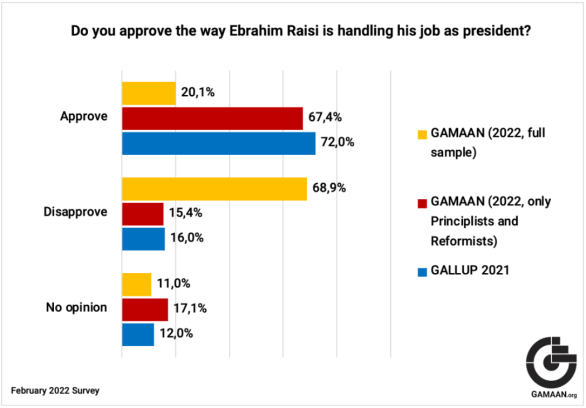
Figure 13-1 — Maleki, Ammar. 2022. Iranians’ Attitudes Toward Political Systems: A 2022 Survey Report. Published online, gamaan.org: GAMAAN.
GAMAAN’s Ties To US-Funded Regime-Change Orgs
Chief among GAMAAN’s ties to U.S. government-funded groups is the organization’s recent “partnership” with the Tony Blair Institute. GAMAAN “exclusively provided” the U.K. nonprofit with detailed survey data gathered in June 2020 (regarding Iranians’ religious beliefs), and February & December 2022 (regarding political systems and the Mahsa Amini street protests, respectively).
The Tony Blair Institute used GAMAAN’s survey data for a series of articles depicting the Iranian populace as eager for regime change, with one article titled “The People of Iran Are Shouting for Regime Change – But Is the West Listening?”.
Founded by former U.K. Prime Minister Tony Blair, the Institute has received millions in grants from the U.S. Agency for International Development (USAID), at least some of which were Cooperative Agreement grants “characterized by extended involvement between recipient and agency.”
The Tony Blair Institute is also funded by the U.K.’s Foreign, Commonwealth, and Development Office (akin to the U.S. State Department), as well as private entities such as the French consulting firm Altai Consulting. Altai boasts the European Commission, USAID, and the French Development Agency as clients.
GAMAAN’s widely-discussed 2020 survey of Iranians’ religious beliefs was “financially supported by and carried out in cooperation with” Dr. Ladan Boroumand, co-founder and research director of the Abdorrahman Boroumand Center, a nonprofit focused on Iranian human rights abuses and critical of Iran’s Islamist government.
Named after her father Abdorrahman Boroumand, an Iranian lawyer and pro-democracy activist who was allegedly assassinated by Islamic Republic agents in 1991, the Center’s ‘Omid’ project documents cases of executions and assassinations in Iran in a searchable electronic database. The organization isn’t shy about supporting regime change, stating that its “goal is to prepare for a peaceful and democratic transition in Iran and build a more just future.”
The Boroumand Center has received substantial funding from the U.S. government-financed National Endowment for Democracy (NED), of which the Boroumand Center is a “partner.”
Ladan Boroumand has held multiple positions at the NED, including serving as a former Reagan-Fascell Democracy Fellow, researching “secularization in Iran,” a current member of the editorial board for the NED’s Journal of Democracy, as well as a current Research Council Member at the NED’s International Forum for Democratic Studies. She has also served on the Steering Committee of the World Movement for Democracy, of which the NED serves as the “secretariat.”
Ladan Boroumand is also on the advisory committee for the Atlantic Council’s Iran Strategy Project, which convened various experts and former officials “to develop a holistic US policy toward the Islamic Republic of Iran for the next four years.”
The Atlantic Council is an influential international relations think tank with extensive ties to U.S. lawmakers that receives large sums from the U.S. government (with FY 2023 grant obligations totaling over $6 million). The group’s October 2024 Iran Strategy Project report recommends a policy of continued pressure against the Islamic Republic, including through “enhanced support to the Iranian people” with the “long-term goal of supporting the Iranian people’s ability to change their system of government if they so desire.”
Ladan Boroumand was invited, along with her sister Roya Boroumand, to a July 2018 speech by former Secretary of State Mike Pompeo at the Reagan Library, amid the Trump administration’s pivot to a hardline posture towards the Islamic Republic. The two sisters likewise joined 12 other Iranian diaspora women in signing an August 2019 open letter calling for a “transition from the Islamic Republic.”
GAMAAN has also consulted with Dr. Shirin Ebadi, an Iranian lawyer and Nobel Peace Prize recipient, who has long worked with the U.S. government and the NED-funded Tavaana, a project of the E-Collaborative for Civic Education (ECCE), founded by staunch opponents of the Islamic Republic, Mariam Memarsadeghi and Akbar Atri.
Tavaana, which describes itself as “Iran’s premier civic education and civil society capacity building initiative,” aimed at ushering in democratic governance. It creates and disseminates anti-government media and information on anti-censorship tools, and has an extensive social media following. Memarsadeghi was also a signatory to the August 2019 open letter calling for a “transition from the Islamic Republic.”
Memarsadeghi is also the founder and director of the Cyrus Forum, an organization that supports ousting the Islamic Republic and works to “reverse engineer an Iranian government that upholds security, the rule of law, and individual liberty.” Ladan Boroumand is one of only two advisors to the Cyrus Forum and was previously listed on Tavaana’s website as a teacher.
Ebadi also appears to have been invited to the U.S. State Department’s 2017 Middle East Partnership Initiative (MEPI) Implementers’ Conference, organized by the Department’s Bureau of Near Eastern Affairs, Office of Assistance Coordination (NEA/AC).
Ebadi’s name and role as president of the Centre for Supporters of Human Rights—a U.K. NGO focused on human rights issues in Iran that Ebadi founded—appear on a guest list circulated by the State Department in September 2017.
GAMAAN has also relied on U.S. government-funded virtual private network (VPN) providers Psiphon and Lantern for assistance in disseminating their surveys and bypassing Iranian government internet censorship.
Since at least 2021, GAMAAN has collaborated with Psiphon, an open-source tool for circumventing internet censorship (using VPN and other technologies) that was developed at the University of Toronto and publicly released in 2006. Psiphon has received millions in funding from the Open Technology Fund, which “receives the majority of its funding from the U.S. government via the U.S. Agency for Global Media (USAGM).”
Psiphon, the Tony Blair Institute, the Abdorrahman Boroumand Center, and Shirin Ebadi did not respond to requests for comment.
The Context
GAMAAN co-founder Ammar Maleki’s ire against the Islamic Republic is more than ideological; it’s personal. His father, Mohammad Maleki, who served as the first president of the University of Tehran, was a well-known critic of the country’s human rights abuses and use of the death penalty.
In 2019, the elder Maleki joined 13 other Iranian activists in signing a pair of open letters calling for Iran’s Supreme Leader to step down and a “complete and peaceful transition” away from the Islamic Republic. Ammar Maleki told Univers, the student newspaper of his employer, Tilburg University, “My father was imprisoned regularly until old age. Almost all the milestones in my life he missed.”
He makes his views on the Islamic Republic clear on X: “To understand/analyze the #Islamic_Republic of Iran, 3 golden rules should be kept in mind: 1- I.R. [Islamic Republic] cannot be reformed by dialogue but will surrender to pressure 2- I.R. officials lie unless proven otherwise 3- when I.R. officials/supporters say #Iran, they mean the I.R. only!”
Hardline politics are not unusual among academics. More unusual and concerning is Maleki’s willingness to accuse those who call into question GAMAAN’s findings and methodology of carrying water for the Islamic Republic. Daniel Tavana experienced this firsthand when he criticized GAMAAN’s methodology online.
“I understand that you have a hard time these days selling your data by the IRGC-initiated IranPoll, so you attack GAMAAN to get attention. I cannot waste my time answering nonsense on GAMAAN’s method for an apologist! Our results were corroborated by external checks & field evidence,” Maleki wrote, referring to Tavana and the Iran Social Survey’s use of IranPoll to conduct surveys within Iran.
Noir couldn’t find evidence of IranPoll having ties to the Islamic Republic, and Maleki did not respond when we asked him to elaborate on the allegation. Tavana likewise stated, “IranPoll has no connection to the government [of Iran].”
Nonetheless, Maleki seems to allege that IranPoll’s work is evidence that Western universities “are under the control of the regime’s thugs,” as he wrote on X.
If mainstream media citations of GAMAAN’s findings are any indication, Maleki’s tenacity seems to be paying off.
Whether you’ve seen it in reports published by the State Department, the American Foreign Policy Council, the government of the United Kingdom, The New York Times, The Wall Street Journal, FiveThirtyEight, The Guardian, The Economist, CBC, Al-Monitor, The Jerusalem Post, Voice of America, the Wilson Center, DW News, Tablet Magazine, The Hill, The Washington Times, or Christianity Today, there’s a good chance that if you live in the West, GAMAAN has helped shape what you think is happening in Iran.
GAMAAN’s rise shows no signs of slowing: the organization announced in January that Maleki had been “selected as the country representative for Iran (2025-2026) in the prestigious World Association for Public Opinion Research (WAPOR).” The Washington Post described WAPOR as “the leading professional association of pollsters working outside the United States.”
For Tavana, GAMAAN isn’t merely worsening academic and mainstream conversation around Iran—it’s potentially providing justification for the kind of military confrontation that actually materialized last month.
“It wasn’t a very long time ago where, you know, the U.S. invaded another country, largely on the assumption that people who lived in that country wanted the invasion and [welcomed] their liberation … And so I think that, like, trafficking in these half-baked ideas is actually quite dangerous, and it’s going [to], if unchecked, get a lot of people killed,” Tavana said.
Sam Carlen is an investigative journalist writing for Noir News, an independent newsletter covering foreign policy and U.S. soft power projection, policing and surveillance, and other topics.
Iain Carlos is an investigative journalist and the founder of Noir News, a newsletter covering foreign policy, policing, surveillance, and other topics.
The Met police chief proves he’s as dishonest and racist as the force he leads
By Jonathan Cook | October 4, 2025
Sir Mark Rowley claims he is worried about rising ‘community tensions’. But the only tensions he cares about are those belonging to an imaginary community he has created of a Jewish hive mind
Once again, the BBC laps up outright disinformation from Sir Mark Rowley, police commissioner of the institutionally racist and corrupt Met. Watch this short clip from the BBC News at Ten last night:
1. Rowley demands supporters of Palestine Action cancel or delay their protest today, after the Manchester synagogue attack, because the timing appears “antisemitic”.
How to untangle this nonsense?
a) The only possible way to interpret Rowley’s argument is that he believes every British Jew identifies and supports Israel’s mass slaughter of children in Gaza and therefore, out of respect for their grief at the Manchester attack, we ought not to protest against the slaughter in Gaza. That undoubtedly makes Rowley the antisemitic one.
b) Even were his deeply antisemitic idea true – that British Jews are an unthinking herd of genocidal monsters – Rowley assumes that we ought to be okay with this: we should just keep quiet about Israel murdering 100 or so Palestinians every day in Gaza, and starving and ethnically cleansing the rest of the population, because it would supposedly offend Britain’s Jewish community to do otherwise.
c) Rowley wants the protesters to take a time-out of a few weeks, even while Israel refuses to take any time-out on murdering Palestinians. Nor is the British government taking a time-out in arming Israel and providing it with intelligence to carry out the genocide. Rowley is suggesting we should simply quieten down for the next few weeks, even as 100 Palestinians are killed each day, before heading back to the streets. He thereby sends an unequivocal message that Palestinian life is worthless – and he does it while claiming we are the racist ones.
2. Rowley claims he wants this weekend’s protests stopped because of the danger they will raise “community tensions, which is my concern”.
And yet from everything he says, the only community’s “tensions” he appears to care about are those of an imaginary one he has created of a Jewish hive mind.
What about the tensions of Palestinian communities, of wider Muslim and Arab communities, of human communities, of those parts of the Jewish community opposed to Israel’s slaughter in Gaza, produced by watching children being torn to shreds by bombs Britain is helping to supply to Israel, by seeing world citizens – including British citizens – being abducted in international waters by Israel as they try to break Israel’s illegal starvation-siege of Gaza?
Does Rowley care about these communities and their tensions, tensions that will only heighten if they are denied their long-established democratic rights to go out on to the streets to protest – rights that have already been aggressively whittled away by successive British governments?
3. Rowley says he finds it “bewildering” why more than 1,000 people would want to get arrested for “supporting a terrorist organisation” – and berates them for taking up police resources at a time when those resources are needed elsewhere.
And yet, Rowley knows there is nothing “bewildering” about their protests. These thousands of British citizens, and millions behind them who are less courageous, are prepared to risk jail, and damage their careers and their futures, with a “terrorism” conviction. They are prepared to do so because they believe the proscription of Palestine Action – the first such proscription in British history for a direct-action group following in the tradition of the Suffragettes – is an assault on our fundamental right to protest, and to protest against the criminality of our own institutions, in this case institutions actively supporting a genocide in Gaza.
If Rowley does not believe he has the resources to arrest the 1,000-plus people who will be sitting quietly in Parliament Square today holding placards opposing the genocide, then he can simply let them be. The sky will not fall in. No one will get hurt. There will be no threat to either public or national security.
The true danger – the danger that Rowley and the government of Sir Keir Starmer really worry about – is that ever more people are beginning to understand that we are ruled by a gang of authoritarian, genocide-assisting criminals.
Starmer government ‘not doing anything’ to help UK citizens kidnapped in international waters

UK Prime Minister Keir Starmer at the ACC Liverpool Convention Centre in Liverpool, UK, on September 29, 2025. [Raşid Necati Aslım – Anadolu Agency]
MEMO | October 4, 2025
The families of the British citizens kidnapped by Israel in international waters this week as they sought to take humanitarian aid to Gaza as part of the Sumud Flotilla have drawn a blank in trying to get government assistance for their release. The Starmer government is “not doing anything” to help, it is alleged.
“Despite official statements claiming that families are being kept informed,” said Samir Asli, “it has now been more than 48 hours and we have still not received any substantial updates from the UK Foreign Office.” Asli’s wife is well-known journalist and activist Yvonne Ridley, a frequent contributor here at Middle East Monitor.
Yvonne was aboard the Omar Al Mokhtar, a humanitarian vessel participating in the peaceful mission to challenge the illegal blockade of Gaza and deliver symbolic aid to a population facing starvation, explained her husband. “On or around 2 October, the boat was intercepted by Israeli forces approximately 70 nautical miles off the coast of Gaza, in international waters, where Israel has no jurisdiction.”
Legal experts have confirmed that such an action constitutes a violation of international law. Indeed, former UK ambassador Craig Murray, who is also a former Head of the Maritime Section of the Foreign and Commonwealth Office and Alternate Head of the UK Delegation to the UN Convention on the Law of the Sea, has pointed out on social media that the flotilla was intercepted well beyond Israel’s 12-mile territorial waters.
“Moreover,” said Murray, “the Israeli maritime blockade has been in place for 17 years and is an intrinsic part of the long-term occupation found illegal in the International Court of Justice advisory opinion. It is, therefore, not a short-term measure in time of armed conflict as specified in the San Remo manual.” In any event, he added, the San Remo rules explicitly state that humanitarian supplies may not be blockaded. “The UN Commission of Inquiry has already determined that Israel is committing genocide, and the blockade is plainly a part of the machinery of such genocide. As such, the Israeli attack on the flotilla is plainly illegal.”
And yet, according to Samir Asli, a Foreign Office official told him that Yvonne’s actions were “illegal”. He obviously disputes this line. “This official’s job is to keep families informed and supported, not to judge Yvonne’s humanitarian work. Yvonne has always acted from a place of conscience, compassion and international law.”
The only response to their request for help from the family’s local Conservative MP, John Lamont, was a short message suggesting that the government might argue that, “Yvonne was travelling against current UK advice.”
At a time when a number of British citizens have been kidnapped in international waters, local MPs need to demand answers and action, not offer excuses, insisted Asli. “Yvonne and the other humanitarians on the flotilla were on a mission of conscience — to help starving children — and deserve the full support of their government.”
Such an inadequate response from the UK government appears to ignore the fact that, as Craig Murray noted, “On the High Seas, the law applying on each ship is the law of its flag state. An attack by a state military warship on a vessel on the High Seas is an attack on the flag state of the vessel attacked.” In other words, Israel has basically attacked the sovereignty of the states under whose flags the vessels were sailing. “Acts of illegal possession of vessels or abduction of crew on the High Seas should be pursued by each flag state as crimes within their domestic jurisdiction, not only in international law. As such, the Metropolitan Police and Director of Public Prosecutions have an obligation to investigate and act over the abduction of persons from UK-flagged vessels on the High Seas.”
The families of Yvonne Ridley and other British citizens being held unlawfully by Israel are calling upon friends, colleagues and supporters to contact their local MPs to insist that the Starmer government fulfils its responsibilities under British and international law to ensure the swift and safe return of their loved ones.
Larry Ellison funded Rubio’s political rise after vetting him for ‘loyalty to Israel’
The Cradle | October 3, 2025
Larry Ellison, the billionaire co-founder of tech giant Oracle, vetted US Secretary of State Marco Rubio for his support of Israel before making large donations to the senator from Florida’s 2016 presidential election campaign, Drop Site news reported on 3 October.
Leaked emails released by an Iranian hacker group, Handala, show that Ellison discussed Rubio’s loyalty to Israel with Ron Prosor, who at that time served as the Israeli ambassador to the UN.
In April 2015, Ellison and Prosor exchanged several emails discussing Rubio and whether the senator would be an advocate for Israel.
After Ellison met Rubio for dinner, Prosor sent a message to Ellison asking how their meeting went.
“How was the conversation with Mario Rubio. [sic] Did he pass your scrutiny? Did you have a chance to talk about Israel? Would love to chat.”
Ellison responded by saying, “Hi Ron. Great meeting with Marco Rubio. I set him up to meet with Tony Blair,” adding, “Marco will be a great friend for Israel.”
At the time, Rubio was seen as a strong challenger in the Republican presidential primary, which was ultimately won by upstart candidate Donald Trump.
Ellison then donated $4 million to Rubio’s presidential campaign, making him among the top donors of the 2016 cycle.
Since that time, Rubio has been a staunch advocate for Israel and is currently helping Ellison in his goal of building a media empire and taking control of Gaza.
Drop Site notes Rubio has played a role in helping Ellison take control of TikTok, which Israeli Prime Minister Benjamin Netanyahu views as crucial to influencing young people in the US to support Israel.
While under Chinese ownership, TikTok allowed relatively free criticism of Israel’s genocide of Palestinians in Gaza.
Ellison is seeking to expand his influence over the traditional media in the US as well. His son David is moving to take control of CBS News, CNN, Warner Brothers, and Paramount, and will reportedly install pro-Israel journalist Bari Weiss as editor of CBS News.
Ellison is also seeking to benefit from post-war Gaza reconstruction through former UK prime minister Tony Blair and the institute he heads.
Blair is seeking to lead a committee that US President Donald Trump plans to establish to rule Gaza and oversee the reconstruction of the enclave once it has been emptied of its roughly 1.7 million Palestinian inhabitants.
Drop Site notes further that Trump’s son-in-law, New York real estate investor Jared Kushner, tasked the Tony Blair Institute this spring to develop a plan for post-war Gaza.
As Secretary of State, Rubio is in a position to influence the plans for Gaza and help determine who will benefit financially from Trump’s plan to build a high-tech city, the “Riviera of the Middle East,” on stolen Palestinian land.
If Blair is given the role of overseeing Gaza’s reconstruction, Ellison will have strong influence in the enclave. Drop Site observed that the “Tony Blair Institute has effectively become an offshoot of Oracle,” following donations of $350 million from Ellison.
Ellison has long been a supporter of Israel. At a 2014 fundraiser attended by other pro-Israel billionaires, he declared that “there is no greater honor” than supporting the Israeli military.
In 2017, Ellison donated over $16 million to the Friends of the IDF, the largest-ever donation to the organization. Ellison is also good friends with Prime Minister Netanyahu, who has been a guest at Ellison’s private island in Hawaii.
Will California Zionise K-12 Education?
By Rick Sterling | Global Research | October 2, 2025
Factual information about Israel and Palestine may soon be outlawed in the California K-12 school system. Assembly Bill 715 is currently on Governor Newsom’s desk. The legislation was recently rushed through the California legislature, amended just days before passage, and voted on at 1 a.m. with almost no time for public comment.
The hurry is intentional because opposition grows whenever people learn about it. AB715 is opposed by educators across the spectrum, including the California Teachers Association, California Faculty Association, Association of School Board Administrators, California School Boards Association, and Council of UC Faculty Associations. Civil rights organizations, such as ACLU Action, also oppose the legislation.
What It Purports to Do
Assembly Bill 715 aims to “prevent antisemitism.” It asserts, “Jewish and Israeli pupils are facing a widespread surge in antisemitic discrimination, harassment, and bullying. In many cases, such discrimination, harassment, and bullying has been so severe and pervasive that it has placed Jewish pupils at risk, or completely impeded their ability to learn or engage in school programs or activities.”
The Anti-Defamation League (ADL) is the main source for the claim that there is a “widespread surge” in antisemitism. Their accuracy is widely disputed. As the Jewish Currents publication reports, “A line-by-line reassessment of the organization’s data illuminates the flaws in its methodology.”
There is already protection in the California Education Code for genuine cases of discrimination or bullying. Section 220 of the code specifies that “No person shall be subjected to discrimination on the basis of disability, gender, gender identity, gender expression, nationality, race or ethnicity, religion, sexual orientation, or any other characteristic that is contained in the definition of hate crimes.” Through their ethnicity and religion, Jewish students are clearly a protected group. So are Israeli students. They can file claims of discrimination under existing legislation.
What It Will Actually Do
AB715 aims to expand the definition of “discrimination” and outlaw any textbook, instructional material, or course content that “would subject a pupil to unlawful discrimination.”
But what is “unlawful discrimination”? AB715 specifies that the U.S. National Strategy to Counter Antisemitism is the basis for identifying antisemitism. That report asserts, “Jewish students and educators are targeted for derision and exclusion on college campuses, often because of their real or perceived views about the State of Israel. When Jews are targeted because of their beliefs or their identity, when Israel is singled out because of anti-Jewish hatred, that is antisemitism.” The document claims, “an unshakeable commitment to the State of Israel’s right to exist, its legitimacy, and its security. In addition, we recognize and celebrate the deep historical, religious, cultural, and other ties many American Jews and other Americans have to Israel.”
The U.S. National Strategy to Counter Antisemitism embraces the controversial “working definition” of antisemitism advanced by the International Holocaust Remembrance Alliance (IHRA). This definition has been widely criticized for its conflation of antisemitism with anti-zionism and criticism of the State of Israel. Over 100 human rights and civil society organizations reject the IHRA definition. Yet this is the definition which AB715 is based on.
If passed, AB715 will result in strict regulation of education and educational material that might subject Jewish students to “unlawful discrimination”. Facts and informed opinions about the reality in Israel and Palestine may be considered “antisemitic” or likely to cause discomfort. For example, students will not learn:
- The International Criminal Court has issued an arrest warrant for Israeli PM Netanyahu charging him with crimes against humanity.
- The International Association of Genocide Scholars determined that Israel is committing genocide in Gaza.
- Human Rights Watch, Amnesty International and Israel’s B’Tselem have ALL independently investigated and determined that Israel is an apartheid state.
- The greatest scientist of the 20th century, Albert Einstein, was against the creation a Jewish state and sought a binational Arab Jewish state in Palestine.
- In 1948, Einstein, Hanna Arendt, and other Jewish leaders denounced Menachim Begin as a Nazi and fascist.
- The Israeli newspaper Haaretz documents a Jewish scholar who was zionist but now supports Hamas and considers their armed resistance legitimate and legal.
All of the above are facts and assessments by credible organizations and individuals. AB715 is so vague yet sweeping that such education about Israel and Palestine may be considered “unlawful discrimination” against a pro-Israel student and therefore prohibited.
The Costs of AB715
If passed, AB715 will cost Californians dearly. It mandates the creation of a new Office of Civil Rights with an Antisemitism Prevention Coordinator and staff producing regular reports, investigations, etc. Incredibly, AB715 allows any member of the public to file a complaint, even anonymously. These complaints must be investigated and responded to within time requirements. School boards and superintendents, already busy, will have to spend precious time and resources investigating each and every complaint in a timely manner. The predictable result will be fear or prohibition on saying anything about Israel or Palestine. The Antisemitism Prevention Coordinator is also mandated to provide antisemitism education to teachers, administrators, and school boards.
Under California’s “Golden State Plan to Counter Antisemitism,” millions of dollars are appropriated for education about the genocide which ended 80 years ago. Meanwhile, there is no funding and it appears the California legislature seeks to prevent education about the genocide happening today in Gaza.
Making it even worse, AB715 invites lawsuits which will further burden the education system. The legislation says, “Civil law remedies, including but not limited to injunctions, restraining orders, or other remedies, may also be available to complainants.” Under AB715, as a gift for zionist activists, any member of the public can be a complainant.
AB715 Should Not Be Signed into Law
The organizations representing California teachers, adminstrators, school superintendents and school boards are ALL against this legislation. AB715 will be costly, wasteful, and damaging to K-12 education in California. Where there are genuine cases of discrimination or bullying, existing legislation is adequate. All students are protected against discrimination or bullying under section 220 of the California Education Code. Where Jewish or Israeli students have been victimized, they have the same recourse as all students. They do not need preferential treatment.
Teaching facts and expert opinions about Israel and Palestine is not antisemitic. It is history and current events.
Feeling uncomfortable when learning some facts or opinions is not being a victim; it is being educated. People can disagree and have different perceptions; they should not be prevented from hearing facts and different perspectives.
The intent of AB715 is clear: to restrict factual information about an important region of the world and to punish educators who present the Palestinian and anti-zionist Jewish perspective. Governor Newsom should not sign the legislation. To encourage him to make the right decision, contact him via this link.
This legislation does not prevent antisemitism; it actually promotes it by demonstrating that major Jewish organizations and the Jewish Legislative Caucus have the power to push this legislation which will deny the history and current reality of the Palestinian people. Meanwhile, Jewish Voice for Peace and organizations across the education profession are working hard to stop this assault on the California education system.
Recognise a state and prevent it from existing?
By José Goulão | Strategic Culture Foundation | October 2, 2025
And suddenly, the overwhelming majority of countries in the so-called Collective West decided to recognise the State of Palestine. Among them were some of the most loyal allies of the Zionist regime and accomplices to its atrocities, such as France, the United Kingdom, Australia, Canada and even, despite its negligible specific weight, the government of the Portuguese Republic. We know that consistency is not the strong point of the Montenegro clique: recognition was declared just a few weeks after the Minister of Foreign Affairs, Paulo Rangel, went to bless the crimes of the Israeli regime, precisely at one of the most intense stages of human and physical devastation in the Gaza Strip.
Any reader will naturally wonder what has now led so many important countries, the guardians of “our civilisation”, to adopt a stance that they could, and should, have taken years ago. Was it the blatant and dramatic exposure of the decades-old genocide of the Palestinian people, which is ravaging the Gaza Strip and which the hypocrisy of fine words and the most beautiful intentions can no longer hide? Perhaps a little, although we should not attach too much importance to this response because shame is not something that abounds in Western governments.
Another reason, this one with a much more important political and strategic significance, is the certainty of all those making the declarations that their decision, apart from being couched in plenty of half-truths, has no practical effect on the real recognition of Palestinian rights and on the murderous conduct of the State of Israel. On the same days that the declarations of recognition were made, the Zionist Prime Minister, Benjamin Netanyahu, assured with complete conviction that there would never be a Palestinian state. This was a challenge to the attitudes of Western countries, which they received with the most devout silence.
And now?
The most relevant situation, and also the one that raises the most doubts about the genuineness of Western governments’ intentions regarding the restoration of the rights of the Palestinian people, is based on a simple question: What now?
Yes, what could these declarations of recognition of the State of Palestine change in the current situation, controlled by the fascist impulses of the Israeli government and the US administration, this time under Trump’s baton – as it could be, with the same effects, under Biden’s orders?
At first glance, they will change nothing. Colonial and expansionist arbitrariness continues unabated in East Jerusalem and from north to south in the West Bank, while the human and physical levelling of Gaza continues unhindered, except for the guerrilla pockets of Hamas.
Western governments have recognised an abstract state with no effective powers over what should be its territory, disappearing every day in the face of the genocidal advances of hordes of settlers imported from all over the planet. Are Western governments doing anything concrete to force Israel to stop colonisation? Are they stopping sending weapons to Israel? Are they considering imposing sanctions capable of suffocating a state run by a criminal clique that is incapable of living on its own?
So far, there is no indication that any of the Western powers are willing to take these steps, which are essential if any qualitative changes in the balance of power throughout Palestine are to lead to negotiations capable of defining the paths for establishing and applying international law in the region. This would imply that, at least in this case, Western leaders would have to put aside their bureaucratic adherence to the ‘rules-based international order’ defined in Washington. The truth is that no government seems willing to take this risk, which, in practice and under these conditions, reveals that recognising or not recognising the State of Palestine will amount to the same thing, that is, more of the same.
Recognise, yes, but…
Western governments have been careful (which opens the door to backtracking) not to recognise the State of Palestine unconditionally, thus continuing to put the strict application of the principles established by international law on hold. Endowed with authority and power granted by five centuries of colonial violence, which allowed them to invent an entity such as the State of Israel, Western governments have attached a series of conditions to the decision. Taken literally, these translate into recognition without recognition because they effectively limit the Palestinian people’s decision-making powers on matters that concern them and on which only they have the right to deliberate.
In a manoeuvre that transfigures much of what is positive about recognition, Western governments are attempting to breathe new life into Mahmoud Abbas’s moribund Palestinian Authority, confined to Ramallah, by giving it powers that it will be unable to exercise. They also demand its absolute surrender to Israel – a demand that is unnecessary in the situation that has been dragging on throughout this century – and they attribute sole responsibility for terrorism in Palestine to Hamas, while ignoring Israeli terror – disguised as ‘security’ and ‘right to exist’. As always, this double standard vitiates the very declarations of recognition from the outset.
The condition that demonstrates how hypocritical and, for now, useless the declarations of recognition are, however, relates to the demand for the disarmament not only of Hamas but of all structures of the Palestinian Resistance. Such demands leave the entire Palestinian people even more helpless and at the mercy of the criminal free will of the Zionist regime, which can thus pursue its genocidal goal, free from any hindrance, while remaining exempt from accountability before international bodies. In the practical consequences of the measures imposed by Western governments in exchange for the recognition of the State of Palestine, the Zionist state would find the best of all worlds and the full realisation of all its objectives.
The shadow of collaborationism
The most recent developments in the recognition process help to dispel some uncertainties about the interests that lie behind the decision, which are not favourable to the Palestinian people.
It was clear from the outset that the recognition of Palestinian independence by Western governments was not, it bears repeating, unconditional. Most of the speeches on the subject clearly overvalued the Palestinian Authority, which is inactive in practice and, more seriously, entirely conditioned by Israel’s demands. The “shared” management of much of the West Bank between the Ramallah government and the Zionist occupation forces means, in fact, that the former has been placed at the service of the latter’s interests. This is often confirmed by the actions of the Palestinian police forces in repressive actions against the Palestinian population itself.
This situation suits Western governments because it means that the ‘autonomous’ authorities are willing to collaborate in ways that run counter to the legitimate interests of the Palestinian people, which have never been recognised by Western states.
At the same time, the West attributes sole representation of the Palestinians to the decrepit Palestinian Authority and its leader Mahmoud Abbas, who is in fact perpetuated in power despite being completely hamstrung by Israel and the United States. It should be remembered, as it is a fact, that his accession to the presidency was achieved through a soft coup organised in 1994 by the United States, Israel and Western powers, as a result of which the historic leader of the Resistance, Yasser Arafat, was removed from the main positions of power (to which he had been elected) and assassinated a few months later.
It should also be remembered that Mahmoud Abbas, very recently described as ‘pragmatic’ by a pro-Israeli publication such as the weekly newspaper Expresso, was received at the White House, from where Arafat had been banned, shortly after taking office as president of the so-called ‘Autonomy’ in 1994.
These circumstances help to better understand the Western constraints that accompanied the recognition of independence. And they lead to the elementary conclusion that there will be no representative entity that reflects the will of the Palestinian people without the holding of free, open and democratic general elections under the control of international bodies supervised by the UN. This process cannot involve the intervention of Israel and the United States of America, which is by definition biased and self-serving.
Another demand common to Western governments is that the Resistance (wrongly and maliciously equated with Hamas) should ‘renounce’ terrorism, that is, armed struggle, while, it should be repeated, sparing Israeli terrorism. This ‘renunciation’ must be accompanied by the disarmament of the Resistance, which means the total surrender of the Palestinian people to the discretionary and genocidal power of Israel. From this perspective, the recognition of Palestine becomes a poisoned gift.
Abbas’ recent speech to the UN General Assembly, delivered via the internet because, this time, the Trump administration illegally refused to grant the Palestinian president a visa to travel to New York, confirmed the existence of dangerous collaboration with Israeli and Western colonial interests.
Mahmoud Abbas, as Palestinian president, promised that ‘Hamas will never be the government’. But how can the most prominent Palestinian leader, whose party was defeated in the last general elections held in the occupied territories, promise that the most voted political force (according to the last poll, held more than 15 years ago) will not be able to govern the state? By manipulating the election results? By adopting a single-party regime or a personal dictatorship? By preventing a party with significant popular support, Hamas or any other, from being a legitimate and necessary part of a majority government? Let us remember that Abbas and his Western and Arab allies prevented Hamas from governing after it won an absolute majority in free elections; and that, despite multiple negotiations and supposed draft agreements, they always sabotaged the creation of ‘national unity governments’ that would have brought Gaza, the West Bank and East Jerusalem under the same ‘autonomous government’. ‘One of our strategic objectives is to maintain the separation between Gaza and the West Bank,’ Netanyahu confessed to his Likud party’s parliamentary group.
None of these paths implied in the content of the recognition statements correspond to the ‘democratic values’ proclaimed by the Western world, which seems willing to impose, through its latest decision, an authoritarian and undemocratic ‘solution’ centred on Abbas.
In his speech, the Palestinian president stated that he does not want Palestine to be ‘an armed state’. What does this idea mean, which is incompatible with the existence of a full state as established in international law? Would the defence and security of Palestine be handed over to Israel? Would the Palestinian people no longer have anyone to defend them, whether it be the armed resistance or the state apparatus?
In his time, shortly before being assassinated by Zionism in 1995, Israeli Prime Minister Isaac Rabin admitted that the maximum status he would grant to a Palestinian entity at the end of the ‘peace process’ would be ‘less than a state’. Have Mahmoud Abbas and the Western leaders who manipulate him revived this idea? Will Palestine ‘less than a state’ be the future state of Palestine as understood? There will be no better way, then, already considered as the ‘final solution’ to the problem, for the continuation of genocide and the creation of Greater Israel – throughout Palestine, as a first step.
The fundamental question, however, remains: what will come after the recognition of independence, given that Israel occupies almost the entire territory where this state would be created? What will Western countries do to give substance to their decision? It should be remembered that international law requires the creation of an ‘independent and viable’ Palestinian state. In prosaic terms, a state like any other. However, this is not what is being planned, with the collaboration of the incompetent Palestinian Authority. Israel’s dizzying policy of creating settlements is gradually eating away at the territory that is essential for the creation of a viable state. Taking a clear-headed view, the Portuguese head of state admitted that one day there will be no territory left to establish a state. This is a reality that I began denouncing many years ago, because it is obvious and Israel makes no secret of it. Despite recognising these circumstances, the Western world is doing nothing concrete to stop the colonisation and make the state it claims to recognise viable.
Once again, the West’s main objective has been to create propaganda and delaying tactics and, with them, to try to neutralise the increasingly strong, active and genuine solidarity of Western peoples with the Palestinian people. This solidarity cannot be allowed to wane; it must be strengthened, because if we rely on the promises and decisions of our governments, the Palestinian people will continue to be the biggest victims. And we cannot allow that to happen.
Hamas denies links to suspects arrested in Germany over alleged plot against Israeli targets
MEMO | October 2, 2025
Hamas on Wednesday denied having any connection to suspects arrested in Germany on charges of trying to buy weapons to carry out potential attacks on Israeli or Jewish targets.
In a statement, the movement said: “The claims that the detainees are linked to Hamas are baseless, and aim to damage the reputation of the movement and distort the German people’s sympathy with our Palestinian cause.”
The statement added that “Hamas confirms its policy has always been, and remains, to restrict its struggle against the Zionist occupation to Palestine only.”
Earlier on Wednesday, Germany’s federal prosecutor announced the arrest of three suspects in Berlin accused of belonging to Hamas. They are alleged to have attempted to obtain firearms and ammunition to prepare possible attacks on Israeli or Jewish targets inside the country.
IOF kidnaps Gaza nurse as medical staff struggle to work under fire

Palestinian Information Center – October 2, 2025
GAZA – Israeli occupation forces (IOF) on Thursday abducted nurse Tasneem al-Hems from a medical point in Khan Yunis, in the southern Gaza Strip, in yet another attack on Palestinian health workers. She is the daughter of Dr. Marwan al-Hems, the director of Gaza’s field hospitals, who was kidnapped by an IOF undercover unit in July this year.
Family sources confirmed that Tasneem was seized by a special IOF unit near her workplace. Her father, Dr. al-Hems, was shot in the leg and abducted on July 21 near the International Committee of the Red Cross hospital in western Khan Yunis. He has since been held in Ashkelon prison, denied access to his lawyer, and remains in detention under extended orders.
The Gaza-based al-Dameer Association for Human Rights condemned the kidnapping and confirmed that Israel is using enforced disappearance against medical professionals. According to the Ministry of Health in Gaza, at least 361 Palestinian medical staff are currently imprisoned by Israel.
Meanwhile, Gaza’s Ministry of Health warned that the few hospitals still partially operating in Gaza City are facing extreme risks. In a statement Thursday, the ministry said that reaching Al-Shifa Medical Complex, Al-Quds Hospital, and Al-Helou Hospital has become “highly dangerous” due to ongoing Israeli bombings.
The ministry urged international bodies to intervene immediately to protect medical institutions and staff and to ensure safe access to health facilities.
Health authorities recently reported that 20 hospitals in Gaza have been forced out of service, with only eight functioning at limited capacity under constant threat of IOF strikes.
Since August 11, 2025, Israel has intensified its genocide against Gaza, attempting to destroy the city and forcibly displace its population southward.
Italian dockworkers block ships bound for Israel amid Gaza flotilla tensions
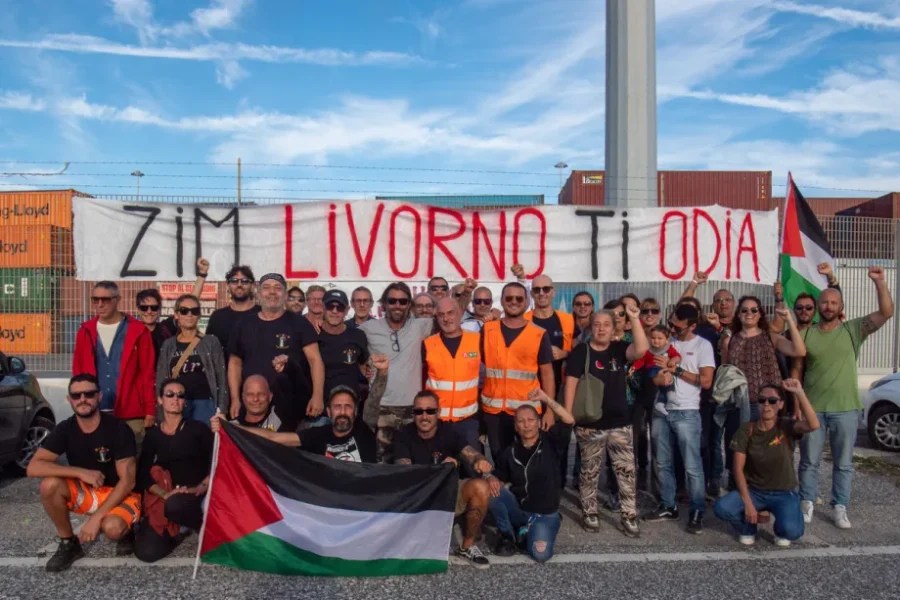
Dockworkers and citizens at the garrison outside the Tuscan dock pose for a photo and rejoice at the news that Israeli ship Zim is preparing to leave the port of Livorno without unloading or loading after Italian dockworkers on strike, block the Darsena Toscana terminal during a protest in support of Gaza, Palestine and Global Sumud Flotilla on September 29, 2025 in Livorno, Italy. [Photo by Laura Lezza/Getty Images]
MEMO | October 2, 2025
Dockworkers in several Italian ports are stepping up actions to block shipments to Israel as tensions mount over the approach of the “Sumud Flotilla” to Gaza.
Labour unions across Europe have pledged coordinated efforts to disrupt maritime trade with Israel if the flotilla comes under attack. In a meeting held in Genoa, union representatives said they had set up an alert system to monitor shipments and respond rapidly by halting the loading or unloading of vessels.
Italy has become the epicenter of the movement. Genoa was the first port to act, followed by Livorno, where union-led strikes have already disrupted operations. The container ship Zim Virginia was kept waiting for five days off the Tuscan coast after dockworkers refused to allow it to dock.
Another vessel, the Zim Iberia, is expected to arrive in Livorno on 3 October and is likely to encounter similar resistance, according to union organizers.
In Genoa, tensions escalated last week when about 2,000 protesters gathered at the port. The demonstration forced the Zim New Zealand to leave without loading any cargo after reports that several containers were suspected of being linked to Israeli shipments.
Union leaders said their campaign is aimed at putting pressure on Israel and demonstrating solidarity with Gaza. They warned that actions would intensify if the flotilla is obstructed.
Protests erupt worldwide against Israeli attack on Global Sumud Flotilla
The Cradle | October 2, 2025
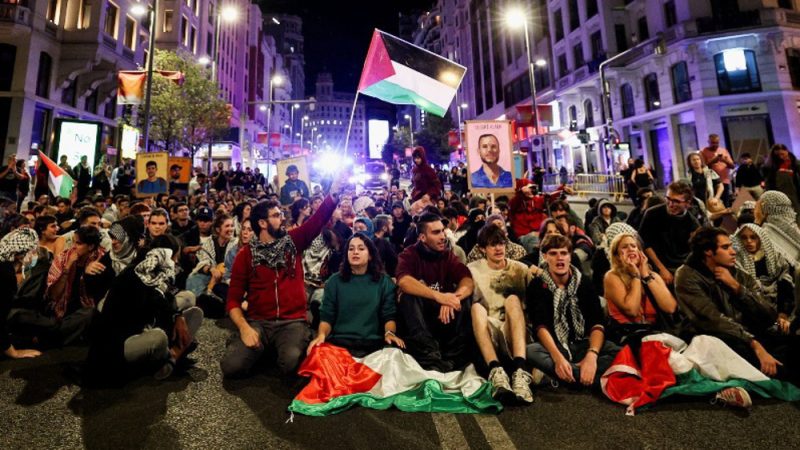
Protests erupted across cities worldwide on the night of 1 October after Israel intercepted the Gaza-bound Global Sumud Flotilla, with thousands taking to the streets to denounce the raid, demand the release of detained activists, and call for an end to the siege on the enclave.
Demonstrations broke out in Greece, Spain, Sweden, and Belgium, as large rallies took place in Italy, where the country’s largest trade unions announced a general strike for 3 October.
Among the largest gatherings overnight, tens of thousands marched through Rome in support of the Sumud Freedom Flotilla.
Hundreds more blocked traffic at Piazza dei Cinquecento, while in Milan, large crowds shut down train stations, blocking rail traffic as part of nationwide demonstrations.
Organizers estimated around 1,000 people would march toward Piazza Barberini. Italy’s unions USB and CGIL confirmed a nationwide strike call, while dock workers carried out their pledge to blockade in response to the flotilla’s interception.
Hundreds also gathered outside the US consulate in Istanbul, chanting slogans, praying for Palestinians, and denouncing what they called genocide.
In Berlin, protesters gathered at Central Station, and in Brussels, marchers moved from Place de la Bourse to the Belgian Foreign Ministry.
In London, thousands marched to the prime minister’s residence, chanting against him. In Germany, demonstrators briefly shut down the main train station.
The Tunisian capital also saw a mass demonstration, while Mauritania’s Nouakchott hosted protests denouncing the flotilla raid.
A snap protest was held outside Sydney Town Hall in support of the Global Sumud Flotilla, with demonstrators voicing solidarity and chanting “From the river to the sea,” which echoed through the rally.
Latin American cities witnessed parallel mobilizations. Local media in Buenos Aires said hundreds demonstrated against what they called an “assault by the Israeli occupation forces” and demanded an end to the genocide in Gaza.
In Mexico City, Reuters captured images of marchers outside the Foreign Ministry, with demonstrators demanding the release of seven Mexican nationals detained in the flotilla raid.
Activists Arlin Medrano and Sol Gonzalez confirmed in a video that their ship had been intercepted in international waters, calling it an illegal act.
David Pena, the Mexican delegation’s legal representative, told protesters Israel planned to charge them with trespassing and deport them.
In Colombia, protesters gathered outside the headquarters of the National Business Association (ANDI) after the Global Movement to Gaza accused it of ties to Israel’s economic mission – an allegation the group denied in a statement.
Demonstrations also swept Bogota, Montevideo, and several Argentine cities, with protesters in Uruguay’s capital calling for the imprisonment of Israeli Prime Minister Benjamin Netanyahu.
Out of 44 vessels that departed with the Global Sumud Flotilla, only four are still marked as ‘sailing’ as of 12:15 pm Thursday, according to live tracking data on the flotilla’s website.
One vessel appeared to have reached Gaza’s waters before communications were lost.
Organizers said one of the boats intercepted was rammed by an Israeli naval vessel.
Israel’s Foreign Ministry labeled the mission on its official X account as the “Hamas Flotilla.”
Colombia expels Israeli diplomats after Gaza aid flotilla raid
MEMO | October 2, 2025
Colombian President Gustavo Petro has ordered the expulsion of all remaining Israeli diplomats from the country, after the interception of the Global Sumud Flotilla heading to Gaza.
He also called for suspending trade agreements with Israel after two Colombian citizens were arrested on board one of the ships. “Israel detained two Colombian women in international waters,” Petro said, demanding their immediate release.
Only four Israeli diplomats were still in Colombia after President Petro cut ties with Israel last year.
In a statement, Colombia’s Ministry of Foreign Affairs, on behalf of the government and the Colombian people, strongly condemned what it described as the kidnapping carried out by Israeli armed forces in international waters. The ministry said this act violated international law and the Geneva Conventions, and targeted the two Colombian nationals, Luna Barreto and Manuela Bedoya, both members of the Global Sumud Flotilla.
The ministry also called for the immediate release of its citizens, as well as all other members of the flotilla. It urged the governments of Spain, Bangladesh, Brazil, Slovenia, Indonesia, Ireland, Libya, Malaysia, the Maldives, Mexico, Oman, Pakistan, Qatar, Thailand, Turkey, and South Africa to take urgent and joint action to protect the lives and safety of their nationals.
According to the ministry, the international flotilla set sail in the Mediterranean with three objectives: to deliver humanitarian aid to Gaza, to raise awareness of the urgent humanitarian needs of the Palestinian people, and to highlight the need to end the war in Gaza.
Featured Video

More Iran War fallout: Maritime insurance industry shifts from London to China
or go to
Aletho News Archives – Video-Images
From the Archives
The Biggest Threat to Peace in Middle East
By Dr. Elias Akleh* | Sabbah Report | May 24, 2010
A build up of heightened tension in the Middle East is escalating in the last few weeks. American and Israeli postures towards Lebanon, Syria, and Iran have become more threatening. Listening to speeches of political leaders one hears talks only about war not peace. Iranians and Israelis are continuously training hard for a possible showdown. Both sides are conducting extensive war games every month. This led Syrians to claim that Israel is preparing for a soon-to-come another war. The Jordanians also are warning that current stalemate of the peace process is an indication of a war breaking out this summer. The Russian President and his army chief hinted, a few months ago, that the US and Israel were planning for an attack on Iran.
Indeed Iran is, as it has been for last few years, the target of most of the threats and accusations of supporting terrorism. Escalating incitement against Iran the American Defense Department sent last month (April) to Congress a report on Iran’s military claiming Iran could develop intercontinental ballistic missiles capable of reaching the US by 2015.
Ignoring the fact that N. Korea, India, Pakistan, and Israel are proven to have nuclear weapons while Iran does not, the US Secretary of State Hillary Clinton chose in her speech, to the nuclear Non-Proliferation Treaty review conference at the UN, to focus on Iran’s alleged nuclear ambitions putting the whole world at risk as she put it. According to Clinton Iran’s acquisition of nuclear weapons, rather than Israel’s more than 200 nuclear bombs, is destabilizing the Middle East. She called on the world’s nations to rally around US efforts to hold Iran, not other nuclear countries, to account.
The accusation that Usama Bin Laden is living comfortably in Iran had received a boost after the broadcast of a documentary called “Feathered Cocaine”. This echoed the June 2003 claims of the Italian newspaper Corre de la Sierra that Bin Laden was in Iran according to some intelligence report, and according to Richard Miniter’s book “Shadow War”. … continue
Blog Roll
 Aletho News
- Japan Clings to US Vassalage Despite Energy Crunch Caused By Iran War
- US Seeks Control Over Global Energy Infrastructure – Kremlin
- US senators target Orban government for standing up to Zelensky
- The deep-rooted culture of corruption in Ukraine
- Iran mobilizing one million soldiers to ‘create hell’ for any US ground assault: Report
- The coming military and psychological unravelling?
- Iran has the last laugh
- More Iran War fallout: Maritime insurance industry shifts from London to China
- US-Israeli aggression on Iran triggers review of GCC countries’ investment pledges to Washington
- Russia slams UK plan to seize tankers suspected of carrying its oil
- If Americans Knew
- Reports: Iran mobilizing 1M fighters, Israel-US run low on ammo, Israeli army faces shortage – Not a ceasefire Day 168
- ‘No Innocent Children’: Far-right Israeli Lawmaker Defends Killing of Palestinian Family
- Mossad’s promises helped Netanyahu convince Trump that Iran could be toppled
- US Arms Control Official Refuses To Comment When Asked If Israel Has Nuclear Weapons
- Veterans warn US landing could be ‘more Gallipoli than Vietnam’
- Israel may be committing war crimes in Lebanon – Not a ceasefire Day 167
- In the West Bank, life is a constant battle – 3 articles
- Jacob Reses, one of the most powerful pro-Israel operatives in Trump’s Washington
- Israeli-US assaults kill or injure 87 children a day – Not a ceasefire Day 166
- ‘Forever live by the sword’: Understanding Israelis’ massive support for Iran war
- No Tricks Zone
- Devastating Assessment Of Comirnaty Vaccine By Former Senior Pfizer Europe Toxicologist
- New Study: CO2 Is ‘Effectively Negligible’ As An Explanatory Climate Change Factor Since 2000
- Former Pfizer Toxicologist Dr. Helmut Sterz Tells Bundestag Hearing Pfizer Vaccine Should Have Never Been Approved
- Energy Expert: Germany’s Nuclear Phaseout Was A “500 Billion Euro Mistake”
- New Research: South Australia’s Mid-Holocene Sea Surface Temperatures Were 4°C Warmer Than Today
- Storing Green Energy To Last Germany 10 Days Would Require A 60-Million Tonne Battery
- New Studies: UK Sea Levels Were 4 Meters Higher Than Today During The Mid-Holocene
- Destructive Green New Deal: German Energy And Metal Group Warns Of Drastic Crisis
- New Study Documents A 20-Year Pause In Arctic Sea Ice Decline – Driven By Internal Variability
- Wake-up Call: Survey Shows Majority Of Germans Now Favor Postponing Climate Targets!
 Aletho News