The myth of Israel’s isolation: the reality of Arab collaboration with Zionism
By Lucas Leiroz | Strategic Culture Foundation | September 15, 2025
The narrative construction of Zionism fundamentally depends on two premises: historical victimization and alleged regional isolation. Both are rhetorical weapons designed to justify Israel’s systematic brutality against Palestinians and other native populations of the Middle East. But neither of these narratives holds up under even a minimally honest analysis of the region’s current geopolitical reality. The myth of the “tiny State of Israel surrounded by enemies” is one of the greatest fabrications of contemporary Western propaganda.
The idea that Israel is a solitary bastion in a sea of Arab hostility is, today, completely baseless. With few exceptions, countries in the region not only tolerate Israel but actively collaborate with the Zionist regime — including militarily and diplomatically. The supposed regional resistance has evaporated in recent decades, giving way to a policy of normalization and, in many cases, direct submission to Israeli interests.
The most emblematic case is Syria. The fall of Assad became an obsession for the West, enabled by Islamist militias with logistical and military support from the West, Israel, and the Gulf petro-monarchies. After Al-Qaeda’s victory, the terrorist regime almost immediately engaged in negotiations with Israel, despite ongoing Zionist bombings of Syrian territory. Today, the so-called “Free Syria” is functionally an ally of Israel. Fragmented and destabilized, the country has lost its national capacity for resistance.
In Lebanon, the scenario is equally ambiguous. Despite Hezbollah’s firmly anti-Israeli stance, the Lebanese government follows a path of conciliation with Tel Aviv. The recent ceasefire agreement, signed without Hezbollah’s consent, makes it clear that the Lebanese elites prioritize accommodation with Israel over national sovereignty. Government pressure for Hezbollah’s disarmament is another indicator of veiled collaboration.
Even the Palestinian Authority — supposedly the legitimate representative of the Palestinian people in the West Bank — has acted as a silent partner of the Zionist regime. Its role is increasingly that of a submissive mediator, suppressing popular resistance and ensuring the stability of illegal Israeli settlements. Local authorities in the West Bank seem entirely incapable of challenging the colonial status quo, abandoning any real project of liberation.
Jordan, with its puppet monarchy, is another blatant example of collaboration. While official rhetoric often speaks of “justice for Palestinians,” in practice Amman functions as a key piece in the architecture of regional containment, facilitating Israeli intelligence and surveillance operations. The Jordanian monarchy is essentially an extension of Anglo-American policy in the region and, by extension, an objective ally of Tel Aviv.
In the Gulf, the situation is even more obvious. The United Arab Emirates, Bahrain, Saudi Arabia, and Qatar maintain close relations with Israel, both economically and militarily — even if many of them do not formally recognize the Zionist entity. As Brazilian analyst Rodolfo Laterza correctly observed, the effectiveness of Israel’s air defense is not due solely to systems like the Iron Dome, but to a regionally integrated infrastructure supported by Gulf monarchies. These countries not only allow American military presence and overflights but also share intelligence and threat tracking — giving Israel a significant strategic advantage.
Israel’s recent bombing of Qatar reignited talk of a possible “Arab awakening,” but until concrete developments occur, such “Arab solidarity” remains fiction and empty rhetoric. The Gulf regimes — utterly dependent on Western military support and fearful of internal destabilization — are among Zionism’s most useful agents in the Middle East. This is combined with the region’s typical strategic ambiguity, where governments believe they can maintain multiple alignments simultaneously without paying the price.
In the end, the only full-fledged state actor opposing Israel is Iran — which, ironically, is not even Arab. Isolated, blockaded, demonized, Iran continues to take a confrontational stance toward Israeli apartheid and remains the main supporter of resistance movements like Hezbollah and Hamas. Alongside war-torn and divided Yemen, it is the only state actor on the board that openly challenges Israel’s expansionist agenda.
Tel Aviv’s propaganda, amplified by the Western media, insists on portraying Israel as a victim. But the truth is that Zionism has co-opted and bought off nearly all its neighbors. The so-called “Israeli isolation” is a fiction — a lie repeated endlessly to justify the unjustifiable: the continuation of a colonial, supremacist, and genocidal project.
Israel executes Gaza children with single shots to head, chest: Foreign doctors
Press TV – September 14, 2025
Foreign doctors in Gaza describe a pattern of children killed by single gunshots to the head or chest, saying it shows Israel is deliberately targeting them.
De Volkskrant, a Dutch newspaper, published an investigation on Saturday, speaking with 15 doctors who were among the last international eyewitnesses in the region.
The doctors told the newspaper they treated 114 children aged 15 and under with such wounds, and most did not survive.
Witnesses said Israeli drones and snipers fired the bullets. Former Dutch army commander Mart de Kruif said accidental hits are almost impossible given the scale and consistency of the injuries.
American trauma surgeon Feroze Sidhwa, who arrived at the European Hospital in Gaza in March 2024, recalls four boys with head wounds admitted within 48 hours.
“I thought: what the hell? How is it possible?” he said, and over the next two weeks, he treated 9 more children with similar wounds.
Doctors described working in extreme heat in hospitals filled with the smell of sewage, explosives, and decay, with ventilators and medical equipment scarce or broken.
Emergency surgeon Mimi Syed intubated a four-year-old girl shot in a humanitarian zone using a laryngoscope she had smuggled in, keeping the child alive and later documenting the bullet lodged in her head.
Doctors reported treating wounds likely caused by fragmentation weapons, where small cube-shaped fragments pierce organs and vessels, causing fatal bleeding or major amputations.
Weapons experts say the wounds match Israeli-made tungsten fragments, though the Israeli military denies using such weapons.
Mass casualty events occur daily, with children making up over 40% of Gaza’s population, and many arriving with grave injuries.
Doctors described children with shrapnel in the brain, bullets in the chest, and limbs destroyed by blasts, with some classified as WCNSF (Wounded Child, No Surviving Family).
British surgeon Goher Rahbour noticed another disturbing pattern, as the targeted body part changed each day, with one day being the chest or head, and another, the limbs or abdomen, suggesting a coordinated and deliberate method.
Doctors speak out despite risks, as Israel often blocks reentry for those who testify, and “Being silent is not an option,” said Sidhwa.
Doctors from the US, UK, Canada, Australia, and the Netherlands said their duty is to save lives and bear witness to Israeli crimes in Gaza.
Their testimony depicts the deliberate targeting of children, the destruction of hospitals, and the human cost of the ongoing genocide.
Since the Israeli regime launched its genocidal war on Gaza, it has murdered 64,803 Palestinians and wounded 164,264, most of them children and women.
Iraqi PM Calls For Islamic Military Alliance Against Israel
Sputnik – 14.09.2025
Iraqi Prime Minister Mohammed Shia al-Sudani urged Arab and Muslim nations to form a joint security force in response to Israel’s recent strikes in Gaza and Qatar.
He said Tuesday’s Israeli attack on Doha, which killed Hamas members and a Qatari officer, was a “shocking breach of international law” and a threat to regional security.
Sudani stressed that the Islamic world has “numerous levers” to deter Israel, warning that aggression “will not stop at Qatar.”
His remarks came ahead of the Arab-Islamic emergency summit in Doha on Sept 15–16, amid Israeli strikes on Qatar, where leaders are expected to discuss activating the long-proposed joint Arab military force.
Iranian Supreme National Security Council chairman Ali Larijani has also called on Islamic nations to create a “joint operations room” against Israel.
Egypt, meanwhile, is pushing for a NATO-style Arab military force for rapid defense in case of attacks, with Cairo seeking regional backing for the plan ahead of the summit.
The Israeli strike on Doha hit a residential compound where Hamas politburo members were meeting to discuss a US proposal to end the Gaza war, which has already claimed more than 64,800 Palestinian lives since October 2023.
Netanyahu’s Crude Exploitation of Charlie Kirk’s Death to Get the American Right Back into Line
If Americans Knew | September 13, 2025
Journalist Glenn Greenwald provides information on Israeli Prime Minister Benjamin Netanyahu’s misinformation about Charlie Kirk, and on Kirk’s evolving views on Israel-Palestine. System Update, September 12, 2025. Full video at: https://rumble.com/v6yv6nq-system-upd…
Zionist lawfare operation facing collapse?
By Kit Klarenberg | Al Mayadeen | September 13, 2025
On September 7th, notorious Zionist lobby group UK Lawyers For Israel published a joint letter, triggered by 86% of International Association of Genocide Scholars members backing a resolution declaring “Israel” is committing genocide in Gaza days earlier. The lengthy screed blamed Hamas for Tel Aviv’s mass slaughter of Palestinians since October 7th, and charged the Resistance group itself was in fact guilty of genocide, on the risible, purported basis that Operation Al-Aqsa Flood was intended “to destroy, in whole or in part, Jews and Israelis.”
UKLFI’s repulsive, inverted narrative of Tel Aviv’s 21st century Holocaust in Gaza was reportedly endorsed by close to 500 “legal, antisemitism, history, holocaust, and genocide scholars.” Yet, upon publication, multiple listed signatories angrily announced their names were included without consent, while denouncing the letter’s content in the strongest possible terms. Close inspection indicates several signatories are listed repeatedly, many are tied to Zionist lobby groups, and others – such as a professor of electrical engineering – are self-evidently not qualified to make any judgement on genocide whatsoever.
Such brazen fraud is par for the course for UKLFI. The group has a lengthy, deplorable history of targeting individuals and organisations via frivolous if not outright vexatious lawfare, falsely conflating criticism of the Zionist entity with antisemitism in order to neutralise Palestine solidarity in schools, universities, workplaces, hospitals, and elsewhere. UKLFI’s embarrassingly botched stunt is especially shameful this time round though, as the operation is presently embroiled in significant legal quandaries of its own. The situation is so dire that UKLFI could collapse.
As Al Mayadeen reported in August, a detailed complaint was filed against UKLFI by the Public Interest Law Centre and European Legal Support Center with Britain’s Solicitors Regulation Authority. The 114-page document accused the group of using the law for nakedly politicised intimidation purposes, and ostensibly operating as a legal body despite being unregulated and unaccountable. Adding to UKLFI’s woes, its charitable wing is concurrently under formal investigation by the Charity Commission For England and Wales, due to the pioneering research of advocacy group CAGE.
‘Validating Evidence’
Founded in 2010 – aptly following a “conference on lawfare” convened in an illegal Israeli settlement near Jerusalem [Al-Quds] – UKLFI quickly established itself at the forefront of a new, “more combative” strain of Tel Aviv’s lobbying in Britain. UKLFI’s website is entirely explicit about its rabid commitment to defending the Zionist entity by any means necessary. UKLFI avowedly provides “legal support including advocacy, research, advice and campaigning in combating attempts to undermine, attack and/or delegitimise Israel, Israeli organisations, Israelis and/or supporters of Israel.”
The organisation moreover aims “to contribute generally as lawyers to creating a supportive climate of opinion” in Britain towards the Zionist entity. CAGE forensically details how UKLFI’s stances are not only “fringe” within the legal profession, but reflect Zionism at its most extreme. For instance, the organisation’s representatives fervently argue the Occupied Palestinian Territories aren’t in fact in breach of international law. The UN has consistently found over many years these Israeli settlements are flagrantly illegal, and displaced Palestinians must be permitted to return home.
CAGE traces in forensic detail UKLFI’s intimate yet opaque ties with the Israeli government. In 2012, UKLFI jointly hosted a two-day seminar alongside the Zionist entity’s Ministry of Foreign Affairs and London’s Israeli embassy on lawfare strategies. This included presentations on strategies to cripple the Boycott, Divestment and Sanctions movement, and how British laws – including the Public Order Act, legislation on Hate Speech, and civil suits for defamation – could be used to the detriment of Palestine solidarity.
In 2019, UKLFI chiefs consulted senior Israeli Ministry of Justice officials, seeking “assistance in finding or validating evidence to help” the organisation in “potential legal actions” brought against it by two pro-Palestine charities, after UKLFI libelously charged the pair were linked directly to proscribed terrorist groups. The Zionist lobby group has lodged bogus complaints against countless organisations, including leading Palestinian aid organisations, to the Charity Commission, and other authorities since birth. This includes Amnesty International, for accusing “Israel” of practicing apartheid. None have been upheld.
In 2016, UKLFI established a charitable wing – the pair are effectively indivisible, sharing patrons and personnel. The charity claims to offer pro bono education and training services, but CAGE notes this invariably amounts to “apologia for racial segregation and apartheid.” Its events routinely host Zionist Occupation Force representatives, and hardline Zionist figures and groups. Some speakers deny uncontroversially proven historic Israeli atrocities and massacres against Palestinians. Others offer advice to audiences on how to weaponise the law to further Tel Aviv’s interests locally and globally.
In 2019, UKLFI’s charitable wing hosted Regavim, an Israeli NGO that actively advocates for the destruction of Palestinian homes in the West Bank. The organisation itself employs lawfare, and via regulatory loopholes, facilitates the destruction and dismantling of Palestinian homes and infrastructure. In the process, per CAGE, “entire communities” are left “without proper roads, houses, or even water systems.” Regavim was founded by Israeli Finance Minister Bezalel Smotrich, and is Zionist entity-funded. Even liberal Israeli lobby groups harshly condemned the event.
A common UKLFI tactic is to bombard British regulatory bodies and private entities “to disrupt any public displays of solidarity for Palestine” in any context, problematising even the most basic expressions of support as somehow antisemitic. This has prompted numerous organisations to ban wearing Palestine badges or other paraphernalia by staff or students, and in extreme instances, led to employees losing their jobs. CAGE records:
“There are manifold cases in both the public and private sector of UKLFI writing to organisations and attempting to ensure staff of those organisations do not wear anything that might indicate support for Palestine… [UKLFI] doesn’t appear to have any cogent case for why expressing solidarity for Palestine necessitates Jewish people to feel unsafe – especially when considering the widespread support that the Palestinian cause has among Jewish groups in the UK.”
‘Encouraging Hamas’
UKLFI’s noxious activities have become turbocharged since the Gaza genocide’s eruption. Along the way, it has taken credit for the suspension of pro-Palestine NHS doctors, among other things. Meanwhile, in April 2024, UKLFI charity wing chief Natasha Hausdorff – formerly an Israeli Supreme Court clerk – testified to parliament’s Business and Trade Committee on British arms exports to the Zionist entity. She argued the flow of weapons should continue, dismissed confirmed Palestinian death tolls as fraudulent, and unbelievably praised Tel Aviv’s “consistent upholding of international humanitarian law.”
The next month, UKLFI deployed perverse arguments to deny the Zionist entity was deliberately starving Gazans. In a letter to the Co-operative Group opposing a motion to boycott Israeli products, UKLFI chief Jonathan Turner condemned a Lancet estimate of 186,000 Palestinians murdered by Tel Aviv during the genocide to date. He sickeningly suggested “Israel’s” unconscionable assault in fact delivered health benefits that could increase local life expectancy, such as a reduction in obesity, due to constricted access to unhealthy food and cigarettes.
In September that year, UKLFI dispatched a formal letter to the British government threatening legal action in the form of a judicial review unless a partial, token suspension of 30 arms export licences to “Israel” was reversed. Three months later, the lobby group submitted complaints to the Bar Standards Board and International Criminal Court against ICC chief prosecutor Karim Khan for seeking arrest warrants against Israeli leaders. UKLFI alleged Khan had breached professional conduct rules, by making false statements and misleading the ICC.
The Court responded by warning UKLFI to be “alive to their own ethical responsibilities and their duty not to mislead.” Clearly undeterred, in April 2025, Hausdorff testified to Parliament’s Foreign Affairs committee. She used the opportunity to dodge charges that “Israel” was deliberately starving Palestinians, repeatedly dismiss Palestinian statehood as a “fantasy”, and accuse Western governments – including Britain’s own – of somehow “encouraging Hamas”. Her comments elicited audible objections of “delusional” from committee chair Emily Thornberry, not recorded in official transcripts.
The next month, Hausdorff led a counter-protest in London against a public commemoration of Palestine’s 1948 ethnic cleansing – known as the Nakba – declaring the event an antisemitic blood libel, and saying that “the lie of the Nakba” was part of a wider attack on Jews. This was despite the commemoration’s sizeable Jewish presence. Hausdorff published her address on social media – one of “innumerable” examples of public statements contrary to international law she has made collated by CAGE, which triggered the Charity Commission probe.
None of UKLFI’s work could plausibly be characterised as fulfilling legitimate charitable or legal objectives. It’s a bitter irony indeed that the organisation, which has for a decade-and-a-half sought to corrupt and distort British law in service of Tel Aviv’s repugnant settler colonial project, and ruined countless careers and lives in the process, now finds itself effectively in the dock. UKLFI’s latest faux pas, like “Israel’s” recent failed attempt at regime change in Iran, is unambiguously indicative of a flailing entity on the verge of extinction.
US lawmakers introduce ‘thought police’ bill to strip citizens of passports over Israel criticism

The Cradle | September 13, 2025
A US congressman is introducing a bill that could potentially be used to deny US citizens the right to travel based solely on their speech, including for criticism of Israel, the Intercept reported on 13 September.
Introduced by Florida Congressman Brian Mast, chair of the House Foreign Affairs Committee, the bill would grant Secretary of State Marco Rubio the power to revoke the passports of US citizens in the same way he has revoked the green cards and visas of foreign nationals in the US for criticizing Israel.
In March, Secretary of State Rubio revoked the visa of Turkish doctoral student Rumeysa Ozturk after she wrote an opinion piece critical of Israel in the Tufts University student newspaper in 2024.
The op-ed did not mention Hamas, but called for boycotting and divesting from Israel.
One section of the bill grants the Secretary of State the ability to deny passports to people determined to have “knowingly aided, assisted, abetted, or otherwise provided material support to an organization the Secretary has designated as a foreign terrorist organization.”
The reference to “material support” disturbs civil liberties advocates because it is vague and can be interpreted to include speech and anti-war activism.
The Anti-Defamation League (ADL), which functions as a front for Israeli intelligence in the US, and the Louis D. Brandeis Center for Human Rights Under Law suggested in a letter last year that Students for Justice in Palestine (SJP) was providing “material support” for Hamas by organizing campus protests against Israel’s genocide of Palestinians in Gaza.
The provision regarding material support to terrorism poses a threat specifically to journalists, The Intercept noted.
In 2023, Senator Tom Cotton of Arkansas demanded a Justice Department “national security investigation” of AP, CNN, The New York Times, and Reuters after they published photos taken by freelance photographers during the Hamas attack on Israeli settlements and military bases on 7 October 2023.
Gaza Inc: Where genocide is battle-tested and market-ready
A scalable model of industrial genocide sold to allies across the globe

By Aymun Moosavi | The Cradle | September 12, 2025
The Israeli occupation state has turned its war on Palestinians into a privatized killing industry. Gaza is where tech firms, mercenaries, and consultancy giants orchestrate surveillance, displacement, and mass death for profit. Apart from being colonial warfare, it is also a prototype for the global export of industrial-scale extermination, repackaged as security innovation. Data-driven and profit-focused, this model, being tested on Palestinians today, will be deployed elsewhere tomorrow. A growing list of private firms now operate as the invisible hand of genocide. Their services range from identifying targets for airstrikes to engineering famine and facilitating mass displacement.
Gaza is where genocide meets capitalism
Since the early 2000s, private military companies (PMCs) have wedged themselves deeply into the economy of war. Firms like Blackwater (now Academi) and Dyncorp International marked a pivotal shift, stepping into roles traditionally held by national militaries.
Initially focused on security and logistics in Iraq and Afghanistan, these companies have expanded their operations, providing combat support and acting as key players in warzones worldwide, including in parts of Africa, Yemen, and Haiti. The irony is evident: The UAE has become a new hub for these private military companies, which find refuge in the Gulf state, where mercenaries receive special privileges from local authorities.
Private companies evolved from distant contractors to active agents of war, operating with impunity. This laid the groundwork for the current model, where non-military personnel influence political outcomes without limits or regulation. Another layer of support comes from private nonprofits. A recent Drop Site News report reveals how US organizations like American Friends of Judea and Samaria (AFJS) and Friends of Israel leverage their 501(c)(3) tax-exempt status to funnel donations directly to Israeli military operations and settlements. These groups supply equipment such as thermal drones, helmets, vests, and first aid kits to units like the 646 Paratrooper Brigade, even inside Gaza. Beyond logistics, they back settlement projects, lobby for the annexation of the occupied West Bank, run educational campaigns promoting Israeli sovereignty, and support military efforts in Lebanon against Hezbollah.
The emergence of artificial intelligence (AI) broadened the scope of acceptable actors of war, opening new, lucrative opportunities in surveillance and intelligence gathering. Israel has embraced this model but applied it with chilling precision. Its elite Unit 8200, the digital brain of the occupation state, has fused military surveillance with corporate tech to create the world’s first AI-assisted genocide. Tools like Lavender and The Gospel now scan Palestinian communications, using dialect recognition and metadata to auto-generate kill lists.
These tools, primarily focused on Arabic dialects, were designed to monitor Palestinians and other Arabic-speaking populations. Companies like Palantir, Google, Meta, and Microsoft Azure have reportedly facilitated these projects, assisting in the development of Lavender and other surveillance systems. Gulf states, particularly Saudi Arabia, invest in global surveillance tech firms that fuel the machinery of genocide.
With AI systems deciding who lives and dies, the line between military command and corporate algorithm has all but vanished. The very infrastructure of Israel’s occupation, from surveillance to assassination, has been outsourced, streamlined, and sold.
From battle-tested weapons to algorithmic apartheid
Israel’s economy is built on militarized capitalism. Its $14.8 billion in weapons sales this year alone are propped up by a marketing line as cynical as it is effective: “battle-tested” on Palestinians. A prime example is Smartshooter’s weaponry, an Israeli firm, being stocked by the UK military since June 2023 in a £4.6-million ($5.7 million) deal. Smartshooter’s technology has been used by the occupation army’s elite Maglan Unit and Golani Brigade during the assault on Gaza.
Journalist Antony Loewenstein was quoted by Declassified as saying:
“Smartshooter is just one of many Israeli companies testing equipment on occupied Palestinians. It’s a highly profitable business and the slaughter in Gaza isn’t slowing down the trade. If anything, it’s increasing due to many nations attracted to the Israeli model of subjugation and control.”
Today, Israel’s arms and tech sectors are indistinguishable. Surveillance software, AI-driven kill lists, and automated targeting systems are packaged alongside rifles and drones. Warfare has become a sandbox for tech innovation, turning Gaza into a lab where privatized genocide is perfected. This fusion has allowed Tel Aviv to industrialize its occupation, creating a modular system of subjugation that can be exported globally. What began as the militarization of tech has become something far more dangerous: the technologization of genocide.
McGenocide
Israel’s model for genocide has international buyers. A recent headline in Haaretz, “Why the future of Israeli defense lies in India,” highlighted the mutual benefits of the Israel–India defense partnership. For Tel Aviv, it reduces reliance on the west, while India gains some strategic leverage in West Asia. Between 2001 and 2021, India imported $4.2 billion worth of Israeli defense technology, including advanced drones and military components.
More recently, Europe became Israel’s biggest arms purchaser, making up to 54 percent of total exports in 2024. In the wake of Brexit and the unpredictability of US President Donald Trump’s administration, Britain, in particular, has strengthened its defense coordination with Israel in an attempt to reposition itself as a key, relevant player in a multipolar order. Reports indicate London is preparing a $2.69-billion deal with Elbit Systems, Israel’s largest weapons manufacturer, to train 60,000 British soldiers annually.
This relationship deepened earlier this year when it was revealed that a British military academy was training occupation army soldiers, many of whom have been implicated in war crimes during the Gaza and Lebanon conflicts. That same Elbit provides 85 percent of the occupation army’s drones and has been repeatedly targeted by the proscribed Palestine Action for its direct role in war crimes. London has not only shielded the company but also ramped up joint operations.
Britain also produces 15 percent of all F-35 fighter jet components. These jets have been used relentlessly in the Gaza genocide, yet their manufacture continues, upheld by British courts despite protests. Far from neutrality, Britain is a stakeholder in Tel Aviv’s genocidal infrastructure. The arms industry has now become a global business, intertwining defense, technology, and systemic oppression. Israel’s model for genocide, which profits directly from this intersection, has spread beyond its borders, with international partners complicit in its success.
Weaponizing aid, redesigning Gaza
Private contractors are now embedded in every layer of Israel’s war machine, including its cynical manipulation of humanitarian aid. The Gaza Humanitarian Foundation (GHF), allegedly set up to facilitate aid, has been exposed for colluding with occupation forces, storing intelligence, and deploying private security firms with zero humanitarian credentials. The role of private companies extends far beyond distant surveillance assistance, infiltrating the mechanisms of humanitarian aid. The GHF has repeatedly come under fire for violating the core principles of aid delivery, such as impartiality and independence. It has been found to fire into crowds, store intelligence, and collaborate with Israeli authorities, while outsourcing private security firms like Safe Reach Solutions (SRS) and UG Solutions (UGS), two private security firms led by personnel with no humanitarian expertise. UGS has recently been exposed as having recruited members of a notorious anti-Islam biker gang from the US. In total, 2,465 Palestinians have been killed and over 17,948 injured while waiting for humanitarian aid in Gaza, according to the Gaza Health Ministry.
The key issue lies in the fact that private companies are not bound by the same ethical standards as traditional humanitarian organisations. This lack of regulation enables them to function as extensions of the occupation, advancing Israel’s goals under the guise of aid with little to no accountability. Privatized aid is therefore not a secondary detail, but a central component of Israel’s genocide model, which transforms humanitarian aid to another tool of occupation.
Scorching the Earth
US President Donald Trump’s ‘Gaza Riviera’ plan and Israeli Prime Minister Benjamin Netanyahu’s vision of mass expulsion both hinge on a complete reimagining of Gaza. Trump’s post-war plan requires a population willing to turn into subjects of an economic hub, while Netanyahu envisions a land cleansed of Palestinians, on which he can erect new illegal settlements. Unlike the imperial model, the genocide model requires the cleansing of a population, as it is easier – and more efficient – to eliminate a population than to make it servile. This makes the privatization of a post-war Gaza not just an option, but a necessity.
According to the Financial Times (FT), Boston Consulting Group (BCG), the US consultancy partly responsible for the establishment of GHF, was reportedly tasked with estimating the cost of Gazan relocation as part of a wider post-war reconstruction plan. Reports also point to the greater reliance on US mercenaries to manage the post-war environment and control the movement of arms, showing how both the imperial model and Israel’s genocide model rely on each other to sustain themselves.
Humanitarian aid has been instrumental in realizing this vision. The four ‘aid distribution’ sites, described by the UN officials as “death traps,” have become militarized zones, driving Palestinians into even smaller enclaves in southern Gaza, directly contributing to Israel’s displacement objective. This is not the future of war. It is the present. And it is being built, tested, and sold in Gaza.
Western media’s pre-existing condition? Gaza atrocity denialism
By Rebecca Ruth Gold | The New Arab | September 10, 2025
In August 2025, for the first time in its 20 year history, the UN-backed Integrated Food Security Phase Classification (IPC) classified Gaza as having reached phase 5, the most acute phase in its system. This classification meant that Gaza was deep into a famine, and many of the starving have already suffered irreversible damage.
The IPC locates Gaza City as being fully within phase 5. The same level of food scarcity is expected to reach Deir al Balah and Khan Younis by late September.
Never before has the IPC made a full phase 5 famine classification outside Africa. It had certainly never reached this classification for a location that was just a few kilometres from world class restaurants. As UN Under-Secretary General Tom Fetcher put it in a memorable speech, the Gaza famine is taking place “within a few hundred meters of food, within a fertile land.”
The Gaza famine has been engineered in a manner that is without precedent in world history. People have described Israel’s siege as medieval, but the famine is backed by the full force of modern technology. Rather than looking to early history for analogies, what is happening in Gaza is best understood as a grotesquely futuristic iteration of modern biopolitics.
“Pre-existing conditions”
Within days of report’s release, Israel immediately called for its retraction. There is nothing unusual about a state that has created a famine pulling all the levers at its disposal to deny it. What makes Israel different from the average perpetrator is the eagerness of US and European media outlets to spread the perpetrator’s denialist narrative.
Already in July, the groundwork had been laid in mainstream outlets like the New York Times, which ran a “correction” to the caption it provided on an image of Mohammed Zakaria al-Mutawaq, a child dying of starvation in Gaza. When the cover image of his emaciated body was used for the story on Gazans dying of starvation, Israel’s Coordinator of Government Activities in the Territories (COGAT), which controls the entry of food and medicine into Gaza, informed the Times that al-Mutawaq was born with cerebral palsy.
Israeli media, including I24 and The Jerusalem Post set to work spreading this misinformation and suggesting that vulnerable individuals dying of starvation could not be treated as evidence of a famine.
Soon after, the Times stated that al-Mutawaq had “pre-existing health problems.” But what they failed to disclose is that this “correction” was made in response to Israeli pressure and that all famines target the vulnerable first. While cerebral palsy is a lifelong condition, it is not typically fatal for young children absent conditions of siege and famine. Had the victims of starvation not been Palestinian, common sense would have prevailed. No one would have found it necessary to make the obvious point that death by starvation combined with co-morbidities is still death by starvation.
Other media outlets soon followed, adjusting their captions to reflect, even in the abstract and untethered from specific cases, the possibility that children dying of starvation were suffering from “preexisting conditions.”
The Associated Press captioned the images on a photo essay by Palestinian photojournalist Jehad Alshrafi documenting how starvation is attacking children’s bodies with the following disclaimer: “In Gaza, malnutrition is often worsened by preexisting conditions and compounded by illnesses linked to inadequate health care and poor sanitation, largely the result of the ongoing war.”
Perhaps the Associated Press thought that they were mitigating the harm done by such captions by acknowledging that these so-called “preexisting conditions” that Israel and its defenders are using to deny evidence of famine are in fact “the result of the ongoing war.” But they should not be excused so easily for their complicity in famine denial.
The “pre-existing conditions” discourse has a dark history in the US, where it was introduced during the 1940s to deny healthcare to ailing patients. Even more ominously in Gaza, the “pre-existing conditions” that the media uses to whitewash famine are themselves the direct result of two decades of siege.
Legitimising Israel’s narratives
The right-wing US media company Free Press further disseminated the Israeli narrative when it published a story claiming that the “symbols of Gazan starvation […] suffer from other health problems.” Once again, ableism was used to deny the Gaza famine.
If the sick were made sicker by Israel’s engineered famine, it was implied that it was their own fault, and Israel could not be blamed for Gaza’s starvation. Yet the “preexisting conditions” cited by the Free Press journalists—rickets and cystic fibrosis—are not typically fatal for young children.
The fact that children in Gaza afflicted with these diseases are at a much higher risk of imminent death only confirms the severity of the famine, as well as its wider impact on conditions of life and mortality rates. Yet some media outlets downplayed the famine by focusing on the medical challenges faced by children who are dying of starvation.
On the very day the IPC released its famine report, CNN redacted its own story on starvation in Gaza by “updating” its captions to “reflect new information regarding the condition of some of the subjects.”
Israeli Prime Minister Netanyahu—himself a war criminal whom the International Criminal Court has indicted with “crimes of starvation,” marking the first time it had ever charged any leader with that crime—endorsed the Free Press story. He did not acknowledge all that his own government had done to undermine accurate reporting and to block data collection on starvation in Gaza.
The Gaza famine is an atrocity, a war crime, and evidence for genocide not just because it leads to deaths from starvation. No less fundamentally, it contributes to the breakdown of a social order. Famine tears communities apart. Mothers are forced to watch their children starve, and children watch their parents risk their lives—sometimes getting shot and killed—while searching for food to keep them alive.
Having normalised famine denialism through a eugenicist discourse in July, Israel was well-prepared to escalate its information warfare when the IPC issued its landmark report in August.
Israel attacked the report on two fronts. First, by falsely claiming that the data was biased. Second, by smearing the report authors due to their alleged political biases. As for the data-related dispute, the official X account for the state of Israel falsely insisted that the IPC had “forged” a famine by lowering the threshold to 15% malnutrition among the general population, as measured by upper-arm circumference. Yet the 15% malnutrition standard, measured according to upper arm circumference, was also relied on for previous IPC reports for other locations that reached a phase 5 famine assessment, including Sudan in 2024 and South Sudan in 2020.
As Jeremy Konyndyk, President of Refugees International concludes, Israel’s misrepresentation “is not a good-faith misread. It is a campaign of concerted disinfo[rmation].” The IPC quickly refuted Israel’s false claims.
Denialism
Food security experts criticise the IPC for being too conservative in its metrics. The general consensus is that the IPC places the bar for phase 5 famine classification too high. By the time famine is assessed by the IPC, mortality rates will have sharply escalated (as happened in Gaza during the second half of July 2025), and for many of those who are starving it will be too late to save them.
Unlike most European countries, the US did not issue any official response to the IPC famine report. On 27 August, during an emergency meeting of the UN Security Council which had been convened to address the famine in Gaza, US Ambassador Dorothy Shea to the UN rejected the report by alleging that one of the authors was biased against Israel. Shea’s critique was based on guilt-by-association and did not engage with the substance of the report’s claims.
The US’s denialist stance was explicitly rejected by all other 14 of the 15 Security Council members, who issued a statement affirming that they “trust the IPC’s work and methodology.” However, this consensus will be meaningless unless further measures are taken in defiance of the US.
Indeed, denialism is a core feature of Israel’s information war and is one reason why the genocide persists. In October 2023, less than three weeks into the Gaza genocide, U.S. President Joe Biden stated that he doubted the veracity of the casualty reports provided by the Palestinian Ministry of Health in Gaza. In a classic case of denying Palestinians the right to narrate their own extermination, he said “I have no confidence in the number that the Palestinians are using.”
These same reports that Biden cast doubt on had been deemed reliable by the United Nations, human rights groups, and mainstream—even the Israeli—media, not to mention Biden’s own State Department.
It was the first time a US President cast doubt on the validity of the figures provided by the Palestinian Ministry of Health.
Subsequent reporting and scholarship has shown that the Ministry of Health’s numbers are likely to be a drastic undercount; importantly, they don’t include indirect deaths from Palestinians who died due to lack of food, water, medicine, and medical care. Yet, mainstream US media started to refer to Gaza’s Ministry of Health as “Hamas-run” in order to undermine the source.
Around the same time, Israel launched a campaign questioning the casualty figures provided by the Palestinian Ministry of Health in Gaza. The Associated Press, The New York Times, The Washington Post, and CNN uncritically absorbed Israel’s messaging and began attaching “Hamas-run” to every reference to casualty figures from the Palestinian Ministry of Health in Gaza.
For no other nation does the media find it necessary to preface every reference to a civilian agency with the name of the political faction governing that country. Civilian agencies ought to be respected for the work they do, wherever they happen to be located.
Ending impunity, sanctions now
The crime of famine often converges in practice with the crime of genocide. For this reason, both kind of denialist narratives often flourish together. Just as complicity in genocide is a crime under international law, so should complicity in famine bring criminal sanctions.
In the first days of September 2025, as the famine and mass murder of civilians in Gaza continued to spiral out of control, Belgium announced that it would formally sanction Israel. The following day, Scotland announced similar measures. The majority of European states have maintained full complicity in this genocide, but the impunity that has been granted to Israel for decades is finally beginning to fray.
Famine expert Alex de Waal has compared famine to torture at the societal level. Systematic forced starvation creates a system in which “the biological imperative of survival turns against every impulse that makes us humans—compassion, solidarity, and love.”
The people of Gaza have pooled all their resources to resist this stage of social breakdown. That they have been able to withstand the pressures of famine for so long attests to the strong social and familial bonds that pre-existed the genocide.
However, no community can survive intact when their starvation becomes so acute that their bodies begin to consume themselves. Mass death by starvation awaits the people of Gaza unless we take action to stop the blockade and force Israel to open its borders and let aid flood Gaza.
Rebecca Ruth Gould is a Distinguished Professor of Comparative Poetics and Global Politics, at the School of Oriental and African Studies (SOAS), University of London.
BBC Ignored Internal Request to Correct Claim Anas Al-Sharif Worked With Hamas
The BBC report remains uncorrected – evidence of a culture of intimidation, fear and political control
By Harriett Williamson | Novara Media | September 10, 2025
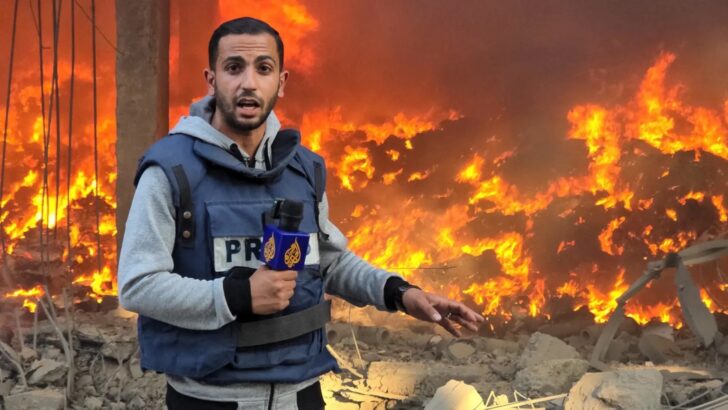
The BBC ignored an internal request to correct reporting that smeared a high-profile Palestinian journalist killed by Israel as a Hamas operative, in what a whistleblower has described as a “grave editorial breach”.
According to a leaked email seen by Novara Media, Global Journalism – part of the BBC Global News team, which is run by BBC deputy director Jonathan Munro – sent an “essential amendment and correction” request regarding BBC News reporting which claimed that Al Jazeera correspondent Anas al-Sharif “did some work with a Hamas media team in Gaza before the current war”.
Al-Sharif was killed on 10 August in a targeted Israeli airstrike on a tent marked “PRESS” outside the entrance of the al-Shifa hospital in Gaza. Five other media workers were also assassinated in the strike: Al Jazeera correspondent Mohammed Qreiqeh and photographers Ibrahim Thaher and Mohamed Nofal, freelance photojournalist Mohammed al-Khalidi and cameraman Momen Aliwa.
In a statement posted on X/Twitter, Israel said: “Al-Sharif was the head of a Hamas terrorist cell and advanced rocket attacks on Israeli civilians and IDF troops. Intelligence and documents from Gaza, including rosters, terrorist training lists and salary records, prove he was a Hamas operative integrated into Al Jazeera.” Accompanying the post were unverified screenshots from spreadsheets. The IDF provided no justification for the killing of al-Sharif’s five colleagues in the same airstrike.
Al Jazeera has categorically denied that al-Sharif was in any way Hamas affiliated.
The leaked email, dated 18 August, was sent by Global Journalism to hundreds of BBC journalists via two distribution addresses. It singled out a line in a BBC News article for correction: “The BBC understands Sharif did some work with a Hamas media team in Gaza before the current war”.
Screenshots seen by Novara Media show the email was sent to a significant number of senior journalists, including World Service Languages controller Fiona Crack, senior news editors Kate Forbes and Abigail Mobbs, director of audience growth Jamie Wakefield, and head of digital content for World Service, Claire Williams.
The email said the sentence “should be amended” to: “A source has told the BBC that Sharif had worked for a Hamas media team in Gaza before the current conflict, but Al Jazeera has denied this and the BBC News Arabic correspondent also says that he has seen no evidence.”
The email is signed by Global Journalism, part of BBC Global News which is led by Munro, who currently serves as BBC News’ senior controller of news content and the deputy CEO of BBC News and Current Affairs.
One BBC employee told Novara Media that the email went out to at least 1,200 journalists. The BBC disputed this and says the number is closer to 400. However, a screenshot seen by Novara Media confirms that just one of the two distribution email addresses goes to over 1,200 accounts.
At the time of reporting, the line in question remains uncorrected on the BBC News article, last updated 13 August. The same claim was also presented as fact on the BBC News liveblog on 11 August in reporting by Jon Donnison from Jerusalem, as well as cropping up in BBC Verify reporting on TikTok.
A BBC employee told Novara Media: “This leaked email […] exposes from the inside the culture of intimidation, fear and political control that journalists are subjected to within the corporation.
“The email admits a reported line that should never have made it onto the BBC’s front page was published without evidence, yet the error remains uncorrected and no one has been held accountable.
“In any other newsroom, such a grave editorial breach on a matter of major public interest, the targeted killing of a fellow journalist, would have led to senior resignations.”
A BBC spokesperson said: “We stand by our reporting in the BBC News article you reference from 13 August and liveblog from 11 August, and can assure audiences that we scrupulously fact check and verify all information we obtain. This internal email was sent to a specific team about a different article and contained a suggested amendment that was incorrect. We are updating our copy to remove the amendment where it has been applied.”
Munro became global director of BBC News in September 2024. The role includes leading the BBC World Service, overseeing BBC Monitoring, and continuing as deputy CEO of BBC News and Current Affairs
In the months leading up to al-Sharif’s death, Israeli officials repeatedly claimed the reporter was a Hamas operative, including in a ‘kill list’ graphic with the names and pictures of six Al Jazeera journalists.
Two weeks before al-Sharif was killed, the Committee to Protect Journalists (CJP) called on the international community to protect him due to “repeated threats” from IDF spokesperson Avichay Adraee. The CJP said accusations of al-Sharif being a Hamas operative “represent an effort to manufacture consent to kill al-Sharif”.
In August, it was revealed that Israel has a secret military unit specifically tasked with linking Palestinian journalists to Hamas and Islamic Jihad as part of a drive to tamp down on global condemnation for the murder of journalists in Gaza.
This isn’t the first time the BBC has been criticised for biased reporting on Israel’s genocide in Gaza. A blistering report from the Centre for Media Monitoring in June showed that Israeli deaths were given 33 times more coverage per fatality by the corporation, that both broadcast segments and articles included clear double standards, and that content consistently shut down allegations of genocide.
Last week, Novara Media revealed that BBC reps for the National Union of Journalists (NUJ) discouraged colleagues from attending a vigil in London – organised by the NUJ – for their murdered colleagues in Gaza.
Gaza is currently the most dangerous place in the world to be a journalist. Since October 2023, Israel has killed more media workers in Gaza than in both world wars, the US civil war, the Korean war, the Vietnam war, the wars in former Yugoslavia and the war in Afghanistan combined.
Harriet Williamson is a commissioning editor and reporter for Novara Media.
350,000 civilians forcibly displaced in latest Israeli assault on Gaza City
MEMO | September 13, 2025
The Gaza government on Saturday condemned the ongoing Israeli military offensive, which has recently displaced over 350,000 residents from eastern neighborhoods toward central and western areas of the city, Anadolu reports.
In a statement issued by the Government Media Office, officials said Israel has been targeting Gaza City’s residential areas since its ground offensive began on Aug. 11, 2025.
The office criticized Israeli Defense Minister Israel Katz’s remarks, claiming that “the gates of hell in Gaza have been opened” on the resistance, asserting that in reality, Israel “systematically targets unarmed civilians, including women, children, and the elderly, as well as homes, hospitals, schools, mosques, and tents.”
The government said more than 1,600 multi-story residential buildings were completely destroyed, over 2,000 residential buildings were severely damaged, and more than 13,000 tents sheltering displaced persons were destroyed.
Since the beginning of September, 70 buildings have been completely demolished, 120 severely damaged, and over 3,500 tents destroyed.
The buildings housed over 50,000 residents, while the destroyed tents sheltered more than 52,000 displaced people, according to the office data.
The government stated that the forced displacement is a “deliberate violation of international humanitarian law and the Geneva Conventions.”
It urged the international community to “act immediately” to stop the ongoing assaults, provide protection for civilians, and hold Israel accountable for gross violations of human rights and war crimes.
The Israeli army has continued a brutal offensive on the Gaza Strip, killing more than 64,800 Palestinians since October 2023. The military campaign has devastated the enclave, which is facing famine.
Charlie Kirk refused Netanyahu funding offer, was ‘frightened’ by pro-Israel forces before death, friend reveals
By Max Blumenthal and Anya Parampil | The Grayzone | September 12, 2025
A Trump insider and longtime friend of Charlie Kirk tells The Grayzone how the assassinated conservative leader’s turning point on Israeli influence provoked a private backlash from Netanyahu’s allies that left him angry and afraid.
The source said anxiety spread within the Trump administration after an apparent Israeli spying operation was uncovered.
Charlie Kirk rejected an offer earlier this year from Israeli Prime Minister Benjamin Netanyahu to arrange a massive new infusion of Zionist money into his Turning Point USA (TPUSA) organization, America’s largest conservative youth association, according to a longtime friend of the slain commentator speaking on the condition of anonymity. The source told The Grayzone that the late pro-Trump influencer believed Netanyahu was trying to cow him into silence as he began to publicly question Israel’s overwhelming influence in Washington and demanded more space to criticize it.
In the weeks leading up to his September 10 assassination, Kirk had come to loathe the Israeli leader, regarding him as a “bully,” the source said. Kirk was disgusted by what he witnessed inside the Trump administration, where Netanyahu sought to personally dictate the president’s personnel decisions, and weaponized Israeli assets like billionaire donor Miriam Adelson to keep the White House firmly under its thumb.
According to Kirk’s friend, who also enjoyed access to President Donald Trump and his inner circle, Kirk strongly warned Trump last June against bombing Iran on Israel’s behalf. “Charlie was the only person who did that,” they said, recalling how Trump “barked at him” in response and angrily shut down the conversation. The source believes the incident confirmed in Kirk’s mind that the president of the United States had fallen under the control of a malign foreign power, and was leading his own country into a series of disastrous conflicts.
By the following month, Kirk had become the target of a sustained private campaign of intimidation and free-floating fury by wealthy and powerful allies of Netanyahu – figures he described in an interview as Jewish “leaders” and “stakeholders.”
“He was afraid of them,” the source emphasized.
At TPUSA, the rift with Israel widens
Kirk was 18 years old when he launched TPUSA in 2012. From its inception, his career was propelled by Zionist donors, who showered his young organization with money through neoconservative outfits like the David Horowitz Freedom Center. He repaid his wealthy backers over the years by unleashing a relentless firehose of anti-Palestinian and Islamophobic diatribes, accepting propaganda trips to Israel, and sternly shutting down nationalist forces challenging his support for Israel during TPUSA events. In the Trump era, few American gentiles had proved more valuable to the self-proclaimed Jewish state than Charlie Kirk.
But as Israel’s genocidal assault on the besieged Gaza Strip drove an unprecedented backlash within grassroots right-wing circles, where only 24% of younger Republicans now sympathize with Israel over the Palestinians, Kirk began to shift. At times, he toed the Israeli line, spreading disinformation about babies beheaded by Hamas on October 7, and denying the famine imposed on the population of Gaza. Yet he simultaneously ceded to his base, wondering aloud if Jeffrey Epstein was an Israeli intelligence asset, questioning whether the Israeli government allowed the October 7 attacks to proceed in order to advance long-term political goals, and parroting narratives familiar to his most vociferous critic on the right, streamer Nick Fuentes.
This July, at his TPUSA Student Action Summit, Kirk provided a forum for the right-wing grassroots to vent its fury about Israel’s political hammerlock on the Trump administration. There, speakers from former Fox News stalwarts Tucker Carlson and Megyn Kelly, to the anti-Zionist Jewish comedian Dave Smith, denounced Israel’s blood-soaked assault on the besieged Gaza Strip, branded Jeffrey Epstein as an Israeli intelligence asset, and openly taunted Zionist billionaires like Bill Ackman for “getting away with scams” despite having “no actual skills.”

Following the confab, Kirk was bombarded with infuriated text messages and phone calls from Netanyahu’s wealthy allies in the US, including many who had funded TPUSA. According to his longtime friend, the Zionist donors treated Kirk with outright contempt, essentially ordering him to fall back into line.
“He was being told what you’re not allowed to do, and it was driving him crazy,” Kirk’s friend recalled. The conservative youth leader was not only alienated by the hostile nature of the interactions, but “frightened” by the backlash.
The friend’s account dovetails with those of multiple right-wing commentators with access to Kirk.
“I think, in the end, Charlie was going through a spiritual transformation,” Candace Owens, a conservative influencer who shifted decisively against Israel after October 7, reflected after her friend’s killing. “I know it, he was going through a lot. There was a lot of pressure, and it’s hard for me to watch the people who were pressuring him just say the things that they’re saying.”
She continued: “They wanted him to lose everything for changing or even slightly modifying an opinion. It’s very hurtful to me.”
Kirk appeared visibly outraged during an August 6 interview with conservative host Megyn Kelly, as he discussed the menacing messages he was receiving from pro-Israel bigwigs.
“It’s all of the sudden: ‘oh, Charlie: he’s no longer with us.’ Wait a second—what does ‘with us’ mean, exactly? I’m an American, okay? I represent this country,” he explained, before addressing the powerful Zionist interests harassing him.
“The more that you guys privately and publicly call our character into question—which is not isolated, it would be one thing if it were just one text, or two texts; it is dozens of texts—then we start to say, ‘whoa, hold the boat here,’” Kirk continued. “To be fair, some really good Jewish friends say, ‘that’s not all of us’… But these are leaders here. These are stakeholders.”
He went on to complain to Kelly, “I have less ability… to criticize the Israeli government than actual Israelis do. And that’s really, really weird.”
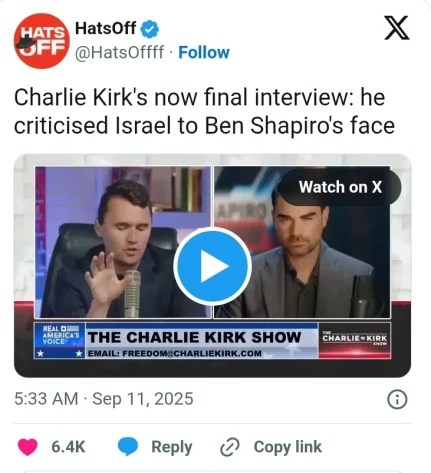
In one of his final interviews, conducted with Israel’s premier influencer in the United States, Ben Shapiro, Kirk once again tried to raise the issue of censorship of Israel critics.
“A friend said to me, interestingly: ‘Charlie, okay, we’ve pushed back against the media on COVID, on lockdowns, on Ukraine, on the border,’” Kirk told Shapiro on September 9. “Maybe we should also ask the question: is the media totally presenting the truth when it comes to Israel? Just a question!”
According to Kirk’s longtime friend, Kirk’s resentment of Netanyahu and the Israel lobby was spreading within Trump’s inner circle. In fact, they said, the president himself was terrified of Netanyahu’s wrath, and feared the consequences of defying him.
During the past year, the Trump insider was told by contacts in the White House that the Secret Service had caught Israeli government personnel placing electronic devices on its emergency response vehicles on two separate occasions.
While The Grayzone was unable to confirm the story with the Secret Service or White House, such an incident would not have been unprecedented. Indeed, according to a report in Politico citing three former senior US officials, a cellphone spying device was placed by Israeli agents “near the White House and other sensitive locations around Washington” toward the end of Trump’s first term in 2019.
Former UK Prime Minister Boris Johnson recounted a similar incident in his memoir, writing that his security team found a listening device in his bathroom soon after Netanyahu used his personal toilet.
The Israel-did-it theory
Kirk was killed this September 10 with a single shot fired by a sniper apparently positioned on a rooftop 200 meters away. He was shot while seated before a crowd of thousands at Utah State University in Orem, Utah on the first leg of his American Comeback Tour. The scene of Kirk collapsing from the impact of a gunshot to his neck just as he began answering a question about transgender mass shooters was perhaps the most shockingly vivid spectacle of assassination – and certainly the most viral – in human history.
There is currently no evidence of an Israeli government role in Kirk’s assassination. However, that has not stopped thousands of social media users from speculating that the pro-Trump operative’s shifting views on the issue contributed in some way to his death. By the time of publication, over 100,000 Twitter/X users have liked a September 11 post by libertarian influencer Ian Carroll declaring about Kirk, “He was their friend. He basically dedicated his life to them. And they murdered him in front of his family. Israel just shot themselves.”
Many advancing the unsubstantiated theory have pointed to a Twitter/X post by Harrison Smith, a personality at the pro-Trump Infowars network, stating on August 13 – almost a month before Kirk’s assassination – that he was told by “someone close to Charlie Kirk that Kirk thinks Israel will kill him if he turns against Israel.”
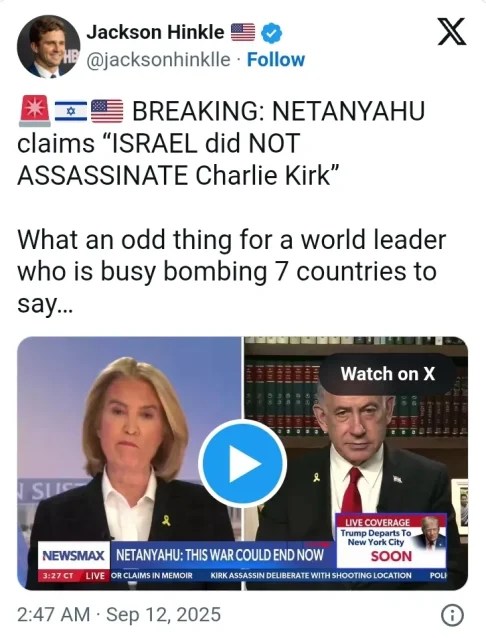
The frenzied speculation has set off shockwaves in Tel Aviv, where Netanyahu was compelled to explicitly deny that his government killed Kirk during a September 11 interview with NewsMax.
Netanyahu and his allies bury the Kirk crisis as “big tent” collapses
That appearance was just one of several interviews and statements the Prime Minister dedicated to Kirk in the wake of his killing in an effort to frame the late conservative leader’s legacy in a uniformly pro-Israel light. The major public relations push has occurred while Netanyahu wages a military campaign on seven fronts, punctuated by a regional assassination spree that most recently reached into the heart of Qatar, a US ally.
Netanyahu first tweeted prayers for Kirk at 3:02 PM in the afternoon on September 10, minutes after news of the shooting broke. He has since authored three additional posts about Kirk, even breaking away from the Israeli war cabinet to spend the afternoon of September 11 memorializing the conservative leader on Fox News.
During that interview, Netanyahu did his best to insinuate that Israel’s enemies were responsible for murdering Kirk, despite the fact no suspect was named or in custody at the time:
“The radical Islamists and their union with the ultra-progressives—they often speak about ‘human rights,’ they speak about ‘free speech’—but they use violence to try to take down their enemies,” the Prime Minister told Harris Faulkner.
In a September 10 Twitter/X post eulogizing the conservative leader, the Israeli Prime Minister described a recent phone conversation with Kirk.
“I spoke to him only two weeks ago and invited him to Israel,” Netanyahu declared. “Sadly, that visit will not take place.”

Left unmentioned was whether Kirk declined the invitation—just as he did with the Prime Minister’s offer to reload TPUSA’s coffers with donations from his coterie of wealthy American Jewish cutouts.
At the time of publication, a 22-year-old resident of Utah has been taken into custody after supposedly confessing to killing Kirk. The public may soon learn the true motives of the alleged assassin. Perhaps they will fuel the narrative which Trump and his allies advanced in the immediate wake of the shooting – that a leftist radical was responsible, and that a wave of draconian repression must follow.
But after the shooter’s initial escape and a series of federal law enforcement mishaps, a large sector of Americans will likely never believe the official story. Nor will they ever know where Kirk’s turning point on Israel would have taken the conservative movement.
Four days before the assassination, frustration among pro-Israel commentators bubbled over in public during a Fox News interview in which Ben Shapiro launched a chilling attack on Kirk without naming him.
“The problem with a ‘big tent’ is that you may end up with many clowns inside,” Shapiro told Fox host and fellow Zionist gatekeeper Mark Levin in an apparent critique of TPUSA.
“Just because you’re saying somebody votes Republican—that doesn’t mean that they ought to be the preacher at the front of the church, they’re not the person that ought to be leading the movement, if they are spending all day criticizing the President of the United States as ‘covering up a Mossad rape ring’ or ‘being a tool of the Israelis for hitting an Iranian nuclear facility.’”
When Kirk took his usual place at the “front of the church” four days later, he was cut down by a sniper’s bullet.
Within 24 hours of Kirk’s death, Shapiro announced that he would be launching his own campus speaking tour, vowing: “We’re gonna pick up that blood stained microphone where Charlie left it.”
Featured Video

Bombing Hitler’s Hometown
or go to
Aletho News Archives – Video-Images
From the Archives
The Biggest Threat to Peace in Middle East
By Dr. Elias Akleh* | Sabbah Report | May 24, 2010
A build up of heightened tension in the Middle East is escalating in the last few weeks. American and Israeli postures towards Lebanon, Syria, and Iran have become more threatening. Listening to speeches of political leaders one hears talks only about war not peace. Iranians and Israelis are continuously training hard for a possible showdown. Both sides are conducting extensive war games every month. This led Syrians to claim that Israel is preparing for a soon-to-come another war. The Jordanians also are warning that current stalemate of the peace process is an indication of a war breaking out this summer. The Russian President and his army chief hinted, a few months ago, that the US and Israel were planning for an attack on Iran.
Indeed Iran is, as it has been for last few years, the target of most of the threats and accusations of supporting terrorism. Escalating incitement against Iran the American Defense Department sent last month (April) to Congress a report on Iran’s military claiming Iran could develop intercontinental ballistic missiles capable of reaching the US by 2015.
Ignoring the fact that N. Korea, India, Pakistan, and Israel are proven to have nuclear weapons while Iran does not, the US Secretary of State Hillary Clinton chose in her speech, to the nuclear Non-Proliferation Treaty review conference at the UN, to focus on Iran’s alleged nuclear ambitions putting the whole world at risk as she put it. According to Clinton Iran’s acquisition of nuclear weapons, rather than Israel’s more than 200 nuclear bombs, is destabilizing the Middle East. She called on the world’s nations to rally around US efforts to hold Iran, not other nuclear countries, to account.
The accusation that Usama Bin Laden is living comfortably in Iran had received a boost after the broadcast of a documentary called “Feathered Cocaine”. This echoed the June 2003 claims of the Italian newspaper Corre de la Sierra that Bin Laden was in Iran according to some intelligence report, and according to Richard Miniter’s book “Shadow War”. … continue
Blog Roll
 Aletho News
- Bombing Hitler’s Hometown
- German journalist threatened with homelessness as German court upholds EU sanctions in landmark free speech case
- US Tells Allies That Ukraine-Bound Arms Could be Sent to Middle East
- Organized terrorism: Iran condemns killing of its diplomats in Lebanon
- Why could Gaza enter the regional war?
- Hamas official rejects Mladenov Plan linking disarmament to Gaza reconstruction
- Two Primary Elections for the Soul of ‘America First’
- Japan Clings to US Vassalage Despite Energy Crunch Caused By Iran War
- US Seeks Control Over Global Energy Infrastructure – Kremlin
- US senators target Orban government for standing up to Zelensky
- If Americans Knew
- Researchers at Human Rights Watch Resign Over Blocked Report on Palestinian Refugee Return
- Jewish Groups Are Backing a War Americans Don’t Want
- Eric Fingerhut Thinks He’s the President of the Jews
- Top Jewish Philanthropists, Rabbis Urge Israeli President to Take Action Against ‘Jewish Extremists’
- Don’t Be Fooled. Zionist Leaders Have Always Wanted to Control Southern Lebanon
- Israel’s widespread use of torture is a core element of its genocide against the Palestinian people
- In Israel’s War on Iran, Many Middle East US Bases Rendered “All But Uninhabitable”
- ‘Burn the lawn’: Israel pursues ‘Rafah model’ in southern Lebanon
- A genocide here, an amputation there
- Reports: Iran mobilizing 1M fighters, Israel-US run low on ammo, Israeli army faces shortage – Not a ceasefire Day 168
- No Tricks Zone
- Devastating Assessment Of Comirnaty Vaccine By Former Senior Pfizer Europe Toxicologist
- New Study: CO2 Is ‘Effectively Negligible’ As An Explanatory Climate Change Factor Since 2000
- Former Pfizer Toxicologist Dr. Helmut Sterz Tells Bundestag Hearing Pfizer Vaccine Should Have Never Been Approved
- Energy Expert: Germany’s Nuclear Phaseout Was A “500 Billion Euro Mistake”
- New Research: South Australia’s Mid-Holocene Sea Surface Temperatures Were 4°C Warmer Than Today
- Storing Green Energy To Last Germany 10 Days Would Require A 60-Million Tonne Battery
- New Studies: UK Sea Levels Were 4 Meters Higher Than Today During The Mid-Holocene
- Destructive Green New Deal: German Energy And Metal Group Warns Of Drastic Crisis
- New Study Documents A 20-Year Pause In Arctic Sea Ice Decline – Driven By Internal Variability
- Wake-up Call: Survey Shows Majority Of Germans Now Favor Postponing Climate Targets!
 Aletho News
