Syria, the Druze, and the Greater Israel project
By Gavin O’Reilly | Strategic Culture Foundation | August 25, 2025
On the 12th of August, media outlet Axios revealed that the United States and Israel were in discussions to establish a land corridor between the occupied Golan Heights and the southern Syrian city of Suwayda, ostensibly to protect the country’s Druze minority. The following Saturday, protests broke out in Suwayda calling for Druze self-determination, with many in attendance waving Israeli flags.
Last December, following a lightning offensive by insurgents based in the northwestern city of Idlib, the Syrian government of Bashar al-Assad collapsed in dramatic fashion. This marked the culmination of a thirteen-year effort by various powers to impose regime-change on the Arab Republic. One such power was Israel, who had provided arms to Salafist militants opposed to Assad’s secular rule. Syria, having acted as a conduit between Iran and Hezbollah, had long been in Tel Aviv’s crosshairs.
Within hours of Assad’s fall, Israel launched a ground invasion of southern Syria. Tel Aviv declared that this was in order to establish a buffer zone between Israel and Syria’s new Islamist government, in spite of the fact Damascus’ new rulers had effectively acted in Israel’s interests over the past decade. Israel also later stated that it intended to defend Syria’s Druze minority.
Syria, like Iraq and Libya before it, had subsequently fallen into bloody sectarian strife following Assad’s removal from power. In early March, government pogroms along Syria’s coast resulted in the deaths of more than 1,400 members of the Shi’a Alawite minority. Rather than any concern over sectarian bloodshed however, Israel’s interest in the Druze instead lies primarily in achieving a geostrategic goal that has been planned for decades.
In 1982, Oded Yinon, a senior official at the Israeli foreign ministry, penned a paper entitled A Strategy for Israel in the Nineteen Eighties. More commonly known as the Yinon Plan, the document was published by the World Zionist Organisation in the Hebrew journal KIVUNIM. In it, Yinon prioritised the dissolution of Iraq along ethnic and religious lines as a key long-term strategic goal for Israel.
Iraq, which subscribed to the pan-Arab Ba’athist ideology, had begun to emerge as Israel’s main regional rival following the Camp David Accords and the normalisation of ties between Egypt and Israel. In 1981, the Israeli Air Force had bombed the under-construction Osirak in eastern Iraq, after suspecting it would be used to develop nuclear weapons.
In early 1991, amidst the breakout of the Gulf War, Iraq launched dozens of scud missiles towards Israel. This was done in the hope that an Israeli response would galvanise Arabs across the region and undermine Gulf support for the U.S.-led coalition. Following pressure from the United States however, Israel would ultimately not respond to these strikes. By the end of February 1991, Iraqi forces had been defeated in Kuwait.
Though it subsequently emerged that the U.S. had gone to war on a fabricated account of Iraqi troops removing premature infants from incubators and leaving them to die on a hospital floor, Washington still maintained a belligerent stance towards Iraq. In April 1991, the U.S., Britain and France imposed a no-fly zone over northern Iraq, ostensibly to protect the Kurdish minority. The following year, a similar no-fly zone was put in place over the south of the country, this time under the pretext of protecting Shi’ite Muslims. Like Israel’s current interest in the Druze, this too had a strategic purpose.
The Yinon Plan outlined how in order to Balkanise Iraq, the country would have to be divided into three distinct sections. In the north of the country, a Kurdish separatist state based around the city of Mosul, in central Iraq, a Sunni region tied to the capital Baghdad, and in the south, a Shi’ite region centred around Basra. The United States’ no-fly zones effectively polarised Iraq along these lines.
Following the 9/11 attacks, a radical new U.S. foreign policy was put into place, beginning with the invasion of Afghanistan in October 2001. Eighteen months after September 11th, a U.S.-led coalition invaded Iraq, in spite of the fact no tangible evidence was ever produced to link Saddam Hussein to the attacks. Coalition forces quickly toppled the Iraqi government, and replaced it with a provisional authority. Its first executive order was to permanently ban all members of the Ba’ath Party from working in the public sector. Iraq subsequently plunged into sectarian bloodshed in the wake of the invasion.
Like Iraq, Ba’athist Syria was also identified by the Yinon Plan as a target for Balkanisation. The 1982 document envisaged a Sunni state in northern Syria centred on the city of Aleppo, an Alawite state along Syria’s Mediterranean coast, and another Sunni state, based around the southern capital of Damascus and hostile to its northern counterpart. Amidst this division, Yinon predicted the establishment of a separatist Druze state in the occupied Golan Heights and the Hauran region of southern Syria and northern Jordan.
Following the collapse of Bashar al-Assad’s government, such an arrangement has now effectively been put in place. Northwest Syria, where Aleppo is located, has become a stronghold of the Turkish-backed Syrian National Army. Hay’at Tahrir al-Sham, which led the offensive that ended Assad’s rule, is based in the capital Damascus. Its recent pogroms against the coastal Alawites polarising Syria along the same sectarian divisions outlined in the Yinon Plan. The recent Israeli-backed calls for Druze self-determination serve to even further fragment the former Arab Republic in line with the 1982 paper.
On the same day that Axios outlined U.S.-Israeli negotiations to establish a land corridor to Suwayda, Israeli Prime Minister Benjamin Netanyahu was interviewed by journalist and former Knesset member Sharon Gal for the Israeli outlet i24. When presented by Gal with an amulet containing ‘a map of the Promised Land’, Netanyahu stated that he felt a connection to a vision of ‘Greater Israel’. This is a historical Zionist term referring to an expansionist Israeli state that would incorporate the West Bank, Gaza Strip and Golan Heights at a minimum.
On Wednesday, Israel announced plans to construct 3,400 housing units in the West Bank between Jerusalem and the eastern settlement of Ma’ale Adumin. Such a move would effectively partition the territory between north and south. Bezalel Smotrich, the Israeli minister who announced the plan, declared that it would ‘bury the idea of a Palestinian state’.
Last year, Miriam Adelson, wife of casino magnate Sheldon Adelson, donated $100mn to Donald Trump’s presidential campaign. This was done on condition that the Republican candidate would endorse the formal Israeli annexation of the West Bank if elected. Sheldon Adelson, who died in 2021, had previously donated $20mn to Trump’s first presidential campaign in 2016. This too had a stipulation attached. That the U.S. Embassy would be moved from Tel Aviv to Jerusalem, a move that Trump subsequently followed through with in December 2017.
24 hours after Trump’s inauguration in January of this year, Israel launched Operation Iron Wall. Intended to destroy the Jenin refugee camp, Iron Wall has resulted in the largest mass-expulsion of Palestinians from the West Bank since 1967.
Since October 7th 2023, Israel has subjected the beleaguered Gaza Strip to a military onslaught in response to Hamas’ Operation Al-Aqsa Flood. This was the largest military incursion into Israel since the 1973 October War. Global media attention was drawn to the fact that the Supernova music festival was taking place on the Gaza border at the same time. However, less attention was paid to the revelation that the event had only been moved to that location two days beforehand. That there were no security or insurance concerns over holding a music festival in direct proximity to a location where clashes had taken place between Islamic Jihad and Israeli forces the previous summer, simply beggars belief.
Further questions arose when it emerged that Egypt, which acts as mediator between Hamas and Israel, had repeatedly warned Tel Aviv that ‘something big’ was coming in the run up to October 7th. This was corroborated by two media reports from The New York Times and CNN, which revealed that U.S. intelligence had also passed on similar warnings to Israel prior to Al-Aqsa Flood. By December 2023, it was revealed that Israel had known of Hamas’ attack plan over a year in advance.
Seven months prior to October 7th, Orit Strock, the Israeli minister responsible for the development of settlements in the West Bank, called Israel’s 2005 withdrawal from Gaza a ‘sin’. Strock was speaking upon the repeal of legislation that had ordered the dismantlement of four West Bank settlements. This was declared by Strock as a precursor to the eventual re-occupation of Gaza, a move that would ‘involve many casualties’.
Indeed, this sentiment was later echoed by Israeli security minister Yoav Gallant, who in the days following October 7th announced a blockade on Gaza, cutting off electricity and preventing food and fuel from entering the besieged strip. Gallant described Palestinians as ‘human animals’, language that couldn’t be described as anything less than genocidal.
In April 2024, a report by The Times of Israel revealed that an offer by Hamas to release all civilian captives in exchange for Israeli forces not entering the strip had been rejected by Tel Aviv. Three months later, a Haaretz report revealed that the Hannibal Directive had been applied on October 7th. This is an Israeli military directive in which a command is given to fire upon their own troops in order to prevent them being taken captive. Its use on October 7th was a significant contributory factor to the death toll on the day. Despite these damning revelations, the Israeli slaughter in Gaza has continued unabated for almost two years.
On Friday, the United Nations released a report officially acknowledging the presence of a man-made famine in Gaza. UN Human Rights Chief Volker Türk did not shy away from placing blame for the situation, and held Israel responsible for what is in reality, a genocide. Starvation is being used to ethnically cleanse the Gaza Strip in line with the Greater Israel project. A project that now also has designs on the Druze and southwestern Syria.
TikTok bars calling Israeli forces ‘terrorists’ after hiring ex-soldier
Press TV – August 24, 2025
TikTok updated its content guidelines to prohibit labeling Israeli forces as “terrorists,” shortly after appointing a former Israeli soldier and self-described “proud Zionist” to oversee its so-called “anti-Semitism” policies.
TikTok appointed Erica Mindel as its new Public Policy Manager for Hate Speech 15 days before the ban was announced, according to users on X.
They also pointed out that the guidelines previously prohibited “all racial supremacy” but have now been narrowed to exclusively address “White supremacy.”
According to her LinkedIn profile and job description, Mindel is tasked with shaping the company’s hate speech policy and serving as TikTok’s internal and external expert on anti-Semitism.
Mindal spent two and a half years in the Israeli military as a madrichot shirion – an instructor in the occupation army – and also worked with the US State Department.
“I am a proud American Jew,” she once said.
She was hired following pressure from the Anti-Defamation League (ADL), a notorious Zionist lobby group in the US. She is based in New York City and is reported to earn an estimated £280,000 annually.
Her two-and-a-half years as an Israeli military instructor, coupled with her work for US Special Envoy to Monitor and Combat Antisemitism Deborah Lipstadt, suggest that her role is aimed at censoring pro-Palestinian content while amplifying Israeli narratives amid the ongoing genocidal war on Gaza.
The move comes as the Israeli regime persists in its systematic oppression of Palestinians by worsening the humanitarian crisis in Gaza.
Disturbing images and videos depicting emaciated children, relentless bombardments, and widespread destruction continue to surface on social media platforms, shedding light on the dire situation faced by Palestinians in the region.
Backed by the US, Israel launched its onslaught on Gaza on October 7, 2023, after Palestinian resistance fighters waged the surprise Operation Al-Aqsa Storm against the Zionist entity in response to the regime’s decades-long campaign of bloodletting and devastation against Palestinians.
The Israeli military has so far killed more than 62,600 Palestinians, mostly women and children.
Israel Bombs Presidential Palace in Sanaa, Prepares For Large-Scale War in Yemen
By Kyle Anzalone | The Libertarian Institute | August 24, 2025
Israel conducted dozens of strikes in Yemen, including striking the presidential palace. Tel Aviv is collecting a large bank of targets for a widespread bombing campaign in Yemen.
On Sunday, the IDF said more than ten Israeli warplanes dropped 35 bombs in Yemen. Along with the presidential palace, Israel targeted the Hizaz and Asar power plants.
Officials in Tel Aviv said the strikes were in response to a missile fired by Ansar Allah, or the Houthis, at Israel on Friday. The IDF reports it was a new type of missile that contained submunitions.
Ansar Allah, the group that has ruled most of Yemen since 2015, stated a blockade of Israeli-linked shipping in the Red Sea in response to the ongoing genocide in Gaza. Ansar Allah has expanded the operations to missile and drone strikes against Israel and US warships in response to Israel and the US bombing Yemen.
Ansah Allah has maintained that it will not end attacks on Israel or the blockade until Tel Aviv ends the onslaught in Gaza. Following the Israeli strikes, a Yemeni official explained that Ansar Allah will “not retreat from it until the aggression is lifted, the siege is broken, and the starvation of Gaza’s people is stopped.”
Walla, an Israeli outlet, reports that Tel Aviv is preparing for large-scale strikes against Yemen. “A very large effort is underway by the Intelligence and Security Service (MNA) and the Mossad to build a broad target bank in order to strike the Houthis’ centers of gravity,” the outlet explains.
Israeli political officials told Walla, “We need to simultaneously hit their military intelligence system, ports, military capabilities, and defense industry.”
From March to May, President Donald Trump ordered the military to attack Yemen to break the blockade of Israeli-linked shipping. Over ten weeks, the US dropped over 1,000 bombs on Yemen, killing hundreds of civilians.
However, the strikes failed to break the blockade. Ansar Allah downed seven US drones and caused an F-18 to fall off an aircraft carrier. Trump agreed to a truce with Ansar Allah in May to end the attacks on American warships in the Red Sea. The ceasefire did not expand to Israel.
The officials argued to Walla that the Israeli strikes on Yemen must do more damage than the American operations. “It is necessary to accumulate many targets whose combined effects can cause very heavy damage, unlike the American operation that failed to defeat them,” they said.
Algeria demands UNSC stop ‘Greater Israel’ project, end Gaza famine
Al Mayadeen | August 23, 2025
Algeria has held the UN Security Council responsible for thwarting the “Greater Israel” project and for safeguarding the foundations of the “two-state solution”, which it described as “the cornerstone of any just, lasting, and final settlement to the Israeli-Palestinian struggle.”
Regarding the situation in the Gaza Strip, Algeria’s Foreign Ministry affirmed that the United Nations’ official declaration of a state of famine in the Strip constitutes an extremely dangerous precedent and a first of its kind in the history of the Palestinian cause and the history of the region.
The Ministry added in its statement on Saturday that the most condemnable and reprehensible aspect is that this full-fledged famine is not a product of unavoidable circumstances, but is rather a deliberate political choice and a result of planning and orchestration by the Israeli occupation.
Famine consistent with ‘Greater Israel’ project
It further clarified that this declared famine is entirely consistent with, and inseparable from, the project of forced displacement, the project of reoccupying Gaza, and what has come to be known as the “Greater Israel” project.
Algeria strongly condemned these policies and practices imposed on the Palestinian people as part of the ongoing war of annihilation in Gaza and, as a Security Council member, stressed its commitment to continuing its diplomatic efforts to support the Palestinian people and work toward ending this unprecedented humanitarian catastrophe.
Furthermore, Algeria called for “action to expedite the establishment of an independent and sovereign Palestinian State with al-Quds as its capital.”
This comes as the Israeli occupation forces continue their genocidal war and deliberate starvation in the Gaza Strip, with the latest figures from the Health Ministry reporting that the aggression has now claimed 62,622 lives and caused 157,673 injuries since October 7, 2023.
Moreover, 281 people, including 114 children, have perished due to starvation, while an additional 2,076 were killed and more than 15,308 were injured by the occupation’s targeting of civilians awaiting aid at various distribution points throughout the Strip.
Dutch foreign minister steps down after failed push for sanctions against Israel
Press TV – August 23, 2025
Dutch Foreign Minister Caspar Veldkamp resigned on Friday, after he failed to secure cabinet support for new sanctions against the Israeli regime over its ongoing genocide in Gaza.
Veldkamp, a member of the centre-right New Social Contract party, had informed the country’s Parliament he intended to bring in new measures in response to Israel’s plans to escalate attacks on Gaza City and other heavily populated areas in the besieged territory.
But he said on Friday that he could not achieve agreement on “meaningful measures” and had repeatedly faced resistance from colleagues over sanctions already in place.
Among his proposals was a ban on imports from Israeli settlements in the occupied Palestinian territories.
Veldkamp also revoked three export permits for navy ship components, warning of “deteriorating conditions” in Gaza and the “risk of undesirable end use.”
“I also see what is happening on the ground in Gaza, the attack on Gaza City, and what is happening in the West Bank, the building decision for the disputed settlement E1, and East Jerusalem,” Veldkamp told reporters.
His efforts also included imposing entry bans on hawkish Israeli ministers, Bezalel Smotrich and Itamar Ben-Gvir, citing their role in inciting settler violence against Palestinians.
His departure leaves the Netherlands without a foreign minister.
Following his resignation, all New Social Contract ministers and state secretaries confirmed their support for Veldkamp and resigned from the caretaker government in solidarity, prompting a political upheaval.
“In short, we are done with it,” party leader Eddy Van Hijum declared, calling Israel’s actions “diametrically opposed to international treaties.”
The Netherlands’ Parliament had repeatedly delayed a debate on sanctions against Israel, a discussion that was already postponed from Thursday, as the Friday afternoon Cabinet meeting dragged on.
“There is a famine, ethnic cleansing, and genocide going on,” said Kati Piri of the merged Green Left/Labor parties. “And our cabinet has been deliberating for hours about whether to take any action at all, shameful.”
Opposition lawmakers had already expressed frustration at the inaction against Israel, with some calling for a no-confidence vote for the minister.
The political crisis comes against the backdrop of an already unstable government. The ruling coalition had collapsed in June when anti-Islam lawmaker Geert Wilders withdrew his support over an immigration dispute.
Since then, the three remaining parties have continued in a caretaker capacity until elections scheduled for October.
Humanitarian conditions in Gaza have sharply deteriorated. The Integrated Food Security Phase Classification (IPC) reported on Friday that “the Famine Review Committee (FRC) has determined that Famine (IPC Phase 5) is currently occurring in Gaza Governorate.”
The FRC further projected that famine thresholds “will be crossed in Deir al-Balah and Khan Younis Governorates in the coming weeks.”
Since October 7, 2023, when the Israeli regime began its genocidal assault on Gaza, at least 271 people have died from hunger-related causes, including 112 children, the Gaza health ministry reports.
The CIA, Mossad, and Epstein: Unraveling the Intelligence Ties of the Maxwell Family
By Alan Macleod | MintPress News | August 22, 2025
With speculation mounting that Trump could pardon her, MintPress profiles the family of convicted sex trafficker Ghislaine Maxwell. From her media baron father, who acted as a high-level spy for Israel, her sister, working to push Tel Aviv’s interests in Silicon Valley, her brothers, who founded a dubious but highly influential anti-Islamic extremism think tank, and nephews in influential roles at the State Department and White House, the Maxwell clan have wide-ranging ties to U.S. and Israeli state power. This is their story.
Releasing Ghislaine, Burying the Epstein Files
Speculation is growing that Ghislaine Maxwell could soon be freed. Despite campaigning on the promise to release the Epstein Files, there are increasing signs that the Trump administration is considering pardoning the world’s most notorious convicted sex trafficker.
Last month, Trump (who contemplated the idea in his first term in office) repeatedly refused to rule out a pardon, stating to journalists that “I’m allowed to do it.” Just days later, Maxwell was transferred across states to a minimum-security facility in Bryan, Texas—a highly unusual practice. Neither women convicted of sex crimes nor those with more than 10 years remaining on their sentences are generally permitted to be transferred to such facilities. The move sparked equal measures of speculation and outrage.
The decision to relocate Maxwell came after somebody—potentially a source within her team itself—began leaking incriminating and embarrassing evidence linking Trump to Epstein. This included a birthday card Trump sent Epstein, featuring a hand-drawn nude woman, accompanied by the text: “Happy Birthday—and may every day be another wonderful secret.”
For years, Maxwell aided her partner Jeffrey Epstein in trafficking and raping girls and young women, creating a giant sex crime ring in the process. Epstein’s associates included billionaires, scientists, celebrities, and politicians, including President Trump, whom he considered his “closest friend.”
In 2021, two years after Epstein’s mysterious death in a Manhattan prison, Maxwell was found guilty of child sex trafficking offenses and was subsequently sentenced to 20 years in prison.
The news that Trump may soon free such an infamous criminal sent shockwaves through his base and drew charges of blatant corruption from the media. “Is there any reason to pardon Ghislaine Maxwell except to buy her silence?” ran the headline of one article in The Hill. Meanwhile, Tim Hogan, senior Democratic National Committee adviser, denounced what he claimed was a “government cover-up in real time.” “Donald Trump’s FBI, run by loyalist Kash Patel, redacted Trump’s name from the Epstein files—which have still not been released,” he said.
Robert Maxwell: Media Tycoon and Israeli Operative
While many of Ghislaine Maxwell’s crimes have come to light, less well-known are her family’s myriad connections to both the U.S. and Israeli national security states. Chief among these are those of her father, disgraced media baron and early tech entrepreneur, Robert Maxwell.
A Jewish refugee fleeing Hitler’s occupation of his native Czechoslovakia, Maxwell fought for Britain against Germany. After World War II, he used his Czech connections to help funnel arms to the nascent State of Israel, weapons that helped them win the 1948 war and carry out the Nakba, the ethnic cleansing of nearly 800,000 Palestinians.
Maxwell’s biographers, Gordon Thomas and Martin Dillon, write that he was first recruited by Israeli intelligence in the 1960s and began buying up Israeli tech corporations. Israel used these companies and their software to carry out spying and other clandestine operations around the globe.
Maxwell amassed a vast business empire of 350 companies, employing 16,000 people. He owned an array of newspapers, including The New York Daily News, Britain’s Daily Mirror, and Maariv of Israel, in addition to some of the world’s most influential book and scientific publishing houses.
With business power came political power. He was elected to the U.K. parliament in 1964 and counted U.S. Secretary of State Henry Kissinger and Soviet Premier Mikhail Gorbachev among his closest friends.
He used this influence to advance Israeli interests, selling Israeli intelligence-gathering software to Russia, the U.S., the U.K., and many other countries. This software included a secret Israeli backdoor that allowed the Israeli intelligence agency, Mossad, to tap into classified information gathered by governments and intelligence agencies around the world.
At the same time, it was expanding its espionage capabilities, Israel was developing a secret nuclear weapons program. This project was exposed by Israeli peace activist Mordechai Vanunu, who, in 1986, leaked evidence to the British press. Maxwell—one of Britain’s most powerful press barons—spied on Vanunu, passing photographs and other information to the Israeli Embassy—intelligence that led to Vanunu’s international abduction by Mossad, and his subsequent imprisonment.
His death was also surrounded by controversy, similar to Epstein’s. In 1991, his lifeless body was found in the ocean, in what authorities ruled a bizarre accident whereby the tycoon had fallen from his luxury yacht. To this day, his children are split on whether they think he was murdered.
The rumors that Maxwell had, for decades, been acting as an Israeli “superspy” were all but confirmed by the lavish state funeral he received in Jerusalem. His body was interred at the Mount of Olives, one of the holiest sites in Judaism, the spot from which Jesus is said to have ascended to heaven.
Virtually the entirety of elite Israeli society–both government and opposition–attended the event, including no fewer than six living heads of Israeli intelligence organizations. President Chaim Herzog himself performed the eulogy. Also speaking at the event was Prime Minister Yitzhak Shamir, who stated that “Robert Maxwell has done more for Israel than can today be said.”
In the United Kingdom, however, he is remembered less fondly. A man with a fearsome reputation, Maxwell ruled his media business with an iron fist, in a similar vein to Rupert Murdoch (another individual with extremely close links to Israel). After his death, it transpired that he had stolen more than $500 million from his employees’ pension fund to bail out other failing companies in his empire, leaving many of his workforce’s retirement plans in tatters. As the newspaper, The Scotsman, remarked ten years later in 2001:
If [Maxwell] was despised in life, he was hated in death when it emerged he had stolen 440 million [pounds] from the pension fund of Mirror Group Newspapers. He was, officially, the biggest thief in British criminal history.”
Isabel Maxwell: Israel’s Woman in Silicon Valley
Even before it had been published, Isabel Maxwell– Robert’s daughter and Ghislaine’s older sister– managed to obtain a copy of Thomas and Dillon’s biography. She immediately flew to Israel, The Times of London reported, where she showed it to a “family friend” and deputy director of Mossad, David Kimche. These actions did little to beat the book’s central allegation that her father was indeed a high-level Israeli “superspy.”
Isabel has enjoyed a long and successful career in the tech industry. In 1992, along with her twin sister, Christine, she founded a company that developed one of the internet’s first search engines.
After the pension scandal, however, she and her siblings shifted their focus to rebuilding every facet of their father’s collapsed business empire. The sisters sold the search engine, netting enormous profits.
As Israeli outlet Haaretz noted, in 2001, Isabel decided to dedicate her life to advancing the Jewish State’s interests, vowing to “work only on things involving Israel” as she “believes in Israel.” Described by former MintPress journalist and investigative reporter Whitney Webb as “Israel’s back door into Silicon Valley,” she has transformed herself into a key ambassador for the country in the tech world.
“Maxwell created a unique niche for herself in [tech] as a liaison between Israeli companies in the initial development stages and private angel investors in the U.S. At the same time, she helps U.S. companies interested in opening development centers in Israel,” wrote local business newspaper, Globes. “She lives intensively, including innumerable flights back and forth between Tel Aviv and San Francisco,” it added.
Israel is known to be the source of much of the world’s most controversial spyware and hacking tools, used by repressive governments the world over to surveil, harass, and even kill political opponents. This includes the notorious Pegasus software, used by the government of Saudi Arabia to track Washington Post journalist, Jamal Khashoggi, before assassinating him in Türkiye.
Isabel built on her father’s political connections. “My father was most influential in my life. He was a very accomplished man and achieved many of his goals during his life. I learned very much from him and have made many of his ways my own,” she said. This included developing intimate ties to a myriad of Israeli leaders, including Ehud Olmert and Ehud Barak, one of Jeffrey Epstein’s closest associates.
During the 2000s, she was a regular participant at the Herzliya Conference, an annual, closed-door gathering of the West’s most senior political, security and intelligence officials, in addition to being a “technology pioneer” at the World Economic Forum.
She was also placed on the board of the Israeli government-funded Shimon Peres Center for Peace and Innovation and the American Friends of the Yitzhak Rabin Center for Israel Studies, two organizations closely associated with those former Israeli prime ministers.
In 2001, she became the CEO of iCognito, taking the job, in her words, “because it [the company] is in Israel, and because of its technology.” The technology in question was aimed at keeping children safe online—highly ironic, given that her sister was actively trafficking and abusing minors throughout that period.
Isabel was a much more serious and accomplished individual than Ghislaine. As Haaretz noted:
While her younger sister, Ghislaine, makes the gossip columns after breakfasting with Bill Clinton or because of her ties with another close friend, Britain’s Prince Andrew, Isabel wants to show photos taken of herself with the grand mufti of Egypt, or with Bedouin in a tent, or of visits to a Gaza refugee camp.”
In 1997, Isabel was appointed president of the Israeli tech security firm, Commtouch. Thanks to her connections, Commtouch was able to secure investment from many of the most prominent players in Silicon Valley, including Bill Gates, a close associate of both the Maxwell family and Jeffrey Epstein himself.
Christine Maxwell: Funded by Israel?
Isabel’s twin sister, Christine, is no less accomplished. A veteran of the publishing and tech industries, she co-founded data analytics firm Chiliad. As CEO, she helped oversee the production of a massive “counterterrorism” database that the company sold to the FBI during the height of the War on Terror. The software helped the Bush administration crack down on Muslim Americans and tear down domestic civil liberties in the wake of 9/11 and the PATRIOT Act. Today, she is the leader and co-founder of another big data corporation, Techtonic Insight.
Like her sister and father, Christine has a close relationship with the State of Israel. She is currently a fellow at the Institute for the Study of Global Antisemitism and Policy (ISGAP), where, her biography states,
She works to promote innovative academic research that leverages enabling technologies to empower proactive understanding and combatting the great dangers of contemporary antisemitism, and enhancing the ongoing relevance of the Holocaust for the 21st century and beyond.”
ISGAP’s board is a who’s who of Israeli national security state officials. This includes Natan Sharansky, former Minister of Internal Affairs and Deputy Prime Minister of Israel, and Brigadier General Sima Vaknin-Gil, the former Chief Censor for the IDF and Director General of the Ministry of Strategic Affairs and Diplomacy. Also on the board is Jeffrey Epstein’s lawyer, Alan Dershowitz.
The think tank was a key player in the U.S. government’s decision to repress the 2024 Gaza protests on university campuses nationwide. The group produced reports linking student leaders with foreign terrorist organizations and promoted dubious claims about a wave of anti-Semitism washing over American colleges. It met frequently with both Democratic and Republican leaders, and urged them to “investigate” (i.e., repress) the leaders of the demonstrations.
ISGAP has continually warned of foreign influence on American campuses, producing reports and holding seminars detailing Qatar’s supposed stranglehold over the U.S. higher education system, and linking that with growing anti-Israel sentiment among America’s youth.
Yet if ISGAP wished to investigate other foreign government influence operations, it would not have to look far, as its own funds overwhelmingly come from a single source: the Israeli state. In 2018, an investigation found that Israel’s Ministry of Strategic Affairs (then headed by Brigadier General Vaknin-Gil herself) channeled $445,000 to ISGAP, a sum representing nearly 80% of its entire revenues for that year. ISGAP failed to disclose that information to either the public or the federal government.
At the height of the concern over foreign interference in American politics, the news barely registered. Since then, the Israeli government has continued to bankroll the group to the tune of millions. In 2019, for example, it approved a grant of over $1.3 million to ISGAP. Thus, in her role as a fellow at the organization, Christine Maxwell is the direct beneficiary of Israeli government cash.
Third Generation Maxwells: Working In the US Government
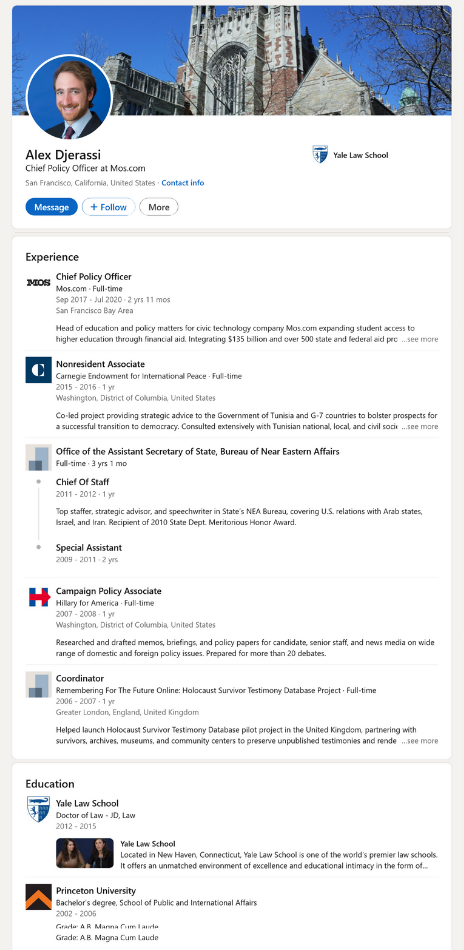
While Robert Maxwell’s daughters were close to state power, some of the family’s third generation have taken up positions within the U.S. government itself. Shortly after graduating from college, Alex Djerassi (Isabel Maxwell’s only son) was employed by Hillary Clinton on her 2007-2008 presidential campaign. Djerassi drafted memos, briefings, and policy papers for the Clinton team and helped prepare her for more than 20 debates.
The Clinton and Maxwell families are closely intertwined. Ghislaine vacationed with Hillary’s daughter, Chelsea, and appeared prominently at her wedding. Both she and Jeffrey Epstein were invited multiple times to the Clinton White House. Long after Epstein was jailed, President Bill Clinton invited Ghislaine to an intimate dinner with him at an exclusive Los Angeles restaurant.
Although she failed in her bid for the White House, President Obama named Hillary Clinton as his Secretary of State, and one of her first actions was to appoint Djerassi to her team. He quickly rose in the ranks, becoming Chief of Staff at the Office of the Assistant Secretary of State, Bureau of Near Eastern Affairs. In this role, he specialized in developing the United States’ policy towards Israel and Iran, although he also worked on the U.S. occupation of Iraq, and accompanied Clinton on visits to Israel and the Arab world.
While at the State Department, he served as the U.S. government representative to the Friends of Libya and the Friends of the Syrian People Conferences. These were two organizations of hardline, hawkish groups working towards the overthrow of those two governments, and their replacement with U.S.-friendly regimes. Washington got what it wanted. In 2011, Libyan leader Colonel Gaddafi was overthrown, killed and replaced by Islamist warlords. And last December, longtime Syrian President, Bashar al-Assad, fled to Russia and was replaced by the founder of al-Qaeda in Syria, Abu Mohammad al-Jolani.
Djerassi was later appointed an associate at the U.S.-government-funded think tank, the Carnegie Endowment for Peace. While there, he again specialized in Middle East policy, his bio noting that he “worked on matters relating to democratization and civil society in the Arab world, the Arab uprisings, and Israeli-Palestinian peace.” Today, he works in Silicon Valley.
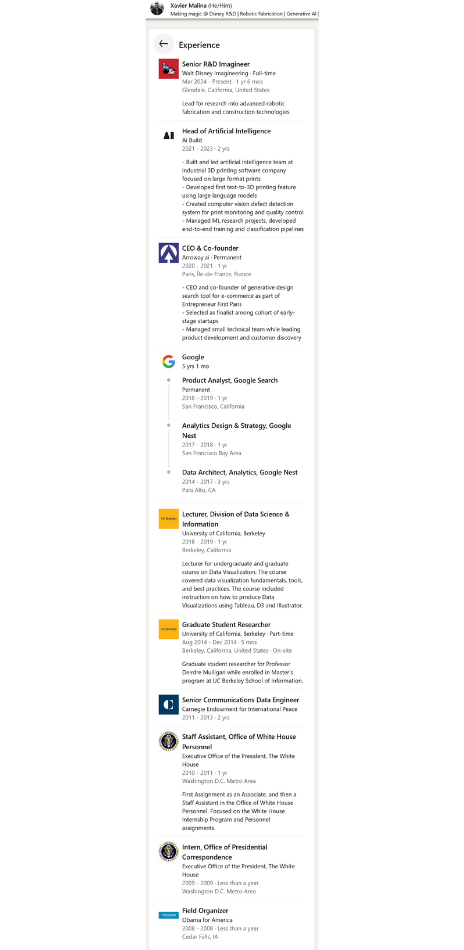
While Djerassi’s fortunes were tied to the Clinton faction of the Democratic Party, his cousin Xavier Malina (Christine Maxwell’s eldest son) backed the right horse, working on the Obama-Biden 2008 presidential run.
He was rewarded for his good work with a position in the White House itself, where he became a Staff Assistant at the Executive Office of the President. Like his cousin, once his time in office was over, Malina also secured a position at the Carnegie Endowment for Peace before pursuing a career in the tech world, working for many years at Google in the Bay Area. He currently works for Disney.
While the actions of parents and grandparents should not determine the careers of later generations, the fact that two individuals who come from a multi-generational family of unrepentant spies and operatives of a foreign power secured positions at the center of the U.S. State is at least worthy of note.
The Maxwell Brothers: From Bankruptcy to Counterterrorism
Much of the Maxwell clan is most influential in American and Israeli politics. However, brothers Ian and Kevin also hold considerable sway over affairs in their native Great Britain. Although being acquitted of charges over widespread allegations that they helped their father, Robert, plunder over $160 million from his employees’ pension fund, the brothers kept a low profile for many years. Kevin, in particular, was known for little more than being Britain’s largest-ever bankrupt, with debts exceeding half a billion dollars.
However, in 2018, they launched Combating Jihadist Terrorism and Extremism (CoJiT), a controversial think tank pushing for a far more invasive and heavy-handed government approach to the question of radical Islam.
In his organization’s book, “Jihadist Terror: New Threats, New Responses,” Ian writes that CoJiT was set up to play a “catalyzing role in the national conversation,” and to answer “difficult questions” arising from the issue. Judging by the content of the rest of the book, this means pushing for even more extensive surveillance of Muslim communities.
Within Britain, CoJiT was a highly influential organization. Its editorial board and contributors are a who’s who of high state officials. Individuals participating in its inaugural conference in London in 2018 included Sara Khan, the government’s Lead Commissioner for Countering Extremism, and Jonathan Evans, the former Director General of MI5, Britain’s domestic intelligence agency.
Like so many Maxwell projects, CoJiT appears to have wrapped up its affairs. The organization has not updated its website or posted anything on its social media channels since 2022.
In fairness, in the past few years, the brothers have had other priorities, leading the campaign to free their sister Ghislaine from prison, insisting that she is entirely innocent. In a manner reminiscent of Robert Maxwell, however, it appears that Kevin may have failed to pay the defense team; in 2022, Maxwell’s lawyers sued him, seeking unpaid fees of nearly $900,000.
The Infamous Mr. Epstein
For years, Ghislaine Maxwell and Jeffrey Epstein ran a sex trafficking ring that exploited hundreds of girls and young women. They were also connected to vast networks of the global elite, including billionaire business owners, royalty, star academics, and foreign leaders, among their closest acquaintances, leading to intense speculation about the extent of their involvement in their many crimes.
It is still unclear when Epstein first met with the Maxwells, with some alleging that he was recruited into Israeli intelligence by Robert Maxwell. Others state the relationship only began after Robert’s death, when he saved the family from penury following its financial problems.
Only one month after his 2019 arrest, Epstein was found dead in his New York City prison cell. His death was officially ruled a suicide, although his family has rejected this interpretation.
Perhaps the two most powerful individuals in Epstein’s circle of confidants were Presidents Bill Clinton and Donald Trump. Clinton, already infamous for the numerous accusations of sexual misconduct against him, is known to have flown at least 17 times on Epstein’s private jet, nicknamed the “Lolita Express,” and was accused by Epstein victim, Virginia Giuffre, of visiting Little St. James Island, the multimillionaire’s private Caribbean residence, where many of his worst crimes took place.
Trump, arguably, was even closer to the disgraced financier. “I’ve known Jeff for fifteen years. Terrific guy,” he said in 2002, “He’s a lot of fun to be with. It is even said that he likes beautiful women as much as I do, and many of them are on the younger side. No doubt about it.” Like Clinton, Trump flew on the Lolita Express. Epstein attended his wedding to Marla Maples in 1993, and claimed to have introduced him to his third wife, Melania.
Unfortunately, while Epstein’s ties incriminate the entire political spectrum, coverage has often been framed as a partisan issue. A MintPress study of over one year of Epstein coverage on MSNBC and Fox News found that each network downplayed his connections to their preferred president, while emphasizing and highlighting the links to the leader of the other major party. As a result, many in the United States see the affair as an indictment of their political rivals, rather than of the political system as a whole.
There also remains the question of Epstein’s links to intelligence, something that has been openly speculated about in the media for decades, even years before any allegations against him were made public. Throughout the 1990s, Epstein’s biographer Julie K. Brown noted, he openly boasted about working for both the CIA and Mossad, although the veracity of his claims remains in doubt. As Britain’s Sunday Times wrote in 2000, “He’s Mr. Enigmatic. Nobody knows whether he’s a concert pianist, property developer, a CIA agent, a math teacher or a member of Mossad.” It is possible that there is at least a grain of truth to all of these identities.
Epstein met with U.S. Deputy Secretary of State William Burns three times in 2014. Burns would later be named director of the CIA. Burns’ proximity to Epstein, however, pales in comparison to that of former Israeli Prime Minister, Foreign Minister, and Defense Minister Ehud Barak. Between 2013 and 2017 alone, Barak is known to have traveled to New York City and met with the convicted criminal at least 30 times, sometimes arriving at his Manhattan mansion incognito or wearing a mask to hide his identity.
Numerous sources have commented on Epstein’s connections to Israeli intelligence. A previous girlfriend and victim of his, referred in court documents as Jane Doe 200 to hide her identity, testified that Epstein boasted about being a Mossad operative and that, after he raped her, she could not go to the police because his position as a spy made her fear for her life.
“Doe genuinely believed that any reporting of the rape by what she believed to be a Mossad agent with some of the most unique connections in the world would result in significant bodily harm or death to her,” reads the court filing.
Ari Ben-Menashe, a former senior official in Israel’s Military Intelligence Directorate, claimed that Epstein was a spy and that he and Ghislaine Maxwell were running a honeytrap operation on behalf of Israel. Four (anonymous) sources told Rolling Stone that Epstein had directly worked with the Israeli government.
Unlike much of the Maxwell family, however, his Israel and intelligence connections are based largely on testimony and unverified accounts. His only known trip to the country was in April 2008, just before his sentencing, a move that sparked fears he would seek refuge there.
Nevertheless, there has been intense public speculation that he could have been working for Tel Aviv. At the Turning Points USA Student Action Summit 2025, former Fox News host Tucker Carlson stated that there is nothing wrong, hateful or anti-Semitic about asking questions about Epstein’s foreign connections. “No one’s allowed to say that the foreign government is Israel, because we’ve been somehow cowed into thinking that that’s naughty,” he said, before expressing his exasperation about the media’s silence on the issue.
What the hell is this? You have the former Israeli prime minister living in your house, you have had all this contact with a foreign government, were you working on behalf of the Mossad? Were you running a blackmail operation on behalf of a foreign government?”
Carlson’s comments drew harsh condemnation from former Israeli Prime Minister Naftali Bennett. “The accusation that Jeffrey Epstein somehow worked for Israel or the Mossad running a blackmail ring is categorically and totally false. Epstein’s conduct, both the criminal and the merely despicable, had nothing whatsoever to do with the Mossad or the State of Israel,” he wrote.
“This accusation is a lie being peddled by prominent online personalities such as Tucker Carlson pretending they know things they don’t,” he added, concluding that Israel was under attack from a “vicious wave of slander and lies.”
Whatever the truth about Epstein, it is indisputable that the powerful Maxwell family holds wide-ranging connections to U.S., British and Israeli state power. It is also beyond doubt that if the full story of their activities were ever to reach the public, it would incriminate a significant number of the world’s most powerful people and organizations. Perhaps that is why Trump has, in short order, gone from promising to release the Epstein Files to potentially releasing his accomplice.
Was the Oct 7 attack a pre-emptive strike?
In incendiary leaked comments, the former head of Israel’s military intelligence disclosed plans to assassinate Hamas’ leadership and initiate war
By Max Blumenthal | The Grayzone | August 22, 2025
In comments leaked by Israel’s Channel 12 this August 16, the Israeli army’s former head of military intelligence, Aharon Haliva, called for a “new Nakba” against the Palestinians and declared, “50,000 dead in Gaza is necessary and required for future generations.”
“For everything that happened on October 7, he proclaimed, “for every person on October 7, 50 Palestinians need to die. It does not matter now if they are children.”
Haliva’s remarks offer further proof of Israel’s genocidal intent in Gaza, and provide fresh evidence in future prosecutions of the country’s military and political leadership for crimes against humanity.
While social media users reeled in horror at his fascistic rhetoric, few noticed a revelation by Haliva which should cast the Al Aqsa Flood operation on October 7 in an entirely new light.
According to Haliva, “After the holidays [in the Fall of 2022], we were opening a joint reorganization with [Israel’s General Security Services] Shin Bet to collect intelligence on [Al-Qassam Chief of Staff Mohammed] Deif and [Hamas Secretary Genera Yahya] Sinwar in order to kill them, because every time we prepared a plan, they moved, and you have to re-collect on them.”
In other words, Israel was planning to violate its ceasefire with Hamas and launch a major decapitation strike against its leading figures, much like the one it deployed against Iran’s military leadership this June 13, when it assassinated 8 major IRGC officials without provocation. The killings would have touched off a major war, but unlike after October 7, Hamas would have been left without any negotiating leverage, as it would have had no Israeli captives in its possession when hostilities began.
When seen in this light, Al Aqsa Flood was a preemptive strike. Sinwar and Deif almost certainly understood that Israel was plotting their assassinations as the opening blow of a punishing assault aimed at snuffing out Palestinian resistance in Gaza once. Deif had already survived four assassination attempts, losing his family, an eye and use of several limbs in the process. As Haliva acknowledged, he and Sinwar were constantly on the move to evade their would-be killers.
And so, as the sun rose on October 7, 2023, Hamas took the initiative, denying a far more powerful adversary the devastating opening move it had methodically planned.
The war on truth: Why are Palestinian journalists being systematically erased?
By Ramzy Baroud | MEMO | August 22, 2025
The killing of seven Palestinian journalists and media workers in Gaza on 10 August has prompted verbal condemnations, yet has inspired little to no substantive action. This has become the predictable and horrifying trajectory of the international community’s response to the ongoing Israeli genocide.
By eliminating Palestinian journalists like Anas al-Sharif and Mohammed Qraiqeh, Israel has made a sinister statement that the genocide will spare no one. According to the monitoring website Shireen.ps, Israel has killed nearly 270 journalists since October 2023.
More journalists are likely to die covering the genocide of their own people in Gaza, especially since Israel has manufactured a convenient and easily deployed narrative that every Gazan journalist is simply a “terrorist”. This is the same cruel logic offered by numerous Israeli officials in the past, including Israeli President Isaac Herzog, who declared that “an entire nation” in Gaza “is responsible” for not having rebelled against Hamas, effectively stating that there are no innocent people in Gaza.
This Israeli discourse, which dehumanises entire populations based on a vicious logic, is frequently repeated by officials who fear no accountability. Even Israeli diplomats, whose job in theory is to improve their country’s image internationally, frequently engage in this brutal ritual. In comments made in January 2024, Israeli ambassador to the UK, Tzipi Hotovely, callously argued that “every school, every mosque, every second house has access to tunnels,” implying that all of Gaza is a valid military target.
This cruelty of language would be easily dismissed as mere rhetoric, except that Israel has, in fact, according to Euro-Med Human Rights Monitor reports, destroyed over 70 per cent of Gaza’s infrastructure.
While extremist language is often used by politicians around the world, it is rare for the extremism of the language to so precisely mirror the extremism of the action itself. This makes Israeli political discourse a uniquely dangerous phenomenon.
There can be no military justification for the wholesale annihilation of an entire region. Yet again, the Israelis are not shying away from providing the political discourse that explains this unprecedented destruction. Former Knesset member Moshe Feiglin chillingly said, last May, that “Every child, every baby in Gaza is an enemy… not a single Gazan child will be left there.”
But for the systematic destruction of a whole nation to succeed, it must include the deliberate targeting of its scientists, doctors, intellectuals, journalists, artists and poets. While children and women remain the largest categories of victims, many of those killed in deliberate assassinations appear to be targeted specifically to disorient Palestinian society, deprive it of societal leadership, and render the process of rebuilding Gaza impossible.
These figures powerfully illustrate this point: according to a report released by the United Nations Office for the Coordination of Humanitarian Affairs, based on the latest satellite damage assessment conducted in July, 97 per cent of Gaza’s educational facilities have been affected, with 91 per cent in need of major repairs or full reconstruction. Additionally, hundreds of teachers and thousands of students have been killed.
But why is Israel so intent on killing those responsible for intellectual production? The answer is twofold: one unique to Gaza, and the other unique to the nature of Israel’s founding ideology, Zionism.
First, regarding Gaza: Since the Nakba in 1948, Palestinian society in Gaza has invested heavily in education, seeing it as a crucial tool for liberation and self-determination. Early footage shows classrooms being held in tents and open spaces, a testament to this community’s tenacious pursuit of knowledge. This focus on education transformed the Strip into a regional hub for intellectual and cultural production, despite poorly funded UNRWA schools. Israel’s campaign of destruction is a deliberate attempt to erase this generational achievement, a practice known as scholasticide, and Gaza is the most deliberate example of this horrific act.
Second, regarding Zionism: For many years, we were led to believe that Zionism was winning the intellectual war due to the cleverness and refinement of Israeli propaganda, or hasbara. The prevailing narrative, particularly in the Arab world, was that Palestinians and Arabs were simply no match for the savvy Israeli and pro-Israeli public relations machine in Western media. This created a sense of intellectual inferiority, masking the true reason for the imbalance.
Israel was able to “win” in mainstream media discourse due to the intentional marginalisation and demonization of Palestinian and pro-Palestinian voices. The latter had no chance of fighting back simply because they were not allowed to, and were instead labeled as “terrorist sympathizers” and the like. Even the late, world-renowned Palestinian scholar Edward Said was called a “Nazi” by the extremist, now-banned Jewish Defense League, who went so far as to set the beloved professor’s university office on fire.
Gaza, however, represented a major problem. With foreign media forbidden from operating in the Strip per Israeli orders, the Gazan intellectual rose to the occasion and, in the course of two years, managed to reverse most of Zionism’s gains over the past century. This forced Israel into a desperate race against time to remove as many Palestinian journalists, intellectuals, academics, and even social media influencers from the scene as quickly as possible—thus, the war on the Palestinian thinker.
The Israeli logic, however, is destined to fail, as ideas are not tied to specific individuals, and resilience and resistance are a culture, not a job title. Gaza shall once more emerge, not only as the culturally thriving place it has always been, but as the cornerstone of a new liberation discourse that is set to inspire the globe regarding the power of intellect to stand firm, to fight for what is right, and to live with purpose for a higher cause.
Euro-Med: Israel’s killing of Gaza farmers reflects a systematic pattern to enforce starvation
Palestinian Information Center – August 22, 2025
GAZA – The Euro-Mediterranean Human Rights Monitor (Euro-Med) condemned Israel’s deliberate killing of five farmers in Khan Yunis, saying the act is part of a “repeated and systematic approach” aimed at eradicating Gaza’s local food production and enforcing starvation as a weapon in the ongoing genocide, now in its 23rd month.
In a statement released Friday, Euro-Med’s field team documented how at approximately 9:00 AM on Thursday, August 21, 2025, at least one Israeli drone-launched missile targeted five farmers from the same family, Suleiman and Mohammed Jamal Darwish al-Astal, Musa Abdullah al-Astal, Mahmoud Naif Mustafa al-Astal, and Mohammed Marwan Ahmed al-Astal, while they were working their land east of Asdaa Prison, west of Khan Yunis in southern Gaza.
Euro-Med highlighted that the killings coincide with an official declaration by the Integrated Food Security Phase Classification (IPC) that famine conditions have been formally recognized in Gaza for the first time. The IPC warned that after 22 months of conflict, over half a million Gazans face “catastrophic circumstances marked by hunger, severe poverty, and death,” and that famine could spread to Deir al-Balah and Khan Yunis by the end of September.
These deaths are not isolated incidents, according to Euro-Med: Israeli occupation forces have killed or wounded hundreds of farmers and continued to destroy hundreds of thousands of dunums of agricultural land, over 93% of Gaza’s approximately 178,000 dunums.
Euro-Med underscored that these actions are carried out under the cover of an ongoing blockade, with major obstructions to aid convoys and deliberate security restrictions that prevent full and equitable aid access to hundreds of thousands of displaced people.
The Monitor emphasized that using starvation as a method of warfare is explicitly prohibited under international humanitarian law. Targeting the food supply, destroying agricultural infrastructure, and depriving civilians of essential means of survival constitute war crimes and crimes against humanity, as defined by international law. The deliberate deprivation of food, considered a primary means of civilian survival, also amounts to genocide.
Euro-Med urged the international community to take immediate and decisive action: open humanitarian corridors, lift the siege, and enable delivery of essential food and non-food supplies to Gaza. The group also called for accountability mechanisms to prosecute those responsible, including issuing and enforcing arrest warrants from the International Criminal Court against Israeli leaders and imposing economic, diplomatic, and military sanctions on Israel to halt its crimes.
New report exposes brutal torture, psychological horror of Gazans in Israeli jails
Press TV – August 22, 2025
Two Palestinian prisoners’ advocacy groups say detainees from Gaza are enduring severe torture and humiliating treatment inside Israeli detention facilities across the occupied territories.
The Palestinian Prisoners’ Society (PPS) and the Palestinian Authority’s Commission of Detainees and Ex-Detainees Affairs released a report detailing systematic mistreatment within the underground Rakevet section of Ramla Prison and the Sde Teiman military camp, both known for brutal abuse of Palestinian detainees.
The briefings, titled ‘Enduring Hell: Gaza Detainees Face Severe Israeli Torture and Terror Behind Bars’, are based on testimonies collected between late July and mid-August.
The findings chronicle the circumstances experienced by individuals detained after being abducted from Gaza, depicting these conditions as among the most dire in many years.
Lawyers who visited inmates in the underground Rakevet unit of Ramla Prison reported that the detainees arrived for their meetings in a state of visible distress, with some weeping and unable to express their traumatic experiences.
Before the visits, the guards physically assaulted and intimidated them, cautioning that they should inform their lawyers that the conditions were “excellent”.
Lawyers were likewise prohibited from disclosing information regarding the families of detainees in Gaza, where the ongoing Israeli genocidal war has killed more than 62,000 Palestinians.
Inmates recounted a system characterized by physical assaults, enforced solitude, and mental anguish. They are deprived of sunlight, permitted merely 20 minutes outdoors every other day, restrained with handcuffs, and compelled to bow their heads.
Mattresses are distributed exclusively at night, leaving the detainees to rest on metal frames throughout the day.
Insults and humiliation are pervasive, as guards are said to compel detainees to curse their own families.
One detainee seemed to have suffered severe beatings, with deep marks on his wrists from handcuffs and streaks of tears on his face.
He stayed quiet throughout the meeting, indicating with his gaze that he was too fearful to voice his thoughts. Lawyers noted a significant level of psychological distress among all detainees they visited.
Multiple detainees reported experiencing severe types of torture while being interrogated and held in detention.
Several detainees described brutal torture during interrogation. One prisoner, identified as AY, said he was arrested in December 2023 and subjected to continuous beatings for 30 days, resulting in torn chest muscles and ongoing pain from prolonged shackling.
Another detainee, YD, reported violent head injuries and rib fractures from beatings during interrogation.
The conditions under which Palestinian inmates are held by Israel are deplorable, with insufficient hygienic standards. Additionally, Palestinian abductees have faced ongoing torture, harassment, and repression.
Palestinian abductees have persistently engaged in open-ended hunger strikes to convey their anger regarding their unlawful detention.
Human rights organizations assert that Israel persists in infringing upon all rights and freedoms afforded to abductees under the Fourth Geneva Convention and international laws.
As reported by the Palestine Detainees Studies Center, approximately 60 percent of Palestinian abductees held in Israeli jails are afflicted with chronic illnesses, with several of them having died either during their detention or following their release as a result of the severity of their conditions.
Sabotage in the Skies: Was Pakistani General Zia-ul-Haq Murdered by Mossad?
The death of Pakistan’s military ruler remains one of the great unsolved puzzles of the 20th century
José Niño Unfiltered | August 17, 2025
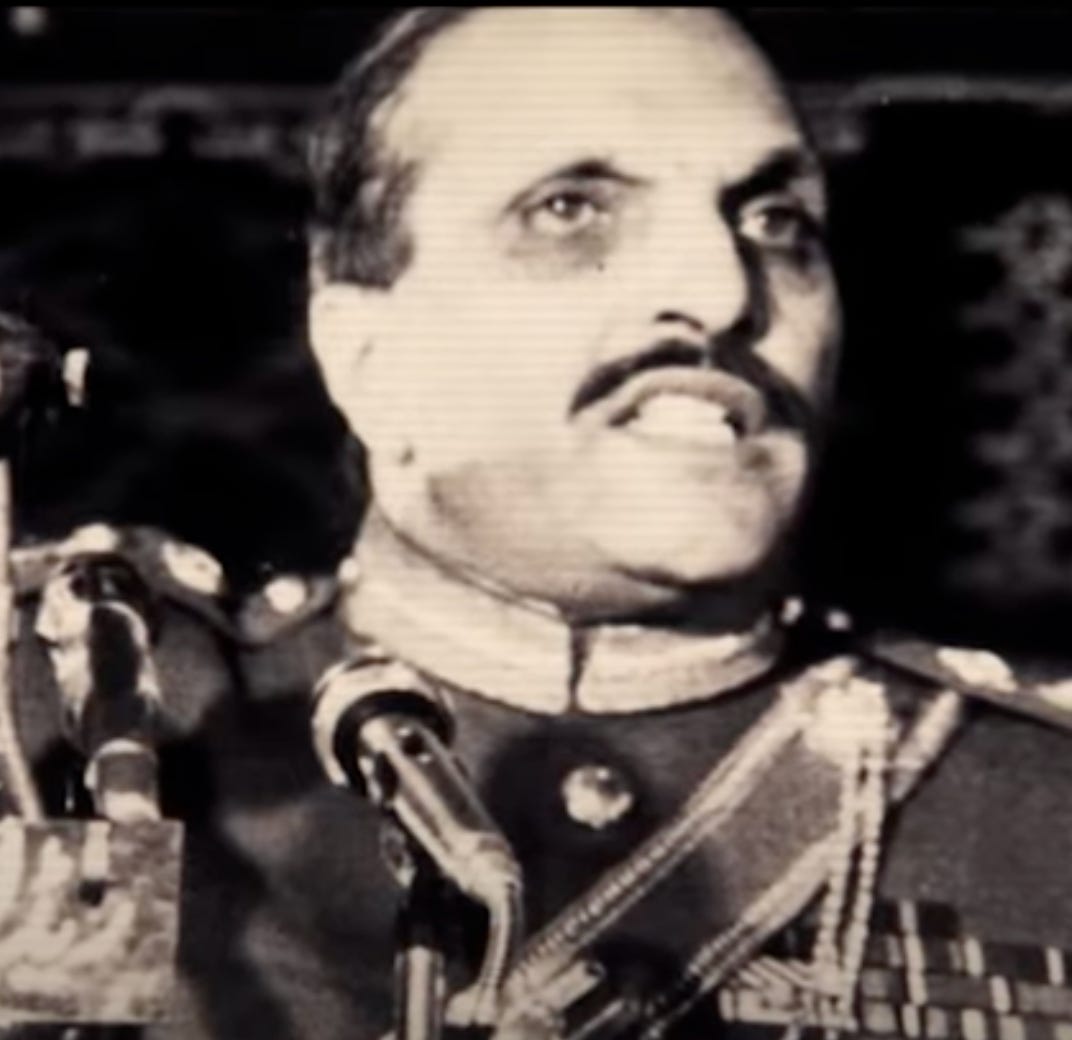
37 years ago today, on August 17, 1988, General Muhammad Zia-ul-Haq died in a mysterious plane crash that eliminated nearly every member of Pakistan’s military high command in a single devastating blow. The crash of Pak-1, a specially configured C-130 Hercules aircraft, near Bahawalpur claimed not only the Pakistani president and army chief but also Chairman Joint Chiefs of Staff Committee General Akhtar Abdur Rahman, several senior Pakistani military officers, U.S. Ambassador Arnold Lewis Raphel, and Brigadier General Herbert M. Wassom, head of the U.S. military aid mission to Pakistan.
Zia’s Strategic Legacy: Architect of Pakistan’s Nuclear Ambitions
Before examining the mysterious circumstances of his death, Zia’s foreign policy accomplishments merit recognition. During his rule (1978—1988), Zia transformed Pakistan from a middling regional actor into a regional power with the ability to change the strategic landscape. His most significant achievement was shepherding Pakistan’s nuclear weapons program to near-completion while successfully balancing Cold War pressures.
After India conducted its first nuclear test—codenamed Smiling Buddha—on May 18, 1974, Pakistan moved swiftly toward its own weapons program. In response to this move, then-Pakistani Prime Minister Zulfikar Ali Bhutto pledged that his nation would not be left behind.
“We will eat grass or leaves, even go hungry, but we will get one of our own,” he declared. Pointing to the existing arsenals of other faith-based powers, he remarked: “There is a Christian bomb, a Jewish bomb and now a Hindu bomb. Why not an Islamic bomb?”
When Zia took power in 1978, he continued the Pakistani ruling class plan to turn the South Asian nation into a nuclear power. In 1987, Zia told the Carnegie Endowment that Pakistan sought sufficient nuclear capability “to create an impression of deterrence.” His bold proclamation that Pakistan was “a screwdriver’s turn away from the bomb” sent shockwaves across intelligence communities worldwide.
The nuclear program’s success vindicated Zia’s vision. Pakistan conducted its first successful nuclear tests on May 28, 1998, becoming the world’s seventh nuclear power.
Pakistan’s Unpredictable Foreign Policy Under Zia
Zia’s foreign policy demonstrated remarkable strategic acumen. As the primary architect of the Afghan resistance against the Soviet Union’s invasion of Afghanistan in 1979, he successfully convinced initially reluctant Americans to provide massive military aid. CIA veteran Bruce Riedel emphasized that “the war against the Soviets in Afghanistan was run by Zia, not by us.” Zia rejected President Carter’s initial $400 million aid offer as “peanuts” and ultimately secured $3.2 billion in military and economic aid from the Reagan administration.
Simultaneously, Zia pursued deeper ties with China and maintained complex relationships with Iran despite sectarian pressures. During the Iran-Iraq War, Pakistan officially maintained neutrality while covertly supporting Iran. Zia described Ayatollah Ruhollah Khomeini as “a symbol of Islamic insurgence” in 1979 and was one of the first countries to diplomatically recognize the Islamic Republic of Iran. Pakistan reportedly conducted clandestine arms deals that saw Chinese and U.S. weapons sent to Iran, including Silkworm and Stinger missiles originally intended for Afghan mujahideen, which played a decisive role for Iran in the “Tanker War” against Iraq.
The Fatal Flight: August 17, 1988
The events of that fateful day began routinely. Zia had traveled to Bahawalpur to witness a demonstration of the U.S. Army’s M1 Abrams tank at the Thamewali Test Range. After the successful demonstration, organized by Major-General Mahmud Ali Durrani, Zia and his delegation departed by army helicopter before transferring to the specially configured C-130 for the return flight to Islamabad.
At 3:40 PM Pakistan Time, Pak-1 took off from Bahawalpur Airport with thirty people aboard, including 17 passengers and 13 crew members. The aircraft had been equipped with an air-conditioned VIP capsule where Zia and his American guests were seated, walled off from both the flight crew and passenger sections. For two minutes and thirty seconds, the plane rose into clear skies. Takeoff was smooth and without problems.
At 3:51 PM, Bahawalpur control tower lost contact. Witnesses cited in Pakistan’s official investigation reported that the C-130 began pitching “in an up-and-down motion” while flying low before going into a “near-vertical dive” and exploding on impact. The plane crashed with such force that it was blown to pieces, with wreckage scattered over a wide area. All 30 people aboard died instantly.
Brigadier Naseem Khan, flying a French-made Puma helicopter in the vicinity, was among the first to arrive at the crash site. “I walked all around it,” he later recalled. “The plane had crashed at an almost perpendicular angle. I first spotted the cap worn by Gen Wassom, and then Gen Akhtar Rahman’s peaked cap. Then my eye fell upon a dismembered leg, wearing a black sock and black shoe. I suspected it belonged to Gen Zia.”
The Cover-Up Begins
Pakistan’s board of inquiry concluded that the most likely cause of the crash was a criminal act of sabotage within the aircraft. Investigators suggested that toxic gases rendered passengers and crew unconscious, preventing any distress call from being made. Curiously, despite prior C-130 models being fitted with flight recorders, none was found after the crash.
The American response proved equally suspicious. According to former New York Times South Asia Bureau Chief and Council on Foreign Relations member Barbara Crossette’s investigation, Ambassador Robert Oakley and General George B. Crist of CENTCOM rejected an attempt to have the FBI investigate a crash that killed the U.S. ambassador and an American general. Instead, they arranged for the Pentagon and State Department to hold an inter-departmental inquiry. Both officials later apologized to Congress for this decision.
Within two months of the crash, the American government was alone in promoting the theory that mechanical malfunction brought down the plane. On the other hand, most Pakistanis assumed assassination from the start.
Ambassador John Gunther Dean’s Shocking Revelations
The most explosive allegations about Zia’s death came from an unexpected source. John Gunther Dean, who in 1988 served as U.S. Ambassador to India, was a distinguished diplomat with four decades of service who had held more ambassadorships than most envoys. Dean was uniquely positioned to observe the aftermath of Zia’s death, and what he suspected would end his diplomatic career.
Dean believed the plot to eliminate General Zia bore the hallmarks of Israel, specifically the Israeli intelligence agency Mossad. His suspicions weren’t outlandish. Dean had personal experience with Israeli operations. Eight years earlier, while serving as Ambassador to Lebanon, Israelis had sought his support for their local projects, assuming that a fellow Jew would be willing to cooperate with them. When Dean rejected those overtures and declared his primary loyalty was to America, an attempt was made to assassinate him.
On August 28, 1980, Dean, his wife, daughter, and son-in-law narrowly escaped serious injury in a motorcade attack in suburban Beirut. The munitions were eventually traced back to Israel. Dean later discovered the Lebanese group claiming responsibility was an Israeli-created front organization used to carry out Mossad terrorist attacks.
Barbara Crossette’s Investigation
In 2005, after 17 years of silence, Dean finally revealed his suspicions to Barbara Crossette, in what would become a landmark investigation. Crossette’s 5,000-word article “Who Killed Zia?” appeared in the prestigious World Policy Journal, published by The New School in New York City under academic Stephen Schlesinger.
Dean’s theory centered on Israel’s alarm over Pakistan’s nuclear program. A few years before his death, Zia took bold steps to develop a nuclear weapons program. Although his primary motive was balancing India’s nuclear arsenal, Zia promised to share such weapons with other Muslim countries, including those in the Middle East. This possibility created major concerns in the Israeli national security community.
According to journalist Eric Margolis, Israel repeatedly tried to enlist India in launching a joint assault against Pakistan’s nuclear facilities. After careful consideration, India declined. This left Israel in a quandary. Zia was a proud military dictator with very close U.S. ties that strengthened his diplomatic leverage. Pakistan was 2,000 miles from Israel and possessed a strong military, making any long-distance bombing raid similar to the 1981 strike against Iraq’s Osirak reactor virtually impossible. That left assassination as the remaining option.
The Diplomatic Retaliation
Dean chose proper diplomatic channels rather than media disclosure. He immediately departed for Washington to share his views with State Department superiors and other top Administration officials. Upon reaching Washington, Dean was quickly declared mentally incompetent, prevented from returning to his India posting, and soon forced to resign. His four-decade career in government service came to a screeching halt.
Dean was sent to Switzerland to “rest” for six weeks before being allowed to return to New Delhi to pack his belongings and resign. He lost his medical clearance and security clearance because of his views about the crash. The accusation of “mental imbalance” effectively ended any investigation into his allegations.
One might expect such explosive charges from such a solid source would provoke considerable press attention, but the story was instead totally ignored and boycotted by the entire North American media. Stephen Schlesinger, who had spent a decade at the helm of World Policy Journal, saw his name vanish from the masthead shortly after publication, and his employment at The New School came to an end.
Ron Unz observed, with some shock, that the article is no longer available on the World Policy Journal website, though the text remains accessible via Archive.org. Even Dean’s detailed New York Times obituary portrayed his distinguished career in flattering terms while devoting not a single sentence to the bizarre circumstances under which it ended.
Zia’s Legacy Lives On
The patterns established during Zia’s era continue influencing Pakistan’s foreign policy today, often creating tension with traditional allies. Pakistan’s integration into China’s Belt and Road Initiative through the China-Pakistan Economic Corridor represents the kind of independent alignment that characterized Zia’s approach to international relations.
However, recent attacks on Chinese nationals working in Pakistan have troubling parallels to the covert plans to potentially target Pakistan’s nuclear program in the 1980s. What was envisioned as a secure trade and energy corridor linking Xinjiang to Gwadar has instead become a flashpoint for insurgency. Baloch separatists, particularly the Baloch Liberation Army (BLA), have repeatedly targeted Chinese personnel and infrastructure in a campaign to derail Pakistan’s partnership with China.
These efforts have ranged from the killing of nine Chinese engineers at the Dasu Hydropower Project in 2021, to Operation Dara-e-Bolan in January 2024, and the March 2025 hijacking of the Jaffar Express that left 59 dead. Each new CPEC agreement, including six signed in 2023, has provoked fresh waves of violence, underscoring the project’s vulnerability. Far from isolated incidents, this sustained series of attacks highlights how militant groups and their great power patrons see undermining CPEC as central to weakening the Chinese-Pakistani alliance.
Speculation about Western intelligence support for Balochi separatists has gained currency in recent years. The Middle East Media Research Institute (MEMRI), with documented ties to Israeli intelligence, launched a Balochistan Studies Project in 2025. This initiative highlighted Balochistan’s strategic importance for monitoring Iran’s and Pakistan’s nuclear program, suggesting Israel’s continued interest in leveraging regional ethnic tensions for broader geopolitical objectives.
The Imran Khan Parallel
The 2022 removal of Prime Minister Imran Khan bears striking similarities to the pressures Zia faced for maintaining independent foreign policy positions. Khan’s insistence on neutrality regarding the Russia-Ukraine conflict angered Washington, just as Zia’s support for Iran during the Iran-Iraq War created friction with Reagan administration officials.
The leaked diplomatic cable published by The Intercept revealed that U.S. State Department official Donald Lu explicitly linked Khan’s removal to his Russia policy. “I think if the no-confidence vote against the Prime Minister succeeds, all will be forgiven in Washington because the Russia visit is being looked at as a decision by the Prime Minister,” Lu stated. “Otherwise, I think it will be tough going ahead.”
Khan was removed through a no-confidence vote on April 10, 2022, exactly one month after the threatening meeting with U.S. officials. The parallel with Zia’s fate thirty-four years earlier is unmistakable: Pakistani leaders who pursue independent foreign policies will face tremendous pressure from Washington and could be unceremoniously removed from power.
Iran-Pakistan Relations: From Conflict to Cooperation
The January 2024 tit-for-tat missile exchanges between Iran and Pakistan initially appeared to represent a dangerous escalation. Iran struck Balochi separatist targets in Pakistani Balochistan on January 16, killing two children. Pakistan retaliated two days later, targeting Balochi militants in Iranian Sistan-Baluchestan province, killing nine people including four children.
However, the rapid diplomatic resolution echoed Zia’s approach to managing regional relationships. Within days, both countries agreed to de-escalate through diplomatic channels. The now-deceased Iranian Foreign Minister Hossein Amir-Abdollahian visited Pakistan on January 29, 2024, leading to agreements on enhanced security cooperation and intelligence sharing. This swift return to cooperation reflected the kind of pragmatic diplomacy Zia employed during the Iran-Iraq War.
This move also reflects the new challenge of challenging Judeo-American perfidy with respect to the activation of Balochi militants against the security interests of both Iran and Pakistan. Iran and Pakistan have been increasingly alarmed by the growing nexus between Baloch separatists and Israel, which both states see as a direct threat to their security. As Mansur Khan Mahsud of Pakistan’s FATA Research Centre told The Cradle, “During the recent 12-day standoff between Iran and Israel, Tehran noticed a tight-knit connection between Baloch separatists and Israel. Their sharing of intelligence with Tel Aviv led to significant human and infrastructure losses for Iran.”
Tehran has gone further with its accusations, directly implicating Tel Aviv and accusing Israel of recruiting and deploying mercenaries through the Balochistan Liberation United Front (BLUF). Abdullah Khan of the Pakistan Institute for Conflict and Security Studies warned: “Iran is enhancing its ties with Pakistan in the background of militants’ increased alignment with Israel. Their liaison with Tel Aviv would further crystallize when Iran shifts its policies and takes action against BLA and BLF sanctuaries within its territory. India has cultivated strong ties with both groups, enabling it to serve as a bridge to connect them with Israel.”
The Multipolar Reality
Today’s geopolitical environment increasingly resembles the complex balance Zia navigated during the 1980s. Pakistan’s alignment with China and Iran in various contexts, from CPEC to regional security cooperation against Israel’s Judeo-Accelerationist foreign policy, represents the kind of hedging strategy Zia pioneered.
The emergence of a multipolar world order, with China and Russia challenging American hegemony, provides Pakistan with alternatives to complete dependence on Washington. This mirrors the strategic space Zia created by balancing Cold War pressures while pursuing Pakistan’s independent interests.
The emergence of India as a strategic partner for both Israel and the United States creates new pressure points for Pakistan. This convergence of Israeli and American interests regarding Pakistan mirrors the strategic calculations that may have motivated action against Zia in 1988. Pakistan’s continued opposition to India, combined with its growing alignment with China and Iran, places it squarely in opposition to the emerging U.S.-India-Israel axis.
Just as Zia-ul-Haq’s demise brought one era to a close, the unresolved questions surrounding his death continue to haunt Pakistan’s foreign policy decision-making in a world where old alliances fade and new fault lines emerge.
Trump administration sued to disclose funding for controversial Gaza aid group
Press TV – August 21, 2025
An American legal advocacy organization has filed a lawsuit to seek the source of funding for the controversial US and Israeli-backed group delivering aid in the Gaza Strip.
The US-run Gaza Humanitarian Foundation (GHF), a so-called humanitarian group set up to cater to the needs of the Palestinian people, has cost the lives of hundreds of Gazans, already ravaged by famine and genocide.
International aid experts have described GHF’s distribution points as “death traps, criticizing the relief group’s work model as “an insult to the humanitarian enterprise and standards.”
GHF spokesperson Chapin Fay told Channel 4 of the UK last week that Western European countries funded GHF, but that he would not reveal which countries did it.
On Wednesday, the New York-based Center for Constitutional Rights (CCR) filed a lawsuit to seek the source of GHF’s funding and its initial tens of millions of dollars paid as salaries and the travel expenses to its aid workers, who have been described as “mercenaries.”
The CCR was investigating the legality of GHF’s charter and demanding that its financial records be revealed under the Freedom of Information Act.
In its lawsuit, the CCR requested that Delaware’s Attorney General Kathy Jennings “investigate GHF and revoke its charter on grounds that it is illegally abusing its privileges with its complicity in war crimes, crimes against humanity, and genocide.”
The New York-based firm said it filed its lawsuit against the Donald Trump administration for its failure to comply with its request.
The CCR said it aims to follow the money to find who is funding the failed aid operation.
“Today’s lawsuit seeks records that could shed light on not only the decision-making process… but also on the creation of GHF, its funding and how it plans to use” a US government grant, the CCR said.
“The Center for Constitutional Rights is particularly interested in information that could reveal whether the administration’s distribution of funds has any link to President Trump’s ‘Gaza Riviera’ plan, which would cleanse the area of Palestinians and redevelop it for investors,” the statement said.
Since GHF began its relief operations in southern Gaza in May, which have left over 1,000 Palestinians seeking food aid dead at its four distribution points across Gaza, its funding sources have been a secret.
US military contractors who staff GHF have also been seen in videos shooting at aid seekers – something former US special forces soldier Anthony Aguilar confirmed after leaving the organization.
“GHF, far from alleviating suffering in Gaza, is contributing to the forced displacement, killing and furtherance of genocide of Palestinians,” the CCR said.
GHF food aid distribution points “have become synonymous with scenes of chaos and carnage,” it added.
Meanwhile, human rights experts familiar with the matter say the word “humanitarian” in the title of the organization only serves to “add to Israel’s humanitarian camouflage.”
“Without clear accountability, the very idea of humanitarian relief may ultimately become a casualty of modern hybrid warfare,” they warned.
Analysts say the United States and the Israeli regime created GHF to bypass the United Nations’ central role in aid distribution in Gaza.
The UN has refused to cooperate with the US-Israeli program, calling it a militarized aid model that would result in the displacement of the Gaza people.
Since the Israeli regime launched its genocidal war in Gaza in October 2023, most of the population has been forced to relocate, some of them several times.
More than 62,122 people in Gaza, most of them women and children, have been killed during this time, according to Gaza’s Health Ministry.
Featured Video

Bombing Hitler’s Hometown
or go to
Aletho News Archives – Video-Images
From the Archives
‘Conspiracy Theory’ Now Fact: Greater Israel Has Arrived
By Kit Klarenberg | Mint Press News | January 28, 2025
Ever since Tel Aviv’s 1948 creation, much has been said and written about ‘Greater Israel’ – the notion Zionism’s ultimate end goal is the forcible annexation and ethnic cleansing of vast swaths of Arab and Muslim lands for Jewish settlement, based on Biblical claims this territory was promised to Jews by God. The mainstream media typically dismisses this concept as antisemitic conspiracy theory, or at most the fringe fantasy of a minuscule handful of extremist Israelis.
In reality … continue
Blog Roll
 Aletho News
- Hezbollah’s Surprise Weapons Redefine Ground Battle with Israel
- Yemen joins fight against US, Israel by firing missiles at occupied territories
- Seizing the Kharg: Washington’s path to defeat in the Persian Gulf
- Iran reports 500 US casualties in strikes on covert US military sites
- Pro-Israel terrorist arrested before assassination of pro-Palestinian activist
- Bombing Hitler’s Hometown
- German journalist threatened with homelessness as German court upholds EU sanctions in landmark free speech case
- US Tells Allies That Ukraine-Bound Arms Could be Sent to Middle East
- Organized terrorism: Iran condemns killing of its diplomats in Lebanon
- Why could Gaza enter the regional war?
- If Americans Knew
- Researchers at Human Rights Watch Resign Over Blocked Report on Palestinian Refugee Return
- Jewish Groups Are Backing a War Americans Don’t Want
- Eric Fingerhut Thinks He’s the President of the Jews
- Top Jewish Philanthropists, Rabbis Urge Israeli President to Take Action Against ‘Jewish Extremists’
- Don’t Be Fooled. Zionist Leaders Have Always Wanted to Control Southern Lebanon
- Israel’s widespread use of torture is a core element of its genocide against the Palestinian people
- In Israel’s War on Iran, Many Middle East US Bases Rendered “All But Uninhabitable”
- ‘Burn the lawn’: Israel pursues ‘Rafah model’ in southern Lebanon
- A genocide here, an amputation there
- Reports: Iran mobilizing 1M fighters, Israel-US run low on ammo, Israeli army faces shortage – Not a ceasefire Day 168
- No Tricks Zone
- Devastating Assessment Of Comirnaty Vaccine By Former Senior Pfizer Europe Toxicologist
- New Study: CO2 Is ‘Effectively Negligible’ As An Explanatory Climate Change Factor Since 2000
- Former Pfizer Toxicologist Dr. Helmut Sterz Tells Bundestag Hearing Pfizer Vaccine Should Have Never Been Approved
- Energy Expert: Germany’s Nuclear Phaseout Was A “500 Billion Euro Mistake”
- New Research: South Australia’s Mid-Holocene Sea Surface Temperatures Were 4°C Warmer Than Today
- Storing Green Energy To Last Germany 10 Days Would Require A 60-Million Tonne Battery
- New Studies: UK Sea Levels Were 4 Meters Higher Than Today During The Mid-Holocene
- Destructive Green New Deal: German Energy And Metal Group Warns Of Drastic Crisis
- New Study Documents A 20-Year Pause In Arctic Sea Ice Decline – Driven By Internal Variability
- Wake-up Call: Survey Shows Majority Of Germans Now Favor Postponing Climate Targets!
 Aletho News